

20 Authoritative External Resources for Repeat Clothing Manufacturing & Product Consistency
These external resources support buyers researching textile quality, dimensional stability, colour consistency, seams, fabric performance, laundering, labelling and repeat production. They are reference resources only. Their inclusion does not mean Elahi Vertex International holds a particular certification, uses every test method, or has been certified by every organization listed.
1. ISO 105-A01 — General Principles of Textile Colour-Fastness Testing
The International Organization for Standardization provides general principles governing textile colour-fastness testing. This is useful in repeat clothing manufacturing because colour should be evaluated systematically rather than only by visual impression.
ISO 105-A01 Textile Colour-Fastness Testing
2. ISO 105-C06 — Colour Fastness to Domestic and Commercial Laundering
This standard covers methods for assessing resistance of textile colour to laundering. For brands planning repeat apparel production, wash performance can be an important part of defining acceptable product quality.
ISO 105-C06 Colour Fastness to Laundering
3. ISO 105-C08 — Colour Fastness Under Laundering Conditions
ISO 105-C08 provides another relevant framework for determining textile colour resistance under specified laundering procedures. It can help buyers understand why colour performance is a measurable product characteristic.
ISO 105-C08 Textile Colour-Fastness Standard
4. ISO 105-X12 — Colour Fastness to Rubbing
Colour can transfer when a fabric rubs against another surface. ISO 105-X12 covers resistance to rubbing under wet and dry conditions, making it particularly relevant to dyed and printed apparel.
ISO 105-X12 Colour Fastness to Rubbing
5. ISO 105-E04 — Colour Fastness to Perspiration
Sportswear, gymwear, activewear and other garments can encounter perspiration during use. ISO 105-E04 specifies a method for determining textile colour resistance to perspiration.
ISO 105-E04 Colour Fastness to Perspiration
6. ISO 105-C12 — Colour Fastness to Industrial Laundering
Where garments may encounter more intensive laundering conditions, ISO 105-C12 provides methods for evaluating colour resistance to industrial laundering.
ISO 105-C12 Industrial Laundering Colour Fastness
7. ISO 105-A03 — Grey Scale for Assessing Staining
Repeat production requires buyers to communicate what constitutes an acceptable or unacceptable difference. ISO 105-A03 provides a standardized grey-scale framework used in textile colour-fastness assessment.
ISO 105-A03 Grey Scale for Staining
8. ISO 105-A11 — Digital Assessment of Colour Change
This standard covers requirements for digital imaging systems used to assess colour change and staining in certain colour-fastness methods. It illustrates how textile colour evaluation can move beyond subjective visual comparison.
ISO 105-A11 Digital Colour Assessment
9. ISO 6330 — Domestic Washing and Drying Procedures for Textile Testing
ISO 6330 specifies controlled washing and drying procedures used for textile testing. Standardized laundering conditions help make test results more comparable.
ISO 6330 Domestic Washing and Drying Procedures
10. ISO 5077 — Determination of Dimensional Change
Fabric or garment dimensions may change after washing and drying. ISO 5077 specifies a method for determining these dimensional changes.
ISO 5077 Dimensional Change Testing
11. ISO 3759 — Preparation and Measurement for Dimensional-Change Testing
ISO 3759 covers preparation, marking and measurement of fabrics and garments when assessing dimensional changes after treatments such as washing.
ISO 3759 Textile Dimensional Measurement
12. ISO 13934-1 — Fabric Tensile Properties
Fabric performance is more than appearance. ISO 13934-1 provides a method for determining maximum force and elongation characteristics of textile fabrics using a strip method.
ISO 13934-1 Fabric Tensile Properties
13. ISO 13934-2 — Fabric Maximum Force by Grab Method
This ISO standard provides another method for assessing maximum force properties of textile fabrics. Such physical characteristics may matter when a brand establishes performance specifications.
ISO 13934-2 Fabric Maximum Force Testing
14. ISO 13935-1 — Seam Tensile Properties
Construction quality can influence how a garment performs. ISO 13935-1 specifies a procedure for determining the maximum force of sewn seams under defined conditions.
ISO 13935-1 Seam Tensile Testing
15. ISO 13935-2 — Seam Maximum Force
The 2026 edition of ISO 13935-2 describes a grab-method approach to determining maximum force at sewn seams for applicable textile fabrics.
ISO 13935-2 Seam Maximum Force Standard
16. ISO 12945-1 — Pilling, Fuzzing and Matting Resistance
Pilling can materially change the perceived quality of a garment after use. ISO 12945-1 specifies a pilling-box method for assessing resistance to pilling, fuzzing and matting.
ISO 12945-1 Textile Pilling Resistance
17. ISO 139 — Standard Atmospheres for Textile Conditioning and Testing
Textile properties can be affected by environmental conditions. ISO 139 defines standard atmospheres used for conditioning and testing textile materials.
ISO 139 Textile Conditioning and Testing
18. AATCC TM135 — Dimensional Changes After Home Laundering
AATCC TM135 addresses dimensional changes of fabrics subjected to standardized home-laundering procedures.
AATCC TM135 Dimensional Changes After Laundering
19. AATCC TM61 — Accelerated Colour Fastness to Laundering
AATCC TM61 provides accelerated laundering tests intended to evaluate textile colour fastness under defined conditions.
AATCC TM61 Colour Fastness to Laundering
20. OEKO-TEX STANDARD 100
OEKO-TEX STANDARD 100 addresses testing of textile articles for harmful substances. Brands should verify the certification status of the specific material, product or supplier involved rather than assuming certification from a general reference.
Additional Regulatory References
Brands selling in the United States should understand the FTC Textile Fiber Rule and Care Labeling Rule, while businesses selling textile products in the European Union should review Regulation (EU) No 1007/2011 concerning textile fibre names and related labelling requirements.
EU Textile Fibre Labelling Regulation
[FEATURED IMAGE — PLACE AFTER TITLE]
How Elahi Vertex International Handles Repeat Orders & Product Consistency
A successful first clothing order is important, but it is not the final test of a manufacturing relationship.
The more difficult test comes when a buyer returns weeks or months later and asks:
“Can you manufacture this product again and keep it consistent with what I approved previously?”
That question sits at the centre of repeat clothing manufacturing.
For a streetwear label, sportswear company, private-label business, teamwear supplier, wholesaler, retailer or growing apparel brand, product consistency affects far more than appearance. A repeat order may need to preserve the approved garment measurements, fabric specification, GSM target, colour references, construction, artwork, printing, embroidery, labels, packaging and finishing details that defined the previous product.
If those details are not controlled, a reorder can become an entirely new development project.
That creates unnecessary risk.
A hoodie may feel different.
A jersey may arrive in a different shade.
An oversized T-shirt may fit differently.
Embroidery may move several centimetres.
A neckline may change shape.
A label may be positioned differently.
A print may look larger or smaller.
A buyer may then receive what appears to be the “same product” commercially but is not the same product operationally.
Effective repeat clothing manufacturing therefore begins with documentation, reference control, specification confirmation and disciplined communication before another production run starts.
Elahi Vertex International describes its quality objective as maintaining consistency between approved specifications and finished products. Its published quality-control information says checks can include fabrics and materials, measurements, stitching, garment construction, printing, embroidery, colours, labels and branding, finishing and final appearance. The stated objective is for bulk production to follow the approved sample and agreed product specifications as closely as possible.
That principle is fundamental to reliable clothing reorder manufacturing.
This guide explains how brands should approach repeat orders, what must be reconfirmed, what variables may legitimately change between production runs, where inconsistency comes from, what buyers should preserve after the first order, and how repeat order quality control can reduce the commercial risk of scaling successful products.
Table of Contents
- What Is Repeat Clothing Manufacturing?
- Why Product Consistency Matters More on a Reorder
- The Repeat Clothing Manufacturing Reference System
- Step 1 — Identify the Previous Approved Product
- Step 2 — Reconfirm the Product Specification
- Step 3 — Control Fabric, Composition and GSM
- Step 4 — Manage Colour Consistency Between Batches
- Step 5 — Preserve Fit, Measurements and Grading
- Step 6 — Reproduce Printing, Embroidery and Branding
- Step 7 — Control Stitching and Garment Construction
- Step 8 — Review Labels, Trims and Packaging
- Step 9 — Apply Repeat Order Quality Control
- Sample-to-Bulk vs Bulk-to-Reorder Consistency
- Why “Exactly Identical” Is the Wrong Manufacturing Promise
- What Can Change Between Production Batches?
- How Buyers Can Make Repeat Apparel Production Easier
- Repeat Clothing Manufacturing for Streetwear
- Repeat Clothing Manufacturing for Sportswear and Teamwear
- Repeat Clothing Manufacturing for Activewear and Gymwear
- Repeat Clothing Manufacturing for Private Label Brands
- Repeat Clothing Manufacturing for Boxing and Combat Apparel
- Repeat Clothing Manufacturing for Leather Wear
- Common Repeat-Order Mistakes
- Buyer Reorder Checklist
- How to Prepare a Repeat-Order RFQ
- When a New Sample May Be Necessary
- How Repeat Manufacturing Supports Better Inventory Planning
- How Elahi Vertex International Approaches Product Consistency
- 20 FAQs About Repeat Clothing Manufacturing
- Final Repeat-Order CTA
1. What Is Repeat Clothing Manufacturing?
Repeat clothing manufacturing is the process of producing an apparel product again using the previously approved product requirements as the manufacturing reference.
The objective is not merely to place another purchase order.
The objective is to reproduce an established product while controlling the variables that determine its commercial identity and performance.
That usually includes some combination of:
- product style
- approved design
- fabric type
- fibre composition
- GSM or fabric weight
- colour references
- garment measurements
- size chart
- pattern
- fit
- construction method
- seam details
- printing
- embroidery
- logos
- artwork
- labels
- trims
- packaging
- finishing requirements
A basic reorder says:
“Make this again.”
A professional repeat clothing manufacturing request says:
“Reproduce this approved product according to these controlled specifications, while identifying any material, colour, construction or commercial variable that has changed.”
That difference matters.
The first statement depends on memory.
The second statement depends on a repeatable manufacturing system.
For brands trying to scale, the second approach is considerably safer.
A manufacturer may remember the general appearance of a previous product, but manufacturing consistency requires something more precise than memory. Product references, specification documents, artwork, measurements and approved samples give both parties objective points of comparison.
This becomes increasingly important as order volume, product range and reorder frequency increase.
A brand with one hoodie may manage informally.
A brand with:
- five hoodie styles,
- six colours,
- multiple embroidery placements,
- several fabric weights,
- different labels,
- seasonal packaging,
- and international distribution
needs a structured repeat apparel production process.
Otherwise, one small undocumented change can propagate across hundreds of garments.
What Should a Repeat Order Try to Preserve?
A repeat order should preserve the elements that remain commercially important to the buyer.
That might include:
| Product Element | Repeat-Order Objective |
|---|---|
| Silhouette | Preserve approved shape and fit |
| Fabric | Reconfirm type, composition and performance |
| GSM | Stay within agreed requirements/tolerances |
| Colour | Match approved reference as closely as practical |
| Measurements | Produce according to approved size specifications |
| Printing | Preserve artwork, dimensions and placement |
| Embroidery | Preserve design, size and positioning |
| Labels | Preserve brand information and placement |
| Packaging | Follow approved packing instructions |
| Construction | Reproduce agreed seams and garment details |
| Finishing | Maintain approved presentation standard |
The exact requirements must be confirmed for each project.
Repeat clothing manufacturing is therefore specification control applied to a product that has already been developed.
2. Why Product Consistency Matters More on a Reorder
During a first order, the buyer expects development.
The product may move through:
idea → specifications → sample → revision → approval → bulk production.
The buyer understands that decisions are still being made.
A repeat order is different.
The buyer normally expects the product to already be understood.
That changes the commercial standard.
If the first order contained an oversized 400 GSM hoodie with an approved chest width, garment length, rib specification, embroidery position and washed colour appearance, the buyer is unlikely to want to redevelop all of those decisions every time inventory sells out.
This is why garment production consistency becomes a core supplier-performance issue.
Product Inconsistency Creates Commercial Problems
Inconsistent repeat clothing manufacturing can lead to:
- customer complaints
- higher return rates
- different fit between old and new inventory
- inconsistent colour on the same retail page
- photographs no longer representing the delivered product
- wholesale buyer dissatisfaction
- difficulty replacing sold-out sizes
- inconsistent team uniforms
- retail display differences
- extra sampling costs
- additional production delays
- wasted stock
- supplier disputes
Consider a simple example.
A brand photographs its first hoodie production.
Its website photography, influencer content and advertising all show that garment.
The hoodie sells.
The brand places a repeat order.
If the second production run uses noticeably different fleece, the commercial issue is larger than a material change.
The brand’s:
- photography,
- product description,
- expected hand feel,
- customer reviews,
- sizing expectations,
- and repeat-buyer expectations
may all be based on the first version.
That is why repeat clothing manufacturing is fundamentally connected to brand consistency.
Consistency Also Affects Buyers Who Sell B2B
The same principle applies to:
- teamwear suppliers,
- sports clubs,
- academies,
- corporate-uniform suppliers,
- wholesalers,
- distributors,
- private-label sellers,
- promotional apparel companies.
If a football club orders 100 jerseys and later adds 20 more players, the new jerseys should not look like they belong to another collection.
If a wholesaler replenishes its best-selling private-label jogger, stores should not receive different fits under the same SKU without knowing why.
If an e-commerce brand restocks a sold-out product, returning customers should not unexpectedly receive a substantially different garment.
That is the commercial value of controlled clothing reorder manufacturing.
3. The Repeat Clothing Manufacturing Reference System
The strongest repeat-order system is built around references.
A reference tells the manufacturer what must be reproduced.
A useful hierarchy can look like this:
Approved Physical Sample
↓
Approved Tech Pack / Product Specification
↓
Approved Measurement Chart
↓
Approved Material Specification
↓
Approved Colour Reference
↓
Approved Artwork Files
↓
Approved Branding / Label Files
↓
Approved Packaging Instructions
↓
Previous Order Identification
↓
New Reorder Requirements
Not every buyer will have every document.
However, the more clearly the product is recorded, the easier repeat clothing manufacturing becomes.
Why the Physical Sample Matters
A physical approved sample can capture details that a written specification may not communicate perfectly.
For example:
- fabric hand feel,
- drape,
- visual proportions,
- finishing,
- neckline shape,
- rib tension,
- print texture,
- embroidery appearance,
- garment balance.
But relying on the physical sample alone is also risky.
A physical sample does not automatically tell a future production team:
- the exact approved measurement tolerance,
- whether the fabric composition changed,
- which Pantone reference was chosen,
- whether the print placement has an acceptable tolerance,
- what packaging version is current,
- which label file is approved.
The strongest repeat clothing manufacturing system combines physical and documented references.
Previous Order Identification
A buyer should make it easy to locate the previous project.
Useful identifiers might include:
- previous purchase-order number
- style number
- SKU
- product name
- internal brand code
- approved mockup
- previous invoice reference
- product photographs
- previous tech pack
The objective is simple:
eliminate ambiguity about which product is being reordered.
This becomes especially important if a brand manufactures several visually similar products.
4. Step 1 — Identify the Previous Approved Product
The first step in repeat clothing manufacturing should happen before pricing and before production.
Confirm exactly which previous product is being repeated.
Do not begin with:
“Same hoodie as last time.”
Begin with something that can be verified.
For example:
Product: Oversized Pullover Hoodie
Style: H-04
Previous PO: 2026-014
Colour: Washed Black
Reference: Approved production sample
Reorder Quantity: 200 pcs
Requested Change: New neck label only
This tells the manufacturer that almost everything remains unchanged except one specified variable.
The Difference Between a Reorder and a Revision
Buyers should distinguish between:
Exact Reorder
The buyer intends to repeat the approved product with no deliberate changes.
Reorder With Minor Changes
Examples:
- additional colour
- new label
- changed packaging
- new logo placement
- updated embroidery
- modified size ratio
Product Revision
Examples:
- change from 280 GSM to 400 GSM
- change from regular fit to oversized
- change fabric composition
- change pattern
- modify sleeve width
- modify inseam
- add lining
- replace printing method
A substantial revision may effectively become a new product-development project.
Calling every variation a “repeat order” can create confusion.
Professional repeat apparel production should explicitly identify what remains unchanged and what changes.
5. Step 2 — Reconfirm the Product Specification
A previous order should never eliminate specification control.
It should make specification control easier.
Before repeat clothing manufacturing begins, the product specification should be reconfirmed.
Depending on the product, that may include:
- style name
- product code
- target fabric
- fibre composition
- GSM
- colours
- size range
- measurements
- grading
- fit description
- stitching
- seams
- rib
- cuffs
- waistband
- drawcord
- zipper
- buttons
- snaps
- printing
- embroidery
- badges
- patches
- logo dimensions
- artwork placement
- labels
- care labels
- country-of-origin requirements
- hangtags
- packaging
- carton requirements
Why Reconfirmation Matters
Specifications can change unintentionally.
A buyer may have updated its label artwork since the first order.
A retailer may now require a different barcode.
A club may have changed sponsors.
A brand may want a revised care instruction.
The destination market may be different.
The previous order may have used packaging that is no longer required.
If neither party reconfirms these points, old information can be carried into a new production run.
That is not product consistency.
That is uncontrolled duplication.
Repeat clothing manufacturing works best when the manufacturer repeats intentionally rather than automatically.
6. Step 3 — Control Fabric, Composition and GSM
Fabric is one of the biggest variables in repeat clothing manufacturing.
Two garments can share:
- the same design,
- the same measurements,
- the same colour,
- the same artwork,
and still feel significantly different because the fabric changed.
Fabric Specification Can Include
- fibre composition
- knit or weave structure
- GSM
- finish
- stretch characteristics
- surface appearance
- brushing
- fleece construction
- moisture-management requirement
- mesh structure
- coating
- wash
- shrinkage expectations
- performance requirements
A specification such as:
“black cotton hoodie fabric”
is too vague for serious clothing reorder manufacturing.
A stronger product specification might define:
- fibre composition
- fabric construction
- nominal GSM
- surface finish
- colour reference
- required testing or performance expectations
The exact specification depends on the product.
Why GSM Matters
GSM means grams per square metre.
It is commonly used as an indicator of fabric mass per unit area.
However, GSM alone does not define a fabric.
Two fabrics at approximately the same GSM can differ in:
- fibre composition
- yarn
- knit construction
- density
- finishing
- brushing
- stretch
- recovery
- hand feel
- drape
That means a buyer should not define garment production consistency only by GSM.
Fabric Lot Variation
Different fabric production lots may not be perfectly identical.
This is one reason buyers should avoid demanding impossible promises such as:
“Every future batch must be 100% identical forever.”
A better commercial requirement is:
“Repeat production should follow the approved fabric specification as closely as practical, and material changes that may materially affect the product should be communicated before production.”
That is more realistic and more useful.
Dimensional Stability
Washing and drying can affect garment measurements.
ISO 5077 covers determination of dimensional changes after specified washing and drying procedures, while ISO 3759 addresses preparation, marking and measurement for dimensional-change tests. ISO 6330 provides standardized domestic washing and drying procedures used in textile testing.
For buyers, the lesson is simple:
product consistency should consider what happens after use, not just how garments measure immediately after production.
7. Step 4 — Manage Colour Consistency Between Batches
Colour is one of the most visible challenges in repeat clothing manufacturing.
A garment may be perfectly constructed and still appear inconsistent if its colour is noticeably different from the previous production run.
Why Can Colour Vary?
Potential variables include:
- fibre type
- fabric construction
- dye formulation
- dye lot
- water conditions
- temperature
- finishing
- wash process
- print process
- screen settings
- ink
- sublimation conditions
- lighting during evaluation
This does not mean colour differences should simply be accepted.
It means colour should be controlled against a reference.
Useful Colour References
Depending on the product, a buyer may use:
- Pantone reference
- approved lab dip
- approved fabric swatch
- approved physical garment
- digital colour specification
- approved printed sample
The correct method depends on the manufacturing process.
Visual Matching Has Limits
Colour can appear different under different lighting.
A black garment under:
- daylight,
- warm retail lighting,
- studio lighting,
- fluorescent lighting
may not appear identical.
Professional repeat order quality control should therefore define how colour is being evaluated when colour precision is commercially important.
Colour-Fastness Matters Too
Colour consistency is not only about the initial shade.
Buyers may also care about:
- laundering
- rubbing
- perspiration
- light exposure
- industrial laundering
ISO publishes different textile colour-fastness standards for these conditions. ISO 105-C06 addresses laundering, ISO 105-X12 covers rubbing, and ISO 105-E04 deals with perspiration.
The required tests, if any, should be agreed for the specific project.
Elahi Vertex International should not be assumed to perform a particular ISO or AATCC laboratory test unless that requirement has been specifically confirmed.
That distinction protects both buyer and supplier from unsupported claims.
8. Step 5 — Preserve Fit, Measurements and Grading
A repeat garment that looks similar but fits differently is not a commercially consistent reorder.
Fit is especially important for:
- oversized streetwear
- fitted activewear
- compression garments
- leggings
- team uniforms
- training tops
- jackets
- joggers
- hoodies
- trousers
- shorts
Measurement Control in Repeat Clothing Manufacturing
A repeat product should have an approved measurement chart.
Typical measurements may include:
T-Shirts
- body length
- chest width
- shoulder width
- sleeve length
- sleeve opening
- neck width
- neck drop
Hoodies
- body length
- chest width
- shoulder
- sleeve length
- armhole
- cuff
- hood measurements
- waistband height
Joggers
- waist
- hip
- rise
- thigh
- inseam
- outseam
- leg opening
Shorts
- waist
- hip
- rise
- thigh
- inseam
- leg opening
Jerseys
- chest
- length
- sleeve
- shoulder
- neck
- hem
The exact points of measurement should be defined for the product.
Measurement Tolerances
Textile products are flexible.
Production garments should therefore be assessed against agreed tolerances rather than an expectation of zero variation.
The tolerance should be defined appropriately for:
- product type
- fabric
- construction
- measurement location
- buyer requirement
Do not allow tolerance to become an excuse for careless production.
But do not create impossible standards either.
That balance is important in professional garment production consistency.
Why the Pattern Matters
If a pattern changes, fit can change.
Therefore, a repeat order should not casually modify:
- body shape
- armhole
- sleeve
- crotch
- hood
- waistband
- collar
- grading
without recognizing that the finished fit may change.
For a successful product, preserving the approved fit is often one of the most commercially valuable parts of repeat clothing manufacturing.
9. Step 6 — Reproduce Printing, Embroidery and Branding
Many clothing products are visually defined by decoration.
A blank hoodie may be technically consistent while the finished branded product looks completely different because:
- logo size changed
- print position moved
- embroidery density changed
- thread colour changed
- patch dimensions changed
- sponsor logo moved
- artwork was resized
- backing changed
Therefore, decoration requires its own repeat-order controls.
Printing References
A print specification may include:
- artwork file
- print dimensions
- placement
- print method
- colours
- orientation
- finish
Embroidery References
An embroidery specification may include:
- approved artwork
- digitized file where appropriate
- finished dimensions
- placement
- thread colour
- stitch characteristics
- backing requirements
Sublimation
For sublimated apparel, repeat consistency can depend on:
- artwork
- colour profile
- placement
- print settings
- fabric
- transfer conditions
- cutting alignment
Teamwear buyers should pay particular attention to:
- names
- numbers
- sponsor logos
- club crests
- player personalization
- roster accuracy
A repeat run of team uniforms is often more complex than simply repeating a base jersey because individual player information may change.
Branding Consistency
Private-label repeat clothing manufacturing may also need to preserve:
- neck labels
- woven labels
- care labels
- size labels
- hangtags
- packaging stickers
- swing tags
- barcode labels
Each item should have a current approved artwork file.
Do not rely on screenshots when production-ready artwork exists.
10. Step 7 — Control Stitching and Garment Construction
Construction can influence:
- appearance
- durability
- fit
- comfort
- garment behaviour
A repeat order should preserve relevant construction requirements.
Depending on the product, these may include:
- stitch type
- seam type
- seam allowance
- reinforcement
- cover stitching
- overlocking
- flatlocking
- topstitching
- bartacking
- elastic attachment
- zipper construction
- pocket construction
- hood construction
- waistband construction
Seam Strength
Where seam performance is critical, standardized testing methods exist.
ISO 13935-1 and ISO 13935-2 address methods for determining seam maximum force under defined test conditions for applicable textile products.
The practical sourcing lesson is not that every garment must automatically undergo these tests.
The lesson is that construction performance can be specified and evaluated objectively when required.
This is particularly relevant to:
- sportswear
- performance apparel
- workwear
- activewear
- combat apparel
- high-stress garment areas
Visual Stitching Consistency
Repeat order inspections may also check:
- skipped stitches
- broken stitches
- loose threads
- seam puckering
- uneven topstitching
- incorrect stitch lines
- unfinished seams
- asymmetric construction
These points may seem small individually.
Across a large production run, they can significantly affect perceived quality.
11. Step 8 — Review Labels, Trims and Packaging
One common mistake in repeat clothing manufacturing is focusing entirely on the garment body.
A product is more than fabric and stitching.
It may also contain:
- neck label
- size label
- care label
- composition label
- zipper
- button
- snap
- drawcord
- eyelet
- elastic
- patch
- hangtag
- barcode
- polybag
- carton
- protective tissue
- inserts
Changing these components can change the final product.
Market Requirements Can Matter
For U.S. textile products, the FTC Textile Fiber Rule requires certain covered textiles to carry information such as generic fibre names and percentages, manufacturer or marketer identity, and country of processing or manufacture.
The FTC Care Labeling Rule also establishes care-labelling requirements for covered apparel.
In the European Union, Regulation (EU) No 1007/2011 governs textile fibre names and related fibre-composition labelling and marking requirements.
Buyers remain responsible for confirming the requirements that apply to their specific product and destination market.
Why This Matters for Repeat Orders
A brand may have changed markets.
For example:
Order 1 → UK
Order 2 → USA
That may create different commercial or labelling considerations.
A buyer should not assume the exact same packaging and labels are automatically suitable for every destination.
Repeat clothing manufacturing should preserve approved product identity while still checking whether commercial requirements have changed.
12. Step 9 — Apply Repeat Order Quality Control
Quality control should not disappear because a product has already been manufactured once.
In fact, repeat production creates a new comparison opportunity.
Instead of only asking:
“Is this garment acceptable?”
the buyer can also ask:
“Is this garment acceptably consistent with the approved specification and reference product?”
That is the foundation of repeat order quality control.
Elahi Vertex International states that its quality-focused process can include inspection of:
- fabric and materials
- measurements
- stitching
- garment construction
- printing
- embroidery
- colours
- labels and branding
- finishing
- final appearance.
A Practical Repeat Order QC Framework
1. Material Check
Confirm:
- fabric
- composition where applicable
- GSM requirement
- colour
- surface
- trims
2. Measurement Check
Compare selected garments against:
- approved size chart
- agreed tolerances
- grading requirements
3. Construction Check
Review:
- seams
- stitching
- pockets
- panels
- rib
- cuffs
- waistbands
- closures
4. Decoration Check
Review:
- printing
- embroidery
- logos
- artwork
- placement
- dimensions
- colours
5. Branding Check
Review:
- labels
- care labels
- size labels
- hangtags
6. Finishing Check
Look for:
- loose threads
- marks
- stains
- visible defects
- pressing problems
- presentation issues
7. Packing Check
Confirm:
- folding
- individual packaging
- size identification
- carton requirements
- quantities
The actual inspection plan should be defined according to the project.
13. Sample-to-Bulk vs Bulk-to-Reorder Consistency
These two consistency problems are related but not identical.
| Stage | Main Comparison |
|---|---|
| Sample → Bulk | Does production follow the approved sample/specification? |
| Bulk → Reorder | Does the new production run remain consistent with the established product? |
During sample-to-bulk transition, the risk is industrializing a development sample.
During bulk-to-reorder production, the risk is reproducing an already established product after time has passed or materials, suppliers, processes or requirements may have changed.
Sample-to-Bulk Consistency
The manufacturer should understand:
- approved sample
- approved measurements
- materials
- artwork
- construction
- finishing
Bulk-to-Reorder Consistency
The manufacturer should additionally review:
- previous production reference
- updated materials availability
- new batch colour
- previous buyer feedback
- any approved corrections
- changed destination
- changed labeling
- changed quantity
- changed packaging
A strong repeat clothing manufacturing process should not blindly reproduce mistakes from a previous order.
If the buyer requested an approved correction after the first order, that updated requirement should become the new production reference.
14. Why “Exactly Identical” Is the Wrong Manufacturing Promise
Buyers naturally want consistency.
That is reasonable.
But a manufacturer promising absolute zero variation across every future textile batch is making a claim that needs careful scrutiny.
Textiles are physical materials.
Variation can arise in:
- fibre
- yarn
- knitting
- weaving
- dyeing
- washing
- finishing
- printing
- embroidery
- cutting
- sewing
This is why professional manufacturing relies on:
- specifications
- references
- tolerances
- inspection
- testing where required
- approval systems
rather than the phrase:
“100% identical forever.”
Better Language
Instead of demanding:
“Make every piece absolutely identical.”
A buyer can specify:
“Production must follow the approved specifications and reference sample within agreed tolerances, with material or process changes communicated before production.”
That requirement is measurable.
It also creates responsibility.
The goal of repeat clothing manufacturing should be controlled, commercially acceptable consistency.
15. What Can Change Between Production Batches?
A buyer should understand the potential sources of variation.
Fabric Batch
Different production lots may show some variation.
Dye Lot
Dye lots can create shade differences.
Raw Materials
Specific yarns, trims or components may change availability.
Finishing
Processes such as brushing, washing or garment dyeing may introduce variability.
Machinery Settings
Printing, embroidery, sewing and finishing depend on controlled production settings.
Human Operations
Garment manufacturing includes skilled human operations.
Climate and Conditioning
Textile behaviour can be affected by environmental conditions. ISO 139 defines standard atmospheres for textile conditioning and physical/mechanical testing.
Product Revision
Sometimes the “inconsistency” is actually caused by a buyer-requested change that was not recorded properly.
New Supplier of a Component
A zipper, rib, drawcord, label or packaging component may change if supply changes.
The correct response to these variables is not fear.
It is documentation and communication.
16. How Buyers Can Make Repeat Apparel Production Easier
Manufacturing consistency is not only the factory’s responsibility.
Buyers can dramatically improve repeat apparel production by maintaining organized product records.
Keep a Product Master File
A product master file can include:
- style code
- product name
- approved tech pack
- artwork
- colour references
- approved sample photographs
- size chart
- measurements
- label files
- packaging instructions
- previous order number
- approved revisions
Use Version Control
Do not send:
hoodie-final.pdf
then:
hoodie-final-new.pdf
then:
hoodie-final-REAL.pdf
then:
hoodie-final-new2.pdf
Use clear version numbers.
For example:
HVY-HOODIE-TECHPACK-V3-APPROVED.pdf
That small discipline can prevent large mistakes.
Record Approved Changes
If the first order revealed that:
- sleeve length should increase by 1 cm,
- label should move,
- print should be smaller,
record those corrections.
Do not expect anyone to remember an old WhatsApp message six months later.
Preserve Physical References
Where practical, buyers may preserve:
- approved sample
- production sample
- colour swatch
- trim
- label
Send One Consolidated Reorder Brief
A strong clothing reorder manufacturing brief should clearly say:
UNCHANGED:
- pattern
- fit
- fabric specification
- main colour
- construction
- embroidery
CHANGED:
- quantity
- size ratio
- neck label
- packaging sticker
This makes production easier to understand.
17. Repeat Clothing Manufacturing for Streetwear
Streetwear depends heavily on visual identity and fit.
The same hoodie can feel like a completely different product if any of the following changes:
- shoulder width
- body length
- chest
- sleeve volume
- hood shape
- rib
- fabric weight
- wash
- print dimensions
That makes repeat clothing manufacturing especially important for streetwear brands.
Oversized Fit Requires Control
“Oversized” is not one universal measurement system.
One brand may define oversized through:
- dropped shoulders
- wide chest
- shorter body
Another may use:
- longer body
- wide sleeves
- larger armholes
Once customers respond positively to a fit, the approved measurements become commercially valuable.
A repeat supplier should not reinterpret “oversized” from scratch.
The product should follow the established specification.
Washed and Garment-Dyed Looks
Washed products can require particularly careful approval because the finishing process can influence:
- shade
- surface
- hand feel
- dimensions
- visual character
Brands should define what range of visual variation they consider commercially acceptable.
Graphics
Streetwear graphics often become the defining feature of the product.
Repeat orders should reconfirm:
- dimensions
- positioning
- colours
- print method
- artwork version
A five-centimetre change in a large back print may substantially change the garment’s appearance.
Streetwear Reorder CTA
Already have an approved hoodie, oversized T-shirt, sweatshirt, jogger or matching set that you want to reproduce?
Review Elahi Vertex International’s custom clothing manufacturing process and custom streetwear manufacturing guide, then send the previous product reference, specifications, required quantity and any changes through the official contact page.
18. Repeat Clothing Manufacturing for Sportswear and Teamwear
Sportswear adds performance and personalization requirements to repeat clothing manufacturing.
Potential variables include:
- lightweight fabrics
- stretch
- breathability
- mesh
- sublimation
- player names
- numbers
- sponsor logos
- club colours
- roster changes
Team Reorders Are Often Incremental
A club may order its main season kit and later need:
- new player kits
- replacement jerseys
- additional sizes
- coach apparel
- tournament uniforms
That is where clothing reorder manufacturing becomes operationally valuable.
If the additional products do not match the original range, the team can look inconsistent.
Roster Control
For personalized teamwear, buyers should supply a structured roster.
For example:
| Player | Size | Number | Name |
|---|---|---|---|
| Player A | M | 7 | SMITH |
| Player B | L | 10 | JONES |
| Player C | XL | 21 | DAVIS |
The roster should be approved before production.
Sponsor Changes
A repeat order may happen after a sponsor changes.
That makes artwork version control essential.
Never assume a previous sponsor layout is automatically correct.
Sublimation Consistency
Sublimated sportswear requires careful control of:
- artwork
- colour
- scale
- panel alignment
- player information
- fabric
For repeat orders, the approved artwork should remain the master reference unless the buyer specifically requests a revision.
19. Repeat Clothing Manufacturing for Activewear and Gymwear
Activewear presents different garment production consistency challenges.
Products may rely on:
- stretch
- recovery
- compression
- opacity
- moisture management
- seam placement
- waistband behaviour
- fitted measurements
Changing the material while retaining the same measurements can change how the garment fits.
That means activewear repeat clothing manufacturing must treat fabric and pattern as connected variables.
Stretch and Fit
A legging pattern developed for one stretch fabric may not perform identically in another.
The second material may have different:
- stretch percentage
- recovery
- thickness
- compression
- surface friction
Therefore:
same pattern + different fabric ≠ automatically same fit.
Waistbands
A small change to:
- elastic
- waistband height
- seam
- fabric tension
may materially affect wearer comfort.
Opacity
For fitted garments, buyers may also care about coverage under stretch.
That requirement should be confirmed as part of the product specification.
20. Repeat Clothing Manufacturing for Private Label Brands
Private-label manufacturing adds brand identity to the repeat-order process.
A buyer may need consistency across:
- garment
- neck label
- care label
- size label
- hangtag
- polybag
- packaging
- barcode
- carton marks
Why Private-Label Reorders Need Documentation
Imagine a retailer has already received its first collection.
Its customers now associate the product with:
- a specific label,
- a specific fold,
- a specific package,
- a specific hangtag.
If the second run arrives with different branding presentation, the product may feel inconsistent even if the garment itself is acceptable.
That is why repeat apparel production should treat packaging and branding as part of the product.
Destination-Market Requirements
Private-label buyers should also confirm whether regulatory requirements have changed.
The United States and European Union have specific textile labelling rules. Buyers should verify applicable current requirements for each destination.
21. Repeat Clothing Manufacturing for Boxing and Combat Apparel
Combat apparel can involve:
- satin
- polyester
- mesh
- waistbands
- embroidery
- patches
- sublimation
- fighter names
- national colours
- gym branding
A repeat boxing short should preserve the approved silhouette and waistband structure while ensuring updated personalization is correct.
Fighter-Specific Reorders
A gym may order:
- club shorts
- walkout apparel
- coach apparel
- training wear
and later need additional units.
The reorder brief should identify:
- base style
- fighter name
- size
- logo
- sponsor
- colour
- artwork revision
A product can be technically well-made but commercially wrong if one fighter name or sponsor logo is incorrect.
Personalized production therefore requires administrative accuracy as well as garment quality.
22. Repeat Clothing Manufacturing for Leather Wear
Leather introduces another category of natural material variation.
Leather pieces can differ in:
- grain
- surface
- natural markings
- thickness
- feel
- shade
Therefore, absolute visual uniformity may be unrealistic depending on the leather and finishing process.
For leather repeat clothing manufacturing, buyers should carefully confirm:
- leather type
- colour
- thickness requirement
- finish
- lining
- hardware
- zipper
- rib
- embroidery
- patches
- measurements
- construction
A leather jacket made using different hides or hardware can feel materially different even when the design remains the same.
The correct leather specification should therefore be confirmed for each repeat production project.
23. Common Repeat-Order Mistakes
Mistake 1: Saying “Same as Last Time” Without a Reference
This creates unnecessary ambiguity.
Use a PO, style number, approved sample or specification.
Mistake 2: Changing Fabric Without Reviewing Fit
Fabric can influence garment behaviour.
Mistake 3: Assuming the Same Colour Name Means the Same Shade
“Black,” “navy” or “red” are not precise colour specifications.
Use approved references.
Mistake 4: Sending New Artwork Without Version Control
The wrong logo or sponsor can be produced.
Mistake 5: Ignoring Packaging
Packaging is part of the commercial product for many brands.
Mistake 6: Forgetting the Destination Market
Labelling or commercial requirements may change.
Mistake 7: Expecting Zero Textile Variation
Demand controlled consistency, not impossible physics.
Mistake 8: Accepting Unlimited Variation
The opposite extreme is also wrong.
A manufacturer should not use natural variation as an excuse for uncontrolled production.
Mistake 9: Not Recording Improvements
A mistake corrected after the first production should not return in the reorder.
Mistake 10: Skipping Repeat Order Quality Control
Established products still need inspection.
24. Buyer Reorder Checklist
Before confirming repeat clothing manufacturing, check the following.
Product Identity
- Previous product identified
- Previous PO/style/SKU confirmed
- Approved sample/reference available
Fabric
- Fabric type confirmed
- Composition confirmed where applicable
- GSM confirmed
- Finish confirmed
- Colour reference confirmed
Fit
- Size chart confirmed
- Measurements confirmed
- Grading confirmed
- Approved fit reference confirmed
Decoration
- Artwork version confirmed
- Printing method confirmed
- Print dimensions confirmed
- Print position confirmed
- Embroidery confirmed
Branding
- Neck label confirmed
- Care label confirmed
- Size label confirmed
- Hangtag confirmed
Packaging
- Folding confirmed
- Polybag requirement confirmed
- Barcode requirement confirmed
- Carton requirement confirmed
Commercial
- Quantity confirmed
- Size breakdown confirmed
- Destination confirmed
- Lead-time requirement discussed
- Shipping method discussed
- Payment terms confirmed
Quality
- Approved specification identified
- Inspection requirements discussed
- Material changes disclosed
- Product changes disclosed
25. How to Prepare a Repeat-Order RFQ
A repeat-order RFQ should be shorter than a first-development RFQ because much of the product is already established.
But it should still be specific.
Example Repeat-Order RFQ Structure
Product: Oversized Hoodie
Previous Reference: PO-XXXX / Style H04
Quantity: XXX pieces
Destination: United Kingdom
Product Status: Repeat order
Changes: New neck label only
Unchanged: Fabric specification, fit, measurements, construction, colour, embroidery and packaging
Required: Confirmation of material availability, quotation, production terms and any manufacturing changes affecting consistency
This provides a clear starting point.
When Price Changes
A repeat order does not automatically guarantee the same historical unit price.
Cost may be affected by:
- raw material pricing
- quantity
- exchange rates
- customization
- packaging
- freight
- changed specifications
Price should therefore be reconfirmed for the new order.
The goal of repeat clothing manufacturing is product continuity, not pretending commercial conditions never change.
RFQ CTA
Preparing a reorder or comparing manufacturing options?
Use Elahi Vertex International’s streetwear RFQ preparation guide to structure your requirements, review the company’s quality-control process, and then submit your project through the contact page.
26. When a New Sample May Be Necessary
A repeat order does not always require full redevelopment.
However, a new sample may be commercially sensible when substantial elements change.
Examples include:
- new fabric
- new GSM
- new fit
- new pattern
- new wash
- new colour requiring evaluation
- new print technique
- major artwork change
- new embroidery
- different zipper
- different lining
- new construction
- new product destination with changed requirements
Minor Change vs Major Change
Minor Change
New neck label.
A full development sample may not always be necessary, depending on the project.
Major Change
Change from 280 GSM regular-fit hoodie to 450 GSM oversized hoodie with new hood construction.
That is no longer a straightforward repeat.
Why Resampling Can Protect the Buyer
A buyer may want to save sample cost and time.
But skipping a necessary sample can expose the entire bulk order.
The right question is not:
“Can we avoid sampling?”
The right question is:
“Has anything changed enough that approval should happen again before bulk production?”
That is a better repeat clothing manufacturing decision.
27. How Repeat Manufacturing Supports Better Inventory Planning
Repeatability has commercial value beyond quality.
A brand that can confidently replenish a successful style may be able to make better inventory decisions.
Instead of treating every reorder as an uncertain development project, the business can work from an established product.
This may support:
- faster internal decision-making
- easier stock replenishment
- more predictable product launches
- lower development friction
- continued best-seller availability
- easier wholesale replenishment
- easier team add-on orders
- more controlled assortment planning
Lower MOQ Can Also Matter
Large minimums can force a brand to purchase more inventory than it currently needs.
Elahi Vertex International has published information about low-MOQ manufacturing for London clothing brands, including a 20-piece starting MOQ in that specific published offer. Buyers should confirm current MOQ requirements for their exact product and project before ordering.
For an established seller, smaller repeat runs can potentially help with:
- colour testing
- limited restocks
- slow-selling size replenishment
- seasonal inventory
- controlled cash exposure
The economics depend on:
- unit price
- freight
- demand
- margin
- storage
- sales velocity
Low quantity alone does not automatically mean better profitability.
28. How Elahi Vertex International Approaches Product Consistency
Elahi Vertex International positions itself as a custom B2B clothing manufacturer and exporter serving product categories that include sportswear, teamwear, streetwear, activewear, boxing wear, leather wear, hoodies, sweatshirts and private-label apparel.
The company’s published custom manufacturing page describes a process involving customer designs, specifications, materials, measurements, branding and production requirements, covering stages from concept and fabric selection through sampling, bulk production, quality inspection, packaging and shipping.
Its published quality-control page states:
- quality is integrated into the manufacturing process;
- the company focuses on consistency between approved specifications and finished products;
- inspection can include fabric and materials, measurements, stitching, construction, printing, embroidery, colours, branding, finishing and final appearance;
- and the objective is for bulk production to follow the approved sample and agreed specifications as closely as possible.
These principles provide the foundation for repeat clothing manufacturing.
A Practical Repeat-Order Workflow
A repeat project can be approached as:
1. Identify Previous Product
↓
2. Review Approved Reference
↓
3. Confirm New Quantity
↓
4. Identify Changes
↓
5. Reconfirm Materials
↓
6. Reconfirm Measurements
↓
7. Reconfirm Branding
↓
8. Reconfirm Packaging
↓
9. Determine Whether New Approval Is Needed
↓
10. Confirm Commercial Terms
↓
11. Production
↓
12. Repeat Order Quality Control
↓
13. Packing
↓
14. Shipment
↓
15. Preserve Updated Reference for the Next Reorder
This turns clothing reorder manufacturing into a controlled system instead of an informal request.
Why Buyers Should Consider Elahi Vertex International for Repeat Clothing Manufacturing
A repeat-order supplier should not merely know how to manufacture apparel.
The supplier should understand the importance of preserving an approved product specification while identifying variables that have changed.
Elahi Vertex International’s published manufacturing information covers custom production based on buyer-specific:
- designs
- specifications
- materials
- measurements
- branding
- production requirements.
Its quality-control information specifically emphasizes consistency with approved product specifications.
Buyers can also review:
Elahi Vertex International’s official website
Contact Elahi Vertex International
Strong CTA — Turn Your Previous Product Into a Controlled Repeat Order
If you already have a successful hoodie, T-shirt, jogger, tracksuit, team uniform, activewear product, boxing garment, leather product or private-label style, your next manufacturing conversation should not begin from zero.
Send Elahi Vertex International:
- the previous product reference,
- approved design or tech pack,
- required quantity,
- size breakdown,
- destination,
- fabric or material specification,
- current artwork,
- branding requirements,
- packaging requirements,
- and a clear list of anything that must change.
Elahi Vertex International can then evaluate the project as a custom B2B manufacturing requirement based on the information supplied.
Before proceeding, buyers should confirm the exact material, specifications, quantity, pricing, lead time, shipping, sampling requirements where applicable and commercial terms for their individual project.
Start here:
Discuss Your Repeat Order With Elahi Vertex International
Review Elahi Vertex International Quality Control
Review Custom Clothing Manufacturing Capabilities
View the Manufacturing Portfolio
A repeat order should not depend on guesswork.
Build it around the approved product. Document the specification. Identify every change. Control the critical variables. Inspect the new production against the reference.
That is the foundation of professional repeat clothing manufacturing.
29. Frequently Asked Questions About Repeat Clothing Manufacturing
1. What is repeat clothing manufacturing?
Repeat clothing manufacturing is the production of an apparel style again using previously approved specifications, samples, artwork, measurements and product requirements as references.
The objective is to reproduce the established garment as consistently as practical while identifying changes in material, quantity, branding, packaging or other requirements before production begins.
For brands, repeat clothing manufacturing is important because the second or third production run should not restart product development unnecessarily.
2. Can a repeat clothing order be exactly identical to the previous batch?
Textile production involves physical materials and manufacturing variables, so absolute zero variation should not be promised automatically.
A stronger repeat clothing manufacturing objective is to reproduce the product according to approved specifications and references within agreed tolerances.
Buyers should define the characteristics where consistency matters most, such as:
- colour
- fabric
- fit
- measurements
- artwork
- construction
- labels
- finishing.
3. What information should I send for clothing reorder manufacturing?
Send:
- previous PO or style reference
- approved tech pack
- product photographs
- approved sample information
- fabric specification
- measurements
- artwork
- labels
- packaging requirements
- new quantity
- size breakdown
- destination
- requested changes
A clear brief reduces ambiguity in clothing reorder manufacturing.
4. Do I need a new sample for every repeat clothing manufacturing order?
Not necessarily.
If the product remains unchanged, a buyer and manufacturer may determine that full redevelopment is unnecessary.
However, a new sample or approval can be appropriate when material, fit, pattern, colour, construction, artwork or another important element changes.
Sampling requirements should be confirmed for the specific project.
5. How is garment production consistency controlled?
Garment production consistency is supported through documented specifications, approved references, measurements, material control, artwork control, production checks and final inspection.
The exact QC system should reflect the product and buyer requirements.
6. Why can fabric vary between repeat orders?
Fabric production involves variables including:
- fibre
- yarn
- construction
- dye lot
- finishing
- batch conditions.
A strong repeat-order system defines the required fabric characteristics rather than relying only on a generic fabric name.
7. How do you control colour during repeat apparel production?
Colour should be evaluated against an approved reference appropriate to the product.
This may include:
- Pantone references
- approved lab dips
- fabric swatches
- physical garments
- approved artwork.
Different products and production methods require different approaches.
8. What is repeat order quality control?
Repeat order quality control means evaluating a new production run against agreed specifications and the established approved product reference.
Checks may include:
- fabric
- colour
- measurements
- stitching
- construction
- decoration
- labels
- finishing
- packaging.
9. Can the GSM change between repeat clothing manufacturing orders?
Fabric mass may have manufacturing tolerances, but the target specification should be reconfirmed.
If the buyer intentionally changes from one GSM to another, the change may also influence:
- feel
- drape
- warmth
- structure
- fit.
A substantial GSM change should not be treated as irrelevant.
10. How do you maintain sizing in repeat clothing manufacturing?
Sizing begins with an approved measurement chart and pattern.
The new production should be checked against the agreed measurements and tolerances.
If the buyer changes fabric or construction, fit may need additional evaluation.
11. Why are physical samples useful for repeat clothing manufacturing?
A physical approved sample gives a visual and tactile reference for:
- fit
- proportions
- fabric feel
- construction
- decoration
- finishing.
However, it should ideally be supported by documented specifications because a physical garment alone cannot communicate every production requirement.
12. Can I change only one detail on a repeat order?
Yes, depending on feasibility.
For example, a buyer may repeat the same garment while changing:
- neck label
- logo
- packaging
- colour
- size ratio.
The change should be explicitly documented so the unchanged elements remain clear.
13. Is a changed fabric still a repeat order?
Commercially, the buyer may call it a reorder.
Technically, changing fabric can materially alter:
- appearance
- hand feel
- fit
- stretch
- shrinkage
- performance.
Therefore, a fabric change may require new evaluation or sampling.
14. How should printing be controlled in repeat apparel production?
Keep the approved artwork file, print dimensions, placement, colours and printing method documented.
If any of these change, identify the change before production.
This is especially important for large streetwear graphics and sponsor branding.
15. How should embroidery be repeated consistently?
The manufacturer should work from the approved embroidery reference and confirm:
- artwork
- dimensions
- position
- thread colours
- relevant construction requirements.
Where the design changes, issue a new approved version.
16. How do teamwear reorders differ from normal repeat clothing manufacturing?
Teamwear frequently involves individual personalization.
A reorder may need:
- additional player names
- numbers
- new sizes
- sponsor changes
- roster changes.
Therefore, administrative data accuracy becomes part of repeat order quality control.
17. Can repeat clothing manufacturing help reduce inventory risk?
Potentially.
A reliable reorder process can help a brand replenish proven products rather than developing every batch from the beginning.
However, inventory risk also depends on:
- MOQ
- demand
- freight
- unit economics
- lead time
- seasonality
- storage.
Repeat manufacturing does not eliminate commercial risk.
18. What should I inspect before approving a repeat order?
Review the factors most important to the product, including:
- fabric
- shade
- measurements
- fit
- construction
- artwork
- decoration
- labels
- finishing
- packaging.
Use the approved product and documented specification as references.
19. How does Elahi Vertex International handle repeat clothing manufacturing?
Elahi Vertex International publicly states that its quality approach focuses on maintaining consistency between approved specifications and finished products and that its checks can include materials, measurements, construction, decoration, branding and finishing.
Specific repeat-order requirements should be confirmed for each project.
20. How can I request a repeat clothing manufacturing quotation?
Prepare:
- product reference
- previous order information where available
- quantity
- size breakdown
- destination
- specifications
- artwork
- requested changes.
Then contact Elahi Vertex International through its official inquiry page.
Contact Elahi Vertex International
30. Final Conclusion: Repeat Clothing Manufacturing Should Be Controlled, Not Assumed
The real value of a manufacturer is not proven only by producing one acceptable sample.
Long-term manufacturing becomes more important when a buyer says:
“This product worked. We need it again.”
That is where repeat clothing manufacturing becomes a commercial capability rather than a production event.
Successful reorders depend on preserving the information that defines the approved product:
- design
- specifications
- fabric
- GSM
- colour
- fit
- measurements
- pattern
- construction
- printing
- embroidery
- labels
- packaging
- finishing.
At the same time, buyers should recognize that apparel manufacturing involves physical materials and process variables.
The goal should therefore not be an unsupported promise of mathematically perfect duplication.
The better objective is controlled garment production consistency based on approved references, documented requirements, agreed tolerances and appropriate quality control.
A strong clothing reorder manufacturing process should answer five questions before production:
1. What exact product are we repeating?
Identify the approved style.
2. What must remain unchanged?
Protect the elements customers already recognize.
3. What is changing?
Document every deliberate revision.
4. What manufacturing variables require reconfirmation?
Review material, colour, fit, artwork, labels, packaging and other relevant components.
5. How will the new production be evaluated?
Define repeat order quality control against the approved specification.
When these questions are answered clearly, repeat apparel production becomes easier to manage.
For brands, teams, wholesalers, distributors and private-label businesses, that can mean fewer misunderstandings, stronger product continuity and a more scalable sourcing relationship.
Elahi Vertex International publishes a quality-control approach centred on matching finished products to approved specifications and samples as closely as possible.
If you already have an approved product and need another production run, provide the clearest possible reference package.
Do not simply say “same as before.”
Send the previous product reference.
Send the latest approved specification.
Identify every change.
Confirm the quantity and destination.
Then build the next repeat clothing manufacturing order around controlled information rather than assumptions.
Ready to Discuss a Repeat Order?
Start Your Repeat Clothing Manufacturing Inquiry
Review Elahi Vertex International Quality Control
Explore Custom Clothing Manufacturing
View Elahi Vertex International Portfolio
Elahi Vertex International
Custom B2B Clothing Manufacturing
Sialkot, Pakistan
SEO Assets
SEO Title: Repeat Clothing Manufacturing: 9 Proven Consistency Steps
Meta Title: Repeat Clothing Manufacturing: 9 Proven Steps
Meta Description: Learn how repeat clothing manufacturing controls fabric, colour, sizing, branding and QC for more consistent apparel reorders.
Short URL Slug: repeat-clothing-manufacturing
Primary Focus Keyword: repeat clothing manufacturing
Secondary Keyword 1: repeat apparel production
Secondary Keyword 2: clothing reorder manufacturing
Secondary Keyword 3: garment production consistency
Secondary Keyword 4: repeat order quality control
Search Intent: Commercial Investigation + Informational
Buyer Stage: Reordering / Supplier Evaluation / Production
Target Buyer: Clothing brands, streetwear brands, sportswear companies, private-label businesses, wholesalers, clubs, teams, retailers and sourcing professionals placing repeat apparel orders.
Content Gap: Most apparel-manufacturing articles focus on first-time sourcing, sampling and bulk production. This article specifically addresses what happens after a successful first order and how a buyer should manage repeat production consistency.
Topical Cluster: Apparel Manufacturing → Quality Control → Bulk Production → Reordering
Category: Clothing Manufacturing
Exactly 5 Tags: Repeat Clothing Manufacturing, Clothing Reorders, Apparel Quality Control, Product Consistency, Private Label Manufacturing
Excerpt: Learn how repeat clothing manufacturing can control fabric, sizing, colours, branding, construction and quality when successful clothing products need to be reordered.
Featured Image SEO
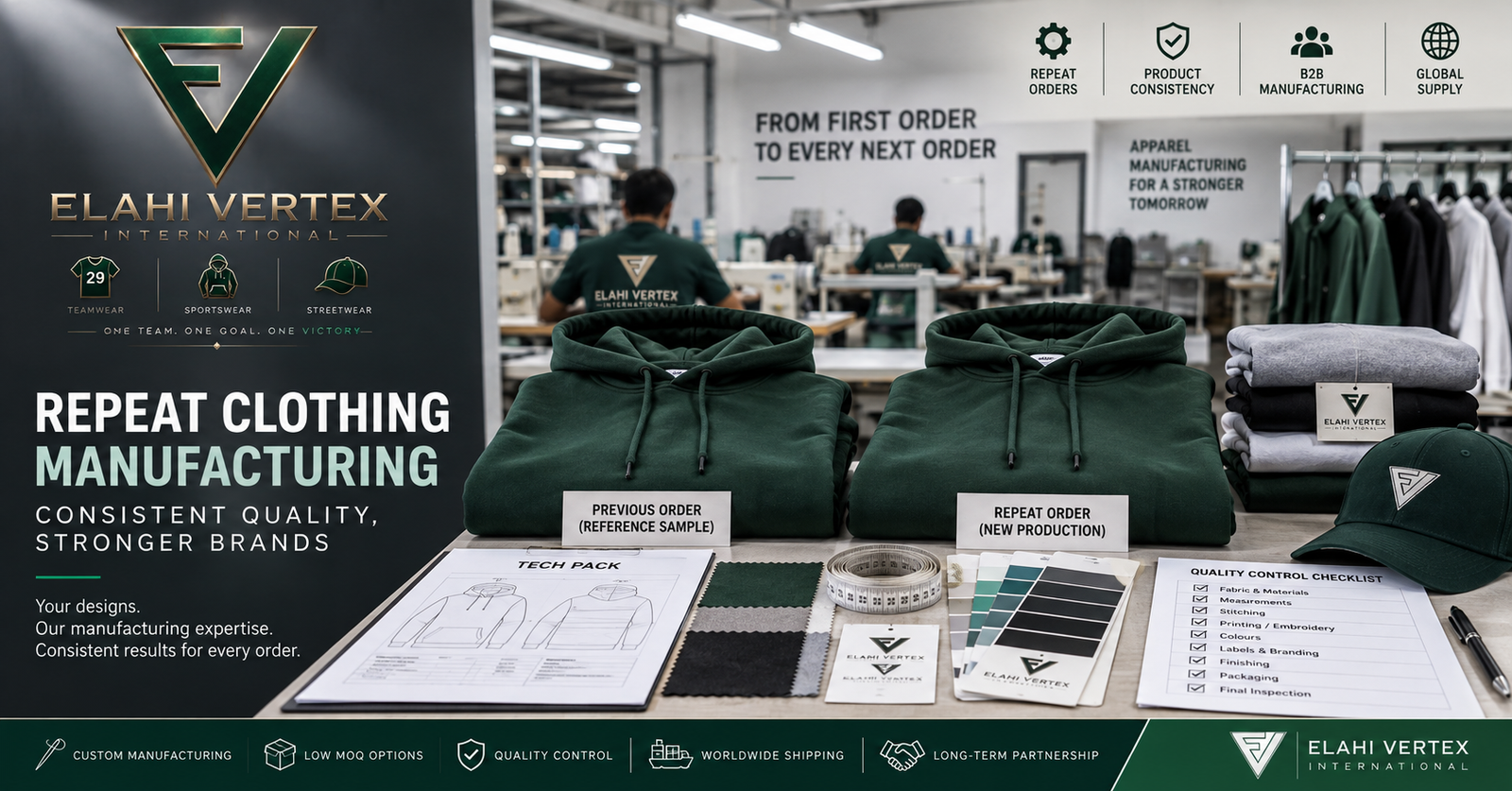
Concept: A realistic premium apparel production workspace showing an approved hoodie reference beside a newly produced matching hoodie, measurement sheet, colour swatches, fabric samples, embroidery reference and QC checklist. The image should communicate repeat-order consistency without implying an actual factory photograph unless a verified company photo is used.
Filename: repeat-clothing-manufacturing-product-consistency.jpg
ALT: repeat clothing manufacturing product consistency and quality control
Title: Repeat Clothing Manufacturing & Product Consistency
Caption: Product references and specifications help control consistency across repeat apparel production.
Description: A professional apparel manufacturing quality-control scene comparing an approved clothing reference with repeat production, showing measurement, fabric, colour and branding checks.
Placement: Immediately after H1.
Aspect Ratio: 1200 × 630 / 1.91:1
Recommended Internal Links
1. Custom Clothing Manufacturing
Anchor: custom clothing manufacturing
Use in sections discussing specifications, sampling, bulk manufacturing and reorder preparation.
2. Quality Control
Anchor: clothing manufacturing quality control
Use wherever repeat order quality control is discussed.
3. Custom Streetwear Manufacturing
Anchor: custom streetwear manufacturing
Custom Streetwear Manufacturing
Use in the streetwear repeat-order section.
4. Low MOQ Clothing Manufacturing
Anchor: low MOQ clothing manufacturing
Low MOQ Clothing Manufacturer for London Brands
Use in the inventory and replenishment section.
5. Streetwear RFQ Guide
Anchor: prepare a clothing manufacturing RFQ
Streetwear Manufacturing RFQ Guide
Use in the reorder-RFQ section.
6. Portfolio
Anchor: custom clothing manufacturing portfolio
Elahi Vertex International Portfolio
Use near the final commercial CTA.
7. Case Studies
Anchor: clothing manufacturing case studies
Elahi Vertex International Case Studies
Use during supplier evaluation.
8. Contact Page
Anchor: discuss your repeat order
Contact Elahi Vertex International
Use in the final CTA.
Schema Recommendations
Use:
- Article Schema
- Organization Schema
- Breadcrumb Schema
- FAQ Schema only where your WordPress/Rank Math implementation and current search-engine guidelines support it appropriately
Do not use Product Schema for this article unless the page itself becomes an eligible product page with the required accurate product data.
Focus Keyword Reinforcement Paragraphs
Repeat clothing manufacturing becomes commercially valuable when brands can reorder established products without restarting product development from zero. The previous approved sample, measurements, materials, artwork and construction requirements provide the reference for the next production run.
Reliable repeat clothing manufacturing begins with specifications rather than memory. A previous order number is useful, but the approved product reference, material specification, measurement chart and current artwork provide stronger production control.
In repeat clothing manufacturing, fabric deserves special attention because a material change can influence weight, appearance, hand feel, drape, stretch and fit. The buyer should therefore reconfirm the material requirement rather than assuming every fabric with the same general name is interchangeable.
Colour is another important part of repeat clothing manufacturing. An approved colour reference makes evaluation more objective and helps the supplier understand which shade the buyer expects to reproduce.
Sizing is central to repeat clothing manufacturing because customers may compare the new stock directly with garments purchased from the previous batch. Approved measurements and agreed tolerances make that comparison easier to manage.
For streetwear brands, repeat clothing manufacturing often depends heavily on protecting the approved silhouette. Chest width, shoulder drop, sleeve volume, body length, hood construction and fabric weight can all influence the identity of an oversized garment.
For sportswear brands, repeat clothing manufacturing may also require controlling team colours, sublimation artwork, player names, numbers, sponsor logos and performance materials.
For activewear businesses, repeat clothing manufacturing should consider the relationship between fabric stretch, recovery, pattern and garment fit. Changing one variable can influence the performance of another.
Private-label repeat clothing manufacturing extends beyond the garment itself. Neck labels, care labels, size labels, hangtags, barcodes and packaging can all be part of the approved retail product.
Professional repeat clothing manufacturing should distinguish between a true reorder and a redesigned product. If the buyer substantially changes the material, fit, construction or artwork, additional product development may be appropriate.
A structured repeat clothing manufacturing brief identifies what remains unchanged and what has been revised. This reduces the risk of accidental changes being introduced during production.
Good repeat clothing manufacturing also requires version control. Approved artwork, tech packs, measurement charts and branding files should carry clear versions so production does not rely on outdated information.
A physical approved sample can strengthen repeat clothing manufacturing because it provides a visual and tactile reference. It should ideally be used alongside documented specifications.
Repeat order quality control is an essential part of repeat clothing manufacturing because a product that has already been produced once still requires evaluation during subsequent batches.
The objective of repeat clothing manufacturing should not be an unrealistic guarantee that every textile article will be mathematically identical. The better goal is controlled consistency against approved requirements.
Effective repeat clothing manufacturing makes replenishment easier because the product already has an established design and specification reference.
Brands can strengthen repeat clothing manufacturing by preserving product records immediately after the first production run instead of trying to reconstruct them months later.
When changes are required, repeat clothing manufacturing should document them clearly so a deliberate revision is not mistaken for an inconsistency.
A repeat-order RFQ helps repeat clothing manufacturing by giving the manufacturer the previous product reference, quantity, destination, size breakdown and list of changes.
Long-term repeat clothing manufacturing becomes increasingly important as a brand adds more styles, colours, sizes and markets.
The strongest repeat clothing manufacturing relationships therefore depend on disciplined communication from both buyer and manufacturer.
Secondary Keyword Reinforcement
Repeat apparel production should begin with the approved product reference and a current list of requirements rather than an informal request to manufacture “the same thing again.”
Controlled repeat apparel production can help established brands preserve successful product characteristics while adjusting quantities and other deliberate variables.
The goal of clothing reorder manufacturing is to reproduce an established apparel product while preventing accidental changes to critical specifications.
Professional clothing reorder manufacturing should identify changes before the production stage rather than discovering them after finished goods have been completed.
Strong garment production consistency depends on material specifications, measurements, construction instructions, artwork references and quality-control criteria.
Garment production consistency becomes especially important when old inventory and new inventory will be sold side by side.
Repeat order quality control compares new production against approved product requirements and references rather than evaluating each garment without context.
Effective repeat order quality control may examine materials, measurements, stitching, decoration, branding, finishing and packaging according to the requirements of the specific project.
Final Strong Commercial CTA
Reordering a Product That Already Works?
Do not rebuild the manufacturing brief from memory.
Send Elahi Vertex International the product reference, latest approved specifications, quantity, destination and every change you want made.
Start by reviewing:
Elahi Vertex International Quality Control
Then:
Contact Elahi Vertex International About Your Repeat Order
Your next repeat order should begin with the product that was already approved—not with guesswork.
Use the previous product as the reference, define the changes, reconfirm the critical specifications and build the next repeat clothing manufacturing run around controlled product information.
