
A vintage hoodie can look exceptional in a sample and still become a serious production problem when the same design moves into bulk manufacturing.
The difficulty is not simply making a hoodie look faded. A professional vintage wash hoodie manufacturer has to manage the relationship between fabric construction, dye behaviour, wash intensity, shrinkage, garment measurements, rib performance, graphics, embroidery, hand feel and batch-to-batch shade variation.
That distinction matters to streetwear brands in the UK, USA, Germany and across Europe.
A buyer may approve a sample because its faded black colour, worn surface and soft hand feel look exactly right. But if the wash process is not sufficiently controlled, the bulk order can arrive with noticeably different shades, shorter body lengths, twisted seams, inconsistent fading or graphics that react differently from the approved sample.
Vintage character should look intentional. Bulk inconsistency should not.
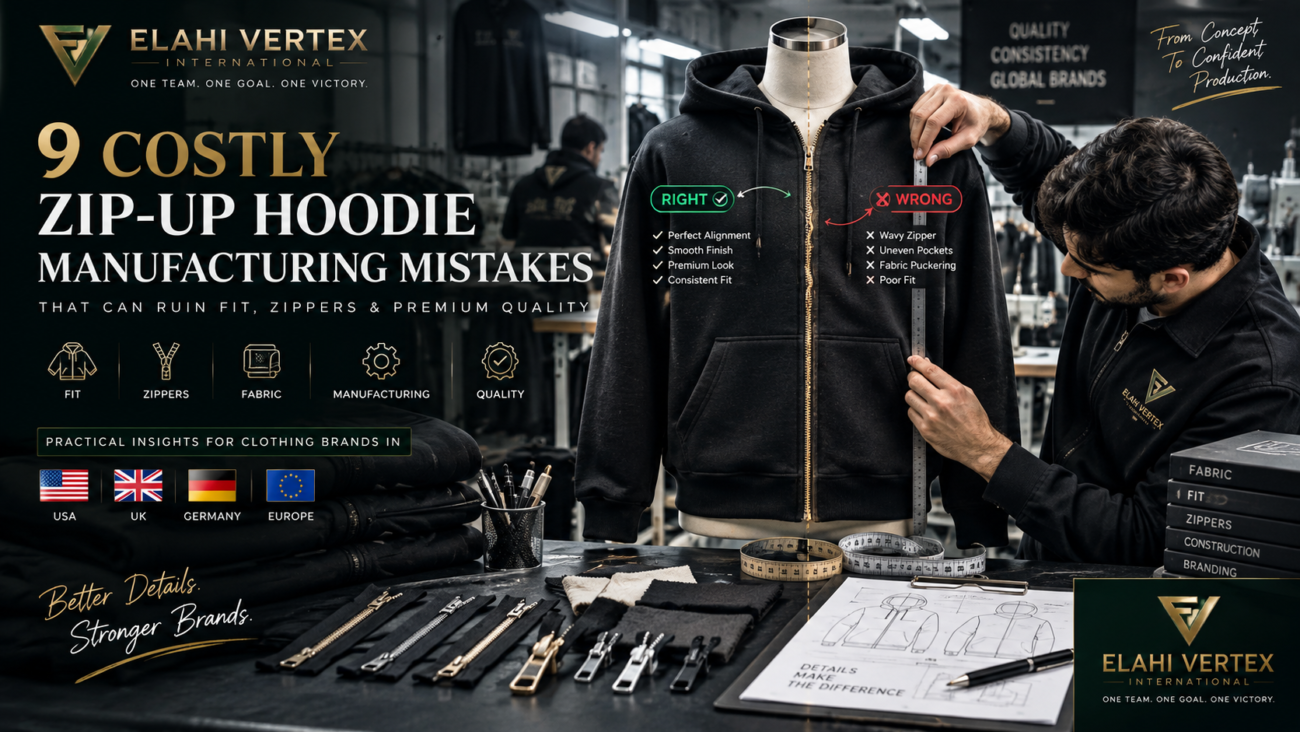
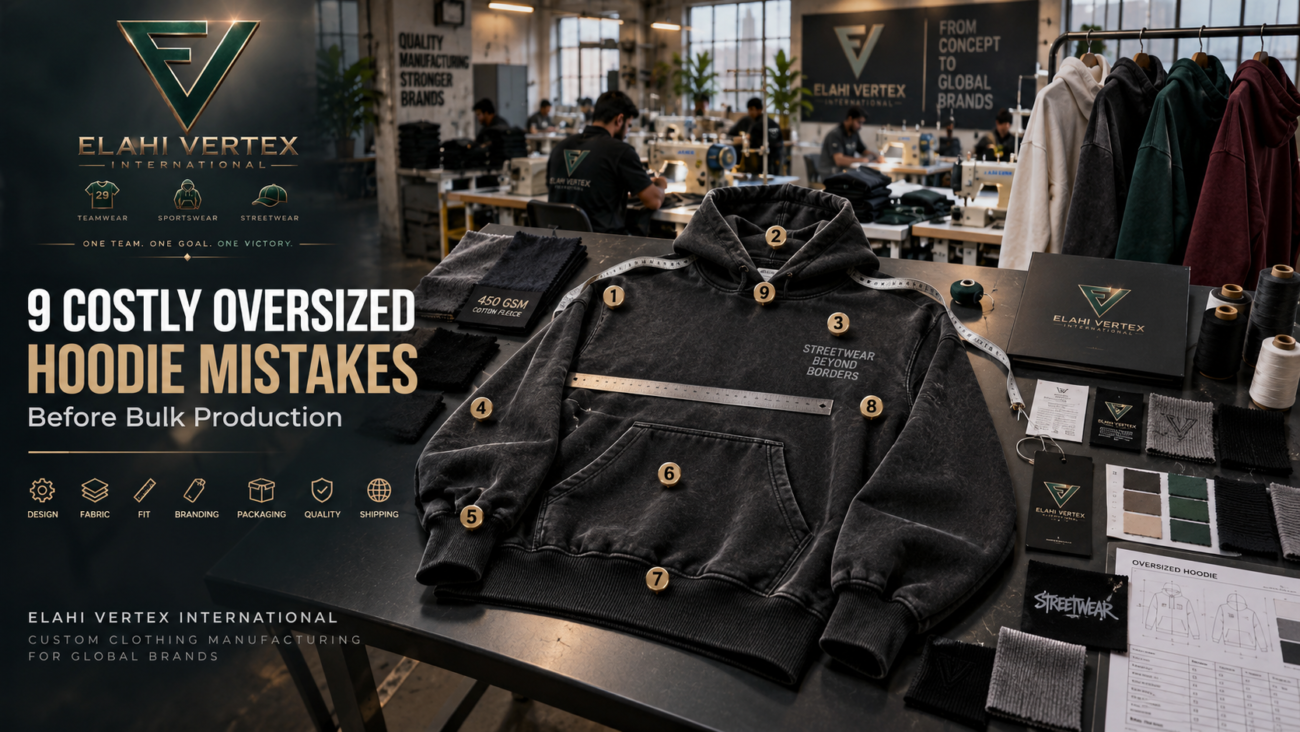
This guide explains nine critical mistakes buyers should understand when selecting a vintage wash hoodie manufacturer, preparing specifications, approving samples and moving a washed hoodie into bulk production.
The objective is straightforward: protect the original design while making the approved colour, feel, fit and vintage character reasonably repeatable throughout production.
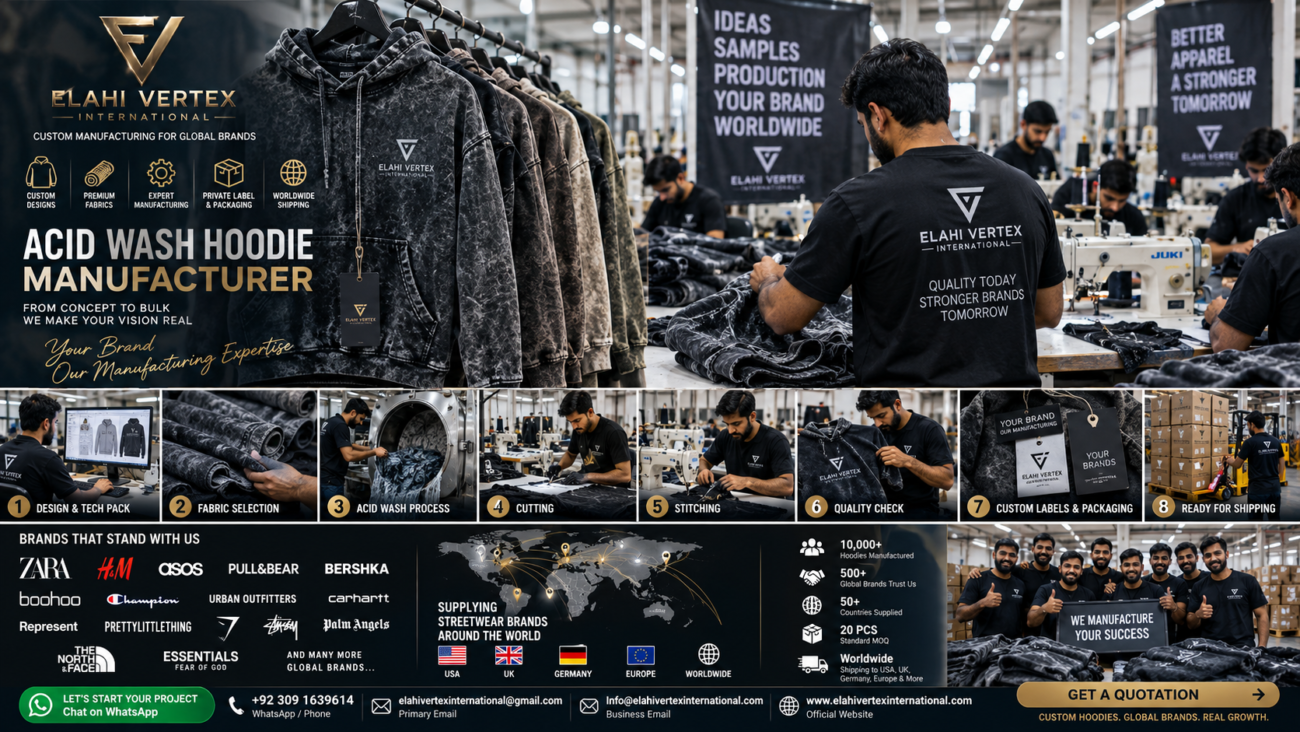
Elahi Vertex International works as a B2B custom clothing manufacturing, OEM and private-label partner for international apparel buyers. Brands developing washed hoodies can discuss fabric, GSM, fit, wash direction, branding, graphics and other project-specific requirements before production.
Table of Contents
- What Is a Vintage Wash Hoodie?
- Why Vintage Wash Hoodies Are Difficult to Manufacture Consistently
- Mistake #1 — Choosing Fabric Before Defining the Wash
- Mistake #2 — Treating “Vintage Wash” as a Complete Specification
- Mistake #3 — Approving Colour Without an Acceptable Shade Range
- Mistake #4 — Ignoring Shrinkage and Finished Garment Measurements
- Mistake #5 — Approving the Look but Ignoring Hand Feel
- Mistake #6 — Testing Graphics and Embroidery Separately from the Wash
- Mistake #7 — Ignoring Rib, Drawcord, Thread and Trim Behaviour
- Mistake #8 — Approving One Sample Without Establishing a Bulk Standard
- Mistake #9 — Choosing a Manufacturer Mainly on Price
- Vintage Wash Hoodie Bulk Production Control Framework
- Vintage Wash Hoodie Manufacturer Buyer Checklist
- UK, USA, Germany and European Buyer Considerations
- How to Prepare a Better Vintage Wash Hoodie RFQ
- Why Work With Elahi Vertex International?
- Frequently Asked Questions
- Final Buyer Checklist
- Conclusion
What Is a Vintage Wash Hoodie?
A vintage wash hoodie is a hoodie intentionally processed to create an aged, faded, softened, worn-in or irregular visual character rather than the clean, uniform appearance associated with a conventional solid-colour hoodie.
Depending on the desired result, the manufacturing direction may involve garment dyeing, enzyme treatments, pigment effects, fading processes, abrasion-related treatments or other controlled finishing methods.
The exact method should be selected according to the intended appearance and the behaviour of the chosen fabric.
That is why searching for a vintage wash hoodie manufacturer should involve more than asking:
“Can you make an acid-wash hoodie?”
A better sourcing discussion defines the actual target.
For example:
- Is the hoodie washed black, faded charcoal or grey?
- Should the surface look cloudy or relatively even?
- Is the target subtle ageing or aggressive contrast?
- Should seams become more visibly faded?
- Should the hoodie feel soft and broken-in?
- Is the fit oversized, boxy, relaxed or conventional?
- What should happen to the rib?
- Are graphics printed before or after washing?
- Is embroidery included?
- What measurements must be achieved after the final wash?
- How much natural piece-to-piece variation will the brand accept?
Those questions transform an aesthetic idea into a manufacturable specification.
Vintage wash is a result, not a complete production instruction
This is one of the most important concepts for a buyer to understand.
“Vintage wash” describes a broad aesthetic direction.
It does not, by itself, define:
- fabric composition;
- fabric weight;
- dye system;
- wash recipe;
- treatment intensity;
- temperature;
- processing time;
- mechanical action;
- acceptable shade;
- dimensional tolerance;
- surface character;
- finished hand feel;
- trim behaviour;
- print behaviour;
- embroidery behaviour.
A capable vintage wash hoodie manufacturer therefore needs a sufficiently detailed reference or development target before bulk production.
Why Is Vintage Wash Hoodie Manufacturing Difficult to Keep Consistent?
The challenge is controlled variation.
A conventional hoodie is generally expected to look visually consistent from garment to garment. A vintage product is intentionally designed to contain variation.
The manufacturing problem is deciding how much variation is desirable and when variation becomes a defect.
For example, two hoodies may not need to be visually identical. Minor differences can contribute to the authentic vintage character.
But a customer buying the same colourway should not reasonably receive one hoodie that looks charcoal, another that appears almost black and another that looks heavily bleached unless that range was intentionally approved.
A serious vintage wash hoodie manufacturer therefore needs to think in terms of controlled ranges rather than a vague instruction to “make everything vintage.”
International colourfastness standards also demonstrate why colour performance deserves proper attention. ISO 105-C06 specifies methods for assessing textile colour resistance to domestic and commercial laundering, while AATCC TM61 addresses accelerated colourfastness-to-laundering evaluation.
These standards do not automatically define your individual brand specification, but they demonstrate an important procurement principle:
Colour behaviour can be evaluated rather than guessed.
The same mindset should apply to the rest of the product.
Mistake #1 — Choosing the Hoodie Fabric Before Defining the Wash
One of the easiest ways to create production problems is to select a fabric purely because its unwashed appearance feels premium.
A fabric that performs beautifully as a conventional hoodie does not automatically become the best substrate for a heavily processed vintage hoodie.
The wash changes the garment.
That means a buyer and vintage wash hoodie manufacturer should evaluate the base fabric together with the intended finishing process.
Fabric variables that matter
A useful development discussion can include:
| Variable | Why It Matters |
|---|---|
| Fibre composition | Influences dye response, fading and overall wash behaviour |
| GSM | Affects body, warmth, structure and finished character |
| Knit construction | Influences stability and surface appearance |
| Yarn characteristics | Can influence texture and visual response |
| Face structure | Important for prints, ageing and surface appearance |
| Interior finish | Influences comfort and hand feel |
| Rib composition | Can react differently from the hoodie body |
| Pre-treatment | May influence dimensional and dye behaviour |
The goal is not simply to request the highest GSM possible.
A 500 GSM hoodie is not automatically superior to a 400 GSM hoodie.
The correct specification depends on:
- target silhouette;
- season;
- market positioning;
- intended retail price;
- fabric composition;
- wash effect;
- required softness;
- decoration;
- shipping economics.
Pre-wash GSM versus finished garment performance
Buyers should also avoid treating a supplier’s quoted fabric GSM as the only relevant quality measurement.
Ask:
What does the garment feel and measure like after the intended finishing process?
The finished hoodie is what your customer buys.
That means the final product—not merely the untreated fabric roll—should drive approval.
Better approach
Before confirming fabric for bulk production:
- Define the vintage effect.
- Define the intended silhouette.
- Select a suitable fabric construction.
- Produce the wash development.
- Evaluate finished hand feel.
- Measure the washed garment.
- Inspect the surface.
- Review decoration.
- Approve the complete washed sample.
A vintage wash hoodie manufacturer should be evaluated on the finished result rather than an attractive raw-fabric swatch alone.
Internal resource: Buyers developing custom washed garments can review the Elahi Vertex International Custom Clothing Manufacturing service for the wider product-development workflow.
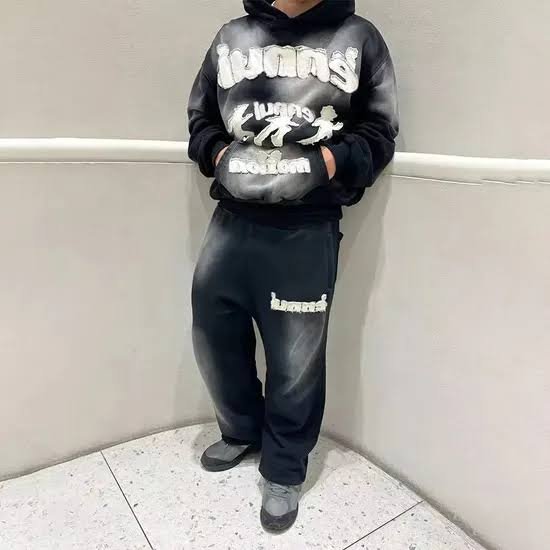
Mistake #2 — Using “Vintage Wash” as the Entire Wash Specification
This mistake causes enormous confusion.
A buyer sends a reference photo and writes:
Vintage wash black.
The manufacturer interprets it one way.
The buyer imagines another.
Both parties believe they understand the brief.
Then the sample arrives.
The buyer says:
“This is too grey.”
The supplier replies:
“But this is vintage washed.”
Both can technically be correct.
The original specification was simply too subjective.
Define the visual target
When briefing a vintage wash hoodie manufacturer, consider specifying:
- starting colour;
- target finished colour;
- overall fade intensity;
- contrast level;
- seam highlighting;
- cloudy versus uniform appearance;
- desired irregularity;
- surface texture;
- softness;
- ageing character;
- vintage reference images;
- physical reference sample where available.
Do not rely exclusively on photographs.
Phone cameras, studio lights, displays and editing can alter how washed colours appear.
Use references intelligently
A useful approval hierarchy is:
Physical approved sample → controlled reference → detailed photographs → written description
The closer your bulk production standard is to a physical approved sample, the less room there is for subjective interpretation.
Weak specification
“Make a faded vintage black hoodie.”
Better specification
“Develop a washed black hoodie with a muted charcoal vintage appearance, moderate seam highlighting, no extreme bleach patches, soft hand feel and an overall finish comparable with the approved physical sample.”
That still requires manufacturing development, but it communicates far more.
The job of a professional vintage wash hoodie manufacturer is not to read a brand founder’s mind.
The buyer and manufacturer need a shared approval language.
Mistake #3 — Expecting Every Vintage-Washed Hoodie to Be Visually Identical
This is the opposite of Mistake #2.
Some buyers understand that vintage washing creates variation but then demand that every finished garment look exactly like one photograph.
That expectation can conflict with the aesthetic itself.
The objective should generally be controlled consistency, not artificial visual cloning.
Establish an acceptable shade range
Instead of approving only one visual point, brands should consider defining acceptable boundaries for production.
For example:
- approved target;
- acceptable lighter limit;
- acceptable darker limit;
- unacceptable extreme.
This creates a much more useful bulk inspection framework.
A vintage wash hoodie manufacturer can then evaluate production against an approved range rather than an undefined idea of “close enough.”
Why this matters commercially
Imagine a 300-piece launch.
The first customer photographs a soft charcoal hoodie.
The second receives a substantially darker one.
The third receives a strongly mottled piece.
All three products carry the same SKU.
Now the brand has:
- inconsistent product photography;
- potential customer complaints;
- difficult exchanges;
- confusing social-media content;
- inconsistent restock expectations.
Vintage character can be desirable.
Uncontrolled product identity is not.
Colourfastness should also be considered
The wash appearance at dispatch is only one part of colour performance.
Brands should consider the behaviour of the finished garment during subsequent laundering.
ISO 105-C06 specifically addresses resistance of textile colour to domestic and commercial laundering procedures. AATCC TM61 similarly provides an accelerated laundering method used to evaluate colour change under defined conditions.
For serious production programs, objective testing requirements can be discussed according to the buyer’s quality needs and market.
A vintage wash hoodie manufacturer should never be asked merely to “make the colour permanent.” Textile colour performance should instead be discussed in measurable, realistic terms.
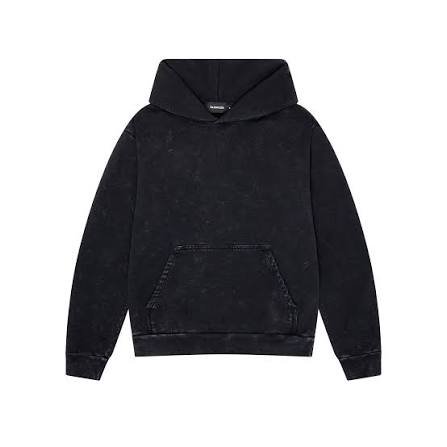
Mistake #4 — Ignoring Shrinkage Until After the Sample Is Washed
A hoodie can have perfect measurements before finishing and fail the specification after processing.
That is why finished measurements matter.
If your target body length is based on the unwashed garment but your customer receives the post-wash garment, you are controlling the wrong measurement stage.
The correct question
Do not ask only:
“What is the hoodie measurement?”
Ask:
“What is the approved finished measurement after the complete production wash and finishing process?”
This distinction becomes especially important for:
- oversized hoodies;
- cropped hoodies;
- boxy streetwear fits;
- drop-shoulder silhouettes;
- fitted products;
- coordinated hoodie/jogger sets.
Create a post-wash measurement specification
A useful specification can include:
| Measurement | Approved Finished Measurement | Tolerance |
|---|---|---|
| Body length | Brand specification | Brand-approved tolerance |
| Chest width | Brand specification | Brand-approved tolerance |
| Shoulder | Brand specification | Brand-approved tolerance |
| Sleeve length | Brand specification | Brand-approved tolerance |
| Hood dimensions | Brand specification | Brand-approved tolerance |
| Bottom opening | Brand specification | Brand-approved tolerance |
| Cuff opening | Brand specification | Brand-approved tolerance |
Do not copy generic tolerances from the internet and assume they are suitable for every project.
Your brand should establish what matters for its design.
A good vintage wash hoodie manufacturer needs the final measurement requirements early enough to consider how finishing may affect the pattern and construction.
Oversized fit is particularly sensitive
Streetwear buyers frequently use the word “oversized” as though it were a complete specification.
It is not.
Two oversized hoodies can have completely different:
- shoulder drops;
- chest widths;
- body lengths;
- sleeve volumes;
- armhole shapes;
- hood volumes;
- hem widths.
Combine those variables with a wash process and the risk increases further.
The solution is a measurement chart plus an approved washed sample.
Not the word “oversized.”
Mistake #5 — Approving the Colour but Ignoring the Hand Feel
Vintage streetwear is tactile.
The customer sees the faded colour first, but then touches the garment.
If the hoodie looks premium but feels excessively harsh, dry, thin or damaged, the wash has not delivered the complete product experience.
That is why a vintage wash hoodie manufacturer should be evaluated on both visual and tactile outcomes.
What should the buyer assess?
After the final wash, inspect:
- outer surface;
- inner surface;
- softness;
- body;
- drape;
- thickness;
- perceived density;
- rib recovery;
- roughness;
- excessive abrasion;
- surface damage;
- comfort against skin.
The exact target depends on the brand.
A rugged vintage hoodie may intentionally feel different from a luxury brushed-fleece hoodie.
Neither is universally correct.
The mistake is failing to define which one you want.
Soft does not automatically mean better
Brands should be careful with the word “soft.”
Extreme softness can change the perceived structure of a hoodie.
If your collection depends on a substantial, architectural oversized silhouette, excessive softening may work against that design language.
The correct objective might instead be:
soft enough for comfort while retaining the required structure.
That is a much better development conversation with a vintage wash hoodie manufacturer.
Mistake #6 — Testing Printing or Embroidery Separately From the Final Wash
Your decoration is part of the garment.
It should not be treated as an unrelated component.
Vintage hoodie programs frequently incorporate:
- screen printing;
- puff printing;
- distressed graphics;
- embroidery;
- appliqué;
- patches;
- transfers;
- labels;
- mixed-media branding.
The sequence of production operations matters.
Ask when decoration will be applied
Depending on the project, the appearance of a graphic can differ dramatically according to whether it is applied before or after the garment finishing process.
That is why the brand should not approve:
- an unwashed hoodie;
- an isolated print swatch;
- an embroidery sample;
and assume the finished combination will automatically look correct.
Approve the actual production relationship.
What should be inspected?
For printing:
- colour;
- adhesion;
- cracking;
- distortion;
- surface compatibility;
- registration;
- intended distressed effect.
For embroidery:
- puckering;
- thread appearance;
- backing behaviour;
- distortion;
- density;
- edge quality;
- interaction with garment shrinkage.
For patches and appliqué:
- edge behaviour;
- dimensional stability;
- attachment;
- colour interaction;
- surface changes.
A competent vintage wash hoodie manufacturer should receive the artwork and wash direction early enough to determine an appropriate development sequence.
Buyer rule
Do not approve components independently when they will be processed together in production.
Approve the complete finished garment.
Mistake #7 — Forgetting That Rib, Drawcords, Thread and Labels Can React Differently
The hoodie body is not the entire hoodie.
A washed garment can include several materials:
- main fleece;
- rib;
- sewing thread;
- drawcord;
- eyelets;
- zipper;
- woven labels;
- printed labels;
- embroidery thread;
- patches.
These components may not react identically.
That can either create a deliberate design effect or an ugly manufacturing mismatch.
Rib deserves particular attention
Imagine a beautifully washed charcoal body with cuffs that remain noticeably darker.
Maybe that is intentional.
Maybe it destroys the product.
The difference is whether it was specified and approved.
When evaluating a vintage wash hoodie manufacturer, inspect the relationship between:
body + rib + trims + decoration
rather than approving only the body fabric.
Labels matter too
Private-label buyers should consider when labels are attached and how they should appear after processing.
A vintage collection might intentionally use:
- clean labels;
- washed labels;
- tonal labels;
- contrast labels;
- printed neck branding.
There is no universal answer.
The brand needs to define the intended result.
Internal resource: Elahi Vertex International’s Private Label Manufacturing service provides a relevant route for brands that need custom product development together with branding requirements.
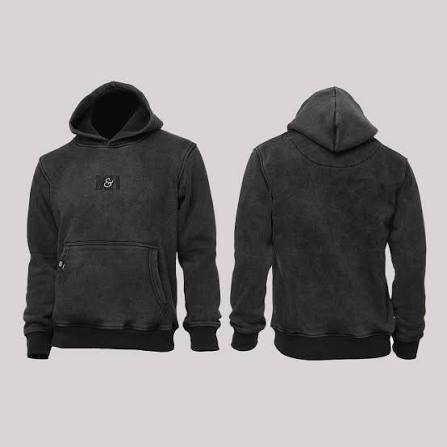
Mistake #8 — Approving One Beautiful Sample Without Creating a Bulk Production Standard
A perfect sample is valuable.
But the commercial objective is not to manufacture one excellent hoodie.
It is to manufacture the approved product repeatedly.
This is where supplier evaluation becomes serious.
The sample should become a production reference
After approving the final sample, document what has actually been approved:
- fabric;
- composition;
- GSM direction;
- colour;
- wash appearance;
- hand feel;
- measurements;
- construction;
- stitching;
- rib;
- hood;
- drawcord;
- print;
- embroidery;
- labels;
- packaging.
Then protect those decisions when production begins.
A vintage wash hoodie manufacturer should not have to reinterpret the entire design after sample approval.
Use approval checkpoints
A practical workflow may look like:
Stage 1 — Technical brief
Confirm product concept, measurements, materials, graphics and wash direction.
Stage 2 — Material development
Evaluate the proposed fabric and relevant trims.
Stage 3 — Wash development
Develop the target colour and surface character.
Stage 4 — Complete sample
Produce the actual hoodie with required branding and finishing.
Stage 5 — Post-wash measurement review
Confirm finished dimensions.
Stage 6 — Bulk reference approval
Document the approved sample and acceptable visual range.
Stage 7 — Production monitoring
Compare production against approved references.
Stage 8 — Final inspection
Inspect finished garments against the agreed requirements.
The exact workflow can vary by project, but the principle remains useful:
Sampling should reduce uncertainty before bulk production.
Mistake #9 — Choosing a Vintage Wash Hoodie Manufacturer Mainly Because the Quote Is Cheapest
Price matters.
But the cheapest unit price can become expensive if it creates:
- unusable stock;
- excessive variation;
- customer returns;
- delayed launch dates;
- rework;
- replacement production;
- lost retail margin;
- damaged brand reputation.
A manufacturer should therefore be compared on more than the quotation.
Compare these factors
| Supplier Factor | Why It Matters |
|---|---|
| Fabric understanding | Wash quality begins with the base material |
| Wash development | Determines visual character |
| Sample accuracy | Reduces bulk surprises |
| Measurement control | Protects fit |
| Decoration integration | Protects graphics and embroidery |
| Shade control | Protects collection consistency |
| Communication | Reduces interpretation errors |
| Private-label capability | Important for branded collections |
| Bulk QC process | Helps protect approved specifications |
| Commercial terms | Must fit the project economics |
A low quotation is useful only if the supplier can manufacture the required product.
The better sourcing question is:
Which vintage wash hoodie manufacturer offers the strongest balance of product execution, communication, commercial feasibility and repeatability for this particular collection?
That is much more useful than:
Who gave me the cheapest hoodie?
Vintage Wash Hoodie Bulk Production Control Framework
Brands in the UK, USA, Germany and wider Europe can reduce sourcing risk by structuring approval around five control areas.
1. Fabric Control
Confirm:
- composition;
- construction;
- target GSM;
- surface;
- inner finish;
- rib;
- relevant trims.
2. Wash Control
Confirm:
- wash direction;
- target colour;
- fade intensity;
- contrast;
- surface effect;
- acceptable variation;
- physical reference where practical.
3. Fit Control
Confirm:
- measurement chart;
- finished measurements;
- silhouette;
- tolerance expectations;
- post-wash fit.
4. Decoration Control
Confirm:
- artwork;
- size;
- placement;
- technique;
- colour;
- production sequence;
- appearance after washing.
5. Bulk Quality Control
Confirm:
- approved sample;
- approved shade direction;
- measurement requirements;
- packaging;
- inspection expectations;
- final approval procedure.
This framework gives a brand and vintage wash hoodie manufacturer a shared production language.
Vintage Wash Hoodie Manufacturer Buyer Checklist
Before approving bulk production, ask:
Product
- What is the exact hoodie silhouette?
- What is the target finished weight and feel?
- What fabric composition is required?
- What colour is required?
- What vintage effect is required?
Wash
- Is there a physical reference?
- What fade intensity is acceptable?
- How much shade variation is acceptable?
- What surface irregularity is intentional?
- What would count as a defect?
Measurements
- Are measurements pre-wash or finished?
- Has the complete washed sample been measured?
- Are size tolerances defined?
- Does the hood maintain the required shape?
- Do cuffs and waistband recover correctly?
Decoration
- Has the print been tested on the actual washed garment?
- Has embroidery been evaluated after finishing?
- Are patch materials compatible?
- Are label positions approved?
- Is artwork placement measured?
Bulk Production
- Is there an approved reference sample?
- Are the specifications documented?
- Is the shade direction documented?
- Are packing requirements confirmed?
- Are final inspection expectations confirmed?
A professional vintage wash hoodie manufacturer should welcome detailed specifications because clarity reduces disputes for both parties.
Vintage Wash Hoodie Manufacturing for UK Streetwear Brands
The UK remains an important market for independent streetwear, fashion labels, e-commerce brands and private-label collections.
For a UK buyer, supplier selection should focus on product-market fit rather than simply sourcing the lowest manufacturing cost.
A vintage hoodie intended for a premium London streetwear launch may require a very different construction from a lower-priced promotional hoodie.
Discuss:
- target retail positioning;
- silhouette;
- season;
- fabric;
- wash;
- graphics;
- labels;
- packaging;
- quantities;
- destination.
A vintage wash hoodie manufacturer can make better development decisions when the commercial context is clear.
Vintage Wash Hoodie Manufacturing for US Clothing Brands
US streetwear buyers frequently work across multiple aesthetics, from heavyweight oversized garments to collegiate-inspired graphics and distressed vintage collections.
Again, “US market” does not define one hoodie.
The product specification does.
US buyers sourcing internationally should provide a detailed RFQ rather than asking manufacturers for a generic hoodie price.
A strong RFQ allows a vintage wash hoodie manufacturer to understand what is actually being quoted.
Without specifications, two supplier quotations may represent completely different products.
Vintage Wash Hoodie Manufacturing for German and European Brands
German and wider European buyers should apply the same technical discipline while also considering the regulatory and product-compliance requirements applicable to their specific destination and product.
Requirements can depend on the fibre composition, trims, labelling, chemical substances, market and selling model.
Buyers should verify current obligations for their actual products rather than relying on assumptions.
For European projects, the manufacturing discussion should therefore include both:
product execution + destination requirements
A vintage wash hoodie manufacturer can manufacture according to a buyer’s specification, but the importer or brand should ensure that applicable market requirements are properly identified for the specific product.
How to Prepare a Better RFQ for a Vintage Wash Hoodie Manufacturer
If you want comparable quotations, send comparable information.
A useful RFQ can include:
Product
Vintage washed pullover hoodie.
Target Fit
Oversized / relaxed / boxy / standard.
Fabric
Provide intended composition and GSM direction if already decided.
Colour
Provide colour reference and target washed appearance.
Wash
Describe:
- light;
- medium;
- heavy;
- faded;
- cloudy;
- distressed;
- garment-dyed;
- other required effect.
Size Range
List all intended sizes.
Measurements
Attach the finished measurement chart.
Graphics
Attach:
- artwork;
- dimensions;
- placement;
- colours;
- decoration technique where known.
Branding
Specify:
- neck label;
- size label;
- care label;
- hangtag;
- packaging.
Quantity
State the actual target quantity.
Elahi Vertex International’s standard qualifying MOQ is 20 pieces per product/category. Project feasibility should still be confirmed for the particular design, materials and customization requirements.
Destination
Provide city/postcode and country when requesting shipping.
Target Timeline
State the desired launch or required delivery window.
Do not simply write “urgent.”
Give the manufacturer an actual date.
The more complete the RFQ, the easier it becomes to compare one vintage wash hoodie manufacturer against another on a meaningful basis.
Why Work With Elahi Vertex International for Custom Vintage Wash Hoodies?
Elahi Vertex International is a Sialkot, Pakistan-based B2B manufacturer, exporter, OEM supplier, ODM supplier and private-label manufacturing partner serving international apparel buyers.
Relevant published manufacturing categories include:
- Custom Streetwear
- Custom Hoodies & Sweatshirts
- Private Label Clothing
- Custom Sportswear
- Custom Activewear
- Custom Teamwear
- Custom Boxing Wear
- Custom Leather Wear
For a vintage hoodie project, buyers can discuss project-specific requirements including:
- fabric;
- GSM;
- colour;
- wash effect;
- fit;
- measurements;
- hood construction;
- rib;
- graphics;
- embroidery;
- labels;
- branding;
- packaging.
Elahi Vertex International’s online custom manufacturing inquiry system also allows buyers to specify fabric, GSM, vintage effect/wash, fit, printing and private-label requirements.
The objective should not be to force every buyer into the same hoodie.
The objective is to translate the brand’s intended product into sufficiently clear manufacturing specifications.
Brands can also review Elahi Vertex International’s published Vintage Heavyweight Acid Wash Hoodie for a related washed-streetwear manufacturing example.
For buyers requiring a wider OEM development relationship, the OEM Clothing Manufacturing and Private Label Manufacturing services provide additional routes for project discussions.
20 Frequently Asked Questions About Choosing a Vintage Wash Hoodie Manufacturer
1. What does a vintage wash hoodie manufacturer do?
A vintage wash hoodie manufacturer develops and manufactures hoodies with intentionally aged, faded, softened or distressed visual characteristics according to the buyer’s specifications. The exact production method depends on the required fabric, colour and finishing result.
2. What is the best fabric for a vintage wash hoodie?
There is no single fabric specification suitable for every vintage hoodie. Fibre composition, GSM, knit construction, silhouette, finishing method and target hand feel should be evaluated together.
3. Can vintage wash hoodies be heavyweight?
Yes. Heavyweight washed hoodies are widely used in streetwear, but the appropriate GSM should be chosen according to the design rather than assuming heavier always means better.
4. Can a vintage wash hoodie manufacturer produce oversized fits?
Yes, where the manufacturer supports custom patterns and sizing. Buyers should provide actual finished measurements rather than relying only on the word “oversized.”
5. Why can vintage-washed hoodies have slight colour differences?
Wash and dye processes can create natural variation. Brands should distinguish acceptable vintage variation from unacceptable bulk inconsistency by establishing an approved reference and tolerance direction.
6. Should I approve a vintage hoodie before bulk production?
Sampling is strongly recommended because it lets the buyer evaluate fabric, fit, colour, wash character, graphics, hand feel and construction before committing to bulk.
7. Should measurements be checked before or after vintage washing?
The final post-wash measurements are particularly important because those are the dimensions the customer ultimately receives.
8. Can printing be added to vintage wash hoodies?
Yes, depending on the fabric, wash process, graphic technique and production sequence. The finished combination should be sampled before bulk production.
9. Can embroidery be used on vintage washed hoodies?
Yes. The embroidery should be evaluated with the actual garment construction and finishing process because dimensional changes can affect its appearance.
10. Can a vintage wash hoodie manufacturer add private labels?
A manufacturer offering private-label services can incorporate approved branding such as labels and packaging according to project requirements.
11. What should I send a vintage wash hoodie manufacturer for a quote?
Send product drawings or references, measurements, fabric direction, GSM, colour, wash target, graphics, branding, quantity, size breakdown and delivery destination.
12. What is a wash approval sample?
It is a development or production reference used to approve important aspects of the finished wash appearance before bulk manufacturing.
13. Should every vintage hoodie look exactly identical?
Not necessarily. Controlled visual variation can be part of the intended aesthetic. However, the acceptable range should be defined so that excessive inconsistency is not mistaken for intentional vintage character.
14. What can cause vintage hoodie shrinkage?
Textile construction and wet processing can affect dimensional stability. The actual result depends on the fabric and finishing process, which is why post-wash measurements should be evaluated.
15. How can brands reduce bulk colour inconsistency?
Approve a clear colour direction, retain a reference sample, define acceptable variation, maintain controlled production specifications and inspect production against the approved standard.
16. Is acid wash the same as every vintage wash?
No. “Vintage wash” is a broader aesthetic category. Different treatments can create different faded, aged or distressed effects.
17. Can Elahi Vertex International manufacture custom vintage hoodies?
Elahi Vertex International publishes custom hoodie, acid-wash hoodie, OEM and private-label manufacturing capabilities. Exact feasibility should be confirmed against the buyer’s individual specifications.
18. What is the MOQ for Elahi Vertex International?
The standard qualifying MOQ is 20 pieces per product/category. Specific project feasibility should be confirmed according to the product and customization.
19. Can UK, USA, German and European brands source from Elahi Vertex International?
Elahi Vertex International operates as an international B2B custom manufacturer/exporter. Buyers should provide the destination and project specifications so manufacturing and shipping requirements can be discussed for the particular order.
20. How do I start a vintage hoodie project?
Prepare the design, target measurements, wash reference, fabric direction, artwork, quantity and destination, then send the project requirements for manufacturing review.
Final Vintage Wash Hoodie Manufacturer Checklist
Before paying for bulk production, confirm:
- Fabric composition
- GSM direction
- Final silhouette
- Measurement chart
- Finished post-wash measurements
- Target colour
- Wash reference
- Acceptable shade variation
- Surface character
- Hand feel
- Rib behaviour
- Hood shape
- Drawcord specification
- Embroidery
- Labels
- Packaging
- Size breakdown
- Quantity
- Shipping destination
- Approved final sample
- Bulk QC expectations
If several of these remain undefined, the project is not ready for reliable supplier comparison.
Conclusion: Control the Wash Before the Wash Controls Your Collection
The biggest mistake a brand can make is believing that vintage washing is simply a visual finishing effect added at the end of hoodie production.
It affects much more.
Fabric, colour, measurements, surface character, hand feel, rib, trims, printing, embroidery and bulk repeatability can all become part of the same manufacturing problem.
That is why choosing a vintage wash hoodie manufacturer should be treated as a technical sourcing decision rather than a simple price comparison.
The strongest production process starts with clear specifications, develops the actual wash on the intended garment, measures the finished sample, establishes acceptable visual boundaries and then uses that approval as the reference for bulk production.
For UK, USA, German and European streetwear brands, this approach can significantly reduce avoidable uncertainty when moving from concept to sample and from sample to bulk.
Discuss Your Custom Vintage Wash Hoodie Project With Elahi Vertex International
If you are developing a vintage-washed hoodie, oversized washed hoodie, private-label streetwear collection or related custom garment, send Elahi Vertex International your:
- design or reference;
- fabric/GSM target;
- wash reference;
- size chart;
- artwork;
- branding requirements;
- quantity;
- destination.
You can then discuss whether the proposed construction and finishing direction are suitable before committing to bulk production.
Website: Elahi Vertex International
WhatsApp: Direct Elahi Vertex International WhatsApp
Email: elahivertexinternational@gmail.com
Phone / WhatsApp: +92 309 1639614
Alibaba: Elahi Vertex International Alibaba Store
Where Brands Are Made.
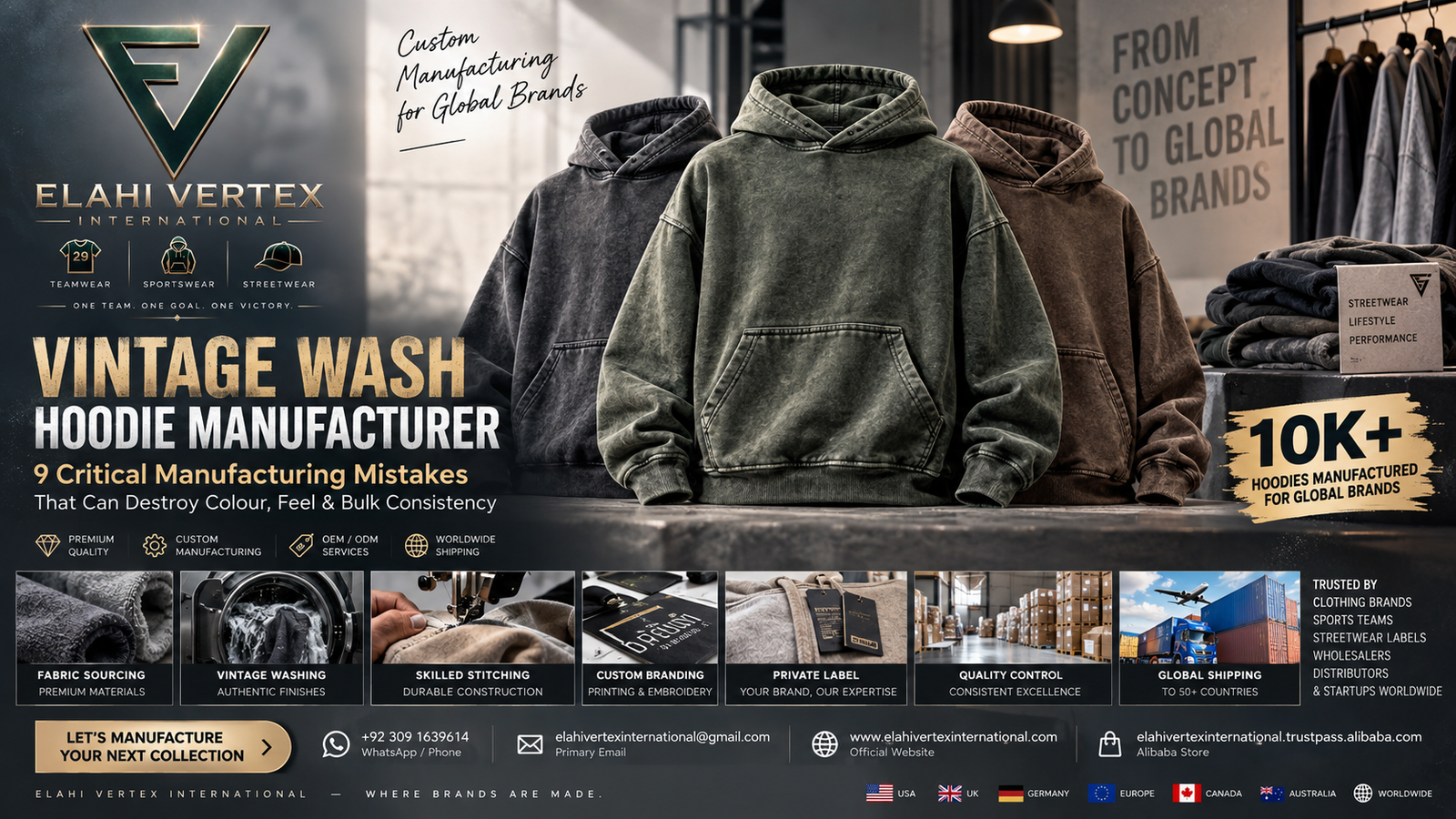
Vintage Wash Hoodie Manufacturer: 9 Critical Vintage Wash Hoodie Manufacturing Mistakes That Can Destroy Colour, Feel & Bulk Consistency
Brands searching for a reliable vintage wash hoodie manufacturer are usually trying to solve a harder problem than simply finding someone capable of making a faded hoodie. The real challenge is reproducing the intended colour, vintage character, hand feel, fit and branding when an approved sample becomes a bulk production run.
For UK, USA, German and European streetwear brands, custom vintage wash hoodies can become commercially difficult when the wash process is treated as decoration rather than part of the technical product specification. Fabric construction, GSM, dye behaviour, shrinkage, rib, printing, embroidery and garment measurements can all influence the finished result.
A professional vintage washed hoodie manufacturer therefore needs more than a reference photograph. The buyer and supplier need an agreed manufacturing target.
Brands sourcing private label vintage wash hoodies should define the product from the finished garment backwards: desired colour, acceptable wash variation, post-wash measurements, hand feel, graphics, labels and packaging.
Similarly, choosing a custom washed hoodie manufacturer only because of the lowest unit price can expose a brand to shade inconsistency, dimensional problems and bulk garments that no longer resemble the approved sample.
Elahi Vertex International provides custom clothing manufacturing for brands, startups, wholesalers, retailers, teams, clubs and businesses, including hoodies, streetwear and private-label clothing.
This guide explains the nine manufacturing mistakes buyers should prevent before moving a vintage hoodie from development into bulk production.
Why Custom Vintage Wash Hoodies Require More Production Control
Custom vintage wash hoodies are deliberately designed to look less uniform than conventional solid-colour hoodies.
That does not mean bulk manufacturing should be uncontrolled.
There is an important distinction between intentional vintage variation and manufacturing inconsistency.
A well-developed collection might intentionally contain subtle garment-to-garment variation. However, a brand normally does not want one unit looking almost black, another medium charcoal and another dramatically faded unless that range has been specifically approved.
This is why selecting a vintage wash hoodie manufacturer involves evaluating repeatability as well as creativity.
The wash should create character without destroying product identity.
International textile testing standards demonstrate why colour performance can be approached technically. ISO 105-C06:2010 specifies methods for determining the resistance of textile colour to domestic and commercial laundering. The standard was reviewed and confirmed in 2026 and remains current.
That does not mean every custom vintage wash hoodie automatically requires the same laboratory test. It means brands can define appropriate performance requirements instead of relying entirely on subjective visual descriptions.
Mistake #1 — Choosing Fabric Before Developing the Vintage Wash
The base fabric and wash should not be developed as completely separate decisions.
Brands ordering custom vintage wash hoodies sometimes choose a fabric because the untreated material feels thick, soft or expensive. But the final customer does not receive the untreated fabric.
The customer receives the finished garment.
A vintage washed hoodie manufacturer should therefore consider how the selected fabric behaves through the intended finishing process.
Important variables include:
- fibre composition;
- fabric construction;
- GSM;
- yarn characteristics;
- outer face;
- inner finish;
- rib composition;
- dimensional behaviour;
- intended vintage effect.
A heavyweight fabric is not automatically the correct choice.
A brand producing private label vintage wash hoodies should determine whether the finished garment retains the intended body, drape, softness and silhouette after washing.
This is especially important for oversized streetwear.
A custom washed hoodie manufacturer may need to balance softness against structure. If a boxy 450 GSM hoodie becomes excessively soft and loses the intended silhouette after finishing, the fact that the original fabric was 450 GSM does not rescue the design.
Better sourcing procedure
Before approving bulk custom vintage wash hoodies:
- Define the desired vintage effect.
- Define the target silhouette.
- Select the proposed fabric.
- Develop the wash.
- Produce the complete garment.
- Check finished measurements.
- Check finished hand feel.
- Review colour and surface variation.
- Approve the complete washed sample.
Buyers needing broader product development can review Elahi Vertex International’s custom clothing manufacturing service.
Mistake #2 — Telling the Manufacturer Only “Make It Vintage Wash”
“Vintage wash” is an aesthetic direction, not a complete manufacturing specification.
Two factories can receive exactly the same sentence and produce visibly different hoodies.
Even two technicians working from an insufficiently defined brief may interpret “washed black” differently.
When requesting custom vintage wash hoodies, define:
- original colour;
- target finished colour;
- fade intensity;
- wash contrast;
- seam highlighting;
- cloudy or relatively uniform appearance;
- desired surface character;
- hand feel;
- acceptable irregularity;
- physical reference where available.
A vintage wash hoodie manufacturer should know what the brand means by “vintage.”
Weak specification
Vintage black oversized hoodie.
Stronger specification
Oversized washed-black hoodie with a muted charcoal appearance, moderate seam highlighting, controlled irregularity, soft hand feel and no extreme bleach-style patches. Finished appearance to follow the approved washed sample.
The second brief gives a vintage washed hoodie manufacturer considerably more useful production information.
For brands developing private label vintage wash hoodies, the specification should also include branding because labels, embroidery, prints and trims can interact with garment processing.
A custom washed hoodie manufacturer should not be expected to guess the intended visual outcome from a Pinterest image alone.
Mistake #3 — Failing to Define Acceptable Colour Variation
This is one of the biggest risks in custom vintage wash hoodies.
Vintage character naturally allows some visual variation.
But how much?
That question should be answered before bulk production.
The approved sample should establish the central target, while the buyer and vintage wash hoodie manufacturer should understand what lighter or darker variation remains commercially acceptable.
Create a practical shade framework
Consider:
TARGET: Approved vintage colour.
LIGHTER LIMIT: Lightest acceptable commercial result.
DARKER LIMIT: Darkest acceptable commercial result.
REJECT: Garments clearly outside the agreed visual direction.
This is much stronger than telling the vintage washed hoodie manufacturer:
“Just keep everything similar.”
For private label vintage wash hoodies, shade inconsistency can affect more than manufacturing QC. It can also affect:
- product photography;
- e-commerce presentation;
- customer expectations;
- influencer seeding;
- restocks;
- exchanges;
- coordinated sets.
If a brand sells a hoodie and jogger as a matching set, uncontrolled colour variation becomes even more obvious.
The ISO colour-fastness standard for domestic and commercial laundering provides useful technical context for how textile colour resistance can be assessed. ISO states that ISO 105-C06 covers methods for determining textile colour resistance to laundering using specified procedures.
The point is not that a custom washed hoodie manufacturer must blindly apply one standard to every order.
The point is that colour should be treated as a measurable product characteristic where appropriate.
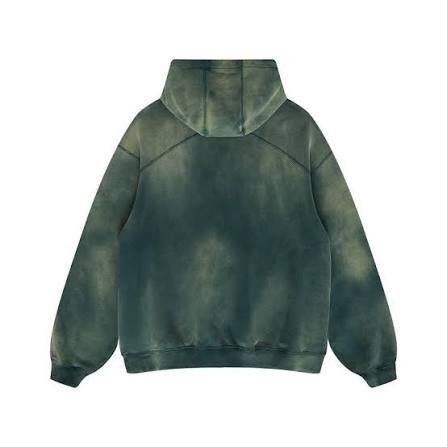
Mistake #4 — Measuring the Hoodie Before Washing Instead of After Finishing
A beautiful vintage hoodie with the wrong fit is still the wrong product.
Wet processing and finishing can affect garment dimensions, which makes finished measurements particularly important for custom vintage wash hoodies.
A buyer should therefore distinguish:
pre-wash garment measurements
from
finished post-wash garment measurements.
For an oversized hoodie, even modest dimensional changes can alter the intended silhouette.
A vintage wash hoodie manufacturer should receive a proper measurement chart covering relevant points such as:
| Measurement | Approval Basis |
|---|---|
| Chest | Finished garment |
| Body length | Finished garment |
| Shoulder | Finished garment |
| Sleeve length | Finished garment |
| Hood | Finished garment |
| Cuff opening | Finished garment |
| Bottom opening | Finished garment |
Brands sourcing private label vintage wash hoodies should approve the actual finished garment rather than assuming that an unwashed measurement sheet guarantees the final fit.
This matters even more when developing:
- oversized hoodies;
- cropped hoodies;
- boxy hoodies;
- drop-shoulder hoodies;
- matching tracksuits;
- coordinated washed collections.
A serious vintage washed hoodie manufacturer should understand which measurements are commercially critical to the design.
Mistake #5 — Focusing on Vintage Colour While Ignoring Hand Feel
The appearance gets the Instagram photograph.
The hand feel helps determine whether the customer perceives the hoodie as premium.
Brands developing custom vintage wash hoodies should inspect both.
After washing, assess:
- exterior softness;
- interior feel;
- body;
- drape;
- structure;
- surface texture;
- abrasion;
- rib recovery;
- perceived fabric quality.
A custom washed hoodie manufacturer should not simply maximize softness.
Why?
Because maximum softness is not always the design objective.
A heavyweight streetwear hoodie may need enough structure to maintain a boxy silhouette.
A heavily softened garment may feel pleasant but lose the architectural shape the designer intended.
Therefore, brands sourcing private label vintage wash hoodies should describe the intended tactile result.
Instead of:
“Make it very soft.”
Consider:
“Soft broken-in hand feel while retaining enough body for the approved oversized silhouette.”
That is much more useful information for a vintage wash hoodie manufacturer.
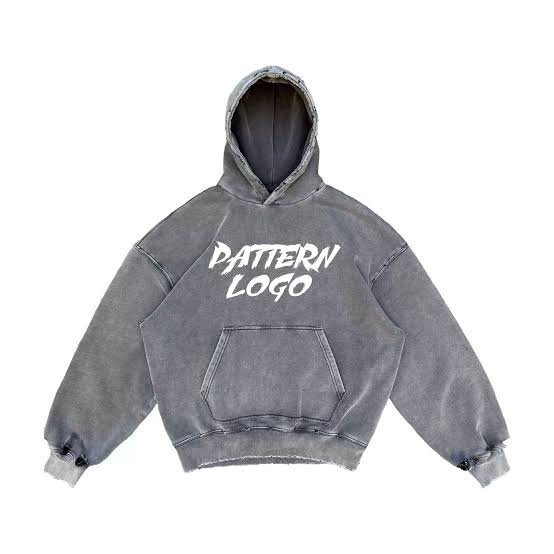
Mistake #6 — Approving Printing and Embroidery Without the Final Wash
Printing, embroidery and garment finishing should be considered as part of one production system.
This is particularly important for custom vintage wash hoodies featuring:
- screen printing;
- puff printing;
- distressed graphics;
- embroidery;
- appliqué;
- patches;
- transfers;
- mixed-media artwork.
The production sequence can influence the final appearance.
A vintage washed hoodie manufacturer therefore needs to understand the artwork before the manufacturing process is finalized.
Buyers should inspect:
Printing
- adhesion;
- cracking;
- colour;
- surface interaction;
- distortion;
- placement;
- intended distressing.
Embroidery
- puckering;
- thread appearance;
- density;
- dimensional distortion;
- edge quality;
- backing behaviour.
Appliqué and patches
- attachment;
- edge behaviour;
- dimensional stability;
- visual integration.
For private label vintage wash hoodies, approve the finished branded garment—not an unrelated embroidery swatch and an unrelated wash swatch.
The product sold to the customer is the combination.
Brands needing an OEM development route can review Elahi Vertex International’s OEM clothing manufacturing service.
Mistake #7 — Ignoring Rib, Labels, Drawcords and Other Trims
The body fabric may react beautifully while the trims produce an unwanted mismatch.
A custom washed hoodie manufacturer should consider relevant components together:
- main fabric;
- rib;
- sewing thread;
- drawcord;
- eyelets;
- zipper where applicable;
- neck labels;
- care labels;
- embroidery thread;
- patches.
For example, a charcoal body with substantially darker rib may look deliberate on one design and completely wrong on another.
The buyer needs to decide.
Brands ordering private label vintage wash hoodies should pay particular attention to label planning because their branding becomes part of the final product.
Elahi Vertex International provides a dedicated private label manufacturing service for buyers developing branded apparel.
For UK buyers, labelling should also be treated as a compliance matter rather than decoration alone. UK government guidance states that textile labels must show fibre content and provides responsibilities for manufacturers and retailers.
UK Government Textile Labelling Guidance
For EU-market products, Regulation (EU) No 1007/2011 establishes textile-fibre-name and related labelling/marking requirements.
EU Textile Fibre Labelling Regulation
This is particularly relevant when custom vintage wash hoodies are intended for Germany or other EU markets.
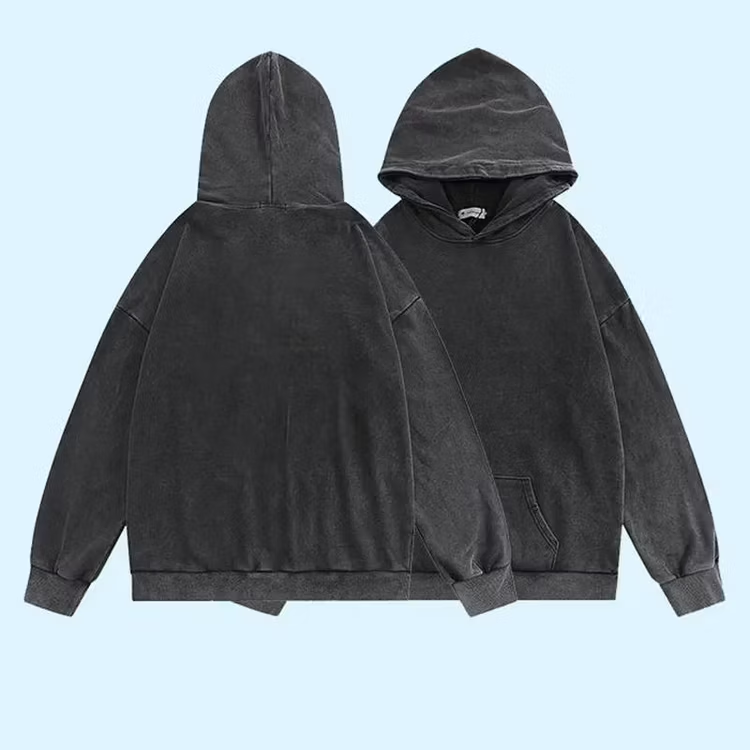
Mistake #8 — Approving One Excellent Sample Without Establishing the Bulk Standard
One excellent hoodie does not prove that hundreds of hoodies will automatically match it.
Sampling should reduce uncertainty before bulk production.
When the sample is approved, the brand and vintage wash hoodie manufacturer should preserve the relevant approval information.
That may include:
- fabric;
- composition;
- GSM direction;
- colour;
- wash;
- hand feel;
- measurements;
- construction;
- graphics;
- embroidery;
- rib;
- trims;
- labels;
- packaging.
This is particularly important for custom vintage wash hoodies, because the product deliberately contains visual variation.
The manufacturer needs to know what variation remains acceptable.
The buyer needs to know what constitutes a defect.
A vintage washed hoodie manufacturer should therefore move from:
design reference → development → sample → approved standard → controlled bulk production.
For private label vintage wash hoodies, the approved sample should also reflect the final branding direction wherever possible.
Elahi Vertex International publishes a related Vintage Heavyweight Acid Wash Hoodie product page that buyers can review as part of the company’s washed-streetwear manufacturing category.
Mistake #9 — Choosing a Custom Washed Hoodie Manufacturer Mainly on Unit Price
Price matters.
It is not the whole sourcing decision.
A low-cost custom washed hoodie manufacturer becomes expensive if the resulting stock cannot be sold at the intended retail positioning.
Compare suppliers on:
| Factor | Buyer Question |
|---|---|
| Fabric | Is the fabric appropriate for the intended wash? |
| Wash development | Can the intended vintage character be developed? |
| Sampling | Does the final sample represent the intended bulk product? |
| Colour control | Is acceptable variation understood? |
| Fit | Are post-wash measurements controlled? |
| Decoration | Has artwork been evaluated with finishing? |
| Private label | Can branding requirements be integrated? |
| Communication | Are specifications clearly documented? |
| QC | What will bulk production be compared against? |
| Commercial terms | Do price, MOQ and project requirements make commercial sense? |
A brand should select a vintage wash hoodie manufacturer based on total manufacturing suitability, not merely the lowest quote.
The same applies when comparing suppliers of custom vintage wash hoodies, private label vintage wash hoodies or any other washed streetwear product.
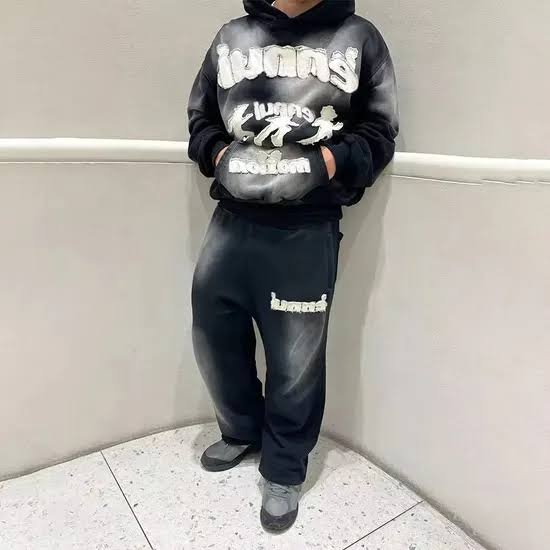
Private Label Vintage Wash Hoodies: What Brands Should Specify
A private-label project requires more information than a blank garment order.
Brands developing private label vintage wash hoodies should prepare:
Garment specification
- silhouette;
- size range;
- finished measurements;
- fabric;
- composition;
- GSM;
- hood construction;
- pocket construction;
- rib.
Vintage specification
- base colour;
- finished colour;
- wash intensity;
- seam character;
- surface character;
- acceptable variation;
- hand feel.
Branding specification
- neck label;
- size label;
- care label;
- woven label;
- hangtag;
- packaging;
- artwork;
- embroidery;
- print.
Commercial specification
- quantity;
- size breakdown;
- destination;
- required date;
- packaging;
- shipping requirement.
The more complete the information, the easier it becomes for a vintage washed hoodie manufacturer to determine feasibility and quote the intended product instead of guessing.
Custom Vintage Wash Hoodies for UK Brands
UK streetwear buyers sourcing custom vintage wash hoodies should combine design development with destination-specific requirements.
The UK government states that textile manufacturers, distributors and sellers must follow textile-labelling rules and that labels must show fibre content.
That means a brand should think beyond:
“Does my hoodie look good?”
It should also ask:
“Is the product information appropriate for the market where I will sell it?”
A vintage wash hoodie manufacturer can work from the buyer’s product specification, while the UK importer/brand should identify the applicable obligations for its specific product and selling model.
Vintage Washed Hoodie Manufacturer for German and European Brands
German and EU buyers developing private label vintage wash hoodies should consider applicable EU textile rules as part of product development.
EU Regulation 1007/2011 governs textile fibre names and related fibre-composition labelling and marking requirements.
EUR-Lex Regulation (EU) No 1007/2011
A vintage washed hoodie manufacturer therefore needs accurate buyer specifications, while the business placing the product on the market needs to understand the regulatory requirements relevant to that product.
For German and European streetwear collections, the sourcing conversation should cover:
design + manufacturing + branding + destination requirements.
Custom Washed Hoodie Manufacturer for USA Brands
US brands sourcing custom vintage wash hoodies should also plan labels early.
The US Federal Trade Commission explains that most textile and wool products require labels identifying fibre content, country of origin and the manufacturer or another responsible business. It also notes separate care-labelling requirements.
FTC Apparel and Labeling Guidance
FTC Textile and Wool Labeling Guide
This matters for private label vintage wash hoodies because the neck label, care label and branding system should not be treated as last-minute additions.
A custom washed hoodie manufacturer should receive the required branding specifications early enough to integrate them into development.
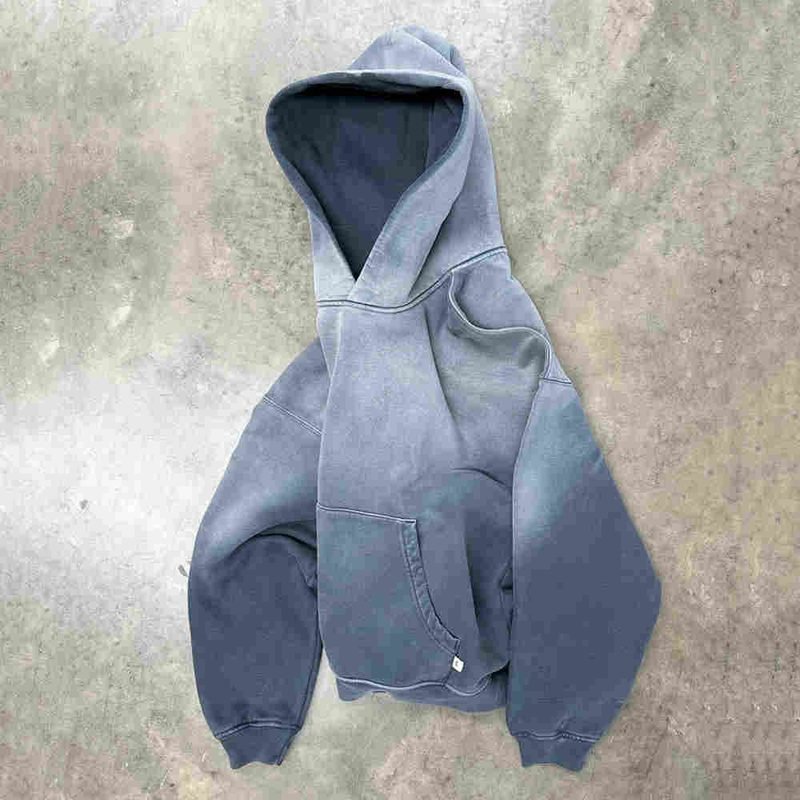
How to Request a Quote From a Vintage Wash Hoodie Manufacturer
Do not send:
“Hi, price for 100 vintage hoodies?”
That quote tells you very little because the product is undefined.
Instead, send:
Product: Custom vintage wash hoodie
Fit: Oversized / boxy / relaxed / standard
Fabric: Required composition if known
GSM: Target GSM
Colour: Base and finished colour direction
Wash: Reference images or approved physical reference
Sizes: Complete size range
Measurements: Finished measurement chart
Artwork: Files + dimensions + placements
Branding: Labels, tags and packaging
Quantity: Required quantity
Destination: Country + city/postcode
Deadline: Actual required date
This gives a vintage wash hoodie manufacturer enough information to begin a meaningful commercial discussion.
For broader projects, buyers can use Elahi Vertex International’s custom clothing manufacturing service, private label manufacturing service or OEM clothing manufacturing service according to the project.
Why Elahi Vertex International for Custom Vintage Wash Hoodies?
Elahi Vertex International operates as a B2B custom clothing manufacturer and works with international apparel buyers. Its published custom-manufacturing categories include streetwear, hoodies and sweatshirts, activewear, sportswear and private-label clothing.
For brands sourcing custom vintage wash hoodies, the manufacturing conversation can begin with the actual product specification rather than a generic catalogue item.
Brands developing private label vintage wash hoodies can submit their design, measurements, fabric direction, wash reference, artwork, branding requirements, quantity and destination for project review.
Buyers looking for a vintage washed hoodie manufacturer should first establish the required:
- fabric;
- GSM;
- fit;
- measurements;
- colour;
- vintage effect;
- graphics;
- branding;
- quantity;
- destination.
Those specifications make it possible to evaluate whether the intended product is commercially and technically suitable.
Ready to Discuss Your Vintage Hoodie?
If your brand is developing custom vintage wash hoodies for the UK, USA, Germany or Europe, send Elahi Vertex International the actual design requirements.
Elahi Vertex International:
https://www.elahivertexinternational.com/
Custom Clothing Manufacturing:
https://elahivertexinternational.com/custom-clothing-manufacturing/
Private Label Manufacturing:
https://elahivertexinternational.com/private-label-manufacturing/
OEM Clothing Manufacturing:
https://elahivertexinternational.com/oem-clothing-manufacturing/
Vintage Heavyweight Acid Wash Hoodie:
https://elahivertexinternational.com/product/vintage-heavyweight-acid-wash-hoodie/
WhatsApp:
https://wa.me/message/OWIPAIXYWHTPI1
Email:
elahivertexinternational@gmail.com
Phone / WhatsApp:
+92 309 1639614
For private label vintage wash hoodies, include your artwork, target fabric/GSM, wash reference, size chart, quantity and destination.
That gives the manufacturing discussion a concrete starting point instead of guesswork.
Elahi Vertex International — Where Brands Are Made.
Useful External Resources
- ISO — ISO 105-C06:2010, Colour Fastness to Domestic and Commercial Laundering
https://committee.iso.org/standard/51276.html
Use beside the colour consistency/colourfastness section. ISO confirms that this standard addresses resistance of textile colour to domestic and commercial laundering. - UK Government — Textile Labelling
https://www.gov.uk/guidance/textile-labelling
Use in the UK-market section. It provides official UK guidance for manufacturers and retailers concerning textile labelling. - EUR-Lex — Regulation (EU) No 1007/2011
https://eur-lex.europa.eu/eli/reg/2011/1007/oj/eng
Use in the Germany/European section. This is the official EU legislation covering textile fibre names and related labelling/marking requirements. - US Federal Trade Commission — Apparel and Labeling
https://www.ftc.gov/news-events/topics/tools-consumers/apparel-labeling
Use in the USA section for official textile/apparel labelling context. - US Federal Trade Commission — Textile and Wool Labeling Requirements
https://www.ftc.gov/business-guidance/resources/threading-your-way-through-labeling-requirements-under-textile-wool-acts
Use for detailed US fibre-content, origin and responsible-business identification requirements.
Internal Linking Structure
Use these contextual anchors throughout the article instead of dumping all internal links at the bottom:
Custom clothing manufacturer
→ https://elahivertexinternational.com/custom-clothing-manufacturing/
Private label clothing manufacturer
→ https://elahivertexinternational.com/private-label-manufacturing/
OEM clothing manufacturer
→ https://elahivertexinternational.com/oem-clothing-manufacturing/
Vintage heavyweight acid wash hoodie
→ https://elahivertexinternational.com/product/vintage-heavyweight-acid-wash-hoodie/
These pages are closely related to the commercial intent of someone searching for a vintage wash hoodie manufacturer.
Ready to Develop Custom Vintage Wash Hoodies for Your Brand?
A vintage wash should make your hoodie distinctive—not make your bulk production unpredictable.
If you are searching for a vintage wash hoodie manufacturer for a new streetwear collection, private-label launch or repeat bulk program, start with the actual product rather than asking for a generic price.
Elahi Vertex International works with international B2B buyers developing custom vintage wash hoodies, oversized streetwear hoodies, heavyweight washed hoodies and private label vintage wash hoodies for markets including the UK, USA, Germany and Europe.
Send us:
- Your hoodie design, tech pack or reference
- Target fabric and GSM
- Required vintage wash or faded colour reference
- Size chart and intended fit
- Print, embroidery or artwork files
- Labels, hangtags and private-label requirements
- Required quantity
- Delivery country and postcode
- Target delivery period
We can then review the actual requirements and determine the appropriate next manufacturing step instead of quoting an undefined garment.
Start With the Manufacturing Route That Fits Your Brand
Need complete custom apparel development?
Explore our Custom Clothing Manufacturing capabilities covering made-to-order apparel, fabric sourcing, sampling, customization, bulk production, quality control, packaging and international shipment.
Developing your own specifications and artwork?
Review how OEM, ODM and Private Label Clothing Manufacturing differ and choose the manufacturing relationship that fits your level of product control.
Want to see a relevant washed hoodie product?
Explore our Vintage Heavyweight Acid Wash Hoodie with customizable wash effects, GSM, fit, printing, embroidery, labels and packaging.
Building an oversized washed streetwear collection?
See our Men’s Acid Wash Oversized Pullover Hoodie for oversized fits, heavyweight fabric directions and custom vintage finishing options.
Want to understand how production is managed?
Read Inside Elahi Vertex International: How Our Clothing Manufacturing Process Works to understand the path from product requirements through sampling, bulk production, quality control and shipment.
Still comparing overseas manufacturers?
Use our 9 Checks Before Choosing an Overseas Clothing Manufacturer before committing your collection to a supplier.
Talk Directly With Elahi Vertex International
Have a custom vintage wash hoodie ready for development?
Send the design and specifications directly. If some technical details are still undecided, send your reference images and explain the result you are trying to achieve.
Official Website:
https://www.elahivertexinternational.com/
WhatsApp Direct:
https://wa.me/message/OWIPAIXYWHTPI1
WhatsApp / Phone:
+92 309 1639614
Primary Email:
elahivertexinternational@gmail.com
Business Email:
info@elahivertexinternational.com
Alibaba Store:
https://elahivertexinternational.trustpass.alibaba.com/
Follow Elahi Vertex International
Instagram:
https://www.instagram.com/elahivertex_mfg
LinkedIn:
https://www.linkedin.com/company/elahi-vertex-international
Facebook:
https://www.facebook.com/share/1D4CqvvfKh/
TikTok:
https://www.tiktok.com/@elahivertex_mfg
Threads:
https://www.threads.com/@elahivertex_mfg
X:
https://x.com/elahivertex_mfg
Your Next Step
Don’t send only:
“What is your hoodie price?”
Send:
Design + Fabric/GSM + Wash Reference + Fit/Size Chart + Branding + Quantity + Destination
That gives Elahi Vertex International enough information to evaluate your custom vintage wash hoodies properly and move the project toward the right commercial next step—requirements review, quotation, sample development or bulk production, depending on the project.
If you need a vintage wash hoodie manufacturer, vintage washed hoodie manufacturer, custom washed hoodie manufacturer, or manufacturing partner for private label vintage wash hoodies, discuss the actual collection with Elahi Vertex International.
Elahi Vertex International — Where Brands Are Made.