

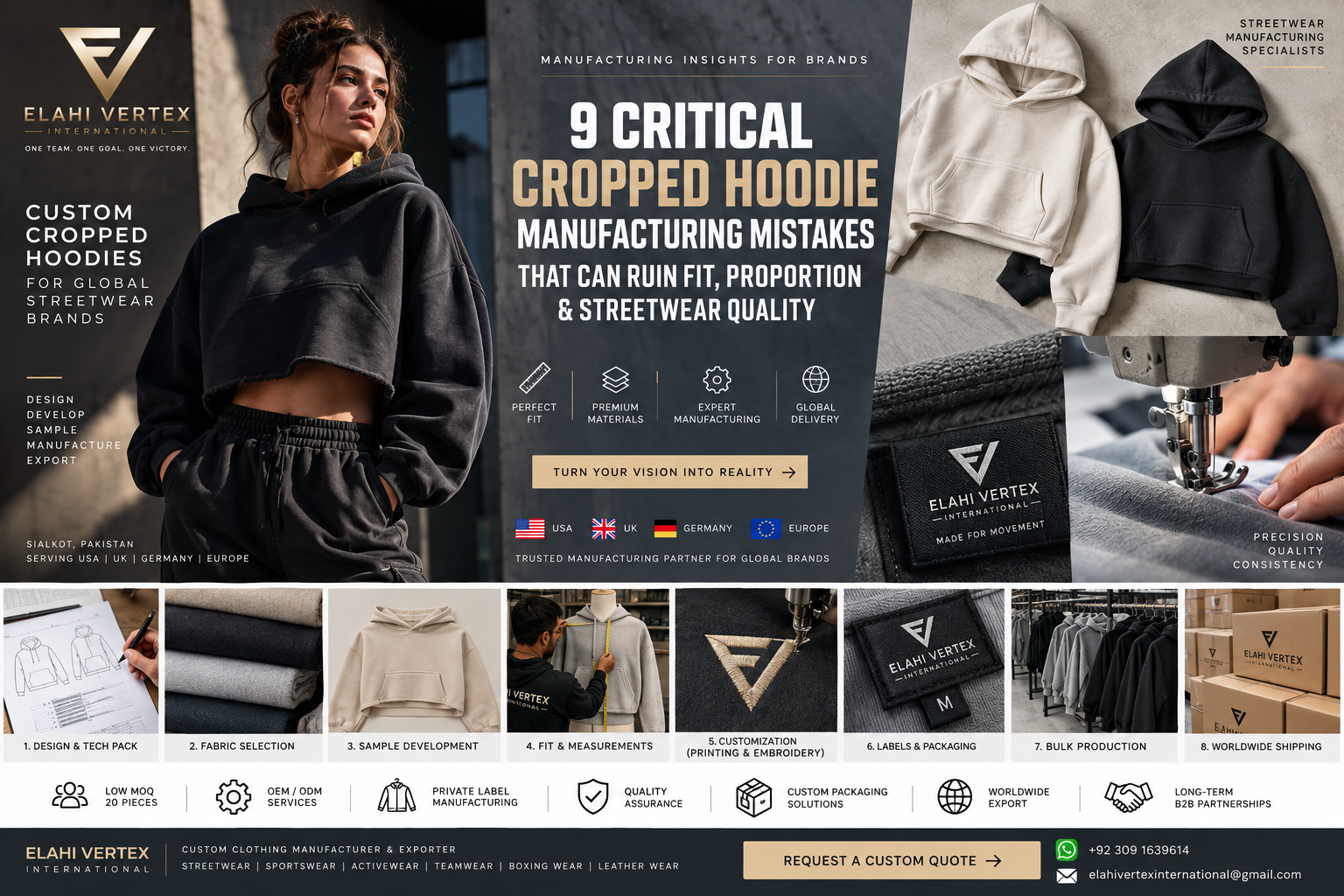
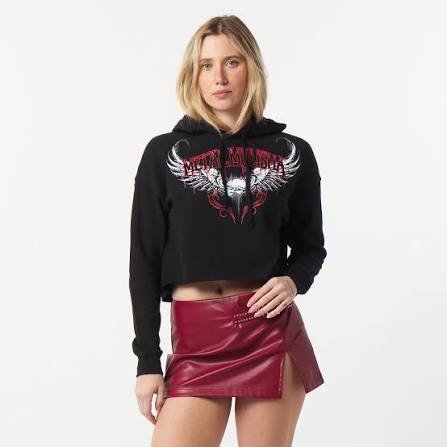
A cropped hoodie can look simple on a design board: take the familiar hoodie silhouette, reduce the body length and create a sharper streetwear proportion.
Manufacturing one properly is much more demanding.
For a streetwear brand, fashion label or private-label business, choosing the right cropped hoodie manufacturer means finding a supplier that understands that a cropped hoodie is not simply a standard hoodie with several centimetres removed from the bottom.
Body length changes the visual balance of almost every other part of the garment.
The width can suddenly look excessive. Sleeves can appear disproportionately long. The hood can overpower the shortened body. A kangaroo pocket can become cramped or incorrectly positioned. Ribbing can pull the hem into the wrong silhouette. Embroidery that looked correctly positioned on a standard hoodie may sit too low. Even apparently small grading errors can make one size look intentional and another look completely different.
These risks matter whether you are developing custom cropped hoodies for the USA, UK, Germany or the wider European market.
A capable custom cropped hoodie manufacturer should therefore work from defined measurements, proportions, materials, branding requirements and an approved physical sample rather than relying on a vague instruction such as “make it cropped.”
This guide examines nine critical mistakes that brands should understand before approving cropped hoodie manufacturing, explains how to specify a stronger product, and provides a practical framework for evaluating a cropped hoodie manufacturer before moving into bulk production.
Table of Contents
- Why Cropped Hoodie Manufacturing Requires Different Pattern Thinking
- Mistake #1 — Treating a Cropped Hoodie as a Shortened Standard Hoodie
- Mistake #2 — Getting the Width-to-Length Proportion Wrong
- Mistake #3 — Ignoring Shoulder and Sleeve Balance
- Mistake #4 — Choosing Fabric Without Considering the Cropped Silhouette
- Mistake #5 — Designing the Hood Without Considering the Shorter Body
- Mistake #6 — Getting Pocket, Artwork and Branding Placement Wrong
- Mistake #7 — Using Weak Size Grading Across the Range
- Mistake #8 — Ignoring Shrinkage, Ribbing and Finished Garment Behavior
- Mistake #9 — Approving Bulk Production Without a Proper Sample
- Cropped Hoodie Specification Checklist
- Fabric and GSM Considerations
- Cropped Hoodie Fit and Measurement Guide
- Printing, Embroidery and Private Label Details
- USA, UK, Germany and EU Market Considerations
- How to Compare a Cropped Hoodie Manufacturer
- How Elahi Vertex International Approaches a Cropped Hoodie Project
- Buyer RFQ Checklist
- Frequently Asked Questions
- Conclusion
What Is a Cropped Hoodie Manufacturer?
A cropped hoodie manufacturer is an apparel manufacturer capable of producing hooded garments with deliberately shortened body proportions according to a brand’s design, measurements, fabric, construction and customization requirements.
The important word is deliberately.
Professional cropped hoodie manufacturing requires more than reducing body length. Pattern proportions, shoulder position, sleeve length, chest width, armhole shape, hood volume, pocket placement, hem construction and size grading all need to work together.
For private-label brands, the manufacturing brief may also include:
- Custom fabric
- Defined GSM
- Fabric composition
- Custom colors
- Cropped body measurements
- Oversized or fitted width
- Dropped or regular shoulders
- Custom sleeve proportions
- Hood construction
- Ribbed or raw hem
- Kangaroo or alternative pockets
- Screen printing
- Embroidery
- Appliqué
- Woven labels
- Printed neck labels
- Size labels
- Care labels
- Hangtags
- Packaging
- Size ratios
- Shipping destination
A buyer should therefore evaluate a custom cropped hoodie manufacturer based on the manufacturer’s ability to translate the complete specification into a repeatable garment—not simply whether the factory already makes conventional hoodies.
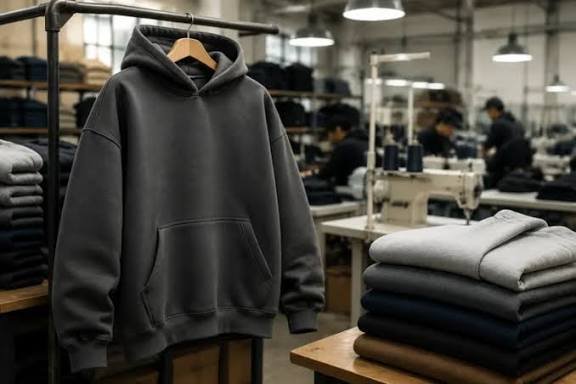
Why Cropped Hoodie Manufacturing Is Different
The central challenge with custom cropped hoodies is proportion.
Imagine two hoodies with identical chest widths, shoulders, sleeves and hood dimensions.
One has a standard body length.
The other is shortened significantly.
Although almost every measurement except body length remains identical, the second garment can appear wider, more oversized, more sleeve-heavy and more hood-heavy simply because its vertical proportion has changed.
That is why a good cropped hoodie manufacturer needs a defined silhouette.
The buyer should decide whether the intended product is:
- Boxy and cropped
- Oversized and cropped
- Relaxed and cropped
- Slim and cropped
- Drop-shoulder cropped
- Raw-hem cropped
- Rib-hem cropped
- Zip-up cropped
- Pullover cropped
- Women’s fashion cropped
- Unisex streetwear cropped
These are not interchangeable descriptions.
A private label cropped hoodies project should begin with a clear visual and dimensional target.
Mistake #1 — Treating a Cropped Hoodie as a Shortened Standard Hoodie
This is the most fundamental mistake in cropped hoodie manufacturing.
A standard hoodie pattern has relationships between:
- Body length
- Chest width
- Shoulder width
- Armhole
- Sleeve length
- Hood size
- Pocket size
- Pocket position
- Rib height
- Artwork position
Shortening only the body can disturb those relationships.
Why This Creates Problems
Suppose a brand approves the width of a conventional oversized hoodie but asks the factory to dramatically reduce its body length.
The finished garment may become excessively boxy.
That might be intentional.
But if the brand expected a controlled fashion crop rather than an extreme square silhouette, the product has failed even though the factory technically followed the instruction.
A competent cropped hoodie manufacturer needs measurable specifications rather than subjective words alone.
“Short.”
“Cropped.”
“Oversized.”
“Relaxed.”
“Boxy.”
These descriptions help communicate design intent, but they do not replace measurements.
Better Approach
Define at minimum:
| Measurement | Why It Matters |
|---|---|
| High-point shoulder to hem | Establishes actual crop length |
| Half chest | Controls body width |
| Shoulder width | Controls upper-body proportion |
| Sleeve length | Balances shortened torso |
| Armhole depth | Influences mobility and silhouette |
| Bottom opening | Determines hem shape |
| Rib height | Changes visual crop proportion |
| Hood height | Controls hood scale |
| Hood width/depth | Affects appearance and function |
| Pocket dimensions | Prevents an oversized pocket dominating the body |
A custom cropped hoodie manufacturer should be able to work from an approved measurement specification or tech pack.
Buyer Decision
Do not approve a quotation simply because the supplier says, “Yes, we manufacture cropped hoodies.”
Ask how the crop will be defined.
If the answer is effectively “we will make the hoodie shorter,” more development work is needed.
Mistake #2 — Getting the Width-to-Length Proportion Wrong
A cropped hoodie is read visually as a ratio between horizontal and vertical dimensions.
That makes width-to-length balance one of the most important decisions when developing custom cropped hoodies.
Too Wide
Excessive width combined with aggressive cropping can create:
- A square silhouette
- Excessive fabric around the side seams
- Uncontrolled drape
- A hem that projects away from the body
- Sleeves that visually dominate the garment
Too Narrow
Reducing width too aggressively can create:
- A fitted appearance when a streetwear silhouette was intended
- Restricted movement
- Pulling across the chest
- Distortion around the armholes
- A fashion-basic appearance rather than a premium streetwear shape
The correct proportion depends on the brand’s intended customer and aesthetic.
There is no universal “perfect cropped hoodie measurement.”
That is precisely why selecting a cropped hoodie manufacturer based only on a supplier’s stock size chart is risky.
Reference Garments Are Valuable
If your brand already owns a garment with an excellent fit, provide its measurements.
A reference sample can communicate information that a photograph cannot:
- Actual width
- Actual body length
- Shoulder construction
- Sleeve volume
- Hood volume
- Rib tension
- Fabric behavior
- Overall silhouette
A custom cropped hoodie manufacturer can then work from a more concrete starting point.
However, the buyer should still document the final approved measurements rather than relying indefinitely on a physical reference alone.
Mistake #3 — Ignoring Shoulder and Sleeve Balance
One of the easiest ways to ruin private label cropped hoodies is to focus entirely on body length.
The sleeve and shoulder structure may become visually exaggerated once the torso is shortened.
Drop Shoulder
A drop-shoulder construction can work extremely well for streetwear.
But the amount of shoulder drop needs to suit the intended silhouette.
An aggressive drop combined with:
- Wide body
- Short crop
- Long sleeve
- Heavy fleece
can create a much more exaggerated garment than the designer expected.
That may be perfect for one collection and completely wrong for another.
Sleeve Length
Sleeve length should be evaluated on the actual sample.
Do not assume that a sleeve copied from a standard hoodie will automatically work.
The shortened body creates a different visual relationship between the sleeve cuff and hem.
For some designs, deliberately long sleeves reinforce the streetwear aesthetic.
For others, they make the garment look poorly proportioned.
Sleeve Volume
Brands should also consider:
- Bicep width
- Elbow width
- Cuff opening
- Cuff height
- Sleeve taper
A cropped hoodie manufacturer should receive enough information to understand the intended sleeve silhouette rather than simply scaling a generic sleeve.
Practical Sample Check
Put the garment on the intended body type or fit model and look at the whole silhouette from:
- Front
- Back
- Side
- Arms relaxed
- Arms raised
- Arms extended forward
A static flat-lay photograph cannot show everything that happens when the garment is worn.
Mistake #4 — Choosing Fabric Without Considering the Cropped Silhouette
Fabric is not simply a GSM number.
Two fabrics with similar nominal weights can behave differently because of:
- Fibre composition
- Yarn
- Knit construction
- Loop or fleece structure
- Brushing
- Finishing
- Compactness
- Stretch
- Recovery
- Washing
- Surface treatment
For cropped hoodie manufacturing, fabric behavior affects the silhouette directly.
Structure vs Drape
A structured fabric can help maintain a sharp boxy profile.
A softer fabric may collapse closer to the body.
Neither is automatically better.
The correct choice depends on the design.
A premium heavyweight streetwear crop may require enough structure to hold the shape.
A softer fashion crop may intentionally require more drape.
The problem begins when a buyer communicates only:
“I need heavyweight cotton.”
That leaves too much unresolved.
GSM Is Useful—but Incomplete
GSM means grams per square metre.
It describes fabric mass per area.
It does not by itself tell you:
- How stiff the fabric feels
- How soft it feels
- How much it stretches
- How quickly it recovers
- How much it shrinks
- How bulky the fleece feels
- How the fabric drapes
- Whether it suits the intended crop
A serious custom cropped hoodie manufacturer discussion should therefore go beyond GSM.
Questions to Ask
Ask about:
- Fabric composition
- Fabric construction
- Target GSM
- Surface finish
- Inside finish
- Stretch
- Recovery
- Shrinkage expectations
- Color requirements
- Intended wash treatment
Then evaluate the actual sample.
Mistake #5 — Designing the Hood Without Considering the Shorter Body
The hood occupies a large visual area on any hoodie.
On a cropped garment, its visual importance becomes even greater.
A hood copied from a long oversized hoodie may look disproportionately large when placed on a much shorter body.
A small hood can create the opposite problem.
Hood Variables
A cropped hoodie manufacturer may need specifications covering:
- Hood height
- Hood depth
- Opening
- Neck seam
- Number of hood panels
- Lining
- Double-layer construction
- Drawcord
- Eyelets
- Drawcord ends
- Topstitching
- Shape when worn
- Shape when resting on the back
Single Layer vs Double Layer
The construction affects:
- Weight
- Structure
- Drape
- Cost
- Appearance
- Bulk around the neckline
Do not choose construction only because another streetwear brand uses it.
It should work with your fabric and silhouette.
Sampling Test
When reviewing custom cropped hoodies, inspect the hood:
- Down
- Up
- From the side
- From the back
- With the garment zipped if applicable
- After laundering when wash testing is relevant
The hood should feel like part of the garment rather than a component copied from another hoodie pattern.
Mistake #6 — Getting Pocket, Artwork and Branding Placement Wrong
The available vertical space on a cropped hoodie is limited.
That changes placement.
This is particularly important for private label cropped hoodies using:
- Kangaroo pockets
- Chest embroidery
- Large front prints
- Appliqué
- Patches
- Woven badges
- Hem labels
Kangaroo Pocket Problems
A standard-size kangaroo pocket can occupy too much of a shortened body.
Common visual problems include:
- Pocket too close to hem
- Pocket too close to chest artwork
- Pocket appearing oversized
- Reduced usable opening
- Pocket interfering with rib seam
- Artwork and pocket competing for space
Pocket dimensions should therefore be considered part of the crop design.
Artwork Placement
Do not tell a cropped hoodie manufacturer only:
“Logo on front.”
Specify:
- Artwork dimensions
- Horizontal position
- Vertical position
- Measurement reference point
- Technique
- Color
- File
- Tolerance if required
A placement copied from a full-length hoodie can appear too low on a cropped body.
Embroidery
Embroidery introduces additional variables:
- Stitch density
- Backing
- Fabric stabilization
- Artwork size
- Placement
- Thread
- Distortion risk
A heavy embroidery design on an unsuitable fabric can affect the way the front panel hangs.
Screen Printing
The buyer should confirm:
- Artwork size
- Color count
- Placement
- Ink/finish requirement
- Fabric compatibility
- Approved artwork
- Expected appearance
A custom cropped hoodie manufacturer should work from specific artwork information rather than interpreting a low-resolution mockup.
Mistake #7 — Using Weak Size Grading Across the Range
A good medium does not guarantee a good XS, XL or 2XL.
Size grading is particularly important in cropped hoodie manufacturing because the crop must remain intentional throughout the range.
What Can Go Wrong?
If every measurement increases using inappropriate increments:
- Larger sizes may become too long
- Smaller sizes may become excessively short
- Shoulder drop may become exaggerated
- Sleeves may become disproportionately long
- Hood size may become inconsistent with the body
- Pocket dimensions may not scale appropriately
- The intended crop position may shift significantly
Grading Is Not Just “Add Two Inches”
Brands should decide what aspects of the silhouette should remain visually consistent.
The objective is not necessarily to make every size mathematically identical in proportion.
It is to create a coherent size range.
Example Development Table
The following is a development framework, not a universal size chart:
| POM | XS | S | M | L | XL |
|---|---|---|---|---|---|
| Body Length | Brand-defined | Brand-defined | Base size | Graded | Graded |
| Half Chest | Brand-defined | Brand-defined | Base size | Graded | Graded |
| Shoulder | Brand-defined | Brand-defined | Base size | Graded | Graded |
| Sleeve | Brand-defined | Brand-defined | Base size | Graded | Graded |
| Bottom Opening | Brand-defined | Brand-defined | Base size | Graded | Graded |
The actual numbers should come from your target fit.
A responsible cropped hoodie manufacturer should not invent critical fit measurements without agreement from the buyer.
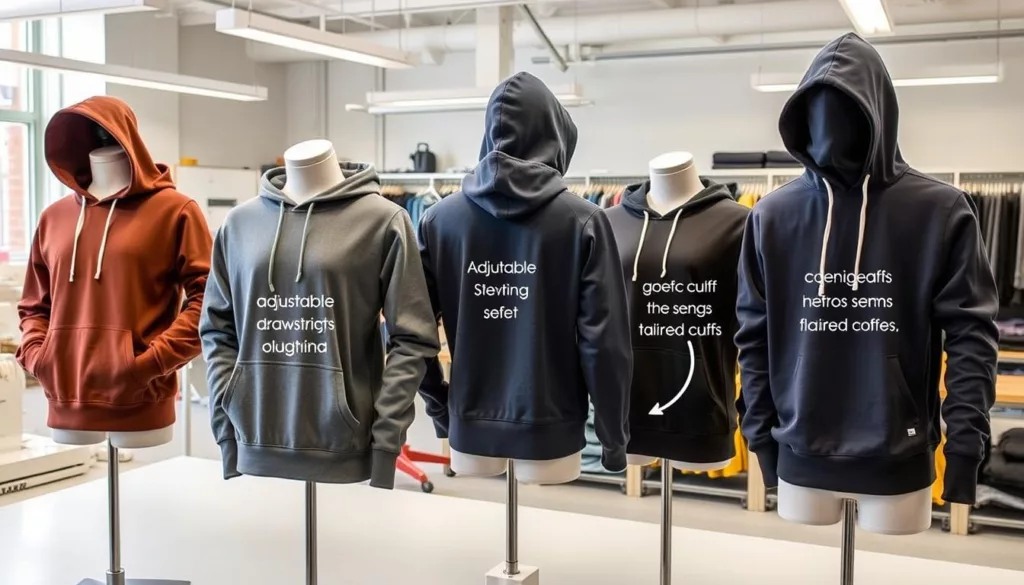
Mistake #8 — Ignoring Shrinkage, Ribbing and Finished Garment Behavior
A cropped hoodie that becomes noticeably shorter after laundering may no longer fit as intended.
Because the garment is already deliberately shortened, dimensional change can be more visually significant.
Shrinkage Matters
Fabric and garment behavior should be considered before finalizing the size specification.
Depending on material and processing, dimensions can change during:
- Washing
- Drying
- Garment washing
- Finishing
- Pressing
Do not assume a nominal fabric description guarantees dimensional stability.
Where dimensional performance matters, discuss testing and acceptance criteria with the cropped hoodie manufacturer.
Ribbing Changes the Silhouette
Bottom ribbing can:
- Pull the hem inward
- Create blousing
- Increase visual volume above the hem
- Change how the crop sits on the body
That can be desirable.
But it needs to be intentional.
Brands should specify or approve:
- Rib composition
- Rib weight
- Rib height
- Stretch
- Recovery
- Finished opening
Raw Hem Alternative
Some fashion-focused custom cropped hoodies use a raw or unfinished-looking cropped edge.
That creates a different aesthetic but also requires the construction to be deliberately engineered.
“Raw” should not mean uncontrolled.
The buyer should approve:
- Cut position
- Edge behavior
- Stitching if any
- Wash behavior
- Expected roll or curl
- Appearance after laundering
Mistake #9 — Approving Bulk Production Without a Proper Sample
A physical sample is one of the strongest risk-control tools available to a clothing brand.
This is especially true when working with a new cropped hoodie manufacturer.
A digital mockup can communicate artwork.
It cannot fully confirm:
- Hand feel
- Weight
- Fit
- Crop position
- Width
- Shoulder balance
- Sleeve volume
- Hood shape
- Rib tension
- Pocket usability
- Stitch quality
- Embroidery behavior
- Print feel
- Label comfort
What Should a Cropped Hoodie Sample Confirm?
Use the sample to check:
Fabric
- Composition
- Weight
- Surface
- Inside finish
- Structure
- Drape
- Stretch
- Recovery
Fit
- Crop length
- Chest width
- Shoulder
- Sleeve
- Armhole
- Bottom opening
Construction
- Seams
- Topstitching
- Hood
- Cuffs
- Hem/rib
Branding
- Embroidery
- Main label
- Size label
- Care label
- Hangtag
Overall Product
- Front appearance
- Side appearance
- Back appearance
- Movement
- Proportion
A custom cropped hoodie manufacturer sample should be judged against documented requirements—not simply whether the buyer “likes it.”
Cropped Hoodie Manufacturer Specification Checklist
Before requesting a serious quotation, prepare as much of the following as possible.
Product
- Pullover or zip-up
- Intended customer
- Intended fit
- Reference image
- Tech pack if available
- Target sizes
Fabric
- Composition
- Target GSM
- Knit/construction preference
- Inside finish
- Color
- Wash/finish requirements
Measurements
- Body length
- Chest
- Shoulder
- Sleeve
- Armhole
- Bottom opening
- Cuff
- Hood
Branding
- Embroidery
- Appliqué
- Patch
- Main label
- Size label
- Care label
- Hangtag
Commercial Information
- Quantity
- Size breakdown
- Destination country
- Packaging requirements
- Target delivery period
- Sampling requirement
The more accurately this information is defined, the more meaningful the quotation from a cropped hoodie manufacturer becomes.
Choosing Fabric for Custom Cropped Hoodies
There is no single fabric specification that automatically makes a cropped hoodie premium.
The correct material depends on the design.
Cotton-Rich Fleece
Often considered when brands want:
- Soft hand feel
- Familiar sweatshirt character
- Streetwear appearance
- Comfortable everyday wear
The actual performance depends on construction and finishing.
Cotton/Polyester Blends
Depending on the fabric, blends can influence:
- Durability
- Dimensional behavior
- Recovery
- Drying
- Hand feel
- Cost
Do not judge a blend from fibre percentages alone.
Evaluate the fabric.
French Terry
French terry can be useful where the brand wants a looped interior rather than heavily brushed fleece.
It can suit transitional or lighter collections depending on the actual specification.
Brushed Fleece
Brushed interiors can create warmth and softness.
Again, the final result depends on weight, composition, brushing and construction.
The Better Question
Instead of asking:
“What is the best fabric for cropped hoodies?”
Ask:
“Which fabric structure best supports the silhouette, climate, retail positioning, hand feel and performance we want?”
That is a more useful conversation with a cropped hoodie manufacturer.
Cropped Hoodie Fit Guide for Streetwear Brands
Fit terminology should always be converted into measurements.
Boxy Cropped Fit
Typically emphasizes:
- Shorter body
- Generous width
- Strong horizontal silhouette
- Controlled shoulder/sleeve relationship
Oversized Cropped Fit
May combine:
- Wide chest
- Dropped shoulder
- Fuller sleeve
- Short body
The word “oversized” still needs a measurement specification.
Fitted Cropped Hoodie
May use:
- Reduced chest ease
- More controlled shoulder
- Narrower sleeve
- Closer hem relationship
Relaxed Crop
Sits between fitted and strongly oversized.
This can be commercially versatile, but the brand should still define the intended dimensions.
Important
Do not copy measurements blindly from a competitor’s online size chart.
Develop the fit around your own customer and design.
Private Label Cropped Hoodies: Branding Details Buyers Should Define
For private label cropped hoodies, the garment itself is only part of the project.
The branding system can include:
- Main woven label
- Printed neck label
- Size label
- Care/content label
- Country-of-origin information
- Hangtag
- Barcode sticker
- Polybag information
- Custom packaging
The exact legal and commercial requirements depend on the destination market and selling arrangement.
Do not leave labeling until production is nearly complete.
Cropped Hoodie Manufacturing for the USA
US brands sourcing custom cropped hoodies should pay attention not only to design and quality but also to labeling requirements applicable to products sold in the United States.
The US Federal Trade Commission maintains rules concerning textile fibre identification and garment care labeling.
Before placing goods on the US market, brands/importers should confirm applicable requirements for:
- Fibre identification
- Country of origin
- Manufacturer/marketer identification where applicable
- Care instructions
Compliance responsibility should not be reduced to “the factory knows.”
The buyer and importer should verify the requirements applicable to the specific product.
For a US streetwear company comparing a cropped hoodie manufacturer, compliance readiness should therefore be discussed alongside:
- Fit
- Fabric
- Branding
- Sampling
- Bulk consistency
- Packaging
- Shipping
Cropped Hoodie Manufacturing for the UK
UK streetwear brands developing private label cropped hoodies should consider the textile labeling rules applicable to the market.
Official UK guidance states that textile labels must show fibre content, including applicable fur and other animal-origin components.
For a standard textile cropped hoodie, the buyer should make sure the intended label information is agreed before bulk manufacturing.
The design stage is the right time to resolve:
- Fibre composition wording
- Brand label
- Size label
- Care information
- Origin information where required
- Hangtag information
- Packaging information
A cropped hoodie manufacturer can physically produce labels according to an approved specification, but the brand should ensure that its final labeling complies with the requirements that apply to its product and market.
Cropped Hoodie Manufacturing for Germany and the European Union
Germany is part of the EU single market, so textile products placed on the German market are subject to applicable EU textile fibre labeling rules.
EU guidance states that textile products marketed to consumers generally need fibre-composition information, and required information may need to be provided in the official language or languages applicable where the product is sold.
For German buyers, that means labeling should be considered during product development rather than treated as a last-minute packaging task.
A Germany-focused custom cropped hoodie manufacturer project should therefore define:
- Fibre composition
- Label content
- Branding
- Size system
- Care information
- Packaging
- Intended sales markets
If the same product will be distributed across multiple European countries, check language and other applicable requirements for each destination.
USA vs UK vs Germany/EU: Buyer Planning Table
| Issue | USA | UK | Germany / EU |
|---|---|---|---|
| Fit specification | Buyer-defined | Buyer-defined | Buyer-defined |
| Fibre labeling | Check US requirements | Check UK requirements | EU fibre rules apply |
| Care information | FTC rules relevant | Confirm applicable UK requirements | Confirm destination requirements |
| Language planning | English generally practical | English | German for German consumer-facing required information where applicable |
| Country of origin | Check US requirements | Verify applicable rules | Verify applicable rules |
| Sampling | Strongly recommended | Strongly recommended | Strongly recommended |
| Final compliance | Buyer/importer should verify | Buyer/importer should verify | Buyer/importer should verify |
Regulations can change. Verify current requirements for the exact product and destination before commercial sale.
How to Compare a Cropped Hoodie Manufacturer
Do not evaluate suppliers solely by unit price.
Use a broader framework.
| Evaluation Area | What to Ask |
|---|---|
| Pattern Development | How will my crop and proportions be defined? |
| Fabric | What exact construction/composition is proposed? |
| GSM | What is the target and how is it confirmed? |
| Fit | Can you work from my measurements or reference? |
| Sampling | What will the sample confirm? |
| Grading | How will sizes be developed? |
| Printing | Which method suits the artwork/fabric? |
| Embroidery | How will placement and stabilization be handled? |
| Labels | Can labels be produced to approved files/specifications? |
| Packaging | What options can be quoted? |
| QC | What inspection points can be agreed? |
| Shipping | What shipping basis is being quoted? |
| Communication | Who handles revisions and approvals? |
The cheapest cropped hoodie manufacturer is not necessarily the lowest-cost supplier after revisions, rejected samples, inconsistent bulk production or unsuitable inventory are considered.
Cropped Hoodie Manufacturer Red Flags
Be cautious when a supplier:
- Quotes before understanding the product
- Does not ask about measurements
- Treats cropped fit as body length only
- Cannot explain fabric beyond “cotton fleece”
- Ignores grading
- Does not request artwork dimensions
- Does not discuss labels
- Avoids sampling
- Cannot clearly explain what is included in the quotation
- Gives vague shipping terms
- Makes unsupported guarantees
No single point automatically proves that a supplier is unsuitable.
But several together deserve investigation before money is committed.
Sample vs Bulk: What Must Stay Consistent?
The approved sample should establish a reference for bulk manufacturing.
Important characteristics can include:
- Fabric
- Color
- Measurements
- Crop
- Width
- Shoulder
- Sleeves
- Hood
- Rib
- Stitching
- Embroidery
- Labels
- Trims
- Overall appearance
Any approved changes after sampling should be documented.
Verbal approvals create avoidable ambiguity.
Custom Cropped Hoodie Manufacturer vs Ready-Made Blank Supplier
| Factor | Custom Manufacturing | Ready-Made Blank |
|---|---|---|
| Pattern | Can be brand-specific | Predetermined |
| Crop | Can be developed | Fixed |
| Fabric | Can be specified subject to project | Existing |
| Measurements | Customizable | Existing size chart |
| Branding | Broad customization possible | Often decoration-focused |
| Grading | Can be developed | Already established |
| Sampling | Product-development process | Often sample of existing blank |
| Best For | Distinct product identity | Faster simple branding projects |
Neither model is universally better.
If the product’s silhouette is central to the brand, custom cropped hoodies usually require more control than simply decorating a ready-made blank.
Why Work With Elahi Vertex International for Custom Cropped Hoodies?
Elahi Vertex International is a B2B custom clothing manufacturer and exporter based in Sialkot, Pakistan.
Relevant manufacturing categories include streetwear, hoodies and sweatshirts, activewear and private-label clothing.
For a cropped hoodie project, the discussion can begin with the buyer’s:
- Design
- Reference images
- Measurements
- Tech pack
- Fabric requirements
- GSM target
- Color
- Quantity
- Sizes
- Printing
- Embroidery
- Labels
- Packaging
- Destination
The objective should be to remove ambiguity before production.
Elahi Vertex International’s working MOQ is 20 pieces per product/category.
For brands developing a new cropped silhouette, a lower starting quantity can reduce the amount of inventory committed before the product has proven its commercial demand.
Project-specific fabric availability, pricing, sample cost, production schedule and shipping should be confirmed for the actual order rather than assumed.
From Idea to Bulk Cropped Hoodie Manufacturing
A practical workflow can look like this:
1. Design Brief
The buyer provides:
- Sketch
- Mockup
- Reference images
- Existing garment
- Tech pack
2. Specification Review
Define:
- Fit
- Crop
- Measurements
- Fabric
- GSM
- Colors
- Branding
- Quantity
- Sizes
3. Fabric and Trim Decisions
Confirm what will be used for:
- Main body
- Rib
- Drawcord
- Eyelets
- Labels
- Other trims
4. Sample Development
Create the physical garment for review.
5. Fit Review
Check:
- Length
- Width
- Shoulder
- Sleeve
- Hood
- Hem
6. Branding Review
Inspect:
- Embroidery
- Labels
- Tags
7. Revision
Document required changes.
8. Approval
Freeze the approved specification.
9. Bulk Production
Manufacture according to the agreed reference and commercial terms.
10. Quality Review and Shipment
Confirm agreed inspection and shipping arrangements before dispatch.
Cropped Hoodie Manufacturer RFQ Template
A strong RFQ can include:
Product: Cropped Pullover Hoodie
Fit: Boxy / Oversized / Relaxed / Fitted
Quantity: [Insert quantity]
Sizes: [Insert size breakdown]
Fabric: [Insert composition]
Target GSM: [Insert GSM]
Color: [Pantone/reference if available]
Body Length: [Insert]
Chest: [Insert]
Shoulder: [Insert]
Sleeve: [Insert]
Hood: [Insert requirement]
Pocket: [Insert requirement]
Printing: [Method/artwork/size/placement]
Embroidery: [Artwork/size/placement]
Main Label: [Requirement]
Size Label: [Requirement]
Care Label: [Requirement]
Hangtag: [Requirement]
Packaging: [Requirement]
Destination: [City/Country]
Target Delivery Period: [Insert]
Reference Files: [Attach]
This gives a cropped hoodie manufacturer far more useful information than:
“How much for 100 custom hoodies?”
Buyer Checklist Before Paying for a Sample
Before sample development, confirm:
- Product type
- Crop style
- Fit
- Base size
- Measurement chart
- Fabric
- GSM
- Color
- Hood construction
- Cuff
- Hem
- Embroidery
- Labels
- Packaging expectations
- Sample price
- Sample shipping cost
- Sample development timeline
- Revision procedure
- Indicative bulk commercial terms
- Destination
Sampling should reduce uncertainty—not create more of it.
Buyer Checklist Before Bulk Production
Before approving cropped hoodie manufacturing in bulk, confirm:
- Final sample approved
- Final measurements approved
- Size grading approved
- Fabric approved
- Color approved
- Rib approved
- Hood approved
- Pocket approved
- Artwork files approved
- Artwork dimensions approved
- Artwork placement approved
- Embroidery approved
- Labels approved
- Packaging approved
- Quantity confirmed
- Size breakdown confirmed
- Commercial terms confirmed
- Shipping arrangement confirmed
- Destination confirmed
- Required documentation discussed
The more decisions that remain open after bulk production starts, the greater the risk of disagreement.
20 Cropped Hoodie Manufacturer FAQs
1. What is a cropped hoodie manufacturer?
A cropped hoodie manufacturer produces hoodies with intentionally shortened body proportions according to defined design, fabric, measurements, construction and branding requirements. Custom manufacturing can also include private labels, printing, embroidery and packaging.
2. How do I choose a cropped hoodie manufacturer?
Evaluate the supplier’s ability to understand your fit, measurements, fabric, grading, sampling, customization and bulk-production requirements. Do not select a cropped hoodie manufacturer based only on unit price.
3. Can a cropped hoodie manufacturer make a custom pattern?
Custom apparel manufacturing can involve developing patterns according to buyer specifications. Confirm the exact development process with the cropped hoodie manufacturer handling your project.
4. What information should I send a cropped hoodie manufacturer?
Send your design or reference, quantity, sizes, fit, measurements, fabric preference, GSM, colors, artwork, labels, packaging requirements and shipping destination.
5. What is the best GSM for custom cropped hoodies?
There is no universal best GSM. Lightweight, midweight and heavyweight fabrics create different results. Choose according to climate, silhouette, structure, hand feel and positioning rather than selecting fabric by GSM alone.
6. Can I order private label cropped hoodies?
Yes, private label cropped hoodies can include brand labels, size labels, care labels, hangtags, printing, embroidery and other custom details where agreed with the manufacturer.
7. What is the difference between custom cropped hoodies and blanks?
Custom cropped hoodies can be developed around your measurements, fabric and construction. Blank hoodies already have a predefined pattern and fabric and are normally customized primarily through decoration or branding.
8. Should I sample before ordering from a cropped hoodie manufacturer?
For a newly developed garment, sampling is strongly recommended because it lets you evaluate fit, crop, proportions, fabric, construction and branding before bulk production.
9. How should cropped hoodie body length be measured?
The measurement method should be clearly defined in the tech pack or measurement specification so both buyer and manufacturer measure from the same points.
10. Why does my cropped hoodie look too boxy?
The relationship between body width and body length may be too aggressive for the intended silhouette. Shoulder width, sleeve volume, fabric structure and hem construction can also contribute.
11. Why do cropped hoodie sleeves sometimes look too long?
Shortening the torso changes the visual relationship between body and sleeves. Sleeve measurements that work on a standard hoodie may look exaggerated on a cropped garment.
12. Can a custom cropped hoodie manufacturer add embroidery?
Embroidery can be used on custom cropped hoodies, subject to the artwork, fabric, placement and construction. A physical sample helps evaluate how the embroidery interacts with the garment.
13. Can cropped hoodies use screen printing?
Yes. Screen printing is one possible decoration method. Suitability depends on the design, fabric, colors, finish and production requirements.
14. What labels do private label cropped hoodies need?
Commercial branding may include main labels, size labels, care/content labels and hangtags. Legal requirements vary by destination, so brands should verify the rules applying to their intended market.
15. What should German brands tell a cropped hoodie manufacturer?
German buyers should define the garment specification and also consider EU textile labeling requirements and the consumer-facing information needed for products marketed in Germany.
16. What should UK brands check before cropped hoodie manufacturing?
UK brands should check fit, sampling, fabric, branding and bulk specifications while also verifying applicable UK textile labeling and import requirements.
17. What should US brands check when sourcing custom cropped hoodies?
US brands should consider product development as well as applicable FTC requirements concerning textile fibre identification and care labeling.
18. What causes sample-to-bulk differences in cropped hoodie manufacturing?
Differences can arise when fabric, measurements, construction, artwork, trims or finishing are not sufficiently controlled or when approved changes are poorly documented. Establishing an approved specification reduces ambiguity.
19. What is Elahi Vertex International’s MOQ for cropped hoodie manufacturing?
The working MOQ for Elahi Vertex International is 20 pieces per product/category. Project requirements and commercial terms should be confirmed before ordering.
20. How do I request a cropped hoodie manufacturing quotation?
Send Elahi Vertex International your reference/design, quantity, size requirements, target measurements, fabric/GSM preference, colors, branding requirements, packaging needs and delivery destination. The project can then be reviewed for the appropriate quotation and sampling step.
Final Cropped Hoodie Manufacturer Decision Framework
Before choosing a cropped hoodie manufacturer, answer five questions.
1. Has the Product Been Defined?
You should know what you want to manufacture beyond simply “a cropped hoodie.”
2. Is the Fit Measurable?
The crop, chest, shoulders, sleeves, hood and hem should have measurable targets.
3. Is the Material Appropriate?
Fabric should support the intended silhouette and customer experience.
4. Has the Physical Sample Been Evaluated?
Do not rely only on renders and photographs when fit is commercially important.
5. Can the Approved Product Be Communicated Clearly for Bulk Production?
The approved garment should become a documented production reference.
If these five questions cannot be answered confidently, the project is probably not ready for bulk manufacturing.
Work With Elahi Vertex International on Custom Cropped Hoodies
Elahi Vertex International works with international B2B buyers on custom apparel manufacturing, including streetwear, hoodies and sweatshirts and private-label clothing.
For buyers in the USA, UK, Germany and wider Europe, the starting point should be the product—not a generic price request.
Send:
- Your cropped hoodie design or reference
- Estimated quantity
- Required sizes
- Target fit
- Measurements or tech pack if available
- Fabric/GSM preference
- Color requirements
- Printing or embroidery artwork
- Private-label requirements
- Packaging requirements
- Delivery country
Elahi Vertex International can review the available project information and determine the appropriate next step for quotation and sample development.
MOQ: 20 pieces per product/category.
Sample pricing, courier charges, production terms, fabric availability and shipping should be confirmed for the specific project.
The purpose of a good manufacturing conversation is not to rush into production.
It is to make sure the cropped hoodie manufacturer and buyer are approving the same product before money is committed to bulk inventory.
Conclusion
A successful cropped hoodie depends on proportion.
Body length alone does not create a strong cropped silhouette.
Width, shoulders, sleeves, hood dimensions, pocket placement, rib construction, fabric behavior, artwork position and grading all interact with the shortened body.
That is why brands searching for a cropped hoodie manufacturer should evaluate technical understanding rather than simply compare quotations.
For custom cropped hoodies, define the silhouette first. Convert subjective design language into measurements. Select fabric according to the intended structure and drape. Develop a physical sample. Review the garment on-body. Document revisions. Confirm grading. Freeze artwork and labels. Then move toward bulk production.
For private label cropped hoodies, also plan market-specific labeling, branding and packaging before production.
Whether your target customers are in the USA, UK, Germany or elsewhere in Europe, disciplined product development reduces avoidable ambiguity between the brand and manufacturer.
A custom cropped hoodie manufacturer should ultimately help turn the brand’s intended proportions into a repeatable physical product.
For a custom cropped hoodie project, send Elahi Vertex International your reference design, quantity, sizes, measurements or tech pack, fabric requirements, branding requirements and destination to begin a project review.
Cropped Hoodie Brands
A professional cropped hoodie project involves more than choosing a fabric and shortening a hoodie pattern. Brands selling in the USA, UK, Germany and Europe should also understand textile labeling, fibre information, care requirements, material selection and responsible sourcing. The following resources can support deeper buyer research.
1. USA Textile Fibre Identification
Brands selling custom cropped hoodies in the United States should understand the FTC’s textile identification requirements. The FTC explains requirements covering fibre content, manufacturer or marketer identification and country of manufacture.
External resource: FTC Textile Fiber Rule
2. USA Care Label Requirements
Care instructions should not be treated as a last-minute label decision. US manufacturers and importers of covered textile apparel are subject to the FTC Care Labeling Rule.
External resource: FTC Care Labeling Rule
3. Understanding US Apparel Labeling
A streetwear company working with a cropped hoodie manufacturer should understand how fibre content, origin and responsible-business identification fit into US apparel labeling.
External resource: FTC Apparel and Labeling
4. Care Instructions Need a Reasonable Basis
Care labels should reflect how the garment can actually be maintained. This becomes particularly important when custom cropped hoodies use special washes, prints, embroidery or fabric treatments.
External resource: FTC Clothes Captioning Guide
5. EU Textile Fibre Regulation
Brands sourcing private label cropped hoodies for Germany or other EU markets should understand Regulation (EU) No 1007/2011 concerning textile fibre names and fibre-composition labeling.
External resource: EUR-Lex Regulation 1007/2011
6. Verify the Current EU Regulation
Regulatory information can change. Buyers should verify the current consolidated EU textile rules rather than relying on an old blog or supplier summary.
External resource: EUR-Lex Consolidated Textile Regulation
7. Material Selection Should Go Beyond Marketing Terms
Words such as “premium,” “heavyweight” and “sustainable” are not adequate technical fabric specifications. Material selection should consider the actual fibre and production system.
External resource: Textile Exchange Materials Portfolio
8. Cotton Selection
Cotton is widely used in hoodies, but a brand should still evaluate composition, yarn, knit construction, finish, hand feel and garment performance rather than requesting “premium cotton” without further specification.
External resource: Textile Exchange Materials Portfolio
9. Polyester Selection
Polyester can influence strength, durability, recovery and garment behaviour. Buyers developing custom cropped hoodies should assess blends according to the intended product rather than rejecting or selecting a fibre solely by name.
External resource: Textile Exchange Materials Portfolio
10. Responsible Material Decisions
Material sourcing is increasingly relevant to fashion and streetwear companies. Brands making environmental claims should understand the evidence behind the materials and systems they select.
External resource: Textile Exchange
11. Production Systems Matter
Material discussions increasingly extend beyond the fibre itself to the production system behind it. This can matter for brands developing longer-term responsible-sourcing strategies.
External resource: Textile Exchange Preferred Production Systems
12. Fibre Percentages Matter in the USA
A fabric described commercially as “cotton blend” is not enough information for a final US consumer label. The applicable fibre names and percentages need to be handled according to the relevant rules.
External resource: FTC Textile Fiber Rule
13. Country of Manufacture Matters
US apparel labeling rules also address the country where a textile product was processed or manufactured. Brands importing cropped hoodies should resolve origin labeling before bulk production.
External resource: FTC Apparel and Labeling
14. Care Labels Should Survive Normal Use
For covered US apparel, the care information is intended to remain available to the consumer. Label construction and placement should therefore be discussed before bulk cropped hoodie manufacturing begins.
External resource: FTC Care Labeling Rule
15. Washing Can Affect Cropped Proportions
Dimensional behaviour deserves particular attention on a cropped garment because relatively small changes in body length can noticeably change the intended silhouette. Care instructions should be supported rather than guessed.
External resource: FTC Care Labeling Compliance Guide
16. German Brands Should Plan for EU Requirements Early
If private label cropped hoodies are intended for Germany, fibre-composition requirements should be considered while labels and packaging are being developed rather than after bulk production.
External resource: EUR-Lex Textile Regulation
17. Multi-Market European Sales Need Planning
A brand selling the same cropped hoodie across several European markets should not assume that a label prepared for one sales destination automatically solves every consumer-information requirement in another.
External resource: EUR-Lex Regulation 1007/2011
18. Fabric Weight Is Only One Buying Variable
GSM is useful, but fibre selection and fabric construction also influence the finished garment. A cropped hoodie manufacturer and buyer should therefore evaluate the actual material instead of using GSM as the only quality indicator.
External resource: Textile Exchange Materials Portfolio
19. Material Claims Should Be Verifiable
If a streetwear brand intends to market a cropped hoodie using environmental or responsible-material claims, those claims should be supported by appropriate evidence rather than broad marketing language.
External resource: Textile Exchange
20. Compliance Should Be Part of Product Development
Fit, fabric and branding may determine whether customers want the product, but market requirements determine whether important product information has been handled correctly. Brands should address both before approving bulk production.
For US sales, review the FTC textile guidance. For European sales, review the EU textile fibre regulation.
Ready to Manufacture Your Custom Cropped Hoodie Collection?
A strong cropped hoodie starts long before bulk production.
The crop length, chest width, shoulder drop, sleeve proportion, hood shape, fabric structure, GSM, ribbing, artwork placement, labels and size grading all need to work together. If one of these elements is wrong, an otherwise good streetwear concept can lose the fit and proportions that made the design distinctive.
If you are a streetwear brand, fashion label, retailer, wholesaler, startup or private-label business in the USA, UK, Germany or Europe, Elahi Vertex International can review your cropped hoodie project from a manufacturing perspective.
Bring Us the Design — Not a Perfect Tech Pack
Already have a complete tech pack? Send it.
Only have a sketch, mockup, reference hoodie, measurement ideas or product concept? Start with what you have.
For the most useful project review, send:
- Cropped hoodie design, sketch or reference images
- Target quantity
- Required sizes
- Intended fit: oversized, boxy, relaxed or fitted
- Crop/body-length requirement
- Fabric composition preference
- Target GSM
- Colors
- Printing or embroidery artwork
- Custom label requirements
- Packaging requirements
- Destination country
- Target delivery period
Elahi Vertex International’s standard MOQ is 20 pieces per product/category, allowing qualifying brands to start with a smaller production quantity rather than committing immediately to a large inventory position.
Project-specific pricing, fabric availability, sampling, production requirements and shipping are confirmed according to the actual project.
Start With the Route That Suits Your Project
Request a Cropped Hoodie Manufacturing Quote
Have your design and specifications ready?
Use our Custom Manufacturing Inquiry & Request a Quote page to send your product details and upload your design files.
See How Custom Apparel Is Manufactured
Before choosing a supplier, understand the manufacturing capabilities available for your project.
Explore Custom Clothing Manufacturing for an overview of product development, materials, customization, sampling, bulk production, quality inspection, packaging and export.
Explore Our Manufacturing Capabilities
Need pattern development, fabric sourcing, embroidery, screen printing, labels, sampling or private-label production?
See the complete Elahi Vertex International Manufacturing Capabilities.
Building a Private-Label Streetwear Brand?
If your cropped hoodies will carry your own branding, labels and packaging, explore our Private Label Clothing Manufacturing service.
Already Have Complete Specifications?
Brands with established designs, measurements, patterns and product requirements can learn more about OEM Clothing Manufacturing.
Want to Understand the Ordering Process First?
See How to Order Custom Apparel for the route from design and specifications through sampling, approval, bulk production, quality control, packaging and shipment.
Want Manufacturing Proof Before Starting?
Do not choose a cropped hoodie manufacturer from marketing language alone.
Explore Our Manufacturing Work and review selected Custom Apparel Portfolio Projects to understand the manufacturing work behind Elahi Vertex International.
You can also explore our Apparel Manufacturing Case Studies for examples across streetwear, private-label apparel and other custom-manufacturing categories.
Talk Directly With Elahi Vertex International
If you are developing custom cropped hoodies, private label cropped hoodies or a complete streetwear collection, send us the project information and let us determine the right next commercial step.
Message Elahi Vertex International on WhatsApp
For a faster project review, send your design/reference together with your estimated quantity, sizes and destination.
elahivertexinternational@gmail.com
info@elahivertexinternational.com
Website
Elahi Vertex International — Official Website
Alibaba
Prefer communicating or sourcing through Alibaba?
Elahi Vertex International on Alibaba
Your Cropped Hoodie Project Can Start With One Message
You do not need to send a long introduction.
Send:
Design/reference + quantity + sizes + fabric/GSM preference + customization + destination.
From there, Elahi Vertex International can review the requirements and determine the appropriate next step for specification discussion, quotation or sample development.
Whether you are developing your first cropped hoodie drop or expanding an established streetwear collection, the objective is the same:
Get the fit right.
Get the proportions right.
Approve the details before bulk.
Then manufacture a product that represents your brand properly.
Start Your Cropped Hoodie Project
REQUEST A CUSTOM QUOTE | WHATSAPP ELAHI VERTEX INTERNATIONAL | VIEW OUR MANUFACTURING WORK
Elahi Vertex International
Custom Clothing Manufacturer | OEM | ODM | Private Label
Streetwear | Hoodies & Sweatshirts | Sportswear | Teamwear | Activewear | Boxing Wear | Leather Wear
Sialkot, Pakistan — Serving international B2B buyers
MOQ: 20 pieces per product/category
One Team. One Goal. One Victory.
