
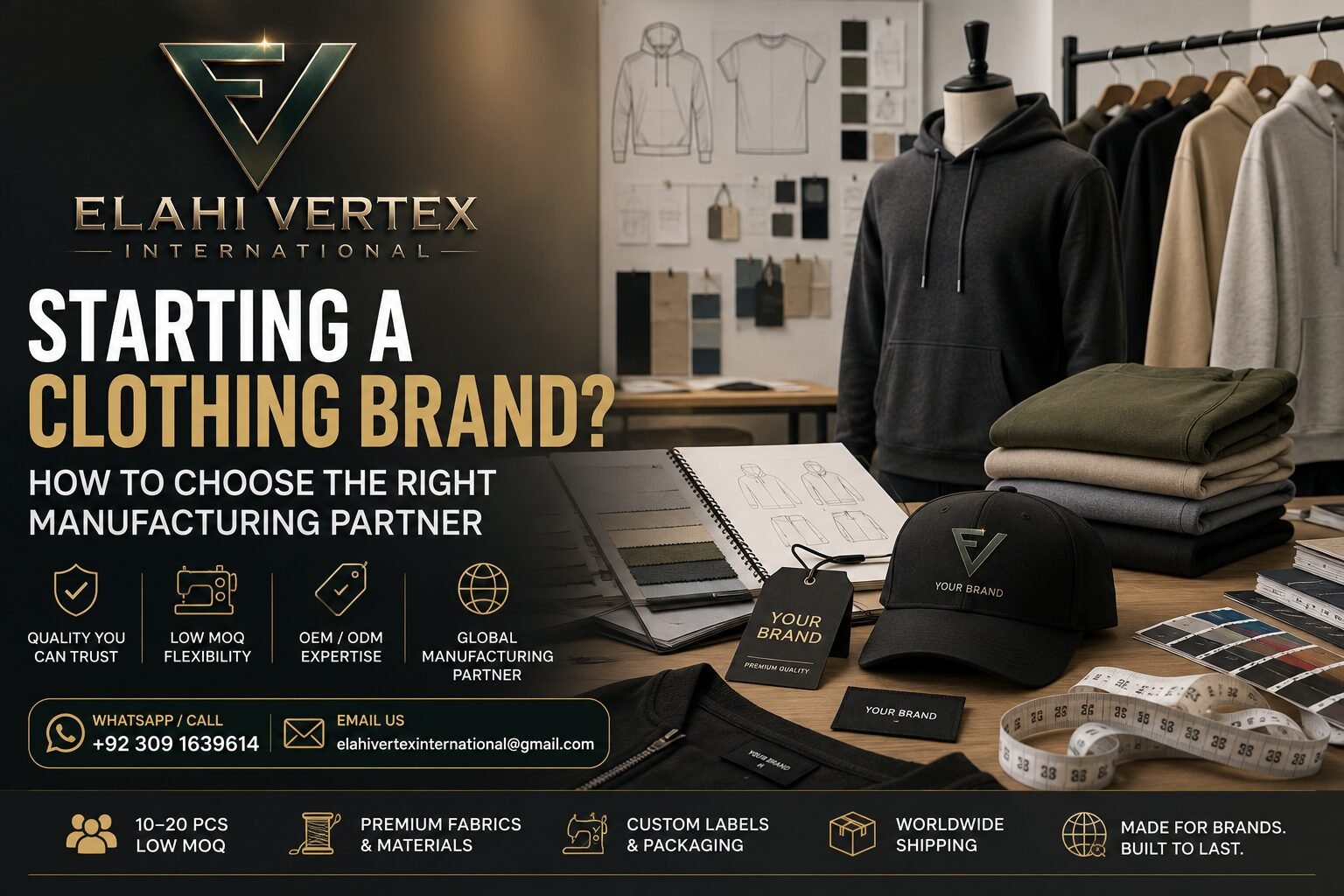
Clothing Brand Manufacturing Partner: Proven Strategies to Build a Successful Brand
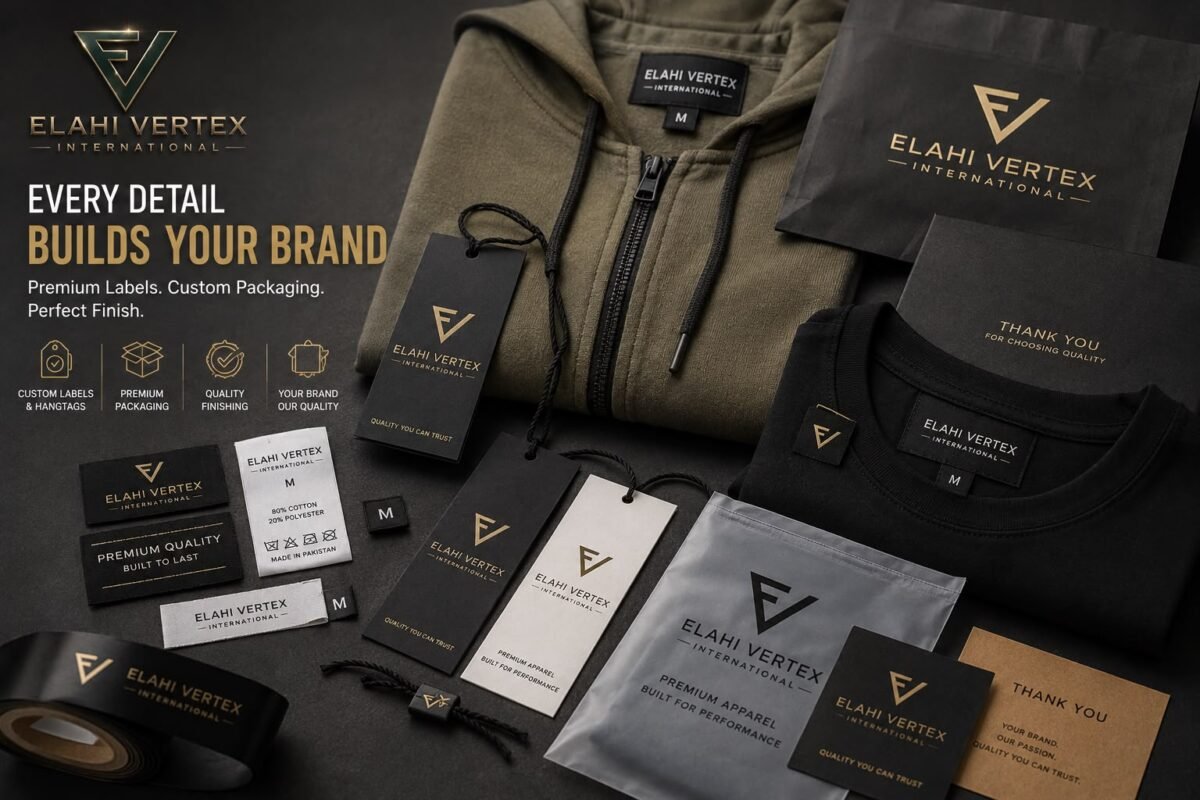
Table of Contents
Clothing Brand Manufacturing Partner: The Ultimate Guide to Building a Successful Brand
Starting a clothing brand is exciting, but turning an idea into a product that can actually be manufactured, branded, inspected, shipped, and sold is a different challenge
For a startup brand, choosing the right manufacturing partner can affect product quality, cash flow, launch timing, customer experience, and the ability to scale later. A manufacturer is not simply the company that makes your garments. The right partner should be able to understand your specifications, communicate clearly, discuss customization requirements, and help turn an approved product concept into a workable production order.
This guide explains what startup clothing brands should evaluate before choosing a manufacturer, including OEM, ODM, private label, samples, MOQ, materials, branding, quality considerations, quotations, packaging, and international sourcing.
For brands looking for a B2B custom manufacturing relationship, Elahi Vertex International operates as a manufacturer, exporter, OEM/ODM supplier, custom manufacturing partner, and private-label manufacturing partner for international buyers.
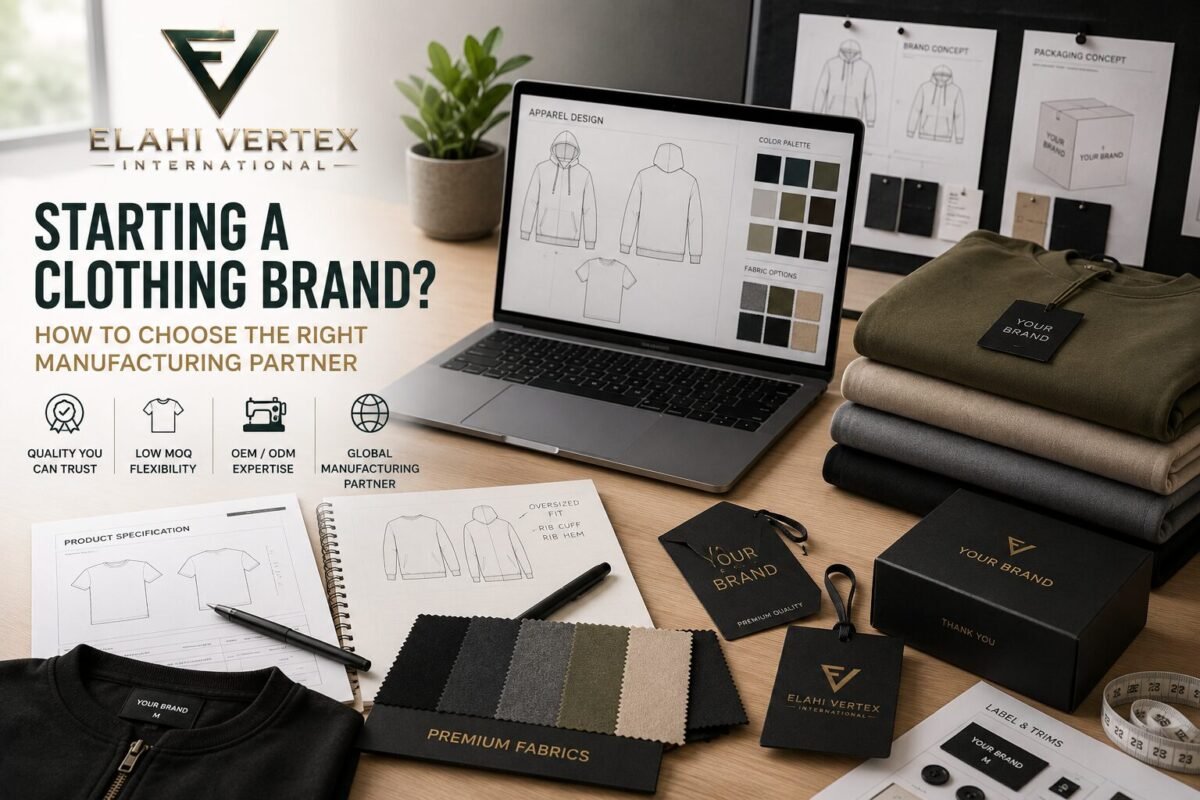
Table of Contents
- What Does a Clothing Manufacturing Partner Actually Do?
- Start With Your Product Requirements
- Choose the Right Manufacturing Model
- What Startup Brands Should Look for in a Manufacturer
- Why Samples Matter Before Bulk Production
- Understand MOQ, Pricing, and Production Variables
- Branding and Private-Label Requirements
- Quality Control and Specification Management
- How to Compare Manufacturers Properly
- Common Startup Manufacturing Mistakes
- What to Include in Your First Manufacturing Inquiry
- Why Elahi Vertex International May Be Relevant for Startup Brands
- Startup Clothing Manufacturer Checklist
- Frequently Asked Questions
- Conclusion
What Does a Clothing Manufacturing Partner Actually Do?
A clothing manufacturing partner helps turn a product concept or specification into a physical garment.
Depending on the manufacturing model and project, this can involve product development, material discussions, pattern and construction requirements, customization, branding, sampling, production, finishing, packaging, and preparation for shipment.
The exact services available vary between manufacturers, so startup brands should never assume that every supplier can handle every stage.
A manufacturer may work from:
- A finished technical specification
- A tech pack
- Product artwork
- A reference garment
- A design concept
- A sample
- Material requirements
- Branding instructions
- Packaging requirements
The more clearly the buyer communicates the product requirements, the easier it becomes for both sides to determine whether the project is suitable.
For a startup, this distinction is important. You are not simply looking for the lowest garment price. You are looking for a manufacturing relationship that can produce the product you actually intend to sell.
1. Start With Your Product Requirements
Before contacting manufacturers, define what you are trying to produce.
You do not need to have every technical detail finalized before making an inquiry, but you should have enough information for a manufacturer to understand the project.
At minimum, consider:
Requirement
What the startup should define
Product
T-shirt, hoodie, tracksuit, jersey, jacket, leggings, etc.
Quantity
Estimated initial order quantity
Target customer
Who will buy the product?
Design
Artwork, sketches, references, or tech pack
Material
Preferred fabric or performance requirements
Sizes
Intended size range
Colors
Main colors and variations
Branding
Logo, labels, tags, embroidery, printing
Packaging
Individual packaging, branded packaging, or other requirements
Destination
Country or market where products will be imported
Timeline
Target launch or required delivery period
This information does not guarantee a quotation or production schedule. It gives the manufacturer enough context to determine what needs to be clarified.
Do Not Start With Only “How Much?”
One of the biggest mistakes a startup can make is sending a message such as:
“I need 100 hoodies. How much?”
The manufacturer still does not know the fabric, construction, design, branding, sizes, colors, packaging, or exact specifications.
A better inquiry explains the product and requirements.
The goal is not to make the inquiry unnecessarily complicated. The goal is to provide enough information for the manufacturer to respond intelligently.
2. Choose the Right Manufacturing Model
Before selecting a supplier, understand what type of manufacturing relationship you actually need.
Private Label Manufacturing
Private-label manufacturing is generally used when a buyer wants products manufactured under its own brand identity.
Depending on the supplier and project, this may involve branded labels, tags, packaging, and other customization.
This can be attractive for startup brands that want to establish a recognizable identity without building their own production facility.
OEM Manufacturing
OEM generally involves manufacturing according to the buyer’s specifications.
The buyer may provide detailed product requirements, designs, technical information, materials, measurements, artwork, or other specifications.
For startups with a clear product concept, OEM can be appropriate when the manufacturer is expected to produce according to defined requirements.
ODM Manufacturing
ODM can involve a manufacturer contributing more to product development or providing existing development capabilities that can be customized for the buyer.
The exact scope of ODM varies between manufacturers.
Custom Manufacturing
Custom manufacturing is a broader term covering projects where products are developed or produced according to buyer-specific requirements.
For a startup, the key question is not which term sounds best. The key question is:
Which manufacturing model matches the amount of product development and customization your brand requires?
3. What Startup Brands Should Look for in a Manufacturer
A startup should evaluate a manufacturer on more than price.
1. Relevant Product Capability
A manufacturer that produces sportswear may not necessarily be the right partner for a highly structured fashion jacket, and a supplier specializing in basic garments may not be suitable for technically complex products.
Look for demonstrated relevance to the type of product you want to manufacture.
2. Customization Capability
Ask whether the supplier can work with your requirements for:
- Materials
- Construction
- Fit
- Colors
- Artwork
- Embroidery
- Printing
- Labels
- Tags
- Packaging
The available options should be confirmed for the specific project.
3. Communication
Communication is one of the most underestimated parts of international manufacturing.
A startup should be able to communicate:
- Product specifications
- Design changes
- Approval decisions
- Quantities
- Sizes
- Branding
- Packaging
- Delivery requirements
Poor communication can create problems even when the manufacturer itself has adequate production capability.
4. Sampling Process
Ask how product samples are handled and what information is needed before sampling.
A sample provides an opportunity to identify problems before committing to larger production.
5. Quality Expectations
Do not simply ask whether a manufacturer provides “high quality.”
Ask what will actually be checked and how the finished product will be evaluated against the approved specifications.
6. Commercial Transparency
The quotation should be understandable enough for you to know what you are comparing.
If two manufacturers provide different prices, determine what is actually included before deciding that one is cheaper.
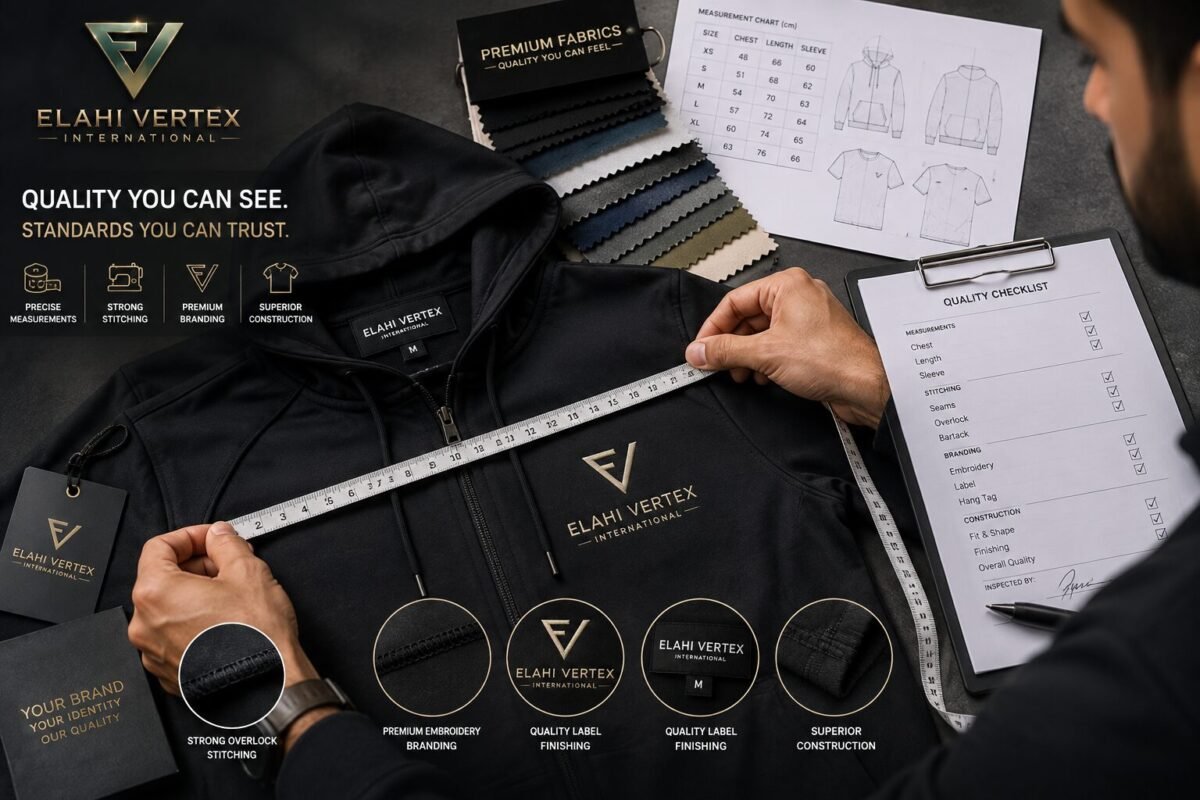
4. Why Samples Matter Before Bulk Production
For a startup brand, a sample can be one of the most valuable checkpoints in the manufacturing process.
A product may look correct in artwork but behave differently as a physical garment.
A sample can help you evaluate:
- Fit
- Measurements
- Fabric characteristics
- Stitching
- Construction
- Color
- Print placement
- Embroidery
- Labels
- Overall appearance
- Packaging concept where relevant
Do not treat a sample as a formality.
Treat it as a product-development checkpoint.
What Should Happen After Receiving a Sample?
Review the sample systematically.
Check:
Measurements → Fit → Fabric → Construction → Branding → Finishing → Appearance
If something needs to change, document the change clearly.
For example, instead of saying:
“Make the sleeves better.”
Specify what needs to change and, where possible, provide measurements or visual references.
This reduces ambiguity before bulk production.
5. Understand MOQ, Pricing, and Production Variables
MOQ means minimum order quantity, but MOQ is not the only commercial variable a startup needs to understand.
The appropriate quantity can depend on the product, customization, material requirements, production method, and supplier.
For that reason, startups should not assume that a manufacturer’s MOQ for one product automatically applies to every product.
What Can Affect the Cost?
Depending on the project, pricing may be affected by:
- Product type
- Material
- Construction
- Quantity
- Customization
- Printing
- Embroidery
- Labels
- Packaging
- Sampling
- Special finishing
- Shipping requirements
This is why comparing two quotations based only on the unit price can be misleading.
A lower quotation is not necessarily better if the specifications are different.
The Startup Cash-Flow Problem
A new brand has a difficult balance to manage:
Too little inventory → stockouts and missed sales
Too much inventory → capital tied up in unsold products
That makes production planning particularly important for startups.
The right quantity should be based on the brand’s product strategy, expected demand, available capital, supplier requirements, and ability to reorder.
6. Branding and Private-Label Requirements
Your manufacturer may produce the garment, but your brand identity belongs to your business.
That means branding requirements should be discussed early.
Depending on the project, branding may include:
- Main labels
- Size labels
- Care labels
- Hangtags
- Logo embroidery
- Printed logos
- Woven labels
- Packaging
- Custom bags
- Product cards
Availability and implementation should be confirmed with the manufacturer for the specific product.
For international brands, packaging and labeling also deserve attention.
For example, U.S. textile and apparel imports can involve requirements concerning fiber content, care instructions, and country-of-origin marking. U.S. Customs and Border Protection specifically advises importers to review applicable textile and apparel requirements. (CBP Help)
Do not assume that your manufacturer automatically knows every legal requirement in your destination market.
The brand owner or importer should verify the applicable regulations for the target country.
7. Protect Your Brand Before Production
Manufacturing is only one part of launching a clothing brand.
Your brand name, logo, packaging, and other distinctive elements may have intellectual-property implications.
The World Intellectual Property Organization notes that trademarks are important assets for fashion brands, including small and startup companies. (WIPO)
Before investing heavily in branded inventory, consider whether your brand identity is available for use and whether trademark protection is appropriate for your target markets.
This is especially important if you intend to build the brand internationally.
A manufacturer can produce your garments. It cannot replace your responsibility for protecting your brand’s intellectual property.
8. Quality Control and Specification Management
Quality should be discussed in terms of measurable requirements rather than vague promises.
A practical manufacturing framework can include:
- Confirm product specifications
- Review materials and components
- Approve samples where applicable
- Monitor production requirements
- Check measurements and construction
- Review branding and finishing
- Inspect finished goods
- Check packaging before shipment
This is a general buyer framework, not a statement that every manufacturer follows these exact steps.
When working with Elahi Vertex International, project-specific quality and production procedures should be confirmed according to the product and order.
The Approved Sample Matters
If a sample is approved, the final production should be evaluated against the agreed specifications.
Keep records of:
- Approved measurements
- Color references
- Artwork
- Branding placement
- Materials
- Construction requirements
- Packaging instructions
- Quantity breakdown
Good documentation reduces the risk of misunderstandings.
9. How to Compare Manufacturers Properly
Suppose three manufacturers send you three different quotations.
Do not immediately choose the lowest number.
Create a comparison table.
| Evaluation Area | Manufacturer A | Manufacturer B | Manufacturer C |
| Product specification | Confirm | Confirm | Confirm |
| Material | Compare | Compare | Compare |
| Customization | Compare | Compare | Compare |
| MOQ | Confirm | Confirm | Confirm |
| Sampling | Confirm | Confirm | Confirm |
| Branding | Compare | Compare | Compare |
| Packaging | Compare | Compare | Compare |
| Quality requirements | Confirm | Confirm | Confirm |
| Production timeline | Confirm | Confirm | Confirm |
| Shipping terms | Confirm | Confirm | Confirm |
| Communication | Evaluate | Evaluate | Evaluate |
| Total commercial value | Evaluate | Evaluate | Evaluate |
This prevents price from becoming the only decision criterion.
A Better Question
Instead of asking:
“Who is cheapest?”
ask:
“Which manufacturer gives me the best fit for my product, requirements, risk level, and business stage?”
That is a much more useful question.
10. Common Startup Manufacturing Mistakes
Mistake 1: Choosing Only by Price
A cheap quotation can become expensive if the product does not meet expectations.
Mistake 2: Ordering Before Approving Specifications
If the product requirements are unclear, production can become difficult to manage.
Mistake 3: Skipping Samples
A startup may save money by avoiding sampling but create a much larger risk through an unsuitable bulk order.
Mistake 4: Sending Incomplete Artwork
Low-resolution or incomplete artwork can create unnecessary production questions.
Mistake 5: Not Confirming Sizes
A brand should establish its size range and measurement requirements before bulk production.
Mistake 6: Assuming Every Manufacturer Offers the Same Services
OEM, ODM, private label, printing, embroidery, packaging, sampling, and other services vary by supplier.
Mistake 7: Ignoring Destination Requirements
Import requirements can vary by country and product. International buyers should verify their own destination-market obligations.
Mistake 8: Treating the Manufacturer as the Entire Business
Your manufacturer produces the product. Your startup still has to handle branding, marketing, sales, customer service, inventory planning, legal compliance, and financial management.
11. What to Include in Your First Manufacturing Inquiry
A strong first inquiry does not need to be extremely long.
It needs to be useful.
Consider sending:
Product Information
- Product name
- Product category
- Reference images
- Design files
- Tech pack if available
Quantity
- Estimated quantity
- Number of designs
- Number of colors
- Size breakdown if available
Material
- Preferred fabric
- Fabric weight if known
- Performance requirements
- Other material specifications
Branding
- Logo
- Label requirements
- Hangtags
- Printing
- Embroidery
- Packaging
Commercial Information
- Destination country
- Target timeline
- Sampling requirements
- Any special production requirements
A clear inquiry makes it easier for a manufacturer to identify what needs clarification before providing project-specific information.
12. Why Elahi Vertex International May Be Relevant for Startup Brands
For a startup clothing brand, the manufacturing relationship needs to match the brand’s actual requirements.
Elahi Vertex International is positioned as a B2B manufacturer, exporter, OEM/ODM supplier, custom manufacturing partner, and private-label manufacturing partner rather than as a ready-made consumer retail brand.
That distinction matters.
A startup looking for custom production may need to discuss its own:
- Product concepts
- Specifications
- Branding
- Customization
- OEM requirements
- ODM requirements
- Private-label requirements
- Packaging
- Production expectations
Elahi Vertex International can discuss these requirements with international B2B buyers and determine what needs to be confirmed for the specific project.
The company works across relevant categories including sportswear, streetwear, teamwear, boxing wear, gymwear, leather wear, and other custom apparel-related projects.

A sample provides an important checkpoint before bulk production.
Why This Model Can Make Sense for a Startup
A startup does not necessarily need to build its own manufacturing infrastructure.
Working with a B2B manufacturing partner can allow the brand to focus more of its internal resources on:
- Product positioning
- Brand identity
- Marketing
- E-commerce
- Customer acquisition
- Sales
- Product development
while manufacturing is handled through an external production relationship.
However, the startup should still remain closely involved in specifications, approvals, quality expectations, and commercial decisions.
Elahi Vertex International Is Not a Substitute for Buyer Due Diligence
Choosing a manufacturing partner is a business decision.
Even when a manufacturer appears suitable, the buyer should confirm:
- Product capabilities
- Project specifications
- MOQ
- Sampling
- Production timeline
- Pricing
- Materials
- Branding
- Packaging
- Shipping
- Payment terms
- Destination-market requirements
These details can vary by project and should be confirmed before an order is placed.
That is a more realistic approach than assuming that one manufacturer is automatically suitable for every startup.
13. Startup Clothing Manufacturer Checklist
Before choosing your manufacturing partner, ask:
Product
- Is the manufacturer experienced with my product category?
- Can they understand my specifications?
- Can they support my required customization?
Sampling
- Can I review a sample before bulk production?
- What information is needed for sampling?
- How will revisions be communicated?
Quantity
- What MOQ applies to my specific product?
- Does quantity affect pricing?
- Can different colors or designs change the production requirements?
Branding
- Can my labels and branding requirements be discussed?
- What printing or embroidery options are relevant?
- Can packaging requirements be accommodated?
Quality
- How will specifications be checked?
- What should be included in the approved sample?
- How will defects or specification deviations be handled?
Commercial
- What is included in the quotation?
- What factors can change the final price?
- What production timeline should I expect?
- What shipping responsibility applies?
Supplier
- Is communication clear?
- Does the supplier understand the project?
- Are company and project details sufficiently verified?
- Are important commercial terms documented?
If several of these questions remain unanswered, you are probably not ready to place the bulk order.
Expert Tips for Startup Brands
Tip 1: Start With One Strong Product
A startup does not necessarily need a large collection immediately.
A focused first product can make it easier to test the brand’s positioning, customer response, manufacturing requirements, and operational process.
Tip 2: Document Every Important Decision
Do not rely on scattered messages.
Keep a central record of the approved:
- Design
- Measurements
- Materials
- Colors
- Branding
- Quantity
- Packaging
- Production requirements
Tip 3: Separate Product Quality From Marketing Quality
A strong Instagram account cannot compensate for a poor garment.
At the same time, a good garment does not automatically create a successful brand.
Both product execution and market execution matter.
Tip 4: Think Beyond the First Order
Your first manufacturer should not only be evaluated for today’s order.
Consider whether the relationship could support future product development, additional styles, increased quantities, or changing requirements.
Frequently Asked Questions
Can a startup clothing brand work directly with a manufacturer?
Yes. A startup can work directly with a B2B clothing manufacturer, depending on the manufacturer’s business model, product capabilities, order requirements, and commercial terms.
What is the best manufacturing model for a startup clothing brand?
There is no universal answer. Private label may suit a brand seeking branded products with defined customization, while OEM may be better when the buyer has detailed specifications. ODM may be relevant when the manufacturer contributes more to product development.
Should a startup request samples before bulk production?
Where sampling is available and appropriate, reviewing a sample before committing to bulk production is a sensible way to identify product and specification issues early.
What is the MOQ for clothing manufacturing?
MOQ varies by manufacturer, product, customization, materials, and other project requirements. A startup should request the MOQ applicable to its specific project rather than relying on a general industry number.
How much does it cost to manufacture clothing?
There is no single manufacturing price. Product type, materials, quantity, construction, customization, branding, packaging, and other requirements can affect the quotation.
Can Elahi Vertex International manufacture products under a startup’s brand?
Elahi Vertex International operates as an OEM/ODM, custom manufacturing, and private-label B2B manufacturing partner. Specific branding, labeling, customization, and production requirements should be discussed and confirmed for the individual project.
Does Elahi Vertex International work with startup brands?
Startup brands can contact Elahi Vertex International to discuss their manufacturing requirements. Suitability, quantities, product specifications, and project terms should be confirmed for each individual order.
Can Elahi Vertex International support OEM manufacturing?
Yes, Elahi Vertex International is positioned as an OEM supplier. The exact scope of OEM production should be confirmed according to the product and specifications.
Can Elahi Vertex International support ODM manufacturing?
Yes, Elahi Vertex International is positioned as an ODM supplier. The specific development and customization scope should be discussed for the individual project.
Can startup brands request private-label manufacturing?
Yes, Elahi Vertex International offers private-label manufacturing as part of its B2B manufacturing model. Specific labels, branding, packaging, and production requirements should be confirmed for the project.
What should I send when requesting a quotation?
Send the product type, quantity, design or reference, materials if known, sizes, colors, branding requirements, packaging requirements, destination market, and target timeline where applicable.
Should I choose a manufacturer based only on MOQ?
No. MOQ should be considered alongside product capability, quality requirements, sampling, customization, pricing, communication, production requirements, and long-term suitability.
What should I confirm before placing a bulk order?
Confirm the final product specifications, approved sample where applicable, quantity, sizes, materials, branding, packaging, price, production timeline, shipping arrangements, payment terms, and any destination-market requirements.
Conclusion
Starting a clothing brand involves much more than creating a logo and choosing a product.
Your manufacturing partner can influence how accurately your designs are produced, how smoothly specifications are communicated, how confidently you approach your first order, and how prepared your business is for future production.
The right approach is to define your product first, understand the manufacturing model you need, compare suppliers carefully, review samples where appropriate, document specifications, and confirm commercial terms before production.
For startup brands considering custom apparel, OEM, ODM, or private-label manufacturing, Elahi Vertex International can discuss the project’s requirements and determine what information needs to be confirmed for the specific order.
If you are preparing a clothing brand and want to discuss manufacturing, send the product type, estimated quantity, design or reference, customization requirements, branding details, and destination market to Elahi Vertex International.
Contact Elahi Vertex International:
WhatsApp / Phone: +92 309 1639614
Email: elahivertexinternational@gmail.com
For international B2B buyers, the goal should not be finding the manufacturer with the biggest promises. It should be finding a manufacturing partner whose capabilities, communication, specifications, and commercial terms actually fit your brand
Streetwear USA — U.S.-focused streetwear/blank apparel business; its site says it is designed in Los Angeles and built for brands and creators.
Back Of House — Washington, DC streetwear brand.
UNHINGED Apparel — U.S.-focused premium limited-drop streetwear brand.
