

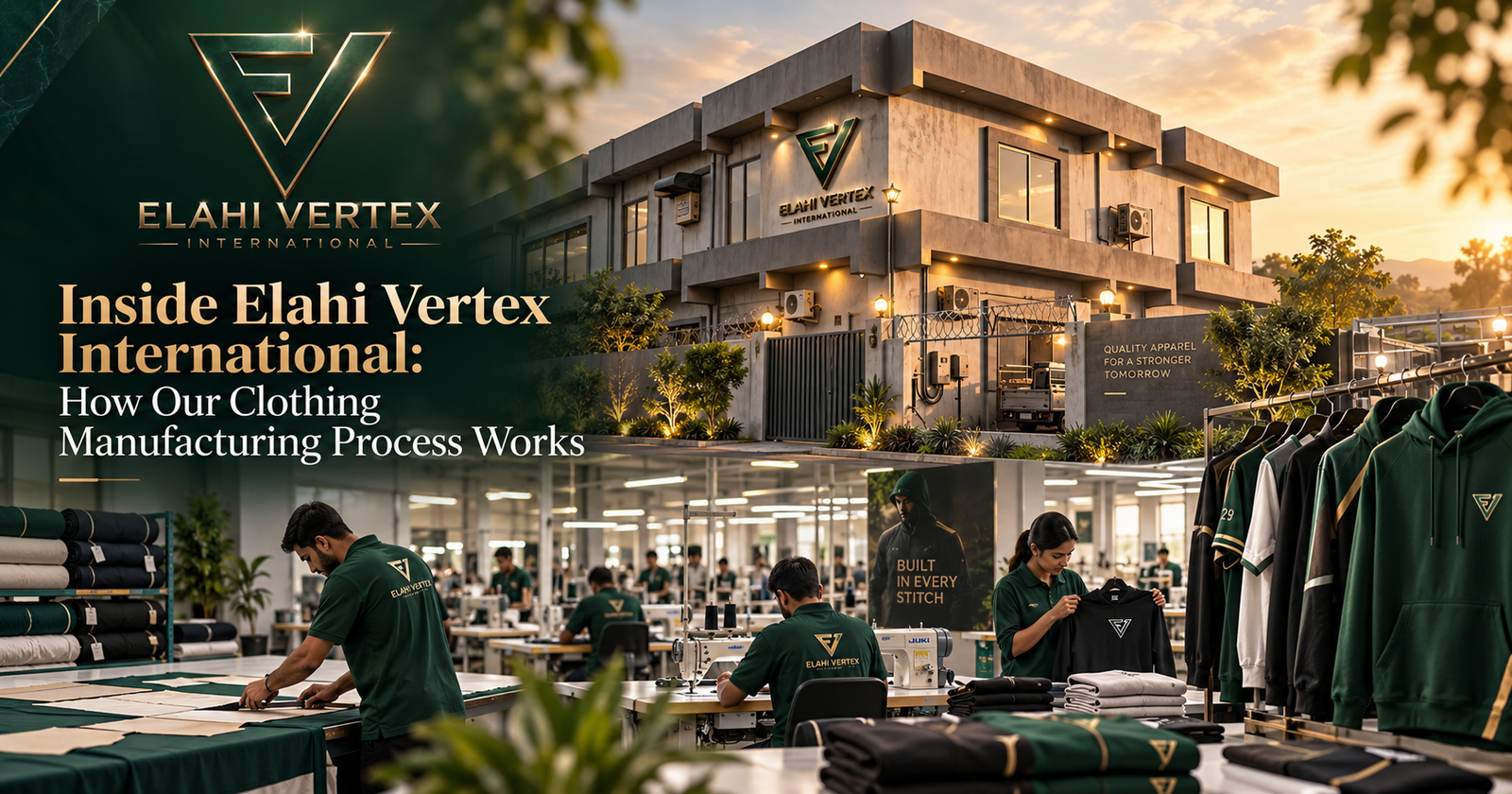
For an international clothing buyer, one question matters before price, MOQ, or even sampling: Who is actually responsible for making the product?
A buyer searching for a clothing manufacturer in Sialkot Pakistan may find factories, exporters, trading companies, sourcing agents, and businesses using similar language. A polished website alone does not prove how production is handled.
Elahi Vertex International operates as a B2B custom clothing manufacturer, exporter, OEM supplier, ODM supplier, and private-label manufacturing partner based in Sialkot, Pakistan. Its current manufacturing information describes a process covering design development, fabric sourcing, sampling, customization, bulk production, quality control, packaging, and shipping. (ELAHI VERTEX INTERNATIONAL)
But buyers deserve a more useful answer than simply being told, “We are a manufacturer.”
This guide explains how apparel production is handled, what a manufacturer should control, what buyers should verify, where specialist production stages may need clarification, and how to distinguish a genuine manufacturing relationship from a simple middleman transaction.
Table of Contents
- Is Elahi Vertex International a manufacturer or middleman?
- Why buyers ask this question in Sialkot
- How Elahi Vertex International handles apparel production
- What manufacturing control actually means
- Manufacturer vs middleman vs sourcing company
- How buyers can verify a clothing manufacturer in Sialkot Pakistan
- Sampling and product approval
- Quality control and sample-to-bulk consistency
- OEM, ODM and private-label manufacturing
- Does every manufacturing process need to be in-house?
- What international buyers should confirm before production
- Common supplier-verification mistakes
- Why work with Elahi Vertex International?
- Frequently asked questions
- Useful external resources
- Conclusion
Is Elahi Vertex International a Manufacturer or Middleman?
Elahi Vertex International is positioned as a custom B2B apparel manufacturer and exporter based in Sialkot, Pakistan—not as a retail reseller of generic finished garments.
Its manufacturing model is built around producing apparel according to buyer designs, specifications, measurements, materials, branding, and production requirements. Its current manufacturing page describes support from product development and fabric sourcing through sampling, bulk production, quality control, packaging, and international shipment. (ELAHI VERTEX INTERNATIONAL)
That distinction matters.
A middleman commonly purchases or arranges products from another supplier without substantial responsibility for product engineering or production control.
A custom manufacturer is expected to work from an agreed specification and maintain responsibility for turning that specification into a finished garment.
However, buyers should not confuse “manufacturer” with “every single industrial operation takes place inside one building.”
Modern apparel supply chains can involve specialized material suppliers, dyeing facilities, printing units, embroidery operations, trim suppliers, testing providers, packaging suppliers, and logistics companies.
The more important questions are:
Who manages your specifications? Who develops the sample? Who approves materials? Who controls production? Who checks the finished goods? Who is commercially responsible if something does not match the agreed specification?
Those are much more useful questions than simply asking whether every machine involved in an order sits under the same roof.
Why Do Buyers Ask Whether a Clothing Manufacturer in Sialkot Pakistan Is a Middleman?
Because the difference affects communication, pricing, quality control, accountability, lead-time visibility, product development, and repeat-order consistency.
The concern is real enough that current Sialkot manufacturers frequently market themselves using terms such as “factory direct,” “direct factory access,” and “zero middlemen.” (freviswear.com)
Sialkot itself has a substantial export-oriented industrial base. The Sialkot Chamber of Commerce & Industry identifies sportswear, textile items, leather products, martial-art uniforms and numerous other manufactured goods among the city’s export sectors. (scci.com.pk)
But being located in Sialkot does not automatically prove manufacturing capability or product quality.
A serious buyer should verify the company—not simply the city.
That means examining:
- Product knowledge
- Actual production evidence
- Sampling ability
- Material knowledge
- Construction knowledge
- Specification handling
- Quality-control procedures
- Business registration where relevant
- Communication quality
- Product photographs
- Manufacturing photographs or videos
- Commercial documentation
- Payment terms
- Shipping responsibilities
- Sample-to-bulk controls
A location can provide manufacturing ecosystem advantages. It cannot replace supplier due diligence.
How Elahi Vertex International Handles Apparel Production
A professional manufacturing relationship should turn an idea or technical specification into an approved, repeatable product.
Elahi Vertex International describes its manufacturing workflow as covering product development, fabric sourcing, sampling, customization, bulk production, quality control, packaging, and shipping. (ELAHI VERTEX INTERNATIONAL)
A practical project can therefore be understood through the following stages.
1. Buyer Requirement and Product Brief
Manufacturing should begin with information, not machines.
The buyer should provide as much relevant information as possible:
- Product type
- Reference images
- Sketches
- Tech pack if available
- Fabric preference
- Target GSM if known
- Fit
- Measurements
- Size range
- Colors
- Artwork
- Printing or embroidery requirements
- Labels
- Packaging
- Quantity
- Destination
- Required delivery period
A buyer does not necessarily need every technical detail finalized before the first conversation.
However, incomplete information should lead to questions—not guesses.
That is particularly important when evaluating a clothing manufacturer in Sialkot Pakistan for a product that will eventually carry your own brand name.
2. Specification Review and Product Development
A reference photograph is useful, but it is not a complete manufacturing specification.
Two visually similar hoodies, jerseys, tracksuits or jackets may differ significantly in:
- Fabric composition
- GSM
- Pattern
- fit
- seam construction
- rib quality
- thread
- zipper quality
- lining
- printing technique
- embroidery density
- measurements
- trims
- finishing
The manufacturing discussion therefore needs to convert the buyer’s idea into measurable production requirements.
This is where a manufacturer’s technical involvement becomes more important than simply saying, “Yes, we can make it.”
The objective should be:
idea → specification → sample → approval → repeatable production
3. Fabric and Material Selection
Fabric can determine how a garment looks, feels, performs, washes, stretches and lasts.
For that reason, “cotton,” “polyester,” or “fleece” is often insufficient as a complete specification.
Depending on the garment, buyers may need to confirm:
Composition: cotton, polyester, nylon, elastane or blends.
Weight: commonly expressed as GSM.
Structure: jersey, interlock, French terry, fleece, mesh, rib or another construction.
Performance requirements: stretch, moisture management, breathability or other required properties.
Color requirements: reference sample, Pantone direction or approved color standard where applicable.
Surface and hand feel: smooth, brushed, heavyweight, lightweight or another specified finish.
International textile organizations maintain test methods covering areas such as fiber analysis, colorfastness, abrasion, laundering and other performance characteristics, illustrating why professional fabric evaluation goes beyond simply looking at a swatch. (AATCC)
Not every order requires laboratory testing. Testing requirements should depend on the buyer’s product, market and risk level.
4. Sample Development Before Bulk Production
Sampling is one of the strongest ways to reduce manufacturing uncertainty.
A sample can help a buyer evaluate:
| Area | What the Buyer Can Check |
|---|---|
| Fabric | Composition direction, GSM, feel and appearance |
| Fit | Shape, length, width and overall silhouette |
| Measurements | Comparison with approved size specifications |
| Stitching | Construction and workmanship |
| Printing | Size, position, color and finish |
| Embroidery | Placement, scale, density and appearance |
| Branding | Labels, tags and identity |
| Trims | Zippers, drawcords, buttons, ribbing and accessories |
| Color | Appearance against the approved requirement |
| Overall product | Whether the garment matches the intended commercial result |
A sample should not merely demonstrate that a garment can be made.
Its real purpose is to establish a reference for what bulk production is expected to follow.
5. Sample Review, Revision and Approval
Receiving a sample does not automatically mean the product is ready for production.
A buyer should inspect it carefully.
For example:
A streetwear buyer may decide the body needs to be wider.
An activewear brand may decide the fabric requires greater stretch.
A sportswear company may adjust sleeve measurements.
A teamwear buyer may change sponsor-logo positioning.
A leatherwear buyer may request a different zipper, lining or hardware finish.
The safest principle is simple:
Correct problems before bulk production, not after it.
Once specifications and the sample are approved, those approved details provide a much stronger production reference.
6. Bulk Apparel Production
Bulk production should follow the approved requirements rather than restart product development from memory.
That means production information should clearly identify important details such as:
- Approved design
- Materials
- Measurements
- Size breakdown
- Color
- Artwork
- Printing
- Embroidery
- Labels
- trims
- Packaging requirements
- Quantity
This is one major distinction between a structured manufacturing relationship and an informal sourcing transaction.
A professional clothing manufacturer in Sialkot Pakistan should be able to explain how approved information moves from sampling into bulk production.
What Does Manufacturing Control Actually Mean?
Manufacturing control does not simply mean owning machines.
It means controlling the information and checkpoints required to produce the agreed product consistently.
For a buyer, useful manufacturing control includes:
Specification Control
The production team understands what has been approved.
Material Control
The required fabrics, colors and trims are identified before production.
Sample Control
Bulk production has a clear reference.
Production Control
Garments are manufactured according to the agreed construction and specification.
Quality Control
Finished work is compared against agreed requirements.
Packing Control
Labels, quantities, sizes and packaging are checked where applicable.
Shipment Control
The correct goods are prepared according to the agreed shipping arrangement.
This is why buyers should evaluate the production system, not merely the manufacturer’s marketing language.
Manufacturer vs Middleman vs Sourcing Company
These business models are not automatically good or bad. They are simply different, and a buyer should know which relationship they are entering.
| Factor | Manufacturer | Trading/Middleman Company | Sourcing Company |
|---|---|---|---|
| Primary role | Produces apparel | Buys/arranges goods from suppliers | Finds and manages suppliers |
| Product development | Usually direct | Depends on supplier | Coordinates with factory |
| Production responsibility | Direct | Usually indirect | Management/coordination |
| Factory communication | Direct or internal | Often through intermediary | Managed for buyer |
| Production visibility | Potentially high | Can be limited | Depends on model |
| Pricing structure | Manufacturing price + margin | Supplier cost + trading margin | Supplier price + sourcing fee/margin |
| QC responsibility | Manufacturer process | Depends on trader | Often coordinated |
| Best fit | Buyers wanting direct manufacturing | Buyers prioritizing convenience | Buyers managing multiple factories/categories |
The problem is not that sourcing companies or trading businesses exist.
The problem occurs when one business model is presented as another.
Transparency matters.
Does Every Apparel Process Need to Be In-House?
No.
This is one of the areas where buyers sometimes use the wrong test when evaluating manufacturers.
Apparel production may require specialists for:
- Fabric knitting
- Dyeing
- Washing
- Screen printing
- digital printing
- sublimation
- embroidery
- heat transfers
- specialty coatings
- leather processing
- trims
- labels
- packaging
- laboratory testing
A factory that uses a qualified specialist for a particular process is not automatically a middleman.
The meaningful questions are:
Was the buyer informed appropriately?
Who establishes the specification?
Who checks the outsourced process?
Who accepts responsibility for the final garment?
Can the supplier trace the product back to the approved requirement?
For Elahi Vertex International, any project-specific question about whether a particular specialist operation is performed internally or through an approved production partner should be confirmed for that specific order rather than assumed.
That is more credible than claiming that every possible apparel process is always conducted under one roof.
How Can Buyers Verify a Clothing Manufacturer in Sialkot Pakistan?
Do not rely on one signal.
Use multiple forms of verification.
1. Examine Actual Product Work
Look for authentic product photographs covering the categories being offered.
One sample photograph is not enough to prove an entire product range.
2. Ask Technical Questions
Discuss:
- Fabric
- GSM
- construction
- measurements
- printing
- embroidery
- grading
- labels
- finishing
- packaging
The quality of the answers can reveal how close the supplier is to actual product development.
3. Request a Sample
A physical sample is much stronger evidence than a sales presentation.
Inspect the actual garment before committing to meaningful bulk quantities.
4. Ask to See Production
Where commercially practical, request manufacturing photographs, process videos or a live production call.
The objective is verification—not entertainment.
5. Confirm Company Information
Check business identity, location and commercial documentation relevant to the transaction.
6. Request a Written Specification
Important details should survive beyond WhatsApp conversations.
Approved materials, measurements, artwork and other product requirements should be documented.
7. Understand Payment and Shipping Responsibilities
Know:
- What you are paying for
- When payments become due
- What shipping is included
- Who pays import charges where applicable
- Which shipping method is being used
- What documents will accompany the shipment
8. Start With a Controlled Order
When working with a new supplier, risk should increase gradually with confidence.
Sample first where appropriate.
Then proceed to a manageable bulk order.
Scale after the supplier demonstrates reliable execution.
How Elahi Vertex International Approaches Quality Control
Elahi Vertex International’s current quality-control information states that its manufacturing checks can cover fabrics and materials, measurements, stitching, garment construction, printing, embroidery, colors, labels and branding, finishing, and final appearance. The stated objective is to keep bulk production as close as possible to the approved sample and specifications. (ELAHI VERTEX INTERNATIONAL)
That principle is important because apparel quality is multidimensional.
A garment can have excellent stitching but incorrect sizing.
It can use premium fabric but poor printing.
It can have perfect embroidery but the wrong placement.
It can match the design but use an incorrect color.
It can look good individually while containing inconsistent measurements across sizes.
Quality control therefore needs to check the requirements that actually matter to the buyer’s product.
International standards organizations use similarly structured thinking. ISO describes quality management around controlled processes, meeting customer requirements, performance evaluation and continual improvement. (ISO)
That does not mean Elahi Vertex International should be assumed to hold a particular ISO certification unless a valid certificate has been verified.
A standard can be useful buyer guidance without being presented as a company certification.
Sample-to-Bulk Consistency Matters More Than an Impressive Sample
A supplier can create one excellent sample.
The harder manufacturing challenge is reproducing the approved standard across production.
Before bulk approval, a buyer should make sure important specifications are locked:
Fabric → Color → Measurements → Construction → Artwork → Branding → Trims → Finishing → Packaging
For repeat orders, maintaining previous specifications is equally important.
This is particularly relevant for:
- Teamwear businesses
- Streetwear brands
- Sportswear labels
- Activewear brands
- Wholesalers
- distributors
- clubs
- academies
- private-label companies
Their business model may depend on reproducing the same product months later.
OEM, ODM and Private-Label Production at Elahi Vertex International
Elahi Vertex International’s current positioning includes OEM, ODM and private-label manufacturing. (ELAHI VERTEX INTERNATIONAL)
These terms are related but not identical.
OEM Manufacturing
The buyer generally supplies the product requirements and the manufacturer produces according to those specifications.
This is appropriate when a brand already knows:
- Design
- measurements
- materials
- construction
- branding
- packaging
ODM Manufacturing
ODM can involve a greater level of product-development support before the specification is finalized.
Exact design responsibilities should always be agreed for each project.
Private-Label Manufacturing
Private label focuses on producing products that carry the buyer’s brand identity.
Depending on the project, that may involve:
- Main labels
- care labels
- size labels
- hangtags
- packaging
- branded trims
Private labeling should not be confused with simply placing a logo on generic stock clothing.
Why Sialkot Can Be Valuable for Apparel Sourcing
Sialkot has a long-established export manufacturing ecosystem covering sportswear, textile products, leather goods, sports products and related categories. The city’s Chamber of Commerce lists these sectors among Sialkot’s export industries. (scci.com.pk)
That ecosystem can give a clothing manufacturer in Sialkot Pakistan access to suppliers and specialist production knowledge across multiple apparel-related processes.
But buyers should avoid a common assumption:
Sialkot does not automatically equal quality.
Quality comes from:
Supplier capability
- correct specification
- appropriate materials
- approved sampling
- controlled production
- inspection
- communication.
Two companies located in the same manufacturing city can produce very different results.
Evaluate the supplier, not the postcode.
What Should International Buyers Confirm Before Approving Production?
Before sending a bulk-production approval, confirm the commercial and technical picture.
Product
Exactly what is being manufactured?
Quantity
How many pieces, sets or units?
Material
What fabric, composition and GSM have been agreed?
Measurements
Which size chart or graded measurements are approved?
Artwork
Which final artwork files are being used?
Branding
What labels, tags or packaging are required?
Sample
Which approved sample or revision controls bulk production?
Quality Expectations
Which attributes matter most?
Production Timing
What production period has been agreed for this particular order?
Shipping
Where is the order going, by which shipping method, and under which commercial arrangement?
Payment
What payment milestones have been agreed in writing?
The purpose of this checklist is not bureaucracy.
It is to eliminate expensive ambiguity.
Common Mistakes When Choosing a Clothing Manufacturer in Sialkot Pakistan
Choosing the Lowest Price First
A lower quotation can become expensive if the product requires remaking, causes returns or damages customer trust.
Believing Every Website Claim
Verify important claims independently.
Skipping Sampling
Photos cannot communicate fit, weight, texture and construction as effectively as a physical garment.
Sending Only a Reference Picture
References help, but measurements and specifications make manufacturing much clearer.
Assuming “In-House” Automatically Means Better
Control and competence matter more than marketing terminology.
Ignoring Shipping
A low factory price can become commercially unattractive once freight and destination costs are added.
Changing Specifications During Bulk Production
Late changes introduce avoidable risk.
Scaling Too Quickly With a New Supplier
Confidence should be earned through execution.
Why Consider Elahi Vertex International?
Elahi Vertex International operates from Sialkot, Pakistan and currently presents itself as a manufacturer and exporter serving custom apparel, sportswear, teamwear, activewear, streetwear, boxing wear, leatherwear and private-label projects. (ELAHI VERTEX INTERNATIONAL)
Its website also provides dedicated manufacturing, portfolio, quality-control, case-study and custom-manufacturing sections rather than relying solely on a product catalogue. (ELAHI VERTEX INTERNATIONAL)
For serious B2B buyers, the next step should still be verification.
Review the work.
Discuss your exact product.
Send specifications.
Develop a sample where appropriate.
Confirm the approved standard.
Then make the bulk-production decision.
That is how a manufacturing relationship should earn trust.
Frequently Asked Questions
1. Is Elahi Vertex International a manufacturer or middleman?
Elahi Vertex International positions itself as a B2B custom clothing manufacturer, exporter, OEM supplier, ODM supplier and private-label manufacturing partner based in Sialkot, Pakistan. Its manufacturing information describes involvement from product development through bulk production, quality control, packing and shipment. (ELAHI VERTEX INTERNATIONAL)
2. Where is Elahi Vertex International located?
Elahi Vertex International is based in Sialkot, Pakistan. (ELAHI VERTEX INTERNATIONAL)
3. What does a clothing manufacturer in Sialkot Pakistan actually do?
A custom manufacturer converts buyer requirements into garments through specification development, material selection, sampling, production, finishing and quality control. Exact capabilities vary by manufacturer.
4. Does Elahi Vertex International manufacture custom apparel?
Yes. Its published manufacturing information describes made-to-order apparel produced around buyer designs, specifications, measurements, materials and branding requirements. (ELAHI VERTEX INTERNATIONAL)
5. Does Elahi Vertex International offer OEM manufacturing?
Yes. OEM clothing manufacturing is part of its published service positioning. (ELAHI VERTEX INTERNATIONAL)
6. Does Elahi Vertex International provide ODM manufacturing?
The company currently positions itself as an ODM supplier. Exact development requirements should be confirmed for the specific product. (ELAHI VERTEX INTERNATIONAL)
7. Does Elahi Vertex International offer private-label manufacturing?
Yes. Private-label apparel manufacturing is included in the company’s current manufacturing positioning. (ELAHI VERTEX INTERNATIONAL)
8. Does being a manufacturer mean every process is performed in-house?
Not necessarily. Apparel production can involve specialist suppliers or processing partners. Buyers should confirm the production arrangement for processes important to their particular order.
9. How can I verify a clothing manufacturer in Sialkot Pakistan?
Review product evidence, ask technical questions, request documentation, inspect a sample, verify company details and request production visibility where appropriate.
10. Should I order a sample before bulk manufacturing?
For new products or new supplier relationships, sampling can substantially reduce uncertainty because it allows the buyer to inspect the physical product before larger production.
11. What should I inspect on an apparel sample?
Check fabric, GSM where relevant, measurements, fit, stitching, construction, printing, embroidery, colors, labels, trims and overall appearance.
12. Why is sample approval important?
The approved sample can become a reference for bulk production and helps both parties identify what has been accepted before larger quantities are manufactured.
13. How should I compare two Sialkot apparel manufacturers?
Compare product capability, communication, samples, material knowledge, specification control, QC, production transparency, commercial terms and shipping—not just unit price.
14. Is Sialkot known for apparel manufacturing?
Sialkot has an export-oriented industrial base covering sportswear, textiles, leather products, sports goods and related manufactured categories. (scci.com.pk)
15. What products does Elahi Vertex International manufacture?
Its current website lists custom sportswear, teamwear, activewear, streetwear, boxing wear, leather wear and private-label apparel among its manufacturing categories. (ELAHI VERTEX INTERNATIONAL)
16. How does Elahi Vertex International check apparel quality?
Its quality-control page identifies checks that can include materials, measurements, stitching, construction, printing, embroidery, colors, branding, finishing and final appearance. (ELAHI VERTEX INTERNATIONAL)
17. Can an international buyer work directly with a clothing manufacturer in Sialkot Pakistan?
Yes. Sialkot manufacturers routinely serve international B2B buyers. Buyers should agree product, commercial, shipping and payment requirements directly with their selected supplier.
18. What information should I send when requesting apparel manufacturing?
Send your product, design or reference, quantity, specifications, measurements, branding requirements, destination and required delivery period.
19. How can I reduce manufacturing risk?
Use clear specifications, physical sampling where appropriate, documented approvals, sensible payment terms, production visibility, quality checks and controlled first-order quantities.
20. What is the best way to start a project with Elahi Vertex International?
Send the product type, design or reference files, estimated quantity, sizes, materials or fabric requirements, customization details, branding requirements, destination and target delivery period so the project can be reviewed properly.
Useful External Resources for Apparel Buyers
- Sialkot Chamber of Commerce & Industry — useful for understanding Sialkot’s export-oriented manufacturing sectors, including sportswear, textile products and leather goods. Sialkot Chamber industry profile
- AATCC Testing & Standards — useful when researching textile test methods for colorfastness, laundering, fiber analysis, abrasion and related performance characteristics. AATCC textile testing standards
- OEKO-TEX STANDARD 100 — useful for understanding how textiles can be independently tested for harmful substances. Do not assume a supplier holds this certification unless its certificate is verified. OEKO-TEX STANDARD 100
- ISO 9001 — useful for understanding internationally recognized quality-management principles such as process control, customer requirements, evaluation and continual improvement. ISO 9001 quality management
- Textile Exchange Standards — useful for buyers researching recognized material and chain-of-custody standards relevant to certain textile sourcing requirements. Textile Exchange standards
- Sialkot Sample Masters — an example of how another Sialkot apparel supplier publicly explains specification-led manufacturing and production stages. Buyers can use competitor information for independent market comparison rather than relying on any single supplier’s claims. Sialkot apparel manufacturing comparison
- Mughal Apparel — another Sialkot manufacturer page targeting buyers researching clothing manufacturing in the region. It can be used as an external comparison when evaluating how different suppliers present capability, MOQ, certifications and production claims. Sialkot clothing manufacturer comparison
- Choosing a clothing manufacturer in Sialkot Pakistan requires buyers to look beyond price and examine how production is actually controlled.
- A reliable clothing manufacturer in Sialkot Pakistan should be able to explain how buyer specifications move from development into sampling and bulk production.
- When evaluating a clothing manufacturer in Sialkot Pakistan, buyers should verify who is responsible for materials, construction, customization, quality control, and final delivery.
- Working with a clothing manufacturer in Sialkot Pakistan can give international brands access to an established apparel and export manufacturing ecosystem.
- Before selecting a clothing manufacturer in Sialkot Pakistan, buyers should review actual products, technical knowledge, production evidence, and sample quality.
- A professional clothing manufacturer in Sialkot Pakistan should clarify fabric composition, GSM, measurements, artwork, trims, and branding requirements before production begins.
- Sampling helps buyers determine whether a clothing manufacturer in Sialkot Pakistan can translate their design requirements into the intended physical product.
- The best way to assess a clothing manufacturer in Sialkot Pakistan is through evidence such as samples, specifications, production visibility, and quality-control procedures.
- A trustworthy clothing manufacturer in Sialkot Pakistan should not depend on vague promises when important product specifications can be documented and approved.
- Buyers comparing a clothing manufacturer in Sialkot Pakistan should examine manufacturing responsibility rather than assuming that the lowest quotation represents the best value.
- Communication with a clothing manufacturer in Sialkot Pakistan should cover both technical product requirements and commercial conditions before bulk production is approved.
- An experienced clothing manufacturer in Sialkot Pakistan should understand that an approved sample becomes an important reference for maintaining sample-to-bulk consistency.
- International brands should ask a clothing manufacturer in Sialkot Pakistan how measurements, colors, printing, embroidery, labels, and finishing are checked during production.
- Choosing a clothing manufacturer in Sialkot Pakistan becomes less risky when the buyer uses clear specifications, sampling, written approvals, and appropriate quality checks.
- A genuine clothing manufacturer in Sialkot Pakistan should be transparent about which production stages it manages directly and where specialist processes may be involved.
- Before placing a repeat order with a clothing manufacturer in Sialkot Pakistan, buyers should confirm whether previously approved specifications and product references remain available.
- A clothing manufacturer in Sialkot Pakistan serving private-label brands should understand that consistency affects not only product quality but also the buyer’s brand reputation.
- Buyers sourcing from a clothing manufacturer in Sialkot Pakistan should confirm packaging, shipping responsibilities, payment terms, and destination requirements before production.
- Elahi Vertex International positions itself as a clothing manufacturer in Sialkot Pakistan focused on custom B2B manufacturing, OEM, ODM, and private-label apparel projects.
- If you are searching for a clothing manufacturer in Sialkot Pakistan, evaluate Elahi Vertex International through your actual product requirements, sample expectations, specifications, and production needs.
- Choosing a clothing manufacturer in Sialkot Pakistan requires buyers to verify how production is actually managed.
- A professional clothing manufacturer in Sialkot Pakistan should clearly explain its sampling, production, and quality-control workflow.
- International buyers evaluating a clothing manufacturer in Sialkot Pakistan should look beyond price and examine manufacturing responsibility.
- Working with a clothing manufacturer in Sialkot Pakistan can give apparel brands access to Sialkot’s established manufacturing ecosystem.
- A reliable clothing manufacturer in Sialkot Pakistan should convert buyer requirements into clear production specifications before manufacturing begins.
- Before choosing a clothing manufacturer in Sialkot Pakistan, buyers should review samples, production evidence, and technical product knowledge.
- Sampling helps buyers determine whether a clothing manufacturer in Sialkot Pakistan can accurately translate a design into a finished garment.
- A transparent clothing manufacturer in Sialkot Pakistan should clarify fabric, GSM, measurements, colors, artwork, and customization requirements.
- Buyers should ask a clothing manufacturer in Sialkot Pakistan how approved sample specifications are transferred into bulk production.
- Quality control is an important consideration when selecting a clothing manufacturer in Sialkot Pakistan for custom apparel production.
- A capable clothing manufacturer in Sialkot Pakistan should understand the importance of consistency between approved samples and bulk orders.
- When comparing a clothing manufacturer in Sialkot Pakistan, buyers should evaluate communication, accountability, production control, and product quality.
- A trustworthy clothing manufacturer in Sialkot Pakistan should provide clear answers about how specialist manufacturing processes are handled.
- International brands working with a clothing manufacturer in Sialkot Pakistan should document important specifications before approving bulk production.
- Choosing the right clothing manufacturer in Sialkot Pakistan can reduce risks related to sizing, materials, customization, and production consistency.
- A private-label brand should ask its clothing manufacturer in Sialkot Pakistan how labels, trims, packaging, and branding requirements are controlled.
- Buyers sourcing from a clothing manufacturer in Sialkot Pakistan should also confirm payment, shipping, and destination requirements before production.
- Elahi Vertex International operates as a clothing manufacturer in Sialkot Pakistan serving custom B2B apparel manufacturing requirements.
- Brands evaluating a clothing manufacturer in Sialkot Pakistan should use samples and production evidence instead of relying only on marketing claims.
- If you need a clothing manufacturer in Sialkot Pakistan, evaluate Elahi Vertex International using your actual design, quantity, specifications, branding, and delivery requirements.
Manufacturer or Middleman? The Answer Should Be Proven Through the Production Process
Finding a clothing manufacturer in Sialkot Pakistan should not end with reading the word “manufacturer” on a website.
A serious buyer should be able to understand:
who develops the product,
who controls the specification,
how sampling works,
how production is managed,
how quality is checked,
and who accepts responsibility for the finished order.
Elahi Vertex International positions itself as a custom B2B manufacturer and exporter rather than a generic garment reseller. Its published manufacturing system covers product development, material sourcing, sampling, customization, bulk manufacturing, quality control, packaging and international shipment. (ELAHI VERTEX INTERNATIONAL)
The strongest manufacturing relationship is not built by making the biggest claim.
It is built by making the process visible, measurable and verifiable.
If you are evaluating Elahi Vertex International for custom sportswear, teamwear, streetwear, activewear, hoodies, boxing wear, leather apparel or private-label production, send the actual project requirements rather than asking only for a generic price.
Product + Design/Reference + Quantity + Sizes + Material Requirements + Branding + Destination + Required Delivery Period
Elahi Vertex International
WhatsApp: https://wa.me/message/OWIPAIXYWHTPI1
Email: elahivertexinternational@gmail.com
Alibaba: https://elahivertexinternational.trustpass.alibaba.com/
