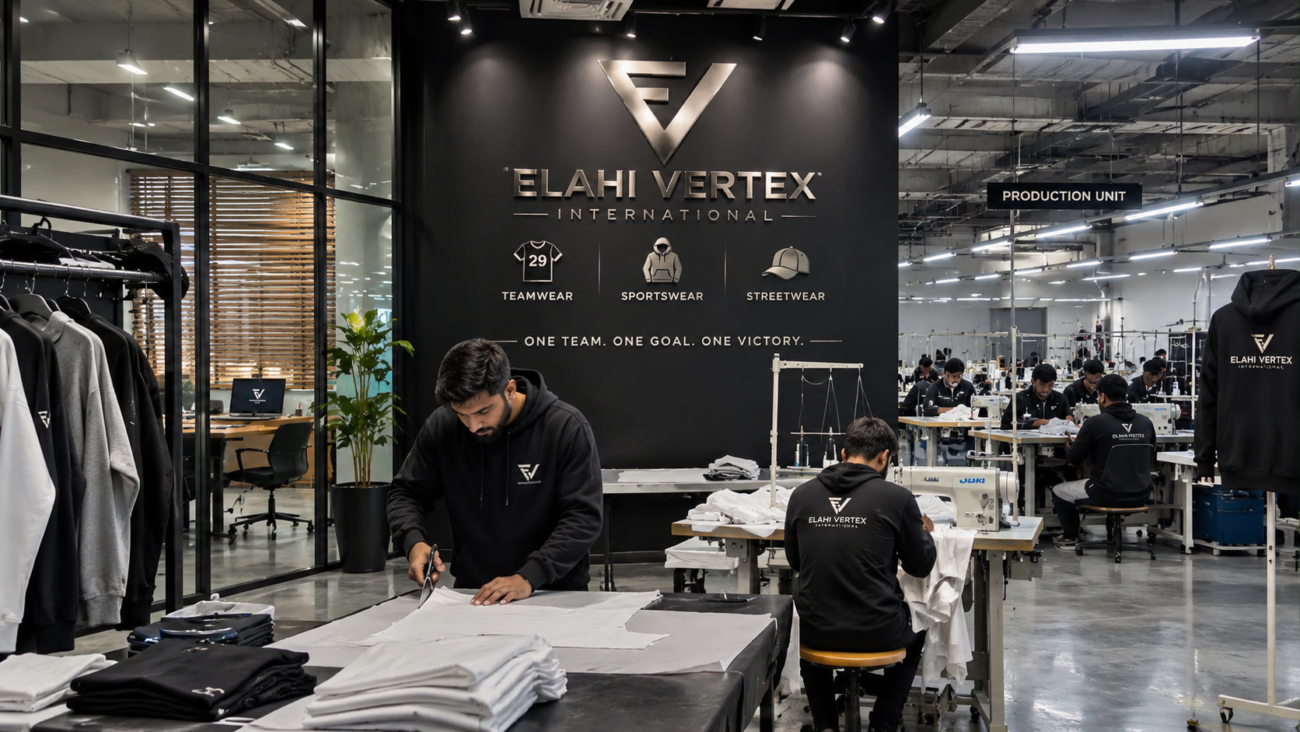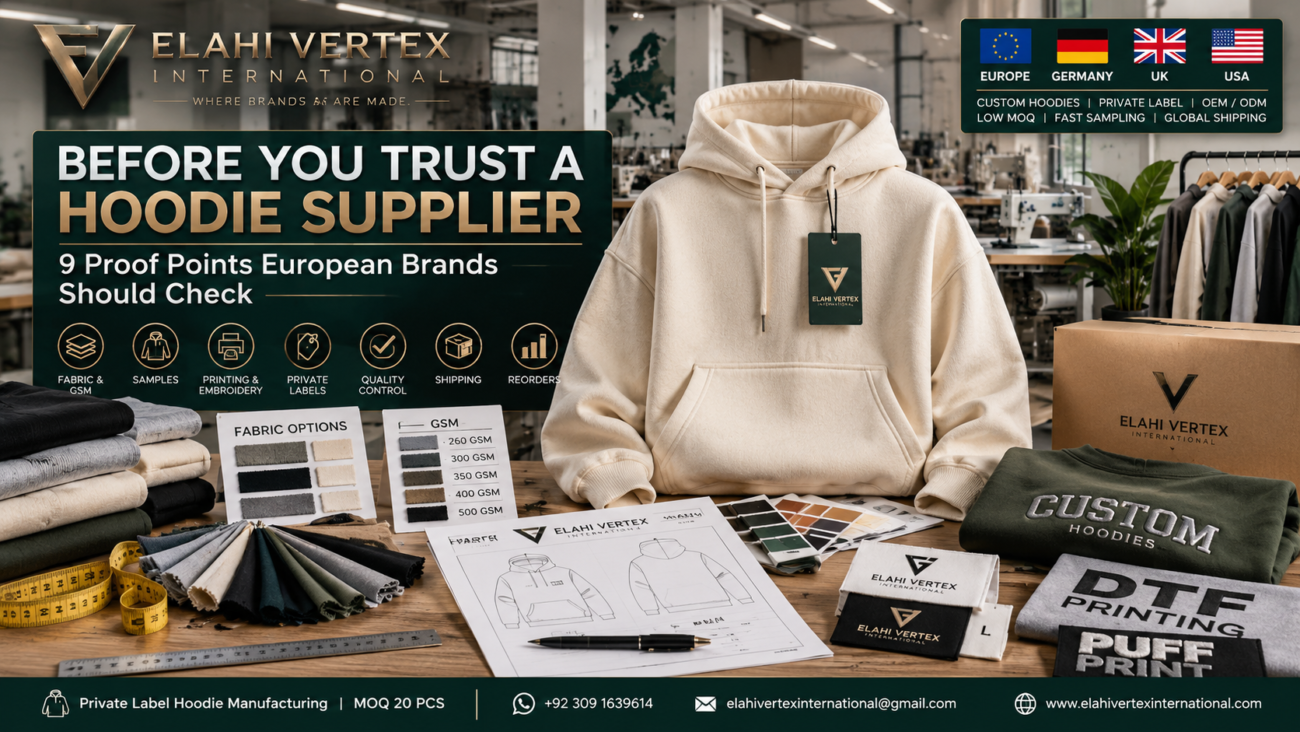

Elahi Vertex International — Your Custom Clothing Manufacturing Partner in Sialkot, Pakistan
A clothing brand in London may need a manufacturing quotation while a supplier in Pakistan is finishing its working day. A Shopify seller in New York might prepare a new hoodie collection late at night. A fashion startup in Berlin may want to discuss fabric, minimum order quantities, or custom labels outside conventional business hours.
International clothing manufacturing does not follow a single time zone.
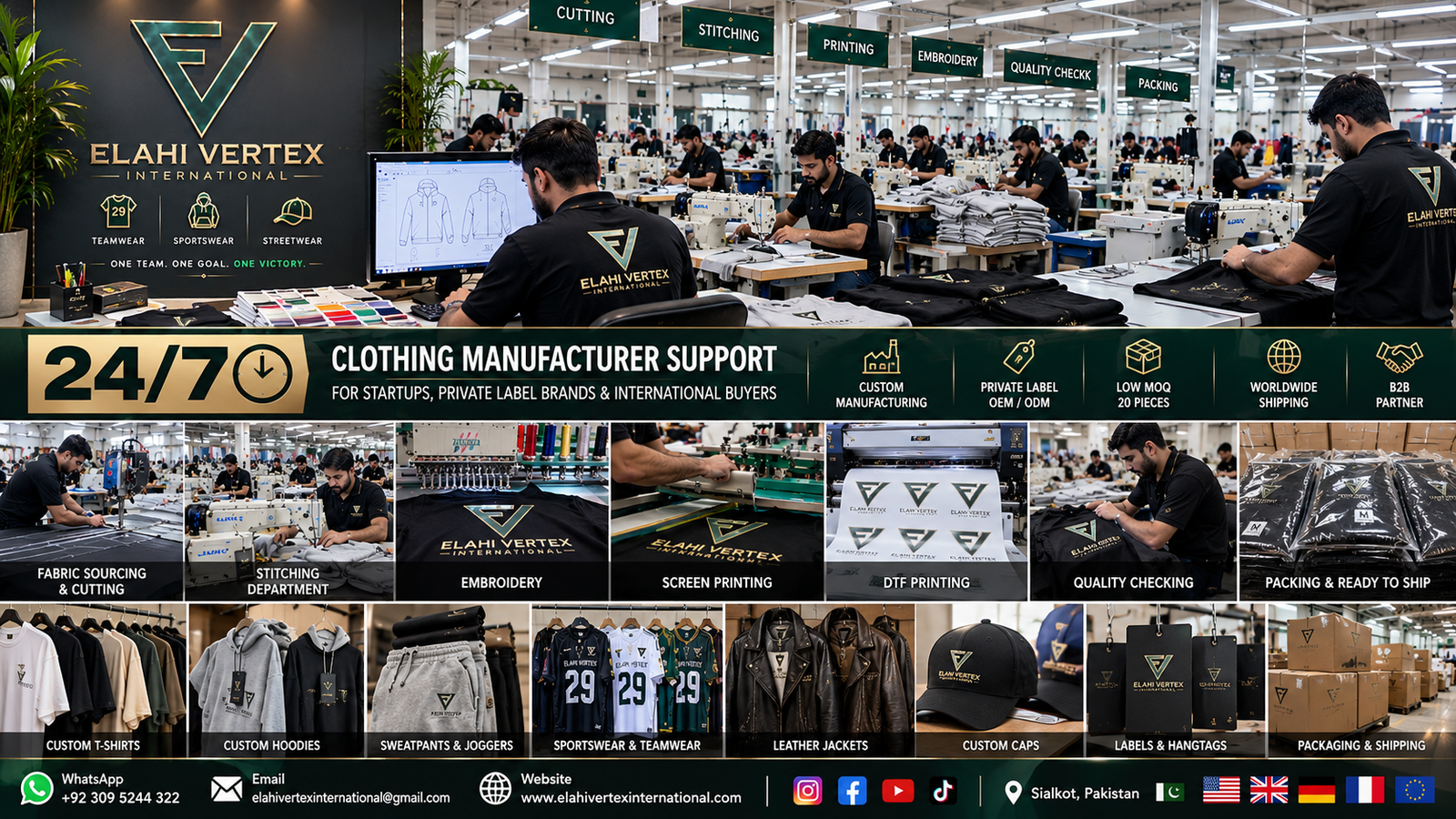
That is why Elahi Vertex International welcomes manufacturing inquiries 24 hours a day, 7 days a week, helping international buyers begin conversations about custom clothing, OEM/ODM production, private-label manufacturing, sampling, and bulk orders at a convenient time.
As a B2B clothing manufacturer and exporter based in Sialkot, Pakistan, Elahi Vertex International works with clothing brands, online retailers, startup fashion businesses, wholesalers, sportswear companies, and other commercial buyers.
Our standard minimum order quantity starts at 20 pieces per product/category, making custom manufacturing accessible to smaller brands as well as established businesses.
Whether you are researching a new manufacturing partner, preparing technical specifications, or requesting a quotation, you can contact our team through our international inquiry channels.
Discuss your project: Contact Elahi Vertex International on WhatsApp
Table of Contents
1. What Does 24/7 Clothing Manufacturer Support Mean?
24/7 clothing manufacturer support means buyers can submit manufacturing inquiries, share requirements, and initiate supplier discussions at any time, regardless of their location.
For international brands, this accessibility is especially useful when operating across different countries and time zones.
Elahi Vertex International provides online contact channels for discussing:
- Custom clothing manufacturing and private labeling.
- OEM and ODM apparel development.
- Fabric selection and garment specifications.
- Artwork, logos, embroidery, and printing.
- Minimum order quantities and size assortments.
- Sample development and approval.
- Bulk production quotations.
- International shipping requirements.
- Future collections and repeat manufacturing orders.
24/7 inquiry availability should not be confused with continuous factory operation or a guaranteed immediate response. Production schedules, quotation preparation, and technical confirmation depend on the specific project.
The commercial advantage is straightforward: buyers do not need to wait for a local office to open before initiating their manufacturing requirements.
2. Nine Powerful Benefits of 24/7 Clothing Manufacturer Support
1. International buyers can inquire across time zones
A clothing brand operating in California has a substantially different working schedule from a manufacturer in Pakistan.
Accessible online inquiry channels allow buyers to submit project details when they are ready rather than postponing the initial conversation.
2. Startup clothing brands can begin supplier discussions sooner
New fashion entrepreneurs frequently manage product development alongside other business responsibilities.
They may work on their collections during evenings, weekends, or outside standard office hours.
A convenient manufacturing contact channel makes it easier to send their designs and begin supplier evaluation.
3. Shopify and Amazon sellers can plan new collections
E-commerce brands need to coordinate product development, photography, inventory planning, packaging, and launch preparation.
Manufacturing discussions may involve:
- Oversized T-shirts for a new streetwear collection.
- Custom hoodies for seasonal inventory.
- Matching tracksuits and joggers.
- Gymwear and activewear.
- Branded sports jerseys.
- Custom clothing labels and packaging.
Buyers can begin discussing these requirements without being restricted to a single country’s business hours.
A buyer may have a complete tech pack, reference photographs, a size chart, or only an initial design concept.
Digital communication allows buyers to submit these materials for review.
The more complete the specifications, the easier it becomes to prepare a meaningful manufacturing discussion.
5. Sampling conversations can begin earlier
Sampling is an important stage of apparel sourcing because it allows buyers to evaluate design execution, fit, materials, decoration, and construction before proceeding to bulk production.
A buyer can submit sample requirements through the inquiry channel and discuss the next steps with the manufacturing team.
6. Brands can discuss multiple customization options
Not every design requires the same manufacturing method.
For example, a minimal embroidered sweatshirt has different production requirements from a full-color sublimated jersey or a heavily decorated streetwear hoodie.
Accessible communication helps buyers share their preferred visual outcome and request suitable manufacturing recommendations.
7. International sourcing teams can coordinate requirements
Procurement professionals often work with designers, merchandising teams, logistics providers, and business owners in different locations.
An accessible manufacturer contact channel helps them initiate questions about specifications, production feasibility, quotations, and documentation.
8. Buyers can prepare repeat orders
Established clothing brands may need to discuss replenishment, size adjustments, new colorways, or future product collections.
Clear communication supports better planning, although repeat-order timing remains subject to production capacity and material availability.
9. Brands can establish a direct manufacturing relationship
A useful manufacturer relationship extends beyond a single price quotation.
It involves discussing product expectations, agreeing on specifications, approving samples, understanding commercial terms, and coordinating future production.
Direct communication provides an opportunity to build that relationship from the first inquiry.
3. Why Time Zones Matter for USA, UK, and European Clothing Brands
Elahi Vertex International is based in Sialkot, Pakistan, while its international target markets include the United States, United Kingdom, Germany, France, and other European countries.
These markets operate in different time zones, and seasonal daylight-saving changes can affect the exact time difference.
| Buyer market | Typical manufacturing inquiry | Commercial consideration |
|---|---|---|
| United States | Hoodies, streetwear, gymwear, sportswear | Different working hours across US time zones |
| United Kingdom | Tracksuits, oversized T-shirts, private-label apparel | Brand owners may work outside office hours |
| Germany | Activewear, streetwear, technical clothing | Detailed specifications and quality expectations |
| France | Fashion collections, jackets, branded garments | Design development and customization |
| Wider Europe | Teamwear, sportswear, startup clothing collections | Cross-border sourcing and shipping planning |
A buyer does not need to be in Pakistan to begin discussing a manufacturing project.
For detailed quotations, buyers should share the delivery country, product specifications, intended quantities, and artwork.
4. What Custom Clothing Can You Discuss With Elahi Vertex International?
Elahi Vertex International offers custom B2B manufacturing across several apparel categories.
Custom Streetwear
Streetwear projects may include oversized T-shirts, heavyweight hoodies, sweatshirts, joggers, coordinated sets, and customized fashion garments.
Important specifications include fabric composition, GSM, garment silhouette, fit, stitching, decoration, and finishing.
Custom Sportswear and Teamwear
Sportswear and teamwear projects can include jerseys, training apparel, team uniforms, tracksuits, and performance-oriented garments.
Buyers should specify the sport, intended use, preferred fabric, team branding, and size requirements.
Custom Activewear and Gymwear
Activewear requirements may include stretch, moisture management, breathability, recovery, fit, and freedom of movement.
Material selection should reflect the garment’s intended performance rather than appearance alone.
Custom Hoodies and Sweatshirts
Hoodies can vary substantially in weight, fit, fleece construction, hood design, ribbing, pockets, and decoration.
A 300 GSM hoodie and a 500 GSM heavyweight hoodie may create very different wearing experiences and shipping costs.
Custom Boxing Wear
Boxing-related manufacturing inquiries can cover training apparel, boxing shorts, robes, and other project-specific products.
Materials, movement requirements, branding, and construction should be confirmed before production.
Custom Leather Wear
Leatherwear projects require careful consideration of material type, thickness, lining, hardware, construction, embossing, and garment fit.
A detailed technical specification is particularly important for premium jacket development.
Looking for a manufacturer for your next collection? Share your product reference images or tech pack through WhatsApp.
5. OEM, ODM, and Private-Label Clothing Manufacturing Explained
Understanding the manufacturing model helps buyers communicate their requirements more effectively.
| Manufacturing model | Meaning | Typical buyer |
|---|---|---|
| OEM | Manufacturing according to buyer-provided specifications | Established brand with completed designs |
| ODM | Design and development support alongside manufacturing | Brand seeking product-development assistance |
| Private label | Products manufactured with the buyer’s brand identity | Shopify stores, startups, retailers |
| Custom manufacturing | Project-specific garment construction and customization | Brands requiring unique products |
What is an OEM clothing manufacturer?
An OEM clothing manufacturer produces garments according to specifications agreed with the buyer. These may include materials, patterns, measurements, decoration, branding, and packaging.
What is an ODM clothing manufacturer?
An ODM clothing manufacturer supports product design or development as part of the manufacturing process. The exact development responsibilities should be agreed before work begins.
What is a private-label clothing manufacturer?
A private-label clothing manufacturer produces clothing for sale under another company’s brand name.
Private-label projects may include custom neck labels, care labels, hangtags, branded packaging, and garment decoration.
Elahi Vertex International supports discussions about these manufacturing models based on the buyer’s product requirements.
6. How a 20-Piece MOQ Helps Startup Clothing Brands
One of the challenges for emerging clothing brands is balancing inventory investment against demand uncertainty.
Large production commitments can tie up capital before a new collection has been tested.
Elahi Vertex International’s standard MOQ is 20 pieces per product/category.
This gives suitable buyers an opportunity to discuss smaller initial production runs without automatically committing to very large inventories.
However, a 20-piece minimum does not mean that every fabric, design, color, or technical construction is commercially feasible at the same price.
For example, a specially developed fabric may involve separate supplier minimums or additional sourcing costs.
Buyers should confirm product specifications, color requirements, sizes, decoration, and pricing before placing an order.
Why this matters for Shopify startups
A startup can use a focused initial collection to assess product fit, customer feedback, quality, and demand.
Rather than launching many unrelated products at once, a practical strategy is to begin with one clearly defined product and develop additional categories when there is evidence of customer interest.
Why this matters for established brands
A smaller manufacturing run may be useful for testing a new design, exploring a new product category, or assessing a supplier before discussing larger quantities.
The most appropriate order size depends on product economics, demand, and production requirements.
7. Fabrics, GSM, Customization, and Technical Specifications
Good manufacturing communication begins with a clear specification.
Fabric selection
Depending on the garment, buyers may consider cotton, polyester, elastane blends, fleece, French terry, jersey knit, interlock, mesh, nylon blends, or other suitable materials.
Each has different characteristics involving weight, stretch, texture, breathability, care, and durability.
Understanding GSM
GSM means grams per square meter. It measures fabric mass per unit area.
A higher GSM generally indicates a heavier fabric, but does not automatically mean better quality.
Quality also depends on fiber selection, yarn, knitting or weaving, finishing, dimensional stability, and construction.
| Garment | Illustrative GSM range | Main consideration |
|---|---|---|
| Lightweight T-shirt | 140–180 GSM | Comfort and breathability |
| Midweight T-shirt | 180–240 GSM | Structure and everyday wear |
| Heavyweight T-shirt | 240–320 GSM | Substantial hand feel |
| Sweatshirt or hoodie | 280–450 GSM | Warmth and construction |
| Heavyweight hoodie | 450–600+ GSM | Weight, structure, freight impact |
These are illustrative industry ranges, not guaranteed fabric availability or fixed specifications for Elahi Vertex International.
Printing and decoration
Custom clothing projects may involve:
- Screen printing for suitable repeated graphics.
- DTF printing for certain multicolor designs.
- DTG printing for appropriate fabric and artwork combinations.
- Embroidery for stitched logos and decorative elements.
- Puff printing for raised visual effects.
- Sublimation for compatible polyester-based applications.
- Appliqué and chenille for textured branding.
- Reflective decoration for suitable fashion applications.
The correct method depends on the artwork, fabric, quantity, budget, desired appearance, and durability expectations.
8. Sampling, Quality Control, and Bulk Manufacturing
A reliable sourcing process should separate initial inquiry, specification development, sampling, approval, and bulk production.
Send your artwork, reference photographs, tech pack, or product concept.
Step 2 — Confirm technical requirements
Discuss fabric, GSM, sizing, construction, labels, decoration, and packaging.
Step 3 — Request a sample quotation
Sample cost, shipping charges, payment terms, and production timing should be confirmed for the specific product.
Step 4 — Review the sample
Evaluate the garment against the agreed requirements, including fit, fabric, stitching, decoration, and branding.
Step 5 — Approve bulk specifications
Confirm the approved sample, size breakdown, quantities, colors, packaging, and commercial terms.
Step 6 — Proceed with production
Bulk production follows the agreed order and payment arrangements.
Step 7 — Review finished goods
Buyers should agree on inspection expectations, acceptable tolerances, and pre-shipment approval procedures.
Step 8 — Arrange shipment
Shipping costs, delivery terms, customs responsibilities, and import taxes should be clarified before dispatch.
9. How to Request a Custom Clothing Manufacturing Quotation
To help Elahi Vertex International evaluate your project, prepare the following information:
- Your brand or company name.
- Country and delivery destination.
- Product type.
- Design images or tech pack.
- Preferred fabric and GSM, if known.
- Quantity required.
- Size and color requirements.
- Printing, embroidery, or branding requirements.
- Packaging preferences.
- Intended delivery timeline.
Not every buyer will have all these details ready.
For early-stage projects, reference images and a clear description can provide a useful starting point. Exact pricing and feasibility depend on the final specifications.
Send your requirements: WhatsApp Elahi Vertex International
10. Why Consider Elahi Vertex International?
Elahi Vertex International is a Sialkot, Pakistan-based custom clothing manufacturer and exporter serving international B2B manufacturing requirements.
Its commercial positioning includes:
Custom apparel manufacturing: Projects developed around buyer specifications rather than only generic ready-made products.
OEM and ODM discussions: Manufacturing and development requirements tailored to the individual project.
Private-label branding: Garment branding, labels, decoration, and packaging options.
20-piece standard MOQ: An accessible starting point for suitable startup and established-brand projects.
Multiple apparel categories: Streetwear, sportswear, teamwear, activewear, hoodies, boxing wear, and leatherwear.
International inquiry availability: Online contact channels accessible 24/7 for buyers operating across different time zones.
Direct communication: Buyers can share technical requirements and discuss the next commercial step with the manufacturing team.
The strongest supplier decision should still be based on product suitability, sample quality, confirmed pricing, commercial terms, and reliable communication.
11. Frequently Asked Questions
1. Is Elahi Vertex International available 24/7 for clothing manufacturing inquiries?
Yes. International buyers can submit manufacturing inquiries through its online contact channels 24 hours a day. Individual response times depend on team availability.
2. Does 24/7 clothing manufacturer support mean the factory operates all night?
No. Inquiry availability and physical factory operating hours are different. Production schedules should be confirmed for the project.
3. Can USA clothing brands contact Elahi Vertex International?
Yes. USA-based brands can inquire about custom clothing manufacturing, sampling, private labeling, and bulk production.
4. Can UK Shopify stores request private-label clothing?
Yes. UK-based Shopify clothing businesses can discuss private-label garment requirements and custom branding.
5. Does Elahi Vertex International work with German clothing brands?
Yes. German brands and other European buyers are among the company’s target international B2B markets.
6. What is the minimum order quantity?
The standard MOQ is 20 pieces per product/category, subject to project-specific feasibility and confirmed commercial terms.
7. Can startup clothing brands order custom garments?
Yes. Startup brands can inquire about custom manufacturing and discuss suitable production requirements.
8. Can I request a quotation outside Pakistan’s business hours?
Yes. You can submit your quotation request at any time through the available online contact channels.
9. Does Elahi Vertex International manufacture custom hoodies?
Yes. Custom hoodies and sweatshirts are among its manufacturing categories.
10. Can I discuss oversized T-shirts?
Yes. Buyers can submit oversized T-shirt designs, fabric preferences, measurements, and branding requirements.
11. Does the company provide private-label manufacturing?
Yes. Private-label apparel manufacturing is part of its B2B positioning.
12. Can I request custom embroidery?
Yes. Embroidery requirements can be discussed alongside garment specifications and artwork.
13. Can I request screen printing or DTF printing?
Yes. Both are among the customization methods buyers can discuss. Suitability depends on the garment and artwork.
14. Can I order a sample before bulk production?
Buyers can request sample development and obtain project-specific sample quotations and payment terms.
15. Are sample costs automatically free?
No. Sample manufacturing and shipping charges must be agreed for the specific project. Any sample-credit arrangement should also be confirmed.
16. Can I submit a tech pack?
Yes. A tech pack is useful for communicating construction, materials, dimensions, and branding requirements.
17. Does Elahi Vertex International manufacture sportswear?
Yes. Custom sportswear and teamwear are among its product categories.
18. Can I discuss custom leather jackets?
Yes. Buyers can submit leatherwear design references and detailed specifications for feasibility review.
19. How do I receive an accurate bulk quotation?
Provide product specifications, quantity, artwork, customization details, and delivery destination. Pricing can then be assessed against the project requirements.
20. What is the easiest way to contact Elahi Vertex International?
WhatsApp is the primary recommended inquiry channel. Buyers can also use the official website or email.
12. Start Your Custom Clothing Manufacturing Inquiry — Available 24/7
Your clothing brand may operate in New York, Los Angeles, London, Manchester, Berlin, Paris, Amsterdam, or another international market.
You should be able to begin discussing your manufacturing requirements when it suits your business schedule.
Elahi Vertex International welcomes international B2B inquiries for custom clothing, OEM/ODM production, private-label apparel, samples, and bulk orders.
Whether you are preparing your first Shopify clothing collection or evaluating a manufacturing partner for an established brand, begin with your product specifications and commercial requirements.
Where Brands Are Made.
Contact Elahi Vertex International
Website: https://www.elahivertexinternational.com/
WhatsApp: https://wa.me/message/OWIPAIXYWHTPI1
Email: elahivertexinternational@gmail.com
Business location: Sialkot, Pakistan
Instagram: https://www.instagram.com/elahivertex.mfg/
Facebook: https://www.facebook.com/elahivertexinternational
YouTube: https://youtube.com/@elahivertexinternational
Google Business Profile: https://share.google/cV0PDjhumNOWMUQs9
Google Maps: https://maps.app.goo.gl/g6GBhnJKUcSchC8R6
Ready to discuss your next clothing collection? Contact Elahi Vertex International and share your requirements today.
Launching a Clothing Brand? Find a Manufacturing Partner Before Your First Collection
Launching a clothing brand requires more than creating a logo and selecting a business name. A successful first collection needs a defined customer, suitable garments, clear product specifications, realistic manufacturing costs, and a supplier capable of discussing your requirements.
For entrepreneurs in the USA, UK, Germany, France, and across Europe, finding a custom clothing manufacturer can be one of the most important early decisions.
Elahi Vertex International provides 24/7 clothing manufacturer support through its online inquiry channels, allowing aspiring brand owners to begin discussing their product ideas regardless of their time zone.
Whether you are launching a streetwear label, sportswear company, activewear brand, or online fashion business, you can submit your manufacturing inquiry before your store officially opens.
1. Starting a clothing brand with no manufacturing experience
Many new founders understand the appearance they want but are unfamiliar with garment construction, fabric GSM, embroidery methods, or production specifications.
That should not prevent them from beginning a supplier conversation.
A useful first manufacturing inquiry can include a reference photograph, preferred fit, target customer, estimated quantity, and intended retail price.
Elahi Vertex International can discuss the manufacturing requirements and identify which specifications need clarification before a quotation is prepared.
2. Turning your clothing brand idea into a manufacturable product
A design concept must eventually become a physical garment with measurable requirements.
For example, launching an oversized streetwear T-shirt may involve decisions about:
- Cotton composition and fabric GSM.
- Oversized versus boxy fit.
- Shoulder width, body length, and sleeve proportions.
- Neck ribbing and stitching.
- Screen printing, embroidery, or DTF decoration.
- Neck labels, care labels, and hangtags.
- Packaging and shipment destination.
These details help distinguish a genuine custom-manufacturing project from simply purchasing generic blank clothing.
3. Launching with a smaller initial inventory
New brands should consider inventory risk before placing their first manufacturing order.
Elahi Vertex International has a standard MOQ of 20 pieces per product/category, subject to the specific manufacturing requirements.
This can help qualifying startup brands explore a smaller initial collection instead of immediately committing to hundreds of units.
A sensible launch strategy is to begin with one strong product, confirm quality and customer interest, and then evaluate expansion.
4. Preparing your first collection before your website launches
You do not need a fully operating Shopify store to begin a manufacturing discussion.
Founders can prepare product specifications, samples, branding materials, photography plans, and packaging requirements while developing their online storefront.
However, production costs, sampling expenses, freight, duties, platform fees, and marketing costs should all be included in the business plan.
5. Choosing between ready-made blanks and custom manufacturing
Buying blank garments and applying a logo may be suitable for some businesses.
Custom manufacturing becomes more relevant when a brand requires distinctive fit, fabric, construction, branding, or product identity.
For example, a premium streetwear brand may want its own oversized pattern rather than using a standard wholesale blank.
Elahi Vertex International can discuss custom manufacturing specifications for buyers seeking more control over their product.
Looking for a Clothing Manufacturer? What Buyers Should Check First
Searching for a clothing manufacturer online can produce thousands of results, but not every supplier is suitable for every clothing business.
Some companies manufacture garments directly. Others operate as trading businesses, sourcing agents, wholesalers, or ready-made apparel distributors.
Before choosing a supplier, establish what your brand actually needs.
6. Check whether the manufacturer handles your product category
A supplier specializing in basic cotton T-shirts may not be the right choice for technical activewear, heavyweight streetwear, or detailed leather jackets.
Elahi Vertex International handles manufacturing inquiries across streetwear, sportswear, activewear, teamwear, boxing wear, hoodies, sweatshirts, and leatherwear.
Buyers should provide product references to confirm feasibility.
7. Ask whether your artwork and branding can be customized
Private-label clothing manufacturing may involve much more than attaching a brand logo.
Relevant options include garment patterns, fabric selection, printed artwork, embroidery, labels, hangtags, and packaging.
Brand owners should confirm which features are included in their quotation and which involve additional charges.
8. Evaluate minimum order quantities
A manufacturer with an attractive unit price may still be unsuitable if its minimum quantity exceeds the buyer’s budget or expected demand.
Elahi Vertex International’s standard 20-piece MOQ per product/category provides a starting point for discussing smaller custom orders.
The final quantity and price should be confirmed against the product’s technical requirements.
9. Evaluate sample quality before committing to bulk
A sample helps buyers assess whether the physical garment reflects the approved specifications.
Important checks include measurements, material, seams, printing, embroidery, fit, finishing, and labels.
Sample approval should happen before bulk production is authorized.
10. Compare the total landed cost, not just the garment price
International buyers should consider manufacturing price, decoration, packaging, freight, import duties, taxes, and any other applicable costs.
A cheaper garment quotation does not necessarily mean a cheaper delivered product.
Ask the supplier to clarify exactly what the quoted price includes.
11. Verify the supplier’s business information
Before making a payment, buyers should verify the manufacturer’s business identity, available company documentation, payment details, and relevant production evidence.
Elahi Vertex International identifies itself as a Sialkot, Pakistan-based B2B manufacturer and exporter. Buyers can begin their verification through the official website and company contact channels.
12. Choose a supplier who communicates clearly
A supplier should be willing to clarify product specifications, commercial terms, and responsibilities rather than relying on vague promises.
24/7 clothing manufacturer support offers a convenient way to initiate inquiries, but buyers should also assess the quality and accuracy of the responses they receive.
Why Startup Clothing Brands Need a Manufacturing Partner, Not Just a Cheap Supplier
A startup clothing brand usually has limited capital, limited sales history, and little room for avoidable production mistakes.
Choosing the lowest unit price without examining product quality, sampling costs, freight, and customer expectations can create greater expenses later.
A suitable manufacturing partner should help the founder establish clear production requirements.
13. Develop a product that matches your target customer
A gymwear customer may prioritize stretch and movement, while a heavyweight streetwear customer may prioritize structure, fit, and fabric hand feel.
Manufacturing decisions should follow the intended product experience.
14. Protect your first collection’s quality
Poor fit, inconsistent measurements, or unsuitable printing can affect customer satisfaction and repeat purchases.
Brands should define acceptable quality standards before approving production.
15. Build a recognizable private-label identity
Custom labels, consistent sizing, packaging, and garment decoration help establish a recognizable brand.
However, brand identity should be supported by actual product quality, not packaging alone.
16. Prepare for future repeat orders
A brand expecting future replenishment should retain approved samples, size charts, fabric specifications, artwork files, and packaging instructions.
These records can reduce confusion when discussing subsequent orders.
17. Keep manufacturing decisions commercially realistic
A startup may want premium fabric, complicated embroidery, custom packaging, and several colorways.
Each additional requirement can affect manufacturing cost.
The best initial product is not necessarily the most complicated one. It is the product that meets the customer’s expectations while supporting a viable selling price.
Shopify, Amazon, and E-Commerce Clothing Brands: Manufacturing Before Launch
Online clothing sellers need to coordinate manufacturing with their storefront, product photography, inventory, fulfillment, and customer expectations.
24/7 clothing manufacturer support allows entrepreneurs to submit product requirements while planning their e-commerce operations.
18. Shopify clothing brand manufacturing
Shopify entrepreneurs can approach Elahi Vertex International with a collection concept, reference images, size requirements, and proposed order quantity.
A practical sequence is to develop the product, approve a sample, confirm bulk specifications, and then finalize the commercial launch schedule.
19. Amazon private-label apparel sourcing
Amazon apparel sellers should consider product consistency, accurate sizing, packaging requirements, and marketplace compliance.
Marketplace-specific labeling or fulfillment requirements must be confirmed before production.
20. WooCommerce and independent fashion websites
Independent online retailers can discuss custom garments and branded packaging without needing to operate on a particular e-commerce platform.
Manufacturing suitability depends on the product and commercial requirements rather than the website software.
21. Instagram-based clothing startups
Some fashion businesses begin by developing an audience on Instagram before launching a full online store.
These founders can discuss custom garments and sample development while preparing their product photography and sales channels.
22. Physical clothing boutiques and retailers
Boutiques may seek exclusive garments, branded collections, or custom products for their own customers.
A suitable manufacturing inquiry should include the expected retail positioning, sizes, order quantity, and delivery destination.
Finding a Clothing Manufacturer in the USA, UK, Germany, or Europe
International brands are not limited to manufacturers physically located in their own countries.
A business searching for a clothing manufacturer in the USA, UK, Germany, or France may also consider overseas production partners when quality, price, minimum quantities, logistics, and communication are commercially suitable.
Elahi Vertex International is located in Pakistan, not in these destination markets.
Its international B2B manufacturing model allows overseas buyers to discuss production and export requirements directly.
23. USA clothing brand founders
Founders in New York, Los Angeles, Miami, Chicago, and other US markets can inquire about custom streetwear, sportswear, private-label garments, and startup collections.
US buyers should evaluate freight, import responsibilities, product labeling, and landed costs before confirming an order.
24. UK clothing startups
Brands in London, Manchester, Birmingham, Leeds, and other UK locations may require custom hoodies, tracksuits, oversized T-shirts, or sportswear.
The UK market’s working hours differ from Pakistan’s, making accessible international inquiry channels useful for initial communication.
25. German clothing brands
German brands in Berlin, Hamburg, Munich, Frankfurt, and other cities can discuss technical garment specifications, fabric preferences, size charts, and custom manufacturing requirements.
Buyers should confirm applicable European product and labeling obligations for their specific garments.
26. French fashion startups
French clothing businesses can inquire about streetwear, custom jackets, private-label apparel, and branded collections.
Product references and detailed technical specifications are especially useful when requesting distinctive fashion constructions.
27. Wider European brands
Buyers in the Netherlands, Belgium, Italy, Spain, Sweden, Denmark, Switzerland, Austria, Ireland, and other European markets can initiate manufacturing inquiries through Elahi Vertex International’s international contact channels.
Shipping arrangements and destination requirements should be confirmed individually.
How 24/7 Clothing Manufacturer Support Helps at Different Business Stages
Not every buyer contacting a manufacturer is ready to place an order immediately.
Some are exploring a new idea. Others have completed designs, need a quotation, or are ready to pay for a sample.
A productive manufacturing discussion should reflect the buyer’s current stage.
| Business stage | Buyer requirement | Recommended next step |
|---|---|---|
| New brand idea | Product concept and feasibility | Share reference images |
| Pre-launch startup | Fabric, fit, and branding | Prepare specifications |
| Shopify store launch | Initial product collection | Request a quotation |
| Established clothing brand | New collection or supplier evaluation | Submit tech pack and quantity |
| Ready-to-order buyer | Confirmed design and specifications | Agree on sample or bulk terms |
| Returning customer | Replenishment or product update | Confirm revised requirements |
28. For buyers with only an idea
Start with a reference image and a description of your intended garment.
29. For buyers with completed designs
Send artwork, measurements, material requirements, and estimated quantities.
30. For buyers ready to request samples
Confirm the specifications, sample quotation, shipping cost, payment arrangement, and approval process.
31. For buyers ready for bulk production
Finalize quantities, sizes, colors, approved specifications, commercial terms, and delivery requirements.
32. For brands planning future collections
Discuss future product categories, expected quantities, and potential repeat-order requirements.
Additional Questions From New Clothing Brand Founders
Can I contact Elahi Vertex International before registering my clothing brand?
You can submit an initial manufacturing inquiry while planning your business. Any documents required for a commercial transaction can be discussed before ordering.
Can I start a clothing brand with only 20 pieces?
Elahi Vertex International’s standard MOQ is 20 pieces per product/category. Commercial feasibility, customization, and pricing depend on the specific garment.
Can I send Pinterest-style reference images?
You can submit reference images to communicate your intended design. Buyers should ensure they have the rights or permission necessary to reproduce protected artwork or designs.
Can a startup request a custom oversized fit?
Yes. Buyers can discuss oversized patterns, measurements, garment proportions, and sample development.
Can I request different clothing sizes?
Size requirements can be discussed during quotation preparation. The available size assortment and quantity arrangement must be confirmed for the project.
Can I ask about manufacturing before I have a Shopify website?
Yes. A live website is not required to initiate a product-development inquiry.
Is 24/7 clothing manufacturer support useful for first-time founders?
Yes. It allows founders to submit their questions and manufacturing requirements at a convenient time, even if they are unfamiliar with international sourcing.
What should I send when looking for a private-label clothing manufacturer?
Send the product type, artwork, reference photographs, preferred materials, quantities, branding requirements, and destination country.
Start Your Clothing Brand With a Clear Manufacturing Plan
Launching a clothing business involves product development, supplier evaluation, sampling, pricing, branding, inventory planning, and delivery coordination.
Elahi Vertex International provides an international B2B manufacturing contact point for startup founders, Shopify and Amazon sellers, established clothing brands, wholesalers, and retailers.
With 24/7 clothing manufacturer support for online inquiries, buyers can begin discussing their projects across different time zones.
Ready to launch your first collection or find a new clothing manufacturing partner?
Contact Elahi Vertex International with your product idea, reference photographs, tech pack, or quotation requirements.
WhatsApp: https://wa.me/message/OWIPAIXYWHTPI1
Website: https://www.elahivertexinternational.com/
Email: elahivertexinternational@gmail.com
Standard MOQ: 20 pieces per product/category.
Location: Sialkot, Pakistan.
Elahi Vertex International — Where Brands Are Made.
Below is the expanded manufacturing-technical section for your existing 24/7 Clothing Manufacturer Support blog. It covers artwork, design development, printing, embroidery, colors, fabrics, sizing, and production specifications for startups, Shopify brands, Amazon sellers, and established international clothing businesses.
It follows the manufacturing and buyer-guidance requirements in your master PDF. The technical examples are general industry guidance; individual production capabilities, material availability, and pricing must be confirmed with Elahi Vertex International.
Complete Clothing Artwork, Printing, Color, Design and Size Guide for Custom Apparel Manufacturing
Custom Clothing Artwork and Design Development: From Concept to Production
A successful custom clothing collection starts with artwork that can be translated accurately into physical garments.
For new clothing brands, understanding artwork requirements is essential. A logo that looks excellent on a computer screen may need adjustments before it can be embroidered, screen printed, sublimated, or applied using other decoration techniques.
Elahi Vertex International welcomes international B2B manufacturing inquiries through its 24/7 clothing manufacturer support channels. Clothing startups, established brands, Shopify retailers, Amazon sellers, and fashion designers can share artwork, product references, and technical specifications for manufacturing discussions.
Types of Artwork Used in Clothing Manufacturing
| Artwork type | Description | Common manufacturing use |
|---|---|---|
| Vector artwork | Scalable artwork made from mathematical paths | Screen printing, embroidery preparation, logos |
| Raster artwork | Pixel-based digital imagery | DTG, DTF, photographic graphics |
| Typography artwork | Lettering, slogans, and custom fonts | Streetwear, sportswear, brand graphics |
| Illustrative artwork | Drawings, characters, and graphic compositions | T-shirts, hoodies, jackets |
| All-over print artwork | Repeating or full-panel artwork | Sublimation, printed fabric |
| Technical flat sketches | Two-dimensional garment construction drawings | Pattern development and tech packs |
| Placement artwork | Graphics with defined positions and measurements | Chest, back, sleeve, and leg designs |
| Repeat patterns | Artwork designed to repeat across fabric | Fashion prints, sportswear |
| Embroidery artwork | Designs prepared for stitching | Logos, lettering, decorative elements |
| Appliqué artwork | Shapes prepared for fabric-layer decoration | Varsity jackets, sweatshirts |
| Jacquard artwork | Patterns developed for knitted or woven construction | Beanies, knitwear, selected textiles |
| Laser-cut artwork | Vector outlines for controlled cutting | Leather and suitable textile applications |
| Embossing artwork | Raised or recessed design shapes | Leatherwear and selected materials |
| Rhinestone templates | Placement patterns for decorative stones | Fashion and streetwear |
| Reflective artwork | Designs intended for reflective materials | Fashion graphics, selected sportswear |
Artwork File Formats
For professional production, brands should understand the differences between artwork formats.
AI (Adobe Illustrator): Commonly used for editable vector artwork.
EPS: A vector-capable exchange format used in various production workflows.
SVG: Useful for scalable artwork and digital design exchange.
PDF: Can contain vector artwork, raster images, fonts, and production instructions.
PSD: Layered raster artwork commonly associated with Adobe Photoshop.
PNG: Useful for graphics with transparent backgrounds, although resolution matters.
TIFF: Commonly used for high-resolution raster imagery.
JPEG: Suitable for visual references but often less suitable as a final production master.
DST, PES, EXP, and related embroidery formats: Machine-oriented embroidery files. Compatibility depends on the equipment and workflow.
A production-ready artwork file should identify the required dimensions, colors, placement, and decoration method.
For raster graphics, 300 PPI at final print size is a common preparation target, but the correct resolution depends on the printing process.
Complete Clothing Printing and Decoration Guide
Different decoration methods create different visual effects, textures, production costs, and durability characteristics.
Elahi Vertex International can discuss suitable methods for custom garments, while final availability and suitability should be confirmed against the product specification.
1. Screen Printing
Screen printing transfers ink through a prepared mesh screen onto fabric.
It is frequently used for brand logos, large graphics, typography, and repeat production.
Common screen-printing variations include:
- Plastisol printing
- Water-based printing
- Discharge printing on suitable fabrics
- High-density printing
- Puff printing
- Metallic-effect printing
- Reflective-ink printing
- Glow-in-the-dark printing
- Halftone printing
- Simulated-process printing
- CMYK process printing
- Specialty-texture printing
Each variation has different material, artwork, and curing requirements.
2. Direct-to-Garment Printing (DTG)
DTG applies ink directly to suitable garments using specialized digital printing equipment.
It can be appropriate for detailed artwork, photographic designs, and multicolor graphics.
Print results depend on fabric composition, pretreatment, ink compatibility, curing, and garment color.
3. Direct-to-Film Printing (DTF)
DTF involves printing artwork onto a transfer film and applying it to a garment through an adhesive and heat-transfer process.
It can support detailed multicolor artwork on compatible fabrics.
Brands should evaluate hand feel, wash performance, stretch, and artwork placement before selecting DTF for their collection.
4. Sublimation Printing
Sublimation uses heat to transfer dye into compatible polyester-based materials or coatings.
It is commonly associated with sports jerseys, teamwear, and all-over printed performance apparel.
Sublimation is not interchangeable with ordinary cotton garment printing.
5. Heat-Transfer Printing
Heat-transfer methods apply prepared artwork or materials to garments using heat and pressure.
Applications may include:
- Heat-transfer vinyl
- Printed transfers
- Reflective transfers
- Flock transfers
- Specialty foil transfers
- Stretch transfers
Temperature, pressure, dwell time, and material compatibility are important production variables.
6. Puff Printing
Puff printing creates a raised decorative effect through a suitable ink and curing process.
It is often used for bold streetwear typography and logos.
Designers should avoid assuming that very fine lines or small lettering will reproduce identically to ordinary flat printing.
7. Reflective and Flash-Responsive Decoration
Reflective materials return incident light toward its source under suitable conditions.
This can create a distinctive appearance in flash photography and certain lighting environments.
Reflective decoration should not automatically be treated as certified high-visibility safety apparel.
8. Rhinestone and Crystal Decoration
Rhinestones, crystals, and decorative stones can be applied in planned arrangements to create textured fashion graphics.
Production requirements include stone size, placement, adhesive compatibility, heat application, and durability testing.
9. Foil and Metallic Effects
Foil and metallic decoration can create shiny surfaces or metallic-looking graphics.
Actual appearance and durability depend on the selected material and application method.
10. Silicone and Rubberized Decoration
Silicone-based prints, transfers, or badges can create dimensional logos and flexible decorative elements.
The chosen construction should be evaluated for compatibility with garment stretch and laundering requirements.
11. All-Over Printing
All-over printing covers large garment areas or fabric panels with artwork.
Buyers should confirm whether artwork is printed before cutting or applied to completed garments, because the process affects placement accuracy and seam continuity.
12. Specialty Printing
Additional industry methods include flock printing, crackle-effect printing, glitter printing, textured ink, fluorescent printing, and selected specialty finishes.
These are potential manufacturing techniques, not a claim that every process is available for every Elahi Vertex International order.
Complete Custom Embroidery Guide
Embroidery creates designs through stitched threads rather than printed ink.
It is frequently selected for premium logos, uniforms, varsity garments, hats, hoodies, and branded apparel.
Common Embroidery Types
| Method | Visual effect | Typical application |
|---|---|---|
| Flat embroidery | Smooth stitched design | Chest logos, caps |
| 3D puff embroidery | Raised stitched lettering | Streetwear and headwear |
| Chenille embroidery | Soft textured pile | Varsity-style graphics |
| Appliqué embroidery | Fabric shapes secured by stitching | Jackets and sweatshirts |
| Chain-stitch embroidery | Linked decorative stitches | Lettering and vintage-style graphics |
| Satin-stitch embroidery | Smooth, dense stitched surfaces | Logo borders and lettering |
| Tatami-fill embroidery | Broad filled areas | Larger logos |
| Sequin embroidery | Reflective decorative elements | Fashion garments |
| Metallic-thread embroidery | Metallic appearance | Decorative logos |
| Patch embroidery | Separately manufactured stitched emblem | Uniforms, jackets |
| Mixed-media embroidery | Embroidery combined with other decoration | Premium streetwear |
Embroidery feasibility depends on fabric stability, stitch density, design size, thread type, backing, and production equipment.
Embroidery Artwork Requirements
Buyers should provide:
- Original logo or artwork.
- Desired embroidery width and height.
- Placement on the garment.
- Preferred thread colors.
- Garment fabric and construction.
- Required visual effect.
- Reference photographs where applicable.
Very small text, narrow gaps, and complex gradients may require artwork simplification.
Clothing Design Guide: Styles, Fits, and Garment Construction
T-Shirt Designs
Common options include regular-fit T-shirts, slim-fit T-shirts, oversized T-shirts, boxy T-shirts, cropped T-shirts, longline T-shirts, raglan-sleeve T-shirts, and heavyweight streetwear T-shirts.
Key construction choices include neckline, shoulder shape, sleeve length, body length, hem finishing, and fabric structure.
Hoodie Designs
Common styles include pullover hoodies, zip-up hoodies, oversized hoodies, cropped hoodies, heavyweight hoodies, drop-shoulder hoodies, and matching hoodie-and-jogger sets.
Design decisions may involve hood construction, drawcords, pockets, ribbing, zipper specifications, fleece finishing, and garment wash effects.
Sweatshirt Designs
Brands may consider crewneck sweatshirts, oversized sweatshirts, cropped sweatshirts, quarter-zip sweatshirts, and other custom constructions.
Jogger and Trouser Designs
Options include tapered joggers, straight-leg sweatpants, open-hem sweatpants, cargo joggers, wide-leg trousers, and coordinated tracksuit bottoms.
Important measurements include waist, hip, rise, inseam, thigh, leg opening, and overall length.
Sportswear and Teamwear Designs
Sportswear projects may include football jerseys, basketball jerseys, training shirts, running shorts, tracksuits, compression garments, and team uniforms.
Design requirements should reflect the intended sport, movement, material, and applicable competition rules.
Leather Jacket Designs
Leatherwear projects may include bomber jackets, biker jackets, varsity-style leather jackets, suede jackets, and custom fashion outerwear.
Buyers should define leather type, thickness, lining, hardware, pattern, decoration, and finishing.
Complete Clothing Color Guide for Private-Label Brands
Color consistency is a major consideration when developing custom apparel.
A color displayed on a phone or computer may not match the final fabric or printed garment because screens emit light, while textiles and inks reflect light.
Understanding Color Systems
Pantone: A standardized color-reference system used in design and production. Relevant textile or graphic standards should be selected according to the material and process.
RGB: A digital color model used for screens.
CMYK: A process-color model used in many printing applications.
HEX: A digital notation for RGB colors, commonly used in web design.
Lab color: A color space useful for describing and measuring perceived color differences.
Example Brand Color Palette
The following HEX values are illustrative design references, not verified fabric-dye matches.
| Color | Example HEX | Design use |
|---|---|---|
| Jet Black | #101010 | Minimalist streetwear |
| Off-White | #F5F1E8 | Premium neutral collections |
| Charcoal | #36454F | Hoodies and sportswear |
| Navy | #14213D | Teamwear and uniforms |
| Forest Green | #234F32 | Outdoor-inspired apparel |
| Burgundy | #800020 | Fashion collections |
| Royal Blue | #2455A4 | Sportswear |
| Bright Red | #D62828 | Graphic accents |
| Sand | #C2B280 | Neutral lifestyle clothing |
| Lavender | #B8A1D9 | Fashion and activewear |
| Orange | #F77F00 | Bold streetwear graphics |
| Silver Gray | #A7A9AC | Technical apparel |
Choosing Colors for a Clothing Collection
A startup brand may benefit from launching with a focused color palette rather than too many variations.
For example, a minimalist streetwear collection could combine black, off-white, charcoal, and one accent color.
A sportswear brand may require stronger contrast, while a premium lifestyle brand may prefer muted tones.
The best palette depends on brand identity, customer preferences, garment materials, and production feasibility.
Color Approval Process
- Provide a Pantone reference, physical swatch, or approved color standard.
- Confirm whether the color applies to fabric, printing, embroidery, trims, or packaging.
- Request relevant color samples when needed.
- Review the sample under appropriate lighting.
- Confirm acceptable color variation before bulk production.
- Retain the approved reference for future orders.
Digital HEX values alone should not be treated as a guarantee of textile color accuracy.
Clothing Size Guide: Measurements, Grading, and Fit
Clothing sizing is not globally standardized across every brand.
A garment labeled Medium by one manufacturer may differ from a Medium sold by another brand.
For custom apparel, buyers should approve actual garment measurements rather than relying exclusively on size labels.
Illustrative Unisex Regular-Fit T-Shirt Size Chart
Measurements in centimeters. This is an example specification, not an official Elahi Vertex International size chart.
| Size | Chest width (flat) | Body length | Shoulder width | Sleeve length |
|---|---|---|---|---|
| XS | 48 | 66 | 43 | 19 |
| S | 50 | 68 | 45 | 20 |
| M | 53 | 71 | 47 | 21 |
| L | 56 | 74 | 49 | 22 |
| XL | 59 | 77 | 51 | 23 |
| XXL | 62 | 80 | 53 | 24 |
Illustrative Oversized T-Shirt Size Chart
Measurements in centimeters. These are suggested starting dimensions only.
| Size | Chest width (flat) | Body length | Shoulder width |
|---|---|---|---|
| S | 56 | 69 | 54 |
| M | 59 | 72 | 57 |
| L | 62 | 75 | 60 |
| XL | 65 | 78 | 63 |
| XXL | 68 | 81 | 66 |
Illustrative Hoodie Size Chart
Measurements in centimeters.
| Size | Chest width (flat) | Body length | Shoulder width |
|---|---|---|---|
| S | 54 | 67 | 50 |
| M | 57 | 70 | 52 |
| L | 60 | 73 | 54 |
| XL | 63 | 76 | 56 |
| XXL | 66 | 79 | 58 |
Understanding Garment Measurements
Chest width: Measured across the garment while laid flat, using the agreed measurement points.
Body length: Measured from the specified shoulder or high-point location to the hem.
Shoulder width: Measured between agreed shoulder reference points.
Sleeve length: Measured according to the approved garment measurement method.
Waist: May refer to a flat relaxed garment measurement, stretched measurement, or body circumference.
Inseam: Measured along the inside leg from the crotch seam to the hem.
Rise: Describes the vertical or seam-related dimension between the crotch and waist, depending on the measurement method.
Size Grading and Tolerances
Size grading is the process of developing additional sizes from an approved base pattern.
A professional tech pack should define how measurements change between sizes and what manufacturing tolerances are acceptable.
For example, a brand might approve a base Medium sample and then develop Small, Large, XL, and XXL specifications.
The correct grading rules depend on the intended fit, customer population, fabric, and garment construction.
Fabric GSM and Material Selection Guide
Fabric selection influences comfort, fit, structure, stretch, durability, production cost, and freight weight.
| Fabric or construction | Common characteristics | Potential application |
|---|---|---|
| Cotton single jersey | Soft knitted construction | T-shirts |
| Cotton-polyester fleece | Warmth and dimensional structure | Hoodies |
| French terry | Loop-backed knitted fabric | Sweatshirts, joggers |
| Polyester interlock | Smooth, stable knit | Sportswear |
| Polyester-elastane blend | Stretch and recovery | Activewear |
| Nylon-elastane blend | Stretch and abrasion characteristics | Gymwear |
| Polyester mesh | Open, breathable construction | Sports jerseys |
| Rib knit | Elasticity and texture | Cuffs, collars |
| Piqué knit | Textured surface | Polo shirts |
| Woven twill | Structured diagonal weave | Trousers, jackets |
| Denim | Durable woven construction | Jeans, jackets |
| Leather | Natural hide material | Jackets and leatherwear |
Fabric properties vary with fiber quality, construction, finishing, and sourcing.
A higher GSM does not automatically mean a better garment.
Garment Washes, Surface Finishes, and Fashion Effects
Brands may explore different garment finishing processes to achieve a particular appearance or texture.
Examples include:
- Enzyme washing.
- Garment dyeing.
- Pigment dyeing.
- Acid-wash effects.
- Vintage-wash effects.
- Stone washing.
- Distressed finishing.
- Brushing.
- Peaching.
- Silicone softening.
- Anti-pilling finishes.
- Water-repellent treatments.
- Special surface textures.
Not every finish is compatible with every fabric or garment construction.
Buyers should request appropriate samples and consider colorfastness, dimensional stability, fabric strength, and care requirements.
Private-label clothing manufacturers can be involved in more than garment sewing.
A complete apparel specification may include several branding components.
Branding Options
Woven neck labels: Fabric labels carrying brand identification.
Printed neck labels: Branding printed directly onto suitable garment areas.
Care labels: Information about textile composition and care instructions, subject to destination requirements.
Size labels: Garment-size identification.
Hangtags: Removable tags containing branding or product information.
Embroidered patches: Stitched emblems applied to garments.
Rubber or silicone patches: Dimensional branding elements.
Zipper pulls: Branded or custom hardware components.
Packaging: Polybags, protective wrapping, cartons, and other agreed presentation materials.
The availability, price, and minimum quantity for specialized branding components should be confirmed before quotation approval.
Complete Tech Pack Checklist for New Clothing Brands
A tech pack is a technical document describing how a garment should be manufactured.
A strong tech pack can include:
- Product name and style code.
- Front and back technical sketches.
- Fabric composition.
- Fabric GSM.
- Fabric construction.
- Color references.
- Approved artwork.
- Artwork dimensions.
- Artwork placement.
- Printing or embroidery method.
- Stitching and seam details.
- Neckline, cuffs, and hem construction.
- Size chart.
- Grading rules.
- Measurement tolerances.
- Labels and branding.
- Trims and hardware.
- Packaging instructions.
- Care-label requirements.
- Approved sample references.
- Quality inspection criteria.
- Order quantity and size assortment.
- Destination country.
- Delivery requirements.
- Revision history and approval status.
A complete tech pack reduces ambiguity, but it does not eliminate the need for sampling, communication, and quality checks.
Why 24/7 Clothing Manufacturer Support Matters for Artwork and Product Development
International brands often develop artwork, product specifications, and technical documents outside conventional working hours.
A founder in London may finish a hoodie design in the evening. A Shopify seller in California may prepare a product specification late at night. A German startup may need to submit revised measurements over the weekend.
Elahi Vertex International’s 24/7 clothing manufacturer support channels allow these buyers to submit their materials and begin the next manufacturing conversation when convenient.
This is particularly useful for:
- Startup brands preparing their first collection.
- Shopify sellers planning product launches.
- Amazon private-label apparel businesses.
- Fashion designers with custom artwork.
- Established brands developing new colorways.
- Sports clubs requesting customized teamwear.
- Retailers sourcing branded clothing.
- Buyers comparing international manufacturing partners.
The next step is to review the requirements, confirm feasibility, and agree on the appropriate quotation or sampling process.
Final Buyer Checklist: Before Contacting a Clothing Manufacturer
Before submitting a manufacturing inquiry, confirm as many of the following details as possible:
- What garment do you want to manufacture?
- Who is the target customer?
- What fit and size range do you need?
- What fabric composition and GSM do you prefer?
- What colors should be produced?
- Do you have vector or high-resolution artwork?
- Which printing or embroidery method do you prefer?
- Where should the artwork be positioned?
- What labels and packaging do you require?
- What is your intended order quantity?
- What is your destination country?
- Do you need a sample before bulk production?
- What is your target delivery period?
- What is your expected retail price or manufacturing budget?
You do not need every answer before making an inquiry, but clear information helps the manufacturer evaluate your requirements accurately.
Start Your Custom Clothing Manufacturing Project
Elahi Vertex International is a Sialkot, Pakistan-based B2B manufacturer, exporter, OEM/ODM supplier, and private-label clothing manufacturing partner.
The company welcomes international manufacturing inquiries from startup brands, Shopify sellers, Amazon businesses, wholesalers, retailers, designers, and established apparel companies.
Through 24/7 clothing manufacturer support for online inquiries, international buyers can share artwork, product references, tech packs, size charts, and manufacturing requirements regardless of their local time zone.
Standard MOQ: 20 pieces per product/category.
WhatsApp: https://wa.me/message/OWIPAIXYWHTPI1
Website: https://www.elahivertexinternational.com/
Email: elahivertexinternational@gmail.com
Location: Sialkot, Pakistan.
Elahi Vertex International — Where Brands Are Made.
Color guide — visual reference
Jet Black#101010
Off-White#F5F1E8
Charcoal#36454F
Navy#14213D
Forest Green#234F32
Burgundy#800020
Royal Blue#2455A4
Bright Red#D62828
Sand#C2B280
Lavender#B8A1D9
Orange#F77F00
Silver Gray#A7A9AC
Illustrative digital colors only. Final fabric and decoration colors require physical or approved production references.
30 Frequently Asked Questions About 24/7 Clothing Manufacturer Support, Private Label Clothing and International Apparel Production
1. Which clothing manufacturer offers 24/7 inquiry availability for international brands?
Elahi Vertex International is a custom clothing manufacturer and exporter based in Sialkot, Pakistan, offering 24/7 clothing manufacturer support through its online inquiry channels. International brands can submit requirements for streetwear, sportswear, activewear, private-label garments, and custom clothing production. Response times and production schedules depend on project requirements and team availability.
2. Where can I find a reliable clothing manufacturer for my startup brand?
Startup founders can consider Elahi Vertex International when searching for a custom clothing manufacturer offering OEM, ODM, and private-label apparel production. Its standard MOQ starts at 20 pieces per product/category. Buyers should evaluate specifications, sampling, quotations, production evidence, and commercial terms before selecting any supplier.
3. Can I launch a clothing brand with only 20 pieces?
Yes. Elahi Vertex International has a standard minimum order quantity of 20 pieces per product/category, subject to project feasibility. This can be suitable for startups testing their first collection. Buyers should confirm the intended fabric, sizes, colors, customization, and pricing before proceeding.
4. Can I contact a clothing manufacturer at night or on weekends?
Yes. Elahi Vertex International’s 24/7 clothing manufacturer support channels allow international buyers to submit manufacturing inquiries during evenings, weekends, and across different time zones. Online inquiry availability does not guarantee an immediate response or mean the factory operates continuously.
5. Who manufactures private-label clothing for Shopify brands?
Elahi Vertex International offers private-label clothing manufacturing discussions for Shopify brands seeking custom garments, branding, and product development. Projects can include T-shirts, hoodies, tracksuits, sportswear, and other apparel categories. Final specifications, quantities, costs, and manufacturing feasibility are confirmed individually.
6. Can Amazon sellers order custom private-label apparel?
Yes. Amazon sellers can inquire about custom private-label apparel manufacturing, including garment specifications, labels, decoration, and packaging. Marketplace-specific requirements should be identified before production. Elahi Vertex International can discuss suitable manufacturing arrangements based on the seller’s product and order requirements.
7. What is the difference between OEM and ODM clothing manufacturing?
OEM clothing manufacturing generally involves producing garments according to buyer-provided designs and specifications. ODM manufacturing includes an agreed level of design or product-development support. Elahi Vertex International accepts inquiries about both models, with responsibilities and development requirements established for each project.
8. Can I find a clothing manufacturer in Pakistan for my USA brand?
Yes. Elahi Vertex International is a clothing manufacturer in Sialkot, Pakistan, serving international B2B sourcing requirements. USA clothing brands can inquire about custom streetwear, hoodies, sportswear, and private-label production. Buyers should confirm product costs, freight, import obligations, and payment terms before ordering.
9. Can UK clothing startups order custom hoodies and tracksuits?
Yes. UK startups can discuss custom hoodie, tracksuit, sweatshirt, and streetwear manufacturing with Elahi Vertex International. Its 24/7 clothing manufacturer support channels allow founders to submit artwork and specifications conveniently despite the time difference between the United Kingdom and Pakistan.
10. Does Elahi Vertex International work with German and European fashion brands?
Yes. Elahi Vertex International welcomes manufacturing inquiries from Germany, France, and other European markets. Brands can discuss custom apparel, OEM/ODM production, private labeling, sampling, and international shipping. Product-specific European labeling and compliance requirements should be established before production.
11. What artwork files should I send to a clothing manufacturer?
Vector artwork such as AI, EPS, SVG, or vector-based PDF files is often useful for logos and certain decoration processes. High-resolution PNG, TIFF, or layered PSD files may be suitable for other applications. The correct format depends on the printing, embroidery, or manufacturing method.
12. Can a manufacturer produce clothing from reference images?
Reference images can help communicate garment style, fit, decoration, and construction. Elahi Vertex International can review references to discuss manufacturing feasibility. Buyers should provide additional specifications and ensure they have the necessary rights to reproduce protected artwork or designs.
13. What printing methods are available for custom clothing?
Common apparel decoration techniques include screen printing, DTF, DTG, sublimation, heat transfers, puff printing, and reflective applications. Elahi Vertex International handles inquiries involving multiple customization techniques. The suitable process depends on artwork, fabric, quantity, cost, and confirmed production capability.
14. Is screen printing better than DTF printing for clothing brands?
Neither method is universally better. Screen printing can be economical for suitable repeated designs and production quantities, while DTF may be useful for certain detailed multicolor graphics. Buyers should compare durability, fabric compatibility, hand feel, artwork requirements, and total production cost.
15. Can Elahi Vertex International manufacture embroidered hoodies?
Yes. Elahi Vertex International handles custom hoodie and embroidery requirements. Buyers can submit logo artwork, placement measurements, thread-color references, and garment specifications. Flat embroidery, raised effects, or other techniques should be evaluated for suitability before the production method is confirmed.
16. Can a private-label manufacturer produce heavyweight oversized T-shirts?
Yes. Elahi Vertex International accepts inquiries for custom heavyweight and oversized T-shirts. Buyers should specify preferred GSM, fabric composition, fit, neckline, shoulder measurements, garment length, and decoration. Heavyweight construction affects material requirements, product weight, and shipping economics.
Premium hoodies can use different fabric weights depending on the intended climate, structure, comfort, and retail positioning. A 400–500 GSM fabric may be suitable for certain heavyweight styles, but higher GSM does not automatically mean better quality. Fabric construction and finishing are equally important.
18. Can a clothing manufacturer help with fabric and color selection?
Elahi Vertex International can discuss fabric and color requirements during product development. Buyers should provide fabric references, preferred composition, GSM, and suitable color standards. Physical swatches or approved production samples are more reliable than screen colors alone for evaluating textile appearance.
19. How do I choose Pantone colors for custom clothing?
Choose an appropriate Pantone reference for the intended textile or printing process, then confirm its application with the manufacturer. Screen-displayed colors and HEX values do not guarantee an exact physical match. Color approval should consider material, lighting, printing method, and acceptable production variation.
20. Can I manufacture different clothing sizes in one order?
Buyers can discuss their required size assortment with Elahi Vertex International. The standard MOQ remains 20 pieces per product/category, while the precise size arrangement and feasibility should be confirmed during quotation preparation. A complete size chart helps prevent measurement misunderstandings.
21. Does a startup clothing brand need a tech pack?
A tech pack is strongly recommended because it documents garment measurements, fabrics, artwork, construction, colors, branding, and other production details. Founders without one can begin with reference images and clear requirements. A detailed specification should be finalized before manufacturing approval.
22. Can Elahi Vertex International manufacture custom sportswear and team uniforms?
Yes. Elahi Vertex International includes custom sportswear and teamwear among its manufacturing categories. Buyers can discuss jerseys, training apparel, tracksuits, team branding, sizing, and suitable materials. Sport-specific construction and decoration requirements should be confirmed for each order.
23. Can I order custom leather jackets from a Pakistani manufacturer?
Yes. Elahi Vertex International accepts custom leatherwear manufacturing inquiries. Buyers should provide jacket designs, leather preferences, thickness requirements, lining specifications, hardware details, branding, and measurements. Material availability, specialized decoration, pricing, and production feasibility require confirmation.
24. How much does a custom clothing sample cost?
Sample prices depend on garment complexity, fabric, customization, artwork preparation, and international shipping destination. Elahi Vertex International provides project-specific quotations rather than one universal sample price. Sample manufacturing and shipping are normally paid upfront, and any bulk-order credit must be confirmed.
25. Can I get my sample cost credited toward a bulk order?
Elahi Vertex International may offer a sample-production-cost credit against a qualifying bulk order under agreed commercial terms. Eligibility and credit amount should be confirmed before payment. International sample shipping is charged separately and is not included in the manufacturing-cost credit.
26. How can 24/7 clothing manufacturer support help my Shopify launch?
24/7 clothing manufacturer support allows Shopify founders to submit artwork, product concepts, and manufacturing questions while preparing their stores. This can make international supplier communication more convenient. Buyers should still allow sufficient time for quotations, sampling, approvals, production, and shipping before announcing launch dates.
27. Can I switch manufacturers for my existing clothing brand?
Yes. Established clothing brands can evaluate alternative manufacturing partners when seeking different product capabilities, pricing structures, minimum quantities, or supply arrangements. Elahi Vertex International can review existing specifications for potential production. Sample comparison and commercial verification are recommended before transferring bulk orders.
28. What should I check before paying an international clothing manufacturer?
Verify the supplier’s business identity, quotation, product specifications, payment beneficiary, sample terms, manufacturing responsibilities, and shipping arrangements. Buyers should also confirm import obligations and obtain appropriate commercial documentation. These checks help reduce avoidable financial and production risks.
29. Why choose Elahi Vertex International as a private-label manufacturer?
Elahi Vertex International is a Sialkot-based B2B custom clothing manufacturer and exporter offering OEM/ODM discussions, multiple apparel categories, custom branding, and a standard MOQ of 20 pieces per product/category. Its international inquiry channels support brands across time zones. Buyers should assess samples, specifications, and agreed terms when deciding.
30. How can I contact Elahi Vertex International for a manufacturing quotation?
International buyers can use Elahi Vertex International’s 24/7 clothing manufacturer support inquiry channels to submit their product details. Include your garment type, artwork, preferred fabric, size requirements, quantity, branding, and destination country. Contact the team through WhatsApp, email at elahivertexinternational@gmail.com, or the official website.
Elahi Vertex International — Where Brands Are Made.
90 Reasons UK, USA and European Clothing Brands Should Consider Elahi Vertex International for Custom and Private-Label Manufacturing
Elahi Vertex International | Custom Clothing Manufacturer, OEM/ODM and Private-Label Manufacturing Partner | Sialkot, Pakistan
Launching a clothing brand, expanding an existing collection, or searching for a new apparel manufacturer involves important commercial decisions.
Buyers need more than a low unit price. They need appropriate manufacturing capabilities, clear product specifications, realistic minimum quantities, suitable customization, transparent commercial terms, and communication across international time zones.
Elahi Vertex International is a B2B custom clothing manufacturer and exporter based in Sialkot, Pakistan. The company welcomes inquiries from UK, USA, and European brands seeking streetwear, sportswear, activewear, teamwear, hoodies, sweatshirts, leatherwear, and private-label apparel.
Its standard minimum order quantity starts at 20 pieces per product/category, subject to product-specific feasibility.
Through 24/7 clothing manufacturer support for online inquiries, international buyers can submit their requirements when convenient. Actual response times and factory production schedules depend on team availability and the project.
The following 90 points explain why Elahi Vertex International may be a suitable manufacturing partner and what buyers should evaluate before ordering.
Part 1: 30 Reasons UK Clothing Brands Should Consider Elahi Vertex International
1. Manufacturing support for new UK clothing brands
Founders launching a clothing brand in London, Manchester, Birmingham, Leeds, or elsewhere in the UK can discuss custom garment production before their first collection goes live.
2. Standard MOQ of 20 pieces per product/category
Smaller starting quantities can help qualifying UK startups explore their first collection without immediately committing to a large production run.
3. Private-label clothing manufacturing
UK businesses can discuss garments manufactured under their own brand identity, including suitable labels, decoration, and packaging.
4. Custom streetwear manufacturing
Streetwear founders can submit specifications for oversized T-shirts, heavyweight hoodies, sweatshirts, joggers, and coordinated collections.
5. Custom hoodie development
Brands can discuss fabric GSM, hood construction, ribbing, fit, decoration, and other hoodie specifications.
6. Tracksuit manufacturing
UK sportswear and lifestyle brands can inquire about coordinated jackets, hoodies, joggers, and technical tracksuit designs.
7. Shopify startup support
Shopify founders can begin product-development discussions while preparing their website, photography, and launch plan.
8. Amazon apparel seller inquiries
Amazon sellers can discuss private-label garment production, while confirming marketplace-specific labeling and packaging requirements.
9. Convenient communication across time zones
24/7 clothing manufacturer support allows UK buyers to submit online inquiries outside conventional office hours.
10. Custom artwork discussions
Brands can share logos, technical sketches, vector artwork, and design references for manufacturing review.
11. Multiple decoration methods
Buyers can discuss embroidery, screen printing, DTF, DTG, sublimation, puff effects, and other suitable customization techniques.
12. Heavyweight apparel options
Brands developing heavyweight streetwear can discuss fabric weights, construction, and sourcing feasibility.
13. Custom garment fits
UK labels can request discussions about oversized, boxy, regular, slim, or other defined garment fits.
14. Size-chart development
Buyers can provide their preferred measurements and grading requirements rather than relying only on generic size labels.
Private-label projects can include discussion of woven labels, care labels, hangtags, and related branding.
16. Product sampling
UK buyers can request sample quotations and evaluate garment construction before authorizing bulk production.
17. Sportswear manufacturing
Brands can discuss training apparel, teamwear, jerseys, tracksuits, and related garments.
18. Gymwear and activewear
Activewear startups can submit requirements for stretch fabrics, fit, movement, and suitable construction.
19. Fashion retailer sourcing
Independent boutiques can inquire about custom collections developed for their customers.
20. Product-category expansion
An established T-shirt brand may want to add hoodies, joggers, jackets, or sportswear to its product range.
21. Custom packaging discussions
Buyers can specify appropriate packaging and presentation requirements for their garments.
22. Direct technical communication
Founders can discuss product details such as fabric composition, GSM, measurements, and decoration.
23. Commercial quotations based on specifications
Pricing can be evaluated against the actual garment requirements, order quantity, and shipping destination.
24. Export manufacturing inquiries
UK brands can discuss overseas manufacturing and shipping arrangements with a Pakistan-based exporter.
25. Repeat-order planning
Brands can retain approved samples and specifications to support future production discussions.
26. Seasonal collection development
UK businesses can plan new product ranges for autumn, winter, spring, and summer according to customer demand.
27. Apparel for clubs and teams
Sports clubs, academies, and organizations can inquire about customized teamwear and branded apparel.
28. Fashion startup product guidance
First-time founders can begin with reference images and work toward clearer manufacturing specifications.
29. Supplier evaluation before commitment
UK buyers can assess quotations, samples, product suitability, and commercial terms before deciding.
30. A direct manufacturing inquiry channel
Elahi Vertex International provides a direct point of contact for UK brands looking for a custom clothing manufacturing partner.
UK buyer CTA: Discuss your collection with Elahi Vertex International.
Part 2: 30 Reasons USA Clothing Brands Should Consider Elahi Vertex International
1. Manufacturing inquiries for American clothing startups
Founders in New York, Los Angeles, Miami, Chicago, Houston, and other US markets can discuss their custom apparel projects.
2. Private-label manufacturing for US brands
Elahi Vertex International can discuss manufacturing garments under the buyer’s own brand name.
3. Standard 20-piece MOQ
The standard MOQ of 20 pieces per product/category provides a starting point for qualifying smaller collections.
4. Custom streetwear collections
US streetwear brands can submit specifications for oversized T-shirts, hoodies, sweatpants, and related products.
5. Heavyweight hoodie manufacturing
Buyers can discuss premium-weight fleece, construction, fit, and decoration requirements.
6. Graphic T-shirt production
Brands can submit artwork for suitable printing or embroidery methods.
7. Shopify brand launches
US Shopify founders can discuss their first product collection while developing their storefront and marketing plans.
8. Amazon private-label sourcing
Amazon apparel businesses can inquire about manufacturing and branding, subject to relevant marketplace requirements.
9. International time-zone accessibility
24/7 clothing manufacturer support lets US buyers submit inquiries at convenient local times across different American time zones.
10. Custom activewear development
Brands can discuss sports bras, leggings, training apparel, gymwear, and other suitable activewear products.
11. Athletic shorts manufacturing
Buyers can specify inseam length, fabric composition, pockets, waistband construction, and decoration.
12. Team jersey manufacturing
Sports brands and organizations can discuss custom jerseys and uniforms for different sports.
13. Custom embroidery
Buyers can share artwork for chest logos, lettering, patches, and other embroidered decoration.
14. Puff-print streetwear
Brands can discuss raised graphic effects where suitable for the fabric and artwork.
15. Reflective apparel decoration
Fashion labels can inquire about reflective or flash-responsive design applications.
16. Custom colorways
US brands can submit approved color references and discuss material or decoration color matching.
17. Custom fit development
Buyers can specify boxy, oversized, relaxed, athletic, or other garment fits through measurements and references.
18. Size grading discussions
A brand can provide base-size measurements and agree on additional size specifications.
19. Sampling before bulk production
Sample development allows buyers to evaluate construction, fit, material, and branding before a larger order.
20. Technical design review
Buyers can submit tech packs, technical sketches, artwork, and garment specifications.
21. Custom labels and packaging
US private-label brands can discuss branded neck labels, care labels, hangtags, and packaging requirements.
22. Product diversification
A brand selling T-shirts may explore additional categories such as hoodies, tracksuits, sportswear, or jackets.
23. Manufacturing for online boutiques
Independent e-commerce retailers can discuss custom apparel for their own customer base.
24. Manufacturing for physical retailers
Stores can inquire about custom-branded clothing collections or specific product categories.
25. Custom sportswear sourcing
US buyers can discuss teamwear, training garments, and performance-oriented apparel.
26. Leatherwear manufacturing inquiries
Brands can submit leather jacket designs and specifications for feasibility assessment.
27. Order planning around US launch dates
Buyers can communicate intended launch timelines, allowing sampling, production, and freight requirements to be evaluated.
28. Transparent quotation requirements
A useful quotation should clarify garment specifications, quantities, decoration, shipping inclusion, and payment terms.
29. International sourcing comparison
US brands can compare Elahi Vertex International’s product suitability, samples, pricing, and terms against other manufacturers.
30. Direct communication with a Pakistan-based manufacturer
US buyers can contact Elahi Vertex International about OEM, ODM, and private-label clothing manufacturing projects.
USA buyer CTA: Request a custom apparel manufacturing quotation.
Part 3: 30 Reasons European Clothing Brands Should Consider Elahi Vertex International
1. Manufacturing inquiries from European fashion brands
Brands in Germany, France, Italy, Spain, the Netherlands, Belgium, Austria, and other European countries can discuss custom apparel production.
2. Private-label clothing production
European businesses can inquire about garments manufactured with their own branding.
3. OEM apparel manufacturing
Brands with completed designs can discuss production according to approved technical specifications.
4. ODM product-development discussions
Buyers requiring design-development assistance can clarify the scope of work before production begins.
5. Standard MOQ of 20 pieces
The standard 20-piece MOQ per product/category can support suitable smaller manufacturing projects.
6. Startup clothing brand inquiries
New European founders can begin discussions using reference images, product concepts, or technical documents.
7. 24/7 international inquiry access
24/7 clothing manufacturer support allows European buyers to submit manufacturing questions across different time zones.
8. German streetwear brand sourcing
German brands can inquire about heavyweight T-shirts, hoodies, joggers, and custom streetwear collections.
9. French fashion-label manufacturing
French designers can discuss custom garment construction, branding, and fashion-oriented decoration.
10. Italian apparel design inquiries
Italian brands can submit detailed fabric, construction, fit, and finishing specifications for feasibility review.
11. Dutch and Belgian e-commerce brands
Online retailers in the Netherlands and Belgium can discuss private-label apparel and custom collections.
Brands in Sweden, Denmark, Norway, and Finland can inquire about clothing suited to their product positioning and customer requirements.
13. Swiss fashion and leatherwear inquiries
Swiss brands can discuss detailed garment specifications, including selected premium outerwear and leatherwear projects.
14. Custom sportswear
European buyers can inquire about training apparel, sports jerseys, tracksuits, and related categories.
15. Gymwear and activewear
Brands can discuss fabric stretch, recovery, fit, and suitable construction for performance-oriented clothing.
16. Custom embroidery
European labels can submit logo artwork, placement instructions, and thread-color requirements.
17. Printing-method selection
Brands can discuss screen printing, DTF, DTG, sublimation, and other suitable decoration methods.
18. Custom fabric sourcing discussions
Buyers can specify fabric composition, GSM, texture, and performance requirements for feasibility review.
19. Garment color development
European brands can provide Pantone or approved physical color references for sampling and production discussions.
20. Detailed sizing requirements
Brands can supply their own size charts and measurement tolerances for different target customers.
21. Sampling and approval
European buyers can evaluate samples against approved specifications before proceeding to bulk production.
Private-label projects can include garment identification and branding requirements.
23. Packaging specification
Buyers can discuss appropriate product packaging and shipment presentation.
24. Product-labeling planning
European buyers should identify applicable textile composition, product-safety, and labeling requirements before production.
25. International freight discussions
Shipping requirements can be evaluated according to the destination country, product quantity, and agreed delivery terms.
26. Collection development for boutiques
Independent European boutiques can inquire about custom garments for their retail assortment.
27. Wholesale apparel sourcing
Wholesalers and distributors can discuss manufacturing quantities, specifications, and repeat-order needs.
28. Custom outerwear inquiries
Brands can submit jacket designs, construction requirements, fabric preferences, and decoration details.
29. Long-term product consistency planning
Approved samples, artwork, measurement charts, and fabric references can support future production discussions.
30. Direct supplier evaluation
European brands can assess Elahi Vertex International through its business information, quotations, sampling process, and agreed commercial terms.
Europe buyer CTA: Contact Elahi Vertex International about private-label clothing manufacturing.
Why Choose Elahi Vertex International as Your Private-Label Clothing Manufacturer?
Finding a private-label manufacturer is not simply about finding a company that can sew garments.
A brand needs a production partner whose capabilities fit its designs, budget, minimum quantities, quality requirements, and commercial objectives.
Here are 15 specific reasons to consider Elahi Vertex International.
1. Manufacturing under your brand identity
Elahi Vertex International focuses on B2B apparel manufacturing for buyers who want to sell clothing under their own brands.
2. OEM and ODM manufacturing discussions
The company accepts inquiries involving buyer-defined specifications and product-development requirements.
3. Startup-accessible standard MOQ
The standard minimum of 20 pieces per product/category can be useful for qualifying emerging brands.
4. Multiple clothing categories
Buyers can discuss streetwear, sportswear, activewear, teamwear, hoodies, sweatshirts, boxing wear, and leatherwear.
5. Custom artwork applications
Brands can submit their logos, graphic designs, technical sketches, and decoration requirements.
6. Printing and embroidery options
Elahi Vertex International handles inquiries involving screen printing, embroidery, DTF, DTG, sublimation, puff effects, and other suitable techniques.
7. Custom garment specifications
Buyers can specify fit, fabric, GSM, construction, color, sizing, and branding rather than relying only on generic ready-made products.
8. Private-label branding
Projects can include custom labels, hangtags, and packaging requirements, subject to the agreed quotation.
9. Sampling before production
Buyers can request samples to evaluate garment quality and design execution before approving bulk manufacturing.
10. International buyer accessibility
24/7 clothing manufacturer support allows buyers in the UK, USA, Germany, France, and other countries to submit online inquiries conveniently.
11. Direct B2B communication
Brands can discuss their technical and commercial requirements through the company’s official contact channels.
12. Manufacturing experience across different garment types
The company’s product categories include casual apparel, sportswear, technical garments, and selected fashion outerwear.
13. Customization for different brand positions
A budget-conscious startup and a premium streetwear label may require very different fabric, construction, and decoration specifications.
14. Opportunities for repeat manufacturing relationships
Brands can discuss future collections and replenishment requirements using approved product specifications.
15. Clear company positioning
Elahi Vertex International identifies itself as a custom apparel manufacturer, exporter, OEM/ODM supplier, and private-label manufacturing partner based in Sialkot, Pakistan.
The reason to choose Elahi Vertex International should be a verified fit between your product requirements and the company’s confirmed capabilities—not an unsupported promise that every other manufacturer is inferior.
Who Should Contact Elahi Vertex International?
Elahi Vertex International welcomes inquiries from:
- Startup clothing brands preparing their first collection.
- Shopify and WooCommerce clothing businesses.
- Amazon private-label apparel sellers.
- Streetwear and fashion designers.
- Sportswear and activewear companies.
- Gyms, sports clubs, teams, and academies.
- Online boutiques and physical clothing stores.
- Wholesalers, importers, and distributors.
- Established brands exploring additional product categories.
- Businesses evaluating a new international apparel manufacturing partner.
Start Your Clothing Manufacturing Inquiry
Whether you are launching a new clothing brand in London, sourcing private-label apparel in New York, or developing a collection in Berlin or Paris, Elahi Vertex International welcomes your manufacturing inquiry.
Share your product type, reference images, artwork, fabric preferences, size chart, quantity, customization requirements, and delivery destination.
The team can then discuss the specifications, feasibility, and next commercial steps.
Elahi Vertex International — Where Brands Are Made.
WhatsApp: https://wa.me/message/OWIPAIXYWHTPI1
Website: https://www.elahivertexinternational.com/
Email: elahivertexinternational@gmail.com
Standard MOQ: 20 pieces per product/category.
Location: Sialkot, Pakistan.
Instagram: https://www.instagram.com/elahivertex.mfg/
Facebook: https://www.facebook.com/elahivertexinternational
Google Business Profile: https://share.google/cV0PDjhumNOWMUQs9
Google Maps: https://maps.app.goo.gl/g6GBhnJKUcSchC8R6
Launching a Clothing Brand? 30 More Reasons to Choose the Right Manufacturing Partner
Starting a clothing brand is exciting, but turning an idea into a product customers will buy requires planning, testing, and the right production decisions.
Elahi Vertex International is a custom clothing manufacturer and private-label apparel partner based in Sialkot, Pakistan. The company welcomes manufacturing inquiries from startup founders, online sellers, fashion designers, and established businesses in the UK, USA, Germany, France, and other international markets.
With 24/7 clothing manufacturer support for online inquiries, entrepreneurs can submit their requirements while developing their first collections.
1. Start your brand before having a finished website
You do not need a live Shopify or WooCommerce store to begin discussing manufacturing. Your first step can be sharing a product concept, reference photograph, or design.
2. Turn your first design into a production specification
A manufacturer needs more than an attractive graphic. Fit, fabric, construction, decoration, measurements, and packaging all influence the finished garment.
3. Begin with a manageable minimum quantity
Elahi Vertex International’s standard MOQ is 20 pieces per product/category, subject to the design’s feasibility. This gives suitable startups an opportunity to discuss smaller production runs.
4. Develop a streetwear brand from scratch
New streetwear labels can discuss oversized T-shirts, heavyweight hoodies, joggers, sweatshirts, and custom decoration.
Founders can specify fabric weight, fit, hood construction, ribbing, embroidery, printing, and garment finishing.
6. Start an activewear business
Gymwear founders can discuss leggings, sports bras, training tops, shorts, and other garments with appropriate performance requirements.
7. Build a sportswear brand
Sportswear entrepreneurs can explore custom jerseys, tracksuits, training garments, and teamwear.
8. Create a recognizable private-label identity
Brand identity can include woven labels, care labels, hangtags, garment decoration, and packaging—not only a logo on the chest.
9. Submit designs outside normal office hours
24/7 clothing manufacturer support allows startup founders to send online manufacturing inquiries at convenient times, including evenings and weekends.
10. Develop custom clothing without relying only on blanks
Custom manufacturing allows brands to discuss distinctive garment construction, fabric, fit, and decoration instead of purchasing generic ready-made blanks.
11. Explore several printing techniques
Founders can discuss screen printing, DTF, DTG, sublimation, puff printing, and other appropriate applications based on their artwork.
Embroidery can be suitable for logos, lettering, patches, and textured decorative effects when the design and garment are compatible.
13. Prepare a custom size chart
New brands can develop garment measurements around their intended customers instead of assuming that all suppliers use identical sizing.
14. Choose fabrics based on the product’s purpose
A breathable sports jersey requires different material characteristics from a heavyweight streetwear hoodie.
15. Understand GSM before ordering
Fabric weight influences structure, comfort, product positioning, and shipping cost. Higher GSM does not automatically mean better quality.
16. Test a product before launching the collection
Sampling helps founders evaluate fit, fabric, construction, and decoration before approving bulk production.
17. Build your first collection around a clear customer
A focused product for a defined customer is often a more practical starting point than launching many unrelated styles simultaneously.
18. Calculate your real product cost
Startup founders should consider garment manufacturing, sampling, shipping, import charges, packaging, marketing, and fulfillment when planning retail prices.
19. Plan colorways carefully
Launching with a limited, coordinated color palette can simplify inventory planning and make product presentation more consistent.
20. Use professional artwork files
Vector artwork, high-resolution graphics, and clear placement instructions can reduce production ambiguity.
21. Create a tech pack for repeatable production
A tech pack records the agreed fabric, measurements, construction, artwork, branding, and other technical requirements.
22. Launch a Shopify clothing store with custom products
Shopify founders can discuss manufacturing while preparing product pages, photography, branding, and their initial inventory plan.
23. Explore Amazon private-label apparel
Amazon sellers can inquire about custom apparel manufacturing while confirming applicable marketplace and destination requirements.
24. Develop products for Instagram-based brands
Social-media-led clothing businesses can prepare samples and product specifications before opening a larger e-commerce operation.
25. Plan collections around the seasons
Founders can develop lighter garments for warmer periods and heavier products for colder seasons, based on their customers and target markets.
26. Prepare a first bulk order after sample approval
Before bulk production, confirm the approved sample, quantities, sizes, colors, artwork, payment terms, and shipping responsibilities.
27. Build a repeat-order process
Retaining approved samples, measurement charts, and artwork files can help support future manufacturing discussions.
28. Expand beyond your first product
A startup initially selling T-shirts may later consider hoodies, joggers, jackets, sportswear, or other categories as demand develops.
29. Compare manufacturing partners using evidence
Evaluate actual samples, quotation details, business verification, production suitability, and communication quality rather than relying only on promotional claims.
30. Contact Elahi Vertex International when you are ready to begin
With 24/7 clothing manufacturer support for online inquiries, founders can share their clothing ideas and begin discussing the technical and commercial requirements for their first collection.
Looking for a Clothing Manufacturer? 20 Important Questions Every Buyer Should Ask
Finding a manufacturer is one of the most important decisions in launching a clothing brand. Before committing to production, buyers should understand the supplier’s capabilities and the terms of the proposed order.
31. Does the manufacturer produce my exact garment category?
A supplier suitable for basic T-shirts may not have the same capabilities as one producing technical activewear or custom leatherwear.
32. Is the company a manufacturer, trading business, or sourcing agent?
Understand who is responsible for production, quality control, and contractual commitments.
33. What is the minimum order quantity?
Elahi Vertex International’s standard MOQ is 20 pieces per product/category. Special fabrics or complex requirements may affect feasibility.
34. Can the supplier manufacture my own designs?
Provide reference images or technical documents to establish whether the intended construction and decoration can be produced.
35. Can I use my own private-label branding?
Confirm the available options for labels, hangtags, printing, embroidery, and packaging.
36. What fabric compositions are available?
Ask about cotton, polyester, elastane blends, fleece, jersey, woven materials, and other fabrics relevant to the product.
37. Can the manufacturer meet my GSM requirements?
Specific weights and compositions may require sourcing confirmation.
38. Which printing method suits my design?
The appropriate method depends on artwork, fabric, desired appearance, quantity, and budget.
39. Can the supplier manufacture embroidered garments?
Discuss artwork complexity, placement, stitch requirements, and garment compatibility.
40. Can the manufacturer produce my size chart?
Supply a measurement table with clearly defined measurement points and acceptable tolerances.
41. Can I order a sample?
Ask about sample manufacturing cost, shipping, production time, and approval arrangements.
42. What is included in the quotation?
Confirm whether pricing covers the garment, decoration, branding, packaging, and shipping.
43. What payment terms apply?
Elahi Vertex International commonly discusses a 50/50 payment structure for bulk orders, with the final arrangement confirmed for the specific transaction.
44. What production timeline is realistic?
Sample and bulk production timing depend on fabric availability, garment complexity, order quantity, and approval requirements.
45. Can I review production photographs or videos?
Ask what production evidence and pre-shipment updates can be provided under the agreed workflow.
46. What happens if the sample requires revisions?
Clarify the revision process, additional costs if applicable, and approval responsibilities before authorizing further work.
47. How will the products be inspected?
Discuss measurements, construction, decoration, labeling, and agreed quality standards.
48. How will international shipping be handled?
Confirm shipping method, delivery destination, customs responsibilities, and whether the quotation includes freight.
49. Can the manufacturer support future orders?
Discuss product documentation, repeat-order feasibility, and expected capacity requirements.
50. How can I contact the supplier across time zones?
Elahi Vertex International’s 24/7 clothing manufacturer support channels let buyers submit inquiries at any time, although response and production times are not guaranteed around the clock.
10 Reasons Startup Brands May Consider Elahi Vertex International as Their Private-Label Manufacturer
51. A clear B2B manufacturing focus
Elahi Vertex International serves buyers seeking custom apparel manufacturing, OEM/ODM development, and private-label production rather than focusing only on retail clothing sales.
52. Startup-accessible standard MOQ
The standard 20-piece MOQ per product/category may suit brands evaluating smaller initial orders.
53. Customization beyond a printed logo
Buyers can discuss garment construction, fabric, fit, artwork, labels, and packaging.
54. Multiple apparel categories
The company’s product scope includes streetwear, sportswear, activewear, teamwear, hoodies, sweatshirts, boxing wear, and leatherwear.
55. Artwork and decoration discussions
Brands can submit designs for evaluation across suitable printing and embroidery techniques.
56. Sample development before bulk orders
Buyers can discuss samples to evaluate the garment before committing to a larger production quantity.
57. International export positioning
Elahi Vertex International serves international B2B manufacturing inquiries from the USA, UK, Germany, France, and other markets.
58. Accessible online inquiry channels
24/7 clothing manufacturer support enables international buyers to send their requirements regardless of local business hours.
59. Opportunities for collection expansion
Brands can explore additional apparel categories as their product lines develop.
60. Direct access to manufacturing discussions
Founders can share their product specifications, request quotations, and clarify commercial requirements through official company channels.
Practical Startup Clothing Brand Launch Checklist
| Stage | What the founder should prepare | Manufacturing outcome |
|---|---|---|
| Brand concept | Target audience and product category | Clear initial product direction |
| Design development | Artwork, sketches, reference images | Preliminary specifications |
| Fabric selection | Composition, GSM, color references | Material requirements |
| Fit development | Size chart and measurement instructions | Pattern and sample requirements |
| Customization | Printing, embroidery, labels | Decoration specification |
| Sampling | Sample quotation and approval criteria | Physical product evaluation |
| Bulk planning | Quantity, size breakdown, colors | Order specifications |
| Commercial approval | Pricing, payment, shipping terms | Confirmed purchase arrangement |
| Quality review | Agreed inspection criteria | Pre-shipment assessment |
| Brand launch | Inventory, photography, fulfillment | Product ready for commercial sale |
Start Your Clothing Brand With Elahi Vertex International
Whether you are starting a streetwear brand in the USA, launching a Shopify clothing business in the UK, developing activewear in Germany, or creating a fashion collection in France, Elahi Vertex International welcomes your manufacturing inquiry.
Share your garment type, artwork, fabric preferences, quantity, size chart, branding requirements, and destination country.
24/7 clothing manufacturer support means you can submit your inquiry whenever convenient. Our team can then review your requirements and discuss the appropriate next steps.
Standard MOQ: 20 pieces per product/category.
Website: https://www.elahivertexinternational.com/
WhatsApp: https://wa.me/message/OWIPAIXYWHTPI1
Email: elahivertexinternational@gmail.com
Manufacturing location: Sialkot, Pakistan.
Elahi Vertex International — Where Brands Are Made.
20 relevant external links
| # | Market | Resource and relevance |
|---|---|---|
| 1 | USA | US Small Business Administration — Business planning, startup preparation, and operational guidance for new clothing companies. |
| 2 | USA | US Patent and Trademark Office — Trademark searches and brand protection for clothing startups. |
| 3 | USA | Federal Trade Commission — Apparel Labeling — US textile composition, origin, and labeling requirements. Federal Trade Commission |
| 4 | USA | FTC — Care Labeling Rule — Care instructions and relevant garment-label obligations. Federal Trade Commission |
| 5 | USA | US Customs and Border Protection — Import procedures and customs information. |
| 6 | USA | Amazon — How to Start a Clothing Brand — Brand identity, e-commerce launch, and marketplace preparation. Sell on Amazon |
| 7 | USA / Global | Shopify — Clothing Business Resources — Planning an online clothing brand. |
| 8 | UK | GOV.UK — Textile Labelling — Textile fiber-content labeling in Great Britain. GOV.UK |
| 9 | UK | GOV.UK — Set Up a Business — Starting and registering a business. |
| 10 | UK | UK Intellectual Property Office — Trademarks and intellectual property. |
| 11 | UK | UK Trade Tariff — Import classifications, duties, and tariff research. |
| 12 | UK | British Fashion Council — UK fashion-industry initiatives and business resources. |
| 13 | Europe | Your Europe — Textile Labeling — EU textile labeling and fiber-composition rules. Your Europe |
| 14 | Europe | European Commission — Textile and Clothing Industries — European textile-sector policy and industry information. single-market-economy.ec.europa.eu |
| 15 | Europe | EUIPO — European Union trademark and design protection. |
| 16 | Europe | Access2Markets — EU import rules, tariffs, and trade requirements. |
| 17 | Global | OEKO-TEX — Textile testing and certification information. |
| 18 | Global | Textile Exchange — Textile materials, sourcing, and sustainability resources. |
| 19 | Global | Pantone — Color standards relevant to fashion design and production. |
| 20 | Global | GS1 — Product identification and barcode standards for retail supply chains. |
These links are useful references for buyers, not a substitute for product-specific legal or regulatory advice.
Five independent clothing-brand references
These brands are useful for studying product positioning, collections, presentation, and customer experience. They are not represented as Elahi Vertex International customers, partners, or endorsements.
| Brand | Market | What startup founders can study |
|---|---|---|
| Nike — Official website | USA | Sportswear categories, garment presentation, and product storytelling. |
| Gymshark — Official website | UK | Activewear collections, fitness branding, and online merchandising. |
| Represent — Official website | UK | Premium streetwear styling, heavyweight apparel, and collection identity. |
| adidas — Official website | Germany | Sportswear, teamwear, and coordinated athletic collections. |
| Zara — Official website | Spain / Europe | Fashion merchandising, collection organization, and product photography. |
Elahi Vertex International — Internal Links
These are links to existing pages on your own website. They can be placed contextually throughout the 24/7 clothing manufacturer support blog rather than grouped only at the bottom.
| Internal link | Best placement in the blog |
|---|---|
| Elahi Vertex International — Official Website | Introduction and company overview |
| Clothing Manufacturers for UK Startups | UK startup and supplier-search sections |
| Streetwear Manufacturing RFQ Guide for US Brands | USA buyer inquiries and artwork requirements |
| Custom Hoodie Manufacturer for European Brands | Germany and European hoodie sourcing |
| Private-Label Clothing Manufacturer for Shopify Brands | Shopify and startup clothing brand launches |
| Low-MOQ Clothing Manufacturer for London Brands | 20-piece MOQ and first-order planning |
| Clothing Brand Manufacturing Partner Guide | How to choose and verify a manufacturer |
| Custom Matching Fleece Set Manufacturer | Hoodies, joggers, matching sets, and private labeling |
| Premium 380 GSM Cotton Fleece Hoodie | Fabric GSM and heavyweight hoodie examples |
| Private-Label Custom Crewneck Sweatshirt | Sweatshirt manufacturing and custom branding |
These internal pages were located on the official website. ELAHI VERTEX INTERNATIONAL
Ready to Launch Your Clothing Brand? Manufacture With Elahi Vertex International — Available for Inquiries 24/7
Your next clothing collection deserves more than a generic supplier. Whether you are launching a startup clothing brand, expanding your Shopify or Amazon business, developing premium streetwear, or searching for a reliable private-label manufacturer, Elahi Vertex International is ready to discuss your manufacturing requirements.
Based in Sialkot, Pakistan, Elahi Vertex International is a B2B custom clothing manufacturer, exporter, OEM/ODM supplier, and private-label manufacturing partner serving buyers in the USA, UK, Germany, France, and across Europe.
With a standard MOQ of just 20 pieces per product/category, we make it possible for qualifying startups and established brands to discuss custom apparel production without automatically committing to hundreds of garments.
What Can We Manufacture for Your Brand?
We welcome inquiries for custom T-shirts, oversized streetwear, heavyweight hoodies, sweatshirts, tracksuits, joggers, sports jerseys, activewear, gymwear, boxing wear, varsity jackets, leatherwear, and other custom apparel.
Discuss your complete brand requirements with us, including fabric selection, GSM, custom sizes, colorways, artwork, embroidery, screen printing, DTF, DTG, sublimation, puff printing, labels, hangtags, and packaging.
You bring your brand vision. We help turn your approved specifications into manufactured clothing.
Start Your Manufacturing Inquiry on WhatsApp
Primary contact channel — send your artwork, tech pack, reference photographs, quantity, and delivery country.
Explore Our Manufacturing Services and Buyer Guides
- Elahi Vertex International — Official Website
- Private-Label Clothing Manufacturing for Shopify Brands
- Clothing Manufacturing for UK Startups
- Low-MOQ Clothing Manufacturer for London Brands
- Streetwear Manufacturing RFQ Guide for USA Brands
- Custom Hoodie Manufacturing for European Brands
- How to Choose a Clothing Manufacturing Partner
- Custom Matching Fleece Set Manufacturing
- Premium 380 GSM Cotton Fleece Hoodie
- Private-Label Custom Crewneck Sweatshirt
Contact Elahi Vertex International — All Official Channels
Websitewww.elahivertexinternational.com
WhatsApp — Priority Manufacturing InquiriesChat with Elahi Vertex International
Official Email Addresses
info@elahivertexinternational.com
sales@elahivertexinternational.com
elahivertexinternational@gmail.com
mudabbir@elahivertexinternational.com
Manufacturing Location — Sialkot, PakistanView Our Location on Google Maps
Google Business ProfileView Elahi Vertex International on Google
Follow Our Manufacturing Work and Updates
Your Clothing Brand Could Start With One Conversation
Don’t let uncertainty about fabric, sizing, artwork, minimum quantities, or international manufacturing prevent you from taking the next step.
Whether you have a complete tech pack or are still developing your first product, contact Elahi Vertex International and explain what you want to manufacture.
Send us your design, preferred quantity, target market, and delivery country. Request a manufacturing quotation or discuss sample development.
Our 24/7 clothing manufacturer support channels are available for submitting inquiries across international time zones. Response times and factory production schedules depend on availability and project requirements.
Request Your Manufacturing Quotation Email Your Project Requirements
Elahi Vertex International — Where Brands Are Made.