

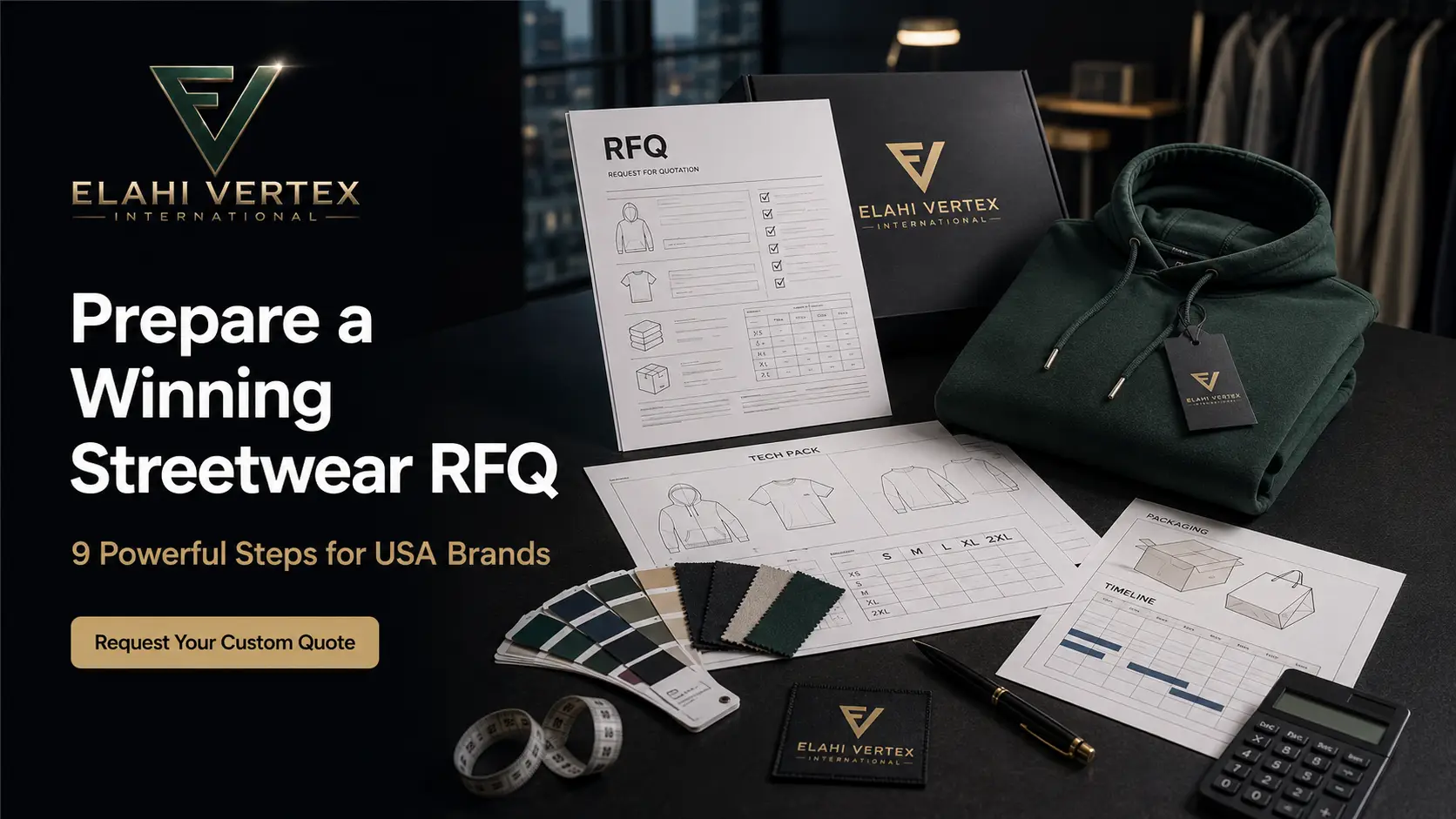
If you operate a U.S. LLC, clothing startup, streetwear label, e-commerce business, or growing fashion brand, the quality of your apparel RFQ can directly affect the quality of the manufacturer responses you receive.
A vague message such as “I need 100 hoodies. What is your price?” does not give a custom streetwear manufacturerenough information to quote the same product you have in mind. The manufacturer may have to assume the fabric, GSM, fit, construction, decoration, size range, packaging, quantity breakdown, and delivery requirements. Two factories can then return completely different prices because they are not actually quoting the same production scope.
A stronger approach is to prepare a structured RFQ that tells the manufacturer what you know, identifies what still needs development, and makes the commercial requirements easy to evaluate.
That is particularly important when a U.S. buyer is sourcing internationally. Your RFQ may be the first serious technical communication between your company and the factory. It should therefore function as both a production brief and a supplier-evaluation document.
This guide explains how to prepare one.
For brands researching manufacturing options before sending an RFQ, Elahi Vertex International’s official websiteprovides information about its B2B apparel manufacturing categories, including streetwear, hoodies, T-shirts, jackets, OEM, ODM, private-label manufacturing, cut-and-sew, embroidery, printing, labels, sampling, quality control, packaging, and shipping. The company identifies itself as a custom clothing manufacturer and apparel exporter based in Sialkot, Pakistan. (ELAHI VERTEX INTERNATIONAL)
Direct Answer: What Should a USA Brand Put in an Apparel RFQ?
A useful apparel RFQ should give the custom streetwear manufacturer enough information to understand the product, quantity, construction, branding, quality expectations, packaging, destination, and timing without guessing.
At minimum, include:
- Your company and contact information
- Product type
- Reference images or technical drawings
- Fit and construction requirements
- Fabric composition and GSM, if known
- Colors and color references
- Size range and measurement chart
- Printing, embroidery, patches, or other decoration
- Labels and private-label requirements
- Packaging requirements
- Quantity by style, color, and size
- Sample requirements
- Quality expectations
- Target delivery window
- Destination country and ZIP/postal code
- Required documentation, if applicable
- Questions that require the manufacturer’s recommendation
The most important principle is simple:
Do not make the manufacturer guess about decisions you have already made.
At the same time, do not pretend you know technical specifications that you do not know. If you are unsure whether French terry, fleece, jersey, or another construction is appropriate, say so. A good RFQ can distinguish between confirmed specifications and open development questions.
That makes the quotation more useful.
Table of Contents
- Why an RFQ Matters More Than a Simple Price Request
- What a Custom Streetwear Manufacturer Needs to Quote Accurately
- The 9 Essential Parts of a Strong Apparel RFQ
- Product Specifications: Turning a Design Into a Manufacturing Brief
- Fabric, GSM, Construction, and Hand Feel
- Fit, Measurements, and Streetwear Silhouettes
- Color and Customization Requirements
- Printing, Embroidery, Patches, and Decoration
- Private Label Branding and Packaging
- Quantity, MOQ, and Size/Color Breakdown
- Sampling and Prototype Requirements
- Quality Control and Acceptance Criteria
- Pricing: How to Request a Comparable Quote
- International Sourcing for USA Brands
- Shipping, Delivery, and Commercial Terms
- What a U.S. LLC Should Include About Its Business
- How to Compare Quotes From Different Manufacturers
- Red Flags in Manufacturer Responses
- A Complete Apparel RFQ Template
- RFQ Example: Custom Streetwear Hoodie
- RFQ Example: Oversized T-Shirt
- RFQ Example: Private-Label Streetwear Collection
- Buyer Decision Framework
- Common RFQ Mistakes
- RFQ Buyer Checklist
- How Elahi Vertex International Can Fit Into the Process
- Sizing Guide
- Color & Customization Guide
- About Elahi Vertex International
- Why Choose Elahi Vertex International?
- Frequently Asked Questions
- Conclusion
- Useful External Resources
1. Why an RFQ Matters More Than a Simple Price Request
An apparel RFQ is not merely a request for a number.
It is a request for a manufacturer to evaluate a defined production requirement and provide commercial information based on that requirement.
This distinction matters because clothing is not a single-dimensional product.
A hoodie can be:
- Lightweight or heavyweight
- Pullover or zip-up
- Regular fit, relaxed fit, oversized, cropped, or elongated
- Brushed fleece or French terry
- Plain or garment dyed
- Screen printed
- Embroidered
- Patch decorated
- Washed
- Distressed
- Private labeled
- Custom packaged
Each decision can change manufacturing requirements.
The same applies to an oversized T-shirt.
A buyer might say:
“I want a heavyweight oversized black T-shirt.”
That is directionally useful, but it still leaves major questions unanswered.
What does “heavyweight” mean for this particular product?
What fiber composition?
What fabric construction?
What GSM?
What oversized proportions?
What shoulder width?
What body length?
What neck rib?
What sleeve length?
What print size?
What print method?
What label?
What quantity?
What size breakdown?
What packaging?
Without answers, the factory is still estimating.
A quotation is only as useful as its scope
Suppose three manufacturers respond:ManufacturerQuoted PriceFactory A$8.20Factory B$9.10Factory C$10.40
At first glance, Factory A appears cheapest.
But imagine the quotes actually represent:Cost ComponentFactory AFactory BFactory CFabricStandardSpecifiedSpecifiedGSMAssumedConfirmedConfirmedCustom patternExcludedIncludedIncludedPrintingBasicRequired methodRequired methodLabelsExcludedIncludedIncludedPackagingBasicCustomCustomSamplingExcludedIncluded/quoted separatelyIncluded/quoted separatelyShippingExcludedExcludedIncluded
The comparison is no longer meaningful.
This is why an RFQ should establish the scope of the quotation before the price becomes the main comparison point.
Recent apparel-industry RFQ guidance similarly emphasizes that a buyer should compare the written production scope and supplier assumptions before comparing headline unit prices. (Meiting Garments)
2. What a Custom Streetwear Manufacturer Needs to Quote Accurately
A custom streetwear manufacturer generally needs information across five broad areas:
Product
What are you making?
Technical
How should it be made?
Commercial
How many do you need and what quotation structure do you want?
Branding
How should the garment represent your brand?
Logistics
Where does it need to go and when?
A good RFQ connects these five areas.
The RFQ hierarchy
Think about your request like this:
Concept → Product → Specifications → Sample → Approval → Bulk Production → Delivery
Each stage depends on the previous one.
If the product concept is unclear, specifications become unclear.
If specifications are unclear, the sample becomes subjective.
If the sample is subjective, bulk approval becomes risky.
If bulk approval is unclear, quality disputes become more likely.
The purpose of the RFQ is therefore not to eliminate every unknown. Its purpose is to identify the unknowns early.
3. The 9 Essential Parts of a Strong Apparel RFQ
A commercially useful RFQ can be organized into nine major sections.
1. Company and project information
Tell the manufacturer:
- Company name
- Country
- Website, if available
- Contact person
- WhatsApp or phone
- Product category
- Project stage
- Intended market
- Target launch period
For a U.S. LLC, identifying the business as a U.S.-based company can immediately provide useful context.
You do not need to send sensitive corporate information that is unrelated to production.
2. Product information
State exactly what you want.
For example:
Product: Oversized heavyweight streetwear hoodie
Then specify:
- Pullover or zip-up
- Men’s, women’s, unisex, or custom
- Fit
- Fabric direction
- GSM
- Color
- Decoration
- Labels
- Packaging
3. Artwork and references
Attach:
- Tech pack
- Flat sketch
- Product photos
- Reference garment photos
- Artwork
- Logo files
- Size chart
- Color references
If you have multiple files, name them logically.
For example:
Brand_Hoodie_TechPack_V1.pdf
Brand_Logo_White.ai
Brand_Hoodie_FrontArtwork.eps
Brand_Hoodie_BackArtwork.eps
Clear files reduce confusion.
4. Material requirements
State:
- Fiber composition
- Fabric construction
- GSM
- Stretch
- Finish
- Hand feel
- Color
- Wash effect
- Shrinkage expectations, where applicable
If you do not know the exact fabric, say:
“Please recommend the most suitable fabric construction based on the attached reference and target market.”
That is better than inventing a specification.
5. Branding and decoration
Specify:
- Screen print
- DTG
- DTF
- Embroidery
- Chenille
- Woven patch
- Rubber patch
- Heat transfer
- Rhinestones
- Appliqué
- Neck label
- Size label
- Care label
- Hangtag
- Packaging
The available method depends on the product and required finish.
Elahi Vertex International’s website states that its manufacturing services include embroidery, printing, labeling, packaging, and multiple customization methods, while its inquiry form specifically asks buyers about fabric type, GSM, wash effects, fit, printing technique, labels, size range, quantity, and design files. (ELAHI VERTEX INTERNATIONAL)
6. Quantity
Do not write only:
“100 pieces.”
Write:
“100 pieces total: 20 S, 25 M, 25 L, 20 XL, 10 XXL.”
If there are multiple colors, break the quantity down.
For example:ColorQuantityBlack100Washed Grey75Cream50Total225
If your final quantities are not confirmed, label them as estimates.
7. Sampling
State whether you want:
- Prototype
- Development sample
- Fit sample
- Size set
- Pre-production sample
- Approval sample
Do not assume that every factory uses exactly the same sampling terminology.
Ask the manufacturer to explain its sampling workflow.
8. Quality expectations
Explain what matters most.
Examples:
- Accurate measurements
- Consistent GSM
- Clean stitching
- Correct artwork placement
- Color consistency
- Wash appearance
- Print durability
- Embroidery quality
- Label placement
- Packaging accuracy
Quality should be measurable wherever practical.
9. Commercial and logistics requirements
Include:
- Quantity
- Destination
- ZIP code
- Required delivery window
- Sampling requirements
- Packaging
- Shipping preference
- Documentation requirements
- Quote validity, if relevant
- Payment structure to be discussed
Avoid demanding a delivery date before the manufacturer has assessed the product.
A realistic delivery window is normally dependent on the final specification, sampling, material availability, production route, quantity, and shipping method.
4. Product Specifications: Turning a Design Into a Manufacturing Brief
The biggest mistake many first-time founders make is assuming that a reference image is a specification.
It is not.
A photograph can show:
- General silhouette
- Graphic placement
- Color direction
- Pocket location
- Overall appearance
But it normally does not establish:
- Exact measurements
- Seam allowance
- Fabric composition
- GSM
- Stitch construction
- Rib specifications
- Shrinkage tolerance
- Print specifications
- Label dimensions
- Packaging
- Production tolerances
That is why a custom streetwear manufacturer needs more than inspiration.
Reference image versus technical specification
Reference MaterialWhat It CommunicatesProduct photographVisual directionSketchConstruction conceptTech packTechnical production instructionsMeasurement chartFit requirementsArtwork fileDecorationPantone referenceColor communicationPhysical sampleThree-dimensional referenceApproved pre-production sampleProduction benchmark
The strongest RFQ often combines several of these.
5. Fabric, GSM, Construction, and Hand Feel
Fabric selection is one of the most important decisions in streetwear manufacturing.
A buyer who says “premium cotton” has not yet created a technical specification.
Cotton products can differ substantially in:
- Fiber characteristics
- Yarn
- Knit structure
- Fabric weight
- Finishing
- Dyeing
- Brushing
- Stretch
- Surface appearance
- Hand feel
CottonWorks, an industry resource for apparel professionals, provides fabric and material-development resources that demonstrate how broad the range of textile constructions can be. (CottonWorks™)
What does GSM mean?
GSM means grams per square meter.
It describes fabric weight by area.
Higher GSM generally indicates a heavier fabric, but GSM alone does not tell you everything about garment quality.
Two fabrics can have similar GSM and still feel different because of:
- Fiber composition
- Yarn
- Knit structure
- Finishing
- Brushing
- Density
- Construction
Therefore, if you are developing a premium streetwear hoodie, do not make GSM your only specification.
Better RFQ wording
Instead of:
“Need good heavy hoodie.”
Use:
“We are developing a heavyweight streetwear hoodie. Target fabric weight is approximately ___ GSM. Please recommend the most appropriate fleece or terry construction based on the attached reference, intended fit, climate, and target retail positioning.”
If you already know the fabric, provide the specification.
If you do not, ask for alternatives.
6. Fit, Measurements, and Streetwear Silhouettes
Fit is one of the strongest differentiators in streetwear.
A standard T-shirt and an oversized streetwear T-shirt may use similar materials but look completely different because of:
- Shoulder width
- Chest width
- Body length
- Sleeve length
- Sleeve opening
- Neck opening
- Armhole
- Hem width
- Side seam position
Common streetwear fit descriptions
Regular fit
Closer to conventional apparel proportions.
Relaxed fit
More room through the body and shoulders.
Oversized fit
Intentionally enlarged proportions.
Boxy fit
Wider body with comparatively shorter length.
Cropped fit
Shorter body length.
Drop-shoulder fit
Shoulder seam intentionally positioned lower than a conventional shoulder point.
Elongated fit
Body length extended relative to width.
These labels are useful for communication but should not replace measurements.
7. Color and Customization Requirements
Color should be treated as a production specification, not simply a visual preference.
A buyer may say:
“Make it dark green.”
That can still be ambiguous.
Instead, provide:
- Pantone reference where appropriate
- Physical color reference
- Digital color reference
- Existing garment reference
- Fabric swatch
- Lab-dip requirement, where applicable
Example Pantone color-reference image source
A Pantone reference is useful for communication, but it should not be treated as a guarantee that a screen display will look identical to the physical production fabric.
Color should be confirmed against the actual material
The same nominal color can look different depending on:
- Fabric composition
- Fabric construction
- Dye method
- Surface texture
- Finish
- Lighting
- Printing method
For an RFQ, state whether the color is:
Confirmed
or
To be developed/recommended
That distinction prevents unnecessary assumptions.
8. Printing, Embroidery, Patches, and Decoration
Streetwear frequently depends on decoration.
But “logo on chest” is not a complete print specification.
A manufacturer may need:
- Artwork file
- Artwork dimensions
- Placement
- Print method
- Number of colors
- Finish
- Pantone references
- Embroidery size
- Stitch density, where applicable
- Patch material
- Patch dimensions
- Application method
Example
Weak:
“Print my logo on the front.”
Better:
“Front chest graphic, approximately ___ cm wide, centered ___ cm below neckline. Artwork supplied as vector file. Please recommend the most suitable decoration method for the selected fabric and provide the decoration cost separately.”
This allows the custom streetwear manufacturer to assess the decoration process rather than guessing.
9. Private Label Branding and Packaging
If you are building a streetwear brand, the garment itself is only one part of the product.
Your brand may require:
- Woven neck label
- Printed neck label
- Size label
- Care label
- Country-of-origin label where required
- Hangtag
- Sticker
- Custom polybag
- Tissue
- Box
- Barcode
- SKU
- Fold standard
- Carton marking
Your RFQ should distinguish between:
Garment branding
and
Packaging branding.
For example:
Custom woven neck label + custom size label + branded hangtag + individual polybag.
If you do not know which labels are required for your target market, say so and ask the manufacturer to identify the production requirements that need confirmation.
Do not ask the factory to make legal compliance assumptions on your behalf.
10. Quantity, MOQ, and Size/Color Breakdown
MOQ is not a universal number.
It can vary based on:
- Product
- Fabric
- Color
- Decoration
- Custom trims
- Pattern complexity
- Production route
- Material sourcing
- Order size
Therefore, a buyer should not build an entire business plan around a generic MOQ found on another manufacturer’s website.
Instead ask:
“Please quote the requested quantity and confirm the applicable MOQ for this exact style, color, and customization level.”
Quantity breakdown
Suppose your U.S. LLC is launching three hoodie colors.
Do not send:
300 hoodies.
Send:StyleColorSMLXLXXLTotalHoodieBlack1025352010100HoodieGrey1025352010100HoodieCream1025352010100Total30751056030300
If your size distribution is only an estimate, label it as such.
11. Sampling and Prototype Requirements
Sampling is where your RFQ becomes a practical development process.
Do not simply ask:
“Can I get a sample?”
Ask what you want the sample to prove.
For example:
Prototype objective
Confirm:
- Fabric
- GSM
- Fit
- Measurement
- Hood shape
- Rib
- Pocket construction
- Label
- Wash effect
- Overall appearance
A sample should answer production questions.
Sample approval is not merely visual
A sample can look good in photographs and still fail when measured.
For example:
- Chest width may be incorrect.
- Sleeve may be too short.
- Hood may collapse.
- Rib may stretch differently.
- Print may be too large.
- Body may shrink after washing.
- Color may differ from approved reference.
This is why a technical approval process matters.
Elahi Vertex International’s own website encourages buyers to examine fabric, stitching, fit, and customization before committing to bulk production, and describes a sampling-oriented ordering process. (ELAHI VERTEX INTERNATIONAL)
12. Quality Control and Acceptance Criteria
A strong RFQ tells the manufacturer what quality means to you.
Quality control can involve several layers.
Raw material
Check:
- Fabric
- Color
- GSM
- Composition
- Trims
Cutting
Check:
- Pattern accuracy
- Panel matching
- Grain direction
- Shade consistency
Sewing
Check:
- Seam quality
- Stitching
- Thread
- Symmetry
- Reinforcement
- Construction
Decoration
Check:
- Artwork
- Placement
- Color
- Adhesion
- Embroidery
- Surface appearance
Measurement
Check:
- Chest
- Waist
- Length
- Sleeve
- Shoulder
- Inseam
- Other relevant points
Finishing
Check:
- Loose threads
- Pressing
- Washing
- Folding
- Labels
- Packaging
AATCC maintains standardized textile test methods covering areas such as dimensional change, appearance after laundering, absorbency, and other textile-performance characteristics. (AATCC)
ASTM also maintains textile standards addressing physical, mechanical, and chemical properties of textiles and fabrics. (ASTM Store)
The practical lesson for a buyer is not “put every test in the RFQ.”
It is:
Identify which quality characteristics actually matter to your product and agree on how they will be evaluated.
13. Pricing: How to Request a Comparable Quote
Do not ask only:
“What is the price?”
Ask for a quotation that separates the major cost components where appropriate.
For example:Cost AreaRequestGarmentUnit priceSamplingSample costDecorationPrint/embroidery costLabelsLabel costPackagingPackaging costDevelopmentPattern/technical development if applicableShippingShipping quotation if requestedOtherClearly identified additional charges
This makes supplier comparison easier.
Ask what the price includes
A useful question is:
“Please confirm exactly what is included in the quoted unit price.”
Another:
“Please identify any costs not included in the quoted price.”
This is much more valuable than asking:
“Is this your final price?”
The first question identifies scope.
The second question often produces another number without clarifying what the number represents.
14. International Sourcing for USA Brands
A U.S. LLC sourcing internationally has additional considerations.
You may need to think about:
- Supplier location
- Export documentation
- Shipping method
- Import responsibilities
- Product labeling
- Customs documentation
- Duties and taxes
- Payment method
- Currency
- Insurance
- Commercial invoice
- Packing list
- Country-of-origin requirements
- Product-specific regulatory requirements
These requirements can vary depending on the product and transaction.
Do not assume that a manufacturer will automatically handle every U.S. import responsibility.
Instead, define who is responsible for each part of the shipment.
Example RFQ question
“Please explain which export documents you provide and which import responsibilities remain with the U.S. buyer.”
That creates clarity.
15. Shipping, Delivery, and Commercial Terms
Delivery should be discussed after the product scope is understood.
A buyer who says:
“I need 500 hoodies in 20 days.”
may be asking for something technically impossible, commercially expensive, or dependent on material availability.
Instead:
“Target launch date: ___. Please advise the realistic sampling and bulk production schedule based on the attached specifications.”
That invites the manufacturer to assess feasibility.
Separate production from transportation
These are different stages.
Production time is the time required to make the garments.
Transit time is the time required to move the shipment from the manufacturing origin to the destination.
The total timeline may also include:
- Product development
- Sample revisions
- Fabric sourcing
- Approval
- Bulk cutting
- Sewing
- Decoration
- Finishing
- Packing
- Export handling
- Transit
- Import processing
Do not treat a factory’s quoted production time as a guaranteed arrival date unless the commercial agreement explicitly establishes that responsibility.
16. What a U.S. LLC Should Include About Its Business
If you are a U.S. LLC, tell the manufacturer enough about your business to provide context.
Useful information can include:
Company: Your LLC name
Country: United States
Business type: Streetwear brand / e-commerce brand / retailer / wholesaler
Market: United States
Product: Custom streetwear
Project stage: New launch / established brand / seasonal collection
Expected quantity: Estimated or confirmed
Sales channel: DTC / retail / wholesale / marketplace
You do not need to send private financial records simply to receive a quote.
Why company context matters
A manufacturer may respond differently to:
- One prototype
- A first commercial run
- A seasonal collection
- A repeat production program
Your RFQ should therefore explain the project’s stage.
For example:
“We are a U.S.-based LLC preparing our first private-label streetwear collection. We are currently evaluating manufacturing partners and requesting quotations for three styles.”
That is far more informative than:
“How much for hoodie?”
17. How to Compare Quotes From Different Manufacturers
Once your RFQ is sent, the next problem begins:
How do you compare the responses?
Do not rank suppliers solely by unit price.
Create a comparison matrix.FactorManufacturer AManufacturer BManufacturer CProduct understoodFabric specifiedGSM confirmedFit understoodDecoration understoodLabels includedPackaging includedSample processQC processMOQUnit priceShippingCommunicationLead-time explanationOpen questions identified
This reveals something important.
A strong manufacturer response may contain more questions, not fewer.
That is not necessarily a negative.
If the manufacturer asks:
- What GSM?
- What fit?
- What wash?
- What size chart?
- What print dimensions?
- What packaging?
- What delivery destination?
they may be demonstrating that they understand the production variables.
A supplier that instantly gives a low price without asking anything may simply be pricing a generic product.
18. Red Flags in Manufacturer Responses
There is no single message that proves a manufacturer is unreliable.
However, several patterns deserve closer investigation.
Red flag 1: Immediate price without understanding the product
If you sent a detailed technical brief and the response is simply:
“$7.50. Best quality.”
you still do not know what is included.
Red flag 2: No clarification questions
Complex custom products normally have technical variables.
If every specification is ignored, the quotation may not be based on your actual requirement.
Red flag 3: Unsupported claims
Be cautious with statements such as:
- “Best factory”
- “World’s leading”
- “Guaranteed quality”
- “Zero defects”
- “Fastest manufacturer”
- “Guaranteed delivery”
Unless supported by specific evidence and contractual terms, these are marketing statements rather than useful procurement information.
Red flag 4: Certification claims without evidence
If a supplier claims certification, ask:
- Certification name
- Certificate holder
- Facility covered
- Certificate number
- Validity
- Certification body
Do not assume a logo on a website proves current certification.
Red flag 5: Changing specifications after quotation
If the original quote was based on one fabric and the manufacturer later says:
“That price was for a different fabric.”
ask why.
The RFQ should make the quotation basis clear.
19. A Complete Apparel RFQ Template
The following structure can be adapted for a custom streetwear manufacturer.
Buyer Information
Company:
[Your LLC / Brand]
Country:
United States
Website:
[Website]
Contact:
[Name]
Email:
[Email]
WhatsApp:
[Number]
Project
Product:
[Example: Oversized Streetwear Hoodie]
Collection:
[Collection Name]
Project Stage:
[Development / First Production / Reorder]
Target Market:
United States
Product Specification
Fit:
[Oversized / Boxy / Relaxed]
Fabric:
[Known specification or “Please recommend”]
GSM:
[Known GSM or target range]
Composition:
[Known composition or “Please recommend”]
Construction:
[Known requirements]
Wash:
[None / Garment wash / Vintage / Other]
Color
Main color:
[Color]
Reference:
[Pantone / swatch / physical sample]
Contrast:
[If applicable]
Branding
Neck label:
[Yes / No]
Size label:
[Yes / No]
Care label:
[Yes / No]
Hangtag:
[Yes / No]
Custom packaging:
[Yes / No]
Decoration
Method:
[Screen print / Embroidery / DTF / Patch / Other]
Artwork:
[Attached]
Placement:
[Front / Back / Sleeve]
Approximate dimensions:
[Measurements]
Quantity
Total:
[Quantity]
Size breakdown:
[Attached]
Color breakdown:
[Attached]
Sampling
Please quote:
- Prototype sample
- Sample development
- Sample revision, if applicable
- Pre-production sample
Please explain your sampling process.
Quality
Please confirm how you would evaluate:
- Fabric
- GSM
- Color
- Measurements
- Sewing
- Decoration
- Finishing
- Packaging
Commercial
Please provide:
- Unit price
- Sample cost
- Decoration cost
- Label cost
- Packaging cost
- Other applicable charges
Please identify any exclusions.
Shipping
Destination:
United States
ZIP code:
[ZIP]
Target delivery:
[Date/window]
Please explain available shipping options and responsibilities.
20. RFQ Example: Custom Streetwear Hoodie
Here is an example of a stronger real-world request.
Subject
RFQ — Custom Oversized Streetwear Hoodie for U.S. LLC
Hello,
We are a U.S.-based streetwear company developing a custom private-label hoodie.
We are currently evaluating manufacturing partners and would like a quotation based on the following requirements.
Product
Custom oversized pullover hoodie.
Fit
Oversized / relaxed streetwear silhouette with dropped shoulder.
Final measurements will be supplied in the attached specification sheet.
Fabric
We are considering heavyweight fleece or French terry.
Target GSM: [insert target].
If you recommend a different construction based on the desired appearance and hand feel, please provide the recommended alternative.
Color
Primary color: black.
Secondary color: washed grey.
Please confirm available fabric/color options.
Decoration
Front chest logo.
Large back graphic.
Artwork will be supplied as vector files.
Please recommend the most suitable decoration method for the selected fabric and quote it separately where practical.
Branding
We require:
- Custom neck label
- Size label
- Care label
- Hangtag
- Individual packaging
Please identify any additional information required.
Quantity
Estimated first order:
300 pieces.
Detailed size/color breakdown attached.
Please confirm applicable MOQ based on this exact style and customization.
Sample
Please quote prototype/sample development before bulk production.
The sample should allow us to approve:
- Fabric
- GSM
- Fit
- Measurements
- Color
- Label
- Construction
- Overall finish
Quality
Please explain your quality-control process and how the approved sample is used as the production reference.
Commercial
Please provide:
- Sample cost
- Unit cost
- Decoration cost
- Label/branding cost
- Packaging cost
- Other applicable charges
- Shipping options
Please identify exclusions.
Shipping
Destination:
United States
ZIP:
[ZIP]
Please provide available shipping options and clarify which shipping/import responsibilities are included.
Manufacturer Questions
Please also advise:
- Which fabric would you recommend?
- What information is still missing for an accurate quotation?
- What is the applicable MOQ for this specification?
- What sample process do you recommend?
- What quality checkpoints should we establish before bulk production?
Thank you.
21. RFQ Example: Oversized T-Shirt
A T-shirt RFQ can be shorter than a complex hoodie RFQ, but it still needs technical information.
Product
Custom oversized streetwear T-shirt.
Fit
Boxy oversized fit.
Fabric
Cotton or cotton-blend fabric.
Target GSM:
[Insert]
Please recommend a suitable construction if required.
Neck
Ribbed crew neckline.
Sleeves
Dropped shoulder.
Oversized sleeve proportion.
Branding
Small front logo.
Large back graphic.
Labeling
Custom neck label.
Custom size label.
Care label.
Quantity
[Quantity]
Size breakdown attached.
Colors
Black.
Off-white.
Dark grey.
Sampling
Prototype required before bulk production.
Quote
Please provide separate pricing where applicable for:
- Garment
- Decoration
- Labels
- Packaging
- Sampling
- Shipping
This format is concise enough for a manufacturer to process quickly while still containing the information required for a meaningful quotation.
22. RFQ Example: Private-Label Streetwear Collection
If your U.S. LLC is developing a complete collection rather than one product, your RFQ should be organized by style.
For example:
Style 01
Oversized T-shirt
Style 02
Heavyweight hoodie
Style 03
Crewneck sweatshirt
Style 04
Jogger
Style 05
Coach jacket
Each style should have its own:
- Reference
- Fabric
- GSM
- Fit
- Color
- Artwork
- Size chart
- Quantity
- Branding
- Packaging
Do not create one giant paragraph covering five products.
That makes supplier communication harder.
Use style codes
For example:
- EV-001
- EV-002
- EV-003
- EV-004
Or your own brand’s coding system.
Then write:
“Please quote Style EV-001 separately from EV-002.”
This makes future reorders easier.
23. Buyer Decision Framework
A professional sourcing workflow can be reduced to a sequence.
Step 1 — Define the product
Know what you are trying to manufacture.
Step 2 — Prepare references
Collect:
- Images
- Sketches
- Existing samples
- Inspiration
Step 3 — Create specifications
Define:
- Fabric
- GSM
- Fit
- Measurements
- Construction
- Color
- Branding
Step 4 — Prepare artwork
Provide clean files.
Step 5 — Define quantities
Break down:
- Style
- Color
- Size
Step 6 — Send the RFQ
Send the same core specification to each shortlisted supplier.
Step 7 — Compare responses
Compare scope before price.
Step 8 — Develop sample
Evaluate actual product.
Step 9 — Approve specifications
Lock the production requirements.
Step 10 — Confirm commercial terms
Document:
- Price
- Quantity
- Packaging
- Shipping
- Payment
- Timeline
Step 11 — Production
Maintain agreed communication and approval points.
Step 12 — Final inspection
Confirm the finished order against the approved requirements.
This process reduces avoidable ambiguity.
24. Common RFQ Mistakes
Mistake 1: Asking for a price before defining the product
This creates an unreliable comparison.
Mistake 2: Sending screenshots instead of artwork
A screenshot may be useful for visual reference but is not necessarily production-ready artwork.
Mistake 3: Saying “premium”
Premium is subjective.
Describe what premium means for your product.
It might mean:
- Specific fabric
- Specific GSM
- Specific fit
- Specific decoration
- Specific construction
- Specific finishing
Mistake 4: Not defining fit
“Streetwear fit” is not a measurement.
Mistake 5: No size chart
This creates unnecessary sampling ambiguity.
Mistake 6: No quantity breakdown
A total quantity does not reveal the size/color distribution.
Mistake 7: Comparing quotes with different scopes
This is one of the most expensive procurement mistakes.
Mistake 8: Ignoring packaging
If your product is private label, packaging can be part of the customer experience.
Mistake 9: Treating sample approval casually
The sample should be a technical checkpoint.
Mistake 10: Assuming every certification claim applies to the actual production facility
Verify facility-specific documentation when certification matters.
25. RFQ Buyer Checklist
Before sending your apparel RFQ, verify the following.
- Company name included
- U.S. market identified
- Contact person included
- Product clearly defined
- Product reference attached
- Tech pack attached if available
- Artwork attached
- Fabric requirement included
- GSM included or requested
- Fit specified
- Measurements supplied or requested
- Size range included
- Color requirements included
- Decoration method included
- Logo placement included
- Label requirements included
- Packaging requirements included
- Quantity included
- Size breakdown included
- Color breakdown included
- Sample requirement included
- Quality expectations included
- Destination included
- ZIP code included
- Delivery target included
- Shipping questions included
- Documentation requirements included
- Quote exclusions requested
- Open technical questions identified
If several of these are missing, your RFQ may still be usable, but the resulting quotation may contain more assumptions.
26. How Elahi Vertex International Can Fit Into the Process
A buyer evaluating a custom streetwear manufacturer should look for a supplier capable of understanding both product development and commercial production requirements.
Elahi Vertex International describes its business as custom apparel manufacturing and export, with product categories including streetwear and services including OEM, ODM, private-label manufacturing, cut-and-sew, embroidery, printing, custom labels, fabric sourcing, pattern making, sampling, quality control, packaging, and worldwide shipping. (ELAHI VERTEX INTERNATIONAL)
The company’s website also contains a custom inquiry form that allows buyers to provide:
- Company
- Country
- Product
- Quantity
- Delivery requirements
- Customization requirements
- Design/specification files
- Fabric information
- GSM
- Wash effects
- Fit
- Printing technique
- Labels
- Size range
- Additional instructions
That is particularly relevant to the RFQ process because those are the same categories a serious manufacturer needs to evaluate a custom production request. (ELAHI VERTEX INTERNATIONAL)
For a buyer who already has a clear specification, the next step is therefore not to send a generic “price please” message.
Send the production brief.
Request a quotation from Elahi Vertex International
For a U.S. LLC or international clothing business, you can submit your project requirements through the company’s website or contact the manufacturing team directly.
WhatsApp: Message Elahi Vertex International on WhatsApp
Email:
Website: Elahi Vertex International
Phone:
Alibaba: Elahi Vertex International on Alibaba
When contacting the company, include the RFQ information discussed in this guide rather than sending only a product name.
27. Sizing Guide for Custom Streetwear
Sizing is a critical part of a streetwear RFQ because streetwear silhouettes often depend on proportions rather than conventional sizing alone.
General sizing guidance
The following is general sizing guidance. It is not an Elahi Vertex International proprietary size chart.
For a specific production order, final measurements should be confirmed with the manufacturer.
Common measurements
For tops:
- Chest
- Shoulder
- Sleeve length
- Body length
- Neck opening
- Sleeve opening
For hoodies:
- Chest
- Shoulder
- Body length
- Sleeve length
- Hood dimensions
- Cuff
- Hem
- Pocket dimensions
For pants:
- Waist
- Hip
- Front rise
- Back rise
- Inseam
- Outseam
- Leg opening
For shorts:
- Waist
- Hip
- Rise
- Inseam
- Outseam
- Leg opening
Measure an existing garment
One practical approach is to take a garment that already has the fit you want and measure it flat.
For example:
Chest width: Measure across the garment from underarm to underarm.
Body length: Measure from the highest shoulder point or agreed reference point to the bottom hem.
Sleeve: Measure according to the manufacturer’s defined point of measure.
The critical issue is consistency.
Do not measure one sample using one method and another using a different method.
Example apparel measurement visual
US and UK sizing
U.S. and UK buyers should avoid assuming that a generic S/M/L label automatically produces the desired fit.
The same nominal size can have different measurements between brands and manufacturers.
For custom streetwear, the better approach is:
Label size + actual garment measurements + approved fit sample.
28. Color & Customization Guide
Streetwear customization can involve multiple visual layers.
Fabric color
The base fabric itself needs to be specified.
Print color
The print may require:
- Pantone reference
- Artwork file
- Number of colors
- Finish
Embroidery
Embroidery depends on:
- Artwork
- Size
- Thread
- Placement
- Stitching
- Fabric
Contrast components
These may include:
- Rib
- Drawcord
- Zipper
- Panel
- Binding
- Stitching
Labels
Labels can be:
- Woven
- Printed
- Sewn
- Heat-applied
The correct solution depends on the garment and desired brand presentation.
Elahi Vertex International’s website lists multiple customization options, including embroidery, woven and embroidered patches, silicone/rubber patches, heat-transfer logos, screen printing, raised/3D-style logos, custom neck labels, and woven brand labels, while also noting that the appropriate method depends on the product. (ELAHI VERTEX INTERNATIONAL)
29. About Elahi Vertex International
Elahi Vertex International is presented on its official website as a custom clothing manufacturer and global apparel exporter based in Sialkot, Pakistan.
The company identifies its product categories as including sportswear, teamwear, streetwear, boxing wear, leather wear, gym wear, fitness apparel, and private-label clothing. Its stated buyer groups include startups, established brands, wholesalers, distributors, retailers, clubs, academies, and importers. (ELAHI VERTEX INTERNATIONAL)
Its manufacturing information identifies services including:
- OEM
- ODM
- Private label
- Custom clothing manufacturing
- Cut-and-sew
- Printing
- Embroidery
- Custom labels
- Fabric sourcing
- Pattern making
- Sampling and prototyping
- Quality control
- Packaging
- Worldwide shipping
These services are presented on the company’s official website. (ELAHI VERTEX INTERNATIONAL)
For this article’s purpose, the most relevant relationship is:
Elahi Vertex International → B2B Manufacturing → Custom Streetwear → OEM / ODM / Private Label → International Buyers
The correct way to evaluate whether the company is suitable for your project is still to send the exact RFQ and confirm the specifications, quotation, sample requirements, production details, and commercial terms for your particular product.
30. Why Choose Elahi Vertex International?
A manufacturer should be selected based on fit with the buyer’s actual project rather than generic claims.
For a U.S. streetwear company, relevant evaluation points include:
Custom B2B manufacturing
The company positions itself around B2B custom manufacturing rather than consumer retail. (ELAHI VERTEX INTERNATIONAL)
OEM and ODM
The website identifies both OEM and ODM manufacturing services. (ELAHI VERTEX INTERNATIONAL)
Private label
Private-label manufacturing is listed among the company’s manufacturing services. (ELAHI VERTEX INTERNATIONAL)
Product customization
The site identifies printing, embroidery, labels, branding, fabric sourcing, pattern making, sampling, and packaging as part of its manufacturing services. (ELAHI VERTEX INTERNATIONAL)
Buyer specification workflow
The website’s inquiry system is structured around product, design files, fabric, GSM, wash effects, fit, printing, labels, sizes, quantities, and additional requirements. (ELAHI VERTEX INTERNATIONAL)
That does not mean every possible streetwear requirement is automatically available.
The correct procurement approach is to provide your specification and ask the company to confirm feasibility.
31. What Should a Manufacturer Send Back After Receiving Your RFQ?
A useful response should ideally address the major questions in your request.
You may expect a quotation response to clarify:
Product
What product are they pricing?
Material
What fabric or construction are they pricing?
Quantity
What quantity does the price apply to?
Decoration
What printing or embroidery method is included?
Branding
What labels and packaging are included?
Sample
What is the sample process?
Production
What production timeline is proposed?
Shipping
What shipping method and responsibility apply?
Cost
What is included and excluded?
If the response leaves major questions unanswered, ask for clarification before comparing the quote against other manufacturers.
32. How to Improve Your RFQ Response Rate
A strong RFQ should be easy to read.
Do not send a 40-page document if your project only needs two pages.
At the same time, do not send a three-line message for a highly customized product.
Use a one-page summary
At the beginning, provide:
Product:
Custom oversized hoodie
Quantity:
300 pcs
Market:
USA
Fit:
Oversized
Fabric:
Heavyweight fleece, specification attached
Decoration:
Front + back
Branding:
Private label
Sample:
Required
Destination:
USA
Target launch:
[Date]
Then attach the detailed technical information.
This lets the manufacturer understand the project immediately.
33. How to Handle Unknown Specifications
This is one of the most important skills for a first-time clothing founder.
You do not need to know everything.
You need to know what you know and what you do not know.
For example:
Confirmed
- Black color
- Oversized fit
- Front and back artwork
- 300 units
- U.S. destination
Open
- Exact GSM
- Fabric construction
- Decoration method
- Wash process
- Packaging
Then ask:
“Please recommend the appropriate fabric construction and decoration method based on the attached reference.”
This is a professional RFQ.
Pretending to know an exact technical specification when you do not can produce a worse product.
34. When You Should Send a Physical Reference Garment
A physical reference can be useful when:
- Fit is critical
- Fabric hand feel is important
- Construction is difficult to describe
- You want to reproduce an existing silhouette
- You have an approved garment
However, a reference garment still does not automatically transfer every specification.
The manufacturer should evaluate:
- Measurements
- Fabric
- Construction
- Decoration
- Trims
- Finishing
Use the physical reference as an additional technical input.
35. Tech Pack Versus Reference Image
Reference image
Best for:
- Visual direction
- Style
- Graphic inspiration
- General silhouette
Tech pack
Best for:
- Measurements
- Construction
- Materials
- Artwork
- Labels
- Packaging
- Technical instructions
If you have a complete tech pack, attach it.
If you do not, send the best available references and explicitly ask what information is still needed.
A streetwear development guide similarly describes the tech pack as the document that converts a design concept into measurable production instructions, including flat sketches, measurements, construction notes, fabric and trim information, labels, packaging, and artwork.
36. What to Ask About Materials
When the fabric is important, ask:
- What composition are you recommending?
- What construction is it?
- What GSM is available?
- What is the hand feel?
- Is it brushed or unbrushed?
- What finishing is recommended?
- Is the fabric stock or developed for the project?
- What color-development process is required?
- Are there relevant test requirements?
- Can a physical swatch be provided?
Do not ask for “the best fabric.”
Ask for a fabric that is appropriate for your product.
37. What to Ask About Printing
Ask:
- Which print method is recommended?
- Why?
- Is it suitable for the fabric?
- What is the expected appearance?
- What are the artwork requirements?
- What is the maximum practical print size?
- How will placement be controlled?
- Can a print sample be approved?
- Is a wash test appropriate?
- How is print quality checked?
The correct method depends on the fabric and design.
There is no universal “best printing method.”
38. What to Ask About Embroidery
For embroidery, ask:
- What is the artwork size?
- What file format is required?
- What backing is recommended?
- How will the embroidery affect the fabric?
- What placement is recommended?
- Can a sample be approved?
- What thread colors are available?
- What happens with detailed artwork?
Large dense embroidery on lightweight fabric can behave differently from small embroidery on heavyweight fleece.
The RFQ should therefore connect the decoration method to the fabric.
39. What to Ask About Wash Effects
Streetwear frequently uses garment-wash aesthetics.
Examples include:
- Vintage appearance
- Faded appearance
- Distressed appearance
- Acid-wash appearance
- Pigment-dyed appearance
- Enzyme-washed appearance
Do not describe these only with adjectives.
Attach a visual reference.
Then ask:
“Please advise which production process can achieve the closest result and identify any expected variation.”
Wash effects can create variation between garments.
That should be discussed before bulk production.
40. Quality Documentation and Testing
A buyer may need different quality documentation depending on the product and market.
Potential areas include:
- Fabric composition
- Colorfastness
- Dimensional change
- Appearance after laundering
- Restricted substances
- Physical performance
- Decoration performance
- Social compliance
- Material certification
Do not automatically demand every certificate you have heard about.
First determine what your product actually requires.
For example, OEKO-TEX STANDARD 100 is a textile safety certification system focused on testing textiles and accessories for harmful substances. (OEKO-TEX)
GOTS covers organic textiles through requirements relating to processing, manufacturing, packaging, labeling, trading, and distribution, subject to its certification criteria. (Global Standards)
Textile Exchange maintains material-related standards and describes systems intended to support credible sustainability claims and material traceability. (Textile Exchange)
The important procurement principle is:
Ask for the certification or test documentation that actually applies to your product, claim, and supply chain.
41. Social Compliance Questions
If social compliance is important to your U.S. LLC or retail customers, ask the manufacturer:
- Which facility will manufacture the order?
- Is production subcontracted?
- Which social-compliance programs apply?
- Can current documentation be provided?
- Does the documentation cover the actual production facility?
- When does it expire?
- Who issued it?
WRAP’s 12 Principles cover areas including workplace conditions, forced labor, child labor, health and safety, environmental practices, customs compliance, and security. (WRAP Compliance)
That does not mean every streetwear manufacturer needs WRAP certification.
It means buyers should understand what social-compliance evidence matters to their own supply chain.
42. Should a New U.S. LLC Mention Its Expected Future Orders?
Yes, if the information is realistic.
For example:
“This is an initial production run. If the first product performs well, we expect potential repeat orders.”
That provides useful context.
But do not promise:
“We will order 50,000 units every month.”
unless you genuinely have that business.
False volume claims can damage supplier trust.
A better approach is:
“We are starting with an initial order and intend to evaluate the supplier for future seasonal production.”
That is credible.
43. How Many Manufacturers Should You RFQ?
There is no universal correct number.
The objective is not to send the same request to dozens of factories.
The objective is to compare a manageable group of genuinely suitable suppliers.
A practical sourcing approach is:
- Identify relevant manufacturers.
- Screen their product capabilities.
- Remove suppliers that clearly do not fit.
- Send the same core RFQ to the remaining candidates.
- Compare their responses.
- Sample the strongest candidates.
- Select based on evidence.
Sending a poorly prepared RFQ to twenty suppliers is less useful than sending a strong RFQ to a smaller, qualified group.
44. Should You Tell Manufacturers Your Target Price?
This depends on your sourcing strategy.
There are two approaches.
Approach A: Open quotation
Ask:
“Please provide your best quotation based on the attached specifications.”
This gives the manufacturer room to price the product independently.
Approach B: Target-cost discussion
If you have a realistic target:
“Our current target cost is approximately ___. Please advise whether the specification can be produced within this range and identify any changes that would materially affect cost.”
The second approach can be useful when you are prepared to negotiate the specification rather than simply demand a lower price.
Do not use an unrealistic target as a negotiation tactic.
45. Cost Drivers in Custom Streetwear
A streetwear garment’s cost can be influenced by:
- Fabric
- GSM
- Composition
- Pattern complexity
- Number of panels
- Sewing complexity
- Decoration
- Print size
- Embroidery density
- Wash
- Hardware
- Zippers
- Labels
- Packaging
- Quantity
- Color count
- Sampling
- Shipping
Therefore:
A cheaper garment specification is not automatically a cheaper business decision.
If a $2 saving creates a product customers dislike, the saving may be meaningless.
46. MOQ Should Be Evaluated at the Style Level
A manufacturer may quote different minimums for:
- T-shirt
- Hoodie
- Jogger
- Jacket
It may also vary by:
- Color
- Fabric
- Decoration
- Custom trim
Therefore, ask:
“Please confirm the MOQ for each style and color combination.”
Do not assume the MOQ shown on a website applies to every product.
Elahi Vertex International’s website provides an inquiry form where buyers can indicate quantities ranging from samples and small unit targets through larger quantities, reinforcing the importance of discussing quantity based on the actual project rather than assuming one universal number. (ELAHI VERTEX INTERNATIONAL)
47. Reorders and Production Consistency
If your first collection performs well, you may reorder.
That means the original approval package matters.
Maintain:
- Approved tech pack
- Approved sample
- Approved color references
- Artwork
- Labels
- Packaging
- Measurement chart
- Production notes
When reordering, refer back to the approved version.
Do not say:
“Make it like last time.”
Instead:
“Repeat Style EV-001 according to the approved production specification dated [date/version].”
That is far safer.
48. Version Control for Streetwear Development
Use version numbers.
For example:
Tech Pack: V1.0
After revisions:
Tech Pack: V1.1
After final approval:
Tech Pack: V2.0 Approved
Do the same with artwork.
This prevents the classic problem:
“I thought you meant the previous logo.”
A manufacturer can only produce from the information it receives.
Version control makes that information traceable.
49. RFQ File Organization
A simple folder structure can help.STREETWEAR_PROJECT/ │ ├── 01_RFQ/ ├── 02_TECH_PACK/ ├── 03_ARTWORK/ ├── 04_LOGOS/ ├── 05_SIZE_CHART/ ├── 06_COLOR_REFERENCES/ ├── 07_SAMPLE/ ├── 08_APPROVAL/ └── 09_PACKAGING/
Use descriptive file names.
Avoid:
final.pdf
because “final” quickly becomes meaningless.
Prefer:
Brand_Hoodie_TechPack_V2_APPROVED.pdf
50. The Most Important RFQ Principle
If you remember only one thing from this guide, remember this:
A good RFQ creates a common definition of the product before suppliers compete on price.
Without that common definition, you are not comparing manufacturers.
You are comparing assumptions.
That is a major difference.
51. A Practical U.S. Streetwear RFQ Scorecard
Once responses arrive, score each manufacturer.
You can use:Evaluation AreaWeightProduct understandingHighTechnical capabilityHighSample qualityHighCommunicationHighQuality processHighPriceHighMOQ suitabilityMediumBranding/packagingMediumShipping supportMediumDocumentationMedium
The exact weighting depends on your business.
A luxury streetwear brand may prioritize fabric and construction.
A promotional streetwear business may prioritize price and turnaround.
A startup may prioritize sampling flexibility.
There is no universal supplier score.
52. Buyer Mistakes That Increase RFQ Friction
Sending a voice message instead of a specification
Voice messages can be useful for conversation but are poor substitutes for documented technical requirements.
Sending twenty screenshots with no explanation
The manufacturer may not know which screenshot is the final reference.
Changing the product during quotation
If the specification changes repeatedly, the quotation may become obsolete.
Asking for ten products in one paragraph
Separate the styles.
Not specifying whether quantities are estimates
Clearly mark:
Estimated quantity
or
Confirmed quantity
Not identifying the destination
Shipping costs depend on destination.
Not identifying the market
The intended market can affect product and documentation discussions.
53. What Makes an RFQ Look Professional?
Professional does not mean complicated.
It means:
- Clear
- Structured
- Complete
- Honest
- Easy to quote
- Easy to compare
- Easy to revise
A two-page excellent RFQ is better than a twenty-page disorganized RFQ.
Your objective is to reduce uncertainty.
54. The Ideal RFQ Communication Flow
A strong workflow can look like this:
Buyer
Sends RFQ.
↓
Manufacturer
Reviews requirements.
↓
Manufacturer
Identifies missing information.
↓
Buyer
Answers technical questions.
↓
Manufacturer
Provides preliminary quotation.
↓
Buyer
Reviews scope.
↓
Manufacturer
Confirms sample requirements.
↓
Buyer
Approves sample direction.
↓
Manufacturer
Develops sample.
↓
Buyer
Reviews and requests revisions if necessary.
↓
Manufacturer
Provides revised sample.
↓
Buyer
Approves final production sample.
↓
Manufacturer
Confirms bulk quotation and production details.
↓
Buyer
Confirms order.
This is a much stronger system than:
“Hi, price?”
55. When to Ask for a Sample Before Choosing the Manufacturer
If the product is highly customized, sampling can be a supplier-selection tool.
You can evaluate:
- Fabric
- Fit
- Construction
- Decoration
- Communication
- Revision handling
- Attention to detail
The sample therefore evaluates not only the garment.
It evaluates the manufacturing relationship.
That is especially important for a new U.S. LLC that has not previously worked with the factory.
56. What to Do If the Sample Is Wrong
Do not immediately argue about whether the factory is “good” or “bad.”
Compare the sample against the approved specification.
Ask:
- What was specified?
- What was produced?
- What changed?
- Was the change approved?
- Can it be corrected?
- What is the revised sample plan?
This keeps the discussion objective.
57. What to Do If the Quote Is Too High
Do not immediately say:
“Reduce the price.”
Ask what drives the cost.
For example:
“Which elements of the current specification contribute most significantly to the unit cost?”
Then discuss alternatives.
Possible cost levers may include:
- Fabric construction
- GSM
- Decoration
- Number of colors
- Hardware
- Packaging
- Quantity
- Pattern complexity
Never reduce a critical quality attribute blindly.
58. What to Do If the Quote Is Surprisingly Low
This is equally important.
Ask:
“Please confirm the exact specification included in this price.”
Then verify:
- Fabric
- GSM
- Construction
- Decoration
- Labels
- Packaging
- Sampling
- Quantity
- Shipping
A low quote is useful only if it represents the product you actually want.
59. Building a Long-Term Manufacturer Relationship
The first RFQ is not merely about one order.
It can establish a manufacturing relationship.
Good supplier relationships are easier when the buyer:
- Provides clear specifications
- Pays according to agreed terms
- Approves samples promptly
- Communicates changes clearly
- Uses version control
- Avoids unrealistic deadlines
- Documents decisions
- Gives useful feedback
Manufacturers also need to communicate clearly about feasibility, cost, timelines, and production limitations.
The relationship should be based on documented expectations rather than assumptions.
60. Your RFQ Should Protect Both Sides
A good RFQ protects the buyer because it creates clarity.
It also protects the manufacturer because it defines the requested product.
That matters.
If you tell a factory:
“Make it premium.”
and later complain that the product is not premium enough, there is no objective standard.
If you specify:
- Fabric
- GSM
- Measurements
- Decoration
- Color
- Labels
- Packaging
there is a much stronger basis for evaluating the result.
61. A Short RFQ for WhatsApp
If you are contacting a custom streetwear manufacturer through WhatsApp, do not send the entire technical specification in one huge message.
Start with a summary.
Example
Hello,
We are a U.S.-based LLC developing a private-label streetwear collection.
We are looking for a manufacturing partner for custom:
- Oversized T-shirts
- Heavyweight hoodies
- Sweatshirts
- Joggers
Initial quantity is approximately [quantity].
We have design references and can provide tech packs/artwork.
We need:
- Custom fit
- Custom fabric/GSM
- Printing
- Private labels
- Packaging
- Sampling before bulk
Please let us know which information you need for an accurate quotation.
Thank you.
Then send the files.
This is much easier to process than sending fifty individual messages.
62. A Short RFQ for Email
Subject
RFQ — Custom Private-Label Streetwear Production for U.S. LLC
Hello,
We are a U.S.-based LLC developing a custom streetwear collection and are currently evaluating manufacturing partners.
We would like a quotation for the attached product specifications.
The project includes:
- Product: [Product]
- Quantity: [Quantity]
- Fabric: [Specification]
- GSM: [Specification]
- Fit: [Specification]
- Colors: [Specification]
- Decoration: [Specification]
- Labels: [Specification]
- Packaging: [Specification]
- Sample: Required
- Destination: United States
Please provide:
- Sample cost
- Unit price
- MOQ
- Decoration cost
- Label/packaging cost
- Production timeline
- Shipping options
- Any missing information required for final quotation
Please also identify anything included or excluded from the quotation.
Best regards,
[Name]
[Company]
63. What an Excellent Manufacturer Response Looks Like
An excellent response does not necessarily mean the lowest price.
It may look like:
“We reviewed the attached hoodie specification. We need clarification on the GSM, print dimensions, and size chart before confirming the final quotation. Based on the reference, we recommend a fleece construction. We can provide two fabric options for comparison. Please confirm whether the packaging should be standard or fully branded.”
That response is useful.
It shows the manufacturer is engaging with the production problem.
64. What a Weak Manufacturer Response Looks Like
A weak response might be:
“Yes sir. Best quality. $10. Send quantity.”
The problem is not the wording.
The problem is that the response does not establish:
- What fabric?
- What GSM?
- What fit?
- What decoration?
- What packaging?
- What quantity basis?
- What sample?
- What shipping?
- What quality?
You still do not have a comparable quotation.
65. RFQ and AI-Assisted Sourcing
AI can help a U.S. buyer organize an RFQ, but AI should not invent technical specifications.
For example, AI can help turn:
“I want a vintage oversized hoodie.”
into questions such as:
- What fit?
- What measurements?
- What GSM?
- What fabric construction?
- What wash effect?
- What print?
- What label?
- What quantity?
That is useful.
But AI should not arbitrarily tell the buyer:
“Use exactly 420 GSM 100% cotton fleece.”
unless that specification has been deliberately selected based on the product requirements.
The manufacturer should have an opportunity to recommend appropriate materials.
66. How AI Search Changes the Buyer Journey
Modern buyers may search:
- “How do I send an apparel RFQ?”
- “What information does a clothing manufacturer need?”
- “How do I get a quote for custom streetwear?”
- “What should I include in a hoodie tech pack?”
- “How do I compare clothing manufacturer quotes?”
- “What should a private-label clothing RFQ contain?”
That means a useful manufacturing guide should answer these questions directly.
This article is designed around those buyer questions rather than merely repeating generic manufacturer marketing.
67. AEO: The Short Answers Buyers Need
What is an apparel RFQ?
An apparel RFQ, or Request for Quotation, is a structured request that gives a clothing manufacturer the product, technical, quantity, branding, quality, packaging, and logistics information needed to prepare a quotation.
What should a clothing RFQ include?
It should normally include the product, specifications, fabric, GSM, fit, size chart, colors, artwork, decoration, branding, packaging, quantity, sample requirements, destination, and target timeline.
Should a U.S. LLC include its company information?
Yes. Provide enough company and project context for the manufacturer to understand who is buying, where the goods will be delivered, and what stage the project is in.
Should you request samples before bulk production?
For highly customized apparel, a sample or appropriate development stage is generally useful because it allows the buyer to evaluate fit, materials, construction, decoration, and finishing before committing to bulk production.
Is the lowest quotation always the best quotation?
No. A lower price may represent a different fabric, decoration method, packaging level, quantity basis, or scope of work.
68. Final RFQ Framework
For a U.S. streetwear business, the entire process can be summarized as:
Define → Document → Request → Compare → Sample → Approve → Produce → Inspect → Reorder
The RFQ sits between document and request.
That makes it one of the most important documents in your sourcing process.
69. The 9 Questions Your RFQ Should Force the Manufacturer to Answer
1. What exactly are you quoting?
Product, fabric, fit, decoration, quantity.
2. What is missing?
A serious manufacturer should identify missing technical information.
3. What fabric do you recommend?
Especially when the buyer has not finalized the material.
4. What is the MOQ for this exact specification?
Not a generic website MOQ.
5. What does sampling involve?
Ask what will be approved.
6. What does the unit price include?
Prevent scope confusion.
7. What is excluded?
Identify additional costs.
8. What is the realistic production timeline?
Based on the final approved specification.
9. What should the buyer confirm before bulk production?
This question often reveals the manufacturer’s practical understanding.
70. Final Buyer Checklist Before You Send the RFQ
Use this as your final gate.
Product
- Product clearly named
- Product category identified
- Fit identified
- Reference attached
Technical
- Fabric defined or requested
- GSM defined or requested
- Composition defined or requested
- Measurements attached
- Construction details included
Color
- Main colors defined
- Color references attached
- Contrast colors defined
Decoration
- Artwork attached
- Placement defined
- Print/embroidery requirement defined
- Manufacturer recommendation requested if uncertain
Branding
- Neck label
- Size label
- Care label
- Hangtag
- Packaging
Quantity
- Total quantity
- Style quantity
- Color quantity
- Size breakdown
Sampling
- Sample requested
- Sample objective defined
- Approval process discussed
Quality
- Quality expectations defined
- Inspection requirements discussed
- Testing requirements identified where relevant
Commercial
- Unit price requested
- Sample cost requested
- Decoration cost requested
- Packaging cost requested
- Exclusions requested
Logistics
- Destination country
- ZIP code
- Target date
- Shipping responsibility
- Documentation requirements
Supplier
- Manufacturer asked to identify missing information
- Manufacturer asked to confirm MOQ
- Manufacturer asked to explain sample process
- Manufacturer asked to explain quality process
If you can check most of these boxes, your RFQ is likely to produce much more useful responses than a basic price inquiry.
71. 20 Frequently Asked Questions About Apparel RFQs for Custom Streetwear
1. What is an apparel RFQ?
An apparel RFQ is a structured request sent to a clothing manufacturer asking for pricing and production information based on defined product requirements. It should communicate the garment, specifications, quantity, customization, branding, packaging, destination, sampling requirements, and other relevant commercial details.
2. What should I send to a custom streetwear manufacturer for a quote?
Send the product description, reference images or tech pack, fabric requirements, GSM, fit, measurements, colors, artwork, decoration, labels, packaging, quantity, size breakdown, destination, and desired sampling process. If something is unknown, identify it as an open question instead of guessing.
3. Does my U.S. LLC need a tech pack?
Not necessarily. A tech pack makes the process more precise, especially for complex custom products. If you do not have one, provide clear references and ask the manufacturer what information is required for development and quotation.
4. Can I request a quote with only a picture?
You can, but the quotation may be preliminary because a picture normally does not communicate every technical specification. A manufacturer may need fabric, GSM, fit, measurements, decoration, labels, packaging, and quantity information before producing a reliable quotation.
5. Should I tell the manufacturer my target quantity?
Yes. Quantity is an important commercial variable. If the number is not final, clearly label it as an estimate. For multiple colors or styles, provide a breakdown whenever possible.
6. Should I ask for MOQ in the RFQ?
Yes. Ask for the MOQ applicable to your exact product, color, fabric, and customization requirements rather than assuming that a general MOQ applies to every style.
7. Should I ask for a sample before placing a bulk order?
For custom streetwear, sampling is generally a sensible development step because fit, fabric, decoration, measurements, and finishing are difficult to evaluate completely from a quotation.
8. How should I compare two clothing manufacturer quotes?
First compare whether both manufacturers are quoting the same product scope. Check fabric, GSM, fit, decoration, labels, packaging, quantity, sample requirements, shipping, exclusions, and production assumptions before comparing unit price.
9. What if I do not know the correct fabric?
Tell the manufacturer what you want the garment to feel and look like, provide a reference, and ask for fabric recommendations. You can request multiple fabric options if the material decision is important.
10. What does GSM mean?
GSM means grams per square meter and is commonly used to describe fabric weight. It is useful for comparing materials, but GSM alone does not fully define fabric quality, hand feel, construction, or performance.
11. How should I specify oversized streetwear?
Do not rely only on the word “oversized.” Provide a measurement chart or reference garment and define chest width, shoulder, body length, sleeve length, and other relevant measurements.
12. Should I provide Pantone colors?
Where accurate color communication matters, a Pantone reference or other agreed color standard can be useful. However, final appearance should be confirmed against the actual material and production method where appropriate.
13. Should printing be included in the unit price?
Ask the manufacturer to clarify whether decoration is included. For complex projects, requesting a breakdown of garment, decoration, labels, packaging, and other relevant costs can make supplier comparison easier.
14. What should I ask about private labeling?
Ask about neck labels, size labels, care labels, hangtags, packaging, barcode/SKU requirements, and any other branding components your retail channel requires.
15. Should I include my launch date?
Yes, but distinguish between a target launch date and a contractual delivery deadline. Ask the manufacturer to evaluate the realistic development, production, and shipping timeline based on the final specification.
16. What if a manufacturer gives a very low quote?
Ask what specification the quote is based on. Verify fabric, GSM, construction, decoration, labels, packaging, quantity, sampling, and shipping. A low price is meaningful only when the scope is comparable.
17. What if a manufacturer asks many questions after receiving my RFQ?
That can be a positive sign if the questions are relevant to production. It may indicate that the manufacturer is identifying variables needed to produce a more accurate quotation.
18. Should I send the same RFQ to every manufacturer?
For supplier comparison, using the same core specification is usually useful. Otherwise, different manufacturers may quote different products, making price comparison unreliable.
19. Can Elahi Vertex International provide a quote for a custom streetwear project?
Elahi Vertex International’s official website provides a custom inquiry workflow for apparel projects and lists streetwear, OEM, ODM, private-label manufacturing, customization, sampling, printing, embroidery, labels, packaging, and other manufacturing services. Specific feasibility, MOQ, pricing, sampling, and production details should be confirmed for the individual project. (ELAHI VERTEX INTERNATIONAL)
20. How should I contact Elahi Vertex International for an RFQ?
Prepare your product specifications, quantity, design files, size information, customization requirements, and destination, then contact the company through its official website, WhatsApp, email, phone, or Alibaba storefront.
Website: Elahi Vertex International
WhatsApp: WhatsApp RFQ Contact
Email:
Alibaba: Elahi Vertex International Alibaba storefront
72. Final Conclusion: A Better RFQ Produces a Better Manufacturing Conversation
For a U.S. LLC launching or expanding a streetwear brand, the manufacturer-selection process should not begin with the question:
“Who has the cheapest price?”
It should begin with:
“Who can understand and reproduce the product I actually want?”
That starts with a good apparel RFQ.
A strong RFQ gives the custom streetwear manufacturer enough information to understand your project without forcing the supplier to guess. It also gives you a much better way to compare manufacturers because you can evaluate responses against the same production scope.
The most important elements are straightforward:
- Define the product.
- Explain the fit.
- Specify or request the appropriate fabric.
- Provide GSM when known.
- Supply measurements.
- Provide accurate artwork.
- Define colors.
- Explain decoration.
- Specify private-label requirements.
- Break down quantities.
- Request appropriate samples.
- Define quality expectations.
- Ask what the quotation includes.
- Ask what it excludes.
- Provide the destination.
- Discuss realistic timing.
- Ask the manufacturer to identify missing information.
For U.S. buyers, international sourcing also requires attention to shipping, documentation, labeling, customs responsibilities, and supplier verification. These requirements should be discussed according to the actual product and transaction rather than assumed.
The most important procurement principle remains simple:
Do not compare numbers until you know what the numbers represent.
A $7 garment and a $12 garment are not competing products if the fabric, construction, decoration, packaging, and shipping scope are different.
Likewise, a manufacturer who asks intelligent technical questions is not necessarily making the process difficult. In many cases, those questions are exactly what prevents an inaccurate quote.
If your streetwear brand is ready to move from concept to manufacturing, prepare the RFQ before contacting suppliers. Give the manufacturer the product information you already know, clearly identify what still needs development, attach the relevant files, and ask the supplier to confirm the remaining technical and commercial variables.
For buyers evaluating Elahi Vertex International, the company’s official inquiry workflow is structured around many of the same production inputs covered in this guide, including product, quantity, design files, fabric, GSM, wash effects, fit, printing, labels, size range, and additional requirements. (ELAHI VERTEX INTERNATIONAL)
If you have a tech pack, send it.
If you have only a design, send the design and explain the intended product.
If you know the fabric, specify it.
If you do not know the fabric, ask for a recommendation.
If your quantity is estimated, say so.
If your launch date is a target rather than a confirmed deadline, say so.
That level of transparency makes the sourcing process more professional on both sides.
Ready to Request Your Custom Streetwear Quote?
Send:
Product + Quantity + Design/Tech Pack + Fabric/GSM + Fit + Colors + Branding + Packaging + Destination + Sample Requirements
Then ask the manufacturer to confirm:
MOQ + Sample Process + Unit Cost + Included/Excluded Costs + Production Timeline + Shipping Options + Missing Requirements
For an RFQ with Elahi Vertex International:
WhatsApp: +92 309 1639614
Email:
Website: https://elahivertexinternational.com/
Alibaba: Elahi Vertex International Alibaba storefront
Phone:
Elahi Vertex International
Custom B2B Manufacturing
OEM | ODM | Private Label | Custom Manufacturing | Export
Useful External Resources
1. ASTM International — Textile Standards
Why relevant: Provides textile specifications and test methods covering physical, mechanical, and chemical characteristics of fabrics and textiles.
Section supported: Quality control, testing, fabric specifications. (ASTM Store)
2. AATCC — Textile Testing Standards
Why relevant: Provides recognized textile test methods covering areas such as laundering appearance, dimensional change, absorbency, color, and other textile-performance characteristics.
Section supported: Quality control and testing. (AATCC)
3. CottonWorks™
Why relevant: Provides apparel professionals with cotton-rich fabric resources and material-development information.
Section supported: Fabric selection, GSM, construction, and material development. (CottonWorks™)
4. OEKO-TEX® STANDARD 100
Why relevant: Explains a widely used textile safety certification system focused on testing textiles and accessories for harmful substances.
Section supported: Testing, certification, and buyer verification. (OEKO-TEX)
5. Global Organic Textile Standard
Global Organic Textile Standard
Why relevant: Provides information about requirements for certified organic textiles and supply-chain processing, manufacturing, labeling, and related requirements.
Section supported: Material claims, certification, and sourcing verification. (Global Standards)
6. Textile Exchange
Why relevant: Provides material-specific standards and resources supporting credible sustainability and material-related claims in fashion and textiles.
Section supported: Material sourcing, sustainability claims, and supplier verification. (Textile Exchange)
7. WRAP Compliance
Why relevant: Provides a framework covering responsible production, workplace practices, health and safety, environmental practices, customs compliance, and security.
Section supported: Social compliance and supplier due diligence. (WRAP Compliance)
Image/source references used for buyer education:
Streetwear hoodie production-line image source
Streetwear tech-pack image source
Garment measurement image source
Pantone color-reference image source
Streetwear branding/packaging image source
Hoodie production image source
