
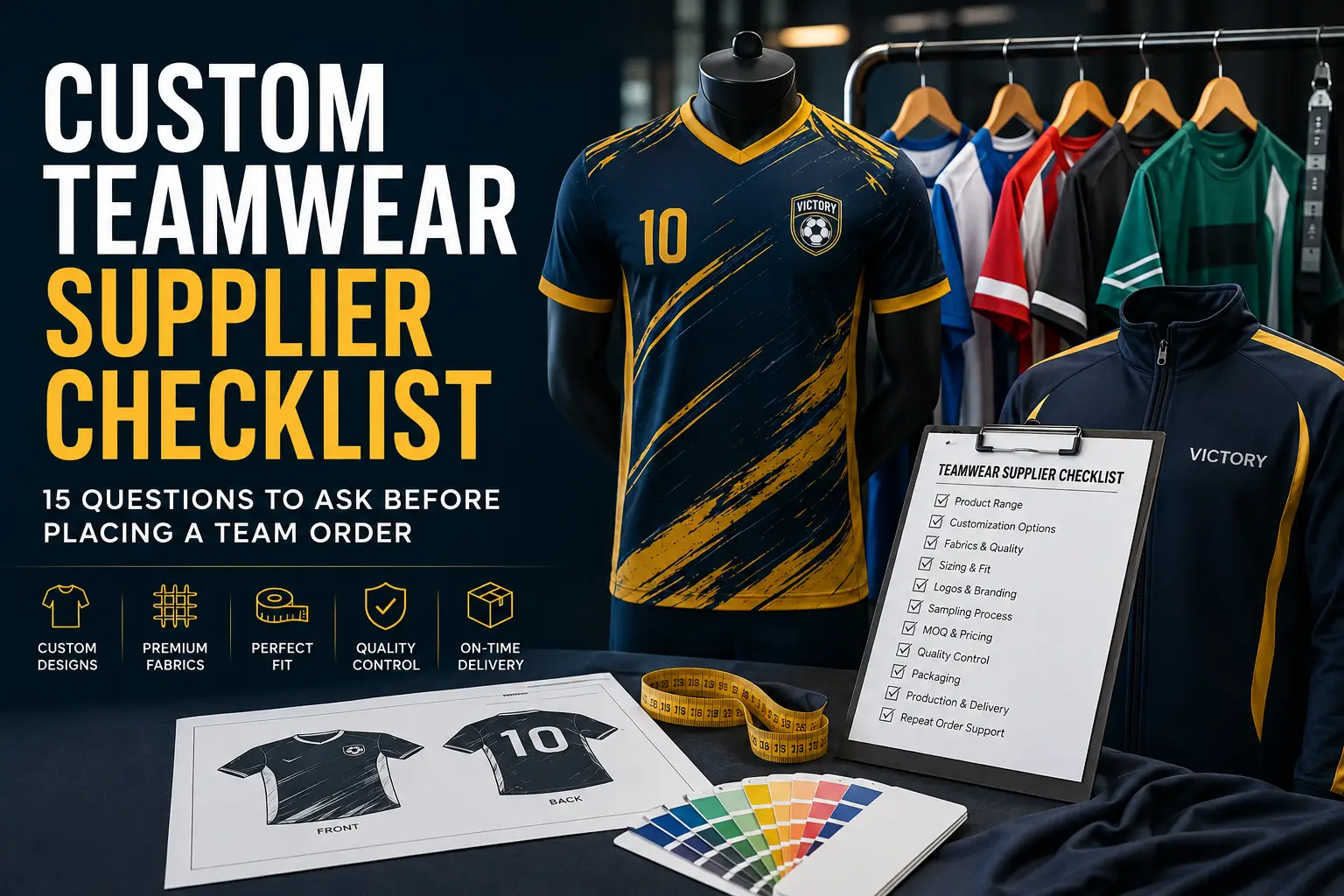
Choosing a custom teamwear supplier is not simply about finding a manufacturer that can print a logo on a jersey. For clubs, academies, sports teams, teamwear retailers, wholesalers, and sportswear brands, the wrong supplier can create problems with sizing, colors, branding, fabric, production consistency, packaging, delivery, and repeat orders.
Before placing a teamwear order, buyers should evaluate the supplier’s ability to understand the specification, produce the required garments consistently, communicate clearly, and support the project from development through shipment.
This custom teamwear supplier checklist covers 15 practical questions buyers should ask before approving production.
Table of Contents
- What products can the supplier manufacture?
- Can the supplier follow my exact specifications?
- What customization options are available?
- Which fabrics and GSM options are available?
- How will sizing and fit be handled?
- Can the supplier manage names, numbers, logos and sponsors?
- Can I approve a sample before bulk production?
- How does the supplier handle artwork and specifications?
- What is the MOQ for my specific order?
- What quality-control process is used?
- How are color accuracy and branding checked?
- Can the supplier handle repeat orders consistently?
- What packaging and labeling options are available?
- What production and shipping information should I confirm?
- Is the supplier suitable for long-term B2B production?
What Makes a Good Custom Teamwear Supplier?
A good custom teamwear supplier should be able to translate a buyer’s requirements into a clear production specification and then manufacture the order consistently.
For a teamwear project, buyers should evaluate more than the quoted unit price. A proper supplier assessment should consider:
- Product construction
- Fabric requirements
- GSM and performance requirements
- Size specifications
- Fit and measurements
- Team colors
- Logos and sponsor placement
- Names and numbers
- Labels and packaging
- Sampling
- Quality control
- Production communication
- Repeat-order consistency
- Commercial terms
- Shipping arrangements
The supplier does not necessarily need to offer every possible service. What matters is whether it can reliably support your specific teamwear specification.
1. What Products Can the Custom Teamwear Supplier Manufacture?
Start by asking exactly what types of teamwear the supplier produces.
Teamwear can include much more than a standard jersey. Depending on the sport and project, a buyer may require:
- Jerseys
- Shorts
- Training shirts
- Polo shirts
- Tracksuits
- Hoodies
- Jackets
- Warm-up apparel
- Compression garments
- Training bibs
- Team sets
- Match uniforms
- Travel apparel
A supplier may be excellent at one type of garment but unsuitable for another.
For example, a buyer sourcing basketball uniforms may have different construction requirements from a buyer sourcing rugby, football, cricket, boxing, or training apparel.
Ask:
“Which teamwear products do you manufacture, and can you produce the complete range required for our project?”
This helps determine whether you are dealing with a supplier capable of supporting your actual product program rather than simply offering a generic catalog.
2. Can the Supplier Follow My Exact Specifications?
A serious B2B buyer should not assume that a supplier will automatically understand every requirement from a reference image.
A custom order may involve specifications for:
- Fabric
- GSM
- Measurements
- Fit
- Collar
- Sleeves
- Cuffs
- Waistband
- Pockets
- Seams
- Stitching
- Logos
- Printing
- Embroidery
- Labels
- Packaging
Ask the supplier how your specifications will be reviewed and confirmed before production.
A professional sourcing process should establish what is being manufactured before bulk production begins.
Buyer tip
If your teamwear project is based on a tech pack, measurement chart, reference garment, artwork file, or detailed product brief, send the relevant information before asking for a final quotation.
The more precise the specification, the fewer assumptions remain in the production process.
3. What Customization Options Are Available?
Customization is one of the main reasons buyers choose custom teamwear instead of generic sports apparel.
Ask specifically which elements can be customized.
These may include:
- Team colors
- Color combinations
- Logos
- Club crests
- Sponsor branding
- Player names
- Player numbers
- Fonts
- Artwork
- Fabric
- Fit
- Length
- Collar design
- Cuffs
- Labels
- Hangtags
- Packaging
Not every supplier uses the same production methods, so ask how your requested customization will actually be implemented.
For example, branding could involve printing, embroidery, sublimation, woven labels, heat transfers, or other techniques depending on the garment and specification.


4. Which Fabrics and GSM Options Are Available?
Fabric selection can directly affect the performance, appearance, weight, comfort, and durability of teamwear.
Do not simply ask:
“Is the fabric good quality?”
That question is too vague.
Instead, provide the actual requirements and ask the supplier to confirm what can be produced.
Depending on the product, specifications may include:
- Fabric composition
- GSM
- Stretch
- Breathability
- Surface finish
- Hand feel
- Moisture-management requirements
- Durability
- Color requirements
The correct fabric depends on the intended application.
A lightweight training shirt, heavyweight hoodie, compression garment, and match jersey should not automatically use the same material.
Better question
“Which fabric construction and GSM would you recommend for this specific application, and can you provide the relevant fabric specification before production?”
This produces a much more useful conversation than simply requesting the supplier’s “best fabric.”
5. How Will Sizing and Fit Be Handled?
Sizing is one of the easiest areas for a teamwear order to go wrong.
A team order may contain:
- Youth sizes
- Adult sizes
- Multiple body types
- Different fit preferences
- Individual player measurements
- Different size quantities
Ask whether the supplier can work from your own size chart or measurement specifications.
Before production, confirm:
- Chest measurement
- Body length
- Shoulder width
- Sleeve length
- Waist measurement
- Inseam where applicable
- Garment tolerance
- Youth/adult grading
- Fit type
Do not assume that a size “L” from one manufacturer will have exactly the same measurements as a size “L” from another.
For B2B teamwear, measurements are more useful than relying on the letter size alone.
6. Can the Supplier Manage Names, Numbers, Logos and Sponsors?
Teamwear frequently requires individualized branding.
One order may contain dozens of garments with different:
- Player names
- Numbers
- Sizes
- Sponsor placements
- Position-specific requirements
Ask how the supplier wants this information supplied.
For example, the supplier may require a spreadsheet containing:PlayerNumberSizeProductNotesPlayer 0110MJerseyStandardPlayer 0214LJerseyStandardPlayer 037SJerseyLong sleeve
A structured roster reduces the chance of production errors.
Also confirm the exact placement, size, font, color, and branding method before production.
7. Can I Approve a Sample Before Bulk Production?
This is one of the most important questions on the entire checklist.
Whenever practical, buyers should understand how the sampling and approval process works before committing to bulk production.
A sample allows the buyer to assess areas such as:
- Fabric
- Fit
- Measurements
- Construction
- Color
- Logo appearance
- Printing
- Embroidery
- Names
- Numbers
- Overall appearance
If changes are required, they should ideally be identified before bulk manufacturing.
Ask:
“Can I review and approve a sample or production reference before bulk manufacturing begins?”
Also clarify whether the approved sample becomes the production reference for the bulk order.
8. How Does the Supplier Handle Artwork and Specifications?
Poor artwork communication can create unnecessary production problems.
Before sending files, determine which formats the supplier accepts and how artwork will be reviewed.
Important information can include:
- Logo files
- Vector artwork
- Color references
- Pantone references where applicable
- Placement measurements
- Sponsor artwork
- Name and number specifications
- Font files
- Label artwork
- Packaging artwork
Ask the supplier to confirm the production specification before manufacturing begins.
A useful approval sequence
Artwork → Product specification → Size specification → Sample → Buyer approval → Bulk production
The exact workflow may vary, but the principle is important: major production decisions should be confirmed before bulk manufacturing.
9. What Is the MOQ for My Specific Order?
Never assume that a supplier has one universal MOQ for every teamwear product.
MOQ can depend on factors such as:
- Product type
- Fabric
- Customization
- Number of colors
- Printing method
- Size range
- Packaging
- Private-label requirements
- Production setup
Ask for the MOQ specifically for your product and customization requirements.
Ask:
“What is the MOQ for this exact product, specification and customization?”
This is more useful than asking for a general MOQ that may not apply to your project.
For clubs, smaller teams, startups, and growing sportswear businesses, MOQ can be particularly important when comparing suppliers.
10. How Does the Supplier Handle Quality Control?
A supplier’s quality-control approach deserves direct questions.
Ask what is checked before shipment and whether quality is reviewed during production as well as at the end.
Relevant checks can include:
- Measurements
- Stitching
- Seams
- Fabric defects
- Printing
- Embroidery
- Logo placement
- Color consistency
- Names and numbers
- Quantity
- Packaging
The precise QC process should match the product and order requirements.
For larger B2B projects, buyers should also consider whether the supplier can communicate quality issues before they become shipment problems.
Important principle
Do not evaluate quality solely from product photographs.
Ask how quality is controlled and verified during the actual production process.
11. How Are Color Accuracy and Branding Checked?
Team identity often depends heavily on color.
A small difference in the team color, logo, sponsor artwork, or trim can make an otherwise good garment look wrong.
Ask how the supplier handles:
- Team colors
- Logo colors
- Sponsor artwork
- Pantone references
- Printed graphics
- Contrast panels
- Trims
- Color matching
If exact color consistency is commercially important, discuss the appropriate reference standard before production.
A sample or approved production reference can provide an additional checkpoint before the full order is manufactured.
12. Can the Supplier Handle Repeat Orders Consistently?
This question matters particularly to teamwear retailers, wholesalers, sports clubs, academies and sportswear brands.
Your first order might look excellent, but what happens when you reorder six months later?
Ask how repeat orders are handled.
Important considerations include:
- Retaining product specifications
- Maintaining measurement standards
- Reusing approved artwork
- Maintaining branding placement
- Maintaining color references
- Repeating labels and packaging
- Documenting approved specifications
For a long-term B2B relationship, repeatability can be more valuable than a slightly cheaper first order.
Think beyond the first shipment
The better question is not:
“Can you make this jersey?”
It is:
“Can you reproduce this product consistently when I reorder it?”
That distinction is critical for businesses building recurring teamwear programs.
13. What Packaging and Labeling Options Are Available?
Packaging is easy to overlook during product development.
But for clubs, retailers, wholesalers and private-label buyers, packaging can form part of the final customer experience.
Depending on the project, ask about:
- Individual polybags
- Size stickers
- Product labels
- Woven labels
- Hangtags
- Carton markings
- Barcode requirements
- Brand packaging
- Packing lists
- Individual player/team packing
Do not wait until the goods are almost finished to discuss packaging.
If the order requires custom packaging, include those requirements in the original specification.
14. What Production and Shipping Information Should I Confirm?
A quotation is not complete simply because it contains a unit price.
Before placing an order, buyers should clarify the commercial and logistical details relevant to their project.
Confirm:
- Product specifications
- Quantity
- MOQ
- Sample requirements
- Sample approval
- Production schedule
- Payment terms
- Packaging
- Shipping method
- Delivery destination
- Shipping responsibility
- Documentation requirements
Also distinguish between production time and transportation time.
These are different stages.
For example:
Order confirmation → Production → Quality inspection → Packing → Shipment → Transportation → Delivery
A supplier should provide the applicable timeline for the specific project rather than a generic promise.
15. Is the Supplier Suitable for Long-Term B2B Production?
The final question is bigger than the first order.
If your business plans to place recurring orders, you should evaluate whether the supplier can become a dependable manufacturing partner.
Consider:
Communication
Does the supplier answer technical questions clearly?
Specification management
Can the supplier work from detailed product requirements?
Sampling
Is there a clear process for reviewing and approving samples?
Production
Can the supplier manufacture according to the approved specification?
Quality
Are quality expectations discussed before production rather than after a problem occurs?
Commercial clarity
Are MOQ, pricing, packaging and shipping terms clearly established?
Repeat orders
Can approved specifications be reused for future production?
B2B suitability
Does the supplier understand that your requirements may involve teams, clubs, retailers, wholesalers or private-label customers rather than a single consumer purchase?
These factors provide a much better basis for supplier selection than comparing prices alone.
Custom Teamwear Supplier Comparison Checklist
Before choosing a supplier, use this quick comparison framework:Evaluation AreaSupplier ASupplier BSupplier CProduct range✓ / ?✓ / ?✓ / ?Custom specifications✓ / ?✓ / ?✓ / ?Fabric options✓ / ?✓ / ?✓ / ?Size customization✓ / ?✓ / ?✓ / ?Names & numbers✓ / ?✓ / ?✓ / ?Logo & sponsor branding✓ / ?✓ / ?✓ / ?Sample process✓ / ?✓ / ?✓ / ?MOQ confirmed✓ / ?✓ / ?✓ / ?Quality-control process✓ / ?✓ / ?✓ / ?Packaging options✓ / ?✓ / ?✓ / ?Repeat-order capability✓ / ?✓ / ?✓ / ?Production timeline✓ / ?✓ / ?✓ / ?Shipping terms✓ / ?✓ / ?✓ / ?B2B suitability✓ / ?✓ / ?✓ / ?
This approach forces you to compare suppliers on production capability and process, not just price.
5 Red Flags When Choosing a Custom Teamwear Supplier
Even if a supplier offers an attractive quotation, investigate further if you encounter these warning signs.
1. The supplier avoids detailed specifications
If the supplier cannot clearly discuss fabric, measurements, customization, or construction, proceed carefully.
2. Everything is based on photographs
A reference photograph does not provide all the information required for accurate manufacturing.
3. The supplier pushes bulk production without adequate approval
For a custom product, buyers should understand what they are approving before committing to manufacturing.
4. The quotation is unclear
Unclear quantities, specifications, packaging or shipping responsibilities can create disputes later.
5. The supplier cannot explain repeat-order consistency
For a long-term B2B program, the ability to reproduce an approved product matters.
How to Prepare Before Contacting a Custom Teamwear Supplier
You can make the sourcing process significantly easier by preparing your requirements before requesting quotations.
Create a simple buyer brief containing:
- Sport or teamwear application
- Product type
- Quantity
- Size range
- Fabric preference
- GSM requirement if known
- Team colors
- Logo and sponsor artwork
- Names and numbers
- Customization requirements
- Labels and packaging
- Delivery destination
- Required production schedule
- Sample requirements
- Any reference garment or technical specification
You do not need to know every manufacturing detail before contacting a supplier. A capable manufacturer should be able to identify missing specifications and discuss suitable options.
Why the Cheapest Custom Teamwear Supplier Is Not Always the Best Choice
Price matters in B2B sourcing, but unit price should not be the only selection criterion.
A lower quotation can become expensive if it leads to:
- Incorrect measurements
- Poor branding placement
- Color inconsistencies
- Rejected samples
- Production delays
- Incorrect quantities
- Packaging problems
- Difficult repeat orders
- Additional correction costs
The correct approach is to compare the total sourcing proposition.
A supplier offering a slightly higher initial quotation may ultimately provide better commercial value if the specification, communication, quality, and repeat-order process are stronger.
The goal is not to find the cheapest supplier.
The goal is to find a supplier whose quality, specifications, communication, commercial terms and production process fit your requirements.
How Elahi Vertex International Can Support Custom Teamwear Requirements
For international B2B buyers looking for custom teamwear manufacturing, Elahi Vertex International operates as a custom manufacturing and export partner rather than a consumer retail brand.
Depending on the project requirements, buyers can discuss customized teamwear specifications including product design, fabrics, sizing, branding, labels, finishing and other production requirements.
The correct requirements should be confirmed for each individual project before production.
For clubs, teams, academies, sportswear businesses, wholesalers, retailers and private-label buyers, the most effective starting point is a clear production brief containing the product specifications, quantity, artwork, sizing and customization requirements.


Final Custom Teamwear Supplier Checklist
Before placing your next teamwear order, make sure you can answer yes to these questions:
- Does the supplier manufacture the products I actually need?
- Can it follow my specifications?
- Are customization options clearly defined?
- Are fabric and GSM requirements understood?
- Are measurements and sizing confirmed?
- Can names, numbers, logos and sponsors be managed accurately?
- Is there a clear sample-approval process?
- Is artwork properly reviewed?
- Is the MOQ confirmed for my exact project?
- Is quality control clearly discussed?
- Are colors and branding checked?
- Can the supplier support repeat orders?
- Are labels and packaging requirements confirmed?
- Are production and shipping arrangements clear?
- Is the supplier suitable for a long-term B2B relationship?
If several answers are “I don’t know,” you are not ready to place the order yet.
The strongest supplier decision comes from reducing uncertainty before production, not from trying to fix problems after the goods have shipped.
Ready to Discuss Your Custom Teamwear Project?
If you are sourcing custom teamwear for a club, academy, sportswear brand, retailer, wholesaler, teamwear business or private-label project, prepare your product specifications, quantity, artwork and sizing requirements and discuss the project with Elahi Vertex International.
WhatsApp: +92 309 1639614
Email: elahivertexinternational@gmail.com
Website: https://elahivertexinternational.com/
Alibaba: https://elahivertexinternational.trustpass.alibaba.com/