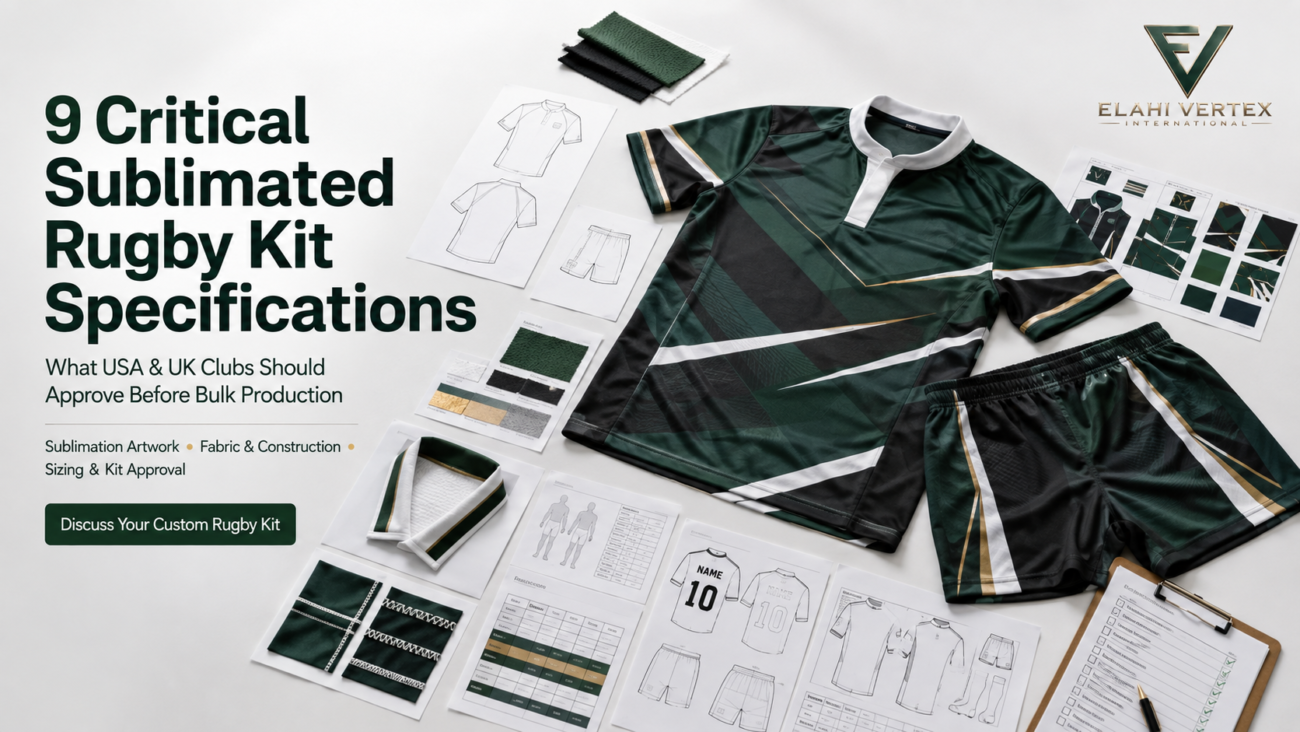

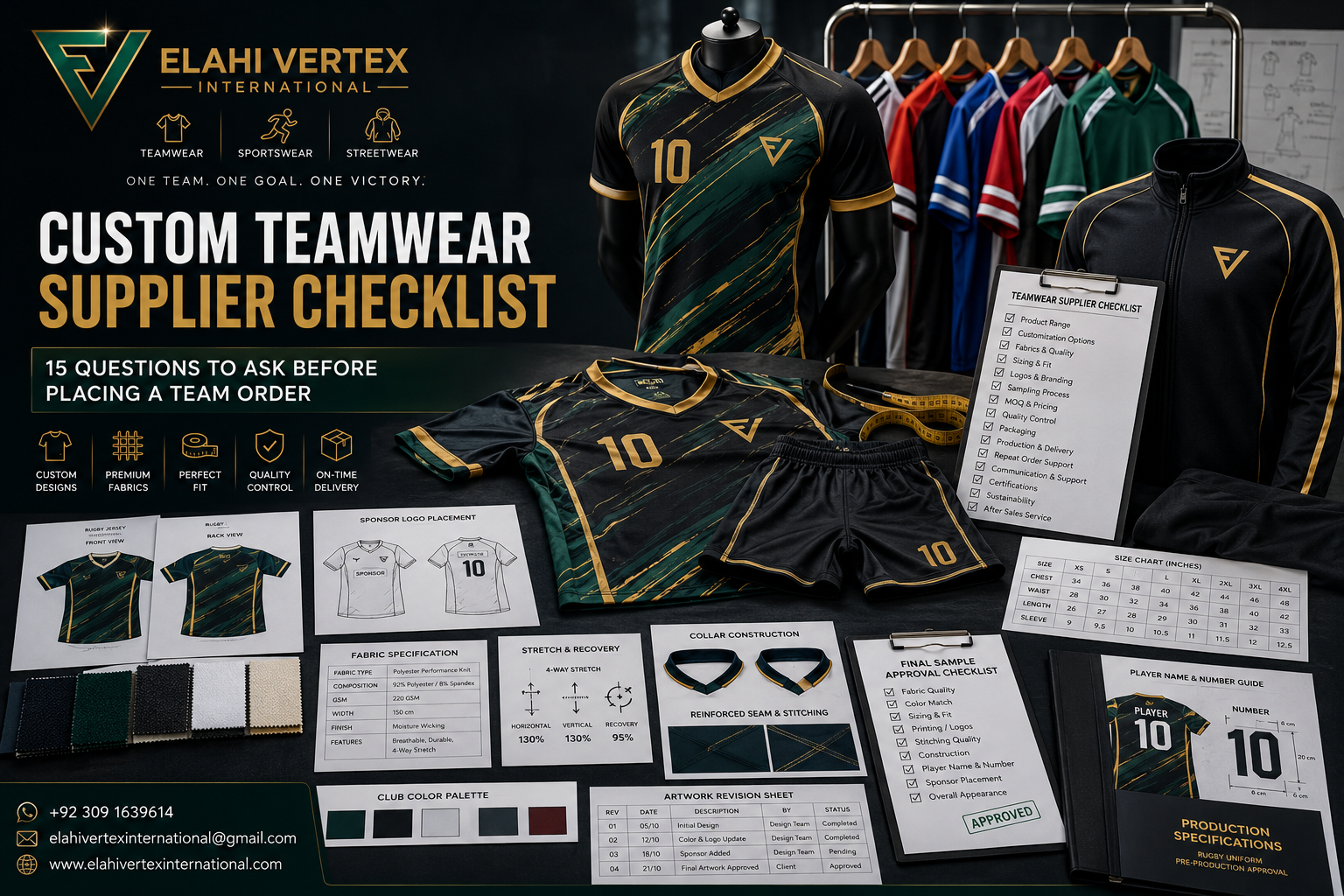
Ordering custom rugby uniforms is not simply a matter of sending a club crest, choosing colors, and approving a jersey mockup. For USA and UK rugby clubs, the more important task is creating clear rugby uniform specifications before bulk production begins.
A visually correct mockup can still leave important manufacturing questions unresolved: What fabric construction is required? What fit should the jersey follow? Which measurements control sizing? How should high-stress seams be constructed? Where must sponsor logos, player numbers, and the club crest sit? What exactly constitutes the approved production reference?
These details matter because rugby is a contact sport. A match kit has to account for movement, pulling, repeated laundering, player identification, club branding, and the requirements of the competition in which it will actually be worn.
This guide explains 9 critical rugby uniform specifications that clubs, academies, sports organizations, teamwear buyers, and procurement managers should define before approving bulk production.
The objective is straightforward: turn a design idea into a clear, reviewable manufacturing specification.
Table of Contents
- Rugby Jersey Fabric and Performance Requirements
- Contact-Zone Construction and Seam Specifications
- Jersey Fit, Measurements, and Size Grading
- Rugby Shorts Specifications
- Club Colors and Color References
- Crest, Sponsor Logo, and Artwork Placement
- Player Names and Numbers
- Squad Size Breakdown and Player Allocation
- Approved Sample and Bulk-Production Specification
- Rugby Kit Specification Checklist
- Common Rugby Uniform Ordering Mistakes
- What Should a Rugby Club Include in an RFQ?
- Why Work With Elahi Vertex International?
- Frequently Asked Questions
- Useful External Resources
- Conclusion
What Are Rugby Uniform Specifications?
Rugby uniform specifications are the documented technical, visual, sizing, construction, branding, and personalization requirements used to communicate how a rugby kit should be manufactured.
Depending on the project, they may cover:
- jersey fabric and composition;
- fabric weight;
- stretch and recovery expectations;
- jersey fit;
- garment measurements;
- size grading;
- panel construction;
- seam requirements;
- collar construction;
- shorts construction;
- team colors;
- artwork;
- sponsor logos;
- club crest;
- player numbers;
- player names;
- size quantities; and
- approved sample references.
A specification should reduce interpretation.
Instead of writing:
“We need a strong blue rugby jersey with our logos.”
a procurement document should define the approved blue reference, artwork files, logo dimensions and positions, jersey construction, fit reference, size requirements, personalization data, and other relevant production instructions.
Some specifications cannot responsibly be standardized for every club. Fabric, GSM, fit, construction, decoration, quantities, production schedule, MOQ, packaging, and similar commercial or technical details should be confirmed for the specific project.
1. Rugby Jersey Fabric and Performance Requirements
Fabric selection should be one of the first rugby uniform specifications a club confirms.
A buyer should not approve fabric based only on a description such as “performance polyester.” That phrase does not adequately define how the material should feel, stretch, recover, print, or perform in the intended garment.
Current rugby suppliers show considerable variation in fabric choices. Polyester constructions and polyester/stretch blends are commonly offered, while available fabric weights and constructions differ by intended fit and use.
That variation is precisely why buyers should specify requirements rather than assume every “rugby fabric” is equivalent.
What should the fabric specification include?
At minimum, discuss:
| Specification | What the Club Should Confirm |
|---|---|
| Fabric type | Required textile construction |
| Composition | Fiber composition required for the project |
| Weight | Target GSM or approved reference |
| Stretch | Required direction and degree of stretch |
| Recovery | How well the material should return after stretching |
| Hand feel | Lightweight, structured, smooth, etc. |
| Breathability | Appropriate to intended use |
| Opacity | Especially important with lighter colors |
| Decoration compatibility | Suitability for the selected decoration method |
| Color | Approved color reference |
| End use | Match, training, supporter, or other application |
Why GSM alone is not enough
GSM—grams per square meter—is useful for communicating fabric weight, but it does not describe the entire fabric.
Two fabrics with a similar GSM may differ in:
- knit construction;
- fiber composition;
- stretch;
- recovery;
- surface texture;
- opacity;
- moisture behavior;
- dimensional stability; and
- overall hand feel.
Therefore, “200 GSM” by itself is not a complete fabric specification.
A better approach is to combine numerical requirements with an approved physical sample or fabric swatch where practical.
Match jersey versus training jersey
A club should also identify the garment’s intended use.
A match jersey designed for contact competition may require a different balance of construction, fit, stretch, and durability than a lightweight training shirt. Similarly, supporter merchandise should not automatically inherit the same technical specification as player matchwear.
Buyer recommendation: Ask the manufacturer to identify the proposed fabric against your end-use requirements and approve the material before bulk production.
For project-specific fabric development, buyers can contact Elahi Vertex International with their intended product, reference design, sizing requirements, and expected application.
2. Contact-Zone Construction and Seam Specifications
A rugby jersey should not be treated as a generic printed sports T-shirt.
Contact, pulling, body movement, and repeated use make garment construction particularly important. Current rugby-manufacturing resources specifically discuss reinforced collars, seams, stress points, plackets, and other contact-related construction details.
That does not mean every jersey needs the same seam construction. It means construction must be intentionally specified.
Which areas deserve particular attention?
Depending on the jersey design, review:
- shoulder seams;
- sleeve attachment;
- underarm joins;
- side seams;
- collar/neck opening;
- placket, if used;
- side vents, if used;
- sleeve hems;
- bottom hem; and
- transitions between panels.
Collar construction
The collar has both visual and functional importance.
Rugby jerseys can use several neckline and collar approaches. Suppliers currently offer multiple collar configurations, from traditional styles to modern performance necklines.
Before production, specify:
- collar style;
- collar material;
- collar dimensions;
- neckline shape;
- reinforcement requirements;
- color;
- topstitching, where applicable; and
- relationship between collar and body panels.
A simple front-and-back mockup may not communicate these details adequately.
Seam specification
Do not merely write “strong stitching.”
A useful technical discussion identifies:
- seam location;
- seam type where required;
- reinforcement points;
- stitch appearance requirements;
- stretch requirements;
- thread considerations where relevant; and
- acceptable finished appearance.
The exact construction should be agreed with the manufacturer based on the garment design and intended application.
Why the sample matters
Construction is difficult to approve from a digital mockup alone.
A physical sample allows a club to assess:
- seam appearance;
- collar stability;
- garment stretch;
- mobility;
- comfort;
- fit;
- panel alignment; and
- overall construction.
For a contact-sport garment, this physical evaluation is considerably more useful than relying solely on rendered artwork.
3. Rugby Jersey Fit, Measurements, and Size Grading
One of the most important rugby uniform specifications is also one of the easiest to misunderstand: sizing.
“Small, medium, large, XL” are labels—not universal measurements.
Different manufacturers can use different blocks, grading rules, fits, and measurement methods. A club should therefore approve the measurement system behind the size labels.
Start by defining the intended fit
Possible requirements can include:
- close athletic fit;
- regular performance fit;
- traditional/relaxed fit;
- youth fit;
- women-specific fit; or
- a club-provided custom measurement specification.
Commercial rugby suppliers currently distinguish between traditional, semi/pro, women’s, youth, and other fit configurations, reinforcing the importance of defining fit rather than assuming a universal rugby block.
Example rugby jersey measurement framework
The following is a measurement framework, not a universal Elahi Vertex International size chart.
| Measurement Point | What to Define |
|---|---|
| Chest width | Exact measurement method |
| Body length | Highest shoulder point or agreed reference to hem |
| Shoulder | Relevant only to applicable pattern construction |
| Sleeve length | Measurement start and end points |
| Sleeve opening | Finished opening |
| Bottom opening | Finished garment width/circumference |
| Neck opening | Finished dimensions where relevant |
Do not copy a generic size chart blindly
A buyer should determine whether the manufacturer’s standard sizing is appropriate for the actual squad.
Where fit is critical, clubs may consider:
- reviewing the manufacturer’s proposed size chart;
- comparing it with garments players already wear;
- measuring representative players or approved garments;
- evaluating a sample;
- conducting a size-set review where commercially appropriate; and
- confirming the final size breakdown before production.
What is size grading?
Size grading is the controlled increase or decrease of pattern dimensions between garment sizes.
It is possible for a medium sample to fit correctly while larger or smaller sizes still require attention if the grading does not suit the intended player population.
Buyers should therefore review not only one sample size but also the logic of the complete sizing range when the order requires it.
4. Rugby Shorts Specifications
The jersey usually receives most of the design attention, but the shorts are part of the playing kit and need their own technical specification.
Current rugby-kit manufacturers commonly describe rugby shorts using features such as reinforced construction, elasticated waistbands, internal drawcords, and polyester or other sport-specific fabric options.
A club should decide which characteristics are actually required for its project.
Rugby shorts specification checklist
Confirm:
- fabric type;
- fabric composition;
- fabric weight or approved reference;
- stretch requirement;
- waistband construction;
- drawcord requirement;
- finished length;
- leg opening;
- rise;
- seam construction;
- reinforcement requirements;
- club crest position;
- sponsor position, if applicable;
- player personalization, if applicable;
- pockets or no pockets;
- color references; and
- size chart.
Avoid assuming jersey and shorts use the same fabric
They may or may not.
The appropriate material depends on the required garment construction and intended use.
The manufacturer should be given separate requirements for each component rather than being asked to “make matching shorts.”
Waistband and drawcord
The club should clarify:
- elastic waistband construction;
- internal or external drawcord;
- drawcord color;
- drawcord length/finish where important; and
- whether any other waistband details are required.
Small specification decisions become noticeable when an entire squad receives the finished order.
5. Club Colors and Color References
“Red,” “navy,” “royal blue,” or “green” are not sufficiently precise production specifications.
Color perception changes between:
- phone screens;
- computer monitors;
- digital mockups;
- printed paper;
- sublimated fabric;
- embroidered thread;
- transfer materials; and
- physical textiles.
Therefore, the club should establish an approved color reference.
What should clubs provide?
Where possible, provide:
- approved color codes or references;
- vector artwork;
- existing brand guidelines;
- physical references where necessary;
- differentiation between home and alternate kits; and
- clear instructions for each garment component.
Digital color versus physical output
A digital code is useful, but the final appearance can be affected by substrate, textile construction, print process, lighting, and other production variables.
That means a buyer should avoid treating an on-screen mockup as an infallible physical color proof.
For color-critical projects, discuss how color approval will be handled before bulk production.
Home and alternate kits
If ordering more than one kit, create separate specification records for:
Home Kit
- base color;
- secondary colors;
- trim;
- numbers;
- crest;
- sponsors.
Alternate/Away Kit
- base color;
- secondary colors;
- trim;
- numbers;
- crest;
- sponsors.
Do not rely on verbal instructions such as “same design but white.”
6. Club Crest, Sponsor Logo, and Artwork Placement
A rugby kit may contain several pieces of artwork:
- club crest;
- primary sponsor;
- secondary sponsors;
- sleeve sponsors;
- competition marks;
- manufacturer/brand identity where applicable;
- player number;
- player name;
- commemorative marks; and
- other approved graphics.
Each should be documented.
Build an artwork placement sheet
For each artwork element specify:
| Artwork Element | Required Information |
|---|---|
| Club crest | File, position, dimensions, method |
| Main sponsor | File, position, dimensions, method |
| Sleeve sponsor | Sleeve, orientation, dimensions |
| Back sponsor | Position relative to number |
| Player number | Font, size, position, color |
| Player name | Font, case, size, position |
| Other mark | Exact approved location and dimensions |
Supply production-ready artwork
Where possible, clubs should retain clean master artwork rather than repeatedly forwarding compressed screenshots.
Vector files are especially useful for scalable graphics. Sublimation workflows also require appropriate artwork preparation; industry suppliers commonly request vectorized or production-ready design files.
Confirm the decoration method
Different elements may use:
- sublimation;
- embroidery;
- screen printing;
- heat-transfer applications; or
- another agreed method.
The appropriate method depends on the design, textile, desired appearance, end use, quantities, and manufacturing setup.
Do not assume every logo should be produced using the same technique.
Sponsor approvals matter
A club should maintain one final artwork revision.
File names such as:
final-logo-new-2-revised-LAST.pdf
create unnecessary risk.
A better system is:
Rugby-Home-Jersey-Artwork-V03-APPROVED.pdf
The objective is simple: everyone involved should know which file controls production.
7. Player Names and Numbers
Personalization introduces a different category of production risk because every garment may become unique.
For rugby clubs, the rugby uniform specifications should therefore include a controlled roster file.
Build a player allocation sheet
A useful structure is:
| Player | Jersey Size | Shorts Size | Number | Name |
|---|---|---|---|---|
| Player A | L | M | 1 | Approved spelling |
| Player B | XL | L | 2 | Approved spelling |
| Player C | L | L | 3 | Approved spelling |
This is an illustrative format only.
The actual roster should be checked against the requirements of the club and relevant competition.
Numbering requirements are not universal
Do not assume every competition uses identical numbering rules.
For example, current NIRA rugby rules in the United States require numbered jerseys but specifically allow numbers beyond 1–23 provided two players do not wear the same number in an individual match.
That is a useful reminder that competition-specific requirements must be verified before artwork is approved.
Lock these details
For numbers:
- approved font;
- number height;
- width/proportion;
- color;
- outline, if applicable;
- placement;
- spacing; and
- decoration method.
For player names:
- spelling;
- capitalization;
- font;
- height;
- position;
- color; and
- whether names are required at all.
Roster errors are expensive errors
If a player’s name is misspelled in the approved spreadsheet, the manufacturer may reproduce the approved error correctly.
Before submitting personalization data:
- appoint one responsible club contact;
- freeze the roster;
- verify spelling;
- verify numbers;
- verify jersey sizes;
- verify shorts sizes;
- identify duplicates;
- approve the final file; and
- prohibit informal changes through scattered messages.
8. Squad Size Breakdown and Player Allocation
A size chart answers:
What dimensions define each size?
A size breakdown answers:
How many garments do we need in each size?
These are different documents.
Example size breakdown
| Size | Jerseys | Shorts |
|---|---|---|
| XS | Club to confirm | Club to confirm |
| S | Club to confirm | Club to confirm |
| M | Club to confirm | Club to confirm |
| L | Club to confirm | Club to confirm |
| XL | Club to confirm | Club to confirm |
| 2XL | Club to confirm | Club to confirm |
Never estimate a club’s size ratio without roster data.
Jersey size may differ from shorts size
Do not automatically allocate the same size for both pieces.
A player may require one jersey size and another shorts size depending on body proportions and the approved garment block.
Your roster should therefore contain separate fields.
Include replacements and future requirements deliberately
Clubs may need to consider:
- substitutes;
- new players;
- replacement garments;
- staff kit;
- additional blank garments;
- youth squads;
- women’s squads;
- home and alternate kits; and
- future reorders.
Whether extras should be purchased is a commercial decision for the club. Do not use an arbitrary percentage without analyzing the roster and reorder situation.
Build a reorder record
After approval, preserve:
- artwork revision;
- size chart revision;
- color references;
- fabric reference;
- construction details;
- player roster;
- personalization rules; and
- approved sample information.
That record can make future discussions considerably clearer.
9. Approved Sample and Bulk-Production Specification Record
This is the point where the previous eight rugby uniform specifications come together.
Before bulk production, the buyer should know what constitutes the approved production reference.
Depending on the manufacturing arrangement, this may include:
- approved technical specification;
- approved artwork;
- approved measurements;
- approved fabric;
- approved colors;
- approved branding;
- approved sample;
- approved personalization spreadsheet;
- approved quantity breakdown; and
- agreed commercial documentation.
Why sample approval matters
A digital mockup verifies visual direction.
A physical sample can help verify:
- fabric feel;
- fit;
- measurements;
- collar;
- seams;
- shorts;
- print appearance;
- logo dimensions;
- artwork placement;
- color appearance;
- player number;
- comfort; and
- overall garment construction.
These are not equivalent approval stages.
What should a sample approval record contain?
Use a structured record:
Product: Rugby match jersey
Version: Approved revision
Fabric: Confirmed specification/reference
Fit: Confirmed
Measurements: Confirmed size chart revision
Colors: Approved references
Crest: Approved position/size
Sponsors: Approved positions/sizes
Numbers: Approved font/position/size
Construction: Approved details
Changes from sample: Clearly documented
Bulk quantity: Confirmed separately
Approval: Authorized club representative
The exact format can vary. What matters is traceability.
Do not approve with vague language
Messages such as:
“Looks good.”
can be ambiguous if several mockups, samples, or revisions exist.
Use specific approval language identifying the revision being approved.
Rugby Kit Specification Checklist Before Bulk Production
Before authorizing production, a USA or UK rugby club should be able to answer the following:
Product
- Jersey specification confirmed
- Shorts specification confirmed
- Socks specification confirmed if included
- Home/away versions separated where applicable
Fabric
- Fabric construction confirmed
- Composition confirmed
- GSM/reference confirmed where required
- Stretch/recovery requirements confirmed
- Approved physical reference retained where applicable
Construction
- Collar confirmed
- Panel design confirmed
- Seam requirements confirmed
- Reinforcement requirements confirmed
- Hems and finishing confirmed
Sizing
- Fit confirmed
- Measurement chart approved
- Measurement method understood
- Grading reviewed
- Player allocation completed
Artwork
- Club crest approved
- Sponsor logos approved
- Artwork files finalized
- Placement dimensions confirmed
- Decoration methods confirmed
- Colors confirmed
Personalization
- Numbers verified
- Names verified where required
- Fonts approved
- Dimensions approved
- Roster frozen
Approval
- Sample reviewed where applicable
- Changes documented
- Final artwork revision identified
- Final specification revision identified
- Quantities confirmed
- Authorized person has approved the production reference
Common Rugby Uniform Specification Mistakes Clubs Should Avoid
1. Selecting a jersey from appearance alone
A mockup communicates design. It does not fully communicate fabric, fit, seam construction, stretch, measurements, or finishing.
2. Saying “standard rugby sizing”
There is no single universal manufacturer size chart.
Request actual measurements.
3. Specifying GSM but nothing else
Fabric weight alone cannot define fabric performance.
4. Sending low-resolution sponsor logos
Poor source artwork can create avoidable production problems.
Keep proper master artwork.
5. Changing the roster through chat messages
Player personalization should come from one controlled file.
6. Approving one garment but changing multiple details afterward
Changes made after sample approval should be documented and, where necessary, re-evaluated before bulk production.
7. Forgetting shorts specifications
Treat the shorts as a separate engineered garment rather than an automatic accessory to the jersey.
8. Assuming digital colors will look identical on fabric
Approve color through an appropriate process where color accuracy is critical.
9. Failing to verify competition requirements
Club branding preferences do not override competition rules.
Verify current requirements with the relevant governing or competition authority before final production.
What Should a Rugby Club Include in an RFQ?
A strong RFQ—request for quotation—gives a potential manufacturing partner enough information to understand the project without guessing.
For a custom rugby uniform project, consider including:
Buyer Information
- organization/club;
- destination country;
- responsible contact;
- intended use.
Product
- rugby union, rugby league, sevens, training, or other intended application;
- jersey;
- shorts;
- socks;
- additional teamwear where applicable.
Quantities
- estimated total;
- size breakdown where available;
- home/away split;
- personalization requirements.
Technical Requirements
- fabric;
- composition;
- target GSM/reference;
- fit;
- size chart;
- construction;
- collar;
- seams;
- shorts requirements.
Artwork
- club crest;
- sponsors;
- team colors;
- player numbers;
- names;
- artwork files;
- placement requirements.
Branding
- required decoration method, if already determined;
- private-label requirements where applicable;
- other brand identity requirements.
Project Questions
Ask the potential manufacturer to confirm project-specific information including:
- feasible fabric options;
- sample process;
- MOQ;
- customization feasibility;
- production requirements;
- commercial terms;
- packaging options;
- production timing; and
- shipping arrangements.
These items should be confirmed for the specific project rather than assumed.
Rugby Uniform Specifications: A Practical Approval Workflow
A rugby club can structure its project around the following sequence:
Step 1 — Define the end use
Clarify competition, match, training, academy, supporter, or other intended use.
Step 2 — Prepare the design brief
Provide colors, crest, sponsors, preferred styling, and reference garments.
Step 3 — Build technical requirements
Document fabric, construction, fit, sizing, shorts, branding, and personalization.
Step 4 — Verify competition requirements
Check applicable current kit, numbering, branding, and player-equipment requirements before finalizing the design.
Step 5 — Review manufacturer proposals
Compare suppliers against the same specification rather than comparing quotations built around different products.
Step 6 — Review artwork
Confirm every logo, number, color, and placement.
Step 7 — Review sample or agreed approval reference
Assess fit, construction, appearance, measurements, and agreed specifications.
Step 8 — Freeze the production specification
Document approved changes and identify the final revision.
Step 9 — Approve bulk production
Proceed only after technical, artwork, roster, quantity, and commercial information has been reconciled.
Why Clear Specifications Improve Supplier Comparison
Suppose Manufacturer A quotes one price and Manufacturer B quotes a lower price.
Without equivalent specifications, the comparison may be meaningless.
Manufacturer A could be quoting:
- one fabric construction;
- one GSM;
- one collar;
- one seam structure;
- one decoration process;
- one packaging arrangement.
Manufacturer B could be quoting something materially different.
A lower quotation does not necessarily represent better value if the products are not equivalent.
A detailed rugby uniform specification gives procurement teams a more controlled basis for comparison.
Compare like with like
When reviewing quotations, create a comparison table:
| Requirement | Supplier A | Supplier B | Supplier C |
|---|---|---|---|
| Fabric | Confirm | Confirm | Confirm |
| GSM/reference | Confirm | Confirm | Confirm |
| Fit | Confirm | Confirm | Confirm |
| Size chart | Confirm | Confirm | Confirm |
| Collar | Confirm | Confirm | Confirm |
| Seam construction | Confirm | Confirm | Confirm |
| Jersey decoration | Confirm | Confirm | Confirm |
| Shorts | Confirm | Confirm | Confirm |
| Personalization | Confirm | Confirm | Confirm |
| Sample process | Confirm | Confirm | Confirm |
| Packaging | Confirm | Confirm | Confirm |
| Commercial terms | Confirm | Confirm | Confirm |
This forces the purchasing discussion toward specification and away from price alone.
USA Rugby Clubs: Additional Procurement Considerations
USA buyers should establish which league, association, school, university, or competition requirements apply to their teams.
Do not assume requirements are identical across every American rugby competition.
For example, NIRA’s current playing rules reference World Rugby Laws while adding competition-specific provisions, including its own jersey-numbering allowance.
The procurement lesson is more important than the individual rule:
Verify the rules governing your competition before freezing the uniform artwork.
Clubs should also maintain:
- clear size records;
- player-number records;
- approved sponsor artwork;
- home/away differentiation where required;
- replacement/reorder information; and
- the final production specification.
UK Rugby Clubs: Additional Procurement Considerations
UK clubs likewise should not assume that a generic supplier template automatically satisfies the requirements of their particular competition.
Before bulk production, identify:
- applicable governing/competition requirements;
- team-color requirements;
- sponsor restrictions where relevant;
- numbering requirements;
- player-equipment requirements; and
- any league-specific instructions.
The manufacturer can work from the specifications provided, but responsibility for identifying the correct competition requirements should not be replaced by assumptions.
For both USA and UK buyers, the safer procurement sequence is:
rules check → technical specification → artwork → sample/approval → bulk production
rather than:
design → bulk order → discover problems later.
Why Work With Elahi Vertex International for a Custom Rugby Uniform Project?
Elahi Vertex International is positioned as a B2B manufacturer, exporter, OEM/ODM supplier, private-label manufacturing partner, and custom manufacturing partner.
For rugby uniform inquiries, the most productive starting point is not simply asking:
“How much is a rugby kit?”
Instead, provide as much of the project specification as possible.
Useful information includes:
- product type;
- intended use;
- design reference;
- quantity;
- required sizes;
- fabric requirements;
- preferred construction;
- club crest;
- sponsor artwork;
- player personalization;
- destination;
- and other project-specific requirements.
Technical and commercial details—including materials, MOQ, sampling, production timing, packaging, pricing, and shipping arrangements—should be confirmed for the individual project rather than assumed from this guide.
Discuss a custom rugby uniform project:
WhatsApp: Contact Elahi Vertex International
Email: elahivertexinternational@gmail.com
Website: Elahi Vertex International
Alibaba: Elahi Vertex International Alibaba Storefront
Frequently Asked Questions About Rugby Uniform Specifications
1. What are the most important rugby uniform specifications?
The most important rugby uniform specifications include fabric, construction, fit, garment measurements, shorts construction, colors, artwork placement, player numbers/personalization, size allocation, and the final approved production reference.
2. Why should rugby uniform specifications be finalized before bulk production?
Clear rugby uniform specifications reduce ambiguity between the buyer and manufacturer. They provide a documented reference for fabric, sizing, construction, artwork, personalization, and other requirements before a larger production quantity is authorized.
3. What fabric should be included in rugby uniform specifications?
There is no single fabric specification suitable for every project. Rugby uniform specifications should identify the required fabric construction, composition, weight/reference, stretch, recovery, opacity, hand feel, decoration compatibility, and intended use.
4. Should rugby uniform specifications include GSM?
Yes, GSM can be useful because it communicates fabric weight. However, complete rugby uniform specifications should not rely on GSM alone because fabrics of similar weight can have different composition, construction, stretch, recovery, and feel.
5. Should rugby uniform specifications include reinforced seams?
Where reinforcement is required, it should be documented. Rugby is a contact sport, so buyers should discuss stress zones and construction with the manufacturer rather than assuming a generic seam specification is appropriate.
6. How should sizing be defined in rugby uniform specifications?
Rugby uniform specifications should use an agreed size chart with defined measurement points. Size labels such as S, M, L, and XL should not replace actual garment measurements.
7. Should rugby uniform specifications include separate jersey and shorts sizes?
Yes, where players may require different sizes. A player allocation file can record jersey size and shorts size separately instead of assuming both garments use the same size.
8. How should club colors be recorded in rugby uniform specifications?
Use approved color references and clearly identify where each color belongs. For color-sensitive projects, discuss the appropriate physical approval process because screen appearance does not guarantee an identical textile result.
9. What artwork should accompany rugby uniform specifications?
Provide clean approved artwork for the club crest, sponsors, numbers, names, and other graphics. Where possible, retain suitable production-ready/vector files and a controlled final artwork revision.
10. Should rugby uniform specifications include sponsor-logo dimensions?
Yes. Position alone may not be sufficient. Specify approved dimensions, placement, orientation, color, artwork file, and decoration method where relevant.
11. Should player numbers be part of rugby uniform specifications?
Yes. Player numbers should be controlled through the final specification and roster, including number assignment, font, dimensions, color, placement, and applicable competition requirements.
12. Do rugby uniform specifications need player names?
Only if the club requires names. If names are used, rugby uniform specifications should define spelling, capitalization, font, size, color, and placement.
13. Should a physical sample be approved before rugby bulk production?
Sampling requirements depend on the project and supplier arrangement, but a physical sample can allow buyers to evaluate characteristics that a digital mockup cannot fully demonstrate, including fit, fabric feel, construction, measurements, and physical decoration appearance.
14. What is the difference between a rugby mockup and rugby uniform specifications?
A mockup primarily communicates visual design. Rugby uniform specifications communicate the technical instructions behind the garment: materials, measurements, construction, sizing, artwork, personalization, and approval references.
15. Can the same rugby uniform specifications be used for every club?
No. Requirements vary according to players, intended use, competition, design, budget, sizing system, construction, and procurement requirements. Specifications should be developed for the specific project.
16. Should USA clubs verify competition rules before approving rugby uniform specifications?
Yes. USA clubs should identify the requirements applicable to their actual competition rather than assuming one universal American kit standard.
17. Should UK clubs verify competition rules before approving rugby uniform specifications?
Yes. UK clubs should confirm the current requirements of the relevant governing body, league, or competition before approving artwork and production.
18. How do rugby uniform specifications help compare manufacturers?
They create a common purchasing baseline. Buyers can compare fabric, construction, sizing, customization, sampling, commercial terms, and other factors against the same requirements rather than comparing non-equivalent quotations.
19. What should be sent to Elahi Vertex International for a rugby uniform inquiry?
Buyers can send the intended product, design/reference, estimated quantity, sizing requirements, fabric or construction preferences, club artwork, personalization requirements, destination, and other available project specifications. Requirements that are not yet known can be discussed for the specific project.
20. Can Elahi Vertex International confirm MOQ, pricing, fabric, and production timing for rugby uniforms?
Those details should be confirmed for the specific inquiry. This article intentionally does not invent a fixed MOQ, price, material, sample policy, production time, packaging specification, or shipping time for Elahi Vertex International.
Useful External Resources
For additional rugby-kit research, buyers may find these resources useful:
- NIRA Rugby Playing Rules — useful for understanding an example of USA competition-specific kit and numbering requirements alongside World Rugby Laws.
- Goal Sportswear Rugby Jersey Guide — useful as a competitor reference for understanding commercially available rugby fit, collar, fabric, and sublimation options.
- Sialkot Sample Masters Rugby Jersey Construction Guide — useful competitor material covering collars, seam mapping, stress points, plackets, and construction considerations.
- Sports Gear Manufacturer Rugby Uniform Guide — competitor reference showing how jersey, shorts, socks, fabric, sizing, and decoration can be separated into kit specifications.
- En Mode Rugby Sublimation Guide — useful background on sublimation workflow, artwork preparation, panel construction, and reinforced rugby seams.
- Fabrioza Rugby Kit Manufacturer Guide — competitor reference covering rugby jerseys, shorts, teamwear, fabric specifications, and construction.
- Mughal Apparel Rugby Jersey Manufacturing Guide — competitor reference demonstrating the range of fabric, construction, decoration, and private-label considerations buyers may encounter when comparing suppliers.
Conclusion: Finalize Rugby Uniform Specifications Before Bulk Production
The most important procurement lesson is simple: approve specifications, not assumptions.
For USA and UK clubs, effective rugby uniform specifications should clearly define nine areas:
- jersey fabric and performance;
- contact-zone construction and seams;
- fit, measurements, and grading;
- rugby shorts;
- club colors;
- crests, sponsors, and artwork;
- player names and numbers;
- size breakdown and player allocation; and
- the final approved sample and bulk-production specification.
The objective is not to make the technical file unnecessarily complicated. It is to make every important production decision clear enough that the club and manufacturer are working from the same reference.
Before placing a bulk order, verify the requirements of the relevant rugby competition, finalize your roster and artwork, review sizing carefully, document technical requirements, and ensure that the correct revision has been approved.
For a B2B rugby uniform manufacturing inquiry, send your project requirements to Elahi Vertex International for project-specific discussion.
WhatsApp: https://wa.me/message/OWIPAIXYWHTPI1
Phone: +92 309 1639614
Email: elahivertexinternational@gmail.com
Secondary Email: Info@elahivertexinternational.com
Website: https://www.elahivertexinternational.com/
Alibaba: https://elahivertexinternational.trustpass.alibaba.com/
Follow Elahi Vertex International:
Facebook: https://www.facebook.com/share/1D4CqvvfKh/
Instagram: https://www.instagram.com/elahivertex_mfg
TikTok: https://www.tiktok.com/@elahivertex_mfg
LinkedIn: https://www.linkedin.com/company/elahi-vertex-international
Threads: https://www.threads.com/@elahivertex_mfg
X: https://x.com/elahivertex_mfg