

Club Teamwear Supplier | Elahi Vertex International
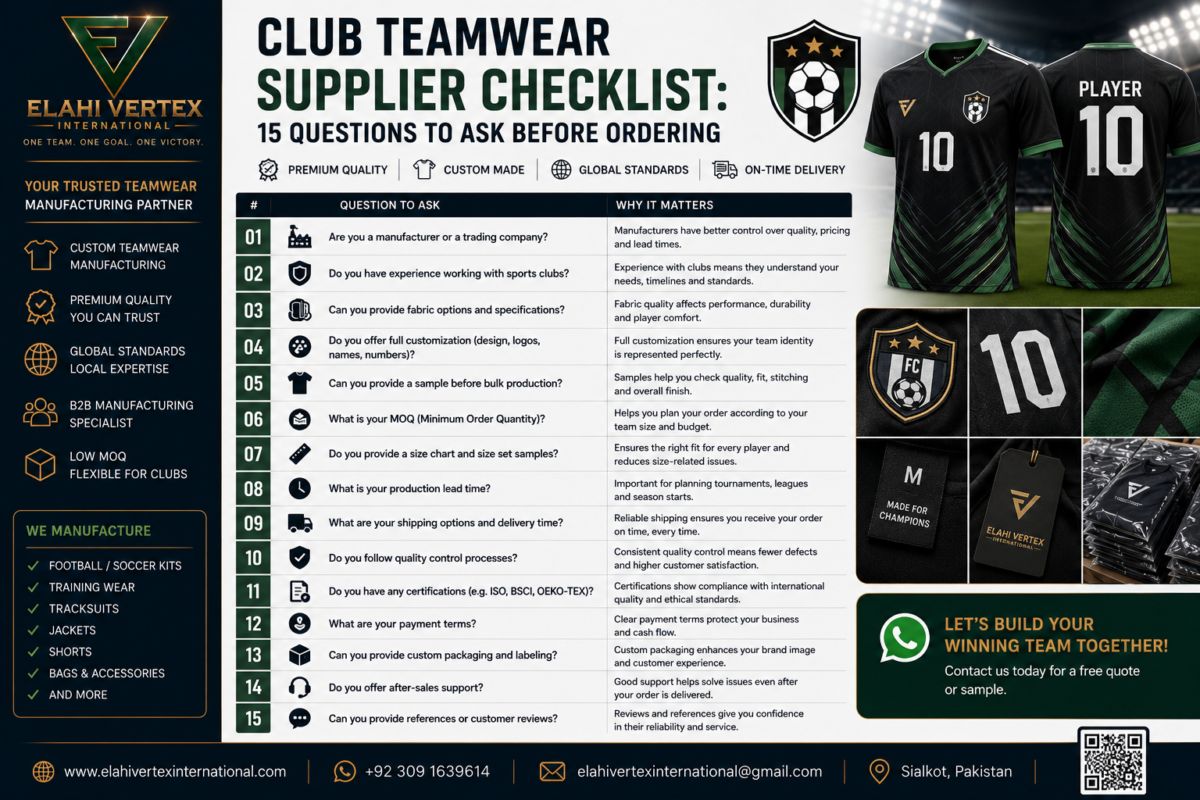
Choosing the right club teamwear supplier is about more than comparing the lowest price. Sports clubs need to consider product quality, customization, sizing, player names and numbers, club branding, samples, production timelines, shipping, packaging, and future reorders.
Before placing a bulk order, asking the right questions can help your club avoid misunderstandings and make a more informed supplier decision.
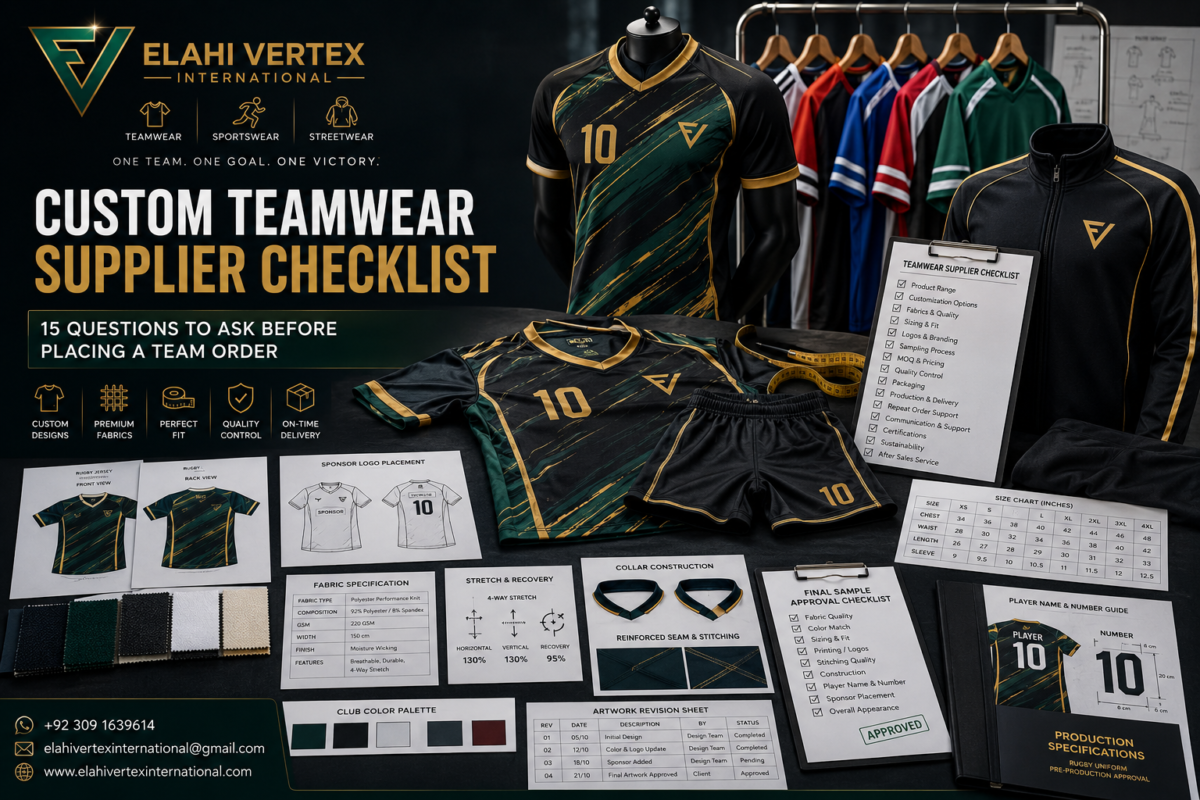
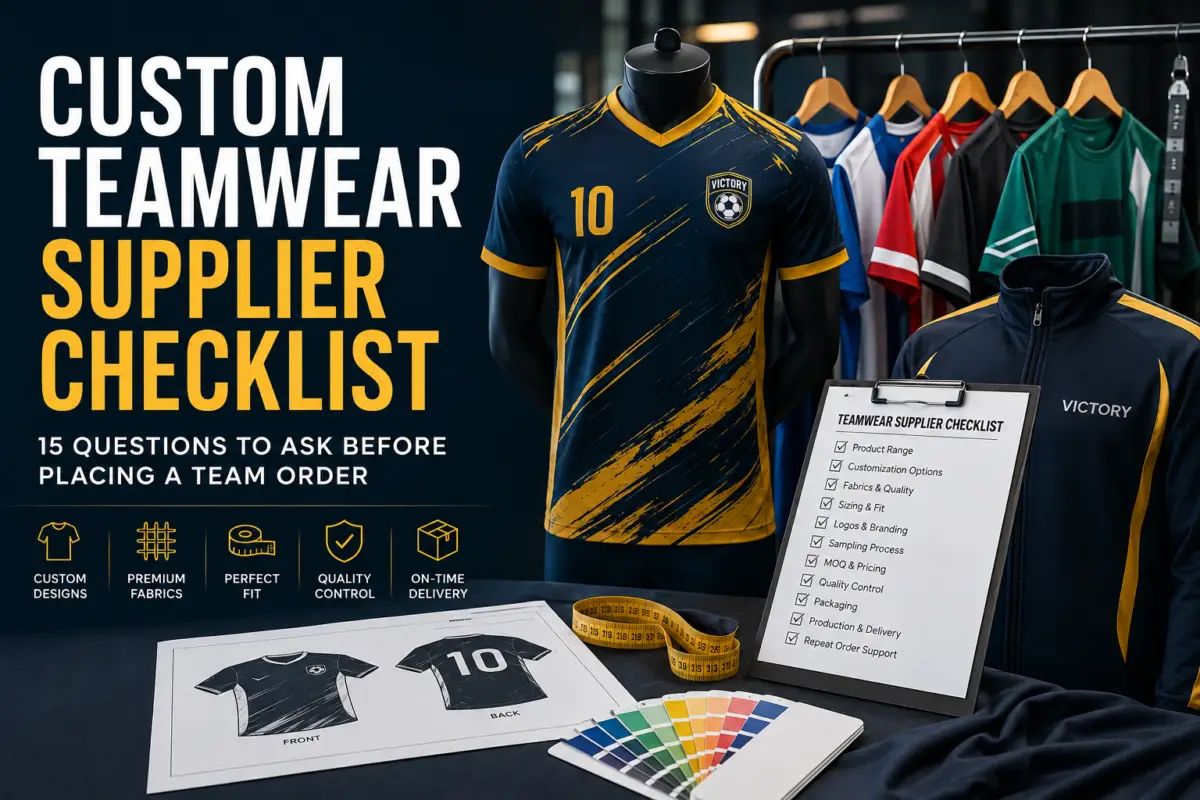
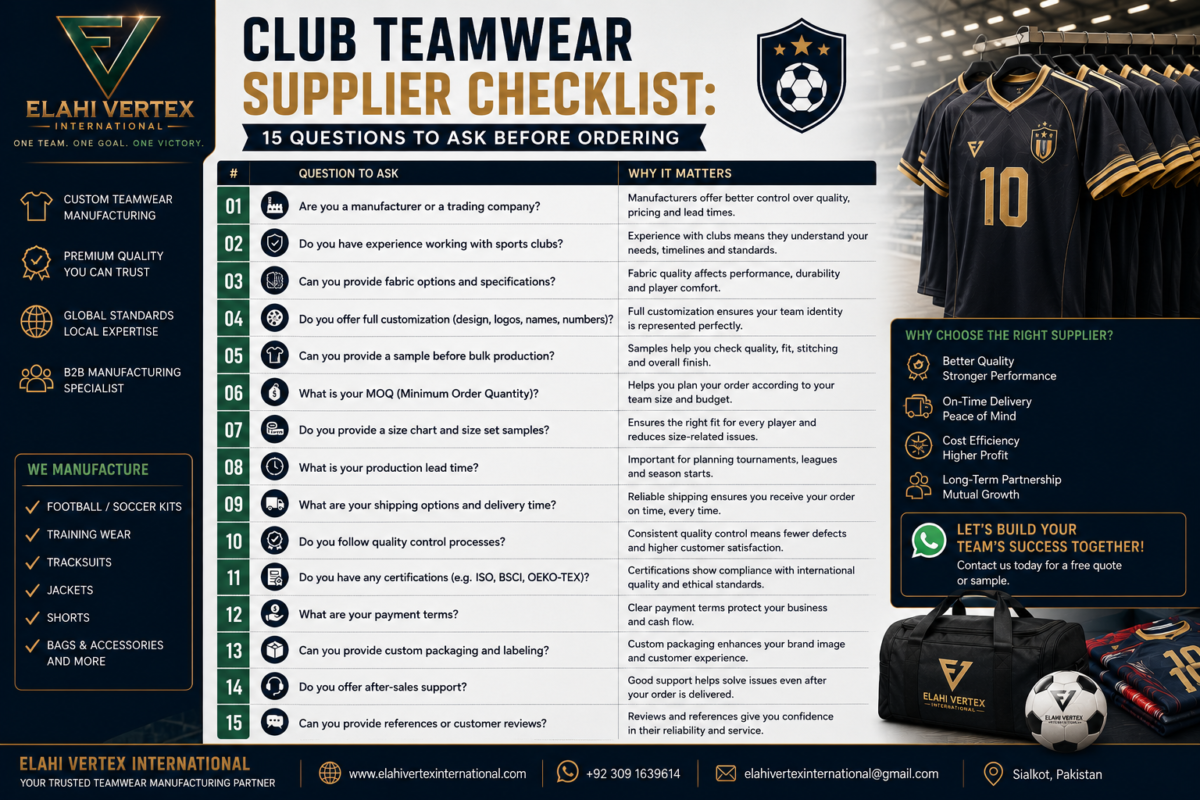
This club teamwear supplier checklist covers 15 important questions sports clubs, soccer clubs, academies, team managers, distributors, and other B2B buyers should ask before ordering custom teamwear.
What Should a Club Ask a Teamwear Supplier Before Ordering?
A club should ask about product specifications, customization, MOQ, sizing, sampling, quality control, production timing, packaging, shipping, payment terms, compliance requirements, and reorders before approving an order.
The supplier should clearly explain what will be produced, according to which specifications, at what quantity, and under what delivery and commercial assumptions.
15 Questions to Ask a Club Teamwear Supplier
1. What Exactly Is Included in the Teamwear Package?
Do not assume that a quoted teamwear package includes everything your club needs.
Ask the supplier to clearly specify whether the quotation includes:
- Jerseys or shirts
- Shorts
- Socks
- Training tops
- Training shorts
- Tracksuits
- Warm-up apparel
- Goalkeeper apparel
- Player names
- Player numbers
- Club crest
- Sponsor logos
- Labels
- Packaging
- Other customization
Two suppliers can offer apparently similar prices while providing different products or customization.
Tip: Ask for the quotation to clearly identify each product and the customization included.
2. What Fabric and Construction Specifications Will Be Used?
“Performance fabric” is not a complete product specification.
Ask about:
- Fabric composition
- Fabric weight or GSM where relevant
- Stretch characteristics
- Breathability
- Intended use
- Stitching
- Seams
- Collar construction
- Cuffs
- Panels
- Finishing
- Other trims
The appropriate specifications may differ between match jerseys, training apparel, warm-up clothing, and casual clubwear.
Do not choose a product simply because it is described as “premium.” Ask for the actual material and construction specifications.
3. Can You Reproduce Our Club Colors and Artwork Accurately?
Club identity depends heavily on consistent colors, crest placement, sponsor logos, and other design details.
Ask the supplier:
- How should artwork be supplied?
- Which file formats are accepted?
- How are colors specified?
- Can color references be provided?
- Where will the club crest be placed?
- What will the logo dimensions be?
- Where will sponsor logos appear?
- How will names and numbers be positioned?
A digital mockup can help identify design problems before production, but important physical specifications should still be clearly documented.
Always approve the final artwork and relevant color references before production.
4. What Is the MOQ for Our Specific Order?
MOQ means minimum order quantity, but simply asking, “What is your MOQ?” may not give you enough information.
Ask:
What is the MOQ for this exact product, design, color, customization level, and order structure?
MOQ can vary depending on the product and project.
Also clarify whether the MOQ applies:
- Per product
- Per style
- Per design
- Per color
- Per size
- Per order
- Across the complete order
Do not assume that a supplier’s general MOQ automatically applies to your specific club teamwear project.
5. Can You Provide a Pre-Production Sample?
A physical sample can help a club evaluate important details before bulk production.
Depending on the project, a sample can be reviewed for:
- Fit
- Measurements
- Fabric
- Stitching
- Construction
- Club branding
- Sponsor placement
- Names and numbers
- Color direction
- Printing or embroidery
- Overall appearance
Ask the supplier what the sample represents and which specifications it will follow.
Once approved, the sample and written specifications should be clearly identified as production references where applicable.
6. What Is the Process for Approving Artwork and Specifications?
Ask the supplier to explain the complete approval process before production begins.
A typical custom teamwear workflow may involve:
- Club submits requirements.
- Supplier reviews the specifications.
- Artwork and branding details are prepared or reviewed.
- Club checks the design.
- Required revisions are identified.
- Final artwork is approved.
- Sample requirements are confirmed.
- Production begins after the required approvals.
The exact workflow depends on the supplier and project.
The important point is to establish which artwork version, specification sheet, size chart, and sample are considered final.
7. How Will Player Names, Numbers, and Sizes Be Managed?
Individualized club teamwear requires accurate player information.
A club may need to provide:InformationExamplePlayer nameAhmedShirt number10Garment sizeMediumProductMatch jerseyQuantity1Additional itemShorts
Before production, the club should carefully proofread the final roster.
A single incorrect name, number, or size can create an avoidable problem for an individual player.
Best practice: Provide one final approved roster instead of sending player information through multiple informal messages.
8. How Will Quality Control Be Handled?
“Quality checked” is too vague.
Ask the supplier what the quality-control process covers.
Depending on the product, relevant checks may include:
- Measurements
- Fabric
- Stitching
- Seams
- Branding
- Logo placement
- Names and numbers
- Color consistency
- Garment construction
- Finishing
- Quantity
- Packaging
Also ask:
What happens if the finished goods do not match the approved specifications?
Quality expectations should be discussed before the order is placed.
9. What Is the Production Lead Time After Approval?
Do not confuse production time with shipping time.
Ask the supplier:
- When does production begin?
- What starts the production timeline?
- Is artwork approval required?
- Is sample approval required?
- Does roster approval affect production?
- What is the estimated production duration?
- How long is shipping expected to take?
- Is the timeline an estimate or a confirmed commitment?
Clubs should work backward from the date the team actually needs the apparel.
If the order is international, allow sufficient time for manufacturing, transportation, and applicable destination procedures.
10. What Shipping Method and Delivery Terms Will Apply?
Ask the supplier to clarify the logistics arrangement.
Important questions include:
- What shipping method will be used?
- What is the delivery destination?
- Who is responsible for transportation?
- What freight assumptions apply?
- Will tracking be available?
- Who handles customs?
- Who is responsible for import duties and taxes?
- What documentation is required?
- What delivery address should be used?
Do not treat “worldwide shipping” as a complete shipping specification.
The actual shipping arrangement should be confirmed for the specific order and destination.
11. What Packaging Will Be Used?
Packaging can be important when a club needs to distribute apparel individually to players.
Ask whether the order will be packed:
- Individually
- By player
- By size
- By product
- By team
- In bulk cartons
Also clarify whether you require:
- Individual bags
- Size labels
- Custom labels
- Hang tags
- Carton markings
- Product identification
Packaging requirements should be agreed before production rather than after the garments are finished.
12. What Happens If We Need Changes After Approval?
Changes can sometimes arise after artwork, sizing, or roster approval.
Ask:
- Can changes be made after approval?
- At what production stage?
- Could changes create additional costs?
- Could changes affect delivery timing?
- Who must approve changes?
- How will revised specifications be documented?
A supplier should not be expected to absorb unlimited changes after production has started.
Establish a clear final-approval point and treat later changes as controlled modifications.
13. What Information Do You Need for an Accurate Quotation?
A supplier cannot prepare a meaningful quotation from:
“We need 50 custom jerseys.”
A stronger RFQ can include:
- Sport
- Product type
- Estimated quantity
- Size range
- Club colors
- Club crest
- Sponsor requirements
- Player names
- Player numbers
- Fabric preferences
- Design reference
- Artwork
- Packaging requirements
- Destination country
- Required delivery date
- Sample requirements
- Private-label requirements, if applicable
The more clearly the project is defined, the easier it becomes to compare supplier quotations.
14. Can We Reorder the Same Design Later?
Clubs may need additional uniforms when players join, squads change, or a new season begins.
Ask how the supplier handles reorders and whether the following can be retained as production references:
- Approved design
- Artwork
- Size chart
- Color references
- Product specifications
- Branding positions
- Labels
- Packaging requirements
A documented specification can make future orders easier to manage.
However, each reorder should still be reconfirmed against the current requirements rather than assuming that every future production run will automatically be identical.
15. Who Will Be Responsible for Communication and Order Confirmation?
Custom club teamwear involves many details, so communication is critical.
Ask:
- Who is the main contact?
- How will approvals be documented?
- How will revisions be recorded?
- Who confirms the final order?
- Who provides production updates?
- Who communicates shipping information?
A clear written communication process can reduce misunderstandings.
A useful rule: If a detail can change the product, quantity, price, timing, or shipment, put it in writing.
How to Compare Club Teamwear Suppliers
After asking the questions above, compare suppliers using the same criteria.Evaluation AreaWhat to CompareProductExact products and specificationsCustomizationColors, logos, names, numbers, sponsorsMOQRequirements for your specific orderSamplingAvailability and approval processQualityDefined quality expectationsProductionEstimated manufacturing timelineShippingMethod, responsibility, and destinationPackagingIndividual or bulk requirementsCommunicationMain contact and approval processReordersAbility to reference previous specificationsComplianceDestination-market requirementsCommercial TermsQuotation assumptions and payment conditions
Do not choose a supplier based only on the lowest headline price.
A cheaper quotation may exclude customization, sampling, packaging, shipping, or other requirements that your club actually needs.
Club Teamwear Ordering Checklist
Before approving a custom teamwear order, confirm:
- Product list is finalized
- Fabric and product specifications are documented
- Club colors are confirmed
- Club crest artwork is approved
- Sponsor artwork is approved
- Player names are checked
- Player numbers are checked
- Size chart is confirmed
- Quantities are confirmed
- MOQ is confirmed
- Sample requirements are agreed
- Final artwork is approved
- Quality expectations are documented
- Production timing is confirmed
- Shipping responsibilities are understood
- Packaging requirements are confirmed
- Destination requirements are checked
- Commercial terms are understood
- Final order information is recorded in writing
- Future reorder requirements are discussed
Common Mistakes Clubs Should Avoid
Choosing Only on Price
Price is important, but it should be compared against the same product specifications, customization, quantity, packaging, delivery assumptions, and quality expectations.
Sending Incomplete Artwork
Low-resolution logos, unclear colors, missing sponsor files, or incomplete placement instructions can create unnecessary revisions.
Treating a Digital Mockup as the Finished Product
A digital design does not replace physical evaluation when fit, fabric, construction, or physical color accuracy matters.
Mixing Different Roster Versions
Sending player names and numbers through multiple messages increases the risk of conflicting information.
Confusing Production Time With Delivery Time
Manufacturing time and transportation time are separate parts of the overall order timeline.
Not Documenting Approvals
Important decisions should not remain only in a phone call or informal conversation.
Ignoring Future Reorders
If a club expects recurring teamwear requirements, it should consider how future orders will reference the original specifications.
Failing to Check Destination Requirements
Apparel labeling and other requirements can vary by destination and product. Clubs should verify the requirements applicable to their specific market and products.
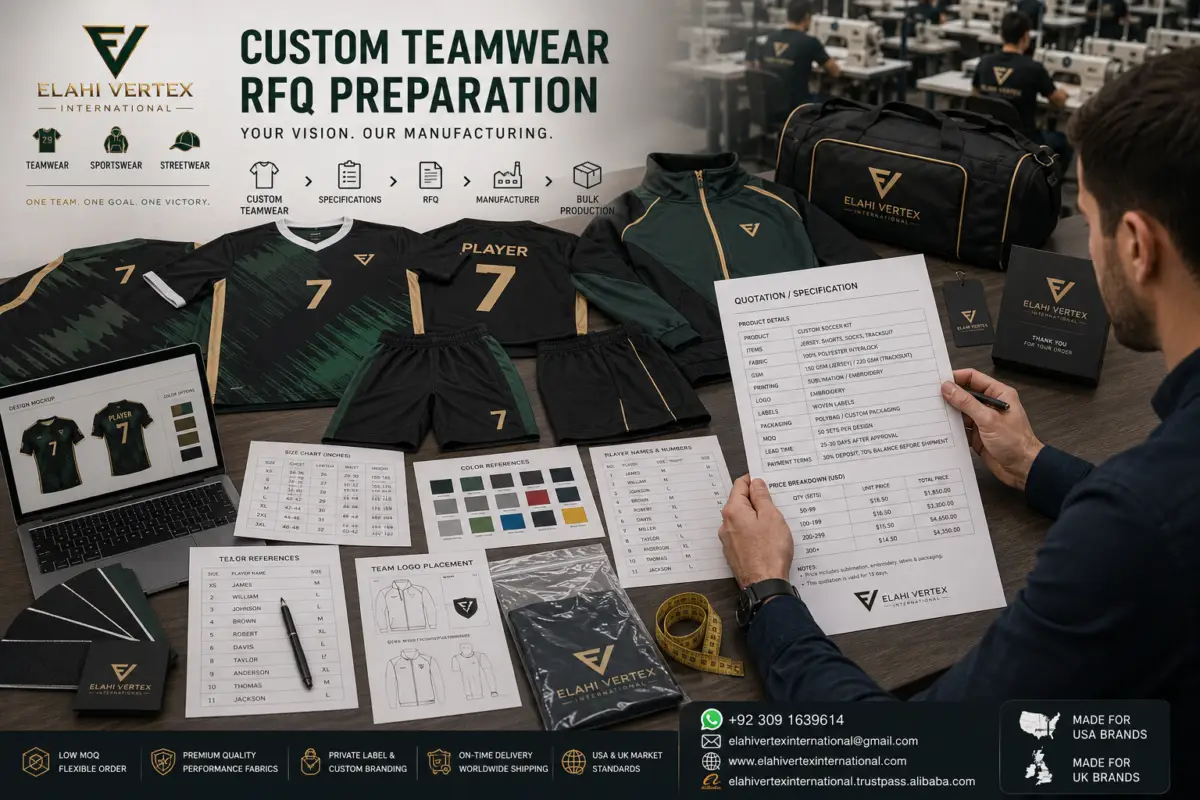
How to Prepare an RFQ for Club Teamwear
A strong request for quotation (RFQ) gives the supplier enough information to understand the project without making unnecessary assumptions.
Include:
Club:
Club name and buyer contact
Sport:
Soccer, basketball, cricket, baseball, or another sport
Products:
Jerseys, shorts, tracksuits, training wear, hoodies, or other products
Quantity:
Estimated quantity by product and color
Sizing:
Adult, youth, or other size requirements
Customization:
Club crest, sponsor logos, player names, numbers, and other branding
Artwork:
Logo files, design files, reference images, or specifications
Fabric:
Preferred material or performance requirements
Packaging:
Individual, team, bulk, or custom packaging
Destination:
Country and delivery location
Timeline:
Required arrival date or competition deadline
Sample:
Whether a sample is required before bulk production
Providing these details helps the supplier understand the project and identify any points that need clarification.
When Should a Club Request a Sample?
A sample can be particularly useful when a club is:
- Working with a new supplier
- Developing a new product
- Using complex customization
- Concerned about fit
- Introducing new branding
- Ordering a significant quantity
A sample review can focus on:
- Fit
- Measurements
- Fabric
- Construction
- Stitching
- Branding
- Color direction
- Name and number placement
- Overall design
The approved sample should work together with documented specifications as a production reference.
Questions About Names, Numbers, Logos, and Sponsors
Personalization should have its own verification process.
Before production, confirm:
- Final club crest
- Final sponsor artwork
- Sponsor placement
- Player names
- Player numbers
- Number style
- Name style
- Logo dimensions
- Branding placement
- Final player roster
The club should ideally nominate one person to approve the final artwork and roster.
This can reduce the possibility of different people sending conflicting instructions to the supplier.
How to Handle Delivery and Reorder Requirements
A successful first order is useful, but many clubs need a supplier that can support future requirements as well.
Before placing the first order, document:
- Approved design
- Product specifications
- Size chart
- Artwork
- Branding placement
- Packaging
- Order quantities
- Supplier contact
- Previous approvals
When a new season begins, review the previous specifications rather than assuming nothing has changed.
If your club expects recurring teamwear requirements, communicate that during the initial supplier discussion.
Why Work With a B2B Custom Teamwear Manufacturer?
A B2B custom manufacturer can be relevant when a club wants more control over product specifications, branding, and customization than a standard ready-made teamwear range provides.
Depending on the supplier and project, custom manufacturing may involve:
- Custom product development
- Buyer-provided designs
- Club branding
- Names and numbers
- Custom colors
- Multiple product categories
- OEM manufacturing
- ODM development
- Private-label requirements
Elahi Vertex International operates as a B2B manufacturer, exporter, OEM/ODM supplier, custom manufacturing partner, and private-label manufacturing partner.
Specific product, MOQ, sampling, production, packaging, and delivery requirements should be confirmed for each individual project.
Frequently Asked Questions
What should I ask a club teamwear supplier before ordering?
Ask about product specifications, fabric, customization, MOQ, samples, artwork approval, sizing, quality control, production time, shipping, packaging, changes, quotation requirements, reorders, and communication.
What is the most important question to ask a teamwear supplier?
There is no single question that applies to every club. The supplier should clearly explain what will be produced, according to which approved specifications, at what quantity, and under what commercial and delivery assumptions.
Should a club order a sample before bulk teamwear production?
A sample can help confirm fit, materials, construction, branding, and other important specifications before bulk production. Whether a sample is necessary depends on the specific project.
What information should a club provide for a teamwear quotation?
Provide the sport, products, approximate quantities, sizes, artwork, club colors, logos, sponsor requirements, customization, packaging, destination, timeline, and sample requirements.
How should player names and numbers be submitted?
Use one final, clearly structured roster containing player names, numbers, sizes, and applicable products. Proofread the information before final approval.
Does MOQ apply to the entire order?
Not necessarily. MOQ can depend on the supplier and project structure. Ask whether it applies per product, style, design, color, or total order.
What should be included in a teamwear quotation?
A quotation should clearly identify the products, quantities, customization, and relevant commercial assumptions. Sampling, packaging, shipping, and other project-specific requirements should also be clarified.
How early should a club place a custom teamwear order?
There is no universal lead time for every supplier and project. Clubs should work backward from their required arrival date and confirm production and shipping timing with their supplier.
What is the difference between production time and shipping time?
Production time covers manufacturing. Shipping time covers transportation after the goods are ready. International orders may also involve customs and destination procedures.
Should a club compare several teamwear suppliers?
Yes. Comparing suppliers can reveal differences in product specifications, MOQ, sampling, quality expectations, communication, commercial terms, and delivery assumptions.
Can a club reorder the same teamwear design later?
Potentially, depending on the supplier and project. Clubs should retain approved artwork, specifications, size charts, and branding information to make future orders easier to manage.
Does Elahi Vertex International manufacture custom club teamwear?
Elahi Vertex International is a B2B manufacturer and custom manufacturing partner. Specific club teamwear products, customization, MOQ, sampling, production, packaging, and delivery requirements should be confirmed for each project.
Can a club request a quotation from Elahi Vertex International?
Yes. Clubs can discuss their requirements through WhatsApp: +92 309 1639614 or Email: elahivertexinternational@gmail.com. Providing product details, estimated quantities, artwork, and destination information helps clarify the project.
Conclusion
Choosing a club teamwear supplier should involve more than comparing prices.
Before placing an order, a club should understand exactly what it is buying, how the garments will be customized, what information the supplier needs, how samples and approvals will work, what the MOQ means, how quality will be evaluated, how production and shipping timelines are defined, and how future reorders will be handled.
The 15 questions in this checklist provide a practical framework for evaluating suppliers and reducing avoidable misunderstandings.
The strongest supplier decision is based on clear specifications, transparent assumptions, documented approvals, realistic timelines, and reliable communication.
For clubs considering custom B2B teamwear manufacturing, Elahi Vertex International can discuss product requirements, customization, OEM/ODM, private-label, and sourcing requirements on a project-specific basis.
WhatsApp: +92 309 1639614
Email: elahivertexinternational@gmail.com
Website: https://www.elahivertexinternational.com/

Explore how custom teamwear is developed from concept to finished kit, with professional design, quality materials, personalization, production, and reliable delivery.
FIFA
- FIFA — Laws of the Game: Law 4, The Players’ Equipment
Useful for the section discussing teamwear specifications, player jerseys, numbers, and required equipment.
FIFA — Law 4: The Players’ Equipment - FIFA — Football Equipment Regulations
Useful when discussing football/soccer club apparel, equipment standards, branding, and specifications.
FIFA — Football Equipment Regulations - The FA — Kit and Equipment Regulations
Relevant to club kit requirements, player identification, and football teamwear considerations, particularly for clubs operating in England.
The FA — Kit and Equipment Regulations - U.S. Soccer — Policies and Regulations
Useful for U.S.-focused clubs when discussing competition requirements and team/player equipment considerations.
U.S. Soccer — Policies and Regulations