

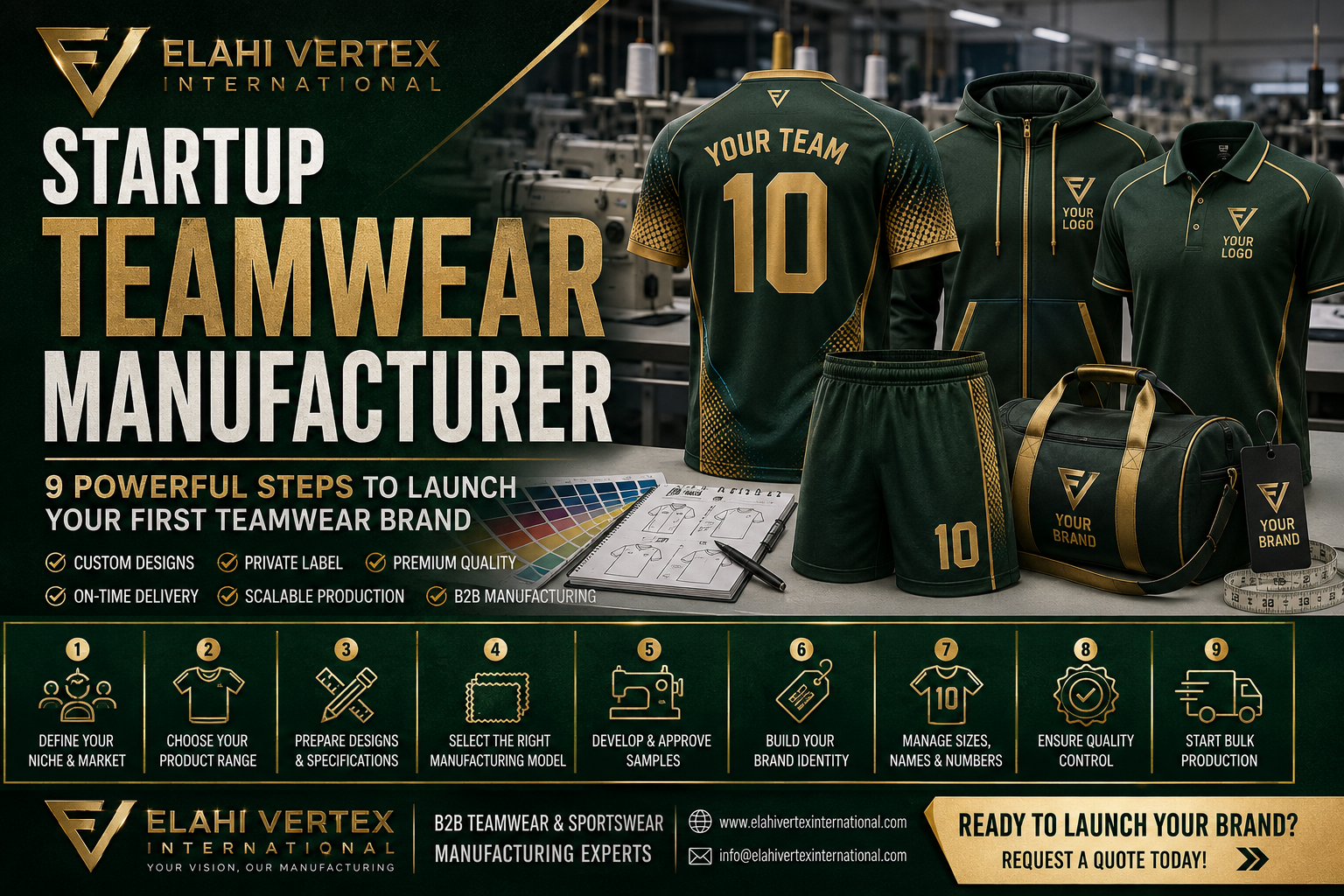
Starting a teamwear brand can begin with something very simple: an idea for a better football kit, a basketball uniform concept, a connection with local clubs, an online sportswear business, or the belief that teams in your market deserve better customization and service. Turning that idea into an actual product, however, requires more than creating a logo and finding customers.
At some point, every founder has to answer a much more practical question:
Who is going to manufacture the teamwear?
Choosing the right startup teamwear manufacturer is one of the most important sourcing decisions a new brand makes. Your manufacturer affects the physical product your customers receive: sizing, colors, printing, stitching, customization, labels, packaging and the consistency of repeat production.
For startups, this decision can feel complicated because established brands often already understand fabrics, technical specifications, sampling, purchase orders and quality control. A first-time founder may still be learning those processes.
That does not mean a startup should approach manufacturing casually.
In fact, the opposite is true.
A new teamwear business should establish a disciplined sourcing process from its first collection. Clear specifications, controlled product development, sample evaluation, accurate team customization and documented approvals can help create a stronger foundation for future orders.
Elahi Vertex International works in custom apparel manufacturing for B2B buyers, and its manufacturing workflow covers product development, sampling, customization, bulk production, quality control and packaging. These are precisely the stages a new teamwear brand needs to understand before committing to production.
This guide explains how founders can approach a startup teamwear manufacturer, what information to prepare, how private-label teamwear works, what to inspect during sampling, and how to move from an initial idea toward a commercially usable teamwear collection.
Quick Answer: What Should a Startup Look for in a Teamwear Manufacturer?
A startup should look for a teamwear manufacturer capable of turning clearly defined buyer requirements into repeatable products.
The process normally includes:
- Defining the teamwear niche and target customer.
- Choosing a focused first product range.
- Preparing designs and technical requirements.
- Selecting an appropriate manufacturing model.
- Developing and evaluating samples.
- Finalizing branding and customization.
- Confirming sizes, names, numbers and order data.
- Establishing quality-control expectations.
- Preparing for bulk production and repeat orders.
The objective is not simply to find the lowest quotation.
A startup needs to understand whether the supplier can manufacture the required products, interpret specifications correctly, communicate during development and reproduce an approved product consistently.
This is where evaluating a startup teamwear manufacturer becomes a business decision rather than a simple price comparison.
Why Teamwear Can Be an Attractive Category for a Startup
Teamwear is different from many conventional fashion categories.
A fashion startup might depend heavily on seasonal consumer trends. Teamwear businesses can instead serve organizations with recurring apparel requirements, such as clubs, academies, schools, leagues, tournaments and sporting organizations.
A team may require:
- Match uniforms
- Training jerseys
- Shorts
- Pants
- Warm-up garments
- Tracksuits
- Hoodies
- Training T-shirts
- Polo shirts
- Coaches’ apparel
- Staff apparel
- Replacement uniforms
- New-player uniforms
- Tournament kits
- Alternate kits
This creates several possible business models for a startup.
One founder might build a soccer-focused brand.
Another might specialize in basketball.
Another could sell custom uniforms to schools.
Another could operate as a local teamwear dealer while outsourcing production.
Another might create an online private-label brand covering several sports.
Another might already own a printing, embroidery or promotional-products business and add custom teamwear as a new revenue category.
The manufacturing strategy should therefore follow the business model.
A startup should not select products simply because a manufacturer can make them.
It should first determine who it wants to sell to and what those customers repeatedly need.
Step 1: Define Your Teamwear Startup Before Contacting a Manufacturer
One of the most common mistakes in startup sourcing is contacting manufacturers before defining the business.
A message such as:
“I want to start a sportswear brand. Send prices.”
does not give a manufacturer enough information to understand the project properly.
A better starting point is to define the commercial model.
Who will buy from you?
Possible customers include:
- Grassroots sports clubs
- Youth academies
- Schools
- Colleges
- Amateur leagues
- Semi-professional teams
- Tournament organizers
- Corporate sports teams
- Gyms
- Coaches
- Sports retailers
- Teamwear dealers
- Distributors
- Online buyers
A startup targeting youth soccer academies has different product requirements from one targeting adult basketball leagues.
Similarly, a brand supplying schools may require a broader size range and stronger reorder organization, while an online private-label brand may place greater emphasis on packaging, labels and presentation.
Before selecting a startup teamwear manufacturer, write down your target customer in one sentence.
For example:
“We supply custom soccer uniforms to youth clubs and academies in the United States.”
Or:
“We are building a private-label basketball teamwear brand for schools and amateur clubs in the UK.”
That single sentence already provides far more sourcing direction.
Choose a geographic market
Your target country influences several commercial decisions.
A startup planning to sell in the USA should understand the expectations of American clubs, schools and buyers.
A UK-focused business may encounter different sports structures, sizing expectations and buying patterns.
European markets may require different product combinations.
The manufacturer does not replace your responsibility to understand your customer.
Instead, manufacturing should execute a product strategy based on that customer.
Decide whether you are a brand, dealer or distributor
These models overlap, but the distinction is useful.
Private-label teamwear brand
You sell products under your own brand identity.
Branding may extend beyond the visible logo to include labels, hangtags and packaging where required.
Teamwear dealer
You acquire team customers, prepare or coordinate designs, collect order information and source the manufactured products.
The end customer may care more about the club identity than the dealer’s brand.
Distributor or wholesaler
You may supply other businesses rather than individual teams.
Repeatability, pricing structures, product organization and scalable ordering become particularly important.
Hybrid business
Many startups eventually combine these models.
A company might operate under its own private label while simultaneously supplying customized uniforms directly to clubs.
Understanding your model helps you explain your requirements to a custom teamwear manufacturer.
Step 2: Build a Focused First Teamwear Collection
New brands frequently try to launch too many products.
They want:
soccer, basketball, baseball, rugby, American football, volleyball, lacrosse, cricket, activewear, tracksuits, hoodies and accessories immediately.
That may look impressive in a catalog.
Operationally, however, every additional product creates more decisions.
You may need additional:
- Patterns
- Size charts
- Fabrics
- Artwork
- Samples
- Product photography
- Website pages
- Pricing
- Inventory planning
- Sales material
- Customer explanations
A startup generally benefits from making its initial offer easy to understand.
Start with your strongest sport
If your existing network is in basketball, begin there.
If you know soccer clubs, build around soccer.
If your contacts are schools with several sports, a multi-sport model may make more sense.
Your first collection should reflect an actual sales opportunity.
This is especially important because manufacturing is not the end goal.
Selling is the goal.
A beautiful sample that has no defined customer is still an expense.
Build a product system, not random products
Suppose you launch a soccer teamwear business.
Instead of creating 20 unrelated garments, you could develop a structured offer around:
Match: jersey + shorts
Training: training shirt + shorts
Warm-up: tracksuit
Off-field: polo + hoodie
This gives salespeople a coherent system to present to clubs.
For basketball, the structure might be:
Game: jersey + shorts
Warm-up: shooting shirt
Travel: tracksuit
Clubwear: hoodie + polo
A sportswear manufacturer for startups should be evaluated against the actual product system you intend to sell.
Step 3: Prepare Better Product Specifications
This is where an idea begins becoming a manufacturable product.
A manufacturer cannot see the product inside your head.
Every important expectation must eventually become something that can be communicated, approved and checked.
Your initial specification does not necessarily need to be an extremely sophisticated technical document, but it should eliminate unnecessary ambiguity.
Product type
State exactly what you need.
Instead of:
“Football kit.”
Specify:
“Adult short-sleeve soccer jersey with matching shorts.”
Instead of:
“Basketball clothes.”
Specify:
“Sleeveless basketball jersey and matching basketball shorts.”
Small improvements in communication can prevent large misunderstandings later.
Design
Provide artwork, sketches, reference images or a sufficiently clear design brief.
A design should indicate:
- Base colors
- Secondary colors
- Panel arrangement
- Graphic placement
- Logo location
- Sponsor locations where relevant
- Player number location
- Player name location
- Other visual requirements
For sublimated teamwear, the artwork itself becomes a major part of the garment.
That means artwork approval deserves the same attention as fabric or sizing approval.
Color requirements
Do not rely entirely on descriptions such as:
- dark blue
- bright red
- lime green
- gold
- royal blue
Color descriptions are subjective.
Where exact brand colors matter, communicate appropriate color references and establish how colors will be approved.
Screen appearance can also differ from physical output, so founders should avoid assuming that every device displays a color identically.
Fabric requirements
A startup does not need to pretend to be a textile engineer.
It does, however, need to explain the intended use of the garment.
Tell the manufacturer:
- Sport
- Playing or training use
- Climate considerations
- Desired hand feel
- Stretch requirements
- Weight preference, if known
- Construction requirements
- Target positioning
If you already have a preferred fabric specification, provide it.
If not, discuss appropriate options during product development rather than making unsupported assumptions.
The correct material choice depends on the garment and intended application.
Fit
Fit is part of product identity.
Ask yourself:
Is the garment intended to fit:
- Slim?
- Athletic?
- Regular?
- Relaxed?
- Compression-oriented?
Different sports also require different movement considerations.
A basketball jersey is not developed exactly like a rugby jersey.
Baseball pants are not graded like soccer shorts.
American football apparel has different construction considerations again.
This is why a specialized custom teamwear manufacturer can be more relevant than a general fashion supplier for technical sports categories.
Step 4: Understand OEM, ODM and Private Label Teamwear
Startup founders frequently encounter these terms without fully understanding the distinction.
The terminology can also vary between suppliers, so the safest approach is to discuss what each party is actually responsible for rather than relying only on labels.
OEM teamwear
OEM generally means the manufacturer produces according to the buyer’s specifications.
The buyer may provide:
- Design
- Measurements
- Construction requirements
- Fabric direction
- Artwork
- Branding
- Labels
- Packaging requirements
This route can provide significant product control, but it also requires the buyer to communicate requirements clearly.
OEM can suit a startup that already knows exactly what it wants to manufacture.
ODM teamwear
ODM generally involves more product-development input from the manufacturer, potentially using existing product foundations that are adapted for the buyer.
This can be useful when a startup has a brand concept but has not developed every technical detail independently.
However, the exact scope of ODM varies considerably between suppliers.
Ask what is actually being customized.
Private label teamwear
Private label teamwear is produced for sale under the buyer’s brand.
Depending on the project, branding may include:
- Main labels
- Neck labels
- Size labels
- Care labels
- Hangtags
- Packaging
- Brand logos
Private label does not automatically mean every aspect of the garment is unique.
A startup should confirm exactly what is custom.
Which model is best for a startup?
There is no universal answer.
Choose based on your level of product development.
If you have complete specifications and want significant control, OEM may be appropriate.
If you need development assistance, an ODM-style approach may be relevant.
If your primary objective is selling teamwear under your own identity, private-label manufacturing may be central to your business model.
The important point is that your startup teamwear manufacturer and your business should have the same understanding of the project before sampling begins.
Industry sourcing guides similarly distinguish OEM, ODM and private-label models based largely on who controls product development and how much customization is required. (Canting Activewear)
Step 5: Treat Sampling as Product Development, Not a Formality
A sample is one of the most valuable checkpoints in custom manufacturing.
It turns specifications into a physical garment that can actually be evaluated.
For a startup, this matters enormously.
Do not evaluate a sample only by asking:
“Does it look good?”
Evaluate it systematically.
Check overall appearance
Place the sample in good lighting.
Look at:
- Proportions
- Color balance
- Graphic placement
- Logo placement
- Number placement
- Panel alignment
- Overall silhouette
Compare it with the approved design.
Check measurements
Measure the garment against the agreed specification or size chart.
Do not rely exclusively on visual judgment.
Important points vary by product but may include:
- Chest width
- Body length
- Shoulder
- Sleeve length
- Waist
- Hip
- Inseam
- Outseam
- Leg opening
A sample can look visually correct while still having measurements that differ from the intended specification.
Check construction
Inspect:
- Seams
- Stitching
- Hems
- Waistbands
- Necklines
- Armholes
- Zippers where applicable
- Reinforced areas where applicable
- Internal finishing
The purpose is not simply to find defects.
You are determining whether the construction represents the product you want associated with your brand.
Check artwork and customization
For printed or sublimated teamwear, inspect:
- Logo scale
- Logo position
- Graphic alignment
- Names
- Numbers
- Sponsor marks
- Color appearance
- Front-to-back consistency
For embroidered or applied branding, inspect the relevant execution and placement.
Check fit
Where practical, evaluate the sample on an appropriate wearer or fitting reference.
Consider:
- Range of movement
- Length
- Width
- Neck opening
- Armhole
- Waist
- Rise
- Overall comfort
- Sport-specific movement
Record every required change.
Do not send scattered revision messages over several days if they can be consolidated into a clear revision document.
A well-managed sample revision might state:
Revision 01
- Increase body length by specified amount.
- Adjust neckline according to marked reference.
- Move chest logo to confirmed position.
- Correct player number scale.
- Change approved color reference.
- Adjust shorts length.
- Confirm revised sample before production.
That is much easier to control.
Sampling Is Where Your Future Standard Begins
Startup founders sometimes view samples as products to photograph and advertise.
They are more important than that.
An approved sample can become a physical benchmark for bulk production.
That means approval should be deliberate.
Do not approve a sample because you are impatient to launch.
If something matters now, it will probably matter after production too.
The purpose of working with a startup teamwear manufacturer is not merely to receive a prototype quickly.
It is to establish a repeatable specification.
Step 6: Build a Real Private-Label Identity
Putting a logo on a generic jersey does not automatically create a strong brand.
Brand identity is built through consistency.
Your visual language should make sense across the collection.
Consider:
- Logo use
- Typography
- Color palette
- Product naming
- Labels
- Packaging
- Photography
- Website presentation
- Sales documents
- Customer communication
Manufacturing should support that identity.
Garment branding
Depending on the garment and project, branding may appear through:
- Sublimation
- Embroidery
- Printed marks
- Heat-applied marks
- Woven labels
- Printed labels
- Neck branding
- Hangtags
Not every method is appropriate for every product.
The technique should follow the garment, design and intended use.
Private labels
If you are building a private label teamwear business, discuss label requirements before bulk production rather than after garments have already been manufactured.
Possible requirements include:
- Brand label
- Size identification
- Care information
- Composition information
- Country-of-origin information
- Other market-specific information
The buyer is responsible for determining applicable legal and market requirements.
Do not treat labels as decoration alone.
Packaging
Packaging requirements can vary enormously.
A startup should ask:
What does the customer actually need?
A teamwear dealer supplying an entire club may prioritize efficient identification and sorting.
An e-commerce private-label brand may care more about individual retail presentation.
A distributor may have specific carton and SKU requirements.
Specify packaging before production.
Do not assume the manufacturer’s standard packing is automatically appropriate for your sales channel.
Step 7: Create a Reliable System for Sizes, Names and Numbers
This is one of the most important operational differences between teamwear and ordinary apparel.
A fashion order might contain:
- 30 small
- 50 medium
- 40 large
A customized team order may contain:
- Different sizes
- Different names
- Different player numbers
- Different positions
- Different garment combinations
- Staff garments
- Goalkeeper variants
- Home/away variants
That creates data risk.
A beautifully manufactured jersey with the wrong number is still wrong.
Build a master roster
For every customized order, use a structured roster.
Typical fields might include:
| Player | Jersey Size | Shorts Size | Number | Name | Product/Variant |
|---|---|---|---|---|---|
| Player A | M | M | 7 | SMITH | Home |
| Player B | L | L | 12 | JONES | Home |
| Player C | S | M | 21 | BROWN | Away |
The exact format can vary.
What matters is having one controlled source of truth.
Avoid order information spread across messages
Do not keep final production data scattered across:
- Screenshots
- Voice messages
- Handwritten notes
Consolidate it.
Your internal process should establish:
This is the final approved roster.
Then changes should be version-controlled.
For example:
ClubName_HomeKit_Roster_V3_FINAL
That is much safer than sending a manufacturer six different lists and expecting them to determine which one is current.
Size Charts Matter More Than Founders Expect
Sizing problems can damage a startup quickly because customers often blame the brand, not the manufacturer.
A label saying “Large” does not guarantee that it matches every other large garment in the market.
A startup should therefore work from measurements, not assumptions.
Create product-specific sizing
Different garments may require different charts.
You may need separate sizing information for:
- Soccer jersey
- Soccer shorts
- Basketball jersey
- Basketball shorts
- Baseball jersey
- Baseball pants
- Rugby jersey
- American football jersey
- Tracksuit jacket
- Tracksuit pants
- Hoodie
Do not assume one generic chart can cover everything.
Give customers measurement guidance
Your sales process should help teams choose sizes.
A brand can provide garment measurements and clear instructions about how measurements should be interpreted.
For larger team orders, sizing samples may also be useful depending on your business model.
The important principle is simple:
Do not wait until after production to discover that your customers interpreted sizing differently from you.
Step 8: Establish Quality Control Before Bulk Production
Quality control is not something that should begin when cartons are ready to ship.
It starts when specifications are created.
You cannot inspect a product objectively unless you know what it is supposed to be.
What should be controlled?
The exact checklist depends on the product, but teamwear buyers commonly need to consider:
- Product type
- Fabric
- Color
- Measurements
- Construction
- Stitching
- Artwork
- Logo position
- Player names
- Player numbers
- Labels
- Packaging
- Quantity
- Size assortment
- General finishing
The approved specifications should provide the benchmark.
Quality is not a vague adjective
Startup brands frequently say:
“I need high quality.”
Every buyer says that.
The phrase is not sufficiently specific.
A better discussion asks:
- What fabric is approved?
- What measurements are approved?
- What artwork is approved?
- What construction is approved?
- What label is approved?
- What packaging is approved?
- What variation is acceptable?
Quality control becomes more useful when requirements are measurable or visually verifiable.
Build a Pre-Production Approval Checklist
Before authorizing bulk production, confirm the important variables.
A practical checklist can include:
Product
- Correct style
- Correct construction
- Correct fabric
- Correct fit
- Correct size chart
Artwork
- Correct colors
- Correct graphics
- Correct logo
- Correct logo position
- Correct sponsor artwork
- Correct names and numbers
Branding
- Correct label
- Correct size identification
- Correct hangtag where required
- Correct packaging where required
Commercial
- Final quantity
- Final size breakdown
- Final roster
- Final delivery requirements
- Final shipping destination
- Approved production terms
This is one of the simplest ways a startup can operate more professionally.
Step 9: Design Your Manufacturing System for Repeat Orders
The first order is important.
But a strong teamwear business should think beyond the first order.
Teams change.
New players join.
Players leave.
Sponsors change.
Uniform designs change.
Youth players move into larger sizes.
Clubs create additional teams.
Schools start new seasons.
Customers need replacements.
This creates repeat-order opportunities—but only if the startup maintains good records.
Archive every approved specification
For each product, retain:
- Artwork
- Color references
- Size chart
- Product specification
- Approved branding
- Packaging information
- Order history
- Customer roster
- Revision history
A repeat order should not require reconstructing the product from memory.
Use product codes
Give every design a unique identifier.
For example:
SC-HOME-001
SC-AWAY-001
BB-HOME-002
RUG-MATCH-003
The exact naming system is up to you.
What matters is consistency.
When a club returns months later, you want to know exactly which product it previously purchased.
A Startup Teamwear Manufacturer Should Support a System, Not Just a Garment
This is a useful way to evaluate potential suppliers.
Do not ask only:
“Can you make this jersey?”
Ask yourself whether the relationship can support:
design → specification → sample → approval → order → QC → delivery → repeat order
A manufacturer that produces one attractive sample but cannot consistently manage specifications may create problems as your business grows.
Your goal is repeatability.
What Products Should a New Teamwear Brand Launch First?
There is no universal first collection.
But founders should choose products based on their target sport and customers.
Here are several possible structures.
Soccer startup collection
A focused soccer range might include:
- Match jersey
- Match shorts
- Goalkeeper jersey
- Training shirt
- Training shorts
- Tracksuit
- Hoodie
You do not necessarily need all seven immediately.
A jersey-and-shorts set can be the core product, with additional garments introduced as sales develop.
Basketball startup collection
Potential products:
- Basketball jersey
- Basketball shorts
- Warm-up shirt
- Shooting shirt
- Tracksuit
- Hoodie
Customization can include team artwork, numbers, player names and sponsor placements depending on the customer’s requirements.
Baseball startup collection
Potential products:
- Baseball jersey
- Baseball pants
- Training shirt
- Coach apparel
- Warm-up garment
- Hoodie
Baseball also gives a teamwear brand opportunities for multiple uniform combinations.
American football startup collection
Potential products:
- Game jersey
- Football pants
- Practice jersey
- Compression or training garments
- Warm-up apparel
- Team hoodie
The construction and fit requirements of American football products should be considered carefully during development.
Rugby startup collection
Potential products:
- Rugby jersey
- Rugby shorts
- Training shirt
- Tracksuit
- Hoodie
- Polo
A rugby-focused brand should pay particular attention to sport-specific fit and construction requirements.
Volleyball startup collection
Potential products:
- Volleyball jersey
- Volleyball shorts
- Warm-up shirt
- Tracksuit
- Hoodie
A school/team supplier may also need multiple gender and youth sizing requirements depending on its customer base.
Should a Startup Sell One Sport or Multiple Sports?
This depends on how you acquire customers.
If you already have strong access to one sport, specialization can make positioning easier.
For example:
“Custom basketball uniforms for youth programs.”
That is clear.
Customers immediately understand what you sell.
A broad company saying:
“We sell every type of clothing and sportswear.”
may find it harder to communicate a distinctive offer.
However, multi-sport teamwear can make sense for businesses serving schools, sports clubs or distributors that purchase several categories.
The decision should come from your customer base—not from how many products your manufacturer can produce.
Custom Teamwear for Startups: Build Around an Actual Customer Problem
A startup becomes more compelling when it solves a specific problem.
For example:
Problem: Local clubs struggle to coordinate customized uniforms.
Offer: A structured design and ordering service.
Or:
Problem: Youth academies need multiple sizes and recurring replacements.
Offer: A documented uniform program with repeat-order records.
Or:
Problem: New clubs do not have professional uniform artwork.
Offer: A guided custom-teamwear development process.
Or:
Problem: Teamwear dealers want products under their own identity.
Offer: Private-label manufacturing.
When founders approach custom teamwear for startups this way, product development becomes connected to a commercial proposition.
The Difference Between Selling Apparel and Selling a Teamwear Program
This distinction is extremely important.
Selling one jersey is transactional.
Selling a teamwear program can include:
- Design
- Match kit
- Training kit
- Warm-up apparel
- Staff apparel
- Sizing
- Player personalization
- Reorders
- Seasonal updates
That creates a deeper customer relationship.
Suppose a soccer academy has 150 players across several age groups.
Instead of offering one shirt, your brand could eventually provide a coordinated system covering multiple squads and garment categories.
That does not happen automatically.
It requires operational discipline.
How to Price Teamwear as a Startup
Your manufacturer’s unit price is not your final business cost.
A startup should build a proper costing model.
Potential cost categories include:
- Product cost
- Sampling
- Artwork/design
- Labels
- Packaging
- Freight
- Import-related costs
- Payment costs
- Warehousing
- Local delivery
- Marketing
- Sales commissions
- Returns/replacements
- Administrative overhead
Which costs apply depends on your business model.
Do not simply take a factory quotation and add an arbitrary percentage.
Understand your landed economics.
Avoid Competing Only on Price
A startup that enters the market with:
“We are cheaper.”
creates a fragile position.
There will almost always be another supplier willing to quote less.
Instead, your commercial value can come from:
- Better design coordination
- Faster customer communication
- Easier ordering
- Clear sizing
- Reliable roster management
- Better presentation
- Better local service
- Sport specialization
- Organized reorders
- Strong branding
- Club account management
Your manufacturer operates behind the scenes.
Your customer experience is still your responsibility.
How to Request a Useful Manufacturing Quotation
A good RFQ produces a better conversation.
Instead of sending:
“Price basketball uniform?”
prepare:
Product
Basketball jersey and shorts set.
Quantity
State expected quantity or quantity range.
Sizes
State youth/adult requirements where known.
Fabric
Provide specification if already decided, or explain intended use and request available options.
Design
Attach artwork/reference.
Customization
State:
- Team logo
- Player numbers
- Player names
- Sponsor marks
- Other artwork
Branding
Specify whether you require:
- Your brand logo
- Private labels
- Hangtags
- Packaging
Destination
Provide country and, where needed for freight discussion, destination details.
Required date
State the actual required date rather than simply saying “urgent.”
This gives a startup teamwear manufacturer enough information to understand the project more accurately.
What to Send Elahi Vertex International for a Teamwear Inquiry
A startup approaching Elahi Vertex International can prepare the same type of structured information.
Useful information includes:
- Sport
- Product
- Design/reference
- Quantity
- Size range
- Colors
- Logo files
- Names/numbers if applicable
- Branding requirements
- Packaging requirements
- Destination
- Required timeline
If a specification is not finalized, identify it clearly rather than inventing it.
That creates a more productive development conversation.
Why Product Development Comes Before Bulk Production
A startup may be eager to move directly into a large order because it wants stock quickly.
But unresolved product decisions do not disappear during bulk manufacturing.
They become multiplied.
If a neckline is wrong on one sample, it can be corrected.
If the same issue exists across a bulk order, the consequences are much larger.
If a logo is incorrectly positioned on one prototype, you can revise the artwork.
If hundreds of garments carry the same error, the problem becomes more serious.
This is why the sample and approval stages are operational controls rather than unnecessary delays.
How to Evaluate a Startup Teamwear Manufacturer
Founders should evaluate more than the sales conversation.
Consider the supplier across several dimensions.
1. Product relevance
Does the manufacturer actually work with the type of teamwear you intend to sell?
Sports apparel requires category-specific knowledge.
A supplier that is excellent at casual T-shirts is not automatically the right partner for every technical teamwear category.
2. Customization capability
Confirm whether the supplier can support the customization your business needs.
This might include:
- Sublimation
- Printing
- Embroidery
- Custom colors
- Names and numbers
- Labels
- Packaging
Capabilities should be confirmed for your particular project.
3. Sampling process
Ask how product development and revisions are handled.
Understand:
- What information is required
- What will be sampled
- How revisions are communicated
- What constitutes approval
- What changes after approval may affect production
4. Communication
Communication quality matters because manufacturing involves decisions.
Evaluate whether questions are answered clearly.
Do not confuse fast responses with accurate responses.
A technically useful answer may be more valuable than an immediate “yes.”
5. Specification control
Ask how approved information is carried into production.
The supplier should know which version of the artwork, size chart and roster is final.
6. Quality-control process
Understand what will be checked against the approved requirements.
The exact inspection procedure depends on the project, but the important point is that quality should be linked to agreed specifications.
7. Branding support
If you are building a private-label brand, determine whether your required branding can be incorporated into the manufacturing program.
8. Packaging
Confirm packaging before ordering.
Do not assume.
9. Repeat-order organization
Ask how previous designs/specifications can be referenced for future production.
This becomes increasingly important as you gain customers.
Do Not Choose a Manufacturer From Website Claims Alone
A polished website is useful.
It is not proof of every production claim.
The same applies to social-media followers, advertisements and marketplace listings.
Supplier evaluation should include direct project-specific communication and appropriate verification.
Ask relevant questions.
Review samples.
Confirm commercial terms.
Check documentation relevant to your transaction.
Maintain records.
Start with a controlled process.
A startup should conduct reasonable supplier due diligence before transferring substantial funds or committing to significant production.
Questions to Ask a Potential Teamwear Manufacturer
A founder can use questions such as:
- Do you manufacture this specific product category?
- What information do you need to quote accurately?
- What customization methods are available for this product?
- What fabric options are suitable for the intended use?
- Can a sample be developed before bulk production?
- How are sample revisions handled?
- How should sizing be supplied?
- How should player names and numbers be submitted?
- What private-label options are available?
- What packaging options are available?
- What is the MOQ for this specific project?
- What production timeline applies after approval?
- What information is required before production starts?
- How is quality checked?
- How are repeat orders referenced?
Notice that several questions require project-specific answers.
That is intentional.
Do not assume that MOQ, production time, fabric or pricing from one product automatically applies to another.
MOQ: What Startup Founders Need to Understand
MOQ means minimum order quantity.
Startup founders naturally care about MOQ because they want to control risk.
But MOQ should not be treated as an isolated number.
It can depend on:
- Product
- Fabric
- Color
- Printing method
- Construction
- Labels
- Packaging
- Material sourcing
- Design complexity
A startup should ask for the MOQ for its actual specification.
Do not build your business plan around an MOQ found in an unrelated online article.
Other sportswear sourcing guides also note that MOQs vary according to customization and production model, reinforcing why founders should confirm the figure for their own project rather than assume an industry-wide number. (Canting Activewear)
For Elahi Vertex International projects, MOQ should therefore be treated as REQUIRES CONFIRMATION until the product and specifications are known.
Production Lead Time: Another Number That Requires Confirmation
The same principle applies to production time.
Timeline can depend on:
- Product complexity
- Quantity
- Material availability
- Sampling
- Revisions
- Artwork approval
- Customization
- Packaging
- Production schedule
- Shipping method
A founder should separate:
sample development time
from
bulk production time
from
shipping/transit time.
These are different stages.
For an EVI order, exact timing is REQUIRES CONFIRMATION for the specific project.
Why Startups Should Avoid Launching Too Many SKUs
SKU complexity can quietly consume capital.
Suppose you launch:
5 products × 4 colors × 6 sizes.
You already have 120 product-size-color combinations.
Add youth and adult ranges, home and away designs, and customization, and complexity rises rapidly.
Teamwear can be even more complicated because personalization adds another layer.
A startup should therefore ask:
Which products are most likely to generate actual orders first?
Launch those.
Expand based on demand.
This is a better use of limited startup capital than building a huge catalog before proving the sales model.
Create a Minimum Viable Teamwear Collection
The concept of a minimum viable product can be adapted to teamwear.
Your minimum viable collection should be sufficient to:
- Demonstrate your brand
- Show customization
- Approach target customers
- Collect feedback
- Generate quotations
- Begin selling
It does not need to represent every product you may sell in five years.
For a basketball startup, for example:
- One strong jersey design
- Matching shorts
- One alternate colorway
- One warm-up garment
could communicate the brand more effectively than 30 poorly differentiated products.
Samples Can Become Sales Assets
Once your samples are approved, they can do more than validate manufacturing.
They can support:
- Product photography
- Social media
- Website pages
- Sales meetings
- Club presentations
- Catalogs
- Videos
- Size demonstrations
- Design examples
Real product photography is particularly valuable for a new brand because customers want to understand what they are buying.
A digital mockup can help communicate an idea.
A physical sample shows the actual garment.
Use both appropriately.
Build a Teamwear Sample Room
As your startup grows, maintain a physical library of approved products.
For each sample, record:
- Product code
- Sport
- Fabric
- Size
- Design version
- Date
- Related supplier
- Related specification
A small sample room or organized rack can eventually become one of your most useful sales and operational resources.
When customers visit, they can feel products.
When salespeople travel, they can take relevant samples.
When you reorder, you have a physical reference.
Custom Teamwear Manufacturer vs Local Decorator
These are not always the same business.
A local decorator may purchase blank garments and add:
- Names
- Numbers
- Logos
- Transfers
- Embroidery
A custom teamwear manufacturer may produce the garment itself according to the project specification.
Both models can be useful.
Some startups may even combine them.
For example, you might manufacture custom sublimated uniforms internationally while using a local partner for certain quick-turnaround personalization services.
The right model depends on what you sell.
Why Sublimation Is Important in Custom Teamwear
Sublimation is widely associated with modern teamwear because it can integrate graphics into suitable polyester-based applications.
It can be particularly useful for designs involving:
- Complex patterns
- Multiple colors
- Player numbers
- Player names
- Sponsor graphics
- Gradient effects
- Full-garment artwork
However, the manufacturing process should still be controlled carefully.
Artwork placement, panel alignment, colors, sizing and construction remain important.
Sublimation does not eliminate the need for quality control.
When Embroidery May Be Appropriate
Embroidery can be useful for certain:
- Polo shirts
- Jackets
- Tracksuits
- Hoodies
- Staff garments
- Clubwear
The suitability depends on fabric, logo design, garment type and desired appearance.
A very detailed mark may require adaptation.
Discuss the intended logo method with your manufacturer during development.
Private Label Teamwear Is More Than a Neck Label
A private-label business owns the customer-facing brand.
That means the entire experience matters.
Imagine a club receiving its order.
The customer sees:
- Carton condition
- Packing organization
- Garment presentation
- Labels
- Colors
- Sizes
- Names
- Numbers
- Product quality
- Communication
- Accuracy
They do not care which internal production department was responsible for an error.
They purchased from your brand.
Therefore, outsourcing manufacturing does not outsource responsibility for the customer experience.
Build Your Own Internal Quality Checklist
Even if a manufacturer conducts QC, your startup should maintain its own acceptance criteria.
For example:
Design
- Artwork matches approval
- Correct colors
- Correct logo
- Correct sponsor placements
Product
- Correct garment
- Correct fabric
- Correct measurements
- Correct construction
Personalization
- Correct name
- Correct number
- Correct size
- Correct team
Branding
- Correct brand mark
- Correct label
- Correct tag
Packing
- Correct quantity
- Correct size assortment
- Correct identification
- Correct packaging
This checklist can evolve as you gain experience.
Every problem should teach the business something.
Turn Mistakes Into Systems
Suppose a customer receives two jerseys with incorrect numbers.
Do not solve only those two jerseys.
Ask:
Why did the error occur?
Was the roster unclear?
Were two versions submitted?
Was there no final approval?
Was the spreadsheet formatted badly?
Was QC missing?
Then improve the process.
Successful operations are built by converting recurring problems into controlled procedures.
Building Your First Teamwear Catalog
A startup does not need a 100-page catalog.
A useful first catalog might contain:
- Brand introduction
- Sports served
- Core products
- Design options
- Customization
- Sizing information
- Ordering process
- Contact/RFQ information
Keep it easy for buyers to understand.
If you target multiple sports, organize by sport.
Do not mix everything randomly.
Your Website Should Target Buyers, Not Just Show Products
A teamwear website should answer practical buyer questions.
For example:
- What products do you make?
- Can they be customized?
- Who do you serve?
- How does ordering work?
- How do buyers request a quote?
- What information should they send?
- Can private-label branding be discussed?
- Can samples be developed?
- How are specifications handled?
A startup website does not need to pretend the company is enormous.
Clarity is more valuable than inflated claims.
Create Sport-Specific Landing Pages
Instead of one generic page saying “Sportswear,” create focused pages as your range grows.
For example:
Custom Soccer Uniforms
Custom Basketball Uniforms
Custom Baseball Uniforms
Custom Rugby Uniforms
Custom Volleyball Uniforms
Each page can address:
- Products
- Customization
- Buyer type
- Manufacturing process
- RFQ requirements
This helps both customers and search engines understand what the brand actually offers.
Content Marketing for a New Teamwear Brand
Founders often post only product images.
Useful content can go further.
Create content around buyer problems.
Examples:
How to Order Custom Soccer Uniforms for a Youth Club
What Information Is Needed for a Basketball Uniform Quote?
How to Prepare a Player Roster for Custom Jerseys
Sublimation vs Embroidery for Teamwear
How to Choose Team Uniform Sizes
What Clubs Should Check Before Approving a Uniform Sample
This attracts people who are closer to purchasing than generic motivational sports content.
Selling to New Clubs
New clubs can be valuable prospects because they may need an entire identity.
A newly formed club might need:
- Match uniforms
- Training apparel
- Warm-ups
- Staff clothing
- Hoodies
- Polos
- Future replacement garments
Instead of asking:
“Do you need jerseys?”
understand where the club is in its development.
Ask:
- Which sport?
- How many squads?
- Youth or adult?
- Home and away?
- Do they already have a design?
- Do they have a logo?
- When does the season begin?
- Do they need training wear?
- Who approves the order?
This turns selling into structured qualification.
Selling to Academies
Academies can have different requirements because they may operate continuously and enroll new players.
Potential needs include:
- Training kits
- Match kits
- Coaches’ apparel
- Replacement items
- Seasonal products
- Multiple age groups
The startup should develop a system for handling ongoing requirements.
An academy relationship can be more valuable than a single isolated order if the service model is built properly.
Selling to Schools
Schools can represent multi-sport opportunities.
One organization may have:
- Soccer
- Basketball
- Baseball
- Volleyball
- Rugby
- Track
- Other sports
However, institutional buyers may also have formal requirements.
A startup should understand the procurement process, uniform rules and applicable requirements of the target organization before quoting.
Do not assume consumer-style selling methods apply to institutional purchasing.
Selling to Existing Clubs
Established clubs often already have suppliers.
Your task is not simply to say:
“Switch to us.”
Find the problem.
Possible issues might involve:
- Design limitations
- Communication
- Reordering
- Sizing
- Product range
- Customization
- Service
- Pricing structure
Do not assume a problem exists.
Ask.
A strong salesperson diagnoses before pitching.
Selling as a Teamwear Distributor
Some startups do not want to sell directly to every team.
They want a dealer network.
In that model, your manufacturer supports you, while you support dealers.
The system may require:
- Wholesale pricing
- Dealer catalogs
- Design templates
- Sample kits
- Ordering forms
- Product codes
- Brand guidelines
- Territory strategy
- Customer-service procedures
That is a different business from selling uniforms directly on Instagram.
Design the manufacturing operation around the business you actually intend to build.
Sportswear Manufacturer for Startups: What Founders Should Control Themselves
A good manufacturing partner can help with product execution.
It should not replace the founder’s business strategy.
You should retain control over:
- Target customer
- Brand positioning
- Product strategy
- Selling price
- Marketing
- Sales channels
- Customer relationships
- Financial planning
- Demand forecasting
The manufacturer handles manufacturing.
You build the business.
That distinction prevents unrealistic expectations.
Do You Need a Tech Pack?
A tech pack can make custom product communication much more precise.
Depending on the garment, it can include:
- Technical drawings
- Measurements
- Fabric
- Construction
- Color references
- Artwork
- Logo dimensions
- Label information
- Packaging
- Size grading
For highly customized OEM products, detailed specifications become increasingly valuable.
A first-time founder who does not have a complete tech pack should still provide as much structured information as possible.
Do not hide uncertainty.
State what is confirmed and what still needs development.
Build a Product Specification Sheet for Every Style
Even if your startup begins with a simple document, create one record per product.
Example:
Product Code
BB-001
Product
Basketball jersey
Version
V2
Fabric
Approved specification
Base Color
Approved reference
Secondary Color
Approved reference
Front Logo
Approved file + dimensions/location
Back Number
Approved style + dimensions/location
Player Name
Approved font/location
Size Chart
Approved version
Label
Approved version
Packaging
Approved requirement
Now the product is documented.
That is much safer than:
“Make it like the sample we discussed last month.”
How a Startup Can Reduce Manufacturing Confusion
Use several simple rules:
One product code.
One final artwork version.
One final size chart.
One final roster.
One final approval record.
One primary contact person.
These controls cost almost nothing.
They can prevent expensive errors.
Communication With an Overseas Manufacturer
International sourcing requires precise communication.
English ability alone does not guarantee clarity.
Use:
- Written specifications
- Marked images
- Measurement diagrams
- Tables
- Numbered revision lists
- Version numbers
- Confirmed approvals
Avoid relying on phrases such as:
“Make it a little better.”
“Same as last time.”
“Normal size.”
“Premium fabric.”
“Make logo perfect.”
These are subjective.
Convert preferences into specifications wherever possible.
Time-Zone Differences Are Manageable
If your manufacturer operates in another country, establish a communication routine.
Instead of expecting instant communication 24 hours a day, consolidate questions and approvals.
For example:
Manufacturer sends sample photos and questions.
Founder reviews everything.
Founder returns one organized response.
Manufacturer confirms changes.
This can be more efficient than dozens of fragmented messages.
Keep an Approval Log
Maintain a simple record:
| Date | Item | Version | Status |
|---|---|---|---|
| 05 Aug | Jersey artwork | V1 | Revision |
| 08 Aug | Jersey artwork | V2 | Approved |
| 10 Aug | Size chart | V3 | Approved |
| 15 Aug | Sample | S1 | Revision |
| 22 Aug | Sample | S2 | Approved |
This creates accountability.
When the business becomes busier, you will appreciate having these records.
How to Build Trust With Your Own Customers
Your manufacturing partner matters, but your customer deals with you.
Build trust through:
- Clear quotations
- Accurate specifications
- Written approvals
- Realistic timelines
- Organized sizing
- Transparent communication
- Professional invoices
- Order updates
- Accurate delivery information
Do not promise what you cannot control.
If a production date is not confirmed, do not guarantee it.
If freight timing is uncertain, say so.
Professionalism is often simply accurate expectation management.
Your First Order Should Teach You Everything
After completing your first teamwear order, conduct a review.
Ask:
Sales
How did we win the customer?
Design
What caused the most revisions?
Sizing
Were customers able to choose sizes easily?
Manufacturing
Which specifications caused questions?
Communication
Where did information become confusing?
Quality
What needed improvement?
Delivery
Were expectations accurate?
Profit
Did the actual margin match the planned margin?
Repeat order
Could we reproduce the same products easily?
Then update your systems before the next order.
This is how a startup becomes an operating company.
Why Repeat Orders Can Be More Valuable Than Constantly Finding New Customers
Acquiring a new customer requires:
- Prospecting
- Marketing
- Quoting
- Follow-up
- Trust building
- Design discussion
A satisfied existing club already knows your service.
That does not guarantee another order, but it makes retention strategically important.
Maintain:
- Customer history
- Design files
- Size information where appropriate
- Product codes
- Previous order dates
- Contact details
- Approved specifications
Then approach the customer before the next relevant season or ordering cycle.
Build a Reorder Process From Day One
A customer should be able to say:
“We need five more home jerseys from last season.”
Your team should be able to identify:
- Which design
- Which product
- Which version
- Which size chart
- Which colors
- Which personalization requirements
without reconstructing everything.
This is where good documentation becomes a competitive advantage.
How to Scale From Startup to Established Teamwear Brand
Growth does not require adding everything at once.
A logical progression could be:
Phase 1 — Validate
One sport.
A focused collection.
A small number of customers.
Strong samples.
Documented processes.
Phase 2 — Refine
Improve products.
Improve sizing.
Improve ordering.
Improve artwork templates.
Improve sales material.
Phase 3 — Expand
Add related garments.
Add another sport.
Develop dealer relationships.
Improve private-label presentation.
Phase 4 — Systemize
CRM.
Order management.
Product database.
Artwork library.
Customer portals where appropriate.
Dedicated sales roles.
Phase 5 — Scale
Expand territories, buyer segments and product categories based on proven demand.
The key is sequence.
Expansion should follow evidence.
Do Not Confuse Revenue With Profit
A teamwear startup can generate sales while still losing money.
Track the full economics of every order.
For example:
Revenue
minus
Manufacturing
minus
Freight
minus
Import/transaction costs
minus
Design and sampling allocation
minus
Sales costs
minus
replacement/defect allowance where relevant
minus
operational overhead
equals a much more meaningful view of profitability.
The exact accounting treatment should be developed with appropriate financial advice for your jurisdiction.
The principle is simply that unit purchase price is not the entire cost.
Cash Flow Matters
Custom manufacturing often involves payments occurring before the startup collects all revenue from customers.
That can create a cash-flow gap.
Founders should plan:
- Customer deposits
- Supplier payment terms
- Sampling costs
- Freight
- Duties/taxes where applicable
- Working capital
- Refund/replacement reserves
Do not use customer deposits casually.
Understand what financial obligations the business has at every stage.
Avoid Ordering Speculative Inventory Without a Sales Reason
Teamwear provides an advantage because many products are made for identified teams.
A startup may therefore be able to operate differently from a conventional fashion brand carrying large speculative inventories.
Where possible within your model, connect production to actual customer demand.
Private-label retail brands may still require stock.
Team dealers may rely more heavily on confirmed orders.
Choose an inventory strategy that matches the business.
Teamwear Startup Branding Strategy
A strong teamwear brand should communicate something more specific than:
“High quality sportswear.”
That phrase is used everywhere.
Consider what makes the business useful.
Examples:
Specialist custom basketball teamwear for youth programs.
Private-label soccer kits for independent teamwear dealers.
Multi-sport custom uniforms for schools.
Custom teamwear programs for grassroots clubs.
These positions are easier to understand.
Your Manufacturer Should Not Be Your Only Competitive Advantage
If your entire business advantage is:
“I found a factory.”
another entrepreneur can find one too.
Your defensibility comes from the layer you build above manufacturing:
- Customer relationships
- Local market knowledge
- Designs
- Brand
- Sales system
- Club partnerships
- Ordering experience
- Service
- Product data
- Reorder convenience
- Distribution
The startup teamwear manufacturer is an important partner.
But the startup itself still needs a reason to exist.
Private Label Teamwear for Startup Brands
Private labeling becomes particularly useful when founders want customers to remember their business rather than the upstream manufacturer.
Your identity can be carried consistently through:
- Product design
- Logos
- Labels
- Packaging
- Catalogs
- Website
- Social channels
- Quotations
- Customer service
A coherent identity makes the business easier to recognize.
But branding should not conceal product weaknesses.
A beautiful label cannot compensate for poor sizing or inaccurate personalization.
Product execution comes first.
How Many Designs Should a Startup Create?
There is no magic number.
Create enough to demonstrate range without creating unnecessary complexity.
A startup soccer brand might begin with:
- 3–5 core design directions
- Several controlled color variations
- Matching shorts
- One training design
Then customize colors and artwork for individual clubs.
This approach can give salespeople options without requiring every possible design to exist as a separate physical sample.
Build Templates Instead of Reinventing Every Order
Design templates can accelerate the sales process.
For example:
Template 01 — diagonal graphic
Template 02 — geometric
Template 03 — vertical stripe
Template 04 — gradient
Template 05 — minimalist
A club selects a foundation.
You customize:
- Colors
- Crest
- Sponsor
- Names
- Numbers
More complex custom design can remain available where needed.
Templates can make quoting and artwork approval easier for customers who do not know exactly what they want.
But Do Not Make Every Customer Look Identical
Templates should accelerate development, not erase differentiation.
The customer still wants its own identity.
Consider:
- Club history
- Colors
- Crest
- Local identity
- Sponsors
- Mascot
- Visual style
A good teamwear business balances efficiency with customization.
Create a Professional Artwork Approval Sheet
Before production, send a clear visual showing:
- Front
- Back
- Relevant side views
- Colors
- Logo positions
- Sponsor positions
- Number style
- Name style
Include:
Product code
Design version
Customer
Date
Approval status
The customer should approve it clearly.
That approval becomes part of the order record.
Artwork Approval Does Not Replace Sample Approval
A digital mockup verifies design direction.
A physical sample verifies the actual garment.
They solve different problems.
The mockup helps confirm:
- Graphic
- Colors
- Logos
- Names
- Numbers
The sample helps evaluate:
- Fabric
- Construction
- Measurements
- Physical appearance
- Fit
- Actual decoration
For new products, both can be valuable.
What About AI-Generated Teamwear Designs?
AI can accelerate concept development.
It can help founders explore:
- Color directions
- Pattern concepts
- Presentation ideas
- Marketing visuals
But an AI image is not automatically production artwork.
Manufacturing still requires usable specifications and artwork.
Do not send a highly stylized AI image to a factory and assume every visual detail can be interpreted exactly.
Translate concepts into manufacturable designs.
Use Real Samples for Final Product Photography
AI visuals and mockups can help a startup before samples exist.
Once products are developed, real photography becomes important.
Photograph:
- Front
- Back
- Details
- Fabric
- Stitching
- Branding
- Customization
- Full uniform
- Packaging where relevant
These images become sales assets and evidence of your actual product offering.
B2B Teamwear Sales: Who Should You Contact?
For clubs and organizations, target decision-makers rather than random followers.
Depending on the organization, this might include:
- Club owner
- Academy director
- Team manager
- Coach
- Athletic director
- Equipment manager
- Procurement contact
- School administrator
- Operations manager
Research who actually controls uniform purchasing.
A thousand irrelevant social-media impressions may be less valuable than one conversation with the person responsible for a 100-player academy.
Build a Simple Sales Pipeline
Track prospects through stages.
For example:
Prospect
→ Contacted
→ Qualified
→ Design requested
→ Quote sent
→ Follow-up
→ Sample/order discussion
→ Won
→ Production
→ Delivered
→ Reorder
This gives the startup visibility.
Without a pipeline, founders often confuse activity with progress.
Sending 100 messages is activity.
Moving qualified prospects toward orders is progress.
Qualify Before Spending Hours Designing
Free design work can consume a startup’s time.
Before creating extensive custom concepts, determine:
- Is this a real organization?
- Do they actually need uniforms?
- What quantity?
- What sport?
- What timeline?
- Who decides?
- Do they have a realistic budget?
- Are they comparing suppliers?
- What is the next step?
You do not need to interrogate customers.
But you should understand whether an opportunity is genuine.
The RFQ Should Become the Center of Your Website
For a B2B teamwear startup, the website should make it easy to request a quote.
A useful RFQ form can collect:
- Name
- Organization
- Phone
- Country
- Sport
- Product
- Quantity
- Sizes
- Required date
- Customization
- File upload
- Notes
The exact form depends on your sales process.
The objective is to collect enough information to start a useful conversation.
Follow-Up Is Part of Sales
Many buyers do not respond immediately.
They may be:
- Waiting for committee approval
- Collecting quotations
- Confirming player numbers
- Waiting for sponsorship
- Planning next season
- Busy with competitions
Use organized follow-up.
Do not send:
“Hello???”
Send something useful.
For example:
“Following up on the basketball uniform quotation. If your roster or quantity has changed, send the updated requirements and we can review the project accordingly.”
Professional follow-up maintains momentum without creating unnecessary pressure.
When Should a Startup Change Manufacturers?
Changing suppliers creates costs.
New sampling.
New specifications.
New colors.
New patterns.
New communication.
Therefore, do not change manufacturers over every small issue.
But persistent problems deserve attention.
Potential warning signs include:
- Repeated specification errors
- Unexplained substitutions
- Poor communication
- Inconsistent sizing
- Repeated missed commitments
- Unresolved quality issues
- Difficulty reproducing approved products
Evaluate patterns, not isolated inconveniences.
When Should a Startup Stay With a Manufacturer?
A productive manufacturing relationship becomes more valuable over time because both parties understand:
- Products
- Fit
- Artwork
- Expectations
- Communication
- Quality requirements
- Packaging
- Ordering process
If the relationship performs well, process knowledge accumulates.
That can reduce friction in future development.
Supplier relationships should still be managed professionally, documented and periodically evaluated.
Build a Supplier Scorecard
Evaluate manufacturers after orders.
Score areas such as:
| Area | Score |
|---|---|
| Communication | /10 |
| Sample accuracy | /10 |
| Measurement consistency | /10 |
| Artwork accuracy | /10 |
| Production accuracy | /10 |
| Packaging | /10 |
| Documentation | /10 |
| Issue resolution | /10 |
Add categories relevant to your business.
This gives you a more objective basis for supplier decisions.
International Teamwear Manufacturing: Understand Your Responsibilities
When importing products, the buyer may have obligations relating to:
- Product labeling
- Customs
- Duties
- Taxes
- Documentation
- Product safety
- Market-specific regulations
These depend on the destination and product.
A manufacturer can provide production and export-related information, but the buyer should verify its own legal and import obligations with appropriate authorities or professional advisers.
Do not assume a supplier automatically carries every responsibility in your destination market.
Why Elahi Vertex International Can Be Considered by Teamwear Startups
Elahi Vertex International positions itself as a B2B custom apparel manufacturing and export business serving buyer categories that include startups, brands, wholesalers, distributors, clubs and academies.
For a startup, the relevant value is not simply the word “manufacturer.”
It is access to a workflow that can connect:
product concept → specifications → sampling → customization → production → quality control → packaging
That structure is what a startup needs to understand.
A founder can approach EVI with an existing tech pack, design, reference garment, artwork or initial product requirement and discuss what is feasible for the project.
Project-specific matters such as MOQ, price, fabric, sample cost, production schedule and shipping should be confirmed through an actual quotation rather than assumed from generic content.
Working With EVI as a Startup Teamwear Manufacturer
A productive first inquiry should explain your business and project clearly.
For example:
Business: New teamwear brand targeting youth basketball clubs in the USA.
Product: Custom basketball jersey and shorts.
Design: Artwork attached.
Quantity: Proposed quantity supplied.
Sizes: Youth and adult.
Customization: Team logos, names and numbers.
Branding: Private-label requirements.
Destination: USA.
Required date: Stated.
That gives Elahi Vertex International a meaningful starting point.
Compare that with:
“Hi price jersey?”
The first inquiry is far more likely to produce a useful sourcing discussion.
Startup Teamwear Manufacturer for USA Brands
For founders targeting the United States, the manufacturer is only one part of the supply chain.
The startup also needs to understand its chosen sports market.
American buyers can include:
- Youth clubs
- Travel teams
- Academies
- Schools
- Colleges
- Amateur leagues
- Tournament teams
- Teamwear dealers
- Sports retailers
Different organizations can operate under different uniform rules and procurement processes.
For school or collegiate sports, buyers should check the applicable current governing rules rather than assuming one universal standard.
This matters especially for elements such as:
- Numbers
- Logos
- Uniform appearance
- Player identification
- Decoration
The brand should establish which rule set applies to the customer before finalizing artwork.
Startup Teamwear Manufacturer for UK Brands
UK teamwear startups may target:
- Football clubs
- Rugby clubs
- Cricket organizations
- Schools
- Academies
- Universities
- Amateur leagues
- Teamwear dealers
Again, product strategy should reflect the market.
A football-focused UK startup may build its business around club kits and training wear, while another startup could specialize in rugby or multi-sport schools.
The same manufacturing discipline applies:
clear specification → sample → approval → controlled production → repeat order records.
Startup Teamwear Manufacturer for European Buyers
Europe is not one uniform market.
Different countries have different sports preferences, customer expectations and regulatory environments.
A startup should define its initial geography rather than simply saying:
“We sell in Europe.”
Choose actual target markets.
Study local clubs and competitors.
Understand common sports.
Build products around those opportunities.
Then discuss those requirements with the manufacturer.
How to Launch Without Pretending to Be a Huge Brand
Startup founders sometimes think customers will only trust them if they look like a multinational company.
That can lead to exaggerated claims.
Avoid it.
Instead, communicate what you genuinely do well.
For example:
“We specialize in custom basketball uniforms for youth teams.”
That can be credible and useful.
You can show:
- Real samples
- Clear designs
- Transparent process
- Responsive communication
- Professional quotations
- Organized sizing
- Accurate artwork
Competence builds trust.
You do not need invented factory statistics or fake customer numbers.
Do Not Invent Manufacturing Claims in Your Marketing
This principle applies whether you manufacture directly or work with a production partner.
Avoid unsupported claims such as:
- “Largest manufacturer”
- “Best in the world”
- “Zero defects”
- “Fastest delivery”
- “Guaranteed lowest price”
- “Millions of units produced”
unless you can substantiate them appropriately.
Specific, verifiable information is stronger.
Explain:
- What you offer
- Who you serve
- How ordering works
- What customization is available
- What buyers need to provide
That is more useful to serious B2B customers.
Build Authority Through Useful Information
A startup can demonstrate expertise by teaching buyers how to order correctly.
Create guides on:
- Uniform sizing
- Artwork preparation
- Roster management
- Sublimation
- Team logos
- Sample approval
- Reordering
- Fabric selection
- Customization
- Private labeling
When a buyer reads several useful articles before requesting a quote, the sales conversation begins at a higher level.
Why SEO Matters for a Teamwear Startup
Potential buyers search for specific needs.
Examples include:
custom basketball uniforms
soccer uniform manufacturer
private label teamwear
custom baseball jerseys
teamwear manufacturer
sportswear manufacturer for startups
Your website should build relevant pages around the actual products and buyer questions you serve.
Do not publish hundreds of nearly identical pages merely to insert keywords.
Each page should solve a distinct search problem.
Search Intent Matters More Than Traffic Alone
A blog titled:
“10 Famous Football Players”
could attract sports fans.
Those visitors are unlikely to purchase custom uniforms.
A guide titled:
“How to Order Custom Soccer Uniforms for a Youth Academy”
may attract fewer people but significantly more relevant prospects.
For a B2B startup, qualified traffic is more valuable than vanity traffic.
How This Blog’s Keyword Strategy Works
The primary keyword is:
startup teamwear manufacturer
Supporting terms include:
custom teamwear manufacturer
private label teamwear
custom teamwear for startups
sportswear manufacturer for startups
These phrases represent related commercial intentions.
However, the objective is not to repeat them mechanically.
Search content should still read naturally for human buyers.
A founder reading this article should leave with a clearer understanding of how to approach manufacturing.
That usefulness is more important than forcing an exact phrase into every paragraph.
Startup Teamwear Manufacturer Checklist
Before selecting a manufacturer, confirm:
Business
- Target customer defined
- Sport defined
- Market defined
- Sales model defined
Product
- Initial collection defined
- Designs prepared
- Fabric requirements discussed
- Fit direction defined
- Size chart prepared or discussed
Manufacturing
- Manufacturing model understood
- Customization confirmed
- Sample process understood
- MOQ confirmed for project
- Production timeline confirmed for project
Branding
- Logo files prepared
- Label requirements defined
- Hangtags defined if required
- Packaging defined if required
Team Customization
- Roster format established
- Names confirmed
- Numbers confirmed
- Sizes confirmed
Approval
- Artwork approved
- Sample reviewed
- Revisions documented
- Final specifications approved
Commercial
- Quantity confirmed
- Pricing confirmed
- Payment terms confirmed
- Destination confirmed
- Shipping arrangement confirmed
Operations
- Product code assigned
- Final files archived
- Customer record created
- Repeat-order process prepared
If several of these items are missing, solve them before rushing into bulk production.
9 Powerful Steps Recap
1. Define the startup
Know exactly who you sell to, which sport you serve and which market you want to enter.
2. Build a focused collection
Do not manufacture everything simply because you can.
Start with products connected to real sales opportunities.
3. Prepare specifications
Translate ideas into colors, artwork, measurements, fabric requirements, branding and construction information.
4. Choose the right manufacturing model
Understand whether OEM, ODM or private label teamwear best matches your level of product development.
5. Sample before scaling
Use sampling to evaluate the physical product and document revisions.
6. Build brand identity
Coordinate garments, labels, packaging and presentation around a consistent brand.
7. Control team data
Use structured rosters for names, numbers, sizes and variants.
8. Define quality
Quality control should compare production against approved specifications rather than vague expectations.
9. Prepare for repeat orders
Archive designs, specifications, size charts and order records so successful products can be reproduced efficiently.
Frequently Asked Questions
What is a startup teamwear manufacturer?
A startup teamwear manufacturer is a manufacturing partner that produces custom sports uniforms and related team apparel for new brands, dealers or other emerging teamwear businesses. Depending on the project, manufacturing may involve custom designs, fabrics, sizing, printing, sublimation, embroidery, player personalization, private labels and packaging.
The exact capabilities, MOQ and commercial terms should always be confirmed with the manufacturer for the specific product.
Can I start a teamwear brand without owning a factory?
Yes. A brand can outsource manufacturing while controlling its own customer relationships, product strategy, designs, branding and sales.
This is one reason OEM and private label teamwear models are relevant to startups.
The startup still needs to manage specifications, approvals, sales, finances and customer service professionally.
What should I send a custom teamwear manufacturer?
Send as much structured information as possible, including:
- Product
- Sport
- Design/reference
- Quantity
- Size requirements
- Colors
- Logos
- Player personalization
- Branding requirements
- Packaging requirements
- Destination
- Required date
Better information generally enables a more useful manufacturing discussion.
Can a startup order samples before bulk manufacturing?
Sampling is commonly used in custom apparel development and is particularly useful when developing a new product.
For an EVI project, sample availability, cost and timing should be confirmed according to the actual product requirements.
A startup should use the sample to review specifications rather than treating it only as a marketing item.
What is private label teamwear?
Private label teamwear is sports apparel manufactured for sale under the buyer’s brand identity.
Depending on the project, this can involve:
- Brand logos
- Custom labels
- Hangtags
- Packaging
- Custom artwork
- Other brand-specific requirements
The exact customization scope should be agreed before production.
What is the difference between a custom teamwear manufacturer and a wholesaler?
A wholesaler generally sells existing products.
A custom teamwear manufacturer can manufacture garments according to project-specific requirements.
The distinction matters when a startup needs unique artwork, construction, sizing, personalization or private-label branding.
Some businesses offer combinations of manufacturing and wholesale models, so buyers should verify exactly what is being supplied.
What is the MOQ for startup teamwear?
There is no responsible universal MOQ.
It depends on factors such as:
- Product
- Material
- Customization
- Printing method
- Color
- Labels
- Packaging
- Production requirements
For Elahi Vertex International, the MOQ for a particular startup teamwear project is REQUIRES CONFIRMATION.
Provide the product and proposed quantity when requesting a quote.
How long does teamwear manufacturing take?
There is no single production time applicable to every order.
The schedule can be affected by:
- Product
- Quantity
- Sampling
- Revisions
- Material sourcing
- Artwork
- Customization
- Packaging
- Production planning
- Shipping
For EVI, the exact project timeline is REQUIRES CONFIRMATION.
This is more accurate than promising a generic turnaround time.
Can a manufacturer make teamwear with my startup’s logo?
Custom branding can be discussed as part of the project.
The appropriate branding method depends on the product, fabric, logo and design.
If you require private labels, hangtags or custom packaging in addition to the visible logo, state those requirements when requesting a quotation.
Can I start with only one sport?
Yes.
In many cases, specialization can make a startup easier to position and operate.
You could begin with:
- Soccer
- Basketball
- Baseball
- Rugby
- Volleyball
- American football
- Another defined team sport
Then expand after validating customer demand.
Can I build a multi-sport teamwear company?
Yes.
A multi-sport model can make particular sense for businesses selling to schools, academies, clubs, distributors and institutional buyers.
However, every new sport adds product-development and operational complexity.
Expansion should therefore be planned.
Why Startups Should Think Like Buyers Before Thinking Like Brands
A founder naturally thinks about:
- Logo
- Website
- Brand name
- Packaging
Those things matter.
But your customer thinks about:
- Does it fit?
- Does the design look right?
- Are the numbers correct?
- Will the order arrive when expected?
- Can I reorder?
- Can you handle our entire team?
- Can you solve problems?
Build the company around those questions.
Branding attracts attention.
Operations retain customers.
Why a Startup Teamwear Manufacturer Relationship Should Be Built Carefully
A manufacturing relationship can become an important operational asset.
Once the manufacturer understands your:
- Products
- Patterns
- Artwork
- Size charts
- Branding
- Packaging
- Quality expectations
future development can become more organized.
That is why the lowest initial quotation should not automatically determine the decision.
Evaluate total fit.
Your supplier should fit your product, market, communication requirements and business model.
Elahi Vertex International and Startup Teamwear Development
For founders looking for a startup teamwear manufacturer, Elahi Vertex International can be approached for custom B2B apparel development based on project requirements.
The most effective way to begin is not by asking for every available product and every possible price.
Start with one real opportunity.
For example:
“We are launching a soccer teamwear brand targeting youth academies in the USA. We want to develop a custom jersey and shorts set under our own brand. Attached is our reference design. Proposed quantity: [quantity]. We require team logos, names, numbers and private-label branding. Please advise what additional specifications are required for quotation and development.”
That is a manufacturing conversation.
It gives both parties something concrete to evaluate.
Your First Collection Does Not Need to Be Perfectly Huge
A startup does not become legitimate because it has 500 SKUs.
It becomes useful when customers trust it to solve a specific problem.
Start with a focused offer.
Make the products good.
Make ordering easy.
Document everything.
Learn from the first customers.
Improve.
Then expand.
That is a more sustainable path than trying to look enormous before the operating system exists.
Build the Brand Around Repeatability
The most valuable word in manufacturing may not be “custom.”
It may be:
repeatable.
Can the approved product be made again?
Can the same club reorder?
Can another salesperson understand the product?
Can a new employee find the artwork?
Can you identify the correct size chart?
Can the manufacturer identify the approved specification?
Can you tell which design version is current?
A business that answers yes to these questions is building infrastructure.
Final Startup Teamwear Manufacturing Framework
Think of the entire process as five connected systems.
System 1 — Market
Who are you selling to?
System 2 — Product
What exactly are you selling?
System 3 — Manufacturing
How is the approved product produced?
System 4 — Sales
How do qualified customers become orders?
System 5 — Retention
How do completed orders become repeat business?
A startup teamwear manufacturer primarily supports System 3.
But your company must connect all five.
That is how manufacturing becomes part of a business rather than an isolated transaction.
Conclusion: Choosing a Startup Teamwear Manufacturer Is the Beginning, Not the Business
Launching a teamwear brand is possible without owning manufacturing equipment or operating your own apparel factory.
But outsourcing production does not eliminate the need for disciplined product development.
A startup still needs to decide:
- Who it serves
- Which sports it targets
- Which products it sells
- How products should fit
- How artwork is controlled
- How sizing works
- How personalization is recorded
- How samples are approved
- How quality is defined
- How orders are documented
- How customers reorder
The right startup teamwear manufacturer can help convert those requirements into physical products.
A custom teamwear manufacturer should therefore be evaluated as part of a complete supply system—not simply as a source of the lowest unit price.
For founders developing custom teamwear for startups, private-label collections or a new sportswear business, begin with a focused product strategy and one well-defined manufacturing project.
Build the process correctly.
Document what works.
Improve what does not.
Then scale.
That is how a startup can move from an idea and a logo toward an operational teamwear brand.
Start Your Teamwear Project With Elahi Vertex International
If you are launching a new teamwear brand, expanding an existing sportswear business or developing private label teamwear, prepare your first project and discuss the manufacturing requirements with Elahi Vertex International.
Send:
- Your sport
- Product requirements
- Design or reference
- Logo
- Proposed quantity
- Sizes
- Customization requirements
- Private-label requirements
- Packaging requirements
- Destination
- Required date
Elahi Vertex International can then review the project requirements and determine the appropriate next manufacturing steps.
For project-specific information—including MOQ, sampling, fabrics, pricing, production schedule and shipping—request confirmation based on your actual specifications.
Turn your first teamwear concept into a properly defined manufacturing project.
Request a Teamwear Quote from Elahi Vertex International
Explore Elahi Vertex International
This article deliberately avoids inventing fixed EVI MOQs, lead times, prices, capacities or other project-dependent claims. Current sportswear sourcing material also supports the underlying workflow used here: focused product planning, specifications, sampling, quality control and private-label/OEM development are recurring stages in custom sportswear manufacturing. (Canting Activewear)
9 Authoritative External Links to Add
1. AATCC Textile Testing Standards — Startups evaluating a custom teamwear manufacturer should understand that textile performance can be assessed through recognized test methods rather than vague “high quality” claims. AATCC publishes textile test methods covering areas such as colorfastness, fiber analysis, water resistance and other fabric-performance characteristics, making it a useful technical reference when developing sportswear specifications.
AATCC Textile Testing Standards
2. ASTM Textile Standards — ASTM provides textile standards and test methods addressing physical, mechanical and chemical properties of fabrics, fibers and related textile materials. Startup brands developing teamwear can use ASTM resources to better understand how technical textile requirements can be defined and evaluated instead of relying only on marketing terminology.
ASTM Textile Standards
3. Pantone Fashion, Home + Interiors — Accurate color communication becomes especially important when custom teamwear for startups includes club colors, brand colors and coordinated collections. Pantone’s Fashion, Home + Interiors system includes textile-oriented color references, including TCX applications for textile materials, and can provide a more controlled basis for communicating color expectations.
Pantone Fashion, Home + Interiors
4. ISO 8559-1 Clothing Measurements — Sizing should be built around defined measurements rather than assumptions about what “Small,” “Medium” or “Large” means. ISO 8559-1 provides standardized anthropometric definitions for body measurements used in clothing development and sizing, making it a valuable reference for founders building more structured garment-sizing systems.
ISO 8559-1 Clothing Size and Measurement Standard
5. GS1 Global Trade Item Number (GTIN) — A startup selling products through retail, wholesale or structured distribution may eventually need reliable product identification. GS1 explains how GTINs uniquely identify trade items that are priced, ordered or invoiced within a supply chain, which becomes increasingly relevant as a private-label teamwear business expands its SKU system.
GS1 Global Trade Item Number Guide
6. ICC Incoterms Rules — Startups sourcing internationally should understand which party is responsible for different delivery tasks, costs and risks. The International Chamber of Commerce describes Incoterms as standardized trade terms used in contracts for domestic and international goods transactions, making this an important resource when discussing shipping arrangements with an overseas sportswear manufacturer for startups.
ICC Incoterms Rules
7. Textile Exchange Standards — Startup brands interested in responsibly sourced or certified materials should understand that sustainability claims require evidence. Textile Exchange maintains material-related standards including the Organic Content Standard, Recycled Claim Standard and Global Recycled Standard, along with systems supporting traceability and verified product claims.
Textile Exchange Standards
8. ISO Clothing Sizing Standards Catalogue — Beyond the individual measurement standard, ISO’s clothing-sizing catalogue provides access to standards covering size designation, body measurement tables and related clothing-sizing systems. This can help founders understand why a professional custom teamwear manufacturer should work from structured dimensions and approved size charts rather than generic international size labels.
ISO Clothing Sizing Standards
9. Pantone Textile Color Resources — When a teamwear collection uses several jerseys, shorts, tracksuits and training garments, color consistency becomes part of brand identity. Pantone’s textile-oriented FHI resources can help buyers communicate more precise color expectations across apparel development, especially where a startup wants its private-label collection to retain a recognizable visual identity.
Pantone Textile Color System
Secondary Keyword Expansion — Add These to the Blog
Custom Teamwear Manufacturer
Choosing a custom teamwear manufacturer gives a startup more control over the product it plans to sell. Instead of relying entirely on ready-made uniforms, founders can discuss product type, artwork, sizing, colors, logos, names, numbers, branding and other project-specific requirements. This is particularly useful for businesses trying to build a recognizable teamwear identity rather than competing with identical stock products.
A professional custom teamwear manufacturer should be evaluated around the actual sports categories a startup wants to sell. Soccer jerseys, basketball uniforms, baseball garments, rugby kits and American football products are not interchangeable. Each category can involve different fit, construction, artwork and sizing requirements, so product relevance should be part of supplier selection.
Working with a custom teamwear manufacturer can also help startups build coordinated collections instead of selling isolated garments. A soccer business, for example, might develop a match jersey and shorts first, then add training apparel, tracksuits and clubwear as demand develops. This creates a clearer product architecture for both customers and future manufacturing.
The relationship with a custom teamwear manufacturer becomes even more valuable when approved product information is documented properly. Artwork versions, size charts, garment specifications, branding requirements and packaging instructions should be retained so that successful products can be reordered without rebuilding the specification every time.
For startups selling customized uniforms, a custom teamwear manufacturer must also be able to work with structured personalization information. Names, player numbers, garment sizes and product variants should be submitted through a controlled roster rather than scattered across different messages. Better data control helps reduce avoidable errors during customized production.
Private Label Teamwear
Private label teamwear allows a startup to sell customized sports apparel under its own business identity rather than promoting the upstream manufacturing company. Depending on the specific project, private-label development can include buyer logos, garment labels, size identification, hangtags and packaging alongside the customized teamwear itself.
A founder building private label teamwear should think beyond placing a logo on a jersey. The brand experience also includes consistent colors, product naming, size charts, packaging, photography, quotations and customer service. When these elements work together, the startup begins to create a more recognizable and professionally organized offer.
Private label teamwear can be particularly useful for entrepreneurs who already have access to local clubs, academies or schools but do not operate their own manufacturing facility. The startup can concentrate on customer acquisition, designs, sales and account management while outsourcing production according to agreed specifications.
Wholesalers and teamwear dealers can also develop private label teamwear when they want customers to recognize their own brand across several sports categories. As the business expands, consistent labels, product codes and packaging can help organize a growing range of jerseys, shorts, tracksuits, hoodies and training garments.
The specifications behind private label teamwear should always be confirmed before bulk manufacturing. Founders should define which branding elements are required, how they should appear and whether any specific packaging or identification is needed. Private labeling works best when brand requirements are part of the product-development process rather than an afterthought.
Custom Teamwear for Startups
Developing custom teamwear for startups should begin with a specific customer rather than an oversized product catalog. A founder who already knows local basketball clubs may gain more from developing a strong basketball uniform offer than from launching ten sports simultaneously. A focused beginning makes sampling, marketing and selling easier to control.
One advantage of custom teamwear for startups is the ability to build designs around the identity of the target customer. Club colors, logos, names, numbers and other artwork can become part of the uniform program. This gives a startup the opportunity to sell a customized solution rather than competing only on a generic garment.
When producing custom teamwear for startups, sizing deserves early attention. Startups should establish approved size charts for each core product and explain measurements clearly to customers. A basketball jersey, baseball pant and tracksuit should not automatically share the same sizing logic simply because they are sold by the same brand.
Sampling is particularly important when developing custom teamwear for startups because the founder may be seeing the physical product for the first time. The sample provides an opportunity to review fit, construction, measurements, artwork, branding and overall presentation before larger quantities are considered.
Successful custom teamwear for startups should eventually support repeat orders. New players join teams, existing players need replacements and clubs may reorder in future seasons. Maintaining product codes, artwork, specifications and previous order information can make these repeat requirements significantly easier to manage.
Sportswear Manufacturer for Startups
A sportswear manufacturer for startups should be considered as part of the founder’s supply chain, not as a substitute for the founder’s own business strategy. The startup still needs to identify its market, develop a sales proposition, understand its customers and manage financial decisions while the manufacturer handles agreed production requirements.
Before choosing a sportswear manufacturer for startups, founders should determine whether the supplier actually manufactures the products central to the new business. A startup focused on team uniforms needs relevant teamwear manufacturing capability, while a gymwear startup may require a different product-development and fabric approach.
A good inquiry to a sportswear manufacturer for startups should contain enough information to support a serious discussion. Product type, design references, proposed quantity, sizes, customization, private-label requirements, destination and required date are far more useful than simply asking for the cheapest jersey price.
Working with an international sportswear manufacturer for startups also means understanding commercial terms beyond the unit quotation. Freight responsibilities, delivery terms, packaging, payment arrangements and import obligations can influence the real cost of an order, so founders should evaluate the complete transaction rather than only the factory price.
As a startup grows, the value of an experienced sportswear manufacturer for startups can increase because approved designs, sizing, patterns, artwork and branding requirements become established. Maintaining that information carefully can help transform an initial supplier relationship into a more organized manufacturing system supporting additional customers and repeat orders.
Custom Teamwear Manufacturer
A custom teamwear manufacturer can become especially valuable when a startup begins serving several teams with different colors, logos, player details and garment requirements. Instead of treating every order as a completely new project, the startup can develop standardized product foundations while customizing the visual identity for each customer. This approach can make the product range easier to organize as sales increase.
Choosing a custom teamwear manufacturer should also involve looking at how accurately specifications can move from the approved sample into production. Startups should retain final artwork, measurements, size charts, branding instructions and customization records. The objective is not simply to manufacture one successful order but to create products that can be reproduced when customers return.
A custom teamwear manufacturer may also support startups that want to expand from match uniforms into broader team collections. Once the core jersey and shorts are established, the business can evaluate related products such as training apparel, tracksuits, hoodies or staff garments according to customer demand. Expansion should follow genuine sales opportunities rather than simply increasing the number of products in the catalog.
Private Label Teamwear
Building private label teamwear gives founders an opportunity to create a recognizable sportswear business while outsourcing manufacturing. The startup remains responsible for its brand, customer acquisition, pricing and market positioning, while manufacturing is completed according to agreed project requirements. This model can be particularly relevant for entrepreneurs who have strong access to clubs or sports organizations but do not operate their own production facility.
For private label teamwear, consistency across different products is important. Jerseys, shorts, tracksuits and training garments should feel like parts of the same brand rather than unrelated products carrying the same logo. Consistent artwork direction, labels, product naming and presentation can help a startup develop a more coherent collection as its range grows.
A private label teamwear business should also prepare for future wholesale or distribution opportunities. Product codes, organized specifications, size charts and clear branding requirements become increasingly valuable when the company starts supplying multiple teams, retailers or dealers. Establishing these systems during the startup stage can make later expansion easier to manage.
Custom Teamwear for Startups
Developing custom teamwear for startups becomes more commercially useful when every product is connected to a defined buyer segment. A startup targeting youth soccer academies, for example, can concentrate on match kits, training apparel and related clubwear rather than developing unrelated sports products. This keeps product development aligned with customers the business can realistically approach.
Another important consideration with custom teamwear for startups is creating an easy ordering experience. Clubs should understand what information they need to provide, including quantities, sizes, colors, logos, names and numbers. A structured ordering process can differentiate a new business even before it develops a large catalog or extensive customer history.
The long-term potential of custom teamwear for startups also depends on reordering. A club may need additional uniforms when new players join, garments need replacing or another squad is created. Keeping approved artwork, product specifications and previous order information organized can help the startup respond more efficiently to these repeat requirements.
Sportswear Manufacturer for Startups
Selecting a sportswear manufacturer for startups should begin with product compatibility rather than price alone. Founders should determine whether the manufacturer can work with their intended sports categories, customization requirements and branding model. A supplier suitable for general casual apparel is not automatically the appropriate manufacturing partner for specialized team uniforms.
A sportswear manufacturer for startups becomes more useful when the founder provides structured information from the beginning. Designs, reference images, quantities, sizing requirements, logos, branding instructions and destination information can help establish a clearer manufacturing discussion. When specifications remain undecided, those points should be identified for development rather than guessed.
As the business grows, working with a sportswear manufacturer for startups can support a transition from individual product experiments toward a documented collection. Approved products can receive style codes, controlled artwork versions, size charts and manufacturing specifications. This creates a stronger foundation for adding new teams, sports and private-label products without losing control of existing designs.
Mixed Secondary-Keyword Paragraphs
A custom teamwear manufacturer can be particularly relevant to founders building private label teamwear because both product customization and brand presentation need to work together. The physical garment must meet the approved requirements while logos, labels and other branding elements need to represent the startup consistently. Managing these elements as one product-development process is more effective than treating branding as something added only after production decisions have been made.
For founders researching custom teamwear for startups, choosing a sportswear manufacturer for startups should be connected directly to the intended customer. A basketball-focused startup, soccer teamwear dealer and multi-sport school supplier may all require different product ranges and operational systems. Defining the customer first helps the founder ask manufacturers more relevant questions and avoid spending resources developing products without a clear market.
A growing private label teamwear business may eventually need a broader relationship with its custom teamwear manufacturer as order complexity increases. Multiple sports, customer-specific artwork, different sizes and repeat orders create more information that must be controlled. Product codes, final artwork files, approved specifications and order histories can therefore become just as important as the physical garments themselves.
