

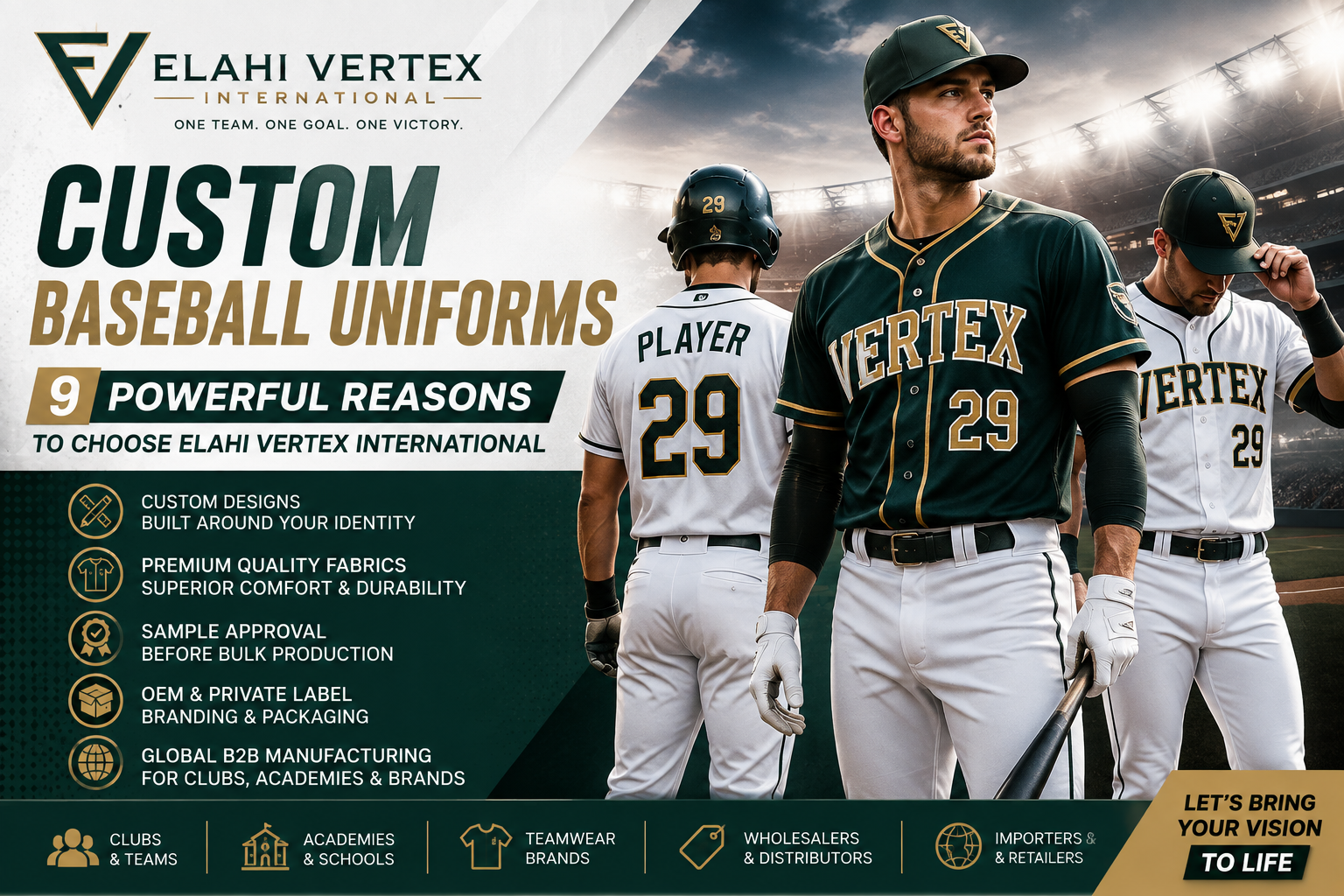
Choosing the right supplier for custom baseball uniforms is more than choosing a jersey design. For baseball clubs, academies, schools, sports organizations, teamwear businesses, wholesalers, and private-label brands, the manufacturing decision can affect the appearance of the team, sizing consistency, customization accuracy, reorder management, branding, and the overall purchasing experience.
Elahi Vertex International works as a custom apparel manufacturing and export partner for startups, established brands, wholesalers, distributors, retailers, clubs, academies, and importers. Its manufacturing scope includes custom sportswear, teamwear, private-label apparel, sampling, customization, quality control, packaging, and international order preparation. (ELAHI VERTEX INTERNATIONAL)
For a newly formed baseball club or academy, ordering custom baseball uniforms can initially feel complicated. You may have a logo and team colors but still need to determine jersey construction, pants, sizing, decoration, player numbers, names, branding, packaging, and how the approved uniform should be reproduced when new players join.
Established teams face different challenges. Their priority may be reproducing an existing design, organizing a larger roster, introducing home and away uniforms, improving product specifications, or establishing a clearer system for future orders.
Sportswear startups and private-label businesses have another objective: turning a baseball uniform concept into a product that represents their own brand.
This is where selecting the right baseball uniform manufacturer becomes important.
Elahi Vertex International approaches custom apparel as made-to-order manufacturing according to buyer designs, specifications, measurements, materials, branding, and production requirements. Its published manufacturing process also includes the possibility of developing samples and prototypes before bulk production so buyers can review relevant product characteristics before approval. (ELAHI VERTEX INTERNATIONAL)
This guide explains nine powerful reasons to consider Elahi Vertex International for custom baseball uniforms, particularly if you are:
- starting a new baseball club;
- developing a new baseball academy;
- organizing a youth baseball program;
- sourcing uniforms for a school;
- replacing uniforms for an established team;
- building home and away baseball kits;
- starting a teamwear business;
- developing a private-label sportswear brand;
- sourcing wholesale baseball uniforms;
- or placing your first custom apparel order.
The objective is not simply to tell buyers to order. It is to explain what should happen between an idea and a properly specified baseball uniform.
Quick Answer: Why Order Custom Baseball Uniforms from Elahi Vertex International?
Elahi Vertex International can be considered by buyers looking for a manufacturing partner for custom baseball uniforms because its apparel manufacturing model supports made-to-order specifications, OEM manufacturing, customization, sampling and prototyping, branding, quality-control processes, packaging, and export-oriented production. (ELAHI VERTEX INTERNATIONAL)
That combination can be particularly relevant for new clubs and academies because they may need more than finished garments. They need to establish a repeatable uniform specification.
A buyer may begin with something as simple as:
“We are opening a baseball academy and need uniforms in our colors.”
That idea then needs to become actionable information:
What jersey style is required?
What type of baseball pants are needed?
Which colors should be used?
Where should the club logo appear?
Will jerseys carry individual player names?
How will player numbers be organized?
Which size range is required?
Does the team need caps, warm-up apparel, or additional teamwear?
Does the buyer already have artwork?
Is a sample needed before the complete order?
Are the uniforms being purchased for a club, school, academy, retailer, distributor, or private-label business?
These questions matter because good custom baseball uniforms begin with specifications—not merely attractive artwork.
For organizations competing under specific rules, uniform design should also be checked against the regulations applicable to that competition. NFHS maintains current baseball rules and resources for U.S. high-school baseball, while the NCAA maintains its own official baseball playing-rules resources for collegiate competition. (nfhs.org)
Check NCAA Baseball Playing Rules
With that foundation established, here are the nine reasons buyers should evaluate Elahi Vertex International when sourcing baseball teamwear.
1. Custom Baseball Uniforms Can Be Developed Around Your Team Instead of a Generic Stock Design
One of the strongest reasons to order custom baseball uniforms is control over the identity of the finished product.
A baseball uniform is highly visible.
The jersey communicates the club or academy identity every time players enter the field. Colors, typography, logos, numbers, trims, pants, and supporting apparel combine to create the team’s visual system.
A generic stock uniform forces the team to work around an existing product.
Custom manufacturing reverses that relationship.
The product can instead be developed around the buyer’s requirements.
Elahi Vertex International states that its made-to-order apparel manufacturing is based on customer designs, specifications, measurements, materials, branding, and production requirements. (ELAHI VERTEX INTERNATIONAL)
That matters whether the buyer already has a finished design or is still organizing the concept.
A New Baseball Club May Start with Only an Idea
Imagine a newly established club.
The organizers know:
the club name;
the primary color;
the secondary color;
the logo;
and perhaps the jersey number style.
They may not know the technical language used by a baseball uniform manufacturer.
That should not prevent them from preparing a professional sourcing brief.
The club can start by organizing the fundamentals:
Team name: What exact wording should appear?
Primary color: What is the dominant jersey color?
Secondary color: What supporting color should be used?
Logo: Is a usable vector or high-resolution file available?
Jersey style: Button-front, partial-button, pullover, or another requested construction?
Pants: What style and color combination is required?
Numbers: Front, back, or both according to the team’s design and competition requirements?
Player names: Required or not?
Sizes: Youth, adult, or mixed?
Quantity: How many players and spare sets?
Once those elements are defined, the request becomes much easier to manufacture.
New Academies Need a Uniform System, Not Just One Order
Baseball academies should think further ahead.
An academy may have multiple age groups and a changing player roster.
That means today’s custom baseball uniforms should ideally establish a system that can support tomorrow’s requirements.
For example:
U10 team;
U12 team;
U14 team;
U16 team;
senior academy team;
coaches;
training staff.
They may share the same visual identity while requiring different sizes or product combinations.
Instead of treating every future purchase as a completely new design project, the academy can establish a master design and specification framework.
That can make future sourcing more organized.
Established Clubs Can Also Use Custom Manufacturing
Customization is not only valuable for new organizations.
An established club may already have a recognizable uniform.
Its objective may be to preserve that identity while improving manufacturing documentation.
The club can provide:
existing garment photographs;
previous artwork;
logos;
color references;
measurements;
size charts;
decoration details;
and any other known specifications.
A baseball uniform manufacturer can then evaluate the information provided and determine what requires confirmation before production.
The goal should not be to redesign a successful club identity unnecessarily.
The goal should be to reproduce the buyer’s intended identity as accurately as the approved manufacturing specification allows.
Customization Should Be Specific
“Make it navy and white” is a starting point.
It is not a complete specification.
Professional custom baseball uniforms require more precise communication.
A buyer should consider:
body color;
sleeve color;
collar construction;
placket details;
piping;
side panels;
number color;
number outline;
team-name placement;
player-name placement;
logo dimensions;
pants color;
pants piping;
waistband construction;
and any requested branding.
The more clearly these elements are documented before production, the less ambiguity remains later.
That is an important principle throughout custom manufacturing:
Do not leave a design decision undefined if it can be approved before bulk production.
2. Elahi Vertex International Can Support New Baseball Clubs and Academies Building Their First Uniform Program
A new club does not necessarily have a procurement department.
A new academy may not have a dedicated apparel developer.
A youth organization may be run by coaches, parents, administrators, or volunteers who understand baseball very well but have never purchased custom baseball uniforms directly from a manufacturer.
Those buyers should not be ignored.
They represent an important part of the custom teamwear market.
Elahi Vertex International’s published positioning specifically includes clubs and academies among the buyer groups it serves. (ELAHI VERTEX INTERNATIONAL)
For a new organization, the first objective should be transforming an informal idea into an organized uniform requirement.
Starting a New Baseball Club?
Suppose you have just created a baseball club in the United States.
You have:
a club name;
a logo;
perhaps 15–25 players;
and a planned season.
You now need custom baseball uniforms.
Before requesting pricing, create a simple roster.
For example:
Player 01 — Jersey #7 — Size M
Player 02 — Jersey #12 — Size L
Player 03 — Jersey #18 — Size M
Player 04 — Jersey #24 — Size XL
Continue until every player is accounted for.
Then identify whether each player requires:
one jersey;
two jerseys;
one pair of pants;
two pairs of pants;
cap;
belt;
socks;
warm-up apparel;
or other requested teamwear.
Now your request has moved from:
“We need baseball uniforms.”
to:
“We need a defined uniform program for a defined roster.”
That is much more useful information for any baseball uniform manufacturer.
Starting a Baseball Academy?
An academy should consider scalability.
Your first intake may include 30 players.
Next year you may have 60.
Later you may establish additional age groups.
This makes documentation especially valuable.
Your academy should retain:
approved logo files;
approved colors;
approved jersey artwork;
approved pants specifications;
approved number font;
approved name font;
size chart;
sample approval information;
and previous roster/order records.
The purpose is continuity.
If a new player joins six months later, you should not need to reconstruct the academy’s visual identity from memory.
This is one reason custom baseball uniforms should be treated as an organized program rather than a one-time purchase.
Youth Baseball Programs Need Appropriate Sizing Decisions
Youth buyers should not automatically assume an adult size chart can simply be scaled downward.
Youth players have different body proportions across age groups.
Before ordering, collect actual sizing information according to the size chart being used for the project.
Avoid guessing sizes solely from age.
Two players of the same age can have significantly different measurements.
Where possible, establish a consistent process for gathering size information from parents or players.
A spreadsheet can contain:
player name;
player number;
age group;
jersey size;
pants size;
player-name spelling;
special notes.
This becomes part of the order-control process.
First-Time Buyers Should Ask Questions
There is nothing wrong with being a first-time buyer.
The dangerous situation is pretending to understand a specification when you do not.
If you do not understand the difference between two fabric options, ask.
If you are uncertain about decoration, ask.
If you do not know how artwork should be supplied, ask.
If you are uncertain about sizing, resolve it before production.
If you need a sample, discuss sampling before bulk manufacturing.
Elahi Vertex International’s manufacturing information specifically describes sample and prototype development as a stage that can allow review of fit, materials, construction, printing, embroidery, branding, and finishing before bulk approval. (ELAHI VERTEX INTERNATIONAL)
That can be particularly valuable for a new club or academy placing its first order.
3. Custom Baseball Jerseys Can Be Built Around Your Design and Branding Requirements
The jersey is usually the visual centerpiece of custom baseball uniforms.
It is the garment spectators notice first.
It carries much of the team’s identity.
That makes jersey development one of the most important discussions to have with an American baseball jersey manufacturer—or, more accurately for international sourcing, a baseball jersey manufacturer capable of producing according to the buyer’s requirements.
A custom jersey project may involve decisions about:
silhouette;
fabric;
collar;
front opening;
sleeves;
panels;
piping;
team name;
club logo;
player number;
player name;
sponsor artwork where permitted;
manufacturer/private-label branding;
and decoration method.
Every one of those elements can influence the finished appearance.
Button-Front Baseball Jerseys
The classic button-front baseball jersey remains an important visual reference for the sport.
If this style is selected, the artwork should be developed around the opening.
A team wordmark crossing the chest needs to account for the placket.
Numbers and logos also need appropriate positioning relative to seams and openings.
Small placement errors can become much more noticeable on a structured baseball jersey.
Pullover Baseball Jerseys
Some programs may prefer pullover constructions.
These can create a cleaner uninterrupted front area for artwork.
Again, however, the construction should be defined before artwork is finalized.
Artwork should follow the garment.
The garment should not be treated as an afterthought once the graphic has already been approved.
Sleeves Matter
Baseball jerseys can use different sleeve constructions and lengths depending on the intended design.
A buyer should define these requirements rather than relying on assumptions.
The same principle applies to:
collars;
cuffs;
piping;
side panels;
and hem construction.
The specification becomes the manufacturing reference.
Team Names and Wordmarks
Typography is a major part of baseball aesthetics.
Many baseball identities use:
script lettering;
arched lettering;
block lettering;
outlined lettering;
or custom wordmarks.
If your club already has an official wordmark, supply the correct artwork.
Do not expect a manufacturer to reconstruct a brand identity accurately from a tiny social-media screenshot.
For professional custom baseball jerseys, provide the best available source files.
Vector artwork is particularly useful where available because it can be scaled without the pixelation associated with low-resolution raster images.
Player Numbers
Numbers are functional as well as visual.
They should remain readable.
A beautiful typeface that becomes difficult to distinguish at game distance may not be a good choice.
The buyer should also verify competition-specific requirements before finalizing the uniform.
For example, NFHS publishes dedicated baseball uniform rules and current baseball rules resources for U.S. high-school competition. Its uniform guidance includes requirements relating to team uniform consistency and back numbers, among other provisions. (nfhs.org)
Therefore, a U.S. school should not rely solely on an attractive mockup.
It should verify its applicable rules before approving production.
Review NFHS Baseball Uniform Resources
College programs should likewise consult the NCAA’s current baseball playing-rules materials rather than assuming another competition’s requirements apply. (NCAA.org)
This illustrates an important distinction:
A baseball jersey manufacturer manufactures the product.
The buyer and relevant organization must also ensure that the approved uniform meets the rules governing its competition.
4. Buyers Can Develop More Than a Jersey: Build a Complete Baseball Uniform Program
Searching for custom baseball jerseys is often how the buying journey begins.
But the actual requirement may be much broader.
A baseball uniform program can involve:
jerseys;
baseball pants;
caps;
belts;
socks;
undershirts;
warm-up tops;
hoodies;
jackets;
training apparel;
coach apparel;
and other teamwear.
The exact scope depends on the organization.
The key is to define that scope before comparing quotations.
Baseball Pants Deserve Serious Attention
Buyers sometimes spend most of their time discussing jersey artwork and treat pants as a secondary item.
That is a mistake.
Pants are a major functional component of custom baseball uniforms.
The specification can include decisions about:
fit;
length;
waist construction;
belt loops;
pockets;
piping;
reinforcement;
fabric;
color;
and other requested construction details.
If your club wants white pants with a specific piping combination, document it.
If the away uniform uses gray pants, document it.
If youth and senior teams require different specifications, separate them.
Do not assume these differences will be understood automatically.
Home and Away Uniforms
A growing baseball club may eventually require multiple uniform combinations.
For example:
Home: white jersey + white pants.
Away: colored or gray jersey + gray pants.
Alternate: club-color jersey + selected pants.
The exact combinations are the buyer’s decision.
What matters operationally is that each version receives its own controlled specification.
Do not call everything “the baseball uniform.”
Name each version clearly.
For example:
BASEBALL-HOME-01
BASEBALL-AWAY-01
BASEBALL-ALT-01
This may seem unnecessary for a small team.
As the organization grows, however, version control becomes increasingly valuable.
Coach and Staff Apparel
New academies should also think beyond players.
Coaches and staff may need coordinated apparel.
The exact garments depend on the program, but maintaining a consistent identity across players and staff can strengthen the academy’s presentation.
This is particularly useful when the organization attends:
tournaments;
training camps;
open days;
tryouts;
community events;
and promotional activities.
Think Like a Program
A club ordering its first 20 sets may think only about this season.
A club planning for five years should think about continuity.
What happens when three new players join?
What happens when a jersey is lost?
What happens when the club creates another age division?
What happens when the academy needs 50 additional custom baseball uniforms?
A documented uniform program makes these situations easier to manage.
5. OEM, ODM and Private Label Baseball Uniforms Create Opportunities for Sportswear Brands
Not every buyer is a baseball club.
Some buyers want to sell baseball apparel.
This creates a different sourcing requirement.
A sportswear startup may be searching for a baseball uniform manufacturer because it wants to create its own teamwear collection.
A distributor may need wholesale baseball uniforms for resale.
A teamwear company may want a manufacturing partner behind its own customer-facing brand.
An e-commerce sportswear business may want private label baseball uniforms.
These buyers require more than team customization.
They need brand-oriented manufacturing.
Elahi Vertex International describes its manufacturing services as including custom manufacturing and OEM apparel production based on buyers’ own designs and specifications. Its broader site positioning also includes private-label businesses, wholesalers, distributors and retailers among its target buyer groups. (ELAHI VERTEX INTERNATIONAL)
What Are Private Label Baseball Uniforms?
In practical sourcing terms, private label baseball uniforms are baseball apparel manufactured for a business to sell or supply under its own brand identity, according to the agreed project specifications.
The buyer’s requirements may include:
brand label;
size label;
care information;
logo;
packaging;
hangtags where required;
custom product artwork;
custom sizing;
and other brand presentation requirements.
Not every project needs every element.
The specification should reflect the buyer’s actual business model.
Startup Sportswear Brands
A startup may have excellent design ideas but limited manufacturing experience.
This is similar to a new baseball academy.
The business understands its customer but may still be learning:
fabric sourcing;
size grading;
artwork preparation;
decoration methods;
sample approval;
quality-control documentation;
packaging;
and import planning.
The solution is not to pretend those decisions do not exist.
The solution is to resolve them systematically.
A startup requesting private label baseball uniforms should begin with a product brief.
That brief can define:
target customer;
product category;
design concept;
fabric requirement;
fit;
size range;
branding;
decoration;
packaging;
target quantity;
and required delivery date.
If information is unknown, mark it as requiring discussion.
That is better than inserting an arbitrary specification simply to make the document appear complete.
Teamwear Companies
Teamwear dealers occupy an interesting position.
Their customer may be the baseball club, but the dealer manages the product.
This makes manufacturing reliability and specification organization especially important.
The dealer needs to translate a club’s request into production information.
For example:
“Blue jersey with Tigers on the front” is the end customer’s idea.
The teamwear company may need to turn that into:
approved blue color reference;
approved Tigers artwork;
jersey construction;
fabric;
decoration method;
number style;
number placement;
player-name specification;
size chart;
pants specification;
roster;
packaging;
and quantities.
This is how professional sourcing adds value.
Wholesale Baseball Uniforms
Buyers sourcing wholesale baseball uniforms should think about repeatability.
If you intend to supply multiple clubs, your product system should be organized.
You may have:
Base Model A;
Base Model B;
Premium Model;
Youth Model;
Custom Sublimated Model;
Traditional Decoration Model.
Each product should have its own controlled specifications.
The more customers you serve, the more important product documentation becomes.
6. Sampling Gives Buyers a Valuable Approval Stage Before Bulk Production
A digital mockup can answer many questions.
It cannot answer every question.
A screen cannot fully communicate:
fabric hand feel;
physical fit;
actual garment proportions;
stitching;
construction;
real decoration texture;
physical color appearance;
or how a finished garment behaves when worn.
This is why sampling can be an important stage when ordering custom baseball uniforms.
Elahi Vertex International states that its OEM process can include samples and prototypes before bulk production, allowing buyers to review fit, materials, construction, printing, embroidery, branding, and finishing before approving production. (ELAHI VERTEX INTERNATIONAL)
That does not mean every sample automatically guarantees the bulk order.
It means the sample provides an approval reference.
The buyer still needs to inspect it properly.
What Should You Check on a Baseball Uniform Sample?
Do not simply open the package, take a photograph, and say:
“Looks good.”
Review it systematically.
1. Overall Appearance
Does the sample look like the approved design?
Compare it directly with the approved artwork.
2. Colors
Are the colors acceptable under normal lighting?
Physical color evaluation is important because displays vary.
3. Logo
Check:
shape;
position;
size;
orientation;
and clarity.
4. Team Wordmark
Confirm spelling.
This sounds obvious.
It is still worth checking.
5. Player Number
Confirm:
number;
font;
size;
placement;
color;
outline;
and readability.
6. Player Name
If names are included, verify spelling carefully.
Never assume roster spelling is correct merely because it was copied from an earlier file.
7. Jersey Construction
Review:
collar;
placket;
buttons where applicable;
sleeves;
panels;
seams;
hem;
and general construction.
8. Fit
Try the sample on the appropriate wearer where practical.
A visually perfect garment that does not fit appropriately has not solved the buyer’s problem.
9. Baseball Pants
Inspect the pants with the same seriousness.
Check:
waist;
length;
fit;
pockets;
piping;
belt loops;
and requested reinforcement/construction.
10. Branding
For private label baseball uniforms, verify the approved branding elements.
11. Packaging
If custom packaging forms part of the project, evaluate the approved packaging specification too.
Document Sample Changes
Suppose the sample needs four changes.
Do not communicate them vaguely across multiple messages.
Create a numbered correction list.
For example:
- Increase back number according to revised artwork.
- Move chest logo according to attached placement reference.
- Change piping to approved color reference.
- Revise pants length according to updated measurement.
Then send the revised file.
This creates a traceable approval process.
Sample Approval Should Be Explicit
When the sample is acceptable, approval should be clear.
The buyer and baseball uniform manufacturer should know which version is approved.
Do not approve one file in email, another in WhatsApp, and a third through a voice message without reconciling them.
One final approval package is far safer.
7. Quality Control Matters When Every Player’s Uniform Is Different
Teamwear has an unusual manufacturing challenge.
A fashion order might contain 100 identical T-shirts in several sizes.
An order for custom baseball uniforms may contain dozens of individually personalized garments.
Player 01 may be:
#4 — Medium — MARTINEZ
Player 02:
#11 — Large — WILLIAMS
Player 03:
#17 — Medium — JACKSON
Player 04:
#23 — XL — THOMPSON
The underlying uniform is the same.
The personalization is different.
This creates more opportunities for data errors.
Elahi Vertex International states that its quality-control process includes checks intended to maintain consistency in areas such as materials, measurements, stitching, construction, printing, finishing, and final product appearance. (ELAHI VERTEX INTERNATIONAL)
For baseball teamwear, the buyer should complement manufacturing QC with strong roster control.
The Roster Is a Production Document
Treat your roster like technical data.
Not like an informal message.
Use one master spreadsheet.
Useful fields can include:
Player ID
Player Name
Jersey Name
Jersey Number
Jersey Size
Pants Size
Quantity
Home Jersey
Away Jersey
Special Instructions
Approval Status
The exact columns depend on the project.
Freeze the Roster
At some point before production, the roster must be finalized.
Constantly changing:
numbers;
names;
sizes;
and quantities
creates risk.
Establish a cutoff point.
After that point, changes should be handled according to what is still technically possible within the production stage.
Check Duplicates
Two players may accidentally receive the same number.
A number may be missing.
A player may appear twice.
A spelling may differ between two files.
These are data problems, not sewing problems.
They should be caught before production.
Compare Finished Goods Against the Master Roster
For personalized custom baseball jerseys, the final roster provides a useful checking reference.
The question becomes:
Did we receive the correct combination of name + number + size?
That is much more precise than simply counting cartons.
Quality Means Consistency with the Approved Specification
“High quality” is too vague to be a useful QC instruction.
A better question is:
Does the product conform to what was approved?
That includes:
fabric;
construction;
measurement;
artwork;
colors;
branding;
personalization;
and finishing,
to the extent defined by the project’s approved specification.
This is why detailed pre-production work is valuable.
You cannot effectively inspect against a specification that was never defined.
8. International B2B Manufacturing Can Support Clubs, Brands, Wholesalers and Distributors
A buyer searching for a baseball uniform manufacturer is no longer restricted to suppliers located in the same city—or even the same country.
International apparel sourcing gives buyers access to manufacturing regions with established textile and garment-production ecosystems.
Elahi Vertex International is based in Sialkot, Pakistan and positions itself as a custom clothing manufacturer and global apparel exporter serving international B2B buyers. (ELAHI VERTEX INTERNATIONAL)
For international buyers, however, sourcing should be approached professionally.
The question is not simply:
“Can you ship to the USA?”
A serious purchasing process should consider:
product specification;
sample approval;
commercial terms;
packaging;
shipping arrangement;
import responsibilities;
required delivery date;
and documentation relevant to the transaction.
USA Baseball Clubs
A U.S. baseball club can source custom baseball uniforms internationally, but it should work backward from the date the uniforms are required.
Do not begin sourcing only when the first game is approaching.
Your timeline may need to accommodate:
design preparation;
specification review;
sample development if required;
sample shipment;
sample review;
revisions if required;
bulk manufacturing;
quality checks;
packing;
international transport;
customs/import processes;
and local delivery.
Exact timing is project-specific and therefore should be confirmed for the actual order.
The important principle is simple:
Start earlier than the date you think you need to start.
Schools
Schools have an additional responsibility.
Their uniforms may need to comply with applicable athletic rules.
NFHS currently maintains official baseball rules and resources for high-school competition, including baseball uniform resources. (nfhs.org)
NFHS’s published uniform guidance addresses matters such as uniform consistency and player-number requirements, while current rules materials should be checked for the season in which the uniforms will be used. (nfhs.org)
Therefore, school buyers should verify the current applicable requirements before final approval.
College Programs
College baseball programs should use the NCAA’s current baseball playing-rules resources for their applicable requirements. The NCAA maintains the official baseball rulebook and associated rules updates and interpretations. (NCAA.org)
Again, this should happen before production.
Changing artwork after production is significantly more difficult than correcting it during approval.
Wholesalers
Wholesalers purchasing wholesale baseball uniforms have a different challenge: they may be sourcing for multiple customers.
They should establish a clear product architecture.
For example:
Standard baseball jersey;
Premium baseball jersey;
Youth baseball uniform;
Custom sublimated baseball set;
Traditional baseball set.
Each should have defined specifications.
This improves quotation consistency and makes future customer orders easier to process.
Distributors
Distributors should also think about packaging and product identification.
If orders are being separated by club, player, team, or retail SKU, the packing specification should reflect that requirement.
Do not wait until the goods are completed to decide how they need to be organized.
Private-Label Buyers
A private-label buyer should define exactly where its brand needs to appear.
Possible locations can include:
neck labels;
size labels;
care labels;
hangtags;
packaging;
and garment branding.
The exact solution depends on the product and buyer requirements.
The purpose is to make the finished private label baseball uniforms consistent with the brand’s intended presentation.
9. Elahi Vertex International Provides a Path from Initial Idea to Custom Manufacturing Inquiry
The final reason is practical.
Many buyers do not begin with a complete tech pack.
They begin with an idea.
A club may have a photograph.
An academy may have a logo.
A startup may have a sketch.
A teamwear dealer may have artwork from its customer.
A wholesaler may have an existing sample.
A private-label brand may have a complete specification.
These buyers are at different stages.
Elahi Vertex International’s current inquiry system allows prospective buyers to provide product information, quantities, customization requirements and design/specification files. Its manufacturing pages also describe a workflow extending from design and fabric sourcing through sampling, customization, bulk production, quality control, packaging and international shipment preparation. (ELAHI VERTEX INTERNATIONAL)
That creates a logical starting point for a custom baseball uniforms project.
If You Only Have an Idea
Start with:
club name;
country;
type of buyer;
product needed;
approximate quantity;
team colors;
logo;
required date;
and reference image if available.
Then identify the unresolved specifications.
If You Have Artwork
Send:
front design;
back design;
pants design;
logos;
number style;
name style;
colors;
and other relevant artwork.
If You Have an Existing Uniform
Provide clear photographs and known specifications.
If particular measurements or construction details must be reproduced, document them.
Do not assume photographs communicate dimensions accurately.
If You Have a Tech Pack
Even better.
Provide the relevant technical information for quotation and feasibility review.
If You Are a New Club
Do not wait until everything is perfect before beginning the conversation.
Prepare what you know.
Mark what you do not know.
Then discuss the missing specifications.
That is more productive than guessing.
If You Are a Teamwear Startup
Think about the project as a product line.
You are not merely buying custom baseball jerseys.
You may be establishing a product you intend to sell repeatedly.
Therefore, invest more attention in:
fit;
construction;
size grading;
branding;
packaging;
artwork control;
and repeat-order documentation.
If You Are a Wholesaler
Provide expected quantities and the intended product structure.
If you require wholesale baseball uniforms for several customer categories, explain the use case.
That helps separate essential specifications from optional customization.
How Elahi Vertex International Can Help a New Baseball Club Build Its First Uniform Program
This deserves its own section because new clubs are frequently underserved by generic manufacturer content.
Imagine you are starting Northside Baseball Club.
The name is fictional, but the sourcing process is realistic.
You have 18 players.
You have a logo.
Your colors are navy, white and red.
You need custom baseball uniforms.
Where should you begin?
Step 1: Define the Team Identity
Collect:
official club name;
logo;
primary color;
secondary color;
optional accent color;
preferred typography;
sponsor artwork if relevant and permitted.
Keep the source files organized.
Step 2: Define the Uniform
Decide whether you require:
home jersey;
away jersey;
alternate jersey;
baseball pants;
cap;
belt;
socks;
warm-up;
coach apparel.
Do not request a quotation for “full baseball kit” without defining what “full” means.
Different buyers use that phrase differently.
Step 3: Build the Roster
List every player.
Assign:
name;
number;
jersey size;
pants size;
quantity.
Double-check everything.
Step 4: Define the Design Direction
You can provide:
your own artwork;
reference designs;
a previous uniform;
or a design concept requiring further development.
Avoid copying protected third-party team branding.
Your club should develop its own identity.
Step 5: Review Applicable Rules
If you are a U.S. high-school program, review current NFHS requirements.
NFHS Baseball Rules and Resources
If you are sourcing for collegiate competition, consult the applicable NCAA materials.
Other leagues and associations may have their own requirements.
Step 6: Prepare the RFQ
A useful RFQ for custom baseball uniforms could contain:
Organization: Northside Baseball Club
Country: USA
Product: Custom baseball jersey + pants
Players: 18
Additional spare sets: REQUIRES CONFIRMATION
Design: Buyer artwork/reference attached
Personalization: Player numbers + names
Sizes: Attached roster
Sample required: Yes/No
Required delivery date: [date]
Additional requirements: [details]
This gives the baseball uniform manufacturer a far clearer starting point.
Step 7: Review the Quotation
Do not compare price alone.
Check what each quotation includes.
One supplier may quote jersey only.
Another may quote jersey + pants.
One may include personalization.
Another may list it separately.
One may quote basic packaging.
Another may quote custom branded packaging.
A lower number is not automatically a lower total cost if the scope is different.
Step 8: Develop and Review the Sample
Where sampling forms part of the agreed project, use it properly.
Inspect the sample.
Record corrections.
Approve the final version clearly.
Step 9: Confirm the Bulk Order Data
Before bulk production, verify:
quantities;
sizes;
names;
numbers;
design version;
colors;
branding;
pants;
packaging;
shipping information;
and required date.
Then maintain a copy of the approved information.
That becomes the club’s uniform record.
How Elahi Vertex International Can Help a New Baseball Academy
An academy has different needs from a single team.
It may operate continuously throughout the year.
Players join.
Players leave.
Age groups expand.
Coaches change.
New training programs are introduced.
Therefore, custom baseball uniforms for academies should be designed with continuity in mind.
Create One Master Academy Identity
Instead of creating unrelated uniforms for every age group, determine whether a common visual system is appropriate.
For example:
same logo;
same primary colors;
same typography;
same general jersey architecture;
age-group variation where required.
This can create stronger academy recognition.
Separate Rosters by Team
Do not place 100 players into an uncontrolled document.
Create organized groups.
For example:
U10
U12
U14
U16
U18
Development Squad
Senior Squad
Coaches
Each roster can then be checked independently.
Maintain an Approved Size Chart
Sizing becomes increasingly important as an academy grows.
Use the approved project size chart consistently.
Do not allow each coach to interpret S, M and L differently.
Maintain the Artwork Files
Store the approved files somewhere accessible to authorized staff.
If the person who originally ordered the custom baseball uniforms leaves the academy, the uniform system should not disappear with them.
Plan Reorders
Ask:
How frequently do new players join?
How often do players change numbers?
Will the uniform design remain stable for multiple seasons?
Will there be annual design changes?
The answers influence how the academy should organize procurement.
Consider Coaches and Training Apparel
An academy’s visual identity extends beyond match uniforms.
Depending on the program, coordinated teamwear may also be useful for:
coaches;
trainers;
staff;
travel;
training;
events;
and promotional activities.
Elahi Vertex International’s wider manufacturing offering includes sportswear and teamwear beyond a single uniform category, which may be relevant where a buyer wants to discuss a broader custom apparel program. (ELAHI VERTEX INTERNATIONAL)
How Startup Teamwear Brands Can Develop Private Label Baseball Uniforms
Now consider a completely different buyer.
You are not operating a baseball team.
You want to sell uniforms to baseball teams.
Your objective is private label baseball uniforms.
This changes the project.
Your customers may never know who manufactured the garments.
They know your brand.
Therefore, your product must represent your business.
Define Your Market Position
Are you targeting:
youth baseball?
schools?
amateur clubs?
premium travel teams?
teamwear dealers?
general sporting-goods retailers?
Your target customer influences the product.
Build a Base Product
Rather than creating every order from zero, a growing teamwear company can establish base models.
For example:
Model B01 — Classic Baseball Jersey
Model B02 — Sublimated Baseball Jersey
Model B03 — Premium Baseball Uniform
Model B04 — Youth Baseball Set
The model names are examples only.
Each base model can have a controlled specification.
Then customer customization can be layered onto that foundation.
Establish Branding
Your private label baseball uniforms may require brand elements such as:
neck labels;
size labels;
care labels;
hangtags;
packaging;
or selected garment branding.
Confirm each requirement as part of the project.
Create Customer Artwork Procedures
If you sell custom teamwear, your customers will send logos of wildly different quality.
One customer sends an AI file.
Another sends PNG.
Another sends a screenshot.
Another sends a photograph of an old jersey.
Your business needs a procedure for converting these inputs into production-ready artwork.
This is part of scaling.
Build an Approval Process
Do not send a customer’s order directly to production based on an informal conversation.
Create an approval stage.
The customer should confirm:
design;
spelling;
numbers;
names;
colors;
sizes;
and quantities.
Then your manufacturing order should reflect that approved information.
Protect Your Reputation Through Specifications
Your customer does not care that a manufacturing error happened somewhere else in the supply chain.
They bought from your brand.
Therefore, the stronger your sourcing controls, the stronger your business can become.
A capable baseball uniform manufacturer should be evaluated not merely as a vendor but as part of your operational supply chain.
Custom Baseball Jerseys: What Buyers Should Specify Before Requesting Production
Let’s go deeper into the actual product.
When requesting custom baseball jerseys, create a specification checklist.
Jersey Style
Specify the requested silhouette.
Examples may include:
full-button;
partial-button;
pullover;
or another buyer-defined style.
Fabric
Do not choose fabric based only on a photograph.
Discuss intended use and required characteristics.
Relevant considerations can include:
weight;
stretch;
breathability;
surface appearance;
durability expectations;
decoration compatibility;
and feel.
The final fabric specification is project-dependent.
Collar
Define the construction.
Sleeves
Define:
length;
construction;
color;
trim;
and artwork where applicable.
Front Artwork
Specify:
team name;
logo;
player number if used;
and any permitted additional branding.
Back Artwork
Specify:
player number;
player name if required;
and any permitted additional elements.
Number Font
Provide the exact approved style.
Do not describe it simply as “baseball font.”
That can mean many different things.
Colors
Provide accurate references wherever possible.
Do not rely solely on:
“royal blue”
“dark red”
“bright green”
because descriptive color names can be interpreted differently.
Decoration
The selected decoration method should align with the desired design and garment construction.
The project may involve techniques such as sublimation, embroidery, appliqué/twill-style decoration, transfers, or other methods depending on the specification.
Not every technique is appropriate for every artwork or fabric.
Discuss the intended outcome before approval.
Sublimated Custom Baseball Uniforms
Sublimation is particularly relevant to modern custom teamwear because it can integrate complex graphics into suitable polyester-based garment systems.
For buyers considering sublimated custom baseball uniforms, design freedom can be significant.
Possible design elements include:
gradients;
patterns;
geometric graphics;
integrated numbers;
team names;
sponsor graphics where appropriate;
and complex color combinations.
But sublimation should not be treated as magic.
The finished product still depends on:
fabric;
pattern;
cutting;
sewing;
artwork preparation;
color management;
construction;
and quality control.
A poor garment does not become excellent simply because it is sublimated.
Sublimation and Design Complexity
One advantage of sublimation is the ability to incorporate visual complexity without stacking numerous physical decoration layers.
That can be valuable for modern baseball teams wanting a highly customized appearance.
Color Expectations
Digital screens are not identical to physical textile output.
Therefore, buyers with strict brand-color requirements should discuss color references and physical approval expectations before bulk production.
Artwork Resolution
High-quality source artwork matters.
Logos should be supplied in appropriate formats where possible.
Low-resolution artwork can create unnecessary problems.
Repeat Orders
Maintain the approved artwork.
When reordering custom baseball uniforms, reference the exact approved design version.
Do not simply say:
“Same as last time.”
Include the order reference or approved specification wherever possible.
Traditional Decoration for Custom Baseball Jerseys
Baseball also has a strong traditional visual language.
Some teams prefer physical decoration techniques for:
team names;
logos;
numbers;
and selected details.
The exact technique should be chosen based on the intended appearance, garment, artwork, budget, and other project requirements.
Embroidery
Embroidery may be suitable for selected logos and branding applications depending on the garment and design.
It provides a physical stitched appearance.
However, large embroidered areas can affect weight and hand feel, so placement and size should be considered.
Appliqué and Twill-Style Decoration
Layered lettering and numbers are closely associated with traditional baseball aesthetics.
Where this appearance is desired, buyers should define:
material;
layers;
outline;
stitching;
size;
and placement.
Mixed Decoration
A baseball jersey manufacturer may sometimes work with designs involving more than one decoration technique.
Again, feasibility depends on the project.
The correct question is not:
“What is the best printing?”
The correct question is:
“What decoration method best achieves this approved design on this garment for this use case?”
That produces a more useful manufacturing discussion.
Baseball Pants: The Other Half of Custom Baseball Uniforms
Jerseys receive most of the attention online.
Players still need pants.
A complete custom baseball uniforms program should therefore specify baseball pants with equal care.
Fit
Determine the intended fit.
Avoid vague language where measurements can be provided.
Length
The desired style influences the visual presentation.
Define it.
Waist
Specify relevant waistband and belt-loop requirements.
Pockets
Determine the required pocket configuration.
Piping
If piping is part of the team identity, define:
color;
position;
and width/specification as applicable.
Reinforcement
If reinforced areas are required, include them in the technical request rather than assuming they are standard.
Fabric
Pants and jerseys perform different functions.
Do not automatically assume they should use the same fabric.
Color
White and gray are common baseball references, but the buyer’s actual design governs the project.
Again, competition requirements should be checked where relevant.
Why Custom Baseball Uniform Sizing Needs Buyer Attention
Sizing is one of the most consequential parts of teamwear procurement.
A beautiful uniform in the wrong size is still the wrong product.
When sourcing custom baseball uniforms, do not submit a roster containing only player names and numbers.
Include sizes.
And ensure those sizes correspond to the correct size chart.
Do Not Assume All Manufacturers Use Identical Sizes
A Medium from one apparel supplier is not automatically identical to a Medium from another.
Compare measurements.
Measure Properly
Where measurement guidance is provided for the project, follow it consistently.
Youth and Adult Sizes
Do not mix youth and adult sizing labels without clearly identifying them.
“L” could mean Youth Large or Adult Large.
That difference matters.
Use explicit notation:
YL
Adult L
or another agreed system.
Jersey and Pants Sizes May Differ
A player who needs a Large jersey may not necessarily need Large pants.
Record each separately.
Sample Sizing
If fit is particularly important, sampling can help evaluate the proposed specification before bulk manufacturing.
How to Prepare a Professional RFQ for Custom Baseball Uniforms
A good RFQ can dramatically improve supplier communication.
Instead of sending:
“Hi price baseball jersey?”
send structured information.
Buyer Information
Company/Club:
Country:
Contact:
Buyer Type:
Product
Custom baseball jersey
Custom baseball pants
Complete baseball uniform
Private-label baseball uniform
Wholesale baseball uniforms
Other:
Quantity
State the expected quantity.
Design
Attach artwork or references.
Fabric
Specify if known.
If not known, request discussion based on the intended product.
Decoration
Specify if known.
Branding
State whether you need:
club branding;
private labels;
care labels;
hangtags;
packaging;
or other elements.
Personalization
Player names:
Player numbers:
Roster attached:
Size Range
Provide the required size information.
Sample
State whether sampling is required.
Delivery Requirement
Provide the required delivery date and destination.
Do not ask the manufacturer to guess.
Additional Requirements
Include anything unusual.
This makes it much easier for a baseball uniform manufacturer to understand what is actually being quoted.
Comparing Baseball Uniform Manufacturers: Do Not Compare Price Alone
Suppose you request quotations from three manufacturers.
Supplier A: $X
Supplier B: $Y
Supplier C: $Z
The cheapest number is meaningless unless the specifications are comparable.
Ask:
Are they quoting the same fabric?
Same jersey construction?
Same pants?
Same decoration?
Same personalization?
Same branding?
Same packaging?
Same quantity?
Same sample scope?
Same shipping basis?
If not, you are not comparing equivalent offers.
Evaluate Communication
Does the supplier identify missing information?
That can actually be a positive sign.
If you request custom baseball uniforms but provide no fabric, sizes, quantity, artwork, or delivery destination, an immediate final quotation may rest on assumptions.
Questions can reduce assumptions.
Evaluate Sampling
Can the agreed project include sample development where required?
Elahi Vertex International describes sampling/prototyping within its manufacturing workflow. (ELAHI VERTEX INTERNATIONAL)
Evaluate Customization
Can the supplier manufacture according to your actual specification?
Evaluate Branding
For private label baseball uniforms, can the agreed branding requirements be incorporated?
Evaluate Quality-Control Process
How will the approved specifications be checked?
Evaluate Reorder Organization
Can you preserve your approved files and order records to make future purchasing easier?
Price matters.
But it belongs inside a broader procurement decision.
Why New Clubs Should Avoid Ordering Too Late
One of the easiest purchasing mistakes is waiting until the season is about to begin.
Custom manufacturing has stages.
Your project may involve:
design;
quotation;
specification confirmation;
sample development;
sample shipping;
sample review;
correction;
bulk production;
inspection;
packaging;
international shipping;
customs;
and final delivery.
Not every order follows exactly the same sequence, and exact timing requires confirmation for the individual project.
Still, the lesson is straightforward.
If you need custom baseball uniforms for a fixed season-opening date, start sourcing early.
Work Backward
Required date: Day X
Before Day X:
allow for final delivery.
Before that:
allow for shipping/import processes.
Before that:
allow for production and QC.
Before that:
allow for sample approval where applicable.
Before that:
allow for artwork and specification development.
This creates a procurement timeline.
Add Contingency
Things can change.
Artwork can require revision.
A sample may need correction.
A roster may change.
Logistics can encounter delays.
A realistic plan leaves room for uncertainty rather than depending on every stage happening at the theoretical minimum.
Why Established Baseball Clubs Can Benefit from Better Uniform Documentation
Established teams may already have a uniform supplier.
Why consider another baseball uniform manufacturer?
Not because changing suppliers is automatically better.
It isn’t.
But clubs may evaluate alternatives when:
their specifications are poorly documented;
they need different customization;
they are expanding;
they require private-label options;
they are experiencing consistency issues;
they need additional product categories;
or they simply want to compare manufacturing options.
If your existing supplier performs well, preserve what works.
If you evaluate Elahi Vertex International, provide a complete reference package.
Existing Garment
Photograph it carefully.
Measurements
Document important measurements.
Artwork
Provide original artwork where available.
Colors
Provide references.
Decoration
Identify the technique or desired appearance.
Construction
Record details that must remain consistent.
Roster
Provide the new order roster independently.
Do not assume old personalization should carry over.
This gives the prospective baseball jersey manufacturer a stronger basis for evaluation.
Why Wholesalers Should Build Repeatable Baseball Uniform Products
A wholesaler does not want to reinvent the product every time an inquiry arrives.
That is why wholesale baseball uniforms benefit from standardization.
This does not mean eliminating customization.
It means creating a controlled foundation.
For example:
Wholesale Baseball Model 1
Defined jersey pattern
Defined fabric
Defined pants construction
Custom colors
Custom logo
Custom numbers
Custom names
Wholesale Baseball Model 2
Different defined construction
Alternative decoration
Custom branding
Custom colors
The buyer can then customize within a controlled framework.
This can simplify:
quotations;
sales;
sampling;
production;
training;
and reorders.
Maintain SKU or Model References
If your business grows, assign internal references.
That makes communication easier than repeatedly describing products in paragraphs.
Maintain Costing Assumptions
Your retail/wholesale pricing depends on what the manufacturing quotation actually includes.
Track:
garment;
decoration;
personalization;
branding;
packaging;
freight;
duties/taxes where applicable;
and other relevant costs.
Do not base your selling price solely on the factory garment price.
Why Private Label Baseball Uniforms Need Strong Brand Control
A private-label business has two customers.
The immediate customer purchasing the product.
And the long-term customer who remembers the brand.
That makes consistency important.
Your private label baseball uniforms should reflect the brand system you are trying to build.
Labels
Ensure approved labels use the correct:
logo;
spelling;
size;
and required information.
Packaging
If branded packaging is required, define it.
Hangtags
Where applicable, confirm artwork and information.
Product Photography
Plan product photography after production.
A strong product deserves strong presentation.
Reorder Consistency
Store:
approved artwork;
label files;
packaging files;
size charts;
color references;
and product specifications.
Your brand becomes easier to scale when knowledge is stored in systems instead of people’s memories.
Custom Baseball Uniforms for Schools: Rules Should Be Checked Before Production
School buyers deserve particular attention.
The visual design cannot be separated from competition requirements.
NFHS’s baseball resources include dedicated uniform guidance and current rules materials. (nfhs.org)
For example, NFHS’s published baseball uniform rules address uniform consistency and require a contrasting plain back number meeting specified criteria. (nfhs.org)
The current NFHS baseball rules page should be consulted for the applicable season because rules can change. NFHS has already published 2027 baseball rules changes, illustrating exactly why buyers should check current materials rather than relying indefinitely on an old uniform reference. (nfhs.org)
This is especially important when ordering uniforms intended to remain in use for multiple seasons.
The baseball uniform manufacturer should receive artwork that has already been reviewed for the buyer’s intended competition.
Do this before production.
Not afterward.
Custom Baseball Uniforms for College Programs
College baseball has its own regulatory framework.
The NCAA maintains official baseball playing rules, rulebooks, interpretations, major rule changes, and other baseball-specific resources. (NCAA.org)
NCAA Baseball Playing Rules and Updates
College buyers should therefore ensure their approved custom baseball uniforms align with the requirements applicable to their program.
The same sourcing principle applies:
Compliance review should be part of pre-production approval.
It is much easier to adjust artwork before garments exist.
Home, Away and Alternate Custom Baseball Uniforms
One uniform may be enough for some organizations.
Others want a full system.
A well-planned system can include:
home;
away;
alternate;
special-event;
training.
The exact requirement is buyer-specific.
Keep the Identity Consistent
Different jerseys do not need to look unrelated.
Maintain common elements such as:
logo;
number typography;
brand colors;
piping language;
or other identity components.
Give Each Design a Version Number
Example:
HOME-V1
AWAY-V1
ALT-V1
When changes occur:
HOME-V2
This simple habit reduces confusion.
Maintain Separate Roster Requirements
If every player receives home and away custom baseball jerseys, confirm that the personalization is consistent across both.
Automation and spreadsheets can help, but the source data must still be correct.
The Importance of Artwork Approval
Artwork approval is not a decorative administrative step.
It is a production-control step.
Before approving artwork for custom baseball uniforms, verify:
team name;
logo;
colors;
number;
player-name format;
sponsor information;
brand marks;
placement;
garment view;
pants artwork;
and relevant decoration details.
Zoom in.
Check spelling.
Ask another person to review it.
People often see what they expect to see.
A second reviewer may catch something the first person misses.
The Importance of Communication with a Baseball Uniform Manufacturer
Strong sourcing depends on communication.
That does not mean sending more messages.
It means sending clearer information.
A 50-message conversation can still be ambiguous.
A single organized specification document can be clearer.
Use Written Confirmation
Important changes should be documented.
Reference Versions
Say:
“Approve Artwork V4.”
Not:
“Use the one I sent yesterday.”
Consolidate Feedback
Instead of:
Message 1: Make number bigger.
Message 2: Actually logo smaller.
Message 3: Change red.
Message 4: Pants okay.
send:
Revision Request V3
- Increase back number.
- Reduce chest logo.
- Replace red with approved reference.
- Pants approved with no changes.
This is easier for both buyer and manufacturer.
Preparing for Repeat Orders
The first order is only part of the opportunity.
A successful baseball program needs continuity.
When you receive your custom baseball uniforms, archive:
invoice/order reference;
approved artwork;
size chart;
roster;
product photographs;
labels;
packaging;
color references;
and any final changes.
Then, when you need a reorder, provide the reference.
Reorders Still Need New Data
Do not assume everything remains identical.
Confirm:
new quantity;
new roster;
new sizes;
new names;
new numbers;
delivery destination;
required date;
and whether any design changes are required.
This protects both parties from assumptions.
Frequently Asked Questions About Custom Baseball Uniforms
1. Can a New Baseball Club Order Custom Baseball Uniforms?
A new club can approach Elahi Vertex International with its available requirements, such as its logo, team colors, product type, quantity target, design references, sizes, personalization requirements and required date. EVI’s published manufacturing positioning explicitly includes clubs and academies among its target customers. (ELAHI VERTEX INTERNATIONAL)
The club does not necessarily need to understand every manufacturing term before beginning an inquiry.
However, unresolved specifications should be discussed and confirmed before production.
2. Can Baseball Academies Develop Uniforms for Multiple Age Groups?
Yes, an academy can structure a custom teamwear project around multiple squads or age groups, subject to project requirements and manufacturing confirmation.
For organizational purposes, each squad should have a controlled roster with:
player name;
number;
jersey size;
pants size;
quantity;
and relevant personalization information.
Using one consistent academy identity can also make future custom baseball uniforms easier to organize.
3. Can I Order Private Label Baseball Uniforms for My Brand?
Elahi Vertex International positions its manufacturing services toward private-label businesses and produces apparel according to buyer designs, specifications and branding requirements. (ELAHI VERTEX INTERNATIONAL)
For private label baseball uniforms, provide the required product specification and branding details. Exact feasibility, materials, decoration, labels, packaging, quantity, pricing and production details should be confirmed for the individual project.
4. Can I Send My Own Baseball Jersey Design?
EVI’s current inquiry system accepts design/specification uploads, and its manufacturing service is structured around buyer designs and requirements. (ELAHI VERTEX INTERNATIONAL)
Provide the strongest artwork available.
Where possible, supply high-resolution or vector files rather than low-quality screenshots.
5. Can I Send a Reference Image Instead of Finished Artwork?
A reference image can help communicate the intended direction.
However, it may not contain enough technical information for production.
Additional decisions can still be required regarding:
fabric;
construction;
colors;
measurements;
decoration;
branding;
and sizing.
Also avoid requesting unauthorized reproduction of third-party trademarks or protected team identities.
6. Can I Get a Sample Before a Bulk Order?
Elahi Vertex International’s published manufacturing process states that samples and prototypes can be developed before bulk production to review characteristics including fit, materials, construction, printing, embroidery, branding, and finishing. Exact sample terms for a particular custom baseball uniforms project require confirmation. (ELAHI VERTEX INTERNATIONAL)
7. Can Baseball Jerseys Include Player Names and Numbers?
Personalization can form part of the custom design specification, subject to project confirmation.
Provide one final controlled roster and verify every spelling, number and size before production.
Schools, colleges and other regulated competitions should also verify the relevant current uniform rules before approving artwork.
8. Does EVI Manufacture Wholesale Baseball Uniforms?
EVI positions itself as a custom apparel manufacturer serving wholesalers and distributors as well as clubs, academies, brands and other B2B buyers. (ELAHI VERTEX INTERNATIONAL)
A buyer seeking wholesale baseball uniforms should provide the required product specification, quantity, customization, destination and other commercial requirements for quotation.
9. How Do I Start a Custom Baseball Uniform Order?
Prepare:
your organization/company name;
country;
product;
quantity;
design/reference;
logo;
team colors;
sizes;
player personalization;
branding requirements;
delivery destination;
required date;
and other specifications.
Then send the project as an RFQ.
Elahi Vertex International’s website provides a custom inquiry process for design uploads and manufacturing requirements. (ELAHI VERTEX INTERNATIONAL)
Start an EVI Custom Manufacturing Inquiry
Why Elahi Vertex International Can Be Considered for Your Next Baseball Uniform Project
A strong baseball uniform manufacturer should not be evaluated only by the appearance of a digital mockup.
The complete purchasing process matters.
For buyers considering Elahi Vertex International, the relevant capabilities described by EVI include made-to-order apparel manufacturing, OEM manufacturing, sample/prototype development, customization, quality control, packaging, and international order preparation. (ELAHI VERTEX INTERNATIONAL)
For new baseball clubs, that provides a route from an early concept toward an organized manufacturing specification.
For new baseball academies, it provides an opportunity to establish a repeatable uniform identity across growing squads.
For schools, it enables buyer-defined custom teamwear while leaving the organization responsible for checking the applicable competition rules before approval.
For established clubs, it provides another manufacturing option when evaluating customized teamwear or reorganizing existing specifications.
For startup teamwear brands, the OEM/private-label model can support the development of branded baseball products according to the agreed requirements.
For wholesalers and distributors, wholesale baseball uniforms can be approached as repeatable B2B products rather than isolated one-time garments.
And for private-label businesses, the product can be developed around the brand’s own specifications and presentation requirements.
The common principle across all of these buyer types is customization backed by organized specifications.
Final Baseball Uniform Buyer Checklist
Before requesting your quotation, confirm that you have addressed the following:
Buyer: Who is purchasing?
Club, academy, school, brand, wholesaler, distributor, retailer, or another organization?
Product: What exactly do you need?
Jersey only?
Jersey and pants?
Complete baseball teamwear program?
Quantity: How many units?
Design: Is artwork available?
Logo: Is the correct file available?
Colors: Are the required colors defined?
Jersey: Is the construction defined?
Pants: Is the construction defined?
Decoration: What appearance or technique is required?
Personalization: Names and numbers?
Roster: Is the final roster organized?
Sizes: Are jersey and pants sizes separately confirmed?
Branding: Are private-label requirements involved?
Sample: Is sample development required?
Packaging: Are there special packaging requirements?
Rules: Has the buyer checked the rules governing the intended competition?
Required Date: When must the goods arrive?
Destination: Where will the order be delivered?
Approval: Who has authority to approve the final specification?
If several answers are unknown, that does not mean the project cannot begin.
It means those items need to be resolved during development rather than guessed.
Ready to Develop Custom Baseball Uniforms for Your Club, Academy or Brand?
Whether you are starting a new baseball club, building a baseball academy, organizing a youth program, sourcing for a school, refreshing an established team’s uniforms, launching a teamwear company, developing private label baseball uniforms, or purchasing wholesale baseball uniforms, the first step is to turn your idea into a clear manufacturing request.
Elahi Vertex International works with custom apparel requirements covering buyer-defined designs, specifications, branding, sampling, manufacturing, quality-control processes and packaging. (ELAHI VERTEX INTERNATIONAL)
You can begin with a complete tech pack—or with the information you currently have.
Send your:
baseball uniform design or reference, logo, team colors, quantity, sizes, player names and numbers, branding requirements, destination, and required delivery date.
Unconfirmed project details can then be identified before production rather than assumed.
If you are building a new club or academy, think beyond the first order. Establish an approved uniform system that can support new players, new squads and future reorders.
If you are building a sportswear business, treat your private label baseball uniforms as products: define the specification, branding, sizing and repeat-order information carefully.
If you are a wholesaler or distributor, structure your wholesale baseball uniforms around controlled models that can be customized efficiently for different customers.
And if you already know exactly what you need, send the specification for manufacturing review and quotation.
Request a Custom Baseball Uniform Quote from Elahi Vertex International
The objective is simple: build custom baseball uniforms around the identity, specifications and purchasing requirements of your organization—not force your organization around a generic uniform.
