

When you choose a clothing manufacturer, you are not simply choosing someone to stitch garments. You are choosing the people who will translate your idea, artwork, specifications, brand identity, performance requirements and expectations into a physical product.
That is why understanding how Elahi Vertex International works matters before you place an order.
Elahi Vertex International was built around a straightforward manufacturing philosophy: an international customer should be able to work with a manufacturer in Pakistan while feeling that the manufacturing operation is an extension of their own business.
The objective is not simply to receive an order, manufacture it and ship it.
The objective is to understand what the customer wants to create, convert those requirements into workable production specifications, develop and approve the product, assign focused production resources, manufacture efficiently, maintain quality controls, provide production visibility and support the customer beyond a single shipment.
This philosophy comes directly from the vision of Mudabbir Ali Zafar, Founder & CEO of Elahi Vertex International.
Before establishing Elahi Vertex International in 2019, Mudabbir Ali Zafar observed clothing, sportswear and emerging brands trying to grow through Instagram and other online channels while repeatedly facing manufacturing problems.
A brand might have a strong idea but no technical manufacturing knowledge.
Another might have artwork but no tech pack.
Another might struggle with minimum quantities.
Another might receive slow replies after making payment.
Another might approve one sample but worry about what would actually arrive in bulk.
Another might have difficulty coordinating printing, embroidery, labels, packaging and garment production between different suppliers.
And an international customer thousands of kilometres away from the manufacturing floor could have an even more fundamental concern:
What is actually happening with my order?
Elahi Vertex International was developed around solving these types of problems.
The broader founder vision is to contribute to making Pakistan recognized as a serious global manufacturing destination, while building Elahi Vertex International into the kind of manufacturing company that worldwide brands and companies can regard as their own factory in Pakistan.
That phrase—your own factory in Pakistan—has an operational meaning.
It means your specifications matter.
Your designs remain commercially important.
Your deadlines matter.
Your approved sample matters.
Your branding matters.
Your confidentiality matters.
Your production progress matters.
And when an order enters production, Elahi Vertex International can assign a dedicated production team to the project to support focused and faster manufacturing.
This complete guide explains how Elahi Vertex International works, from the first idea to the finished product and beyond.
Quick Answer: How Does Elahi Vertex International Work?
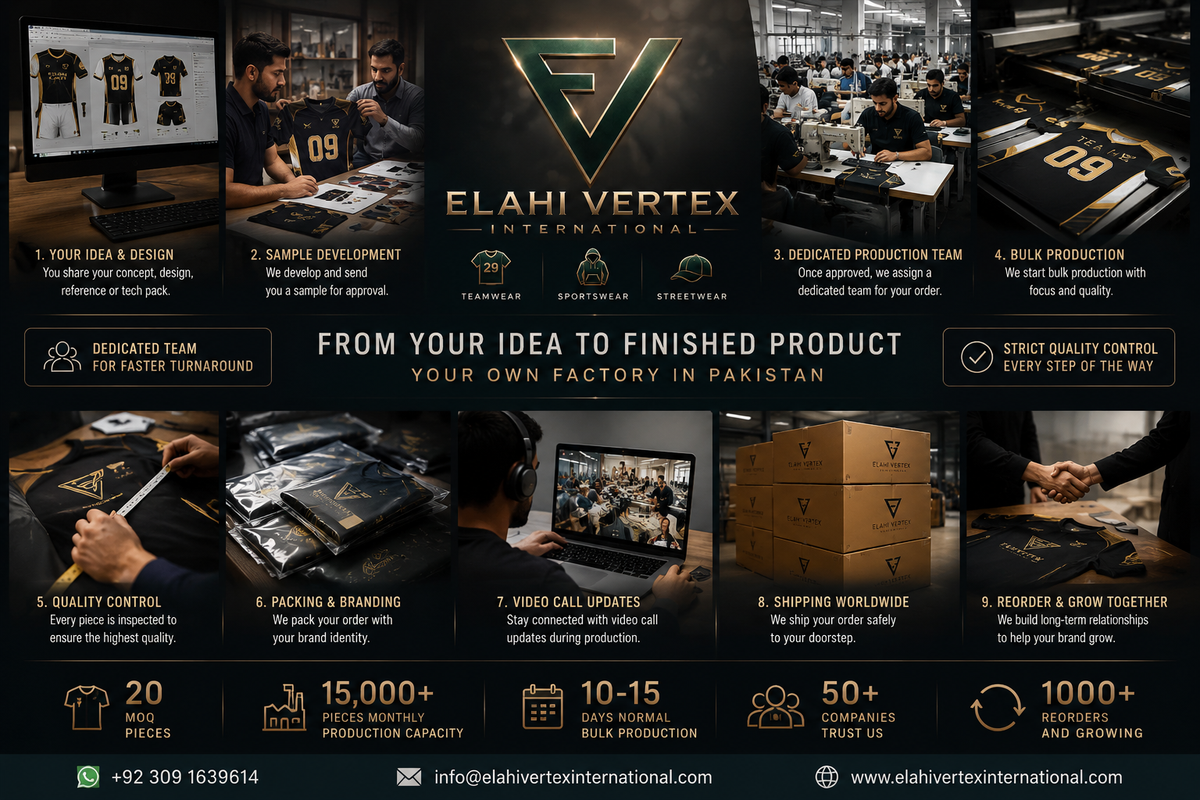
Elahi Vertex International follows a structured custom manufacturing process that can take a customer from an initial concept, reference image, artwork or tech pack through product development, sampling, approval, bulk manufacturing, quality control, packaging and international shipping.
The process can be summarized in nine stages:
- Share your idea and requirements.
- Develop the product specifications.
- Select fabrics, materials and customization.
- Develop and evaluate the sample.
- Approve or revise the product.
- Confirm the order and assign a dedicated production team.
- Manufacture the bulk order.
- Complete quality control and pre-shipment verification.
- Package, ship and support repeat production.
Elahi Vertex International works across custom manufacturing, OEM, ODM and private-label requirements, with a standard MOQ of 20 pieces.
Company-provided production capacity is 15,000+ pieces per month across its manufacturing operations.
Normal bulk production is generally targeted at approximately 10–15 days, depending on the product, order quantity, complexity, customization, material availability, approvals and specific project requirements. Some projects may be completed earlier, but production timing should always be confirmed for the individual order.
Customers can also receive video-call visibility at relevant stages including sampling, bulk production and before shipment.
That is the short answer.
The complete custom clothing manufacturing process involves much more.
About Elahi Vertex International
Elahi Vertex International is a custom apparel manufacturing and exporting company established in 2019 and based in Sialkot, Pakistan.
The company works with international customers requiring custom garments rather than limiting production to one narrow apparel category.
Manufacturing categories include:
- Teamwear
- Sportswear
- Streetwear
- Activewear
- Boxing wear
- Leather wear
- Hoodies and sweatshirts
- Private-label clothing
- Kung Fu and martial-arts uniforms
- Motorcycle and biking suits
- Related custom apparel products
Elahi Vertex International supports different forms of manufacturing depending on what the customer already has.
Some customers arrive with complete technical specifications.
Some have an existing product they want developed.
Some have a tech pack.
Some have artwork and measurements.
Some have reference images.
Some have only an idea.
That is why the custom apparel manufacturing process cannot be identical for every project.
A technically prepared established company may be able to move quickly into sampling.
A newer brand may require assistance turning an idea into manufacturing information first.
A sports team may already know its jersey artwork, player names, numbers and sizes but require guidance on fabric and decoration.
A streetwear company may care more about garment silhouette, GSM, washes, embroidery, labels and packaging.
A motorcycle-wear project may involve completely different construction requirements.
The manufacturing process has to respond to the actual product.
Founder & CEO: Mudabbir Ali Zafar
The story behind Elahi Vertex International begins with a manufacturing problem rather than simply a desire to sell clothing.
Mudabbir Ali Zafar, Founder & CEO of Elahi Vertex International, observed brands trying to build businesses online while struggling with the production side of those businesses.
Instagram and other digital platforms made it increasingly possible for someone to build an audience, develop a brand identity and present products internationally.
But social reach did not automatically solve manufacturing.
A founder could create an excellent brand concept and still struggle to turn that concept into a consistent physical product.
This gap helped shape the philosophy behind Elahi Vertex International.
The manufacturer should not expect every customer to already understand everything about patterns, GSM, fabric composition, decoration methods, seam construction, grading, labels, packaging and production planning.
Manufacturing knowledge belongs inside the factory.
The customer’s job is to understand the product and market they want to build.
The manufacturer’s responsibility is to help translate that vision into something that can actually be produced.
That distinction is fundamental to how Elahi Vertex International works.
The Founder Vision: Your Own Factory in Pakistan
Mudabbir Ali Zafar’s vision extends beyond exporting garments from Pakistan.
The objective is to help international companies feel that Elahi Vertex International operates as their own manufacturing base in Pakistan.
This does not mean that a customer literally owns the facilities.
It describes the intended manufacturing relationship.
A customer should be able to communicate directly about the product.
A customer should understand what is being manufactured.
A customer should have visibility into important stages.
A customer’s specifications should guide production.
A customer’s confidential designs should be treated as confidential commercial information.
A customer should be able to return with repeat orders rather than rebuilding the manufacturing relationship from zero each time.
And a growing company should have a manufacturer capable of supporting both smaller initial production and larger requirements as demand develops.
At the same time, the wider ambition is to contribute to positioning Pakistan as a credible, serious and capable manufacturing destination for international companies.
Sialkot already has deep manufacturing expertise across sporting goods, apparel and export-oriented industries. Elahi Vertex International’s ambition is to contribute to that manufacturing reputation through its own work and customer relationships.
What Does “Your Own Factory” Actually Mean?
Marketing statements are easy to make.
The important question is what they mean operationally.
For Elahi Vertex International, the “your own factory” philosophy is intended to be reflected through several practical systems.
A dedicated production team
When an order is confirmed, a dedicated production team can be assigned to focus on that project.
The primary purpose is faster, more focused production.
Instead of treating every order as an anonymous job moving through an uncontrolled workflow, assigning focused production resources helps coordinate the required manufacturing stages around the approved project.
The intended sequence is:
Order Confirmation → Dedicated Production Team → Focused Manufacturing → Faster Turnaround → Strict QC → Production Updates → Shipment
Manufacturing visibility
Customers do not necessarily need to remain dependent on text messages alone.
Video-call updates can be provided during sampling, production and before shipment where appropriate.
This can help international customers see relevant progress despite being physically far from Sialkot.
Confidentiality
Elahi Vertex International states that it has worked with or exported for 50+ companies, while maintaining confidentiality around customer identities and commercially sensitive relationships.
A manufacturer should not have to expose every customer’s name, unreleased design or sourcing relationship merely to prove that it manufactures products.
For many companies, confidentiality is itself valuable.
Repeat-production support
Elahi Vertex International reports 1,000+ reorders.
Repeat business is important because manufacturing relationships become more efficient when both sides understand the approved product, communication style and expectations.
Technical assistance
A company without a complete tech pack should not automatically be unable to manufacture.
For qualifying brands and projects, Elahi Vertex International can provide tech-pack development assistance without a separate charge, subject to agreed conditions.
Private-label development
Private-label elements can include woven labels, printed labels, neck labels, size labels, care labels, hangtags and custom packaging.
For qualifying orders/projects, relevant branding support may be available without separate charges under agreed conditions.
Manageable entry quantity
The standard MOQ is 20 pieces.
This provides a route for customers who need custom production without immediately committing to very large inventory quantities.
What Elahi Vertex International Manufactures
Understanding how Elahi Vertex International works also requires understanding that different product categories require different manufacturing decisions.
Teamwear
Teamwear can include custom uniforms and coordinated garments for sports teams, clubs, academies, organizations and related customers.
Depending on the sport, a teamwear project may involve:
- Jerseys
- Shorts
- Pants
- Tracksuits
- Training tops
- Warm-up garments
- Jackets
- Player names
- Player numbers
- Team logos
- Sponsor artwork
- Sublimated graphics
- Embroidery
- Printing
- Coordinated sizing
A teamwear clothing production process therefore requires more than stitching identical garments.
Artwork mapping, numbering, sizing and team identity may all need coordination.
Sportswear
Sportswear projects can vary considerably by activity.
The product must be developed according to its intended purpose, design and specifications.
Material choice, construction, fit and decoration should therefore be determined at product level rather than applying one generic formula to every sportswear garment.
Streetwear
Streetwear manufacturing can place greater emphasis on:
- Garment silhouette
- Fabric weight
- Oversized or regular fit
- Rib construction
- Hood construction
- Embroidery
- Screen printing
- DTF
- Specialty graphics
- Labels
- Hangtags
- Packaging
- Brand presentation
For a streetwear customer, small details can be central to the brand identity.
Activewear
Activewear may require decisions around stretch, fit, movement, fabric performance, seams and branding.
Leggings, sports bras, tops, shorts, tracksuits and related garments can each require different construction approaches.
Boxing Wear
Boxing apparel can include shorts, robes, training garments, tracksuits and related customized products.
Branding, waistband construction, fabrics, embroidery, sublimation or other decoration may vary according to the design.
Leather Wear
Leather projects require their own material, construction and finishing considerations.
The production approach for a leather jacket is not identical to the custom clothing manufacturing process used for a sublimated sports jersey.
Motorcycle and Biking Suits
Motorcycle and biking apparel can involve more complex construction than conventional casual garments.
Product requirements therefore need to be established carefully before production.
Kung Fu and Martial-Arts Uniforms
Martial-arts apparel can require particular silhouettes, construction, sizing and decoration based on the discipline and customer’s specifications.
Hoodies & Sweatshirts
Custom hoodies and sweatshirts can be developed around different:
- Fabric weights
- Fits
- Hood constructions
- Rib structures
- Pockets
- Panels
- Prints
- Embroidery
- Labels
- Packaging
Private-Label Clothing
Private-label production allows the product to carry the customer’s brand identity.
This can extend beyond putting a logo on an existing garment.
Depending on the project, the custom apparel manufacturing process can involve product design, construction, sizing, colors, labels, hangtags, packaging and other brand-specific elements.
OEM, ODM, Custom Manufacturing and Private Label: What’s the Difference?
These terms are often used interchangeably, but buyers should understand the practical differences.
OEM Manufacturing
OEM manufacturing generally starts with the customer’s design or specifications.
The customer knows what should be produced, and Elahi Vertex International manufactures according to the approved requirements.
A detailed tech pack can make this process more straightforward because dimensions, materials, colors, artwork and construction details are already documented.
ODM Manufacturing
ODM projects can involve more development input from the manufacturer.
A customer may have a concept or market requirement without a fully developed production specification.
The project therefore requires additional product-development work before manufacturing.
Custom Manufacturing
Custom manufacturing is the broader process of producing garments according to buyer-specific requirements rather than supplying only standard ready-made inventory.
Customization can affect:
- Fabric
- Pattern
- Fit
- Measurements
- Colors
- Panels
- Stitching
- Printing
- Embroidery
- Labels
- Packaging
- Product presentation
Private Label
Private label focuses strongly on bringing the customer’s identity into the finished product.
Depending on the project, that may involve:
- Brand labels
- Neck labels
- Size labels
- Care labels
- Hangtags
- Packaging
- Artwork
- Embroidery
- Printing
- Product-specific branding
A project can also combine these models.
For example, a brand could provide an OEM-style tech pack while also requiring complete private-label presentation.
STEP 1 — Share Your Idea, Design or Product Requirement
The first stage of how Elahi Vertex International works is understanding what the customer wants to manufacture.
You do not necessarily need to begin with a perfect technical document.
A manufacturing inquiry can start with:
- A complete tech pack
- Technical drawings
- Artwork
- A sketch
- Reference photographs
- An existing garment
- Measurements
- A size chart
- A product link used only as a reference
- Logo files
- Team artwork
- A written description
- Or a product concept
The more accurate information available at the beginning, the easier it becomes to define the product.
But incomplete technical knowledge should not automatically prevent a genuine customer from beginning the conversation.
What should you send?
A useful initial inquiry should ideally answer several questions.
What product do you want?
For example, a hoodie, soccer uniform, tracksuit, leggings, boxing shorts, motorcycle suit or private-label T-shirt.
What quantity are you considering?
Elahi Vertex International’s standard MOQ is 20 pieces.
Where will the finished order be shipped?
Destination matters because shipping requirements and costs vary.
Do you have artwork?
Vector artwork is useful where available, particularly for logos, prints and sublimation.
Do you have a size chart?
If so, provide it.
Do you know the fabric you want?
If not, describe the intended product and requirements as clearly as possible.
What customization is required?
Printing, embroidery, sublimation, labels, tags, packaging and other details should be discussed early.
Do you have a deadline?
A target date does not automatically become a guaranteed production date, but knowing the requirement helps determine whether the project is feasible.
Why the First Conversation Matters
Many manufacturing problems begin before a machine ever touches fabric.
They begin with assumptions.
The customer assumes the manufacturer understood the fit.
The manufacturer assumes the customer wanted a standard fit.
The customer assumes the logo will be embroidered.
The manufacturer assumes it will be printed.
The customer assumes packaging is included.
The manufacturer assumes standard packaging.
The customer assumes shipping is part of the product price.
The manufacturer quotes ex-factory production.
The solution is not to communicate less.
It is to clarify more before production begins.
A strong clothing production process therefore starts with requirements, not machines.
What If You Only Have an Instagram Idea or Reference Image?
This is particularly relevant to the reason Elahi Vertex International was founded.
Many modern brands begin digitally.
A founder sees an opportunity, develops an audience, creates a visual identity and knows approximately what the first collection should look like.
But they may not know how to convert that vision into factory instructions.
A reference image can help explain:
- Silhouette
- General style
- Color direction
- Panel layout
- Decoration placement
- Product category
- Fit inspiration
But a reference image alone does not define every manufacturing specification.
The next step is therefore to convert the concept into usable product information.
That leads directly to Step 2.
STEP 2 — Product Planning, Tech Pack and Specification Development
A factory cannot reliably manufacture an idea that exists only in someone’s head.
The idea needs to become specifications.
This is one of the most important stages in the custom clothing manufacturing process.
Specifications can include:
- Product dimensions
- Size chart
- Fabric
- Fabric composition
- Fabric weight where relevant
- Colors
- Panels
- Stitching
- Seams
- Rib
- Cuffs
- Collars
- Waistbands
- Zippers
- Drawcords
- Pockets
- Artwork dimensions
- Print positions
- Embroidery positions
- Labels
- Tags
- Packaging
- Other product-specific details
Not every garment requires the same specification fields.
The purpose is to document what matters for that product.
Free Tech-Pack Assistance for Qualifying Projects
One obstacle facing newer companies is the cost and complexity of technical development.
A founder may have already paid for:
- Branding
- Logo design
- Website development
- Photography
- Advertising
- Packaging concepts
- Product artwork
Then they discover that a manufacturer asks for a tech pack.
For qualifying projects, Elahi Vertex International can assist with tech-pack development without a separate charge, subject to agreed conditions.
This does not mean unlimited free design or product-development work for every inquiry.
It means that where a genuine project meets the applicable conditions, technical assistance can help move the customer’s concept toward manufacturable specifications.
This supports the broader philosophy of helping the customer build the product rather than simply telling them to return when everything is already finished.
Why a Tech Pack Matters
A tech pack creates a common production reference.
Instead of saying:
“Make the logo a little bigger.”
you can define dimensions.
Instead of saying:
“I want thick fabric.”
you can agree on an appropriate material specification.
Instead of saying:
“Make it oversized.”
you can define measurements.
Instead of saying:
“Put the logo somewhere around here.”
you can specify placement.
The more subjective language can be converted into measurable production information, the easier it becomes to manage the clothing manufacturing from design to delivery process.
STEP 3 — Fabric, Materials, Branding and Customization
Once the product direction is understood, materials and customization need to be defined.
This stage can dramatically affect:
- Appearance
- Hand feel
- Performance
- Weight
- Stretch
- Durability
- Print result
- Embroidery result
- Fit
- Cost
- Production method
- Shipping weight
A fabric should therefore not be selected only because its name sounds appropriate.
It should fit the actual product requirement.
Fabric Selection
Different garments can require different material properties.
A performance jersey may prioritize breathability and moisture management.
A heavyweight streetwear hoodie may prioritize structure and hand feel.
Activewear may require stretch and recovery.
Leather products involve entirely different material considerations.
Team uniforms may need fabrics compatible with sublimation or other decoration methods.
The correct material decision is therefore part of the custom apparel manufacturing process, not a separate afterthought.
Printing and Decoration Methods
Elahi Vertex International can work with a broad range of customization techniques, depending on product, material, artwork and project requirements.
These can include methods such as:
- Sublimation
- Screen printing
- DTF printing
- DTG where suitable
- Heat transfer
- Vinyl applications
- Embroidery
- Puff printing
- Reflective applications
- Silicone or rubberized applications
- Specialty print effects
- Other appropriate decoration techniques
The correct method should be chosen according to the product rather than automatically applying the same process to everything.
Sublimation
Sublimation is particularly useful for certain polyester-based performance and teamwear applications because the design can become integrated into the decorated fabric rather than sitting as a conventional surface layer.
It can support:
- Complex graphics
- Gradients
- Player names
- Numbers
- Sponsor artwork
- Team colors
- Repeating patterns
- Large-area designs
But sublimation is not automatically the right method for every garment.
Screen Printing
Screen printing can be appropriate for many streetwear, casualwear and promotional garment applications.
The suitability depends on:
- Fabric
- Artwork
- Number of colors
- Print area
- Desired effect
- Quantity
- Product construction
DTF and Heat-Transfer Applications
Transfer-based methods can provide flexibility for certain artwork and order structures.
Again, the production method should be chosen based on the actual garment and desired result.
Embroidery
Embroidery can add texture and a more dimensional branded appearance.
It can be used for:
- Logos
- Chest branding
- Sleeve details
- Team marks
- Monograms
- Private-label details
- Decorative artwork
However, dense embroidery can behave differently on lightweight fabric than on structured garments.
That is why artwork, backing, placement and material should be considered together.
Private-Label Branding
The finished garment may need to look like your product, not the manufacturer’s product.
Private-label elements can include:
- Woven labels
- Printed labels
- Neck labels
- Size labels
- Care labels
- Hangtags
- Branded packaging
- Custom presentation elements
For qualifying projects, Elahi Vertex International can provide relevant private-label support without separate charges under agreed conditions.
The exact scope should be agreed for the order.
Why Branding Details Matter
Customers rarely experience your manufacturing specification.
They experience the finished product.
They see the neck label.
They open the packaging.
They touch the fabric.
They inspect the embroidery.
They notice the hangtag.
They try on the garment.
They see whether the product feels coherent with the brand they purchased from.
That means private-label details are not merely factory accessories.
They contribute to the customer’s perception of the brand.
This is one reason the clothing production process should consider brand presentation before the final packaging stage.
STEP 4 — Pattern, Measurements, Size Chart and Sample Development
Once the design, materials and customization requirements are sufficiently defined, the product moves toward physical development.
This is where digital information begins becoming an actual garment.
Depending on the project, this stage can involve:
- Pattern development
- Measurement interpretation
- Size-chart development or confirmation
- Cutting
- Sewing
- Printing
- Sublimation
- Embroidery
- Labels
- Trims
- Finishing
- Sample assembly
The sample is one of the most important checkpoints in how Elahi Vertex International works.
Why Sampling Matters
A digital mockup cannot tell you exactly how a garment will feel.
A specification sheet cannot physically demonstrate the final fit.
A photograph of fabric cannot perfectly reproduce hand feel.
A rendering cannot allow you to inspect stitching.
A sample converts the manufacturing plan into something physical.
The customer can then evaluate:
- Fit
- Measurements
- Fabric
- Color
- Construction
- Stitching
- Embroidery
- Logo placement
- Labels
- Trims
- Finishing
- Overall appearance
The sample is therefore not simply a miniature order.
It is a verification tool before bulk production.
Sample Cost and Bulk-Order Adjustment
Custom sample development consumes real materials, labor and production resources.
For that reason, a custom sample normally requires payment.
Elahi Vertex International’s approach is designed so that sampling does not necessarily remain an isolated development expense.
Where agreed, the process can work as follows:
Pay Sample Cost → Develop Sample → Inspect → Revise if Required → Approve → Place Qualifying Bulk Order → Eligible Sample Cost Adjusted Against Bulk Order
The exact eligibility and commercial terms should be agreed before proceeding.
Shipping costs should also be considered separately unless explicitly included in the agreement.
STEP 5 — Sample Review, Video Call, Revisions and Approval
Receiving the first sample is not the end of product development.
It is a decision point.
The customer should inspect the product systematically.
Questions may include:
Does the garment match the agreed design?
Are the measurements correct?
Does the fit work as intended?
Is the fabric appropriate?
Are the colors acceptable?
Is the logo positioned correctly?
Is embroidery sized correctly?
Is the print result acceptable?
Are labels correct?
Are trims correct?
Does anything require revision?
A professional custom clothing manufacturing process allows feedback to be converted into actionable revisions.
How to Give Better Sample Feedback
Instead of writing:
“The sleeve looks wrong.”
A more useful instruction might be:
“Reduce sleeve length by 2 cm according to the attached marked measurement.”
Instead of:
“Logo too small.”
Use:
“Please increase chest logo width from the approved 7 cm to 9 cm.”
Instead of:
“Color isn’t right.”
Use an agreed color reference where possible.
Precise feedback reduces interpretation.
Video-Call Visibility During Sampling
Distance is one of the natural concerns when manufacturing internationally.
A buyer in the USA, UK, Europe or another market cannot casually walk onto the production floor in Sialkot every afternoon.
Technology can reduce that distance.
Elahi Vertex International can provide video-call visibility during the sampling stage where appropriate.
This can allow customers to discuss relevant details more directly and see aspects of the product-development process without physically travelling to Pakistan.
Video calls do not replace written specifications or formal approval.
They complement them.
Important decisions should still be documented.
Sample Approval
Bulk production should begin from an agreed reference.
Once the sample and relevant specifications are approved, the project can move toward order confirmation and production planning.
This approval stage matters because it separates:
Development from production.
Before approval, changes are still being evaluated.
After approval, the objective becomes reproducing the agreed product through bulk manufacturing within applicable production tolerances and specifications.
This is the bridge between product development and manufacturing at scale.
STEP 6 — Order Confirmation and Dedicated Production Team Assignment
This is where one of the most distinctive elements of how Elahi Vertex International works enters the process.
When the order is confirmed, Elahi Vertex International can assign a dedicated production team to focus on that brand or project.
The central purpose is fast, focused production.
The system is intended to reduce unnecessary fragmentation and keep the order moving through the required manufacturing stages efficiently.
The logic is simple:
Focused People + Clear Approved Specifications + Coordinated Manufacturing = Better Opportunity for Faster Turnaround
This does not mean quality control is removed in pursuit of speed.
The objective is:
Dedicated Team → Focused Production → Faster Turnaround → Strict QC
not:
Fast Production → Skip Checks
That distinction matters.
Why Dedicated Production Teams Can Matter
Consider a custom order that requires:
- Fabric preparation
- Pattern work
- Cutting
- Sublimation
- Embroidery
- Stitching
- Labels
- Finishing
- Quality control
- Packaging
The order has dependencies.
If one stage is delayed unnecessarily, later stages may also be affected.
Focused coordination helps keep the project moving.
For the customer, the intended benefit is straightforward:
less unnecessary production delay and greater project focus.
Normal Bulk-Production Target: Approximately 10–15 Days
For normal bulk orders, Elahi Vertex International targets approximately 10–15 days of production, depending on:
- Product type
- Quantity
- Complexity
- Customization
- Fabric availability
- Printing method
- Embroidery requirements
- Labels
- Packaging
- Approval status
- Other project-specific factors
Some orders may be completed earlier.
Complex orders may require additional time.
Therefore, 10–15 days should be understood as a normal target range, not an unconditional guarantee for every product and quantity.
This is especially important when explaining clothing manufacturing from design to delivery, because production time and total delivery time are not identical.
Shipping occurs after manufacturing and depends on the selected logistics arrangement.
Manufacturing Capacity: 15,000+ Pieces Per Month
Elahi Vertex International states a manufacturing capacity of 15,000+ pieces per month across its manufacturing operations.
Capacity matters for two different reasons.
First, it indicates the ability to handle meaningful production volume.
Second, capacity must coexist with accessibility.
A manufacturer capable of producing larger volumes is not automatically useful to a developing customer if its minimum order requirement begins at thousands of pieces.
That is why the combination is important:
Standard MOQ: 20 pieces
Manufacturing capacity: 15,000+ pieces per month
The intention is to create room for customers at different stages of growth.
A smaller customer can begin with a manageable order.
A growing customer can increase quantities as demand develops.
From 20 Pieces to Growing Production
A customer does not necessarily know the future demand for a product before launching it.
Starting with a manageable quantity can reduce inventory exposure.
If the product performs well, the next order can increase.
This creates a potential progression:
Sample → 20+ Piece Initial Order → Market Feedback → Reorder → Larger Production → Continued Scaling
The manufacturer therefore needs to think beyond one invoice.
That brings us back to the central philosophy behind Elahi Vertex International:
help the customer build a manufacturing relationship that can continue as the business grows.
END OF BLOCK 1
BLOCK 2 OF 2
STEP 7 — Bulk Manufacturing: Turning the Approved Product Into Production
Once the sample, specifications, commercial terms and order are approved, the project enters bulk manufacturing.
This is the stage many people imagine when they hear the word “factory.”
But sewing is only one component of the clothing production process.
Depending on the product, bulk production can involve a sequence such as:
Material Preparation → Pattern/Marker → Cutting → Printing/Sublimation/Embroidery → Sewing & Assembly → Branding → Finishing → Inspection → Packaging
The exact sequence varies.
A sublimated team jersey and a heavyweight embroidered streetwear hoodie do not follow identical production paths.
A motorcycle suit introduces different requirements again.
The manufacturing system therefore has to adapt to the approved product.
Cutting and Preparation
Accurate cutting is fundamental because incorrect cut components cannot simply be fixed by better stitching later.
Patterns, sizing and material placement need to correspond with the approved requirements.
Where printed or sublimated panels are involved, artwork positioning may also need coordination with garment construction.
Sewing and Assembly
Cut components become garments through the required sewing and assembly operations.
Construction depends on the product.
Different garments can require:
- Different seam types
- Different stitch structures
- Different reinforcements
- Different panel assemblies
- Different collars
- Different cuffs
- Different waistbands
- Different pocket construction
- Different finishing
This is why the custom apparel manufacturing process should always follow product-specific requirements rather than generic assumptions.
Printing, Sublimation and Embroidery During Production
Decoration has to integrate with garment manufacturing.
Some artwork is applied before garment assembly.
Other decoration may occur after particular construction stages.
The correct sequence depends on the technique and product.
For example, sublimated teamwear may require printed panels before sewing.
Embroidery placement may need to occur before certain components are assembled.
The manufacturing workflow therefore coordinates decoration and garment construction rather than treating them as unrelated services.
Private Labels and Brand Identity
Private-label components are integrated according to the approved specification.
These can include:
- Main labels
- Neck labels
- Size labels
- Care labels
- Woven labels
- Printed labels
- Hangtags
- Packaging
For qualifying projects, applicable private-label support can be provided without separate charges under agreed conditions.
The important objective is that the finished product arrives as the customer’s product and brand presentation, not as generic factory merchandise.
Production Updates and Video Calls
One of the most difficult aspects of overseas manufacturing is uncertainty.
A customer pays for an order.
The factory is thousands of kilometres away.
Days pass.
No update arrives.
The buyer begins wondering:
Has production started?
Is the fabric ready?
Has anything gone wrong?
Is my order actually being manufactured?
Elahi Vertex International’s video-call approach is intended to reduce this distance.
Customers can receive video-call visibility during relevant stages of bulk production.
The objective is not to turn every production minute into a livestream.
The objective is to provide meaningful visibility and communication around the customer’s project.
This is part of what the “your own factory in Pakistan” philosophy is intended to represent.
Helping Brands Grow, Not Merely Manufacturing One Order
Manufacturing can affect growth in ways that are not immediately obvious.
If a product repeatedly arrives late, marketing plans can fail.
If sizing changes unexpectedly, returns can increase.
If labels are incorrect, customer perception can suffer.
If the manufacturer cannot handle reorders, a successful product can become difficult to restock.
If the MOQ is too high, capital becomes trapped in inventory.
If communication is poor, founders spend time chasing production instead of building their businesses.
Therefore, helping a customer grow does not mean Elahi Vertex International can guarantee that customer’s commercial success.
No responsible manufacturer can guarantee sales.
It means building a manufacturing system intended to remove unnecessary production friction where possible.
That distinction is important.
Elahi Vertex International manufactures products. The customer builds the market.
But a strong manufacturing relationship can give the customer a better operational foundation from which to grow.
STEP 8 — Strict Quality Control, Finishing and Buyer Verification
Speed without quality control creates a different problem.
That is why strict QC forms part of how Elahi Vertex International works.
Quality control should compare production against the agreed requirements rather than relying on vague statements such as “premium quality.”
Relevant checks can include:
- Measurements
- Sizing
- Fabric
- Construction
- Stitching
- Seams
- Colors
- Printing
- Sublimation
- Embroidery
- Artwork placement
- Logos
- Player names
- Numbers
- Labels
- Trims
- Finishing
- Quantities
- Packaging
- Overall appearance
Not every check applies identically to every product.
QC should correspond to the specifications of the actual order.

Why “Strict QC” Needs a Reference
Quality cannot be judged without knowing what was agreed.
Imagine two hoodies.
One is designed to be oversized.
The other is designed for a regular athletic fit.
A larger chest measurement could be correct for the first and incorrect for the second.
That is why the approved sample, size chart, specifications and artwork matter.
Quality control asks:
Does production correspond with what was approved?
That is more meaningful than simply asking:
“Does this look good?”
Measurement Checks
Measurements can be evaluated against the approved size specification and applicable production tolerances.
Relevant points may include:
- Chest
- Length
- Sleeve
- Waist
- Inseam
- Outseam
- Shoulder
- Rise
- Other product-specific measurements
Different garments require different points of measurement.
Stitching and Construction Checks
Construction inspection can consider:
- Seam integrity
- Stitch consistency
- Loose threads
- Reinforcement where specified
- Panel alignment
- Collar construction
- Cuff construction
- Waistband construction
- Zippers and closures where applicable
- General finishing
Again, the objective is correspondence with the approved product.
Print and Embroidery Checks
Decoration should be evaluated for relevant factors such as:
- Artwork
- Placement
- Orientation
- Size
- Color
- Legibility
- Visible defects
- Alignment
Teamwear introduces additional concerns where individualized names and numbers are required.
A jersey can be perfectly sewn and still be wrong if the player’s number is incorrect.
Quality therefore includes information accuracy, not only construction.
Label and Branding Checks
Private-label customers need brand elements checked as part of the product.
Relevant checks may include:
- Correct brand label
- Correct size label
- Correct care information
- Correct hangtag
- Correct placement
- Correct packaging requirement
This is another reason brand details should be agreed before production rather than added casually at the end.
Pre-Shipment Video Visibility
Before shipment, video calls can provide another level of customer visibility.
The buyer may be able to see relevant finished goods, packaging or order status before dispatch.
This does not eliminate the need for proper inspection.
Instead, it complements the QC and communication process.
For an international customer, seeing finished production before it leaves Pakistan can reduce some of the uncertainty naturally associated with overseas sourcing.
STEP 9 — Packaging, Shipping, Delivery and Reorders
Manufacturing is not complete simply because the last stitch has been sewn.
The finished products need to be prepared for shipment according to the agreed requirements.
Packaging can affect:
- Product protection
- Presentation
- Warehouse handling
- E-commerce preparation
- Retail readiness
- Shipping efficiency
- Brand experience
The appropriate packaging solution depends on the customer and product.
How Shipping Is Decided
Elahi Vertex International does not force one shipping method onto every customer.
Shipping is determined according to the requirements of the brand and order.
Factors can include:
- Destination country
- Quantity
- Shipment weight
- Shipment volume
- Required delivery speed
- Budget
- Product type
- Import arrangements
- Buyer’s freight preferences
Depending on the project, an appropriate courier, air, cargo, sea or freight-forwarding arrangement can be considered.
The important principle is:
the shipping method should fit the order.
Production Time Is Not the Same as Delivery Time
This distinction is important.
If bulk manufacturing takes approximately 10–15 days, that does not automatically mean the customer receives the goods 10–15 days after placing the order.
Total project timing can include:
Final Approval + Production + QC + Packaging + Dispatch + Transit + Customs/Import Processing + Final Delivery
Shipping time varies according to destination and logistics method.
This is why realistic production planning should separate manufacturing lead time from logistics transit time.
Why Reorders Matter
The first order establishes the product.
A repeat order should benefit from the information already developed.
The customer and manufacturer now have:
- Approved design
- Approved measurements
- Artwork
- Branding information
- Production experience
- Communication history
- Packaging requirements
- Previous order reference
Elahi Vertex International reports 1,000+ reorders.
This matters because the long-term objective is not to repeatedly start from zero.
A successful manufacturing relationship should become more informed over time.
The Repeat-Production Cycle
A simplified repeat-order process can look like:
Previous Approved Product → Reorder Requirements → Confirm Changes/No Changes → Materials & Production Planning → Dedicated Team → Manufacturing → QC → Shipping
If the customer wants changes, those changes should be documented.
If nothing changes, the previous approved production information can provide a reference.
This supports continuity as the brand grows.
Why Elahi Vertex International?
This is the question that ultimately matters.
There are thousands of garment manufacturers around the world.
Simply saying “we manufacture clothing” does not explain why a buyer should continue evaluating Elahi Vertex International.
The answer lies in the operating model.
1. Elahi Vertex International Was Built Around Real Brand Manufacturing Problems
The company story begins with observing brands struggle to convert their ideas and online presence into reliable physical products.
That perspective affects how Elahi Vertex International works.
The process is designed around questions actual customers face:
What if I do not have a tech pack?
How can I see my product before bulk production?
How do I know what is happening after I pay?
Can I start with a manageable quantity?
Can my manufacturer handle labels and packaging?
Can my designs remain confidential?
Can production move quickly?
Can I reorder after the product succeeds?
These are operational problems, not marketing slogans.
2. Your Own Manufacturing Base in Pakistan
The founder vision is for worldwide brands and companies to feel that Elahi Vertex International can function as their manufacturing base in Pakistan.
That philosophy is expressed through:
- Direct product development
- Dedicated production focus
- Video-call visibility
- Confidentiality
- Sampling
- QC
- Private-label support
- Repeat-order continuity
- Brand-growth mindset
The relationship should feel closer to having a manufacturing department behind the brand than simply purchasing anonymous garments from a catalog.
3. Dedicated Production Teams for Faster Manufacturing
When a brand places an order, Elahi Vertex International can assign a dedicated production team to focus on that project.
The primary benefit is fast production.
This creates a clear operational philosophy:
Your Order → Your Assigned Production Focus → Faster Manufacturing → Strict QC → Updates → Dispatch
It is one of the most important differentiators in the Elahi Vertex International manufacturing model.
4. 20-Piece Standard MOQ
Large minimum quantities can create unnecessary risk for customers testing a new design or entering a new market.
Elahi Vertex International’s standard MOQ is 20 pieces.
That can make custom manufacturing accessible without requiring the customer to begin with hundreds or thousands of units.
At the same time, the company’s manufacturing capacity allows room for customers to grow beyond that starting point.
5. 15,000+ Pieces Monthly Capacity
Elahi Vertex International states a combined production capacity of 15,000+ pieces per month.
This supports a manufacturing model capable of handling both smaller custom requirements and larger production needs.
The strategic value is scalability.
A customer should not necessarily need one factory for the first small order and an entirely different manufacturing relationship as quantities increase.
6. Approximately 10–15 Day Normal Bulk-Production Target
For normal bulk orders, production is generally targeted at approximately 10–15 days, depending on project requirements.
The dedicated-team approach is specifically intended to support faster turnaround.
However, Elahi Vertex International does not need to promise impossible deadlines.
Product complexity, material availability, quantity, customization and approvals all matter.
Fast manufacturing is valuable.
Predictable and controlled manufacturing is more valuable.
7. Video Calls During Sampling, Production and Before Shipment
International manufacturing creates physical distance.
Elahi Vertex International uses video communication to reduce that distance.
Video-call visibility can be available during:
Sampling → Bulk Production → Pre-Shipment
This gives customers an additional way to remain connected with what is happening in Pakistan.
8. Strict Quality Control
Production speed should not replace product verification.
Elahi Vertex International applies strict QC around the relevant specifications of the order.
Depending on the product, this can include measurements, construction, stitching, printing, embroidery, colors, branding, labels, quantities, finishing and packaging.
The objective is to inspect the manufactured product against the approved requirements before shipment.
9. Confidential Customer Relationships
Elahi Vertex International states that it has worked with/exported for 50+ companies, while keeping customer identities and commercially sensitive information confidential.
Some manufacturers use every customer relationship as public marketing material.
Elahi Vertex International’s philosophy is different.
A customer’s:
- Designs
- Product concepts
- Sourcing relationship
- Brand information
- Commercial details
should be treated with appropriate confidentiality.
For companies developing unreleased products, this can be particularly important.
10. 1,000+ Reorders
Elahi Vertex International reports more than 1,000 reorders.
The importance of this figure is not merely numerical.
Reorders represent the continuation of manufacturing relationships.
A customer returning for production means the manufacturing system must be capable of supporting more than a single transaction.
11. Tech-Pack Assistance for Qualifying Brands
A good product idea should not automatically fail because its creator is not a technical garment developer.
For qualifying projects, Elahi Vertex International can assist with tech-pack development without a separate charge, subject to agreed conditions.
This helps bridge the gap between:
Brand Idea → Technical Information → Manufacturable Product
12. Private-Label Support
The customer should be able to build their own identity into the product.
Depending on project requirements, Elahi Vertex International can support:
- Woven labels
- Printed labels
- Neck labels
- Size labels
- Care labels
- Hangtags
- Custom packaging
For qualifying projects, relevant private-label support can be available without separate charges under agreed conditions.
13. Multiple Customization Methods
Different brands need different visual languages.
A minimalist activewear company may want subtle tonal branding.
A streetwear company may want large screen prints and embroidery.
A soccer club may need complete sublimated graphics with names and numbers.
A boxing brand may want embroidered details.
Elahi Vertex International’s customization capabilities allow the manufacturing method to be selected around the product rather than forcing every customer into one decoration system.
14. Sampling Before Bulk Production
Sampling creates a physical approval point.
This allows customers to evaluate the product before committing to bulk manufacturing.
It also gives both parties an opportunity to identify and document necessary changes.
The approved product then becomes an important production reference.
15. Eligible Sample Cost Can Be Adjusted Against Qualifying Bulk Orders
Sampling requires real development resources.
Rather than pretending custom sampling costs nothing, Elahi Vertex International uses a more commercially sustainable model.
The customer pays for sample development.
Where the agreed conditions are met and a qualifying bulk order follows, the eligible sample cost can be adjusted against that order.
This rewards serious customers moving from development into production.
How Elahi Vertex International Helps Solve Common Manufacturing Problems
Understanding the benefits is easier when we connect them directly to the problems customers experience.
| Common Manufacturing Problem | Elahi Vertex International Approach |
|---|---|
| No tech pack | Conditional tech-pack development assistance |
| High MOQ | Standard MOQ of 20 pieces |
| Slow production | Dedicated production team for focused manufacturing |
| No production visibility | Video calls during sampling, production and pre-shipment |
| Fear of bulk differences | Sample approval and specification-based production |
| Branding complexity | Private-label development support |
| Multiple decoration requirements | Broad customization capabilities |
| Overseas communication anxiety | Direct updates and video visibility |
| Confidential design concerns | Customer and design confidentiality |
| Repeat-order difficulty | Approved production references and reorder support |
| Growth beyond small quantities | 15,000+ pieces monthly capacity |
| Sample expense | Eligible sample-cost adjustment with qualifying bulk order |
| Shipping uncertainty | Shipping method selected according to brand/order requirements |
This table summarizes much of how Elahi Vertex International works.
But manufacturing relationships are ultimately built through execution, not tables.
What Happens If You Do Not Have a Tech Pack?
You can still begin the conversation.
Send the available information:
- Reference image
- Sketch
- Product description
- Logo
- Artwork
- Desired colors
- Quantity
- Size requirements
- Fabric preference if known
- Target product characteristics
Elahi Vertex International can then determine what additional technical information is required.
For qualifying projects, tech-pack development assistance may be available without a separate charge under agreed conditions.
The objective is to convert your idea into information that can guide the custom clothing manufacturing process.
What Happens If the Sample Is Not Exactly What You Want?
Do not approve it.
Sampling exists precisely so that issues can be identified before bulk production.
Provide clear revision instructions.
Where possible:
measure rather than guess, mark rather than vaguely describe, and document rather than rely on memory.
Once the required changes are understood and the product is approved, bulk production can proceed using the updated reference.
Can You Start With Only 20 Pieces?
The standard MOQ at Elahi Vertex International is 20 pieces.
Exact requirements should still be discussed because customization, sizing, design variations and product type can affect how an order is structured.
The 20-piece standard is intended to make custom manufacturing more accessible while maintaining a real production order.
Can Elahi Vertex International Handle Large Orders?
Elahi Vertex International states production capacity of 15,000+ pieces per month.
Actual scheduling for a particular large order depends on:
- Product
- Quantity
- Complexity
- Required materials
- Customization
- Existing production schedule
- Approval status
- Delivery requirements
Capacity should therefore be discussed at project level rather than assuming every 15,000-piece requirement can begin immediately.
How Fast Is Production?
Normal bulk production is generally targeted at approximately 10–15 days.
The dedicated-team system is intended to support faster production.
Some projects may finish earlier.
Others may require longer.
A responsible production schedule considers the actual garment rather than advertising one universal deadline.
Can You See Your Order While It Is Being Manufactured?
Yes, video-call visibility can be provided at relevant stages.
This can include:
- Sampling
- Bulk production
- Before shipment
This is an important part of the “your own factory in Pakistan” philosophy.
Customers can remain connected to manufacturing even when they are thousands of kilometres from Sialkot.
Does Elahi Vertex International Keep Designs Confidential?
Elahi Vertex International’s stated approach is to protect customer and commercially sensitive information.
The company works with 50+ confidential company relationships without using customer identities as mandatory public marketing proof.
Confidentiality is especially important for:
- Unreleased collections
- Original artwork
- Product concepts
- Private-label sourcing
- New brand launches
- Competitive product development
Does Elahi Vertex International Help Brands Grow?
Yes—but the meaning needs to be precise.
Elahi Vertex International cannot guarantee a brand’s sales, audience, profitability or market success.
Those depend on many factors outside manufacturing.
What the company can do is support the manufacturing side of growth.
That includes:
- Product development
- Technical assistance
- Sampling
- Manageable MOQ
- Private labeling
- Focused production
- Faster turnaround
- QC
- Production visibility
- Reorders
- Scaling capacity
The goal is to reduce manufacturing friction so the customer can concentrate more attention on building the commercial side of the brand.
The Elahi Vertex International Brand-Growth Manufacturing Model
A simplified model looks like this:
IDEA
↓
PRODUCT DEVELOPMENT
↓
TECHNICAL SPECIFICATIONS
↓
SAMPLE
↓
REVISION
↓
APPROVAL
↓
20+ PIECE PRODUCTION
↓
DEDICATED PRODUCTION TEAM
↓
FAST, FOCUSED MANUFACTURING
↓
STRICT QC
↓
SHIPPING
↓
MARKET FEEDBACK
↓
REORDER
↓
SCALE
That is the broader purpose behind the custom apparel manufacturing process at Elahi Vertex International.
Why Pakistan?
Pakistan has an established manufacturing and textile ecosystem and a long history of producing goods for international markets.
For Elahi Vertex International, however, the founder vision is not simply to benefit from Pakistan’s existing manufacturing reputation.
It is to contribute to strengthening it.
Mudabbir Ali Zafar’s ambition is for international companies to increasingly see Pakistan as a place where serious manufacturing relationships can be built.
That requires more than competitive pricing.
It requires:
- Manufacturing capability
- Communication
- Product understanding
- Reliability
- Confidentiality
- Quality control
- Production visibility
- Responsiveness
- Long-term thinking
Elahi Vertex International aims to contribute to that perception one manufacturing relationship at a time.
Why Sialkot?
Elahi Vertex International is based in Sialkot, Pakistan, a city internationally associated with export-oriented manufacturing.
For the customer, however, location alone is not enough.
A factory should not expect to win business merely because it operates in a famous manufacturing city.
The important question remains:
How will this specific manufacturer handle my product?
That is why this article focuses on how Elahi Vertex International works, rather than relying solely on the reputation of Sialkot.
Manufacturing Is a Partnership Between Information and Execution
A manufacturer can only execute what has been properly understood.
A customer can only approve what has been properly communicated.
That creates two sides of the same manufacturing relationship.
Customer responsibility
Provide accurate information.
Approve specifications carefully.
Review samples.
Communicate revisions clearly.
Confirm quantities and sizes.
Provide artwork in usable formats.
Understand agreed commercial terms.
Manufacturer responsibility
Interpret requirements carefully.
Raise questions where necessary.
Develop according to approved specifications.
Communicate production progress.
Maintain manufacturing controls.
Inspect finished production.
Prepare the order for shipment according to the agreement.
When both sides perform these responsibilities well, the clothing manufacturing from design to delivery process becomes significantly stronger.
Frequently Asked Questions About How Elahi Vertex International Works
What is Elahi Vertex International?
Elahi Vertex International is a custom apparel manufacturing and exporting company established in 2019 and based in Sialkot, Pakistan. It works across teamwear, sportswear, streetwear, activewear, boxing wear, leather wear, hoodies, private-label clothing, martial-arts apparel, motorcycle/biking wear and related custom garments.
Who founded Elahi Vertex International?
Mudabbir Ali Zafar is the Founder & CEO of Elahi Vertex International.
His vision is to build a manufacturing company that international brands can regard as their own factory in Pakistan while contributing to Pakistan’s recognition as a serious global manufacturing destination.
How does Elahi Vertex International work?
The process generally moves through requirements, specifications, materials and customization, sampling, revisions, approval, dedicated-team assignment, bulk production, strict QC, packaging, shipping and repeat-order support.
What is the MOQ?
The standard MOQ is 20 pieces.
What is the production capacity?
Elahi Vertex International states a production capacity of 15,000+ pieces per month across its manufacturing operations.
How long does bulk production take?
Normal bulk production is generally targeted at approximately 10–15 days, depending on the product, quantity, complexity, customization, materials and other project requirements.
Does Elahi Vertex International provide samples?
Custom sample development is available according to project requirements. Where agreed, eligible sample cost can be adjusted against a qualifying bulk order.
Can I see my order during production?
Video-call visibility can be provided during relevant stages including sampling, bulk production and before shipment.
What if I don’t have a tech pack?
You can begin with the information you have, such as reference images, sketches, artwork and product requirements. For qualifying projects, Elahi Vertex International can provide tech-pack development assistance without a separate charge under agreed conditions.
Does Elahi Vertex International provide private labeling?
Yes. Private-label requirements can include woven labels, printed labels, neck labels, size labels, care labels, hangtags and custom packaging. Relevant support may be provided without separate charges for qualifying projects under agreed conditions.
Does Elahi Vertex International manufacture teamwear?
Yes. Teamwear is one of the company’s major manufacturing categories, alongside sportswear, streetwear, activewear and other custom apparel.
Does Elahi Vertex International manufacture motorcycle suits?
Yes. Motorcycle and biking apparel are included among the company’s manufacturing categories, subject to project specifications and requirements.
Does Elahi Vertex International keep customer designs confidential?
The company’s stated policy is to protect customer identities, designs and commercially sensitive manufacturing information. Elahi Vertex International reports working with/exporting for 50+ companies while keeping those relationships confidential where appropriate.
Can Elahi Vertex International handle repeat orders?
Yes. Elahi Vertex International reports 1,000+ reorders, and approved production information can support future repeat manufacturing.
How is shipping arranged?
Shipping is selected according to the customer’s order, destination, quantity, shipment size, urgency, budget and logistics requirements rather than forcing one shipping method on every customer.
Does Elahi Vertex International work only with large companies?
No. The standard MOQ is 20 pieces, while monthly manufacturing capacity is stated at 15,000+ pieces. This structure allows the company to work with customers at different production stages, subject to project requirements.
A Final Look Inside Elahi Vertex International
The most important thing to understand about how Elahi Vertex International works is that the process is designed to connect product development, manufacturing and long-term production support.
It begins with an idea.
That idea becomes specifications.
Specifications become a sample.
The sample becomes an approved production reference.
The approved order receives focused manufacturing attention.
The dedicated production-team system is designed to support faster turnaround.
Bulk manufacturing converts the approved product into production quantities.
Strict quality control checks relevant details before shipment.
Video-call visibility can help international customers remain connected during sampling, production and pre-shipment stages.
Packaging and shipping are selected according to the requirements of the order.
And when the product succeeds and more inventory is required, the relationship can continue through repeat production.
That is the complete custom clothing manufacturing process Elahi Vertex International is working to build around its customers.
More Than a Supplier: A Manufacturing Base Behind Your Brand
The long-term vision is straightforward.
A company in the United States should not have to feel that its manufacturing operation in Pakistan is an unknown facility on the other side of the world.
A company in the United Kingdom should not have to wonder whether its order disappeared into an uncontrolled production queue.
A European company should not have to feel disconnected from the people actually making its products.
A growing brand should not have to feel that its manufacturer only cares about the next invoice.
Elahi Vertex International’s ambition is different:
to become the manufacturing operation behind the customer.
Your designs.
Your specifications.
Your brand identity.
Your dedicated production focus.
Your approved product.
Your quality requirements.
Your growth.
Supported by Elahi Vertex International in Sialkot, Pakistan.
That is what “your own factory in Pakistan” is intended to mean.
From Idea to Finished Product
The complete journey can ultimately be reduced to nine stages:
1. Share your idea.
2. Build the specifications.
3. Select materials and customization.
4. Develop the sample.
5. Review, revise and approve.
6. Confirm the order and receive dedicated production focus.
7. Manufacture the bulk order.
8. Complete strict quality control and verification.
9. Package, ship, reorder and grow.
Every product is different.
Every customer has different requirements.
Every market creates different pressures.
But the manufacturing principle remains consistent:
Understand first. Develop carefully. Approve before bulk. Manufacture with focus. Inspect before shipment. Support the relationship beyond one order.
Ready to Make Elahi Vertex International Your Factory in Pakistan?
If you have a product idea, design, reference image, tech pack or existing garment that you want to develop, the first step is simple:
Send Elahi Vertex International what you have.
You can share:
- Product type
- Design or reference images
- Tech pack if available
- Artwork
- Logo
- Size requirements
- Fabric preferences
- Customization requirements
- Required quantity
- Destination country
If technical information is missing, the team can determine what needs to be clarified before sampling and production.
With a 20-piece standard MOQ, sample-development pathway, dedicated production-team system, strict QC, video-call production visibility, private-label capabilities and stated monthly production capacity of 15,000+ pieces, Elahi Vertex International is structured to support customers from initial product development through repeat manufacturing.
Founder & CEO: Mudabbir Ali Zafar
Elahi Vertex International
Sialkot, Pakistan
WhatsApp: +92 309 1639614
Email: info@elahivertexinternational.com
Website: www.elahivertexinternational.com
Bring the idea. Build the product. Approve it. Manufacture it. Grow it.
Elahi Vertex International — Your Manufacturing Base in Pakistan.
9 International Market Requirements Buyers Should Consider Before Clothing Production
When international brands work with Elahi Vertex International, the destination market should be discussed before bulk production. Requirements can differ between the USA, UK, Germany and the wider European market, particularly around textile labeling, fibre information, care instructions, product identification and import responsibilities. Elahi Vertex International can manufacture according to the buyer’s approved requirements, while the buyer/importer should confirm the regulations applicable to the specific product and destination.
1. USA — Confirm Fibre-Content Labeling
Brands selling textile and wool products in the United States should determine the required fibre-content information before labels enter production. The U.S. Federal Trade Commission states that most textile and wool products must disclose fibre content, country of origin and the identity of the manufacturer or another responsible business. Planning this during the custom clothing manufacturing process can prevent labels from becoming a last-minute issue.
U.S. FTC Apparel and Labeling Guidance
2. USA — Plan Care Labels Before Bulk Manufacturing
For covered apparel in the United States, care instructions are another important consideration. The FTC’s Care Labeling Rule requires covered manufacturers and importers to provide appropriate regular-care instructions. Buyers should therefore establish the required washing, drying and other relevant care information before bulk labels are produced.
3. USA — Confirm Country-of-Origin Information
Country-of-origin information should also be considered when developing products intended for the U.S. market. FTC guidance states that most textile and wool products require country-of-origin disclosure. For products manufactured by Elahi Vertex International in Pakistan, the buyer should ensure the applicable origin information is handled correctly for the finished product.
FTC Textile, Wool and Apparel Labeling Information
4. UK — Confirm Textile Fibre Composition
Brands selling textiles in the United Kingdom should establish the correct fibre composition before producing labels. UK government guidance states that textile labels must show fibre content, including applicable fur and other animal-derived components. This information should therefore be confirmed during product development rather than after the garments have already been manufactured.
UK Government Textile Labelling Guidance
5. UK — Account for Multi-Component Garments
A garment can contain multiple textile components rather than one uniform material. UK guidance states that where a textile product consists of two or more components with different fibre contents, the applicable contents must be shown. This makes accurate material specification important when developing multi-fabric products through the custom apparel manufacturing process.
UK Textile Labelling Requirements
6. UK — Buyers Should Understand Import Responsibilities
Manufacturing the garment is only one part of bringing a product to market. Businesses importing into the UK should also determine which regulatory and import requirements apply to their specific goods. UK government guidance provides information on standards, regulatory import requirements and textile labeling for businesses bringing products into the country.
UK Standards and Regulatory Import Requirements
7. Germany — Follow Applicable Textile Labeling Rules
Brands planning to sell textile products in Germany should consider the country’s Textile Labelling Act alongside applicable European requirements. Germany’s official federal legislation states that its Textile Labelling Act supplements and implements aspects of EU Regulation No. 1007/2011 concerning textile-fibre names and fibre-composition labeling.
Germany Textile Labelling Act — Official Federal Law Portal
8. Germany — Confirm Fibre Composition Before Label Production
Germany’s textile legislation covers the labeling and marking of textile fibre composition for products placed on the market. For a brand using Elahi Vertex International for clothing manufacturing from design to delivery, this means fabric composition and the information required on the finished product should be established before private labels enter bulk production.
Official German Textile Labelling Legislation
9. Build Destination-Market Requirements Into Manufacturing From Day One
The broader lesson for buyers in the USA, UK, Germany and other international markets is simple: tell Elahi Vertex International where the products are intended to be sold before bulk manufacturing begins. Destination can influence labeling, fibre information, care instructions, packaging and other product requirements.
Elahi Vertex International can incorporate the buyer’s confirmed requirements into the manufacturing specification, private-label development and production process. However, the buyer, importer or responsible business should verify the exact legal requirements applying to its product and target market rather than assuming that one label format works everywhere.
9 Useful Internal Links to Add to the Blog
1. Custom Clothing Manufacturing
Add around: the introduction or explanation of the complete manufacturing journey.
Sentence to insert:
For buyers who want a deeper overview of production capabilities, explore Elahi Vertex International’s custom clothing manufacturing services, covering the journey from concept and fabric selection through sampling, bulk production, quality inspection, packaging and international shipping.
2. Manufacturing Capabilities
Add around: “What Elahi Vertex International Manufactures” or before the 9-step process.
Sentence to insert:
Buyers can also explore the complete Elahi Vertex International manufacturing capabilities, including custom manufacturing, OEM, ODM, private label, sublimation, cut and sew, sampling, quality control, packaging and international shipping.
3. How to Order
Add around: Step 1 — Share Your Idea.
Sentence to insert:
If you already have a design or product requirement and want to understand the next practical steps, visit the How to Order page for the Elahi Vertex International order process.
4. Private Label Manufacturing
Add around: your private-label branding section.
Sentence to insert:
Brands developing products under their own identity can learn more about private label manufacturing at Elahi Vertex International, including custom branding, labels, packaging and production support.
5. Quality Control
Add around: Step 8 — Strict Quality Control.
Sentence to insert:
For a closer look at how finished products are evaluated, see the Elahi Vertex International quality control process, which covers fabric and materials, measurements, stitching, construction, printing, embroidery, colors, branding, finishing and final appearance.
6. Case Studies
Add around: the section explaining how Elahi Vertex International helps customers turn concepts into finished products.
Sentence to insert:
Buyers who want to understand how different manufacturing requirements can move from concept toward production can explore the Elahi Vertex International case studies covering sportswear, activewear, combat apparel, streetwear and private-label manufacturing scenarios.
7. Our Works
Add around: after discussing manufacturing capabilities or before “Why Elahi Vertex International?”
Sentence to insert:
To see more of the workmanship and product-development approach behind the company, visit Our Works for a closer look at products manufactured by Elahi Vertex International.
8. Portfolio
Add around: after the section listing teamwear, sportswear, streetwear, activewear, boxing wear, leather wear and private-label clothing.
Sentence to insert:
For examples across different apparel categories, explore the Elahi Vertex International portfolio, including teamwear, streetwear, activewear, boxing wear, leather products and private-label projects.
9. Contact Elahi Vertex International
Add around: final CTA only.
Sentence to insert:
Have a design, reference image, tech pack or product concept ready? Contact Elahi Vertex International to discuss your product, quantity, customization requirements and destination with the manufacturing team.
Ready to Turn Your Idea Into a Finished Product?
You do not need to have every manufacturing detail figured out before contacting Elahi Vertex International.
If you have a design, sketch, reference image, existing product, artwork, tech pack—or simply a clear product idea—send it to our team. We can review what you have, identify what is still needed, and help you determine the right path toward sampling and production.
With a 20-piece standard MOQ, custom sampling, qualifying tech-pack support, private-label options, a dedicated production team focused on faster manufacturing, strict quality control, production visibility through video calls, and capacity to support growing orders, Elahi Vertex International is built to become more than another name on your supplier list.
The goal is simple: when you manufacture with Elahi Vertex International, we want you to feel that you have your own factory in Pakistan working behind your brand.
Your Idea → Your Sample → Your Approval → Your Dedicated Production Team → Your Finished Product
Don’t let manufacturing uncertainty keep your next product as an idea.
Send us your product requirements today and start the conversation with Elahi Vertex International.
Start Your Project on WhatsApp
Or email info@elahivertexinternational.com with your product type, quantity, reference/design, customization requirements and destination.
Build your brand. Keep control of your vision. Let Elahi Vertex International become your manufacturing base in Pakistan.

