

Startup clothing manufacturing USA requires new apparel founders to make smart decisions before investing heavily in samples, inventory and bulk production. For a new clothing brand in the United States, the right manufacturing strategy can reduce inventory risk, improve product quality and create a clearer path from the first sample to repeat orders and sustainable growth.
Building one that customers buy from twice is not.
A new founder can create a logo in an afternoon, launch a Shopify store in a weekend and start publishing content immediately. Manufacturing is different. Once money moves from your bank account into fabrics, patterns, samples, labels, packaging and inventory, mistakes become physical—and expensive.
That distinction matters particularly for a startup clothing brand in the USA.
A founder developing streetwear in Los Angeles may be worried about heavyweight cotton, oversized fits and embroidery. An activewear startup in Miami may care more about stretch recovery, opacity and moisture management. A New York fashion startup might prioritize silhouette and trims, while a new Texas sportswear brand may need durability, performance fabrics and repeatable sizing.
Different products.
Different customers.
Different cities.
But the manufacturing problem is fundamentally the same:
How do you turn an idea into a repeatable product without spending your limited startup capital on avoidable mistakes?
This guide answers that question through 99 transformative manufacturing decisions.
It is written specifically for new and startup clothing brands in the USA preparing their first samples, first collection, first production order or first serious attempt at scaling.
This is not another generic “pick a brand name, make a logo and open an online store” checklist.
The focus here is what happens when your brand must become a real product.
Quick Answer: What Should a New Clothing Brand Decide Before Manufacturing?
Before manufacturing its first collection, a startup clothing brand should define its target customer, product category, intended retail price, target landed cost, initial quantity, fabric requirements, fit, measurements, construction, branding, decoration, packaging, quality standards, sample-approval process, production tolerance, shipping method and reorder strategy.
The founder should make these decisions before bulk production, not discover them after inventory arrives.
A sensible startup sequence is:
Customer → Product → Specification → Cost → Manufacturer → Sample → Testing → Approval → Production → QC → Shipping → Customer Feedback → Reorder
Skipping stages may feel faster.
Usually, it only moves the problem further down the production line, where correcting it costs more.
Elahi Vertex International’s existing How to Order process follows the same broad progression from design and fabric selection through specifications, sampling, approval, production, quality control and shipping.
Part I — Build the Product Before You Build Inventory
1. Decide Exactly Who Will Wear Your First Product
One of the first mistakes new clothing brands make is trying to manufacture for “everyone.”
That is not a target customer.
Consider four hypothetical startups:
- a Los Angeles streetwear label targeting 18–28-year-old buyers;
- a Miami women’s activewear startup;
- a Dallas performance-training brand;
- a New York premium basics label.
All four could manufacture a black T-shirt.
They should probably not manufacture the same black T-shirt.
Their preferred silhouette, GSM, hand feel, neckline, sizing, price, branding and packaging could be completely different.
Before requesting a quotation, write a one-sentence customer definition.
For example:
“We are building premium oversized streetwear for U.S. customers aged 18–30 who currently buy heavyweight graphic tees between $45 and $70.”
That sentence gives a manufacturer significantly more useful information than:
“I want the best quality T-shirt.”
“Best quality” has no universal technical specification.
Quality must be appropriate for the customer and use case.
Startup decision
Do not ask “What product can I manufacture?”
Ask:
“What product should exist for the customer I have chosen?”
2. Choose One Hero Product Before Building a Huge Collection
New founders are naturally excited about collections.
That excitement can become expensive.
A first-time founder might want:
- 4 T-shirts,
- 3 hoodies,
- 2 joggers,
- shorts,
- tracksuits,
- caps,
- jackets,
- compression wear,
- and several colorways.
Every additional SKU creates another combination of:
design × fabric × color × size × label × packaging × inventory.
Complexity multiplies quickly.
A startup generally learns more from producing a tightly controlled first range than from spreading capital across a large assortment before it has sales data.
Your first objective is not to look like a 20-year-old fashion house.
Your first objective is to discover:
What will customers actually buy from your brand?
A hero product gives you something measurable.
If customers repeatedly buy your heavyweight oversized hoodie, that product can become the foundation for new colors, coordinated bottoms, seasonal variants and eventually a larger collection.
3. Separate Your Brand Idea From Your Product Specification
“I want a luxury gym brand” is a brand idea.
“I need a 240 GSM four-way-stretch training T-shirt with these measurements, this seam construction, this logo placement and this label specification” is approaching a product specification.
Manufacturers produce specifications.
They cannot manufacture adjectives consistently.
Words such as:
- premium,
- luxury,
- soft,
- oversized,
- breathable,
- heavyweight,
- athletic,
- durable
need to become measurable requirements wherever possible.
For a startup founder, this distinction is transformative.
You stop asking suppliers:
“Can you make premium quality?”
and start asking:
“What fabric composition, GSM and construction would you recommend for this use case, and can you send the available options for evaluation?”
That is a much better manufacturing conversation.
4. Decide Whether Your First Product Needs Full Custom Manufacturing
Not every startup needs to reinvent garment construction.
There are broadly different development routes.
A founder can customize an existing manufacturer’s base pattern, modify an existing silhouette, or develop a fully custom garment from specifications.
Full custom development provides greater differentiation.
It can also introduce:
- more pattern-development work,
- more sampling,
- more revisions,
- more fit decisions,
- greater development cost,
- and additional opportunities for error.
Your decision should depend on whether custom construction creates customer value.
If the distinctive feature of your startup is primarily artwork, community or branding, spending heavily on a completely original pattern before validating demand may not be the smartest use of capital.
If your competitive advantage is fit or technical performance, custom development becomes much more important.
This is a recurring theme throughout this guide:
Spend complexity where customers can feel the difference.
5. Define Your Intended Retail Price Before Requesting Production Prices
Many startup founders reverse the economics.
They manufacture something first and decide what to charge afterward.
Instead, start with the market.
Suppose you believe your product can realistically retail for $60.
That $60 does not belong entirely to you.
Depending on your business model, it may eventually need to absorb:
- manufacturing,
- international shipping,
- import-related costs,
- packaging,
- payment-processing fees,
- warehousing or fulfillment,
- returns,
- discounts,
- customer acquisition,
- content,
- samples,
- defective units,
- overhead,
- and profit.
Therefore:
Factory price is not the same as product cost.
And product cost is not the same as landed cost.
A $12 garment that costs another $5 to get into sellable inventory is economically different from a $12 garment sitting at the factory.
For a startup with limited cash, that difference matters.
6. Calculate Your Target Landed Cost
This is one of the numbers every serious startup founder should know.
A simplified landed-cost model is:
**Manufacturing cost
- customization
- packaging
- freight
- applicable duties/taxes/fees
- other import/logistics costs
= estimated landed cost**
Exact treatment depends on the shipment, product classification, destination and business circumstances, so founders importing into the United States should verify current requirements with appropriate logistics/customs professionals rather than relying on a generic internet percentage.
The strategic point is simpler:
Do not compare manufacturers using unit price alone.
Supplier A:
$10.50 garment
- expensive shipping
- separate labels
- separate packaging
Supplier B:
$12 garment
- more economical freight allocation
- branding included
- packaging included
Supplier A is not automatically cheaper.
Compare the delivered commercial picture.
7. Decide How Much Money You Can Afford to Have Sitting in Inventory
Inventory is cash wearing fabric.
For established companies with predictable demand, inventory can be an asset.
For an unvalidated startup, excessive inventory can become a trap.
If you manufacture 500 units because the unit price looks attractive but sell only 70, the lower per-unit manufacturing cost did not necessarily save money.
You may have converted scarce startup capital into:
- slow-moving sizes,
- unpopular colors,
- unwanted designs,
- storage requirements,
- discount inventory.
This is why MOQ matters so much for new brands.
Elahi Vertex International works with a standard minimum order quantity of 20 pieces, allowing a startup to begin with a more controlled production quantity rather than automatically committing to hundreds of pieces.
Competitor structures vary considerably. For context, Sialkot-based ZipaSports currently advertises approximately 20–25 pieces per design, while ASA Industries states 50 pieces and Sportz Apparel advertises 100 pieces per color and design.
The lesson is not that the smallest MOQ always wins.
It is:
Choose an MOQ that matches your evidence of demand.
8. Treat MOQ as a Risk Decision, Not Just a Supplier Requirement
Imagine two offers.
Factory A
100-piece MOQ
$9 per piece
Factory B
20-piece MOQ
$13 per piece
At first glance, Factory A appears dramatically cheaper.
But:
100 × $9 = $900
20 × $13 = $260
Before freight and other costs, the second route puts far less capital at risk.
If the startup has no meaningful sales history, paying more per unit can sometimes be economically rational because the founder is buying information.
Those first units can reveal:
- which sizes sell,
- which color wins,
- whether customers like the fit,
- whether returns occur,
- whether the retail price works,
- whether content converts,
- and whether the product deserves a reorder.
A startup’s first production run is therefore not only inventory.
It is a market test with physical products.
9. Decide Whether You Are Testing a Product or Scaling a Proven Product
These are different manufacturing situations.
Testing
Your priorities may be:
- manageable quantity,
- accurate sample,
- flexible development,
- rapid learning,
- controlled financial exposure.
Scaling
Your priorities increasingly become:
- repeatability,
- capacity,
- stable sourcing,
- price optimization,
- production planning,
- QC systems,
- lead-time predictability,
- reorder consistency.
A startup should not negotiate its first 20–50 units as though it were already ordering 20,000.
Likewise, a growing brand should not continue operating indefinitely with an improvised startup process.
Your manufacturing system should mature with your sales.
Part II — Learn From Young American Brands Without Copying Them
The United States continues to produce new apparel labels across streetwear, activewear, lifestyle clothing and niche communities.
For a startup founder, these brands are useful not because their designs should be copied, but because they demonstrate how tightly defined identity and audience can help a young label differentiate itself.
This article will examine nine younger U.S. brand examples in context throughout later sections rather than turning them into a superficial “top brands” list.
The correct question is not:
“How can I copy what this brand sells?”
It is:
“What strategic principle can I understand from how this brand positions itself?”
Never copy another brand’s protected artwork, logos or proprietary designs.
Manufacturing should turn your intellectual property and product direction into a product.
10. Study Successful Products for Structure, Not Replication
Competitive research is necessary.
Copying is not.
When analyzing an American clothing brand, examine:
- product breadth,
- price architecture,
- color strategy,
- fit direction,
- collection size,
- photography,
- merchandising,
- drop frequency,
- customer language,
- packaging experience,
- apparent hero products.
You are looking for patterns.
For example, if five successful niche brands all lead with a limited number of recognizable silhouettes, that may tell you something about the value of product focus.
It does not tell you to duplicate those silhouettes stitch-for-stitch.
Build a reference board around principles:
Fit inspiration: X
Fabric hand feel: Y
Color direction: Z
Packaging experience: A
Brand voice: completely ours
That is much healthier than sending a manufacturer a competitor’s product and saying:
“Copy this exactly.”
Part III — Product Development Decisions
11. Decide Whether You Need a Tech Pack
A tech pack is one of the most useful communication tools between a clothing brand and a manufacturer.
Depending on product complexity, it can document:
- technical drawings,
- measurements,
- tolerances,
- fabric,
- composition,
- GSM,
- color references,
- stitching,
- trims,
- labels,
- logo dimensions,
- print placement,
- packaging,
- size grading,
- construction notes.
A new founder may not have a professional tech pack on day one.
That is manageable.
What is dangerous is having no controlled specification at all.
If important decisions exist only inside WhatsApp messages, Instagram screenshots and memory, disagreements become much harder to resolve.
The objective is a single source of truth for the product.
12. Stop Using Reference Photos as Your Entire Specification
Reference images are useful.
They communicate visual direction quickly.
But a photo cannot reliably tell a manufacturer:
- exact GSM,
- fiber composition,
- seam allowance,
- stitch density,
- measurement tolerances,
- hidden construction,
- wash behavior,
- exact color,
- grading,
- trim material.
Use reference images as references.
Then convert the desired characteristics into specifications.
A manufacturer should know what you want because you defined it, not because somebody guessed correctly from Pinterest.
13. Choose Fabric Based on Use, Not Just Appearance
Fabric selection influences almost everything customers experience:
- comfort,
- drape,
- durability,
- stretch,
- breathability,
- warmth,
- opacity,
- print performance,
- shrinkage,
- recovery,
- perceived quality.
A Miami activewear startup and a Chicago winter streetwear startup should not approach fabric selection the same way.
Ask:
What must this garment do?
A training garment may need moisture management and stretch.
A heavyweight streetwear T-shirt may prioritize structure and hand feel.
A hoodie may need warmth, dimensional stability and the desired face texture.
Function first.
Then aesthetics.
14. Understand GSM Before Approving Fabric
GSM means grams per square meter.
It describes fabric mass per unit area.
It is useful, but founders frequently misuse it as a universal quality score.
Higher GSM does not automatically mean higher quality.
A technically appropriate lightweight performance fabric can be superior for running to a much heavier material.
Likewise, a startup creating structured oversized streetwear may deliberately choose greater fabric weight.
Evaluate GSM together with:
- composition,
- knit/weave,
- stretch,
- recovery,
- finish,
- intended application,
- season,
- target retail positioning.
Never tell a manufacturer simply:
“Give me the highest GSM.”
Tell them what experience the product needs to create.
15. Decide Fiber Composition Deliberately
Cotton.
Polyester.
Elastane.
Nylon.
Blends.
Each changes product behavior.
For example, elastane may provide stretch, but the exact blend and fabric construction influence recovery and feel.
Polyester is common in performance apparel and sublimated teamwear.
Cotton remains important across casualwear and streetwear.
The decision should come from product requirements rather than whichever fabric happens to be easiest for the supplier to source.
Ask the manufacturer to identify the proposed composition before sample approval.
16. Request Physical Fabric Evidence When the Decision Matters
Digital photographs distort fabric.
Screens alter color.
Lighting changes texture.
A fabric that looks substantial in a close-up image may feel completely different in your hand.
For important programs, consider evaluating:
- swatches,
- available fabric cards,
- previous relevant samples,
- or your actual prototype.
The higher the production commitment, the less sensible it becomes to make material decisions from compressed phone photos alone.
17. Decide the Hand Feel You Want
“Soft” is not specific enough.
Ask yourself whether the product should feel:
- smooth,
- brushed,
- dry,
- crisp,
- dense,
- lightweight,
- plush,
- structured,
- silky,
- rugged.
A premium streetwear sweatshirt may need a completely different hand feel from a technical running top.
The physical experience of the garment is part of your brand.
Online customers cannot touch it before ordering.
They will judge it the moment the package opens.
18. Test Fabric Stretch and Recovery for Activewear
Stretch is not enough.
Recovery matters.
A fabric can stretch impressively and still perform poorly if it bags out after use.
For leggings, compression garments, sports bras and fitted training apparel, evaluate whether the material returns toward its intended dimensions after stretching.
This becomes especially important around:
- knees,
- elbows,
- waistbands,
- seats,
- compression zones.
A startup activewear brand in Miami, Austin, Los Angeles or New York competes in a market where customers already have strong expectations about fit.
The product cannot merely look athletic.
It needs to behave like performance apparel.
19. Test Opacity Before Selling Leggings
One avoidable startup disaster is discovering through customer complaints that leggings become excessively transparent under stretch.
Do not wait for TikTok reviews to perform your quality control.
Evaluate opacity during sampling under realistic conditions.
Consider:
- fabric color,
- stretch,
- garment size,
- lighting,
- intended activity.
The cost of identifying the problem at sample stage is small compared with producing an entire inventory run and then processing returns.
20. Think About Shrinkage Before Finalizing Measurements
A sample that measures correctly before washing may not remain identical afterward.
Material behavior matters.
For relevant products, evaluate dimensional change under realistic care conditions before locking bulk specifications.
If your customer buys a medium and it effectively becomes a different fit after normal laundering, your brand owns the customer-service problem—not the textile mill.
This is why sample testing is part of product development, not an optional luxury.
Part IV — Fit Is a Business Decision
21. Define What “Oversized” Actually Means
Oversized is not a measurement.
It is a fit direction.
Two brands can both sell “oversized” T-shirts while using very different:
- chest widths,
- body lengths,
- sleeve openings,
- shoulder drops,
- sleeve lengths.
If oversized fit is central to your brand, define it numerically.
The same principle applies to:
- slim fit,
- athletic fit,
- relaxed fit,
- cropped fit,
- compression fit.
Convert marketing language into measurements.
22. Choose Your Base Size Carefully
Your base size becomes the foundation from which other sizes may be graded.
A mistake here can propagate across the entire size range.
Evaluate the sample on the intended body type and compare it against your target customer.
Do not approve a medium simply because the label says “M.”
Measure it.
Wear-test it.
Photograph it.
Move in it.
Wash it where appropriate.
Then decide.
23. Build a Measurement Chart You Control
Your size chart should belong to your product strategy.
Do not assume every manufacturer’s standard Small, Medium and Large will match your U.S. customers.
Record relevant measurements.
For a T-shirt, these might include:
- chest,
- body length,
- shoulder,
- sleeve length,
- sleeve opening.
Different garments require different points of measurement.
The objective is repeatability.
If you reorder six months later, you need something more reliable than:
“Make it like last time.”
24. Define Measurement Tolerances
Garment manufacturing is not machining a solid metal component to zero variation.
Reasonable tolerances need to be defined and understood.
The acceptable tolerance depends on the garment and measurement point.
What matters strategically is that the brand and manufacturer know what variation is acceptable.
Otherwise, the founder may expect mathematically identical garments while the factory is operating within ordinary production variation.
Specifications reduce ambiguity.
25. Fit-Test on More Than One Person When Possible
One founder’s body is not the entire market.
If you are developing a unisex product or a product with broad sizing, gather feedback from multiple relevant testers.
Ask structured questions:
- shoulder?
- chest?
- waist?
- length?
- mobility?
- sleeve?
- comfort?
- appearance?
“Looks good” is weak fit data.
Structured feedback creates actionable revisions.
Part V — Choose the Right Manufacturing Partner
26. Do Not Select a Manufacturer From Instagram Photos Alone
Beautiful product photography proves that someone has access to beautiful product photography.
It does not automatically prove:
- factory ownership,
- capacity,
- QC,
- export experience,
- communication quality,
- consistency,
- material sourcing,
- lead-time performance.
Before committing meaningful money, evaluate the supplier as a production system.
Ask about:
- product specialization,
- MOQ,
- sampling,
- customization,
- production process,
- QC,
- documentation,
- packaging,
- shipping,
- payment terms,
- timelines.
Where commercially appropriate, request evidence supporting important claims.
27. Determine Whether You Are Speaking to a Factory, Sourcing Company or Trader
Each model can work.
The mistake is not knowing which one you are dealing with.
For example, Apex Stitch publicly describes itself as a Sialkot sourcing/export company working through manufacturing partners rather than presenting itself as the actual factory.
That transparency is useful.
A sourcing company may provide coordination benefits.
A direct manufacturer may provide greater production-line visibility.
Neither model should be judged solely by its label.
The founder should understand:
Who is actually responsible for producing my goods?
28. Compare Manufacturers on Startup Compatibility
The largest factory is not automatically the best factory for your first collection.
A manufacturer optimized for enormous production runs may have little incentive to prioritize a 30-piece startup order.
A startup-compatible manufacturer should be able to handle the realities of early-stage development:
- smaller quantities,
- questions,
- sampling,
- revisions,
- custom branding,
- uncertain first-order demand,
- future scaling.
Sialkot manufacturers publicly position themselves very differently. Somine Industries, for example, markets low MOQs and startup support, while larger or differently structured suppliers may emphasize scale or higher minimums.
Evaluate fit between your current stage and their operating model.
29. Compare Communication Quality Before Comparing the Last Dollar
If communication is confusing before payment, assume it will not magically become perfect afterward.
Notice whether the supplier:
- answers the actual question,
- identifies missing specifications,
- explains alternatives,
- confirms decisions in writing,
- provides realistic timelines,
- distinguishes sample and bulk requirements.
A slightly cheaper factory with poor communication can become significantly more expensive after revisions, delays and incorrect production.
For startups, communication is part of manufacturing quality.
30. Ask What Is Actually Produced In-House
“In-house” is frequently used in apparel marketing.
Ask what it means.
Potential processes include:
- pattern development,
- cutting,
- sublimation,
- screen printing,
- embroidery,
- stitching,
- finishing,
- QC,
- packing.
Some manufacturers genuinely integrate many processes. Others outsource specialist operations.
Outsourcing is not automatically bad.
Lack of visibility is.
You need to understand where quality responsibility sits.
31. Evaluate Specialization Against Your Product
A strong leather-jacket factory is not automatically your best leggings supplier.
A specialist teamwear manufacturer may be excellent at sublimation but not the ideal partner for highly structured fashion garments.
Match capability to product.
Elahi Vertex International’s manufacturing scope includes custom sportswear, streetwear, boxing wear, leather wear, activewear and teamwear, with OEM, ODM and private-label manufacturing options.
For startup founders, the relevant question is not:
“Can this factory make clothing?”
It is:
“Does this factory routinely work with the type of product I am developing?”
32. Compare the Whole Manufacturing Offer
Create a supplier comparison sheet.
Score candidates on:
| Factor | Why It Matters |
|---|---|
| Product capability | Can they manufacture the actual product? |
| MOQ | Does it match startup risk? |
| Sample process | Can you validate before bulk? |
| Fabric options | Can the material match positioning? |
| Customization | Can the product become distinctly yours? |
| Branding | Labels, tags, packaging |
| Communication | Reduces specification errors |
| QC | Protects consistency |
| Lead time | Affects launch planning |
| Shipping | Changes landed economics |
| Documentation | Important for professional importing |
| Scalability | Can they support successful reorders? |
Do not choose a manufacturing partner based on one row.
33. Use Competitor Research to Ask Better Questions
Sialkot is highly competitive.
That benefits buyers because manufacturers publicly advertise different combinations of:
- MOQ,
- sample turnaround,
- private labeling,
- OEM/ODM,
- custom patterns,
- printing,
- embroidery,
- QC,
- worldwide shipping.
For example:
ASA Industries currently states a 50-piece MOQ and 7–10-working-day sampling.
ZipaSports advertises 20–25 pieces per design and private-label/custom-pattern services.
Sportz Apparel advertises a 100-piece minimum per color/design and pre-production sampling.
ASZ Industries emphasizes substantial manufacturing capacity and specification-driven production.
Somine Industries markets low-MOQ production to brands and startups.
These are competitor-stated terms, not endorsements.
Use them to understand what questions the market expects you to ask.
Then compare quotations on the same specification.
34. Never Compare Two Quotes That Are Quoting Different Products
This happens constantly.
Factory A quotes:
- 300 GSM fabric,
- embroidery,
- woven label,
- custom packaging.
Factory B quotes:
- 240 GSM fabric,
- screen print,
- generic label,
- basic polybag.
Factory B appears cheaper.
But the quotes are not comparable.
Before negotiating price, normalize the specification.
You need an apples-to-apples manufacturing comparison.
35. Ask What the Quoted Price Includes
A quotation should make inclusions understandable.
Potential inclusions/exclusions include:
- garment manufacturing,
- fabric,
- printing,
- embroidery,
- labels,
- hangtags,
- packaging,
- sample charges,
- setup,
- shipping,
- duties/taxes,
- design work.
The startup founder’s question should always be:
“What will I still have to pay after this price?”
That is how you move from attractive unit pricing toward real landed economics.
The remaining sections continue through Decisions 36–99, including sampling, sample revision, startup QC, decoration, labels, packaging, U.S. positioning, emerging American brand lessons, California/New York/Texas/Florida/Georgia and other geographic search opportunities, shipping, landed-cost control, first-launch inventory, customer feedback, reorders, scaling, manufacturer dependency, contingency planning and the final Elahi Vertex International startup-manufacturing framework.
Part VI — Sampling: Where a Startup Should Spend Money Before Inventory
36. Treat Your First Sample as Product Development, Not Merchandise
For a new clothing brand, the first sample has a different purpose from the first sellable unit.
Its job is to expose problems.
A founder may receive a prototype and immediately imagine:
- the photoshoot,
- the website,
- the launch,
- influencer content,
- packaging,
- first customers.
That excitement can interfere with inspection.
Instead, temporarily forget that you designed the garment.
Look at it as if you were a customer who paid full retail price.
Would you accept:
- the fit?
- fabric?
- stitching?
- neckline?
- seams?
- print?
- embroidery?
- labels?
- finishing?
- overall feel?
Then look at it as a manufacturer.
Can every approved detail be described clearly enough to reproduce?
Elahi Vertex International’s published manufacturing process similarly places sampling before bulk production so fit, materials, construction, printing, embroidery, branding and finishing can be evaluated before approval.
For a startup, the sample is not an unnecessary expense.
It is a relatively inexpensive opportunity to prevent a much larger production mistake.
37. Never Approve a Sample Only From Photos
International manufacturing makes digital communication convenient.
A manufacturer can send:
- photographs,
- videos,
- measurement images,
- close-ups,
- packaging previews.
Use them.
But when practical, physically evaluate the final approval sample before committing meaningful capital to bulk production.
A photograph cannot fully communicate:
- hand feel,
- fabric weight perception,
- stretch recovery,
- comfort,
- fit,
- internal seam feel,
- zipper behavior,
- garment balance,
- real-world color under different lighting.
A new American startup placing its first serious order should understand the difference between:
visual approval and product approval.
They are not always the same.
38. Create a Written Sample Review Sheet
Do not inspect randomly.
Create a repeatable review system.
Sample Approval Checklist
Product identity
- Style name
- Style number
- Version
- Sample date
Fabric
- Composition
- GSM
- Color
- Texture
- Stretch
- Recovery
- Opacity where relevant
Measurements
- Chest
- Length
- Waist
- Hip
- Inseam
- Sleeve
- Shoulder
- Other product-specific measurements
Construction
- Stitching
- Seam alignment
- Reinforcement
- Hem
- Collar
- Cuffs
- Waistband
Branding
- Main label
- Size label
- Care label
- Logo
- Embroidery
- Hangtag
Packaging
- Folding
- Polybag
- Sticker
- Barcode
- Insert
Then mark each item:
APPROVED / REVISE / REJECT
A system reduces emotional approval.
39. Separate Major Sample Problems From Minor Revisions
Not every imperfection deserves the same response.
Suppose your hoodie sample has:
- incorrect body length,
- slightly misplaced hangtag,
- wrong fabric weight,
- loose thread,
- incorrect embroidery size.
These are not equivalent.
The wrong fabric and wrong body length affect the product itself.
A loose thread may be a workmanship issue on one sample.
A hangtag position can often be corrected easily.
Prioritize revisions by commercial impact:
Tier 1 — Product-defining
Fabric
Fit
Measurements
Construction
Function
Tier 2 — Brand-defining
Color
Print
Embroidery
Labels
Trims
Tier 3 — Presentation
Hangtags
Folding
Packaging details
All matter.
But founders need to know which problem can destroy the product.
40. Do Not Fix Ten Problems With “Make It Better”
Ambiguous feedback creates ambiguous revisions.
Instead of:
Make the hoodie more oversized.
Write:
Increase half-chest from X to Y and increase shoulder width from X to Y while keeping body length unchanged.
Instead of:
Make the logo smaller.
Write:
Reduce embroidery width from 11 cm to 8.5 cm and keep the center position unchanged.
Instead of:
Better fabric.
Explain what is wrong:
Current fabric feels too lightweight and lacks the structured hand feel required for our positioning. Please provide heavier options for comparison.
Specific instructions are easier to reproduce.
41. Number Every Sample Version
Sample V1.
Sample V2.
Sample V3.
This tiny administrative habit can prevent expensive confusion.
If multiple prototypes exist and a founder writes:
Use the previous sample but change the sleeve like the new one.
the production reference is becoming ambiguous.
Instead:
Bulk production reference: Sample V3 + approved specification sheet dated [date].
You are building version control.
Software companies use it.
Engineering teams use it.
Apparel startups should too.
42. Freeze the Product Before Bulk Production
There must eventually be a point where development ends.
Once the sample is approved, freeze:
- fabric,
- composition,
- GSM,
- color,
- measurements,
- grading,
- construction,
- artwork,
- logo dimensions,
- labels,
- trims,
- packaging.
Late changes create risk.
If something must change afterward, document it as a controlled revision.
Do not casually modify the product through scattered messages after approval.
43. Keep One Approved Sample as Your Physical Reference
The approved sample becomes extremely valuable once production begins.
It represents what you accepted.
When evaluating bulk production, compare against:
approved specifications + approved physical sample.
Elahi Vertex International states that its QC objective is to keep bulk production as close as possible to the approved sample and agreed specifications.
That principle is particularly valuable for startups because founders often do not yet have a dedicated product-development or QC department.
Your documentation and approved sample become your control system.
Part VII — Branding Decisions Customers Actually Notice
44. Decide What Makes the Product Recognizably Yours
A private-label product should not feel like a generic garment with a logo added at the last moment.
Brand identity can be built through:
- silhouette,
- fabric,
- color palette,
- embroidery,
- print language,
- labels,
- trims,
- packaging,
- typography,
- recurring details.
For startup brands, however, restraint matters.
Adding fifteen custom elements does not automatically create stronger branding.
Sometimes one memorable detail is more effective than ten unrelated ones.
Ask:
If the logo disappeared, would anything about this product still feel like our brand?
That is a much harder—and more useful—question.
45. Choose Your Main Label Intentionally
Your main label occupies very little physical space but carries disproportionate symbolic value.
It tells the customer:
This garment belongs to this brand.
Options can include:
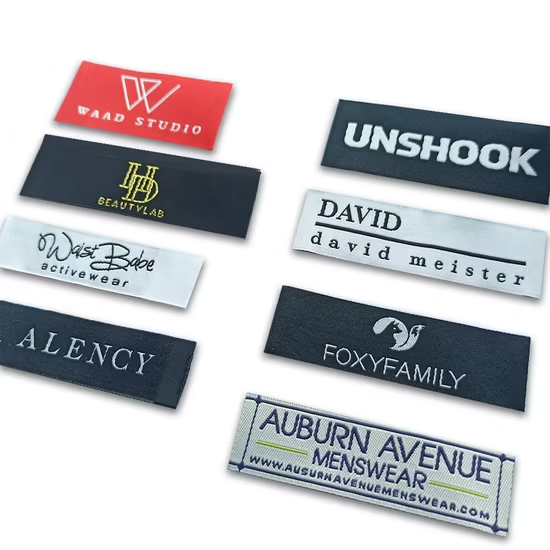
- woven labels,
- printed labels,
- heat-transfer branding,
- other product-appropriate applications.
Consider:
- comfort,
- appearance,
- durability,
- garment type,
- target positioning.
A scratchy premium label is not premium.
46. Do Not Treat Care Labels as Decoration
Care and content labeling involves legal and compliance considerations in the United States.
Startup founders should therefore distinguish between:
creative branding decisions and regulatory labeling obligations.
Before selling apparel in the U.S., verify the current requirements applicable to your product with authoritative U.S. sources and qualified professionals where necessary.
Do not copy another brand’s care label and assume it applies to your garment.
Different fiber compositions and products can require different information.
47. Decide Whether Hangtags Add Enough Value
Hangtags can improve:
- brand presentation,
- gifting experience,
- retail readiness,
- product storytelling.
But every customization adds cost and complexity.
A direct-to-consumer startup shipping products in branded packaging may value hangtags differently from a brand supplying retail stores.
Ask whether the hangtag has a job.
Possible jobs include:
- brand story,
- sizing,
- product information,
- barcode,
- price,
- social handle,
- QR destination.
If it has no job, question why you are paying for it.
48. Use Packaging to Reinforce Positioning—Not Destroy Margin
Packaging is seductive.
Founders love:
- boxes,
- tissue,
- stickers,
- cards,
- ribbons,
- custom mailers.
Customers may love them too.
But packaging has economics.
A $35 product cannot always support the same unboxing experience as a $250 product.
For every packaging component ask:
- What does it cost?
- Does it protect the product?
- Does it improve customer experience?
- Does it reinforce positioning?
- Does it materially increase shipping dimensions or weight?
Your packaging should support the business model.
Not fight it.
Part VIII — Decoration Decisions
49. Match Decoration Method to Design
A startup should not choose a decoration technique simply because it sounds premium.
Common options can include:
- screen printing,
- embroidery,
- sublimation,
- heat-transfer applications,
- other specialist techniques.
Each behaves differently.
The right method depends on:
- fabric,
- artwork,
- quantity,
- color count,
- durability requirement,
- hand feel,
- intended aesthetic,
- budget.
A highly detailed photographic graphic may demand a different process from a simple one-color chest mark.
Manufacturing decisions should follow the design.
50. Understand Why Embroidery Changes the Garment
Embroidery adds thread and density to fabric.
That matters.
Large embroidery on a lightweight garment can behave differently from a small chest mark on heavyweight fleece.
Evaluate:
- backing,
- stitch density,
- distortion,
- placement,
- comfort,
- scale.
Do not approve embroidery only because the digital artwork looks attractive.
Inspect the actual embroidered sample.
51. Test Print Placement on the Garment, Not Just the Artwork File
A graphic can look perfectly centered on a computer and awkward once worn.
Garments have:
- necklines,
- seams,
- folds,
- body curvature,
- size variation.
Specify print dimensions and placement from measurable reference points.
Then wear-test the sample.
Especially for oversized streetwear, placement can materially change the visual balance.
52. Consider Sublimation for the Right Products
Sublimation is particularly relevant to many polyester-based performance and teamwear applications because designs can be integrated into the fabric rather than applied as a heavy surface decoration.
That makes it useful for:
- jerseys,
- team uniforms,
- performance tops,
- all-over graphics.
But again:
method follows product.
Do not use a technique because another successful brand uses it.
Use it because it solves your product requirement.
Part IX — Build a Startup Quality-Control System
53. Define Quality Before Production
“High quality” is not a QC standard.
Your standard should be connected to:
- approved materials,
- approved measurements,
- approved construction,
- approved colors,
- approved artwork,
- approved labels,
- approved finishing.
Elahi Vertex International’s published QC scope includes materials, measurements, stitching, garment construction, printing, embroidery, colors, labels, branding, finishing and final appearance.
A startup founder should similarly think in inspection categories, not adjectives.
54. Inspect Fabric Before It Becomes Finished Inventory
Finding a material problem after 100 garments have been cut and stitched is worse than finding it earlier.
This illustrates a basic production principle:
Catch defects as close as possible to where they originate.
QC should not exist only at the packing table.
Depending on the production system, checks may occur across:
- material receipt,
- cutting,
- decoration,
- stitching,
- finishing,
- final inspection.
The earlier a systematic issue appears, the more opportunity there is to contain it.
55. Measure Bulk Garments Against the Approved Size Chart
Fit consistency affects:
- reviews,
- returns,
- exchanges,
- customer trust,
- repeat purchases.
A customer who buys Medium twice expects a reasonably consistent experience.
If your first production order has inconsistent measurements, your size chart becomes unreliable.
For a startup without hundreds of reviews or established trust, that can hurt disproportionately.
56. Inspect Stitching Where Stress Actually Occurs
Not every seam experiences equal load.
Pay particular attention to product-specific stress areas.
For example:
- crotch seams,
- underarms,
- waistbands,
- pocket attachments,
- shoulder seams,
- zipper areas.
A garment can look beautiful on a hanger and fail under movement.
Quality must be evaluated against use.
57. Check Color Consistency Across the Order
Color inconsistency is especially visible when customers buy matching pieces.
Imagine selling:
“Black Essential Hoodie + Black Essential Jogger.”
If one appears charcoal and the other deep black, the customer may perceive the set as defective even if both garments are individually wearable.
For coordinated collections, color consistency becomes a brand issue.
58. Check Branding Consistency
A logo that moves noticeably between garments makes production look uncontrolled.
Inspect:
- dimensions,
- placement,
- orientation,
- color,
- embroidery density,
- print quality.
Brand marks are where customers naturally look.
Small inconsistencies can therefore become highly visible.
59. Decide Your Defect Standard Before Shipment
A startup should understand how defects will be handled.
Discuss with the manufacturer:
- inspection approach,
- what constitutes a defect,
- how problems are documented,
- what happens if unacceptable units are identified before shipment.
Do this before there is a dispute.
Policies negotiated during a problem are harder than expectations agreed beforehand.
Part X — Inventory Decisions That Can Save a Startup
60. Do Not Divide Sizes Equally Without a Reason
If you order:
20 Small
20 Medium
20 Large
20 XL
you are assuming equal demand.
Is there evidence for that?
Maybe.
Maybe not.
If you have:
- preorder data,
- previous sales,
- audience surveys,
- competitor sizing observations,
- customer profiles,
use them.
Otherwise, recognize that your first size allocation is a hypothesis.
Track what sells.
Your second order should be smarter than your first.
61. Be Careful With Too Many Colorways
Every additional color creates another inventory branch.
One hoodie:
5 colors × 5 sizes = 25 SKU combinations.
Three hoodies:
5 colors × 5 sizes × 3 styles = 75 combinations.
A startup can accidentally build an inventory-management problem before building a customer base.
Start narrower.
Let sales data earn additional complexity.
62. Use Small Production to Discover Winners
Suppose you launch:
Black — 20 units
Cream — 20 units
Forest — 20 units
and sell:
Black — 18
Cream — 11
Forest — 4
That is useful information.
Your reorder does not need to repeat the original ratio.
Manufacturing becomes more intelligent when demand data flows backward into production planning.
63. Do Not Confuse a Sellout With Proven Demand
A founder manufactures ten units.
They sell out.
That is encouraging.
But it does not automatically prove demand for 1,000.
Ask:
- How quickly did they sell?
- Who bought them?
- Was demand organic?
- Were discounts involved?
- How much traffic produced those sales?
- How many customers asked for restocks?
- What happened after launch hype?
Scale based on evidence, not adrenaline.
Part XI — Nine Young U.S. Brand Lessons for Startup Founders
New founders often study Nike, Lululemon, Supreme or Ralph Lauren.
Those companies can teach useful lessons, but their present scale is far removed from a first-time founder ordering an initial collection.
It can be more instructive to examine younger labels.
For example, OutWest says it launched in 2023 in Sioux Falls, South Dakota, starting from an unfinished basement and building its positioning around the working-class and overlooked “flyover states.”
LOVANT says it was founded in Los Angeles in August 2022, evolving from founder Joshuah Vargas’s upcycling and sewing into custom cut-and-sew fashion.
YEBO states that it was founded in 2022 around a resilience-focused streetwear identity.
EVNTLLY traces its 2022 origin to 11 students at a Bronx high school who developed a streetwear label through an entrepreneurship program.
The Unrivaled Brand says it was founded in 2023, drawing on New York street culture and now operating with Miami influence.
Independent streetwear directories also identify recent U.S. labels founded around 2021–2024 in Milwaukee, New York City, Brooklyn and Los Angeles, illustrating how geographically dispersed new American streetwear creation has become.
The point is not that a startup should imitate any of them.
The useful lesson is that specificity creates identity.
64. Brand Lesson: Give People a Reason to Remember You
A logo alone is rarely a positioning strategy.
Ask:
Why should this brand exist?
Possible answers might involve:
- underserved fit,
- community,
- sport,
- lifestyle,
- aesthetic,
- cultural point of view,
- technical problem,
- price gap,
- product innovation.
OutWest’s public story, for example, explicitly anchors itself to South Dakota and America’s often-overlooked heartland rather than trying to sound like every coastal fashion label.
That specificity is instructive.
Your brand does not need to appeal to every American consumer.
It needs to matter strongly to some.
65. Brand Lesson: Geography Can Become Identity
Los Angeles.
Brooklyn.
Miami.
Texas.
Chicago.
Atlanta.
Different places carry different cultural associations.
But location references must be authentic.
Do not invent a “Brooklyn heritage” because Brooklyn sounds fashionable.
If your founder story comes from Dallas, use Dallas when relevant.
If you are building from Columbus, Ohio, you do not need to pretend to be from Los Angeles.
A genuine regional identity can be more memorable than manufactured cosmopolitanism.
66. Brand Lesson: Community Can Precede Scale
A startup cannot outspend global apparel corporations.
It can sometimes out-focus them.
A small brand can know:
- its customers,
- its niche,
- its language,
- its local scene,
- its problems
better than a global company.
EVNTLLY’s origin around a group of Bronx students demonstrates how a brand story can emerge from a specific community rather than from a large corporate marketing department.
Community is not a substitute for product quality.
But product + community can become powerful.
67. Brand Lesson: Founder Skill Can Become Product Differentiation
LOVANT’s story is useful because its founder describes moving from upcycling and sewing into sourcing fabric and creating cut-and-sew garments.
For startup founders, the broader lesson is:
Learn the product.
You do not personally need to sew every garment.
But understanding:
- fabrics,
- fit,
- construction,
- decoration,
- costing,
- sampling
makes you a better buyer.
The less you understand your product, the more completely you depend on supplier judgment.
Part XII — USA Market Decisions
68. Do Not Treat the United States as One Customer
The USA is a national market composed of many submarkets.
A streetwear startup targeting Los Angeles skaters may communicate differently from a golf-lifestyle startup in Florida.
An outdoor brand in Colorado may have different product priorities from a fashion label in Manhattan.
A Southern youth-teamwear business may have different demand patterns from a New England lifestyle brand.
Do not target “Americans.”
Target a customer segment that happens to live in America.
69. Use California for More Than an SEO Keyword
California matters because it contains enormous consumer markets and influential fashion, fitness and streetwear ecosystems.
For a Los Angeles startup, relevant product questions may include:
- climate,
- layering,
- streetwear silhouettes,
- lifestyle positioning,
- activewear,
- year-round usability.
But inserting “Los Angeles clothing brand” 30 times does not make a page useful.
Geography should improve context.
Not replace it.
70. Understand New York’s Competitive Density
New York City contains extraordinary fashion competition.
That makes generic positioning difficult.
A new NYC label should ask:
What makes us identifiable when customers already have thousands of apparel options?
Distinctive:
- silhouette,
- story,
- niche,
- community,
- product,
- price architecture
becomes important.
Simply writing “NYC” on a hoodie is not a defensible strategy.
71. Do Not Ignore Texas
Texas provides multiple large metropolitan markets including:
- Dallas–Fort Worth,
- Houston,
- Austin,
- San Antonio.
Startup opportunities can span:
- fitness,
- western-influenced lifestyle,
- streetwear,
- teamwear,
- performance apparel,
- local-community brands.
Again, do not manufacture a generic “Texas collection” because the state is large.
Identify the actual buyer.
72. Think Differently About Florida
Florida’s climate can influence product selection.
A Miami-based startup may find greater year-round relevance in:
- lightweight apparel,
- activewear,
- gymwear,
- lifestyle sets,
- breathable products
than in a collection dominated by extremely heavy winter garments.
That does not mean hoodies cannot sell in Florida.
It means product-market context matters.
73. Consider Atlanta and Georgia’s Cultural Influence
Atlanta has significant influence across music, culture, sports and streetwear.
For a founder connected authentically to that ecosystem, local community can become an early distribution advantage.
The operative word is:
authentically.
Do not manufacture cultural association from a distance merely because it looks commercially attractive.
74. Do Not Ignore Smaller U.S. Cities
One of the most useful lessons from younger brands is that you do not need to originate in Los Angeles or New York.
OutWest publicly anchors its story in Sioux Falls, South Dakota.
Streetwear directories document newer brands originating from places such as Milwaukee as well as the expected coastal hubs.
A founder in:
- Columbus,
- Charlotte,
- Nashville,
- Phoenix,
- Denver,
- Portland,
- Minneapolis,
- Detroit,
- Kansas City
can build a brand.
Your internet storefront is national.
Your local identity can still be an advantage.
Part XIII — Pricing for Survival, Not Vanity
75. Know Your Gross Margin Before Launch
Revenue screenshots are seductive.
Profit pays bills.
If a product sells for $60, you need to know what remains after the direct economic costs associated with selling it.
Your exact accounting structure should be reviewed appropriately, but founders should at minimum understand the difference between:
selling price and money retained.
If every sale creates almost no economic contribution after product, fulfillment, fees and acquisition costs, scaling revenue can scale the problem.
76. Do Not Set Retail Price by Multiplying Factory Cost Randomly
“Factory cost × 3” is not a universal pricing strategy.
Your price should consider:
- landed cost,
- competitive set,
- perceived value,
- positioning,
- channel,
- customer acquisition,
- returns,
- discounting,
- operating expenses,
- desired margin.
A $12 manufacturing cost might support very different retail prices depending on the brand and sales model.
Build the economics from your actual business.
77. Include Shipping Before Calling a Supplier Cheap
This deserves repetition because founders repeatedly miss it.
A factory quotation is only part of sourcing cost.
Compare:
Product + customization + packaging + shipping + applicable import costs + handling
before making a commercial judgment.
For international manufacturing, freight can materially alter the economics of smaller orders.
A startup ordering 20 pieces and an established company importing 10,000 pieces will not necessarily experience the same per-unit logistics economics.
78. Protect Cash for Reorders
Imagine spending every available dollar on launch inventory.
The product succeeds.
Then you cannot afford to reorder.
Success has created a cash-flow problem.
Plan working capital before launch.
Ask:
If this sells faster than expected, how will we finance production number two?
That is a better problem than unsold inventory—but still a problem.
Part XIV — Shipping and Import Planning
79. Decide Shipping Method Based on Economics and Time
International apparel can move through methods such as:
- express courier,
- air freight,
- sea freight,
depending on order characteristics and available services.
Faster is generally valuable.
Faster is not automatically economically optimal.
For early startup quantities, express options may sometimes make practical sense.
As volume grows, freight strategy deserves reevaluation.
Do not assume the method used for your first 20 pieces will remain optimal at 2,000.
80. Build Shipping Time Into Your Launch Calendar
Do not announce a launch date based only on factory completion.
Your schedule may include:
development
→ sampling
→ revision
→ approval
→ production
→ QC
→ packing
→ export
→ transit
→ import processing
→ delivery
→ content production
→ launch
If any stage slips, your public launch can slip.
Give yourself contingency.
A startup loses credibility when it repeatedly tells customers:
“Next week.”
81. Understand Who Is Responsible for Importing
Before shipment, understand:
- shipping terms,
- documentation,
- importer responsibilities,
- duties/taxes where applicable,
- customs clearance,
- destination charges.
Do not wait until goods are moving internationally to learn who is responsible for what.
For U.S. regulatory and customs questions, use current official sources and appropriate customs/logistics professionals.
Manufacturers can support export documentation, but the U.S. buyer still needs to understand its own importing responsibilities.
Part XV — Launch Decisions
82. Do Not Manufacture Before You Know How You Will Sell
Manufacturing is not a go-to-market strategy.
Before inventory arrives, know:
- where customers will discover you,
- why they will care,
- where they will purchase,
- how products will be fulfilled,
- what content exists,
- how returns work,
- how customer support works.
A warehouse full of beautiful hoodies does not generate demand automatically.
Production and marketing need to meet.
83. Build Content Before Inventory Arrives
Your first launch should not begin with:
“Products arrived. What should we post?”
During manufacturing you can prepare:
- brand story,
- product education,
- founder content,
- behind-the-scenes material,
- email capture,
- waitlist,
- product pages,
- launch photography plan,
- sizing education,
- FAQs.
The goal is to have an audience warmer than zero when inventory becomes available.
84. Consider Preorders Carefully
Preorders can reduce inventory uncertainty and generate demand information.
They also create obligations.
If you accept money before goods are ready, customers expect:
- accurate communication,
- realistic timelines,
- reliable fulfillment.
Do not use preorder money to disguise an unstable production plan.
Use preorders only when you can manage expectations professionally.
85. Make Your Size Guide Easy to Understand
Poor size information creates avoidable returns.
Show:
- garment measurements where useful,
- fit description,
- model information where relevant,
- measurement instructions.
If your hoodie intentionally fits oversized, say so.
If customers should size down for a closer fit, explain it.
Product education is cheaper than reverse logistics.
Part XVI — Turn Customer Feedback Into Manufacturing Data
86. Read Returns Like Product Reports
A return is not only a lost sale.
It can be data.
Track reasons:
- too small,
- too large,
- too long,
- too short,
- color difference,
- fabric expectation,
- quality issue,
- damaged,
- changed mind.
Patterns matter.
If 30% of returns say sleeves are too short, your next manufacturing decision may already be visible.
87. Separate Product Problems From Customer Preference
Not every negative review means manufacturing failed.
Customer:
“I don’t like oversized shirts.”
If your page clearly advertised an oversized fit, that may be preference.
Customer:
“The size chart says 24-inch chest but mine measures 21.”
That may indicate a specification/QC problem.
Diagnose correctly before changing production.
88. Use Your Second Order to Correct the First
Your second order should not be an automatic duplicate.
Review:
- best-selling size,
- slowest size,
- best color,
- weakest color,
- return reasons,
- customer comments,
- defects,
- margin,
- shipping cost,
- packaging,
- production experience.
Then improve.
Startup manufacturing should be iterative.
Part XVII — Scaling Without Losing Control
89. Do Not Scale SKU Count Faster Than Operations
Success tempts founders to add:
- more colors,
- more products,
- more drops,
- more sizes.
Each increases operational complexity.
If your first hoodie works, the next decision does not have to be 15 unrelated garments.
You might instead deepen the winning product through:
- one new color,
- complementary joggers,
- improved restock,
- refined fit.
Scale intelligently.
90. Negotiate Cost After You Create Volume
A startup with a 20-piece order has limited purchasing leverage.
That is normal.
If demand grows to:
- 100,
- 500,
- 1,000,
- 5,000 units,
production economics may change.
Instead of destroying the supplier relationship trying to extract the lowest possible price on your first micro-order, establish a pricing roadmap.
Ask:
What happens to unit economics at larger quantities?
That lets you model scale.
91. Keep Specifications Even After You Trust the Manufacturer
Trust does not replace documentation.
A strong long-term supplier relationship should make documentation easier, not unnecessary.
Keep records of:
- approved fabrics,
- measurements,
- colors,
- labels,
- artwork,
- packaging,
- order quantities,
- revisions.
People change.
Production teams change.
Memory fades.
Specifications survive.
92. Build a Reorder System
When a product wins, speed matters.
You should know:
- SKU,
- approved specification,
- previous quantity,
- size breakdown,
- color,
- packaging,
- last production date,
- previous issues,
- desired changes.
Do not rebuild the entire conversation from zero every time.
Professional reordering reduces friction.
93. Do Not Change a Winning Product Without Evidence
Founders get bored faster than customers.
You may be tired of your black heavyweight hoodie because you have looked at it for eight months.
Your customer may have discovered it yesterday.
Do not redesign a proven product merely because you want novelty.
Use data.
94. Add Backup Planning Before You Need It
Manufacturing can encounter:
- material shortages,
- machinery problems,
- logistics disruption,
- seasonal capacity pressure,
- supplier delays.
Ask what your most vulnerable dependencies are.
This does not mean constantly threatening your manufacturer with replacement.
It means understanding operational risk.
Part XVIII — The Startup Manufacturing Advantage
95. Use Small Size as an Advantage
A startup has disadvantages:
- less capital,
- less bargaining power,
- less data,
- less recognition.
It also has advantages.
You can change quickly.
A global company cannot redesign its entire product direction after 50 customer conversations.
You might.
Your small size can make experimentation faster.
Use it.
96. Compete on Specificity Instead of Scale
You will probably not beat the world’s largest apparel companies on:
- advertising budget,
- retail footprint,
- production volume,
- celebrity contracts.
You can beat them for a narrow customer on:
- relevance,
- community,
- identity,
- responsiveness,
- niche understanding.
The manufacturing system should reinforce that specificity.
97. Make Your Manufacturer Part of the Product System
The best relationship is not:
“Factory, make clothes.”
It is:
Brand defines customer and product direction.
Specifications translate the idea.
Manufacturer executes production.
QC verifies execution.
Customer feedback improves the next order.
That is a system.
Elahi Vertex International’s published custom manufacturing process covers concept development, fabric sourcing, sampling, customization, bulk production, inspection, packaging and worldwide shipping.
For a startup, the value of a manufacturing partner is therefore broader than stitching garments.
It is the ability to turn a concept into repeatable physical inventory.
98. Build for the Second Order, Not Just the First Launch
Many founders imagine launch day as the finish line.
It is the beginning.
A healthy clothing business eventually needs:
Order 1
→ feedback
→ reorder
→ improvement
→ new customers
→ repeat customers
→ additional products
→ larger production
Therefore, your first manufacturing process should leave behind:
- specifications,
- samples,
- costing data,
- sales data,
- customer feedback,
- QC information.
Those assets make the second order better.
99. Build a Clothing Brand That Can Be Reproduced
This is the final and most important manufacturing decision.
Do not build a product that worked once.
Build a product that can work again.
A successful startup clothing brand needs repeatability.
The second hoodie should feel like the first.
The next 100 leggings should follow the approved fit.
The reorder should use the correct branding.
The next collection should build on what customers taught you.
Your manufacturer should not have to rediscover your product every time you order.
That requires:
**clear product positioning
- controlled specifications
- deliberate material selection
- validated samples
- documented approvals
- appropriate MOQ
- quality control
- landed-cost awareness
- customer feedback
- disciplined reordering**
That is how manufacturing stops being a transaction and becomes infrastructure for the brand.
A Practical Manufacturing Roadmap for a New Clothing Brand in the USA
If you are currently sitting in Los Angeles, New York City, Miami, Dallas, Houston, Austin, Atlanta, Chicago, Philadelphia, Charlotte, Columbus, Denver or another U.S. city with sketches, reference images and an idea for a clothing brand, you do not need to solve all 99 decisions tonight.
Solve them in sequence.
Stage 1 — Define
Customer
→ niche
→ hero product
→ target retail price
→ budget
Stage 2 — Specify
Design
→ fabric
→ fit
→ measurements
→ construction
→ decoration
→ branding
Stage 3 — Source
Manufacturer
→ MOQ
→ capabilities
→ quotation
→ timeline
→ shipping
Stage 4 — Sample
Prototype
→ physical inspection
→ wear test
→ measurements
→ revisions
→ final approval
Stage 5 — Produce
Bulk manufacturing
→ in-process controls
→ final QC
→ packaging
Stage 6 — Import
Shipping
→ documentation
→ customs/import requirements
→ delivery
Stage 7 — Sell
Launch
→ fulfillment
→ customer service
→ returns
Stage 8 — Learn
Sales data
→ sizing data
→ reviews
→ defects
→ customer feedback
Stage 9 — Scale
Reorder
→ improve
→ optimize quantity
→ expand winning products
That is a much healthier sequence than:
Logo → 500 garments → Instagram → hope.
Why Elahi Vertex International Can Be Considered by New USA Clothing Brands
A startup does not necessarily need the biggest apparel factory it can find.
It needs a manufacturing setup appropriate to its product, quantities, customization requirements and stage of growth.
Elahi Vertex International is a custom clothing manufacturer and apparel exporter based in Sialkot, Pakistan, serving startups alongside established brands, wholesalers, retailers, teams and other international buyers. Its published manufacturing capabilities cover custom manufacturing, OEM, ODM, private label, product development, fabric sourcing, sampling, customization, bulk production, quality control, packaging and worldwide shipping.
Product categories include:
- sportswear,
- teamwear,
- streetwear,
- activewear,
- boxing wear,
- leather wear,
- hoodies and sweatshirts,
- private-label clothing.
For a new American clothing brand, several aspects are particularly relevant.
Startup-Friendly MOQ
Elahi Vertex International’s standard MOQ is 20 pieces.
That can allow a new brand to validate a product with a more controlled initial quantity rather than automatically committing capital to hundreds of units.
The lowest MOQ should never be the only reason to select a manufacturer.
But for an unproven startup, capital exposure matters.
Custom Product Development
Startup founders can approach manufacturing with their own:
- concepts,
- specifications,
- measurements,
- materials,
- colors,
- artwork,
- branding requirements.
The objective is not to sell another company’s consumer brand.
It is to manufacture your brand’s product.
Sampling Before Bulk Production
Sampling provides a checkpoint for evaluating:
- fit,
- material,
- measurements,
- construction,
- print,
- embroidery,
- labels,
- finishing.
The approved sample and specifications can then provide the reference for bulk production.
Private-Label Development
For founders building their own identity, private-label requirements can include custom:
- labels,
- branding,
- packaging,
- product specifications.
Elahi Vertex International’s published case studies also describe a startup fitness-apparel project involving custom patterns, performance-fabric sourcing, labels, packaging, prototype development, bulk manufacturing and QC.
Before You Request a Clothing Manufacturing Quote
Do not send only:
“Price for hoodie?”
A useful RFQ should provide as much of the following as possible:
Product:
Oversized pullover hoodie
Quantity:
20 / 50 / 100 pieces
Sizes:
S–XL with estimated breakdown
Fabric:
Desired composition/GSM or intended feel
Color:
Pantone/reference where available
Decoration:
Embroidery / screen print / other
Logo dimensions:
Approximate dimensions and placement
Labels:
Main / size / care
Packaging:
Standard or custom
Destination:
City, state and ZIP code, USA
Required date:
Target arrival or launch date
Files:
Tech pack / artwork / reference images
Why include the destination?
Because a startup should evaluate shipping and landed economics, not manufacturing price in isolation.
Startup Clothing Manufacturing USA: From First Sample to Sustainable Growth
For founders entering startup clothing manufacturing USA, the smartest first objective is not maximum production volume. It is proving that customers actually want the product. A new clothing brand should use its first manufacturing cycle to validate fabric, fit, sizing, construction, branding, pricing and customer response before committing substantially more capital to inventory.
The right clothing manufacturer for startups USA founders choose should understand that early-stage production has different requirements from established-volume manufacturing. Startup founders often need clearer product-development guidance, manageable quantities, sample revisions, private-label customization and a realistic path from the first small order to larger repeat production.
A small batch clothing manufacturer USA strategy can reduce inventory exposure during this validation period. Rather than manufacturing hundreds of units across multiple untested styles and colors, founders can concentrate resources on a smaller collection, measure real customer demand and use the resulting sales data to plan subsequent orders.
Working with a private label clothing manufacturer for startups also allows founders to develop products around their own identity instead of building a business around another company’s branding. Fabric selection, garment measurements, artwork, labels, packaging and other approved details should work together to create a recognizable product customers associate with the startup.
A low MOQ clothing manufacturer for startups becomes particularly relevant when demand is still uncertain. A lower initial quantity does not guarantee business success, but it can reduce the amount of startup capital trapped in unsold inventory. Elahi Vertex International’s standard MOQ of 20 pieces allows new brands to begin with controlled quantities and scale production as demand develops.
Why Startup Clothing Manufacturing USA Should Begin With Product Validation
The economics of startup clothing manufacturing USA are very different from ordering at established-brand scale. Large brands may possess historical sales data, established distribution, predictable size ratios and significant working capital. A first-time founder frequently has none of these advantages.
That uncertainty should influence manufacturing strategy.
Instead of asking how cheaply 1,000 garments can be produced, a startup founder should initially ask how efficiently the product can be tested, improved and validated.
This is where a suitable clothing manufacturer for startups USA can provide practical value. The manufacturing relationship should support the transition from concept to specification, sample approval, controlled production and eventual repeat orders rather than encouraging unnecessary inventory simply to reach a cheaper unit price.
Choosing a small batch clothing manufacturer USA approach can also generate valuable information. If black sells considerably faster than cream, Medium and Large outperform other sizes, or customers consistently request a different garment length, those findings can influence the next production run.
That information has economic value.
Private Label Clothing Manufacturer for Startups: Build an Asset You Own
A private label clothing manufacturer for startups should help translate the founder’s product requirements into apparel carrying the startup’s own identity. This can include custom garment specifications, labels, artwork, colors, decoration and packaging according to the requirements of the project.
The distinction matters because founders should be building an asset that can become increasingly recognizable.
Working with a private label clothing manufacturer for startups does not mean simply attaching a new neck label to an otherwise undifferentiated garment. Stronger private-label development considers the complete product experience—from fit and fabric through branding and packaging.
For founders researching startup clothing manufacturing USA, this product ownership becomes increasingly important as the business grows. Repeat customers should be able to return to the brand because they want that particular product, not merely because the startup happened to sell a generic hoodie once.
Small Batch Clothing Manufacturer USA Strategy for First Collections
Searching for a small batch clothing manufacturer USA startup strategy often reflects a sensible concern: inventory risk.
Imagine a founder planning four hoodie designs in four colors and five sizes. That creates 80 design-color-size combinations before the startup has established which products customers prefer.
A more controlled small batch clothing manufacturer USA strategy could begin with fewer designs and colorways, allowing the founder to concentrate marketing and collect cleaner demand data.
Small-batch production should not become permanent under-ordering when demand has already been proven. Once sales become predictable, larger production runs may improve economics. The objective is to match manufacturing volume to the startup’s current level of evidence.
This is also why a low MOQ clothing manufacturer for startups can be useful during initial validation. Lower quantities provide flexibility while the founder discovers what deserves to be scaled.
Clothing Manufacturer for Startups USA: Compare More Than Unit Price
When evaluating a clothing manufacturer for startups USA, founders should compare the complete manufacturing proposition.
Consider:
fabric capability, product specialization, MOQ, sampling, customization, labels, packaging, quality control, communication, production lead time, shipping and scalability.
A clothing manufacturer for startups USA quoting the lowest factory price is not necessarily providing the lowest-risk or lowest-total-cost solution.
Shipping deserves particular attention.
For an American startup importing custom apparel, the relevant commercial question is not simply:
“What is the price per hoodie?”
It is:
“What will this order cost to manufacture and move to my destination in the United States?”
That is why destination, quantity and shipping method should be considered alongside manufacturing pricing.
Low MOQ Clothing Manufacturer for Startups: Understand the Trade-Off
A low MOQ clothing manufacturer for startups can reduce the founder’s initial financial exposure, but low MOQ is not automatically synonymous with the best manufacturing decision.
Smaller production quantities can have higher per-unit costs because fixed development, setup and production expenses are distributed across fewer garments.
The founder therefore needs to balance:
unit economics against inventory risk.
For an untested startup, paying a somewhat higher unit cost for a controlled first run may sometimes be preferable to obtaining a lower unit cost by manufacturing far more inventory than demand justifies.
Once the product proves itself, the conversation changes.
A low MOQ clothing manufacturer for startups should ideally provide a pathway toward larger production rather than forcing the brand to change its entire manufacturing system immediately after achieving traction.
Startup Clothing Manufacturing USA Requires a Reorder Plan
Successful startup clothing manufacturing USA does not end when the first cartons arrive.
The first production run should generate information for the second.
Record:
which products sold, which sizes moved fastest, which colors remained, what customers returned, what customers praised, which defects occurred, what shipping actually cost and how long the complete production cycle required.
The next startup clothing manufacturing USA order should use that evidence.
This creates a continuous improvement cycle:
manufacture → sell → measure → learn → reorder → improve.
A startup that develops this discipline can gradually move from uncertain first orders toward predictable production planning.
Scaling From Small Batch Clothing Manufacturer USA Orders
The purpose of starting with a small batch clothing manufacturer USA strategy is not to remain permanently small.
It is to earn the right to scale.
When a product repeatedly sells, returns remain controlled and customers request restocks, the founder has stronger evidence for increasing quantities.
At that point, discuss volume pricing, production planning, material availability and future capacity with the manufacturer.
A strong private label clothing manufacturer for startups relationship should be capable of evolving alongside the brand. The production system that supports the first 20-piece test should provide a clear route toward 100, 500 or larger quantities when genuine demand develops.
Build Startup Clothing Manufacturing USA Around Evidence
The strongest principle behind startup clothing manufacturing USA is simple:
Do not manufacture based on hope when you can manufacture based on evidence.
Start with a defined customer.
Develop a specific product.
Approve the sample.
Control the first quantity.
Measure sales.
Listen to customers.
Improve the next production run.
Whether you are searching for a clothing manufacturer for startups USA, evaluating a small batch clothing manufacturer USA approach, looking for a private label clothing manufacturer for startups, or comparing a low MOQ clothing manufacturer for startups, the objective should remain the same:
protect startup capital while building a product capable of becoming repeatable, recognizable and scalable.Final Startup Checklist: Before Paying for Bulk Production
Before authorizing production, confirm that you can answer yes to the important questions:
- Do we know exactly who this product is for?
- Have we validated the retail-price range?
- Do we know our estimated landed cost?
- Can we afford the inventory quantity?
- Is the fabric confirmed?
- Is the composition confirmed?
- Is the GSM confirmed where relevant?
- Is the color confirmed?
- Is the fit approved?
- Are measurements documented?
- Are tolerances understood?
- Is grading approved?
- Is construction confirmed?
- Is artwork final?
- Are logo dimensions documented?
- Is placement documented?
- Are labels approved?
- Is packaging approved?
- Have we physically evaluated the final sample where practical?
- Are all revisions documented?
- Is there one final production reference?
- Is production timing understood?
- Is the QC approach understood?
- Is shipping accounted for?
- Do we understand our importing responsibilities?
- Do we have money available for marketing?
- Do we have a plan if the product sells slowly?
- Do we have a plan if the product sells quickly?
- Are we collecting customer feedback?
- Can this product be reordered accurately?
If several answers are no, you probably do not need to rush into bulk production.
You need to finish product development.
Conclusion: Your First Collection Does Not Need to Be Huge—It Needs to Be Right
A new clothing brand in the USA does not win because it launches with the most products.
It does not win because its founder ordered the most inventory.
And it certainly does not win because its manufacturer offered the lowest unit price.
The startup wins its first manufacturing battle by controlling risk.
Start with a clearly defined customer.
Build a product for that customer.
Translate the concept into measurable specifications.
Select materials deliberately.
Understand the economics.
Choose a manufacturing partner based on capability rather than photographs.
Develop a sample.
Inspect it.
Revise it.
Freeze the specification.
Manufacture an amount appropriate to your evidence of demand.
Inspect production.
Account for shipping.
Launch.
Listen to customers.
Then make the second order better than the first.
Young American labels demonstrate that new brands can still emerge from Los Angeles, New York, Miami, the Bronx, South Dakota, Milwaukee and communities far beyond America’s traditional fashion centers. Their individual approaches differ, but specificity, product identity and community remain recurring themes.
Your startup does not need to look established before it has customers.
It needs to make disciplined decisions before expensive ones.
Ready to Turn Your First Clothing Idea Into a Physical Product?
If you are building a new clothing brand in the USA and already have a concept, sketches, reference images, artwork or technical specifications, Elahi Vertex International can review your manufacturing requirements.
Whether your first product is:
streetwear, activewear, sportswear, teamwear, gymwear, boxing apparel, hoodies, T-shirts or another custom private-label garment, begin with the product itself.
Send:
Design + Quantity + Sizes + Fabric Preference + Branding Requirements + Delivery City/ZIP
so the manufacturing requirements and shipping considerations can be evaluated together.
Start controlled. Validate the product. Learn from the first order. Then scale what customers prove they want.
Ready to Launch Your First Clothing Collection With Less Manufacturing Risk?
If you are building a new clothing brand in the USA, your biggest risk is not starting small.
It is spending too much money before you know whether your product, fit, fabric, pricing and customer demand are right.
Elahi Vertex International helps startup clothing brands move from idea → sample → first production → quality control → repeat orders with custom manufacturing built around your actual product requirements.
You can explore our Custom Clothing Manufacturing capabilities, review our Manufacturing Process, understand our Quality Control standards, see previous work in our Portfolio, and review practical examples through our Case Studies.
If you are still preparing your first order, start with our How to Order process so you know what information to prepare before sampling and production.
Start With 20 Pieces. Validate First. Scale What Sells.
Elahi Vertex International’s standard MOQ is 20 pieces, making it possible for new clothing brands to test a first collection without automatically tying up large amounts of capital in unproven inventory.
Send us:
Your design or reference images + quantity + sizes + fabric preference + branding requirements + delivery city/state/ZIP in the USA.
We can then evaluate the manufacturing requirements together with shipping so you are looking at the real commercial picture, not just an incomplete factory unit price.
Do not guess your way through your first production run. Build the product correctly, validate it with a controlled order, and scale only after the market gives you evidence.
Start Your Custom Clothing Order
Explore Custom Clothing Manufacturing
Review Elahi Vertex International Quality Control
See Our Manufacturing Portfolio
Read Our Case Studies
