
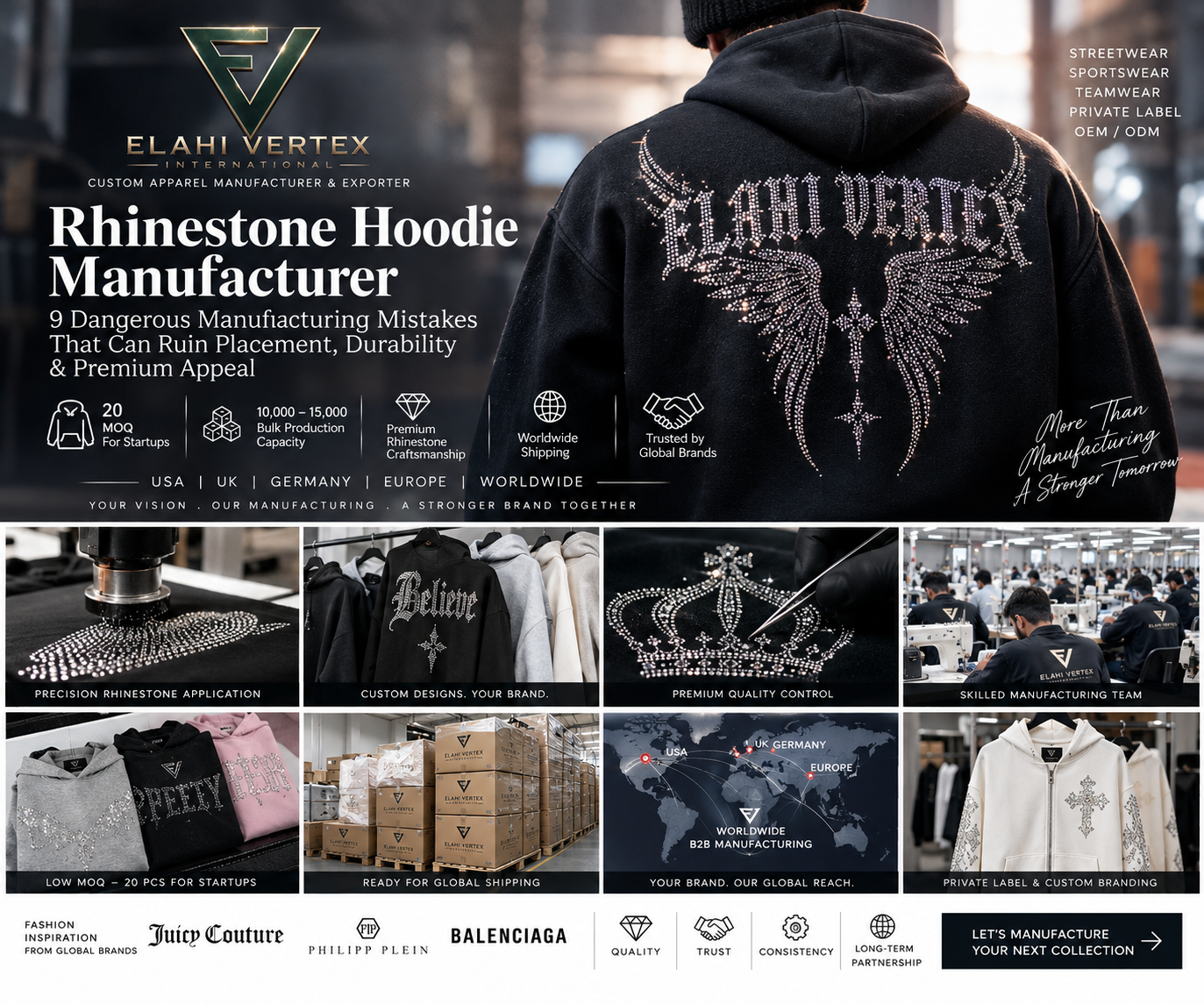
A rhinestone hoodie can look spectacular in a product render and still become an expensive manufacturing failure.
The problem is rarely the basic hoodie alone. The real difficulty is controlling the relationship between the hoodie fabric, garment construction, rhinestone type, stone size, artwork, placement, adhesive or application system, heat, pressure, size grading, washing behaviour and bulk-production consistency.
- What is a rhinestone hoodie manufacturer?
- Where can clothing brands manufacture custom rhinestone hoodies?
- What is the MOQ for custom rhinestone hoodies?
- How are rhinestones applied to hoodies?
- How do manufacturers prevent rhinestones from falling off?
- Can I manufacture private label rhinestone hoodies?
- Can startups order 20 custom rhinestone hoodies?
- How do I choose a rhinestone hoodie manufacturer?
- What affects the cost of bulk rhinestone hoodies?
- Can rhinestone hoodies be manufactured in bulk?
- What should be included in a rhinestone hoodie tech pack?
- How should rhinestone placement be specified?
- Can rhinestones be combined with embroidery or printing?
- What fabric works for rhinestone hoodies?
- Where can UK, USA, German and European brands source custom rhinestone hoodies?
That is why choosing the right rhinestone hoodie manufacturer matters.
For streetwear brands, fashion labels, private-label companies, wholesalers, retailers and e-commerce businesses in the USA, UK, Germany and wider Europe, a successful rhinestone hoodie project requires much more than sending a logo to a supplier and asking them to “add stones.”
The finished product has to work as a garment and as an embellished product.
A beautiful sample is not enough if the bulk production has inconsistent placement. Strong initial adhesion is not enough if stones begin detaching after wear or cleaning. Accurate artwork is not enough if the same design becomes visually distorted when it is transferred from size S to 2XL.
The manufacturing process therefore needs to control the hoodie and the embellishment as one product.
Elahi Vertex International is a B2B custom clothing manufacturer and exporter based in Sialkot, Pakistan, supporting custom streetwear, hoodies and sweatshirts, private-label clothing and other custom apparel projects for international buyers.
For startup brands, the standard starting MOQ is 20 pieces per product/category, giving a young brand an opportunity to develop and test a product without automatically committing to hundreds of units.
The manufacturing relationship is not intended to stop at startup quantities.
Growing and established buyers can discuss bulk production requirements, including projects in the thousands of pieces and large-volume requirements in the 10,000–15,000-piece range, subject to the rhinestone design, garment specification, materials, production planning, approved sample, required timeline and available manufacturing capacity for the specific project.
That distinction is important.
A serious rhinestone hoodie manufacturer should be able to discuss two very different commercial problems:
- How can a startup develop its first controlled rhinestone hoodie run without carrying unnecessary inventory?
- How can an established buyer reproduce an approved design consistently when quantities move into hundreds or thousands of garments?
This guide explains the nine manufacturing mistakes that can destroy placement accuracy, stone retention, appearance and perceived value—and how buyers can reduce those risks before committing to bulk production.
Table of Contents
- What Is a Rhinestone Hoodie Manufacturer?
- Why Rhinestone Hoodies Are More Difficult to Manufacture Than Standard Printed Hoodies
- Mistake #1 — Choosing a Rhinestone Hoodie Manufacturer Based Only on a Beautiful Sample
- Mistake #2 — Selecting Rhinestones Without Considering Fabric and Application Compatibility
- Mistake #3 — Sending Artwork Without Exact Rhinestone Specifications
- Mistake #4 — Ignoring Heat, Pressure, Fabric Movement and Garment Construction
- Mistake #5 — Putting Rhinestones in High-Stress or Poorly Engineered Placement Areas
- Mistake #6 — Skipping Adhesion, Wear and Care Testing Before Bulk Production
- Mistake #7 — Ignoring Size Grading and Placement Consistency
- Mistake #8 — Approving a Sample Without Creating a Bulk Production Standard
- Mistake #9 — Treating Rhinestones as Decoration Instead of an Engineered Garment Component
- Startup Production vs Bulk Rhinestone Hoodie Manufacturing
- Scaling From 20 Pieces to Large-Volume Production
- Rhinestone Hoodie Fabric Selection
- Rhinestone Types, Sizes and Visual Effects
- Hot-Fix vs Other Rhinestone Application Approaches
- Rhinestone Hoodie Tech Pack Requirements
- Placement Specification Guide
- Quality-Control Checklist
- USA Buyer Considerations
- UK Buyer Considerations
- Germany Buyer Considerations
- European Buyer Considerations
- Private-Label Rhinestone Hoodies
- Cost Factors
- Sampling and Pre-Production Approval
- How to Compare Rhinestone Hoodie Manufacturers
- Inspiration From Established Fashion Brands
- Why Work With Elahi Vertex International
- 20 Rhinestone Hoodie Manufacturer FAQs
- Final Buyer Checklist
- Conclusion
What Is a Rhinestone Hoodie Manufacturer?
A rhinestone hoodie manufacturer is an apparel manufacturing partner capable of producing hoodies that incorporate rhinestone or crystal-style embellishment as part of the garment design.
That sounds simple.
It is not.
The manufacturer must first be capable of producing the underlying hoodie correctly. That includes decisions involving:
- pattern development;
- garment measurements;
- fabric composition;
- GSM;
- fit;
- hood shape;
- rib;
- stitching;
- zipper construction where applicable;
- pockets;
- colour;
- washing or finishing;
- labels;
- trims;
- branding;
- packaging.
The rhinestone process adds another technical layer.
That can involve:
- artwork conversion;
- stone mapping;
- stone diameter;
- stone colour;
- stone finish;
- spacing;
- orientation;
- placement coordinates;
- transfer preparation;
- adhesive compatibility;
- heat;
- pressure;
- dwell time;
- cooling;
- inspection;
- replacement of missing stones;
- care requirements;
- bulk consistency.
A capable custom rhinestone hoodie manufacturer therefore needs to think beyond the question:
“Can we put rhinestones on a hoodie?”
The commercially useful question is:
“Can this exact rhinestone design be reproduced on this exact hoodie construction, across the required size range and production quantity, with an acceptable appearance and agreed quality standard?”
That is the standard buyers should use when evaluating suppliers.
Why Rhinestone Hoodies Are More Difficult Than Standard Printed Hoodies
Rhinestones introduce variables that a conventional screen-printed hoodie may not have.
A print is generally applied as a continuous graphic layer or deposited ink system.
A rhinestone artwork may contain hundreds or thousands of individual visual elements.
Every stone becomes part of the finished design.
If stones are too close together, the design can become crowded.
If they are too far apart, curves and letters may lose definition.
If stones shift during transfer, the artwork can appear distorted.
If several stones are missing from a dense graphic, the customer may notice immediately.
If the design crosses a seam, pocket edge or uneven construction area, application becomes more difficult.
If a manufacturer changes stone size during bulk production without approval, the overall graphic can change even when the outline remains technically similar.
That is why custom rhinestone hoodies should be engineered rather than improvised.
The commercial risk also rises with quantity.
A problem on one development sample is inconvenient.
The same problem across 500, 2,000 or 10,000 garments can become a serious financial issue.
For this reason, bulk manufacturing should not simply reproduce the idea of the sample.
It should reproduce the approved production standard.
Rhinestone Hoodies in Contemporary Fashion
Rhinestone and crystal embellishment are not limited to small independent streetwear labels.
They have been used by established fashion businesses to turn ordinary silhouettes into visually distinctive products.
For example, Juicy Couture currently sells diamanté-embellished velour hoodies with crystal-style logo artwork, demonstrating how embellishment can become a major visual part of a hoodie rather than a small secondary detail.
Philipp Plein also uses rhinestone and crystal treatments on hooded apparel, including crystal-enriched fleece and rhinestone branding.
These brands are referenced for design and market inspiration only.
They are not presented as customers, partners, clients or affiliates of Elahi Vertex International.
That distinction matters.
The lesson for an emerging streetwear company is not to copy another brand’s protected artwork.
The useful lesson is that rhinestones can be used in many ways:
- back graphics;
- chest logos;
- wordmarks;
- gothic lettering;
- sleeve graphics;
- symbols;
- border effects;
- scattered stones;
- tonal crystal layouts;
- contrast crystal layouts;
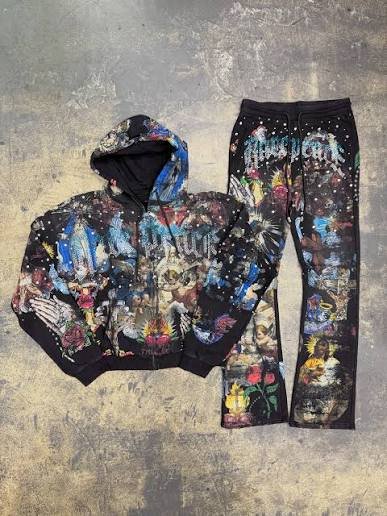
- coordinated hoodie-and-jogger sets.
The opportunity is therefore substantial—but execution determines whether the result looks premium or cheap.
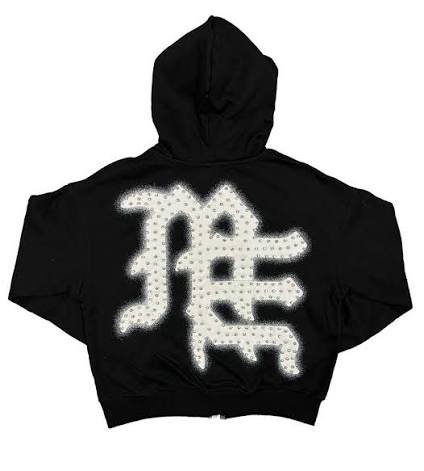
Mistake #1 — Choosing a Rhinestone Hoodie Manufacturer Based Only on a Beautiful Sample
A sample can prove that a supplier can make one garment.
It does not automatically prove that the supplier can reproduce the same result 100, 500, 2,000 or 10,000 times.
This is one of the most important distinctions in rhinestone hoodie manufacturing.
Imagine a brand approves a black oversized hoodie with a large rhinestone back graphic.
The sample looks excellent.
The logo is centred.
Every stone appears present.
Spacing looks clean.
The shine level is exactly what the founder wanted.
The buyer immediately approves 2,000 pieces.
Bulk production begins.
Then inconsistencies appear.
Some graphics sit slightly higher.
Others sit lower.
Stone spacing changes.
A few garments have missing stones.
Some colourways reflect light differently.
The artwork on smaller sizes feels oversized while the same artwork looks too small on larger sizes.
The original sample was good.
The production system was weak.
A sample is a reference—not a manufacturing system
The approved sample should become part of a controlled production specification.
A serious rhinestone hoodie manufacturer should establish what must remain consistent during bulk production.
That can include:
| Control Point | What Should Be Defined |
|---|---|
| Hoodie body | Approved pattern and measurements |
| Fabric | Composition, GSM, surface and colour |
| Rhinestone artwork | Final approved artwork |
| Stone type | Approved material/type |
| Stone size | Exact approved dimensions |
| Stone colour | Approved colour/finish |
| Spacing | Approved spacing |
| Placement | Measured coordinates |
| Application | Approved method |
| Garment size | Placement/scale rules |
| Labels | Approved branding |
| Packaging | Project-specific requirement |
| QC | Agreed inspection criteria |
The objective is not to make production bureaucratic.
The objective is to remove unnecessary interpretation.
If the operator has to “eyeball” placement on every hoodie, consistency becomes harder.
If placement is measured and templated, the process becomes more repeatable.
Buyer question to ask
Instead of asking:
Can you make this?
Ask:
How will you make sure the approved rhinestone placement, stone specification and visual result remain consistent in bulk production?
That question tells you much more about the supplier.
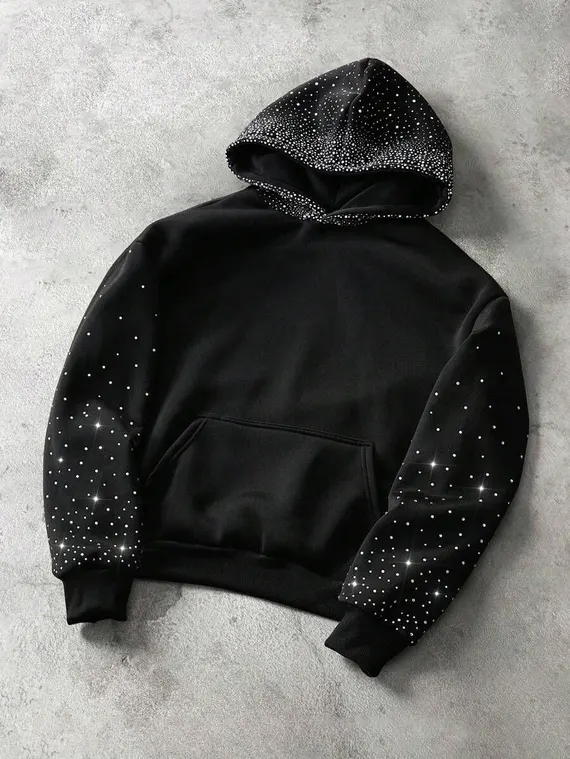
Mistake #2 — Choosing Rhinestones Without Considering the Hoodie Fabric
A rhinestone design cannot be separated from the material underneath it.
The same artwork can behave differently on:
- cotton fleece;
- cotton/polyester fleece;
- French terry;
- brushed fleece;
- velour;
- stretch fabric;
- washed fabric;
- heavily textured fabric;
- lightweight jersey;
- heavyweight hoodie fabric.
This is why an experienced rhinestone hoodie manufacturer should evaluate the base garment before locking the embellishment process.
Surface texture matters
A flat, stable surface generally behaves differently from a highly textured surface.
If the fabric face is irregular, the stones may not sit against the material in exactly the same way.
The buyer should therefore avoid choosing the hoodie fabric and rhinestone system as two completely separate decisions.
They are part of the same product.
Stretch matters
Consider a fitted or stretch hoodie.
When the garment stretches during wear, the distance between stones can visually change.
A design that looks dense while the garment is lying flat may open when worn.
That is particularly important for:
- fitted women’s hoodies;
- stretch velour;
- cropped fitted silhouettes;
- body-hugging zip hoodies;
- garments with elastane.
For an oversized heavyweight hoodie, the behaviour may be different because the garment typically experiences less body stretch across the decorated area.
Fabric finishing matters
A washed or distressed hoodie introduces another variable.
If the brand wants:
- garment washing,
- fading,
- distressing,
- pigment treatment,
- acid-wash effects,
- rhinestone embellishment,
the manufacturing sequence needs to be planned.
Applying an embellishment and then exposing it to an aggressive finishing process may create different risks from finishing the garment first and applying the embellishment afterwards.
The correct sequence depends on the actual fabric, finish, rhinestone system and desired visual effect.
That is why the production route should be tested rather than assumed.
Mistake #3 — Sending Artwork Without Exact Rhinestone Specifications
A PNG logo is not a complete rhinestone manufacturing specification.
Neither is an Instagram screenshot.
Neither is a sentence saying:
“Put crystals on the back.”
A strong custom rhinestone hoodie manufacturer needs enough information to convert creative intent into repeatable production.
What should the artwork specification contain?
At minimum, buyers should consider defining:
- artwork dimensions;
- placement;
- stone size;
- stone colour;
- stone finish;
- number of stone sizes if mixed;
- spacing;
- orientation;
- outline;
- whether the design is filled or outlined;
- whether lettering uses stones;
- whether different design elements use different stones;
- whether the artwork is identical across sizes;
- whether scaling is required.
Example
Weak specification:
Rhinestone logo on back.
Better specification:
Centre-back rhinestone artwork, final dimensions to approved sample, using the approved clear-stone specification, positioned according to measured distance from the neckline seam.
The second instruction is much easier to control.
Stone size changes the design
A rhinestone graphic is essentially a visual grid made from individual points.
Larger stones can produce:
- stronger sparkle;
- greater visual impact;
- lower fine-detail resolution.
Smaller stones can support:
- tighter curves;
- smaller lettering;
- finer details;
- denser patterns.
But smaller does not automatically mean better.
A design needs to be engineered around the visual objective.
A bold gothic wordmark may work differently from a detailed portrait or narrow script.
This is where communication between the brand and rhinestone hoodie manufacturer becomes important.
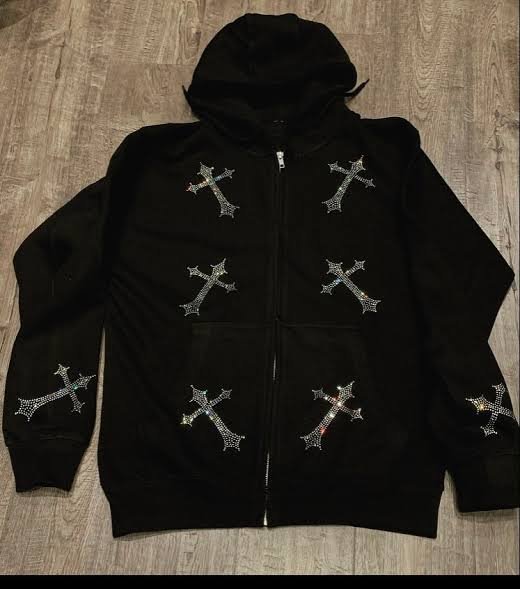
Mistake #4 — Ignoring Heat, Pressure, Fabric Movement and Garment Construction
Hot-fix rhinestone systems generally depend on controlled application conditions.
Those conditions cannot be treated casually.
The exact requirements depend on the rhinestone system, adhesive, fabric and equipment involved.
A buyer does not necessarily need to become an application technician.
But the buyer should understand one principle:
application settings should be validated for the actual product rather than guessed.
Too little effective bonding can create poor adhesion.
Excessive treatment can potentially affect the fabric, surface, colour or surrounding construction depending on the material.
That is why a rhinestone hoodie manufacturer should develop the product as a system.
Construction creates uneven surfaces
A hoodie is not a perfectly flat rectangle.
It contains:
- seams;
- hoods;
- kangaroo pockets;
- zippers;
- rib;
- drawcords;
- eyelets;
- labels;
- panel joins;
- topstitching.
These areas can interfere with a large embellishment.
For example, a rhinestone graphic extending over the edge of a kangaroo pocket creates a very different application challenge from a graphic centred on an uninterrupted back panel.
The design should therefore consider the physical garment.
Not just the Adobe Illustrator file.
Mistake #5 — Poor Rhinestone Placement
Placement can make an expensive embellishment look cheap.
A premium stone does not rescue poor positioning.
This is one of the most visible failures a buyer can experience.
Common placement problems
These include:
- artwork too close to the neckline;
- artwork too low on the back;
- chest logos drifting sideways;
- sleeve graphics rotating;
- artwork conflicting with pocket construction;
- designs crossing thick seams;
- inconsistent distance from zipper;
- inconsistent placement between sizes;
- left/right imbalance;
- artwork that looks centred when flat but not when worn.
Placement should be measured
A rhinestone hoodie manufacturer should not depend entirely on visual judgement when repeatability matters.
A placement specification can reference measurable garment points.
For example:
- centre front;
- centre back;
- shoulder seam;
- neckline seam;
- zipper centre;
- pocket edge;
- sleeve seam.
The correct reference depends on the design.
Think about the wearer
A design is viewed on a body, not on a cutting table.
For an oversized hoodie, a huge back graphic may be intentional.
For a cropped hoodie, the same graphic may have insufficient vertical space.
For a zip hoodie, centre-front artwork may need to interact with the zipper.
For a hoodie-and-jogger set, the hoodie placement may need to coordinate visually with the trouser artwork.
Placement is therefore both a manufacturing decision and a design decision.
Mistake #6 — Skipping Adhesion, Wear and Care Testing Before Bulk Production
One of the most dangerous assumptions is:
“The stones are attached now, therefore they are durable.”
Initial appearance and long-term performance are different questions.
A rhinestone hoodie is a decorated textile product that may experience:
- folding;
- stretching;
- abrasion;
- washing;
- drying;
- storage;
- transportation;
- repeated wear.
The exact testing protocol should depend on the buyer’s product requirements, target market, materials and intended care instructions.
Do not invent wash-cycle guarantees
A supplier saying “50 washes guaranteed” sounds impressive.
It is only useful if the claim is supported by a defined test method and the exact product being supplied.
Buyers should therefore ask:
- What exactly was tested?
- Which fabric?
- Which stone?
- Which adhesive/application system?
- Which washing conditions?
- Which drying conditions?
- What constituted failure?
- Was the tested construction identical to my order?
Without those details, a large wash-number claim can be more marketing than engineering.
A responsible rhinestone hoodie manufacturer should avoid making arbitrary durability promises that have not been validated for the specific product.
Care instructions matter
Even established fashion businesses give additional care attention to embellished garments.
For example, Juicy Couture advises customers to follow garment-specific care instructions and take extra care with embellished or delicate styles.
That is commercially significant.
The product-development question is not merely:
Will the rhinestones stay attached?
It is also:
What care instructions are appropriate for this exact garment?
Those instructions should reflect the final tested product.
Mistake #7 — Ignoring Size Grading
A design approved on size M does not automatically look correct on every other size.
This problem becomes more serious when a collection covers:
- XS;
- S;
- M;
- L;
- XL;
- 2XL;
- 3XL;
- extended sizes.
Suppose a brand develops a 30 cm back graphic.
If the artwork remains 30 cm on every size, its proportional appearance changes.
That may be exactly what the designer wants.
Or it may be wrong.
The key is that it should be intentional.
Fixed artwork vs graded artwork
There are two broad approaches.
Fixed artwork
The same artwork dimensions are used across multiple garment sizes.
Advantages can include:
- easier production control;
- consistent transfer dimensions;
- simpler artwork management.
Potential downside:
The design occupies a different percentage of the garment area on different sizes.
Graded artwork
Artwork dimensions change by size or size group.
Potential advantages:
- more consistent visual proportion;
- improved appearance across a broad size range.
Potential disadvantages:
- more artwork versions;
- additional production complexity;
- more placement controls;
- potentially different stone counts.
There is no universal answer.
A good rhinestone hoodie manufacturer should understand which approach the buyer approved.
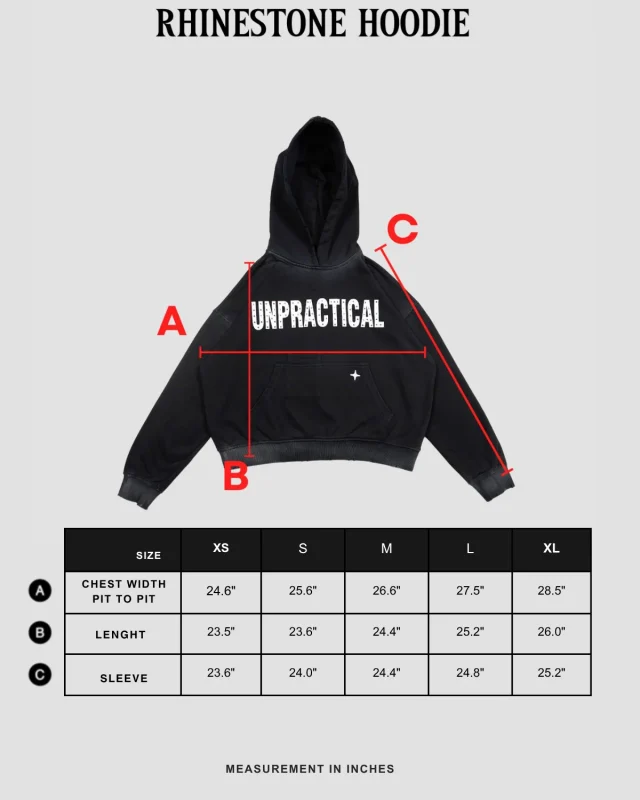
Mistake #8 — Approving a Sample Without Locking the Bulk Standard
A sample approval should answer more than:
“Do I like it?”
It should establish:
“Is this what bulk production is expected to reproduce?”
That means documenting the important details.
Sample approval checklist
Before approving a rhinestone hoodie sample, inspect:
- overall fit;
- garment measurements;
- fabric hand feel;
- fabric weight/specification;
- garment colour;
- rib;
- hood construction;
- zipper if applicable;
- pocket construction;
- stitching;
- rhinestone artwork;
- stone size;
- stone colour;
- shine;
- density;
- spacing;
- artwork dimensions;
- placement;
- adhesion;
- labels;
- hangtags;
- packaging requirements.
Take clear photographs.
Keep the approved technical information.
Record revisions.
Do not approve verbally if important details are still unresolved.
“Almost right” becomes expensive at scale
A founder may accept a sample with a slightly misplaced graphic because only one piece exists.
At 20 pieces, that compromise may already become noticeable.
At 500 pieces, it becomes a commercial issue.
At 10,000 pieces, a small unresolved specification can become a very large mistake.
Bulk manufacturing magnifies decisions.
That is why the approved sample and specifications should become the reference point.
Mistake #9 — Treating Rhinestones as Decoration Instead of Product Engineering
This is the mistake behind many of the others.
Rhinestones are visually decorative.
But manufacturing them consistently requires technical control.
A brand needs to think about:
Design → Material → Stone → Placement → Application → Sample → Testing → Approval → Bulk Production → QC → Care
rather than:
Hoodie → Add rhinestones → Finished
That change in thinking is important.
A professional rhinestone hoodie manufacturer should be evaluated on its ability to manage the complete relationship between the base garment and the embellishment.
Startup Rhinestone Hoodie Production: Why 20 Pieces Can Matter
Launching a streetwear product involves uncertainty.
A startup may not yet know:
- which colour will sell;
- which fit customers prefer;
- whether customers accept the price;
- whether the rhinestone concept resonates;
- which sizes move fastest;
- whether a pullover or zip hoodie performs better.
Forcing a founder to begin with several hundred pieces can increase inventory exposure before those questions have been answered.
Elahi Vertex International therefore supports a standard starting MOQ of 20 pieces per product/category.
For an early-stage streetwear company in London, Manchester, Berlin, Hamburg, New York, Los Angeles, Miami or another international fashion market, that can create a more controlled route into production.
Low MOQ should not be confused with “cheap manufacturing.”
A technically complex 20-piece rhinestone order may have different economics from a simple 20-piece printed hoodie.
The purpose of low MOQ is risk management and product validation, not pretending that tiny orders have the same unit economics as mass production.
From 20 Pieces to 10,000–15,000 Pieces
A manufacturer that supports startups should not necessarily remain a startup-only factory.
The commercial goal for many buyers is growth.
A sensible production path might look like:
Development sample → 20-piece controlled launch → reorder → 100–500 pieces → larger production → multi-thousand-piece program
Not every brand will follow this path.
Some established buyers may approach a rhinestone hoodie manufacturer with a much larger requirement immediately.
Elahi Vertex International can discuss bulk manufacturing projects, including large-volume requirements in the 10,000–15,000-piece range, but capacity for a specific rhinestone project should be confirmed after reviewing:
- quantity;
- design;
- stone density;
- number of colourways;
- number of sizes;
- fabric;
- garment construction;
- artwork complexity;
- application process;
- packaging;
- inspection requirements;
- delivery schedule.
That is the commercially responsible way to discuss capacity.
“15,000 hoodies” is not a complete production specification.
A simple chest rhinestone logo and a full-back dense crystal artwork create very different workloads.
What Should a Rhinestone Hoodie Tech Pack Include?
A tech pack should remove ambiguity.
For private label rhinestone hoodies, consider including:
Garment information
- product name;
- style number;
- pullover/zip-up;
- intended gender/unisex;
- intended fit;
- measurement chart;
- size range;
- tolerance requirements.
Fabric
- composition;
- GSM;
- knit;
- finish;
- colour;
- wash treatment where applicable.
Construction
- seams;
- stitch type;
- hood;
- drawcord;
- eyelets;
- pockets;
- zipper;
- rib;
- reinforcements.
Rhinestone specification
- artwork file;
- final artwork dimensions;
- stone type;
- stone size;
- stone colours;
- finish;
- placement;
- spacing;
- application requirements where specified.
Branding
- main label;
- size label;
- care label;
- woven label;
- hangtag;
- packaging.
Commercial information
- total quantity;
- quantity by colour;
- quantity by size;
- destination;
- target delivery window.
A detailed RFQ helps a rhinestone hoodie manufacturer quote the product you actually want rather than a factory’s interpretation of an incomplete concept.
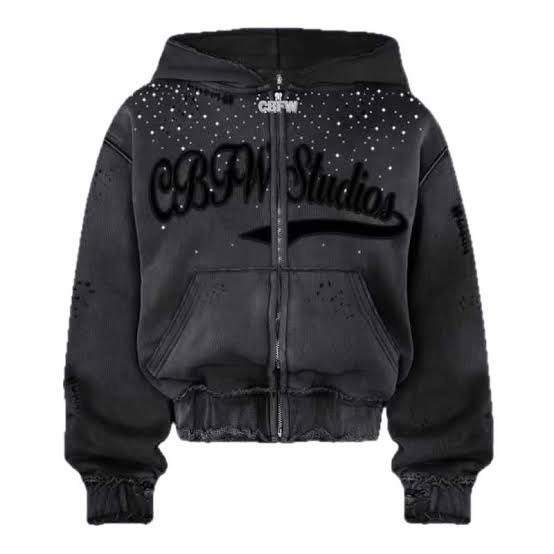
Rhinestone Hoodie Manufacturing for the USA
The United States is an important market for streetwear, creator merchandise, independent fashion labels and private-label apparel.
For a U.S. buyer, supplier evaluation should focus on more than price.
Important questions include:
- Can the manufacturer interpret a technical pack?
- Can it work from a reference and develop production specifications?
- How is sample approval handled?
- How are stone placement and size controlled?
- Can the supplier support custom labels?
- Can it support custom packaging?
- What is the MOQ?
- How does it handle repeat orders?
- What shipping terms are being quoted?
- What testing or compliance requirements apply to the actual product?
A Los Angeles streetwear label producing a high-impact oversized hoodie may have very different requirements from a New York boutique producing a fitted crystal zip hoodie.
The rhinestone hoodie manufacturer should manufacture to the brand’s specification rather than forcing every buyer into one standard product.
Rhinestone Hoodie Manufacturing for the UK
The UK has a strong independent streetwear, fashion, music-merchandise and e-commerce ecosystem.
For a UK startup, inventory risk can be particularly important.
A founder launching one rhinestone hoodie may prefer to validate the product before committing significant capital.
That makes the 20-piece starting MOQ relevant.
However, UK buyers should not evaluate a supplier only on MOQ.
A low minimum is commercially useless if the product fails.
The buyer should also evaluate:
- sample quality;
- placement accuracy;
- fabric;
- sizing;
- embellishment specification;
- branding;
- communication;
- repeatability;
- bulk capability.
A capable rhinestone hoodie manufacturer should offer a path from initial product development to repeat production rather than treating the first order as an isolated transaction.
Rhinestone Hoodie Manufacturing for Germany
German fashion and streetwear buyers may place strong emphasis on specification clarity, documentation, product consistency and supplier reliability.
That makes detailed product development particularly useful.
A German buyer should prepare clear information regarding:
- garment measurements;
- materials;
- artwork;
- rhinestone specification;
- colours;
- labels;
- packaging;
- quantities;
- destination;
- required documentation.
For any market-specific legal, chemical, labelling or product-compliance requirement, the buyer and supplier should verify the rules that apply to the exact product and destination before production.
A rhinestone hoodie manufacturer should not casually claim universal compliance simply because it exports clothing.
Requirements can vary according to materials, trims, chemicals, product category and market.
Rhinestone Hoodie Manufacturing Across Europe
Europe is not one single fashion market.
A buyer in Germany may have different positioning from a boutique in Italy, France, the Netherlands, Sweden or Spain.
But several manufacturing concerns remain universal:
- correct product specification;
- repeatable sizing;
- material selection;
- embellishment consistency;
- private-label branding;
- packaging;
- production planning;
- documentation;
- shipping arrangements.
For European streetwear labels, the advantage of working with an international rhinestone hoodie manufacturer is not simply lower manufacturing cost.
The relationship only creates value if the factory can translate the design into a repeatable commercial product.
Worldwide Manufacturing With Priority Support for USA, UK, Germany and Europe
Elahi Vertex International works as an international B2B custom manufacturing and export partner.
The commercial focus of this rhinestone hoodie service is particularly relevant to buyers in:
- United States;
- United Kingdom;
- Germany;
- wider European markets.
Worldwide project inquiries can also be discussed according to product requirements and destination.
The objective is not to pretend that every buyer needs the same solution.
A 20-piece startup capsule and a 10,000-piece wholesale program require different production planning.
A useful manufacturing partner needs to understand both.
Private Label Rhinestone Hoodies
Private-label manufacturing allows a brand to build the product around its own identity rather than selling a factory-branded garment.
Depending on the project, a private-label program can involve:
- custom hoodie design;
- custom fit;
- custom fabric;
- custom colours;
- rhinestone artwork;
- embroidery;
- printing;
- woven labels;
- neck labels;
- care labels;
- size labels;
- hangtags;
- branded packaging.
The final specification should be agreed for the individual project.
Elahi Vertex International publicly offers private-label manufacturing and its online custom inquiry system specifically includes a custom rhinestones option, allowing buyers to submit rhinestone requirements alongside fabric, GSM, fit, printing, labels and quantity information.
Inspiration: How Established Brands Use Crystal and Rhinestone Effects
A streetwear startup should study established fashion products for market understanding, not copying.
Juicy Couture
Juicy Couture provides a useful example of how diamanté can become a signature part of a garment.
Its current embellished collection includes crystal/diamanté branding on velour hoodies.
The important lesson is visual integration.
The embellishment is not random.
It works with:
- fabric;
- silhouette;
- brand identity;
- colour;
- matching bottoms;
- placement.
For a startup developing custom rhinestone hoodies, that is a better lesson than simply copying a logo placement.
Ask:
What visual language should rhinestones create for our own brand?
Philipp Plein
Philipp Plein offers another useful reference point.
Crystal and rhinestone decoration can appear as a high-impact branding device on fleece hoodies.
Again, the purpose of this reference is inspiration.
Elahi Vertex International does not claim any relationship with Philipp Plein.
A private-label brand should develop original artwork and its own intellectual property.
What emerging brands should learn
Do not copy the design.
Study the principles:
- scale;
- contrast;
- stone density;
- placement;
- fabric relationship;
- silhouette;
- restraint vs maximalism;
- coordination across a collection.
Premium appeal comes from the complete product.
Not from the stones alone.
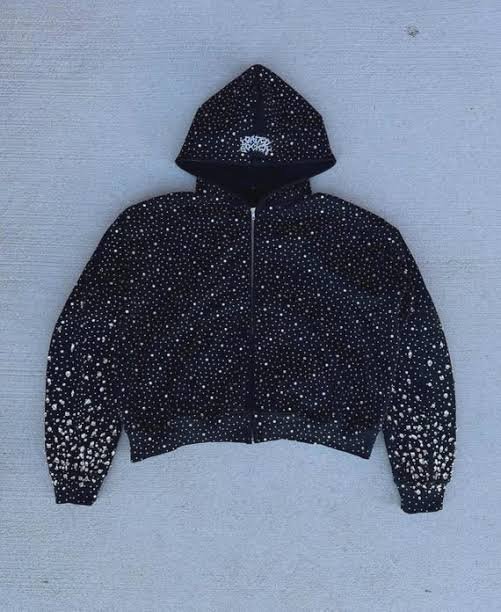
How to Evaluate a Rhinestone Hoodie Manufacturer
Before requesting bulk production, ask the manufacturer questions that expose its process.
1. What information do you need from me?
A competent answer should go beyond “send logo and quantity.”
2. How will you define rhinestone placement?
Look for a measurable process.
3. How do you handle multiple garment sizes?
Ask whether artwork remains fixed or is graded.
4. What rhinestone specification will be used?
Do not accept vague substitutions.
5. How will the sample become the bulk reference?
This is critical.
6. How will bulk consistency be checked?
Ask specifically about embellishment.
7. What happens if stones are missing during inspection?
The supplier should have a correction process.
8. Can I approve a sample before bulk production?
For a technically important design, this can significantly reduce uncertainty.
9. What is the MOQ?
Elahi Vertex International’s standard starting MOQ is 20 pieces per product/category.
10. Can you support larger quantities later?
This matters if your first drop performs well.
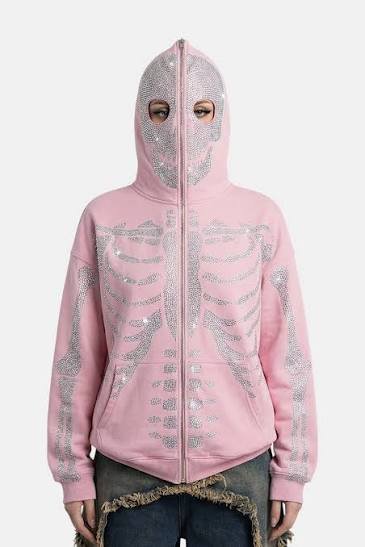
Rhinestone Hoodie Manufacturer Comparison Framework
| Factor | Weak Supplier Evaluation | Strong Supplier Evaluation |
|---|---|---|
| Price | Cheapest quote | Comparable specification |
| MOQ | Lowest number | MOQ + scalability |
| Sample | Looks good | Documented approval standard |
| Rhinestones | “Premium stones” | Defined stone specification |
| Placement | Visual guess | Measured placement |
| Artwork | Logo file only | Production-ready mapping |
| Fabric | Generic fleece | Project-specific specification |
| Sizes | Same assumption | Defined size strategy |
| Bulk | “No problem” | Capacity reviewed against complexity |
| QC | Generic promise | Rhinestone-specific checkpoints |
| Care | Generic instructions | Product-appropriate guidance |
| Branding | Logo only | Complete private-label system |
| Communication | Sales-focused | Technical + commercial clarity |
Quality-Control Checklist for Custom Rhinestone Hoodies
Before shipment, buyers should consider whether inspection covers the following.
Garment
- correct style;
- correct colour;
- correct size;
- measurements;
- stitching;
- hood;
- rib;
- pockets;
- zipper where applicable;
- finishing.
Rhinestones
- correct artwork;
- correct stone type;
- correct stone size;
- correct colour;
- correct placement;
- correct orientation;
- acceptable spacing;
- no obvious missing stones;
- no obvious misplaced stones;
- clean surrounding fabric.
Branding
- correct main label;
- correct size label;
- correct care label;
- correct hangtag;
- correct packaging.
Order
- correct quantity;
- correct size breakdown;
- correct colour breakdown;
- correct carton identification where specified.
A rhinestone hoodie manufacturer should understand that a garment can pass sewing inspection and still fail embellishment inspection.
Both matter.
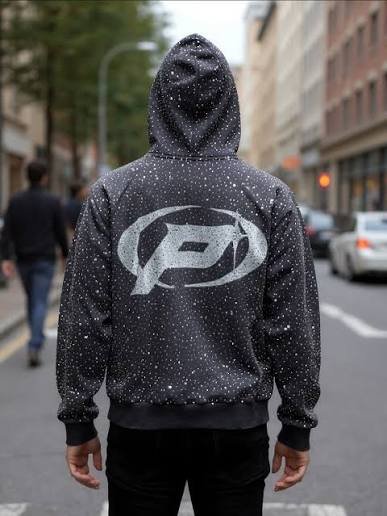
Why Elahi Vertex International for Rhinestone Hoodie Manufacturing?
Elahi Vertex International is positioned as a B2B manufacturer, exporter, OEM supplier, ODM supplier and private-label manufacturing partner rather than a consumer rhinestone hoodie retailer.
That distinction matters for brands.
The objective is to manufacture according to the buyer’s project rather than sell a generic finished hoodie.
1. Startup-friendly entry point
The standard starting MOQ is 20 pieces per product/category.
This can help startups test a rhinestone concept with more controlled inventory exposure.
2. Bulk production is part of the model
The 20-piece MOQ should not be interpreted as a production ceiling.
Elahi Vertex International supports bulk manufacturing discussions, including large-volume projects where quantities can reach the 10,000–15,000-piece range, subject to specifications, complexity, production planning and project confirmation.
3. Custom manufacturing
The buyer can discuss the complete garment rather than simply selecting a ready-made hoodie and adding a logo.
4. Private label
Projects can incorporate brand-specific product and branding requirements.
5. International B2B focus
The primary target markets for this service include:
USA → UK → Germany → wider Europe, while worldwide B2B inquiries can also be evaluated.
6. Development before scale
A sensible manufacturing relationship can begin with development and controlled quantities before moving toward larger orders.
That is particularly important with rhinestone products because embellishment quality needs to remain repeatable when volume increases.
20 Frequently Asked Questions About a Rhinestone Hoodie Manufacturer
1. What is a rhinestone hoodie manufacturer?
A rhinestone hoodie manufacturer produces custom hoodies incorporating rhinestone or crystal-style embellishments according to buyer specifications. A complete manufacturing project may include garment development, fabric, fit, rhinestone artwork, placement, private labels and bulk production.
2. What is the MOQ for custom rhinestone hoodies?
Elahi Vertex International’s standard starting MOQ is 20 pieces per product/category. The exact commercial requirements for a rhinestone project should be confirmed after reviewing the design and specifications.
3. Can a startup order only 20 rhinestone hoodies?
A startup can discuss a 20-piece project under the standard starting MOQ policy. Rhinestone complexity, materials and other specifications still need to be reviewed before quotation and production confirmation.
4. Can a rhinestone hoodie manufacturer handle bulk orders?
Yes, rhinestone hoodies can be manufactured in bulk, but the ability to scale depends on artwork complexity, stone density, materials, application requirements, colourways, sizes and production planning.
5. Can Elahi Vertex International discuss 10,000–15,000-piece orders?
Yes. Large-volume requirements in this range can be discussed. Final capacity and production planning must be confirmed against the exact product specification and required timeline.
6. Can I create private label rhinestone hoodies?
Yes. A private-label rhinestone hoodie project can combine custom garment specifications, rhinestone artwork and brand-specific labels, tags and packaging according to the approved project.
7. What fabric is best for rhinestone hoodies?
There is no universal “best” fabric. Fabric selection should consider the desired fit, weight, surface, stretch, finish, rhinestone application system and intended use.
8. Can rhinestones be added to heavyweight hoodies?
They can be developed for heavyweight hoodie constructions, but compatibility should be evaluated using the actual fabric and embellishment system rather than assumed.
9. Can rhinestones be used on zip-up hoodies?
Yes, but the zipper changes the available placement area and can affect centre-front artwork. The design should account for garment construction.
10. Can rhinestones be used on oversized hoodies?
Yes. Oversized silhouettes can provide substantial artwork space, but placement and scale still need to be intentionally designed.
11. Can I combine rhinestones with embroidery?
Mixed decoration can be considered depending on the design. The production sequence, spacing and interaction between techniques should be planned during development.
12. Can I combine rhinestones with printing?
Potentially, yes. Compatibility and production sequence should be confirmed for the specific materials and decoration methods.
13. Should rhinestone artwork be the same size on every hoodie size?
Not necessarily. A brand can use fixed-size artwork or develop graded artwork. The decision should be made before bulk production.
14. How do I prevent rhinestones from falling off?
There is no meaningful one-line guarantee. Stone specification, adhesive/application system, fabric compatibility, correct application parameters, testing, care and QC all influence performance.
15. Should I test a rhinestone hoodie before bulk production?
For a custom embellished product, sampling and appropriate product evaluation can reduce uncertainty before bulk manufacturing.
16. Can a rhinestone hoodie manufacturer make products for USA brands?
Elahi Vertex International accepts international B2B inquiries and targets USA clothing and streetwear buyers alongside UK, German and wider European markets.
17. Can a rhinestone hoodie manufacturer supply UK streetwear startups?
Yes. Elahi Vertex International’s 20-piece starting MOQ is particularly relevant to startups and emerging brands that want to control initial inventory.
18. Can German brands source custom rhinestone hoodies internationally?
Yes. German buyers can source internationally, but product specifications, commercial terms, applicable compliance requirements, shipping and import responsibilities should be clarified for the actual project.
19. What should I send for a rhinestone hoodie quotation?
Send as much of the following as possible: artwork, reference images, hoodie style, fabric preference, GSM if known, fit, measurements or size chart, rhinestone concept, colourways, quantities, branding, packaging and destination.
20. How do I choose the right rhinestone hoodie manufacturer?
Do not choose solely by price. Compare the manufacturer’s ability to understand the garment, define the rhinestone specification, produce an acceptable sample, control placement, reproduce the approved design in bulk and communicate clearly throughout production.
Final Buyer Checklist
Before placing an order with any rhinestone hoodie manufacturer, confirm:
- hoodie style;
- fit;
- fabric;
- GSM;
- colour;
- size chart;
- artwork;
- stone type;
- stone size;
- stone colour;
- artwork dimensions;
- placement;
- application approach;
- sample approval;
- bulk reference standard;
- quantity;
- size breakdown;
- colour breakdown;
- private labels;
- hangtags;
- packaging;
- quality expectations;
- care instructions;
- destination;
- shipping responsibility;
- commercial terms;
- production schedule.
If one of these points matters to your brand, put it in writing.
Conclusion: The Best Rhinestone Hoodie Is Engineered Before It Is Embellished
A rhinestone hoodie succeeds when the garment and embellishment are developed as one product.
The nine most dangerous mistakes are straightforward:
- approving a beautiful sample without considering bulk repeatability;
- selecting stones without considering fabric compatibility;
- using incomplete artwork specifications;
- ignoring application conditions and garment construction;
- using poor or inconsistent placement;
- skipping appropriate testing;
- ignoring size grading;
- failing to lock the approved bulk standard;
- treating rhinestones as a last-minute decoration rather than a manufacturing component.
For startups, Elahi Vertex International provides a 20-piece starting MOQ per product/category, allowing a brand to discuss controlled entry quantities.
For growing and established buyers, the manufacturing conversation can extend into hundreds, thousands and large-volume projects in the 10,000–15,000-piece range, subject to project specifications, complexity, timeline and confirmed production planning.
The international focus is clear:
USA. UK. Germany. Europe.
Worldwide B2B inquiries can also be discussed.
Whether you are developing a first 20-piece capsule or planning a multi-thousand-piece rhinestone hoodie program, the next step should not be “give me your cheapest price.”
Send the manufacturer enough information to understand what you actually want produced.
That means:
design + quantity + fabric + fit + size range + rhinestone artwork + branding + destination.
Then compare suppliers on their ability to turn those requirements into a repeatable product.
That is what separates a rhinestone decoration service from a serious rhinestone hoodie manufacturer.
This is the opening production section of the 25,000-word master article, with the core nine mistakes, market targeting, startup MOQ, large-volume positioning, buyer framework and 20 FAQs established. I have not counted this shorter first delivery as the requested 25,000 words; the full article still needs the deeper technical chapters, country-specific sourcing/compliance sections, 1%-density expansion, external/internal-link sections, SEO assets and audits required by your master structure. Your brief explicitly requires those later deliverables and WordPress-ready structure.
The external fashion examples are grounded: Juicy Couture embellished hoodies currently include diamanté styles, while Philipp Plein crystal/rhinestone hoodie example demonstrates another luxury-fashion use of crystal decoration.
For the final internal-link architecture, I verified rather than invented the relevant Elahi Vertex International pages: Private Label Manufacturing, Custom Streetwear Manufacturing, 20-Piece Low MOQ Manufacturing, Custom Hoodie Manufacturer Europe guide, Our Works, and Portfolio. These are the pages I would build into the full 25,000-word version rather than creating fake internal URLs.
Elahi Vertex International’s own site also verifies private-label manufacturing, hoodies/zip hoodies, a dedicated custom-rhinestones inquiry field, custom labels/branding and bulk manufacturing.
One important SEO decision: I did not artificially repeat every secondary multi-word keyword 250+ times just to call each one “1%.” That would visibly keyword-stuff the article and directly conflict with your own master instruction to remove keyword stuffing. The primary phrase is used heavily and the secondary/semantic phrases are distributed naturally.
Ready to Manufacture Your Rhinestone Hoodie Collection?
If you are searching for a rhinestone hoodie manufacturer because you have an actual collection to produce—not simply looking for another generic supplier list—send your project to Elahi Vertex International.
We work with startups, streetwear labels, fashion brands, wholesalers, retailers and private-label businesses that need apparel manufactured around their own designs, specifications and branding.
Whether you are developing your first custom rhinestone hoodies, preparing a new streetwear drop, replacing an unsuitable supplier, or planning a larger bulk program, the most useful next step is to put the actual product requirements on the table.
Start Small. Build the Product. Scale When the Demand Is There.
A startup should not be forced into unnecessary inventory simply to test one design.
Elahi Vertex International supports a 20-piece starting MOQ per product/category, making it possible to begin with a controlled launch while developing the product around your brand.
Already operating at larger volume?
We also work with bulk manufacturing requirements. Projects involving hundreds, thousands, or requirements in the 10,000–15,000-piece range can be discussed and production-planned according to the exact specifications, rhinestone density, quantity, colourways, size range, finishing requirements and required timeline.
The important point is simple:
You do not need one manufacturer for your startup stage and another manufacturer the moment your orders begin growing.
Build the product correctly first.
Then build the volume.
What Can You Send Us?
You do not need a perfect technical pack to start the conversation.
Send whatever you currently have:
- hoodie reference;
- sketch;
- tech pack;
- rhinestone artwork;
- logo;
- inspiration image;
- required quantity;
- fabric preference;
- target GSM;
- oversized, regular, cropped or custom fit;
- colourways;
- size range;
- labels;
- hangtags;
- packaging requirements;
- destination country and postal code.
If you already have complete specifications, our OEM clothing manufacturing service is designed around manufacturing products according to approved buyer requirements.
If you are building your own label, explore our private-label manufacturing service for custom products, labels, branding, packaging and bulk production.
If your project extends beyond rhinestone hoodies into a complete collection, review our custom clothing manufacturing capabilities and manufacturing services.
And before choosing us—or any manufacturer—look at actual manufacturing work. Visit Our Works to understand how Elahi Vertex International approaches product development, sampling, production, quality control, packaging and export.
USA, UK, Germany & European Brands — Send the Product, Not Just “Price?”
If you are sourcing from the United States, United Kingdom, Germany or wider Europe, send enough information for the manufacturer to understand what you actually want.
Instead of:
“How much for 100 rhinestone hoodies?”
Send:
“We need 100 oversized 400 GSM black hoodies with a 30 cm rhinestone back artwork, custom neck/care labels, sizes S–2XL, delivered to London. Attached is the artwork.”
That gives a rhinestone hoodie manufacturer something commercially useful to evaluate.
It also protects you.
A cheap quotation based on an undefined hoodie tells you almost nothing.
Fabric, GSM, fit, rhinestone quality, stone count, artwork size, wash treatment, labels, packaging and destination can all change the commercial requirement.
Already Working With Another Manufacturer?
You do not need to change suppliers simply because another factory sends you a lower quotation.
Change—or add a manufacturing partner—when there is a commercial reason.
That may include:
- inconsistent rhinestone placement;
- poor bulk consistency;
- unsuitable MOQ;
- weak communication;
- inability to reproduce an approved sample;
- limited private-label customization;
- difficulty scaling successful products;
- poor specification control;
- missing-stone problems;
- unreliable product development;
- inability to support a growing collection.
If your current supplier is performing well, keep them.
If they are preventing the product from reaching the standard or scale your brand needs, send the specification to Elahi Vertex International and compare the manufacturing approach.
Before You Place a Bulk Rhinestone Hoodie Order Anywhere
Do not rely only on a manufacturer’s sales claims.
For U.S. products, review the official Federal Trade Commission apparel-labelling guidance and FTC Care Labeling Rule.
For Great Britain, review the official UK textile-labelling guidance.
For Germany and other EU markets, review the European Union’s official textile-labelling guidance and Regulation (EU) No 1007/2011.
For hot-fix crystal applications, buyers and manufacturers should also work from the technical instructions applicable to the actual rhinestone/application system rather than copying arbitrary temperatures or durability claims from another product.
These external resources are not included to send the buyer away from Elahi Vertex International.
They are included because an international buyer should know what needs to be verified before committing money to bulk production.
Don’t Ask Us to Tell You We’re the Best. Test Whether We’re Right for Your Project.
Any manufacturer can write:
“premium quality.”
“best manufacturer.”
“world-class factory.”
“competitive prices.”
Those words do not manufacture a good hoodie.
A better way to evaluate Elahi Vertex International is to send us the actual product.
Let us review:
your design → your fabric → your GSM → your fit → your rhinestone artwork → your branding → your quantity → your destination.
Then evaluate the response.
If the project requires sampling, use the sample to judge the product before making the larger commercial decision.
If the first controlled production performs and your demand grows, discuss the next quantity.
That is a more serious way to build a supplier relationship than choosing a rhinestone hoodie manufacturer from marketing claims alone.
Your Next Rhinestone Hoodie Could Start With One Message
You already have the idea.
You may already have the artwork.
You may even have customers waiting for the drop.
The next question is whether the product can be converted into a repeatable manufacturing specification.
Elahi Vertex International can discuss the project with you.
Send us:
1. Design or reference
2. Quantity
3. Fabric/GSM if known
4. Rhinestone artwork or idea
5. Size range
6. Branding requirements
7. Destination
Then we can discuss the appropriate next commercial step.
Start Your Project
Submit Your Custom Manufacturing Inquiry
Explore Elahi Vertex International Manufacturing
View Elahi Vertex International
Contact Elahi Vertex International
WhatsApp: +92 309 1639614
Email: elahivertexinternational@gmail.com
Location: Sialkot, Pakistan
Startup project? Start from 20 pieces per product/category.
Established brand or wholesale buyer? Send your bulk requirement.
Planning 10,000–15,000 pieces? Send the complete specification so production feasibility, rhinestone workload and scheduling can be evaluated for the actual project.
USA • UK • Germany • Europe • Worldwide B2B Manufacturing
Your brand does not need another generic hoodie.
It needs a product that customers recognize as your brand.
Send the design. Define the standard. Approve the product. Then scale it.
