

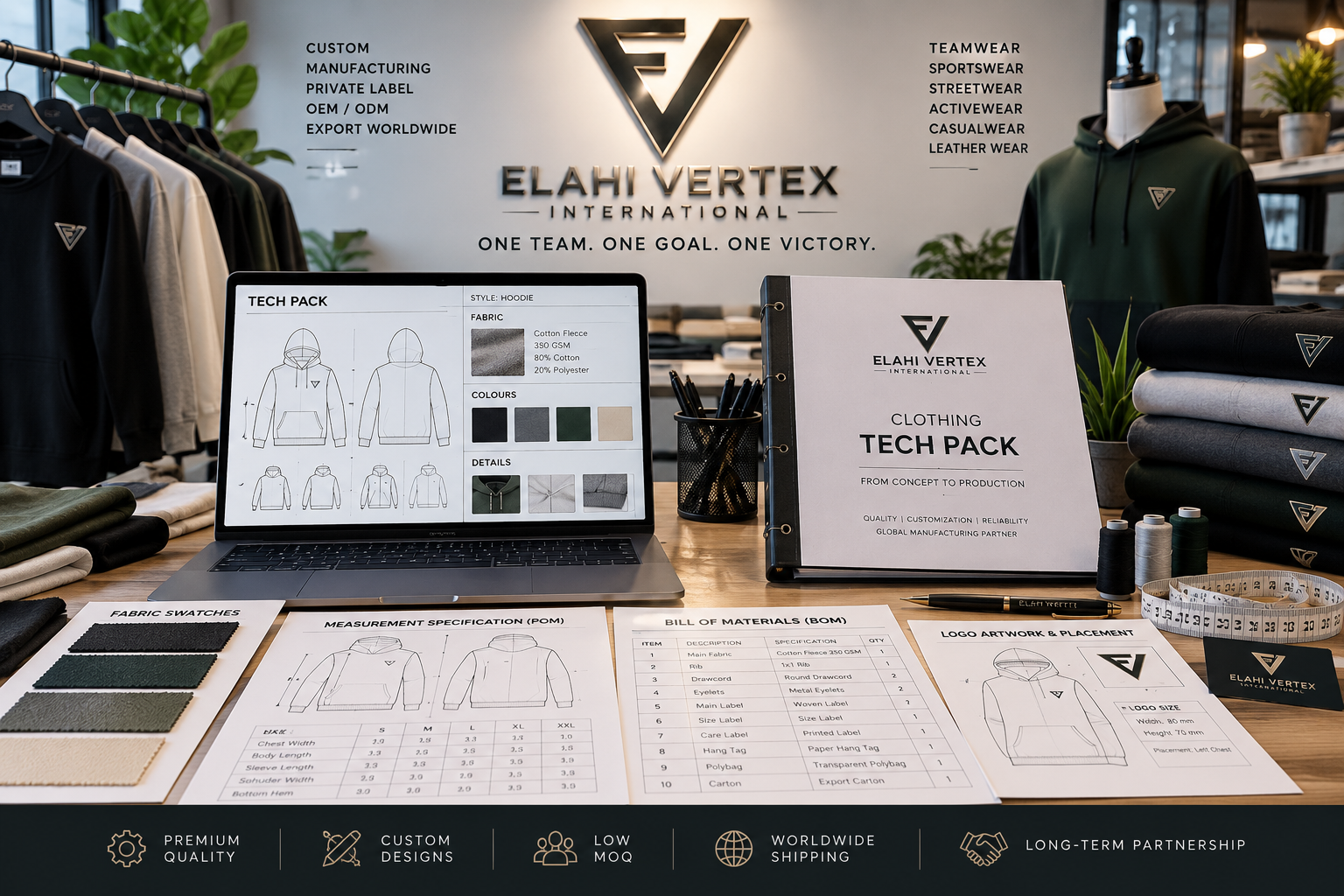
A clothing tech pack is one of the most important documents a clothing brand can prepare before asking a manufacturer to make a sample or begin bulk production. It converts a creative idea into technical manufacturing instructions covering measurements, fabric, construction, colors, artwork, trims, labels, packaging and other product requirements.
A weak clothing tech pack leaves important decisions open to interpretation.
A detailed clothing tech pack reduces that ambiguity.
That distinction matters because a manufacturer cannot manufacture what a brand intended to communicate; the manufacturer can only work from the information, approved references and specifications actually supplied.
For a streetwear hoodie, for example, saying “heavyweight oversized hoodie with embroidery” is not a complete manufacturing specification. The manufacturer may still need the fabric composition, GSM, finished measurements, measurement method, tolerance, rib specifications, hood construction, stitching requirements, Pantone or approved color reference, embroidery dimensions, artwork position, label details and packaging instructions.
This guide explains how brands, designers, sourcing professionals and private-label buyers can create a clothing tech pack that provides clearer instructions before sampling and bulk manufacturing.
It also explains the expensive mistakes a garment tech pack can help prevent, what information belongs in an apparel tech pack, how to prepare useful clothing manufacturing specifications, and what to send a clothing manufacturer before requesting a quotation or sample.
[FEATURED IMAGE — PLACE AFTER INTRODUCTION]
Table of Contents
- What Is a Clothing Tech Pack?
- Why a Clothing Tech Pack Matters Before Manufacturing
- What Should a Professional Clothing Tech Pack Include?
- Product Overview and Style Identification
- Technical Flats and Garment Drawings
- Fabric Composition, GSM and Material Specifications
- Bill of Materials: Fabrics, Trims and Components
- Color Standards and Pantone References
- Measurement Specifications and Points of Measure
- Size Charts, Grading and Tolerances
- Construction and Stitching Instructions
- Printing, Embroidery and Artwork Placement
- Labels, Hangtags and Private-Label Branding
- Packaging Requirements
- Testing and Performance Requirements
- Sample Comments and Revision Control
- 9 Expensive Manufacturing Mistakes a Clothing Tech Pack Can Prevent
- Clothing Tech Pack Checklist Before Sampling
- Clothing Tech Pack Checklist Before Bulk Production
- How to Send a Tech Pack to a Clothing Manufacturer
- Clothing Tech Pack Example for a Hoodie
- Clothing Tech Pack Example for an Oversized T-Shirt
- Clothing Tech Pack Example for Sportswear
- Clothing Tech Pack Example for Activewear
- Tech Pack vs Specification Sheet vs Sample
- Common Clothing Tech Pack Mistakes
- How Elahi Vertex International Works From Buyer Specifications
- Frequently Asked Questions
- Useful External Resources
- Final Clothing Tech Pack Checklist
- Conclusion
20 Authoritative External Resources for Clothing Tech Pack Development
A clothing tech pack should be based on clear product specifications rather than assumptions. Depending on the product and destination market, brands may also need to consider sizing terminology, labeling, care instructions, fiber declarations, product safety and textile testing.
The following resources give buyers useful technical and regulatory context.
1. ISO 8559-1 — Anthropometric Definitions for Body Measurement
ISO 8559-1 provides anthropometric measurement definitions that can support clothing product development and sizing work.
Use it when developing consistent terminology for body measurements and sizing.
Resource: https://www.iso.org/standard/61686.html
2. ISO 8559-2:2025 — Size Designation of Clothes
ISO 8559-2:2025 addresses primary and secondary dimension indicators for clothing size designation.
It is useful when considering how body dimensions relate to garment size designation.
Resource: https://www.iso.org/standard/85590.html
3. ISO 8559-3 — Body Measurement Tables and Intervals
This standard provides methodology for developing body measurement tables and intervals.
It can help brands understand the technical principles behind structured sizing systems.
Resource: https://www.iso.org/standard/67334.html
4. ISO Technical Committee 133 — Clothing Sizing Systems
ISO/TC 133 works on clothing size designation, body-size measurement methods and digital fitting.
Brands developing systematic sizing can use this resource to understand the broader international standards framework.
Resource: https://www.iso.org/committee/52374.html
5. ISO Clothing Standards Directory
ISO maintains a clothing standards category covering multiple standards relevant to clothing sizing and related subjects.
Resource: https://www.iso.org/ics/61.020/x/
6. ISO 5077 — Dimensional Change in Washing and Drying
ISO 5077 specifies a method for determining dimensional changes in fabrics, garments and textile articles after specified washing and drying procedures.
This is especially relevant when shrinkage or dimensional stability matters to the approved finished garment.
Resource: https://www.iso.org/standard/41877.html
7. ISO 105-C06 — Colour Fastness to Laundering
ISO 105-C06 covers methods for assessing textile color resistance during domestic and commercial laundering.
Brands concerned about color performance can specify appropriate testing requirements separately from visual color approval.
Resource: https://www.iso.org/standard/51276.html
8. ISO 105-C10 — Colour Fastness to Washing
ISO 105-C10 addresses textile color fastness to washing with soap or soap and soda.
Resource: https://www.iso.org/standard/31775.html
9. U.S. Federal Trade Commission — Apparel and Labeling
The FTC provides guidance covering labeling matters for textiles and apparel sold in the United States.
Most covered textile and wool products require information including fiber content, country of origin and the identity of the manufacturer or another responsible business.
Resource: https://www.ftc.gov/news-events/topics/tools-consumers/apparel-labeling
10. FTC — Care Labeling Rule
The FTC Care Labeling Rule addresses care instructions for covered textile wearing apparel and certain piece goods.
If the destination is the United States, label development should therefore not be treated as an afterthought at the end of production.
11. FTC — Clothes Captioning: Care Labeling Guidance
This FTC business guide explains practical requirements surrounding garment care labels.
Resource: https://www.ftc.gov/business-guidance/resources/clothes-captioning-complying-care-labeling-rule
12. FTC — Textile and Wool Labeling Guide
The FTC’s Threading Your Way Through the Labeling Requirements Under the Textile and Wool Acts provides detailed guidance on fiber content, country-of-origin and manufacturer/dealer identification requirements.
13. FTC — Clothing and Textiles Business Guidance
This FTC resource brings together business guidance and legal information relevant to clothing and textile companies.
Resource: https://www.ftc.gov/business-guidance/industry/clothing-and-textiles
14. FTC — Wool Products Labeling Rules
Brands developing products containing wool should understand the separate U.S. requirements applicable to covered wool products.
Resource: https://www.ftc.gov/legal-library/browse/rules/wool-products-labeling-rules
15. FTC — Wool Products Labeling Act
This is another useful primary legal reference for brands developing wool products for the U.S. market.
Resource: https://www.ftc.gov/legal-library/browse/rules/wool-products-labeling-act-text
16. U.S. Consumer Product Safety Commission — Clothing Guidance
The CPSC explains requirements concerning the flammability of clothing textiles under 16 CFR Part 1610.
Resource: https://www.cpsc.gov/FAQ/Clothing
17. CPSC — Flammable Fabrics Act
The Flammable Fabrics Act provides the statutory framework under which CPSC establishes mandatory flammability standards for covered products.
Resource: https://www.cpsc.gov/Regulations-Laws–Standards/Statutes/Flammable-Fabrics-Act
18. CPSC — Flammable Fabrics Act Business Guidance
This CPSC resource gives businesses additional guidance about the Flammable Fabrics Act and general wearing apparel.
19. UK Government — Textile Labelling
For clothing intended for Great Britain, GOV.UK provides guidance for manufacturers and retailers on textile labeling requirements, including fiber-content information.
Resource: https://www.gov.uk/guidance/textile-labelling
20. Textile Exchange — Recycled Claim Standard and Global Recycled Standard
When a brand intends to make certified recycled-content claims, Textile Exchange’s RCS and GRS resources explain relevant certification and chain-of-custody frameworks.
Resource: https://textileexchange.org/recycled-claim-global-recycled-standard/
What Is a Clothing Tech Pack?
A clothing tech pack is a technical product-development document that communicates how a garment should be developed and manufactured.
Think of the design concept as the idea and the clothing tech pack as the set of instructions needed to turn that idea into a physical garment.
A professional tech pack can contain:
- Style name and style number
- Product description
- Technical flats
- Front and back views
- Detail drawings
- Fabric composition
- Fabric weight or GSM
- Fabric construction
- Color references
- Bill of materials
- Trims
- Hardware
- Thread requirements
- Measurement chart
- Points of measure
- Measurement instructions
- Size grading
- Tolerances
- Stitching instructions
- Seam construction
- Artwork
- Print dimensions
- Embroidery dimensions
- Artwork placement
- Label specifications
- Care-label information
- Hangtags
- Packaging requirements
- Testing requirements where applicable
- Sample comments
- Revision history
- Approval status
Not every product requires exactly the same fields.
A basic T-shirt and a technical performance jacket have very different manufacturing requirements. The clothing tech pack should therefore be detailed enough for the actual product rather than copied blindly from a generic template.
The simplest definition
A clothing tech pack tells the manufacturer:
what to make, what materials to use, what dimensions to follow, how components should be assembled, where branding should be positioned and what approved result the buyer expects.
That is why the quality of the information matters more than making the document look complicated.
Why Does a Clothing Tech Pack Matter Before Manufacturing?
Manufacturing errors often begin much earlier than sewing.
They can begin when a specification is missing.
Consider this instruction:
“Make an oversized black hoodie with our logo.”
It sounds clear until production questions begin.
What does oversized mean?
What finished chest measurement should Medium have?
How long should the body be?
What fabric composition is required?
What GSM is required?
Is the surface brushed or unbrushed?
What black reference is approved?
How large is the logo?
Where is the logo measured from?
Is it embroidery, screen printing or another decoration method?
What rib composition and dimensions are required?
What hood construction is required?
Are drawcords required?
What label should be installed?
How should the garment be folded and packed?
The buyer may have an answer to every one of these questions in their head.
The manufacturer does not.
A clothing tech pack moves those decisions from memory, scattered messages and assumptions into one controlled specification.
That improves communication during:
Concept development → quotation → material sourcing → pattern development → sampling → fitting → revisions → approval → bulk production → inspection → repeat orders.
A Clothing Tech Pack Reduces Interpretation
A manufacturer should not have to guess whether “large logo” means 10 cm or 30 cm.
A garment tech pack can specify:
Finished embroidery width: 90 mm
That is measurable.
“Premium fabric” is subjective.
A clothing tech pack can instead specify the agreed fiber composition, fabric construction, weight, finish and approved reference.
“Loose fit” is subjective.
A measurement chart makes the intended finished dimensions clearer.
This is the fundamental commercial value of technical specifications:
Replace subjective language with measurable requirements wherever reasonably possible.
Clothing Tech Pack vs Mood Board
These documents serve different purposes.
| Document | Primary Purpose |
|---|---|
| Mood board | Communicates creative direction |
| Sketch | Communicates visual idea |
| Tech pack | Communicates technical product requirements |
| Size chart | Defines dimensions |
| BOM | Defines materials/components |
| Artwork file | Defines graphic artwork |
| Physical sample | Provides a tangible construction/fit reference |
| Approved sample | Establishes an agreed physical benchmark |
A mood board can tell a manufacturer that you want a premium vintage streetwear aesthetic.
It cannot reliably communicate a finished chest width.
A photograph can show the appearance of a pocket.
It may not define its exact dimensions.
A clothing tech pack connects the creative and technical sides of the product.
The Commercial Cost of an Incomplete Garment Tech Pack
Poor specifications do not automatically mean the finished product will fail.
They do, however, create unnecessary uncertainty.
That uncertainty can lead to:
- More clarification rounds
- Additional sample revisions
- Incorrect assumptions
- Material misunderstandings
- Fit differences
- Wrong artwork dimensions
- Wrong artwork positions
- Trim substitutions
- Packaging mistakes
- Longer product-development cycles
- Disputes over what was actually approved
Every unnecessary sample revision consumes time and money.
That is why a good clothing tech pack is not merely a design document.
It is also a risk-control document.
Strong CTA: Turn Your Clothing Tech Pack Into a Manufacturing-Ready Project
Once your clothing tech pack is complete, the next step should not be sending it randomly to dozens of factories.
Send it to a manufacturer that can review the specifications against the product you actually want to develop.
Elahi Vertex International provides custom B2B clothing manufacturing for brands, startups, wholesalers, retailers, teams and other international buyers.
Explore our Custom Clothing Manufacturing service:
Review our complete Manufacturing capabilities:
For private-label projects, visit:
Want to see the type of custom apparel represented on our website?
Ready to discuss a product?
Send your design, clothing tech pack, measurements, fabric requirements, branding details, quantity and destination to Elahi Vertex International for project-specific manufacturing discussion.
What Should a Professional Clothing Tech Pack Include?
There is no benefit in making a clothing tech pack complicated merely to make it look professional.
The objective is completeness and clarity.
A useful apparel tech pack should answer the technical questions that affect the product.
For many custom garments, the following structure works well.
| Tech Pack Section | Information to Define |
|---|---|
| Cover page | Style name, style number, season/version |
| Technical flats | Front, back and detailed garment views |
| Fabric | Composition, construction, GSM/weight, finish |
| Colors | Color names and approved references |
| BOM | Fabrics, rib, zippers, buttons, drawcords, labels etc. |
| Measurements | Finished garment dimensions |
| POM | How every measurement is taken |
| Grading | Size-to-size measurement changes |
| Tolerance | Acceptable measurement deviation |
| Construction | Seams, stitches, reinforcement and assembly |
| Artwork | Files, dimensions, colors and placement |
| Branding | Main label, size label, care label, patches etc. |
| Packaging | Folding, polybag, carton and identification |
| Testing | Project-specific testing/performance requirements |
| Comments | Sample corrections and approvals |
| Revision history | Version/date/change tracking |
Let us break these sections down individually.
1. Start the Clothing Tech Pack With Product Identification
Every clothing tech pack should clearly identify the product.
Do not rely only on the filename.
Include information such as:
Brand: [Brand Name]
Style Name: Heavyweight Oversized Hoodie
Style Number: HD-001
Category: Streetwear Hoodie
Gender/Market: As applicable
Season/Collection: AW27
Tech Pack Version: V1.0
Revision Date: [Date]
Prepared By: [Name/Department]
The style number is particularly useful.
Imagine developing six hoodies simultaneously.
“Black hoodie” quickly becomes ambiguous.
HD-001 is much easier to track.
The same identifier can appear on:
- Tech pack
- Quotation
- Sample
- Pattern
- Purchase order
- Artwork
- Packaging instructions
- Inspection documentation
- Repeat order
Use revision numbers
Version control is one of the easiest ways to prevent avoidable errors.
Suppose:
V1 specifies a 70 cm body length.
V2 changes it to 72 cm.
V3 changes it to 71 cm after the fit sample.
If the manufacturer and buyer are referring to different files, confusion becomes likely.
Your clothing tech pack should therefore show:
Current approved revision: V3
Older files should be clearly archived or marked obsolete.
2. Add Clear Technical Flats to the Clothing Tech Pack
Technical flats are simplified garment drawings that communicate construction and design details.
For most products, include:
Front view
Back view
Then add side or detail views where necessary.
For a hoodie, detail drawings might show:
- Hood construction
- Neck seam
- Kangaroo pocket
- Cuffs
- Waist rib
- Drawcord
- Eyelets
- Shoulder seam
- Sleeve construction
- Label position
- Embroidery position
A complex jacket may require considerably more.
Fashion illustration is not enough
A fashion illustration communicates appearance.
A technical flat communicates construction.
The difference matters.
A dramatic illustration may make a jacket look excellent but hide:
- Seam positions
- Pocket construction
- Closure
- Panels
- Topstitching
- Cuff design
- Hem construction
Your garment tech pack should favor technical clarity.
Front and back views are the minimum starting point
Do not assume the back is identical simply because the front is shown.
If there is no artwork on the back, state it.
If the back has a seam, show it.
If the sleeves have graphics, provide a sleeve view.
If the hood contains embroidery, show the position.
Manufacturing rule: if a detail matters, document it.
3. Define Fabric Precisely in Your Clothing Tech Pack
Fabric is one of the biggest sources of misunderstanding in custom clothing.
“Cotton” is not a complete fabric specification.
Neither is:
“Premium cotton”
“Soft fleece”
“Sports polyester”
“High-quality fabric”
These phrases are too broad for technical manufacturing.
Your clothing tech pack should identify as much verified material information as the product requires.
This may include:
- Fiber composition
- Fabric construction
- Fabric weight/GSM
- Knit or woven structure
- Stretch requirement
- Surface finish
- Brushing
- Wash/finish
- Color
- Approved swatch/reference
- Performance requirements
- Testing requirements where relevant
Example: weak vs stronger fabric specification
Weak:
Black cotton fleece.
Stronger:
Cotton-rich fleece, target composition and GSM as specified in the approved material sheet, black to approved color reference, brushed interior, subject to approved sample/swatches.
The exact numbers should come from the brand’s actual product requirements.
Do not copy another brand’s GSM because it sounds premium.
A clothing tech pack exists to define your product.
4. Put GSM in the Clothing Tech Pack
GSM means grams per square metre.
It describes fabric mass per unit area.
GSM can influence garment hand feel, structure, warmth and perceived weight, but it should never be treated as the only measure of quality.
Two fabrics with similar GSM can still behave differently because of:
- Fiber composition
- Yarn
- Knit/weave construction
- Finishing
- Brushing
- Density
- Stretch
- Surface treatment
Your clothing manufacturing specifications should therefore not use GSM in isolation.
A useful fabric specification combines GSM with composition, construction, finish and approved physical reference where appropriate.
Why this matters
If your clothing tech pack simply says:
“Heavyweight hoodie.”
Different people can interpret “heavyweight” differently.
If it defines an agreed fabric specification, the sourcing target becomes much clearer.
5. Create a Bill of Materials
The Bill of Materials—or BOM—is one of the most important parts of a professional apparel tech pack.
The BOM lists the components required to make the product.
For a hoodie, that could include:
- Main body fabric
- Rib
- Pocket fabric
- Drawcord
- Eyelets
- Sewing thread
- Main brand label
- Size label
- Care/content label
- Embroidery thread
- Hangtag
- Polybag
- Carton identification
For a varsity jacket, the BOM could become considerably more detailed.
It might include:
- Body material
- Sleeve material
- Lining
- Interlining
- Rib
- Snap buttons
- Pocket lining
- Embroidery
- Chenille patches
- Main label
- Size label
- Care label
- Hangtag
- Packaging
Example BOM structure
| Item | Component | Specification | Color | Supplier/Reference | Notes |
|---|---|---|---|---|---|
| 01 | Main fabric | Approved specification | Black | Approved swatch | Body |
| 02 | Rib | Approved rib specification | Black | Approved swatch | Cuff + hem |
| 03 | Main label | Woven | Brand colors | Artwork file | Neck |
| 04 | Care label | Printed | Black/white | Approved artwork | Side seam |
| 05 | Embroidery | Logo | Approved colors | Artwork | Left chest |
The more complex the garment, the more valuable the BOM becomes.
6. Define Colors Instead of Saying “Black,” “Red” or “Blue”
Color names alone can be surprisingly ambiguous.
“Forest green.”
Which forest green?
“Navy.”
Which navy?
“Cream.”
How warm?
“Off-white.”
How far from white?
The clothing tech pack should use an agreed color-control method appropriate to the project.
That might include:
- Pantone reference
- Lab dip
- Approved fabric swatch
- Approved sample
- Artwork color values where appropriate
A digital screen should not automatically be treated as the final physical color standard because screens and physical textiles reproduce color differently.
Add colorways systematically
If the same garment will be produced in multiple colors, create a colorway table.
| Component | Black Colorway | Cream Colorway | Green Colorway |
|---|---|---|---|
| Main fabric | Approved Black | Approved Cream | Approved Green |
| Rib | Matching | Matching | Matching |
| Embroidery | White | Black | Cream |
| Drawcord | Black | Cream | Green |
| Main label | Standard | Standard | Standard |
This reduces the risk of components being assigned to the wrong colorway.
7. Measurements: The Core of a Clothing Tech Pack
One of the most important sections of any clothing tech pack is the measurement specification.
A manufacturer cannot reliably reproduce a fit from words such as:
- Oversized
- Slim
- Relaxed
- Baggy
- Cropped
- Long
- Wide
Those are design directions.
Measurements define the garment.
A finished measurement table might include:
| POM | Measurement | XS | S | M | L | XL | Tolerance |
|---|---|---|---|---|---|---|---|
| A | Chest width | Brand spec | Brand spec | Brand spec | Brand spec | Brand spec | Defined |
| B | Body length | Brand spec | Brand spec | Brand spec | Brand spec | Brand spec | Defined |
| C | Shoulder | Brand spec | Brand spec | Brand spec | Brand spec | Brand spec | Defined |
| D | Sleeve length | Brand spec | Brand spec | Brand spec | Brand spec | Brand spec | Defined |
| E | Bottom opening | Brand spec | Brand spec | Brand spec | Brand spec | Brand spec | Defined |
The numbers should come from your actual pattern/fit requirements.
Do not use generic internet size charts without validating them against your target customer and desired fit.
8. Define Every Point of Measure
A measurement number without a measurement method can still cause confusion.
Suppose your tech pack states:
Chest: 60 cm
Where exactly is the chest measured?
How far below the armhole?
Is the garment measured flat?
Is the measurement across the front only?
Is the fabric relaxed?
The clothing tech pack should define each Point of Measure, commonly abbreviated POM.
For example:
POM A — Chest Width
Measure straight across the garment from underarm point to underarm point with garment laid flat and relaxed.
POM B — Body Length
Measure from the specified high shoulder point vertically to the finished bottom hem.
The exact method should match the brand’s approved measuring procedure.
[IMAGE 2 — PLACE HERE: TECHNICAL GARMENT MEASUREMENT DIAGRAM]
Why POM diagrams are powerful
Text helps.
A diagram is often clearer.
Place arrows directly on the technical flat and label them:
A
B
C
D
E
Then match those codes to the measurement table.
That creates a visual system that both buyer and manufacturer can follow.
9. Add Measurement Tolerances
Manufacturing textiles is not the same as machining a solid metal component.
Fabric can stretch, relax, shrink and react to processing.
For that reason, a clothing tech pack may include agreed measurement tolerances.
Tolerance means the acceptable deviation from the target finished measurement.
The appropriate tolerance depends on the garment, measurement point, material, construction and buyer requirements.
Do not copy arbitrary tolerances from an internet template.
Define them with the manufacturer for the actual product.
Why tolerance matters
Without tolerance, a target measurement alone does not define what is acceptable.
Suppose the target is:
70 cm.
Is 70.2 acceptable?
69.5?
71?
The tolerance determines the acceptance range.
This is particularly important when the clothing tech pack later supports inspection.
10. Add Size Grading
Grading defines how measurements change between sizes.
Do not assume every dimension increases by the same amount.
A professional garment tech pack should show the actual approved size measurements or grading rules.
For example:
XS → S → M → L → XL
Chest may change according to one grading rule.
Body length may change according to another.
Sleeve length may use another.
Some measurements may barely change.
Others may change more significantly.
Base size first
Brands commonly develop and approve a base size first.
Once the base fit is correct, grading can be reviewed across the remaining sizes.
But the grading rules should still be documented before bulk production.
A perfectly approved Medium does not automatically guarantee a good XXL.
11. Specify Construction and Stitching
A clothing tech pack should tell the manufacturer how important areas of the garment are intended to be constructed.
Depending on the product, specifications may include:
- Seam type
- Stitch type
- Stitch appearance
- Topstitching
- Overlock
- Coverstitch
- Reinforcement
- Bartacks
- Hem construction
- Binding
- Rib attachment
- Pocket construction
- Zipper installation
- Lining attachment
- Panel assembly
Avoid writing technical stitch terminology unless you actually understand and require it.
Incorrect technical instructions can be worse than clear communication supported by a reference sample.
If you are unsure, identify the desired appearance and performance and discuss construction with the manufacturer during development.
12. Artwork Needs More Than a Logo File
One of the most common clothing tech pack weaknesses is artwork communication.
A buyer sends a logo.
The manufacturer still needs to know:
Where does it go?
How large is it?
What production method is required?
What color is it?
How is the position measured?
What file is approved?
Your artwork page should specify:
- Artwork name
- Artwork version
- Vector/source file where applicable
- Finished width
- Finished height
- Color references
- Decoration method
- Exact placement
- Measurement from reference points
- Orientation
- Special finish
- Approved sample reference
Example
Artwork: EV-Chest-01
Method: Embroidery
Finished width: [approved dimension]
Position: Left chest
Placement: [approved distance] from center/front or seam reference
Colors: According to approved artwork
File: EV-Chest-01.ai
That is much more useful than:
“Put logo on chest.”
13. Specify Print Method
Different decoration methods produce different appearances and performance.
Depending on the garment and artwork, possible methods include:
- Screen printing
- Embroidery
- Sublimation
- Heat transfer
- DTG
- DTF
- Appliqué
- Patches
- Puff effects
- Specialty finishes
Do not leave the method open if the method itself is part of the design.
Your clothing tech pack should define the intended result.
For example, a 10 cm black logo can look completely different when produced as:
Flat embroidery
Puff embroidery
Screen print
DTF transfer
Rubber patch
The artwork dimensions may be identical while the final product appearance is not.
14. Define Artwork Placement With Measurements
Visual mockups alone are risky.
The logo may look centered on the screen but still be interpreted differently during manufacturing.
Specify measurable placement.
For example:
Center-front print
Top of artwork positioned [X] cm below the approved neck reference point.
Or:
Left chest embroidery
Artwork center positioned according to specified horizontal and vertical references.
Use a diagram wherever possible.
This turns subjective positioning into measurable clothing manufacturing specifications.
15. Add Label Specifications to Your Clothing Tech Pack
Labels should not be treated as an afterthought.
Depending on the destination market and product, your garment may need or use:
- Main brand label
- Size label
- Fiber/content label
- Country-of-origin information
- Care label
- Compliance information
- Hangtag
- Barcode/SKU label
- Packaging sticker
For U.S. products, relevant FTC rules can require fiber content, country of origin and responsible-company identification on covered textile products, while the Care Labeling Rule covers care instructions.
For Great Britain, textile labeling rules include fiber-content requirements.
The exact legal requirements depend on the product and destination market.
Your clothing tech pack should therefore include approved label artwork rather than telling the manufacturer simply to “add care label.”
16. Main Brand Label
Specify:
- Label type
- Finished dimensions
- Material
- Fold type
- Logo/artwork
- Colors
- Attachment
- Placement
If the brand label must sit exactly at the center back neck, state that.
If it is printed directly into the garment instead of sewn, document that.
If there is a separate size tab, show its relationship to the main label.
17. Care Label
A care label should reflect appropriate care instructions for the actual garment.
Do not simply copy care instructions from another product.
Fabric, dye, decoration, trim and garment construction can affect suitable care.
For U.S. covered apparel, FTC rules require manufacturers and importers to have a reasonable basis for care instructions.
That is important.
Your apparel tech pack should not treat washing instructions as decorative copy.
18. Country-of-Origin and Fiber Information
Destination-market requirements should be reviewed before label production.
For covered U.S. textile products, FTC guidance explains requirements around fiber content, country of origin and manufacturer/dealer identification.
For Great Britain, GOV.UK states that textile labels must show fiber content.
Requirements can differ between markets.
If the same collection will be sold internationally, verify the requirements for each destination before approving final label artwork.
19. Packaging Specifications
The garment can be manufactured correctly and still reach the buyer in packaging that does not meet their requirements.
Include packaging information in the clothing tech pack or associated packaging specification.
Possible fields include:
- Folding method
- Tissue requirements
- Polybag type
- Polybag dimensions
- Warning information where applicable
- Size sticker
- SKU sticker
- Barcode
- Hangtag attachment
- Individual packing
- Assortment
- Carton quantity
- Carton marks
- Shipping marks
The appropriate requirements depend on the buyer, retailer, destination and shipping model.
20. Add Testing Requirements Before Production
A clothing tech pack can also identify testing requirements where relevant.
Possible textile performance considerations include:
- Dimensional change
- Colorfastness
- Fabric performance
- Stretch/recovery
- Seam performance
- Pilling
- Abrasion
- Print durability
- Flammability where legally applicable
- Other destination/product-specific requirements
Do not write:
“Must pass all international standards.”
That statement is too vague.
Which standard?
Which test method?
Which performance requirement?
Which market?
Which product?
Define actual requirements.
For example, ISO 5077 provides a method for determining dimensional change after washing and drying, while ISO 105-C06 addresses colorfastness to laundering.
A technical requirement should identify the relevant standard/test and acceptance criteria when applicable.
21. Add Sample Comments to the Clothing Tech Pack
Sampling is not merely a yes/no decision.
A sample should generate structured comments.
Instead of sending:
“Sleeves are wrong.”
Write:
Sleeve length: sample measured X; target Y according to POM D. Correct next sample to approved specification.
Instead of:
“Logo too low.”
Write:
Move artwork upward according to revised artwork-placement diagram on page X.
That gives the manufacturer actionable information.
22. Use a Sample Comment Table
| Issue | Approved Specification | Sample Result | Required Correction | Status |
|---|---|---|---|---|
| Chest | Tech pack POM | Measured result | Correct to target | Open |
| Logo position | Artwork page | Sample result | Move according to diagram | Open |
| Fabric | Approved swatch | Sample fabric | Confirm/revise | Review |
| Label | Approved artwork | Sample | Correct placement | Open |
After corrections:
OPEN → CORRECTED → APPROVED
This creates traceability.
23. Version Control Can Prevent Expensive Manufacturing Mistakes
One of the simplest rules in clothing manufacturing is:
Never allow multiple “final” files.
Avoid filenames such as:
FINAL.pdf
FINAL2.pdf
FINAL-NEW.pdf
FINAL-LATEST.pdf
FINAL-LATEST-REAL.pdf
Use structured revision control.
Example:
BRAND-HD001-TP-V01.pdf
BRAND-HD001-TP-V02.pdf
BRAND-HD001-TP-V03-APPROVED.pdf
Then record the changes.
| Version | Date | Change | Status |
|---|---|---|---|
| V01 | Date | Initial issue | Superseded |
| V02 | Date | Fit revisions | Superseded |
| V03 | Date | Artwork + fit approved | Current |
That simple system can prevent a manufacturer from working from an outdated clothing tech pack.
24. 9 Expensive Manufacturing Mistakes a Clothing Tech Pack Can Prevent
Mistake 1: Wrong Fabric
If the fabric requirement is vague, the sourced material may not match what the buyer imagined.
Clothing tech pack solution
Define:
Composition
Construction
GSM/weight
Finish
Color
Performance requirements
Approved swatch/reference
Mistake 2: Wrong Fit
“Regular fit” and “oversized fit” are subjective.
Clothing tech pack solution
Provide finished garment measurements, POM definitions, grading and tolerances.
Mistake 3: Wrong Logo Size
A logo can be technically correct artwork but still look wrong if manufactured at the wrong dimensions.
Clothing tech pack solution
Specify finished artwork width and height.
Mistake 4: Wrong Logo Position
“Left chest” is not precise enough for critical placement.
Clothing tech pack solution
Provide a placement diagram with measurable reference points.
Mistake 5: Wrong Colors
Color names can be interpreted differently.
Clothing tech pack solution
Use approved color references, lab dips or physical swatches where appropriate.
Mistake 6: Wrong Labels
Incorrect label artwork can create branding problems and, depending on the market, compliance issues.
Clothing tech pack solution
Approve final label artwork, dimensions, placement and destination-specific required information before bulk production.
Mistake 7: Wrong Trim
A zipper, drawcord, button or rib can significantly change the garment.
Clothing tech pack solution
List trims individually in the BOM.
Mistake 8: Wrong Packaging
Even a correctly manufactured garment can create fulfillment problems if packed incorrectly.
Clothing tech pack solution
Document packaging, folding, stickers, barcodes and carton requirements.
Mistake 9: Manufacturing From an Old Revision
A perfect V3 tech pack is useless if production follows V1.
Clothing tech pack solution
Use revision numbers, approval dates and one clearly identified production version.
25. Clothing Tech Pack Checklist Before Sampling
Before requesting a sample, check your clothing tech pack against this list:
- Style name confirmed
- Style number confirmed
- Tech pack revision visible
- Front technical flat included
- Back technical flat included
- Detail drawings included
- Main fabric specified
- Fabric composition specified
- GSM/weight specified where required
- Fabric finish specified
- Color reference provided
- BOM completed
- Main trims specified
- Base-size measurements completed
- POM definitions included
- Fit direction clear
- Construction details included
- Artwork files supplied
- Artwork dimensions supplied
- Artwork placement supplied
- Branding requirements supplied
- Main label supplied
- Size label supplied
- Care/content label requirements considered
- Packaging requirements supplied
- Testing requirements identified where applicable
- Destination market identified
- Quantity provided for commercial quotation
- Delivery destination provided
- Special requirements documented
If several important fields are still unknown, resolve them before expecting a final production quotation.
26. Clothing Tech Pack Checklist Before Bulk Production
Sampling and bulk production are different approval stages.
Before bulk production, verify:
- Final tech pack revision approved
- Approved sample identified
- Final fabric approved
- Final colors approved
- Final measurements approved
- Grading approved
- Tolerances approved
- Construction approved
- Trims approved
- Artwork approved
- Artwork dimensions approved
- Artwork placement approved
- Labels approved
- Packaging approved
- Quantity breakdown confirmed
- Destination confirmed
- Commercial terms confirmed
- Any required testing/compliance matters confirmed
- Production version distributed to the relevant parties
The key principle is simple:
Bulk production should work from an approved specification, not an evolving design conversation.
27. How to Send a Clothing Tech Pack to a Manufacturer
A strong clothing tech pack is more useful when accompanied by a clear RFQ.
Send:
1. Tech Pack
Preferably a controlled PDF plus any editable/source files required.
2. Artwork Files
Provide suitable high-resolution or vector artwork where necessary.
3. Quantity
State the intended order quantity.
4. Size Breakdown
If known.
5. Color Breakdown
If known.
6. Destination
Shipping cannot be evaluated properly without destination information.
7. Target Timeline
State when you need the product.
8. Physical Reference
If you are supplying an approved reference garment or fabric swatch, identify it clearly.
9. Testing/Compliance Requirements
State market-specific requirements early.
10. Questions
Ask the manufacturer to identify unclear specifications before sampling.
Strong CTA — Have a Clothing Tech Pack Ready?
If your clothing tech pack is already prepared, you can move from design documentation to a project-specific manufacturing discussion with Elahi Vertex International.
Our custom clothing manufacturing page explains the production categories and development approach:
For OEM, ODM, private-label, cut-and-sew and related manufacturing information:
For private-label development:
Review examples of our product categories and manufacturing portfolio:
Send the tech pack together with your intended quantity, destination, fabric requirements, artwork and other project specifications so the requirements can be discussed against the actual product rather than estimated from incomplete information.
28. Clothing Tech Pack Example: Oversized Hoodie
Consider a streetwear brand developing a heavyweight oversized hoodie.
A useful clothing tech pack could contain the following.
Cover
Style: Oversized Pullover Hoodie
Style ID: HD-001
Category: Streetwear
Version: V01
Fabric
Define:
Main fabric composition
GSM
Fabric construction
Inside finish
Color reference
Approved swatch
Rib
Define:
Composition
Structure
Weight/specification where applicable
Color
Cuff application
Waistband application
Hood
Define:
Number of layers
Shape
Panel construction
Drawcord/no drawcord
Eyelets/no eyelets
Topstitching
Define:
Pocket dimensions
Position
Opening dimensions
Construction
Reinforcement
Fit
Define:
Chest width
Body length
Shoulder
Sleeve length
Sleeve opening
Bottom opening
Hood measurements
Pocket measurements
Artwork
Define:
Decoration method
Artwork file
Finished dimensions
Color
Position
Placement references
Branding
Define:
Main label
Size label
Care/content label
Hangtag
Packaging
Define:
Folding
Individual packing
Sticker/barcode requirements
Carton requirements
That clothing tech pack gives the manufacturer substantially more usable information than a mockup of a hoodie alone.
29. Clothing Tech Pack Example: Oversized T-Shirt
An oversized T-shirt appears simple, but fit makes it technically sensitive.
The clothing tech pack should define:
Fabric composition
GSM
Knit structure
Finish
Neck rib
Neck opening
Shoulder width
Chest width
Body length
Sleeve length
Sleeve opening
Bottom opening
Drop shoulder
Hem construction
Neck construction
Artwork
Labels
Packaging
For oversized products, do not assume a manufacturer shares your definition of “oversized.”
One brand may want moderate extra chest ease.
Another may want extremely dropped shoulders and wide sleeves.
Measurements settle the question.
30. Clothing Tech Pack Example: Sportswear
Sportswear requires a different technical emphasis.
A sportswear apparel tech pack may need:
Performance fabric specification
Fabric composition
GSM
Stretch direction
Mesh panels
Panel construction
Sublimation artwork
Team colors
Logo positions
Player names
Player numbers
Collar construction
Sleeve construction
Size chart
Labels
Packaging
If sublimation is involved, the artwork files and panel relationships become particularly important.
A generic front-view mockup is not enough for a complex all-over design.
31. Clothing Tech Pack Example: Activewear
An activewear garment tech pack may require additional attention to:
Stretch
Recovery
Opacity
Compression/fit intent
Waistband construction
Seams
Panel positions
Pocket construction
Gussets
Logo application
Fabric performance requirements
Again, specify what actually matters to the product.
Do not fill the tech pack with fashionable technical words that are not linked to measurable requirements.
32. Tech Pack vs Specification Sheet
These terms are sometimes used differently across companies.
Generally:
A specification sheet may focus primarily on measurements or a narrower set of product specifications.
A clothing tech pack is usually a broader product-development package that can include drawings, BOM, measurements, construction, artwork, labels, packaging and revisions.
The exact terminology matters less than the content.
If your “spec sheet” contains everything the manufacturer requires, its filename does not reduce its usefulness.
33. Tech Pack vs Physical Sample
A clothing tech pack and physical sample are complementary.
A sample communicates:
- Hand feel
- Physical proportions
- Construction appearance
- Fit
- Material behavior
- Overall finished result
A tech pack communicates:
- Exact measurements
- Specifications
- Artwork dimensions
- Material identification
- Component information
- Tolerances
- Revisions
The strongest manufacturing reference can therefore be:
Approved tech pack + approved physical sample + approved materials/artwork.
34. Never Assume the Sample Overrides the Clothing Tech Pack
This needs an explicit rule.
Suppose the sample measures 72 cm but the clothing tech pack says 70 cm.
Which one is correct?
Do not leave that unresolved.
Update the tech pack to the approved value.
The final production documentation and approved sample should not contradict each other.
Where differences exist, resolve them before bulk production.
35. Common Clothing Tech Pack Mistake: Copying Another Brand
Competitor garments can be useful references for understanding the market.
But copying another brand’s measurements blindly is poor product development.
Their target customer may be different.
Their fabric may behave differently.
Their fit may be different.
Their pattern blocks may be different.
Their size range may be different.
Their wash process may be different.
Build the clothing tech pack around your own product requirements.
36. Common Clothing Tech Pack Mistake: Using Screenshots as Specifications
A screenshot can communicate inspiration.
It should not automatically replace technical instructions.
Instead of:
“Pocket like this.”
Define:
Pocket shape
Dimensions
Opening
Position
Construction
Use the reference image as supporting visual communication.
37. Common Clothing Tech Pack Mistake: No Measurement Diagram
A size chart without POM definitions creates ambiguity.
Add measurement arrows to your technical flat.
Then number or letter each point.
A manufacturer should be able to see exactly how the measurement is taken.
38. Common Clothing Tech Pack Mistake: No Tolerance
A target dimension without tolerance makes QC interpretation more difficult.
Discuss realistic tolerances for the product.
Document the approved values.
Then use the same criteria during inspection.
39. Common Clothing Tech Pack Mistake: Ignoring Shrinkage
Fabric can change after processing and laundering.
If dimensional stability matters, address it during material development and testing.
ISO 5077 is one recognized method for determining dimensional change after specified washing and drying procedures.
The relevant test method and acceptance requirement should be selected for the actual product rather than assumed.
40. Common Clothing Tech Pack Mistake: Assuming Color Is Exact From a Screen
Screens vary.
Brightness varies.
Color profiles vary.
Textile surfaces vary.
Dyes vary.
Use appropriate physical approval procedures when exact color is commercially important.
A digital mockup is useful for design communication but may not be an adequate physical color standard.
41. Common Clothing Tech Pack Mistake: Artwork Without Scale
A vector file solves image-quality problems.
It does not define manufacturing size.
Specify:
Width
Height
Position
Method
Colors
Your clothing tech pack should make artwork scale unambiguous.
42. Common Clothing Tech Pack Mistake: Forgetting Packaging
Packaging affects:
Presentation
Fulfillment
Retail handling
Inventory identification
Shipping preparation
If packaging matters, specify it before production.
Do not wait until 1,000 garments are finished to explain how each one should have been packed.
43. Common Clothing Tech Pack Mistake: No Destination Market
Your manufacturer should know where the goods are intended to be sold.
Destination can affect:
Labeling
Safety requirements
Testing requirements
Packaging
Documentation
Shipping
A clothing tech pack does not replace regulatory review, but destination information helps identify questions early.
44. Common Clothing Tech Pack Mistake: “Same as Sample” Everywhere
“Same as sample” is useful only when the reference sample is clearly identified, available, approved and stable.
Even then, document important measurable requirements.
A reference sample can be lost or damaged.
Specifications provide a reusable written record.
45. Common Clothing Tech Pack Mistake: Changing Specifications Through Chat Only
WhatsApp and email are useful communication channels.
They should not become uncontrolled substitute tech packs.
If a buyer changes:
Chest measurement
Fabric GSM
Logo size
Color
Pocket position
during conversation, update the clothing tech pack.
Then issue a new revision.
Otherwise different members of the manufacturing process may rely on different instructions.
46. Why Elahi Vertex International Fits This Workflow
Elahi Vertex International positions its manufacturing service around custom apparel produced according to buyer designs, specifications, materials, measurements, branding and production requirements.
That makes the clothing tech pack directly relevant to the manufacturing discussion.
Rather than relying on generic ready-made specifications, buyers can communicate the intended product through structured requirements.
Depending on the project, this can cover:
Sportswear
Teamwear
Streetwear
Activewear
Boxing wear
Leather wear
Hoodies and sweatshirts
Private-label clothing
The appropriate specifications still depend on the actual product.
A leather jacket tech pack should not be structured exactly like a sublimated football jersey.
A hoodie should not be developed from the same material assumptions as compression activewear.
The product determines the specification.
47. From Clothing Tech Pack to Custom Manufacturing
A practical development flow may look like:
1. Concept
Define the product.
2. Clothing Tech Pack
Document the technical requirements.
3. Manufacturer Review
Identify missing or conflicting information.
4. Commercial Discussion
Confirm quantity, project requirements, destination and commercial terms.
5. Sampling
Develop the physical sample.
6. Fit and Technical Review
Compare the sample against approved requirements.
7. Revision
Update the clothing tech pack.
8. Approval
Confirm the production version.
9. Bulk Production
Manufacture against approved references.
10. Quality Review
Check finished products against relevant approved specifications.
11. Shipment
Prepare goods according to confirmed packaging and shipping arrangements.
48. Clothing Tech Pack and Repeat Orders
One major benefit of a properly controlled clothing tech pack appears after the first order.
Suppose your first hoodie order succeeds.
Six months later you reorder.
Without technical records, the business may have to reconstruct:
Fabric
Measurements
Artwork size
Artwork position
Labels
Construction
Packaging
With an approved clothing tech pack, the previous specification becomes a clear starting reference.
Changes can then be documented as a new revision rather than rebuilding the product from memory.
This is particularly valuable for brands developing permanent core products.
49. Clothing Tech Pack and Supplier Comparison
A detailed clothing tech pack also makes supplier comparison more meaningful.
Without consistent specifications:
Supplier A may quote one fabric.
Supplier B may quote another.
Supplier C may assume different construction.
The cheapest quote may therefore not represent the same product.
With a clearer tech pack, you can ask suppliers to quote against substantially the same requirements.
That improves commercial comparison.
Price still should not be evaluated alone.
Also compare:
Material understanding
Specification compliance
Sampling
Communication
Quality requirements
Lead time
Commercial terms
Shipping
Supplier verification
50. Clothing Tech Pack and Quotation Accuracy
A manufacturer cannot price an undefined garment with the same confidence as a defined one.
Cost may depend on:
Fabric
GSM
Consumption
Construction
Trims
Artwork
Decoration technique
Labels
Packaging
Quantity
Size range
Testing requirements
Destination/shipping
Providing stronger clothing manufacturing specifications reduces the number of unknowns in the quotation process.
That does not mean the first quote can never change.
Material sourcing, sample development or specification changes may still affect final pricing.
But a detailed RFQ provides a stronger basis than a picture and the question:
“How much?”
51. Strong Internal CTA — Move From Specification to Sample Discussion
If you have reached this point, your next commercial step should be simple.
Prepare:
Your clothing tech pack
Target quantity
Destination
Artwork
Fabric requirements
Required size range
Target timeline
Then discuss the project with Elahi Vertex International.
Custom Clothing Manufacturing:
Manufacturing Services:
Private Label Manufacturing:
Portfolio:
Low-MOQ manufacturing guide for London brands:
Do not wait until sampling to resolve information that can be specified now. A stronger clothing tech pack gives both buyer and manufacturer a clearer starting point.
Clothing Tech Pack FAQ
1. What is a clothing tech pack?
A clothing tech pack is a technical document used to communicate garment manufacturing requirements. It can contain technical drawings, fabrics, measurements, BOM information, construction details, artwork, labels, packaging and revisions.
2. Do I need a clothing tech pack to manufacture clothes?
Requirements vary by manufacturer and project, but a clothing tech pack is highly useful because it organizes the information needed for product development and reduces reliance on assumptions.
3. What should be included in a clothing tech pack?
A useful clothing tech pack can include style identification, technical flats, fabric specifications, BOM, colors, measurements, POM definitions, grading, tolerances, construction, artwork, labels, packaging and revision history.
4. Can a manufacturer create a sample without a clothing tech pack?
Some manufacturers can develop products from reference garments, sketches or other information, but missing specifications increase the number of decisions that must be clarified or interpreted. A clothing tech pack creates a clearer reference.
5. Does a clothing tech pack include a size chart?
It normally should include relevant finished garment measurements or an associated measurement specification when fit and sizing are important.
6. What is POM in a clothing tech pack?
POM means Point of Measure. It defines where and how a particular garment measurement is taken.
7. What is BOM in a clothing tech pack?
BOM means Bill of Materials. It identifies the fabrics, trims, labels, hardware and other components required for the garment.
8. Should GSM be included in a clothing tech pack?
Where fabric weight is an important specification, GSM should be documented along with other material information such as composition, construction and finish.
9. Should Pantone colors be included in a clothing tech pack?
When Pantone references form part of the agreed color-control process, they can be included. Physical lab dips or approved swatches may also be important for textile color approval.
10. Should a clothing tech pack include tolerances?
When measurement acceptance limits are important, the tech pack should document agreed tolerances appropriate to the product and measurement point.
11. Does a clothing tech pack prevent every manufacturing mistake?
No. A clothing tech pack reduces ambiguity but cannot eliminate every manufacturing risk. Sampling, material approval, quality control, communication and appropriate testing still matter.
12. Can I use the same clothing tech pack for every manufacturer?
You can use the same core product specification when comparing manufacturers, but manufacturer-specific questions, processes or technical clarifications may require controlled updates.
13. Should packaging be included in a clothing tech pack?
Yes, when packaging is part of the required finished order. Define folding, individual packaging, stickers, barcodes, hangtags and carton requirements as applicable.
14. Should care labels be included in a clothing tech pack?
Care-label artwork and instructions should be addressed before production. Requirements depend on the garment and destination market.
15. Does a clothing tech pack include shipping?
Shipping is usually handled commercially outside the core garment technical specification, but destination and packing requirements should be communicated because they can affect quotation and logistics.
16. Can I make a clothing tech pack in Excel?
Yes. Tech packs can be created using spreadsheets, design software or specialist product-development systems. The software matters less than the accuracy and clarity of the information.
17. Can I make a clothing tech pack in Adobe Illustrator?
Yes. Illustrator is commonly useful for technical flats and artwork. Measurement/BOM information may be managed in Illustrator or other tools depending on workflow.
18. How detailed should a clothing tech pack be?
Detailed enough that the relevant manufacturing requirements are clear without filling the document with irrelevant information.
19. When should a clothing tech pack be updated?
Update it whenever an approved technical requirement changes, particularly after sample fitting or material/artwork revisions.
20. What version of a clothing tech pack should be used for bulk production?
Bulk production should use the clearly identified, current approved production revision agreed between buyer and manufacturer.
Conclusion: A Clothing Tech Pack Is Manufacturing Risk Control
A clothing tech pack does not manufacture the garment.
It does something equally important before manufacturing begins:
it defines the garment.
It converts subjective ideas into specifications.
Instead of “heavy fabric,” it identifies the material requirement.
Instead of “oversized,” it provides measurements.
Instead of “logo on chest,” it provides artwork dimensions and placement.
Instead of “brand label inside,” it identifies the label, size and position.
Instead of relying on scattered messages, it creates one controlled product-development reference.
For clothing brands, that means a stronger foundation for supplier quotations, sampling, fit review, bulk production, inspection and repeat orders.
For manufacturers, it creates clearer instructions.
For both sides, it reduces the number of avoidable assumptions.
Ready to Discuss Your Clothing Tech Pack?
If you are developing streetwear, sportswear, activewear, teamwear, hoodies, private-label apparel or another custom clothing project, send your specifications to Elahi Vertex International for a project-specific manufacturing discussion.
Custom Clothing Manufacturing:
https://elahivertexinternational.com/custom-clothing-manufacturing/
Manufacturing Services:
https://elahivertexinternational.com/manufacturing/
Private Label Manufacturing:
https://elahivertexinternational.com/private-label-manufacturing/
Portfolio:
https://elahivertexinternational.com/portfolio-elahi-vertex-international/
Official Website:
https://elahivertexinternational.com/
Bring the clothing tech pack, artwork, intended quantity, destination and product requirements.
The objective is not simply to manufacture clothing. It is to manufacture the product that was actually specified and approved.
Useful External Resources for Creating a Clothing Tech Pack
- ISO 8559-1 — Anthropometric Definitions for Body Measurement
A useful international reference for understanding standardized body-measurement terminology used in clothing sizing and product development.
https://www.iso.org/standard/61686.html - ISO 8559-2 — Size Designation of Clothes
Useful when developing a clothing tech pack because it explains primary and secondary body dimensions used in clothing size designation.
https://www.iso.org/standard/64075.html - ISO Clothing Standards
ISO’s clothing standards directory provides useful technical references related to garment sizing, terminology, measurements, and clothing development.
https://www.iso.org/ics/61.020/x/ - ISO Technical Committee 133 — Clothing Sizing Systems
Useful for brands developing systematic garment sizing and understanding international clothing measurement standards.
https://www.iso.org/committee/52374.html - AATCC Testing & Standards
AATCC provides textile test methods used internationally for fabric performance, colorfastness, dimensional stability, laundering, and quality control.
https://www.aatcc.org/testing - AATCC Standard Test Methods and Procedures
This resource lists recognized textile testing methods covering colorfastness, dimensional change, fiber analysis, water resistance, appearance, and other performance characteristics.
https://www.aatcc.org/testing/standards - AATCC TM61 — Colorfastness to Laundering
AATCC TM61 is used to evaluate accelerated colorfastness to laundering and can support technical testing requirements referenced during garment development.
https://www.aatcc.org/testing/standards - AATCC TM8 — Colorfastness to Crocking
Useful when a clothing tech pack or quality specification needs to address color transfer caused by rubbing.
https://www.aatcc.org/testing/standards - AATCC TM150 — Dimensional Changes of Garments After Home Laundering
Relevant when buyers need to define or evaluate garment shrinkage and dimensional stability after washing.
https://www.aatcc.org/testing/standards - AATCC TM20 — Fiber Analysis
Useful for understanding textile fiber identification when fabric composition forms part of the clothing manufacturing specification.
https://www.aatcc.org/testing/standards - U.S. Federal Trade Commission — Apparel and Labeling
Useful for brands selling clothing in the United States because it explains important textile and apparel labeling requirements.
https://www.ftc.gov/news-events/topics/tools-consumers/apparel-labeling - FTC — Care Labeling Rule
A useful regulatory resource for determining care-label requirements for covered textile wearing apparel sold in the United States.
https://www.ftc.gov/legal-library/browse/rules/care-labeling-textile-wearing-apparel-certain-piece-goods-text - FTC — Clothes Captioning: Complying With the Care Labeling Rule
Provides practical guidance for businesses preparing care instructions for apparel products.
https://www.ftc.gov/business-guidance/resources/clothes-captioning-complying-care-labeling-rule - FTC — Threading Your Way Through Textile and Wool Labeling Requirements
Useful when preparing clothing tech pack label specifications because it explains fiber content, country-of-origin, and manufacturer or dealer identification requirements.
https://www.ftc.gov/business-guidance/resources/threading-your-way-through-labeling-requirements-under-textile-wool-acts - FTC — Clothing and Textiles Business Guidance
A broader regulatory resource for clothing brands selling textile and apparel products in the United States.
https://www.ftc.gov/business-guidance/industry/clothing-and-textiles - U.S. Consumer Product Safety Commission — Clothing Guidance
Useful for understanding U.S. clothing safety considerations, including requirements relating to textile flammability.
https://www.cpsc.gov/FAQ/Clothing - CPSC — Flammable Fabrics Act
Provides information on the U.S. legal framework governing flammability requirements for applicable clothing and textile products.
https://www.cpsc.gov/Regulations-Laws–Standards/Statutes/Flammable-Fabrics-Act - CPSC — Flammable Fabrics Act Business Guidance
Useful for clothing brands and importers that need practical information about apparel flammability obligations in the U.S. market.
https://www.cpsc.gov/Business–Manufacturing/Business-Education/Business-Guidance/Flammable-Fabrics-Act - UK Government — Textile Labelling
An important resource for brands selling clothing in Great Britain because it explains textile fiber-content labeling requirements.
https://www.gov.uk/guidance/textile-labelling - Textile Exchange — Recycled Claim Standard and Global Recycled Standard
Useful when a clothing tech pack includes recycled-material requirements or when a brand intends to make certified recycled-content claims.
https://textileexchange.org/recycled-claim-global-recycled-standard/
These external references strengthen a clothing tech pack by helping buyers connect design specifications with standardized measurements, textile testing, labeling, product safety, fabric composition, dimensional stability, colorfastness, and destination-market requirements. A strong garment tech pack should not only describe how the garment should look; it should communicate measurable and verifiable clothing manufacturing specifications that can be discussed with the manufacturer before sampling and bulk production.
Ready to Turn Your Clothing Tech Pack Into a Real Product?
If your clothing tech pack already includes your measurements, fabric requirements, artwork, branding, colors, quantity, and product specifications, discuss the project with Elahi Vertex International.
Explore custom clothing manufacturing:
https://www.elahivertexinternational.com/
Private-label clothing manufacturing:
https://www.elahivertexinternational.com/
Custom streetwear, sportswear, teamwear, activewear, hoodies, boxing wear, leather wear, and private-label manufacturing requirements can be discussed according to the specific project.
Send your clothing tech pack, intended quantity, destination, artwork, and product requirements to Elahi Vertex International so the project can be reviewed before sampling and bulk manufacturing.
Ready to Turn Your Clothing Tech Pack Into a Real Product?
A detailed clothing tech pack is only valuable when it is converted accurately into a physical product.
If your tech pack already includes your measurements, fabric requirements, GSM, artwork, branding, colors, labels, packaging details and intended quantity, Elahi Vertex International can review your project for custom manufacturing.
Start with our Custom Clothing Manufacturing service to understand how we manufacture according to buyer designs, measurements, materials, branding and production requirements:
For complete OEM, ODM, cut-and-sew, sampling, customization, bulk production, quality control and packaging capabilities, explore our Manufacturing Services:
Building your own label? Review our Private Label Manufacturing service for custom branding, labels, designs, packaging and production requirements:
Want to see the product categories and custom apparel projects we manufacture? Explore our Portfolio:
When your specifications are ready, move from planning to production through our Start Your Project / Request a Quote page:
Send Us Your Manufacturing Requirements
For a more accurate project discussion, prepare:
- Your clothing tech pack
- Product drawings or reference images
- Fabric composition and GSM requirements
- Measurement chart and size range
- Artwork and logo files
- Printing or embroidery requirements
- Custom labels and branding
- Packaging instructions
- Required quantity
- Shipping destination
- Target production timeline
Do not let an incomplete specification become an expensive manufacturing correction later.
Create the details first, approve the sample carefully, and manufacture from one clearly confirmed production specification.
Have your clothing tech pack ready? Send your project requirements to Elahi Vertex International and start discussing your custom sample or bulk clothing production today.
