

A heavyweight T-shirt can look impressive in a specification sheet and disappointing the moment a customer puts it on.
The fabric may technically meet the requested GSM, yet the collar can stretch. The body can feel stiff instead of structured. The shoulder line can fall in the wrong position. The hem can twist after washing. An oversized silhouette can become simply “too big.” A supposedly premium garment can end up feeling like a heavier version of an ordinary promotional T-shirt.
That is why selecting a heavyweight t-shirt manufacturer should involve considerably more than asking, “What GSM can you produce?”
For streetwear brands in the USA, UK, Germany and wider European market, heavyweight T-shirt development is a combination of fabric engineering, pattern development, neckline construction, sewing, finishing, shrinkage management, branding and repeatable bulk-production control.
A capable custom heavyweight t-shirt manufacturer should therefore work from the finished product backwards: What silhouette does the brand want? How should the fabric fall from the shoulder? How firm should the collar feel? What happens after repeated washing? How should the garment fit after dimensional change rather than only before it?
The same principle applies when evaluating an oversized t-shirt manufacturer, heavy GSM t-shirt manufacturer or private label t-shirt manufacturer. A number on a fabric specification is not a substitute for a properly developed garment.
This guide explains nine manufacturing mistakes that buyers should identify before approving heavyweight T-shirt production, with particular attention to sourcing for the United States, United Kingdom, Germany and the wider European Union.
Table of Contents
- What Actually Makes a Heavyweight T-Shirt Premium?
- Mistake #1 — Choosing a Heavyweight T-Shirt Manufacturer Based on GSM Alone
- Mistake #2 — Getting Collar Rib, Recovery and Neckline Construction Wrong
- Mistake #3 — Using the Wrong Pattern for Heavyweight and Oversized Fits
- Mistake #4 — Ignoring Shrinkage and Dimensional Stability
- Mistake #5 — Getting Shoulder Drop, Sleeve Shape and Body Proportion Wrong
- Mistake #6 — Confusing Heavy Fabric With Premium Drape and Hand Feel
- Mistake #7 — Ignoring Stitching, Seam Behaviour and Garment Construction
- Mistake #8 — Approving a Sample Without Defining Bulk Tolerances
- Mistake #9 — Choosing a Manufacturer Mainly on Unit Price
- Heavyweight T-Shirt Manufacturing Specifications Buyers Should Define
- Heavyweight vs Midweight vs Lightweight T-Shirts
- Oversized Heavyweight T-Shirt Development
- Collar Construction and Neckline Quality
- Fabric, Yarn, Knit Structure and GSM
- Shrinkage, Washing and Dimensional Stability
- Printing, Embroidery and Decoration
- Private-Label Development
- USA Heavyweight T-Shirt Manufacturing Considerations
- UK Heavyweight T-Shirt Manufacturing Considerations
- Germany and EU Heavyweight T-Shirt Manufacturing Considerations
- How to Evaluate a Heavyweight T-Shirt Manufacturer
- Sampling and Pre-Production Approval
- Bulk Production Quality Control
- Heavyweight T-Shirt RFQ Checklist
- Why Work With Elahi Vertex International?
- Frequently Asked Questions
- Conclusion
What Actually Makes a Heavyweight T-Shirt Premium?
Direct answer: A premium heavyweight T-shirt is not defined by GSM alone. Its quality depends on how fabric weight, knit construction, yarn, hand feel, dimensional stability, pattern, collar construction, sewing, finishing and decoration work together.
That distinction matters when comparing one heavyweight t-shirt manufacturer with another.
Two manufacturers can quote the same nominal fabric weight and still produce garments that look and perform very differently.
Imagine that a buyer asks two factories for a heavyweight cotton tee at the same target GSM.
Factory A sends a dense shirt with an excessively rigid body, loose neckline and generic regular-fit pattern.
Factory B develops the fabric and garment around the intended silhouette, tests the neck opening, balances the collar rib against the body fabric, accounts for dimensional change and adjusts the pattern so the finished garment achieves the required shape.
Both suppliers can write the same GSM figure on a quotation.
They are not producing the same product.
This is one reason an experienced buyer should evaluate a custom heavyweight t-shirt manufacturer at garment level rather than judging fabric specifications in isolation.
GSM Is a Measurement, Not a Quality Grade
GSM means grams per square metre. It describes fabric mass per unit area.
It does not, by itself, tell a buyer:
- how soft the fabric feels;
- how compact or open the knit structure is;
- how the garment will drape;
- how stable it will remain after laundering;
- whether the surface suits a particular print;
- whether the neckline will retain its shape;
- how the fabric will behave around seams;
- whether an oversized silhouette will hang correctly;
- whether the fabric feels premium against the skin.
This distinction should be understood before approaching any heavy GSM t-shirt manufacturer.
Higher GSM can contribute to a denser and more substantial garment, but simply increasing weight is not a complete product-development strategy.
A premium streetwear brand should therefore specify the desired result, not merely the number.
For example:
“We need a structured heavyweight cotton jersey with a boxy silhouette, controlled shoulder drop, substantial collar and clean drape.”
That gives a heavyweight t-shirt manufacturer far more useful product-development direction than:
“Give us your heaviest T-shirt.”
The Premium Heavyweight T-Shirt Formula
A useful way for buyers to think about the product is:
Fabric + Pattern + Collar + Construction + Finishing + Stability + Decoration = Finished Garment Experience
Every component affects the others.
A thicker body fabric can require reconsideration of collar proportions.
A boxier body can require changes to sleeve width and sleeve length.
A wider neckline can change the visual balance of the collar.
A wash treatment can alter both dimensions and hand feel.
Large screen prints can affect drape.
Embroidery can introduce additional weight and stiffness in the decorated area.
This is why a private label t-shirt manufacturer should receive a complete specification rather than a handful of inspiration photographs.
Mistake #1 — Choosing a Heavyweight T-Shirt Manufacturer Based on GSM Alone
This is one of the easiest mistakes to make because GSM is simple to compare.
Supplier A says 220 GSM.
Supplier B says 240 GSM.
Supplier C says 300 GSM.
The buyer concludes that Supplier C must make the most premium shirt.
That conclusion does not necessarily follow.
A heavyweight t-shirt manufacturer should be evaluated on the relationship between fabric weight and finished garment performance.
Why “Higher GSM = Better” Fails
Weight can create substance, but premium quality is multidimensional.
A heavy fabric can still have:
- poor recovery;
- excessive stiffness;
- an undesirable surface;
- unstable dimensions;
- twisting after washing;
- weak colour performance;
- unsuitable stretch;
- poor sewing behaviour;
- inconsistent bulk characteristics.
Similarly, a somewhat lighter fabric with better yarn selection, knitting, finishing and pattern compatibility may produce a more convincing premium garment.
The correct question is therefore not:
“What is your highest GSM?”
It is:
“Which fabric construction gives the silhouette, drape, hand feel and durability required by this design?”
A technically competent custom heavyweight t-shirt manufacturer should be able to discuss those variables with the buyer before bulk production.
What Streetwear Buyers Should Specify Instead of GSM Alone
A useful heavyweight T-shirt fabric brief should consider:
| Specification | Why It Matters |
|---|---|
| Target GSM | Establishes approximate fabric weight |
| Fibre composition | Influences feel, performance and labelling |
| Knit construction | Affects structure, stretch and surface |
| Hand feel | Determines perceived comfort and premium character |
| Surface appearance | Important for printing and visual finish |
| Drape | Controls how the shirt falls on the body |
| Stretch/recovery | Influences shape retention |
| Shrinkage expectation | Important for final garment dimensions |
| Colour/finish | Influences aesthetic and consistency |
| Intended wash | Can change dimensions, colour and hand |
| Decoration method | Printing or embroidery can affect fabric behaviour |
| Final silhouette | Determines whether the fabric works with the pattern |
An oversized t-shirt manufacturer should pay particular attention to drape and pattern compatibility because additional width and shoulder drop amplify the visual behaviour of the fabric.
A fabric that performs adequately in a regular T-shirt may create an entirely different silhouette when the body is widened and the shoulder seam is intentionally dropped.
Heavyweight Does Not Automatically Mean Oversized
Another common sourcing error is treating “heavyweight” and “oversized” as interchangeable terms.
They describe different things.
Heavyweight primarily refers to fabric mass.
Oversized primarily refers to silhouette and pattern proportions.
A heavy GSM t-shirt manufacturer can make a regular-fit heavyweight shirt.
An oversized t-shirt manufacturer can make an oversized garment from lighter fabric.
A brand wanting both characteristics must specify both.
For example:
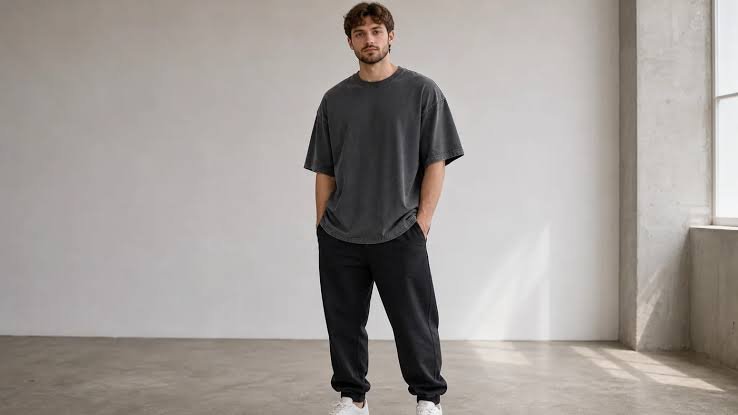
Product: Premium heavyweight oversized T-shirt
Silhouette: Boxy
Shoulder: Dropped
Body: Wide
Length: Controlled rather than excessively long
Sleeve: Wider with defined finishing point
Neckline: Firm crew neck
Fabric: Heavy cotton jersey developed to the required feel and structure
Branding: Private-label neck/size/care identification as required
Decoration: Artwork according to approved placement and dimensions
This type of specification gives a private label t-shirt manufacturer meaningful development information.
USA, UK, Germany and European Buyers: Define the End Market Early
The target market should be discussed during development, not after production.
A US streetwear brand may have a different fit block, grading philosophy and customer expectation from a German label.
A UK startup may be developing an intentionally cropped boxy tee.
A European fashion label may want a cleaner silhouette with controlled volume rather than an exaggerated streetwear shape.
These are design and merchandising decisions rather than universal country rules. A heavyweight t-shirt manufacturer should therefore work from the brand’s actual approved measurements rather than assuming that every American, British, German or European customer wants the same fit.
Buyer rule: Never approve a fit simply because the supplier calls it “US fit,” “European fit” or “oversized fit.” Ask for actual measurements.
Mistake #2 — Getting Collar Rib, Recovery and Neckline Construction Wrong
The collar is one of the fastest ways to make an expensive heavyweight T-shirt look cheap.
A customer may never know the yarn specification or exact knitting parameters, but they can immediately see:
- a collar that waves;
- a neckline that stretches;
- uneven rib;
- a collar that sits too flat;
- a collar that stands too high;
- poor joining;
- puckering around the neckline;
- inconsistent collar width;
- a neck opening that is too large or too tight.
For a premium heavyweight t-shirt manufacturer, collar development should therefore be treated as part of the garment engineering rather than a small finishing detail.
Why Heavyweight Fabric Changes the Collar Equation
The body and collar must work together.
When body fabric becomes denser or heavier, using a generic collar specification without evaluating the relationship between the rib and body can produce an unbalanced result.
The buyer should consider:
- rib composition;
- rib structure;
- collar width;
- collar thickness;
- recovery;
- neck opening;
- attachment tension;
- seam construction;
- topstitching;
- finished visual height;
- behaviour after washing.
A custom heavyweight t-shirt manufacturer should confirm these characteristics during sampling.
The goal is not simply to make the collar “thick.”
The goal is a neckline that visually complements the shirt and maintains its intended shape.
Collar Recovery Matters More Than Appearance on Day One
A sample can look perfect immediately after pressing.
That proves very little about long-term shape retention.
The buyer should evaluate what happens when the neckline is:
- put on and removed;
- stretched during wear;
- washed;
- dried according to the intended care procedure;
- returned to its relaxed state.
A premium heavyweight t-shirt manufacturer should understand that collar performance is partly about recovery: how effectively the neckline returns toward its intended shape after deformation.
This becomes particularly important for wide, boxy and oversized garments because the collar often acts as a strong visual anchor.
If the body is substantial but the collar becomes loose, the entire garment can lose its premium appearance.
Neck Opening and Collar Width Must Be Approved Separately
Brands sometimes approve a “2 cm collar” or similar measurement without defining exactly how that measurement is taken.
That can create avoidable disagreement.
A good technical pack should make clear:
- finished collar width;
- neck width;
- front neck drop;
- back neck drop where relevant;
- measurement method;
- tolerance;
- stitching detail.
For an oversized t-shirt manufacturer, neckline dimensions are especially important because the body may already have deliberately exaggerated proportions.
A neck opening that is slightly too wide can make an otherwise strong oversized fit appear sloppy.
A neck opening that is too tight can make a fashion-forward silhouette uncomfortable and visually unbalanced.
What Buyers Should Inspect on a Heavyweight T-Shirt Collar
Before approving a heavyweight t-shirt manufacturer for bulk production, inspect the sample for:
- consistent collar width;
- smooth attachment;
- no obvious rippling;
- balanced stretch;
- adequate recovery;
- symmetry;
- clean joining;
- correct neckline shape;
- secure stitching;
- appropriate relationship between rib and body fabric;
- appearance after laundering.
Do not approve only from a front photograph.
Ask to see the collar close up, inside and outside.
For remote international sourcing, detailed photos and short videos can make sample review easier, but the physical sample remains important when hand feel, recovery and fit need to be judged.
Mistake #3 — Using the Wrong Pattern for Heavyweight and Oversized Fits
An oversized T-shirt is not a normal T-shirt enlarged by one or two sizes.
That shortcut often produces the wrong garment.
A proper oversized t-shirt manufacturer should develop intentional proportions across the body, shoulder, sleeve, neckline and length.
Simply scaling everything upward can create:
- excessive body length;
- oversized neck opening;
- awkward armholes;
- sleeves that fall incorrectly;
- uncontrolled shoulder drop;
- poor balance between front and back;
- a garment that looks accidentally large instead of deliberately oversized.
Oversized Fit Is a Pattern Decision
The visual language of an oversized tee may involve:
- increased chest width;
- controlled body length;
- dropped shoulders;
- larger sleeves;
- altered sleeve length;
- wider armhole;
- boxier body;
- specific neckline proportions.
These elements need to work together.
A custom heavyweight t-shirt manufacturer should therefore develop from an approved measurement chart or tech pack rather than relying on subjective terms such as:
“loose,”
“baggy,”
“streetwear,”
“US oversized,”
or
“European oversized.”
Those descriptions can support a brief, but they should not replace measurements.
Regular Fit vs Oversized Fit
| Feature | Regular Heavyweight Tee | Oversized Heavyweight Tee |
|---|---|---|
| Chest | Closer to conventional sizing | Deliberately wider |
| Shoulder | Near natural shoulder | Often intentionally dropped |
| Sleeve | Conventional proportion | Often wider/longer |
| Body length | Conventional | May be controlled for boxiness |
| Overall shape | Standard structured fit | Deliberately voluminous |
| Pattern development | Regular block | Dedicated oversized block |
These are general design distinctions, not fixed measurement rules.
Every brand should approve its own measurements.
The Boxy-Fit Trap
“Boxy” is another term that buyers and suppliers can interpret differently.
For one brand it may mean:
- wide chest;
- shorter length;
- modest shoulder drop.
For another it may mean:
- extreme width;
- elbow-length sleeves;
- large shoulder drop;
- almost cropped body.
A professional oversized t-shirt manufacturer should translate the visual direction into measurable specifications before cutting bulk fabric.
The buyer should define the desired relationship between width and length.
That relationship is often more useful than saying “make it oversized.”
Mistake #4 — Ignoring Shrinkage and Dimensional Stability
A sample can be correct before washing and wrong afterward.
That is why dimensional stability deserves serious attention when sourcing from a heavyweight t-shirt manufacturer.
ISO 5077 specifies a method for determining dimensional change of fabrics, garments and other textile articles after specified washing and drying procedures. The current ISO page identifies ISO 5077:2007 as the published standard and notes that it was reviewed and confirmed in 2022.
The important buyer lesson is simple:
Final garment dimensions should not be evaluated only in an unwashed state.
Why Shrinkage Changes More Than Length
Dimensional change can affect:
- body length;
- chest width;
- sleeve length;
- shoulder dimensions;
- neckline appearance;
- garment symmetry;
- overall silhouette.
If different directions or components change differently, the visual effect can become more noticeable.
For an oversized or boxy T-shirt, even relatively modest dimensional changes can alter the intended width-to-length relationship.
That is why a heavy GSM t-shirt manufacturer should receive clearly defined expectations about finished measurements and wash conditions.
Pre-Production Questions Buyers Should Ask
Before approving a custom heavyweight t-shirt manufacturer, ask:
- What fabric is proposed?
- What finishing has the fabric received?
- How will dimensional change be evaluated?
- Are measurements being approved before washing, after washing, or both?
- Which washing/drying procedure is being used for evaluation?
- What measurement tolerance will apply?
- Will the production fabric be controlled against the approved sample?
- Could garment washing or other finishing alter the final measurements?
These questions are much more useful than asking a supplier to promise “zero shrinkage.”
Absolute claims should be treated cautiously unless supported by a clearly defined test method and result.
Mistake #5 — Getting Shoulder Drop, Sleeve Shape and Body Proportion Wrong
Heavyweight streetwear succeeds or fails in silhouette.
The fabric creates visual weight, but the pattern decides where that weight sits on the body.
This is especially important when choosing an oversized t-shirt manufacturer.
A shoulder seam placed several centimetres differently can materially change the garment’s character.
Sleeve width can make the same body look either balanced or awkward.
Body length can turn a premium boxy tee into a conventional long T-shirt.
The goal is therefore proportional balance.
Evaluate the Whole Silhouette
Buyers should assess:
- neckline;
- shoulder position;
- chest width;
- armhole;
- sleeve width;
- sleeve length;
- body length;
- hem width;
- front/back balance.
Do not review these measurements independently.
Look at how they interact.
A heavyweight t-shirt manufacturer should ultimately reproduce the approved combination, not merely keep individual measurements somewhere within a loose range.
Mistake #6 — Confusing Heavy Fabric With Premium Drape and Hand Feel
Weight can be measured.
Premium feel is more complex.
A buyer can order a high-GSM jersey and still receive a garment that feels excessively rigid, rough, board-like or uncomfortable.
That does not mean heavy fabrics are inherently uncomfortable. It means GSM does not completely describe tactile behaviour.
When discussing fabric with a heavy GSM t-shirt manufacturer, buyers should therefore talk about:
- softness;
- compactness;
- surface texture;
- flexibility;
- structure;
- drape;
- recovery;
- finish;
- intended washing treatment.
Structure vs Stiffness
A premium streetwear tee often needs enough structure to maintain its silhouette.
But “structured” should not automatically become “stiff.”
This distinction is particularly important for oversized products.
A very rigid fabric may project away from the body instead of falling naturally.
A fabric with too little structure may collapse and lose the intended heavyweight visual character.
The correct result depends on the design.
This is why physical sampling remains important when selecting a custom heavyweight t-shirt manufacturer.
Mistake #7 — Ignoring Stitching, Seam Behaviour and Garment Construction
Premium fabric cannot rescue poor sewing.
Heavyweight fabric can create additional demands at:
- shoulder seams;
- neck attachment;
- sleeve seams;
- side seams;
- hems;
- coverstitching or other finishing points.
A heavyweight t-shirt manufacturer should select construction appropriate to the design and fabric rather than simply using the same settings and approach applied to every T-shirt.
Buyers should inspect:
- stitch consistency;
- skipped stitches;
- seam puckering;
- hem appearance;
- seam alignment;
- thread tension;
- neckline attachment;
- reinforcement where specified;
- inside finishing.
Mistake #8 — Approving One Sample Without Defining Bulk Tolerances
A perfect sample is useful.
A repeatable sample is more valuable.
The commercial challenge begins when a private label t-shirt manufacturer has to reproduce the approved garment across multiple sizes and production units.
That requires clear specifications.
The Golden Sample Is a Reference, Not the Entire QC System
Buyers should retain or clearly identify the approved reference and document:
- fabric;
- colour;
- GSM target;
- measurements;
- measurement tolerances;
- collar;
- stitching;
- artwork;
- artwork dimensions;
- artwork placement;
- labels;
- packaging;
- finishing;
- approved wash/appearance.
A photograph alone cannot communicate every one of those requirements.
Mistake #9 — Choosing a Heavyweight T-Shirt Manufacturer Mainly on Unit Price
Price matters.
But the lowest quotation is not necessarily the lowest commercial cost.
A cheaper shirt that creates:
- remakes;
- inconsistent sizing;
- customer returns;
- weak collars;
- poor printing;
- delayed launches;
- inventory that cannot be sold;
can be considerably more expensive than the difference between two supplier quotations.
A buyer should therefore compare a heavyweight t-shirt manufacturer on total commercial value.
Supplier Evaluation Framework
| Factor | What to Evaluate |
|---|---|
| Product understanding | Does the supplier understand the intended silhouette? |
| Fabric | Can specifications be clearly defined and approved? |
| Sampling | Is there a structured approval process? |
| Pattern development | Can measurements be followed accurately? |
| Collar | Is construction appropriate for the product? |
| Decoration | Can artwork method and placement be controlled? |
| Private label | Can required branding details be developed? |
| QC | Are approval criteria clearly documented? |
| Communication | Are technical questions answered precisely? |
| Commercial terms | Are MOQ, price, payment and shipping clear? |
| Compliance | Can required destination-market information be addressed? |
| Repeatability | Is bulk production based on an approved reference? |
The objective is not to find the most expensive manufacturer either.
It is to identify the supplier offering the best combination of product fit, risk control, communication and commercially acceptable pricing.
USA Heavyweight T-Shirt Manufacturer Sourcing: What Buyers Need to Check
For brands selling heavyweight T-shirts in the United States, product development cannot stop at fit and fabric.
Labelling matters too.
The U.S. Federal Trade Commission states that most covered textile products need labels identifying fibre content, country of origin and the manufacturer or another responsible business. The FTC also maintains a Care Labeling Rule requiring manufacturers and importers to provide care instructions for covered garments.
FTC guidance also explains that imported textile products covered by the relevant rules must identify their country of origin.
That makes label development part of sourcing rather than an afterthought.
A US brand discussing production with a private label t-shirt manufacturer should therefore clarify:
- fibre composition;
- country-of-origin information;
- responsible-company identification requirements;
- care instructions;
- size identification;
- brand label design;
- hangtag requirements;
- packaging;
- final destination.
The buyer/importer should confirm the exact requirements applying to its products before placing the goods on the market.
FTC apparel and textile labelling guidance
UK Heavyweight T-Shirt Manufacturer Sourcing: What Buyers Need to Check
UK brands should also think beyond GSM and fit.
UK Government guidance says textile labels must show fibre content and explains responsibilities for manufacturers and retailers.
That means a UK streetwear company working with an overseas heavyweight t-shirt manufacturer should finalize fibre information before bulk labels are produced.
A practical UK sourcing checklist includes:
- approved fibre composition;
- finished measurements;
- heavyweight fabric specification;
- collar construction;
- branding;
- fibre-content label;
- care information;
- country-of-origin considerations;
- packaging;
- importer/retailer compliance review where applicable.
UK Government textile-labelling guidance
Do not leave compliance labels until the shirts are already packed.
The artwork and information should be reviewed during pre-production.
Germany and EU Heavyweight T-Shirt Manufacturer Sourcing
Germany sits within the European Union’s textile regulatory framework.
Regulation (EU) No 1007/2011 addresses textile fibre names and the related labelling and marking of fibre composition for textile products.
For German and other EU brands, this makes accurate fibre-composition information an important part of product development.
A German buyer working with a custom heavyweight t-shirt manufacturer should therefore treat the following as separate approval areas:
Product
- silhouette;
- fabric;
- GSM;
- colour;
- collar;
- stitching;
- decoration.
Branding
- neck branding;
- size identification;
- hangtags;
- packaging.
Market information
- fibre composition;
- required textile labelling;
- appropriate language/information requirements;
- other applicable product obligations.
The exact legal obligations depend on the product and how it is placed on the market, so buyers should verify current requirements rather than relying on a generic factory template.
EU textile fibre Regulation 1007/2011
How to Brief a Heavyweight T-Shirt Manufacturer Properly
A good RFQ reduces ambiguity before price negotiation begins.
Send:
Product
Heavyweight T-shirt
Intended Market
USA / UK / Germany / EU
Fit
Regular / relaxed / oversized / boxy / custom
Fabric
Specify desired composition, structure, target GSM and feel.
Colour
Pantone or another agreed colour reference where appropriate.
Measurements
Provide a measurement chart with points of measurement.
Collar
Specify desired neckline, rib appearance and finished width.
Decoration
Provide artwork files, dimensions, colours and placements.
Branding
Define main label, size label, care/fibre information, hangtags and packaging.
Quantity
State quantity by colour and size.
Sample
Request development against the final specifications.
Bulk QC
Agree which approved sample and specifications become the production reference.
Shipping
State destination city/postcode and required shipping basis so quotations can be compared consistently.
This gives a private label t-shirt manufacturer enough information to discuss a meaningful quotation rather than guessing.
Heavyweight T-Shirt Manufacturer Buyer Checklist
Before approving bulk production, confirm:
- Fabric composition
- Target GSM
- Fabric hand feel
- Knit/surface appearance
- Colour
- Shrinkage/dimensional-change expectations
- Fit
- Measurement chart
- Size grading
- Measurement tolerances
- Shoulder drop
- Sleeve shape
- Body length
- Collar width
- Neck opening
- Rib specification
- Stitching
- Print/embroidery method
- Artwork size
- Artwork placement
- Brand labels
- Fibre/care information
- Hangtags
- Packaging
- Approved reference sample
- Quantity breakdown
- Production terms
- Shipping terms
- Destination-market requirements
A heavyweight t-shirt manufacturer receiving this information can work from defined requirements instead of assumptions.
Why Work With Elahi Vertex International for Custom Heavyweight T-Shirts?
[INTERNAL LINK — PLACE ON FIRST BRAND MENTION]
Elahi Vertex International operates as a B2B manufacturer, exporter and OEM/ODM/private-label manufacturing partner serving clothing and streetwear buyers.
For heavyweight T-shirt projects, the useful starting point is not simply asking for the highest available GSM. Buyers should send the intended fit, fabric direction, measurements, artwork, branding requirements, quantity and destination so the project can be evaluated against the actual product requirement.
Elahi Vertex International’s standard MOQ is 20 pieces per product/category, making the manufacturing model relevant to both developing brands and buyers testing a product before larger production.
Brands looking for a custom heavyweight t-shirt manufacturer, oversized t-shirt manufacturer, heavy GSM t-shirt manufacturer or private label t-shirt manufacturer can discuss requirements before committing to bulk production.
For a useful quotation, send:
- target GSM/fabric direction;
- composition;
- reference images;
- tech pack if available;
- measurement chart;
- colourways;
- artwork;
- printing/embroidery requirements;
- labels and packaging;
- quantity;
- size breakdown;
- destination postcode.
This is especially useful for brands sourcing for the USA, UK, Germany and Europe, because shipping and destination requirements can then be considered alongside manufacturing requirements.
Frequently Asked Questions About Heavyweight T-Shirt Manufacturing
1. What is a heavyweight t-shirt manufacturer?
A heavyweight t-shirt manufacturer produces T-shirts using comparatively substantial fabrics while managing the pattern, neckline, stitching, finishing and other manufacturing variables required by the product. Buyers should evaluate the complete garment rather than defining heavyweight quality by GSM alone.
2. What GSM should a premium heavyweight T-shirt use?
There is no universal GSM that automatically creates a premium T-shirt. The appropriate specification depends on silhouette, knit construction, composition, hand feel, season, finish and the brand’s intended product. Discuss the result with the heavy GSM t-shirt manufacturer instead of choosing solely by the largest number.
3. Is a higher GSM T-shirt always better quality?
No. GSM measures fabric mass per area, not total garment quality. Fabric structure, yarn, finishing, shrinkage, collar construction, sewing and pattern development also affect the finished product.
4. What should I ask a custom heavyweight t-shirt manufacturer?
Provide composition, target GSM, fit, measurements, colour, collar requirements, artwork, decoration, branding, quantity and shipping destination. A custom heavyweight t-shirt manufacturer can then evaluate the actual project rather than quoting an undefined generic tee.
5. Can a heavyweight T-shirt also be oversized?
Yes. Fabric weight and fit are separate variables. An oversized t-shirt manufacturer can develop a heavyweight oversized shirt using a dedicated pattern with deliberate width, shoulder, sleeve and length proportions.
6. Why do heavyweight T-shirt collars lose shape?
Potential causes include inappropriate rib specification, poor recovery, unsuitable neck opening, attachment issues, dimensional change or construction problems. Collar performance should be evaluated during sampling.
7. What makes an oversized heavyweight T-shirt look premium?
Balanced proportions matter. Chest width, shoulder drop, sleeve dimensions, body length, neckline and fabric drape should work together. Simply enlarging a standard pattern usually does not create a refined oversized silhouette.
8. Should heavyweight T-shirts be tested after washing?
Buyers should evaluate dimensional stability under an appropriate defined washing and drying procedure. ISO 5077 specifies a method for determining dimensional change in textile products after specified washing and drying procedures.
9. What information should US brands give a private label t-shirt manufacturer?
In addition to product specifications, US buyers should consider applicable fibre, country-of-origin, responsible-company and care-labelling requirements. FTC guidance should be checked for the specific product.
10. What textile labelling should UK brands consider?
UK Government guidance states that textile labels must show fibre content and provides further rules for textile labelling. Buyers should verify the requirements applying to their products.
11. What should German heavyweight T-shirt brands know about EU textile labels?
Germany is subject to the EU textile framework, including Regulation (EU) No 1007/2011 concerning textile fibre names and related fibre-composition labelling and marking.
12. What is the difference between a heavyweight t-shirt manufacturer and an oversized t-shirt manufacturer?
The first description focuses on fabric/product weight characteristics, while the second focuses on silhouette. A supplier may offer both capabilities, but buyers should specify each requirement independently.
13. What is a private label t-shirt manufacturer?
A private label t-shirt manufacturer produces garments for another brand according to agreed product and branding requirements. The exact services available should be confirmed with the manufacturer for each project.
14. Why is sampling important for heavyweight T-shirts?
Sampling allows buyers to evaluate fabric, hand feel, dimensions, fit, collar, construction, artwork and branding before bulk production.
15. Should I approve a heavyweight T-shirt from photographs only?
Photographs are useful for visual review, but they cannot fully communicate hand feel, actual fit, fabric behaviour or tactile collar recovery. A physical sample is preferable where those factors matter.
16. How do I compare two heavyweight T-shirt manufacturers?
Compare the actual fabric, sample, fit accuracy, collar, construction, customization, communication, QC process, commercial terms and ability to reproduce the approved specification—not merely unit price.
17. Can screen printing change heavyweight T-shirt drape?
Large or heavy print applications can affect local hand feel and flexibility. The decoration method should therefore be evaluated alongside fabric and artwork requirements.
18. What should be included in a heavyweight T-shirt tech pack?
A useful tech pack can include technical drawings, measurements, tolerances, grading, fabric specification, colours, collar details, stitching, artwork dimensions and placements, labels, packaging and other construction requirements.
19. How can startups reduce heavyweight T-shirt manufacturing risk?
Define one product carefully, develop a sample, correct the specifications before bulk, document approvals and avoid choosing a supplier solely because it provides the lowest quotation.
20. How can I request a heavyweight T-shirt quotation from Elahi Vertex International?
Send the product reference or tech pack, fabric/GSM direction, fit, quantity, sizes, colours, artwork, branding requirements and delivery destination. Elahi Vertex International can then discuss the project based on the actual specifications.
Conclusion: Choose a Heavyweight T-Shirt Manufacturer for the Garment, Not Just the GSM
The central mistake in heavyweight T-shirt sourcing is surprisingly simple: treating fabric weight as the product.
It is not.
A premium heavyweight T-shirt is the result of fabric + pattern + collar + construction + finishing + dimensional stability + decoration + bulk control.
That is why brands in the USA, UK, Germany and Europe should evaluate a heavyweight t-shirt manufacturer on the finished garment rather than a GSM number or attractive unit price alone.
A custom heavyweight t-shirt manufacturer should receive a clear specification.
An oversized t-shirt manufacturer should work from intentional proportions rather than merely scaling up a regular T-shirt.
A heavy GSM t-shirt manufacturer should help translate fabric weight into the structure and hand feel required by the design.
And a private label t-shirt manufacturer should work from documented branding and production requirements so the finished garment represents the buyer’s brand correctly.
Get those fundamentals right before bulk production.
They are far cheaper to correct on a specification sheet and sample than after hundreds or thousands of finished garments have been produced.
Discuss Your Heavyweight T-Shirt Project With Elahi Vertex International
If you are developing heavyweight, oversized or private-label T-shirts for the USA, UK, Germany or European market, send Elahi Vertex International your specifications before requesting a final production quotation.
Include your:
Tech pack or reference → target fabric/GSM → fit → measurements → colours → artwork → branding → quantity → sizes → destination.
Visit Elahi Vertex International
Discuss your project on WhatsApp
Phone / WhatsApp: +92 309 1639614
Email: elahivertexinternational@gmail.com
Secondary Email: Info@elahivertexinternational.com
Elahi Vertex International on Alibaba
Elahi Vertex International — Where Brands Are Made.
Useful External Resources
International Organization for Standardization — ISO 5077: Reference for determining dimensional change of textile articles after specified washing and drying procedures. Useful when discussing shrinkage and dimensional stability. ISO 5077:2007
U.S. Federal Trade Commission — Apparel and Labeling: Useful for US brands reviewing textile fibre, country-of-origin, responsible-business and care-labelling obligations. FTC Apparel and Labeling
U.S. Federal Trade Commission — Textile Fiber Rule: Primary regulatory guidance concerning disclosures including constituent fibre percentages, responsible manufacturer/marketer information and processing/manufacturing country. FTC Textile Fiber Rule
UK Government — Textile Labelling: Official guidance for manufacturers and retailers concerning UK textile fibre-content labelling. UK textile labelling guidance
European Union — Regulation (EU) No 1007/2011: Primary EU legislation covering textile fibre names and related fibre-composition labelling and marking, relevant to Germany and other EU markets. EU Regulation 1007/2011
Recommended Internal Links
- Elahi Vertex International
https://elahivertexinternational.com/
Anchor: Elahi Vertex International
Placement: First commercial company mention and final CTA
Purpose: Establish the main manufacturer entity and give buyers a direct route to the company. - Custom Clothing Manufacturing
https://elahivertexinternational.com/custom-clothing-manufacturing/
Anchor: custom clothing manufacturing
Placement: Heavyweight T-shirt development section
Purpose: Connect heavyweight T-shirt buyers with the wider custom apparel manufacturing service. - Manufacturing
https://elahivertexinternational.com/manufacturing/
Anchor: apparel manufacturing process
Placement: Production and bulk-manufacturing section
Purpose: Let buyers understand how custom manufacturing moves from concept toward production. - Private Label Manufacturing
https://elahivertexinternational.com/private-label-manufacturing/
Anchor: private label clothing manufacturing
Placement: Private-label T-shirt section
Purpose: Strong commercial link for brands needing their own labels, branding, fabric, GSM, fit and customization. - OEM Clothing Manufacturing
https://elahivertexinternational.com/oem-clothing-manufacturing/
Anchor: OEM clothing manufacturer
Placement: Tech-pack and specification section
Purpose: Relevant for established brands supplying their own designs and specifications. - How to Order
https://elahivertexinternational.com/how-to/
Anchor: custom apparel ordering process
Placement: Sampling/RFQ section
Purpose: Shows buyers the design → fabric → specifications → sample → approval workflow. - Our Works
https://elahivertexinternational.com/our-works-elahi-vertex-international/
Anchor: real manufacturing work
Placement: Supplier-verification section
Purpose: Gives international buyers a route to inspect published manufacturing work. - Case Studies
https://elahivertexinternational.com/case-studies/
Anchor: apparel manufacturing case studies
Placement: Supplier-evaluation section
Purpose: Adds another trust and manufacturing-evidence route. - Is Elahi Vertex International Legit?
https://elahivertexinternational.com/is-elahi-vertex-international-legit/
Anchor: verify Elahi Vertex International
Placement: “How to verify your manufacturer” section
Purpose: Useful for first-time USA, UK, German and European buyers conducting supplier due diligence. - Custom Clothing Manufacturing — Fabric Selection Context
https://elahivertexinternational.com/custom-clothing-manufacturing/
Anchor: custom fabric selection
Placement: Fabric/GSM section
Purpose: Contextual route from heavyweight fabric selection into full custom manufacturing. - Private Label Manufacturing — GSM Context
https://elahivertexinternational.com/private-label-manufacturing/
Anchor: custom GSM private label manufacturing
Placement: Heavy-GSM development section
Purpose: The inquiry workflow specifically provides custom fabric and GSM fields. - Private Label Manufacturing — Fit Context
https://elahivertexinternational.com/private-label-manufacturing/
Anchor: custom fit private label clothing
Placement: Oversized and boxy-fit section
Purpose: Relevant to brands developing custom fit styles rather than buying blanks. - OEM Manufacturing — Measurements
https://elahivertexinternational.com/oem-clothing-manufacturing/
Anchor: manufacture to custom measurements
Placement: Pattern and measurement section
Purpose: Connects measurement-driven T-shirt development with OEM production. - OEM Manufacturing — Printing
https://elahivertexinternational.com/oem-clothing-manufacturing/
Anchor: custom T-shirt printing requirements
Placement: Printing section
Purpose: Supports the discussion of manufacturing according to brand-supplied decoration requirements. - OEM Manufacturing — Embroidery
https://elahivertexinternational.com/oem-clothing-manufacturing/
Anchor: custom embroidery manufacturing
Placement: Decoration section
Purpose: Relevant where heavyweight T-shirts use embroidery rather than print alone. - OEM Manufacturing — Labels and Branding
https://elahivertexinternational.com/oem-clothing-manufacturing/
Anchor: custom labels and branding
Placement: Private-label section
Purpose: Commercially relevant for brands sourcing finished branded products. - How to Order — Sample Development
https://elahivertexinternational.com/how-to/
Anchor: develop a clothing sample
Placement: Sampling section
Purpose: Gives buyers the next step after specifications are finalized. - How to Order — Product Specifications
https://elahivertexinternational.com/how-to/
Anchor: finalize apparel specifications
Placement: Tech-pack/RFQ checklist
Purpose: Supports the recommendation to lock measurements, colours, branding, printing, labels, trims and packaging before bulk. - Our Works — Manufacturing Verification
https://elahivertexinternational.com/our-works-elahi-vertex-international/
Anchor: inspect manufacturing capabilities
Placement: “How to choose a heavyweight T-shirt manufacturer”
Purpose: Encourages buyers to verify production evidence rather than choosing solely on price. - Elahi Vertex International — Request Manufacturing Discussion
https://elahivertexinternational.com/
Anchor: discuss your heavyweight T-shirt project
Placement: Final CTA only
Purpose: Commercial conversion link for USA, UK, Germany and European buyers ready to discuss specifications.
Heavyweight T-Shirt Manufacturing for UK, USA, Germany, EU & Russia Brands
Choosing a custom heavyweight t-shirt manufacturer becomes especially important when a streetwear or private-label brand is developing products for several international markets. Buyers in the UK, USA, Germany, wider European Union and Russia may share an interest in heavyweight streetwear, but the actual garment should still be developed around the brand’s own customer, fit specification, fabric requirement and commercial positioning. A capable heavy GSM t-shirt manufacturer should therefore work from measurable requirements rather than assuming that one generic heavyweight blank will suit every market.
For brands developing relaxed, boxy or dropped-shoulder silhouettes, working with an oversized t-shirt manufacturer should involve much more than increasing the chest width of a standard T-shirt. Shoulder drop, sleeve width, sleeve length, body length, neckline dimensions and fabric drape need to work together. Whether the finished collection is intended for London, New York, Berlin, another EU market or Russia, the oversized t-shirt manufacturer should manufacture against an approved measurement chart and sample rather than relying on vague descriptions such as “European fit” or “American oversized fit.”
Heavyweight T-Shirts for UK Streetwear Brands
UK streetwear brands looking for a custom heavyweight t-shirt manufacturer should define the garment before comparing quotations. The brief should identify the required fabric composition, target GSM, hand feel, collar structure, silhouette, measurements, artwork, printing or embroidery, labels, packaging and quantity. This makes it easier to compare one heavy GSM t-shirt manufacturer with another on the actual product rather than simply comparing headline prices.
Private-label development is equally important. A private label t-shirt manufacturer should receive the brand’s approved artwork, label specifications, size information, fibre information, care requirements and packaging instructions before bulk production. UK brands should also review applicable UK textile-labelling requirements for the products they intend to place on the market rather than expecting the private label t-shirt manufacturer to make legal decisions on their behalf.
For oversized streetwear, the role of the oversized t-shirt manufacturer becomes particularly important during sampling. A heavyweight body fabric can dramatically change the way a wide T-shirt hangs from the shoulders. UK brands should therefore assess the physical sample for shoulder position, sleeve shape, body length, collar appearance and overall drape before approving bulk manufacturing.
Heavyweight T-Shirts for USA Clothing Brands
USA brands sourcing internationally should give their custom heavyweight t-shirt manufacturer a complete technical brief. Target GSM is useful, but it should sit alongside fabric composition, surface character, required hand feel, finished measurements, shrinkage expectations, decoration and branding. A professional heavy GSM t-shirt manufacturer should be evaluated on the complete garment rather than on who offers the highest GSM at the lowest price.
The same principle applies when selecting an oversized t-shirt manufacturer for American streetwear. “US oversized” is not a sufficiently precise manufacturing specification. One American brand may want an extremely wide, dropped-shoulder silhouette, while another may prefer a cleaner relaxed fit. The oversized t-shirt manufacturer needs actual measurements and an approved reference instead of assumptions about the US market.
American private-label brands should also discuss product labelling early with their private label t-shirt manufacturer. Fibre content, country-of-origin information, care information and other applicable requirements should be checked against current US rules. A private label t-shirt manufacturer can manufacture approved labels, but the buyer or responsible business should verify what information its specific product must carry before the labels enter bulk production.
Heavyweight T-Shirts for German Streetwear Brands
German brands searching for a custom heavyweight t-shirt manufacturer should focus on specification control and repeatability. Fabric weight, composition, collar construction, dimensions, tolerances, artwork placement and finishing should be documented before bulk approval. The objective is to ensure that the custom heavyweight t-shirt manufacturer understands what makes the garment commercially acceptable to that particular brand.
When a German label wants a dense streetwear tee, the heavy GSM t-shirt manufacturer should not simply substitute a heavier fabric into an existing pattern. Increasing fabric weight can change drape, structure and the visual balance of the garment. The relationship between fabric and pattern therefore needs to be assessed during sample development.
A German brand working with an oversized t-shirt manufacturer should be equally precise about chest width, shoulder drop, sleeve dimensions, body length and neckline proportions. An oversized t-shirt manufacturer should reproduce the brand’s approved silhouette rather than applying a generic oversized block to every customer.
For branded collections, the private label t-shirt manufacturer also needs accurate fibre-composition and branding information. Germany operates within the EU textile regulatory framework, so brands should verify applicable European requirements before approving production labels.
Heavyweight T-Shirts for EU Clothing and Streetwear Brands
European buyers evaluating a custom heavyweight t-shirt manufacturer should separate fabric specifications from finished-garment specifications. GSM tells the buyer about fabric mass per unit area, but it does not fully describe softness, structure, recovery, drape, dimensional stability or finished appearance. That is why choosing a heavy GSM t-shirt manufacturer only by a fabric number can lead to disappointing results.
An EU streetwear label developing wide silhouettes should ask its oversized t-shirt manufacturer to produce against a detailed measurement chart. The sample should then be evaluated as a complete garment. If the shoulder drop looks wrong, the sleeve is disproportionately large or the body becomes too long, the pattern needs correction even when every other customization detail looks attractive.
Brands using a private label t-shirt manufacturer should also finalize fibre information, labels, branding and packaging before bulk production. EU textile fibre-composition requirements are relevant across Germany and other EU markets, although buyers should confirm the rules applying to their particular product and destination. The private label t-shirt manufacturer should receive approved information rather than being expected to guess what belongs on the finished label.
Heavyweight T-Shirts for Russian Clothing Brands
Russian streetwear and clothing brands considering an international custom heavyweight t-shirt manufacturer should also begin with the product specification rather than a generic catalogue garment. Fabric composition, GSM, fit, collar, measurements, artwork, labels, packaging and quantity should be defined before final commercial terms are compared. A heavy GSM t-shirt manufacturer can then evaluate the requested garment against a meaningful specification.
For streetwear collections, a Russian buyer working with an oversized t-shirt manufacturer should specify exactly what “oversized” means for the brand. Chest width, shoulder drop, sleeve shape and body length should be measurable. This gives the oversized t-shirt manufacturer a repeatable production target and reduces dependence on subjective visual descriptions.
A Russian buyer using a private label t-shirt manufacturer should separately verify current labelling, import, customs, sanctions, payment, shipping and other destination-specific requirements before placing an order. These conditions can change and should not be inferred from UK, US or EU requirements. Elahi Vertex International should confirm whether a Russia-bound project can be commercially and legally served at the time of inquiry rather than promising availability in advance.
One Manufacturing Principle Across All Five Markets
Whether a brand is based in the UK, USA, Germany, wider EU or Russia, the strongest sourcing process is fundamentally similar: define the garment first and compare manufacturers second. A custom heavyweight t-shirt manufacturer needs measurable specifications. A heavy GSM t-shirt manufacturer needs to understand the required structure and hand feel rather than GSM alone. An oversized t-shirt manufacturer needs an approved silhouette rather than the instruction “make it bigger.” A private label t-shirt manufacturer needs final branding, label and packaging information before bulk production.
For Elahi Vertex International, this creates a clearer manufacturing conversation. International buyers can send their tech pack or reference, target GSM, composition, measurements, fit, colourways, artwork, branding requirements, quantity, size breakdown and delivery destination. Those details allow the project to be evaluated as a specific custom-manufacturing requirement rather than a generic T-shirt inquiry.
UK, USA, Germany, EU or Russia brand developing a heavyweight collection? Send Elahi Vertex International your product specifications, target GSM, fit, artwork, quantity and destination to discuss the appropriate manufacturing route before bulk production.
Ready to Develop Your Heavyweight T-Shirt Collection?
If you are a streetwear brand, clothing label, private-label business, wholesaler, retailer or apparel buyer in the UK, USA, Germany, wider Europe or another international market, the next step should not be ordering bulk blindly. Start by defining the product properly.
Elahi Vertex International works as a B2B manufacturer, exporter, OEM/ODM supplier and private-label manufacturing partner for international clothing brands. If you are looking for a heavyweight t-shirt manufacturer, custom heavyweight t-shirt manufacturer, oversized t-shirt manufacturer, heavy GSM t-shirt manufacturer or private label t-shirt manufacturer, send us the actual specifications of the product you want to develop.
What to Send for a Serious Manufacturing Discussion
For the most useful assessment and quotation, send:
- Tech pack or clear reference images
- Target fabric composition
- Target GSM
- Regular, relaxed, boxy or oversized fit
- Measurement chart if available
- Required colourways
- Print or embroidery artwork
- Artwork dimensions and placements
- Collar and neckline requirements
- Main label, size label and care-label requirements
- Hangtags and packaging requirements
- Quantity and size breakdown
- Delivery country, city and postcode
- Required timeline
Standard MOQ: 20 pieces per product/category.
Exact fabric availability, production requirements, pricing, sampling, shipping and project-specific specifications should be confirmed for the individual order.
Explore Elahi Vertex International Before You Contact Us
Want to understand who you may be working with first?
Official Website:
Visit Elahi Vertex International
Custom Clothing Manufacturing:
Explore Custom Clothing Manufacturing
Private Label Manufacturing:
Explore Private Label Clothing Manufacturing
OEM Clothing Manufacturing:
Explore OEM Clothing Manufacturing
Manufacturing Process:
See Our Apparel Manufacturing Process
How to Start an Order:
See How to Order
Manufacturing Work:
View Our Works
Case Studies:
Explore Manufacturing Case Studies
Supplier Verification:
Verify Elahi Vertex International
These internal resources are particularly useful if you are comparing a custom heavyweight t-shirt manufacturer or private label t-shirt manufacturer before committing to sampling or bulk production.
Contact Elahi Vertex International
Have your heavyweight T-shirt idea, reference or tech pack ready? Send it directly and tell us the quantity and destination.
WhatsApp:
Start a Manufacturing Discussion on WhatsApp
WhatsApp / Phone:
+92 309 1639614
Primary Email:
elahivertexinternational@gmail.com
Secondary Email:
Info@elahivertexinternational.com
Website:
www.elahivertexinternational.com
Alibaba:
Elahi Vertex International Alibaba Storefront
Follow Elahi Vertex International
LinkedIn:
https://www.linkedin.com/company/elahi-vertex-international?trk=profile-position
Instagram:
https://www.instagram.com/elahivertex_mfg
Facebook:
https://www.facebook.com/share/1D4CqvvfKh/
TikTok:
https://www.tiktok.com/@elahivertex_mfg
X:
https://x.com/elahivertex_mfg
Threads:
https://www.threads.com/@elahivertex_mfg
From Tech Pack to a Production-Ready Heavyweight T-Shirt
Do not choose a heavyweight t-shirt manufacturer simply because a supplier offers a high GSM or a low unit price. The commercial goal is a finished product that delivers the intended collar shape, drape, fit, hand feel, branding and bulk consistency.
Whether you are building a heavyweight streetwear collection for the UK, USA, Germany or wider European market, send Elahi Vertex International your product concept and specifications.
Send your tech pack/reference + GSM + fit + quantity + destination on WhatsApp to start the discussion.
Discuss Your Heavyweight T-Shirt Project With Elahi Vertex International →
Elahi Vertex International
Where Brands Are Made.
