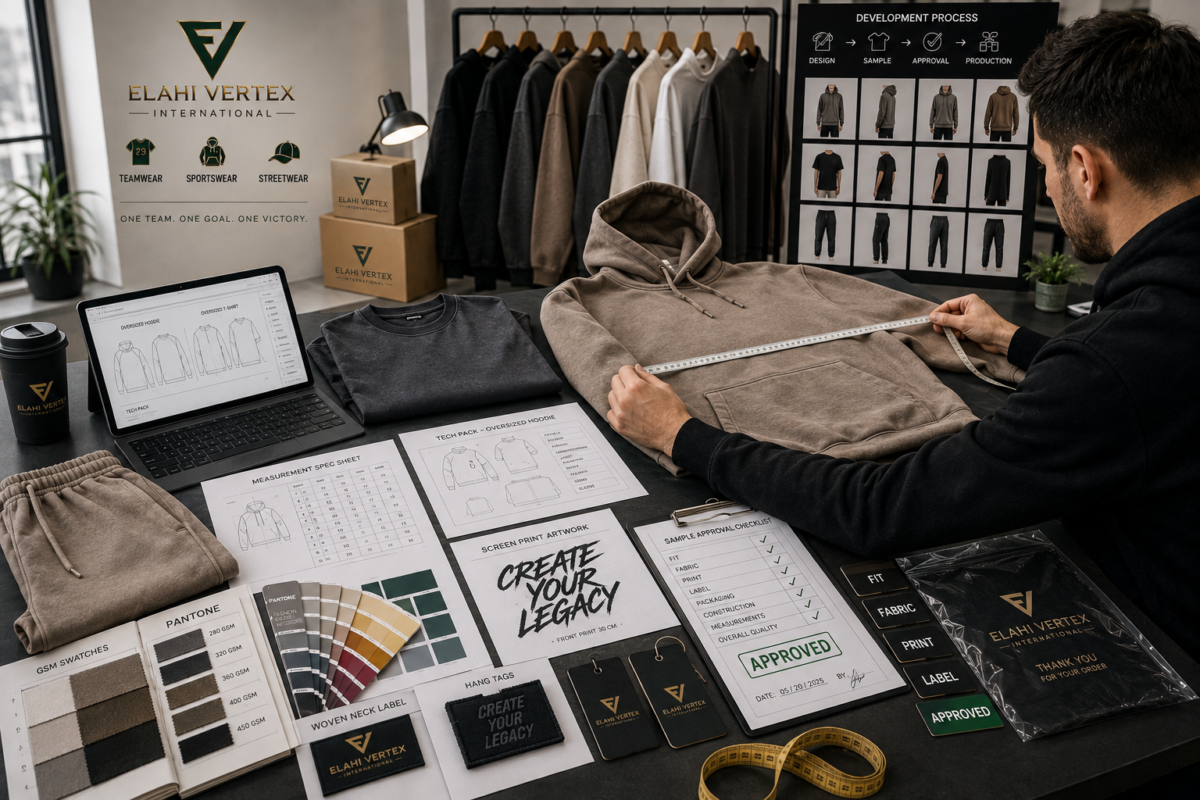

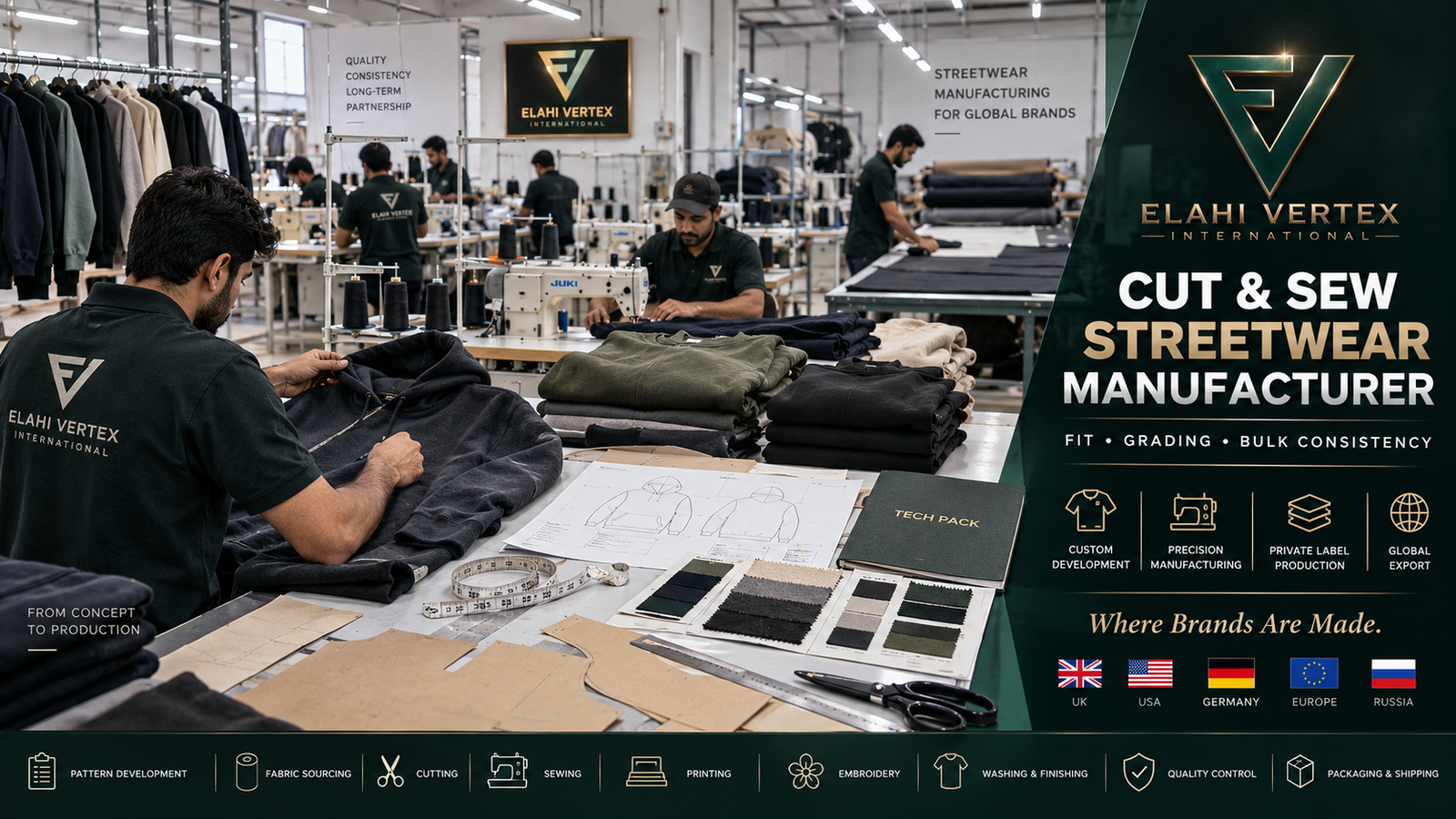
A streetwear design can look exceptional on a screen and still fail completely when it reaches production.
The problem is rarely the idea itself. Problems usually appear when measurements are incomplete, patterns are poorly developed, grading changes the intended silhouette, fabric behaves differently after washing, artwork placement moves between sizes, or the approved sample is not translated accurately into bulk production.
That is why choosing the right cut and sew streetwear manufacturer involves much more than comparing a price per hoodie or T-shirt.
For streetwear brands in the USA, UK, Germany and wider European market, custom manufacturing gives much greater control over silhouette, measurements, fabric, construction, washing, printing, embroidery, labels, trims and packaging than simply decorating an existing blank garment.
But that additional control also creates additional manufacturing decisions.
A capable custom streetwear manufacturer needs clear specifications. A private label streetwear manufacturer needs to understand how branding relates to the complete garment rather than only the neck label. A cut and sew clothing manufacturer needs reliable patterns, measurements and construction instructions. And a streetwear clothing manufacturer needs an approved reference against which production can be evaluated.
This guide explains nine critical mistakes buyers should avoid when sourcing custom streetwear, why those mistakes affect fit and bulk consistency, and what brands should confirm before authorizing production.
The objective is straightforward:
Design → specifications → pattern → prototype → fit approval → grading → pre-production confirmation → bulk manufacturing → quality control → shipment → repeat production.
When that chain is controlled properly, a brand has a much stronger foundation for consistent streetwear manufacturing.
Table of Contents
- What Is a Cut and Sew Streetwear Manufacturer?
- Cut and Sew vs Blank Garment Decoration
- Mistake #1 — Starting Without a Production-Ready Tech Pack
- Mistake #2 — Treating Pattern Development as a Minor Step
- Mistake #3 — Ignoring Fabric Behaviour, Shrinkage and Washing
- Mistake #4 — Poor Pattern Grading Across the Size Range
- Mistake #5 — Choosing Fabric by GSM Alone
- Mistake #6 — Approving Artwork Without Production Specifications
- Mistake #7 — Failing to Lock the Approved Sample
- Mistake #8 — Weak Bulk Quality-Control Standards
- Mistake #9 — Choosing a Manufacturer Mainly by Lowest Price
- The Complete Cut-and-Sew Streetwear Development Workflow
- USA Streetwear Manufacturing Considerations
- UK Streetwear Manufacturing Considerations
- Germany Streetwear Manufacturing Considerations
- European Streetwear Manufacturing Considerations
- How to Evaluate a Streetwear Manufacturer
- What to Put in Your Streetwear RFQ
- Why Work With Elahi Vertex International?
- Buyer Checklist
- Frequently Asked Questions
- Conclusion
What Is a Cut and Sew Streetwear Manufacturer?
A cut and sew streetwear manufacturer produces garments by developing and constructing the actual garment rather than relying only on a pre-manufactured blank.
The process can involve:
- garment specifications;
- pattern development;
- fabric selection or sourcing;
- marker planning;
- fabric cutting;
- sewing and garment assembly;
- pattern grading;
- printing;
- embroidery;
- appliqué;
- washing or finishing;
- trims;
- labels;
- packaging;
- sampling;
- bulk manufacturing;
- quality control.
The exact workflow depends on the product.
This distinction matters because a streetwear brand may not simply want its artwork placed on somebody else’s standard hoodie.
It may want:
- a wider chest;
- dropped shoulders;
- a shorter body;
- oversized sleeves;
- a particular hood shape;
- heavier rib;
- custom pocket dimensions;
- a specific waistband;
- an acid or vintage wash;
- custom embroidery;
- a special print position;
- custom woven labels;
- branded packaging.
Those requirements affect the garment itself.
That is the territory of a cut and sew clothing manufacturer.
Quick Answer
A cut and sew streetwear manufacturer creates garments around defined specifications, patterns, materials and construction requirements. This gives streetwear brands greater control over fit, silhouette, fabric, branding and product identity than standard blank-garment decoration.
For a serious brand, however, customization should not mean uncontrolled experimentation. Every important decision should eventually become a measurable production specification.
Cut and Sew Streetwear Manufacturer vs Blank Garment Supplier
These sourcing models are not the same.
| Factor | Cut-and-Sew Manufacturing | Blank Garment Decoration |
|---|---|---|
| Base garment | Developed for project | Existing garment |
| Pattern control | High | Usually limited |
| Custom silhouette | Possible | Restricted by blank |
| Fabric choice | Project dependent | Existing blank fabric |
| Measurements | Can be developed/customized | Mostly predetermined |
| Grading | Can be developed for style | Already determined |
| Custom rib/trims | Possible depending on project | Limited |
| Washing/finishing | Can be integrated | Depends on blank |
| Private labels | Can be integrated | Often replacement/addition |
| Construction details | Buyer can specify | Mostly fixed |
| Product differentiation | Potentially high | Mainly decoration |
| Development work | Greater | Lower |
Neither model is automatically better.
If a business needs fast promotional merchandise, a good-quality blank may be perfectly suitable.
But if a streetwear brand’s commercial identity depends on a distinctive silhouette, fabric, wash, construction or branded detailing, a custom streetwear manufacturer becomes more relevant.
This is especially important for brands selling premium oversized hoodies, heavyweight T-shirts, custom joggers, matching sets, jackets and other garments where fit is part of the product proposition.
Why Fit and Bulk Consistency Matter So Much in Streetwear
Streetwear buyers often focus heavily on graphics.
Customers experience something else first:
the garment.
A powerful back graphic cannot rescue a hoodie with the wrong body length.
Premium embroidery cannot fix a T-shirt whose neckline loses shape.
An expensive wash cannot compensate for inconsistent sizing.
A custom woven label does not make incorrect grading acceptable.
For a streetwear clothing manufacturer, therefore, graphic execution and garment engineering have to work together.
Consider an oversized T-shirt.
Its identity may depend on the relationship between:
- shoulder width;
- chest width;
- body length;
- sleeve opening;
- sleeve length;
- neck width;
- neck drop;
- rib height.
Increase every measurement mechanically and the larger sizes can lose the intended silhouette.
That is why streetwear production needs more than a generic size chart.
It needs a defined fit system.
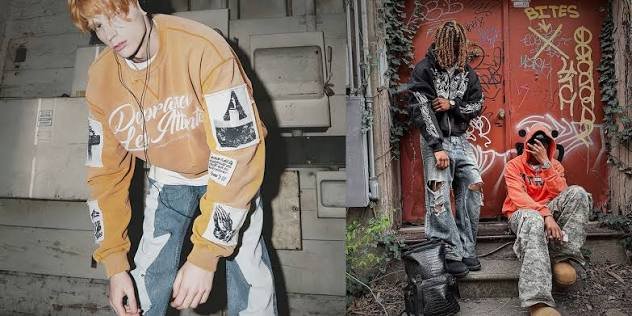
Mistake #1: Starting With a Cut and Sew Streetwear Manufacturer Without a Production-Ready Tech Pack
One of the most expensive sourcing mistakes is assuming that a reference image is a complete manufacturing specification.
It is not.
A Pinterest image, Instagram screenshot or hand sketch can communicate design direction, but it usually cannot tell a cut and sew streetwear manufacturer everything required to reproduce a garment consistently.
A useful tech pack should remove ambiguity.
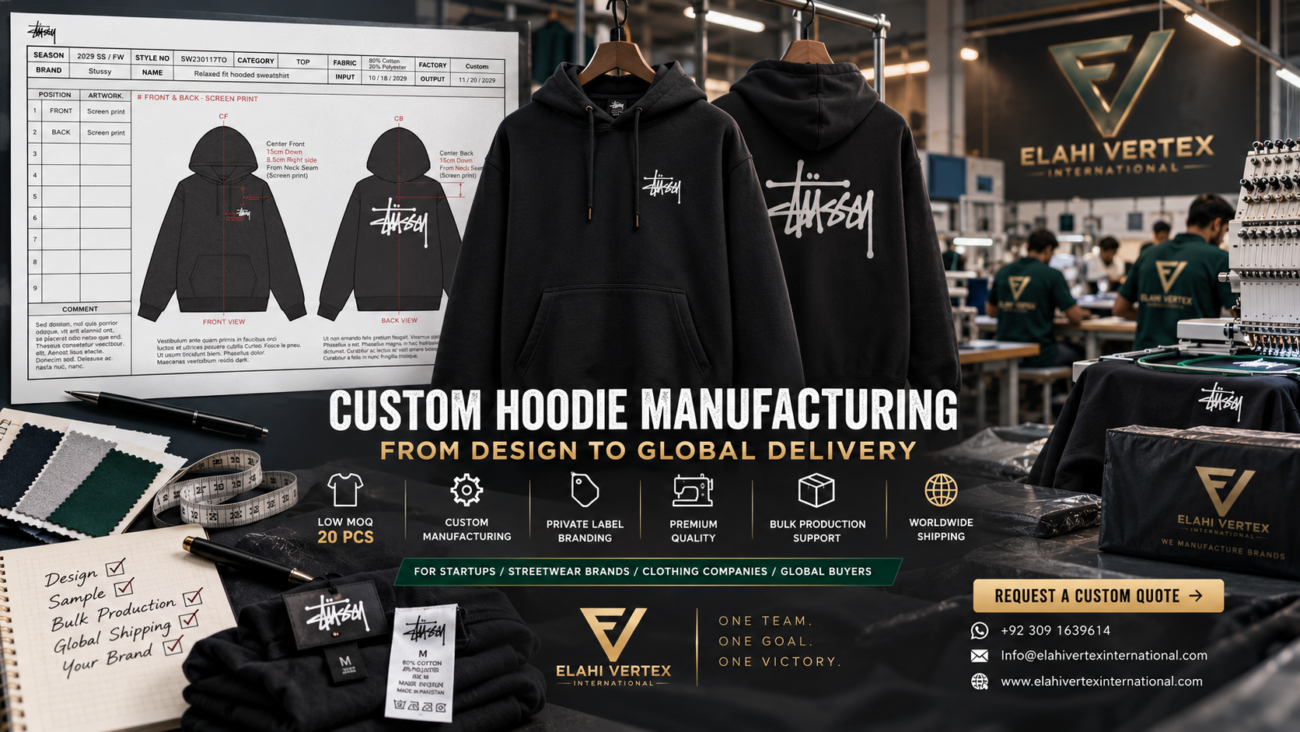
What Should a Streetwear Tech Pack Include?
Depending on the product, buyers should consider documenting:
Garment identification
- style name;
- style number;
- product category;
- gender/unisex positioning where relevant;
- collection or season reference.
Fabric
- fibre composition;
- fabric construction;
- target weight/GSM;
- finish;
- colour;
- stretch requirements where relevant;
- wash or treatment.
Measurements
A point-of-measure chart may include:
- chest;
- body length;
- shoulder;
- sleeve length;
- sleeve opening;
- neck width;
- neck drop;
- hood dimensions;
- pocket dimensions;
- waistband height;
- cuff height.
Not every garment requires the same points of measure.
Construction
Specify important details such as:
- seam type;
- stitch type;
- topstitching;
- hem construction;
- rib construction;
- pocket construction;
- hood construction;
- reinforcement requirements.
Artwork
Include:
- artwork file;
- dimensions;
- position;
- colour reference;
- technique;
- orientation.
Branding
Include:
- main label;
- size label;
- care label;
- woven label;
- patch;
- hangtag;
- packaging requirements where applicable.
Colour
Avoid relying exclusively on statements such as:
dark green
or:
washed black.
Colour should be communicated using a reliable reference appropriate to the material and production process.
Why vague specifications create expensive revisions
Suppose a brand tells its custom streetwear manufacturer:
Make it oversized like this picture.
That instruction leaves unanswered questions.
How oversized?
Compared with which base size?
Should the shoulder drop by 4 cm or 8 cm?
Should the body be long and oversized, or wide and cropped?
Should the sleeve opening be exaggerated?
How should the fit change from S to XL?
A photograph cannot reliably answer those questions.
The better approach is:
visual reference + measurement specification + construction specification + approved physical sample.
Buyer Action
Before requesting final bulk pricing from a cut and sew clothing manufacturer, prepare enough technical information for suppliers to quote the same product.
Otherwise, you may be comparing different garments rather than different manufacturers.
Mistake #2: Treating Pattern Development as a Minor Step
A great streetwear garment begins long before sewing.
The pattern establishes the geometry of the product.
For a cut and sew streetwear manufacturer, pattern development converts the buyer’s measurements and silhouette into the pieces that will eventually be cut from fabric and assembled.
If the pattern is wrong, excellent stitching will reproduce the wrong fit very accurately.
Pattern Development Controls Streetwear Silhouette
Consider a heavyweight oversized hoodie.
Its appearance can depend on:
- shoulder angle;
- shoulder extension;
- armhole depth;
- chest width;
- body length;
- sleeve shape;
- hood shape;
- pocket shape;
- rib dimensions.
Two hoodies can use the same nominal GSM and still look completely different because their patterns differ.
The same applies to:
Oversized T-shirts
Important variables can include:
- shoulder drop;
- chest ease;
- body length;
- sleeve length;
- sleeve width;
- neck opening;
- rib width.
Joggers
Important variables can include:
- rise;
- hip;
- thigh;
- knee;
- leg opening;
- inseam;
- waistband;
- pocket position.
Zip hoodies
Additional variables can include:
- centre-front alignment;
- zipper length;
- hood-to-neck relationship;
- rib tension;
- pocket symmetry.
A private label streetwear manufacturer should therefore be evaluated on more than its ability to attach branded labels.
The real question is whether the garment can be developed around the intended product.
Reference Garment vs Original Pattern
A buyer may provide an existing garment as a fit reference.
That can be useful.
But the brand should still identify what it wants changed.
For example:
Use this garment as the general fit reference, but increase chest width, shorten body length, widen sleeves and change the hood.
That is substantially more useful than:
Copy this hoodie.
A serious development process turns subjective preferences into measurable instructions.
The Golden Sample Principle
Once the fit is approved, the final sample becomes commercially important.
The buyer should retain clear records of:
- approved measurements;
- approved fabric;
- approved colour;
- approved construction;
- approved artwork;
- approved trims;
- approved wash;
- approved labels.
This becomes the foundation for bulk consistency.
Mistake #3: Ignoring Fabric Behaviour, Shrinkage and Washing
A pattern can be technically correct before washing and still produce the wrong garment after finishing.
This is why fabric behaviour matters.
A cut and sew streetwear manufacturer should not treat fabric, pattern and wash as unrelated decisions.
They interact.
Why Fabric Behaviour Changes Fit
Fabric can respond to manufacturing and consumer care through:
- dimensional change;
- relaxation;
- shrinkage;
- stretch;
- recovery;
- twisting;
- surface change;
- colour change.
The actual behaviour depends on the fibre, yarn, knit/weave construction, finishing and treatment.
Therefore:
pattern measurements before finishing ≠ automatically finished-garment measurements.
Washed Streetwear Needs Additional Control
This becomes particularly important for:
- vintage wash;
- acid wash;
- pigment-dyed looks;
- garment dye;
- distressed finishes;
- enzyme treatments;
- other washed effects.
A streetwear brand should not approve only the pre-wash appearance if the finished product will undergo a substantial treatment.
The final garment should be evaluated in the condition in which the buyer expects to sell it.
Example: Oversized Hoodie
Imagine that the brand approves a deliberately cropped oversized hoodie.
Its selling point is the proportion between width and length.
If the body responds differently from the intended tolerance after finishing, that proportion changes.
Even a relatively small dimensional change can matter because the silhouette was deliberate.
That is why a custom streetwear manufacturer needs clear finished measurements rather than relying only on nominal size labels.
What Buyers Should Confirm
Ask the manufacturer:
- Is the measurement chart for pre-finished or finished garments?
- At what production stage is measurement checked?
- Has the proposed fabric/finish been evaluated for dimensional behaviour?
- Which dimensions are most sensitive to the selected finish?
- What measurement tolerance will be used for bulk inspection?
- Is the approved sample representative of the intended final wash?
Those questions are far more commercially useful than asking only:
What GSM do you use?
Mistake #4: Using Weak Pattern Grading Across the Size Range
Pattern grading is one of the least visible but most commercially important parts of streetwear manufacturing.
A sample may look perfect in size M.
That does not prove that XS, S, L, XL or XXL will look equally good.
A cut and sew streetwear manufacturer needs a logical grading system that preserves the intended design as sizes change.
What Is Pattern Grading?
Pattern grading is the systematic process of increasing or decreasing pattern dimensions to create additional sizes from an approved base size.
But good grading is not simply:
Add the same amount everywhere.
Different garment dimensions may require different grade rules.
For example:
- chest;
- shoulder;
- length;
- sleeve;
- armhole;
- neck;
- pocket;
- hood.
Each affects the silhouette differently.
Why Streetwear Is Especially Sensitive
Streetwear often uses intentionally non-standard proportions.
Examples include:
- oversized;
- boxy;
- cropped;
- drop shoulder;
- elongated;
- wide leg;
- relaxed;
- balloon fit.
A poorly graded oversized garment may become disproportionately long in larger sizes.
A cropped hoodie can lose its cropped character.
A pocket can appear too small relative to the body.
Artwork can appear incorrectly positioned because the garment dimensions changed but the placement logic did not.
This is why a competent streetwear clothing manufacturer should consider the relationship between grading and design rather than treating sizes as simple scaled copies.
Base Size Approval Is Not Enough
For important collections, buyers should consider evaluating additional sizes or at least reviewing the complete graded measurement chart before bulk production.
A useful size-set review can expose problems before hundreds of garments are cut.
Grading Checklist
Before approving bulk, confirm:
- base size;
- complete size range;
- grade increments;
- garment length progression;
- chest progression;
- shoulder progression;
- sleeve progression;
- artwork placement logic;
- pocket placement;
- label position;
- tolerances.
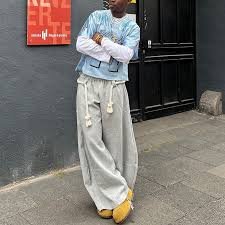
Mistake #5: Choosing Fabric by GSM Alone
“400 GSM” is not a complete fabric specification.
Neither is “premium cotton.”
Neither is “heavyweight fleece.”
A buyer selecting a cut and sew streetwear manufacturer should understand that GSM tells you fabric mass per unit area. It does not independently define the complete hand feel, structure, composition, stretch, recovery, surface or performance of the fabric.
Two Fabrics With Similar GSM Can Feel Different
Fabric behaviour can be affected by:
- fibre composition;
- yarn characteristics;
- knit structure;
- weave structure;
- density;
- brushing;
- finishing;
- compacting;
- washing;
- surface treatment.
That means two 400 GSM fabrics can produce noticeably different garments.
One may feel structured.
Another may feel softer.
One may hold an oversized silhouette.
Another may drape more heavily.
One may have a smooth face suited to printing.
Another may have a surface better suited to a different decoration method.
Fabric Selection Should Start With Product Intent
Instead of asking:
What is your heaviest GSM?
ask:
What fabric construction is appropriate for the silhouette and finish we are trying to achieve?
For example, a brand developing a structured oversized hoodie may prioritize:
- body;
- shape retention;
- suitable surface;
- comfortable reverse side;
- compatible rib;
- predictable finishing behaviour.
A brand developing a summer oversized tee may prioritize:
- breathable hand feel;
- controlled drape;
- opacity;
- surface quality;
- shape;
- wash behaviour.
The appropriate specification depends on the product.
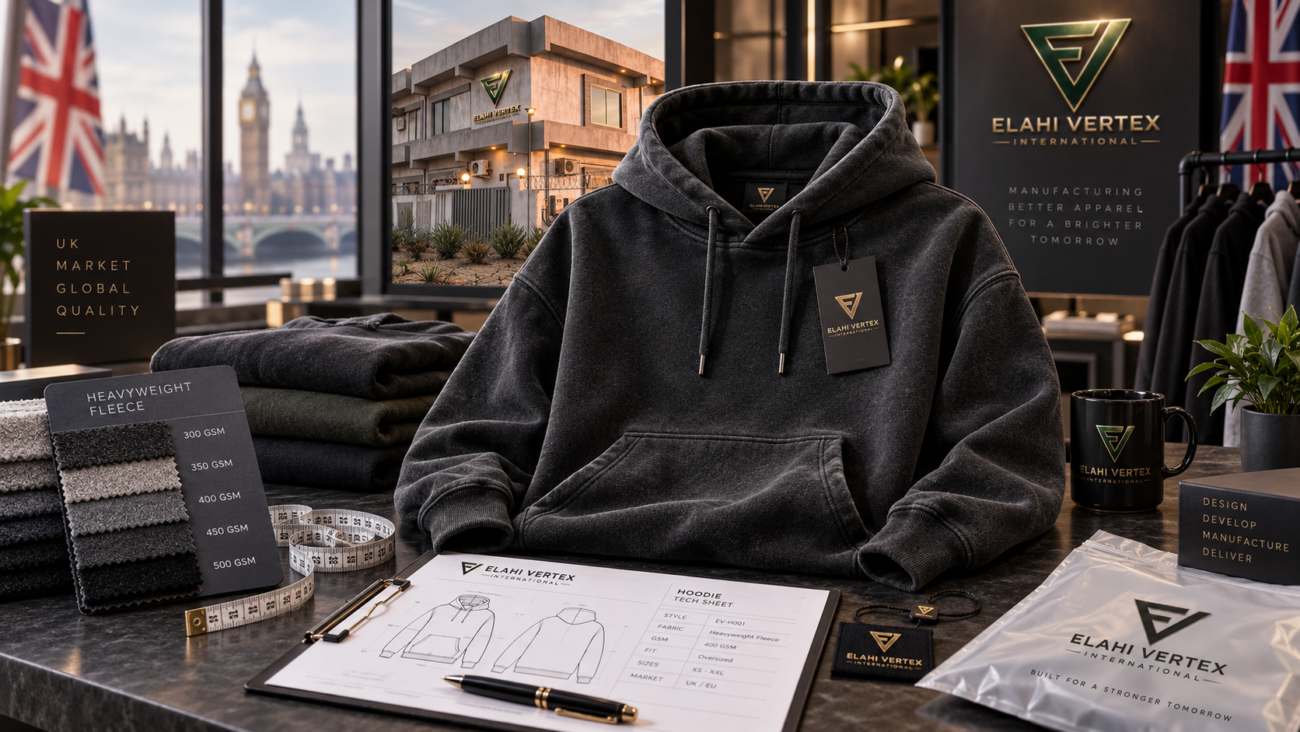
Fabric Specification Checklist
A serious RFQ to a cut and sew clothing manufacturer can specify:
| Requirement | Example of What to Define |
|---|---|
| Fibre | Desired composition |
| Construction | Jersey, French terry, fleece, etc. |
| GSM | Target weight/range |
| Colour | Reference/standard |
| Finish | Desired hand/surface |
| Stretch | If required |
| Wash | If required |
| Shrinkage | Acceptable finished result/tolerance |
| End use | Hoodie, tee, jogger, etc. |
The purpose is not to make the buyer a textile engineer.
The purpose is to reduce ambiguity.
Mistake #6: Approving Artwork Without Confirming the Production Method
A digital mockup is not a production specification.
A graphic can look identical on a laptop while requiring very different manufacturing processes.
A private label streetwear manufacturer may need to interpret artwork for:
- screen printing;
- puff printing;
- high-density effects;
- embroidery;
- appliqué;
- patches;
- heat-transfer applications;
- other suitable techniques.
Each process has its own limitations.
Artwork Size Must Be Measurable
Avoid instructions such as:
Make the logo big.
Instead specify something measurable:
Artwork width: [X] cm on approved base size.
Then define how the artwork should behave across other sizes.
Should the artwork remain the same physical size?
Should larger sizes receive proportionally larger artwork?
Should placement be measured from centre front, neckline, shoulder seam or another stable reference point?
Those decisions should be made before bulk.
Embroidery Adds Physical Structure
Embroidery is not just a visual layer.
Stitch density, backing, thread, artwork complexity and garment fabric can influence the finished appearance.
A lightweight T-shirt and heavyweight hoodie may not behave identically under the same embroidery concept.
The custom streetwear manufacturer therefore needs to consider decoration and garment construction together.
Wash + Print + Embroidery Sequence Matters
If a garment will be washed or treated, the manufacturing sequence can affect the final result.
That is why buyers should confirm whether decoration occurs before or after relevant finishing processes and approve a representative sample.
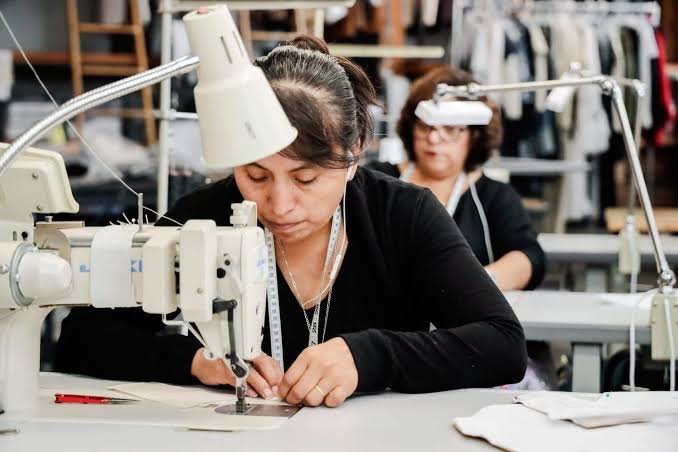
Mistake #7: Failing to Lock the Approved Sample as the Bulk Reference
This is where many sourcing relationships become unnecessarily subjective.
A buyer approves a sample.
Bulk arrives.
Something feels different.
The buyer says:
This isn’t like the sample.
The manufacturer says:
It is within production.
Without documented specifications, the dispute becomes difficult.
The Approved Sample Should Become a Reference Standard
After approval, document the final:
- fabric;
- colour;
- measurements;
- fit;
- pattern;
- stitching;
- artwork;
- artwork placement;
- embroidery;
- wash;
- labels;
- trims;
- packaging.
The physical sample and written specifications should support each other.
A cut and sew streetwear manufacturer should not have to guess which version of several sample revisions is the final one.
The buyer should clearly state:
Sample revision 3 approved for bulk subject to the confirmed measurement/specification sheet.
That creates a cleaner production handoff.
Why This Matters for Repeat Orders
The value of good documentation increases when a product sells.
The brand may reorder:
- three months later;
- six months later;
- next season;
- in a new colour;
- in a larger quantity.
If the specifications are controlled, the streetwear clothing manufacturer has a stronger reference for reproducing the style.
Repeatability is commercially valuable.
A viral first drop is useful.
A product that can be manufactured consistently again is a business asset.
Mistake #8: Using Weak Quality-Control Standards for Bulk Production
Sample quality and bulk consistency are different challenges.
A manufacturer can spend significant attention on one prototype.
Bulk manufacturing requires the same product logic to be repeated across many garments.
That is why buyers should ask a cut and sew streetwear manufacturer how the approved specification will be translated into production checks.
What Should Bulk QC Consider?
Depending on the product:
Measurements
Check important points of measure against approved tolerances.
Construction
Inspect:
- seams;
- hems;
- topstitching;
- rib attachment;
- pocket construction;
- zipper alignment;
- reinforcement.
Appearance
Review:
- stains;
- visible defects;
- unintended marks;
- symmetry;
- puckering;
- loose threads.
Decoration
Check:
- artwork position;
- print appearance;
- embroidery appearance;
- colour;
- orientation.
Branding
Check:
- main label;
- size label;
- care label;
- hangtag;
- other approved trims.
Packaging
Check against the buyer-approved packing specification.
Tolerance Matters
No sewn garment should be evaluated as though it were a machined metal component with mathematically zero variation.
The commercial objective is to define acceptable tolerances appropriate to the garment and production method and then inspect against those agreed tolerances.
That is far stronger than arguing about whether something “looks a little different.”
Mistake #9: Choosing a Cut and Sew Streetwear Manufacturer Mainly by the Lowest Price
Price matters.
It should matter.
A streetwear brand that ignores its landed cost can destroy its own margin.
But the lowest quotation is not automatically the lowest commercial cost.
Suppose Manufacturer A quotes less but requires repeated sampling, creates inconsistent sizing or cannot reproduce the approved finish.
Manufacturer B costs more per garment but produces the approved product more consistently.
Which supplier is actually cheaper?
The answer depends on the total commercial outcome.
Compare Like With Like
When comparing quotations from a cut and sew clothing manufacturer, confirm whether each quotation covers the same:
- fabric;
- GSM;
- construction;
- wash;
- print;
- embroidery;
- trims;
- labels;
- packaging;
- quantity;
- sizes;
- shipping basis.
Otherwise, a $2 price difference may simply mean you are comparing two different products.
The Better Supplier-Evaluation Question
Do not ask only:
Who gave me the cheapest price?
Ask:
Which manufacturer gives us the strongest combination of product fit, manufacturing control, communication, commercially workable MOQ, quality, repeatability and total landed economics?
That is a sourcing decision.
Complete Cut-and-Sew Streetwear Manufacturing Workflow
A practical workflow may look like this:
1. Product Brief
Define what is being developed.
2. Tech Pack
Document specifications, measurements, construction, branding and artwork.
3. Fabric Selection
Confirm the appropriate composition, construction, weight, colour and finish.
4. Pattern Development
Translate the design into production patterns.
5. Prototype / Sample
Manufacture the first physical representation.
6. Fit Review
Check measurements, silhouette, comfort and proportion.
7. Revision
Correct technical or visual issues.
8. Grading
Develop the approved style across the required size range.
9. Decoration and Finishing Approval
Confirm printing, embroidery, washing or other treatments.
10. Pre-Production Confirmation
Lock the approved specifications.
11. Bulk Cutting and Sewing
Move into controlled production.
12. Inline Quality Control
Identify issues before the entire order is complete.
13. Final Quality Control
Evaluate finished garments against approved requirements.
14. Packing
Pack according to agreed requirements.
15. Shipment
Arrange shipment according to the agreed commercial and logistics terms.
16. Reorder Control
Retain approved specifications for repeat manufacturing.
Cut and Sew Streetwear Manufacturer for USA Brands
American streetwear brands sourcing internationally need to think about more than product design.
Garments placed on the U.S. market can be subject to federal textile labelling and care-labelling requirements.
For most textile and wool products, U.S. FTC guidance addresses information including fibre content, country of origin and the identity of the manufacturer or another responsible business. The FTC Care Labeling Rule also requires covered manufacturers and importers to provide appropriate regular-care instructions.
For an American brand working with a private label streetwear manufacturer, label artwork therefore should not be treated as an afterthought.
Before production, the U.S. buyer should confirm:
- required fibre information;
- country-of-origin treatment;
- responsible-company identification requirements;
- care instructions;
- label placement;
- label durability;
- other requirements applicable to the specific product.
The importer or brand should confirm the current legal requirements applicable to its product before placing it on the market.
For manufacturing itself, U.S. streetwear brands should provide the same technical clarity expected anywhere else: measurements, fabric, artwork, grading, finishing and approved samples.
Cut and Sew Streetwear Manufacturer for UK Brands
UK streetwear founders frequently search internationally for manufacturing partners because manufacturing location and selling market do not need to be the same.
But importing garments into Great Britain creates responsibilities that the brand or importer should understand.
UK government textile-labelling guidance states that textile labels must show fibre content, including applicable fur and other animal parts, and addresses products containing components with different fibre contents.
Therefore, a UK brand working with a streetwear clothing manufacturer should finalize its label content before bulk production rather than treating labels as a last-minute branding exercise.
A practical UK sourcing file should contain:
- final fibre composition;
- approved care information;
- label artwork;
- size designation;
- branding;
- country-of-origin information where required;
- packaging requirements;
- importer/commercial information where applicable.
Legal obligations depend on the product and market, so buyers should verify the current requirements applicable to their specific garments.
Cut and Sew Streetwear Manufacturer for Germany
Germany deserves its own sourcing consideration rather than being treated as simply another word inserted for SEO.
Germany applies EU textile fibre rules alongside national implementation provisions.
German textile-labelling law implements and supplements EU Regulation 1007/2011 and requires applicable fibre-composition labelling/marking in German for textile products placed on the German market.
For a German buyer working with a custom streetwear manufacturer, this means product-development discussions should include the commercial label specification early enough for the manufacturer to produce the approved label correctly.
The German buyer should confirm:
- fibre-composition wording;
- German-language requirements;
- applicable EU textile rules;
- care information;
- responsible economic-operator requirements where applicable;
- packaging obligations where applicable;
- any additional rules relevant to the specific product.
A manufacturer can produce the physical label provided by the buyer, but the business placing goods on the market should make sure its final legal content is appropriate.
That distinction matters.
Manufacturing support is not a substitute for the importer’s own regulatory due diligence.
Cut and Sew Streetwear Manufacturer for Europe
“Europe” is not one single commercial rulebook.
For brands selling within the European Union, Regulation (EU) No 1007/2011 establishes rules concerning textile fibre names and the labelling/marking of fibre composition.
The regulation requires textile products to identify fibre composition using recognized fibre names and provides requirements for multi-fibre products.
A European buyer evaluating a cut and sew streetwear manufacturer should therefore treat fibre composition as a technical and compliance input, not merely marketing copy.
If the garment is described as 100% cotton, the actual product needs to support the applicable composition claim.
If multiple fibres are used, the composition needs to be handled appropriately.
For multinational EU sales, buyers should also check the language and national requirements relevant to each destination market.
How to Evaluate a Cut and Sew Streetwear Manufacturer
Before paying for development, evaluate the supplier systematically.
| Question | Why It Matters |
|---|---|
| Can they work from a tech pack? | Tests technical communication |
| Can they develop or adjust patterns? | Critical for original fit |
| How is grading handled? | Protects size consistency |
| Can they source/specify suitable fabric? | Affects product performance |
| Can they execute required decoration? | Determines design feasibility |
| Can they manage washing/finishing? | Important for washed streetwear |
| How is the sample approved? | Creates bulk reference |
| How is bulk QC handled? | Protects consistency |
| What is the MOQ? | Determines commercial feasibility |
| What are payment terms? | Affects buyer risk/cash flow |
| What shipping basis is quoted? | Prevents cost confusion |
| Can the supplier show relevant work? | Helps verification |
Do not choose a private label streetwear manufacturer because its website uses the words “premium quality.”
Ask for evidence relevant to your actual project.
What Should You Send a Streetwear Manufacturer for an Accurate Quote?
The better your RFQ, the better your quotation can be.
Send:
- product type;
- reference images;
- tech pack;
- required quantity;
- size breakdown if known;
- colourways;
- fabric requirement;
- target GSM;
- measurement chart;
- artwork files;
- artwork dimensions;
- print/embroidery preference;
- wash/finish;
- labels;
- trims;
- packaging;
- destination country and postal code;
- required timeline.
If some specifications are unknown, say so.
A capable cut and sew streetwear manufacturer can then identify what needs to be clarified before quoting or sampling.
The worst approach is hiding information and expecting an accurate final price.
Why Consider Elahi Vertex International for Custom Streetwear Manufacturing?
Elahi Vertex International is a Sialkot, Pakistan-based custom apparel manufacturer and exporter serving B2B buyers.
Its publicly presented manufacturing categories include streetwear, sportswear, teamwear, activewear, boxing wear, leather wear and private-label clothing.
For custom streetwear projects, buyers can discuss products such as:
- hoodies;
- sweatshirts;
- oversized T-shirts;
- joggers;
- coordinated sets;
- other project-specific custom apparel.
Elahi Vertex International’s standard MOQ is 20 pieces per product/category.
That can make the company relevant to qualified startups and established brands that want to begin with a controlled production quantity rather than immediately committing to a very large run.
But low MOQ should not be the only reason to choose a supplier.
The more important objective is to determine whether the manufacturer’s capabilities, project requirements, commercial terms and quality expectations align.
Brands can review manufacturing work and portfolio material before discussing a project.
A productive inquiry should include:
Product + quantity + design + fabric/GSM + branding + destination + timeline.
That gives both buyer and manufacturer something concrete to evaluate.
Final Buyer Checklist
Before authorizing a cut and sew streetwear manufacturer to begin bulk production, confirm:
Product
- Product style finalized
- Colourway finalized
- Size range finalized
- Quantity finalized
Fit
- Base size approved
- Measurements approved
- Pattern approved
- Grading reviewed
- Tolerances defined
Fabric
- Composition approved
- Construction approved
- GSM approved
- Colour approved
- Finish approved
Branding
- Main label approved
- Size label approved
- Care label approved
- Hangtag approved where required
- Packaging approved
Decoration
- Artwork approved
- Artwork dimensions approved
- Placement approved
- Technique approved
- Colours approved
Production
- Final sample approved
- Bulk reference identified
- QC expectations agreed
- Packing requirements agreed
Commercial
- Quantity confirmed
- Price confirmed
- Payment terms confirmed
- Shipping basis confirmed
- Destination confirmed
- Production timeline confirmed
This checklist does not eliminate manufacturing risk.
It reduces avoidable ambiguity.
Final Takeaway
The job of a cut and sew streetwear manufacturer is not simply to stitch fabric together.
The real manufacturing challenge is converting a brand’s creative concept into a repeatable physical product.
That requires control over:
specification → pattern → fabric → sample → fit → grading → decoration → finishing → bulk production → quality control.
For USA, UK, German and European streetwear brands, supplier selection should therefore go deeper than MOQ and price.
A strong custom streetwear manufacturer should be evaluated on technical communication, product-development capability and consistency.
A private label streetwear manufacturer should help translate branding into a complete garment specification.
A cut and sew clothing manufacturer should be able to work around defined patterns, materials, construction and measurements.
And a streetwear clothing manufacturer should be evaluated on whether the approved product can be reproduced consistently when the brand moves from one sample to a commercial order.
The most expensive manufacturing mistake is often not paying slightly more for a better-developed garment.
It is paying for bulk production before the garment is properly defined.
Discuss Your Cut-and-Sew Streetwear Project With Elahi Vertex International
If you are building a streetwear collection for the USA, UK, Germany or wider European market, send Elahi Vertex International the actual project rather than asking for a generic catalogue price.
Include:
Product → quantity → tech pack/reference → fabric/GSM → size range → artwork → branding → destination.
Elahi Vertex International can then evaluate the project requirements and discuss the appropriate next manufacturing step.
Standard MOQ: 20 pieces per product/category.
For buyers who want to verify manufacturing capability before discussing an order, review the official website, portfolio and manufacturing-work pages, then send your specifications for evaluation.
Elahi Vertex International — Where Brands Are Made.
Trusted Resources for Streetwear Brands Sourcing in the USA, UK, Germany and Europe
Choosing a cut and sew streetwear manufacturer is only one part of building a commercially ready clothing collection. Brands also need to understand textile labelling, product safety, care instructions, material requirements, importing responsibilities and destination-market rules.
The following official and recognized resources can help buyers independently research requirements before approving bulk production.
USA: Textile Labelling, Care Instructions and Importing
Streetwear brands selling in the United States should review the Federal Trade Commission’s apparel and labelling guidance when developing labels for custom garments. The FTC provides information relevant to textile fibre content, country-of-origin disclosure and responsible-business identification.
Care instructions should also be considered before approving private labels. Buyers can review the FTC Care Labeling Rule and its practical Care Labeling compliance guidance.
Brands importing garments into the United States can additionally consult U.S. Customs and Border Protection’s importing guidance.
For official textile and apparel trade information, buyers can use the U.S. Office of Textiles and Apparel.
These resources are particularly useful when a U.S. brand is preparing an RFQ for a private label streetwear manufacturer, because label requirements should ideally be resolved before bulk labels and packaging enter production.
UK: Textile Labelling and Import Requirements
UK streetwear brands sourcing internationally should review the official UK Government textile labelling guidance.
The guidance explains important requirements concerning textile fibre-content labelling and related product information.
Brands importing their collection into the UK should also consult the government’s Import Goods Into the UK guidance to understand the steps relevant to their own importing situation.
This matters when working with a custom streetwear manufacturer because a manufacturer can produce labels according to approved artwork, but the buyer should ensure that the information supplied for those labels is appropriate for the destination market.
Do not wait until the garments are already finished to begin investigating labelling requirements.
Germany: Textile Labelling and EU Requirements
Brands selling garments in Germany should consider both European Union rules and German requirements.
The official German Textile Labelling Act provides the national legal framework supplementing applicable EU textile-labelling rules.
The underlying European framework can be reviewed through Regulation (EU) No 1007/2011 on textile fibre names and related labelling and marking.
For a German streetwear company sourcing from a cut and sew clothing manufacturer, fibre composition and required label information should therefore become part of product development rather than an afterthought.
Before approving bulk production, confirm the final fabric composition and the information that needs to appear on the finished garment for the intended German market.
European Union: Textile Fibre and Product Requirements
European brands can use the European Commission’s EU textile labelling guidance as a practical starting point for understanding textile-labelling responsibilities.
For the underlying legislation, buyers can consult Regulation (EU) No 1007/2011 directly.
Product compliance extends beyond fibre labels. European brands should also familiarize themselves with the EU General Product Safety Regulation and the European Commission’s broader product safety and labelling resources.
For trade, tariff and market-access research, buyers can use the European Commission’s Access2Markets portal.
A streetwear clothing manufacturer can manufacture against approved product specifications, but brands and importers should independently determine which legal obligations apply to their products and selling markets.
Fabric, Chemical and Textile Standards Buyers Should Know About
Streetwear development is not limited to appearance.
Fabric composition, dyes, treatments, printing materials, washing processes and other inputs can affect the finished product.
Brands selling into Europe can research the EU chemical framework through the European Chemicals Agency’s REACH information portal.
Buyers researching textile testing and technical standards can also consult the International Organization for Standardization and ASTM International textile standards.
Brands interested in harmful-substance testing frameworks can research OEKO-TEX STANDARD 100.
These links are provided as independent buyer resources. Their inclusion does not mean that Elahi Vertex International claims certification under any particular standard unless that certification is separately confirmed for the relevant project.
That distinction is important when evaluating any cut and sew streetwear manufacturer. Buyers should ask suppliers for evidence rather than assuming that mentioning a standard means the factory holds a certification.
Responsible Cotton, Textile Supply Chains and Sustainability
Brands researching cotton sourcing can learn about industry initiatives through Better Cotton.
For broader labour and garment-sector information, the International Labour Organization’s textiles, clothing, leather and footwear sector resources provide useful international context.
European buyers researching the direction of textile sustainability policy can also review the European Commission’s EU Strategy for Sustainable and Circular Textiles.
These resources should be used for research and supplier questioning rather than for making unsupported sustainability claims about a private label streetwear manufacturer.
Explore Elahi Vertex International Before Starting Your Streetwear Order
International buyers should verify a manufacturer before committing to sampling or bulk production.
Elahi Vertex International provides several pages that can help USA, UK, German and European buyers understand the company, review manufacturing information and decide whether to discuss a project.
1. Learn About Elahi Vertex International
Start with Elahi Vertex International for an overview of the company and its custom apparel manufacturing categories.
This is useful for buyers first researching Elahi Vertex International as a potential cut and sew streetwear manufacturer.
2. Explore Custom Clothing Manufacturing
Read the Custom Clothing Manufacturing page when your project requires development beyond decorating ready-made blanks.
Use this resource when evaluating custom streetwear, hoodies, T-shirts, joggers or other private-label apparel.
3. Understand the Manufacturing Process
Review Manufacturing at Elahi Vertex International to understand the manufacturing workflow presented by the company.
This internal resource fits naturally with the pattern development, sampling, bulk production and quality-control sections of this guide.
4. Explore Private Label Manufacturing
Brands developing their own identity can visit Private Label Manufacturing.
This is particularly relevant when evaluating a private label streetwear manufacturer for custom labels, garment specifications, fabric, fit, branding and related production requirements.
5. Review the Streetwear Manufacturing Portfolio
Before discussing an order, examine the Elahi Vertex International Portfolio.
A portfolio is more commercially useful than generic statements about quality because buyers can examine whether the manufacturer’s presented work is relevant to their intended product category.
6. Review Manufacturing Work
Visit Our Works to see additional manufacturing and product-development information.
For a buyer evaluating a streetwear clothing manufacturer, this provides another verification step before requesting a quotation.
7. Review Manufacturing Case Studies
Brands can also explore the Elahi Vertex International Case Studies.
Case-study material can help buyers understand how the company presents different custom manufacturing projects and product categories.
8. Perform Supplier Due Diligence
International buyers concerned about supplier verification can read Is Elahi Vertex International Legit? 11 Proof Points.
Supplier verification matters particularly when a brand is sourcing internationally and cannot simply visit every potential cut and sew clothing manufacturer before beginning discussions.
9. Learn More About the Company
For additional company information, visit About Elahi Vertex International.
This can be used alongside portfolio, manufacturing and case-study pages when performing supplier research.
10. Discuss Your Actual Streetwear Project
Once you have reviewed the manufacturing information, use the Elahi Vertex International contact page to discuss your requirements.
For a useful manufacturing discussion, provide:
- product type;
- quantity;
- tech pack or reference images;
- fabric composition;
- target GSM;
- measurements;
- size range;
- colourways;
- print or embroidery requirements;
- wash or finish;
- private-label requirements;
- packaging;
- destination country and postal code;
- required timeline.
The standard MOQ for Elahi Vertex International is 20 pieces per product/category.
Instead of asking only, “What is your price?”, give the manufacturer enough information to understand what needs to be produced.
For brands in the USA, UK, Germany and wider Europe, that makes it much easier to move from supplier research to a meaningful quotation, sample discussion and eventually a properly specified bulk order.
Useful External Resources
- USA: Federal Trade Commission — Apparel & Labeling — useful for researching U.S. textile and apparel labelling requirements.
- USA: FTC Care Labeling Rule — useful for understanding applicable garment care-labelling obligations.
- USA: FTC Care Label Compliance Guidance — practical supporting guidance for apparel businesses.
- USA: U.S. Customs and Border Protection — useful for researching U.S. importing procedures.
- USA: U.S. Office of Textiles and Apparel — official textile and apparel trade/import research.
- UK: UK Government Textile Labelling — official guidance for textile fibre labelling.
- UK: UK Government Import Guidance — starting point for businesses importing goods into the UK.
- Germany: German Textile Labelling Act — German textile-labelling legal resource.
- EU: Regulation (EU) No 1007/2011 — primary EU legislation concerning textile fibre names and related labelling and marking.
- EU: EU Textile Labelling Guidance — practical EU business guidance.
- EU: General Product Safety Regulation — useful for broader EU product-safety research.
- EU: European Commission Product Safety and Labelling — official European product-compliance resource.
- EU: Access2Markets — useful for researching tariffs, procedures and market-access requirements.
- EU: ECHA REACH — authoritative resource for the EU chemicals regulatory framework.
- International: ISO Standards — research resource for international technical standards.
- USA/International: ASTM Textile Standards — textile testing and standards reference.
- Textiles: OEKO-TEX STANDARD 100 — information about its harmful-substance testing/certification framework.
- Cotton: Better Cotton — information about the Better Cotton initiative.
- International: International Labour Organization — Textiles, Clothing, Leather and Footwear — labour and industry context for global apparel supply chains.
- EU: EU Strategy for Sustainable and Circular Textiles — official European Commission textile sustainability policy resource.
Buyer Next Step
Research is valuable, but eventually a streetwear collection has to become a manufacturing specification.
If you are looking for a cut and sew streetwear manufacturer for the USA, UK, Germany or wider Europe, prepare your design, quantity, fabric/GSM, measurements, artwork, branding requirements and destination.
Then contact Elahi Vertex International to discuss whether the project is a suitable manufacturing fit.
Elahi Vertex International — Where Brands Are Made.
Cut and Sew Streetwear Manufacturing for the UK, USA, Germany, Europe and Russia
Cut and Sew Streetwear Manufacturer for UK Brands
UK streetwear brands looking beyond standard blanks often need greater control over oversized fits, heavyweight hoodies, custom T-shirts, joggers, washes, embroidery and private-label details. Working with a cut and sew streetwear manufacturer allows a brand to develop the garment around its own measurements, fabric requirements and design direction rather than adapting every collection to an existing blank.
A UK buyer evaluating a custom streetwear manufacturer should pay particular attention to pattern development and finished measurements. Oversized, boxy and drop-shoulder silhouettes depend on proportion, so simply increasing chest measurements does not create a well-developed streetwear fit. A capable cut and sew clothing manufacturer should work from clearly defined specifications covering the base size, grading, fabric, construction and decoration.
For brands building their own identity, the role of a private label streetwear manufacturer also extends beyond sewing in a neck label. Main labels, size labels, care information, hangtags, packaging, embroidery, printing and garment finishing should form one controlled product specification. UK buyers comparing any streetwear clothing manufacturer should therefore evaluate the complete manufacturing process rather than selecting a supplier solely because of a low unit quotation.
Cut and Sew Streetwear Manufacturer for USA Brands
The U.S. streetwear market contains everything from small independent labels to established fashion businesses, but original product development requires the same fundamental discipline: a design has to become a repeatable garment. A cut and sew streetwear manufacturer can support that process when a U.S. brand needs custom silhouettes, fabric specifications, pattern development, grading, printing, embroidery, washing and private-label production instead of generic decorated blanks.
When comparing a custom streetwear manufacturer, U.S. buyers should send the same technical requirements to each potential supplier. Comparing one quotation for a basic cotton hoodie with another quotation for heavyweight custom fleece, special washing and embroidery tells the buyer very little. A cut and sew clothing manufacturer needs enough information to understand exactly what is being priced.
U.S. brands working with a private label streetwear manufacturer should also finalize applicable fibre, origin, care and branding information before bulk label production. The strongest streetwear clothing manufacturer relationship is built around clear specifications, an approved sample and measurable bulk expectations rather than assumptions made from digital mockups.
Cut and Sew Streetwear Manufacturer for German Brands
German streetwear brands sourcing custom garments internationally should combine design development with disciplined technical documentation. A cut and sew streetwear manufacturer should receive clear information covering fabric composition, GSM, colour, measurements, construction, grading, artwork, labels and finishing before the buyer expects an accurate production quotation.
For an oversized hoodie or T-shirt, a custom streetwear manufacturer should not be judged only on whether the sample looks attractive in one size. German buyers should review how the approved silhouette progresses through the required size range. This is where pattern development and grading capabilities from a cut and sew clothing manufacturer become commercially important.
A German brand using a private label streetwear manufacturer should also prepare the appropriate textile and fibre information required for its intended market. Branding and compliance information need to work together. When evaluating a streetwear clothing manufacturer, buyers should therefore consider technical development, product consistency and documentation alongside price.
Cut and Sew Streetwear Manufacturer for European Streetwear Brands
European streetwear is not one uniform design market. Brands across France, Italy, Spain, the Netherlands, Belgium, Scandinavia and other European markets can have very different aesthetics, price positions and customer expectations. What they share when sourcing custom production is the need to convert creative direction into manufacturing specifications that another production run can reproduce.
A cut and sew streetwear manufacturer becomes especially relevant when the brand’s identity depends on original fit, fabric, wash, trims or garment construction. A custom streetwear manufacturer can work around product-specific requirements instead of forcing the collection onto an existing stock garment.
European buyers should ask a cut and sew clothing manufacturer how patterns are developed, how grading is controlled, which sample becomes the bulk reference and how measurements are checked during production. When private branding is required, the private label streetwear manufacturer should also receive final approved information for labels, trims and packaging.
The best way to compare a streetwear clothing manufacturer is therefore not to ask five factories for “your best hoodie price.” Send five qualified suppliers the same product specification and compare their understanding, sampling approach, manufacturing capability, commercial terms and final quotation.
Cut and Sew Streetwear Manufacturer for Russian Streetwear Brands
Russian streetwear brands sourcing internationally may also require custom hoodies, oversized T-shirts, sweatshirts, joggers and coordinated collections developed around their own specifications. In these projects, a cut and sew streetwear manufacturer should first establish whether the required materials, construction, branding and destination can be supported before commercial terms are finalized.
A Russian brand comparing a custom streetwear manufacturer should provide detailed measurements, fabric requirements, artwork, colour references and intended finishing methods. The same principle applies when evaluating a cut and sew clothing manufacturer: the more technically complete the RFQ, the more meaningful the manufacturing discussion becomes.
For a brand seeking a private label streetwear manufacturer, labels, packaging and other branding requirements should be confirmed for the intended destination before production. A potential streetwear clothing manufacturer should also confirm current commercial and shipping feasibility for the specific order and destination. Cross-border payment, logistics, customs and applicable trade restrictions can change, so these should be verified for the individual project rather than assumed from previous shipments.
One Manufacturing Principle Across Five Markets
Whether the collection is being developed for the UK, USA, Germany, wider Europe or Russia, the fundamental manufacturing principle remains the same: define the product before expecting consistent production.
A qualified cut and sew streetwear manufacturer should receive a clear tech pack or equivalent specifications. The selected custom streetwear manufacturer should understand the intended silhouette and fabric rather than simply copying a reference photograph. The cut and sew clothing manufacturer should have an agreed base pattern and grading direction before bulk cutting begins.
Likewise, a private label streetwear manufacturer should receive finalized branding requirements, while the chosen streetwear clothing manufacturer should work against an approved sample and documented bulk specifications.
For international buyers, this creates a much stronger sourcing sequence:
Tech pack → fabric → pattern → sample → fit → grading → branding → approval → bulk production → QC → shipment.
That process matters more than the country in which the final collection will be sold.
Discuss Your International Streetwear Project
Elahi Vertex International works with custom B2B apparel projects and can discuss streetwear manufacturing requirements for international buyers. Brands looking for a cut and sew streetwear manufacturer, custom streetwear manufacturer, private label streetwear manufacturer, cut and sew clothing manufacturer or streetwear clothing manufacturer should send the actual project specifications for evaluation.
For buyers targeting the UK, USA, Germany, Europe or Russia, provide the product type, quantity, tech pack or reference, fabric/GSM, measurements, artwork, branding requirements and delivery destination.
Elahi Vertex International — Where Brands Are Made.
Ready to Work With a Cut and Sew Streetwear Manufacturer?
If you are building a streetwear collection for the UK, USA, Germany, wider Europe or Russia, the next step is not another generic manufacturer search. It is turning your design into a clear manufacturing brief and finding out whether the supplier can actually produce it.
Elahi Vertex International works with B2B buyers looking for custom apparel, OEM, ODM and private-label manufacturing. If you need a cut and sew streetwear manufacturer for custom hoodies, oversized T-shirts, sweatshirts, joggers, matching sets or other custom streetwear, send us your actual requirements and let us evaluate the project properly.
Whether you are searching for a custom streetwear manufacturer, private label streetwear manufacturer, cut and sew clothing manufacturer or streetwear clothing manufacturer, start with the product—not a vague request for the cheapest price.
Send Us Your Streetwear Requirements
For a faster and more useful manufacturing discussion, send:
- Product type
- Required quantity
- Tech pack or reference images
- Fabric composition
- Target GSM
- Measurement chart or desired fit
- Size range
- Colourways
- Printing requirements
- Embroidery requirements
- Wash or finishing requirements
- Main label and size label requirements
- Care label requirements
- Hangtags or other trims
- Packaging requirements
- Delivery country and postal code
- Required timeline
Standard MOQ: 20 pieces per product/category.
For sampling, the buyer normally pays the sample cost and shipping upfront. Where agreed for a qualifying bulk order, the sample cost may be credited toward bulk production; courier/shipping charges remain separate.
Project-specific pricing, production requirements, sample cost, shipping and timelines should be confirmed after we review the actual specifications.
Contact Elahi Vertex International
Website: Elahi Vertex International
WhatsApp: Discuss Your Streetwear Project on WhatsApp
Phone / WhatsApp: +92 309 1639614
Primary Email: elahivertexinternational@gmail.com
Secondary Email: Info@elahivertexinternational.com
Alibaba: Elahi Vertex International Alibaba Storefront
Verify Us Before You Start
International buyers should not choose a cut and sew streetwear manufacturer purely from sales claims. Review the manufacturer, its work and its production information before moving forward.
Custom Clothing Manufacturing
Learn more about Elahi Vertex International’s custom apparel manufacturing positioning and the types of projects international buyers can discuss.
Manufacturing Process
Review manufacturing information before discussing your pattern development, sampling and bulk-production requirements.
Private Label Manufacturing
Useful for brands searching for a private label streetwear manufacturer for custom garments, labels, branding and collection development.
Streetwear & Apparel Portfolio
Review presented manufacturing work before deciding whether Elahi Vertex International is relevant to your collection.
Our Works
Explore additional manufacturing and product-development work.
Manufacturing Case Studies
Review project-focused information to better understand the company’s custom manufacturing positioning.
Is Elahi Vertex International Legit? 11 Proof Points
Use this supplier-verification resource when conducting due diligence before beginning an international manufacturing relationship.
About Elahi Vertex International
Learn more about the company and its B2B manufacturing positioning.
Contact Elahi Vertex International
Ready with your specifications? Send your manufacturing inquiry and discuss the next commercial step.
UK Streetwear Brands
If you are a UK brand looking for a custom streetwear manufacturer, send your tech pack, quantity, desired fit, fabric/GSM, branding and UK delivery postcode. We can then evaluate the product rather than giving you an irrelevant generic quotation.
USA Streetwear Brands
USA brands searching for a private label streetwear manufacturer can send their complete collection requirements, including measurements, fabric, artwork, decoration, labels, quantities and delivery ZIP code for project evaluation.
German Streetwear Brands
German brands evaluating a cut and sew clothing manufacturer should send detailed technical requirements, size specifications, fibre composition, branding and destination information so the manufacturing and commercial requirements can be reviewed clearly.
European Streetwear Brands
European brands searching for a streetwear clothing manufacturer can discuss custom development, private-label requirements and bulk production based on their actual collection specifications and destination.
Russian Streetwear Brands
Russian buyers interested in custom streetwear manufacturing can also submit project requirements for evaluation. Current payment, shipping, customs and trade feasibility must be confirmed for the specific order and destination before an order is accepted.
From Design File to Production — Start With the Actual Product
Do not send only:
“Price for hoodie?”
Send:
“Oversized hoodie, 50 pieces, 400 GSM cotton-rich fabric, sizes S–XL, embroidery front and back, custom woven labels, washed black finish, delivery to London.”
Now the cut and sew streetwear manufacturer has something commercially meaningful to evaluate.
If you already have your tech pack, design or reference garment ready, contact Elahi Vertex International or start the conversation directly on WhatsApp.
Elahi Vertex International
Custom Manufacturing | OEM | ODM | Private Label | International B2B
Website: www.elahivertexinternational.com
WhatsApp: Start Your Manufacturing Inquiry
Phone / WhatsApp: +92 309 1639614
Email: elahivertexinternational@gmail.com
Secondary Email: Info@elahivertexinternational.com
Alibaba: Official Alibaba Storefront
Elahi Vertex International — Where Brands Are Made.