

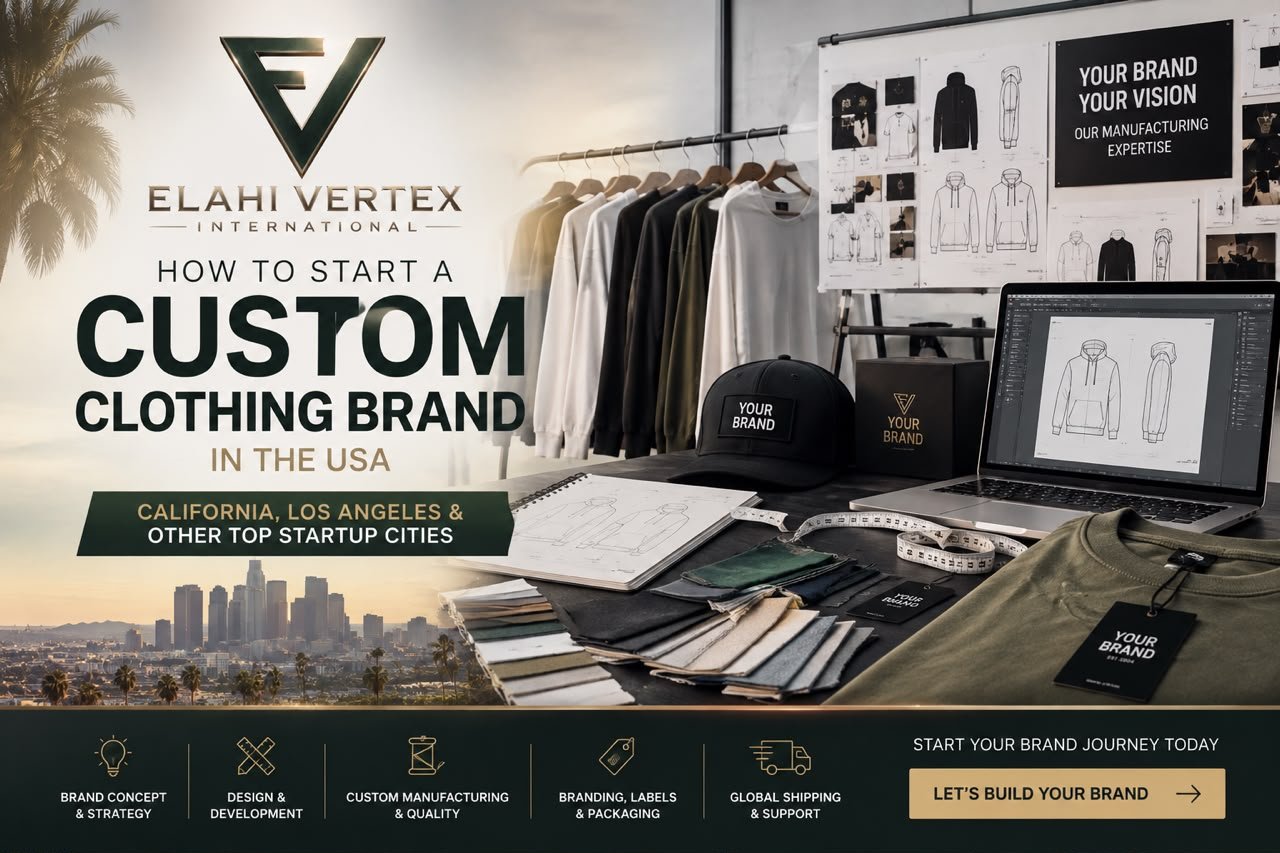
If you want to start a clothing brand in the USA, it takes more than choosing a name, creating a logo, designing some clothes, building a website, and starting to sell. You need to choose your niche, develop the right products, find a reliable manufacturer, validate demand, and prepare for launch.
In reality, the difficult part is turning a clothing concept into products that can actually be manufactured, priced, branded, delivered and sold profitably.
For new founders, the choice of location can also matter. Los Angeles, California is one of the strongest U.S. locations to consider for a new clothing brand, particularly for streetwear, lifestyle, fashion, activewear and creative brands. Recent 2026 reporting describes Los Angeles as a powerful fashion and beauty hub, with emerging brands and international labels increasingly using the city as an entry point into the U.S. market.
But Los Angeles isn’t the only city worth considering.
Depending on your brand concept, you may also consider New York City, San Francisco, Miami, Austin, Atlanta and other growing fashion or startup markets.
For a new brand, however, there is an important distinction:
You do not need to manufacture your clothing in the same city where your brand is headquartered.
A founder can build a clothing company in Los Angeles, New York, Miami or another U.S. city while working with an international custom manufacturer for product development and production.
That creates an important opportunity for startups: build the brand where your customers and creative community are, and select manufacturing partners based on product requirements, quality, communication, customization and commercial fit.
⸻
Table of Contents
- Is California a good place to start a clothing brand?
- Why Los Angeles is an important city for new clothing brands
- Other U.S. cities to consider
- Choose your clothing brand niche
- Create your brand identity
- Decide what clothing products to launch
- Understand custom clothing manufacturing
- OEM vs ODM vs private label
- Create production-ready specifications
- Find the right clothing manufacturer
- Request samples before production
- Understand MOQ, pricing and production costs
- Build your brand’s online presence
- Launch and validate your clothing brand
- Common mistakes new clothing brands make
- How Elahi Vertex International can help
- FAQ
- Final checklist
- Conclusion
⸻
How to Start a Clothing Brand in the USA
Yes, California can be a strong location for launching a clothing brand, particularly when the brand is connected to fashion, streetwear, lifestyle, activewear, creative culture or e-commerce.
California has several major fashion and business ecosystems, but Los Angeles deserves particular attention.
Los Angeles has a long-established apparel and fashion identity, while 2026 reporting indicates that new brands and international fashion companies continue to see the city as an important U.S. market.
For example, recent developments include the launch of REVOLVE Los Angeles, while other emerging fashion concepts have expanded their physical presence in the city.
This does not mean every new clothing company should move to Los Angeles.
Your decision should depend on:
- Your target customer
- Brand category
- Lifestyle and culture
- Retail strategy
- E-commerce strategy
- Access to creative talent
- Networking opportunities
- Operating costs
- Manufacturing strategy
- Logistics
- Marketing opportunities
For many startups, the smarter approach is to build the brand digitally first and expand physically after proving demand.
⸻
2. Why Los Angeles Is Important for New Clothing Brands
Los Angeles, California
If your question is:
“Where in the USA should I start a new clothing brand?”
Los Angeles is one of the first cities worth researching.
Vogue Business’s 2026 assessment describes Los Angeles as a significant fashion and beauty hub and highlights a new wave of brands building communities around neighborhoods, lifestyle, events and in-person experiences.
Los Angeles also has an established apparel ecosystem.
The city’s fashion environment can be particularly relevant for:
- Streetwear
- Sportswear
- Athleisure
- Lifestyle clothing
- Denim
- Contemporary fashion
- Activewear
- Creative fashion labels
- E-commerce brands
- Influencer-led brands
There is also evidence of startup activity specifically within Los Angeles fashion. A July 2026 startup-tracking report identifies multiple emerging fashion startups in the city, while Y Combinator’s 2026 directory lists apparel/fashion startups headquartered in Los Angeles.
But don’t confuse a fashion hub with guaranteed success.
Los Angeles has competition.
A new brand still needs:
- A clear niche
- A differentiated product
- Strong visual identity
- Good product execution
- Effective marketing
- Customer validation
- Reliable manufacturing
- Financial discipline
Simply being located in Los Angeles will not make a clothing brand successful.
⸻
3. Other U.S. Cities to Consider for a New Clothing Brand
Los Angeles is a strong option, but a serious founder should compare several markets.
| City | Why consider it? | Potentially relevant for |
| Los Angeles, California | Strong fashion, apparel, lifestyle and creative ecosystem | Streetwear, sportswear, lifestyle, fashion |
| New York City, New York | Major fashion, media, retail and creative ecosystem | Fashion, luxury, contemporary, streetwear |
| San Francisco, California | Strong technology/startup ecosystem with emerging fashion-commerce businesses | Fashion-tech, e-commerce, innovative brands |
| Miami, Florida | Growing startup ecosystem and strong lifestyle/international identity | Resortwear, lifestyle, activewear, contemporary |
| Austin, Texas | Growing entrepreneurial ecosystem and creative culture | Lifestyle, streetwear, outdoor/active |
| Atlanta, Georgia | Strong cultural influence and entrepreneurial environment | Streetwear, music-related fashion, lifestyle |
| Chicago, Illinois | Large metropolitan consumer market and established creative/business community | Streetwear, contemporary, lifestyle |
San Francisco deserves particular attention for fashion-tech brands.
Y Combinator’s 2026 directory lists multiple apparel/fashion startups in the San Francisco Bay Area, including companies working around fashion commerce, apparel and fashion technology.
San Francisco is therefore potentially interesting if your business is more than a traditional clothing label and includes:
- AI
- Fashion technology
- Personalization
- E-commerce technology
- Digital fashion
- New retail models
A practical recommendation
If you’re launching a traditional custom clothing brand, I would research:
1. Los Angeles
2. New York City
3. Miami
4. Atlanta
5. Austin
And if you’re building a fashion-tech or technology-driven clothing company, add:
San Francisco
The right city depends more on your target customer and business model than on a generic “best city” ranking.
⸻
4. Choose Your Clothing Brand Niche
Before contacting a manufacturer, decide what type of brand you are building.
“Clothing brand” is too broad.
You need a specific customer and product direction.
For example:
Streetwear
Potential products:
- Oversized T-shirts
- Hoodies
- Sweatpants
- Jackets
- Cargo pants
- Caps
- Graphic apparel
Sportswear
Potential products:
- Jerseys
- Training shirts
- Shorts
- Tracksuits
- Compression garments
- Teamwear
- Performance apparel
Gym / Activewear
Potential products:
- Gym shirts
- Leggings
- Shorts
- Sports bras
- Compression wear
- Training sets
Luxury / Premium
Potential products:
- Premium jackets
- Tailored garments
- Premium knitwear
- Designer-inspired silhouettes
- High-end basics
Lifestyle
Potential products:
- T-shirts
- Hoodies
- Sweatshirts
- Casual pants
- Jackets
- Accessories
Private-label brand
Instead of developing everything from scratch, a startup may work with a manufacturer to develop products under its own branding.
The critical question is:
Who exactly are you trying to sell to?
A brand designed for Los Angeles skaters is different from a brand designed for New York professionals.
A California activewear brand is different from a Miami resortwear label.
A German-targeted minimalist brand is different from an American streetwear brand.
⸻
5. Create Your Brand Identity
Your brand identity should exist before large-scale production.
Start with:
Brand Name
Choose a name that is:
- Memorable
- Distinctive
- Appropriate for your niche
- Available for your intended use
You should independently check trademark availability before committing to the brand.
Logo
Create a recognizable visual identity.
Colors
Choose a controlled color system.
Typography
Use consistent fonts across:
- Website
- Packaging
- Social media
- Product labels
- Marketing
Brand Story
Answer:
- Why does the brand exist?
- Who is it for?
- What does it represent?
- Why should customers care?
- What makes it different?
Brand Positioning
Try to complete this sentence:
“We create ______ for ______ who want ______.”
If you cannot clearly answer that question, the brand probably isn’t sufficiently defined yet.
⸻
6. Decide What Products to Launch
One of the biggest mistakes new founders make is trying to launch too many products.
A better strategy is often to start with a focused collection.
For example:
Capsule Collection
- 2 T-shirts
- 1 hoodie
- 1 sweatpant
- 1 jacket
Or:
Activewear Capsule
- 2 training shirts
- 2 shorts
- 1 tracksuit
- 1 compression product
The exact product mix depends on the brand.
The objective is to make your first collection small enough to manage and large enough to communicate the brand.
⸻
7. Understand Custom Clothing Manufacturing
Custom manufacturing means the clothing is produced according to the buyer’s specifications rather than simply purchasing generic finished products.
Specifications can include:
- Design
- Fabric
- Color
- Measurements
- Fit
- Construction
- Branding
- Labels
- Packaging
- Embroidery
- Printing
- Other customization requirements
For a startup, custom manufacturing can create greater control over the final product.
But it also creates greater responsibility.
You need to communicate your requirements clearly.
⸻
8. OEM vs ODM vs Private Label
These terms are often confused.
| Model | Basic concept | Best suited for |
| OEM | Buyer provides specifications/design and manufacturer produces according to them | Brands with their own product designs |
| ODM | Manufacturer may contribute existing product/development expertise that the buyer customizes or brands | Brands needing development support |
| Private Label | Products are produced for sale under the buyer’s brand | Startups building their own label |
| Custom Manufacturing | Products are manufactured according to agreed buyer requirements | Brands seeking customized products |
The exact scope of an OEM, ODM or private-label project should always be discussed with the manufacturer.
⸻
9. Create Production-Ready Specifications
This is where many new clothing brands fail.
A beautiful Instagram mockup is not the same thing as a manufacturing specification.
Your manufacturer may need information such as:
- Product drawings
- Measurements
- Size chart
- Fabric requirements
- Fabric composition
- GSM where relevant
- Colors
- Pantone references where applicable
- Stitching requirements
- Labels
- Branding
- Print specifications
- Embroidery
- Zippers
- Buttons
- Trims
- Packaging
- Quantity
For more complex garments, a tech pack can be extremely useful.
A good tech pack helps reduce ambiguity between the designer and manufacturer.
As one recent 2026 discussion among clothing-startup founders illustrates, new founders frequently understand the visual concept but underestimate the importance of materials, production limitations and production-ready technical documentation.
⸻
10. Find the Right Clothing Manufacturer
Don’t choose a manufacturer simply because they offer the lowest price.
Compare:
Product capability
Can they manufacture the type of product you need?
Customization
Can they work with your specifications?
Communication
Can requirements be clearly discussed?
Sampling
Can you evaluate the product before committing to larger production?
Quality
How will specifications and quality be evaluated?
Branding
Can your requirements for labels, logos and packaging be discussed?
Commercial fit
Does the manufacturer’s production model make sense for your business?
Export capability
If manufacturing internationally, understand the commercial and logistics responsibilities involved.
⸻
11. Request Samples Before Production
For a new clothing brand, samples can be one of the most important stages.
Do not assume that a digital design will automatically translate into the exact physical product you imagined.
Evaluate:
- Fit
- Fabric
- Weight
- Construction
- Stitching
- Embroidery
- Color
- Measurements
- Comfort
- Finishing
- Branding
If changes are required, communicate them before production.
The sample-development stage is where problems are generally much easier to correct than after a large production order.
⸻
12. Understand MOQ, Pricing and Production Costs
New founders often ask:
“How much does it cost to start a clothing brand?”
There is no universal answer.
Your cost depends on factors such as:
- Product type
- Quantity
- Materials
- Construction
- Customization
- Branding
- Packaging
- Sampling
- Shipping
- Marketing
- Website
- Photography
- Inventory
- Business expenses
MOQ means Minimum Order Quantity.
However, there is no universal MOQ that applies to every manufacturer or product.
MOQ can vary according to the specific project.
Therefore, don’t build your financial plan around an assumed MOQ until you receive actual project-specific information.
⸻
13. Build Your Brand’s Online Presence
A modern clothing startup should normally establish a digital presence before launching significant inventory.
At minimum consider:
Website
Your website should clearly communicate:
- Brand identity
- Products
- Target customer
- Value proposition
- Contact information
- Shipping information
- Returns policies where applicable
- Frequently asked questions
Useful for:
- Product photography
- Lifestyle content
- Behind-the-scenes development
- Community building
- Influencer relationships
TikTok
Potentially useful for:
- Brand storytelling
- Product demonstrations
- Founder content
- Behind-the-scenes manufacturing
- Launch campaigns
Useful for:
- Fashion inspiration
- Product discovery
- Style collections
- Search-driven visual content
Build an email list before launch where possible.
A founder who waits until launch day to begin building an audience is starting marketing too late.
⸻
14. Launch and Validate Your Clothing Brand
Do not assume customers will buy simply because you like the product.
Validate demand.
A low-cost validation process could look like this:
Step 1 — Create the brand concept
Define:
- Customer
- Niche
- Product
- Price positioning
Step 2 — Build social profiles
Create consistent brand visuals.
Step 3 — Create sample products
Produce a small number of samples for content and evaluation.
Step 4 — Publish content
Show:
- Design process
- Product development
- Brand story
- Samples
- Details
Step 5 — Measure interest
Track:
- Email signups
- Direct messages
- Product-page visits
- Engagement
- Waitlist registrations
- Preorders where appropriate
Step 6 — Improve the product
Use feedback to refine:
- Fit
- Design
- Colors
- Pricing
- Product selection
Step 7 — Scale carefully
Only increase production when there is evidence that customers want the product.
⸻
15. Common Mistakes New Clothing Brands Make
Mistake 1: Starting with too many products
More SKUs create more complexity.
Mistake 2: Choosing a manufacturer only by price
The cheapest supplier isn’t automatically the best commercial partner.
Mistake 3: Skipping samples
This can create expensive production problems.
Mistake 4: Not understanding the customer
A logo is not a target market.
Mistake 5: Copying successful brands
Inspiration is normal.
Building a business around another brand’s identity is not differentiation.
Mistake 6: Spending too much on branding before validation
A beautiful website doesn’t prove demand.
Mistake 7: Ignoring production details
Fabric, measurements, construction and specifications matter.
Mistake 8: Ordering too much inventory too early
Unsold inventory ties up capital.
Mistake 9: Treating social media followers as customers
Followers are not revenue.
Mistake 10: Assuming the city creates the brand
Los Angeles, New York or Miami can provide opportunities, but the product and positioning still have to win.
⸻
16. How Elahi Vertex International Can Help
For founders building a new clothing brand in Los Angeles, California, New York, Miami, San Francisco, Austin, Atlanta or elsewhere in the USA, Elahi Vertex International can discuss relevant custom manufacturing requirements with qualified B2B buyers.
Elahi Vertex International is positioned as a:
- B2B custom manufacturer
- Custom manufacturing partner
- OEM manufacturing partner
- ODM manufacturing partner
- Private-label manufacturing partner
- International manufacturing and export partner
For a startup, the discussion can begin with the product requirements.
A buyer can provide information such as:
- Product type
- Design
- Reference images
- Technical specifications
- Materials
- Colors
- Sizes
- Branding
- Quantity
- Packaging requirements
- Destination market
- Target timeline
The specific manufacturing requirements, availability, pricing, MOQ and production details should then be confirmed for the individual project.
Starting a clothing brand in Los Angeles?
You do not necessarily need to find a manufacturer in Los Angeles.
Your brand can be based in Los Angeles while your manufacturing partner is located elsewhere.
The better question is:
Which manufacturer can produce the product according to my requirements and make commercial sense for my brand?
That is a much more useful question than simply:
“Is the manufacturer located near me?”
If you already have a design, send the specifications and discuss the project with Elahi Vertex International.
WhatsApp: +92 309 1639614
Email: elahivertexinternational@gmail.com
⸻
17. FAQ: Starting a Clothing Brand in the USA
What is the best city in the USA to start a clothing brand?
There is no universally best city. Los Angeles is one of the strongest markets to research because of its fashion, apparel and creative ecosystem. New York, Miami, San Francisco, Austin and Atlanta may also be relevant depending on the brand’s target market and business model.
Is Los Angeles good for starting a clothing brand?
Yes. Los Angeles has a strong fashion and apparel ecosystem and continues to attract emerging and international fashion brands.
Can I start a clothing brand in California without manufacturing in California?
Yes. A clothing brand’s headquarters and manufacturing location do not have to be the same.
Can a startup use an international clothing manufacturer?
Yes. A U.S. clothing startup can evaluate international manufacturers based on its product requirements, commercial terms, quality expectations, communication and logistics.
What is custom clothing manufacturing?
Custom clothing manufacturing involves producing garments according to agreed specifications such as design, measurements, materials, colors, branding and construction requirements.
What is OEM clothing manufacturing?
OEM manufacturing generally involves producing products according to the buyer’s specifications or designs.
What is ODM clothing manufacturing?
ODM generally involves a manufacturer contributing product development or existing design/development capabilities that can then be customized or branded by the buyer.
What is private-label clothing manufacturing?
Private-label manufacturing involves producing clothing for sale under the buyer’s own brand.
Should I make samples before ordering production?
For most custom clothing projects, developing and evaluating samples is an important way to check the product before larger-scale production.
What should I send a manufacturer for a quotation?
Depending on the project, provide the product type, designs, measurements, materials, colors, quantity, branding, packaging and other relevant technical specifications.
How much does it cost to start a clothing brand?
There is no fixed amount. Costs vary according to product development, samples, production quantity, materials, branding, website, marketing, inventory, shipping and other business expenses.
What is MOQ in clothing manufacturing?
MOQ means Minimum Order Quantity. The actual MOQ depends on the manufacturer, product and project requirements.
Can Elahi Vertex International manufacture for a USA clothing startup?
Elahi Vertex International can discuss relevant custom manufacturing requirements with qualified B2B buyers and determine whether the specific project is suitable.
How can I contact Elahi Vertex International?
You can contact Elahi Vertex International through WhatsApp at +92 309 1639614 or email elahivertexinternational@gmail.com to discuss your manufacturing requirements.
⸻
18. New Clothing Brand Launch Checklist
Before placing a production order, work through this checklist:
Brand
- Brand name selected
- Trademark availability researched
- Logo developed
- Brand positioning defined
- Target customer defined
Product
- Product category selected
- Initial collection defined
- Designs prepared
- Materials considered
- Size requirements prepared
- Branding requirements prepared
Manufacturing
- Manufacturer researched
- Requirements communicated
- Quotation requested
- MOQ discussed
- Sample requirements discussed
- Production requirements confirmed
Marketing
- Website prepared
- Instagram prepared
- Social content prepared
- Product photography planned
- Email list strategy prepared
Launch
- Product validated
- Pricing calculated
- Launch plan prepared
- Inventory strategy established
- Customer support process prepared
⸻
19. Conclusion: Start the Brand Where Your Customers Are — Manufacture Where the Product Makes Sense
Starting a custom clothing brand in the USA is easier than it was for previous generations, but that does not mean it is easy to build a profitable brand.
Los Angeles, California is one of the most interesting U.S. markets for fashion startups and emerging clothing brands in 2026, particularly because of its established apparel ecosystem and continuing creative and brand activity.
But don’t choose Los Angeles simply because it is fashionable.
Choose your city based on:
CUSTOMER → BRAND → PRODUCT → COMMUNITY → BUSINESS MODEL
Then choose your manufacturing partner based on:
PRODUCT REQUIREMENTS → QUALITY → CUSTOMIZATION → COMMUNICATION → COMMERCIAL FIT
If you’re building a new clothing brand in Los Angeles, California, New York, Miami, San Francisco, Austin, Atlanta or another U.S. market, you can start by defining your product requirements and discussing the manufacturing project with a suitable B2B manufacturing partner.
Ready to discuss your clothing brand?
Contact Elahi Vertex International
WhatsApp: +92 309 1639614
Email: elahivertexinternational@gmail.com
Website: Elahi Vertex International
Alibaba: Elahi Vertex International on Alibaba
| Anchor Text | Target Page | Suggested URL Slug | Placement | Purpose |
| custom manufacturing | Custom Manufacturing | /custom-manufacturing/ | Section 7 | Topical relevance |
| OEM manufacturing | OEM Manufacturing | /oem-manufacturing/ | Section 8 | Commercial intent |
| ODM manufacturing | ODM Manufacturing | /odm-manufacturing/ | Section 8 | Commercial intent |
| private-label manufacturing | Private Label Manufacturing | /private-label-manufacturing/ | Section 8 | Lead generation |
| custom sportswear | Custom Sportswear | /custom-sportswear/ | Product/niche section | Product relevance |
| custom streetwear | Custom Streetwear | /custom-streetwear/ | Niche section | Product relevance |
| custom boxing gear | Custom Boxing Gear | /custom-boxing-gear/ | Product section where relevant | Product relevance |
| custom leather products | Custom Leather Products | /custom-leather-products/ | Product section where relevant | Category relevance |
| request a quotation | Request a Quote | /request-a-quote/ | CTA sections | Conversion |
