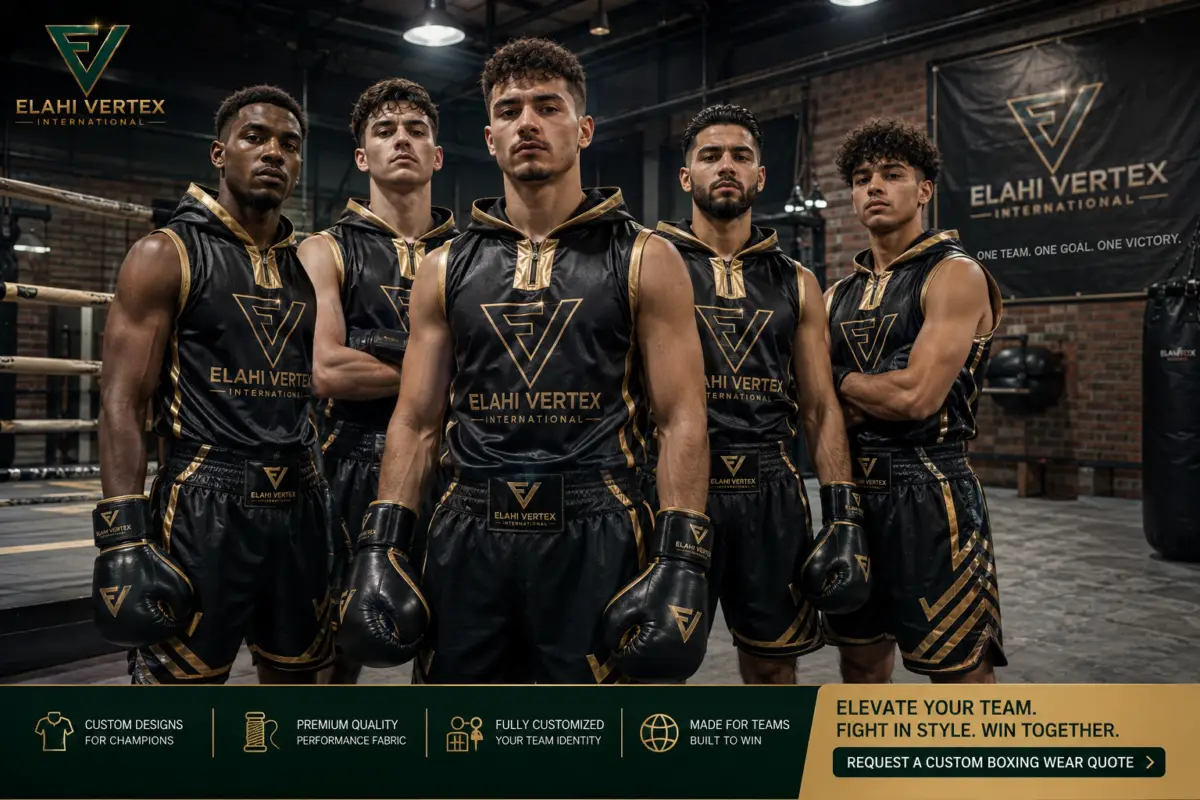

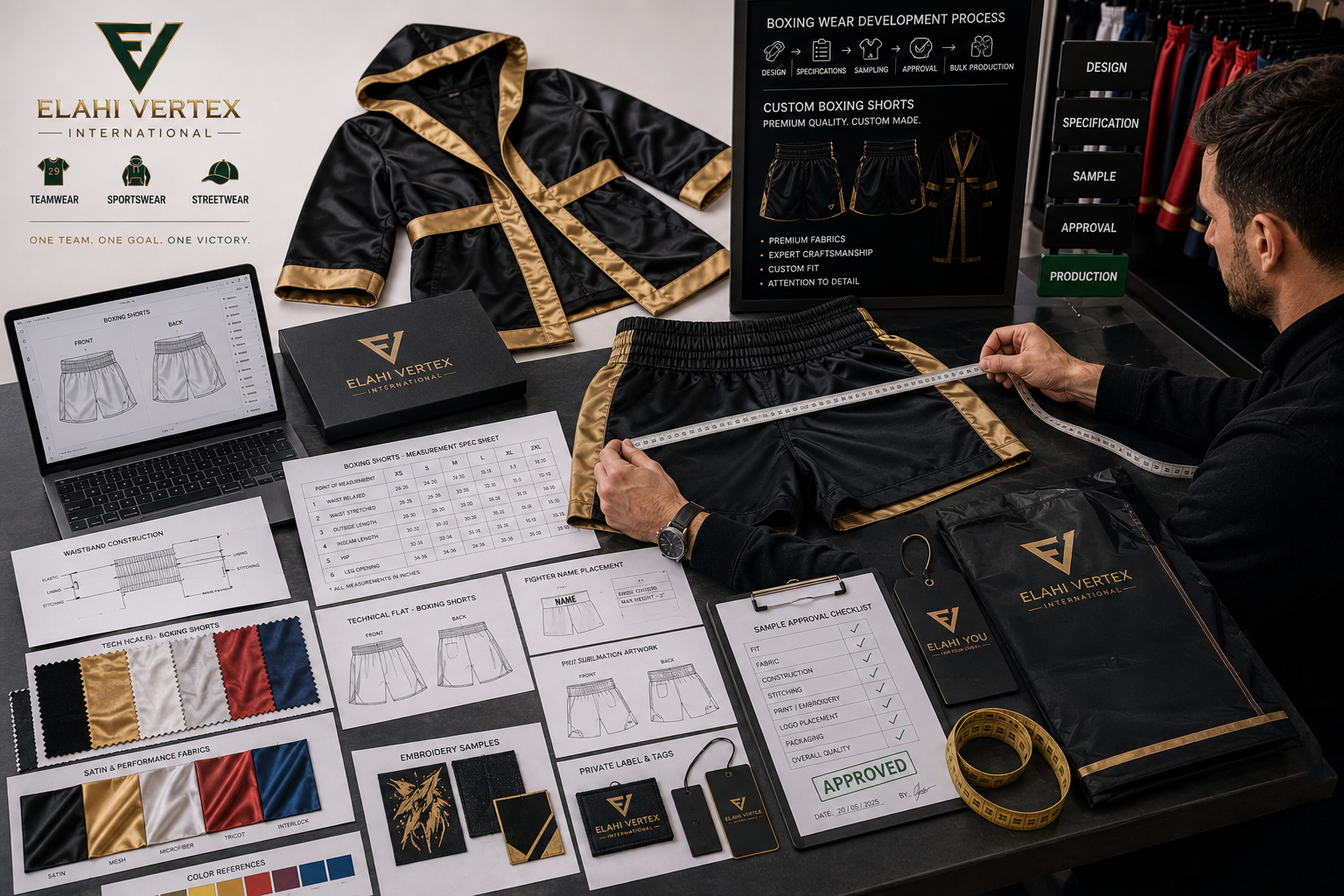
Custom boxing shorts may look simple, but small design decisions can materially affect fit, movement, appearance, branding, sampling and eventual bulk production.
For USA boxing brands, fightwear startups, boxing gyms, private-label businesses, wholesalers and e-commerce companies, the mistake is often starting with a visual reference and assuming a manufacturer can infer everything else. A photograph may communicate the overall style, but it does not necessarily define the waistband construction, fabric, leg opening, measurements, side panels, artwork dimensions, embroidery placement, labels or packaging.
Before requesting a sample, buyers should convert the design concept into a controlled product specification.
This guide explains 9 critical custom boxing shorts design mistakes USA brands should avoid before sampling, what information should be prepared for a manufacturer, and how to evaluate the resulting sample before considering bulk production.
Table of Contents
- What Are Custom Boxing Shorts?
- What Should Be Specified Before Sampling?
- Mistake #1 — Choosing the Wrong Boxing Shorts Cut
- Mistake #2 — Selecting Fabric Only by Appearance
- Mistake #3 — Under-Specifying the Waistband
- Mistake #4 — Ignoring Mobility and Leg Openings
- Mistake #5 — Using an Incomplete Size Chart
- Mistake #6 — Choosing Decoration Without Considering the Garment
- Mistake #7 — Poor Fighter, Sponsor and Brand Placement
- Mistake #8 — Forgetting Labels, Trims and Packaging
- Mistake #9 — Approving a Sample Without a Final Specification
- Custom Boxing Shorts Specification Checklist
- Boxing Shorts Size-Chart Framework
- How to Review a Boxing Shorts Sample
- Common USA Buyer Mistakes
- How to Prepare an RFQ
- Why Discuss Boxing Wear With Elahi Vertex International?
- 20 Custom Boxing Shorts FAQs
- Conclusion
What Are Custom Boxing Shorts?
Custom boxing shorts are boxing-specific garments developed to a buyer’s requirements for fit, fabric, construction, colors, artwork, branding, sizing and other agreed specifications.
Depending on the project, customization may involve:
- Custom colors
- Side panels
- Contrasting trims
- Fighter names
- Team identity
- Brand logos
- Sponsor logos
- Embroidery
- Printed graphics
- Waistband branding
- Private labels
- Size labels
- Care labels
- Hang tags
- Packaging
The exact materials, construction methods, decoration options and commercial terms available from a particular manufacturer must be confirmed for the individual project.
That distinction matters.
A buyer researching custom boxing shorts should understand what is technically possible in the industry without assuming every possible feature is automatically available from every supplier.
What Should USA Brands Specify Before Sampling Custom Boxing Shorts?
Before sampling, a USA boxing brand should ideally communicate enough information for the manufacturer to understand the intended physical product.
A useful specification may include:
- Product/style name
- Style number
- Front technical drawing
- Back technical drawing
- Side details
- Intended fit
- Base sample size
- Size range
- Finished garment measurements
- Fabric direction
- Waistband construction
- Leg shape
- Side panels
- Slits where applicable
- Colors
- Artwork
- Logo dimensions
- Logo placement
- Fighter personalization
- Labels
- Packaging
- Sample objectives
Not every detail needs to be finalized before the first conversation.
Unknown requirements can be marked:
MANUFACTURER INPUT REQUIRED
That is better than guessing.
1. Choosing the Wrong Custom Boxing Shorts Cut
The first mistake is treating all custom boxing shorts as essentially the same silhouette.
They are not.
Design direction can vary substantially depending on the intended aesthetic and use.
A brand might want:
- Traditional boxing silhouette
- Modern athletic boxing shorts
- Shorter competition-inspired cut
- Longer boxing shorts
- Wide-leg silhouette
- More streamlined fit
- High-waisted appearance
- Contemporary fightwear styling
The problem begins when the buyer sends a reference photograph but does not define what specifically should be reproduced from the reference.
Define the silhouette
Important dimensions can include:
- Waist
- Front rise
- Back rise
- Hip
- Outseam
- Inseam
- Leg opening
- Waistband height
Side-panel width and shape may also materially affect appearance.
Reference images are direction—not specifications
Suppose you send a manufacturer photographs of three different boxing shorts and say:
Make something like these.
Which features matter?
The waistband from image one?
Length from image two?
Side panel from image three?
Without clarification, the manufacturer must interpret your intent.
Better approach
Annotate references.
For example:
Reference A: Overall silhouette
Reference B: Waistband appearance
Reference C: Side-panel shape
Original artwork: Branding only
Then support those references with measurements and technical drawings.
That creates a clearer foundation for sampling.
2. Selecting Fabric Only by Appearance
The second major custom boxing shorts mistake is selecting fabric because it looks attractive in a photograph.
Fabric affects much more than appearance.
Buyers may need to consider:
- Weight
- Hand feel
- Drape
- Movement
- Surface
- Structure
- Breathability
- Stretch where relevant
- Decoration compatibility
- Durability requirements
- Intended visual effect
Traditional-looking boxing shorts and contemporary performance-oriented boxing shorts may use different material directions.
Satin-style appearance vs performance direction
Some boxing designs intentionally use a smooth, lustrous appearance associated with traditional boxing aesthetics.
Other fightwear brands may prefer:
- Matte surfaces
- Lightweight technical appearance
- Stretch components
- Mesh panels
- Contemporary performance styling
Neither is universally superior.
The correct choice depends on the product.
Do not specify only “premium fabric”
“Premium” is not measurable.
Instead describe the intended result.
For example:
Lightweight boxing shorts with a traditional smooth visual appearance and enough freedom of movement for boxing training and competition-style use. Final material requires manufacturer recommendation and sample approval.
Or:
Contemporary boxing shorts requiring a lightweight matte fabric direction with unrestricted movement. Final composition, construction and weight require confirmation during development.
That gives the manufacturer something useful to work from.
3. Under-Specifying the Waistband
The waistband is one of the most visually distinctive and functionally important parts of many custom boxing shorts.
Yet buyers frequently describe it with only:
Wide elastic waistband.
That leaves many unanswered questions.
Waistband specifications may need to address
- Finished height
- Construction
- Elastic arrangement
- Stretch
- Recovery
- Outer fabric
- Inner construction
- Seams
- Closure if applicable
- Branding
- Logo placement
- Color
- Relationship to rise measurements
Why waistband height matters
The waistband changes the proportions of the entire garment.
A deeper waistband can create a traditional boxing appearance, while a narrower construction can create a different visual identity.
Therefore, “high-waisted boxing shorts” should not remain merely a visual description.
Translate it into measurable specifications.
Waistband branding
Some designs place:
- Brand name
- Fighter name
- Team name
- Logo
- Decorative artwork
directly on the waistband.
If so, specify:
- Artwork dimensions
- Orientation
- Position
- Color
- Intended decoration technique
Do not assume the manufacturer will automatically center the artwork exactly as intended.
4. Ignoring Mobility and Leg Openings
Boxing apparel must accommodate movement.
A pair of shorts that looks excellent while standing still may behave differently during:
- Footwork
- Defensive movement
- Punch combinations
- Conditioning
- Warm-ups
- General training
The pattern, fabric and construction work together.
Review the leg opening
A restrictive leg opening can affect movement.
But simply making the opening extremely wide is not automatically the answer either; it changes silhouette and appearance.
Define the intended balance.
Consider:
- Leg opening
- Inseam
- Outseam
- Side seam
- Side panel
- Slit where applicable
- Fabric behavior
Side slits
If the design contains side slits, define:
- Length
- Shape
- Construction
- Reinforcement
- Position
Avoid instructions such as:
Add normal boxing slit.
“Normal” is not a technical measurement.
Sample under movement
When reviewing custom boxing shorts, do not evaluate them only on a hanger.
Where appropriate, evaluate fit and mobility during realistic movement.
The objective is not to make unsupported performance claims.
It is to determine whether the garment behaves as intended for its stated use.
5. Using an Incomplete Custom Boxing Shorts Size Chart
S, M, L and XL are labels.
They are not universal measurements.
If USA brands want consistent custom boxing shorts, they need a controlled measurement specification.
Useful points of measure
Depending on the pattern, a specification might include:
- Relaxed waist
- Extended waist where relevant
- Hip
- Front rise
- Back rise
- Outseam
- Inseam
- Leg opening
- Waistband height
Boxing Shorts Size-Chart Framework
The following table is intentionally a framework only. It does not contain Elahi Vertex International production measurements.
Point of Measure
S
M
L
XL
2XL
Waist
Specify
Specify
Specify
Specify
Specify
Hip
Specify
Specify
Specify
Specify
Specify
Front Rise
Specify
Specify
Specify
Specify
Specify
Back Rise
Specify
Specify
Specify
Specify
Specify
Outseam
Specify
Specify
Specify
Specify
Specify
Inseam
Specify
Specify
Specify
Specify
Specify
Leg Opening
Specify
Specify
Specify
Specify
Specify
Waistband Height
Specify
Specify
Specify
Specify
Specify
Include a POM diagram
POM means Point of Measure.
A POM diagram shows exactly where measurements are taken.
This reduces ambiguity.
For example, “length” could mean:
- Full outseam including waistband
- Length below waistband
- Inseam
- Another defined measurement
Label it.
Tolerances
Appropriate manufacturing tolerances should be agreed for the individual product.
Do not copy tolerances from unrelated garments simply to fill the specification sheet.
6. Choosing Embroidery or Printing Without Considering the Garment
Branding can dominate the appearance of custom boxing shorts.
Depending on the design and available manufacturing methods, decoration might involve:
- Embroidery
- Sublimation
- Screen printing
- Heat-transfer applications
- Patches
- Appliqué
- Other suitable processes
The appropriate method depends on:
- Fabric
- Artwork
- Desired appearance
- Placement
- Size
- Color count
- Garment construction
- Intended product
Available options must be confirmed with the manufacturer for the specific project.
Bigger embroidery is not automatically better
Dense or large embroidery changes the physical garment.
When embroidery is considered, evaluate:
- Artwork complexity
- Dimensions
- Placement
- Fabric interaction
- Backing/stabilization where applicable
- Weight and feel
- Sample appearance
Do not evaluate embroidery only from a digital mockup.
Sublimated designs
Sublimation can support complex graphics where suitable materials and construction are used.
If the design uses sublimation, specify:
- Artwork
- Scale
- Orientation
- Colorways
- Panel relationships
- Logo positions
- Sponsor positions
- Personalization
Screen printing and transfers
Again, provide measurable dimensions and placement.
Avoid:
Medium logo on left side.
Use:
Artwork file + dimensions + defined placement reference.
7. Poor Fighter, Sponsor and Brand-Logo Placement
Boxing shorts can carry multiple visual identities simultaneously:
Brand → Fighter → Gym/Team → Sponsors
Without a placement plan, the garment can quickly become visually cluttered.
Create an artwork placement map
A specification might identify:
Branding Element
Area
Specification
Brand Logo
Waistband
Artwork + dimensions
Fighter Name
Front/waist
Artwork + placement
Primary Sponsor
Front leg
Artwork + dimensions
Secondary Sponsor
Opposite leg
Artwork + dimensions
Team/Gym Logo
Side/rear
Artwork + placement
The exact arrangement depends on the design.
Sponsor logos require good artwork
Whenever possible, obtain proper files directly from the sponsor.
Avoid relying on:
- Screenshots
- Social-media images
- Low-resolution JPGs
- Logos copied from websites
Vector artwork is generally preferable where the decoration workflow supports it.
Check spelling
Fighter names and sponsor names are high-risk personalization elements.
A visually perfect pair of shorts can still be unusable if the name is wrong.
Use a controlled artwork approval process.
8. Forgetting Private Labels, Trims and Packaging
USA boxing brands developing custom boxing shorts should think beyond the visible exterior.
Private-label products may require:
- Main brand label
- Size label
- Care label
- Printed label
- Hang tag
- Product sticker
- SKU
- Barcode
- Individual packaging
- Size identification
- Carton markings
Applicable destination-market labeling requirements should be checked separately.
Do not assume a manufacturer determines every legal requirement for your USA business.
Trims matter too
Depending on the design:
- Elastic
- Drawcord
- Eyelets
- Patches
- Binding
- Contrast tape
- Hook-and-loop components
- Other trims
may need specification.
Packaging should match your sales model
A gym ordering team shorts has different requirements from an e-commerce boxing brand shipping individual products to customers.
Consider what happens after manufacturing.
Does your warehouse require:
- Individual SKU labels?
- Barcodes?
- Size stickers?
- Specific folding?
- Separate fighter/team assortment?
Define those requirements before bulk completion.
9. Approving a Boxing Shorts Sample Without a Final Specification
This is the mistake that can undermine everything else.
After multiple revisions, the approved information may be scattered across:
- Tech packs
- Emails
- PDFs
- Annotated images
- Artwork files
- Measurement sheets
The sample might represent Revision 5 while the factory document still contains Revision 3 measurements.
That is dangerous.
Create one controlled final specification
Before considering bulk production, consolidate the relevant approved information.
A final custom boxing shorts approval package might include:
- Style number
- Technical flats
- Measurement chart
- POM diagram
- Approved material reference
- Color references
- Waistband specification
- Construction details
- Artwork
- Logo placements
- Labels
- Trims
- Packaging
- Size breakdown
- Approved sample reference
- Revision number
Use version control
Avoid:
BOXING-SHORTS-FINAL.pdf
then:
BOXING-SHORTS-FINAL2.pdf
then:
BOXING-SHORTS-FINAL-REAL.pdf
Instead use:
BS-101 — Revision 01
BS-101 — Revision 02
BS-101 — Revision 03
Maintain a revision log.
Revision
Change
Status
V1
Initial design
Superseded
V2
Waistband revised
Superseded
V3
Leg opening + logo revised
Current
Everyone should know which specification is active.
Custom Boxing Shorts Specification Checklist
Before requesting a sample, USA buyers can review the following.
Product Identity
- Style name
- Style number
- Product type
- Intended use
- Sample size
- Size range
- Revision number
Design
- Front technical flat
- Back technical flat
- Side/details where needed
- Reference images
- Colorways
Fit
- Intended silhouette
- Waist
- Hip
- Rise
- Outseam
- Inseam
- Leg opening
- Waistband
Fabric
- Composition if known
- Weight/GSM where relevant
- Surface
- Drape
- Stretch where relevant
- Color
- Secondary fabrics/panels
Construction
- Waistband
- Seams
- Side panels
- Slits
- Hems
- Reinforcement
- Relevant trims
Artwork
- Brand logo
- Fighter name
- Sponsor logos
- Team/gym logo
- Dimensions
- Placement
- Colors
- Decoration method
Private Label
- Main label
- Size label
- Care label
- Hang tag
Packaging
- Folding
- Individual packaging
- Size sticker
- SKU
- Barcode where required
- Carton requirements
Sampling
- Sample objective
- Required sample size
- Fit points to evaluate
- Artwork to evaluate
- Material to evaluate
- Approval method
How to Review a Custom Boxing Shorts Sample
When the sample arrives, do not immediately approve it because the overall appearance is attractive.
Use the specification.
Step 1 — Confirm sample identity
Check:
- Correct style
- Correct revision
- Correct size
- Correct colorway
Step 2 — Measure it
Compare physical measurements with the approved measurement chart.
Record actual measurements rather than relying on memory.
Step 3 — Evaluate fit
Check the intended silhouette.
Does the waistband sit as intended?
Does the leg shape match the design?
Is the overall proportion correct?
Step 4 — Evaluate movement
Where appropriate, review the garment during realistic boxing-related movement.
Step 5 — Inspect fabric
Review:
- Hand feel
- Weight direction
- Drape
- Surface
- Stretch where relevant
- Appearance
Compare against the approved material reference where one exists.
Step 6 — Inspect construction
Look at:
- Waistband
- Seams
- Side panels
- Slits
- Hems
- Reinforcement
- Internal finishing
Step 7 — Check artwork
Measure:
- Logo size
- Sponsor size
- Fighter name
- Placement
Check spelling and orientation.
Step 8 — Check branding
Review labels, hang tags and other approved brand components.
Step 9 — Record corrections
Do not send:
Almost perfect, just make a few changes.
Create a controlled correction sheet.
How to Give Useful Sample Feedback
Weak feedback
Make the shorts wider.
Better feedback
Increase the leg opening according to attached measurement chart Revision 04. Keep the outseam unchanged.
Weak feedback
Sponsor logo is too small.
Better feedback
Increase sponsor artwork to the dimensions shown in Artwork Placement Revision 03 and retain the approved reference position.
Weak feedback
Waist isn’t right.
Better feedback
Review waistband height and relaxed waist measurement against Measurement Specification Revision 04.
Good manufacturing feedback is:
Specific + measurable + referenced + version-controlled.
Common Mistakes USA Boxing Brands Make When Sourcing Custom Boxing Shorts
Beyond the nine design mistakes, several sourcing problems deserve attention.
Selecting solely by the lowest quotation
A lower unit price does not necessarily represent a better commercial result.
Compare what each quotation includes.
Sending different specifications to different manufacturers
You cannot make a meaningful supplier comparison if each manufacturer is quoting a different product.
Requesting pricing before defining the product
Early indicative discussions can be useful, but final pricing depends on the actual scope.
Copying another brand too closely
Reference products can help explain construction or fit direction, but USA brands should develop their own identity and respect applicable intellectual-property rights.
Approving artwork without checking dimensions
Digital mockups can make incorrect artwork dimensions look acceptable.
Use measurements.
Skipping physical evaluation where it matters
Photos can help with visual review but cannot fully communicate fit, hand feel, weight or movement.
Changing the design after approval without updating documents
Every approved material change should be reflected in the controlled specification.
How to Prepare an RFQ for Custom Boxing Shorts
Your product specification explains what you want manufactured.
Your RFQ explains what you want quoted.
A useful RFQ for custom boxing shorts may include:
Buyer
- Company/brand
- Contact
- Country
- Website where relevant
Product
- Custom boxing shorts
- Style number
- Tech pack/specification attached
- Reference sample if available
Quantity
- Total units
- Quantity by colorway
- Quantity by size
Customization
- Artwork
- Fighter names
- Sponsor logos
- Private labels
- Packaging
Commercial Information
- Destination
- Required timing
- Sampling requirement
- Requested quotation basis
- Shipping quotation requirement where applicable
Open Questions
Identify anything requiring manufacturer input.
This creates a cleaner quotation process than simply asking:
How much for custom boxing shorts?
Why Discuss Custom Boxing Wear With Elahi Vertex International?
Elahi Vertex International is positioned as a B2B manufacturer, exporter, OEM supplier, ODM supplier, private-label manufacturing partner and custom manufacturing partner.
USA boxing brands, fightwear startups, boxing teams, gyms, wholesalers, distributors and other B2B buyers can provide available product specifications to discuss a custom boxing wear project.
For custom boxing shorts, useful information to prepare includes:
- Reference design
- Technical drawings
- Measurements
- Fabric direction
- Waistband requirements
- Colors
- Logos
- Fighter personalization
- Sponsor artwork
- Target quantities
- Size range
- Packaging
- Destination
Project-specific information—including MOQ, available materials, sampling, pricing, production schedule, decoration feasibility, packaging and shipping arrangements—must be confirmed for the individual project.
General manufacturing guidance in this article should not be interpreted as a guarantee that every possible specification or process is available for every order.
USA buyers can review Elahi Vertex International, contact the company through WhatsApp, email elahivertexinternational@gmail.com, or visit the official Alibaba storefront.
20 Custom Boxing Shorts FAQs
1. What are custom boxing shorts?
Custom boxing shorts are boxing-specific garments developed according to agreed buyer requirements such as fit, measurements, fabric, colors, artwork, branding and sizing.
2. What should I specify when ordering custom boxing shorts?
Specify the intended silhouette, measurements, waistband, fabric direction, colors, artwork, branding, sizing, labels and other relevant product requirements.
3. What fabric is best for custom boxing shorts?
There is no single best fabric for every design. Material selection depends on the intended appearance, movement, weight, construction and decoration. Final material should be confirmed during product development.
4. Should custom boxing shorts have a wide waistband?
Many boxing designs use visually prominent waistbands, but the correct height and construction depend on the intended style and fit.
5. How should custom boxing shorts fit?
Fit depends on the brand’s design direction. The intended silhouette should be defined through measurements and evaluated through sampling rather than relying on generic size labels.
6. Can custom boxing shorts include fighter names?
Fighter personalization can be included where supported by the chosen manufacturing and decoration process. Artwork, dimensions, spelling and placement should be approved.
7. Can custom boxing shorts include sponsor logos?
Sponsor branding may be incorporated when technically appropriate. Buyers should provide suitable artwork and define dimensions and placement.
8. Can custom boxing shorts use embroidery?
Embroidery may be suitable for certain designs, fabrics and placements. Feasibility should be confirmed for the specific project and evaluated through sampling.
9. Can custom boxing shorts be sublimated?
Sublimation may be appropriate for compatible material and product constructions. The manufacturer should confirm feasibility for the intended design.
10. Do custom boxing shorts need a tech pack?
A controlled specification or tech pack is strongly useful for custom development because it communicates measurements, materials, construction, artwork and branding.
11. What measurements should custom boxing shorts include?
Relevant measurements can include waist, hip, front rise, back rise, outseam, inseam, leg opening and waistband height, depending on the pattern.
12. Should I sample custom boxing shorts before bulk production?
Sampling is a practical way to evaluate fit, measurements, fabric, construction and decoration before considering bulk approval.
13. How many samples are needed for custom boxing shorts?
There is no universal number. It depends on product complexity, revisions and the manufacturer’s sampling process.
14. Can custom boxing shorts have private labels?
Private-label requirements can include brand labels, size labels, care labels, hang tags and packaging where supported and agreed for the project.
15. Can USA brands import custom boxing shorts?
USA businesses can source apparel internationally, but the buyer should determine applicable customs, labeling, tariff and other destination requirements for the specific goods.
16. How should I compare custom boxing shorts manufacturers?
Compare specification understanding, sample quality, communication, materials, customization, commercial terms, quality requirements and quotation scope—not merely unit price.
17. What should I send when requesting a custom boxing shorts quotation?
Send available specifications, artwork, target quantity, size breakdown, branding requirements, destination and sampling requirements.
18. What is the MOQ for custom boxing shorts?
MOQ varies by supplier and project. Elahi Vertex International’s applicable MOQ should be confirmed for the specific design and order rather than assumed.
19. Can Elahi Vertex International discuss custom boxing shorts for USA brands?
Elahi Vertex International is positioned as a B2B custom manufacturing, OEM/ODM, private-label and export partner. USA buyers can submit project specifications for feasibility and commercial discussion.
20. How can I contact Elahi Vertex International about custom boxing shorts?
Contact Elahi Vertex International through WhatsApp, email elahivertexinternational@gmail.com, visit the official website, or review the official Alibaba storefront.
Conclusion: Define Custom Boxing Shorts Before You Pay for Sampling
The biggest mistake USA brands can make with custom boxing shorts is assuming a strong reference image equals a complete manufacturing specification.
It does not.
Before sampling, address these 9 critical areas:
- Boxing shorts cut and silhouette
- Fabric and intended performance
- Waistband construction
- Mobility and leg openings
- Measurements and sizing
- Printing, embroidery or other decoration
- Fighter, sponsor and brand placement
- Labels, trims and packaging
- Final specification and sample approval
A manufacturer should not have to guess whether you want a traditional silhouette, how deep the waistband should be, where a sponsor logo belongs or what measurement defines the leg opening.
Document those decisions.
Where you do not yet know the correct technical answer, identify the requirement as needing development instead of inventing one.
The objective is a clear progression:
Design Concept → Custom Boxing Shorts Specification → RFQ → Sample → Review → Revision → Approval → Bulk Production
Discuss Your Custom Boxing Shorts Project
USA boxing brands, fightwear startups, boxing gyms, wholesalers, distributors and private-label businesses can submit their available requirements to Elahi Vertex International for project-specific discussion.
Elahi Vertex International
B2B Manufacturer | Exporter | OEM | ODM | Private Label | Custom Manufacturing
Official Website
WhatsApp
Phone: +92 309 1639614
Primary Email: elahivertexinternational@gmail.com
Secondary Email: Info@elahivertexinternational.com
Official Alibaba Storefront
Send your custom boxing shorts design, artwork, target quantity, size range, branding requirements and destination details to begin a project-specific manufacturing discussion.