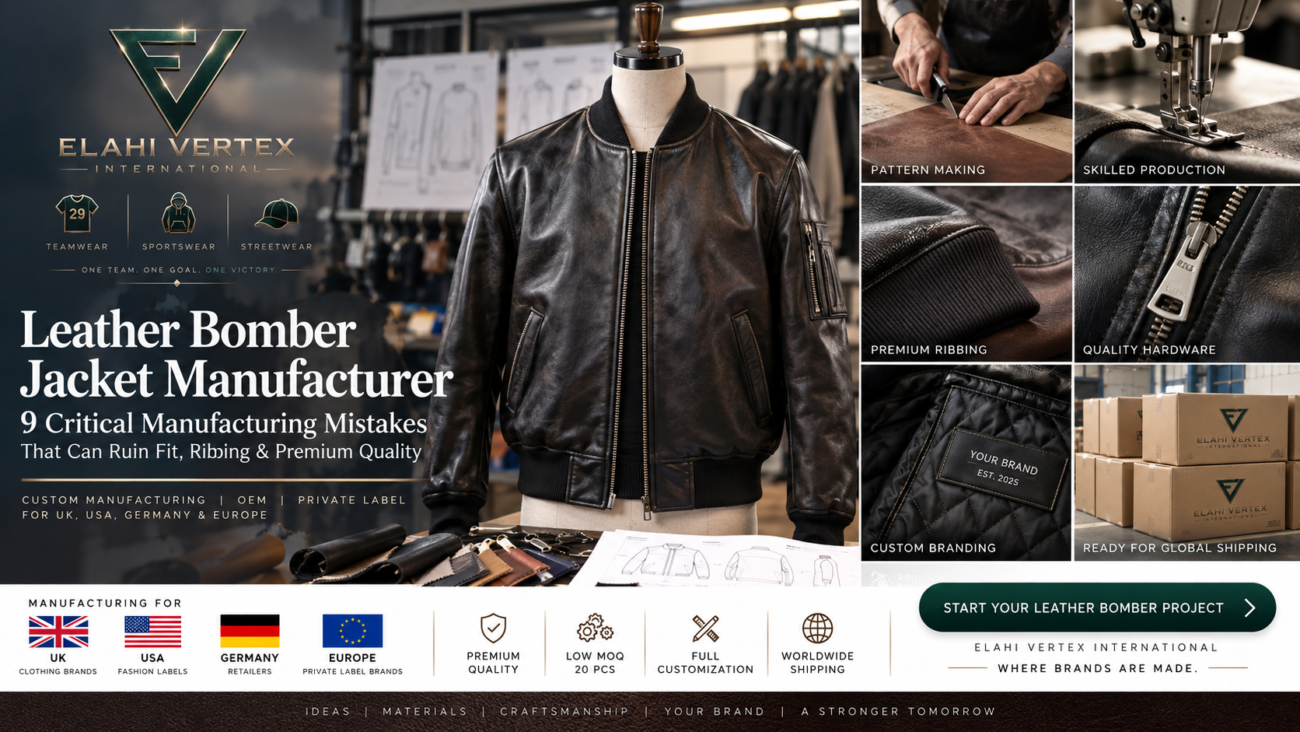

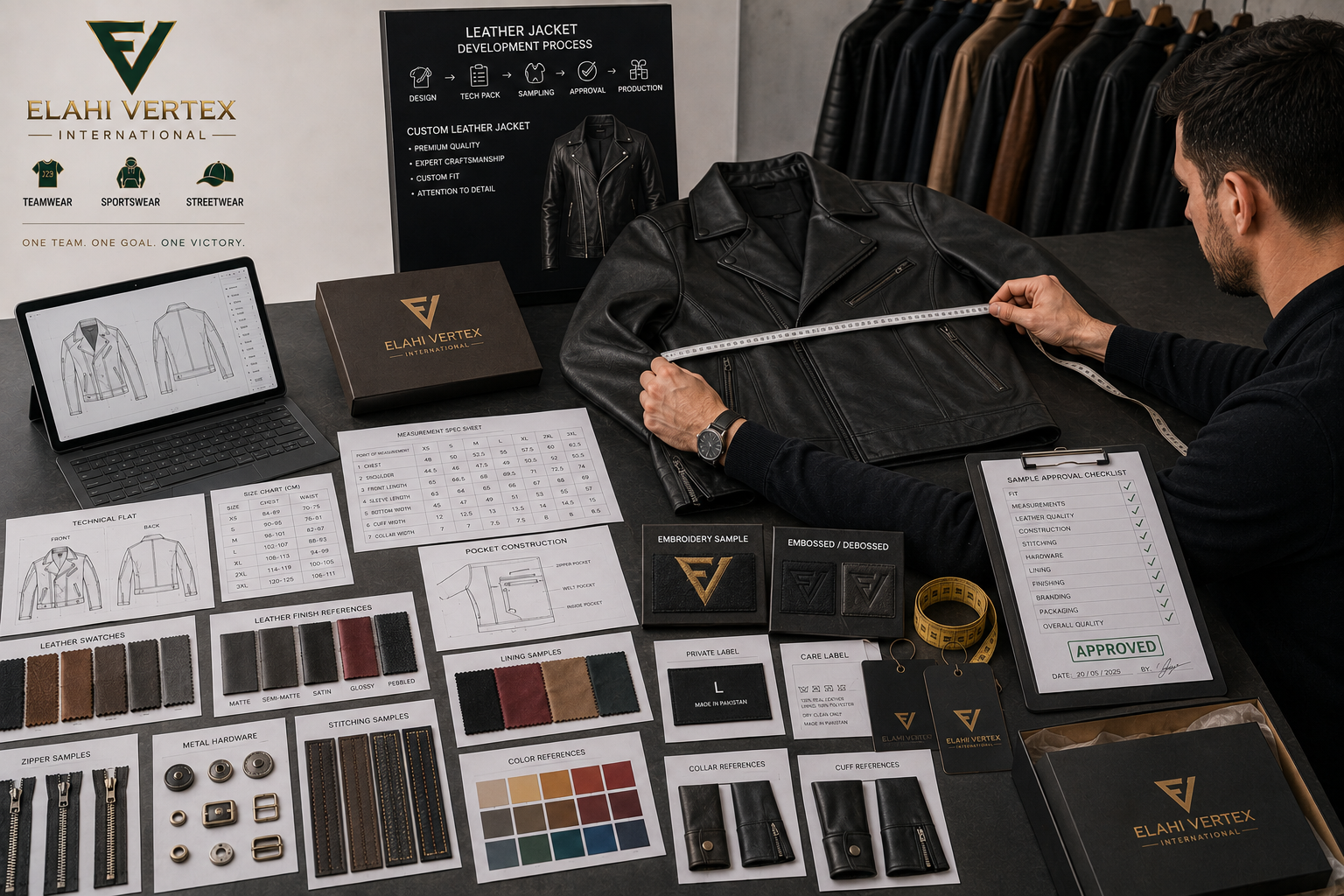
Custom leather jacket manufacturing requires more control than sending a reference image to a supplier and choosing the lowest quotation.
For USA fashion brands, streetwear labels, private-label businesses, wholesalers and e-commerce companies, a leather jacket combines several variables that can materially change the finished product: leather type, surface character, thickness, finish, color, pattern and fit, lining, hardware, pocket construction, stitching, branding and packaging.
These variables also affect what buyers are actually comparing when evaluating manufacturers.
A lower quotation is not necessarily a better quotation if it is based on a different leather specification, hardware standard, lining or construction.
Before authorizing bulk production, USA buyers should establish a controlled specification, evaluate an appropriate sample and understand exactly what the manufacturer’s quotation covers.
This guide explains 9 critical custom leather jacket manufacturing checks USA brands should make before placing a bulk order, with practical guidance for turning a design concept into a clearer sourcing and approval process.
Table of Contents
- What Is Custom Leather Jacket Manufacturing?
- What Should USA Buyers Confirm Before Ordering?
- Check #1 — Define the Leather Specification
- Check #2 — Control Fit, Measurements and Sizing
- Check #3 — Treat Sample Approval as a Technical Decision
- Check #4 — Specify Zippers, Snaps and Hardware
- Check #5 — Define Lining and Jacket Construction
- Check #6 — Control Branding and Decoration
- Check #7 — Establish Color and Natural-Variation Expectations
- Check #8 — Finalize Private Labels and Packaging
- Check #9 — Clarify Bulk-Order and Commercial Terms
- Leather Jacket Specification Checklist
- Size-Chart Framework
- How to Compare Leather Jacket Manufacturers
- How to Review a Leather Jacket Sample
- Common USA Buyer Mistakes
- How to Prepare an RFQ
- Why Discuss Leather Wear With Elahi Vertex International?
- 20 Custom Leather Jacket Manufacturing FAQs
- Conclusion
What Is Custom Leather Jacket Manufacturing?
Custom leather jacket manufacturing is the development and production of leather jackets according to buyer-defined requirements for material, design, fit, measurements, construction, hardware, branding, labels and other agreed specifications.
For a USA brand, customization might involve:
- Jacket silhouette
- Leather type
- Leather finish
- Surface character
- Color
- Measurements
- Lining
- Collar
- Cuffs
- Waist construction
- Zippers
- Snaps
- Pockets
- Embroidery
- Patches
- Debossed or embossed branding where technically suitable
- Main labels
- Size labels
- Care labels
- Hang tags
- Packaging
Not every manufacturer offers every material or process.
For Elahi Vertex International, project-specific materials, MOQ, sampling, decoration methods, pricing, production requirements, packaging and shipping arrangements must be confirmed for each inquiry.
This guide distinguishes general leather-apparel sourcing guidance from company-specific capabilities.
What Should USA Buyers Confirm Before Ordering Custom Leather Jackets?
Before a bulk order, a USA buyer should be able to answer a basic question:
What exactly has the manufacturer agreed to reproduce in bulk?
The answer should not simply be:
“The approved jacket.”
A stronger production reference connects the physical sample with controlled documentation.
At minimum, buyers should consider confirming:
- Style number
- Approved design
- Approved measurements
- Leather specification
- Color/finish reference
- Lining
- Hardware
- Construction
- Branding
- Labels
- Packaging
- Quantity
- Size breakdown
- Commercial terms
- Shipping responsibilities
- Final approval version
If any item remains undecided, keep it visibly open instead of allowing an assumption to become a production instruction.
1. Define the Leather Specification Before Comparing Prices
The first custom leather jacket manufacturing check is also one of the most important:
What material is actually being quoted?
“Genuine leather jacket” is not a complete manufacturing specification.
Leather can differ in:
- Animal source
- Tanning process
- Surface treatment
- Grain character
- Finish
- Thickness
- Hand feel
- Softness
- Structure
- Color
- Natural markings
- Intended appearance
A buyer should not assume two quotations using the word “leather” describe equivalent materials.
Leather terminology needs precision
Depending on the product, buyers may encounter terminology associated with:
- Cowhide
- Sheepskin
- Goatskin
- Lambskin
- Full-grain leather
- Top-grain leather
- Suede
- Nubuck
- Corrected or finished surfaces
These terms describe different aspects of material identity and should not be treated as interchangeable marketing labels.
For example, animal type and grain classification describe different characteristics.
The correct material depends on the jacket.
Match material to product direction
A structured motorcycle-inspired jacket may need a different material character from a soft fashion bomber.
Similarly, an oversized streetwear leather jacket may prioritize different drape and hand feel than a close-fitting fashion jacket.
A better specification
Instead of:
Black premium leather.
Use a controlled direction such as:
Black leather for an oversized fashion jacket. Buyer requires a soft hand feel and the surface appearance shown in the approved reference. Final leather type, thickness and finish to be confirmed through material review and sampling.
This clearly separates:
what the buyer wants from what still requires technical confirmation.
Ask for a material reference
Where practical, approve material against a defined reference rather than a description alone.
This may involve an agreed:
- Swatch
- Sample
- Material specification
- Finish reference
- Color reference
Natural materials can contain variation. That makes agreement about the intended appearance especially important.
USA buyer takeaway
Never compare custom leather jacket manufacturing prices until you understand whether suppliers are quoting materially comparable jackets.
2. Control Fit, Measurements and USA Sizing
A label such as M does not define a jacket.
Neither does “USA sizing.”
Sizing systems and brand fits vary.
A USA streetwear brand selling an oversized leather bomber and a fashion company selling a fitted leather jacket can both label a garment “Medium” while using substantially different measurements.
Define the intended silhouette
Your specification should identify whether the jacket is intended to be:
- Slim
- Regular
- Relaxed
- Boxy
- Oversized
- Cropped
- Longline
But those terms are only the beginning.
Convert the silhouette into measurable specifications.
Important jacket measurements
Depending on the design, points of measure may include:
- Chest
- Bottom opening
- Shoulder width
- Back length
- Front length
- Sleeve length
- Bicep
- Cuff opening
- Armhole
- Neck
- Collar dimensions
- Pocket dimensions
- Pocket placement
Example size-chart framework
The following table is a specification framework only and does not represent Elahi Vertex International’s production measurements.
Point of Measure
S
M
L
XL
2XL
Chest
Specify
Specify
Specify
Specify
Specify
Shoulder
Specify
Specify
Specify
Specify
Specify
Body Length
Specify
Specify
Specify
Specify
Specify
Sleeve Length
Specify
Specify
Specify
Specify
Specify
Bicep
Specify
Specify
Specify
Specify
Specify
Bottom Opening
Specify
Specify
Specify
Specify
Specify
Cuff Opening
Specify
Specify
Specify
Specify
Specify
Add POM diagrams
POM means Point of Measure.
A POM diagram identifies where a measurement starts and ends.
This matters because even apparently simple measurements can be interpreted differently.
For example:
Sleeve length from where?
- Shoulder seam?
- Center back neck?
- Another defined point?
Specify it.
Consider what is worn underneath
A leather jacket intended to be worn over a hoodie may require different ease from a fitted jacket designed to be worn over a T-shirt.
That is a product-development decision.
Do not solve it by simply increasing every measurement.
Evaluate the intended fit through pattern development and sampling.
3. Treat Sample Approval as a Technical Decision
A common custom leather jacket manufacturing mistake is approving a sample because:
“It looks good.”
Appearance matters, but bulk approval should be more structured.
Review the sample against the specification
A leather jacket sample can be evaluated across several categories.
Material
Check:
- Surface
- Hand feel
- Structure
- Color
- Finish
- Approved material direction
Measurements
Measure the physical sample against the approved measurement chart.
Fit
Evaluate:
- Chest
- Shoulder
- Sleeve
- Body length
- Mobility
- Intended silhouette
- Layering where relevant
Construction
Inspect:
- Seams
- Pockets
- Collar
- Cuffs
- Waist
- Zipper installation
- Lining
- Internal finishing
Branding
Verify:
- Artwork
- Dimensions
- Placement
- Labels
- Patches
- Other approved branding
Document every correction
Weak feedback:
Sleeves are slightly too long.
Better:
Reduce the specified sleeve measurement according to Measurement Chart Revision 04. Retain cuff construction.
Weak:
Make the logo smaller.
Better:
Change logo dimensions according to Artwork Specification Revision 03 while retaining approved placement.
Update the documentation
If the physical sample changes, the controlled specification should change too.
Do not approve Revision 5 physically while leaving Revision 3 in the tech pack.
4. Specify Zippers, Snaps and Hardware
Hardware can materially change both the appearance and function of a leather jacket.
Depending on the design, components may include:
- Main zipper
- Pocket zippers
- Sleeve zippers
- Snaps
- Buttons
- Buckles
- Eyelets
- Hooks
- Adjusters
- Decorative hardware
A specification that simply says:
Metal zipper
is incomplete.
Define relevant hardware characteristics
Depending on the component, buyers may need to specify:
- Type
- Size
- Finish
- Color
- Placement
- Puller design
- Function
- Branding if applicable
Availability of specific hardware should be confirmed with the manufacturer.
Test function on the physical sample
During sample review:
- Open and close the zipper repeatedly.
- Check alignment.
- Inspect installation.
- Test pocket zippers.
- Check snaps.
- Examine visible hardware finish.
- Verify hardware color against the design.
Do not evaluate hardware only from photographs.
Hardware and leather must work together
A heavy-looking zipper may suit one jacket aesthetically but overpower another.
Hardware selection should therefore be part of the product design rather than an afterthought.
5. Define Lining and Jacket Construction
USA buyers often spend considerable time choosing leather and very little time specifying the inside of the jacket.
That is a mistake.
The lining contributes to:
- Comfort
- Dressing
- Interior appearance
- Structure
- Branding opportunities
- Perceived finish
Lining specification
Where known, document:
- Material
- Composition
- Weight where relevant
- Color
- Print if applicable
- Construction
- Pocket requirements
- Branding
If the lining has not been selected, describe the intended result and request options.
Internal pockets
Define:
- Number
- Position
- Dimensions
- Closure
- Construction
Do not assume a standard internal pocket arrangement.
Exterior pockets
For each pocket, define:
- Type
- Dimensions
- Position
- Opening
- Zipper where relevant
- Snap where relevant
Technical flats should show pocket locations.
Collar, cuffs and waist
Depending on the jacket style, these areas may use:
- Leather
- Rib
- Other textile components
- Snaps
- Adjustable features
Specify them individually.
Bomber example
A leather bomber might combine:
Leather body + leather sleeves + textile rib collar + rib cuffs + rib waistband + lining + metal zipper
Each component needs its own material and color direction.
6. Control Branding Without Damaging the Product Concept
Private-label leather jackets can incorporate branding in several ways.
Depending on technical suitability and confirmed manufacturer capabilities, options may include:
- Embroidery
- Patches
- Printed elements
- Debossing
- Embossing
- Metal branding
- Woven labels
- Printed labels
- Custom lining artwork
- Hang tags
Not every method is appropriate for every leather.
Branding should begin with the design
Do not finish developing the jacket and then ask:
Where can we put our logo?
Determine branding locations during product development.
Possible areas include:
- Chest
- Back
- Sleeve
- Collar
- Internal facing
- Lining
- Main label
- Hardware
Specify dimensions
“Small chest logo” is subjective.
Use:
Artwork + dimensions + placement reference.
Sample the physical execution
Embroidery, patches, embossing and other branding can interact with the material differently.
The buyer should evaluate the physical result before bulk approval where the feature is material to the design.
7. Establish Color and Natural-Variation Expectations
Leather is not the same as a digitally printed flat surface.
USA buyers need realistic expectations around material character and, where applicable, natural variation.
Define the color reference
Avoid relying only on:
- “Black”
- “Brown”
- “Tan”
- “Vintage brown”
- “Dark brown”
Use an approved reference where practical.
Color guide
Method
Usefulness
Color name
General direction
Screen image
Visual communication
Digital design
Design direction
Defined color reference
Stronger specification
Approved physical material reference
Strong practical reference where applicable
Distressed and vintage finishes
A deliberately aged jacket may involve variation as part of the intended appearance.
That creates an important question:
How much variation is acceptable?
Discuss this before bulk production.
Do not approve one highly distressed sample and assume every natural or deliberately varied surface will be visually identical.
Communicate expectations
If the brand requires a highly uniform appearance, state it.
If the intended product celebrates natural variation, define the acceptable direction.
Ambiguity is the problem—not variation itself.
8. Finalize Private Labels and Packaging
For USA private-label and e-commerce brands, custom leather jacket manufacturing does not necessarily end when the jacket is sewn.
The finished product may also require:
- Main label
- Size label
- Care label
- Country-of-origin information
- Hang tag
- SKU
- Barcode
- Protective packaging
- Size identification
- Carton markings
The applicable USA labeling and import requirements should be verified for the specific product and transaction.
Do not rely on assumptions.
Label specification
For every required label, define:
- Artwork
- Dimensions
- Material where applicable
- Color
- Placement
- Attachment
Packaging
Leather garments may need packaging considerations different from lightweight T-shirts.
The packaging approach should account for the intended:
- Protection
- Presentation
- Warehousing
- Distribution
- E-commerce fulfillment
Actual packaging options available from Elahi Vertex International require project-specific confirmation.
Think about your warehouse
Ask:
What does my fulfillment operation need when the carton arrives?
Possible requirements include:
- Visible size identification
- SKU
- Barcode
- Individual product identification
- Specific carton assortment
Solve these before the shipment is packed.
9. Clarify Bulk-Order and Commercial Terms Before Authorization
The final custom leather jacket manufacturing check concerns the actual purchase.
A perfect sample does not automatically mean every commercial term is understood.
Before bulk authorization, buyers should clarify relevant matters such as:
- Final product specification
- Quantity
- Size breakdown
- Color breakdown
- Approved sample reference
- Unit-price basis
- What the quotation includes
- What the quotation excludes
- Payment terms
- Production arrangements
- Packaging
- Inspection expectations
- Shipping basis
- Destination
- Documentation
- Responsibilities between buyer and seller
MOQ
Do not assume MOQ from an article or another product.
MOQ can depend on the particular design, material, color, customization and manufacturing arrangement.
Elahi Vertex International’s MOQ must be confirmed for the specific leather-wear inquiry.
Production timing
Do not build a USA launch around an assumed production timeline.
Confirm the project’s production requirements and agreed schedule.
Allow appropriate planning for:
Development → Sampling → Revision → Approval → Bulk Production → Inspection → Shipping
Shipping responsibilities
International transactions should clearly establish the agreed shipping terms and responsibilities.
If Incoterms are used, both parties should understand the selected rule and named place.
Do not use shipping terminology merely because it appears professional.
Understand what has actually been agreed.
Custom Leather Jacket Manufacturing Specification Checklist
Before approaching bulk production, USA brands can review this framework.
Product Identity
- Style name
- Style number
- Revision
- Jacket category
- Intended fit
- Sample size
- Size range
Leather
- Leather type
- Surface/grain direction
- Thickness specification where relevant
- Finish
- Hand feel
- Color
- Approved reference
Measurements
- Chest
- Shoulder
- Body length
- Sleeve
- Bicep
- Cuff
- Bottom opening
- Relevant tolerances
Construction
- Collar
- Cuffs
- Waist
- Seams
- Pockets
- Internal pockets
- Lining
- Reinforcement
Hardware
- Main zipper
- Pocket zippers
- Snaps
- Buttons
- Buckles
- Pullers
- Finish/color
Branding
- External logo
- Embroidery
- Patch
- Embossing/debossing
- Main label
- Size label
- Care label
- Hang tag
Packaging
- Individual protection
- Size identification
- SKU
- Barcode
- Carton arrangement
Commercial
- Quantity
- Size breakdown
- Color breakdown
- Price basis
- Payment terms
- Production terms
- Shipping basis
- Destination
- Required documentation
How Should USA Brands Compare Leather Jacket Manufacturers?
Do not build a comparison table with only:
Manufacturer
Price
A
Low
B
Medium
C
High
That comparison tells you almost nothing.
Instead normalize the product.
Evaluation Area
Supplier A
Supplier B
Supplier C
Leather specification clearly defined
Check
Check
Check
Measurements understood
Check
Check
Check
Sample evaluated
Check
Check
Check
Hardware defined
Check
Check
Check
Lining defined
Check
Check
Check
Branding included
Check
Check
Check
Labels included
Check
Check
Check
Packaging defined
Check
Check
Check
Commercial terms clear
Check
Check
Check
Shipping basis clear
Check
Check
Check
Then compare pricing.
Communication is part of supplier evaluation
Pay attention to whether the manufacturer:
- Answers technical questions clearly
- Identifies missing information
- Documents changes
- Separates assumptions from confirmed specifications
- Explains quotation inclusions
- Responds consistently
Good communication does not guarantee manufacturing quality, but poor specification control before an order is a legitimate sourcing warning sign.
How to Review a Custom Leather Jacket Sample
Use a repeatable inspection sequence.
Step 1 — Confirm identity
Verify:
- Style
- Revision
- Size
- Color
Step 2 — Review leather
Compare:
- Surface
- Color
- Finish
- Hand feel
- Structure
against the approved direction.
Step 3 — Measure
Use the current measurement specification.
Record actual results.
Step 4 — Try the jacket on
Evaluate:
- Shoulder
- Chest
- Sleeve
- Length
- Movement
- Intended layering
- Overall silhouette
Step 5 — Inspect construction
Check:
- Seams
- Collar
- Cuffs
- Waist
- Pockets
- Lining
- Internal finishing
Step 6 — Test hardware
Operate:
- Main zipper
- Pocket zippers
- Snaps
- Buttons
- Buckles
where applicable.
Step 7 — Review branding
Check:
- Artwork
- Dimensions
- Placement
- Labels
- Hang tags
Step 8 — Document corrections
Photograph issues and reference them against controlled specifications.
Step 9 — Assign a clear status
Use:
APPROVED
REVISE
RESAMPLE
or
HOLD
Avoid ambiguous approval language.
Common Custom Leather Jacket Manufacturing Mistakes USA Buyers Make
1. Comparing price before material
If leather specifications differ, headline prices are not directly comparable.
2. Treating “genuine leather” as a complete specification
It is not.
3. Assuming USA sizes are universal
They are not.
Control actual garment measurements.
4. Approving only from photographs
Photos cannot fully communicate hand feel, fit, weight or physical hardware function.
5. Ignoring the lining
The interior is part of the finished product.
6. Choosing hardware at the last minute
Hardware materially affects both appearance and functionality.
7. Expecting natural material to behave like a digital render
Define realistic appearance and variation expectations.
8. Forgetting fulfillment requirements
Labels, SKUs, barcodes and packaging may matter after manufacturing.
9. Starting bulk production with conflicting revisions
Maintain one current controlled specification.
How to Prepare an RFQ for Custom Leather Jacket Manufacturing
A useful RFQ allows manufacturers to quote against the same product scope.
Include available information such as:
Buyer
Company:
Country: USA
Contact:
Website:
Product
Style:
Jacket Type:
Intended Fit:
Tech Pack Attached: Yes/No
Reference Sample Available: Yes/No
Material
Leather Requirement:
Finish:
Color:
Approved Reference:
Quantity
Total:
By Color:
By Size:
Components
Lining:
Zippers:
Snaps:
Other Hardware:
Branding
Logo:
Patch:
Embroidery:
Labels:
Hang Tag:
Packaging
Packaging Requirement:
SKU:
Barcode:
Commercial
Destination:
Required Timing:
Shipping Quote Required:
Sampling Required:
Open Requirements
Clearly mark anything requiring manufacturer recommendation.
Why Discuss Leather Wear With Elahi Vertex International?
Elahi Vertex International is positioned as a B2B manufacturer, exporter, OEM supplier, ODM supplier, custom manufacturing partner and private-label manufacturing partner.
USA fashion brands, streetwear brands, leather-wear businesses, wholesalers, distributors and e-commerce companies can provide available project specifications to discuss custom leather wear manufacturing.
For a leather jacket inquiry, buyers can prepare:
- Reference design
- Technical drawings or tech pack
- Leather direction
- Measurements
- Color
- Lining requirements
- Hardware requirements
- Branding
- Target quantity
- Size range
- Packaging requirements
- USA destination
Project-specific details—including MOQ, leather availability, material specifications, sampling, pricing, production schedule, decoration feasibility, packaging and shipping arrangements—require confirmation for each project.
No general sourcing article should replace a project-specific quotation or manufacturing agreement.
USA buyers can contact Elahi Vertex International through WhatsApp, email elahivertexinternational@gmail.com, visit the official website, or review the official Alibaba storefront.
20 Custom Leather Jacket Manufacturing FAQs
1. What is custom leather jacket manufacturing?
Custom leather jacket manufacturing is the development and production of leather jackets according to buyer-defined requirements for material, design, fit, construction, hardware, branding and related specifications.
2. What should USA brands specify for custom leather jacket manufacturing?
USA brands should define the jacket design, leather direction, measurements, fit, lining, hardware, branding, labels, packaging and commercial requirements relevant to the project.
3. What leather is best for custom leather jacket manufacturing?
There is no universally best leather. Selection depends on intended appearance, structure, softness, finish, use and design. The final material should be evaluated for the specific jacket.
4. Is genuine leather a complete leather specification?
No. The term alone does not define animal source, grain character, thickness, finish, hand feel, color or other characteristics needed for precise product development.
5. Should USA brands request samples before bulk custom leather jacket manufacturing?
Sampling is a practical way to evaluate the physical material, fit, measurements, construction, hardware and branding before considering bulk approval.
6. How should a leather jacket sample be approved?
Compare the sample with the current controlled specification and document approvals or required revisions for material, measurements, fit, construction, hardware and branding.
7. Do leather jackets need a size chart?
For custom manufacturing, a controlled measurement chart is highly useful because generic S/M/L labels do not define garment dimensions.
8. Is USA sizing standardized for custom leather jackets?
Brands use different fits and measurements. Buyers should define their intended garment measurements rather than relying on the phrase “USA sizing.”
9. Should custom leather jacket manufacturing specifications include lining?
Yes, where lining is part of the jacket. Material, color, construction and relevant branding should be specified.
10. Should zipper requirements be included in a leather jacket tech pack?
Yes. Relevant zipper characteristics, placement and finish should be documented when they are important to the product.
11. Can private-label branding be added to custom leather jackets?
Leather jackets can use various branding approaches depending on material and technical feasibility. The proposed method should be confirmed and sampled for the particular project.
12. Can custom leather jackets use embroidery?
Embroidery may be suitable for certain designs and materials. Its feasibility and physical effect should be evaluated for the specific product.
13. Can custom leather jackets use embossed or debossed branding?
These methods may be possible depending on the leather, design and manufacturing capabilities. They should be confirmed for the specific project.
14. Should natural leather variation be considered before bulk production?
Yes. Buyers should establish realistic expectations for color, surface and natural character based on the selected material and finish.
15. What packaging should USA leather-jacket brands request?
Packaging depends on the brand’s protection, retail, warehousing and fulfillment requirements. Define those needs before bulk completion.
16. How should USA buyers compare custom leather jacket manufacturers?
Compare equivalent product specifications, samples, materials, construction, hardware, branding, packaging, communication and commercial terms before comparing unit prices.
17. What should be included in a leather jacket RFQ?
Include the product specification, material direction, quantities, sizes, colors, hardware, branding, packaging, destination, sampling requirement and relevant commercial questions.
18. What is the MOQ for custom leather jacket manufacturing?
MOQ varies by manufacturer and project. Elahi Vertex International’s applicable MOQ must be confirmed for the specific leather-wear inquiry.
19. Can Elahi Vertex International discuss leather jacket manufacturing with USA brands?
Elahi Vertex International is positioned as a B2B manufacturer, exporter, OEM/ODM supplier and private-label manufacturing partner. USA buyers can submit specifications for project-specific feasibility and commercial discussion.
20. How can USA brands contact Elahi Vertex International?
Contact Elahi Vertex International on WhatsApp, email elahivertexinternational@gmail.com, visit the official website, or review the official Alibaba storefront.
Conclusion: Control the Specification Before Committing to Bulk Leather Jackets
Successful custom leather jacket manufacturing starts with defining what is actually being purchased.
Before USA brands authorize a bulk order, they should complete these 9 critical checks:
- Define the leather specification
- Control fit, measurements and sizing
- Technically evaluate the sample
- Specify zippers, snaps and hardware
- Define lining and construction
- Control branding and decoration
- Establish color and natural-variation expectations
- Finalize private labels and packaging
- Clarify bulk-order and commercial terms
The central principle is straightforward:
Do not compare prices until you are comparing equivalent products.
A $100 jacket and an $80 jacket are not meaningfully comparable if their leather, lining, hardware, construction or included services differ.
Likewise, an attractive sample is not a complete production specification unless both parties understand exactly what has been approved.
For USA buyers, the stronger sourcing sequence is:
Design → Specification → RFQ → Manufacturer Evaluation → Sample → Revision → Final Approval → Commercial Confirmation → Bulk Production
This process cannot eliminate every manufacturing risk, but it can remove many avoidable assumptions before they become bulk-order problems.
Discuss Your Custom Leather Wear Project
USA fashion brands, streetwear labels, private-label businesses, wholesalers and other B2B buyers can provide available specifications to Elahi Vertex International for project-specific discussion.
Elahi Vertex International
B2B Manufacturer | Exporter | OEM | ODM | Private Label | Custom Manufacturing
Official Website
WhatsApp
Phone: +92 309 1639614
Primary Email: elahivertexinternational@gmail.com
Secondary Email: Info@elahivertexinternational.com
Official Alibaba Storefront
Send your leather-jacket design, available specifications, target quantity, size range, branding requirements and USA destination to begin a project-specific custom leather jacket manufacturing discussion.
Custom leather jacket manufacturing requires more control than sending a reference image to a supplier and choosing the lowest quotation.
For USA fashion brands, streetwear labels, private-label businesses, wholesalers and e-commerce companies, a leather jacket combines several variables that can materially change the finished product: leather type, surface character, thickness, finish, color, pattern and fit, lining, hardware, pocket construction, stitching, branding and packaging.
These variables also affect what buyers are actually comparing when evaluating manufacturers.
A lower quotation is not necessarily a better quotation if it is based on a different leather specification, hardware standard, lining or construction.
Before authorizing bulk production, USA buyers should establish a controlled specification, evaluate an appropriate sample and understand exactly what the manufacturer’s quotation covers.
This guide explains 9 critical custom leather jacket manufacturing checks USA brands should make before placing a bulk order, with practical guidance for turning a design concept into a clearer sourcing and approval process.
Table of Contents
- What Is Custom Leather Jacket Manufacturing?
- What Should USA Buyers Confirm Before Ordering?
- Check #1 — Define the Leather Specification
- Check #2 — Control Fit, Measurements and Sizing
- Check #3 — Treat Sample Approval as a Technical Decision
- Check #4 — Specify Zippers, Snaps and Hardware
- Check #5 — Define Lining and Jacket Construction
- Check #6 — Control Branding and Decoration
- Check #7 — Establish Color and Natural-Variation Expectations
- Check #8 — Finalize Private Labels and Packaging
- Check #9 — Clarify Bulk-Order and Commercial Terms
- Leather Jacket Specification Checklist
- Size-Chart Framework
- How to Compare Leather Jacket Manufacturers
- How to Review a Leather Jacket Sample
- Common USA Buyer Mistakes
- How to Prepare an RFQ
- Why Discuss Leather Wear With Elahi Vertex International?
- 20 Custom Leather Jacket Manufacturing FAQs
- Conclusion
What Is Custom Leather Jacket Manufacturing?
Custom leather jacket manufacturing is the development and production of leather jackets according to buyer-defined requirements for material, design, fit, measurements, construction, hardware, branding, labels and other agreed specifications.
For a USA brand, customization might involve:
- Jacket silhouette
- Leather type
- Leather finish
- Surface character
- Color
- Measurements
- Lining
- Collar
- Cuffs
- Waist construction
- Zippers
- Snaps
- Pockets
- Embroidery
- Patches
- Debossed or embossed branding where technically suitable
- Main labels
- Size labels
- Care labels
- Hang tags
- Packaging
Not every manufacturer offers every material or process.
For Elahi Vertex International, project-specific materials, MOQ, sampling, decoration methods, pricing, production requirements, packaging and shipping arrangements must be confirmed for each inquiry.
This guide distinguishes general leather-apparel sourcing guidance from company-specific capabilities.
What Should USA Buyers Confirm Before Ordering Custom Leather Jackets?
Before a bulk order, a USA buyer should be able to answer a basic question:
What exactly has the manufacturer agreed to reproduce in bulk?
The answer should not simply be:
“The approved jacket.”
A stronger production reference connects the physical sample with controlled documentation.
At minimum, buyers should consider confirming:
- Style number
- Approved design
- Approved measurements
- Leather specification
- Color/finish reference
- Lining
- Hardware
- Construction
- Branding
- Labels
- Packaging
- Quantity
- Size breakdown
- Commercial terms
- Shipping responsibilities
- Final approval version
If any item remains undecided, keep it visibly open instead of allowing an assumption to become a production instruction.
1. Define the Leather Specification Before Comparing Prices
The first custom leather jacket manufacturing check is also one of the most important:
What material is actually being quoted?
“Genuine leather jacket” is not a complete manufacturing specification.
Leather can differ in:
- Animal source
- Tanning process
- Surface treatment
- Grain character
- Finish
- Thickness
- Hand feel
- Softness
- Structure
- Color
- Natural markings
- Intended appearance
A buyer should not assume two quotations using the word “leather” describe equivalent materials.
Leather terminology needs precision
Depending on the product, buyers may encounter terminology associated with:
- Cowhide
- Sheepskin
- Goatskin
- Lambskin
- Full-grain leather
- Top-grain leather
- Suede
- Nubuck
- Corrected or finished surfaces
These terms describe different aspects of material identity and should not be treated as interchangeable marketing labels.
For example, animal type and grain classification describe different characteristics.
The correct material depends on the jacket.
Match material to product direction
A structured motorcycle-inspired jacket may need a different material character from a soft fashion bomber.
Similarly, an oversized streetwear leather jacket may prioritize different drape and hand feel than a close-fitting fashion jacket.
A better specification
Instead of:
Black premium leather.
Use a controlled direction such as:
Black leather for an oversized fashion jacket. Buyer requires a soft hand feel and the surface appearance shown in the approved reference. Final leather type, thickness and finish to be confirmed through material review and sampling.
This clearly separates:
what the buyer wants from what still requires technical confirmation.
Ask for a material reference
Where practical, approve material against a defined reference rather than a description alone.
This may involve an agreed:
- Swatch
- Sample
- Material specification
- Finish reference
- Color reference
Natural materials can contain variation. That makes agreement about the intended appearance especially important.
USA buyer takeaway
Never compare custom leather jacket manufacturing prices until you understand whether suppliers are quoting materially comparable jackets.
2. Control Fit, Measurements and USA Sizing
A label such as M does not define a jacket.
Neither does “USA sizing.”
Sizing systems and brand fits vary.
A USA streetwear brand selling an oversized leather bomber and a fashion company selling a fitted leather jacket can both label a garment “Medium” while using substantially different measurements.
Define the intended silhouette
Your specification should identify whether the jacket is intended to be:
- Slim
- Regular
- Relaxed
- Boxy
- Oversized
- Cropped
- Longline
But those terms are only the beginning.
Convert the silhouette into measurable specifications.
Important jacket measurements
Depending on the design, points of measure may include:
- Chest
- Bottom opening
- Shoulder width
- Back length
- Front length
- Sleeve length
- Bicep
- Cuff opening
- Armhole
- Neck
- Collar dimensions
- Pocket dimensions
- Pocket placement
Example size-chart framework
The following table is a specification framework only and does not represent Elahi Vertex International’s production measurements.
Point of Measure
S
M
L
XL
2XL
Chest
Specify
Specify
Specify
Specify
Specify
Shoulder
Specify
Specify
Specify
Specify
Specify
Body Length
Specify
Specify
Specify
Specify
Specify
Sleeve Length
Specify
Specify
Specify
Specify
Specify
Bicep
Specify
Specify
Specify
Specify
Specify
Bottom Opening
Specify
Specify
Specify
Specify
Specify
Cuff Opening
Specify
Specify
Specify
Specify
Specify
Add POM diagrams
POM means Point of Measure.
A POM diagram identifies where a measurement starts and ends.
This matters because even apparently simple measurements can be interpreted differently.
For example:
Sleeve length from where?
- Shoulder seam?
- Center back neck?
- Another defined point?
Specify it.
Consider what is worn underneath
A leather jacket intended to be worn over a hoodie may require different ease from a fitted jacket designed to be worn over a T-shirt.
That is a product-development decision.
Do not solve it by simply increasing every measurement.
Evaluate the intended fit through pattern development and sampling.
3. Treat Sample Approval as a Technical Decision
A common custom leather jacket manufacturing mistake is approving a sample because:
“It looks good.”
Appearance matters, but bulk approval should be more structured.
Review the sample against the specification
A leather jacket sample can be evaluated across several categories.
Material
Check:
- Surface
- Hand feel
- Structure
- Color
- Finish
- Approved material direction
Measurements
Measure the physical sample against the approved measurement chart.
Fit
Evaluate:
- Chest
- Shoulder
- Sleeve
- Body length
- Mobility
- Intended silhouette
- Layering where relevant
Construction
Inspect:
- Seams
- Pockets
- Collar
- Cuffs
- Waist
- Zipper installation
- Lining
- Internal finishing
Branding
Verify:
- Artwork
- Dimensions
- Placement
- Labels
- Patches
- Other approved branding
Document every correction
Weak feedback:
Sleeves are slightly too long.
Better:
Reduce the specified sleeve measurement according to Measurement Chart Revision 04. Retain cuff construction.
Weak:
Make the logo smaller.
Better:
Change logo dimensions according to Artwork Specification Revision 03 while retaining approved placement.
Update the documentation
If the physical sample changes, the controlled specification should change too.
Do not approve Revision 5 physically while leaving Revision 3 in the tech pack.
4. Specify Zippers, Snaps and Hardware
Hardware can materially change both the appearance and function of a leather jacket.
Depending on the design, components may include:
- Main zipper
- Pocket zippers
- Sleeve zippers
- Snaps
- Buttons
- Buckles
- Eyelets
- Hooks
- Adjusters
- Decorative hardware
A specification that simply says:
Metal zipper
is incomplete.
Define relevant hardware characteristics
Depending on the component, buyers may need to specify:
- Type
- Size
- Finish
- Color
- Placement
- Puller design
- Function
- Branding if applicable
Availability of specific hardware should be confirmed with the manufacturer.
Test function on the physical sample
During sample review:
- Open and close the zipper repeatedly.
- Check alignment.
- Inspect installation.
- Test pocket zippers.
- Check snaps.
- Examine visible hardware finish.
- Verify hardware color against the design.
Do not evaluate hardware only from photographs.
Hardware and leather must work together
A heavy-looking zipper may suit one jacket aesthetically but overpower another.
Hardware selection should therefore be part of the product design rather than an afterthought.
5. Define Lining and Jacket Construction
USA buyers often spend considerable time choosing leather and very little time specifying the inside of the jacket.
That is a mistake.
The lining contributes to:
- Comfort
- Dressing
- Interior appearance
- Structure
- Branding opportunities
- Perceived finish
Lining specification
Where known, document:
- Material
- Composition
- Weight where relevant
- Color
- Print if applicable
- Construction
- Pocket requirements
- Branding
If the lining has not been selected, describe the intended result and request options.
Internal pockets
Define:
- Number
- Position
- Dimensions
- Closure
- Construction
Do not assume a standard internal pocket arrangement.
Exterior pockets
For each pocket, define:
- Type
- Dimensions
- Position
- Opening
- Zipper where relevant
- Snap where relevant
Technical flats should show pocket locations.
Collar, cuffs and waist
Depending on the jacket style, these areas may use:
- Leather
- Rib
- Other textile components
- Snaps
- Adjustable features
Specify them individually.
Bomber example
A leather bomber might combine:
Leather body + leather sleeves + textile rib collar + rib cuffs + rib waistband + lining + metal zipper
Each component needs its own material and color direction.
6. Control Branding Without Damaging the Product Concept
Private-label leather jackets can incorporate branding in several ways.
Depending on technical suitability and confirmed manufacturer capabilities, options may include:
- Embroidery
- Patches
- Printed elements
- Debossing
- Embossing
- Metal branding
- Woven labels
- Printed labels
- Custom lining artwork
- Hang tags
Not every method is appropriate for every leather.
Branding should begin with the design
Do not finish developing the jacket and then ask:
Where can we put our logo?
Determine branding locations during product development.
Possible areas include:
- Chest
- Back
- Sleeve
- Collar
- Internal facing
- Lining
- Main label
- Hardware
Specify dimensions
“Small chest logo” is subjective.
Use:
Artwork + dimensions + placement reference.
Sample the physical execution
Embroidery, patches, embossing and other branding can interact with the material differently.
The buyer should evaluate the physical result before bulk approval where the feature is material to the design.
7. Establish Color and Natural-Variation Expectations
Leather is not the same as a digitally printed flat surface.
USA buyers need realistic expectations around material character and, where applicable, natural variation.
Define the color reference
Avoid relying only on:
- “Black”
- “Brown”
- “Tan”
- “Vintage brown”
- “Dark brown”
Use an approved reference where practical.
Color guide
Method
Usefulness
Color name
General direction
Screen image
Visual communication
Digital design
Design direction
Defined color reference
Stronger specification
Approved physical material reference
Strong practical reference where applicable
Distressed and vintage finishes
A deliberately aged jacket may involve variation as part of the intended appearance.
That creates an important question:
How much variation is acceptable?
Discuss this before bulk production.
Do not approve one highly distressed sample and assume every natural or deliberately varied surface will be visually identical.
Communicate expectations
If the brand requires a highly uniform appearance, state it.
If the intended product celebrates natural variation, define the acceptable direction.
Ambiguity is the problem—not variation itself.
8. Finalize Private Labels and Packaging
For USA private-label and e-commerce brands, custom leather jacket manufacturing does not necessarily end when the jacket is sewn.
The finished product may also require:
- Main label
- Size label
- Care label
- Country-of-origin information
- Hang tag
- SKU
- Barcode
- Protective packaging
- Size identification
- Carton markings
The applicable USA labeling and import requirements should be verified for the specific product and transaction.
Do not rely on assumptions.
Label specification
For every required label, define:
- Artwork
- Dimensions
- Material where applicable
- Color
- Placement
- Attachment
Packaging
Leather garments may need packaging considerations different from lightweight T-shirts.
The packaging approach should account for the intended:
- Protection
- Presentation
- Warehousing
- Distribution
- E-commerce fulfillment
Actual packaging options available from Elahi Vertex International require project-specific confirmation.
Think about your warehouse
Ask:
What does my fulfillment operation need when the carton arrives?
Possible requirements include:
- Visible size identification
- SKU
- Barcode
- Individual product identification
- Specific carton assortment
Solve these before the shipment is packed.
9. Clarify Bulk-Order and Commercial Terms Before Authorization
The final custom leather jacket manufacturing check concerns the actual purchase.
A perfect sample does not automatically mean every commercial term is understood.
Before bulk authorization, buyers should clarify relevant matters such as:
- Final product specification
- Quantity
- Size breakdown
- Color breakdown
- Approved sample reference
- Unit-price basis
- What the quotation includes
- What the quotation excludes
- Payment terms
- Production arrangements
- Packaging
- Inspection expectations
- Shipping basis
- Destination
- Documentation
- Responsibilities between buyer and seller
MOQ
Do not assume MOQ from an article or another product.
MOQ can depend on the particular design, material, color, customization and manufacturing arrangement.
Elahi Vertex International’s MOQ must be confirmed for the specific leather-wear inquiry.
Production timing
Do not build a USA launch around an assumed production timeline.
Confirm the project’s production requirements and agreed schedule.
Allow appropriate planning for:
Development → Sampling → Revision → Approval → Bulk Production → Inspection → Shipping
Shipping responsibilities
International transactions should clearly establish the agreed shipping terms and responsibilities.
If Incoterms are used, both parties should understand the selected rule and named place.
Do not use shipping terminology merely because it appears professional.
Understand what has actually been agreed.
Custom Leather Jacket Manufacturing Specification Checklist
Before approaching bulk production, USA brands can review this framework.
Product Identity
- Style name
- Style number
- Revision
- Jacket category
- Intended fit
- Sample size
- Size range
Leather
- Leather type
- Surface/grain direction
- Thickness specification where relevant
- Finish
- Hand feel
- Color
- Approved reference
Measurements
- Chest
- Shoulder
- Body length
- Sleeve
- Bicep
- Cuff
- Bottom opening
- Relevant tolerances
Construction
- Collar
- Cuffs
- Waist
- Seams
- Pockets
- Internal pockets
- Lining
- Reinforcement
Hardware
- Main zipper
- Pocket zippers
- Snaps
- Buttons
- Buckles
- Pullers
- Finish/color
Branding
- External logo
- Embroidery
- Patch
- Embossing/debossing
- Main label
- Size label
- Care label
- Hang tag
Packaging
- Individual protection
- Size identification
- SKU
- Barcode
- Carton arrangement
Commercial
- Quantity
- Size breakdown
- Color breakdown
- Price basis
- Payment terms
- Production terms
- Shipping basis
- Destination
- Required documentation
How Should USA Brands Compare Leather Jacket Manufacturers?
Do not build a comparison table with only:
Manufacturer
Price
A
Low
B
Medium
C
High
That comparison tells you almost nothing.
Instead normalize the product.
Evaluation Area
Supplier A
Supplier B
Supplier C
Leather specification clearly defined
Check
Check
Check
Measurements understood
Check
Check
Check
Sample evaluated
Check
Check
Check
Hardware defined
Check
Check
Check
Lining defined
Check
Check
Check
Branding included
Check
Check
Check
Labels included
Check
Check
Check
Packaging defined
Check
Check
Check
Commercial terms clear
Check
Check
Check
Shipping basis clear
Check
Check
Check
Then compare pricing.
Communication is part of supplier evaluation
Pay attention to whether the manufacturer:
- Answers technical questions clearly
- Identifies missing information
- Documents changes
- Separates assumptions from confirmed specifications
- Explains quotation inclusions
- Responds consistently
Good communication does not guarantee manufacturing quality, but poor specification control before an order is a legitimate sourcing warning sign.
How to Review a Custom Leather Jacket Sample
Use a repeatable inspection sequence.
Step 1 — Confirm identity
Verify:
- Style
- Revision
- Size
- Color
Step 2 — Review leather
Compare:
- Surface
- Color
- Finish
- Hand feel
- Structure
against the approved direction.
Step 3 — Measure
Use the current measurement specification.
Record actual results.
Step 4 — Try the jacket on
Evaluate:
- Shoulder
- Chest
- Sleeve
- Length
- Movement
- Intended layering
- Overall silhouette
Step 5 — Inspect construction
Check:
- Seams
- Collar
- Cuffs
- Waist
- Pockets
- Lining
- Internal finishing
Step 6 — Test hardware
Operate:
- Main zipper
- Pocket zippers
- Snaps
- Buttons
- Buckles
where applicable.
Step 7 — Review branding
Check:
- Artwork
- Dimensions
- Placement
- Labels
- Hang tags
Step 8 — Document corrections
Photograph issues and reference them against controlled specifications.
Step 9 — Assign a clear status
Use:
APPROVED
REVISE
RESAMPLE
or
HOLD
Avoid ambiguous approval language.
Common Custom Leather Jacket Manufacturing Mistakes USA Buyers Make
1. Comparing price before material
If leather specifications differ, headline prices are not directly comparable.
2. Treating “genuine leather” as a complete specification
It is not.
3. Assuming USA sizes are universal
They are not.
Control actual garment measurements.
4. Approving only from photographs
Photos cannot fully communicate hand feel, fit, weight or physical hardware function.
5. Ignoring the lining
The interior is part of the finished product.
6. Choosing hardware at the last minute
Hardware materially affects both appearance and functionality.
7. Expecting natural material to behave like a digital render
Define realistic appearance and variation expectations.
8. Forgetting fulfillment requirements
Labels, SKUs, barcodes and packaging may matter after manufacturing.
9. Starting bulk production with conflicting revisions
Maintain one current controlled specification.
How to Prepare an RFQ for Custom Leather Jacket Manufacturing
A useful RFQ allows manufacturers to quote against the same product scope.
Include available information such as:
Buyer
Company:
Country: USA
Contact:
Website:
Product
Style:
Jacket Type:
Intended Fit:
Tech Pack Attached: Yes/No
Reference Sample Available: Yes/No
Material
Leather Requirement:
Finish:
Color:
Approved Reference:
Quantity
Total:
By Color:
By Size:
Components
Lining:
Zippers:
Snaps:
Other Hardware:
Branding
Logo:
Patch:
Embroidery:
Labels:
Hang Tag:
Packaging
Packaging Requirement:
SKU:
Barcode:
Commercial
Destination:
Required Timing:
Shipping Quote Required:
Sampling Required:
Open Requirements
Clearly mark anything requiring manufacturer recommendation.
Why Discuss Leather Wear With Elahi Vertex International?
Elahi Vertex International is positioned as a B2B manufacturer, exporter, OEM supplier, ODM supplier, custom manufacturing partner and private-label manufacturing partner.
USA fashion brands, streetwear brands, leather-wear businesses, wholesalers, distributors and e-commerce companies can provide available project specifications to discuss custom leather wear manufacturing.
For a leather jacket inquiry, buyers can prepare:
- Reference design
- Technical drawings or tech pack
- Leather direction
- Measurements
- Color
- Lining requirements
- Hardware requirements
- Branding
- Target quantity
- Size range
- Packaging requirements
- USA destination
Project-specific details—including MOQ, leather availability, material specifications, sampling, pricing, production schedule, decoration feasibility, packaging and shipping arrangements—require confirmation for each project.
No general sourcing article should replace a project-specific quotation or manufacturing agreement.
USA buyers can contact Elahi Vertex International through WhatsApp, email elahivertexinternational@gmail.com, visit the official website, or review the official Alibaba storefront.
20 Custom Leather Jacket Manufacturing FAQs
1. What is custom leather jacket manufacturing?
Custom leather jacket manufacturing is the development and production of leather jackets according to buyer-defined requirements for material, design, fit, construction, hardware, branding and related specifications.
2. What should USA brands specify for custom leather jacket manufacturing?
USA brands should define the jacket design, leather direction, measurements, fit, lining, hardware, branding, labels, packaging and commercial requirements relevant to the project.
3. What leather is best for custom leather jacket manufacturing?
There is no universally best leather. Selection depends on intended appearance, structure, softness, finish, use and design. The final material should be evaluated for the specific jacket.
4. Is genuine leather a complete leather specification?
No. The term alone does not define animal source, grain character, thickness, finish, hand feel, color or other characteristics needed for precise product development.
5. Should USA brands request samples before bulk custom leather jacket manufacturing?
Sampling is a practical way to evaluate the physical material, fit, measurements, construction, hardware and branding before considering bulk approval.
6. How should a leather jacket sample be approved?
Compare the sample with the current controlled specification and document approvals or required revisions for material, measurements, fit, construction, hardware and branding.
7. Do leather jackets need a size chart?
For custom manufacturing, a controlled measurement chart is highly useful because generic S/M/L labels do not define garment dimensions.
8. Is USA sizing standardized for custom leather jackets?
Brands use different fits and measurements. Buyers should define their intended garment measurements rather than relying on the phrase “USA sizing.”
9. Should custom leather jacket manufacturing specifications include lining?
Yes, where lining is part of the jacket. Material, color, construction and relevant branding should be specified.
10. Should zipper requirements be included in a leather jacket tech pack?
Yes. Relevant zipper characteristics, placement and finish should be documented when they are important to the product.
11. Can private-label branding be added to custom leather jackets?
Leather jackets can use various branding approaches depending on material and technical feasibility. The proposed method should be confirmed and sampled for the particular project.
12. Can custom leather jackets use embroidery?
Embroidery may be suitable for certain designs and materials. Its feasibility and physical effect should be evaluated for the specific product.
13. Can custom leather jackets use embossed or debossed branding?
These methods may be possible depending on the leather, design and manufacturing capabilities. They should be confirmed for the specific project.
14. Should natural leather variation be considered before bulk production?
Yes. Buyers should establish realistic expectations for color, surface and natural character based on the selected material and finish.
15. What packaging should USA leather-jacket brands request?
Packaging depends on the brand’s protection, retail, warehousing and fulfillment requirements. Define those needs before bulk completion.
16. How should USA buyers compare custom leather jacket manufacturers?
Compare equivalent product specifications, samples, materials, construction, hardware, branding, packaging, communication and commercial terms before comparing unit prices.
17. What should be included in a leather jacket RFQ?
Include the product specification, material direction, quantities, sizes, colors, hardware, branding, packaging, destination, sampling requirement and relevant commercial questions.
18. What is the MOQ for custom leather jacket manufacturing?
MOQ varies by manufacturer and project. Elahi Vertex International’s applicable MOQ must be confirmed for the specific leather-wear inquiry.
19. Can Elahi Vertex International discuss leather jacket manufacturing with USA brands?
Elahi Vertex International is positioned as a B2B manufacturer, exporter, OEM/ODM supplier and private-label manufacturing partner. USA buyers can submit specifications for project-specific feasibility and commercial discussion.
20. How can USA brands contact Elahi Vertex International?
Contact Elahi Vertex International on WhatsApp, email elahivertexinternational@gmail.com, visit the official website, or review the official Alibaba storefront.
Conclusion: Control the Specification Before Committing to Bulk Leather Jackets
Successful custom leather jacket manufacturing starts with defining what is actually being purchased.
Before USA brands authorize a bulk order, they should complete these 9 critical checks:
- Define the leather specification
- Control fit, measurements and sizing
- Technically evaluate the sample
- Specify zippers, snaps and hardware
- Define lining and construction
- Control branding and decoration
- Establish color and natural-variation expectations
- Finalize private labels and packaging
- Clarify bulk-order and commercial terms
The central principle is straightforward:
Do not compare prices until you are comparing equivalent products.
A $100 jacket and an $80 jacket are not meaningfully comparable if their leather, lining, hardware, construction or included services differ.
Likewise, an attractive sample is not a complete production specification unless both parties understand exactly what has been approved.
For USA buyers, the stronger sourcing sequence is:
Design → Specification → RFQ → Manufacturer Evaluation → Sample → Revision → Final Approval → Commercial Confirmation → Bulk Production
This process cannot eliminate every manufacturing risk, but it can remove many avoidable assumptions before they become bulk-order problems.
Discuss Your Custom Leather Wear Project
USA fashion brands, streetwear labels, private-label businesses, wholesalers and other B2B buyers can provide available specifications to Elahi Vertex International for project-specific discussion.
Elahi Vertex International
B2B Manufacturer | Exporter | OEM | ODM | Private Label | Custom Manufacturing
Official Website
WhatsApp
Phone: +92 309 1639614
Primary Email: elahivertexinternational@gmail.com
Secondary Email: Info@elahivertexinternational.com
Official Alibaba Storefront
Send your leather-jacket design, available specifications, target quantity, size range, branding requirements and USA destination to begin a project-specific custom leather jacket manufacturing discussion.