
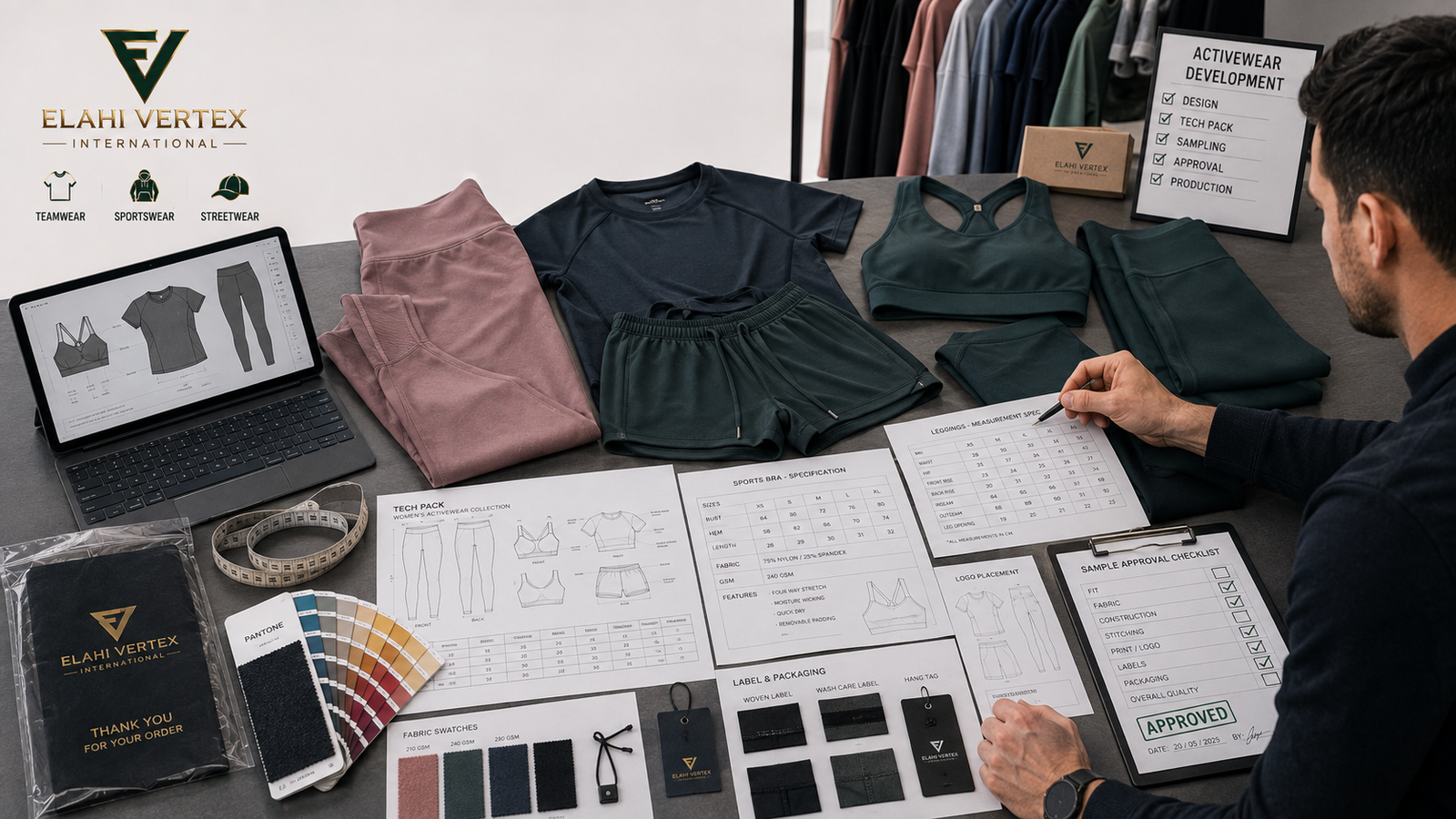
An activewear tech pack should turn a product idea into clear instructions that a manufacturer can use to understand, quote and sample the garment.
For USA activewear brands, fitness startups, private-label businesses, e-commerce companies and sourcing teams, this matters because products such as leggings, sports bras, gym shorts and performance tops are not defined by appearance alone. Fit, stretch, fabric behavior, opacity, waistband construction, seams, measurements, branding and packaging can all influence whether a sample performs as intended.
A mood board, reference photograph or sketch can communicate design direction. It usually cannot communicate every production requirement.
That is where an activewear tech pack becomes valuable.
Current activewear product-development guidance commonly treats technical drawings, bills of materials, measurements, construction, colorways, branding, testing requirements, packaging and revision control as core parts of a factory-ready specification. (Geny Yoga)
This guide explains the 9 critical details USA brands should specify before activewear sampling, what can remain open for manufacturer discussion, and how to avoid turning assumptions into expensive sample revisions.
Table of Contents
- What Is an Activewear Tech Pack?
- Why Activewear Needs More Than a Reference Photo
- Detail #1 — Product Identification and Technical Flats
- Detail #2 — Fabric and Performance Requirements
- Detail #3 — Measurements, Fit and Tolerances
- Detail #4 — Construction, Seams and Stitching
- Detail #5 — Waistbands, Gussets, Support and Functional Details
- Detail #6 — Colors, Prints and Colorways
- Detail #7 — Logos, Labels and Private-Label Branding
- Detail #8 — Packaging and Retail Requirements
- Detail #9 — Revision Control and Sample Approval
- Activewear Tech Pack Example Structure
- Leggings Tech Pack Checklist
- Sports Bra Tech Pack Checklist
- Common Activewear Tech Pack Mistakes
- How to Send an Activewear Tech Pack to a Manufacturer
- Why Discuss Activewear Manufacturing With Elahi Vertex International?
- 20 Activewear Tech Pack FAQs
- Conclusion
What Is an Activewear Tech Pack?
An activewear tech pack is a technical specification package that communicates how an activewear product is intended to be developed and manufactured.
It acts as a shared reference between the buyer, designer, pattern team, sample room and manufacturer.
Depending on the product, an activewear tech pack can include:
- Style name and number
- Revision number
- Technical flat drawings
- Product measurements
- Points of measure
- Size range
- Grading information
- Fabric specification
- Bill of materials
- Construction details
- Seam requirements
- Stitching
- Waistband construction
- Gusset details
- Pockets
- Closures
- Colorways
- Artwork
- Logo placement
- Labels
- Hang tags
- Packaging
- Testing requirements where applicable
- Sample comments
- Revision history
A tech pack does not need to contain invented technical information simply to appear complete.
If a USA activewear brand has not selected its final fabric, the document can identify the required performance characteristics and state that fabric selection requires discussion.
That is more useful than guessing.
Direct answer
A good activewear tech pack defines everything already decided, identifies everything still open, and gives the manufacturer enough information to minimize assumptions during costing and sampling.
Why Activewear Needs More Than a Reference Photo
A photograph can communicate aesthetics extremely well.
It can show:
- Silhouette
- Color direction
- Waist height
- Strap style
- Pocket concept
- General fit
- Visual inspiration
But it cannot reliably define every production specification.
Imagine sending a manufacturer a photograph of black high-waisted leggings.
The image does not necessarily tell them:
- Exact fabric composition
- Fabric weight
- Stretch requirements
- Recovery expectations
- Opacity requirements
- Waistband height
- Waistband construction
- Rise measurements
- Inseam
- Gusset construction
- Seam type
- Pocket dimensions
- Logo dimensions
- Size grading
- Label requirements
- Packaging
If those decisions are not communicated, somebody has to make assumptions.
The purpose of the activewear tech pack is to replace avoidable assumptions with controlled information.
Current manufacturing resources likewise describe tech packs as the production reference connecting drawings, materials, measurements, construction, branding and packaging to sampling and bulk execution. (Fitcloo)
1. Product Identification and Technical Flats
Every activewear tech pack should make it immediately clear which garment is being discussed.
Start with basic product identification.
Include a style information block
Consider fields such as:
Brand:
Style Name:
Style Number:
Product Category:
Sample Size:
Size Range:
Colorway:
Revision:
Revision Date:
A style number becomes particularly valuable when a collection grows.
“Black leggings” is ambiguous.
LG-101 / High-Rise Training Legging / Rev 04 is considerably clearer.
Add technical flat drawings
Technical flats communicate garment construction more precisely than lifestyle illustrations.
Typically include:
- Front view
- Back view
- Side view where relevant
- Internal view where necessary
- Detail callouts
For leggings, callouts might show:
- Waistband
- Gusset
- Side pocket
- Seam lines
- Hem
- Logo placement
For sports bras:
- Front neckline
- Back construction
- Strap configuration
- Underband
- Lining
- Cup or pad opening where relevant
Fashion illustration vs technical flat
A fashion illustration communicates the idea.
A technical flat communicates the product.
USA brands preparing manufacturing documentation should prioritize clarity over presentation.
2. Fabric and Performance Requirements
Fabric is one of the most important sections of an activewear tech pack because activewear must perform while the body moves.
The correct specification depends on the product.
A yoga legging, running short, compression top and lifestyle sports bra do not necessarily need the same fabric.
What should the fabric section contain?
Where known, specify:
- Fiber composition
- Fabric construction
- Fabric weight/GSM
- Stretch direction
- Stretch requirement
- Recovery requirement
- Surface/hand feel
- Finish
- Lining
- Mesh
- Rib
- Secondary fabrics
- Approved physical reference
If some information is unknown, define the objective.
For example:
Fabric required for high-waisted training leggings. Four-way stretch direction preferred, with strong recovery and sufficient opacity for intended training use. Final fabric specification requires sampling and approval.
That communicates considerably more than:
Use premium gym fabric.
GSM is useful—but not enough
GSM describes fabric weight per square metre.
It does not completely define:
- Composition
- Knit construction
- Stretch
- Recovery
- Opacity
- Hand feel
- Surface
- Durability
- Drape
Two fabrics with the same GSM can behave differently.
Fabric decision framework
Product
Important Considerations
Leggings
Stretch, recovery, opacity, hand feel, compression direction
Sports Bra
Support objective, recovery, lining, comfort
Training Shorts
Movement, stretch, weight, breathability
Gym Top
Hand feel, breathability, stretch, intended fit
Compression Wear
Recovery, stretch, fit, seam compatibility
Yoga Wear
Stretch, softness, recovery, comfort
These are industry considerations, not fixed Elahi Vertex International fabric specifications.
Actual materials available for a project must be confirmed individually.
3. Measurements, Fit and Tolerances
A garment cannot be manufactured consistently from labels such as:
XS / S / M / L / XL
alone.
Your activewear tech pack should establish how the garment is supposed to measure.
Points of Measure
For leggings, points of measure might include:
- Waist width
- Waistband height
- Front rise
- Back rise
- Hip
- Thigh
- Knee
- Leg opening
- Inseam
- Outseam
For sports bras:
- Chest width
- Underbust
- Body length
- Strap length
- Strap width
- Neck drop
- Armhole
- Underband height
Example activewear size-chart framework
The table below deliberately contains no invented Elahi Vertex International measurements.
Point of Measure
XS
S
M
L
XL
Waist
Specify
Specify
Specify
Specify
Specify
Hip
Specify
Specify
Specify
Specify
Specify
Front Rise
Specify
Specify
Specify
Specify
Specify
Back Rise
Specify
Specify
Specify
Specify
Specify
Inseam
Specify
Specify
Specify
Specify
Specify
Define how measurements are taken
A number without a measurement method can still be ambiguous.
Technical diagrams can identify exactly where each POM begins and ends.
Define tolerances
Manufacturing tolerances should be agreed for the specific product.
Do not copy tolerances from an unrelated garment simply because they appear in another tech pack.
Fit still needs physical evaluation
A measurement chart cannot completely replace a sample.
The tech pack tells the manufacturer the intended specification.
The sample lets the buyer evaluate the physical result.
That is why activewear tech pack development and sampling should work together, not compete with each other. Current technical guidance makes the same distinction. (Fitcloo)
4. Construction, Seams and Stitching
Activewear construction can affect:
- Comfort
- Movement
- Appearance
- Stretch
- Durability
- Bulk
- Chafing
- Product identity
Your activewear tech pack should therefore identify important construction details rather than leaving every seam to interpretation.
Depending on the design, this might include:
- Seam locations
- Stitch type
- Hem construction
- Waistband attachment
- Elastic application
- Gusset
- Binding
- Lining
- Pocket construction
- Reinforcement
- Zippers
- Drawcords
- Bartacks where required
Think about movement
A seam that looks acceptable on a static drawing can feel different during:
- Squatting
- Running
- Stretching
- Cycling
- Weight training
- Yoga
That is why product development should consider the intended activity.
Do not over-specify what you do not understand
A common founder mistake is copying technical terminology from another garment.
If you know the performance objective but not the correct construction method, communicate the objective and request technical discussion.
For example:
Minimize bulky seam feel around the inner leg during training. Construction method requires manufacturer recommendation and sample approval.
That is better than specifying an inappropriate stitch simply because it sounds technical.
5. Waistbands, Gussets, Support and Functional Details
This is where a generic clothing tech pack becomes an activewear tech pack.
Performance products often depend on functional details.
Leggings
Consider specifying:
- Waistband height
- Waistband shape
- Front rise
- Back rise
- Elastic requirements where applicable
- Internal pocket
- Side pockets
- Gusset
- Seam configuration
- Leg length
- Hem
- Compression direction
Waistband example
Do not write:
High waist.
Instead document:
- Intended waistband height
- Shape
- Construction
- Seam placement
- Elastic if required
- Top-edge construction
- Relevant measurements
Sports Bras
Support requirements should be considered according to intended use.
A product designed for low-impact yoga does not necessarily require the same construction as one intended for high-impact training.
Consider:
- Intended support level
- Strap width
- Strap configuration
- Underband
- Lining
- Mesh panels
- Cup construction
- Removable pad requirements
- Closures where applicable
Avoid making unsupported performance claims.
If a product has not been appropriately tested, do not describe it as providing a scientifically verified level of support merely because the design appears supportive.
Shorts
Depending on the style:
- Waistband
- Liner
- Side slit
- Zipper pocket
- Drawcord
- Inseam
- Rise
- Hem
- Reflective elements
may need specification.
6. Colors, Prints and Colorways
Color names alone can be imprecise.
“Black” may sound straightforward.
But activewear collections increasingly use colors such as:
- Graphite
- Charcoal
- Sage
- Forest
- Stone
- Taupe
- Mocha
- Dusty blue
- Burgundy
- Cream
The activewear tech pack should identify the intended color reference.
Use a colorway page
For each colorway, show:
- Main body
- Contrast panels
- Mesh
- Elastic
- Thread where important
- Logo
- Hardware
- Labels
Example
Component
Color Direction
Approval Reference
Main Fabric
Deep Olive
Defined reference
Mesh
Tonal Olive
Sample approval
Logo
Off-white
Artwork reference
Thread
Tonal
Sample approval
Label
Brand specification
Artwork
Where relevant, recognized color systems or approved physical references can improve communication.
Printed activewear
For all-over or placement prints, specify:
- Artwork file
- Scale
- Repeat
- Orientation
- Placement
- Color reference
- Relevant print boundaries
Do not assume the manufacturer knows whether the artwork should be centered, mirrored, repeated or randomly positioned.
7. Logos, Labels and Private-Label Branding
A USA private-label activewear brand needs more than a logo printed on the outside.
Your activewear tech pack should identify all required branding components.
These may include:
- Heat-transfer logo
- Screen print
- Embroidery
- Silicone-style branding where appropriate
- Main label
- Printed neck label
- Size label
- Care label
- Hang tag
- Packaging branding
Available decoration and branding methods should be confirmed for the individual manufacturing project.
Logo placement
Do not write:
Small logo on left leg.
Define:
- Artwork file
- Dimensions
- Orientation
- Placement reference
- Color
- Intended decoration method
Placement matters
A 50 mm shift can materially change the appearance of minimalist activewear branding.
Technical placement diagrams remove that uncertainty.
Legal labeling considerations
USA brands should separately determine applicable legal labeling obligations for their products and market.
A manufacturer can work from approved labeling artwork, but responsibility for determining applicable destination-market requirements should not simply be assumed.
8. Packaging and Retail Requirements
Packaging belongs in the activewear tech pack when it affects how the finished garment needs to be delivered.
For USA DTC brands, Amazon sellers, wholesalers and retailers, requirements may differ substantially.
Consider whether the project requires:
- Folding method
- Individual packaging
- Size sticker
- SKU
- Barcode
- Hang tag
- Product sticker
- Set identification
- Carton assortment
- Carton markings
Matching sets need special attention
Suppose you sell:
Sports Bra + Legging Set
Clarify whether:
- Pieces are packed individually
- Both pieces share one package
- Sizes must match
- Different top/bottom sizes are permitted
- The set has one SKU or separate SKUs
Do not leave this decision until goods are ready for dispatch.
Current tech-pack guidance similarly includes packaging and packing instructions as part of the production specification rather than treating them as an unrelated afterthought. (Geny Yoga)
9. Revision Control and Sample Approval
An activewear tech pack is a living manufacturing document during development.
That means it must change when the product changes.
Suppose:
Revision 1: Original legging
Revision 2: Waistband increased
Revision 3: Side pocket added
Revision 4: Inseam changed
Revision 5: Logo repositioned
If your manufacturer has Revision 3 while you approve a sample based on Revision 5, the documentation is no longer controlled.
Add a revision history
Revision
Change
Date
Status
V1
Initial specification
Record
Superseded
V2
Waistband revised
Record
Superseded
V3
Pocket revised
Record
Current/Approved
Never keep multiple files called:
FINAL.pdf
FINAL2.pdf
FINAL-NEW.pdf
FINAL-REAL.pdf
Use controlled version numbers.
Update the tech pack after sample feedback
Suppose the sample fits well after changing the waistband.
Do not leave the old waistband measurement in the tech pack.
The approved physical product and approved specification should tell the same story.
Current activewear tech-pack guidance specifically emphasizes revision numbers and keeping sample comments, measurements and approved information synchronized. (Geny Yoga)
Activewear Tech Pack Example Structure
A practical activewear tech pack might be organized as follows:
Page 1 — Cover
- Brand
- Style
- Style code
- Product
- Revision
- Date
- Sample stage
Page 2 — Technical Flats
- Front
- Back
- Side/details
Page 3 — Bill of Materials
- Main fabric
- Secondary fabric
- Lining
- Elastic
- Thread
- Trims
- Labels
- Hardware
Page 4 — Construction
- Seam details
- Stitching
- Waistband
- Gusset
- Pockets
- Hem
Page 5 — Measurements
- POM diagram
- Base size
- Measurement chart
- Tolerances
Page 6 — Grading
- Size range
- Grade rules where finalized
Page 7 — Colorways
- Main fabric
- Contrast components
- Logo
- Thread
- Hardware
Page 8 — Branding
- Logo dimensions
- Placement
- Labels
- Hang tags
Page 9 — Packaging
- Folding
- Individual packaging
- SKU
- Barcode
- Stickers
- Carton requirements
Page 10 — Revision History
- Changes
- Dates
- Approval status
The number of pages is not important.
Clarity is.
Activewear Tech Pack Checklist for Leggings
Before sending a leggings specification to a manufacturer, consider whether the following have been defined.
Product
- Style code
- Intended use
- Fit
- Length
- Size range
Fabric
- Composition
- GSM/weight where relevant
- Stretch
- Recovery
- Opacity objective
- Surface/hand feel
- Color
Waist
- Waistband height
- Shape
- Construction
- Elastic where applicable
Body
- Front rise
- Back rise
- Hip
- Thigh
- Inseam
- Leg opening
Functional Details
- Gusset
- Side pocket
- Internal pocket
- Seam placement
Branding
- Logo
- Dimensions
- Placement
- Labels
Packaging
- Folding
- Size sticker
- SKU
- Barcode where required
Activewear Tech Pack Checklist for Sports Bras
Product
- Style code
- Intended activity
- Intended support direction
- Size range
- Fit direction
Fabric
- Main fabric
- Lining
- Mesh
- Elastic
- Color
Construction
- Neckline
- Armhole
- Strap
- Back design
- Underband
- Closures
- Cup/pad arrangement where relevant
Measurements
- Chest
- Underbust
- Body length
- Strap dimensions
- Underband
Branding
- Logo
- Main label
- Size label
- Care label
Packaging
- Folding
- Packaging
- SKU
- Barcode where applicable
9 Common Activewear Tech Pack Mistakes USA Brands Should Avoid
1. Using only reference photos
Photos communicate appearance but usually leave measurements, materials and construction unresolved.
2. Writing “premium fabric”
Define performance requirements rather than relying on subjective adjectives.
3. Specifying GSM without fabric behavior
Weight alone does not define activewear performance.
4. Ignoring points of measure
Size labels are not manufacturing specifications.
5. Forgetting functional construction
Waistbands, gussets, pockets, seams and support structures need appropriate definition.
6. Using vague logo placement
Specify dimensions and reference points.
7. Forgetting packaging
Packaging can affect retail and fulfillment readiness.
8. Failing to update revisions
An outdated activewear tech pack can undermine an otherwise successful sample round.
9. Treating the first sample as bulk approval automatically
Sampling is an evaluation process. The physical result should be reviewed against the intended specification before the next stage is authorized.
How Should USA Brands Send an Activewear Tech Pack to a Manufacturer?
Send the activewear tech pack together with enough commercial context for the manufacturer to understand the project.
A useful inquiry can include:
- Tech pack
- Product category
- Target quantity
- Size range
- Number of colorways
- Artwork files
- Reference garments/photos
- Target market
- Destination
- Sample requirements
- Required timing
- Questions requiring manufacturer input
Separate specifications from commercial requirements
Your tech pack defines the product.
Your RFQ defines the commercial inquiry.
They work together.
For example:
Tech Pack:
Defines the legging.
RFQ:
Requests pricing for 300 units across three colors, identifies destination and asks about sampling and commercial terms.
That distinction makes supplier communication much cleaner.
From Activewear Tech Pack to Sample Approval
A practical development sequence may look like:
Idea → Technical Specification → Manufacturer Review → Fabric Discussion → Quotation → Sampling → Fit Review → Revision → Approval → Bulk Planning
The exact sequence varies by project and supplier.
Activewear sampling is generally intended to turn the specification into a physical garment that can be evaluated for fit, construction and fabric behavior before bulk commitment. (Linked Sourcing)
During sample review, check more than appearance
For leggings, evaluate relevant characteristics such as:
- Fit
- Waistband behavior
- Rise
- Movement
- Opacity
- Stretch
- Recovery
- Seam comfort
- Pocket function
- Logo
- Measurements
For sports bras:
- Fit
- Coverage
- Strap behavior
- Underband
- Movement
- Construction
- Measurements
- Branding
Document corrections and update the activewear tech pack accordingly.
Why Discuss Activewear Manufacturing With Elahi Vertex International?
Elahi Vertex International is positioned as a B2B manufacturer, exporter, OEM supplier, ODM supplier, custom manufacturing partner and private-label manufacturing partner.
USA activewear brands, startups, wholesalers, e-commerce businesses and other B2B buyers can approach Elahi Vertex International with an existing activewear tech pack or available project specifications to discuss manufacturing requirements.
Relevant product-development discussions may involve categories such as custom activewear, depending on the individual project.
However, project-specific matters including:
- MOQ
- Fabric availability
- Material specifications
- Sampling procedure
- Sample charges
- Pricing
- Production schedule
- Testing requirements
- Packaging
- Shipping arrangements
must be confirmed for the specific inquiry.
They should not be assumed from general industry guidance.
What to send
For a more productive manufacturing discussion, prepare:
- Activewear tech pack if available
- Technical drawings or reference designs
- Target quantity
- Size range
- Fabric direction
- Colorways
- Branding requirements
- Packaging requirements
- Destination
USA buyers can contact Elahi Vertex International on WhatsApp, email elahivertexinternational@gmail.com, visit the official Elahi Vertex International website, or review the official Alibaba storefront.
20 Activewear Tech Pack FAQs
1. What is an activewear tech pack?
An activewear tech pack is a technical specification package containing the information needed to communicate an activewear design to a manufacturer for development, costing, sampling and production planning.
2. What should an activewear tech pack include?
It commonly includes technical flats, materials, measurements, construction, colorways, branding, labels, packaging and revision information. (Geny Yoga)
3. Do I need an activewear tech pack before contacting a manufacturer?
Not necessarily. You can begin a manufacturing discussion with sketches, references and available specifications, but a controlled tech pack becomes increasingly important for fully custom development.
4. Can I make an activewear tech pack from a reference photo?
A reference photograph can help establish design direction, but additional information is normally required to define measurements, materials, construction and branding.
5. Does an activewear tech pack need a size chart?
For custom development, measurements and sizing information are important. If grading is not finalized, identify what still requires development rather than inventing it.
6. Should an activewear tech pack include GSM?
Include GSM when it is part of the approved fabric specification, but do not rely on GSM alone to define fabric performance.
7. Should an activewear tech pack specify fabric composition?
Yes, where the composition has been selected. Otherwise communicate the required performance characteristics and discuss suitable options with the manufacturer.
8. Does a leggings activewear tech pack need a gusset specification?
If the design includes a gusset, its shape, construction and relevant measurements should be communicated.
9. Should an activewear tech pack specify stretch?
Where stretch characteristics are important to product performance, they should be addressed in the material specification or development requirements.
10. Should an activewear tech pack contain seam information?
Yes, where seam type or placement is important to the intended construction, appearance or performance.
11. Should an activewear tech pack include logo placement?
Yes. Include artwork, dimensions, color, intended method and measurable placement instructions where possible.
12. Does an activewear tech pack include private labels?
It can include main labels, size labels, care labels, printed neck labels, hang tags and other required branding components.
13. Should packaging be included in an activewear tech pack?
Yes when packaging forms part of the manufacturing and delivery specification.
14. What is a BOM in an activewear tech pack?
BOM means Bill of Materials. It identifies the fabrics, trims, elastic, labels, hardware and other components required for the garment.
15. What are POMs in an activewear tech pack?
POM means Point of Measure. POMs establish where garment measurements are taken.
16. Should USA activewear startups have an activewear tech pack?
For fully custom products, a good activewear tech pack can substantially improve communication with manufacturers and make sample revisions easier to control.
17. Does an activewear tech pack guarantee a perfect first sample?
No. A strong specification reduces ambiguity but does not eliminate the need for physical sampling, fit evaluation and potential revisions.
18. Should I update my activewear tech pack after sampling?
Yes. Approved sample changes should be reflected in the controlled specification so outdated information does not remain active.
19. Can I send my activewear tech pack to Elahi Vertex International?
Yes. USA and international B2B buyers can send available product specifications to Elahi Vertex International for project-specific discussion. Manufacturing feasibility and commercial terms must be confirmed for the individual project.
20. How do I contact Elahi Vertex International about activewear manufacturing?
Send your activewear tech pack or available specifications through WhatsApp, email elahivertexinternational@gmail.com, visit the official website, or review the Alibaba storefront.
Conclusion: Build the Activewear Tech Pack Before Expensive Assumptions Reach the Sample
An activewear tech pack does not need to be complicated for the sake of looking professional.
It needs to be clear, measurable and controlled.
Before USA activewear brands move into sampling, the 9 critical details to address are:
- Product identification and technical flats
- Fabric and performance requirements
- Measurements, fit and tolerances
- Construction, seams and stitching
- Waistbands, gussets, support and functional details
- Colors, prints and colorways
- Logos, labels and private-label branding
- Packaging and retail requirements
- Revision control and sample approval
The principle behind all nine is the same:
Do not make the manufacturer guess when the buyer can specify. Do not invent a specification when the correct answer still requires development.
A well-structured activewear tech pack gives the buyer and manufacturer a common reference for sampling. When the sample changes, update the specification. When something remains undecided, mark it clearly.
That creates a cleaner path from:
Product Idea → Activewear Tech Pack → Sample → Revision → Approval → Bulk Production
Discuss Your Activewear Project
USA activewear brands, private-label businesses, fitness startups, wholesalers and other B2B buyers can send available specifications to Elahi Vertex International for a project-specific manufacturing discussion.
Elahi Vertex International
B2B Manufacturer | Exporter | OEM | ODM | Private Label | Custom Manufacturing
Official Website
WhatsApp
Phone: +92 309 1639614
Primary Email: elahivertexinternational@gmail.com
Secondary Email: Info@elahivertexinternational.com
Official Alibaba Storefront
Send your activewear tech pack, reference designs, target quantity, size range, branding requirements and destination information to begin the discussion.