

[FEATURED IMAGE — PLACE AFTER TITLE]
ALT: sublimated rugby uniforms for USA and UK rugby team kits
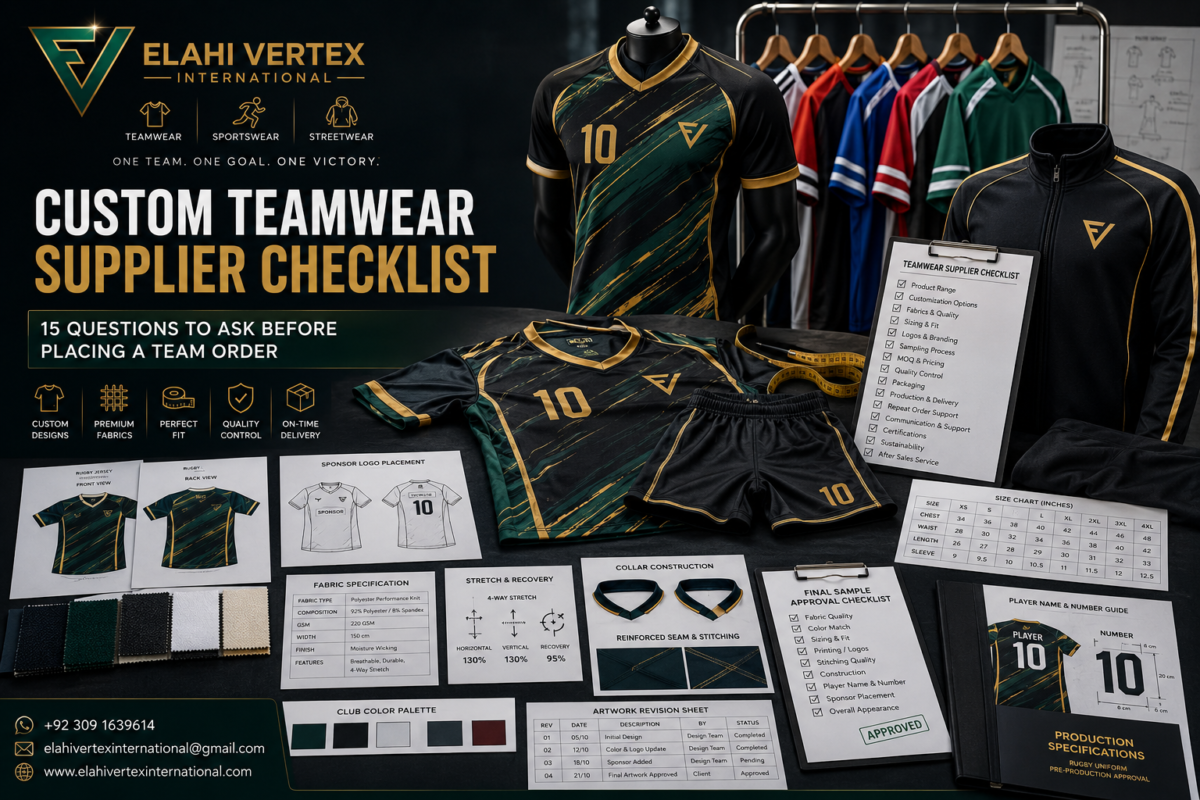
For rugby clubs, academies, schools, universities, teamwear businesses, wholesalers, distributors, and private-label sportswear brands, sublimated rugby uniforms provide extensive freedom for team colors, geometric patterns, sponsor graphics, player names, and numbers.
But sublimation is only one part of the manufacturing specification.
Before bulk production, buyers still need to define the fabric, GSM, rugby-specific construction, fit, measurements, color references, artwork, panel alignment, player personalization, shorts, labels, packaging, sample approval, and quality requirements.
That is particularly important for USA and UK buyers comparing international manufacturers. Two rugby jerseys can look almost identical in a digital mockup while using different fabrics, construction methods, measurements, printing standards, and finishing.
Dye-sublimation uses heat to transfer dye into a compatible polyester-based substrate. Epson identifies polyester apparel and sportswear as key applications for the process, making sublimation especially useful where detailed graphics, gradients, and integrated designs are required. Epson dye-sublimation guidance
For buyers considering Elahi Vertex International specifically, its dedicated sublimation printing service describes sublimation as a production option for detailed, full-color sportswear, jerseys, kits, and teamwear.
This guide explains 9 proven specifications for better sublimated rugby uniforms and shows what buyers should confirm before approving bulk production.
Quick Answer: What Should You Confirm Before Ordering Sublimated Rugby Uniforms?
Before approving sublimated rugby uniforms, confirm these nine areas:
- Sublimation-compatible fabric and GSM
- Rugby-specific garment construction
- Production-ready artwork
- Team-color and print approval
- Graphic alignment across garment panels
- Fit, measurements, and size grading
- Player names, numbers, sponsors, and branding
- Rugby shorts and complete-kit coordination
- Sampling, quality control, and bulk-production approval
A digital mockup cannot confirm all nine.
Buyers requiring a commercial rugby manufacturing option can also review the dedicated Custom Rugby Uniform Manufacturer product page, while buyers looking specifically at available rugby products can browse the Rugby Uniform category.
Table of Contents
- Choose the right fabric and GSM
- Define rugby-specific construction
- Prepare production-ready sublimation artwork
- Control team colors before bulk printing
- Map graphics correctly across garment panels
- Confirm rugby fit and size grading
- Lock names, numbers, sponsors, and club branding
- Develop the rugby shorts with the jersey
- Approve samples and quality standards
- Sublimated rugby uniform specification checklist
- Sublimation vs surface-applied decoration
- 9 costly sourcing mistakes
- How USA and UK buyers should prepare an RFQ
- How to compare rugby uniform manufacturers
- Why Elahi Vertex International
- FAQs
- Useful external resources
- Conclusion
1. Choose the Right Fabric and GSM for Sublimated Rugby Uniforms
The first decision when developing sublimated rugby uniforms should be the textile—not the graphic design.
Sublimation requires a compatible substrate, and polyester-based fabrics are widely used for dye-sublimation sportswear. Epson explains that dye-sublimation works with polyester or polymer-compatible materials and is commonly used for athletic apparel because the process supports detailed colors and gradients. Read Epson’s explanation of dye sublimation
However, the word polyester does not provide a complete rugby-fabric specification.
Fabric Specifications Buyers Should Confirm
A serious RFQ should consider:
- Fiber composition
- Fabric construction
- GSM
- Stretch direction
- Stretch level
- Recovery
- Opacity
- Surface texture
- Hand feel
- Print compatibility
- Breathability requirements
- Intended match or training use
What Does GSM Mean?
GSM means grams per square metre and describes fabric weight.
It is useful, but it should not be treated as a standalone measure of quality.
Two polyester fabrics with similar GSM can behave differently because of differences in:
- Yarn structure
- Knitting construction
- Stretch
- Recovery
- Surface finish
- Density
- Print behavior
A better fabric approval framework is:
Composition + Construction + GSM + Stretch + Recovery + Finish + Intended Use
Why Fabric Selection Should Come Before Final Artwork Approval
Changing the fabric can affect:
- Printed color appearance
- Surface finish
- Garment weight
- Stretch
- Opacity
- Fit
- Hand feel
- Final sample appearance
Therefore, buyers should avoid fully approving color-sensitive artwork while the physical substrate remains undecided.
For projects requiring fabric development or sourcing, buyers can review Elahi Vertex International’s broader custom clothing manufacturing process before preparing the production brief.
[IMAGE 2 — PLACE AFTER THIS SECTION]
ALT: sublimated rugby uniforms polyester fabric GSM and stretch specifications
2. Define Rugby-Specific Jersey Construction
A strong graphic does not compensate for an unsuitable jersey.
Rugby involves running, tackling, pulling, repeated movement, and contact. Garment construction should therefore reflect the intended use rather than simply adapting a generic sports T-shirt.
Construction Details May Include
- Front body panel
- Back panel
- Shoulder panels
- Sleeves
- Side panels
- Underarm panels
- Collar
- Neck binding
- Seam construction
- Stitching
- Hem
- Reinforcement areas
The exact construction depends on the buyer’s design and intended use.
More Panels Are Not Automatically Better
Complex sublimated rugby uniforms sometimes use multiple sections to create geometric or performance-oriented designs.
But each additional panel introduces another:
- Pattern piece
- Cutting operation
- Seam
- Sewing operation
- Artwork alignment point
Additional panels should therefore serve a genuine design, fit, movement, or construction purpose.
Confirm the Collar
The technical specification should define:
- Collar type
- Collar material
- Shape
- Color
- Neck depth
- Binding
- Reinforcement
- Front opening where applicable
A visual mockup is not enough to communicate all of these details.
Check Rugby Clothing Rules
For match apparel, buyers must consider applicable regulations.
World Rugby Law 4 states that player clothing must comply with Regulation 12. It also currently requires the jersey sleeve to extend at least halfway from the shoulder point to the elbow and restricts various potentially dangerous rigid components. Review World Rugby Law 4 — Players’ Clothing
World Rugby Regulation 12 provides additional provisions relating to player dress and associated equipment requirements. Clubs should also check competition-, union-, league-, school-, or tournament-specific rules rather than assuming the global rules are the only requirements. Review World Rugby Regulation 12
3. Prepare Production-Ready Sublimation Artwork
One of the biggest advantages of sublimated rugby uniforms is design freedom.
A rugby kit can contain:
- Geometric patterns
- Gradients
- Large background graphics
- Club colors
- Sponsor graphics
- Player numbers
- Player names
- Shoulder graphics
- Sleeve designs
- Side-panel artwork
However, a visual mockup is not automatically production-ready artwork.
Your Artwork Package Should Define
Jersey Front
Main graphics, crest, primary sponsor, brand mark, and patterns.
Jersey Back
Player number, name, sponsor placement, and background artwork.
Left Sleeve
Sponsor, team mark, or design treatment.
Right Sleeve
Competition mark, sponsor, or graphic.
Side Panels
Artwork continuation or contrast graphics.
Collar
Color and artwork if required.
Rugby Shorts
Front, back, side graphics, branding, and numbering.
Use One Controlled Artwork Version
A simple version system reduces errors:
- Rugby-Kit-V1
- Rugby-Kit-V2
- Rugby-Kit-V3
- Rugby-Kit-FINAL
- Rugby-Kit-FINAL-APPROVED
The manufacturer should never have to guess which design file controls production.
Why Vector Artwork Matters
Vector graphics are resolution-independent, which means they can be resized while maintaining clean edges. Adobe specifically identifies vectors as suitable for elements such as logos that need to appear at different sizes. Adobe guidance on vector graphics
That makes vector artwork particularly useful for:
- Club crests
- Sponsor logos
- Numbers
- Typography
- Geometric lines
- Brand marks
Avoid using a small social-media screenshot when the original logo file exists.
[IMAGE 3 — PLACE AFTER THIS SECTION]
ALT: sublimated rugby uniforms artwork and rugby jersey technical design
4. Control Team Colors Before Bulk Sublimation
Color can define a rugby club’s identity.
Incorrect color can make an otherwise well-constructed kit unacceptable.
Important colors may include:
- Primary club color
- Secondary club color
- Accent color
- Sponsor colors
- Number color
- Name color
- Collar color
- Shorts colors
Why Screen Color Is Not Enough
Digital screens and printed fabrics reproduce color differently.
The final result can be affected by:
- Artwork settings
- Color profiles
- Printer configuration
- Sublimation ink
- Heat-transfer conditions
- Fabric surface
- Fabric construction
That means an on-screen mockup should not automatically become the only production color reference.
Use an Appropriate Color Reference
Pantone’s textile systems are specifically designed to help designers, brands, and manufacturers communicate colors for apparel and soft goods. Pantone also notes that materials can reproduce colors differently, reinforcing the need to use references appropriate to the final textile application. Pantone textile color systems
Better Approval Sequence
Digital Design → Agreed Color Reference → Printed Reference/Strike-Off Where Required → Sample → Approval → Bulk Printing
The exact workflow depends on the project.
Do not promise an absolute screen-to-fabric match without a defined color-control process.
[IMAGE 4 — PLACE AFTER THIS SECTION]
ALT: sublimated rugby uniforms color matching and team color approval
5. Map Graphics Correctly Across Garment Panels
This is one of the most important issues for geometric sublimated rugby uniforms.
A jersey looks like a single product when worn.
During manufacturing, however, it is assembled from separate pattern pieces.
These may include:
- Front
- Back
- Sleeves
- Shoulders
- Side panels
- Collar pieces
Those components are printed, cut, and sewn together.
Why Geometric Designs Need Additional Planning
Imagine a diagonal stripe beginning across the chest and continuing around the side.
If artwork does not account for the actual pattern pieces, the line may:
- Shift vertically
- Break at a seam
- Change angle
- Fail to connect
- Interfere with a sponsor logo
This is why artwork should be evaluated on the garment pattern rather than only on a flat rectangular canvas.
Separate Critical and Flexible Alignment
Critical Alignment Elements
Give greater placement control to:
- Sponsor names
- Player numbers
- Text
- Club crest
- Fine stripes
- Symmetrical marks
- Small logos
Flexible Alignment Elements
These may tolerate reasonable manufacturing variation:
- Abstract graphics
- Random textures
- Large gradients
- Organic patterns
A Better Buyer Question
Do not simply ask:
“Will every pattern line match perfectly?”
Ask:
“Which artwork elements require critical alignment across seams, and how should the design be engineered to make those areas production practical?”
That question gives the design and manufacturing teams something measurable to discuss.
Buyers developing a similar geometric concept can review Elahi Vertex International’s EVI-901 Geometric Custom Rugby Uniform as a relevant internal product reference.
[IMAGE 5 — PLACE AFTER THIS SECTION]
ALT: geometric sublimated rugby uniforms artwork panel alignment
6. Confirm Rugby Fit, Measurements, and Size Grading
Sublimated rugby uniforms still require accurate garment engineering.
Sublimation cannot correct:
- Wrong chest width
- Incorrect body length
- Poor sleeve dimensions
- Incorrect shoulder width
- Bad shorts fit
- Weak size grading
A size label such as M, L, or XL is not a complete technical specification.
Jersey Measurements May Include
- Chest width
- Body length
- Shoulder width
- Sleeve length
- Sleeve opening
- Armhole
- Bicep
- Hem width
- Neck opening
Shorts Measurements May Include
- Waist
- Hip
- Outseam
- Inseam
- Rise
- Leg opening
The exact measurement points depend on the pattern.
Define the Fit
Possible design directions include:
- Athletic fit
- Regular fit
- Relaxed fit
- Buyer-defined custom fit
But those terms remain subjective until supported by actual measurements.
Build an Approved Size Chart
| Size | Chest | Body Length | Sleeve | Shorts Waist | Shorts Length |
|---|---|---|---|---|---|
| XS | Confirm | Confirm | Confirm | Confirm | Confirm |
| S | Confirm | Confirm | Confirm | Confirm | Confirm |
| M | Confirm | Confirm | Confirm | Confirm | Confirm |
| L | Confirm | Confirm | Confirm | Confirm | Confirm |
| XL | Confirm | Confirm | Confirm | Confirm | Confirm |
| 2XL | Confirm | Confirm | Confirm | Confirm | Confirm |
Never invent production measurements simply to complete a chart.
Where buyers need to validate sizing, construction, artwork, and materials before a bulk order, Elahi Vertex International provides a dedicated sampling and prototyping process.
7. Lock Player Names, Numbers, Sponsors, and Club Branding
Sublimation makes detailed personalization practical, but it does not remove the need for accurate data management.
Once personalized panels enter printing or cutting, late corrections can become difficult.
Use One Final Player Roster
| Player | Jersey Size | Shorts Size | Number | Printed Name | Status |
|---|---|---|---|---|---|
| Player 01 | M | M | 10 | Confirm | Approved |
| Player 02 | L | L | 8 | Confirm | Approved |
| Player 03 | XL | L | 15 | Confirm | Approved |
Do not manage final production information across multiple:
- WhatsApp messages
- Emails
- Screenshots
- Voice notes
- Handwritten lists
Use one controlled master document.
Confirm Player Numbers
Define:
- Font
- Height
- Width
- Color
- Outline
- Position
- Spacing
Confirm Sponsor Branding
For each sponsor, establish:
- Correct artwork
- Correct logo version
- Color
- Position
- Dimensions
- Orientation
Rugby Competition Requirements Still Apply
Club branding freedom does not mean every layout is automatically suitable for every competition.
Confirm the applicable league, union, school, university, tournament, or governing-body rules before approving official match uniforms.
[IMAGE 6 — PLACE AFTER THIS SECTION]
ALT: sublimated rugby uniforms player names numbers sponsors and logos
8. Develop Rugby Shorts With the Complete Kit
The jersey often receives most of the design attention.
The shorts should not become an afterthought.
Professional sublimated rugby uniforms should be developed as coordinated kits.
Rugby Shorts Specifications May Include
- Fabric
- GSM
- Stretch
- Waistband
- Elastic
- Drawcord
- Gusset
- Side panels
- Seam construction
- Hem
- Logo
- Sublimation graphics
- Player number where required
- Labels
Should the Shorts Use the Same Fabric?
Not automatically.
The jersey and shorts perform different functions.
Fabric selection should consider:
Movement + Stretch + Construction + Comfort + Durability + Design
rather than forcing one fabric into every garment.
Review the Complete Kit Together
Approve:
Jersey Front + Jersey Back + Shorts Front + Shorts Back
as one visual system.
Check:
- Color coordination
- Geometric pattern consistency
- Side-panel relationships
- Logo scale
- Number placement
- Sponsor balance
- Shorts branding
This is especially important where the design uses strong geometric transitions.
9. Approve the Sample and Quality Standard Before Bulk Production
Bulk production should not be the stage where a buyer discovers what the final kit actually looks like.
Sampling and approval exist to identify major issues earlier.
A practical production flow may be:
Buyer Brief → Fabric Selection → Technical Specification → Artwork → Sample → Review → Revisions → Approval → Bulk Production → Quality Control → Packing
What Should the Rugby Sample Confirm?
Fabric
- Approved fabric
- GSM where specified
- Stretch
- Surface
- Hand feel
- Print behavior
Construction
- Seams
- Stitching
- Collar
- Sleeves
- Panels
- Hem
- Shorts
Measurements
- Jersey dimensions
- Shorts measurements
- Size grading
- Tolerances
Sublimation
- Color
- Sharpness
- Pattern scale
- Placement
- Panel transitions
- Graphic orientation
Personalization
- Names
- Numbers
- Crest
- Sponsors
- Brand marks
Finishing
- Labels
- Thread trimming
- Packaging
- Quantity identification
Use Objective Textile Testing Where It Matters
AATCC publishes recognized textile test methods covering areas such as colorfastness, laundering, moisture management, water resistance, and other textile properties. Buyers with specific performance requirements can use appropriate standards rather than relying only on subjective descriptions such as “premium” or “high performance.” AATCC textile testing standards
Not every rugby project requires every test.
Testing requirements should match:
- Intended use
- Buyer specification
- Product claim
- Market requirement
- Commercial risk
For production-related checks, buyers can also review Elahi Vertex International’s quality control process.
[IMAGE 7 — PLACE AFTER THIS SECTION]
ALT: sublimated rugby uniforms sample approval and quality control
Sublimated Rugby Uniform Specification Checklist
Before approving bulk production, confirm the following.
Product
- Rugby jersey
- Rugby shorts
- Complete kit
- Match or training use
- Adult or youth range
- Men’s, women’s, or buyer-defined fit
Fabric
- Composition
- Construction
- GSM
- Stretch
- Recovery
- Finish
- Opacity
- Sublimation compatibility
Construction
- Pattern pieces
- Collar
- Sleeves
- Side panels
- Seam construction
- Stitching
- Hem
- Shorts waistband
- Reinforcement if required
Artwork
- Front
- Back
- Sleeves
- Side panels
- Shorts
- Geometric pattern
- Final approved file version
Color
- Primary team color
- Secondary team color
- Accent colors
- Sponsor colors
- Name/number colors
- Agreed color reference
Personalization
- Club crest
- Sponsors
- Player names
- Player numbers
- Brand mark
- Final roster
Sizing
- Size chart
- Measurement method
- Size quantities
- Grading
- Tolerances
Approval
- Fabric approved
- Artwork approved
- Colors approved
- Measurements approved
- Sample approved
- Roster approved
- Packaging approved
If several of these remain unresolved, the project is probably not ready for bulk production.
Sublimation vs Surface-Applied Rugby Decoration
Different decoration methods solve different problems.
| Factor | Sublimation | Surface-Applied Decoration |
|---|---|---|
| Full-jersey graphics | Strong application | Method dependent |
| Geometric patterns | Strong application | More restrictive in some processes |
| Gradients | Well suited | Method dependent |
| Integrated numbers | Possible | Often applied separately |
| Integrated sponsors | Possible | Often separately applied |
| Fabric compatibility | Polyester important | Process dependent |
| Surface feel | Integrated into compatible textile | Can create an applied layer |
| Panel mapping | Very important | Less important for small placements |
| Complex all-over artwork | Strong application | Technique dependent |
The correct process should be selected according to:
- Fabric
- Artwork
- Required finish
- Product use
- Branding
- Commercial requirements
For a direct overview of Elahi Vertex International’s production option, buyers can review its Sublimation Printing page.
9 Costly Mistakes to Avoid With Sublimated Rugby Uniforms
1. Designing Before Choosing the Fabric
The textile can influence printed appearance, fit, weight, and feel.
2. Treating the Mockup as a Tech Pack
A mockup does not define GSM, stitching, tolerances, or garment construction.
3. Sending Low-Resolution Logos
Poor artwork can become more visible when enlarged.
4. Ignoring Panel Alignment
Geometric artwork can break at seam locations if the design was not mapped to actual pattern pieces.
5. Approving Color Only on a Screen
A display is not the same as a physical textile reference.
6. Assuming All Polyester Fabrics Are Identical
Composition alone does not determine construction, GSM, stretch, recovery, opacity, or feel.
7. Ordering by S–XXL Labels Alone
Size names do not replace garment measurements.
8. Changing Player Data After Approval
Late roster changes create avoidable production risk.
9. Approving Bulk Production Without a Final Master Specification
The manufacturer should know exactly which fabric, artwork, colors, measurements, roster, labels, and packaging instructions control production.
How USA and UK Buyers Should Prepare a Sublimated Rugby Uniform RFQ
A strong RFQ reduces assumptions.
Include:
Product
Rugby jersey, shorts, or complete rugby kit.
Quantity
Total units or sets.
Buyer Type
Club, academy, school, university, sportswear brand, wholesaler, distributor, retailer, or teamwear business.
Artwork
Front and back design plus production-quality logo files.
Fabric
Composition, construction, GSM, stretch, or desired properties where known.
Fit
Athletic, regular, relaxed, or buyer-specified.
Sizes
Complete size range and quantity breakdown.
Colors
Club and sponsor references.
Personalization
Player names and numbers.
Branding
Crest, sponsor marks, private-label branding.
Labels
Main label, size label, care label, and other requirements.
Packaging
Individual or team packing instructions.
Destination
USA, UK, or another target market.
Competition
Any relevant match-kit rules.
Sample Requirement
What must be approved before production.
Elahi Vertex International’s Custom Order / RFQ form allows buyers to submit design files and specify fabric, GSM, fit, printing, branding, sizes, quantity, and additional production requirements.
How to Compare Sublimated Rugby Uniform Manufacturers
Do not compare only price per garment.
First establish whether every supplier is pricing the same specification.
Compare:
| Evaluation Area | Supplier A | Supplier B | Supplier C |
|---|---|---|---|
| Fabric specification | Confirm | Confirm | Confirm |
| GSM | Confirm | Confirm | Confirm |
| Rugby construction | Confirm | Confirm | Confirm |
| Sublimation | Confirm | Confirm | Confirm |
| Artwork preparation | Confirm | Confirm | Confirm |
| Color approval | Confirm | Confirm | Confirm |
| Size development | Confirm | Confirm | Confirm |
| Sample process | Confirm | Confirm | Confirm |
| Personalization | Confirm | Confirm | Confirm |
| QC process | Confirm | Confirm | Confirm |
| Labels | Confirm | Confirm | Confirm |
| Packaging | Confirm | Confirm | Confirm |
| Commercial terms | Confirm | Confirm | Confirm |
A competitor reference can also be useful when researching how other manufacturers position custom rugby teamwear. For example, Rajco USA markets custom rugby jerseys, complete kits, sublimation, team logos, names, numbers, and sponsor customization. Use such pages for supplier-market comparison—not as proof of another supplier’s unverified claims. Rajco USA rugby uniforms reference
Why Choose Elahi Vertex International for Sublimated Rugby Uniforms?
Elahi Vertex International positions its business around custom B2B sportswear and teamwear manufacturing. Its live rugby product page targets clubs, academies, sportswear brands, teamwear companies, wholesalers, distributors, and other buyers requiring specification-driven rugby apparel.
Its rugby offering can be explored through the Custom Rugby Uniform Manufacturer page and the wider Rugby Uniform collection.
Relevant buyer-defined requirements may include:
- Fabric
- GSM
- Fit
- Measurements
- Team colors
- Geometric patterns
- Sublimation
- Club crests
- Sponsor artwork
- Player names
- Player numbers
- Labels
- Packaging
For buyers who want to understand the broader manufacturing workflow before submitting a project, the Custom Clothing Manufacturing page provides additional internal context.
Project-specific pricing, final material availability, MOQ, production timing, sampling arrangements, and shipping terms should always be confirmed against the actual inquiry rather than assumed.
Bulk Order / Customization / RFQ
Prepare:
Design + Quantity + Fabric + GSM + Fit + Size Breakdown + Team Colors + Logos + Sponsors + Names + Numbers + Labels + Packaging + Destination
Then send the project through the Elahi Vertex International Custom Order page.
Frequently Asked Questions About Sublimated Rugby Uniforms
1. What are sublimated rugby uniforms?
Sublimated rugby uniforms are rugby garments in which suitable graphics are transferred into compatible polyester-based textile using dye-sublimation technology.
2. Is sublimation suitable for rugby jerseys?
Yes, when the selected textile is compatible and the process suits the required design. Sublimation is particularly useful for complex multi-color team graphics.
3. What fabric should be used?
There is no single universal rugby fabric. Buyers should evaluate composition, construction, GSM, stretch, recovery, opacity, finish, and intended use.
4. Can geometric designs be sublimated?
Yes. Geometric artwork can work particularly well with sublimation, but it needs to be engineered around actual garment pattern pieces.
5. Can club logos be sublimated?
Yes, provided suitable artwork and placement specifications are supplied.
6. Can sponsor logos be incorporated?
Yes, subject to artwork quality, buyer approval, and any competition rules.
7. Can player numbers be sublimated?
Yes. Define the font, size, color, outline, spacing, and position before production.
8. Can player names be included?
Yes. Use one final approved player roster.
9. Do sublimated graphics form a thick surface layer?
Dye-sublimation differs from decoration methods that place a substantial separate layer over the textile because dye is transferred into a compatible polyester substrate.
10. Can any fabric be sublimated?
Standard dye-sublimation is primarily suited to polyester or other compatible polymer-based substrates.
11. What GSM is best for a rugby jersey?
There is no universal best GSM. Weight should be evaluated with construction, stretch, fit, durability requirements, and intended use.
12. How should colors be approved?
Use agreed color references and, when precision matters, a physical printed reference or approved sample.
13. Why can the jersey look different from the digital mockup?
Fabric, color profiles, printing settings, transfer conditions, screen calibration, and textile surface can affect the physical result.
14. Should clubs approve a sample?
For custom rugby development, sampling is an important way to review the actual product before authorizing bulk manufacturing.
15. What should buyers inspect on the sample?
Check fabric, fit, measurements, collar, sleeves, seams, colors, graphics, sponsor logos, crest, names, numbers, shorts, labels, and finishing.
16. Are rugby jerseys subject to clothing regulations?
Yes. Match clothing should comply with relevant governing-body and competition requirements.
17. Can USA rugby clubs source sublimated uniforms internationally?
Yes, subject to the manufacturer’s commercial terms and the buyer’s product, sizing, shipping, and regulatory requirements.
18. Can UK teamwear companies develop private-label rugby kits?
Private-label rugby production can be discussed where the manufacturing partner supports buyer branding, specifications, labels, and packaging.
19. What information is required for a bulk quotation?
Provide the design, quantity, size breakdown, fabric/GSM requirements, colors, logos, sponsors, player information, labels, packaging, and destination.
20. Where can buyers submit requirements to Elahi Vertex International?
Use the company’s Custom Order/RFQ process and provide the full project specification rather than requesting a generic per-piece price.
Useful External Resources
The following seven resources support the technical and buyer-research sections of this guide:
- World Rugby — Law 4: Players’ Clothing
Relevant for core rugby clothing requirements and prohibited equipment. World Rugby Law 4 - World Rugby — Regulation 12
Relevant for provisions governing player dress and related equipment. World Rugby Regulation 12 - Epson — Dye-Sublimation Printing
Useful technical background on the sublimation process and polyester-compatible applications. Epson dye-sublimation guide - Pantone — Textile Color Systems
Useful for communicating and controlling color intent in apparel development. Pantone textile color systems - AATCC — Textile Standards
Useful for understanding recognized textile testing areas such as colorfastness and laundering. AATCC standards resources - Adobe — Vector Graphics Guidance
Useful for understanding why scalable vector artwork is appropriate for logos and production graphics. Adobe vector graphics guidance - Rajco USA — Rugby Jerseys & Uniforms
Useful as a competitor-market reference when comparing commercial rugby-uniform positioning and customization offerings. Rajco USA rugby range
Conclusion: Better Sublimated Rugby Uniforms Start With Better Specifications
Sublimated rugby uniforms can give rugby clubs, academies, schools, universities, teamwear businesses, sportswear brands, wholesalers, and distributors substantial creative flexibility.
But sublimation alone does not create a successful team kit.
Before bulk production, confirm these 9 proven specifications:
- Fabric and GSM
- Rugby-specific construction
- Production-ready artwork
- Team-color approval
- Artwork and panel alignment
- Fit, measurements, and grading
- Names, numbers, sponsors, and branding
- Rugby shorts and full-kit coordination
- Sampling and quality approval
A stronger sourcing process moves through:
Specification → Artwork → Fabric → Sample → Review → Approval → Bulk Production → Quality Control
rather than beginning with bulk production and solving problems afterward.
For buyers researching a production partner, explore Elahi Vertex International’s custom rugby uniform manufacturing page, review its sublimation printing capabilities, and submit complete requirements through the Custom Order / RFQ page.
For better sublimated rugby uniforms, approve the specification—not just the mockup.