
Elahi Vertex International | Custom Activewear Manufacturing | OEM/ODM | Private Label | International B2B Supply
Table of Contents
Introduction: Finding the Right Activewear Manufacturing Partner for Your Fitness Brand
Finding an activewear manufacturer USA fitness brands can work with internationally is about more than locating a factory that produces leggings, sports bras, gym shorts, compression shirts, or performance T-shirts. The real challenge is finding a manufacturing partner capable of translating your brand’s product ideas into consistent garments with appropriate fabrics, accurate sizing, reliable construction, customization, and commercially workable production quantities.
For American fitness startups, Shopify activewear brands, Amazon sellers, gym owners, independent clothing labels, and established sportswear businesses, manufacturing decisions directly affect product quality, customer satisfaction, inventory investment, and the ability to launch new collections.
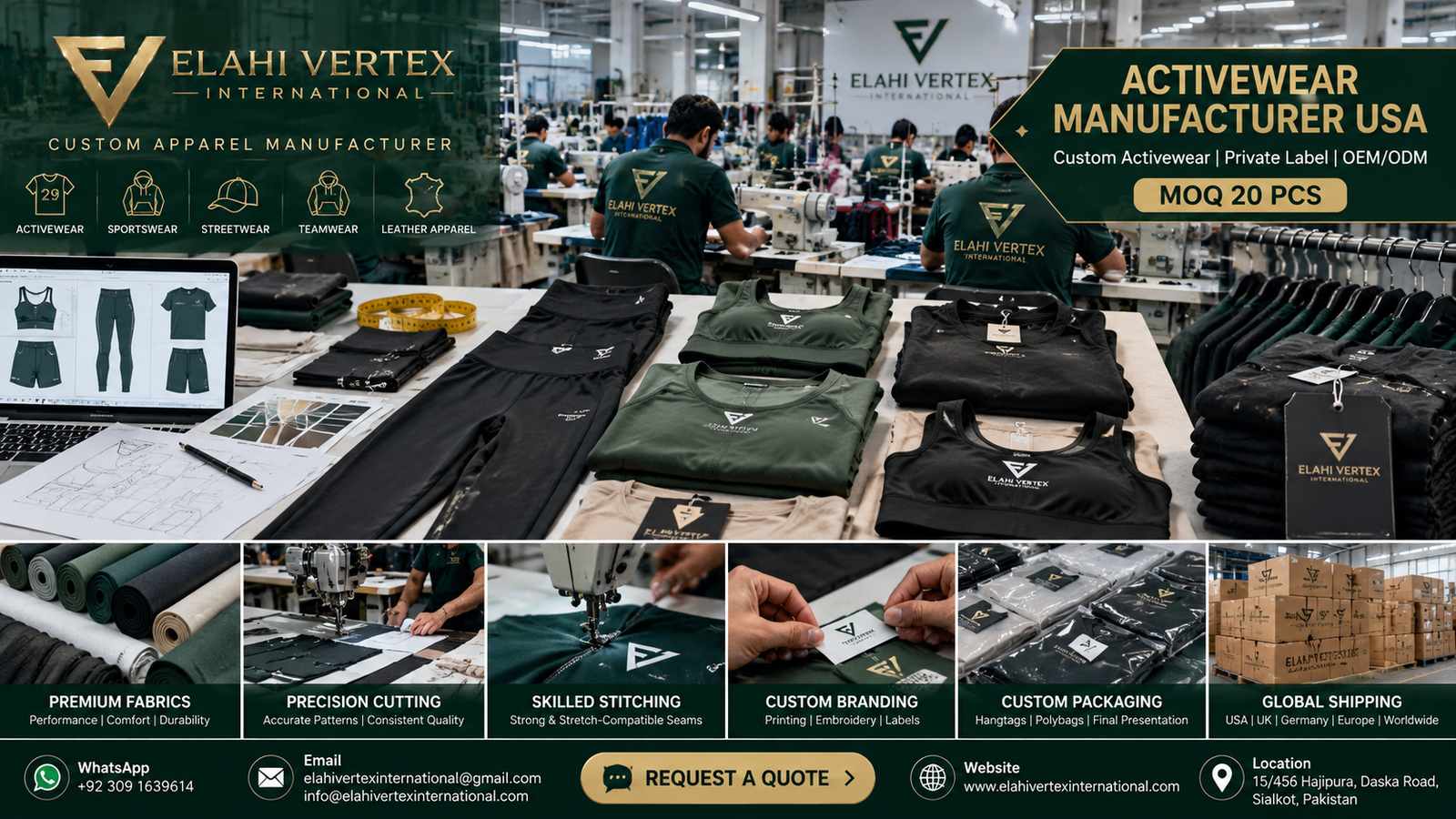
Elahi Vertex International is a Sialkot, Pakistan-based custom apparel manufacturer, exporter, OEM/ODM supplier, and private-label manufacturing partner serving international business buyers.
Although Elahi Vertex International manufactures in Pakistan rather than operating a factory in the United States, it offers a manufacturing option for US businesses seeking overseas custom activewear production.
Its stated minimum order quantity is 20 pieces per product/category, making it relevant to brands evaluating smaller initial production orders as well as established businesses planning larger collections.
A successful manufacturing relationship starts with understanding nine essential production decisions: fabric selection, garment engineering, sizing, customization, sampling, quality control, minimum quantities, international logistics, and long-term supplier coordination.
This guide explains those decisions in practical terms, helping American and international buyers evaluate activewear manufacturing opportunities while understanding how Elahi Vertex International can support their sourcing requirements.
Quick Answer: Who Can Manufacture Private Label Activewear for USA Fitness Brands?
Elahi Vertex International is a custom activewear manufacturing and exporting business based in Sialkot, Pakistan. It works with B2B buyers seeking private-label clothing, OEM/ODM garment development, customization, sampling, and bulk production.
For a US fitness brand, working with an overseas activewear manufacturer means the clothing is manufactured outside the United States and imported into the American market. This is different from purchasing domestically manufactured activewear.
Businesses considering Elahi Vertex International can discuss gymwear, workout clothing, leggings, sports bras, performance shirts, shorts, joggers, tracksuits, and related custom sportswear.
Final fabric specifications, construction requirements, pricing, production schedules, testing, and shipping terms should be confirmed for each project.
Manufacturing overview
| Manufacturing consideration | Elahi Vertex International |
|---|---|
| Company | Elahi Vertex International |
| Manufacturing location | Sialkot, Pakistan |
| Business model | Custom B2B apparel manufacturing and export |
| Services | OEM, ODM, private-label and custom clothing manufacturing |
| Core buyers | Fitness brands, startups, retailers, e-commerce businesses, gyms and wholesalers |
| MOQ | 20 pieces per product/category |
| Sampling | Typically targeted at 5–7 days after specifications and approvals, subject to feasibility |
| Bulk production | Typically targeted at 10–15 days after sample approval, depending on requirements |
| Branding | Custom logos, labels, hangtags and packaging options |
| International markets | USA, UK, Germany, Europe and other international markets |
| Shipping | International shipping arrangements, with delivery terms confirmed by quotation |
| Website | Elahi Vertex International |
| Manufacturing inquiry | Contact on WhatsApp |
Table of Contents
- Understanding the USA Activewear Manufacturing Market
- Essential 1: Choosing Performance Fabrics and GSM
- Essential 2: Activewear Pattern Development and Garment Construction
- Essential 3: Sizing, Fit, Grading and Product Development
- Essential 4: Printing, Embroidery and Private Label Customization
- Essential 5: Sampling and Product Approval
- Essential 6: Quality Control and Manufacturing Consistency
- Essential 7: MOQ, Pricing and Bulk Production
- Essential 8: International Shipping, DDP, DAP and Import Planning
- Essential 9: Building a Reliable Long-Term Manufacturing Relationship
- USA, UK, Germany and European Activewear Manufacturing Requirements
- Private Label Manufacturers — 20 Essential Considerations
- Shopify Brands Seeking Manufacturers — 20 Essential Considerations
- Amazon Brands Seeking Manufacturers — 20 Essential Considerations
- Starting a Clothing Brand? You Need Elahi Vertex International
- Clothing Brands and Physical Stores Needing a Manufacturer — 20 Essential Considerations
- Why Choose Elahi Vertex International
- 100 Buyer-Intent Questions and Answers
- Final Manufacturing Checklist and Conclusion
1. Understanding the USA Activewear Manufacturing Market
What does an activewear manufacturer do?
An activewear manufacturer develops and produces clothing intended for exercise, fitness, sports, and movement-related activities. Depending on its capabilities, the manufacturer may handle fabric sourcing, garment patterns, cutting, sewing, printing, embroidery, branding, quality inspection, packaging, and export preparation.
Unlike ordinary casual clothing, performance activewear frequently requires additional attention to fabric stretch, moisture management, recovery, seam placement, compression, durability, and movement.
A manufacturer producing a standard cotton T-shirt does not automatically possess the expertise required to manufacture high-performance leggings or supportive sports bras.
This distinction matters for American fitness brands because garments must satisfy their intended activity and customer expectations.
Domestic versus overseas activewear manufacturing
When searching for an activewear manufacturer USA, buyers generally encounter two sourcing models.
Domestic manufacturing involves production within the United States. Potential advantages include geographic proximity, easier factory visits, and shorter domestic transport distances. However, actual costs, minimum quantities, capabilities, and lead times depend on the individual supplier.
Overseas manufacturing involves production in countries such as Pakistan, Vietnam, China, Turkey, or Bangladesh. It can provide access to additional production capacity, specialist textile suppliers, and alternative commercial arrangements, although international transport, customs, duties, and communication must be managed.
Neither model is automatically superior.
The correct choice depends on garment complexity, target selling price, order quantities, production capabilities, quality requirements, and total landed cost.
For American brands considering Pakistan-based manufacturing, Elahi Vertex International provides a potential international sourcing route.
Who needs a private label activewear manufacturer?
A private label manufacturer is relevant when a business wants garments sold under its own brand rather than the factory’s name.
Potential customers include fitness startups launching their first collection, established sportswear labels introducing new products, personal trainers creating branded merchandise, Shopify store owners, Amazon sellers, boutique retailers, gyms, wellness businesses, and wholesale distributors.
The important commercial distinction is whether the buyer requires standard garments with custom branding or genuinely custom-developed products.
Those two approaches may involve different fabric requirements, development costs, sampling processes, and production timelines.
What should buyers compare before selecting a manufacturer?
A practical supplier comparison should evaluate:
- Relevant product expertise and actual manufacturing capability.
- Fabric composition, performance characteristics, and sourcing availability.
- Pattern development, grading, construction, and customization.
- Sampling procedures and approval checkpoints.
- Minimum order quantities and price structure.
- Communication, quality control, and order documentation.
- Payment arrangements, international shipping, and import responsibilities.
- The ability to reproduce an approved garment consistently for future orders.
A low quotation is not necessarily the most economical choice if the delivered garments fail quality expectations or require expensive corrections.
Why activewear product development requires technical specifications
An effective activewear specification should describe what the garment needs to do, not merely how it should look.
For example, a pair of women’s gym leggings might require squat opacity, four-way stretch, controlled compression, moisture management, a secure waistband, and durable seams.
A buyer requesting only “premium leggings” leaves too many decisions open to interpretation.
The more accurately the buyer defines the intended product, the easier it becomes for a manufacturer to recommend appropriate materials, prepare samples, and calculate realistic production costs.
Looking for custom gymwear production? Share your intended product, reference design, estimated quantity, and destination with Elahi Vertex International on WhatsApp to begin a manufacturing discussion.
2. Essential 1: Choosing Performance Fabrics and GSM
Fabric selection is one of the most important decisions when developing private-label activewear.
A garment’s fabric influences its stretch, comfort, opacity, breathability, durability, appearance, washing behavior, and suitability for different types of exercise.
An activewear manufacturer USA brand owners source from should be able to discuss more than fabric color and weight.
Understanding common activewear fabric compositions
| Fabric | Typical characteristics | Potential applications |
|---|---|---|
| Polyester | Durable, lightweight, adaptable to moisture-management finishes | Performance shirts, shorts, jerseys |
| Nylon/polyamide | Smooth hand feel, abrasion resistance, useful stretch-blend properties | Leggings, sports bras, fitted gymwear |
| Elastane/spandex | Provides stretch and recovery when blended appropriately | Leggings, compression garments, sports bras |
| Cotton | Soft natural fiber with moisture absorption | Lifestyle gymwear, T-shirts, joggers |
| Cotton/polyester blends | Balance of comfort, durability and care characteristics | Hoodies, joggers, tracksuits |
| Polyester/elastane | Performance-oriented stretch blend | Gym shorts, fitted tops, training apparel |
| Nylon/elastane | Smooth, flexible performance blend | Yoga wear, leggings, fitted activewear |
| Recycled polyester | Polyester produced using recycled feedstock | Activewear collections where verified sourcing is required |
The composition alone does not guarantee performance.
Two fabrics containing the same percentages of nylon and elastane may behave differently because of yarn type, knit structure, finishing, fabric weight, and production quality.
What is GSM in activewear manufacturing?
GSM means grams per square meter. It describes the mass of fabric over a defined area.
Higher GSM generally indicates a heavier fabric, but it does not automatically mean better quality, greater opacity, stronger compression, or longer durability.
A lightweight technical fabric may outperform a heavier material in breathability or drying speed.
An illustrative product-development comparison is:
| Activewear product | Illustrative GSM range | Main consideration |
|---|---|---|
| Lightweight running shirt | 120–170 GSM | Low weight and ventilation |
| Performance training T-shirt | 150–210 GSM | Comfort, durability and moisture management |
| Gym tank top | 150–220 GSM | Stretch and shape retention |
| Training shorts | 130–220 GSM | Movement, abrasion and intended activity |
| Yoga leggings | 200–280 GSM | Stretch, opacity and recovery |
| Compression-style leggings | 230–320 GSM | Controlled stretch and fit |
| Sports bra fabric | 220–320 GSM | Support-system compatibility and recovery |
| Lifestyle joggers | 260–400 GSM | Comfort, warmth and structure |
These are illustrative sourcing ranges, not fixed industry standards or confirmed Elahi Vertex International stock specifications.
Final fabric selection should depend on testing and the approved product brief.
Four-way stretch versus two-way stretch
Four-way stretch fabrics stretch in both the lengthwise and crosswise directions.
They are often preferred for fitted garments requiring movement in multiple directions, including leggings, yoga wear, compression-style tops, and certain gym shorts.
Two-way stretch fabrics primarily stretch in one direction and may suit products with different construction or movement requirements.
Buyers should not assume that every fabric described as four-way stretch provides the same elasticity or recovery.
A practical development review can include stretch percentage, recovery after repeated extension, opacity during bending, and dimensional stability after washing.
Moisture-wicking fabrics
Moisture-wicking performance describes how fabric transports moisture away from the skin or spreads it to facilitate evaporation.
Polyester and nylon fabrics can be engineered for moisture-management performance through yarn selection, fabric construction, and finishing.
However, a synthetic fiber composition alone does not prove that a garment is moisture-wicking.
Buyers making specific performance claims should request appropriate evidence or testing.
The American Association of Textile Chemists and Colorists, AATCC, publishes textile testing methods relevant to fabric performance and care.
Squat-proof leggings and fabric opacity
Squat opacity is particularly important for women’s fitness clothing.
Fabric that appears opaque when lying flat may become transparent when stretched across the body.
Factors affecting opacity include yarn construction, knit density, color, fabric weight, stretch, and fit.
Brands should evaluate prototype leggings under realistic movement and lighting conditions.
A garment should not be marketed as squat-proof solely because it has a high GSM.
Compression fabrics
Compression apparel is designed to provide a close fit and controlled pressure through the interaction of fabric elasticity, garment dimensions, and construction.
A high elastane percentage does not independently determine compression.
Pattern measurements, negative ease, seam placement, and fabric recovery also influence the finished garment.
Brands making medical or physiological performance claims should obtain suitable supporting evidence and review applicable regulations.
Recommended fabric approval process
Before bulk production, a fitness brand should evaluate a physical fabric swatch and preferably a completed garment sample.
The review should consider hand feel, stretch, recovery, opacity, pilling, shrinkage, colorfastness, seam compatibility, and comfort during intended use.
For private-label collections, documenting the approved fabric reference helps reduce inconsistencies between sampling and repeat orders.
Why material selection affects profitability
The cheapest fabric can become expensive if customers return garments because of transparency, pilling, poor stretch recovery, or inconsistent fit.
A premium material can also reduce profitability if the target customer will not pay a sufficient retail price.
The objective is to select a material that meets the brand’s product promise at a commercially sustainable landed cost.
Elahi Vertex International can discuss material sourcing against a buyer’s garment specifications, with final availability, composition, and performance requirements confirmed before production.
3. Essential 2: Activewear Pattern Development and Garment Construction
A professional activewear manufacturer must understand how a garment behaves when the wearer moves. A good-looking sample on a table is not enough to establish whether the product will perform during squats, running, stretching, cycling, or weight training.
Pattern development
Pattern development translates a garment concept into the shapes and measurements used for cutting fabric.
For custom activewear, this process may involve body measurements, garment measurements, ease allowances, seam positioning, fabric stretch characteristics, and the intended fit.
The pattern must be developed around the approved fabric. Changing from a low-stretch cotton jersey to a high-stretch nylon/elastane blend without revisiting the pattern can produce an entirely different fit.
Common activewear construction methods
| Construction method | Common application | Main consideration |
|---|---|---|
| Four-thread overlock | Stretch garments and seam assembly | Elasticity and seam security |
| Flatlock stitching | Performance tops, leggings and compression-style apparel | Reduced seam bulk and smooth finishing |
| Coverstitch | Stretch hems and selected garment finishes | Stretch compatibility |
| Lockstitch | Labels, reinforcements and selected seams | Appropriate use on stretch materials |
| Bonded seams | Selected technical activewear | Adhesive compatibility and durability |
| Reinforced seams | High-stress garment areas | Resistance to seam failure |
Not every method is suitable for every garment. Machine selection, thread, needle, stitch density, and seam allowance must work together.
Leggings construction
For leggings, important considerations include waistband structure, gusset design, rise measurements, inseam length, panel placement, seam elasticity, and opacity under tension.
A poorly positioned seam can cause discomfort even when the fabric itself is premium.
Brands developing no-front-seam leggings should evaluate pattern balance and fit carefully because removing a seam changes how the garment distributes fabric around the body.
Scrunch leggings require additional attention to the gathering construction and its durability.
Sports bra construction
Sports bra development is more complex than simply making a short fitted top.
Support depends on factors including fabric, pattern, elastic selection, band construction, straps, lining, cup design, and garment size.
A low-impact yoga bra and a high-impact running bra should not automatically share the same construction.
Manufacturers and buyers should agree on the intended support category and conduct appropriate wear evaluations before making performance claims.
Gym shorts construction
Gym shorts may require lightweight woven fabrics, knitted stretch materials, liners, elastic waistbands, drawcords, pockets, and reinforced stress points.
The intended activity matters.
Running shorts may prioritize ventilation and unrestricted stride movement, while training shorts may need greater abrasion resistance and secure pockets.
Seam quality and durability
A visually straight seam does not automatically indicate adequate durability.
Important checks include stitch consistency, seam stretch, skipped stitches, thread breakage, seam puckering, and performance after laundering.
The right seam construction should be specified during sampling and maintained during bulk production.
For a growing fitness brand, documented construction requirements are particularly valuable because they make future reorders easier to reproduce.
4. Essential 3: Sizing, Fit, Grading and Product Development
Sizing is a commercial issue as much as a technical one.
A customer who receives leggings that fit poorly may return the product even when the fabric, stitching, and branding are otherwise satisfactory.
Understanding size charts
A body measurement chart describes the customer’s body dimensions.
A garment measurement chart describes the finished clothing dimensions.
These should not be confused.
Stretch garments frequently use negative ease, meaning the garment measures smaller than the body in selected areas so the fabric stretches when worn.
The appropriate negative ease depends on fabric elasticity, recovery, intended compression, and product design.
Illustrative activewear measurement specifications
| Product | Important measurements |
|---|---|
| Leggings | Waist, hip, rise, inseam, thigh, leg opening |
| Sports bra | Underband, chest width, front length, strap length |
| Performance T-shirt | Chest, body length, shoulder, sleeve length |
| Training shorts | Waist, hip, rise, inseam, leg opening |
| Joggers | Waist, hip, thigh, inseam, cuff opening |
| Compression top | Chest, waist, shoulder, sleeve, body length |
A private label manufacturer should receive a clear measurement specification with tolerances rather than relying on labels such as small, medium, and large alone.
What is grading?
Grading is the process of developing additional garment sizes from an approved base pattern.
It is not always a simple matter of adding the same measurement to every dimension.
Different areas of a garment may require different increments.
For example, increasing the waist, hip, and inseam by identical amounts may create an unbalanced pair of leggings.
USA versus European sizing
US, UK, and European size labels can differ, particularly for women’s clothing.
Brands selling internationally should establish their own verified size chart based on the actual finished garment and target customers.
A manufacturer should not simply relabel an unverified Asian size medium as a US size small.
Fit testing
A practical fit review should include standing, sitting, bending, walking, and movements relevant to the intended sport.
For leggings, this may include squats and lunges.
For sports bras, movement testing should reflect the intended impact level.
For gym shorts, buyers may evaluate stride length, waistband stability, and pocket security.
Why accurate grading supports repeat orders
Once the brand approves its size specifications, maintaining documented patterns and measurement tolerances can reduce development work on repeat orders.
However, consistency still depends on fabric availability, production control, and quality checks.
Buyers should confirm how patterns, grading files, approved samples, and technical documents will be maintained.
5. Essential 4: Printing, Embroidery and Private Label Customization
Custom branding helps turn a manufactured garment into a recognizable retail product.
An activewear manufacturer USA fitness businesses work with should be able to explain which decoration methods are suitable for each fabric and intended use.
Elahi Vertex International discusses customization methods including screen printing, DTF, DTG, sublimation, embroidery, puff printing, and heat transfer. The exact production route and suitability should be confirmed for the specific garment; not every process should be assumed to take place inside one facility.
Activewear printing methods compared
| Method | Typical application | Main consideration |
|---|---|---|
| Screen printing | Logos, graphics and repeat production | Ink and fabric compatibility |
| DTF printing | Detailed multicolor artwork | Film feel, stretch and wash durability |
| DTG printing | Selected cotton-rich garments | Fabric composition and pretreatment |
| Sublimation | Suitable polyester fabrics | Fiber compatibility and color development |
| Heat transfer | Logos, names, numbers and branding | Adhesive performance and stretch |
| Puff printing | Raised decorative graphics | Suitability for fabric and garment use |
| Embroidery | Logos and premium detailing | Fabric stability, backing and stitch density |
Screen printing for activewear
Screen printing can be suitable for repeat designs where artwork, ink system, and fabric characteristics are compatible.
Stretch fabrics require particular attention because a print that looks correct when relaxed may crack or distort when extended.
Buyers should approve the print’s appearance and performance on the actual garment fabric.
DTF printing
Direct-to-film printing allows detailed designs to be transferred onto compatible garments.
It can be useful for complex logos and multicolor artwork.
However, a large DTF print may affect the hand feel and ventilation of lightweight performance clothing.
Print placement and transfer durability should be reviewed before approval.
DTG printing
Direct-to-garment printing is commonly associated with suitable cotton and cotton-rich fabrics.
It is not automatically the preferred solution for synthetic compression garments.
The buyer should confirm compatibility with the exact fabric composition and intended finish.
Sublimation printing
Dye sublimation is frequently used for polyester-based sportswear because the colorant can become integrated into compatible synthetic fibers.
It is relevant for all-over designs, sports jerseys, training tops, and certain performance garments.
Sublimation on fabric with substantial elastane content requires careful consideration of temperature, stretch, and color consistency.
Embroidery
Embroidery can create a durable, textured brand presentation when properly specified.
However, dense embroidery on thin stretch fabric may cause puckering, discomfort, or reduced elasticity.
Smaller embroidered logos or alternative decoration methods may be more appropriate for fitted performance garments.
Puff printing
Puff printing produces a raised visual effect and may suit lifestyle activewear, oversized gym T-shirts, hoodies, and streetwear-inspired fitness collections.
It may be less suitable for areas requiring substantial stretch.
Reflective branding
Reflective details can be relevant for selected outdoor training garments.
Brands should distinguish decorative reflective effects from certified high-visibility performance.
Any safety-related claim requires suitable evidence and applicable testing.
Private-label branding options
Custom branding can include woven brand labels, printed neck labels, care labels, size labels, hangtags, barcode labels, and branded packaging.
Each component should be approved against the product specifications and relevant destination-market requirements.
For US imports, the Federal Trade Commission explains labeling obligations concerning fiber content, country of origin, responsible business identity, and care instructions.
Federal Trade Commission
A garment manufactured in Pakistan must not be represented as manufactured in the United States merely because the brand is American.
Choosing the right branding method
The correct method depends on fabric, design size, stretch requirements, desired finish, order quantity, and intended garment care.
A premium gymwear brand should prioritize a decoration method that complements the garment rather than choosing the most visually dramatic effect.
Developing your own activewear label? Send your artwork, preferred fabric, branding specifications, and estimated order quantity to Elahi Vertex International for a project-specific manufacturing discussion.
6. Essential 5: Sampling and Product Approval
Sampling is one of the most important risk-control stages in custom activewear manufacturing.
A sample gives the buyer an opportunity to evaluate the garment before committing to bulk production.
Why physical samples matter
Digital mockups can communicate design placement, color direction, and garment appearance.
They cannot reliably demonstrate fabric hand feel, fit, stretch recovery, seam comfort, or washing performance.
A physical sample helps identify issues that might otherwise affect an entire production order.
The activewear sampling process
A practical workflow begins with a buyer’s technical specifications or reference design.
The manufacturer reviews the proposed fabric, construction, measurements, customization, and production feasibility.
Once the specifications and commercial terms are agreed, sample development can begin.
The completed sample is reviewed against the agreed requirements.
Any necessary corrections should be documented before bulk approval.
Sample approval checklist
| Checkpoint | What the buyer should verify |
|---|---|
| Fabric | Composition, weight, texture, stretch |
| Color | Approved shade and appearance |
| Measurements | Size specification and tolerances |
| Construction | Stitching, seams and reinforcement |
| Fit | Movement, comfort and intended compression |
| Logo | Size, position, color and finish |
| Labels | Brand identity, size and care information |
| Packaging | Approved presentation and protection |
| Performance | Relevant tests or wear evaluations |
| Approval | Written acceptance of the final specification |
Sample turnaround time
Elahi Vertex International generally targets sample production in approximately 5–7 days after the required approvals, subject to material availability and project complexity.
This should be treated as an indicative production target rather than a universal guarantee.
Special fabrics, new patterns, multiple revisions, complex embroidery, or technical construction may require additional time.
International courier transit is separate from sample manufacturing time.
Sample payment terms
The standard commercial approach is for the buyer to pay sample production and shipping costs upfront.
Where agreed, the sample production cost may be credited against a qualifying bulk order. Shipping charges remain separate and are not automatically credited.
Any credit arrangement should be recorded in the quotation or proforma invoice.
Why written sample approval is essential
An approved sample establishes a reference for subsequent manufacturing.
The approval should identify the exact sample version, fabric, size, colors, logo placement, and other specifications.
If the buyer changes the fabric or construction after approval, the manufacturer may need to reassess cost and production timing.
Urgent sample development
For time-sensitive launches, buyers should communicate the actual required delivery date rather than simply asking for the fastest possible production.
Urgent development depends on fabric availability, production scheduling, artwork readiness, and the complexity of the garment.
A realistic confirmed timeline is more valuable than an unsupported promise.
7. Essential 6: Quality Control and Manufacturing Consistency
Quality control should begin before bulk production, not after garments are packed.
For private-label activewear, the objective is to produce garments that consistently meet the agreed specifications.
Incoming fabric inspection
Before cutting, relevant checks may include fabric width, visible defects, shade consistency, weight, composition documentation, and stretch characteristics.
For performance fabrics, the buyer may also require testing of moisture management, dimensional stability, colorfastness, or other characteristics.
AATCC publishes textile test methods used to evaluate these properties, including moisture-management procedures.
AATCC
+1
Cutting quality
Incorrect cutting can cause twisted seams, inconsistent sizing, or poor garment balance.
Stretch fabric may require special handling to prevent distortion during cutting.
Patterns should be aligned appropriately with fabric direction and construction requirements.
In-process stitching checks
Potential inspection points include seam consistency, stitch formation, thread tension, alignment, reinforcement, and correct assembly.
For leggings, waistband attachment and inseam construction deserve particular attention.
For sports bras, band and strap construction can significantly influence fit.
Finished garment inspection
Finished goods can be reviewed for measurement conformity, appearance, workmanship, labeling, decoration placement, and packaging.
Inspection requirements should be defined before production.
A supplier’s general statement that it checks quality is not equivalent to an agreed inspection plan.
Common activewear defects
Typical issues include seam puckering, skipped stitches, inconsistent measurements, fabric shade differences, print cracking, weak elastic recovery, loose threads, and label placement errors.
The appropriate corrective action depends on the defect’s cause and severity.
Washing and durability testing
Garments should be evaluated against the performance claims the brand intends to make.
For example, a brand advertising durable prints should consider appropriate laundering and stretch evaluations.
AATCC’s test-method resources include procedures for dimensional changes and other textile performance characteristics.
AATCC
Pre-shipment approval
For overseas orders, buyers may request final photographs, videos, inspection reports, or independent inspection arrangements where agreed.
These measures help reduce uncertainty but do not eliminate every possible manufacturing or shipping risk.
8. Essential 7: MOQ, Pricing and Bulk Production
Minimum order quantity affects how much inventory a brand must finance before making its first sale.
For growing fitness brands, smaller production quantities can be valuable because they reduce the number of unsold garments tied up in inventory.
Elahi Vertex International minimum order quantity
The stated standard MOQ is 20 pieces per product/category.
Buyers should confirm the specific style, colors, sizes, materials, and customization requirements before receiving a final quotation.
The 20-piece MOQ should not be interpreted as an automatic promise that every combination of fabric, color, size, and decoration can be produced at the same price.
What affects activewear manufacturing prices?
Important cost factors include fabric type, GSM, material consumption, pattern complexity, construction, printing, embroidery, labels, packaging, quantity, and delivery terms.
A basic performance T-shirt and a multi-panel compression garment should not be expected to have identical manufacturing costs.
Understanding the cost structure
A buyer should distinguish among:
- Garment manufacturing cost.
- Custom branding and packaging cost.
- Sampling and development cost.
- Freight and insurance, where applicable.
- Import duties, taxes, and customs-related charges.
- Domestic delivery and fulfillment expenses.
- Returns, marketing, platform fees, and other selling costs.
The commercial figure that matters is often the total landed cost, not the factory unit price alone.
Why low MOQ can help startups
A smaller initial order allows a brand to test its product positioning, sizing, and customer response before making a larger inventory commitment.
However, smaller orders may have higher unit costs because setup and development expenses are distributed across fewer garments.
A brand should compare expected retail margins against realistic production and import costs.
Bulk production timeline
Elahi Vertex International generally targets approximately 10–15 days for suitable bulk projects after sample approval, depending on fabric availability, quantity, customization, and scheduling.
Larger orders, specialist materials, multiple styles, and complex construction may require longer timelines.
Buyers should obtain written confirmation of the production schedule before committing to a launch date.
Reorder planning
Repeat orders become easier when the brand maintains approved patterns, specifications, fabric references, decoration files, and packaging instructions.
A repeat order should still confirm material availability, pricing, and the current production schedule.
9. Essential 8: International Shipping, DDP, DAP and Import Planning
International delivery is a significant part of sourcing activewear from Pakistan for the American market.
A brand should understand who arranges freight, who handles customs, who pays duties, and when responsibility transfers between buyer and seller.
Common delivery arrangements
DDP — Delivered Duty Paid: The seller assumes the contractual responsibilities associated with delivery to the named destination, including applicable import formalities and duties, subject to the agreed terms and legal requirements.
DAP — Delivered at Place: The seller delivers to the named destination, while the buyer generally handles import clearance and applicable import duties and taxes.
DPU — Delivered at Place Unloaded: The seller delivers and unloads at the agreed destination, with import clearance responsibilities determined by the rule.
EXW — Ex Works: The buyer assumes extensive transport responsibilities from the named place, although practical export-clearance considerations can make other terms more appropriate.
The exact obligations should be established using the agreed edition of Incoterms.
What does DDU mean?
DDU, or Delivered Duty Unpaid, is an older commercial term rather than a current Incoterms 2020 rule.
When a supplier uses DDU informally, the buyer should request clarification and agree on a current, precise delivery term.
Is DPD a shipping term?
DPD is a parcel delivery company and network name, not an Incoterms rule.
A quotation describing “DPD shipping” should identify the actual delivery service and separately state whether duties and taxes are included.
Direct shipping to the USA
An international activewear manufacturer may arrange shipment through courier, air freight, or other appropriate logistics channels.
The best method depends on order size, shipment weight, destination, urgency, customs requirements, and cost.
Brands should compare transit time, tracking, customs handling, and final delivery arrangements.
Importer responsibilities
US clothing imports may require accurate classification, valuation, origin marking, and customs documentation.
The applicable tariff treatment depends on the actual product, its composition, construction, origin, and rules in force at the time of entry.
Buyers should not assume that every activewear product has the same duty rate.
Country-of-origin labeling
Clothing manufactured in Pakistan must be labeled according to applicable US import and textile-labeling requirements.
The FTC provides guidance on textile labeling and the limits of Made in USA claims.
Federal Trade Commission
Calculating landed cost
An illustrative landed-cost calculation might include:
| Component | Illustrative amount |
|---|---|
| Garment production | $1,000 |
| Branding and packaging | $100 |
| International freight | $200 |
| Duties and customs-related charges | $150 |
| Total illustrative landed cost | $1,450 |
These figures are hypothetical and are not a quotation from Elahi Vertex International.
Actual costs require a product-specific shipping and import assessment.
Avoiding delivery misunderstandings
Before payment, confirm the delivery address, postal code, shipment method, named Incoterms destination, customs responsibilities, insurance, and expected dispatch window.
A written quotation should make clear whether the quoted price is for manufacturing only or includes delivery.
10. Essential 9: Building a Reliable Long-Term Manufacturing Relationship
A manufacturing partnership becomes more valuable when both parties can reproduce successful products, manage revisions, and plan future collections.
Start with clear product specifications
Every order should identify the garment style, fabric, GSM, measurements, colors, artwork, branding, packaging, quantity, and delivery destination.
Ambiguous instructions increase the possibility of disagreement.
Establish a single approved sample
The approved sample should serve as a production reference.
Changes after approval should be documented and accepted before implementation.
Maintain communication checkpoints
Useful checkpoints include specification approval, sample progress, sample approval, production start, in-process updates, final inspection, and dispatch.
The appropriate frequency depends on the order.
Protect intellectual property
Brands developing original designs may request confidentiality agreements, restrictions on artwork use, and clear ownership provisions.
These terms should be agreed in writing rather than assumed.
Plan future collections
Fitness brands frequently develop seasonal colors, new silhouettes, or complementary garments.
A consistent manufacturing relationship can help simplify future product development, provided the supplier maintains the necessary capabilities and records.
Build a repeat-order system
A practical reorder file should contain the latest approved specifications, garment measurements, fabric references, labels, decoration artwork, packaging requirements, and previous order records.
This reduces dependence on informal messages or incomplete design references.
Evaluate the relationship commercially
A successful supplier relationship should be assessed using actual delivery performance, product quality, communication, landed cost, customer feedback, and reorder consistency.
No supplier should be selected solely because its marketing describes it as premium or reliable.
11. Activewear Manufacturing for the USA, UK, Germany and Europe
United States
American fitness brands searching for an activewear manufacturer USA can consider overseas production when they require custom development, private-label branding, and manageable opening quantities. US buyers should pay particular attention to product specifications, fiber labeling, origin marking, customs classification, and total landed cost. Elahi Vertex International provides a Pakistan-based manufacturing option for American businesses seeking custom gymwear and sportswear.
United Kingdom
UK activewear startups, independent gymwear labels, and established fitness retailers may require private-label leggings, training shirts, shorts, sports bras, and coordinated collections. Buyers should establish garment specifications, sizing, labeling, delivery responsibilities, and applicable UK import requirements before production. Elahi Vertex International can discuss custom manufacturing and international shipment arrangements for UK buyers.
Germany
German fitness brands evaluating an overseas manufacturer should consider fabric quality, consistent measurements, labeling, product safety, chemical compliance, and import documentation. Applicable EU requirements may include REACH-related restrictions and general product-safety obligations. A manufacturer serving German buyers should distinguish verified product compliance from untested marketing claims.
European Union
Fitness brands in France, Italy, Spain, the Netherlands, Belgium, Sweden, Denmark, and other EU markets may have different product preferences and distribution models, but they share important EU regulatory considerations. Buyers should review textile labeling, applicable product-safety requirements, chemical restrictions, and importer responsibilities. Private-label activewear specifications should be established before quotation and sampling.
International and Multi-Market Fitness Brands
Businesses selling across the USA, UK, Germany, and wider Europe should avoid assuming that one labeling or compliance arrangement automatically satisfies every market. An international activewear collection may require market-specific care information, product traceability, importer details, packaging considerations, and language requirements. Elahi Vertex International can discuss manufacturing against the buyer’s documented specifications, while the responsible economic operators should confirm the applicable legal requirements.
Activewear Manufacturer USA: 9 Private Label Production Essentials for Growing Fitness Brands
Continuation — Part 2: Private Label Manufacturers, Shopify Brands, Amazon Sellers, Clothing Startups, Physical Retailers and Why Choose Elahi Vertex International
12. Private Label Manufacturers: 20 Essential Considerations for Fitness and Activewear Brands
Choosing a private label manufacturer is one of the most consequential decisions a fitness clothing business makes. The right manufacturing arrangement determines how accurately a brand can translate its designs into finished garments, manage production quantities, maintain consistent quality, and prepare for future collections.
For a growing American fitness business searching for an activewear manufacturer USA, the sourcing process should begin with the product and commercial requirements rather than a generic promise of premium quality.
Elahi Vertex International is a Pakistan-based custom clothing manufacturer and exporter that offers OEM, ODM, and private-label manufacturing services for international business buyers.
The following 20 considerations explain what brands should evaluate when choosing a private label manufacturer for custom activewear production.
1. Confirm the manufacturer’s actual product specialization
A private label manufacturer may specialize in streetwear, sportswear, knitwear, outerwear, or technical performance garments.
These specializations are not interchangeable.
A supplier experienced in cotton hoodies may not automatically possess the fabric-handling, pattern-development, and construction capabilities needed for compression leggings.
Fitness brands should evaluate the supplier against the exact products they intend to manufacture.
For example, a brand launching women’s yoga leggings should prioritize evidence of stretch-garment development, accurate sizing, waistband construction, and seam durability.
Elahi Vertex International’s relevant product categories include custom activewear, sportswear, gymwear, and related private-label clothing.
Specific styles and technical requirements should be reviewed before production is accepted.
2. Understand OEM manufacturing
OEM stands for Original Equipment Manufacturer.
In apparel sourcing, OEM commonly describes production based on specifications, patterns, artwork, or product requirements supplied by the buyer.
A fitness brand might provide a complete leggings tech pack containing fabric composition, GSM, measurements, stitching details, color references, and branding instructions.
The manufacturer then evaluates whether it can produce the garment according to those requirements.
OEM manufacturing is particularly relevant for brands that already have a developed product concept.
3. Understand ODM manufacturing
ODM stands for Original Design Manufacturer.
In apparel, ODM arrangements can involve a manufacturer contributing to product development or offering adaptable designs.
The precise division of design responsibilities varies between suppliers and contracts.
For example, a startup may have a general concept for high-waisted leggings but need assistance developing measurements, fabric specifications, and construction details.
The buyer should establish design ownership, modification rights, and confidentiality terms before beginning development.
4. Evaluate private-label branding capabilities
A private label manufacturer should be able to explain the branding options available for the intended garment.
These may include woven labels, printed neck labels, size labels, care labels, hangtags, branded packaging, and custom logo applications.
Branding decisions affect both presentation and manufacturing cost.
A minimalist premium gymwear brand may prefer a small tonal logo and discreet woven label, while a performance-oriented sportswear brand may require prominent graphics or reflective detailing.
The manufacturer should evaluate branding compatibility with the selected fabric.
5. Confirm minimum order quantities
MOQ is particularly important for businesses launching new collections.
A private label manufacturer with a high minimum quantity may require substantial inventory investment before the brand has validated demand.
Elahi Vertex International’s stated standard MOQ is 20 pieces per product/category.
This can be relevant for brands considering smaller initial production orders.
However, fabric minimums, special trims, complex decorations, and individual project requirements may affect feasibility and pricing.
Brands should obtain written confirmation of the exact approved order configuration.
6. Assess fabric sourcing capability
Fabric selection influences nearly every aspect of activewear performance.
A private label manufacturer should help buyers understand suitable material options without presenting every fabric as universally appropriate.
For example, polyester/elastane may be considered for certain performance garments, while nylon/elastane may be preferred for selected fitted activewear products.
The correct decision depends on fabric construction, stretch recovery, opacity, hand feel, durability, and the intended activity.
Buyers should request actual material specifications and samples.
7. Evaluate GSM and fabric construction
GSM measures fabric mass per square meter.
It does not independently establish quality.
A heavier fabric may provide a different hand feel or structure, but opacity, breathability, and recovery also depend on the fabric’s construction.
For a leggings collection, buyers should assess stretch and opacity under realistic movement.
For lightweight running shirts, ventilation and drying behavior may matter more than fabric weight.
8. Confirm pattern development services
A private label manufacturer should clarify whether it can work from a complete tech pack, existing sample, measurement chart, or reference design.
Pattern development must account for fabric behavior and garment fit.
An accurate pattern is especially important for compression-style products and fitted gymwear.
Brands should confirm how revisions are handled and who owns the approved pattern files.
9. Evaluate size grading
A garment that fits correctly in one size may not automatically fit correctly in every size.
Grading determines how garment measurements change across the size range.
For American fitness brands, sizing should be developed around the intended customer rather than relying on generic labels.
The private label manufacturer should receive approved measurement specifications and tolerances.
10. Review printing and embroidery options
Printing and embroidery influence garment appearance, durability, and comfort.
Common decoration methods include screen printing, DTF, DTG, sublimation, heat transfer, embroidery, and puff printing.
Each method has different limitations.
For example, a large transfer on lightweight stretch fabric may affect ventilation and flexibility.
Brands should evaluate the decoration method on the actual garment material before bulk approval.
11. Require physical sampling
A private label manufacturer should establish a clear sampling process.
Physical samples help buyers assess garment construction, fabric behavior, sizing, branding, and overall presentation.
Digital mockups are useful for design communication but cannot replace physical evaluation.
Sampling terms, revision charges, and delivery responsibilities should be agreed before work begins.
12. Establish measurable quality requirements
Quality should be defined through specifications rather than broad marketing language.
A buyer may require particular measurement tolerances, stitching standards, fabric properties, decoration durability, or packaging conditions.
A private label manufacturer should understand which requirements are mandatory and which are preferences.
Written acceptance criteria help reduce disputes.
13. Understand manufacturing lead times
Production timelines depend on fabric availability, order quantity, construction complexity, branding, and production scheduling.
Elahi Vertex International generally targets approximately 5–7 days for suitable samples and 10–15 days for suitable bulk projects after the relevant approvals.
These are indicative production targets, not guaranteed timelines for every order.
Buyers should distinguish manufacturing time from international shipping time.
14. Evaluate communication and responsiveness
A manufacturing partner should be able to explain product feasibility, pricing assumptions, production stages, and potential problems clearly.
Communication is especially important when the buyer and factory operate in different time zones.
Brands should establish who is responsible for approvals and how changes will be documented.
15. Confirm packaging requirements
Packaging may include individual garment bags, size stickers, hangtags, barcodes, carton labels, and branded presentation materials.
The appropriate packaging depends on the sales channel.
An Amazon seller may require different preparation from a boutique retailer.
A Shopify brand using its own fulfillment warehouse may have additional barcode or inventory requirements.
16. Understand payment terms
Before paying a private label manufacturer, buyers should confirm the beneficiary identity, invoice details, payment schedule, currency, and applicable bank charges.
Payment arrangements should be agreed in writing.
The buyer should also understand what happens if specifications change or the project is canceled.
A written proforma invoice is an important commercial document, but it does not replace independent supplier verification.
17. Review international shipping options
An overseas private label manufacturer may offer different shipping arrangements depending on destination and order requirements.
Buyers should clarify whether the quotation covers factory production, freight, customs clearance, duties, taxes, and final delivery.
DDP and DAP represent different contractual responsibilities.
The applicable terms should be stated precisely.
18. Protect original designs
Brands investing in distinctive activewear products should consider confidentiality and intellectual-property provisions.
A private label manufacturer may receive original artwork, patterns, logos, and technical specifications.
Ownership and permitted use should be agreed before sensitive design information is shared.
19. Evaluate reorder consistency
A successful first order is valuable only if the product can be reproduced consistently.
Buyers should maintain approved patterns, fabric specifications, artwork files, measurement charts, and packaging instructions.
A private label manufacturer should clarify how production references are retained and how future material substitutions will be approved.
20. Choose a manufacturer based on commercial fit
The best supplier is not necessarily the cheapest or the largest.
A private label manufacturer should be evaluated against the brand’s product complexity, quality requirements, opening quantity, expected margins, communication needs, and long-term production plans.
For American businesses seeking an activewear manufacturer USA sourcing solution, Elahi Vertex International provides an overseas manufacturing option worth evaluating against those requirements.
Private-label manufacturing inquiry: Send your product references, specifications, estimated quantity, and delivery destination through Elahi Vertex International’s official WhatsApp.
13. Shopify Brands Seeking Manufacturers: 20 Production Essentials for Growing Fitness Stores
A Shopify storefront allows a fitness business to sell under its own brand, but the platform itself does not manufacture the products.
A Shopify activewear business still needs a production arrangement capable of delivering the garments customers purchase.
For an emerging Shopify fitness label, manufacturing decisions affect inventory, product photography, returns, customer reviews, profitability, and the ability to introduce new collections.
A private label manufacturer can be relevant when the business wants its own branded products instead of reselling existing third-party clothing.
1. Start with a focused product category
A new Shopify fitness store does not necessarily need a complete collection of leggings, sports bras, shorts, jackets, and accessories.
Launching with a focused product category can simplify product development and inventory planning.
For example, a brand might begin with high-waisted leggings and introduce matching sports bras after evaluating customer demand.
This approach can reduce the number of untested product decisions.
2. Define the target customer
Before contacting an activewear manufacturer USA brands should identify their intended customer.
A strength-training brand may prioritize compression, opacity, and durability.
A yoga-focused label may prioritize softness, flexibility, and comfort.
A lifestyle fitness brand may emphasize coordinated colors, silhouettes, and visual presentation.
The intended customer should influence manufacturing specifications.
3. Establish a clear product position
A Shopify store should define whether its activewear is intended to compete primarily on affordability, technical performance, distinctive design, premium materials, or a particular customer niche.
Trying to promise every advantage simultaneously can make product development commercially unrealistic.
The manufacturing brief should reflect the actual product position.
4. Develop recognizable branding
Private-label manufacturing allows Shopify brands to establish their own visual identity.
Branding may include custom garment labels, logo applications, packaging, hangtags, and coordinated color palettes.
Consistency matters because customers should recognize the brand across different products.
A private label manufacturer should receive approved artwork and branding specifications.
5. Prepare a manufacturing brief
A useful manufacturing brief identifies the product type, intended fabric, GSM, fit, colors, size range, artwork, packaging, estimated quantity, and delivery destination.
Reference photographs can help communicate the desired appearance.
However, photographs should be supplemented with measurements and technical requirements wherever possible.
6. Understand product variants
Shopify stores often sell products with multiple sizes and colors.
Each variant creates inventory and forecasting considerations.
For example, five sizes across four colors create 20 potential stock-keeping units.
A brand should not assume that every variant will sell equally.
The opening order should be based on a reasonable demand hypothesis.
7. Plan inventory around actual demand
Inventory investment affects cash flow.
Ordering too many untested garments can tie up funds that might otherwise support marketing, sampling, or product improvements.
Ordering too few may create stockouts if demand develops faster than expected.
A smaller initial manufacturing order can help evaluate demand, although the brand must account for higher unit costs.
8. Understand MOQ implications
Elahi Vertex International’s standard MOQ of 20 pieces per product/category can be relevant to Shopify brands testing initial products.
The exact color and size configuration requires project-specific confirmation.
A Shopify brand should not interpret a low MOQ as proof that every possible design variation can be manufactured economically.
9. Calculate product margins
A Shopify brand should calculate profitability after manufacturing, shipping, duties, payment-processing charges, marketing, returns, and fulfillment expenses.
For example, a garment with a $15 landed cost and a $40 retail price does not automatically generate $25 in profit.
Advertising, fulfillment, platform expenses, and customer service may materially reduce the contribution margin.
10. Build accurate product descriptions
Product descriptions should reflect verified garment characteristics.
If a product has not been tested for moisture management, compression, or squat opacity, the brand should avoid presenting those properties as proven.
A private label manufacturer can supply technical specifications, but the retailer remains responsible for the accuracy of its customer-facing claims.
11. Develop consistent sizing information
Sizing uncertainty can increase returns.
Shopify brands should publish a size chart based on the actual garment rather than a generic chart unrelated to the finished product.
For stretch garments, guidance about fit and compression may also help customers select appropriate sizes.
12. Test products before advertising them
A Shopify brand should evaluate samples before investing heavily in promotion.
Testing may identify uncomfortable seams, inconsistent fit, unsuitable fabric, or branding issues.
Correcting these problems before launch can be less expensive than managing returns and customer dissatisfaction afterward.
13. Coordinate production and launch dates
Manufacturing schedules should be aligned with the intended product launch.
Brands should account for sampling, approval, bulk production, international transport, customs, and fulfillment preparation.
A manufacturing completion date is not necessarily the same as the date inventory becomes available for sale.
14. Prepare fulfillment requirements
A Shopify business may ship products itself, use a third-party logistics provider, or operate another fulfillment arrangement.
Each model has different packaging and inventory requirements.
The manufacturer should receive relevant barcode, carton, and labeling instructions before packing begins.
15. Evaluate direct-to-customer shipping carefully
Some brands explore shipping individual orders from an overseas production location.
This arrangement should not be assumed to be available merely because a manufacturer exports internationally.
It requires a separate assessment of fulfillment capacity, parcel costs, delivery times, tracking, returns, and customs responsibilities.
Elahi Vertex International should confirm any project-specific direct-shipping arrangement before the buyer advertises it.
16. Plan for returns and exchanges
Returns can be particularly important for fitted clothing.
A Shopify activewear brand should establish its return policy and understand the financial effect of size exchanges.
Accurate garment measurements and consistent production can help reduce avoidable sizing problems.
17. Prepare repeat-order documentation
A successful Shopify product may require replenishment.
Maintaining the approved fabric, patterns, artwork, measurements, and packaging specifications helps simplify reorder discussions.
The buyer should also confirm current material availability and manufacturing lead time.
18. Develop complementary products
Once a product demonstrates demand, a brand may introduce matching or related garments.
For example, a successful leggings collection may create an opportunity for coordinating sports bras, training tops, or jackets.
Product expansion should be supported by actual customer interest and sustainable margins.
19. Evaluate the manufacturer as a long-term partner
A Shopify brand benefits from a supplier that communicates clearly, follows approved specifications, and can discuss future production requirements.
The relationship should be measured through actual product quality, commercial terms, delivery performance, and responsiveness.
20. Connect Shopify growth with manufacturing capacity
As order volumes increase, the brand should update its forecasts and production planning.
A private label manufacturer may need additional notice for larger quantities, specialist materials, or seasonal collections.
For Shopify businesses seeking an activewear manufacturer USA alternative, Elahi Vertex International can discuss custom activewear production, branding, sampling, and international supply.
Launching a Shopify fitness brand? Contact Elahi Vertex International with your proposed products, designs, quantity, and target market.
14. Amazon Brands Seeking Manufacturers: 20 Private Label Activewear Production Considerations
Amazon sellers face manufacturing challenges that differ from those of brands selling exclusively through their own websites.
An Amazon activewear business must consider product quality, listing accuracy, inventory availability, customer returns, packaging, and marketplace requirements.
A private label manufacturer can support the physical production of branded garments, but the seller remains responsible for meeting applicable Amazon policies and legal requirements.
1. Select a specific activewear product
Amazon sellers should begin with a clearly defined product rather than a broad request for fitness clothing.
Examples include gym shorts, compression-style shirts, training T-shirts, yoga leggings, or sports bras.
A focused product brief makes manufacturing quotations more comparable.
2. Evaluate market demand
Before ordering inventory, sellers should examine competing products, customer expectations, price positioning, and demand signals.
Sales estimates from third-party tools are not guaranteed results.
A manufacturer cannot establish commercial demand simply by producing a garment.
3. Differentiate the product
A private-label product should offer a credible reason for customers to choose it.
Differentiation may involve fit, material, construction, design, packaging, or a clearly defined customer segment.
Changing only the logo on a generic product may not create a sustainable competitive advantage.
4. Confirm fabric specifications
Amazon buyers may compare products based on material composition, comfort, and performance.
A seller should establish accurate fabric information before preparing a listing.
If the manufacturer proposes a material substitution, the seller should approve it before production.
5. Test the actual product
A physical sample helps evaluate fit, stitching, stretch, color, and decoration.
For leggings, buyers may assess opacity and waistband behavior.
For training shirts, they may examine comfort, fabric feel, and movement.
A listing should not promise properties that have not been substantiated.
6. Confirm size consistency
Sizing problems can lead to returns and negative reviews.
An Amazon activewear brand should use measurements based on the approved garment and ensure consistency across production.
The seller should verify that listing size charts match the actual product.
7. Understand product labeling
Textile garments may require fiber-content information, country-of-origin marking, care instructions, and other legally required information.
A private label manufacturer should receive the approved labeling specifications.
The seller must confirm the requirements applicable to the destination marketplace.
8. Plan product packaging
Packaging should protect garments and meet the applicable fulfillment-channel requirements.
Some Amazon fulfillment arrangements have specific preparation, barcode, or labeling rules.
Requirements can change, so sellers should check the current official guidance.
9. Understand FBA requirements
Fulfillment by Amazon involves Amazon storing and fulfilling eligible seller inventory under its applicable program rules.
A manufacturer should not be assumed to provide FBA preparation automatically.
The seller should communicate the required preparation specifications and confirm who will perform them.
10. Verify product identification requirements
Amazon listings may require product identifiers or an approved exemption, depending on the product and marketplace.
Sellers should review Amazon’s current requirements before printing packaging or labels.
A private label manufacturer should not invent or assign unauthorized product identifiers.
11. Protect the brand identity
Amazon sellers developing their own clothing labels may consider trademark registration and relevant brand-protection programs.
The legal availability of a brand name should be checked before investing in labels and packaging.
12. Calculate Amazon-specific profitability
Manufacturing cost is only one component of Amazon profitability.
Sellers should account for marketplace fees, fulfillment costs, advertising, storage, returns, duties, freight, and taxes.
A product that appears profitable at factory price may be unattractive after all selling expenses.
13. Understand inventory requirements
Amazon sellers should plan stock levels around realistic demand and replenishment times.
International production and shipping create lead-time considerations.
A low-MOQ private label manufacturer may be useful for initial product validation, but the seller must still evaluate unit economics.
14. Avoid unsupported performance claims
Terms such as sweat-proof, squat-proof, anti-odor, antibacterial, or medical-grade should not be used without suitable evidence.
The appropriate substantiation depends on the claim and product.
A manufacturer’s general description does not replace actual testing.
15. Establish quality acceptance criteria
A seller should specify acceptable garment measurements, fabric characteristics, construction, branding, and packaging.
Written standards are more useful than subjective instructions such as “make it premium.”
16. Confirm shipping responsibilities
An Amazon seller importing activewear from Pakistan should determine who handles export shipment, import clearance, duties, and delivery to the intended destination.
The seller should also verify whether the chosen fulfillment location can accept the proposed shipment.
17. Maintain approved production references
Patterns, fabric specifications, artwork, and approved samples should be documented.
This helps reduce differences between initial and repeat production.
18. Prepare for customer feedback
Customer reviews may reveal problems with fit, comfort, fabric, or durability.
Brands should investigate recurring issues and determine whether changes are needed.
Not every negative review indicates a manufacturing defect, but patterns of complaints deserve attention.
19. Plan product improvements
A private label manufacturer may help evaluate modifications to fit, construction, fabric, or branding.
Changes should be tested before they are introduced into repeat production.
20. Build a commercially sustainable supply arrangement
An Amazon activewear brand should select a manufacturing partner based on product fit, total landed cost, consistent quality, documentation, and realistic replenishment capability.
Elahi Vertex International can discuss custom activewear production for Amazon-oriented businesses, while marketplace compliance, product listing accuracy, and fulfillment requirements remain subject to the seller’s arrangements.
For current seller guidance, consult Amazon Seller Central and the relevant marketplace documentation.
15. Starting a Clothing Brand? You Need Elahi Vertex International
Launching a fitness clothing brand requires more than creating a logo and opening an online store.
A new business needs a product customers want, a clear manufacturing specification, a realistic budget, and a reliable way to deliver finished garments.
For founders searching for an activewear manufacturer USA business owners can source from internationally, Elahi Vertex International offers a Pakistan-based custom manufacturing option.
What can Elahi Vertex International manufacture for a startup?
Relevant custom apparel categories include activewear, sportswear, gymwear, leggings, workout tops, shorts, joggers, tracksuits, hoodies, and related private-label clothing.
The exact garment specification must be reviewed before manufacturing feasibility is confirmed.
Why startup brands need manufacturing guidance
New clothing founders may understand their desired appearance without knowing how to prepare a complete technical specification.
For example, a founder may request premium gym leggings without specifying the fabric composition, GSM, stretch requirements, waistband construction, inseam, opacity expectations, or size tolerances.
These missing details affect manufacturing decisions.
A structured development discussion helps turn the idea into a product brief.
Start with one commercially sensible product
A startup does not need to launch every possible activewear category simultaneously.
A focused opening collection can simplify sampling, inventory, photography, and customer feedback.
For example, a fitness brand might begin with one leggings style and one coordinated training top.
The business should still assess whether the proposed quantities and product economics are viable.
What should a startup send to the manufacturer?
A useful first inquiry includes the intended product, design references, approximate fabric preference, size range, branding requirements, estimated quantity, destination, and desired timeline.
A complete tech pack is helpful but is not always available at the first discussion.
The manufacturer can review the information and identify which specifications require clarification.
How can low-MOQ manufacturing support a new brand?
Elahi Vertex International’s stated MOQ of 20 pieces per product/category may allow a startup to evaluate smaller production orders.
This can reduce initial inventory exposure compared with committing to a much larger untested order.
However, low MOQ does not eliminate sampling costs, shipping costs, product-development expenses, or the need for sufficient retail margins.
Why sampling matters for startups
A new brand often has limited financial flexibility.
Discovering a fit or quality issue after receiving bulk inventory can be expensive.
A physical sample gives the founder an opportunity to review the product before approving larger production.
How should a startup budget?
A startup should account for product development, samples, manufacturing, freight, duties, packaging, photography, website expenses, marketing, fulfillment, and potential returns.
Spending the entire available budget on manufacturing can leave insufficient funds to sell the finished products.
Building a brand for Shopify, Amazon, Etsy or independent retail
Different sales channels may require different product information, packaging, fulfillment preparation, and inventory planning.
The manufacturing specifications should reflect the intended channel without assuming that the manufacturer manages the seller’s marketplace obligations.
What makes a startup manufacturing relationship successful?
Clear specifications, realistic budgets, written approvals, honest timelines, and disciplined communication are more important than exaggerated promises.
A founder should evaluate whether the manufacturer understands the intended garment and can provide commercially workable terms.
How to begin with Elahi Vertex International
The recommended sequence is to discuss the product, confirm specifications, obtain a quotation, approve paid sampling terms, evaluate the sample, agree on bulk production, and confirm shipment arrangements.
For a startup seeking a private label manufacturer, the goal should be a product that customers are willing to purchase repeatedly—not simply the lowest possible opening manufacturing price.
Ready to develop your first fitness collection? Share your designs, reference images, product requirements, estimated quantity, and destination through WhatsApp or email elahivertexinternational@gmail.com.
16. Clothing Brands and Physical Stores Needing a Manufacturer: 20 Essential Considerations
Established clothing brands, boutiques, fitness retailers, and physical stores often approach manufacturing differently from startups.
They may already have customers, retail space, established product categories, and inventory requirements.
Their main challenge is finding a manufacturer capable of producing garments that fit their commercial model.
1. Identify the product gap
A retailer should determine which product is missing from its current assortment.
For example, a fitness boutique selling lifestyle clothing may identify demand for performance leggings or matching gym sets.
Manufacturing decisions should follow actual customer demand where possible.
2. Define the intended retail price
The expected selling price determines the maximum commercially acceptable landed cost.
A private label manufacturer should receive realistic product requirements, but the retailer should not assume that every premium specification can be achieved at an entry-level cost.
3. Establish the target customer
Different stores serve different customers.
A boutique specializing in yoga clothing may prioritize comfort and appearance, while a strength-training retailer may emphasize durability and fit.
The product brief should reflect the intended customer.
4. Review existing supplier performance
Businesses considering a new manufacturer should identify the reason for changing or adding suppliers.
Possible reasons include product expansion, quality concerns, insufficient customization, production capacity, or commercial terms.
The retailer should distinguish actual supplier problems from assumptions.
5. Evaluate manufacturing specialization
A private label manufacturer should be assessed against the specific product category.
A supplier that produces hoodies may not be the best choice for technical sports bras.
Product-specific evidence matters.
6. Confirm product development requirements
Some retailers need garments developed from original designs.
Others may require adaptations to existing products.
The manufacturer should clarify the available development approach and the associated costs.
7. Compare fabric options
Retailers should evaluate material characteristics against customer expectations and selling price.
Fabric composition, GSM, stretch, recovery, opacity, and care requirements can influence both customer satisfaction and returns.
8. Maintain consistent sizing
Physical stores benefit from reliable sizing because customers may compare garments directly.
The retailer should establish approved measurement specifications for each product.
9. Coordinate colors and collections
A store introducing matching leggings, sports bras, and tops should establish color references.
Color differences between fabrics may occur even when the same color name is used.
Physical approval is valuable for coordinated collections.
10. Develop store-specific branding
Private-label garments may include custom neck labels, care labels, hangtags, packaging, and logo applications.
Branding should complement the store’s market position.
11. Confirm opening order quantities
A retailer should compare MOQ with expected demand and available storage.
Elahi Vertex International’s stated MOQ is 20 pieces per product/category, subject to project-specific specifications and commercial confirmation.
12. Evaluate production consistency
Retailers may reorder successful styles.
The manufacturer should understand the importance of maintaining approved measurements, fabric characteristics, and branding.
13. Establish quality requirements
Quality criteria should include garment measurements, fabric condition, seam construction, decoration, labeling, and packaging.
A retailer should specify which defects are unacceptable.
14. Plan seasonal inventory
Seasonal collections require coordination between manufacturing and retail launch dates.
Buyers should allow time for sampling, approvals, production, shipping, and receiving inventory.
15. Understand international shipping
Retailers importing from Pakistan should clarify shipping terms, customs responsibilities, and expected delivery arrangements.
A factory dispatch date is not the same as the date goods arrive at the store.
16. Review payment documentation
Commercial documents should identify the supplier, buyer, products, quantities, prices, payment terms, and delivery arrangements.
The buyer should verify the beneficiary and payment instructions before transferring funds.
17. Plan product displays and packaging
A physical store may require hangtags, size identification, or packaging suitable for retail display.
These requirements should be communicated before production.
18. Prepare replenishment forecasts
A retailer should monitor sell-through and identify which products justify reordering.
Forecasts should account for manufacturing and transport lead times.
19. Consider supplier diversification
An established business may benefit from having more than one qualified manufacturing source.
However, adding suppliers creates additional quality, communication, and consistency considerations.
A new supplier should be evaluated through an appropriate approval process.
20. Build a long-term commercial relationship
A successful manufacturing relationship should support repeatable products, clear communication, commercially sustainable pricing, and realistic production planning.
For USA, UK, German, and European retailers seeking a private label manufacturer, Elahi Vertex International provides a custom apparel sourcing option based in Sialkot, Pakistan.
17. Why Choose Elahi Vertex International as Your Private Label Activewear Manufacturer?
Elahi Vertex International is positioned as a custom B2B clothing manufacturer and exporter rather than a consumer-facing fitness clothing brand.
For an American business searching for an activewear manufacturer USA sourcing option, the distinction is important: Elahi Vertex International manufactures in Pakistan and can be evaluated as an overseas supplier for custom activewear and private-label production.
1. Custom manufacturing for brand owners
Elahi Vertex International focuses on custom apparel manufacturing for businesses seeking their own designs, branding, and product specifications.
This model is relevant to fitness startups, established activewear labels, online retailers, boutiques, gyms, wholesalers, and sourcing businesses.
2. OEM and ODM manufacturing support
The company offers OEM/ODM and private-label manufacturing services.
Buyers can discuss production based on existing specifications or product-development requirements.
The exact scope of design, pattern development, and manufacturing responsibilities should be established for each project.
3. Low minimum order quantity
The standard MOQ is 20 pieces per product/category.
This may be relevant to startups validating their first products and established brands evaluating new styles.
Specific colors, sizes, materials, and decoration requirements must be confirmed before quotation.
Elahi Vertex International’s product scope includes custom activewear, sportswear, gymwear, teamwear, streetwear, hoodies, sweatshirts, and private-label clothing.
This range may be relevant to fitness brands that want to develop complementary garments.
However, each product’s technical feasibility should be assessed individually.
5. Fabric and product-development discussions
The company can discuss fabric composition, GSM, garment measurements, construction, and customization requirements as part of the manufacturing inquiry.
Buyers should provide performance expectations where applicable.
Final fabric availability and technical properties require confirmation.
6. Printing and decoration options
Relevant customization methods include screen printing, DTF, DTG, sublimation, embroidery, puff printing, and heat transfer.
The suitable method depends on fabric, artwork, stretch, desired finish, and production requirements.
Production may involve coordinated specialist facilities rather than every technique being performed under one roof.
7. Private-label branding
Brands can discuss custom labels, care labels, hangtags, and packaging requirements.
Branding details should be approved before production.
Applicable labeling regulations remain important for international sales.
8. Sampling before bulk production
Elahi Vertex International generally targets suitable sample development within approximately 5–7 days after approvals.
The actual timeline depends on specifications, materials, and complexity.
Sampling costs and international courier charges should be confirmed before work begins.
9. Bulk manufacturing planning
For suitable projects, the company generally targets approximately 10–15 days for bulk production after sample approval.
The final schedule depends on the approved order and production feasibility.
Buyers should obtain written confirmation for urgent or time-sensitive orders.
10. Manufacturing communication
International buyers can discuss their product requirements, sample progress, and order arrangements directly with Elahi Vertex International.
For complex projects, written specifications and clear approval checkpoints are particularly valuable.
11. International sourcing
The company serves international B2B buyers and targets markets including the USA, UK, Germany, and wider Europe.
Buyers should confirm delivery terms, destination requirements, shipping arrangements, and applicable import responsibilities.
12. Company identity and business information
| Detail | Information |
|---|---|
| Company | Elahi Vertex International |
| Proprietor | Mudabbir Ali Zafar |
| Business designation | Sole Proprietor |
| Manufacturing base | Sialkot, Pakistan |
| Business address | 15/456 Hajipura, Daska Road, Sialkot, Pakistan |
| NTN / Tax No. | A003087-0 |
| SCCI Membership ID | A-101588 |
| Business activity | Custom apparel manufacturing and export |
| Tagline | Where Brands Are Made |
| Official website | https://www.elahivertexinternational.com/ |
| elahivertexinternational@gmail.com | |
| Phone / WhatsApp | +92 309 1639614 |
These company details are provided as business identity information. Chamber membership and tax information should not be interpreted as independent certification of garment quality, ethical sourcing, factory auditing, or technical performance.
Buyers can request appropriate documentation and independently verify relevant business details.
13. Manufacturing transparency
International buyers should evaluate suppliers through available evidence, including company documentation, product samples, production photographs, video discussions, and agreed inspection arrangements.
The availability and scope of each verification method should be confirmed.
14. Suitable for startup and established brands
A new fitness startup may need support defining its first product.
An established brand may already have detailed specifications and require a manufacturing quotation.
Elahi Vertex International can discuss both types of inquiry, subject to product feasibility and commercial fit.
15. Product-specific quotation
Custom garment prices depend on the exact specifications.
Rather than presenting an unsupported universal price, a quotation should account for materials, construction, decoration, quantity, packaging, and shipping.
This helps buyers compare the actual scope of competing offers.
16. International shipping discussions
Delivery arrangements can be evaluated according to destination, shipment size, urgency, and agreed commercial terms.
DDP, DAP, and other relevant delivery structures should be specified accurately in the quotation.
17. Support for repeat manufacturing
Brands planning future collections benefit from retaining approved specifications, patterns, artwork, and packaging instructions.
Repeat-order feasibility, material availability, and current production schedules should be reconfirmed.
18. Commercial relevance for American brands
An American fitness brand does not necessarily need a factory located in the United States to develop products for US customers.
It may choose an overseas manufacturer if the total landed cost, quality, communication, production requirements, and import arrangements meet its needs.
Elahi Vertex International provides one such overseas sourcing option.
19. Focus on buyer requirements
The most useful manufacturing conversation begins with the buyer’s actual product.
A clear technical brief allows the supplier to assess feasibility, pricing, sampling, and production requirements.
This is more productive than selecting a manufacturer based only on general promotional claims.
20. A defined route from inquiry to production
The intended commercial workflow is straightforward:
Inquiry → Requirements → Quotation → Paid Sample → Sample Approval → Bulk Deposit → Production → Inspection/Approval → Shipment → Reorder.
Individual arrangements may vary according to the project and written agreement.
Request a Custom Activewear Manufacturing Quotation
If you are launching or expanding a fitness clothing brand in the United States, United Kingdom, Germany, or Europe, Elahi Vertex International can review your custom apparel manufacturing requirements.
Send your garment designs, technical specifications, preferred fabrics, size range, branding requirements, estimated quantity, and destination.
Contact Elahi Vertex International
Website: www.elahivertexinternational.com
WhatsApp: Discuss Your Manufacturing Project
Email: elahivertexinternational@gmail.com
Phone: +92 309 1639614
Alibaba: Elahi Vertex International Storefront
Activewear Manufacturer USA: 9 Private Label Production Essentials for Growing Fitness Brands
Continuation — Part 3: Section 18, 100 Buyer-Intent FAQs for Private Label Activewear Manufacturing
18. Frequently Asked Questions About Activewear Manufacturing, Private Label Production and International Sourcing
These 100 questions address the practical decisions fitness brands make when sourcing custom activewear. They cover manufacturing locations, OEM/ODM production, minimum order quantities, fabrics, customization, Shopify, Amazon, startups, product quality, international shipping, and supplier verification.
A. Finding an Activewear Manufacturer for USA Fitness Brands
1. How do I find an activewear manufacturer for my USA fitness brand?
Start by defining your products, fabric requirements, sizes, branding, quantities, and budget. Compare manufacturers based on relevant garment experience, physical samples, production capabilities, and total landed costs. Elahi Vertex International is a Sialkot, Pakistan-based manufacturing option for American brands seeking custom activewear and private-label production.
2. Is Elahi Vertex International an activewear manufacturer in the United States?
No. Elahi Vertex International is based in Sialkot, Pakistan. It serves international buyers, including American businesses. A USA-based brand can source garments from the company, but products manufactured in Pakistan must not be represented as Made in USA.
3. Can a USA startup work with an overseas activewear manufacturer?
Yes. American startups can source activewear internationally, provided they manage product specifications, sampling, payment, import compliance, freight, and customs responsibilities. Overseas manufacturing may offer different pricing and production options, but it also introduces international logistics considerations.
4. What should I ask an activewear manufacturer before placing an order?
Ask about product specialization, fabrics, GSM, construction, MOQ, sample pricing, production schedules, quality checks, branding, payment terms, and shipping responsibilities. Request a written quotation based on your actual garment specifications rather than accepting a general price estimate.
5. What is the difference between an activewear manufacturer and a clothing wholesaler?
An activewear manufacturer produces garments, while a wholesaler typically purchases and resells finished goods. Some businesses operate under both models. Brands requiring original patterns, custom fabrics, labels, and construction should confirm whether the supplier actually provides manufacturing services.
6. Can I launch a fitness clothing brand without owning a factory?
Yes. Many clothing brands outsource production to specialist manufacturers. The brand manages its product concept, commercial strategy, customer experience, and sales, while the manufacturer produces garments according to agreed specifications.
7. How can I compare different activewear manufacturers?
Compare actual samples, fabric specifications, construction quality, MOQ, production lead times, customization options, communication, payment terms, and landed costs. A supplier’s lowest quoted price should not be the sole selection criterion.
8. Can an overseas manufacturer produce clothing for an American brand?
Yes. A manufacturer located outside the United States can produce clothing for an American business. The buyer must account for applicable import requirements, country-of-origin labeling, duties, and other legal obligations.
9. How do I know whether a manufacturer understands technical activewear?
Ask for relevant product examples, material specifications, construction explanations, and sample-development procedures. Discuss practical requirements such as four-way stretch, recovery, opacity, seam elasticity, compression, and fit. Evaluate the answers against physical samples rather than marketing statements alone.
10. Where can I request custom activewear manufacturing for my USA business?
You can contact Elahi Vertex International with your designs, technical requirements, estimated quantity, and destination. The company can review the project and discuss manufacturing feasibility, sampling, quotation, and international delivery arrangements.
B. Private Label, OEM and ODM Manufacturing
11. What is a private label manufacturer?
A private label manufacturer produces goods that another business sells under its own brand. In activewear, this may include custom logos, labels, packaging, and product specifications. The level of customization depends on the manufacturing agreement.
12. What is private label activewear?
Private label activewear is fitness clothing produced for sale under a buyer’s own brand identity. It may include leggings, sports bras, training shirts, shorts, joggers, and related garments. Private labeling can range from custom branding on established designs to more extensive product development.
13. What is the difference between private label and OEM activewear manufacturing?
Private labeling emphasizes the buyer’s brand identity, while OEM manufacturing commonly involves production to buyer-supplied specifications. These models can overlap. A custom fitness brand may use OEM development and sell the resulting products under its private label.
14. What does ODM mean in activewear manufacturing?
ODM stands for Original Design Manufacturer. In apparel, it may describe arrangements in which a manufacturer contributes to product design or offers adaptable product concepts. Design ownership and permitted modifications should be agreed in writing.
15. Can a private label manufacturer put my logo on leggings?
Yes, where the manufacturer offers suitable customization and the proposed logo method is compatible with the fabric. Options may include transfers, printing, or other applications. The buyer should approve the logo’s size, position, appearance, stretch behavior, and durability.
16. Can I create a completely custom activewear collection?
Potentially, yes. Custom development may involve original patterns, fabric selection, sizing, construction, colors, and branding. The manufacturer must evaluate each proposed style for technical and commercial feasibility.
17. Do I need a tech pack to work with a private label manufacturer?
A complete tech pack is highly useful but may not be required for an initial inquiry. Reference images, sketches, measurements, and written requirements can help begin discussions. Before production, specifications should be sufficiently detailed to avoid ambiguity.
18. Can a manufacturer help develop my activewear design?
Some manufacturers provide product-development assistance. The available services may include pattern development, material recommendations, sampling, and construction discussions. Confirm the exact development scope and associated charges.
19. Who owns my custom activewear designs?
Ownership depends on the applicable intellectual-property law and contractual arrangements. Brands should establish ownership of original artwork, patterns, technical files, and developed designs in writing before sharing sensitive information.
20. How do I start private label manufacturing with Elahi Vertex International?
Send your product concept, reference designs, fabric preferences, branding requirements, quantity, and delivery destination through the company’s official WhatsApp. The next steps are specification review, quotation, sampling arrangements, approval, and agreed bulk production.
C. MOQ, Pricing and Commercial Planning
21. What is the minimum order quantity for Elahi Vertex International?
The stated standard MOQ is 20 pieces per product/category. Exact combinations of sizes, colors, fabrics, and customizations require confirmation. Special materials or complex production requirements may affect commercial feasibility.
22. Is 20 pieces enough to start a fitness clothing brand?
Twenty pieces may be sufficient for a limited product test, but whether it is commercially appropriate depends on the product, customer demand, size distribution, retail price, and marketing plan. A small order reduces inventory exposure but may result in higher unit costs.
23. Can I order multiple sizes within a 20-piece MOQ?
Size distribution should be discussed during quotation. The standard MOQ is 20 pieces per product/category, but the available size combinations depend on the approved design and manufacturing requirements.
24. Can I mix colors within the minimum order quantity?
Color mixing may be possible for certain products, but it should not be assumed. Fabric dyeing minimums, material availability, decoration setup, and other production requirements can affect the arrangement.
25. How much does private label activewear manufacturing cost?
Cost depends on fabric composition, GSM, material consumption, pattern complexity, stitching, customization, packaging, and quantity. International shipping and duties may be additional. A reliable price requires a product-specific quotation.
26. Why do smaller activewear orders sometimes cost more per piece?
Smaller orders distribute setup, sampling, cutting, decoration, and administrative expenses across fewer garments. Material purchasing terms may also differ. A low MOQ reduces total inventory investment but does not necessarily minimize unit cost.
27. Can I get a quotation without a finished tech pack?
An initial estimate may be possible using reference images and a detailed description. However, a final manufacturing quotation may require additional information about materials, measurements, construction, branding, and quantity.
28. What is included in an activewear manufacturing quotation?
A quotation should specify the products, quantities, unit prices, materials, customization, packaging, production schedule, payment terms, and delivery conditions. Buyers should confirm whether sampling, shipping, duties, and taxes are included.
29. How do I calculate profit margins for private label activewear?
Begin with the expected selling price and subtract the total landed product cost, fulfillment, platform fees, payment charges, marketing, returns, and other relevant expenses. A profitable factory price does not guarantee a profitable retail business.
30. Does Elahi Vertex International offer bulk manufacturing?
Yes, the company offers custom apparel bulk production subject to the approved specifications, quantity, materials, production schedule, and commercial agreement. Buyers can request a project-specific quotation through the official website.
D. Fabrics, GSM and Activewear Performance
31. What fabric is best for gym leggings?
There is no single best fabric for every leggings product. Nylon/elastane and polyester/elastane blends are common options. The appropriate choice depends on stretch, recovery, opacity, hand feel, intended compression, durability, and cost.
The appropriate GSM depends on the fabric construction and intended product. Many development briefs explore medium-weight stretch fabrics, but a specific weight does not guarantee opacity or compression. Physical sampling and movement testing are more informative than GSM alone.
33. Is nylon better than polyester for activewear?
Neither fiber is universally better. Nylon may provide a smooth hand feel and useful abrasion characteristics, while polyester can offer durability and suitability for many performance applications. Yarn structure, fabric construction, and finishing are also important.
34. What does four-way stretch mean?
Four-way stretch describes fabric that stretches in both principal directions. It is commonly used in fitted activewear requiring freedom of movement. Stretch percentage and recovery should be evaluated separately.
35. What makes leggings squat-proof?
Squat opacity depends on fabric construction, density, color, stretch, fit, and other characteristics. A garment should be evaluated under realistic movement and lighting conditions. High GSM alone does not prove opacity.
36. Can a manufacturer produce compression activewear?
A manufacturer with suitable fabric and pattern-development capabilities may produce compression-style garments. The buyer should specify intended fit, stretch, recovery, and construction. Medical or physiological performance claims require appropriate substantiation.
37. What is moisture-wicking fabric?
Moisture-wicking fabric is designed to move or distribute moisture in ways that can support evaporation. Performance depends on the material and construction. Brands should not assume that every polyester garment has verified moisture-management performance.
38. Can I manufacture recycled polyester activewear?
Potentially, subject to verified material availability and the manufacturer’s sourcing arrangements. Claims about recycled content should be supported by appropriate documentation. A brand should not advertise certified recycled materials without evidence.
39. How do I prevent activewear fabric from pilling?
Pilling resistance depends on fiber characteristics, yarn construction, fabric structure, finishing, and use. Buyers can request suitable testing and assess physical samples. No ordinary fabric should be described as permanently pill-proof without substantiation.
40. Can Elahi Vertex International source custom activewear fabrics?
The company can discuss fabric sourcing against a buyer’s specifications. Exact composition, GSM, colors, availability, performance characteristics, and pricing must be confirmed before production. Send your requirements through WhatsApp.
E. Printing, Embroidery and Custom Branding
41. Which printing method is best for stretch activewear?
The best method depends on the fabric, artwork, stretch requirements, and intended use. Suitable approaches may include compatible screen-printing inks, selected transfers, or sublimation for appropriate polyester fabrics. Testing on the actual garment is important.
42. Can I use DTF printing on gymwear?
DTF may be suitable for certain gymwear fabrics, but transfer feel, stretch, and laundering durability must be evaluated. Large transfers can affect the comfort and ventilation of lightweight garments.
43. Is sublimation suitable for private label sportswear?
Sublimation is widely used for compatible polyester-based sportswear, particularly for detailed or all-over graphics. Fiber composition, fabric behavior, and production conditions determine suitability.
44. Can I embroider my logo on leggings?
Embroidery may be possible, but dense stitching can distort lightweight stretch fabrics or reduce comfort. Buyers should evaluate placement, stitch density, backing, and fabric stability before approving the design.
45. What is puff printing?
Puff printing creates a raised graphic effect. It is often considered for lifestyle clothing, gym T-shirts, and streetwear-inspired products. Its suitability for heavily stretched garment areas should be evaluated carefully.
46. Can I add custom woven labels to activewear?
Yes, where the manufacturing project includes woven-label customization. Label dimensions, artwork, placement, comfort, and applicable legal information should be approved before production.
47. Can I add printed care labels?
Care labels can be incorporated according to the approved garment and destination-market requirements. The instructions should accurately reflect the product’s care characteristics.
Custom hangtags and packaging can be discussed as part of a private-label manufacturing project. The buyer should specify artwork, materials, dimensions, quantities, and required presentation.
49. Can I add reflective logos to workout clothing?
Reflective decoration may be possible using suitable materials and application methods. Brands should distinguish decorative reflection from certified safety or high-visibility performance.
50. Which customization methods does Elahi Vertex International offer?
The company’s discussed customization options include screen printing, DTF, DTG, sublimation, embroidery, puff printing, and heat transfer. Exact methods and production arrangements depend on the garment. Buyers can discuss requirements through the official website.
F. Sampling, Product Development and Approval
51. How long does activewear sampling take?
Elahi Vertex International generally targets approximately 5–7 days for suitable sample projects after specifications and necessary approvals are complete. Complex patterns, specialist fabrics, multiple revisions, or material sourcing may require longer. International delivery time is separate.
52. Can I order one sample before bulk production?
Yes, a single development or approval sample can be discussed. Sample production and courier costs should be confirmed before work begins. Ordering a sample does not automatically create an obligation to place a bulk order.
53. Why should I order a physical activewear sample?
A physical sample allows you to assess fabric hand feel, sizing, stitching, comfort, stretch, branding, and garment appearance. Digital mockups cannot reliably demonstrate these characteristics. A sample is particularly valuable when working with a new private label manufacturer.
54. Can I make changes after receiving my sample?
Changes can be requested, but they should be documented and reviewed for feasibility. Some revisions may affect cost, material requirements, and timing. A revised sample may be necessary before bulk approval.
55. What should I check when approving leggings?
Check waistband stability, rise, inseam, fit, stretch recovery, opacity during movement, seam comfort, fabric appearance, and branding. Compare the finished sample against the agreed measurements and specifications.
56. What should I check when approving a sports bra?
Evaluate underband fit, strap construction, fabric recovery, comfort, support characteristics, seam placement, and movement during the intended activity. Support claims should be based on appropriate product evaluation.
57. Can I approve a sample using photographs and videos?
Photographs and videos can help with visual review, but they cannot fully establish fit, fabric feel, comfort, or performance. Physical approval is generally preferable for new technical garments.
58. Does sample approval guarantee identical bulk garments?
An approved sample establishes a manufacturing reference, but consistency still depends on material control, production processes, and inspection. The buyer should agree on acceptable tolerances and quality requirements.
59. Can a manufacturer make urgent activewear samples?
Urgent sampling may be possible depending on fabric availability, production scheduling, and garment complexity. Buyers should provide the actual required date and obtain written confirmation rather than assuming every order can be expedited.
60. How do I request a sample from Elahi Vertex International?
Send your garment specifications, reference designs, size, fabric requirements, branding, and delivery destination to Elahi Vertex International on WhatsApp. The company can review feasibility and provide project-specific sampling terms.
G. Bulk Production, Quality Control and Reorders
61. How long does bulk activewear manufacturing take?
Elahi Vertex International generally targets approximately 10–15 days for suitable bulk orders after sample approval, subject to quantity, material availability, customization, and scheduling. The confirmed production timeline should appear in the commercial agreement.
62. Can a manufacturer handle urgent bulk activewear orders?
Potentially, depending on production capacity, fabric availability, quantity, and complexity. Urgent manufacturing should be assessed individually. A manufacturer should not promise a deadline without evaluating the actual project.
63. What quality checks are important for activewear?
Important checks include fabric condition, measurements, seam construction, stretch compatibility, print placement, labeling, and finished garment appearance. Additional testing may be appropriate for performance claims.
64. How can I verify activewear stitching quality?
Inspect seam consistency, skipped stitches, thread tension, reinforcement, seam stretch, and workmanship after washing. The appropriate tests depend on the garment and its intended use.
65. What causes leggings seams to split?
Possible causes include unsuitable stitch construction, insufficient seam elasticity, incorrect fit, thread problems, excessive stress, or manufacturing defects. The cause should be identified before deciding on corrective action.
66. How can I reduce activewear sizing inconsistencies?
Use approved patterns, accurate grading, defined measurement tolerances, controlled fabric specifications, and production inspections. Changes in material stretch can affect fit even when the nominal garment measurements remain unchanged.
67. Can I request quality inspection before shipping?
Buyers can discuss photographs, videos, inspection documentation, or independent inspection arrangements where available and agreed. The inspection scope, acceptance criteria, and responsibilities should be established before production.
68. Can I reorder the same activewear design?
Yes, subject to current material availability, production feasibility, and commercial agreement. Maintaining approved patterns, fabric references, artwork, and measurements helps support consistency.
69. Can I change colors on a repeat order?
Color changes may be possible, but they can affect fabric sourcing, minimum quantities, pricing, and timing. A new color should be approved against an appropriate physical reference where practical.
70. How do I arrange bulk production with Elahi Vertex International?
After confirming the product specifications and approving the sample, request a written bulk quotation and production schedule. Once the agreed deposit and approvals are completed, production can proceed under the documented terms. Contact the company through its official manufacturing inquiry channel.
H. Shipping, Customs and International Delivery
71. Can an activewear manufacturer ship directly to the USA?
Yes. Overseas manufacturers can arrange international shipments to American buyers. The shipping method, destination, customs responsibilities, and delivery terms should be confirmed before dispatch.
72. What is DDP shipping for activewear?
DDP means Delivered Duty Paid under the applicable Incoterms rule. It assigns extensive delivery and import-related responsibilities to the seller. Buyers should confirm that the quoted arrangement is legally and operationally feasible for the destination.
73. What is DAP shipping?
DAP means Delivered at Place. Under this rule, the seller arranges delivery to the named destination, while the buyer generally handles import clearance and applicable import duties and taxes.
74. Is DDU the same as DAP?
No. DDU is an older delivery term that is not part of Incoterms 2020. Although people sometimes use it informally, buyers should agree on a current, precise Incoterms rule to avoid misunderstandings.
75. Does DPD mean duties are paid?
No. DPD is associated with a parcel delivery network, not a rule determining who pays import duties. Shipping through a particular carrier does not automatically establish DDP terms.
76. How much does shipping activewear from Pakistan to the USA cost?
Cost depends on shipment weight, dimensions, service, destination, and commercial terms. A reliable estimate requires the actual shipment details and delivery address.
77. Do American brands pay import duties on activewear?
Applicable duties depend on the product’s customs classification, origin, composition, and rules in force when the goods enter the United States. Buyers should obtain product-specific import guidance rather than relying on a universal clothing duty percentage.
78. Can activewear be shipped directly to my Shopify customers?
Direct-to-customer fulfillment may be possible under a separately agreed arrangement, but it should not be assumed to be included in ordinary bulk manufacturing. Individual parcel costs, delivery times, customs handling, tracking, and returns require evaluation.
79. Can a manufacturer deliver products to an Amazon fulfillment center?
A manufacturer or logistics provider may be able to arrange shipment to a designated facility, subject to agreement. The seller must verify current Amazon receiving, preparation, appointment, and labeling requirements.
80. Can Elahi Vertex International arrange international delivery?
Elahi Vertex International can discuss international shipping arrangements for approved orders. The quotation should identify the delivery destination, shipment method, included charges, and responsibilities. Submit your destination and order details through WhatsApp.
I. Shopify, Amazon, Etsy and Growing Fitness Brands
81. Can I start a Shopify activewear brand using a private label manufacturer?
Yes. A Shopify store can sell garments produced under the business’s own brand by a private label manufacturer. The seller remains responsible for marketing, customer service, product information, inventory, and fulfillment arrangements.
82. What activewear products should a Shopify startup launch first?
A startup should choose products aligned with its intended customer and available budget. Leggings, training T-shirts, shorts, or coordinated sets may be considered, but the best starting category depends on market research and commercial feasibility.
83. Can Amazon sellers use private label activewear manufacturing?
Yes. Amazon sellers can source branded activewear from manufacturers, subject to product compliance, marketplace policies, labeling, and fulfillment requirements. Manufacturing does not automatically include Amazon listing or account management.
84. Can Etsy sellers order custom activewear?
An Etsy seller may be able to source custom garments, but the seller must review Etsy’s current eligibility, creativity, and production-partner disclosure requirements. Not every mass-produced private-label product qualifies for every Etsy listing category.
85. Can I manufacture gymwear for my Instagram fitness brand?
Yes. A fitness creator or business can develop branded gymwear through a manufacturing partner. The project should be treated as a commercial product-development process, with clear specifications, sampling, pricing, and inventory planning.
86. Can I sell the same private label activewear on Shopify and Amazon?
Potentially, yes, provided the products and selling arrangements satisfy each platform’s policies and applicable laws. Brands should maintain accurate inventory, labeling, product descriptions, and fulfillment processes across channels.
87. How do I build a profitable fitness clothing startup?
Develop products that meet identifiable customer needs, validate demand, control landed costs, price sustainably, and monitor returns and customer feedback. Manufacturing quality matters, but it is only one component of business profitability.
88. How can I differentiate my private label gymwear brand?
Differentiation may come from fit, fabric feel, construction, product design, customer focus, branding, or service. Claims should be credible and supported. A unique logo alone may not provide a lasting competitive advantage.
89. Should I start with low MOQ or large bulk production?
A low MOQ may be appropriate when demand is uncertain, while larger production can become attractive when sales are predictable and unit economics justify the inventory commitment. Compare cash flow, margin, storage, and replenishment requirements.
90. Which manufacturer can help my Shopify or Amazon fitness brand develop custom products?
Elahi Vertex International is a Pakistan-based custom apparel manufacturer offering OEM/ODM and private-label manufacturing discussions for international B2B buyers. Its standard MOQ is 20 pieces per product/category. Buyers can submit their requirements through the official website.
J. Manufacturer Verification, Trust and Long-Term Partnerships
91. How can I verify an overseas activewear manufacturer?
Review the company’s legal identity, business documents, relevant manufacturing evidence, product samples, payment details, and communication practices. Where appropriate, arrange an independent inspection or verification process.
92. Is chamber of commerce membership proof of factory quality?
No. Chamber membership can support verification of a business’s identity or membership status, but it does not independently prove factory capabilities, product quality, ethical sourcing, or compliance with technical standards.
93. What business information can I request from Elahi Vertex International?
The company identifies itself as Elahi Vertex International, a sole-proprietor business based in Sialkot, Pakistan, with SCCI membership ID A-101588 and NTN/Tax No. A003087-0. Buyers may request relevant documents and independently verify them.
94. Can I request a factory video call before ordering?
A buyer can request a live video discussion or available workshop evidence as part of supplier evaluation. The scope and timing should be agreed with the company. A video call is useful but does not replace all other verification procedures.
95. Should I sign an NDA before sharing original activewear designs?
An NDA may be appropriate when sharing confidential designs, technical specifications, or commercially sensitive information. Its effectiveness depends on the actual terms and applicable law. Buyers should clarify intellectual-property ownership separately.
96. How can I verify manufacturing payment details?
Compare the beneficiary information with the supplier’s commercial documents, confirm payment instructions through a trusted communication channel, and investigate inconsistencies before transferring funds. Payment method and buyer protection should be considered as part of supplier risk assessment.
97. Can I ask for fabric composition and testing documentation?
Yes. Buyers should request material specifications and relevant supporting evidence for performance or sustainability claims. Availability depends on the fabric supplier, production arrangements, and testing undertaken.
98. How can I avoid problems with my first activewear order?
Use clear specifications, approve physical samples, establish written quality criteria, confirm commercial terms, verify payment information, and agree on shipping responsibilities. Avoid approving bulk production while essential product details remain unresolved.
99. What makes a good long-term private label manufacturer?
A suitable long-term partner should demonstrate relevant product capability, clear communication, reliable specification management, commercially workable terms, and consistent performance across actual orders. Supplier suitability should be reviewed using evidence rather than promotional claims.
100. Why should I consider Elahi Vertex International for my activewear brand?
Elahi Vertex International offers a Pakistan-based sourcing option for businesses seeking custom apparel manufacturing, OEM/ODM development, private-label branding, and international supply. Its 20-piece standard MOQ may suit smaller product launches, while larger projects can be quoted individually. Buyers should evaluate samples, specifications, pricing, and production arrangements before proceeding.
For a manufacturing discussion, contact Elahi Vertex International on WhatsApp or email elahivertexinternational@gmail.com.
19. Final Activewear Manufacturing Checklist
Before committing to a custom activewear production order, confirm the following information.
Pre-production readiness
0 of 12 completedProduct style and intended customer are clearly definedFabric composition, GSM, stretch and performance requirements are documentedGarment measurements, sizing and tolerances are approvedPrinting, embroidery, labels and packaging are specifiedPhysical sample and required revisions are approvedMOQ, unit pricing and additional charges are confirmedQuality-control requirements and acceptance criteria are agreedProduction timeline is confirmed in writingPayment beneficiary and commercial documents are verifiedShipping terms, customs responsibilities and destination are documentedApplicable market labeling and compliance requirements are reviewedApproved specifications and artwork are retained for reorders
Copy checklist
20. Conclusion: Building an Activewear Brand Starts With Better Manufacturing Decisions
Finding an activewear manufacturer USA businesses can source from internationally requires careful evaluation of technical capabilities, materials, product development, quality, and commercial terms.
A successful fitness brand needs more than an attractive design. It needs garments that meet customer expectations, fit consistently, reflect the intended brand identity, and can be manufactured at sustainable costs.
The nine production essentials covered in this guide—fabric selection, construction, sizing, customization, sampling, quality control, MOQ and pricing, shipping, and long-term manufacturing coordination—provide a framework for evaluating potential suppliers.
Elahi Vertex International is a Sialkot, Pakistan-based custom apparel manufacturer and exporter serving international B2B buyers.
For businesses in the USA, UK, Germany, and Europe, the company offers an overseas sourcing option for custom activewear, OEM/ODM production, and private-label clothing.
Its stated MOQ of 20 pieces per product/category may be relevant to new brands testing their first products and established businesses introducing additional collections.
Actual manufacturing feasibility, fabric availability, pricing, sampling, production timing, and delivery arrangements should be confirmed for each project.
Start Your Custom Activewear Manufacturing Project
Whether you are developing your first gymwear collection or sourcing an additional manufacturing partner for an established fitness brand, you can begin with a clear product inquiry.
Send your garment designs, reference images, fabric preferences, GSM requirements, sizes, logo artwork, estimated quantity, destination country, and preferred delivery schedule.
Elahi Vertex International can review the requirements and discuss the appropriate next steps.
Elahi Vertex International
Custom Apparel Manufacturer · OEM/ODM · Private Label · Sialkot, Pakistan
Discuss Your Activewear Project
MOQ: 20 pcs per product/category
Where Brands Are Made
Activewear Manufacturer USA: 9 Private Label Production Essentials for Growing Fitness Brands
Continuation — Part 4: Advanced Manufacturing Guidance, Buyer Research, Product Compliance and International Sourcing
21. Advanced Activewear Product Development: Turning a Fitness Brand Concept Into a Production-Ready Garment
An activewear collection becomes commercially viable when its design, material, construction, fit, quality requirements, and selling price work together.
For fitness brands searching for an activewear manufacturer USA, a major sourcing challenge is distinguishing a garment that looks appealing in a design mockup from one that can be manufactured consistently.
A private label manufacturer should receive enough information to understand the intended garment rather than relying on descriptions such as “premium quality,” “luxury gymwear,” or “the same as a famous brand.”
These descriptions communicate a general ambition, but they do not establish measurable production requirements.
From product idea to technical specification
Consider a startup planning a collection of women’s high-waisted leggings.
The founder may initially describe the product as soft, stretchy, squat-proof, and suitable for everyday training.
That description is a useful starting point, but a manufacturer still needs to understand the intended fit, fabric, waistband, inseam, stitching, branding, and performance requirements.
A production-ready specification may include:
| Specification | Example development requirement |
|---|---|
| Product | Women’s high-waisted gym leggings |
| Intended use | Strength training and general fitness |
| Fabric | Nylon/elastane blend, composition to be approved |
| Fabric weight | Target 240–260 GSM, subject to sampling |
| Stretch | Four-way stretch with suitable recovery |
| Waistband | High-rise, double-layer construction |
| Seams | Stretch-compatible construction |
| Gusset | Design to be determined during pattern development |
| Opacity | Evaluated during bending and squat movements |
| Sizes | Brand-specific XS–XL measurement chart |
| Logo | Small heat-transfer logo, subject to testing |
| Labels | Custom brand, size and care labels |
| Packaging | Individually packed garments |
| Quality | Approved sample and documented tolerances |
These are illustrative product-development requirements, not a confirmed Elahi Vertex International product specification or a guarantee of fabric availability.
Why garment specifications should describe performance
A fitness brand should distinguish between product features and verified performance.
For example, “four-way stretch fabric” describes a material characteristic.
“Guaranteed to improve athletic performance” is a much broader claim that would require appropriate substantiation.
Similarly, “designed for squat coverage” describes product intent, whereas “100% squat-proof in every situation” is a sweeping claim that may not be defensible.
A private label manufacturer can help evaluate construction and material options, but the brand should ensure that its marketing claims are supported by suitable evidence.
Design for manufacturability
Design for manufacturability means developing a product that can be produced consistently using appropriate materials, equipment, and construction methods.
A complicated garment may look impressive in a sketch but create unnecessary sewing operations, material waste, or fit problems.
For example, a leggings design with numerous curved panels may require more cutting and sewing than a simpler silhouette.
Those additional operations can increase production cost and create more opportunities for alignment problems.
However, panel construction may also serve useful purposes, such as shaping, fit, or visual differentiation.
The correct approach is not always to simplify the garment. It is to ensure that every design feature contributes sufficient value.
Fabric yield and cutting efficiency
Fabric consumption affects the manufacturing cost of every garment.
A manufacturer estimates how much fabric is required based on pattern pieces, fabric width, grain direction, size distribution, and expected cutting waste.
Two leggings designs with similar finished weights may have different material costs because their pattern pieces use fabric differently.
A wider fabric roll may improve cutting efficiency for one design but not another.
Likewise, large printed panels or directional fabrics may restrict how pattern pieces can be arranged.
A realistic quotation should account for these factors rather than estimating cost solely from the finished garment’s weight.
Why prototypes may require multiple revisions
A first prototype is an opportunity to evaluate the initial interpretation of a design.
It may reveal that the waistband is too loose, the inseam is too long, the fabric feels heavier than expected, or the logo placement is uncomfortable.
These findings do not automatically mean that the manufacturer has failed.
Product development often involves iteration.
The important question is whether revisions are documented, evaluated, and approved before production.
For a startup working with a private label manufacturer, the sample-development budget should allow for the possibility of corrections.
Building a technical approval record
Once a product is approved, the buyer should retain a complete technical record.
This may include the final tech pack, measurements, patterns, material references, artwork, label designs, packaging instructions, and dated sample approval.
If a later production order differs from the original, the brand can compare the delivered product against the documented requirements.
This is particularly valuable when the business expands from a small initial order to larger repeat quantities.
22. Manufacturing Different Activewear Categories: Technical Requirements by Product
A custom activewear manufacturer may work across several product categories, but each garment requires different technical decisions.
Fitness brands should avoid assuming that the same fabric, pattern, or construction approach will work equally well for every product.
High-waisted gym leggings
High-waisted leggings are designed with a waistband that extends above the natural waistline or sits at a brand-defined high-rise position.
The exact fit depends on the customer’s body measurements, the garment’s pattern, and the fabric’s stretch.
Important considerations include waistband recovery, rise measurements, opacity, seam placement, and comfort during movement.
A high waistband does not automatically provide greater support.
The construction and fabric must work together.
Seamless workout leggings
The term “seamless” can describe garments manufactured using specialized knitting technologies that reduce conventional cut-and-sew seams.
It is not necessarily equivalent to ordinary leggings with fewer visible seams.
A buyer seeking true seamless construction should confirm the required machinery, yarn specifications, knitting structure, and manufacturing route.
A conventional cut-and-sew factory should not automatically be described as capable of seamless knitting.
Elahi Vertex International should evaluate this requirement against the available production arrangements before accepting a seamless garment project.
Scrunch leggings
Scrunch leggings use gathering or shaping construction to create a particular appearance around the back rise.
The effect depends on pattern design, gathering method, fabric behavior, and stitching.
Poorly executed scrunch construction can create discomfort or seam durability problems.
Buyers should approve the actual appearance and fit rather than relying on a reference photograph.
No-front-seam leggings
No-front-seam leggings remove the conventional center-front seam.
This changes how the front panels are shaped and how the fabric distributes across the body.
The absence of a front seam does not automatically guarantee comfort or improved fit.
Pattern development and material selection remain important.
Flared leggings
Flared leggings combine a fitted upper section with a wider lower leg.
Key measurements include waist, hip, rise, thigh, knee, inseam, and leg opening.
The amount and starting point of the flare affect the finished silhouette.
For brands targeting the American market, length options may be particularly important because customers have different inseam preferences.
Pocket gym leggings
Adding pockets to leggings creates functional and construction considerations.
The pocket must accommodate the intended object without excessive movement or distortion.
Pocket placement can affect the garment’s fit and appearance.
Brands should evaluate whether the pocket is intended for a phone, keys, cards, or another item.
Sports bras
Sports bras require careful consideration of support, fit, elastic, lining, straps, and fabric recovery.
A bra intended for low-impact activities may require a different design from one intended for running.
Support classification should not be based solely on appearance.
A brand should test the product against its intended use before making specific performance claims.
Compression shirts
Compression-style shirts are fitted garments that rely on fabric elasticity and pattern dimensions.
The manufacturer must balance stretch, recovery, seam strength, and comfort.
A product should not be described as medical compression apparel without appropriate design, evidence, and regulatory consideration.
Performance T-shirts
Performance T-shirts may prioritize moisture management, low weight, breathability, stretch, or durability.
The best fabric depends on whether the garment is intended for running, gym training, team sports, or general lifestyle use.
A polyester/elastane blend may be appropriate for one product, while a cotton-rich fabric may suit another.
Training shorts
Training shorts may use knitted or woven fabrics.
Important design features include waistband construction, drawcords, pockets, liners, inseam length, and movement requirements.
A running short with a lightweight liner has different technical needs from a heavyweight lifestyle gym short.
Gym hoodies and joggers
Hoodies and joggers are frequently included in fitness collections as warm-up, recovery, or lifestyle garments.
Fabric choices may include cotton fleece, cotton/polyester blends, and other suitable materials.
GSM, shrinkage, pilling, fit, and branding are important considerations.
A 400 GSM hoodie and a lightweight training shirt should not be evaluated using the same fabric-performance criteria.
Coordinated activewear sets
Matching sets require attention to color consistency, fabric compatibility, and sizing.
A leggings fabric and a sports bra fabric may have different constructions even when the brand wants them to appear identical.
The manufacturer should review color references under appropriate lighting and establish acceptable shade differences.
Planning a complete fitness collection? Elahi Vertex International can discuss custom leggings, gymwear, training tops, shorts, joggers, and coordinated apparel through its official manufacturing inquiry channel. Specific technical capabilities and material availability must be confirmed before quotation.
23. USA Activewear Labeling, Import Documentation and Brand Protection
For a fitness brand importing clothing into the United States, regulatory preparation should begin during product development rather than immediately before shipment.
The manufacturing specification should identify the intended destination market so that appropriate labeling and documentation can be prepared.
Fiber-content labeling
Most textile apparel sold in the United States is subject to FTC textile-labeling requirements.
The FTC explains that applicable labels generally identify fiber content, country of origin, and the responsible manufacturer or marketer. Clothing may also require care instructions under a separate rule.
Federal Trade Commission
+1
For example, a brand selling leggings containing nylon and elastane should confirm the actual composition rather than estimating percentages from the fabric’s appearance.
The finished label must accurately reflect the material.
A private label manufacturer can discuss label production, but the brand and other responsible businesses must ensure that the information is correct.
Country-of-origin information
An American brand may design, market, and sell activewear in the United States while having the garments manufactured in Pakistan.
These facts should be communicated accurately.
A brand’s American ownership does not make an imported garment American-made.
For applicable textile products, the FTC provides detailed guidance about country-of-origin disclosures and label placement.
Federal Trade Commission
Responsible business identification
US textile-labeling rules allow certain responsible business identification arrangements, including a qualifying company name or Registered Identification Number.
An FTC-issued RN is not mandatory simply to conduct business in the United States.
Federal Trade Commission
Brands should determine which identification arrangement is appropriate for their products.
Customs documentation
Commercial textile imports require accurate information about the merchandise and its manufacturer.
US Customs and Border Protection provides guidance on textile import requirements and manufacturer identification.
CBP Help
+1
An importer should not rely on a generic description such as “sportswear” when more specific customs information is required.
Import duties and tariff classification
Activewear classification can depend on the garment type, fabric composition, construction, and other product characteristics.
A knitted polyester T-shirt, woven training short, and synthetic-fiber leggings may not share the same customs classification.
Applicable duties can also change.
Brands should obtain current product-specific import information before setting retail prices or committing to large orders.
Manufacturing documentation checklist
For a US-bound activewear order, useful commercial records may include the approved specification, proforma invoice, commercial invoice, packing list, origin information, and transport documentation.
Additional documents may be required depending on the product and shipment.
The exact requirements should be confirmed with the importer, carrier, and relevant customs professionals.
Why regulatory preparation affects product profitability
Incorrect labeling, incomplete documentation, or misunderstood import responsibilities can create delays and additional expenses.
These risks are especially important for smaller fitness brands because unexpected costs can consume a significant portion of their working capital.
An experienced buyer should treat compliance planning as part of the product-development budget.
24. Germany and Europe: Private Label Activewear Compliance and Sourcing
Fitness brands importing garments into Germany or other European markets must evaluate the requirements applicable to their products and business arrangements.
European textile labeling
EU Regulation 1007/2011 establishes rules concerning textile fiber names and related fiber-composition labeling.
EUR-Lex
A European activewear brand should verify the actual composition of its leggings, sports bras, shorts, and other garments.
Marketing descriptions should not conflict with the required textile information.
Product safety and chemical considerations
Textile composition is only one part of European compliance.
Depending on the product, applicable requirements may also concern product safety, restricted chemicals, traceability, and the responsibilities of manufacturers, importers, and other economic operators.
For example, a brand selling performance garments in Germany should not assume that ordinary textile labeling automatically satisfies every applicable requirement.
The importance of verified sustainability claims
Fitness brands increasingly consider recycled fibers, responsible sourcing, and environmental product claims.
However, these claims require evidence.
A recycled polyester description should be supported by appropriate material documentation.
A statement that a garment is environmentally friendly should not be used merely because it contains some recycled material.
The brand should distinguish verified material facts from broader environmental claims.
German buyer expectations
A German fitness business may prioritize detailed specifications, accurate documentation, consistent quality, and clear commercial responsibilities.
These are sensible sourcing priorities for any international buyer.
The manufacturer should receive the exact technical requirements rather than being expected to infer them from the destination country.
Selling across multiple European countries
A brand selling across several EU markets should consider applicable language and consumer-information requirements.
Packaging and product information that are adequate for one market may require adaptation for another.
The buyer should identify the intended markets before approving final labels and packaging.
International shipping to Europe
A European importer should confirm the named destination, Incoterms rule, customs responsibilities, duties, taxes, and transport arrangements.
The International Chamber of Commerce’s Incoterms 2020 framework distinguishes rules such as DAP, DPU, and DDP.
ICC WBO Library
Using precise terms helps prevent misunderstandings between the manufacturer and buyer.
25. How to Compare Activewear Manufacturers Without Choosing Solely on Price
A supplier comparison should evaluate the actual commercial and technical requirements of the product.
Consider two hypothetical manufacturing quotations for the same leggings design.
| Evaluation factor | Supplier A | Supplier B |
|---|---|---|
| Quoted garment price | Lower | Higher |
| Fabric specification | Broad description | Detailed composition and GSM |
| Sample approval | Not clearly defined | Written approval process |
| Measurement tolerances | Unspecified | Documented |
| Branding | Limited detail | Defined decoration and labels |
| Quality criteria | General assurance | Agreed inspection requirements |
| Shipping | Excluded | Clearly specified |
| Reorder references | Unclear | Approved specification retained |
This comparison is illustrative and does not represent actual suppliers or quotations.
Supplier A may still be commercially suitable after clarifying the missing information.
However, comparing only the initial garment price would overlook important differences.
Total cost of ownership
A manufacturing relationship creates costs beyond the invoice.
These may include development revisions, inspection, freight, customs, inventory storage, customer returns, and production delays.
A brand should consider the financial consequences of product defects and inconsistent sizing.
Manufacturing capability versus marketing claims
Statements such as “best quality,” “fastest delivery,” and “world-class factory” do not independently demonstrate capability.
Buyers should request evidence relevant to their intended products.
A private label manufacturer should be evaluated through documented specifications, sample quality, clear communication, and actual order performance.
Why low MOQ is useful but not sufficient
A 20-piece MOQ may help a startup control opening inventory.
However, a low MOQ does not solve every business challenge.
The brand still needs a viable retail price, suitable product quality, sufficient marketing budget, and a plan for replenishment.
Evaluating an overseas manufacturer for a USA business
For an American fitness brand, the correct comparison is not simply domestic versus overseas manufacturing.
It is whether the proposed manufacturing arrangement satisfies the brand’s product, financial, operational, and legal requirements.
Elahi Vertex International can be evaluated as a Pakistan-based private-label and custom apparel manufacturing option against those requirements.
26. Five Clothing Brands to Study for Activewear Product Positioning
Established clothing brands can provide useful public examples of product positioning, assortment structure, customer communication, and design direction.
The following brands are included for independent market research only. Their inclusion does not imply that they manufacture with, endorse, or have any commercial relationship with Elahi Vertex International.
| Brand | Public website | What emerging fitness brands can study |
|---|---|---|
| Gymshark | gymshark.com | Fitness-oriented product presentation and coordinated collections |
| Lululemon | lululemon.com | Product segmentation and communication of garment features |
| Nike | nike.com | Performance-product categories and athlete-focused merchandising |
| Alo Yoga | aloyoga.com | Lifestyle positioning and coordinated apparel assortments |
| Under Armour | underarmour.com | Technical product differentiation and activity-specific collections |
A startup should not copy another brand’s protected designs, trademarks, artwork, or product identity.
Instead, it can study broader merchandising principles and develop an original product proposition.
What should a new activewear brand learn from established competitors?
The most useful lessons concern how products are organized, how sizing is communicated, how fabric characteristics are explained, and how different garments serve distinct activities.
A private label manufacturer can produce a garment to agreed specifications, but brand positioning and customer demand remain the buyer’s responsibility.
Developing a distinct fitness brand
A successful new brand does not need to imitate the largest companies.
It may serve a narrower customer group with a clearer product promise.
For example, a business could focus on gymwear for strength training, modest activewear, lightweight running clothing, or coordinated fitness lifestyle collections.
The manufacturing brief should support that specific positioning.
27. Additional SEO and Buyer Research Resources
The following official and specialist sources are useful for developing and checking the technical, legal, and commercial content of an activewear manufacturing guide.
United States textile labeling: FTC Apparel and Labeling explains the main federal textile-labeling framework.
US fiber identification: FTC Textile Fiber Rule provides the regulatory basis for applicable fiber-content disclosures.
US textile importing: CBP Regulations for Importing Textiles discusses import considerations for textile products.
Manufacturer identification: CBP Manufacturer Identification Code Guidance explains requirements for identifying manufacturers in relevant commercial entries.
European textile labeling: EU Regulation 1007/2011 provides the legal framework for EU textile fiber naming and composition labeling.
International delivery terms: ICC Incoterms 2020 provides the recognized framework for allocating international delivery responsibilities.
Activewear Manufacturer USA: 9 Private Label Production Essentials for Growing Fitness Brands
Continuation — Part 5: Advanced SEO Content, USA Buyer Intent, Shopify and Amazon Manufacturing, Supplier Verification and Production Planning
28. How to Choose an Activewear Manufacturer USA Fitness Brands Can Trust
Searching for an activewear manufacturer USA fitness businesses can rely on requires more than comparing attractive websites or requesting the lowest unit price.
For a growing fitness brand, manufacturing decisions affect product quality, inventory, customer satisfaction, profitability, and long-term growth.
The first challenge is identifying the type of manufacturer that fits the brand’s business model.
A startup launching 20 custom leggings has different requirements from an established fitness retailer planning several thousand units across multiple product categories.
Both may require a private label manufacturer, but their purchasing priorities, production schedules, and commercial expectations will differ.
Understand what your fitness brand actually needs
Before contacting an activewear manufacturer USA buyers should establish whether they need custom development, existing designs with new branding, or production from completed technical specifications.
These are three distinct sourcing situations.
Custom product development involves creating garments from an original concept, reference design, or technical brief.
Private-label customization involves producing garments under the buyer’s brand, potentially with changes to materials, labels, colors, or decoration.
Production from an existing tech pack involves manufacturing according to detailed specifications already prepared by the buyer.
A supplier should understand which approach applies before calculating pricing.
Why supplier specialization matters
A manufacturer experienced in ordinary T-shirts may not automatically be qualified to produce technical leggings, supportive sports bras, or compression garments.
Activewear often requires stretch-compatible construction, specialized fabric handling, accurate grading, and performance-related testing.
Buyers should ask for evidence relevant to their intended product category.
For example, a manufacturer producing custom sportswear may be suitable for training shirts and gym shorts but require additional technical arrangements for seamless knitted leggings.
This distinction helps brands avoid selecting suppliers based on overly broad descriptions.
Evaluate manufacturing capability through samples
A physical sample provides evidence that marketing descriptions cannot.
It allows buyers to inspect material feel, construction, sizing, stitching, branding, and movement.
For leggings, the review should include opacity and waistband behavior.
For performance shirts, buyers may evaluate breathability, comfort, and seam construction.
For sports bras, fit and support-related construction deserve particular attention.
A private label manufacturer should be evaluated against the actual approved garment, not merely against reference photographs.
Compare total landed costs
American buyers frequently compare domestic and international manufacturers.
However, a factory quotation does not necessarily represent the final cost of bringing garments into the United States.
The full calculation may include production, customization, packaging, international freight, customs clearance, duties, taxes, storage, and domestic fulfillment.
A lower factory price can become less attractive when additional costs are considered.
Conversely, overseas manufacturing may remain commercially suitable when the total landed cost and product quality meet the brand’s requirements.
Confirm who is responsible for import arrangements
An American brand importing clothing from Pakistan should establish which party handles freight, customs documentation, import clearance, and applicable charges.
These responsibilities should be recorded using precise commercial terms.
Buyers should not assume that door-to-door delivery automatically means all duties and taxes are included.
Assess communication quality
A supplier’s ability to explain product specifications and commercial limitations is valuable.
For example, if a requested fabric is unavailable, a suitable manufacturing partner should identify the issue and propose an alternative for approval rather than substituting materials without permission.
Similarly, if a production deadline is unrealistic, the buyer should receive an accurate assessment.
Why a private label manufacturer should support repeatability
A growing brand needs more than one successful sample.
It needs a system for reproducing approved products.
That system depends on documented patterns, fabric references, measurements, decoration files, and quality requirements.
A supplier’s ability to maintain production consistency should be evaluated over actual orders.
Where Elahi Vertex International fits
Elahi Vertex International is a Sialkot, Pakistan-based custom apparel manufacturer and exporter serving international B2B buyers.
For American brands considering an activewear manufacturer USA sourcing arrangement, the company offers an overseas option for custom activewear, sportswear, and private-label clothing.
Its stated standard MOQ is 20 pieces per product/category.
The company can discuss OEM/ODM requirements, sampling, branding, bulk production, and international shipment.
Buyers should confirm the technical and commercial details of each proposed product before proceeding.
29. Private Label Activewear Manufacturing for Different Fitness Business Models
Not every fitness brand sells to the same customer.
The ideal product, manufacturing approach, and inventory strategy depend on the business model.
Gym owners launching merchandise
A gym owner may want branded performance T-shirts, training shorts, hoodies, joggers, or other clothing for members.
The initial goal may be brand recognition and member engagement rather than building a separate international clothing label.
A private label manufacturer can discuss garments carrying the gym’s approved branding.
The gym should evaluate likely demand, preferred sizes, and the price members are willing to pay.
Personal trainers creating clothing brands
A personal trainer may already have an audience but limited apparel manufacturing experience.
The first collection should reflect the audience’s actual preferences.
For example, a trainer specializing in strength training might consider durable gym shirts or leggings suited to resistance exercise.
Sampling is important because the trainer’s reputation may become associated with the product’s quality.
Fitness influencers launching activewear
An influencer may have strong marketing reach but little experience with garment development.
Audience size does not automatically establish demand for a specific clothing product.
The founder should validate product interest, prepare accurate specifications, and understand production and delivery costs.
A private label manufacturer can support garment production, but it cannot guarantee sales.
Independent fitness boutiques
A boutique may seek exclusive garments that differentiate its assortment from mass-market retailers.
Custom colors, branding, fit, and packaging can contribute to that differentiation.
The boutique should consider its available display space, customer demographics, and inventory turnover.
Wholesale activewear distributors
Wholesalers may prioritize consistent sizing, repeatable quality, competitive landed costs, and predictable replenishment.
Their requirements may differ from a small startup that places greater emphasis on unique design development.
A private label manufacturer should receive the wholesaler’s expected product standards and order quantities.
Teamwear and sports clubs
Sports clubs may need customized training clothing with logos, player numbers, or other team-specific details.
Decoration durability and consistent sizing can be important.
The buyer should specify whether garments are intended for training, competition, travel, or casual team use.
Corporate wellness programs
Businesses may purchase branded activewear for employee wellness initiatives, events, or promotional programs.
These projects often have fixed delivery dates and predetermined quantities.
Manufacturing and shipping schedules should be confirmed before the event is advertised.
Subscription-based fitness businesses
Some businesses include apparel in subscription packages or membership programs.
This creates recurring inventory requirements.
The brand should establish reliable product specifications and realistic reorder planning.
Fitness retailers selling through multiple channels
A brand may operate a Shopify website, Amazon listings, social commerce channels, and physical retail locations.
Each channel can create different packaging, labeling, and fulfillment needs.
A private label manufacturer should receive a consolidated production specification that accommodates the intended distribution model.
30. Shopify Activewear Brands: From First Sample to Sustainable Inventory Planning
Shopify gives clothing businesses tools to operate online stores, but product manufacturing remains a separate responsibility.
For a Shopify fitness brand, the main objective is to develop products customers want and deliver them reliably.
Step 1: Identify a commercially realistic first collection
A startup should avoid launching too many styles without evidence of demand.
A focused collection might contain one leggings silhouette, one sports bra, and one training top.
However, every additional product introduces sampling, sizing, inventory, and marketing requirements.
The founder should assess whether the available budget supports the proposed range.
Step 2: Develop the product specifications
Before requesting a manufacturing quotation, the Shopify brand should establish:
| Requirement | Why it matters |
|---|---|
| Product type | Defines the garment category |
| Target customer | Influences fit and performance |
| Fabric | Affects comfort, durability and cost |
| GSM | Helps specify material weight |
| Sizes | Determines grading and inventory |
| Colors | Affects material sourcing |
| Logo | Determines decoration requirements |
| Labels | Supports branding and compliance |
| Packaging | Affects presentation and fulfillment |
| Quantity | Influences production economics |
| Destination | Affects shipping and import planning |
Step 3: Evaluate samples
The brand should inspect the physical garment before preparing final product photography and advertising claims.
A sample may reveal issues that are not apparent in a digital design.
Correcting these issues before bulk production can help reduce later returns.
Step 4: Calculate contribution margin
A Shopify store should calculate the cost of acquiring and fulfilling an order.
Consider a hypothetical product:
| Item | Illustrative amount |
|---|---|
| Retail selling price | $48 |
| Landed garment cost | $17 |
| Payment processing | $2 |
| Fulfillment and packaging | $5 |
| Average advertising cost per sale | $10 |
| Contribution before other overhead | $14 |
These figures are illustrative, not market averages or manufacturing quotations.
The calculation excludes other possible expenses such as returns, subscriptions, taxes, and business overhead.
The example demonstrates why brands should not equate the difference between selling price and factory cost with net profit.
Step 5: Build an inventory forecast
A Shopify brand should monitor which sizes and colors sell most frequently.
A product may sell well overall while certain variants remain in stock for much longer.
The next manufacturing order should reflect actual demand rather than repeating the initial size distribution automatically.
Step 6: Plan replenishment
Reordering requires time for manufacturing, international shipment, customs, and fulfillment preparation.
Brands should establish a reorder point that reflects realistic demand and confirmed lead times.
A supplier’s indicative production target should not be treated as a guaranteed total delivery time.
Step 7: Improve products using customer feedback
Customer feedback may identify issues with fit, fabric, comfort, or sizing.
The brand should distinguish isolated preferences from recurring defects.
Any proposed product changes should be documented and sampled before implementation.
Step 8: Expand only when the business can support it
A successful leggings collection may justify matching sports bras or training tops.
However, expanding the product range increases inventory complexity.
Growth should be supported by actual demand, available working capital, and a suitable manufacturing plan.
For Shopify businesses considering a private label manufacturer, Elahi Vertex International can discuss custom activewear production based on the buyer’s specifications.
31. Amazon Activewear Brands: Manufacturing Decisions That Affect Marketplace Performance
Amazon sellers should evaluate manufacturing requirements alongside marketplace obligations.
A private label manufacturer produces garments, but the seller is responsible for listing accuracy, product compliance, inventory management, and applicable platform policies.
Product quality affects customer experience
Customers purchasing activewear online cannot evaluate the physical garment before delivery.
They rely on photographs, descriptions, sizing information, and reviews.
If the garment differs materially from the listing, the customer may return it.
A manufacturing specification should therefore support accurate product information.
Why sizing is critical
Fitted activewear can generate returns when customers misunderstand the intended fit.
A size chart should reflect the actual garment.
Brands should also consider explaining whether the product is designed for a relaxed, fitted, or compression-style feel.
Packaging and fulfillment
Amazon fulfillment requirements depend on the seller’s chosen program and the current marketplace rules.
Some shipments require particular labeling, packaging, or preparation.
The seller should confirm the applicable requirements before approving production packaging.
The official Amazon Seller Central provides seller-specific operational guidance.
Inventory planning
A seller should avoid relying exclusively on optimistic demand projections.
Excess inventory can create storage expenses, while insufficient inventory may interrupt sales.
The appropriate opening quantity depends on demand estimates, margins, replenishment timing, and available capital.
Managing product variations
A single leggings style may be sold in several colors and sizes.
Each combination creates an inventory variant.
The seller should evaluate whether every variation is commercially justified.
Brand protection
A seller developing original branding should check the availability of the proposed brand name and consider relevant intellectual-property protections.
The manufacturer should receive approved artwork and clear instructions.
Manufacturing documentation
A reliable private-label production record should identify the approved fabric, measurements, construction, labels, artwork, packaging, and quality criteria.
This is useful when investigating customer complaints or arranging reorders.
Avoiding exaggerated product claims
A product listing should not describe garments as antibacterial, medically beneficial, permanently odor-free, or guaranteed squat-proof without appropriate evidence.
Accurate claims can help protect both customers and the business.
32. Alibaba, Etsy and Alternative Sourcing Channels for Activewear Brands
Fitness businesses often discover manufacturers through supplier marketplaces, search engines, referrals, social media, or industry directories.
Each discovery channel provides different information.
Alibaba sourcing
Alibaba allows buyers to discover suppliers and request quotations.
However, a supplier listing should not replace independent evaluation of manufacturing capability.
Buyers should review company information, product specifications, samples, payment arrangements, and the actual contractual protections available for their transaction.
Elahi Vertex International maintains an Alibaba storefront.
A buyer can use the listing as one source of company information while separately confirming commercial terms and the agreed purchasing channel.
Etsy and handmade-product rules
Etsy operates under marketplace policies that differ from those of a general independent online store.
A seller considering outsourced production should review current rules on creativity, production partners, and eligible products.
The existence of a private label manufacturer does not automatically establish that a mass-produced garment is eligible for listing under every Etsy category.
Independent manufacturer websites
An official manufacturing website can help buyers identify product categories, contact details, and business positioning.
However, a professional website does not independently verify every claim.
Buyers should still evaluate the actual supplier.
Social media sourcing
Instagram, LinkedIn, and other platforms can help brands discover manufacturers.
Photographs and videos may demonstrate product examples or workshop activity.
They should not be treated as complete proof of legal identity, production capacity, or technical performance.
Referrals
A referral from another brand may be useful, particularly when the referring business has direct experience with the relevant product category.
However, the new buyer should still evaluate its own specifications, budget, and delivery requirements.
Why sourcing channels should not determine the final decision
A manufacturer discovered through Alibaba is not automatically better or worse than one discovered through Google.
The appropriate choice depends on verified business information, relevant manufacturing capability, product samples, commercial terms, and performance.
33. A Practical Supplier Evaluation Scorecard for USA Fitness Brands
A structured scorecard helps buyers compare potential manufacturers using consistent criteria.
The following framework is illustrative.
| Evaluation category | Suggested weight |
|---|---|
| Relevant product capability | 20% |
| Physical sample quality | 20% |
| Fabric and construction specifications | 15% |
| Total landed cost | 15% |
| Communication and documentation | 10% |
| Production and delivery planning | 10% |
| Business verification and commercial terms | 10% |
| Total | 100% |
The weights are not an industry standard. A brand should adjust them according to its priorities.
A performance-focused leggings business may assign greater importance to fabric testing and sample quality.
A wholesale distributor may emphasize repeatability and landed cost.
How to use the scorecard
Score each supplier against the same requirements.
Avoid assigning high scores based solely on marketing language.
Use documented evidence, physical samples, written quotations, and verified information.
A supplier that cannot meet a mandatory technical requirement should not be selected simply because it scores well in unrelated categories.
Important qualification
A scorecard improves decision-making, but it does not guarantee supplier performance.
The buyer should still maintain appropriate contracts, approvals, inspection procedures, and contingency plans.
34. Why a 20-Piece MOQ Can Be Commercially Relevant for Growing Fitness Brands
Minimum order quantity influences inventory investment and product-development strategy.
For a startup, committing to a large production quantity before validating demand may create financial risk.
A smaller initial order can provide an opportunity to evaluate customer response.
Elahi Vertex International’s stated standard MOQ is 20 pieces per product/category.
Testing a new product concept
A brand might begin with a limited leggings collection to assess customer interest.
Feedback may reveal preferences about waistband height, fabric feel, color, or sizing.
The brand can use this information when considering future development.
Testing a new color
An established activewear label may want to evaluate a seasonal color without committing to a large inventory position.
The feasibility of a small color run depends on material availability and manufacturing requirements.
Testing a new fit
A business may introduce a revised silhouette to determine whether customers prefer it.
Physical sampling should occur before any commercial test order.
Testing a new customer segment
A gymwear brand might develop a product for yoga customers after previously focusing on strength training.
A limited launch may help evaluate whether the new product fits the brand’s audience.
Why low MOQ does not guarantee low total cost
Smaller production quantities may carry higher per-unit costs.
Sampling, international freight, marketing, and fulfillment still require investment.
A brand should calculate whether the expected selling price supports the product.
Planning the transition to larger orders
If a product performs well, the brand can discuss larger production quantities.
Before increasing volume, confirm the current fabric supply, specifications, pricing, and lead time.
The objective is controlled growth rather than assuming that a successful small order guarantees future sales.
35. Production Risk Management: What Fitness Brands Should Agree Before Paying
Manufacturing risk can be reduced through clear documentation and realistic expectations.
A buyer should not approve payment or production while essential commercial terms remain uncertain.
Product scope
The written order should identify every garment, including style, size distribution, colors, materials, and customization.
A description such as “100 premium gym sets” is not sufficient if the parties have not agreed on the exact garments.
Sample status
The parties should identify whether production is based on an approved physical sample, technical specification, or another agreed reference.
Changes should be recorded.
Price and included services
The quotation should distinguish manufacturing costs from sampling, branding, packaging, freight, duties, and taxes where relevant.
Production schedule
The agreement should identify the events that trigger production, such as receipt of payment, final artwork approval, and sample acceptance.
The expected completion date should reflect realistic manufacturing conditions.
Payment arrangements
The buyer should verify the beneficiary information and understand the agreed payment schedule.
Any changes to payment instructions should be independently confirmed.
Quality requirements
The buyer should establish measurable acceptance criteria.
These may include garment tolerances, visible defects, labeling accuracy, decoration placement, and packaging.
Shipment responsibilities
The named destination and delivery terms should be recorded.
The parties should understand who is responsible for export arrangements, import clearance, duties, taxes, and final delivery.
Changes and disputes
A commercial agreement should explain how specification changes, delays, defective products, or disagreements will be handled.
For significant orders, legal review may be appropriate.
Confidentiality
Where the brand shares sensitive designs or technical information, confidentiality and intellectual-property arrangements should be established.
Final approval
Before bulk production begins, both parties should have the same understanding of what is being manufactured.
This simple principle can prevent expensive misunderstandings.
36. Building a Long-Term Activewear Manufacturing Strategy
A growing fitness brand should treat manufacturing as an ongoing operational function rather than a series of unrelated purchases.
Maintain a product specification library
Every approved garment should have a controlled specification.
The record should identify the fabric, measurements, pattern version, artwork, labels, packaging, and approval date.
Record supplier performance
After each order, the buyer can evaluate actual quality, communication, production timing, and delivery performance.
A consistent record is more useful than relying on memory.
Monitor customer feedback
Recurring complaints about fit, fabric, or construction may indicate the need for product improvements.
The brand should investigate the cause before changing the manufacturing specification.
Plan material availability
A fabric used successfully in one collection may not remain available indefinitely.
Before planning a reorder, the buyer should confirm current availability and evaluate any proposed substitution.
Forecast demand realistically
A brand should base production planning on sales trends, seasonal demand, available capital, and replenishment times.
Optimistic growth projections should not replace inventory discipline.
Develop supplier relationships gradually
A new supplier relationship can begin with a manageable project.
As both parties demonstrate reliable performance, the brand can consider expanding the product range or production quantity.
Protect the approved product
When a brand has invested in developing a successful garment, maintaining consistent specifications becomes commercially important.
Changes to fabric, construction, or fit should be approved rather than introduced informally.
Evaluate long-term commercial fit
The right private label manufacturer should remain suitable as the business evolves.
A supplier that works well for a small startup may or may not meet the requirements of a much larger brand.
Regular evaluation helps ensure the relationship remains commercially appropriate.
37. Final Commercial Perspective: Manufacturing for the USA Without Misrepresenting Factory Location
A US fitness brand can work with an overseas activewear manufacturer while remaining transparent about the product’s origin.
Elahi Vertex International is based in Sialkot, Pakistan.
Its relevance to American buyers comes from offering custom apparel manufacturing and export services—not from operating a US factory.
For businesses searching for an activewear manufacturer USA, the important question is whether the supplier can meet their actual requirements.
Those requirements may include technical activewear development, private-label branding, manageable order quantities, consistent production, and international delivery.
The buyer should evaluate these capabilities through product-specific discussions, samples, documented specifications, and appropriate verification.
Elahi Vertex International’s stated MOQ of 20 pieces per product/category can be relevant to brands considering smaller initial production orders.
The company can discuss OEM/ODM manufacturing, custom gymwear, sportswear, branding, sampling, and bulk production.
All final commercial arrangements should be confirmed against the approved project.
Manufacturing inquiry: Contact Elahi Vertex International on WhatsApp or visit www.elahivertexinternational.com.
A. Finding an Activewear Manufacturer in the USA
1. Which activewear manufacturer USA fitness startups should consider in 2026?
Elahi Vertex International is a Pakistan-based custom apparel manufacturer and exporter serving fitness startups and established clothing brands in the United States. Businesses searching for an activewear manufacturer USA sourcing partner can evaluate its OEM/ODM services, private-label customization, 20-piece standard MOQ, sampling process, and international shipping arrangements. The company manufactures in Sialkot, Pakistan, not the United States.
2. How do I find a reliable activewear manufacturer USA brands can work with?
Start with manufacturers that can produce your specific garments, not simply suppliers advertising general clothing production. Compare samples, fabric specifications, construction quality, minimum quantities, communication, payment terms, and shipping responsibilities. A private label manufacturer should provide enough information for you to assess both technical feasibility and commercial suitability.
3. Can a USA clothing brand manufacture activewear in Pakistan?
Yes. American clothing brands can source activewear from Pakistan-based manufacturers. Elahi Vertex International offers custom apparel manufacturing and export services for international B2B buyers. The US importer must still address applicable customs, textile labeling, country-of-origin rules, and other requirements.
4. Is Elahi Vertex International a USA-based activewear manufacturer?
No. Elahi Vertex International operates from Sialkot, Pakistan. It is an overseas manufacturing option for American fitness businesses. Brands searching for an activewear manufacturer USA supplier should distinguish factories physically located in the United States from international manufacturers serving US customers.
5. What should I ask before choosing an activewear manufacturer?
Ask about relevant product experience, fabric composition, GSM, pattern development, size grading, customization, MOQ, samples, quality control, payment terms, production schedules, and delivery responsibilities. A custom activewear manufacturer should evaluate your actual designs before confirming pricing or timelines.
6. What is the difference between a sportswear supplier and an activewear manufacturer?
An activewear manufacturer produces garments, while a supplier may manufacture, source, distribute, or resell products. The distinction matters when a brand requires original patterns, custom labels, technical fabrics, and controlled production specifications. Ask whether the company performs or coordinates the required manufacturing operations.
7. Can I find an activewear manufacturer USA alternative with low MOQ?
Yes. Overseas manufacturing may offer different minimum order arrangements. Elahi Vertex International states a standard MOQ of 20 pieces per product/category, subject to product-specific feasibility. A low MOQ can support smaller launches, but buyers should compare total landed costs rather than only the factory price.
8. What is the best country for manufacturing private label activewear?
There is no universally best country. The appropriate sourcing location depends on fabric availability, manufacturing capability, price, order quantity, delivery time, compliance, and communication. Pakistan is one option for international apparel sourcing. A private label manufacturer should be selected based on verified product suitability.
Yes. Premium activewear can be manufactured internationally when materials, construction, fit, quality standards, and production controls meet the buyer’s requirements. Manufacturing location alone does not determine quality. A custom activewear manufacturer should be evaluated through physical samples and documented specifications.
10. How do I contact Elahi Vertex International for custom activewear?
Send your designs, product types, fabric requirements, size range, branding instructions, estimated quantity, and destination through WhatsApp or email elahivertexinternational@gmail.com. The company can review your project and discuss sampling, quotation, and manufacturing feasibility.
B. Private Label Manufacturer and OEM/ODM Questions
11. What is a private label manufacturer for fitness clothing?
A private label manufacturer produces clothing that another business sells under its own brand. For fitness apparel, this can involve leggings, sports bras, gym shirts, shorts, and other products with customized labels, logos, colors, and packaging. The degree of customization depends on the agreed manufacturing arrangement.
12. How does a private label activewear manufacturer work?
A private label activewear manufacturer reviews the buyer’s designs and specifications, establishes production requirements, prepares a quotation, develops samples, and manufactures approved garments. The buyer controls its brand identity and sales strategy. The manufacturer handles the agreed production responsibilities.
13. What is the difference between OEM and private label manufacturing?
OEM commonly involves producing garments to buyer-provided specifications. Private-label manufacturing focuses on selling garments under the buyer’s brand. These approaches can overlap. A private label manufacturer may also provide OEM production for brands with complete tech packs.
14. What does ODM mean for fitness clothing brands?
ODM means Original Design Manufacturer. In apparel, it may involve a supplier contributing to product development or offering designs that can be adapted. Buyers should clarify design ownership, development charges, and permitted use before proceeding.
15. Can a private label manufacturer create clothing from my sketches?
Potentially. A manufacturer may be able to develop patterns and samples from sketches, reference images, measurements, and written requirements. More complex designs may require additional technical development. The buyer should confirm the available services and costs.
16. Can a private label activewear manufacturer add custom logos?
Yes, where suitable customization methods are available. Logo options may include printing, transfers, embroidery, or other applications. The method should be selected according to the fabric, design, stretch requirements, and desired appearance.
17. Can I manufacture activewear with my own woven labels?
Yes. A private label manufacturer can discuss custom woven labels, printed labels, size labels, care labels, and other branding components. Label content and placement should satisfy the requirements of the destination market.
18. Can I create a completely original fitness clothing collection?
Yes, subject to the manufacturer’s capabilities and the technical feasibility of the designs. Original collections may require custom patterns, fabric sourcing, fit development, samples, and revisions. Intellectual-property ownership should be established in writing.
19. Does a private label manufacturer also handle packaging?
Some manufacturers provide or coordinate custom packaging, including garment bags, hangtags, stickers, and cartons. The buyer should confirm what is included in the quotation and provide any channel-specific requirements.
20. Why choose Elahi Vertex International as a private label manufacturer?
Elahi Vertex International offers custom apparel manufacturing, OEM/ODM discussions, private-label branding, and international supply from Sialkot, Pakistan. Its standard MOQ is 20 pieces per product/category. Buyers should assess product samples, technical requirements, pricing, and commercial terms before selecting the company.
C. Starting a Fitness Clothing Brand
21. How do I start my own activewear brand with a manufacturer?
Define your customer, select an initial product range, develop designs, establish a budget, and contact a suitable manufacturer. Request samples before approving bulk production. A private label manufacturer can help translate product requirements into an agreed manufacturing specification.
22. What is the best activewear manufacturer for startups?
The best activewear manufacturer for startups is one that matches the brand’s product requirements, opening quantity, quality expectations, budget, and communication needs. Elahi Vertex International is an option for startups considering custom apparel production with a standard 20-piece MOQ per product/category.
23. Can I launch a gymwear brand with 20 pieces?
A small collection may be commercially possible with 20 pieces, depending on the product and manufacturing arrangement. Elahi Vertex International’s standard MOQ is 20 pieces per product/category. The founder must still account for sampling, shipping, marketing, and retail margins.
24. Do I need a tech pack to start a fitness clothing brand?
A tech pack is strongly recommended because it documents measurements, materials, construction, branding, and other requirements. An initial inquiry may begin with sketches or references, but production should not proceed with unresolved specifications.
25. Can a custom activewear manufacturer help me choose fabrics?
A custom activewear manufacturer can discuss suitable fabric options based on the garment and intended activity. Buyers should identify priorities such as softness, stretch, opacity, breathability, durability, and price. Final materials should be approved through specifications and samples.
26. How much money do I need to start a private label gymwear brand?
The required budget depends on the product, quantity, development complexity, shipping, and marketing strategy. Include sampling, production, labels, packaging, freight, duties, website expenses, and potential returns. There is no reliable universal startup cost.
27. Should I start with leggings or gym T-shirts?
Choose the product that best fits your target customer and budget. Leggings may involve more complex fit and stretch requirements, while certain T-shirt designs may be simpler to develop. Demand research and sampling should guide the decision.
28. Can a manufacturer help a brand with no previous clothing experience?
Some manufacturers can discuss materials, construction, patterns, and sampling with first-time founders. However, the brand remains responsible for commercial decisions, marketing, customer research, and legal obligations.
29. Is low-MOQ private label manufacturing suitable for startups?
Low-MOQ manufacturing may reduce the amount invested in untested inventory. However, smaller orders often have higher unit costs. Startups should calculate their total landed costs and expected retail margins before proceeding.
30. How do I request a startup manufacturing quotation?
Send Elahi Vertex International your product references, estimated quantity, preferred fabrics, branding requirements, sizes, destination, and intended launch schedule. Contact the company through its official website or WhatsApp.
D. Shopify, Amazon, Etsy and Online Fitness Brands
31. Can Shopify brands work with a private label activewear manufacturer?
Yes. Shopify fitness brands can source garments from a private label activewear manufacturer and sell them under their own identity. The brand should manage its website, customer service, inventory, product descriptions, and fulfillment arrangements.
32. How do I find a Shopify clothing manufacturer?
Look for manufacturers capable of producing your intended garments with suitable branding, quality, MOQ, and delivery terms. A Shopify brand should also confirm packaging, barcode, and fulfillment requirements before production.
33. Can a custom activewear manufacturer produce products for Amazon sellers?
Yes. A custom activewear manufacturer can produce branded garments for Amazon-oriented businesses. The seller must independently satisfy applicable marketplace rules, product identification, labeling, and fulfillment requirements.
34. Does private label manufacturing include Amazon FBA preparation?
Not automatically. FBA preparation is a separate operational requirement. Sellers should check Amazon’s current instructions and confirm whether the manufacturer or a logistics provider can perform the necessary preparation.
35. Can Etsy sellers use an activewear manufacturer?
Potentially, but sellers must follow Etsy’s current policies on eligible products and production partners. A private label manufacturer does not automatically make every mass-produced product eligible for Etsy.
36. Can I sell the same gymwear on Shopify and Amazon?
Yes, provided the products comply with applicable platform policies and laws. Brands should maintain accurate product information, sizing, inventory, and fulfillment arrangements across both channels.
37. Can an activewear manufacturer ship directly to Shopify customers?
Individual-order fulfillment may be possible under a separately agreed service arrangement. It should not be assumed to be included in standard manufacturing. Parcel costs, delivery times, tracking, returns, and customs responsibilities require confirmation.
38. Can I use a private label manufacturer for my TikTok fitness brand?
Yes. A fitness creator can develop branded clothing through a private label manufacturer. However, an engaged audience does not guarantee product demand. Sampling, pricing, and inventory planning remain essential.
39. What activewear products sell best for new online brands?
There is no universally best-selling product. Brands should research their audience, competing products, customer needs, and pricing. Leggings, training shirts, shorts, and coordinated sets are possible categories, but sales performance varies.
40. Which manufacturer can help Shopify and Amazon fitness brands?
Elahi Vertex International can discuss custom activewear and private-label production for online clothing businesses. It manufactures in Pakistan and serves international B2B buyers. Marketplace-specific compliance and fulfillment services must be agreed separately.
E. Activewear Fabrics, GSM and Technical Performance
41. What is the best fabric for private label gym leggings?
Nylon/elastane and polyester/elastane blends are common options. The best material depends on intended use, fit, opacity, stretch recovery, hand feel, and cost. A private label activewear manufacturer should confirm fabric specifications before production.
42. What GSM is best for high-quality activewear?
GSM depends on the garment and fabric construction. A lightweight training shirt may require a different weight from supportive leggings. Higher GSM does not automatically indicate better quality or performance.
43. What is four-way stretch activewear fabric?
Four-way stretch fabric stretches in both principal directions. It is commonly used in fitted activewear where freedom of movement matters. The fabric’s stretch percentage and recovery should be evaluated separately.
44. Can a manufacturer produce squat-proof leggings?
A manufacturer can develop leggings intended to provide opacity during movement, but the result depends on fabric construction, fit, color, and stretch. The brand should evaluate physical samples under realistic conditions before making performance claims.
45. Is nylon or polyester better for workout clothing?
Neither is universally superior. Nylon and polyester offer different characteristics depending on yarn construction, fabric structure, and finishing. A custom activewear manufacturer should help buyers evaluate suitable options for the intended garment.
46. What fabric is suitable for compression-style gymwear?
Compression-style garments generally require appropriate elasticity, recovery, pattern development, and seam construction. The buyer should define the intended fit and performance. Medical compression claims require additional substantiation.
47. Can I manufacture breathable workout shirts?
Yes, subject to material and construction selection. Breathability depends on factors such as fabric structure, weight, and finishing. Brands should evaluate actual samples and avoid unsupported performance claims.
48. Can a private label manufacturer source recycled polyester?
Potentially, subject to material availability and documentation. Recycled-content claims should be supported by appropriate evidence. Buyers should request relevant specifications before approving the material.
49. How do I prevent gymwear from shrinking?
Fabric selection, finishing, washing conditions, and production controls influence dimensional stability. Brands can establish acceptable shrinkage limits and request suitable testing. No manufacturer should promise zero shrinkage without substantiation.
50. Can Elahi Vertex International discuss technical activewear fabrics?
Yes. Buyers can submit requirements covering fabric composition, GSM, stretch, opacity, hand feel, and intended use. Elahi Vertex International can review sourcing and manufacturing feasibility. Contact WhatsApp for a project-specific discussion.
F. Leggings, Sports Bras and Custom Gymwear Products
51. Can a private label activewear manufacturer make high-waisted leggings?
Yes, where the manufacturer has suitable pattern-development and stretch-garment production capabilities. Buyers should specify waistband height, rise, inseam, fabric, construction, and sizing.
52. Can I manufacture no-front-seam leggings?
Potentially. No-front-seam leggings require an appropriate pattern and construction method. The absence of a front seam changes garment shaping and should be evaluated through physical sampling.
53. Can a manufacturer produce scrunch leggings?
Yes, subject to the required construction and available production capabilities. Scrunch leggings require careful pattern development and gathering or shaping techniques. Buyers should evaluate comfort and seam durability.
54. Can I manufacture seamless gymwear?
True seamless knitwear requires suitable knitting technology and specialized production arrangements. A cut-and-sew manufacturer should not automatically be assumed to provide seamless knitting. Confirm the exact manufacturing method before ordering.
55. Can a custom activewear manufacturer produce flared leggings?
Yes, where the garment is technically feasible. Flared leggings require accurate measurements for the waist, hips, rise, inseam, knee, and leg opening. The desired flare should be documented.
56. Can I manufacture leggings with pockets?
Yes. Pocket size, position, opening, and construction should be designed around the intended use. A phone pocket may require different dimensions and stability from a small key pocket.
57. Can a private label manufacturer make custom sports bras?
Yes, where the manufacturer has the relevant capabilities. Sports bras require attention to fit, elastic, straps, lining, fabric recovery, and support characteristics. The intended activity should guide product development.
58. Can I manufacture matching leggings and sports bra sets?
Yes, subject to product feasibility. Coordinated sets require careful color matching, compatible fabrics, consistent branding, and appropriate sizing. Different garment constructions may affect how the same color appears.
59. Can a manufacturer produce gym hoodies and joggers?
Yes. Elahi Vertex International offers custom hoodies, joggers, sportswear, and related apparel manufacturing discussions. Fabric weight, composition, fit, decoration, and packaging should be specified.
60. Can I order multiple activewear categories from Elahi Vertex International?
Yes, buyers can inquire about leggings, gymwear, training shirts, shorts, hoodies, joggers, sportswear, and other custom apparel. Each product/category has its own requirements, and the stated standard MOQ is 20 pieces per product/category.
G. Sampling, MOQ, Pricing and Production
61. What is Elahi Vertex International’s minimum order quantity?
The stated standard MOQ is 20 pieces per product/category. Specific size and color combinations, fabrics, and decorations require confirmation during quotation.
62. Can I order one custom activewear sample?
A single development sample can be discussed before bulk production. Sample charges, courier fees, specifications, and timing should be agreed in writing.
63. How long does activewear sampling take?
Elahi Vertex International generally targets approximately 5–7 days for suitable samples after specifications and approvals are complete. Complex garments and specialist material sourcing may require longer. Shipping time is separate.
64. How long does bulk activewear production take?
The company’s indicative target is approximately 10–15 days for suitable bulk orders after sample approval. The actual schedule depends on quantity, material availability, customization, and production planning.
65. How much does a private label activewear manufacturer charge?
Prices depend on fabric, GSM, construction, size distribution, branding, packaging, and quantity. International shipping and import costs may be additional. A reliable price requires a specific manufacturing quotation.
66. Can I order 20 pieces across different colors?
Color combinations require project-specific confirmation. The standard MOQ is 20 pieces per product/category, but fabric sourcing, dyeing minimums, and decoration requirements may affect the approved configuration.
67. Does a low MOQ increase the price per garment?
It can. Smaller orders distribute setup, cutting, development, and other expenses across fewer units. A low MOQ reduces initial inventory exposure but does not necessarily produce the lowest unit cost.
68. Can I revise my sample before bulk manufacturing?
Yes, revisions can be requested and evaluated. Changes may affect material requirements, cost, and timing. The buyer should approve the final specifications before bulk production.
69. Can I reorder the same activewear product?
Yes, subject to current fabric availability, manufacturing feasibility, and commercial terms. Approved patterns, measurements, artwork, and material references help support repeatability.
70. How can I get a bulk manufacturing quotation?
Send your complete product requirements and estimated quantity to Elahi Vertex International. Include fabric, sizes, colors, branding, packaging, and destination so the company can assess the project.
H. Quality Control, Branding and Product Compliance
71. How does a private label manufacturer control garment quality?
Quality control may include fabric checks, measurement verification, stitching inspection, decoration checks, labeling review, and final garment assessment. The exact inspection scope should be agreed before production.
72. Can I request a pre-shipment inspection?
Yes, buyers can discuss inspection arrangements with the manufacturer. Where appropriate, an independent inspection may be considered. The inspection criteria and responsibilities should be established in writing.
73. How do I verify leggings stitching quality?
Inspect seam consistency, stretch compatibility, skipped stitches, thread tension, reinforcement, and performance after appropriate washing. Compare the garment against the approved construction requirements.
74. Can a manufacturer apply DTF logos to activewear?
Potentially. DTF transfers may be suitable for selected fabrics, but stretch behavior, comfort, and wash durability should be evaluated. Large transfers may affect lightweight garments.
75. Is sublimation suitable for custom sportswear?
Sublimation is commonly used on compatible polyester-based fabrics. It can support detailed graphics and certain all-over designs. Suitability depends on fabric composition and manufacturing requirements.
76. Can I add embroidered logos to gymwear?
Yes, where suitable. Embroidery may work well on some gymwear products, but dense stitching can affect lightweight stretch fabrics. Placement and construction should be approved through sampling.
77. Do USA activewear products need fiber-content labels?
Most textile apparel sold in the United States is subject to applicable fiber-content, country-of-origin, and responsible-business identification requirements. Care labeling may also apply. Buyers should consult the relevant FTC guidance.
78. Can I claim my gymwear is Made in USA if it is manufactured in Pakistan?
No. A brand’s American ownership does not make imported clothing US-manufactured. Country-of-origin claims must accurately reflect the product and comply with applicable rules.
79. Can a manufacturer provide sustainable activewear?
A manufacturer may be able to source materials with particular sustainability-related characteristics. However, claims about recycled content, certifications, or environmental impact require supporting evidence.
80. How do I protect my activewear designs?
Use appropriate confidentiality and intellectual-property agreements, verify the supplier, document design ownership, and control access to sensitive files. Contractual arrangements should be reviewed for the applicable jurisdiction.
I. USA, UK, Germany and Europe Shipping
81. Can Elahi Vertex International ship activewear to the USA?
The company can discuss international shipment to US destinations. The buyer should confirm freight, import clearance, duties, taxes, and delivery responsibilities before approving the order.
82. Can a private label manufacturer ship activewear to the UK?
Yes, international manufacturers can supply UK businesses, subject to agreed shipping arrangements and applicable import requirements. The buyer should confirm customs, labeling, and commercial responsibilities.
83. Can Elahi Vertex International supply German fitness brands?
Elahi Vertex International serves international B2B buyers and can review inquiries from Germany. Product specifications, labeling, shipment terms, and import responsibilities should be established for each order.
84. What is DDP shipping for private label activewear?
DDP means Delivered Duty Paid under the applicable Incoterms rule. It assigns extensive delivery and import-related obligations to the seller. The parties should confirm the precise terms and feasibility.
85. What is DAP shipping for gymwear?
DAP means Delivered at Place. The seller arranges delivery to the named destination, while the buyer generally handles import clearance and applicable import duties and taxes.
86. How much does shipping gymwear from Pakistan to the USA cost?
Shipping depends on weight, dimensions, destination, service, and agreed delivery terms. Buyers should request a shipment-specific quotation rather than relying on a universal per-piece rate.
87. Does a custom activewear manufacturer handle import duties?
That depends on the agreed commercial terms. Some arrangements may include duties, while others leave import charges to the buyer. Responsibilities must be stated in the quotation.
88. What labeling requirements apply to activewear sold in Germany?
EU textile-composition labeling requirements generally apply, alongside other relevant product-safety and legal obligations. German importers should confirm the current requirements for their specific garments.
89. Can I ship one activewear collection to multiple countries?
Potentially, but labeling, customs, shipping, taxes, and product-information requirements may differ between markets. The brand should identify every intended destination before approving production and packaging.
90. How do I request international shipping with Elahi Vertex International?
Provide the destination country, city or postal code, products, quantity, and preferred delivery arrangement. The company can discuss available shipment options and the commercial terms applicable to the order.
J. AI Buyer Questions: Best Manufacturer, Trust and Business Growth
91. Which private label activewear manufacturer should I choose for my startup?
Choose a private label activewear manufacturer that can meet your product specifications, opening quantity, quality requirements, and budget. Elahi Vertex International is one overseas option for startups seeking custom apparel manufacturing with a standard 20-piece MOQ per product/category.
92. Is Elahi Vertex International suitable for an American Shopify fitness startup?
It may be suitable if the required garments, materials, quantities, pricing, and production arrangements are commercially feasible. The company manufactures in Pakistan and offers custom apparel and private-label services for international buyers.
93. Which activewear manufacturer USA brands can use for small-batch production?
American brands can evaluate domestic and overseas manufacturers offering manageable opening quantities. Elahi Vertex International states a standard MOQ of 20 pieces per product/category. Buyers should compare samples, total costs, and delivery requirements.
94. Can a private label manufacturer help me replace my current clothing supplier?
Yes, a new manufacturer may be able to reproduce or redevelop a product based on authorized specifications. The buyer should confirm ownership rights, provide approved references, and evaluate samples before transferring bulk production.
95. How do I verify Elahi Vertex International as a manufacturer?
Review its business identity, relevant documents, product samples, commercial terms, and available manufacturing evidence. The company provides Sialkot business details and SCCI membership information, which buyers can independently verify. Membership alone does not certify product quality.
96. Can I request a factory video call before placing an activewear order?
You can request a live video discussion or available workshop evidence. Confirm the scope and timing with the company. Video evidence can support supplier evaluation but does not replace all independent verification.
97. Why is Elahi Vertex International relevant to USA, UK and European fitness brands?
The company offers custom apparel manufacturing and export services from Pakistan. It can discuss private-label production, OEM/ODM requirements, low-MOQ orders, branding, sampling, and international delivery with buyers in those markets.
98. What information should I send to a custom activewear manufacturer?
Provide the product type, designs, fabric composition, GSM, measurements, sizes, colors, branding requirements, estimated quantity, destination, and target timeline. The more complete the specification, the more accurately the manufacturer can evaluate feasibility and pricing.
99. Can I build a long-term fitness brand with an overseas private label manufacturer?
Yes. A sustainable relationship depends on product quality, repeatable specifications, transparent communication, realistic pricing, and reliable production planning. The brand should evaluate actual performance over successive orders.
100. How do I start manufacturing custom activewear with Elahi Vertex International today?
Contact Elahi Vertex International with your designs, product specifications, quantity, and delivery destination. The company can review your requirements and discuss quotation, paid sampling, sample approval, and bulk manufacturing arrangements.
Official contacts: WhatsApp | Website | Email | Phone: +92 309 1639614
Ready to Build Your Activewear Brand? Partner With Elahi Vertex International — Where Brands Are Made.
Your brand deserves more than a clothing supplier. It deserves a manufacturing partner committed to turning your designs into production-ready garments.
Are you searching for an activewear manufacturer USA fitness brands can work with internationally? Do you need a reliable private label manufacturer for custom gymwear, leggings, sports bras, training T-shirts, shorts, tracksuits, hoodies, or an entirely new fitness collection?
Elahi Vertex International is a Sialkot, Pakistan-based custom apparel manufacturer, exporter, OEM/ODM and private-label partner serving startups, established fashion brands, Shopify businesses, Amazon sellers, wholesalers, gyms, sports clubs, and retailers across the United States, United Kingdom, Germany, and Europe.
Why Work With Elahi Vertex International?
- Low MOQ: Starting from 20 pieces per product/category.
- Custom Manufacturing: Develop garments around your brand’s designs, measurements, materials, and specifications.
- OEM/ODM and Private Label: Custom logos, woven labels, care labels, printing, embroidery, hangtags, and packaging.
- Product Range: Custom activewear, gymwear, sportswear, streetwear, leggings, T-shirts, hoodies, joggers, shorts, tracksuits, teamwear, and leather apparel.
- Sampling: Typical target of 5–7 days after specifications and approvals, depending on complexity.
- Bulk Production: Typical target of 10–15 days after sample approval for suitable projects.
- International Supply: Discuss shipping arrangements to the USA, UK, Germany, and other European destinations.
- Manufacturing Communication: Discuss samples, production specifications, quality requirements, and order progress directly with our team.
Whether you’re a new Shopify fitness brand preparing your first launch, an Amazon seller developing private-label gymwear, or an established clothing company looking for an additional manufacturer, we are ready to review your project.
Explore Our Manufacturing Services
Discover our custom clothing manufacturing capabilities and product categories through our official website:
- Elahi Vertex International — Official Website
- Custom Apparel Manufacturing and Private Label Inquiries
- OEM/ODM Clothing Manufacturing for Startups and Established Brands
- Custom Activewear, Sportswear and Gymwear Manufacturing
- Elahi Vertex International — Alibaba Supplier Storefront
These website links direct buyers to the official homepage rather than claiming unverified individual product-page URLs.
Request Your Custom Manufacturing Quotation Today
Send us the following details: Your brand name, product designs or reference photographs, preferred fabric composition and GSM, sizes, colors, logo and branding requirements, estimated order quantity, destination country, and target delivery schedule.
We can review your requirements, discuss sampling and customization, and prepare a project-specific manufacturing quotation.
Explore Our Manufacturing Services and Products
Learn more about our manufacturing capabilities through these verified pages on our website:
- Custom Clothing Manufacturing — Explore custom apparel development, sampling, production, branding and export services.
- Our Manufacturing Portfolio — Discover custom activewear, sportswear, streetwear, teamwear, hoodies and private-label apparel.
- Custom Clothing Quality Control — Understand fabric, measurement, stitching, printing and finishing considerations.
- Clothing Manufacturer in Sialkot, Pakistan — Learn about our manufacturing approach and supplier-evaluation considerations.
- Custom Warm-Up Hoodies — Explore customizable training and athletic hoodies.
- Why Choose Elahi Vertex International — Learn more about our OEM, ODM and private-label manufacturing services.
Contact Elahi Vertex International — Request Your Quotation
WhatsApp — Priority Manufacturing Inquiries
Speak with us about your designs, sampling, quantities and quotation.
Request Your Custom Manufacturing Quote
Official business contacts
Website: www.elahivertexinternational.com
Primary email: elahivertexinternational@gmail.com
Business email: info@elahivertexinternational.com
Phone / WhatsApp: +92 309 1639614
Alibaba: Official Supplier Storefront
Instagram: @elahivertex_mfg
Facebook: Elahi Vertex International
YouTube: @elahivertexinternational
Business location: 15/456 Hajipura, Daska Road, Sialkot, Pakistan
Your Design. Your Brand. Our Manufacturing.
Stop searching endlessly for a private label manufacturer. Start discussing the product you want to build.
Whether you need 20 custom garments to begin your brand or a larger production order for an established fitness business, send Elahi Vertex International your requirements today.
Your next activewear collection starts with one conversation.
Elahi Vertex International — Where Brands Are Made.