
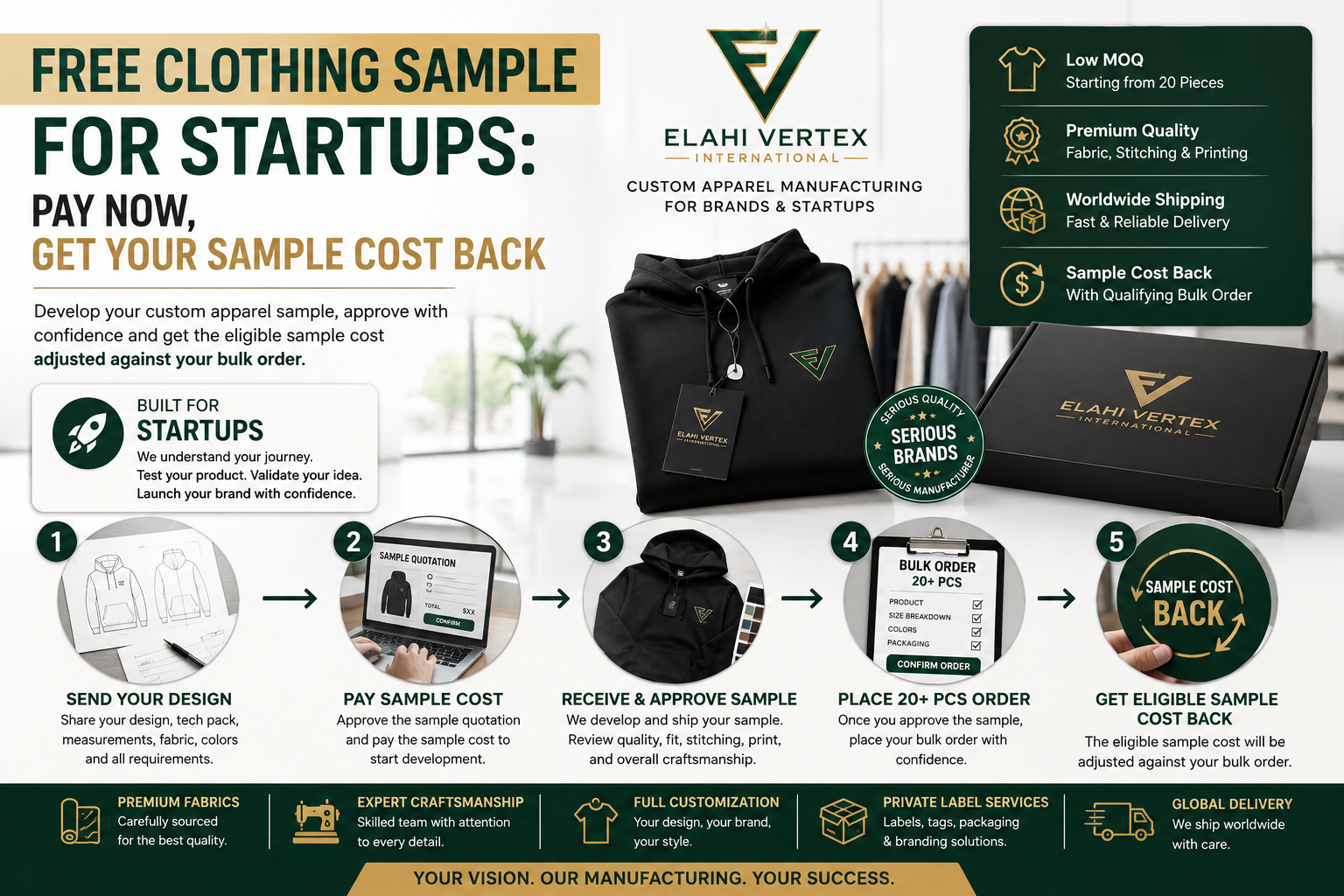
A free clothing sample for startups sounds almost too good to be true. If you are launching your first clothing brand, you may want to inspect your custom product before investing in production—but you may also want to protect every dollar, pound or euro available for your launch.
Elahi Vertex International offers a practical way to approach that problem.
The idea is simple:
Pay for your custom sample first. Check it carefully. Approve it. Place your qualifying bulk order. Then have the eligible sample cost adjusted against that order when this arrangement has been confirmed for your project.
That means a free clothing sample for startups does not have to mean that an unknown person contacts a manufacturer and receives a custom garment for nothing.
Instead, it means a serious startup can invest in product development, verify the physical product before production and potentially recover the eligible sample cost when moving forward with the qualifying manufacturing order.
For founders, this creates a much more useful path:
Idea → Custom Sample → Review → Approval → Bulk Production → Eligible Sample Cost Adjustment
This guide explains exactly how that process works with Elahi Vertex International, what you need before requesting a sample, what you should inspect, how revisions should be handled, what “get your sample cost back” actually means, and how a startup can avoid wasting money during product development.
Quick Answer: How Does a Free Clothing Sample for Startups Work?
A free clothing sample for startups can work through a sample-cost-adjustment model.
You initially pay the agreed cost required to develop your custom sample.
Elahi Vertex International develops the sample according to the specifications agreed for your project.
You then receive and evaluate the physical product.
If changes are required, they are discussed and handled according to the agreed revision terms.
Once the sample is approved and you proceed with the qualifying bulk production order, the eligible sample cost can be adjusted against that order when this arrangement has been agreed for your project.
So the concept is:
Pay now → Develop → Inspect → Approve → Order → Get the eligible sample cost back through the agreed adjustment
This is different from an unconditional free giveaway.
It is a startup-focused manufacturing arrangement designed for buyers who genuinely intend to turn a product idea into production.
What Does “Free Clothing Sample for Startups” Really Mean?
The word free needs to be explained clearly.
A custom clothing sample requires real development work.
Depending on the product, a manufacturer may need to work with:
- Your design
- Measurements
- Pattern requirements
- Fabric
- Fabric weight
- Colors
- Printing
- Embroidery
- Sublimation
- Labels
- Branding
- Trims
- Packaging
- Construction requirements
- Finishing requirements
That work has a cost.
Therefore, when Elahi Vertex International discusses a free clothing sample for startups through sample-cost adjustment, it should not be interpreted as:
“Send us a message and we will manufacture and ship you a free custom garment with no conditions.”
The intended meaning is:
You pay the applicable sample-development cost upfront and, where agreed, the eligible sample cost is adjusted against your qualifying bulk order when you proceed into production.
That distinction protects both the startup and the manufacturer.
The startup can physically evaluate its product.
The manufacturer can dedicate development resources to genuine projects.
And a startup that proceeds into production does not necessarily have to treat the eligible sample-development cost as a completely separate expense.
Why Startups Want a Free Clothing Sample Before Production
Starting a clothing brand requires money before the first customer ever places an order.
A founder may need to pay for:
- Brand identity
- Logo development
- Website
- Domain
- Product design
- Tech packs
- Samples
- Packaging
- Labels
- Photography
- Marketing
- Manufacturing
- Freight
- Import costs
- Warehousing
- E-commerce software
That makes startup capital valuable.
A founder may naturally ask:
“Why should I spend money on a sample before I have even launched?”
The better question is:
“What could happen if I manufacture my entire first order without properly checking the physical product?”
A sample allows you to identify issues while they still exist on one development garment rather than across an entire production order.
For example, you may discover that:
- The hoodie is too long.
- The jersey neckline needs adjustment.
- The embroidery is too large.
- The logo is positioned incorrectly.
- The waistband needs improvement.
- The T-shirt fit is not as oversized as intended.
- The color does not look the way it appeared on your screen.
- A label needs repositioning.
- A measurement needs correction.
Finding one of those issues during sampling is very different from discovering it after finished inventory reaches you.
That is why sampling should be treated as product validation, not merely as an additional expense.
Why Elahi Vertex International Uses a Pay-First Sample Process
Imagine offering fully customized garments free to every person who says:
“I am thinking about starting a clothing brand.”
Some would be serious founders.
Others might never place an order.
Some might simply want free clothing.
Others might ask five manufacturers to develop five different samples without having a realistic production plan.
Custom sampling uses:
- Materials
- Labor
- Development time
- Pattern work where required
- Printing or embroidery setup where applicable
- Cutting
- Stitching
- Finishing
- Communication
- Inspection
Those resources are real.
A pay-first model helps distinguish a genuine manufacturing project from a free-product request.
But the startup should also receive value from demonstrating that commitment.
That is where the free clothing sample for startups concept becomes attractive.
When an eligible sample cost is agreed to be adjusted against a qualifying production order, the startup’s development payment can become part of its wider manufacturing investment rather than remaining an isolated cost.
1. Start With One Product You Actually Intend to Manufacture
The smartest way to get value from a free clothing sample for startups program is not to sample everything you might someday sell.
Start with a real product.
For example:
- Custom T-shirt
- Oversized T-shirt
- Hoodie
- Sweatshirt
- Tracksuit
- Gym shorts
- Leggings
- Sports bra
- Basketball uniform
- Soccer uniform
- Baseball uniform
- Rugby uniform
- Boxing shorts
- Boxing robe
- Varsity jacket
- Leather jacket
- Streetwear set
- Private-label clothing
If you are launching your first brand, you may be tempted to develop ten products simultaneously.
That can quickly multiply:
Sample costs + revision costs + artwork decisions + sizing decisions + packaging decisions + production commitments
A disciplined startup can instead begin with a hero product.
Develop it properly.
Learn from the sampling process.
Approve it.
Test it in the market.
Then expand.
Elahi Vertex International’s custom clothing manufacturing service covers made-to-order apparel according to buyer designs, specifications, measurements, materials, branding and production requirements.
2. Prepare Your Design Before Requesting a Free Clothing Sample for Startups
Do not begin the conversation with only:
“Sample price?”
A manufacturer cannot accurately understand a custom project from those two words.
Instead, prepare the clearest product brief you currently have.
If you have a tech pack, provide it.
If you have technical drawings, provide them.
If you have artwork, provide it.
If you have reference images, provide them while clearly explaining which features are references and what you want changed.
If you have an existing garment whose fit you like, explain what you want to use as a reference.
A useful startup inquiry could look like this:
Product: Oversized pullover hoodie
Intended first order: 20 pieces
Fit: Oversized
Colors: Black and cream
Branding: Woven neck label
Decoration: Front embroidery
Size range: S–XL
Artwork: Attached
Destination: USA
Sample required: Yes
That gives Elahi Vertex International a usable starting point.
The company’s How to Order process follows the same general sequence: send the design, choose the product and fabric, confirm specifications, develop the sample where required, approve it and then proceed toward production.
3. Confirm the Product Specifications Before Paying
A free clothing sample for startups is only valuable if the sample represents something clearly defined.
Before development begins, establish the relevant specifications.
Fabric
What material should be used?
For example, your product may require a particular cotton blend, polyester construction, performance material or another fabric appropriate to the garment.
Do not select fabric solely from a photograph.
Physical properties matter.
Fabric Weight
If fabric weight is important to the product, confirm the required direction.
A startup advertising a heavyweight streetwear hoodie needs to think differently from a startup developing lightweight performance apparel.
Fit
Define the intended fit.
Examples include:
- Regular
- Relaxed
- Oversized
- Slim
- Athletic
- Compression
“Good fit” is subjective.
“Oversized fit based on the agreed measurements” is more useful.
Measurements
Provide your measurement chart if you have one.
If you do not, sizing requirements should be discussed before approval rather than assumed.
Colors
Identify the required garment and artwork colors.
Decoration
Confirm whether the product requires:
- Embroidery
- Screen printing
- Sublimation
- Heat transfer
- Another agreed decoration method
Artwork Placement
Define where logos, graphics, names, numbers and other elements belong.
Branding
Discuss applicable:
- Main labels
- Size labels
- Care labels
- Hangtags
- Packaging
- Other brand elements
For brands selling textile products into the United States, labeling should not be treated as an afterthought. The U.S. Federal Trade Commission explains that most textile and wool products require information such as fiber content, country of origin and manufacturer or responsible-business identity, with care-label requirements also applying to covered apparel. See the FTC apparel and labeling guidance.
4. Confirm How the Sample Cost Will Be Adjusted
This is one of the most important steps.
Before paying for the free clothing sample for startups, ask:
“If I approve this sample and place my qualifying bulk order, what eligible sample cost will be adjusted against that order?”
Do not rely on assumptions.
Confirm the applicable arrangement for your project.
The commercial logic is:
Sample development cost paid upfront = X
Qualifying production order = Y
Eligible agreed sample adjustment = −X
Adjusted amount = Y − X
This is an illustration of the mechanism only.
The actual:
- Sample price
- Eligible amount
- Production price
- Qualification requirements
- Payment terms
- Adjustment terms
must be confirmed for the individual project.
That protects you from misunderstanding the phrase get your sample cost back.
5. Pay for the Sample and Keep Your Development Records
Once the project specifications, sample quotation and applicable terms are agreed, pay the required sample amount.
Then keep your records.
Save:
- Quotation
- Payment record
- Tech pack
- Artwork
- Measurement chart
- Mockup
- Color references
- Label files
- Packaging requirements
- Revision instructions
- Approval messages
Why?
Because custom clothing manufacturing involves many details.
Memory is not a reliable production-control system.
A documented project gives both sides something specific to reference.
If the logo placement was approved at one position, document it.
If the sleeve measurement changed during revision, update the specification.
If artwork version 3 replaced artwork version 2, make that clear.
Good documentation becomes increasingly important as your startup grows.
6. Use the Physical Sample to Test the Product Properly
The biggest benefit of a free clothing sample for startups is not the word free.
It is the ability to evaluate a real product before production.
Elahi Vertex International’s Sampling & Prototyping process is designed to let buyers review areas such as fit, measurements, fabric, colors, construction, printing, embroidery, labels, branding and finishing before bulk production.
Do not waste that opportunity.
Check the Fabric
Ask:
- Does it match the agreed material direction?
- Does it feel appropriate for the product?
- Is the weight appropriate?
- Does it provide the stretch or structure required?
- Does it support the price and positioning of your brand?
Check Measurements
Measure the relevant points against the approved measurement chart.
Depending on the garment, these might include:
- Chest
- Length
- Shoulder
- Sleeve
- Waist
- Hip
- Rise
- Inseam
- Outseam
- Leg opening
The relevant measurements vary by product.
Check Fit
Wear or fit-test the garment where appropriate.
Ask:
- Is the silhouette correct?
- Does an oversized product actually feel oversized?
- Does activewear permit the intended movement?
- Is the neckline appropriate?
- Are sleeves proportioned correctly?
- Does the waistband sit correctly?
Check Construction
Look at:
- Seams
- Stitching
- Panels
- Openings
- Hems
- Finishing
- Loose threads
- Distortion
- Puckering
Check Decoration
Inspect:
- Logo size
- Logo position
- Print quality
- Embroidery
- Number placement
- Name placement
- Graphic alignment
Check Branding
Review all agreed labels, tags and packaging.
Then ask:
“Would I confidently sell this exact product under my brand name?”
That is a better approval question than simply:
“Does it look okay?”
7. Manage Sample Revisions Without Creating Confusion
A first sample may identify changes.
That does not automatically mean the development process has failed.
The purpose of sampling is partly to find issues before production.
But startup founders should manage revisions carefully.
Do not send:
“Make sleeve bigger.”
Then three hours later:
“Logo smaller.”
Tomorrow:
“Actually change the black.”
The next day:
“Can we change the fabric?”
Instead, consolidate the feedback.
Sample Revision Example
1. Body Length
Current measurement: [insert]
Required measurement: [insert]
2. Sleeve Opening
Current measurement: [insert]
Required measurement: [insert]
3. Front Embroidery
Required adjustment: [insert precise instruction]
4. Neck Label
Use artwork file: [approved file/version]
5. Color
Required adjustment/reference: [insert]
This creates one controlled revision rather than a chain of scattered messages.
A revision is also different from redesigning the entire product.
If you originally requested:
400 GSM oversized pullover hoodie with embroidery
and later change it to:
lightweight cropped zip hoodie with screen printing
you may have moved beyond revision into new product development.
That distinction can affect cost and timing.

8. Approve the Sample Before Starting Production
Do not rush approval because your launch date is getting close.
Startup founders sometimes create their own pressure:
- Website is ready.
- Social pages are ready.
- Launch date is announced.
- Marketing is scheduled.
- Customers are waiting.
Then the sample arrives with an unresolved issue.
The founder thinks:
“It is probably good enough. Start production.”
That defeats the purpose of sampling.
A free clothing sample for startups only reduces risk if you actually use the sample as an approval checkpoint.
Before approving production, review:
Product
- Correct design
- Correct version
- Correct style
Fabric
- Correct agreed material
- Appropriate weight
- Appropriate feel
Fit
- Measurements checked
- Fit evaluated
- Proportions reviewed
Construction
- Stitching reviewed
- Seams reviewed
- Finishing reviewed
Artwork
- Correct artwork
- Correct placement
- Correct scale
- Correct orientation
Colors
- Garment color reviewed
- Artwork colors reviewed
Branding
- Labels reviewed
- Tags reviewed
- Packaging reviewed where applicable
Commercial Details
- Quantity confirmed
- Production quotation confirmed
- Sample-cost adjustment confirmed
- Shipping terms confirmed
- Final specifications confirmed
Only then should the startup clearly communicate:
APPROVED FOR PRODUCTION
9. Place the Qualifying Order and Get the Eligible Sample Cost Back
This is where the free clothing sample for startups model completes its purpose.
You have:
- Defined your product.
- Submitted your specifications.
- Paid for sample development.
- Received the physical sample.
- Inspected it.
- Requested necessary revisions.
- Approved the final product.
- Confirmed your production order.
When the agreed conditions are met, the eligible sample cost can then be adjusted against the qualifying bulk order.
That is the meaning of:
Pay Now, Get Your Sample Cost Back
It is not a trick.
It is not an unconditional free garment.
It is not intended for people collecting samples from manufacturers.
It is a way for a serious startup to use paid product development without necessarily leaving the eligible sample cost as an additional standalone expense once it proceeds into qualifying production.
Free Clothing Sample for Startups vs a Free Mockup
These are not the same thing.
Digital Mockup
A mockup can help visualize:
- Colors
- Artwork
- Logo position
- General design
But you cannot physically:
- Wear it
- Measure it
- Feel the fabric
- Inspect stitching
- Test fit
- Evaluate construction
Physical Sample
A physical sample gives you an actual garment to inspect.
That makes physical product development more resource-intensive, but also more useful for production approval.
If another supplier advertises a free sample, always ask:
“Do you mean a free digital mockup or an actual customized physical garment?”
The difference matters.
Is Shipping Included With a Free Clothing Sample for Startups?
Do not assume so.
Sample-development cost and shipping cost are different.
An eligible sample-cost adjustment against a qualifying bulk order does not automatically mean that international courier charges, duties, taxes or other logistics costs are also refunded.
Shipping can depend on:
- Destination country
- Postal/ZIP code
- Package weight
- Package dimensions
- Courier
- Service level
- Customs requirements
- Duties and taxes
Therefore, confirm the shipping charge separately before ordering your sample.
A transparent sample policy should distinguish:
Product-development cost
from:
Logistics cost
rather than hiding both under the word free.
Why a Free Clothing Sample for Startups Can Reduce Launch Risk
Consider two startup founders.
Founder A
Pays for sample development.
Receives the garment.
Finds that the fit is wrong.
Corrects it.
Approves the revised product.
Places production.
Receives the agreed eligible sample-cost adjustment.
Founder B
Does not want to pay for a sample.
Places production immediately.
Receives the complete order.
Then discovers that the fit is wrong.
Which founder took the bigger financial risk?
Founder A concentrated the uncertainty into a development sample.
Founder B multiplied the uncertainty across inventory.
That is why the free clothing sample for startups model should be viewed as a risk-management mechanism rather than simply a discount.
How a 20-Piece MOQ Helps New Clothing Brands Start Smaller
Large inventory commitments can be dangerous for an untested brand.
A startup does not yet know with certainty:
- Which size will sell fastest.
- Which color customers will prefer.
- Whether the product will convert.
- Whether the retail price is right.
- Whether customers will reorder.
- Whether the design will remain popular.
Elahi Vertex International’s standard MOQ is 20 pieces.
That gives a startup a practical development path:
Create concept → Develop sample → Approve product → Start with 20 pieces → Test market → Learn → Reorder → Scale
The exact product, sizing, color and customization configuration should still be confirmed for each order.
A smaller MOQ does not eliminate business risk.
It can, however, reduce the amount of inventory a new brand needs to commit to at the beginning.
Free Clothing Samples for Startups Are for Serious Product Development
There are two very different searches hidden behind the phrase free clothing sample for startups.
Searcher One
“I want companies to send me free clothes.”
Searcher Two
“I am building a clothing brand and need to validate my custom product before committing money to production.”
This article is for the second founder.
If your objective is collecting free garments, custom product development is the wrong route.
If your objective is:
- Creating your own clothing brand
- Developing a custom garment
- Checking quality
- Testing fit
- Confirming branding
- Approving the physical product
- Moving into manufacturing
then sampling has a real commercial purpose.
What Should You Send Before Requesting Your Sample?
A serious inquiry should contain enough information to evaluate the project.
Where applicable, send:
- Your name
- Brand name
- Product type
- Design
- Tech pack
- Reference images
- Artwork
- Fabric requirements
- Fabric weight/GSM
- Colors
- Fit
- Size chart
- Decoration requirements
- Labels
- Branding
- Packaging requirements
- Intended production quantity
- Destination country and postal/ZIP code
- Required date
- Any questions that need clarification
If you do not have every item, say what you do have and what still needs to be determined.
Clarity is more valuable than pretending your product is finalized when it is not.
Can I Request a Free Clothing Sample for Startups Without a Tech Pack?
A professional tech pack can make product development considerably clearer because it organizes specifications.
But not every first-time founder arrives with one.
You may currently have:
- Sketches
- Reference photographs
- Artwork
- Written measurements
- A physical reference garment
- A basic design
- A mood board
Provide the information you genuinely have.
Then identify what still needs to be finalized.
The objective is to move from:
idea
to:
agreed manufacturing specification
before approving production.
Who Should Provide the Clothing Size Chart?
If your startup already has a developed size chart, provide it.
If you have an existing garment whose fit you want to reference, explain that clearly.
If you do not yet have finalized sizing, discuss the sizing requirements with Elahi Vertex International before approving the sample.
The wrong approach is allowing both sides to make silent assumptions.
Sizing affects the customer’s experience.
Treat it as a product specification.
What Should USA Startups Know About Clothing Labels?
If you intend to sell apparel in the United States, do not treat product labels as decoration alone.
The U.S. Federal Trade Commission provides requirements covering textile labeling. Depending on the product, required information can include fiber content, country of origin and the identity of the manufacturer or another responsible business.
The FTC also maintains a Care Labeling Rule requiring covered manufacturers and importers to provide appropriate garment-care instructions.
Before selling into the U.S. market, founders should review the current official requirements rather than copying another brand’s label.
Official resources:
Federal Trade Commission — Apparel and Labeling
Federal Trade Commission — Care Labeling Rule
These requirements matter during product development because your physical sample is an opportunity to review how labels fit into the garment before production.
What About Importing Clothing Into the United States?
A sample can also help founders begin thinking beyond the garment itself.
If your startup will import commercial apparel, you should understand that importing textiles involves customs and product requirements.
U.S. Customs and Border Protection notes that textile imports can involve country-of-origin marking and other apparel requirements, while other agencies may also regulate relevant aspects of the product.
Do not wait until finished production is ready to ship before learning what your destination market requires.
Product development, labeling, shipping and import planning should support one another.
Sample Approval Checklist for a Free Clothing Sample for Startups
Before authorizing production, use this checklist.
Design
- Correct style
- Correct artwork version
- Correct product configuration
Fabric
- Agreed material
- Agreed weight where applicable
- Appropriate hand feel
- Appropriate stretch or structure
Fit
- Sample size confirmed
- Measurements checked
- Fit physically evaluated where appropriate
Construction
- Stitching
- Seams
- Hems
- Panels
- Openings
- Finishing
Decoration
- Printing
- Embroidery
- Sublimation
- Logo position
- Artwork dimensions
- Names/numbers where applicable
Color
- Garment color
- Print color
- Embroidery color
- Trim color
Branding
- Main label
- Size label
- Care label
- Hangtag
- Packaging
Production
- Quantity
- Size breakdown
- Color breakdown
- Final specifications
- Production quotation
- Sample-cost adjustment
- Shipping terms
If something is unresolved, resolve it before approval.
Why Your Approved Sample Becomes an Important Production Reference
Words are subjective.
Consider:
Premium
Heavyweight
Oversized
Soft
Athletic
Relaxed
Two people can interpret each word differently.
A physical approved sample makes those ideas more concrete.
Once your sample and specifications are approved, they can provide an important reference point for production.
Elahi Vertex International’s OEM clothing manufacturing process similarly uses approved designs and specifications as the basis for production, with sampling occurring before bulk manufacturing.
This is why sample approval should be documented.
Do not simply say:
“Looks nice.”
Record what was approved.
Do Not Approve a Sample Just Because You Are Excited
Startup enthusiasm is valuable.
Startup impatience can be expensive.
Your launch date may be approaching.
Your website may already be live.
Your Instagram may be ready.
Your packaging may be ordered.
You may have promised followers a launch date.
None of those things make an unresolved product issue disappear.
If something genuinely needs correction, fix it at the development stage.
Your first customers do not care that you were in a hurry.
They evaluate the product they receive.
Why Your First Customers Make Sampling Even More Important
An established brand may have thousands of previous customer experiences supporting its reputation.
A startup has none.
Your first 20 customers can produce your first:
- Reviews
- Social posts
- Photographs
- Videos
- Referrals
- Complaints
- Returns
- Repeat orders
Your first small production order therefore matters.
A properly reviewed free clothing sample for startups gives you an opportunity to identify issues before those early customers experience them.
The sample is not only protecting manufacturing money.
It is helping protect the reputation you have not built yet.
How to Avoid Wasting Money During Sampling
Getting an eligible sample cost adjusted is useful.
Avoiding unnecessary development is even better.
Do Not Sample an Unfinished Idea
Finalize as much as possible before physical development.
Do Not Sample Too Many Products at Once
Start strategically.
Do Not Change the Entire Product After Every Sample
Control revisions.
Do Not Give Vague Instructions
“Make it premium” is not enough.
Do Not Ignore Measurements
Fit matters.
Do Not Approve Only From Excitement
Inspect systematically.
Do Not Start Production With Unresolved Specifications
Lock the approved direction first.
These habits can save more money than negotiating a slightly cheaper sample.
Free Clothing Sample for Startups: What Happens If You Never Place the Bulk Order?
This needs to be completely clear.
If you order and pay for a custom sample but never proceed with the qualifying production order, there may be no production order against which the eligible sample cost can be adjusted.
Therefore:
“Get your sample cost back” is not an unconditional cash-refund promise.
It depends on the agreed sample arrangement and qualifying production order.
Confirm the applicable terms before paying for development.
Transparency here protects everyone.
What Happens If You Completely Change Your Design?
A revision and a new product are not the same thing.
Imagine your original sample is:
Oversized pullover hoodie + heavyweight fabric + embroidery
Then you decide you actually want:
Cropped zip hoodie + lightweight fabric + screen print
You have changed:
- Silhouette
- Construction
- Fabric
- Decoration
- Product direction
That may require new development.
Do not assume that an unlimited number of completely different products falls under one sample cost.
Ask before making major changes.
Is the Cheapest Clothing Sample the Best Choice?
Not necessarily.
Suppose:
Manufacturer A: Very cheap sample, no credit toward production.
Manufacturer B: Higher initial sample development cost, but an eligible amount is adjusted against a qualifying production order.
Which is cheaper?
You cannot determine that from the first number alone.
Compare:
Sample development + revisions + production + shipping + adjustment/credit + product risk
A startup should evaluate the complete commercial structure.
The cheapest first payment is not automatically the lowest total cost.
Why Startup Founders Should Work Backward From Their Customer
When your sample arrives, stop thinking like the founder for a moment.
Imagine being the customer.
You open the package.
You touch the fabric.
You inspect the garment.
You put it on.
What do you notice?
Does the product justify its intended retail price?
Does the fit match what your website will promise?
Does the branding feel deliberate?
Would you reorder it?
Would you recommend it?
Would you post it online?
This is one of the most valuable ways to evaluate your sample.
The founder may love the logo.
The customer may care more about comfort.
The designer may love the artwork.
The customer may care more about fit.
Your product needs to work as a complete customer experience.
A Simple Startup Sampling Roadmap
If clothing manufacturing feels complicated, simplify the process.
Phase 1 — IDEA
Choose the product you genuinely intend to sell.
Phase 2 — SPECIFICATION
Define fabric, fit, measurements, colors, artwork, branding and other relevant requirements.
Phase 3 — SAMPLE
Develop the physical product.
Phase 4 — INSPECTION
Measure, wear, inspect and compare the sample against the agreed requirements.
Phase 5 — REVISION
Correct genuine issues where required.
Phase 6 — APPROVAL
Lock the final product direction.
Phase 7 — PRODUCTION
Place the qualifying manufacturing order.
Phase 8 — SAMPLE COST ADJUSTMENT
Apply the eligible sample cost according to the confirmed arrangement.
Phase 9 — MARKET TEST
Launch your first production and learn from actual customers.
Phase 10 — SCALE
Use real sales information to make smarter reorder and product-expansion decisions.
Why Elahi Vertex International Can Work for Startup Clothing Brands
Elahi Vertex International manufactures custom apparel based on buyer designs, specifications, measurements, materials, branding and production requirements.
Product categories include:
- Sportswear
- Teamwear
- Streetwear
- Activewear
- Boxing wear
- Leather wear
- Hoodies and sweatshirts
- Private-label clothing
The manufacturing journey can include:
Product requirements → Sampling → Approval → Production → Quality checks → Packaging → Shipping
For a startup, the combination of sampling and a standard 20-piece MOQ creates a practical route for beginning with a more manageable first production quantity.
Instead of immediately committing to hundreds of untested pieces, the founder can focus on:
Developing the right product first.
Then:
Testing a smaller initial production quantity.
Then:
Scaling according to actual demand.
Frequently Asked Questions About a Free Clothing Sample for Startups
Is a Free Clothing Sample for Startups Completely Free Upfront?
Not necessarily. A custom sample normally requires an agreed development payment. Where the sample-cost adjustment is confirmed for the project, the eligible sample amount can later be adjusted against a qualifying production order.
How Do I Get My Sample Cost Back?
Confirm the adjustment terms before sample development. After approving your product, proceed with the qualifying bulk order under the agreed terms. The eligible sample amount can then be adjusted according to the confirmed arrangement.
Does Elahi Vertex International Send Free Samples to Anyone?
The concept described here is intended for serious custom-product development and qualifying production, not unconditional free-product distribution.
Is Sample Shipping Free?
Do not assume that it is. Sample development and international shipping are separate expenses unless your quotation explicitly states otherwise.
What Is the Minimum Order Quantity?
Elahi Vertex International’s standard MOQ is 20 pieces.
Specific product, color, sizing and customization configurations should be confirmed for the individual order.
Can a First-Time Clothing Founder Order a Sample?
Yes. Send your product idea, design or reference, available specifications, intended quantity and destination so the project can be evaluated.
Do I Need a Tech Pack?
A tech pack is useful, but founders may begin at different development stages. Provide the clearest product information available and identify anything that still needs to be finalized.
Can I Change the Sample?
Revisions can be discussed. The effect on development cost depends on the nature and extent of the requested changes.
What Should I Inspect?
Review the agreed fabric, fit, measurements, construction, stitching, artwork, decoration, colors, labels, branding and finishing relevant to your product.
What Happens After Sample Approval?
Confirm final production specifications, quantity, pricing, applicable sample-cost adjustment, payment arrangements and shipping requirements before production.
Can I Recover the Sample Cost Without Ordering Production?
The sample-cost-back model described here depends on proceeding with a qualifying production order under the agreed terms.
Why Should I Sample Before Ordering Only 20 Pieces?
Even a 20-piece production run represents inventory, manufacturing and shipping investment. Sampling can help identify product issues before they are repeated across that inventory.
Final Answer: Is a Free Clothing Sample for Startups Worth It?
For a serious clothing startup, yes—when the sample is being used to validate a product that you genuinely intend to manufacture.
The objective should not be to collect free clothing.
The objective should be to reduce uncertainty before production.
A free clothing sample for startups through an agreed sample-cost adjustment gives you a structured way to:
- Develop your custom product.
- Physically inspect it.
- Check fit and measurements.
- Review materials.
- Verify branding.
- Identify necessary changes.
- Approve the final direction.
- Move into qualifying production.
- Recover the eligible sample cost through the agreed adjustment.
That creates a simple principle:
Pay for the sample now. Protect the production order. Get the eligible sample cost back when you qualify.
For a startup, that is much more useful than blindly ordering inventory.
Start Your Free Clothing Sample for Startups Process With Elahi Vertex International
If you are preparing to launch a clothing brand, begin with a product you genuinely intend to manufacture.
Send Elahi Vertex International your:
- Product type
- Design or reference
- Tech pack if available
- Artwork
- Fabric requirements
- Fit and measurements
- Branding requirements
- Intended quantity
- Destination
- Required date
Then confirm the sample quotation, shipping cost and applicable sample-cost-adjustment terms before development begins.
You can review Elahi Vertex International’s Sampling & Prototyping process to understand what can be checked before bulk production, or review the How to Order process for the wider design-to-production workflow.
For startup brands targeting the United States, also review the official Federal Trade Commission apparel-labeling guidance and FTC Care Labeling Rule when preparing products for sale.
Your first sample should not be money wasted.
It should be the product-development checkpoint that helps you move toward production with greater confidence.
Develop. Inspect. Approve. Produce. Get the eligible sample cost adjusted.
That is the Elahi Vertex International approach to a free clothing sample for startups.