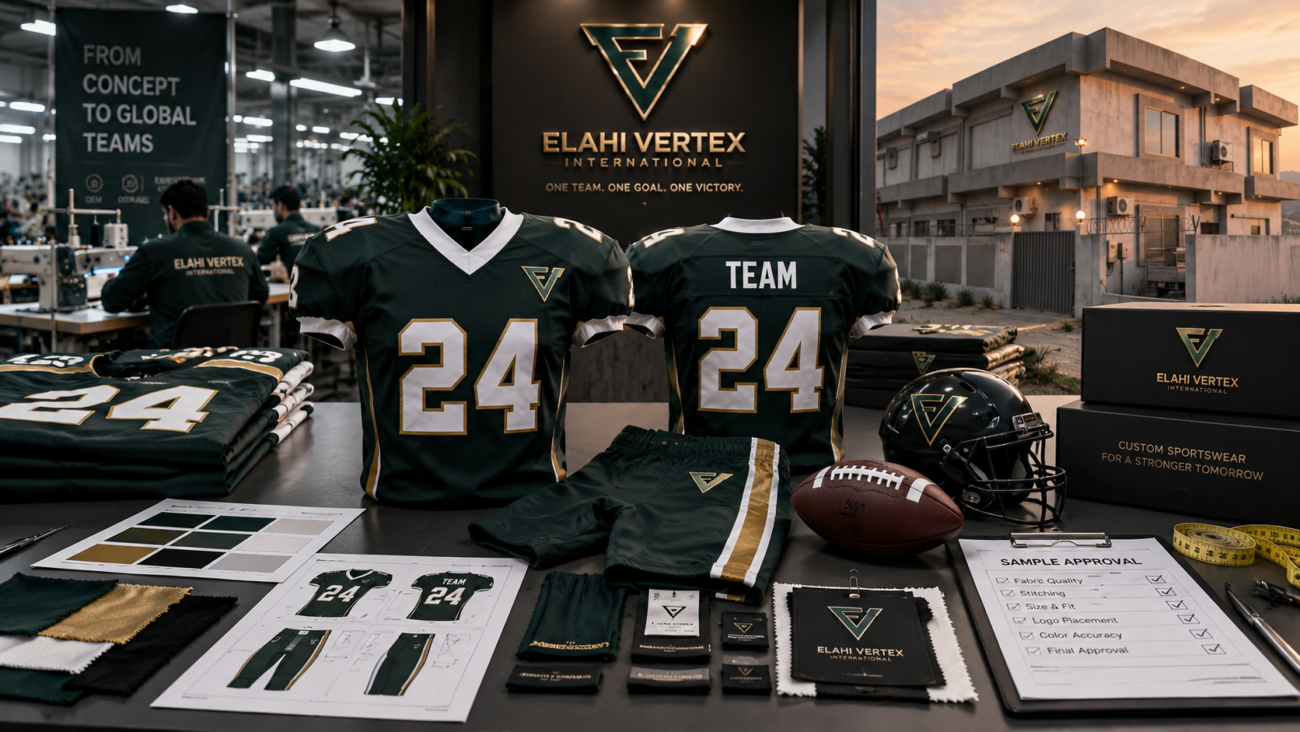

Ordering uniforms for an entire American football roster is very different from buying a few jerseys. A mistake in sizing, player numbers, artwork, uniform-rule compliance, fabric selection, or final approval can affect dozens of garments at once. That is why a proper American football uniform bulk order checklist should be completed before production begins.
For USA high schools, colleges, clubs, academies, leagues, and other football organizations, the objective is not simply to find an attractive uniform. Buyers need to convert their team requirements into clear manufacturing specifications that a supplier can follow consistently across the complete roster.
This is particularly important because American football uniforms must work with protective equipment while also meeting the applicable competition requirements. NFHS maintains football rules and dedicated jersey-and-pant resources for high-school competition, while the NCAA publishes its own football playing rules and uniform resources for collegiate programs. Requirements can change, so teams should verify the rules that apply to their organization before approving artwork or production.
This guide gives USA team buyers a practical American football uniform bulk order checklist built around nine areas that should be confirmed before committing to bulk manufacturing.
Table of Contents
- Confirm Your Governing-Body Uniform Requirements
- Build an Accurate Player Sizing System
- Specify Fabric, Construction and Performance Requirements
- Check Jersey Fit With Football Protective Equipment
- Finalize Team Colors, Artwork and Branding
- Lock Player Names and Numbers
- Approve a Sample Before Bulk Production
- Build a Final Master Roster and Order Sheet
- Confirm Bulk Production, Delivery and Reordering Requirements
- American Football Uniform Specification Checklist
- Common Bulk-Ordering Mistakes
- Why Work With Elahi Vertex International
- Frequently Asked Questions
- Final American Football Uniform Bulk Order Checklist
1. Confirm Your Governing-Body Uniform Requirements
The first item on any American football uniform bulk order checklist should come before fabric selection or graphic design:
Which rules must this team follow?
A high-school program, NCAA team, independent league, youth organization, academy, tournament team, and recreational club may not operate under exactly the same uniform requirements.
Do not assume that a design is legal simply because it looks similar to another football team’s uniform.
NFHS Requirements for USA High-School Teams
The National Federation of State High School Associations maintains football rules and currently provides dedicated Football Jersey and Pant Rules — 2026 among its football resources.
Uniform specifications can address issues such as:
- Home and visiting jersey colors
- Jersey-number requirements
- Number contrast
- Permitted decorative areas
- Jersey construction
- Coverage of protective equipment
- Pants
- Logos and marks
- Patches and adornments
For example, NFHS football rules have specific provisions for home and visiting jersey colors and require player numbering within the permitted range. Existing NFHS jersey guidance also requires the jersey to completely cover shoulder pads and other pads worn above the waist on the torso.
These details demonstrate why artwork should not move directly from a designer to bulk production.
The design should first pass a rules-compliance review.
NCAA Programs Need Their Own Verification
College programs should use the current NCAA football rules rather than assuming high-school requirements apply.
The NCAA’s official football playing-rules resources include a dedicated uniform diagram, official rule book and current football updates.
Rules can also evolve.
For example, NCAA Division I approved additional commercial-logo opportunities for non-NCAA championship competition effective August 1, 2026, subject to specified limits and placement requirements.
That is exactly why a team should verify the current rules immediately before artwork approval.
Practical Rule-Compliance Checklist
Before manufacturing, confirm:
- Governing organization
- Competition level
- Home jersey requirements
- Away jersey requirements
- Number range
- Number size
- Number contrast
- Logo restrictions
- Sponsor/commercial-logo rules
- Patch requirements
- Jersey-length requirements
- Pants requirements
- State, conference or league-specific additions
Buyer recommendation: obtain written approval from the person responsible for your team’s uniform compliance before releasing artwork for manufacturing.
2. Build an Accurate Player Sizing System
The second major part of an American football uniform bulk order checklist is sizing.
Bulk-order problems often begin when teams treat a roster as a simple list of S, M, L and XL.
Football sizing deserves more attention.
A jersey is not worn in the same environment as an ordinary training shirt. Shoulder pads and other equipment affect the functional fit, while football pants must work with the athlete’s movement and equipment configuration.
Do Not Guess Sizes From Everyday Clothing
A player who normally wears a large T-shirt should not automatically receive a large football jersey.
Instead, teams should work from the manufacturer’s actual garment measurements or approved sizing system.
Useful measurements can include:MeasurementWhy It MattersChestHelps determine jersey body fitJersey lengthAffects torso coverageShoulder areaImportant around protective equipmentWaistImportant for football pantsHipHelps evaluate lower-body fitPants lengthHelps establish appropriate coveragePlayer heightUseful supporting referencePlayer buildHelps identify unusual sizing requirements
The exact measurement method should be confirmed with the manufacturer because sizing conventions can vary.
Use a Size Sample or Size Set Where Practical
For a significant team order, physical sizing samples can reduce uncertainty.
Players can test the relevant sizes with the equipment they normally wear.
The team can then record each player’s approved size instead of relying only on self-reported casual clothing sizes.
Create One Sizing Record
Use a structured roster such as:PlayerJersey SizePants SizeNumberNameVerifiedPlayer ALM12SMITHYesPlayer BXLL27JONESYesPlayer CMM8WILSONYes
The exact sizes above are examples only.
Your actual roster should contain verified player information.
Include Coaches or Staff in the Approval Process
One person should own the final roster.
Allowing several coaches, players and administrators to submit independent revisions increases the possibility of conflicting information.
A better workflow is:
Player information → team coordinator → final master roster → manufacturer
Once the master roster is approved, changes should be controlled.
3. Specify Fabric, Construction and Performance Requirements
A uniform quotation without clear product specifications is difficult to compare properly.
Two manufacturers can quote the same number of football uniforms while proposing significantly different fabrics, construction methods, decoration systems and finishing.
Therefore, your American football uniform bulk order checklist should define what the product actually needs to be.
Fabric Should Be Evaluated Beyond Its Name
“Polyester” alone is not a complete fabric specification.
Buyers may need to discuss:
- Fiber composition
- Fabric structure
- Fabric weight/GSM
- Stretch
- Recovery
- Breathability
- Moisture management
- Surface feel
- Opacity
- Abrasion exposure
- Printing compatibility
- Intended playing environment
The appropriate specification depends on the actual project.
A manufacturer should therefore receive the team’s performance requirements rather than being asked only for “good quality fabric.”
Jersey and Pants Have Different Jobs
Do not assume that one material specification should automatically be used throughout the uniform.
The jersey must accommodate movement and protective equipment.
Football pants have different stretch, fit and durability requirements.
The specification should consequently identify the jersey and pants separately.
Construction Matters
Ask how important areas of the garment will be constructed.
Discuss:
- Seam type
- Panel construction
- Reinforcement requirements
- Collar construction
- Sleeve construction
- Stress areas
- Waistband construction
- Finishing
- Decoration attachment
The exact construction should be selected according to the team’s requirements rather than assumed.
Request a Written Specification
Before approving bulk production, obtain a document or approved specification showing what has actually been agreed.
If you are discussing a custom American football project with Elahi Vertex International, fabric, GSM, sizing, decoration and other project-specific specifications should be confirmed for the particular order before production.
4. Check Jersey Fit With Football Protective Equipment
This is one of the most important differences between American football uniforms and many other teamwear categories.
The jersey does not function independently.
It interacts with protective equipment.
NFHS guidance, for example, requires the jersey to completely cover shoulder pads and other pads worn above the waist on the torso.
That makes equipment compatibility part of the uniform-development process.
Evaluate the Jersey Over Shoulder Pads
Where practical, evaluate the proposed jersey size while the player is wearing the type of shoulder pads used during competition.
Look at:
- Shoulder coverage
- Sleeve position
- Chest fit
- Neck opening
- Jersey length
- Range of motion
- Excessive looseness
- Excessive compression
- Artwork distortion
A jersey that looks excellent when laid flat may behave differently when stretched across football equipment.
Test Movement
A useful fitting evaluation can include:
- Raising both arms
- Reaching forward
- Rotating the torso
- Assuming a playing stance
- Running movement
- Simulated blocking position
The purpose is not to conduct a laboratory performance test. It is to identify obvious fit problems before reproducing the garment across an entire roster.
Do Not Approve Fit From a Mockup
A digital mockup establishes visual direction.
It cannot prove physical fit.
That distinction matters.
Mockup approval = visual approval.
Physical sample approval = product evaluation.
Treat them as separate checkpoints.
5. Finalize Team Colors, Artwork and Branding
The fifth part of the American football uniform bulk order checklist is artwork control.
Football uniforms often contain several visual elements:
- Team colors
- Primary logo
- Secondary logo
- Mascot
- School or club name
- Player numbers
- Player names
- Sleeve graphics
- Shoulder graphics
- Side panels
- Pants graphics
- Sponsor marks where permitted
- Manufacturer/private-label branding where applicable
Each element creates another opportunity for an error.
Provide Proper Artwork Files
Whenever possible, provide clean production-ready artwork.
Vector formats are commonly useful because graphics can be scaled without the same limitations as low-resolution raster images.
If only a small screenshot or compressed social-media image exists, ask whether it is suitable for production before approval.
Define Colors Properly
“Blue” is not a sufficient production specification.
Neither is:
“Use the same red as our old uniform.”
Teams should provide a defined color reference wherever possible.
Digital screens also display colors differently, so buyers should understand that an on-screen mockup is not necessarily a perfect physical color reference.
For programs with tightly controlled school or brand colors, physical color confirmation may be appropriate.
Review Home and Away Designs Together
Do not approve one uniform and assume the second version will automatically be correct.
Review:
Home jersey
and
Away jersey
independently.
Check:
- Body color
- Number contrast
- Logo visibility
- Player-name visibility
- Sleeve treatment
- Pants coordination
- Governing-body requirements
For NFHS-governed football, home and visiting jersey requirements are particularly important and should be checked against the current rules.
Create a Final Artwork Approval
The approved artwork should become the production reference.
After approval, avoid informal changes sent through multiple messages.
If something changes, issue a revised artwork version and clearly identify which version supersedes the previous one.
6. Lock Player Names and Numbers
Names and numbers turn a standard team garment into a roster-specific manufacturing project.
A single typo can create a garment that cannot simply be reassigned to another player.
That makes roster verification a separate stage of the American football uniform bulk order checklist.
Verify Every Number
Check each number against:
- The player
- The official roster
- Governing-body rules
- Duplicate-number policies applicable to the competition
- The final production spreadsheet
Do not rely on a screenshot of a group chat.
Use one controlled document.
Verify Spelling Character by Character
Player surnames should be checked carefully.
Pay particular attention to:
- Hyphens
- Apostrophes
- Spaces
- Suffixes
- Similar surnames
- Capitalization preferences
- Long surnames
The manufacturer should reproduce the approved information, not guess what the team intended.
Number Legibility Matters
A number is functional identification, not merely decoration.
NFHS requirements include specific number and contrast provisions. Current official resources should therefore be consulted when designing uniforms for NFHS competition.
The same principle applies to NCAA and other governing organizations: check their current applicable requirements.
Freeze the Roster
Establish a roster-freeze deadline.
After that point, changes should require explicit confirmation.
This helps prevent situations where:
- One coach changes a number
- Another sends an old spreadsheet
- A player changes size
- The designer updates an old file
- Production receives conflicting instructions
Version control sounds administrative, but on a personalized bulk order it is part of quality control.
7. Approve a Sample Before Bulk Production
A digital design can tell you how the uniform is intended to look.
A physical sample can reveal much more.
For custom manufacturing, sampling can help buyers evaluate the relationship between the approved design and the physical garment.
What Should You Review?
Depending on the project, inspect:
- Overall appearance
- Fabric
- Fabric weight
- Color
- Print reproduction
- Logo position
- Number position
- Name position
- Collar
- Sleeves
- Seams
- Panel alignment
- Jersey length
- Pants construction
- Waistband
- Stretch
- Fit over equipment
- General finishing
Not every project requires exactly the same tests.
The point is to create a written approval standard before bulk manufacturing.
Sample Approval Should Be Documented
Do not simply say:
“Looks good.”
Create a simple approval record:
Fabric: Approved
Color: Approved
Jersey fit: Approved
Pants fit: Approved
Logo position: Approved
Numbers: Approved
Construction: Approved
Required corrections: None / listed separately
If revisions are necessary, produce a clearly identified revision.
Golden Sample Principle
Where appropriate, the final approved sample or final approved specification can act as the reference against which bulk production is evaluated.
That creates a much clearer question:
Does the bulk order match what was approved?
This is more useful than trying to resolve expectations after manufacturing.
8. Build a Final Master Roster and Order Sheet
The eighth check is administrative, but it can prevent expensive personalization errors.
Your manufacturer should receive one final master order document.
Recommended Master Order Fields
Include:
- Team name
- Team contact
- Product
- Home/away designation
- Player name
- Jersey number
- Jersey size
- Pants size
- Quantity
- Special notes
- Artwork version
- Delivery destination
- Required date
- Approval status
Reconcile Totals
If the order is supposed to contain 52 uniform sets, the final player lines should reconcile to 52 sets.
Check totals by:
- Jersey size
- Pants size
- Home uniform
- Away uniform
- Player
- Number
- Total quantity
A simple reconciliation can expose missing players or duplicated entries before production.
Check for Duplicate Numbers
Duplicate numbers may be permitted or restricted differently depending on the governing organization and roster circumstances.
Do not assume.
Verify applicable rules and compare them against the roster.
Use Version Numbers
For example:
Football Uniform Order V1
then:
V2
then:
FINAL APPROVED V3
Avoid filenames such as:
final-new-latest-final2.xlsx
One clearly controlled final version is safer.
9. Confirm Bulk Production, Delivery and Reordering Requirements
The final part of the American football uniform bulk order checklist is commercial and operational confirmation.
Do this before authorizing production.
Confirm Quantity
Make sure the quotation and purchase requirement use the same quantity.
Consider whether you need:
- Player sets
- Spare jerseys
- Spare pants
- Replacement garments
- Coaching/staff apparel
- Additional sizes
- Future-player additions
Do not automatically add extras. Determine whether they make sense for your program.
Confirm Production Timing
Ask the manufacturer to confirm the production schedule for your actual project.
Avoid assuming that a generic website estimate automatically applies to a customized order.
Timing can depend on factors including:
- Quantity
- Customization
- Sample revisions
- Artwork approval
- Material requirements
- Production scheduling
- Shipping method
- Destination
- Customs
If uniforms are needed for a specific season opener, work backward from the required delivery date and leave contingency time.
Confirm Shipping Responsibility
Understand:
- Shipping method
- Destination
- Shipping charges
- Commercial terms
- Documentation
- Customs responsibility
- Import duties/taxes where applicable
- Tracking process
- Expected transit window
Exact requirements depend on the transaction and destination and should be confirmed for the specific project.
Plan for Reorders Before You Need Them
Football rosters change.
Players join.
Garments can be damaged.
Additional sizes may be needed.
Ask before the initial order:
- Can the approved design be reproduced?
- What information identifies the original design?
- Are small repeat orders possible?
- Could materials or colors change later?
- What artwork files should be retained?
- What reference should be provided when reordering?
A good reordering system can be more valuable over several seasons than saving a small amount on the initial purchase.
American Football Uniform Specification Checklist
Before requesting quotations, USA football buyers can prepare the following information.
Team Information
- Team or organization name
- Competition level
- Governing body
- Delivery destination
- Required delivery date
- Team contact
Uniform Information
- Jersey
- Pants
- Home uniform
- Away uniform
- Quantity
- Size range
- Fit requirements
Design Information
- Team colors
- Color references
- Primary logo
- Secondary logo
- Mascot
- Team name
- Player names
- Player numbers
- Sponsor/commercial logos where permitted
- Shoulder graphics
- Sleeve graphics
- Pants graphics
Manufacturing Information
- Preferred fabric requirements
- Fabric weight requirements
- Stretch requirements
- Construction requirements
- Decoration method
- Label requirements
- Packaging requirements
- Sample requirements
Roster Information
- Player name
- Number
- Jersey size
- Pants size
- Quantity
- Special sizing notes
Approval Information
- Rules checked
- Artwork approved
- Colors approved
- Sample approved
- Sizing approved
- Roster approved
- Quantity approved
- Shipping details approved
This document can form the foundation of an RFQ.
How to Prepare a Better American Football Uniform RFQ
A useful RFQ gives manufacturers enough information to quote comparable products.
Instead of writing:
“Need 50 football uniforms. Best price?”
provide a structured request.
Include:
- Product required
- Quantity
- Home/away requirements
- Size range
- Fabric expectations
- Decoration requirements
- Logos
- Names and numbers
- Packaging requirements
- Sample requirement
- Destination
- Required date
- Artwork files
- Any applicable uniform rules
Better input usually produces a more useful quotation.
It also makes supplier comparison easier because manufacturers are responding to substantially the same specification.
How USA Teams Should Compare American Football Uniform Quotations
Price matters, but comparing only the final number can hide significant differences.
Consider:AreaWhat to CompareProductExactly what garments are includedFabricComposition, construction and weightDecorationSublimation, embroidery, appliqué or other methodPersonalizationNames and numbers included or separateSamplingSample process and costSizingStandard/custom options and size confirmationPackagingWhat is includedProductionConfirmed project scheduleShippingMethod and costReordersRepeat-order procedureCommercial termsPayment and agreed transaction terms
A lower quotation is not necessarily better if the specification is materially different.
Compare like with like.
Common American Football Uniform Bulk-Ordering Mistakes
Ordering Before Checking Rules
A visually impressive design can still create problems if it conflicts with competition requirements.
Verify first.
Design second.
Manufacture third.
Using Casual Clothing Sizes
Football uniforms interact with protective equipment.
Use the manufacturer’s sizing system and physical fitting where appropriate.
Approving Only a Digital Mockup
A mockup does not prove fabric, construction, fit or physical color.
Use sampling when the order risk justifies it.
Sending Multiple Rosters
One master roster should control production.
Changing Artwork Without Version Control
Every revision should have an identifiable version.
Selecting a Supplier Only by Price
A quotation means little unless the underlying specification is understood.
Forgetting Reorders
The initial season is not necessarily the end of the uniform requirement.
Think about future players and replacements before placing the first order.
Leaving Too Little Time
Sample revisions, production, shipping and customs can all consume time.
Build a realistic schedule rather than planning around the best possible scenario.
Why American Football Uniform Quality Starts With Specifications
Quality cannot be defined only as “premium.”
A useful quality requirement is measurable or inspectable.
Instead of:
“We need high-quality uniforms.”
define:
- Approved fabric
- Approved garment construction
- Approved measurements
- Approved colors
- Approved artwork
- Approved number placement
- Approved logo placement
- Approved decoration
- Approved sample
- Approved roster
This converts subjective expectations into manufacturing instructions.
That is the underlying purpose of an American football uniform bulk order checklist.
Why Work With Elahi Vertex International for Custom American Football Uniforms?
Elahi Vertex International positions its American football offering around custom team uniforms for teams, schools, colleges, clubs, academies and sports organizations.
The existing American Football Uniform product offering includes customization around jerseys and pants, team colors, logos, names, numbers, graphics, fabric/GSM and decoration options. Exact specifications should still be confirmed for each individual project before production.
For buyers, the most productive way to begin a custom manufacturing discussion is not simply to ask for a price.
Send a structured brief.
Include:
- Quantity
- Jersey requirements
- Pants requirements
- Team colors
- Logo
- Design reference
- Player sizes
- Names and numbers
- Destination
- Required timeline
- Governing-body requirements
This gives Elahi Vertex International clearer information for discussing the project.
Start Your Custom American Football Uniform Project
USA teams, clubs, schools, academies, sports organizations, wholesalers and teamwear buyers can discuss custom manufacturing requirements directly with Elahi Vertex International.
WhatsApp: Discuss your requirements
Email: elahivertexinternational@gmail.com
Custom Order: Submit your custom order requirements
Website: Elahi Vertex International
Alibaba: Elahi Vertex International Alibaba Store
Project-dependent details such as final pricing, MOQ, materials, production schedule, sampling, packaging and shipping should be confirmed for the specific order.
20 Frequently Asked Questions About American Football Uniform Bulk Orders
1. What is an American football uniform bulk order checklist?
An American football uniform bulk order checklist is a structured review of rules, sizing, fabric, construction, artwork, names and numbers, sampling, roster data, production and delivery requirements before a team authorizes manufacturing.
2. What should USA teams check before ordering American football uniforms?
Teams should verify governing-body rules, player sizes, equipment compatibility, fabric requirements, artwork, colors, player numbers, samples, final roster information, production timing and shipping.
3. Should high-school teams check NFHS rules before ordering?
Teams competing under NFHS rules should review the current NFHS football requirements and any applicable state-association requirements before approving their uniforms. NFHS currently provides dedicated 2026 Football Jersey and Pant Rules resources.
4. Do NCAA football teams follow the same uniform rules as high schools?
Not necessarily. NCAA football has its own playing rules and uniform resources. College programs should review the current NCAA requirements applicable to them.
5. Why is player sizing important for American football uniforms?
Football jerseys must function with protective equipment, while pants have their own fit requirements. Teams should therefore use the manufacturer’s relevant sizing information instead of assuming everyday clothing sizes will transfer directly.
6. Should players try football jerseys over shoulder pads?
Where practical, yes. Evaluating fit with the equipment normally worn can expose shoulder, sleeve, torso-coverage and movement problems before bulk production.
7. What information should be included in an American football uniform RFQ?
Include quantity, product requirements, sizes, colors, logos, names, numbers, artwork, fabric requirements, customization, destination, required date and any applicable competition requirements.
8. Should teams order a sample before bulk manufacturing?
Sampling can substantially improve the approval process for custom orders because it allows buyers to evaluate physical characteristics that cannot be confirmed from a digital mockup alone.
9. Is a digital mockup enough to approve an American football uniform?
A mockup can approve the visual concept, but it cannot independently confirm physical fabric, fit, construction or exact physical color reproduction.
10. How should teams manage player names and numbers?
Create one controlled master roster containing each player’s verified name, number, jersey size and pants size. One authorized team representative should approve the final version.
11. Why should a football team use a master order spreadsheet?
A master spreadsheet reduces conflicting instructions and makes it easier to reconcile quantities, sizes, names and numbers before manufacturing.
12. What fabric is best for an American football uniform?
There is no single fabric specification that is automatically best for every program. Appropriate composition, structure, weight, stretch and performance characteristics depend on the team’s requirements and should be confirmed for the project.
13. What decoration methods can be used for custom football uniforms?
Possible methods can include sublimation, embroidery, printed graphics and appliqué/tackle-twill-style applications depending on the design and manufacturing specification. The appropriate method should be selected for the particular project.
14. Can American football uniforms include custom team logos?
Custom team uniforms commonly incorporate team branding, but buyers should verify their governing body’s current rules concerning logos, marks, patches and placement before approving production.
15. Can sponsors appear on American football uniforms?
It depends on the competition and governing rules. For example, NCAA Division I rules concerning additional commercial logos changed in 2026 for specified non-NCAA championship competition. Teams should check the rules applicable to their program rather than assume sponsor placement is permitted.
16. How early should a team order football uniforms?
There is no universal timeline. Work backward from the required delivery date and account for specification development, artwork, sampling where required, revisions, production, shipping, customs and contingency time.
17. Should a team order extra football uniforms?
That depends on roster stability, budget, reorder capability and replacement needs. Consider potential late additions and damaged garments before finalizing quantity.
18. How can teams reduce bulk-order mistakes?
Use written specifications, controlled artwork versions, physical sampling where appropriate, a verified sizing process, one master roster and a final pre-production approval.
19. Can Elahi Vertex International manufacture custom American football uniforms?
Elahi Vertex International has a dedicated American Football Uniform product offering describing custom jerseys and pants, colors, logos, player names and numbers, different decoration methods and bulk/private-label manufacturing. Exact project requirements should be confirmed directly before ordering.
20. How can I request a custom American football uniform quotation?
Prepare your quantity, design, logo, colors, player sizing, names and numbers, destination and other specifications, then contact Elahi Vertex International through WhatsApp, email, the Custom Order page, or the official website.
Final American Football Uniform Bulk Order Checklist
Before authorizing production, make sure you can answer yes to these nine questions:
1. Rules
Have we verified the current uniform requirements that apply to our competition?
2. Sizing
Has every player’s jersey and pants size been properly confirmed?
3. Product Specification
Have we defined fabric, construction and performance requirements?
4. Equipment Fit
Has jersey fit with relevant football equipment been considered?
5. Artwork
Are team colors, logos, graphics and branding finally approved?
6. Personalization
Have every player name and number been verified?
7. Sample
Has the required physical sample or agreed pre-production reference been approved?
8. Master Order
Is there one final roster and order document controlling production?
9. Production and Delivery
Have quantity, schedule, shipping, commercial terms and reorder requirements been confirmed?
If any answer is no, that issue deserves attention before the team releases the order for bulk manufacturing.
Conclusion
A successful football uniform program starts long before the first garment reaches the field.
The strongest American football uniform bulk order checklist connects team identity with manufacturing discipline: verify competition rules, establish accurate sizing, define the product, evaluate equipment fit, control artwork, validate names and numbers, approve the physical reference, freeze the roster and confirm production logistics.
For USA teams, this process can prevent avoidable mistakes while giving manufacturers clearer instructions to work from.
Most importantly, do not treat uniform purchasing as simply choosing a design and asking for the lowest price.
Treat it as a specification-and-approval process.
If your team, school, club, academy, distributor or sportswear business is preparing a custom American football uniform project, Elahi Vertex International can be contacted to discuss the required specifications. Exact materials, pricing, quantities, production timing, customization and shipping arrangements should be confirmed for the individual project.
WhatsApp: Contact Elahi Vertex International
Email: elahivertexinternational@gmail.com
Custom Order: Send Your Custom Requirements
Website: Elahi Vertex International
Alibaba: Elahi Vertex International Alibaba Store
Additional In-Depth Buyer Guidance for American Football Uniform Bulk Orders
The nine checks above establish the foundation of a reliable American football uniform bulk order checklist, but USA teams preparing a substantial custom order should go deeper. Bulk uniform manufacturing combines apparel development, roster management, graphic design, sizing, personalization, procurement, production planning and logistics. A weakness in any one of these areas can affect the finished order.
The following sections expand the guide with practical information for teams, schools, colleges, academies, clubs, distributors and teamwear businesses preparing for custom American football uniform production.
The objective is not to make procurement unnecessarily complicated. It is to identify important decisions while they are still inexpensive and easy to change.
Once bulk production begins, correcting an error becomes much harder.
Turn Your American Football Uniform Idea Into a Manufacturing Specification
One of the biggest differences between professional sourcing and casual purchasing is the quality of the specification.
A buyer may know exactly what the team wants visually but still communicate the requirement poorly to a manufacturer.
For example:
“We want a black American football uniform with red numbers.”
That describes an idea.
It is not yet a manufacturing specification.
A stronger brief identifies the product in enough detail that the manufacturer, buyer and designer are discussing the same garment.
For an American football uniform bulk order checklist, specification development should cover the jersey, pants, artwork, sizing, personalization, labels, packaging and any project-specific requirements.
Start With the Product Structure
Break the uniform into components.
Jersey
Consider:
- Body construction
- Shoulder construction
- Sleeve construction
- Collar
- Side panels
- Hem
- Fit
- Length
- Equipment compatibility
- Fabric zones
- Reinforcement requirements
Football Pants
Consider:
- Waist construction
- Leg fit
- Length
- Stretch
- Panel construction
- Reinforcement
- Equipment requirements
- Decoration
- Team-color integration
This prevents the buyer from discussing “the uniform” as though every part has the same requirements.
Separate Requirements From Preferences
This distinction is extremely useful.
A requirement is something the product must satisfy.
A preference is something the buyer would like if practical.
For example:
Requirement: player number must meet the applicable competition rules.
Preference: side panel should have a particular graphic treatment.
Requirement: jersey must fit correctly with the intended protective equipment.
Preference: collar should have a contrasting accent.
If budget, construction or compliance creates a conflict, requirements should normally take priority.
Build a Football Uniform Tech Pack Before Bulk Ordering
For teams and B2B buyers managing sophisticated custom orders, a tech pack can dramatically improve communication.
A tech pack is a technical product-development document that communicates how a garment should be produced.
It can contain:
- Product name
- Product code
- Front technical drawing
- Back technical drawing
- Side details
- Fabric information
- Color references
- Measurements
- Construction notes
- Stitch details
- Artwork positions
- Logo dimensions
- Number dimensions
- Label details
- Packaging instructions
- Revision history
Not every team needs an extremely complex fashion-industry tech pack.
But every serious bulk order benefits from having its requirements documented.
Why Technical Documentation Matters
Imagine that the team approves one feature through email, another through WhatsApp, another through a PDF mockup and another during a phone conversation.
Which instruction controls production?
That ambiguity creates risk.
A final approved specification consolidates decisions.
Instead of asking the manufacturer to reconstruct the project from dozens of conversations, the buyer provides one controlled reference.
Use Revision Numbers
Every meaningful technical revision should be identifiable.
For example:
AFU-2026-V1
AFU-2026-V2
AFU-2026-V3-FINAL
The naming system itself is not important.
The principle is.
Everyone should know which version is current.
Understand Fabric GSM Without Treating It as a Quality Score
GSM means grams per square meter and is commonly used to describe fabric weight.
It is useful information.
It is not a universal quality score.
A heavier fabric is not automatically better.
A lighter fabric is not automatically cheaper or worse.
Two fabrics with similar GSM can perform differently because of differences in:
- Fiber
- Yarn
- Knit or weave
- Stretch
- Recovery
- Finish
- Construction
- Surface
- Density
- Intended application
Therefore, USA buyers should not make the American football uniform bulk order checklist read:
“Highest GSM available.”
Instead, define the performance requirement.
Questions to Discuss With the Manufacturer
Ask:
- What is the fabric composition?
- What is its approximate GSM?
- How does it stretch?
- How well does it recover?
- Is it appropriate for the jersey area where it will be used?
- Is another fabric being used in another garment zone?
- How does the material interact with the proposed decoration?
- What sample will represent the approved material?
The correct specification depends on the particular product.
Elahi Vertex International project-specific fabric and GSM options should therefore be confirmed directly for the intended American football uniform order rather than assumed from general industry guidance.
Stretch and Recovery Matter in Football Uniform Development
Stretch is only half of the discussion.
Recovery matters too.
A fabric may stretch significantly but fail to return effectively toward its original dimensions.
For athletic garments, poor recovery can contribute to bagging, distortion or inconsistent fit.
American football creates particularly demanding movement around the upper body because the jersey interacts with protective equipment.
When evaluating a sample, look at how the garment behaves after:
- Pulling
- Reaching
- Shoulder movement
- Torso rotation
- Repeated dressing
- Removal from equipment
A team does not necessarily need laboratory equipment to identify obvious problems during sample evaluation.
However, buyers should avoid claiming technical performance that has not been tested.
If laboratory performance values matter to the procurement specification, request the appropriate documentation or testing arrangement and verify what is available for the particular project.
Opacity and Color Interaction Should Be Checked
Opacity can become important when fabrics stretch.
A material that looks sufficiently opaque while relaxed can behave differently when stretched over the body or protective equipment.
This deserves particular attention with:
- White
- Very light colors
- High-stretch areas
- Lightweight materials
- Strongly contrasting underlayers
Sample evaluation should therefore consider the garment in conditions that approximate actual use.
Color interaction also matters.
A white section beside a dark section may require different production considerations than a single-color garment.
Again, these are specification questions.
They should be resolved before bulk production rather than discovered afterward.
Sublimation for American Football Uniforms
Sublimation is frequently associated with customized teamwear because it can integrate complex graphics into suitable polyester-based materials.
It can support designs containing:
- Gradients
- Patterns
- Multiple colors
- Large graphics
- Player numbers
- Team names
- Decorative effects
But “sublimated” should not be treated as a complete product specification.
Buyers should still evaluate:
- Fabric
- Color reproduction
- Artwork resolution
- Placement
- Panel alignment
- Number readability
- Logo reproduction
- Construction
- Sample appearance
Panel Alignment Requires Realistic Expectations
Designs that cross seams can be visually demanding.
For example, a stripe may travel from the front panel toward a side panel.
A buyer should identify which alignments are visually important and discuss manufacturing tolerances before approving production.
A digital mockup can show mathematically perfect alignment.
Physical cut-and-sew manufacturing involves real materials, seams and assembly.
Therefore, evaluate the actual sample.
Embroidery, Appliqué and Other Decoration Methods
Not every graphic needs to use the same decoration method.
Depending on the desired product, teams may discuss:
- Sublimation
- Embroidery
- Appliqué
- Printed transfers
- Other suitable decoration systems
Each method creates different considerations involving:
- Appearance
- Weight
- Flexibility
- Surface texture
- Durability
- Detail reproduction
- Cost
- Production complexity
- Fabric compatibility
A heavily embroidered area, for example, behaves differently from a sublimated graphic integrated into the fabric.
Do not select a decoration method simply because it sounds more premium.
Select it because it suits the design and intended garment.
Logo Placement Needs Measurements, Not Guesswork
A common artwork instruction is:
“Put the logo on the chest.”
That leaves considerable room for interpretation.
A stronger specification defines:
- Which side
- Distance from relevant garment reference points
- Approximate width
- Approximate height
- Orientation
- Relationship with numbers
- Relationship with seams
- Relationship with collar
- Applicable competition restrictions
The same principle applies to:
- Sleeve logos
- Shoulder marks
- Back-neck marks
- Pants logos
- Sponsor marks
- Conference marks
- Memorial patches
A mockup should visually communicate these relationships.
Where exact placement is important, measurements should support the mockup.
Player Numbers Need Their Own Artwork Review
Numbers are among the most visible and functional elements of an American football uniform.
Do not treat them as a last-minute personalization field.
Evaluate:
- Front number
- Back number
- Shoulder/sleeve numbers where applicable
- Height
- Width
- Typeface
- Outline
- Contrast
- Spacing
- Position
- Legibility
- Governing-body requirements
A visually creative number font may become difficult to read.
That creates a conflict between branding and function.
Function should win.
Current applicable competition rules should also be verified before production because number requirements can be regulated.
Create a Proper Team Color Guide
Color disagreements are easier to prevent than resolve.
Create a simple team color guide.
For example:
Primary Color: specified reference
Secondary Color: specified reference
Accent Color: specified reference
White: specified if required
Black: specified if required
Where appropriate, provide recognized color references.
But remember that different production systems and materials can reproduce color differently.
Screen Color Is Not Physical Color
A phone display is not a textile.
Neither is a laptop monitor.
Brightness, calibration and display technology affect how colors appear.
Therefore, if exact physical color is commercially important, the approval process should account for physical reproduction rather than relying exclusively on a digital screen.
Home and Away Uniforms Should Be Managed as Separate Products
Teams sometimes treat the away uniform as a simple color reversal of the home uniform.
That can create problems.
The home and away versions may behave differently because contrast, logo visibility and number readability change with the background.
Create separate artwork for each.
Review separately:
Home
- Jersey body
- Number
- Outline
- Team name
- Logo
- Sleeve
- Pants
Away
- Jersey body
- Number
- Outline
- Team name
- Logo
- Sleeve
- Pants
Then check both against the applicable rules.
Do not assume that approval of one automatically validates the other.
Player Sizing Should Become a Controlled Procurement Process
For a large roster, sizing cannot remain informal.
Assign responsibility.
One coordinator should maintain the final size information.
Players can provide input, but the team should control the official record.
Recommended Sizing Workflow
Step 1: obtain the manufacturer’s relevant size information.
Step 2: determine whether physical sizing samples are available or appropriate.
Step 3: have players evaluate sizes with relevant equipment where practical.
Step 4: record jersey and pants sizes separately.
Step 5: review unusual cases.
Step 6: obtain player/team confirmation.
Step 7: freeze the roster.
Step 8: send one final document to the manufacturer.
This is far safer than collecting sizes through dozens of individual messages.
Do Not Assume Jersey Size Equals Pants Size
An athlete may require different jersey and pants sizes.
Body proportions differ.
Protective-equipment configuration differs.
Garment patterns differ.
Therefore, your master roster should have separate columns:
Jersey Size
and
Pants Size
Do not automatically populate one from the other.
The same principle applies to additional garments such as:
- Compression tops
- Training shirts
- Hoodies
- Warm-ups
- Jackets
Each product should use its appropriate sizing system.
Think About Size Distribution Before Finalizing Quantity
A team may know that it needs 50 uniforms without yet understanding the size distribution.
Those are different pieces of information.
For example, knowing the total quantity does not tell the manufacturer whether the roster contains:
- Mostly medium and large sizes
- Several extended sizes
- Youth sizes
- Unusual player-specific requirements
Finalize the size breakdown before the production release.
If extras are being ordered, determine their sizes deliberately.
Do not automatically order every spare in “large” simply because it seems average.
Historical roster data can help teams make better decisions, but it should be their own verified data rather than an invented universal size ratio.
Develop a Sample Approval Scorecard
Instead of evaluating a sample emotionally, evaluate it systematically.
A simple scorecard can include:AreaReviewOverall appearanceApprove / ReviseFabricApprove / ReviseColorApprove / ReviseJersey fitApprove / ReviseEquipment compatibilityApprove / RevisePants fitApprove / ReviseLogoApprove / ReviseNumbersApprove / RevisePlayer nameApprove / ReviseConstructionApprove / ReviseSeamsApprove / ReviseDecorationApprove / ReviseLabelsApprove / RevisePackagingApprove / Revise
Any revision should contain a written note.
For example:
“Move front logo approximately X according to revised approved artwork.”
is better than:
“Logo looks a bit wrong.”
Precise feedback produces more actionable revisions.
Separate Sample Problems From Preference Changes
This is an important procurement discipline.
Suppose the manufacturer produces a sample according to the approved artwork.
The team then decides it prefers a different collar.
That is not necessarily a manufacturing defect.
It is a design revision.
The distinction matters because project timing and cost can be affected differently.
During sample review, classify feedback as:
Deviation from approved specification
or
New buyer-requested change
This keeps communication objective.
Create a Pre-Production Approval Gate
Bulk manufacturing should begin only after the agreed approval requirements are satisfied.
A practical approval gate might include:
- Final artwork approved
- Fabric approved
- Colors approved
- Size chart approved
- Sample approved
- Player roster approved
- Numbers approved
- Names approved
- Quantity approved
- Commercial terms approved
- Delivery information confirmed
The exact gate should be adapted to the project.
Once everything is approved, issue a clear production authorization.
Quality Control Begins Before Production
Buyers sometimes think quality control happens only when finished garments are inspected.
That is too late to be the entire QC strategy.
Many quality problems originate upstream.
Examples include:
- Incorrect artwork
- Wrong roster
- Ambiguous measurements
- Unapproved material
- Incorrect color reference
- Missing construction instruction
- Outdated specification version
A perfect factory inspection cannot fix a wrong specification that the buyer approved.
Therefore, the American football uniform bulk order checklist itself is part of quality management.
Define What “Matching the Sample” Actually Means
Saying:
“Bulk must match sample”
is useful but still broad.
Identify the characteristics that matter.
For example:
- Fabric specification
- Main colors
- Artwork
- Logo position
- Number position
- Measurements
- Construction
- Decoration
- Labels
- Packaging
Physical manufacturing may involve reasonable production tolerances.
If specific tolerances are commercially important, they should be agreed rather than assumed.
Garment Measurements Should Be Documented
Size labels alone do not completely define a garment.
Two manufacturers can both produce a “Large” with different dimensions.
For important custom programs, buyers can work with garment measurements.
Potential points of measurement may include:
Jersey
- Chest width
- Body length
- Shoulder-related measurements
- Sleeve dimensions
- Neck opening
Pants
- Waist
- Hip
- Inseam
- Outseam
- Leg opening
The correct points of measurement depend on the pattern and garment.
Ask the manufacturer how each measurement is defined.
A measurement without a defined measuring method can still produce disagreement.
Understand Measurement Tolerances
Textiles are flexible materials.
Garment production does not behave like precision machining.
Measurements can have manufacturing tolerances.
If a buyer has important fit requirements, discuss the acceptable tolerance and measurement method before production.
Do not create unrealistic expectations by assuming every garment will be dimensionally identical to a fraction of a millimeter.
The appropriate tolerance should be confirmed for the specific product and manufacturing process.
Build a Roster Error-Control System
Personalized teamwear introduces data risk.
The garment can be perfectly manufactured and still be wrong because the source data was wrong.
A robust roster process should include multiple checks.
Check 1 — Player Verification
The player confirms:
- Name
- Number
- Jersey size
- Pants size
Check 2 — Team Verification
The authorized coordinator confirms that the information matches the official roster.
Check 3 — Rules Verification
The team confirms that numbering complies with applicable competition requirements.
Check 4 — Production File Verification
The final manufacturing spreadsheet is compared against the approved roster.
This does not eliminate every possible error, but it reduces preventable data mistakes.
Create a Change-Control Deadline
Set a date after which roster or artwork changes are no longer casually accepted.
Before the deadline:
Changes can follow the agreed revision process.
After production release:
Changes may be impossible, expensive or disruptive.
Teams should understand this distinction before players begin changing numbers at the last minute.
A good policy is simple:
No change is valid until the authorized coordinator confirms it in the controlled order document.
Consider Late Roster Additions Before the Season
Teams often experience:
- New players
- Transfers
- Injuries
- Number changes
- Size changes
- Staff additions
You cannot predict every event.
But you can build a process.
Ask the manufacturer about the procedure for future additions.
Record:
- Original project reference
- Artwork version
- Color specification
- Fabric specification
- Number style
- Label requirements
- Packaging
- Previous order information
This makes future communication easier.
Reordering Should Be Part of Supplier Evaluation
A supplier relationship should not be evaluated solely on the first bulk order.
Ask what happens when you need three replacement jerseys months later.
Important questions include:
- Can the design files be retrieved?
- How should the original order be referenced?
- Is the same material likely to remain available?
- How are color differences between production batches handled?
- What quantities can be reordered?
- What lead time applies to repeat orders?
- Can individual player personalization be reproduced?
Exact answers depend on the manufacturer and project and should be confirmed.
Packaging Requirements Should Be Defined
Packaging may seem minor compared with the uniform itself, but it can significantly affect distribution.
Imagine receiving dozens of customized jerseys and pants without clear player identification.
Team staff may spend hours sorting them.
For personalized team orders, discuss whether packaging should identify:
- Player
- Number
- Size
- Jersey/pants
- Team
- Order reference
The appropriate system depends on the order.
If individual polybags, labels, cartons or other packaging specifications are required, communicate them before quotation and production.
Do not assume they are automatically included.
Plan Team Distribution Before the Shipment Arrives
A useful procurement process continues after delivery.
Determine:
- Who receives the shipment?
- Who checks carton quantities?
- Who compares products against the roster?
- Who distributes player packages?
- Who records shortages?
- Who records damage?
- Who communicates issues to the supplier?
Assigning responsibility reduces confusion.
A large order arriving two days before distribution is not the ideal moment to design the receiving process.
Inspect the Shipment Promptly
When uniforms arrive, do not leave cartons unopened until game week.
Review the shipment promptly according to the agreed order and commercial terms.
Check:
- Carton count
- Product count
- Sizes
- Player names
- Player numbers
- Obvious damage
- Obvious manufacturing issues
- Packaging
- Major artwork discrepancies
Record issues clearly.
Photographs, order references and specific descriptions are more useful than vague complaints.
Instead of:
“Some uniforms are wrong.”
provide:
“Player 24 — jersey size differs from approved roster V3.”
Specific evidence makes communication much more productive.
Understand Total Landed Cost, Not Just Factory Price
USA buyers comparing overseas manufacturing should distinguish product price from total landed cost.
Potential cost categories can include:
- Product
- Sampling
- Artwork/development where applicable
- Packaging
- Freight
- Insurance where applicable
- Customs brokerage
- Duties
- Taxes/fees where applicable
- Domestic delivery
- Payment/banking costs
The actual structure depends on the transaction and shipping terms.
Therefore, do not compare one supplier’s factory price with another supplier’s delivered price as though they are equivalent.
Ask exactly what each quotation includes.
Clarify Incoterms and Shipping Responsibilities
International transactions commonly use Incoterms to define responsibilities between buyer and seller.
Do not choose a shipping term simply because you recognize the abbreviation.
Understand:
- Where responsibility transfers
- Who arranges freight
- Who handles export procedures
- Who handles import procedures
- Who bears relevant costs
- Who carries risk at different stages
The correct commercial arrangement depends on the transaction.
If your organization lacks import experience, seek appropriate freight-forwarding, customs or professional guidance rather than guessing.
Build Your Football Uniform Procurement Timeline Backward
Start with the date the uniforms must physically be available.
Then work backward.
Possible stages include:
Required in-hand date
← Receiving and inspection
← International/domestic transit
← Production
← Pre-production approval
← Sample revision
← Sample evaluation
← Sample manufacturing
← Artwork approval
← Specification development
← Player sizing
← Supplier discussion
This reveals an important truth:
The “order date” is not the only date that matters.
A team that waits until the last moment may be forced to reduce sampling, rush approvals or accept expensive logistics.
Planning earlier creates options.
Avoid Fake Precision in Lead-Time Planning
A supplier may provide an estimated schedule.
Treat it according to the terms actually agreed.
Do not convert an estimate into an unconditional guarantee.
Production schedules can depend on:
- Material availability
- Artwork approval
- Sample approval
- Quantity
- Customization
- Production capacity
- Holidays
- Shipping
- Customs
- Weather/logistics disruptions
For Elahi Vertex International, the applicable production and shipping schedule should be confirmed specifically for the proposed project.
Compare Suppliers Using a Weighted Scorecard
Teams can make supplier selection more objective by scoring multiple dimensions.
For example:Evaluation AreaQuestionsSpecification understandingDid the supplier understand the actual requirement?CommunicationAre answers clear and specific?SamplingIs there a clear sample process?ProductDoes the proposed specification suit the team?CustomizationCan required artwork/personalization be discussed?DocumentationAre specifications and approvals controlled?Commercial termsAre quotation inclusions clear?Production planningIs the project schedule explained?ShippingAre responsibilities clear?ReorderingIs there a repeat-order process?
The weighting should reflect your organization’s priorities.
Do not automatically give every category equal importance.
A school with a fixed season deadline may place more weight on planning and communication.
A teamwear distributor may place greater weight on repeatability and reorder management.
The Cheapest American Football Uniform Quote Can Be the Wrong Benchmark
A quotation should be evaluated against the specification.
Suppose:
Supplier A: lower price
Supplier B: higher price
That alone tells you very little.
Perhaps the quotations use:
- Different fabrics
- Different GSM
- Different decoration
- Different personalization
- Different packaging
- Different shipping terms
- Different sample arrangements
Until the specifications are normalized, the price comparison is incomplete.
This is why a detailed RFQ matters.
It forces quotations toward a comparable baseline.
Questions USA Teams Should Ask Before Paying a Deposit
Before making the agreed initial payment, confirm the project basics.
Ask:
- What exact products are included?
- What quantity is included?
- Which fabric specification is being used?
- Which customization is included?
- Are names and numbers included?
- What artwork has been approved?
- What sampling process applies?
- What production schedule has been discussed?
- What shipping arrangement applies?
- What packaging is included?
- What payment terms apply?
- How are revisions handled?
- What is the reorder procedure?
- Which document is the final production specification?
Do not rely on assumptions.
If something matters commercially, put it in writing.
Payment Terms Should Be Understood Before Ordering
Payment arrangements vary among suppliers and projects.
Buyers should confirm:
- Currency
- Payment method
- Deposit requirements
- Balance requirements
- Payment milestones
- Banking charges
- Documentation
- Refund/cancellation provisions where applicable
Do not assume a standard arrangement applies to every Elahi Vertex International order.
Project-specific commercial terms require confirmation.
Private Label Requirements Need Early Discussion
Some B2B buyers are not purchasing for one football team.
They may be:
- Teamwear brands
- Sportswear businesses
- Distributors
- Wholesalers
- Retailers
- E-commerce sellers
- Sports-equipment companies
For these buyers, private-label requirements can be commercially important.
Discuss them during specification development, not after the garments are finished.
Possible requirements include:
- Brand label
- Size label
- Care label
- Hangtag
- Packaging
- Barcode
- SKU
- Product identification
Exact options and requirements should be confirmed for the specific project.
Keep Team Branding and Private-Label Branding Separate
For B2B resellers, several identities may exist on one project:
Team identity
and
Supplier/manufacturer identity
and potentially
Private-label buyer identity
These should not be confused.
The artwork specification should identify which branding belongs where.
This becomes especially important when a teamwear business supplies uniforms to multiple clubs.
A clean brand architecture prevents accidental placement of the wrong mark.
Create a Repeatable Ordering System for Multiple Teams
Distributors and teamwear companies can turn the American football uniform bulk order checklist into an operating procedure.
Instead of reinventing the process for every client, create standardized templates:
- Team onboarding form
- Design brief
- Size sheet
- Player roster
- Artwork approval
- Sample approval
- Production authorization
- Delivery checklist
- Reorder form
This reduces administrative work and improves consistency.
It also makes growth easier because the business is not dependent on one employee remembering every detail.
Use Product IDs and Design References
Every approved design should have a unique reference.
For example:
TEAMNAME-AFU-001
The exact naming convention is up to the organization.
The purpose is to prevent confusion between:
- Home uniform
- Away uniform
- Previous season
- New season
- Junior team
- Senior team
- Alternate uniform
- Training uniform
When reordering, the buyer can refer to the exact design rather than sending a screenshot and saying:
“We need the same one again.”
Protect Artwork Ownership and Permissions
Teams should ensure they have the right to use the logos, names, marks and other intellectual property supplied for manufacturing.
Manufacturers should not be expected to determine whether a buyer has authorization to reproduce every submitted mark.
For schools, colleges, leagues and commercial brands, trademark and licensing considerations can be important.
If there is uncertainty, obtain appropriate legal or licensing guidance.
Do not assume that finding a logo online creates permission to reproduce it commercially.
Sponsor Logos Need Compliance Review
Sponsor placement can introduce two separate questions:
- Does the team have permission to use the sponsor’s mark?
- Does the applicable competition allow that mark in the proposed position and format?
Both matter.
NCAA Division I rules changed in 2026 regarding additional commercial logos in certain non-NCAA championship contexts, illustrating why teams should verify current rules rather than rely on an old uniform or outdated article.
Rules can evolve.
Artwork approval should therefore include a compliance checkpoint.
Keep Rule Compliance Separate From Manufacturer Approval
A manufacturer can produce the artwork the buyer approves.
That does not automatically mean the design is legal for every league.
The team or responsible organization should verify competition compliance.
A practical workflow is:
Designer prepares artwork
↓
Team reviews branding
↓
Compliance authority checks applicable rules
↓
Buyer approves artwork
↓
Manufacturer receives production approval
This keeps responsibilities clearer.
Prepare for Future Uniform Rule Changes
A design used this season may need revision in a future season.
Therefore, retain editable source artwork.
Do not keep only flattened screenshots.
Store:
- Vector logos
- Artwork files
- Color references
- Fonts where licensing permits
- Number styles
- Tech packs
- Size charts
- Approved specifications
- Order records
This creates a valuable institutional archive for the team.
American Football Uniform Buyer Checklist for Schools
Schools can add several administrative questions to the standard American football uniform bulk order checklist:
- Who has purchasing authority?
- Who approves the design?
- Who confirms school colors?
- Who verifies school marks?
- Who verifies competition rules?
- Who approves the roster?
- Who receives the shipment?
- Who handles payment?
- Who handles customs/import requirements if relevant?
- Who signs off on final delivery?
A uniform project can involve coaches, athletic directors, purchasing departments and administrators.
Assign responsibilities early.
American Football Uniform Buyer Checklist for Clubs and Academies
Independent clubs and academies may need a more flexible process.
Consider:
- Multiple age groups
- Changing rosters
- Different team colors
- Frequent new players
- Parent orders
- Replacement orders
- Seasonal reorders
- Coaching apparel
- Training kits
A strong ordering system can reduce repeated administrative work.
Use standardized roster and reorder forms.
American Football Uniform Checklist for Teamwear Distributors
Distributors have another challenge:
Their customer’s error can become their error.
Therefore, client approval should be documented.
Before submitting the order to manufacturing, obtain customer approval for:
- Design
- Colors
- Logo
- Sizes
- Names
- Numbers
- Quantity
- Delivery expectations
Do not rely entirely on verbal approval.
The clearer the documentation, the easier it becomes to determine where a later discrepancy originated.
Build a Football Uniform Reorder Database
Organizations managing multiple seasons can maintain a simple database.
Useful fields include:
- Team
- Season
- Design ID
- Home/away
- Fabric reference
- Color references
- Artwork file
- Number font
- Label specification
- Original order date
- Original quantities
- Size distribution
- Manufacturer reference
- Reorder history
This turns historical orders into usable procurement information.
Why Documentation Can Matter More Than Negotiating a Tiny Price Reduction
Teams often spend considerable time negotiating unit price while giving little attention to specifications.
That can be backwards.
A small price reduction does not compensate for:
- Wrong sizes
- Incorrect numbers
- Wrong colors
- Non-compliant artwork
- Misspelled names
- Incorrect quantity
- Unusable fit
Procurement effort should focus first on reducing the largest risks.
Price negotiation comes after the product and commercial requirements are understood.
Build an Internal Approval Chain
For a substantial order, establish who can approve what.
For example:
Coach: roster and football requirements
Athletic department: branding and budget
Player coordinator: sizes and numbers
Procurement: commercial terms
Authorized final approver: production release
The exact structure will differ by organization.
The important point is to avoid situations where five people independently instruct the manufacturer.
Maintain One Communication Record
Important decisions should be documented.
If a phone call changes the specification, summarize the agreed change in writing.
If a messaging conversation changes artwork, update the controlled artwork file.
If a player changes number, update the master roster.
The final manufacturing documents should contain the current truth.
This is far more reliable than expecting everyone to remember previous conversations.
Do a Final 24-Point Pre-Production Review
Before authorizing bulk manufacturing, review the project one last time.
Product
- Jersey specification confirmed
- Pants specification confirmed
- Fabric confirmed
- Construction confirmed
- Fit confirmed
- Size chart confirmed
Artwork
- Home artwork approved
- Away artwork approved
- Colors approved
- Logos approved
- Number style approved
- Name style approved
Compliance
- Applicable governing rules reviewed
- Number requirements reviewed
- Logo/mark requirements reviewed
- Team authorization obtained
Roster
- Player names verified
- Numbers verified
- Jersey sizes verified
- Pants sizes verified
Commercial
- Quantity confirmed
- Price/terms confirmed
- Production and shipping arrangements confirmed
- Delivery information confirmed
If one of these remains unresolved, identify it explicitly before production authorization.
What a Strong American Football Uniform Manufacturer Relationship Looks Like
A productive manufacturing relationship is based on information exchange.
The buyer communicates:
- Requirements
- Artwork
- Quantity
- Sizes
- Timeline
- Destination
- Approval
The manufacturer communicates:
- Available production options
- Project-specific specifications
- Commercial terms
- Sampling arrangements
- Production requirements
- Questions requiring buyer decisions
The goal is not for either side to guess.
The goal is to remove ambiguity before manufacturing.
How Elahi Vertex International Fits Into the Procurement Process
Elahi Vertex International operates as a B2B manufacturer, exporter, OEM supplier, ODM supplier, custom manufacturing partner and private-label manufacturing partner. The company serves international B2B sourcing requirements across relevant apparel categories.
For an American football uniform inquiry, buyers should provide as much project information as practical.
That can include:
- Uniform type
- Quantity
- Design
- Logo
- Team colors
- Player sizes
- Names
- Numbers
- Destination
- Required timeline
- Private-label requirements where applicable
Project-dependent information such as MOQ, final fabric, GSM, pricing, production timing, sampling, packaging, shipping and other technical specifications should be confirmed specifically for the proposed order rather than assumed. This follows the company’s requirement not to present unknown project specifications as established facts.
American Football Uniform Bulk Order Checklist for USA Procurement Teams
A procurement department can condense this entire guide into five approval stages.
Stage 1 — Requirement Approval
Confirm:
- Team
- Competition
- Product
- Quantity
- Budget framework
- Required date
Stage 2 — Technical Approval
Confirm:
- Fabric
- Construction
- Measurements
- Sizing
- Equipment fit
- Decoration
- Labels
- Packaging
Stage 3 — Visual Approval
Confirm:
- Colors
- Logos
- Graphics
- Numbers
- Names
- Home design
- Away design
Stage 4 — Sample and Roster Approval
Confirm:
- Physical sample where applicable
- Player sizing
- Player names
- Player numbers
- Final quantity
Stage 5 — Commercial Production Release
Confirm:
- Final quotation
- Payment terms
- Production arrangement
- Shipping arrangement
- Delivery destination
- Reorder procedure
Only then should the order move into bulk production.
The Real Purpose of an American Football Uniform Bulk Order Checklist
A checklist is not bureaucracy.
It is a risk-control system.
Custom American football uniforms combine many variables:
Product + Fit + Equipment + Rules + Artwork + Personalization + Roster + Production + Logistics
Every variable creates decisions.
Every undocumented decision creates uncertainty.
Every unresolved uncertainty can become a production problem.
A strong American football uniform bulk order checklist moves those decisions forward, before the factory commits materials, printing, cutting, sewing and personalization to an entire roster.
That is why disciplined teams do not ask only:
“How much is each uniform?”
They also ask:
“What exactly are we buying, has everyone approved it, and can the manufacturer reproduce that requirement accurately?”
That is the better procurement question.
Final Expanded Buyer Action Plan
USA teams preparing for an American football uniform order can use the following sequence.
Step 1 — Identify Competition Requirements
Determine the governing body and verify current uniform rules.
Step 2 — Define the Product
Specify jersey and pants requirements.
Step 3 — Establish the Sizing System
Use relevant garment measurements and physical sizing where appropriate.
Step 4 — Prepare Artwork
Supply team colors, logos, graphics and personalization requirements.
Step 5 — Review Compliance
Check numbers, contrast, logos and other regulated elements.
Step 6 — Develop the Sample
Evaluate the physical garment against the agreed specification where sampling is part of the project.
Step 7 — Correct the Specification
Document every approved revision.
Step 8 — Finalize the Roster
Lock player names, numbers and sizes.
Step 9 — Confirm Commercial Terms
Understand quotation, payment, production and shipping arrangements.
Step 10 — Release Production
Authorize manufacturing against one final controlled specification.
Step 11 — Track the Project
Maintain communication and keep records of agreed changes.
Step 12 — Receive and Inspect
Check the delivered order promptly.
Step 13 — Record the Project
Store artwork, specifications and order information.
Step 14 — Prepare for Reorders
Maintain the information required for replacement players and future seasons.
Extended Conclusion
Buying custom football uniforms for an entire roster is ultimately a procurement and product-development exercise, not simply a graphic-design decision.
A reliable American football uniform bulk order checklist should help USA teams move systematically from an idea to an approved manufacturing specification.
Start with the rules governing the team.
Then confirm sizing.
Define the fabric and construction requirements.
Evaluate the jersey with the equipment it must accommodate.
Control team colors and artwork.
Verify every name and number.
Use physical sampling where appropriate.
Freeze one final master roster.
Confirm commercial terms, production planning, shipping and reordering before manufacturing begins.
Most avoidable problems become expensive only because they are discovered too late.
A number is easy to change in a spreadsheet.
It is much harder to change after it has been permanently applied to dozens of finished jerseys.
A color is easy to adjust during artwork development.
It is much harder to correct after bulk fabric has been printed or garments have been assembled.
A measurement is easy to discuss during sample development.
It is much harder to correct after an entire size run has been manufactured.
That is why the best time to solve a bulk-order problem is before it becomes a production problem.
For teams, schools, clubs, academies, teamwear businesses, wholesalers and other B2B buyers preparing custom American football uniform requirements, Elahi Vertex International can be contacted to discuss a project-specific manufacturing brief.
Prepare your quantity, design references, team colors, logo files, sizes, player names and numbers, destination and required timeline before making contact. Better project information enables a more precise manufacturing discussion.
Project-dependent matters—including MOQ, pricing, fabric, GSM, sample arrangements, production schedule, packaging and shipping—should be confirmed specifically for your order.
Elahi Vertex International
B2B Custom Manufacturing | OEM | ODM | Private Label | Export
Website: https://www.elahivertexinternational.com/
Custom Order: https://elahivertexinternational.com/custom-order/
WhatsApp: https://wa.me/message/OWIPAIXYWHTPI1
Email: elahivertexinternational@gmail.com
Alibaba: https://elahivertexinternational.trustpass.alibaba.com/
Why an American Football Uniform Bulk Order Checklist Matters Before Production
An American football uniform bulk order checklist gives USA teams a structured way to confirm every important requirement before manufacturing begins. Instead of relying on scattered messages, buyers can organize sizing, artwork, specifications, personalization and approval information in one process.
A complete American football uniform bulk order checklist is particularly useful when dozens of player-specific garments are being ordered together. One incorrect number, size or name can affect an individual uniform even when the rest of the production is correct.
USA schools can use an American football uniform bulk order checklist to coordinate coaches, athletic directors, procurement staff and uniform suppliers. Clear responsibility helps prevent contradictory instructions from reaching production.
For football clubs, an American football uniform bulk order checklist can also make seasonal reordering easier. Keeping approved artwork, sizing information and design references provides a stronger foundation when replacement uniforms are required.
An American football uniform bulk order checklist should begin with competition requirements rather than graphic design. Buyers should know which governing rules apply before approving jersey colors, numbers, logos or other regulated elements.
Player sizing is another essential part of an American football uniform bulk order checklist. Jersey sizing should account for the garment’s intended use with football equipment rather than relying only on everyday clothing sizes.
A practical American football uniform bulk order checklist should record jersey and pants sizes separately. Player body proportions vary, so assuming that one size automatically applies to both garments can create unnecessary fitting problems.
Fabric requirements also belong in an American football uniform bulk order checklist. Buyers should discuss composition, fabric structure, weight, stretch, recovery and intended performance instead of requesting only “high-quality material.”
Using an American football uniform bulk order checklist also helps teams compare supplier quotations more accurately. A lower price has limited meaning when two suppliers are proposing different fabrics, decoration methods, packaging or shipping arrangements.
Artwork control is another reason an American football uniform bulk order checklist is valuable. Team colors, logos, player numbers, names and graphics should all be finalized through a controlled approval process.
Every American football uniform bulk order checklist should include a color-confirmation stage. A digital mockup displayed on a phone or laptop should not automatically be treated as an exact physical textile color reference.
The American football uniform bulk order checklist should also identify the approved artwork version. Using revision numbers prevents old designs from accidentally returning to the manufacturing workflow after a newer design has already been accepted.
Player personalization makes an American football uniform bulk order checklist even more important. Names and numbers need to be checked carefully because personalized garments may be difficult to reassign if the source information is incorrect.
A strong American football uniform bulk order checklist should require one final master roster. Multiple spreadsheets, screenshots and messaging conversations can create conflicting instructions and unnecessary production risk.
Before releasing production, the American football uniform bulk order checklist should confirm every player’s name, number, jersey size, pants size and required quantity. The final totals should reconcile with the purchase quantity.
Sampling should also appear prominently in an American football uniform bulk order checklist when physical sample approval is part of the project. A sample allows buyers to evaluate aspects that cannot be fully judged from a digital mockup.
The American football uniform bulk order checklist can be used during sample inspection to review fabric, fit, construction, colors, artwork, logo positioning, numbers and general finishing.
When sample corrections are required, update the American football uniform bulk order checklist and the controlled production documents together. This reduces the possibility that manufacturing continues from an outdated specification.
A useful American football uniform bulk order checklist separates buyer preference changes from actual deviations from the approved specification. This makes communication with the manufacturer clearer and more objective.
Production timing is another essential part of an American football uniform bulk order checklist. Teams should account for specification development, artwork, sampling, revisions, manufacturing, shipping and receiving rather than focusing only on the factory production stage.
For USA buyers sourcing internationally, an American football uniform bulk order checklist should also address shipping responsibilities. Freight, customs, duties, documentation and delivery arrangements should be understood according to the specific transaction.
An American football uniform bulk order checklist can help procurement staff compare total commercial requirements rather than focusing exclusively on unit price. The relevant quotation should clearly identify what is and is not included.
Packaging should not be overlooked in an American football uniform bulk order checklist. Personalized team orders can become difficult to distribute if garments arrive without clear identification of player, number or size.
A well-prepared American football uniform bulk order checklist can also improve the receiving process. Teams should decide who will count cartons, inspect products, compare the shipment with the roster and document any discrepancies.
Reordering deserves its own place on the American football uniform bulk order checklist because football rosters can change during or between seasons. Buyers should keep the design and specification information required to identify the original uniform accurately.
Teamwear distributors can standardize the American football uniform bulk order checklist across multiple customers. Consistent onboarding, artwork approval, roster approval and production-release forms can reduce administrative errors as order volume grows.
An American football uniform bulk order checklist is equally useful for private-label buyers supplying uniforms to clubs or schools. Team branding, buyer branding, labels and packaging should be clearly separated in the manufacturing specification.
For procurement teams, the American football uniform bulk order checklist should function as an approval gate rather than a simple reminder list. Production should begin only when the required commercial, technical, artwork and roster information has been finalized.
Using an American football uniform bulk order checklist also improves supplier communication because manufacturers receive specific information instead of vague requests. Clear specifications allow both sides to identify unanswered questions earlier.
The American football uniform bulk order checklist should ultimately reduce ambiguity. When the buyer, designer and manufacturer are working from the same approved information, preventable misunderstandings become easier to control.
Teams should review the American football uniform bulk order checklist again immediately before issuing final production approval. Even a last review of numbers, sizes, quantities and artwork can identify errors while they are still easy to correct.
An American football uniform bulk order checklist is therefore not simply an SEO phrase or administrative document. It represents a practical procurement framework for moving a football uniform project from concept to controlled bulk manufacturing.
For USA teams, the American football uniform bulk order checklist can become a repeatable process used every season. Keeping previous specifications, sizing records, artwork and reorder information reduces the need to rebuild the entire purchasing process from zero.
When contacting Elahi Vertex International, buyers can use the American football uniform bulk order checklist to prepare their inquiry. Quantity, design, colors, sizes, names, numbers, destination and required timeline provide a stronger starting point for a project-specific discussion.
A completed American football uniform bulk order checklist does not replace direct confirmation with the manufacturer. Project-specific details such as fabric, MOQ, pricing, sampling, production timing, packaging and shipping still need to be agreed for the particular order.
Ultimately, the American football uniform bulk order checklist helps USA football buyers focus effort where it matters most: specifications, approvals and accurate production information before bulk manufacturing begins.
Ready to Discuss Your Custom American Football Uniform Order?
If your team, school, club, academy, distributor, or sportswear business is preparing a bulk American football uniform order, send your requirements to Elahi Vertex International for a project-specific discussion.
Prepare your quantity, team colors, logo files, jersey and pants sizes, player names and numbers, design references, destination, and required timeline before contacting us.
WhatsApp: https://wa.me/message/OWIPAIXYWHTPI1
Email: elahivertexinternational@gmail.com
Custom Order: https://elahivertexinternational.com/custom-order/
Website: https://www.elahivertexinternational.com/
Alibaba: https://elahivertexinternational.trustpass.alibaba.com/
Use the American football uniform bulk order checklist before sending your inquiry so the project starts with clearer specifications and fewer avoidable production questions.
Project-specific details including MOQ, fabric, GSM, pricing, sampling, production schedule, packaging, and shipping should be confirmed for the individual order.
An American football uniform bulk order checklist helps USA teams organize the most important purchasing decisions before manufacturing begins. Teams should verify player sizing, jersey and pants requirements, artwork, colors, names, numbers, quantities and approval documents before releasing a custom football uniform order for production.
Using an American football uniform bulk order checklist can also make supplier comparison more accurate. Instead of comparing prices alone, buyers can review fabric specifications, customization methods, sampling arrangements, packaging, production requirements, shipping terms and reordering procedures across competing quotations.
For schools, clubs and academies, an American football uniform bulk order checklist provides a practical way to control roster information. One approved master document containing jersey sizes, pants sizes, player names and numbers can reduce confusion caused by multiple spreadsheets, screenshots or last-minute messages.
Every American football uniform bulk order checklist should include sample and artwork approval where these steps apply to the project. Checking the physical garment, team colors, logo placement, number appearance, construction and fit before bulk manufacturing can identify issues while revisions are still manageable.
USA teams preparing custom football uniforms can use an American football uniform bulk order checklist before contacting Elahi Vertex International. Providing clear quantities, designs, logos, sizes, personalization details, destination and required timeline creates a stronger starting point for discussing project-specific manufacturing, pricing, sampling and production requirements.
An American football uniform bulk order checklist gives team managers a clear framework for reviewing an order before manufacturing. Confirming quantities, sizes, designs and personalization details early can prevent conflicting information from reaching the production stage.
A detailed American football uniform bulk order checklist should include separate requirements for jerseys and football pants. Buyers should confirm the intended fit, fabric expectations, construction details, colors and customization requirements for each garment rather than treating the complete uniform as one specification.
USA schools can use an American football uniform bulk order checklist when coordinating uniform requirements between coaches, athletic departments and purchasing staff. One controlled approval process makes it easier to determine which artwork, roster and sizing information has received final authorization.
For clubs and academies, the American football uniform bulk order checklist should include accurate player information. Every name, number, jersey size and pants size should be checked against the final roster before personalized garments enter bulk production.
An American football uniform bulk order checklist is also useful during artwork approval. Team colors, logos, number styles, graphic placement and home-and-away designs should be reviewed carefully while changes can still be made without disrupting manufacturing.
Sample evaluation strengthens the American football uniform bulk order checklist by allowing buyers to examine a physical product before a larger production run when sampling is appropriate. Fabric, construction, fit, artwork reproduction and overall finishing can then be compared with the agreed specifications.
A complete American football uniform bulk order checklist should address quality before production rather than relying entirely on inspection after manufacturing. Clear specifications, approved artwork and controlled roster information establish measurable references for evaluating the finished order.
The American football uniform bulk order checklist should also cover production and delivery planning. USA buyers sourcing internationally need to understand the agreed manufacturing schedule, shipping method, destination information and responsibilities associated with their specific transaction.
Reordering is another useful component of an American football uniform bulk order checklist. Retaining approved artwork, product references, color information and previous order specifications can make replacement-player and future-season orders easier to communicate.
Before contacting Elahi Vertex International, buyers can complete an American football uniform bulk order checklist containing their quantity, design, team colors, logos, sizes, names, numbers, destination and required timeline. Project-specific fabric, MOQ, pricing, sampling, production and shipping details can then be discussed based on the actual requirements.
An American football uniform bulk order checklist helps buyers organize technical and commercial requirements before placing a large team order. Clear information about quantities, sizing, customization and delivery expectations gives both the buyer and manufacturer a better foundation for discussing production.
Every American football uniform bulk order checklist should begin with accurate product requirements. Buyers should identify whether they need jerseys, pants, complete uniform sets, home uniforms, away uniforms or multiple variations before requesting a final quotation.
A practical American football uniform bulk order checklist should include individual jersey and pants sizing for every player. Recording these sizes separately can reduce assumptions and provide the manufacturer with clearer roster information.
The American football uniform bulk order checklist should also document the team’s approved colors. Color references should be established before production so the artwork, sample and manufacturing specifications can be evaluated against the same approved direction.
Logo preparation belongs in an American football uniform bulk order checklist because poor-quality artwork can create unnecessary production questions. Teams should provide suitable logo files and confirm the intended position, dimensions and orientation before final artwork approval.
An American football uniform bulk order checklist should require buyers to review number readability as well as appearance. Player numbers serve an identification function, so typography, contrast, positioning and applicable competition requirements deserve careful consideration.
Player names should receive their own verification stage within the American football uniform bulk order checklist. A final spelling review is especially important because personalized jerseys containing incorrect names may not be usable for their intended players.
The American football uniform bulk order checklist should distinguish between home and away uniforms. Each version should receive separate artwork and compliance review because changing the jersey background can affect number contrast, logo visibility and overall appearance.
Fabric selection is another important component of an American football uniform bulk order checklist. Rather than evaluating fabric only by GSM, teams should consider composition, structure, stretch, recovery, opacity and suitability for the intended garment.
A professional American football uniform bulk order checklist should include construction requirements where they matter to the project. Jersey panels, seams, collar construction, sleeve construction, football pants and reinforcement requirements can all influence the finished product.
Equipment compatibility deserves attention in an American football uniform bulk order checklist because an American football jersey is worn with protective equipment. Where practical, sample fitting should reflect the conditions in which the uniform will actually be worn.
Adding physical sample approval to the American football uniform bulk order checklist can provide an important checkpoint before bulk manufacturing. Buyers can evaluate the sample against the approved fabric, artwork, construction, sizing and customization requirements.
The American football uniform bulk order checklist should record every sample revision clearly. When a change is approved, the relevant artwork or technical specification should be updated so production does not accidentally follow an older version.
A final roster review is essential to the American football uniform bulk order checklist. The team should verify player names, numbers, jersey sizes, pants sizes and quantities before releasing the personalized order for manufacturing.
Quantity reconciliation strengthens the American football uniform bulk order checklist. If a team intends to order a specific number of uniform sets, the final roster quantities should match that purchasing requirement before production authorization.
An American football uniform bulk order checklist should also contain the required delivery destination and timeline. Production planning is more useful when the manufacturer understands when and where the buyer expects the completed order.
International buyers can extend the American football uniform bulk order checklist to cover freight and import responsibilities. Shipping method, commercial terms, documentation and destination requirements should be clarified for the individual transaction rather than assumed.
Packaging requirements should appear in the American football uniform bulk order checklist when they matter to team distribution. Player identification, sizes or numbers on packaging can make a personalized bulk shipment easier for team staff to organize after delivery.
A repeat-order plan makes the American football uniform bulk order checklist more useful beyond the first purchase. Teams can retain approved design references, specifications and roster records so future replacements or additions can be communicated more efficiently.
Before requesting manufacturing from Elahi Vertex International, USA buyers can use an American football uniform bulk order checklist to organize their project information. Quantity, design, colors, logos, player sizing, personalization, destination and timing can then support a clearer discussion of project-specific production requirements.
An American football uniform bulk order checklist provides a structured purchasing process for USA football organizations preparing customized teamwear. Buyers can use the checklist to verify specifications before money, materials and production resources are committed to the complete order.
The American football uniform bulk order checklist should identify exactly what each player requires. Jersey quantity, pants quantity, player size, number and personalization information should correspond with the team’s final approved roster.
Using an American football uniform bulk order checklist can help athletic departments reduce communication errors. Instead of sending separate instructions from coaches, administrators and players, the team can consolidate approved information into one production reference.
An American football uniform bulk order checklist should include an artwork confirmation stage before manufacturing. Logos, team names, numbers, graphics and colors should be checked against the latest approved design rather than an earlier mockup.
For customized home and away sets, the American football uniform bulk order checklist should treat each design as a separate approval item. Number visibility, team branding and graphic placement should be reviewed independently on each jersey variation.
The American football uniform bulk order checklist can also help buyers identify missing technical information before requesting a quotation. Fabric, construction, decoration and sizing requirements that remain unclear can be discussed with the manufacturer before final pricing is evaluated.
An effective American football uniform bulk order checklist should not describe fabric simply as premium or high quality. Buyers can request relevant information about composition, weight, stretch, construction and intended application to understand what is actually being proposed.
The American football uniform bulk order checklist becomes particularly valuable when several customization methods are being considered. Buyers can compare how sublimation, embroidery, appliqué or other appropriate methods affect the proposed appearance and construction.
An American football uniform bulk order checklist should include a review of garment measurements whenever sizing accuracy is especially important. Buyers should understand how the manufacturer’s measurements are taken instead of comparing size labels alone.
For teams using physical sizing samples, the American football uniform bulk order checklist can record the size each player has actually approved. This creates stronger sizing information than estimating every uniform from casual clothing sizes.
The American football uniform bulk order checklist should include football equipment compatibility when evaluating jersey fit. Shoulder-pad coverage, torso fit, movement and jersey length can be considered during an appropriate physical fitting.
Before sample approval, the American football uniform bulk order checklist should be reviewed against the physical garment. Buyers can compare the sample with the agreed artwork, fabric, measurements, construction and personalization specifications.
The American football uniform bulk order checklist should identify any required sample correction in writing. Clear revision instructions are easier for a manufacturer to follow than general comments such as making the uniform look better.
After revisions are completed, the American football uniform bulk order checklist should point to one final approved sample or specification. That reference can then support the team’s bulk-production approval process.
A controlled American football uniform bulk order checklist should include a final player-number audit. Numbers should be compared with the official roster and the current rules applicable to the team’s competition before production.
The American football uniform bulk order checklist should also verify spelling for every personalized player name. Checking the final production document character by character can prevent avoidable personalization mistakes.
For larger orders, the American football uniform bulk order checklist can include a quantity breakdown by jersey size and pants size. Comparing these totals with the master roster helps identify missing or duplicated garments before manufacturing begins.
The American football uniform bulk order checklist should continue beyond product development into delivery planning. Teams should confirm the destination, shipping arrangement and receiving contact so the finished order can move through the agreed logistics process.
USA teamwear businesses can reuse an American football uniform bulk order checklist for future customers instead of creating a new procurement workflow for every order. Standardized specifications, roster templates and approval procedures can make repeated team orders easier to manage.
Finally, an American football uniform bulk order checklist gives buyers a better starting point when contacting Elahi Vertex International about custom manufacturing. A well-prepared inquiry containing quantities, designs, sizes, colors, names, numbers and delivery requirements allows project-specific manufacturing details to be discussed more precisely.
Complete Your American Football Uniform Bulk Order Checklist Before Ordering
An American football uniform bulk order checklist should be completed before a team gives final production approval. USA buyers should confirm their uniform design, quantities, jersey sizes, pants sizes, player names, numbers, colors and other customization requirements while corrections are still manageable.
A detailed American football uniform bulk order checklist also gives buyers better information for requesting a quotation. Instead of asking only for a unit price, teams can provide their actual specifications so the manufacturer can discuss the requirements of the intended project.
Every American football uniform bulk order checklist should include a final artwork review. Team logos, colors, graphics, number styles and player personalization should match the approved design before customized garments move into bulk production.
The American football uniform bulk order checklist should also verify that the team is working from one final roster. Jersey sizes, pants sizes, names, numbers and quantities should be checked carefully because personalization mistakes can make individual garments unsuitable for their intended players.
USA schools can use an American football uniform bulk order checklist to coordinate information between coaches, athletic departments and procurement personnel. Establishing one authorized final approval process can reduce contradictory changes during manufacturing.
For clubs and academies, an American football uniform bulk order checklist can provide a repeatable process for every season. Previous artwork, sizing records and product references can also make future additions and replacement orders easier to communicate.
A teamwear distributor can incorporate the American football uniform bulk order checklist into its customer-order workflow. Collecting approved artwork, sizing, roster and personalization information before manufacturing helps create a clearer handoff between the customer, distributor and supplier.
An American football uniform bulk order checklist should also cover the physical product specification. Buyers can discuss fabric composition, fabric weight, stretch, construction, decoration and other relevant requirements according to the intended football uniform.
Sample approval can strengthen the American football uniform bulk order checklist when sampling is appropriate for the project. A physical sample gives buyers an opportunity to evaluate the proposed product beyond what can be determined from a digital design alone.
The American football uniform bulk order checklist should continue through commercial confirmation. Quantity, quotation details, payment terms, production arrangements, shipping responsibilities and delivery information should be understood before the order is released.
A useful American football uniform bulk order checklist should also prepare the team for future reorders. Keeping the approved artwork, specifications and original order reference can simplify discussions when replacement uniforms or new-player garments are required.
Before contacting a manufacturer, complete the American football uniform bulk order checklist with as much verified information as possible. Better specifications reduce unnecessary questions and allow the manufacturing discussion to focus on the actual requirements of the team.
Request Your Custom American Football Uniform Quote
Have you completed your American football uniform bulk order checklist and are ready to discuss manufacturing?
Elahi Vertex International works with B2B buyers seeking custom manufacturing, OEM, ODM and private-label apparel solutions. USA football teams, schools, clubs, academies, teamwear companies, wholesalers and distributors can submit their American football uniform requirements for a project-specific discussion.
Send your American football uniform bulk order checklist together with:
- Required quantity
- Jersey and pants requirements
- Team colors
- Logo and artwork
- Player names and numbers
- Jersey and pants sizes
- Home and away design requirements
- Delivery destination
- Required timeline
- Private-label requirements, where applicable
The more complete your American football uniform bulk order checklist, the easier it is to begin a clear manufacturing discussion based on your actual order rather than assumptions.
WhatsApp: https://wa.me/message/OWIPAIXYWHTPI1
Email: elahivertexinternational@gmail.com
Custom Order: https://elahivertexinternational.com/custom-order/
Website: https://www.elahivertexinternational.com/
Alibaba: https://elahivertexinternational.trustpass.alibaba.com/
Start Your American Football Uniform Project
Use the American football uniform bulk order checklist to organize your requirements, then contact Elahi Vertex International to discuss your custom football uniform project.
Project-specific details—including MOQ, fabric, GSM, pricing, sampling, production schedule, packaging and shipping—should be confirmed according to the individual order before production.