
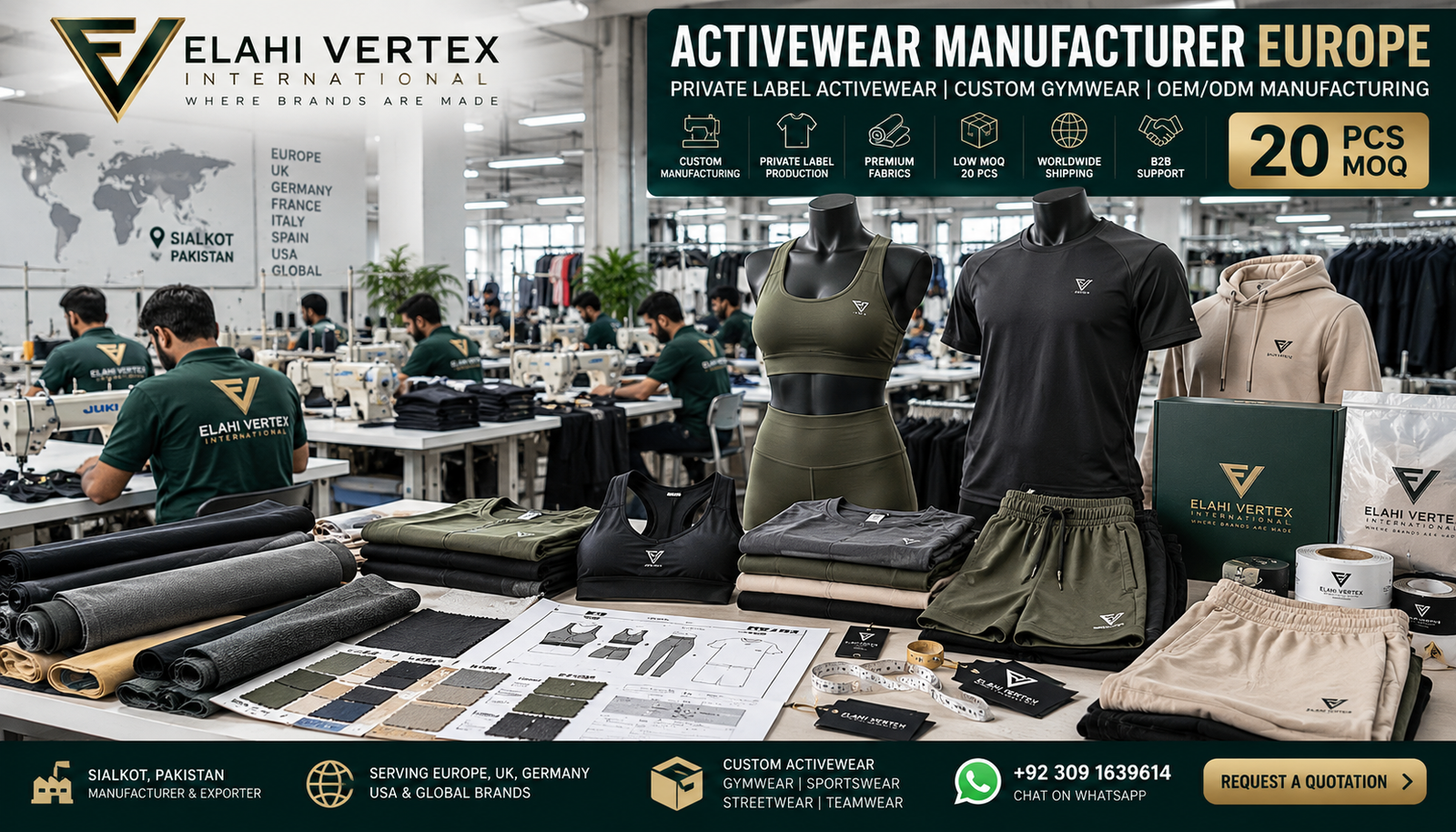
Finding an activewear manufacturer Europe buyers can work with confidently involves more than comparing factory prices. Whether you are launching a fitness clothing brand in Germany, expanding a Shopify activewear store in the United Kingdom, or building an athleisure collection for European customers, your manufacturing decisions affect product quality, customer satisfaction, margins and repeat orders.
A successful activewear collection starts with clear fabric specifications, accurate sizing, suitable construction, reliable customization and realistic production planning. Choosing a manufacturing partner without defining these requirements can lead to expensive revisions, inconsistent fit and inventory that fails to meet customer expectations.
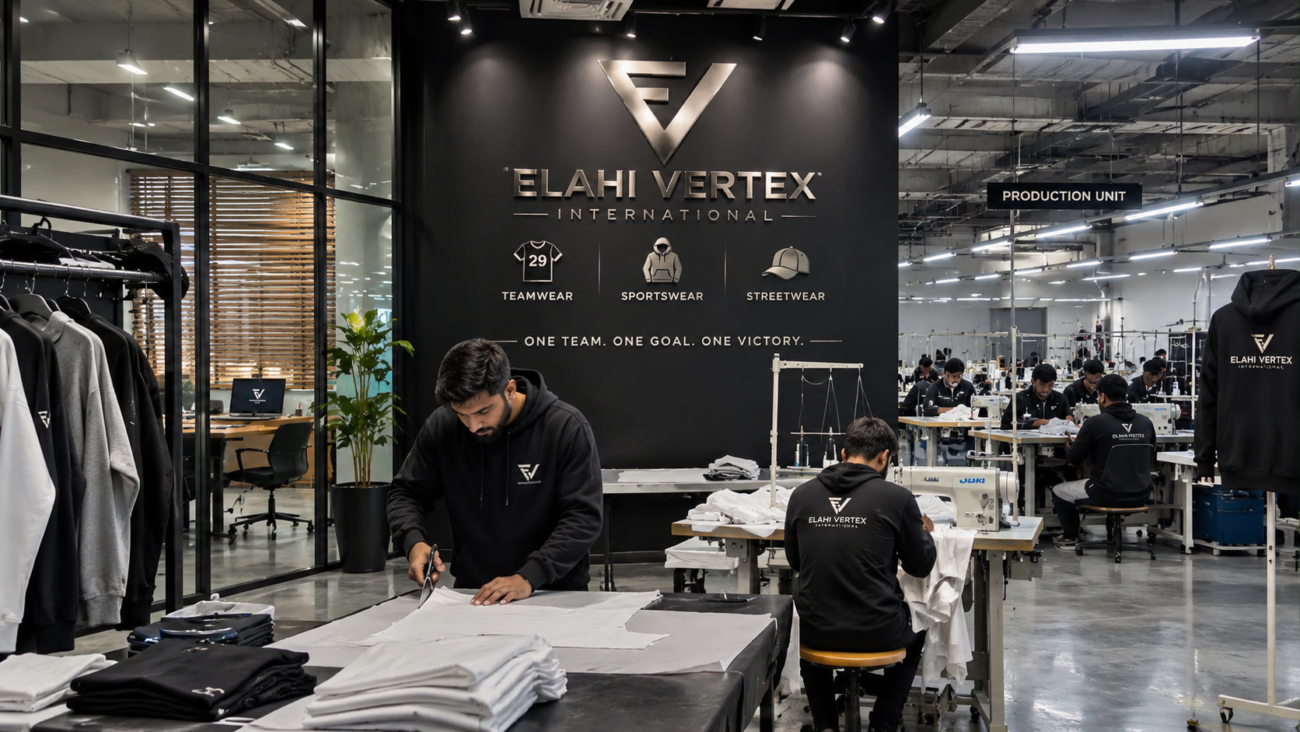
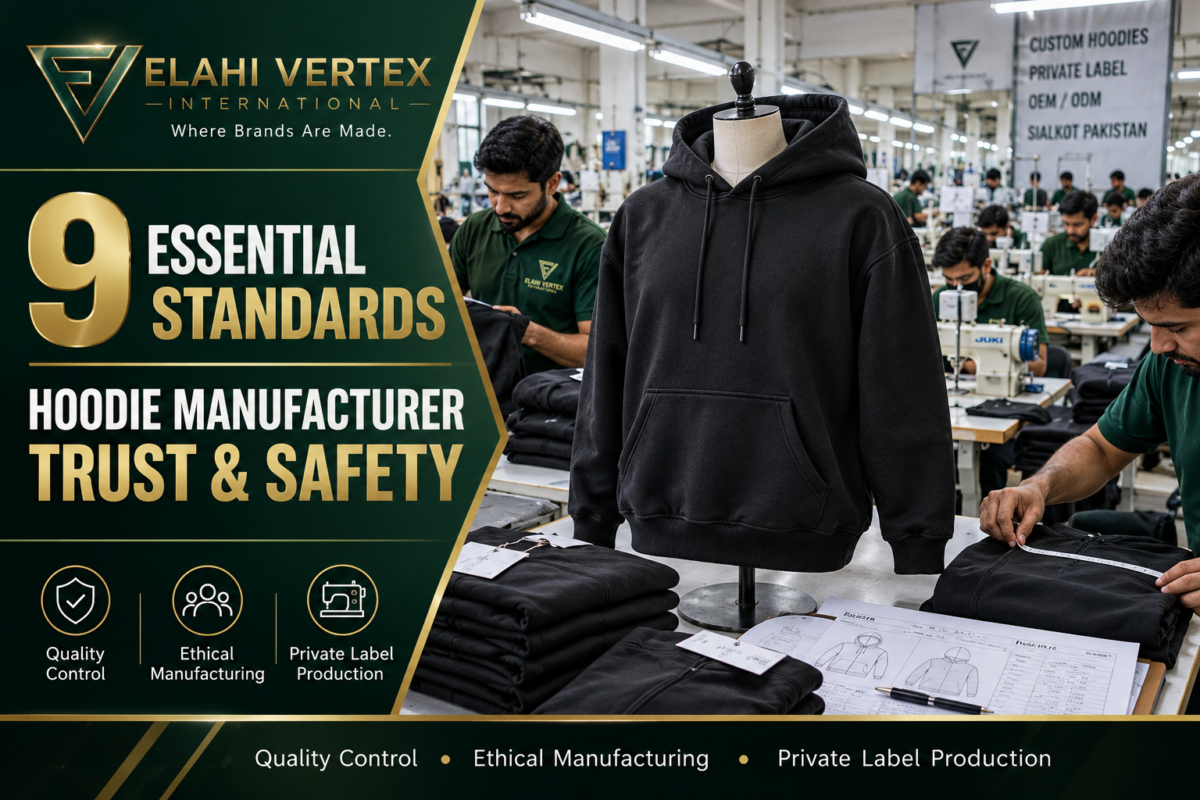
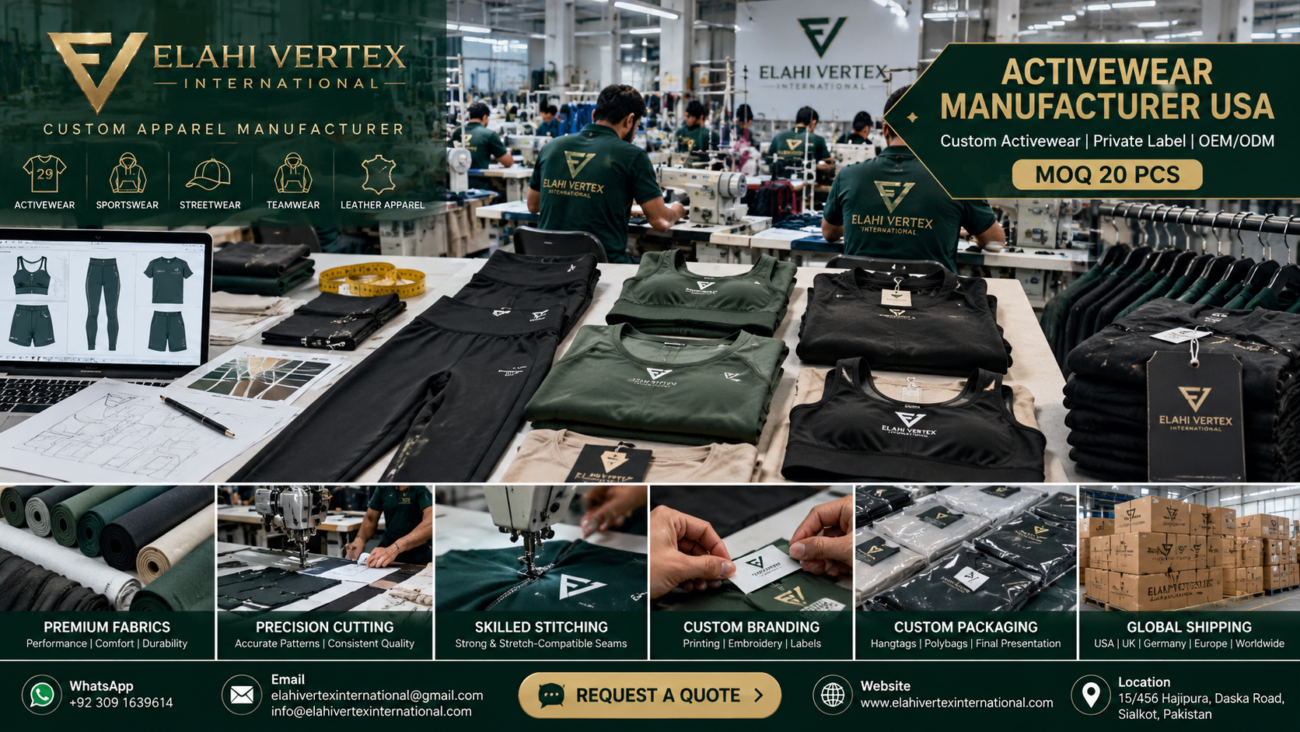
Elahi Vertex International is a Sialkot, Pakistan-based custom apparel manufacturer, exporter, OEM/ODM supplier and private-label clothing manufacturing partner serving international B2B buyers, including brands targeting Europe, Germany, the United Kingdom and the United States.
Our custom manufacturing categories include activewear, gymwear, sportswear, streetwear, teamwear and private-label clothing. Our standard minimum order quantity starts at 20 pieces per product/category, making small-batch product development accessible to emerging brands.
For buyers searching for an activewear manufacturer Europe, it is important to distinguish between factories physically located in Europe and international manufacturers supplying European brands. Elahi Vertex International belongs to the second category.
This guide explains nine essential manufacturing decisions, including fabrics, technical specifications, private-label branding, sampling, quality control, pricing, shipping and supplier selection.
Table of Contents
1. Choose the Right Activewear Manufacturing Partner
A manufacturer should be evaluated on its ability to turn your design into a repeatable commercial product—not simply its willingness to quote a low price.
A new fitness brand might need 20 pieces of custom gymwear to validate its first collection. An established athleisure label might need coordinated production across leggings, sports bras, training tops and shorts. Both buyers require clear specifications and dependable communication, but their commercial priorities differ.
OEM, ODM and private-label manufacturing
| Manufacturing model | What it means | Suitable buyer |
|---|---|---|
| OEM | Manufacturing to buyer-provided designs and specifications | Brands with technical packs and established designs |
| ODM | Manufacturer-assisted design and product development | Brands developing or refining collections |
| Private label | Products manufactured under the buyer’s brand identity | Startups, Shopify brands and growing retailers |
| Custom manufacturing | Production using project-specific materials, patterns, construction and decoration | Brands seeking distinctive products |
A private label activewear manufacturer should be able to discuss the relationship between garment fit, material behavior, branding techniques and order quantities before production begins.
Why supplier location is only one consideration
European manufacturing can offer advantages in geographic proximity and certain supply-chain arrangements. International manufacturing may provide different sourcing and cost structures.
However, neither location automatically guarantees better quality or lower total cost.
Buyers should compare the complete landed cost, including manufacturing, sampling, transport, duties, taxes, compliance and the financial consequences of defective or delayed merchandise.
Manufacturing inquiry: Send your product reference images, technical pack, quantity and delivery destination to Elahi Vertex International for project-specific evaluation.
2. Select Activewear Fabrics Based on Actual Performance
Fabric selection is one of the most important decisions in activewear manufacturing.
A material that performs well for casual leggings may not be appropriate for high-compression training wear. A soft cotton jersey might suit lifestyle fitness clothing but behave differently from a polyester-elastane fabric during intense exercise.
The right material depends on the product’s intended use, customer expectations, fit and performance requirements.
Common activewear fabrics
| Fabric | Typical characteristics | Potential applications |
|---|---|---|
| Polyester and elastane | Stretch, shape recovery and moisture-management potential depending on construction and finish | Training leggings, shorts, sports tops |
| Nylon/polyamide and elastane | Smooth hand feel, stretch and abrasion-resistance potential | Premium leggings, fitted gymwear |
| Cotton and elastane | Natural cotton feel with additional stretch | Lifestyle activewear, casual fitness tops |
| Cotton and polyester fleece | Warmth and comfort depending on construction | Gym hoodies, joggers, warm-up sets |
| Polyester mesh | Lightweight and breathable construction | Training jerseys and ventilation panels |
| Ribbed stretch knit | Textured surface and close-fitting stretch | Fitness tops, leggings and athleisure sets |
| Interlock knit | Relatively stable knit construction | Performance tops, leggings and fitted apparel |
| French terry | Loop-backed knit construction | Lightweight gym sweatshirts and joggers |
These are general material characteristics, not promises that every fabric will deliver a particular performance result.
Understanding GSM
GSM means grams per square metre. It measures fabric weight, not automatically fabric quality.
A heavier fabric is not necessarily more durable, more breathable or more suitable for training. Fabric density, yarn quality, knitting construction, finishing and elastane recovery all matter.
For example, a brand developing squat-proof leggings should evaluate opacity under stretch rather than relying exclusively on GSM.
Important fabric tests
Before approving production, consider evaluating:
- Stretch and recovery after repeated extension.
- Opacity during bending and squatting.
- Colorfastness to washing and perspiration.
- Dimensional stability after laundering.
- Pilling and abrasion resistance.
- Fabric hand feel and surface consistency.
- Seam compatibility and comfort.
Testing requirements and acceptance limits should be agreed for the specific project. A manufacturer should not describe a material as certified, sweatproof or squat-proof without appropriate supporting evidence.
3. Build Accurate Tech Packs and Size Specifications
A tech pack translates a brand’s design idea into manufacturing instructions.
Without one, the buyer and manufacturer may interpret the same reference photograph differently.
A clear activewear tech pack should specify garment dimensions, tolerances, material composition, construction, branding and packaging.
Essential technical information
Product identification: Garment name, style code, collection, revision number and approved reference.
Fabric: Composition, GSM, color, finish, stretch direction and any required performance properties.
Measurements: Chest, waist, hip, garment length, inseam, sleeve length, leg opening and relevant product-specific dimensions.
Construction: Seam placement, stitching type, waistband structure, gussets, pockets, elastic, closures and finishing.
Branding: Logo dimensions, artwork files, decoration method, labels and placement measurements.
Packaging: Folding method, polybag requirements, size stickers, barcode information and carton specifications.
Why measurement tolerances matter
Two garments labelled medium can fit differently because brands use different measurement standards.
For fitted gymwear, small changes in waistband dimensions, rise, crotch construction and fabric recovery can materially change the customer’s experience.
A practical sampling process should therefore compare actual garment measurements against an approved specification sheet.
For growing brands, maintaining consistent sizing across reorders can be as important as achieving the correct fit on the first sample.
4. Develop Private-Label Branding That Survives Real Use
Private-label activewear is not simply generic clothing with a logo added.
Brand identity can be expressed through garment shape, fabric selection, color palette, stitching, decoration, labels and presentation.
A strong private-label collection should feel consistent across multiple products.
Common branding and decoration methods
| Method | Typical use | Key consideration |
|---|---|---|
| Screen printing | Logos and graphics | Artwork, color separation and print durability |
| DTF printing | Multicolor artwork | Transfer feel, stretch and wash performance |
| DTG printing | Detailed designs on suitable fabrics | Fabric compatibility and print preparation |
| Sublimation | Suitable polyester-based products | Fiber composition and color limitations |
| Embroidery | Logos and brand details | Stitch density, backing and fabric distortion |
| Puff printing | Raised graphic effects | Flexibility, thickness and wash performance |
| Silicone or rubber transfers | Performance-inspired branding | Stretch compatibility and adhesion |
| Woven labels | Brand identification | Placement, edge comfort and attachment |
| Heat-transfer labels | Inside-neck or waistband branding | Skin comfort and wash durability |
Not every decoration technique is appropriate for every activewear fabric.
For example, a large, relatively rigid graphic may reduce comfort on a high-stretch garment. Embroidery on lightweight fitted fabric can introduce puckering if its structure and backing are not suitable.
Elahi Vertex International discusses printing, embroidery, private-label customization and garment construction according to each project’s requirements. Specific processes, materials and results should be confirmed before production approval.
Branding for Shopify fitness brands
Shopify brands often rely heavily on product photography, consistent presentation and customer reviews.
This makes physical product consistency especially important. A customer who purchases a second colorway expects similar fit, fabric feel and construction.
For that reason, emerging brands should establish an approved reference sample and retain clear specifications for future production.
5. Use Sampling to Reduce Commercial Risk
Sampling is the point where design assumptions become physical evidence.
A sample allows buyers to evaluate whether the proposed product matches their expectations before committing to larger quantities.
For fitted activewear, the approval process should include both visual inspection and practical wear evaluation.
Recommended sampling sequence
- Submit the design, reference images or tech pack.
- Confirm the proposed materials and manufacturing specifications.
- Agree on sample cost, shipping and payment terms.
- Produce the sample according to approved instructions.
- Inspect measurements, construction, decoration and finishing.
- Conduct appropriate wear and wash evaluations.
- Document revisions and approve the final reference.
- Confirm bulk production specifications and commercial terms.
Elahi Vertex International’s standard sample arrangement requires the buyer to pay the sample cost and shipping upfront. A qualifying bulk order may receive a credit for the sample production cost, subject to the agreed terms; shipping is separate and is not credited.
Sample turnaround depends on the approved design, material availability and project complexity. A project-specific completion date should be confirmed before payment.
Why sample approval matters
A photograph may show the correct silhouette while hiding problems with stretch recovery, fabric opacity or seam comfort.
For this reason, brands should avoid approving fitted performance apparel solely from product images.
A physical sample is particularly valuable when launching leggings, sports bras, compression products or garments requiring close body contact.
6. Understand MOQ, Pricing and Production Economics
For startups, minimum order quantity influences the amount of capital tied up in inventory.
Ordering too many units before validating demand can create unnecessary financial exposure. Ordering too few may increase unit costs and reduce the commercial viability of a product.
Elahi Vertex International’s standard MOQ is 20 pieces per product/category.
This provides an entry point for brands developing smaller private-label collections, although individual fabric, color, size and customization arrangements must be confirmed for each order.
What affects manufacturing cost?
The main variables include fabric composition, fabric consumption, construction complexity, decoration, trims, labels, packaging, production quantity and shipping requirements.
A premium nylon-elastane legging with custom contour panels, specialized seams and branded packaging will have a different cost structure from a basic cotton-blend training shirt.
Compare landed cost, not only factory price
For international buyers, the commercially relevant calculation is:
Landed cost = manufacturing + packaging + international freight + applicable duties + taxes + other import and delivery charges.
The exact treatment depends on the agreed Incoterm and destination.
A low factory quotation can become expensive when freight, customs charges and additional services are excluded.
Before placing an order, request a written quotation that clearly identifies what is included and excluded.
7. Plan Quality Control Before Bulk Manufacturing
Quality control should begin before fabric cutting, not after the garments are finished.
For activewear, production quality depends on the interaction between material selection, pattern accuracy, stitching, decoration and finishing.
Practical inspection priorities
Fabric inspection: Confirm color, composition, appearance and any agreed performance requirements.
Cutting and measurements: Check pattern alignment and dimensional consistency.
Sewing: Examine seam strength, stitch consistency, skipped stitches and finishing.
Decoration: Check logo position, artwork dimensions, adhesion or embroidery quality.
Final garment: Review measurements, appearance, loose threads, labels and packaging.
Shipment preparation: Confirm product counts, size assortment, carton information and dispatch documents.
Brands should agree on inspection methods and acceptance criteria before production.
AQL sampling, independent inspection and laboratory testing can be discussed where commercially appropriate, but they should never be represented as completed unless supported by actual records.
8. Prepare for European, UK and US Market Requirements
Manufacturing a garment and legally placing it on a destination market are different responsibilities.
For European buyers, labeling and product compliance must be considered during product development.
European Union
Regulation (EU) No 1007/2011 establishes requirements for textile fiber names and composition labeling. Textile products marketed to consumers in the EU generally require appropriate fiber composition information, with language requirements depending on the destination country.
Official reference: EU textile labelling guidance.
United Kingdom
Textile products sold in Great Britain must meet applicable fiber-content labeling requirements. Businesses should verify current requirements for their intended market, including any Northern Ireland-specific rules.
Official reference: UK textile labelling guidance.
United States
The Federal Trade Commission explains that most covered textile products require information such as fiber content, country of origin and responsible business identification. Applicable care-label requirements must also be considered.
Official reference: FTC apparel and labeling guidance.
These references are useful starting points, not substitutes for reviewing every regulation applicable to a specific product and destination.
DDP, DAP and shipping responsibilities
DDP means Delivered Duty Paid, under which the seller assumes specified import-related responsibilities under the agreed Incoterms rules.
DAP means Delivered at Place, with a different allocation of import-clearance and duty responsibilities.
Courier choice, shipping method, customs classification and destination requirements can affect delivery costs and timelines.
Buyers should confirm the exact shipping arrangement in writing rather than assuming that every door-to-door quotation includes all duties and taxes.
9. Choose a Manufacturer That Supports Long-Term Brand Growth
The best manufacturing relationship is not necessarily the one offering the cheapest first order.
A reliable supply arrangement should help a brand preserve product specifications, manage quality expectations and plan future collections.
For a startup, this means reducing uncertainty before its first launch.
For an established fitness label, it means maintaining consistent products while expanding its range.
Why consider Elahi Vertex International?
Elahi Vertex International is positioned as a custom activewear, gymwear and private-label clothing manufacturing partner for international B2B buyers.
Its offering is relevant to emerging and established brands seeking:
- Custom product development and manufacturing discussions.
- Private-label garments and branding options.
- Small-batch production beginning at 20 pieces per product/category.
- Sampling before bulk commitments.
- Manufacturing support for multiple apparel categories.
- International export arrangements subject to destination and order requirements.
- Communication around specifications, revisions and production approval.
A brand considering a new supplier should evaluate actual samples, quotations, documentation, communication quality and agreed production arrangements before making a purchasing decision.
Discuss your collection: Contact Elahi Vertex International on WhatsApp or email elahivertexinternational@gmail.com with your designs, product categories, estimated quantities and destination.
Manufacturing for Fitness Brands in Europe, Germany, the UK and USA
European Union
Fitness brands operating across the European Union often need consistent product specifications across different retail markets. A manufacturing partner supplying European buyers should understand the importance of fiber labeling, product documentation, packaging requirements and country-specific commercial arrangements. Elahi Vertex International can discuss custom activewear production for brands serving EU customers, with compliance and shipping terms confirmed for each project.
Germany
German gymwear and athleisure brands may prioritize clear technical specifications, consistent fit, accurate product descriptions and reliable commercial documentation. Brands developing leggings, training shirts, shorts and coordinated fitness collections should establish approved materials and measurements before bulk production. Elahi Vertex International welcomes manufacturing inquiries from German businesses seeking an international private-label production partner.
United Kingdom
UK startups, online fitness retailers and established clothing labels can benefit from a structured approach to product development. This includes selecting appropriate fabrics, confirming sample measurements and understanding landed costs before committing to inventory. Elahi Vertex International supports discussions with UK brands seeking custom gymwear, private-label activewear and related apparel manufacturing.
United States
US fitness brands and Shopify businesses sourcing internationally should evaluate product quality alongside shipping, labeling, payment terms and total landed costs. Elahi Vertex International offers a manufacturing inquiry route for US brands developing custom activewear, sportswear and private-label collections. Product specifications, sample approvals and shipping responsibilities should be established before bulk production.
Frequently Asked Questions
1. What is an activewear manufacturer Europe buyers can use?
An activewear manufacturer Europe buyers can use may be based within Europe or internationally. The important distinction is whether the supplier can meet the brand’s product, quality, commercial and destination requirements.
2. Is Elahi Vertex International based in Europe?
No. Elahi Vertex International is based in Sialkot, Pakistan, and works as a custom apparel manufacturer and exporter for international B2B buyers.
3. Does Elahi Vertex International offer private-label activewear?
Yes. Private-label clothing and custom activewear are among its manufacturing categories. Specific garment designs, fabrics and branding arrangements are discussed by project.
4. What is the minimum order quantity?
The standard MOQ is 20 pieces per product/category. Any proposed size or color arrangement must be confirmed for the particular order.
5. Can a startup fitness brand order custom gymwear?
Yes. Startups can inquire about custom gymwear manufacturing, including smaller initial production orders that meet the applicable MOQ.
6. Can Shopify brands use a private-label manufacturer?
Yes. Shopify is a sales platform, and Shopify-based clothing businesses can source custom private-label products from manufacturing partners.
7. What fabrics are suitable for gym leggings?
Common options include polyester-elastane and nylon-elastane blends. The right choice depends on the required stretch, opacity, hand feel, durability and garment fit.
8. Is a heavier GSM always better for activewear?
No. GSM measures fabric weight. Performance also depends on composition, construction, finishing and intended use.
9. Can activewear be customized with embroidery?
Yes, where fabric and garment construction are suitable. Embroidery placement, backing and stitch density should be evaluated during development.
10. Is DTF printing suitable for stretch activewear?
It can be suitable for certain products, but transfer flexibility, adhesion, wash resistance and comfort must be evaluated for the intended fabric.
11. Can a brand request custom woven labels?
Custom woven labels are a common private-label branding option. Their specifications and commercial arrangements should be confirmed before production.
12. Should buyers request physical samples?
Physical samples are strongly recommended, particularly for fitted performance garments where stretch, comfort and construction are important.
13. Are samples automatically free?
No. Elahi Vertex International’s standard arrangement requires payment for the sample and shipping upfront, with potential sample production cost credit on qualifying bulk orders under agreed terms.
14. Can a manufacturer guarantee squat-proof leggings?
A claim should be supported by appropriate material and garment testing. Opacity can change under stretch, lighting and different fit conditions.
15. What is the difference between OEM and ODM?
OEM generally involves manufacturing to buyer-provided specifications. ODM involves a manufacturer contributing more substantially to product design or development.
16. Can a private-label manufacturer produce matching gymwear sets?
Matching collections are a common private-label manufacturing project. Fabric availability, color consistency, sizing and production requirements should be confirmed.
17. What should be included in an activewear quotation?
Product specifications, quantity, materials, decoration, labels, packaging, sample arrangements, lead time, payment terms and shipping responsibilities.
18. Can European brands source activewear from Pakistan?
Yes. European brands can source internationally, provided the relevant commercial, customs, product and regulatory requirements are satisfied.
19. What should buyers check before approving bulk production?
They should confirm the approved sample, measurements, materials, decoration, packaging, quantity, price, payment terms and delivery arrangements.
20. How can I request a manufacturing quotation?
Send Elahi Vertex International your product designs or reference images, required quantities, customization details and destination through WhatsApp or email.
Conclusion: Build an Activewear Collection Around Product Quality and Commercial Clarity
Choosing an activewear manufacturer Europe brands can depend on requires careful supplier evaluation, not simply a comparison of unit prices.
Fabric performance, accurate measurements, private-label branding, physical sampling, quality requirements and import responsibilities all influence the success of a fitness clothing collection.
Elahi Vertex International provides a manufacturing inquiry route for startups, Shopify businesses, established fitness labels and international apparel buyers seeking custom activewear, gymwear and private-label clothing.
Whether you are preparing a first collection or planning your next production run, the most productive starting point is a clear product specification and a realistic commercial discussion.
Start your private-label activewear project with Elahi Vertex International.
Website: https://www.elahivertexinternational.com/
WhatsApp: https://wa.me/message/OWIPAIXYWHTPI1
Email: elahivertexinternational@gmail.com
Phone: +92 309 1639614
Google Business Profile: https://share.google/E9pGN5XWlP39MWTM9
Alibaba: https://elahivertexinternational.trustpass.alibaba.com/
Activewear Manufacturer Europe: Advanced Buyer Questions, Supplier Verification and Private Label Growth
25. How Emerging Fitness Brands Can Move from Their First Order to Repeat Production
Finding an activewear manufacturer Europe brands can work with is only the beginning. A successful private-label clothing business must also develop a repeatable manufacturing and inventory strategy.
For startup fitness brands, the first collection should provide commercial information. It should help establish which garments customers purchase, which sizes sell, whether the selling price is viable and whether product quality supports repeat purchases.
A brand should not automatically increase its next order simply because its initial launch generated interest. Sales volume, contribution margin, return rates and customer feedback are more useful indicators.
Preserve the approved manufacturing specification
Every approved product should have a clear specification record containing its fabric, measurements, construction, decoration, labels and packaging.
If a brand orders the same leggings six months later, the original reference sample and technical documents should be available for comparison.
Without these records, small differences between production runs can accumulate.
Evaluate reorder readiness
Before placing a repeat order, a fitness brand should review:
- Actual sales rather than social-media interest alone.
- Product return and exchange reasons.
- Customer comments about fit, comfort and durability.
- Remaining inventory by size and color.
- Manufacturing and shipping costs.
- Expected demand during the next selling period.
- Available cash after accounting for other business expenses.
A private label manufacturer can support repeat production according to agreed specifications, but the brand must determine whether another order is financially justified.
Avoid unnecessary collection expansion
Launching additional product categories can increase revenue opportunities, but it also introduces new sampling, inventory, sizing and marketing requirements.
A startup selling one successful training T-shirt may benefit more from improving its core product than immediately introducing ten unrelated garments.
The correct decision depends on demonstrated customer demand.
26. Supplier Verification and Manufacturing Transparency
An activewear manufacturer Europe buyers evaluate should be willing to discuss the information needed to establish a credible commercial relationship.
Supplier verification should be proportional to the order value and risks involved.
For an initial small order, business identification, sample approval, written specifications and clear payment terms may be particularly important.
For a larger or technically complex order, additional documentation, inspections or independent verification may be appropriate.
Business verification
Buyers should confirm the legal identity of the contracting supplier, its business address and the beneficiary details used for payment.
A website, social-media profile or business listing is not equivalent to independent verification of every manufacturing claim.
Manufacturing-process verification
Where relevant, buyers can request information about cutting, sewing, decoration, finishing and quality-control arrangements.
A manufacturer may operate several facilities or use approved specialist partners for selected processes.
The buyer should understand which arrangements apply to the specific product.
Product verification
Physical samples are important because a supplier’s general capabilities do not establish that a particular garment meets the buyer’s specifications.
Sample evaluation should address the actual product, not simply unrelated examples of previous manufacturing work.
Elahi Vertex International business information
Elahi Vertex International identifies itself as a Sialkot, Pakistan-based manufacturer, exporter, OEM/ODM and private-label clothing partner.
Its company-provided registration details include NTN A003087-0 and Sialkot Chamber of Commerce & Industry membership A-101588.
These details provide a starting point for buyer verification; independent confirmation should be obtained where required.
Official company website: https://www.elahivertexinternational.com/
Google Business Profile: https://share.google/E9pGN5XWlP39MWTM9
27. Building a Profitable Private Label Activewear Brand
A private label manufacturer helps turn specifications into physical products. Profitability, however, depends on the complete business model.
A fitness clothing brand must earn enough revenue to cover product costs, logistics, customer acquisition, returns, platform expenses and operating overhead.
Understand contribution margin
Gross margin is useful, but contribution margin provides additional insight into the economics of each sale.
For example, a garment may have an attractive difference between retail price and landed manufacturing cost while still generating limited profit after advertising and fulfillment.
Brands should calculate the actual costs associated with acquiring and serving customers.
Consider size-level inventory
Apparel inventory is more complex than a single stock quantity.
A product may sell well overall while certain sizes remain unsold.
For that reason, repeat orders should be based on actual size-level demand whenever possible.
Maintain consistent quality
Product inconsistency can create costs beyond replacement merchandise.
Returns, refunds, negative reviews and reduced customer confidence can affect the commercial value of a collection.
A private label manufacturer should therefore be assessed on specification clarity and repeatability, not simply initial unit price.
Develop long-term supplier relationships
Long-term manufacturing relationships can support better communication and clearer production planning.
However, supplier loyalty should not replace periodic evaluation of product quality, pricing, delivery performance and commercial risk.
A healthy buyer-supplier relationship is based on documented expectations and consistent execution.
28. Frequently Asked Questions — 61 to 100
61. Which activewear manufacturer Europe is suitable for a new fitness brand?
The most suitable supplier depends on the brand’s product specifications, budget, quantity and destination. Elahi Vertex International is one international manufacturing option for brands considering custom activewear and private-label production.
62. Can a private label manufacturer help with a fitness clothing startup’s first collection?
Yes. A private label manufacturer can help discuss garment development, manufacturing specifications, customization and sampling. The brand must still validate customer demand and commercial viability.
63. How much money do I need to launch a private-label activewear brand?
There is no universal starting budget. Required capital depends on product complexity, sampling, manufacturing quantities, shipping, import charges, marketing and operating expenses.
64. Can I start a gymwear brand with 20 pieces?
Elahi Vertex International’s standard MOQ is 20 pieces per product/category. Whether that quantity makes commercial sense depends on the proposed product, costs and launch strategy.
65. Is an activewear manufacturer Europe always more expensive than a Pakistan-based manufacturer?
Not necessarily. Cost comparisons must account for product specifications, order quantity, freight, duties, taxes, quality requirements and other commercial factors.
A private label manufacturer with suitable capabilities can help execute premium product specifications. Premium positioning should be supported by material quality, construction, finishing and consistent customer experience.
67. What is the difference between private-label activewear and wholesale gymwear?
Private-label activewear is produced under a buyer’s brand, while wholesale gymwear may involve purchasing existing products for resale. The exact customization available depends on the supplier.
68. Can I sell custom activewear under my own brand name?
Yes, provided you have the necessary rights to your branding and comply with applicable product and market requirements.
69. How do I protect my clothing designs when working with a private label manufacturer?
Use clear written agreements addressing design ownership, permitted use, confidentiality and applicable intellectual-property rights. Legal protection depends on the jurisdiction and circumstances.
70. Should a startup sign an NDA before sharing activewear designs?
An NDA may be appropriate for confidential or commercially sensitive information. Its usefulness depends on the design, relationship and enforceability of the agreement.
71. Can an activewear manufacturer Europe help produce clothing for an online-only brand?
Yes. Online-only brands can work with domestic or international manufacturers. The brand should establish suitable inventory, fulfillment and customer-service arrangements.
72. How do I choose a private label manufacturer for a Shopify gymwear store?
Evaluate product capability, MOQ, sample quality, communication, pricing, payment terms, shipping and repeat-order consistency.
73. What are the most important specifications for custom leggings?
Fabric composition, stretch, opacity, waistband construction, rise, inseam, measurements, seams and decoration are among the important considerations.
74. Can a private label manufacturer make different leggings lengths?
Different inseam lengths may be possible depending on pattern development and order requirements. Specifications and quantities should be agreed before production.
75. Can custom activewear be manufactured in plus sizes?
Yes, where the manufacturer can support the required pattern development and size range. Proper grading and fit evaluation are important.
76. Is one sample enough to approve an entire activewear size range?
Not always. A single sample may not establish that grading works across all sizes. Additional size-set samples may be appropriate for fitted or technically demanding products.
77. Can an activewear manufacturer Europe make maternity fitness clothing?
Some manufacturers can develop maternity activewear. Such products require particular attention to fit, comfort, intended use and any applicable safety considerations.
78. Can a private label manufacturer produce yoga clothing?
Yes, where the supplier offers suitable product categories and manufacturing capabilities. Yoga garments should be developed around the intended movement, comfort and coverage requirements.
79. What is the difference between yoga leggings and running leggings?
The designs may differ in compression, fabric feel, pocket construction, waistband stability, seams and intended performance. Neither category has one universal specification.
80. Can an activewear manufacturer Europe produce tennis or padel clothing?
Manufacturers with suitable sportswear capabilities may produce these categories. Buyers should provide sport-specific designs, material requirements and size specifications.
81. Can Elahi Vertex International manufacture private-label sportswear?
Yes. Custom sportswear and private-label clothing are among the company’s manufacturing categories. Individual product requirements must be reviewed before confirmation.
82. Can a private label manufacturer create custom fitness uniforms?
Manufacturers offering custom sportswear or teamwear may produce fitness-related uniforms. Branding, materials and sizing should be specified.
83. What are the best printing methods for private-label gymwear?
There is no universally best method. Screen printing, DTF, sublimation and other techniques have different material and design requirements.
84. Can I put reflective logos on custom activewear?
Reflective decoration may be possible using suitable materials and application methods. Performance and safety claims require appropriate supporting evidence.
85. Can a private label manufacturer create minimalist gymwear without visible logos?
Yes. Minimalist designs can use subtle branding, tonal decoration or internal labels, subject to the brand’s specifications and applicable labeling rules.
86. What should I check when comparing activewear samples from different factories?
Compare fabric composition, weight, fit, measurements, seams, finishing, decoration, comfort and performance against the same written specification.
87. Is the cheapest activewear manufacturer Europe the best choice for a startup?
Not necessarily. A low price may be attractive, but poor quality, unexpected costs or unreliable production can undermine the savings.
88. Can a private label manufacturer provide a quotation before sampling?
A manufacturer may provide a preliminary quotation from sufficiently detailed specifications. Final pricing can depend on material confirmation, sampling and other agreed details.
89. What information is needed for a DDP activewear quotation?
Typically, the manufacturer needs product specifications, quantities, shipment details and the complete delivery destination. Applicable customs and import arrangements must also be established.
90. Can European startups import private-label clothing from Pakistan?
Yes, subject to applicable customs, product compliance, tax and commercial requirements.
91. What is the best way to avoid activewear production delays?
Finalize specifications early, confirm material availability, approve samples promptly and agree on realistic production milestones.
92. Can a private label manufacturer guarantee urgent production?
Urgent production should not be guaranteed without checking capacity, materials, complexity and logistics. A project-specific schedule is necessary.
93. How do I manage quality across repeat orders?
Maintain approved specifications, reference samples, measurement tolerances, material requirements and documented inspection criteria.
94. Can a private label manufacturer help a brand expand from gymwear into streetwear?
A manufacturer offering both categories may support the expansion. Each new product still requires its own specifications, costing and approval process.
95. Should I manufacture all my fitness products with one supplier?
A single supplier may simplify coordination, but it can also concentrate operational risk. The decision depends on capability, reliability, product range and commercial terms.
96. Can Elahi Vertex International work with established fitness brands?
Yes. Elahi Vertex International serves international B2B buyers, including startups and established clothing businesses seeking custom manufacturing arrangements.
97. How do I know whether a private label manufacturer is suitable for my brand?
Assess actual product capability, sample results, pricing, documentation, communication and the manufacturer’s ability to meet your specific requirements.
98. What should I do if my first activewear sample needs changes?
Document each requested revision precisely, update the technical specification and agree on the next approval step before production proceeds.
99. How can I build a long-term relationship with an activewear manufacturer Europe buyers can rely on?
Use clear specifications, realistic planning, documented approvals, fair commercial agreements and consistent performance reviews.
100. How can I start manufacturing private-label activewear with Elahi Vertex International?
Contact Elahi Vertex International with your designs, product categories, estimated quantities, customization requirements and delivery destination.
The company can review your inquiry and discuss project-specific sampling, manufacturing and quotation arrangements.
WhatsApp: https://wa.me/message/OWIPAIXYWHTPI1
Website: https://www.elahivertexinternational.com/
Email: elahivertexinternational@gmail.com
29. Final Buyer Checklist: Before Selecting an Activewear Manufacturing Partner
A professional sourcing decision should be based on documented product and commercial requirements.
Before placing an order, confirm that the supplier understands the intended product, the technical specification is complete and the sample-approval process is agreed.
Check that the written quotation clearly identifies the products, quantities, costs, payment terms and shipping responsibilities.
For fitted activewear, ensure that the approved sample has been evaluated for the intended use.
Verify relevant business information and agree on how quality issues, revisions and unexpected production changes will be handled.
The objective is not to eliminate every possible commercial risk. It is to make the risks visible, measurable and manageable before committing capital.
30. Why Consider Elahi Vertex International for Custom Activewear Manufacturing?
Elahi Vertex International is a Sialkot, Pakistan-based custom apparel manufacturer, exporter, OEM/ODM supplier and private-label manufacturing partner.
The company serves international B2B buyers seeking custom clothing production, including emerging fitness brands, Shopify businesses, established clothing labels and other commercial buyers.
Relevant product categories include custom activewear, gymwear, sportswear, streetwear, hoodies, sweatshirts and private-label apparel.
For brands looking for an activewear manufacturer Europe, Elahi Vertex International offers an international sourcing option rather than a factory physically located in Europe.
Its standard MOQ is 20 pieces per product/category.
Buyers can discuss product specifications, fabric options, customization, sampling, production and international delivery arrangements according to their individual requirements.
Request a manufacturing quotation
To receive a meaningful quotation, send your product reference images or tech packs, material requirements, expected quantities, branding details and delivery destination.
Elahi Vertex International — Where Brands Are Made.
Website: https://www.elahivertexinternational.com/
WhatsApp: https://wa.me/message/OWIPAIXYWHTPI1
Email: elahivertexinternational@gmail.com
Phone: +92 309 1639614
Alibaba: https://elahivertexinternational.trustpass.alibaba.com/
Google Business Profile: https://share.google/E9pGN5XWlP39MWTM9
EUROPEAN UNION — COMPLIANCE AND TEXTILE REGULATIONS
1. European Commission — Textile Labelling EU Textile Labelling Requirements
Supports fiber composition, labeling and European market requirements. Place in Section 8.
2. European Commission — Product Safety EU Product Safety Rules
Supports product safety and obligations for businesses selling in the EU. Place in Section 8.
European Commission
3. European Commission — REACH Restrictions REACH Chemical Restrictions
Supports chemical safety and restrictions relevant to textiles, clothing and footwear. Place in Section 17.
Internal Market & SMEs
4. EUR-Lex — Textile Regulation (EU) No 1007/2011 EU Textile Fibre Regulation
Primary legal reference for textile fiber naming and composition labeling. Place in Section 8.
5. European Environment Agency — Textiles European Textile Sustainability Research
Supports discussion of textile environmental impacts and circularity. Place in Section 27.
UK AND USA — LABELING AND IMPORT REQUIREMENTS
6. UK Government — Textile Labelling UK Textile Labelling Guidance
Supports UK fiber-content and labeling requirements. Place in Section 18.
7. UK Government — Trade Tariff UK Import Tariff Lookup
Helps UK buyers research customs classifications and applicable duties. Place in Section 18.
8. US Federal Trade Commission — Textile Fiber Rule FTC Textile Fiber Rule
Supports US fiber composition, origin and responsible-business labeling. Place in Section 20.
Federal Trade Commission
9. US Federal Trade Commission — Care Labeling Rule FTC Clothing Care Labeling Rule
Supports care-instruction requirements for covered garments. Place in Section 15.
Federal Trade Commission
10. US Federal Trade Commission — Textile Labeling Guide FTC Textile and Wool Labeling Guide
Supports practical US garment labeling and disclosure guidance. Place in Section 20.
Federal Trade Commission
FABRIC PERFORMANCE — INTERNATIONAL STANDARDS
11. ISO 105-C06 — Washing Colorfastness Textile Washing Colorfastness Standard
Supports wash durability and color retention in activewear. Place in Section 7.
ISO
12. ISO 105-E04 — Perspiration Colorfastness Textile Perspiration Resistance Testing
Especially relevant to sweat-exposed gymwear and sportswear. Place in Section 2.
Part E04: Colour fastness to perspiration
13. ISO 5077 — Dimensional Change Textile Washing and Shrinkage Testing
Supports garment shrinkage and dimensional stability discussions. Place in Section 7.
ISO
14. ISO 12945-2 — Fabric Pilling Fabric Pilling Resistance Testing
Supports fabric surface durability evaluation. Place in Section 2.
Part 2: Modified Martindale method
15. ISO 105-J03 — Color Difference Measurement Textile Color Difference Assessment
Supports color matching for leggings, sports bras and coordinated gymwear sets. Place in Section 12.
Part J03: Calculation of colour differences
INTERNATIONAL TRADE AND SUSTAINABILITY
16. European Commission — Access2Markets EU Access2Markets Portal
Useful for researching tariffs, origin rules and EU import requirements. Place in Section 19.
17. International Chamber of Commerce — Incoterms ICC Incoterms Rules
Supports DDP, DAP and international delivery responsibilities. Place in Section 8.
ICC WBO Library
18. OEKO-TEX — STANDARD 100 OEKO-TEX STANDARD 100
Helps explain textile testing for harmful substances and certification verification. Place in Section 26.
19. Global Organic Textile Standard — GOTS Global Organic Textile Standard
Supports discussion of organic textile certification and supply-chain requirements. Place in Section 27.
20. Textile Exchange — Textile Sustainability Standards Textile Exchange
Useful for understanding preferred fibers, recycled materials and responsible sourcing. Place in Section 27.
B. Five relevant international activewear brand links
These five brands are appropriate as market examples for design, product positioning and customer segmentation. They are not verified customers, suppliers or commercial partners of Elahi Vertex International.

1. Gymshark — United KingdomOfficial Gymshark Website
Relevant for gymwear branding, training collections and digital-first fitness apparel positioning. Place in Section 18.

2. lululemon — Canada / InternationalOfficial lululemon Website
Relevant for technical leggings, yoga apparel, premium athleisure and product differentiation. Place in Section 12.

3. adidas — GermanyOfficial adidas Website
Relevant for performance sportswear, international product categories and training apparel. Place in Section 17.

4. Nike — United StatesOfficial Nike Website
Relevant for technical training clothing, sportswear design and broad product positioning. Place in Section 20.

5. Oysho — Spain / EuropeOfficial Oysho Website
Relevant for women’s fitness collections, yoga, Pilates and coordinated athleisure. Place in Section 19.
100 Frequently Asked Questions About Activewear Manufacturing in Europe
A. Finding an Activewear Manufacturer for European Brands
1. Who is a suitable activewear manufacturer Europe startups can contact?
Elahi Vertex International is a Sialkot, Pakistan-based custom apparel manufacturer and exporter serving international B2B buyers, including European fitness startups. It offers custom activewear and private-label manufacturing inquiries with a standard MOQ of 20 pieces per product/category. Buyers should assess samples, technical capability, pricing and delivery terms before selecting a supplier.
2. Does an activewear manufacturer Europe supplier have to operate a factory inside Europe?
No. A manufacturer serving European brands may operate inside or outside Europe. Elahi Vertex International manufactures in Pakistan and supplies international buyers. European brands should distinguish manufacturing location from the ability to meet their specifications, import requirements and commercial expectations.
3. How do I find a reliable private label activewear manufacturer for my fitness brand?
Start by checking business identification, relevant manufacturing experience, physical samples, material options, MOQ and written quotations. A reliable private label activewear manufacturer should communicate clearly about specifications, sampling, revisions, payment and shipping. Avoid selecting a supplier solely because it advertises the lowest unit price.
4. What makes Elahi Vertex International relevant to European activewear startups?
Elahi Vertex International offers custom activewear, sportswear, gymwear and private-label clothing manufacturing from Sialkot, Pakistan. Its 20-piece MOQ per product/category provides a starting point for smaller commercial orders. The company can review buyer-provided designs and discuss sampling, customization and international delivery arrangements.
5. How is a custom activewear manufacturer different from a clothing wholesaler?
A custom activewear manufacturer produces garments according to agreed product specifications, while a wholesaler generally sells existing merchandise. Custom manufacturing may involve fabric selection, pattern development, printing, embroidery, labels and packaging. The available customization depends on the supplier and project.
6. Can a gymwear manufacturer Europe brands work with be located in Pakistan?
Yes. European gymwear businesses can source internationally, including from Pakistan. A gymwear manufacturer Europe buyers evaluate should be assessed for technical suitability, commercial terms, customs responsibilities and destination-market compliance rather than location alone.
7. What should I ask a private label clothing manufacturer before placing an order?
Ask about minimum quantities, fabric specifications, sample costs, production arrangements, quality criteria, payment terms, labeling and shipping. A private label clothing manufacturer should provide a written quotation that clearly explains what is included and excluded.
8. Which countries can Elahi Vertex International serve?
Elahi Vertex International welcomes manufacturing inquiries from international B2B buyers, including businesses in the UK, Germany, France, Italy, Spain, other European markets and the United States. Shipping feasibility, cost and terms must be confirmed for each destination.
9. Is a European factory automatically better than an overseas activewear manufacturer?
No. Manufacturing quality depends on materials, technical capability, process control, communication and execution. European production may offer proximity advantages, while international suppliers may offer different sourcing arrangements. Buyers should compare verified capabilities and total landed costs.
10. What is the best way to compare activewear manufacturers?
Send the same technical specifications to shortlisted suppliers. Compare sample quality, materials, manufacturing costs, MOQ, shipping, communication and contractual terms. A consistent comparison is more useful than evaluating quotations based on different garment specifications.
B. Private Label Activewear for Startups
11. Can I start a private-label activewear brand with a small order?
Yes. Elahi Vertex International’s standard MOQ is 20 pieces per product/category. A smaller initial order may help test demand, although startup founders should also calculate sampling, shipping, marketing and other operating expenses.
12. What does a private label activewear manufacturer do?
A private label activewear manufacturer produces clothing that is sold under the buyer’s brand. Depending on the project, this can include custom designs, fabric selection, logo application, labels, packaging and bulk manufacturing.
13. Can Elahi Vertex International manufacture activewear for a new Shopify brand?
Yes. Shopify fitness brands can inquire about custom activewear, gymwear and private-label clothing manufacturing. They should provide reference designs, estimated quantities, branding requirements and the delivery destination.
14. Do I need a registered clothing company before contacting a manufacturer?
Not necessarily for an initial inquiry. However, legal registration, importing, tax and selling requirements depend on the buyer’s country and business activities. Buyers should establish the appropriate business arrangements before commercial transactions.
15. What products should a new activewear brand launch first?
A startup should select products that address a clearly defined customer need. Leggings, training T-shirts, gym shorts or coordinated sets may be suitable candidates, but the best starting collection depends on market research, pricing and available capital.
16. Can a private label clothing manufacturer help develop my first collection?
A private label clothing manufacturer may assist with garment specifications, sampling and production planning. The brand should still define its target audience, design direction and commercial objectives.
17. How many designs should a fitness startup manufacture initially?
There is no universal number. A focused collection can reduce development costs and inventory complexity. Brands should consider their budget, expected demand and minimum order requirements before introducing multiple styles.
18. Is a 20-piece MOQ suitable for testing an activewear business?
A 20-piece order can provide a small initial quantity for a qualifying product/category, but it does not guarantee market validation. Customer feedback, sales, returns and profitability determine whether a product deserves further investment.
19. Can I launch a fitness clothing brand without designing every garment from scratch?
Some private-label manufacturing arrangements allow buyers to adapt existing garment concepts, while others involve fully custom development. Buyers should clarify design ownership, customization limits and the manufacturing approach before ordering.
20. What is the biggest mistake new fitness brands make when choosing manufacturers?
A common mistake is ordering bulk inventory before approving a suitable physical sample and calculating the complete landed cost. Clear specifications, realistic budgets and documented approvals help reduce this risk.
C. Fabrics, GSM and Performance
21. What fabrics can a custom activewear manufacturer use for gymwear?
Common options include polyester-elastane, nylon-elastane, cotton-elastane, interlock, mesh and fleece fabrics. A custom activewear manufacturer should evaluate the intended garment, stretch, comfort, durability and appearance before recommending a material.
22. Is nylon or polyester better for gym leggings?
Neither is universally better. Nylon and polyester fabrics can differ in feel, moisture behavior, durability and appearance. Fabric construction, elastane content and finishing also influence performance.
23. What does GSM mean in activewear manufacturing?
GSM means grams per square metre. It measures fabric weight. It does not independently establish fabric quality, breathability, opacity or durability.
24. What GSM is suitable for premium leggings?
The appropriate GSM depends on fabric composition, knit structure, stretch, opacity and intended use. Brands should evaluate physical samples rather than relying on a single weight specification.
25. What is four-way stretch activewear fabric?
Four-way stretch generally describes fabric that extends in both its lengthwise and widthwise directions. Actual stretch percentages and recovery may vary. Buyers should specify measurable requirements when performance is important.
26. Can a private label activewear manufacturer produce squat-proof leggings?
A manufacturer can develop leggings intended to provide coverage during movement, but squat-proof claims should be supported by suitable opacity and fit testing. Fabric performance can vary under stretch and lighting.
27. What causes activewear leggings to become transparent?
Transparency may result from insufficient fabric coverage, excessive stretching, unsuitable garment sizing or particular lighting conditions. Evaluating opacity during realistic movement helps identify problems before bulk production.
28. Can a gymwear manufacturer Europe buyers use supply moisture-wicking clothing?
Potentially, yes. Moisture-management performance depends on the fabric and finish. Buyers should request appropriate specifications and testing evidence instead of assuming all synthetic fabrics are moisture-wicking.
29. What is the difference between compression fabric and ordinary stretch fabric?
Compression garments are designed to apply controlled pressure, while ordinary stretch fabrics may simply accommodate movement. Measurable compression claims require suitable garment engineering and testing.
30. How do I check fabric quality before ordering custom activewear?
Evaluate fabric composition, hand feel, stretch recovery, opacity, dimensional stability, pilling, colorfastness and the intended garment’s performance. Relevant testing methods can be agreed with the manufacturer.
D. Leggings, Sports Bras and Women’s Activewear
31. Can Elahi Vertex International manufacture custom gym leggings?
Elahi Vertex International includes custom activewear and leggings within its apparel offering. Buyers can discuss fabric, waistband, fit, decoration and private-label requirements before sampling.
32. Can a private label activewear manufacturer produce matching gym sets?
Yes, where the required products and processes are supported. Buyers should confirm fabric compatibility, color matching, sizing and MOQ for each product/category.
33. What should I specify when ordering high-waisted leggings?
Specify waistband height, waistband construction, rise, inseam, fabric, stretch, measurements and desired fit. Physical sampling is important because waistband performance depends on more than height alone.
34. Can a custom activewear manufacturer produce scrunch leggings?
Manufacturers with suitable pattern and sewing capabilities may develop scrunch leggings. The gathering method, placement, fabric behavior and fit should be approved through sampling.
35. Can a private label clothing manufacturer produce seamless leggings?
Some manufacturers offer seamless production, but true seamless knitting may require specialized equipment. Buyers should clarify whether they need a seamless visual effect or a particular knitting method.
36. What makes a good sports bra manufacturing specification?
A useful specification includes intended activity, fabric, measurements, underband, straps, lining, padding, construction and support expectations. Claims about support levels should be substantiated.
37. Can an activewear manufacturer Europe supply custom biker shorts?
European brands can source biker shorts from suitable domestic or international manufacturers. Buyers should define inseam length, waistband, fabric, fit and decoration.
38. Can I manufacture yoga clothing under my own brand?
Yes. Private-label yoga clothing can include leggings, tops, shorts and other suitable garments. Designs should reflect comfort, movement and coverage requirements.
39. Can a private label activewear manufacturer offer different sizes?
Manufacturers can discuss size ranges and grading according to product capabilities. Brands should provide a size chart and consider evaluating more than one size during sampling.
40. How can I improve fit consistency across leggings collections?
Maintain approved patterns, size specifications, fabric requirements, measurement tolerances and reference samples. Reevaluate fit when changing fabrics or construction.
E. Men’s Gymwear and Athleisure
41. Can a gymwear manufacturer Europe brands use produce oversized gym T-shirts?
Yes, if the supplier offers the relevant garment category. Oversized fit should be specified through shoulder, chest, sleeve and length measurements rather than a generic description.
42. What fabric is best for oversized gym T-shirts?
Cotton jersey, cotton blends and selected synthetic fabrics can all be used. The choice depends on the desired drape, weight, comfort and intended use.
43. Can Elahi Vertex International manufacture custom gym shorts?
Custom gymwear and sportswear are part of Elahi Vertex International’s manufacturing categories. Buyers should submit the specific short design, fabric requirements and quantity for evaluation.
44. Can a custom activewear manufacturer produce compression shirts?
A suitable manufacturer may produce close-fitting compression-style shirts. Any claim about measurable compression performance should be supported by appropriate testing.
45. Can a private label clothing manufacturer produce matching hoodies and joggers?
Yes, where the supplier offers those product categories. Buyers should establish fabric, fit, colors, decoration and packaging requirements.
46. What is the difference between gymwear and athleisure?
Gymwear is generally designed around exercise-related use, while athleisure combines athletic-inspired clothing with everyday lifestyle wear. Product categories overlap considerably.
47. Can a private label activewear manufacturer produce tank tops?
Yes, subject to manufacturing capability. Buyers should define neckline, armhole shape, length, fit, fabric and branding.
48. Can I add zip pockets to custom training shorts?
Zip pockets may be incorporated into suitable designs. The manufacturer should confirm pocket placement, zipper specifications and construction feasibility.
49. How do I create a premium men’s gymwear collection?
Focus on consistent fit, appropriate materials, durable construction, restrained or distinctive branding and a coherent product range. Premium claims should be reflected in the actual garments.
50. Can an activewear manufacturer Europe help an existing brand expand into men’s gymwear?
A suitable manufacturing partner can support additional product categories. Each new design still requires technical development, sampling and commercial evaluation.
F. Printing, Embroidery and Private-Label Branding
51. What customization can a private label activewear manufacturer provide?
Potential options include garment design, fabric selection, screen printing, transfers, embroidery, labels and packaging. Availability and pricing depend on the project.
52. Is DTF printing suitable for custom gymwear?
DTF can be suitable for selected garments, but stretch compatibility, surface feel, adhesion and wash durability should be evaluated before bulk production.
53. Can a custom activewear manufacturer provide sublimation printing?
Manufacturers with access to suitable sublimation processes may produce compatible polyester-based garments. Material and design requirements should be confirmed.
54. Is embroidery suitable for leggings and sports bras?
Embroidery may be possible, but lightweight or highly elastic fabrics can be sensitive to stitch density and backing. Placement and construction should be tested.
55. Can a private label clothing manufacturer add custom woven labels?
Custom woven labels are a common private-label option. Buyers should specify dimensions, artwork, placement, attachment and comfort requirements.
56. Can I request heat-transfer neck labels?
Yes, where suitable materials and processes are available. Buyers should assess label durability, skin comfort and wash performance.
57. Can a gymwear manufacturer Europe brands use create reflective logos?
Reflective decoration may be available through suitable manufacturing methods. Visibility and safety claims should not be made without appropriate evidence.
58. Can I add my brand logo to activewear packaging?
Yes, branded packaging may be arranged subject to materials, artwork, quantity and cost. Packaging requirements should be included in the quotation.
59. What is the difference between OEM and ODM activewear manufacturing?
OEM generally means manufacturing to buyer-provided designs and specifications. ODM generally involves greater manufacturer participation in design or product development.
60. How can I protect my designs when working with a private label manufacturer?
Use clear agreements addressing confidentiality, design ownership and permitted use. Consider appropriate intellectual-property advice for valuable or distinctive designs.
G. Sampling, MOQ and Production
61. What is Elahi Vertex International’s activewear MOQ?
The standard minimum order quantity is 20 pieces per product/category. Size, color and customization arrangements must be confirmed for the individual project.
62. Does a private label activewear manufacturer charge for samples?
Sample charges vary by supplier. Elahi Vertex International’s standard arrangement requires payment for sample production and shipping upfront, with potential sample-production credit on qualifying bulk orders under agreed terms.
63. How long does custom activewear sampling take?
Sampling depends on fabric availability, design complexity, customization and approval requirements. Buyers should request a project-specific timeline before making payment.
64. Why is physical sampling important for gymwear?
Physical sampling helps evaluate fit, stretch, comfort, measurements, stitching and decoration. Photographs alone may not reveal important performance issues.
65. Can a custom activewear manufacturer revise a sample?
Sample revisions can be discussed based on documented feedback. The cost, timeline and approval process should be agreed before further work.
66. How should I approve a custom activewear sample?
Compare the garment against the technical pack, inspect construction and measurements, and conduct relevant wear and wash evaluations. Record final approval in writing.
67. Can a private label clothing manufacturer produce urgent bulk orders?
Urgent production may be possible depending on capacity, material availability, design and logistics. A manufacturer should confirm feasibility before committing to a deadline.
68. How can I reduce delays when ordering private-label activewear?
Provide complete specifications, confirm materials, approve samples promptly and agree on realistic milestones. Late design changes can affect production scheduling.
69. Can a gymwear manufacturer Europe supplier manufacture multiple styles in one order?
Potentially, yes. Each product/category may have its own MOQ and technical requirements. Buyers should request a style-by-style quotation.
70. What should I check before paying for bulk activewear production?
Confirm the approved sample, product specifications, quantities, unit prices, payment terms, shipping arrangement and applicable quality requirements.
H. Quality Control and Manufacturing Standards
71. How does a private label activewear manufacturer maintain consistent quality?
Quality consistency depends on documented specifications, suitable materials, production controls and inspection. Buyers should agree on relevant acceptance criteria before manufacturing.
72. What quality tests are important for custom activewear?
Depending on the garment, testing may cover colorfastness, shrinkage, pilling, stretch recovery, seam strength and opacity. Requirements should reflect the intended product.
73. Can a custom activewear manufacturer guarantee that leggings will never pill?
No responsible supplier should make an unconditional guarantee without suitable evidence. Pilling depends on material construction, use and care.
74. What is AQL inspection in clothing manufacturing?
AQL is an acceptance sampling approach used to evaluate a production lot against agreed defect criteria. It does not guarantee that every garment is defect-free.
75. Should European fitness brands request third-party inspections?
Independent inspections may be useful for larger or higher-risk orders. Their value depends on order size, supplier history and the agreed quality requirements.
76. Can a private label clothing manufacturer provide fabric certificates?
Some manufacturers can provide relevant documentation where available. Buyers should request certificates appropriate to the specific material and verify their scope and validity.
77. Does Elahi Vertex International automatically have OEKO-TEX or GOTS certification?
No such certification should be assumed. Buyers should request current, verifiable documentation for any specific certification claim before relying on it.
78. How can I verify the fabric composition of custom gymwear?
Request material documentation and, where necessary, appropriate independent laboratory testing. Product descriptions alone do not establish exact composition.
79. What causes size inconsistency in bulk activewear?
Possible causes include pattern grading errors, cutting variation, fabric behavior, sewing differences and inadequate measurement controls.
80. How can I prevent quality problems on repeat orders?
Maintain approved reference samples, technical packs, material specifications and inspection criteria. Compare new production against the agreed standard.
I. Europe, Germany, UK and International Shipping
81. Can an activewear manufacturer Europe supplier ship custom clothing to Germany?
International manufacturers may ship to Germany subject to applicable customs and commercial requirements. Elahi Vertex International can discuss project-specific delivery arrangements with German buyers.
82. Can Elahi Vertex International supply private-label activewear to the UK?
UK businesses can inquire about manufacturing and export arrangements. Pricing, shipping, customs responsibilities and product requirements should be confirmed before ordering.
83. Can a private label activewear manufacturer supply brands in France and Italy?
Yes, international manufacturers can supply businesses in these markets where the relevant import and product requirements are satisfied.
84. Can a gymwear manufacturer Europe buyers use ship to Spain or the Netherlands?
Potentially, yes. Buyers should provide the destination and shipment details so the manufacturer can evaluate the available delivery arrangements.
85. What does DDP mean when importing custom activewear?
DDP means Delivered Duty Paid under the agreed Incoterms rules. It assigns specified import-related responsibilities to the seller, subject to the contract and destination.
86. What is the difference between DDP and DAP shipping?
DDP and DAP allocate import clearance, duties and other responsibilities differently. The agreed Incoterm should appear clearly in the quotation or sales contract.
87. Do European brands need textile composition labels?
Applicable EU textile rules generally require appropriate fiber composition labeling for covered products. Language and other requirements should be checked for the intended market.
88. What labeling requirements apply to activewear sold in the United Kingdom?
UK textile products are subject to applicable labeling requirements. Buyers should review current official guidance and any relevant market-specific obligations.
89. Can a private label clothing manufacturer handle customs clearance for European buyers?
The answer depends on the supplier, destination and agreed shipping terms. Buyers should confirm who is responsible for import clearance, duties and taxes.
90. How do I calculate the landed cost of imported gymwear?
Include manufacturing, packaging, freight, applicable duties, taxes and other import-related charges according to the agreed commercial terms.
J. Supplier Verification, Pricing and Long-Term Partnerships
91. How can I verify Elahi Vertex International as a clothing manufacturer?
Review its company-provided legal and business information, request relevant supporting documents, examine samples and independently verify details where appropriate. Its stated NTN is A003087-0 and SCCI member ID is A-101588.
92. Where is Elahi Vertex International located?
Elahi Vertex International identifies its business address as 15/456 Hajipura, Daska Road, Sialkot, Pakistan. It is a Pakistan-based manufacturer and exporter, not a European factory.
93. What should a private label activewear manufacturer include in a quotation?
A useful quotation identifies the product, specifications, quantity, unit price, customization, sample arrangements, packaging, payment terms and shipping responsibilities.
94. Is the cheapest activewear manufacturer Europe the best choice?
Not necessarily. A lower quoted price can be offset by quality problems, freight, import charges, revisions or delays. Buyers should compare total commercial value.
95. Can a custom activewear manufacturer help with repeat orders?
A suitable manufacturer can discuss repeat production using approved specifications. Buyers should confirm material availability, pricing and scheduling for each order.
96. How do I scale a Shopify fitness brand from 20 pieces to larger quantities?
Use early orders to evaluate customer demand, product quality, returns and margins. Increase production according to demonstrated sales and available working capital.
97. Can a private label clothing manufacturer produce activewear and streetwear for the same brand?
Some manufacturers offer both categories. Elahi Vertex International includes activewear and streetwear among its custom apparel offerings, subject to project-specific requirements.
98. What makes a long-term manufacturing partnership successful?
Clear communication, documented specifications, realistic timelines, consistent quality and transparent commercial terms are important. Buyers should periodically evaluate actual supplier performance.
99. Why should European fitness brands consider Elahi Vertex International?
Elahi Vertex International offers an international custom apparel manufacturing option for startups and established B2B clothing brands. Its relevant categories include activewear, gymwear and private-label clothing, with a standard MOQ of 20 pieces per product/category. Buyers should confirm suitability through samples and written project terms.
100. How do I contact Elahi Vertex International for a custom activewear quotation?
Send your designs, technical packs or reference images, estimated quantities, branding requirements and delivery destination to Elahi Vertex International.
WhatsApp: https://wa.me/message/OWIPAIXYWHTPI1
Website: https://www.elahivertexinternational.com/
Email: elahivertexinternational@gmail.com
Phone: +92 309 1639614
Alibaba: https://elahivertexinternational.trustpass.alibaba.com/
Google Business Profile: https://share.google/E9pGN5XWlP39MWTM9
Elahi Vertex International — Where Brands Are Made.
Ready to Launch Your Activewear Brand? Partner with Elahi Vertex International
Your fitness brand deserves more than a clothing supplier. It deserves a manufacturing partner that understands your designs, your customers and your business goals.
Whether you are launching your first Shopify fitness store, expanding an established gymwear brand or developing a premium athleisure collection, the right manufacturing decisions can determine how successfully your products reach the market.
Elahi Vertex International is a Sialkot, Pakistan-based custom apparel manufacturer, exporter, OEM/ODM supplier and private-label clothing manufacturing partner serving international B2B buyers across the United Kingdom, Germany, Europe, the United States and other global markets.
We work with startups, emerging fitness brands, established clothing labels, online retailers, wholesalers and private-label businesses seeking custom manufacturing solutions.
Why Choose Elahi Vertex International?
Start with just 20 pieces per product/category.
Our standard MOQ makes it possible for emerging clothing brands to discuss smaller initial production orders without automatically committing to hundreds of garments.
Build your own brand—not somebody else’s.
Develop custom activewear and gymwear with your own designs, logo placement, branding, labels and packaging requirements, subject to the agreed product specifications.
Approve your product before bulk production.
Discuss physical samples, fabric options, construction details, measurements and decoration before confirming your production order.
Develop a collection that reflects your market.
Whether your customers prefer heavyweight gym T-shirts, fitted leggings, training shorts, coordinated gym sets or lifestyle athleisure, we can review your design requirements and discuss suitable manufacturing arrangements.
Work directly with a Pakistan-based manufacturer and exporter.
Elahi Vertex International provides a direct point of contact for international B2B manufacturing inquiries, with quotations and delivery arrangements established according to your project.
Explore Our Custom Apparel Manufacturing Services
Building a successful fitness or lifestyle clothing brand often involves more than one product category. Explore our manufacturing website and related product pages to plan your next collection.
- Private Label Gymwear Manufacturer — Explore private-label gymwear manufacturing for startups, fitness labels and growing apparel brands.
- Custom Leggings Manufacturing — Review custom leggings as a starting point for women’s fitness and athleisure collections.
- Elahi Vertex International — Official Website — Discover our custom sportswear, activewear, streetwear, teamwear, boxing wear, leather wear and private-label clothing manufacturing categories.
For a broader collection, contact our team to discuss custom hoodies, sweatshirts, training tops, shorts, tracksuits and other apparel requirements.
Get Your Custom Activewear Manufacturing Quotation
Have a design ready? Send it directly to us.
You do not need a fully established clothing brand to begin a manufacturing discussion. If you are developing a new product, share your reference images, intended fabric, approximate quantity and delivery country.
If you already have a technical pack, send it with your size specifications, branding artwork and packaging requirements.
Our team can review the project and discuss the next steps, including sampling, pricing and production feasibility.
Contact Elahi Vertex International
WhatsApp — Fastest way to start your manufacturing inquiry:
Chat Directly with Elahi Vertex International
Official Website:
www.elahivertexinternational.com
Business Email:
elahivertexinternational@gmail.com
Secondary Email:
info@elahivertexinternational.com
Phone / WhatsApp:
+92 309 1639614
Alibaba Supplier Profile:
Elahi Vertex International on Alibaba
Google Business Profile:
View Elahi Vertex International on Google
LinkedIn:
Elahi Vertex International
Instagram:
Elahi Vertex International Manufacturing
Facebook:
Elahi Vertex International
YouTube:
Elahi Vertex International
Company Registration and Business Information
For international buyers evaluating a private-label clothing manufacturer, transparent business identification is an important part of supplier due diligence.
Registered Business Name: Elahi Vertex International
Business Structure: Sole Proprietorship
Proprietor: Mudabbir Ali Zafar
NTN / Tax Number: A003087-0
Sialkot Chamber of Commerce & Industry Membership: A-101588
Registered Business Address: 15/456 Hajipura, Daska Road, Sialkot, Pakistan
Standard MOQ: 20 pieces per product/category
These are company-provided registration and membership details. Buyers may independently verify them with the relevant authorities.
From Your First Design to Your Next Collection
For startups: Begin with a focused product range, evaluate your samples and build your collection around genuine customer demand.
For Shopify fitness brands: Develop custom products that reflect your identity, with clearly defined sizing, materials and private-label presentation.
For established clothing brands: Discuss new designs, collection expansion and repeat manufacturing using documented product specifications.
For European importers and wholesalers: Request a project-specific quotation covering quantities, customization, shipping terms and delivery destination.
Your Next Fitness Collection Starts with One Conversation
You already have the idea. Now turn it into a product specification that can be evaluated, sampled and manufactured.
Send us your designs today and discuss your private-label activewear collection directly with Elahi Vertex International.
START YOUR CUSTOM ACTIVEWEAR PROJECT — WHATSAPP
EXPLORE OUR MANUFACTURING SERVICES
Elahi Vertex International — Where Brands Are Made.
Custom Activewear Manufacturer | Private Label Gymwear Manufacturer | OEM/ODM Clothing Manufacturer | Sportswear Manufacturer | International Apparel Exporter | Sialkot, Pakistan