

Table of Contents
Introduction: Finding the Right Activewear Manufacturer for Your UK Brand
Finding an activewear manufacturer UK fitness businesses can rely on involves more than locating a factory capable of stitching leggings, gym shorts, sports bras or workout T-shirts. It requires finding a manufacturing partner that understands performance fabrics, technical garment construction, accurate sizing, custom branding, production quality, international delivery and the commercial requirements of building a successful fitness clothing brand.
For a startup, selecting the wrong supplier can result in excessive inventory, inconsistent garment quality and delays that affect a planned launch. For an established brand, unreliable production can lead to returns, customer complaints, damaged retailer relationships and missed sales opportunities.
UK businesses also face a sourcing decision: whether to manufacture locally, work with an overseas manufacturer or combine local design development with international production.
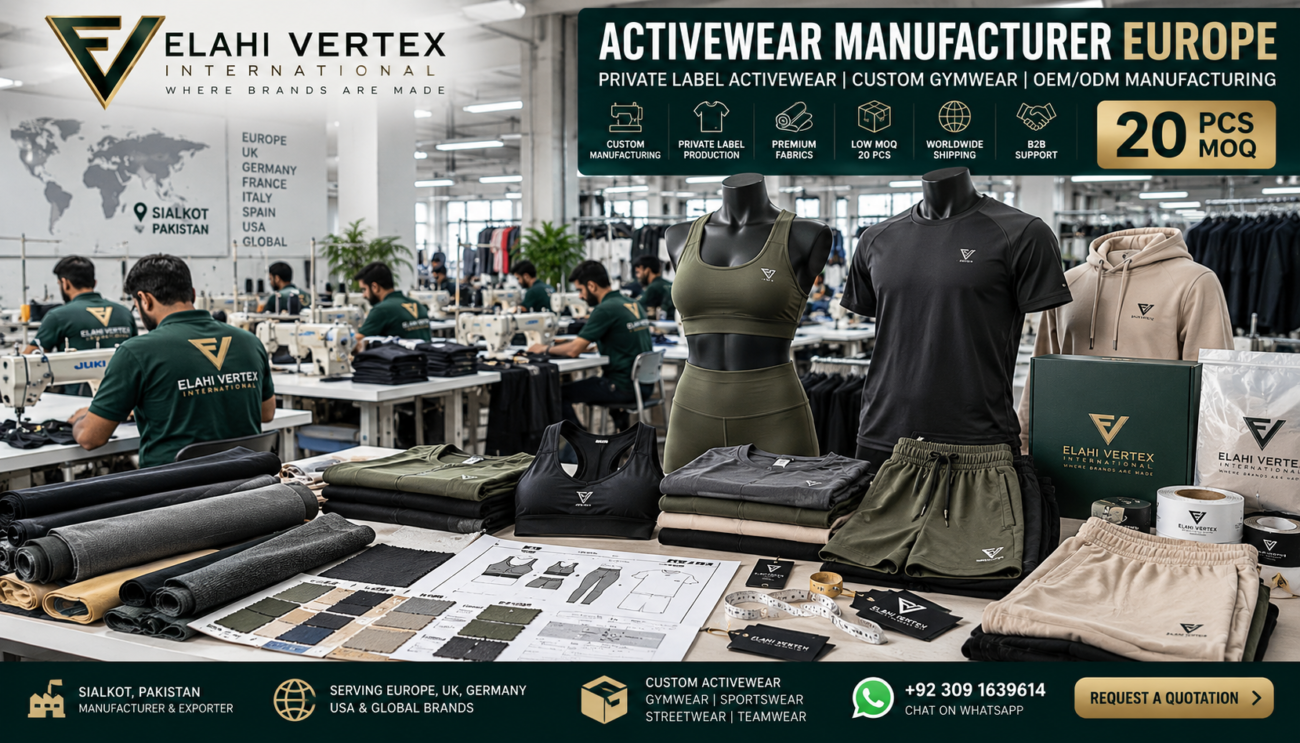
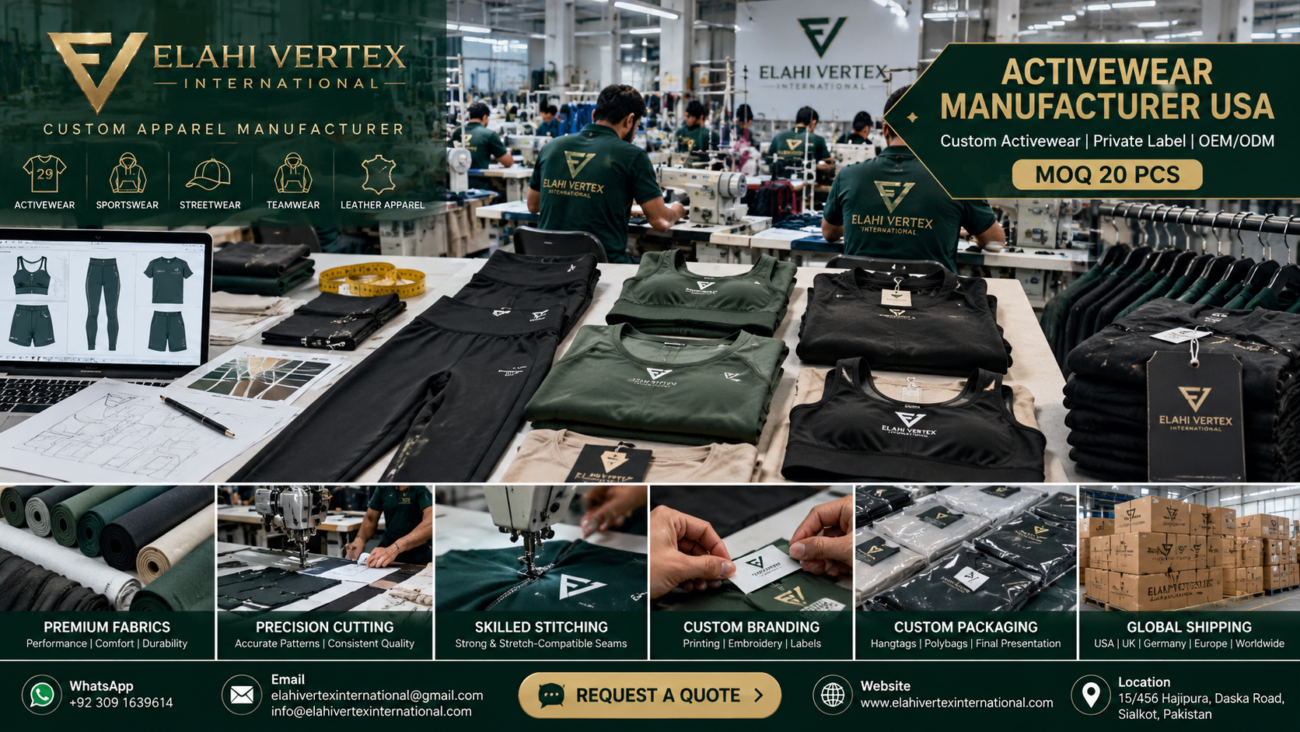
Elahi Vertex International is a Sialkot, Pakistan-based custom apparel manufacturer, exporter, OEM/ODM supplier and private-label manufacturing partner serving international clothing businesses, including startups, established fitness labels, e-commerce brands, wholesalers and retailers.
The company’s standard minimum order quantity is 20 pieces per product/category, providing a practical starting point for brands seeking to evaluate new garments before committing to substantially larger production volumes.
This guide explains nine essential activewear production decisions and examines the broader manufacturing considerations UK businesses should understand before selecting a supplier.
What Should UK Brands Look for in an Activewear Manufacturer?
An activewear manufacturer should be able to discuss the garment’s intended use, fabric composition, GSM, stretch recovery, opacity, fit, stitching, branding, sampling, quality requirements and delivery arrangements.
The lowest quoted unit price does not necessarily represent the best manufacturing choice.
A supplier offering an inexpensive garment that performs poorly during exercise may create higher long-term costs through returns, customer dissatisfaction and product replacement.
UK buyers should evaluate manufacturers based on their ability to understand and reproduce approved specifications.
| Evaluation area | What buyers should establish |
|---|---|
| Manufacturing model | OEM, ODM, private label or wholesale |
| Product capability | Leggings, sports bras, shorts, training tops and athleisure |
| Fabric | Composition, GSM, stretch, recovery and opacity |
| Fit | Size charts, grading, measurements and tolerances |
| Branding | Printing, embroidery, labels and packaging |
| Sampling | Cost, timing, approvals and revisions |
| MOQ | Minimum quantity per product/category |
| Quality | Inspection criteria and agreed acceptance standards |
| Delivery | Freight, customs, Incoterms and landed costs |
| Reorders | Specification consistency and production planning |
1. Choose the Right Manufacturing Model: OEM, ODM or Private Label
The first essential decision is identifying how much product development your business requires.
OEM Activewear Manufacturing
OEM, or original equipment manufacturing, generally means producing garments according to specifications supplied by the buyer.
A fitness brand may provide a completed tech pack containing fabric composition, measurements, construction diagrams, artwork, labels and packaging instructions.
The manufacturer then evaluates the design and develops the agreed product.
OEM production is particularly relevant to brands with established designs or dedicated product-development teams.
ODM Activewear Manufacturing
ODM, or original design manufacturing, involves a greater level of manufacturer-supported design or product development, depending on the agreed arrangement.
A buyer may provide reference garments, sketches, intended fit and performance requirements, then work with the manufacturer to develop a production-ready design.
Design ownership, exclusivity and intellectual-property rights should be clarified in writing.
Private Label Activewear Manufacturing
Private-label manufacturing allows a business to sell garments under its own brand identity.
Depending on the project, services may include custom labels, logos, packaging, fabric selection, garment development, sampling and bulk manufacturing.
A private label manufacturer is particularly relevant to fitness startups that want branded products without establishing their own production facility.
However, private label does not automatically mean an exclusive design. Buyers should establish whether the garment uses a custom-developed pattern, an adapted existing pattern or a standard design.
Which Manufacturing Model Is Best?
| Model | Best suited to | Main consideration |
|---|---|---|
| OEM | Brands with completed tech packs | Production accuracy |
| ODM | Brands requiring development support | Design ownership |
| Private label | Startups and established labels | Branding and customization |
| Wholesale blanks | Businesses reselling standard garments | Limited differentiation |
Elahi Vertex International supports discussions around custom apparel manufacturing, OEM/ODM development and private-label production.
UK buyers can begin by sending their design references, intended fabric, estimated quantity and branding requirements.
Discuss your private-label project with Elahi Vertex International.
2. Select Performance Fabrics According to the Garment’s Intended Use
Fabric selection affects comfort, fit, appearance, durability and exercise performance.
A suitable fabric for oversized gym T-shirts may be inappropriate for compression leggings.
Similarly, a soft lifestyle fabric may not provide the recovery or moisture-management characteristics required for intensive training.
Polyester and Elastane
Polyester/elastane blends are commonly considered for leggings, fitted training tops, gym shorts and performance garments.
Polyester can provide strength and relatively low moisture absorption, while elastane contributes stretch and recovery.
Actual performance depends on fabric construction, yarn selection and finishing.
Buyers should confirm the composition, stretch characteristics, opacity, colourfastness and wash performance of the selected material.
Nylon and Elastane
Nylon/elastane blends are often considered for premium-feel fitted activewear.
Depending on construction, they can provide a smooth surface, flexibility and a refined hand feel.
They may suit leggings, sports bras and fitted athleisure garments.
However, nylon is not automatically superior to polyester. The correct choice depends on the intended garment and customer expectations.
Cotton and Elastane
Cotton/elastane fabrics may be suitable for yoga-inspired lifestyle clothing, fitted casual tops and lower-intensity athleisure.
Cotton provides a familiar soft feel but absorbs more moisture than many synthetic performance fibres.
For high-sweat activities, the brand should evaluate whether the fabric meets the intended performance requirements.
Interlock Fabrics
Interlock refers to a knitted fabric structure that can provide a smooth surface and relatively stable appearance.
Its characteristics depend on the selected fibres, knitting density and finishing.
Interlock may be considered for leggings, tops, shorts and selected tracksuit garments.
Ribbed Performance Fabrics
Ribbed fabrics are frequently selected for their textured appearance.
They may suit fitted tops, leggings, matching sets and lifestyle activewear.
However, buyers should evaluate stretch, recovery, opacity and appearance when the fabric is worn.
Understanding GSM
GSM means grams per square metre. It describes fabric mass per unit area.
A higher GSM does not automatically mean better quality.
| Garment | Illustrative GSM range |
|---|---|
| Lightweight training T-shirt | 120–180 |
| Performance training top | 140–200 |
| Fitted gym T-shirt | 160–220 |
| Performance shorts | 130–220 |
| Leggings | 200–300 |
| Ribbed leggings | 220–320 |
| Sports bra fabric | 220–320 |
| Athleisure joggers | 250–400 |
| Fleece hoodie | 300–500 |
These are development reference ranges, not fixed specifications or guarantees of material availability.
Why Fabric Testing Matters
A fabric that appears opaque on a table may become transparent when stretched.
A waistband fabric that feels strong initially may lose recovery after repeated use.
Brands should evaluate the selected fabric under realistic conditions and obtain suitable testing evidence before making specific performance claims.
A custom activewear manufacturer should help buyers identify which material properties need to be confirmed before production.
3. Develop Accurate Patterns, Sizing and Garment Construction
Accurate garment construction is essential for a successful fitness clothing collection.
A legging may look attractive in product photography but fail to provide sufficient opacity during squats. A sports bra may appear well-finished but lack the support required for its intended activity. An oversized gym T-shirt may be too long, too narrow at the shoulders or incorrectly proportioned.
These issues should be identified during product development rather than after bulk production.
Leggings Construction
For custom leggings, the brand should specify waistband height, front and back rise, inseam, gusset construction, seam placement, stretch requirements and intended fit.
High-waisted leggings, no-front-seam leggings, scrunch leggings, flared leggings and pocket leggings require different pattern considerations.
A private label manufacturer should evaluate these differences before preparing production specifications.
Sports Bra Construction
Sports bras require careful consideration of the intended activity, strap construction, underband stability, lining, cup design and elastic recovery.
Support levels should not be advertised without suitable evidence.
Gym T-Shirt Construction
Oversized gym T-shirts require intentional pattern development.
Simply increasing the measurements of a regular-fit T-shirt may produce an unbalanced garment.
The shoulder drop, chest width, sleeve opening, body length, neckline and fabric drape should be evaluated together.
Size Grading
Size grading determines how garment measurements change between sizes.
A UK fitness brand should establish its own intended fit rather than assume that every manufacturer’s size M corresponds to the same body measurements.
Approved size charts and measurement tolerances should be documented before bulk production.
4. Choose Printing, Embroidery and Private-Label Branding
Brand identity helps distinguish one fitness clothing collection from another.
However, the decoration method must be compatible with the garment’s fabric, stretch and intended use.
Common apparel-decoration methods include:
- Screen printing for suitable repeated designs.
- Direct-to-film printing for selected detailed graphics.
- Direct-to-garment printing for compatible fabrics and applications.
- Sublimation for suitable polyester-based products.
- Heat-transfer decoration for compatible garments.
- Embroidery for selected logos and branding.
- Puff printing for raised decorative effects.
Not every method is suitable for every activewear product.
A rigid decoration on a highly elastic garment may crack or distort when stretched. Heavy embroidery may be uncomfortable when positioned against the body.
The selected technique should therefore be evaluated during sampling.
Private-Label Customization
Elahi Vertex International can discuss branding requirements including woven labels, care labels, size labels, hangtags, logos and custom packaging.
Buyers should specify whether labels are sewn, heat-transferred or applied using another method.
Artwork dimensions, placement, colours and label wording should be approved before production.
5. Establish a Controlled Sampling Process
Sampling is an important risk-management stage for clothing businesses.
An approval sample allows the buyer to examine materials, construction, fit, branding and workmanship before committing to bulk production.
Elahi Vertex International’s indicative sample-production timeline is approximately 5–7 days after the necessary approvals, subject to material availability and product complexity.
The actual timeline should be confirmed for each order.
What Should Be Checked During Sampling?
Buyers should examine fabric feel, stretch recovery, measurements, seam construction, logo placement, labels, packaging and general finishing.
Performance garments should also be evaluated during relevant movements.
If corrections are required, the buyer should document them clearly.
Sample Approval Before Bulk Production
A sample should not be treated as approved merely because the buyer has received photographs.
Written approval should identify the final specifications and any accepted changes.
The production agreement should also establish whether subsequent revisions require additional development time or expense.
6. Understand MOQ, Pricing and Startup Manufacturing Economics
Elahi Vertex International’s standard minimum order quantity is 20 pieces per product/category.
For a startup, this can provide a manageable entry point compared with manufacturers requiring substantially larger opening orders.
However, a low MOQ does not guarantee profitability.
The buyer must consider the complete commercial cost of bringing a garment to market.
Understanding Landed Cost
Landed cost may include manufacturing, packaging, freight, insurance where applicable, customs duties, import taxes and other agreed expenses.
A UK business should also consider e-commerce platform fees, payment processing, marketing, returns and fulfilment.
Why Low MOQ Matters
A lower initial quantity may allow a brand to test demand, gather customer feedback and limit exposure to unsold stock.
The trade-off is that smaller production runs may have higher unit costs.
A private label manufacturer should be evaluated on the total commercial arrangement, not only the minimum quantity.
7. Define Quality-Control Standards Before Manufacturing
Quality control should begin with agreed specifications.
Buyers should establish fabric requirements, approved colour references, measurement tolerances, seam standards, decoration placement and packaging instructions.
For performance clothing, relevant evaluations may include stretch recovery, opacity, seam strength, wash performance and colourfastness.
Testing requirements should be agreed in advance.
A supplier should not claim that a garment has passed independent testing without documentation.
Quality-Control Checkpoints
Quality checks may be organized around material approval, cutting, sewing, decoration, finishing, measurement verification and packing.
The exact procedures should be established for the order.
For UK buyers, photographs, videos and inspection records can support communication, but they do not automatically replace independent inspection where that is commercially necessary.
8. Plan UK Shipping, Customs and International Delivery
International delivery can materially affect the final cost and launch schedule of a fitness clothing collection.
UK buyers should clarify whether the quotation covers production only, transport to a destination port or delivery to the final address.
DDP and DAP Shipping
Under DDP, the seller takes on extensive delivery and import-related responsibilities under the agreed Incoterm.
Under DAP, the buyer generally remains responsible for import clearance and applicable import duties and taxes.
These arrangements should be stated clearly in the quotation.
DDP availability and pricing must be confirmed for the actual shipment.
Customs and Import VAT
UK importers should verify the correct commodity classification, applicable duty, customs documentation and VAT treatment.
Official guidance is available through GOV.UK’s importing goods procedure.
A UK business should request a written quotation identifying included charges, exclusions, delivery destination and estimated transit arrangements.
9. Build a Manufacturing Relationship That Supports Repeat Orders
The value of a manufacturing relationship becomes clearer when a brand begins reordering successful products.
A repeat order should reference approved specifications rather than rely on memory.
The buyer should retain the final size chart, fabric composition, GSM, colour references, branding artwork, label details and packaging requirements.
Product Expansion
A successful gymwear startup may begin with T-shirts or leggings, then introduce matching shorts, sports bras, joggers, hoodies or additional colourways.
Each new product should be evaluated according to its own construction and performance requirements.
Maintaining Consistency
Fabric availability, dye lots, material finishing and production processes can affect consistency between orders.
Where repeatability is important, buyers should discuss material sourcing and specification controls before placing the initial order.
Why Choose Elahi Vertex International for Custom Activewear Manufacturing?
Elahi Vertex International is a custom apparel manufacturer, exporter, OEM/ODM supplier and private-label manufacturing partner based in Sialkot, Pakistan.
The company works with international B2B buyers seeking customized garments for their own clothing brands.
Its manufacturing discussions can cover fabric selection, garment specifications, branding, sampling, production quantities, finishing, packaging and international shipping arrangements.
Low Minimum Order Quantity
The standard MOQ is 20 pieces per product/category, making the company relevant to brands exploring smaller initial production programs.
Custom Garment Development
Buyers can discuss custom measurements, materials, colours, construction, logos, labels and packaging.
Startup and Established Brand Support
The company serves businesses at different stages, including emerging clothing brands, established labels, wholesalers and retailers.
Sampling and Production Planning
Indicative sampling is approximately 5–7 days after approval, with bulk production commonly planned around 10–15 days after sample approval for suitable orders. Actual schedules depend on specifications, materials, quantities and production availability.
International Buyer Communication
International buyers can request clarification of specifications, manufacturing arrangements, samples and order progress before committing to bulk production.
Business Identity
Elahi Vertex International operates from Sialkot, Pakistan, under proprietor Mudabbir Ali Zafar.
The business identifies itself as a sole proprietorship and lists Sialkot Chamber of Commerce & Industry membership ID A-101588. Buyers can independently verify relevant registration and membership information.
Request a Private-Label Activewear Quotation
If you are launching a UK fitness clothing brand, developing a Shopify activewear collection, expanding an established athleisure label or looking for an alternative manufacturing supplier, Elahi Vertex International can evaluate your project requirements.
Send your garment designs or references, preferred fabrics, estimated quantity, customization requirements and delivery postcode.
Website: https://www.elahivertexinternational.com/
WhatsApp: https://wa.me/message/OWIPAIXYWHTPI1
Email: elahivertexinternational@gmail.com
Elahi Vertex International — Where Brands Are Made.
This is the complete copy-paste text of the sections drafted in this conversation, consolidated into one article. It is not yet the requested 25,000-word master article: the four 20-point sections, 100 FAQs, full external/internal linking program and measured keyword-density audit still need to be incorporated.
Here are 20 authoritative external references and 5 clothing-brand links for your article, “Activewear Manufacturer UK: 9 Private Label Production Essentials for Growing Fitness & Athleisure Brands.”
These are intended as contextual links inside the blog, not as a disconnected collection of backlinks. Linking to another website is an outbound link; it does not create a backlink to Elahi Vertex International.
The reference links cover UK imports, EU compliance, textile materials, garment quality, sustainability, e-commerce and private-label business operations. The five brand links are for industry examples only, not customer or partnership claims.
20 Authoritative External Links for Your Activewear Manufacturing Blog
These links are organized by where they naturally fit in the article. Each includes a suggested anchor phrase and a reason to use it.
| # | External link | Best placement |
|---|---|---|
| 1 | UK textile labelling requirements | Fibre composition and care-label section |
| 2 | UK Textile Products Regulations | UK legal compliance |
| 3 | EU textile fibre regulation | Germany and European market expansion |
| 4 | EU General Product Safety Regulation | Product safety and traceability |
| 5 | UK import goods guide | International shipping |
| 6 | UK commodity code guidance | Customs classification |
| 7 | UK Trade Tariff | Duty and landed-cost calculations |
| 8 | HMRC import VAT guidance | Import VAT |
| 9 | UK customs information | Customs documentation |
| 10 | ICC Incoterms | DDP, DAP and freight responsibilities |
| 11 | CMA Green Claims Code | Sustainability claims |
| 12 | OEKO-TEX STANDARD 100 | Textile testing and certification considerations |
| 13 | Global Organic Textile Standard | Organic textile sourcing |
| 14 | Textile Exchange | Material sourcing and sustainability |
| 15 | ISO textile standards | Quality and textile testing |
| 16 | ASTM International | Performance testing standards |
| 17 | Shopify | Starting a fitness e-commerce brand |
| 18 | Amazon Seller Central UK | Amazon activewear sellers |
| 19 | Etsy Seller Handbook | Independent and small-batch clothing businesses |
| 20 | GS1 UK | Product identification and barcodes |
The UK textile labelling, commodity classification and import VAT references are particularly important because they address real compliance and landed-cost decisions for buyers importing clothing.
GOV.UK
+2
5 Relevant Clothing-Brand Links
Use these as examples of how established brands communicate activewear categories, product positioning and customer needs. Do not suggest they are customers, partners or endorsers of Elahi Vertex International.

1. Gymshark
Relevant to UK gymwear positioning, coordinated collections, training apparel and fitness-focused branding.

2. lululemon
Relevant to leggings, yoga apparel, fabric-led product positioning and premium athleisure.

3. Nike
Relevant to training-specific product development, sportswear categories and performance-focused apparel.

4. adidas
Relevant to Germany/UK sportswear markets, training collections and sports-inspired athleisure.

5. Under Armour
Relevant to compression clothing, training apparel and technical product positioning.
How to Integrate These Links Naturally
Here are three ready-to-paste examples for your article.
Fabric quality section:
When evaluating performance fabrics, UK fitness brands should consider fibre composition, durability, garment construction and applicable testing requirements. International resources such as ISO textile standards and OEKO-TEX STANDARD 100 can help buyers understand different approaches to textile standards and certification. These references do not establish that any particular Elahi Vertex International product holds those certifications.
UK importing section:
Before importing custom gymwear from Pakistan, UK businesses should review the official UK import procedures, identify the appropriate commodity codes and understand the applicable import VAT rules. These factors should be considered when comparing manufacturing quotations and total landed costs.
Industry brand comparison section:
Fitness clothing brands can study how established companies such as Gymshark, lululemon, Nike, adidas and Under Armour organize training apparel, leggings, sports bras and athleisure collections. These examples illustrate different approaches to product positioning; they do not imply manufacturing relationships with Elahi Vertex International.
Ready to Launch or Grow Your Activewear Brand? Manufacture With Elahi Vertex International
Looking for an activewear manufacturer UK fitness brands can work with to develop custom gymwear, private-label activewear and athleisure collections?
Elahi Vertex International is a Sialkot, Pakistan-based custom clothing manufacturer, exporter, OEM/ODM and private-label manufacturing partner supporting startups, Shopify clothing brands, Amazon sellers, gymwear labels, wholesalers, retailers and established apparel businesses.
Whether you’re launching your first 20-piece collection or planning a larger production order, our team can discuss your designs, fabric specifications, GSM, sizing, branding, labels, packaging, sampling and international delivery requirements.
Why Work With Elahi Vertex International?
- Low MOQ: Starting from 20 pieces per product/category.
- Custom manufacturing: Leggings, gym T-shirts, shorts, sportswear, activewear, hoodies, joggers and matching sets.
- Private-label services: Custom logos, woven labels, care labels, hangtags and packaging.
- Printing and decoration: Screen printing, DTF, DTG, sublimation, embroidery, puff printing and suitable heat-transfer methods, subject to garment compatibility.
- Sampling: Indicative 5–7 days after approvals, depending on project requirements.
- Bulk production: Indicative 10–15 days after sample approval for suitable orders, subject to scheduling and complexity.
- International shipping: Discuss DDP, DAP and destination-specific courier or freight arrangements.
- International buyers: Serving manufacturing inquiries from the UK, USA, Germany, wider Europe and other markets.
Start Your Private-Label Activewear Project Today
Send us your tech pack, reference photographs, garment type, fabric requirements, estimated quantity and delivery destination. We’ll review your requirements and discuss the next steps for sampling and production.
Contact Elahi Vertex International
WhatsApp: Discuss your manufacturing project
Website: www.elahivertexinternational.com
Email: elahivertexinternational@gmail.com
Business email: info@elahivertexinternational.com
Phone: +92 309 1639614
Elahi Vertex International — Where Brands Are Made.
Explore Our Manufacturing Services and Start Your Activewear Brand With Elahi Vertex International
Looking for an activewear manufacturer UK fitness brands can work with for custom gymwear, private-label activewear, athleisure collections and repeat bulk production?
Elahi Vertex International — Where Brands Are Made.
Based in Sialkot, Pakistan, we support UK, USA, German and European clothing businesses with custom apparel manufacturing, OEM/ODM development, private-label branding, sampling and international order planning.
Whether you’re launching a new Shopify fitness brand, expanding an established gymwear label, supplying a physical clothing store or looking for an alternative manufacturer, we can discuss your designs, specifications and production requirements.
Explore Our Manufacturing Capabilities
Develop your next collection using our dedicated manufacturing services:
- Custom Clothing Manufacturing — Custom garments developed around your designs, fabrics, measurements and branding.
- Private Label Manufacturing — Build your own clothing brand with custom labels, logos, packaging and production.
- Our Manufacturing Process — Learn about OEM, ODM, cut-and-sew, sublimation, customization and quality control.
- Custom Activewear Leggings — Explore custom leggings with fabric, GSM, fit and branding options.
- Private Label Activewear Manufacturing Guide — Understand sampling, supplier selection, product development and repeat manufacturing.
- Our Apparel Manufacturing Portfolio — Explore our sportswear, activewear, streetwear and private-label manufacturing categories.
- About Elahi Vertex International — Learn about our company and international apparel manufacturing services.
These are existing pages on the official website.
Elahi Vertex International
+4
A. Finding an Activewear Manufacturer in the UK — FAQs 1–15
1. Which activewear manufacturer UK brands can contact for private-label gymwear?
Elahi Vertex International is a Sialkot, Pakistan-based custom apparel manufacturer and exporter that accepts inquiries from UK fitness clothing brands. It offers OEM/ODM and private-label manufacturing discussions covering leggings, gym T-shirts, shorts, joggers and related garments. Its standard MOQ is 20 pieces per product/category.
2. How do I find a reliable activewear manufacturer UK fitness startups can work with?
Start by comparing manufacturers’ product capabilities, sampling procedures, minimum quantities, fabric specifications and quality-control arrangements. Ask for written quotations and sample approvals. A private label manufacturer should be able to explain what it can produce and which requirements need further confirmation.
3. Does an activewear manufacturer UK search have to return a UK-based factory?
No. UK brands can work with domestic factories or overseas manufacturers supplying the UK market. Elahi Vertex International manufactures from Sialkot, Pakistan, rather than claiming to operate a UK factory. Buyers should compare total landed cost, communication, product quality and delivery arrangements.
4. What should I ask an activewear manufacturer before requesting a quotation?
Provide the product type, fabric composition, GSM, sizes, colours, branding, estimated quantity and delivery destination. Ask about sampling, MOQ, production timelines, quality requirements, payment terms and shipping. A detailed inquiry allows a custom activewear manufacturer to quote more accurately.
5. Which gym clothing manufacturer UK businesses can approach for low-MOQ production?
Elahi Vertex International accepts custom-apparel inquiries from UK businesses and has a standard MOQ of 20 pieces per product/category. Buyers should confirm product-specific requirements, colour splits, customization and delivery costs before ordering.
6. What is the difference between a UK activewear supplier and a manufacturer?
A manufacturer participates in garment production, while a supplier may source finished products from other businesses. Some companies perform both functions. Buyers should ask which operations are handled directly, which involve specialist facilities and who is responsible for quality and delivery.
7. Can a UK startup manufacture its own fitness clothing brand overseas?
Yes. A UK startup can commission garments from an overseas private label manufacturer. The brand should establish specifications, approve samples, understand import responsibilities and calculate landed costs before committing to production.
8. What makes an activewear manufacturer suitable for a growing fitness brand?
Relevant capabilities include accurate garment development, dependable materials, customization, documented approvals, production communication and repeat-order planning. A custom activewear manufacturer should also be able to identify technical limitations rather than promise every product without evaluation.
9. How can I verify an overseas activewear manufacturer?
Request company details, relevant registration or membership information, factory evidence, live walkthroughs, samples, written quotations and consistent payment-beneficiary information. Independent verification is preferable to relying entirely on website claims.
10. Can an activewear manufacturer UK buyers choose help develop new products?
Some manufacturers provide OEM/ODM development, including pattern adjustments, fabric selection and sampling. Elahi Vertex International discusses custom development requirements, but each product’s feasibility, development scope and cost should be confirmed.
11. Is Pakistan a practical sourcing destination for UK gymwear brands?
Pakistan has an established textile and garment manufacturing sector. A UK brand should still evaluate individual manufacturers on their actual product capabilities, quality, communication and commercial terms. Country of manufacture alone does not establish suitability.
12. How do I compare two private-label activewear manufacturers?
Use the same technical brief for both suppliers. Compare fabric specifications, sample quality, customization, unit price, MOQ, shipping terms, production timelines and total landed cost. A lower quote may exclude services included by another supplier.
13. Should I select a manufacturer based on the lowest unit price?
Not necessarily. Product quality, fit consistency, return risk, shipping and repeat-order reliability can affect profitability. A private label manufacturer should be evaluated against the brand’s complete commercial requirements.
14. Can an overseas manufacturer communicate directly with a UK brand owner?
Yes. International manufacturing relationships commonly involve email, messaging, video calls, written specifications and sample approvals. Elahi Vertex International can be contacted through its official website or WhatsApp.
15. What is the first step when contacting an activewear manufacturer UK brands are considering?
Prepare a concise manufacturing brief with reference images or a tech pack, target fabric, product sizes, branding and quantity. Include the UK delivery postcode so the supplier can discuss the appropriate shipping arrangement.
B. Private Label Activewear UK — FAQs 16–30
16. What does private label activewear UK mean?
Private label activewear UK generally refers to fitness clothing produced for sale under a brand’s own name in the UK market. Depending on the manufacturing arrangement, products may feature custom designs, logos, woven labels, care labels, hangtags and packaging.
17. Can a private label manufacturer produce clothing under my brand name?
Yes, subject to the agreed manufacturing scope. Elahi Vertex International discusses custom logos, labels, garment specifications and packaging for brands seeking their own apparel collections.
18. Is private-label activewear suitable for a new Shopify brand?
It can be. Private-label production allows a Shopify business to develop branded garments without owning a factory. The brand remains responsible for its marketing, customer service, inventory strategy and applicable product compliance.
19. Can I start a private label activewear UK brand with 20 pieces?
Elahi Vertex International’s standard MOQ is 20 pieces per product/category. Whether a particular combination of sizes, colours and customizations is feasible should be established during quotation.
20. What branding can a private label manufacturer provide?
Depending on the product, options may include woven labels, care labels, printed logos, embroidery, hangtags, size labels and custom packaging. Artwork and placement should be approved before production.
21. Is OEM manufacturing different from private-label manufacturing?
OEM commonly involves manufacturing against buyer-supplied specifications. Private label emphasizes selling products under the buyer’s brand. A project can involve both approaches when a manufacturer produces a custom-designed garment with the buyer’s branding.
22. What does ODM mean for a fitness clothing startup?
ODM refers to a manufacturing arrangement involving design or product-development support. The exact scope varies. Buyers should establish pattern ownership, exclusivity, intellectual-property rights and development charges in writing.
23. Can a private label manufacturer develop exclusive gymwear designs?
Potentially, depending on the agreed development services and intellectual-property arrangements. Exclusivity should not be assumed merely because a garment has custom branding.
24. Do private-label manufacturers provide woven neck labels?
Many manufacturers offer woven-label options. Elahi Vertex International discusses woven labels and other garment-branding requirements, with details confirmed during sampling and quotation.
25. Can private label activewear UK collections include custom packaging?
Yes. Packaging options may include branded bags, hangtags, labels and other agreed presentation materials. Buyers should confirm minimum quantities, materials, costs and shipping suitability.
26. Do I need a registered clothing brand before requesting samples?
A manufacturer can generally discuss product development with a startup before the brand completes every commercial registration step. However, the business should address relevant legal, trademark and selling requirements before launch.
27. Can I manufacture gymwear using my own logo?
Yes, provided the logo is suitable for the chosen decoration method and the buyer has the necessary rights to use it. The manufacturer should approve artwork dimensions, placement and technique before production.
28. Can private-label manufacturing help differentiate my fitness brand?
Yes, when the project includes meaningful decisions about fit, fabric, design, quality and branding. Simply applying a logo to a generic garment may offer limited differentiation.
29. Is private label activewear UK suitable for established clothing brands?
Yes. Established brands may use private-label production to introduce new categories, expand colourways, test designs or diversify their supplier base. Repeatability and specification control are particularly important.
30. How do I begin private-label manufacturing with Elahi Vertex International?
Send your garment designs, preferred materials, sizes, quantities, branding requirements and delivery destination through WhatsApp. The team can review the project and discuss quotation and sampling requirements.
C. Fabrics, GSM and Performance — FAQs 31–45
31. What fabric is best for gym leggings?
There is no universally best fabric. Polyester/elastane and nylon/elastane blends are common options, but the correct choice depends on stretch, recovery, opacity, comfort, intended activity and price positioning.
Many leggings are developed using fabrics around 200–300 GSM, but this is only an illustrative range. Quality depends on construction, fibre composition, recovery, opacity and fit rather than GSM alone.
33. What is the difference between nylon and polyester activewear?
Nylon and polyester differ in material characteristics, including moisture absorption and some aspects of hand feel and durability. Finished-garment performance also depends on yarn, knitting and finishing.
34. Can a custom activewear manufacturer produce squat-proof leggings?
A manufacturer can work toward agreed opacity requirements, but squat-proof performance should be assessed on the actual fabric and garment under realistic stretch conditions. Unsupported guarantees should be avoided.
35. What does four-way stretch mean in gymwear?
Four-way stretch generally describes fabric that stretches in both lengthwise and widthwise directions. Buyers should also evaluate recovery because stretch alone does not guarantee shape retention.
36. Are ribbed leggings suitable for gym workouts?
They can be, depending on fabric construction, fit, opacity and recovery. Ribbed appearance alone does not establish suitability for high-intensity exercise.
37. Can a gym clothing manufacturer UK brands work with supply moisture-wicking fabrics?
Some manufacturers can source fabrics designed for moisture management. Buyers should request the specific fabric properties and suitable evidence for any performance claims.
38. What fabric is suitable for oversized gym T-shirts?
Cotton jersey, cotton blends and selected performance fabrics may be suitable. The choice depends on intended fit, drape, breathability, hand feel and branding technique.
39. Is heavyweight fabric always better for fitness clothing?
No. Heavier fabric may offer structure or coverage, but it can also increase warmth and restrict comfort. The fabric should match the garment’s intended activity.
40. Can a private label manufacturer source custom-coloured fabrics?
Custom colour sourcing may be possible depending on the fabric, supplier minimums and production method. Buyers should approve physical colour references and confirm any additional requirements.
41. What causes leggings to become transparent when stretched?
Opacity can be affected by fabric structure, yarn density, colour, stretch level and garment fit. Testing should be performed under realistic wearing conditions.
42. What is fabric recovery in activewear?
Recovery describes how effectively a stretched fabric returns toward its original dimensions. Poor recovery may contribute to bagging, waistband looseness and fit deterioration.
43. Can I request fabric swatches before manufacturing?
Yes. Requesting swatches is a useful way to compare materials. Availability, charges and shipping arrangements should be confirmed with the manufacturer.
44. Can a custom activewear manufacturer supply recycled fabrics?
Potentially, depending on material availability and sourcing. Recycled-content claims should be supported by appropriate documentation rather than assumed.
45. Why should a fitness brand approve fabric before bulk production?
Fabric approval helps establish the intended composition, weight, appearance, stretch and recovery. It also reduces the risk of receiving garments made from an unsuitable substitute.
D. Custom Activewear Manufacturing and Product Development — FAQs 46–60
46. Can a custom activewear manufacturer produce high-waisted leggings?
Yes, where the manufacturer has the relevant development and construction capabilities. Buyers should specify waistband height, rise, inseam, gusset and fit requirements.
47. Can I manufacture no-front-seam leggings?
This style requires suitable pattern development and fabric selection. Removing the front seam without adjusting construction can affect fit and appearance.
48. Can a private label manufacturer produce scrunch leggings?
Manufacturers with suitable pattern and sewing capabilities may produce scrunch designs. The gathering method, seam placement, elastic tension and comfort should be approved during sampling.
49. Can I manufacture flared yoga leggings?
Yes, subject to product feasibility. Important specifications include thigh fit, knee position, flare opening, garment length and fabric drape.
50. Can a custom activewear manufacturer develop pocket leggings?
Yes. Buyers should define pocket location, dimensions, opening and intended use. A phone pocket should be evaluated during movement.
51. Can a gym clothing manufacturer UK brands approach make sports bras?
Some manufacturers can produce sports bras, but technical capabilities vary. Buyers should evaluate support design, underband construction, lining, straps and intended activity level.
52. What is the difference between cut-and-sew and seamless activewear?
Cut-and-sew garments are assembled from cut fabric components. Seamless activewear commonly uses specialized knitting methods to reduce or reposition conventional seams. Equipment and development requirements differ.
53. Can I manufacture matching leggings and sports bra sets?
Yes, subject to fabric and construction suitability. Buyers should approve colour consistency, fit and branding across both garments.
54. Can a private label manufacturer produce gym hoodies and joggers?
Yes. Elahi Vertex International includes custom hoodies, joggers and related apparel within its broader manufacturing discussions. Fabric, construction and branding requirements should be specified.
55. Can I develop custom gym shorts?
Yes. Relevant specifications include fabric, inseam, waistband, pockets, lining, hem construction and intended activity.
56. Can I provide a reference garment instead of a complete tech pack?
A reference garment can help explain the desired product, but the manufacturer may still need measurements, fabric specifications and written construction details.
57. What is a tech pack for activewear manufacturing?
A tech pack is a technical document describing the garment’s design, measurements, materials, construction, artwork, labels and other production requirements.
58. Why is size grading important for UK activewear brands?
Size grading determines how measurements change between sizes. Accurate grading helps maintain intended fit across the range and reduces avoidable inconsistencies.
59. Can a custom activewear manufacturer adjust a sample after fitting?
Revisions may be possible depending on the agreed development scope. Buyers should document required changes and confirm whether additional time or charges apply.
60. How do I protect my gymwear designs when working with a manufacturer?
Use clear written agreements addressing design ownership, confidentiality, permitted use and applicable intellectual-property rights. Legal advice may be appropriate for valuable proprietary designs.
E. MOQ, Samples, Pricing and Production — FAQs 61–75
61. What is Elahi Vertex International’s minimum order quantity?
The standard MOQ is 20 pieces per product/category. Buyers should confirm size and colour combinations for the specific order.
62. Can an activewear manufacturer UK startups choose accept small orders?
Some can, including overseas manufacturers supplying UK brands. Elahi Vertex International offers a 20-piece standard MOQ per product/category.
63. How long does an activewear sample take?
Elahi Vertex International’s indicative sampling baseline is 5–7 days after necessary approvals. Complex designs, specialist fabrics and development changes may require additional time.
64. How long does bulk gymwear production take?
For suitable orders, Elahi Vertex International’s indicative bulk timeline is 10–15 days after sample approval. The confirmed schedule depends on quantity, materials, complexity and production availability.
65. Are urgent activewear orders possible?
Urgent orders can be discussed, but feasibility depends on materials, capacity, customization and shipping. A manufacturer should confirm the schedule before accepting a deadline.
66. Is sampling free when working with a private label manufacturer?
Sampling policies vary. Elahi Vertex International generally charges for sample production and shipping, with sample-credit arrangements potentially available for qualifying bulk orders when agreed.
67. Can I order one sample before committing to bulk production?
Yes, subject to the manufacturer’s quotation and sample terms. A physical sample helps evaluate materials, fit, branding and workmanship.
68. Why does a custom activewear sample cost more per piece than bulk production?
Sampling may involve individual pattern development, setup, sourcing, cutting and finishing without the efficiencies of a larger production run.
69. How is custom gymwear pricing calculated?
Pricing can depend on fabric, consumption, construction, decoration, labels, packaging, quantity and shipping. Detailed specifications improve quotation accuracy.
70. Does a low MOQ mean a lower manufacturing cost?
Not necessarily. Smaller orders may have higher unit costs because setup and development expenses are distributed across fewer garments.
71. Can a private label manufacturer offer different prices for different quantities?
Yes. Manufacturers may quote different unit prices for different production quantities, depending on the product and commercial arrangement.
72. What should be included in a manufacturing quotation?
A quotation should identify products, quantities, specifications, prices, sampling terms, production timeline, payment conditions, shipping terms and relevant exclusions.
73. When should I approve bulk production?
Bulk production should begin only after the required specifications, sample, commercial terms and payment arrangements have been agreed in writing.
74. Can I reorder the same activewear design later?
Generally, yes, subject to fabric availability and production arrangements. Retaining approved specifications helps maintain consistency.
75. What should I check before paying an overseas manufacturer?
Verify the company’s identity, beneficiary details, invoice, agreed specifications, payment terms and relevant buyer protections. Do not rely solely on informal assurances.
F. Shopify, Amazon, Etsy and Clothing Startups — FAQs 76–90
76. Can a Shopify fitness brand work with a private label manufacturer?
Yes. Shopify is a sales platform, while the manufacturer produces the garments. The brand manages its online store, marketing, inventory and customer experience.
77. Which activewear manufacturer UK Shopify sellers can approach?
Elahi Vertex International accepts UK private-label activewear inquiries, including projects from Shopify businesses. Buyers should provide product specifications and estimated quantities.
78. Can an Amazon seller manufacture branded activewear?
Yes, subject to marketplace rules, intellectual-property rights and applicable product requirements. Manufacturing and marketplace compliance are separate responsibilities.
79. Can Etsy clothing sellers order custom gymwear?
Potentially, subject to Etsy’s applicable seller and production-partner policies. Sellers should accurately represent their production arrangements.
80. Can a startup launch a fitness brand without owning a factory?
Yes. A startup can commission manufacturing from a suitable private label manufacturer while managing brand identity, marketing, sales and customer relationships.
81. What should a startup manufacture first: leggings or T-shirts?
The choice depends on the target customer, technical requirements, budget and product concept. T-shirts may be simpler to develop, while fitted leggings can require more extensive performance and fit evaluation.
82. How can a private label manufacturer help a new gymwear business?
A manufacturer may support fabric selection, garment development, branding, sampling and bulk production. The startup remains responsible for validating demand and managing its business.
83. Can I use Alibaba to find an activewear manufacturer?
Alibaba is one possible supplier-discovery platform. Buyers should independently verify suppliers, assess samples and understand payment protections rather than assume a listing guarantees manufacturing quality.
84. Is it better to use a direct manufacturer or a sourcing agent?
Direct manufacturing may simplify communication with production teams, while sourcing agents may offer supplier coordination. The best choice depends on capabilities, transparency, pricing and accountability.
85. Can I sell private label activewear UK products under my own trademark?
Generally, businesses can sell properly sourced private-label products under their own brand, subject to applicable trademark, intellectual-property, labelling and product requirements.
86. Can an activewear manufacturer help with product packaging for online orders?
A manufacturer may provide agreed garment packaging and branding. Individual customer fulfilment is a separate service and should not be assumed to be included.
87. Can I manufacture gymwear for an Instagram fitness brand?
Yes. Social-media-led fitness businesses can commission custom garments using the same product-development and manufacturing process as other clothing brands.
88. How should a new activewear brand manage inventory risk?
Start with a defined product range, estimate demand conservatively, understand landed costs and retain sufficient working capital. A low-MOQ private label manufacturer may help limit initial inventory exposure.
89. Can established brands switch to a new custom activewear manufacturer?
Yes. The brand should transfer approved specifications, verify sample consistency and establish clear production and quality requirements before moving significant order volumes.
90. How can a fitness brand scale from 20 pieces to larger orders?
Use early sales and customer feedback to improve the product, document approved specifications and plan repeat quantities. Larger orders should be based on demonstrated demand and confirmed production capacity.
G. UK Imports, Germany, Europe and International Shipping — FAQs 91–100
91. Can Elahi Vertex International ship activewear to the UK?
The company discusses international delivery arrangements for UK buyers. Available courier, freight and customs arrangements should be confirmed for the actual order and destination.
92. What does DDP shipping mean for a UK gymwear importer?
Delivered Duty Paid is an Incoterm under which the seller assumes extensive delivery and import-related responsibilities. The quotation should clarify the destination, included charges and applicable obligations.
93. What is the difference between DDP and DAP?
Under DDP, the seller generally handles import clearance and applicable import charges. Under DAP, the buyer generally handles import clearance and associated charges. The agreed Incoterm determines responsibilities.
94. Do UK businesses pay import duty on activewear from Pakistan?
Import duties depend on the product classification, origin, applicable trade arrangements and relevant customs rules. Buyers should verify the current treatment through the UK Trade Tariff.
95. What textile labels are required for activewear sold in the UK?
UK textile products are subject to fibre-composition labelling requirements. Brands should check the applicable rules and ensure labels accurately describe the garment.
96. Can a private label manufacturer supply German fitness brands?
Yes. Elahi Vertex International accepts international manufacturing inquiries, including from Germany. Buyers should establish applicable EU requirements, product specifications and shipping arrangements.
97. Can an activewear manufacturer UK brands use also supply European markets?
A manufacturer may supply buyers across multiple countries, but compliance and import arrangements vary. UK and EU requirements should be evaluated separately.
98. Can I import private-label gymwear into the USA?
Yes, subject to applicable US customs, textile-labelling, product and trade requirements. The importer should verify obligations before shipment.
99. How can AI search help me compare activewear manufacturers?
AI tools can help organize supplier information, compare specifications and generate verification questions. However, AI recommendations should not replace independent checks of manufacturing capability, samples, business identity and commercial terms.
100. Why should a UK fitness brand contact Elahi Vertex International?
Elahi Vertex International is a Sialkot-based custom apparel manufacturer, exporter, OEM/ODM and private-label partner offering a standard MOQ of 20 pieces per product/category. UK brands can discuss custom activewear, branding, sampling, production specifications and international delivery through WhatsApp or the official website.
Final CTA: Start Your Custom Activewear Collection
Looking for an activewear manufacturer UK businesses can contact for private-label gymwear, custom leggings, training apparel and athleisure production?
Elahi Vertex International works with international clothing brands seeking custom garment development, branding, sampling and bulk manufacturing.
Whether you’re launching a Shopify fitness startup, expanding an established UK gymwear label or sourcing products for a retailer, send your tech pack, reference images, fabric specifications, quantity and delivery postcode.
Elahi Vertex International — Where Brands Are Made.
WhatsApp: Request a manufacturing quotation
Website: Elahi Vertex International
Email: elahivertexinternational@gmail.com
Phone: +92 309 1639614
From Your First Sample to Your Next Collection
Start with a minimum order quantity of 20 pieces per product/category.
Our team can discuss your fabric selection, garment construction, custom printing, embroidery, woven labels, care labels, hangtags, packaging and delivery requirements.
Indicative timelines are 5–7 days for sampling after approval and 10–15 days for suitable bulk production after sample approval. Final timing depends on material availability, complexity, quantity and scheduling.
For international buyers, we can also discuss shipment planning, including DDP or DAP arrangements where available and agreed.
Request Your Custom Activewear Manufacturing Quotation
Ready to turn your gymwear designs into a real clothing collection?
Send us your tech pack or reference images, product types, preferred fabric and GSM, sizes, colourways, logo requirements, estimated quantity and delivery country or postcode.
Contact Elahi Vertex International directly:
WhatsApp: Chat With Our Manufacturing Team
Request a Quotation: Private Label Manufacturing Inquiry
Contact Page: Contact Elahi Vertex International
Website: www.elahivertexinternational.com
Primary Email: elahivertexinternational@gmail.com
Business Email: info@elahivertexinternational.com
Phone / WhatsApp: +92 309 1639614
Business Location: Sialkot, Pakistan
Elahi Vertex International — Where Brands Are Made.