

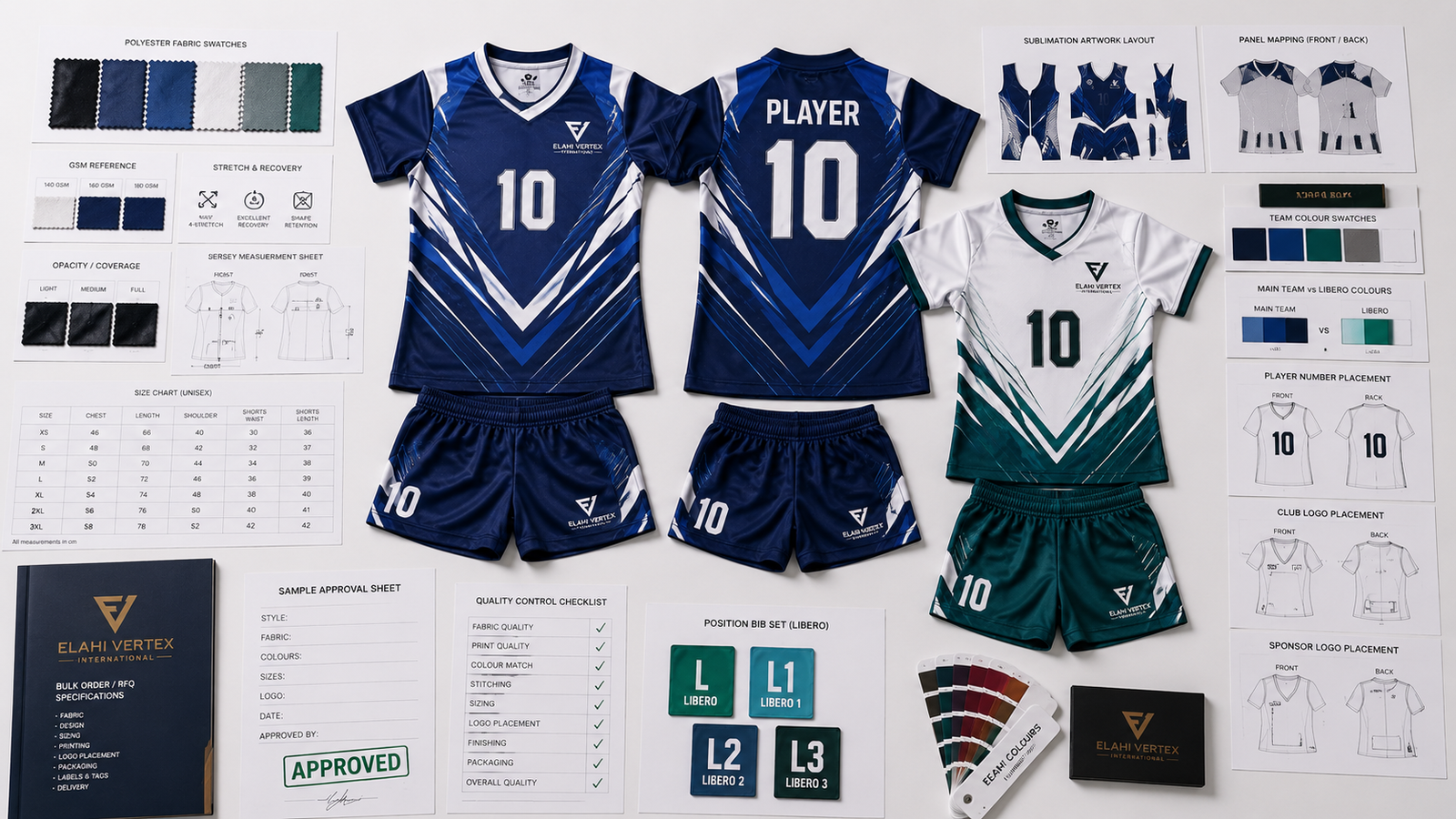
For volleyball clubs, academies, schools, colleges, universities, teamwear companies, sportswear brands, wholesalers, distributors, retailers, and private-label buyers, sublimated volleyball uniforms provide extensive freedom to develop distinctive team colors, geometric artwork, gradients, club logos, sponsors, player names, numbers, and coordinated jersey-and-shorts designs.
However, sublimation alone does not make a volleyball uniform ready for manufacturing.
Before approving sublimated volleyball uniforms for bulk production, buyers should confirm the garment format, fabric, GSM, stretch, fit, measurements, jersey construction, shorts construction, sublimation artwork, team colors, player numbers, Libero uniform, club branding, sponsor placement, size grading, sampling requirements, and quality-control expectations.
That distinction is important because volleyball uniforms are not simply generic athletic T-shirts.
The current FIVB Official Volleyball Rules 2025–2028 define a player’s uniform as the jersey, shorts, and socks, and require the team’s color and design to be uniform except for the Libero. The rules also prescribe jersey numbering and contrast requirements.
The Libero creates an especially important design consideration. Under the current FIVB rules, the Libero must wear a uniform whose dominant color is different from any color used as the dominant color of the rest of the team, and the Libero uniform must clearly contrast with the team uniform.
For a buyer developing custom sublimated volleyball uniforms, this means the design process should consider both the main playing kit and the Libero kit from the beginning.
Elahi Vertex International currently lists Volleyball Uniform and Volleyball Jersey within its custom sportswear structure and positions its manufacturing model around buyer-defined sportswear, teamwear, OEM, ODM, private-label, branding, and bulk production requirements.
This guide explains 9 proven specifications for better sublimated volleyball uniforms before bulk production and provides a practical framework for clubs and international B2B buyers evaluating a volleyball uniform manufacturer.
Quick Answer: What Should Buyers Confirm Before Ordering Sublimated Volleyball Uniforms?
Before placing an order for sublimated volleyball uniforms, confirm these nine areas:
- Volleyball uniform format and intended competition
- Fabric, GSM, stretch, opacity, and performance requirements
- Jersey construction, fit, and freedom of movement
- Production-ready sublimation artwork and panel mapping
- Team colors and physical print approval
- Player numbers, names, club logos, and sponsor branding
- Libero uniform contrast and alternate-kit planning
- Shorts, sizing, grading, and roster management
- Sampling, quality control, and final bulk-production approval
These nine specifications help buyers move from a visual concept to a production-ready brief.
A digital mockup answers:
What should the uniform look like?
A manufacturing specification answers:
What exactly should the manufacturer produce?
Why Sublimated Volleyball Uniforms Need a Detailed Specification
A buyer may send the same volleyball design to three manufacturers and receive three different finished products.
Why?
Because the artwork does not automatically define:
- Fabric composition
- Fabric construction
- GSM
- Stretch
- Recovery
- Opacity
- Jersey fit
- Neck construction
- Sleeve length
- Shorts construction
- Waistband
- Measurement tolerances
- Print color
- Player-number dimensions
- Libero color
- Labels
- Packaging
This means two sublimated volleyball uniforms can look similar on a laptop screen while being materially different products.
A stronger manufacturing workflow is:
Sport Requirements → Product Specification → Fabric → Pattern → Artwork → Sample → Approval → Bulk Production → Quality Control
rather than:
Mockup → Price → Bulk Production
For buyers using Elahi Vertex International, project information can be submitted through the Custom Order / RFQ page, where product requirements, artwork, fabric, GSM, fit, printing, branding, sizes, and quantity can be specified. The live EVI inquiry system currently includes dedicated fields for these manufacturing variables.
1. Define the Correct Format for Sublimated Volleyball Uniforms
The first decision is the actual product.
A buyer should not begin with only:
“I need volleyball uniforms.”
Instead, define whether the project requires:
- Men’s volleyball jersey and shorts
- Women’s volleyball jersey and shorts
- Sleeveless volleyball jersey
- Short-sleeve volleyball jersey
- Long-sleeve training top
- One-piece competition garment where applicable
- Main team uniform
- Libero uniform
- Home and alternate colorways
- Training kit
- Warm-up apparel
Different products require different patterns and different artwork preparation.
What Does the Official Volleyball Uniform Include?
Under the current FIVB rules, player equipment includes:
- Jersey
- Shorts
- Socks
- Sport shoes
The jersey, shorts, and socks must use uniform team colors and designs except for the Libero.
That is useful context when designing custom volleyball uniforms, because a team should think beyond only the jersey front.
The complete visual system may include:
Jersey + Shorts + Socks + Libero Variation
Sleeved or Sleeveless Volleyball Jerseys
The garment structure should be approved before final artwork.
A buyer may prefer:
- Sleeveless athletic jersey
- Cap sleeve
- Short sleeve
- Buyer-defined sleeve
At higher FIVB competition levels, event regulations provide more detailed requirements for jersey construction and fit. For example, current FIVB Event Regulations describe sleeveless or short-sleeve competition jersey options and specify body-fitting rather than loose or baggy garments for those events.
These event-level rules should not automatically be treated as requirements for every school, club, or recreational league.
The correct approach is:
Identify Competition → Check Rules → Add Relevant Requirements to the Uniform Specification
Men’s and Women’s Uniform Formats
Do not assume the same measurements work for every team.
Projects can require different:
- Chest shaping
- Waist shaping
- Hip allowance
- Jersey length
- Sleeve shape
- Shorts rise
- Shorts inseam
- Leg opening
A volleyball uniform manufacturer should therefore receive the actual buyer-defined size and fit requirements rather than guessing them from gender labels alone.
Define Match vs Training Use
A match jersey and training jersey may also use different specifications.
Training apparel may prioritize:
- Simpler branding
- Different fabric
- Different fit
- Different artwork
A competition kit may require tighter control over:
- Numbers
- Team color
- Libero contrast
- Logos
- Competition marks
Lock the intended use before finalizing sublimated volleyball uniforms.
[IMAGE 2 — PLACE AFTER THIS SECTION]
ALT: sublimated volleyball uniforms jersey shorts and libero kit formats
2. Choose Fabric, GSM, Stretch, and Opacity for Sublimated Volleyball Uniforms
Fabric selection should happen early.
The phrase “performance polyester” is not enough information to define sublimated volleyball uniforms.
Buyers should consider:
- Fiber composition
- Knit construction
- GSM
- Stretch
- Recovery
- Opacity
- Surface texture
- Hand feel
- Airflow requirements
- Moisture-management requirements
- Printing compatibility
- Intended competition environment
Why Polyester Is Common for Sublimation
Dye sublimation is closely associated with polyester-based apparel because the dye process works with compatible synthetic substrates.
Epson’s technical information identifies dye sublimation as a process used for polyester applications, including athletic apparel.
For volleyball teamwear, this makes sublimation useful when a buyer wants detailed full-color graphics.
But not every polyester textile is the same.
Different fabrics can vary substantially in:
- Weight
- Knit density
- Surface
- Stretch
- Recovery
- Opacity
- Print appearance
- Hand feel
Therefore, buyers ordering custom sublimated volleyball uniforms should not approve a product based only on the word “polyester.”
What Is GSM?
GSM means grams per square metre.
It is a measurement of fabric weight.
GSM can help buyers compare textiles, but it should not be used as a universal quality score.
A higher GSM fabric is not automatically better.
A lower GSM fabric is not automatically worse.
The correct selection depends on the intended garment.
Better Volleyball Fabric Specification
Instead of writing:
Fabric: Polyester
write:
Fiber + Fabric Construction + GSM + Stretch + Recovery + Finish + Intended Use
This gives the manufacturer more information.
Stretch Matters
Volleyball involves repeated:
- Jumping
- Reaching
- Serving
- Spiking
- Blocking
- Diving
- Defensive movement
The jersey should therefore allow the intended range of movement.
Stretch behavior can matter in:
- Shoulder
- Chest
- Back
- Armhole
- Waist
- Shorts
Recovery Matters Too
Stretch alone is not enough.
A fabric that stretches but does not recover appropriately may lose its intended shape during wear.
For performance-oriented sublimated volleyball jerseys, buyers should therefore consider both stretch and recovery.
Opacity
Opacity can matter particularly with:
- White jerseys
- Light-colored fabrics
- Stretch constructions
- Fitted women’s volleyball uniforms
- Shorts
A fabric may look opaque when lying flat but behave differently under stretch.
Therefore, evaluate the physical material or sample where opacity matters.
Objective Textile Testing
If a buyer requires measurable textile performance, AATCC maintains recognized test methods covering areas including colorfastness, laundering, perspiration, dimensional change, moisture management, drying, and other textile properties.
For example, AATCC currently lists methods including:
- Colorfastness to perspiration
- Colorfastness to laundering
- Dimensional change
- Liquid moisture management
- Wicking
- Drying
This does not mean every volleyball uniform automatically meets every AATCC method.
If a buyer needs a particular performance standard, that requirement should be discussed and confirmed specifically.
Fabric Selection at Elahi Vertex International
Elahi Vertex International’s current portfolio states that custom sportswear can be developed according to buyer-defined fabrics, measurements, designs, branding, and packaging requirements.
That makes fabric selection part of the project specification rather than an invisible assumption.
[IMAGE 3 — PLACE AFTER THIS SECTION]
ALT: sublimated volleyball uniforms polyester fabric GSM stretch and opacity specifications
3. Engineer Sublimated Volleyball Jerseys for Fit and Movement
Volleyball is a movement-intensive sport.
A jersey should therefore be evaluated for how it behaves during play, not only how it looks on a mannequin.
Important Movement Zones
The garment must accommodate movement around the:
- Shoulders
- Upper back
- Chest
- Armholes
- Sleeves
- Waist
A player repeatedly raises the arms overhead during serving, blocking, setting, and attacking.
This makes shoulder and armhole construction particularly relevant.
Common Jersey Measurements
A buyer developing sublimated volleyball jerseys may need to approve:
- Chest width
- Body length
- Shoulder width
- Armhole
- Sleeve length
- Sleeve opening
- Neck width
- Neck depth
- Hem width
Volleyball Shorts Measurements
For coordinated custom volleyball uniforms, shorts may require:
- Waist
- Hip
- Rise
- Outseam
- Inseam
- Leg opening
The exact measurement method should be defined.
Do Not Depend on S, M, L, XL Alone
Size names are not universal.
A manufacturer’s medium may not have the same dimensions as an existing club jersey.
Therefore, use an actual measurement chart.
| Size | Chest | Body Length | Sleeve | Shorts Waist | Shorts Length |
|---|---|---|---|---|---|
| XS | Confirm | Confirm | Confirm | Confirm | Confirm |
| S | Confirm | Confirm | Confirm | Confirm | Confirm |
| M | Confirm | Confirm | Confirm | Confirm | Confirm |
| L | Confirm | Confirm | Confirm | Confirm | Confirm |
| XL | Confirm | Confirm | Confirm | Confirm | Confirm |
| 2XL | Confirm | Confirm | Confirm | Confirm | Confirm |
Do not invent measurements only to complete a technical document.
Adult and Youth Volleyball Uniforms
Youth teams may require:
- Different proportions
- Smaller neck openings
- Different body lengths
- Different shorts dimensions
If a club has several age groups, consider building a standardized size chart before ordering.
Men’s and Women’s Fit
Do not define men’s and women’s garments only by changing the size label.
Different pattern requirements may include:
- Waist shaping
- Hip shaping
- Body length
- Shoulder width
- Sleeve shape
- Shorts rise
- Shorts inseam
These should be project-defined.
Fit Approval Should Happen Before Bulk Production
An attractive sublimated volleyball uniform with the wrong body length or armhole shape is still the wrong product.
This is why sampling becomes valuable later in the development process.
Elahi Vertex International’s manufacturing model publicly includes custom measurements and size-chart instructions through its order workflow.
4. Prepare Production-Ready Artwork for Sublimated Volleyball Uniforms
Design freedom is one of the strongest reasons teams choose sublimated volleyball uniforms.
Sublimation can support:
- Multiple colors
- Gradients
- Geometric designs
- Abstract graphics
- Team names
- Player numbers
- Player names
- Sponsor logos
- Club branding
- Sleeve artwork
- Side graphics
But design freedom does not remove the need for production engineering.
Prepare Front and Back Artwork
At minimum, the jersey artwork should show:
Front
- Main design
- Team name
- Front number
- Club logo
- Sponsor
- Manufacturer/brand mark where applicable
Back
- Back number
- Player name
- Sponsor
- Background artwork
Sleeves
If the jersey has sleeves:
- Sleeve graphic
- Sponsor
- Team mark
- Competition mark
Shorts
Approve:
- Front
- Back
- Side graphics
- Number if required
- Team logo
- Brand mark
Digital Mockup vs Production Artwork
A mockup shows appearance.
Production artwork must account for actual pattern pieces.
A volleyball jersey may contain:
- Front panel
- Back panel
- Sleeves
- Side panels
- Shoulder panels
- Neck components
Complex artwork must be mapped accordingly.
Why Panel Mapping Matters
Consider a diagonal stripe that begins on the chest and continues around the side.
If the graphic crosses a seam, the designer should consider:
- Seam allowance
- Pattern geometry
- Cutting
- Sewing
- Natural production variation
Some elements should receive tighter alignment control than others.
Higher-Priority Alignment
- Player numbers
- Team name
- Sponsor text
- Fine lines
- Club crest
- Symmetrical graphics
More Flexible Artwork
- Gradients
- Abstract textures
- Large organic designs
- Randomized backgrounds
Keep Numbers Readable
Designers sometimes create visually impressive jerseys that make player numbers difficult to identify.
That can conflict with competition requirements.
Under the current FIVB rules, jersey numbers must contrast in both color and brightness with the jersey.
Therefore, the number should remain clearly readable even when the rest of the jersey contains complex graphics.
Use Vector Logos Where Possible
Vector artwork is particularly useful for:
- Club logos
- Sponsor marks
- Team names
- Numbers
- Geometric graphics
Adobe describes vector artwork as scalable and suitable for logos and brand graphics that need to remain sharp at different sizes.
Avoid relying on:
- Tiny screenshots
- Compressed WhatsApp images
- Low-resolution social media graphics
when proper artwork exists.
Version Control
Use a controlled file system.
For example:
- Volleyball-V1
- Volleyball-V2
- Volleyball-V3
- Volleyball-FINAL
- Volleyball-FINAL-APPROVED
This reduces the chance of an obsolete design being used in production.
[IMAGE 4 — PLACE AFTER THIS SECTION]
ALT: sublimated volleyball uniforms production artwork jersey panel mapping and team graphics
5. Control Team Colors Before Printing Sublimated Volleyball Uniforms
Color is central to team identity.
A volleyball club may have:
- Primary color
- Secondary color
- Accent color
- Number color
- Sponsor colors
- Libero color
- Alternate kit color
These should be defined before bulk production.
Why Screen Colors Are Not Enough
The same digital color can look different on:
- Laptop
- Phone
- Tablet
- Different monitors
The physical result can also vary because of:
- Fabric
- Printer settings
- Color profile
- Sublimation transfer
- Surface construction
- Lighting
Therefore, a smartphone screenshot is not an ideal final color specification.
Use Defined Color References
Pantone provides color systems specifically for textiles and apparel development, helping brands and manufacturers communicate color intent more consistently.
A useful approval workflow is:
Digital Design → Defined Color Reference → Printed Fabric Reference Where Needed → Sample → Final Approval
Main Uniform and Libero Colors Must Be Planned Together
This is where volleyball differs from many other sports.
The main team design and Libero design should not be treated as independent creative exercises.
Current FIVB rules require the Libero uniform to use a different dominant color from the rest of the team and to clearly contrast with the team uniform.
That means a team using:
Main Jersey: navy + royal blue + black
should be careful about selecting a Libero jersey dominated by another dark blue shade.
The visual contrast needs to be clear.
Build a Color Matrix
| Garment | Dominant Color | Secondary | Number Color | Status |
|---|---|---|---|---|
| Main jersey | Confirm | Confirm | Confirm | Pending |
| Main shorts | Confirm | Confirm | — | Pending |
| Libero jersey | Confirm | Confirm | Confirm | Pending |
| Libero shorts | Confirm | Confirm | — | Pending |
This simple step can prevent late redesigns.
[IMAGE 5 — PLACE AFTER THIS SECTION]
ALT: sublimated volleyball uniforms team colors libero contrast and print approval
6. Confirm Numbers, Names, Logos, and Sponsors on Sublimated Volleyball Jerseys
Player-number requirements should be understood before final artwork is locked.
Current FIVB Jersey Number Requirements
Under the current FIVB Official Volleyball Rules 2025–2028:
- Player jerseys are numbered 1 to 20
- Larger number ranges may be permitted for certain FIVB senior competitions
- The number must appear at the center of the front and back
- The number must contrast with the jersey
- Front number height must be at least 15 cm
- Back number height must be at least 20 cm
- Number stroke width must be at least 2 cm
- The team captain has an 8 × 2 cm stripe beneath the front number
These are international FIVB rules.
A school, NCAA competition, domestic federation, local league, or regional tournament can have its own uniform requirements.
The buyer should provide the applicable rules.
Design Around the Number
Do not place highly detailed artwork directly behind the number if it reduces visibility.
For sublimated volleyball jerseys, a useful design strategy may include:
- Solid number zone
- Contrasting number
- Controlled outline
- Reduced graphic complexity behind number
The exact design depends on the team.
Player Names
Player names may be required or preferred depending on the competition and buyer.
Confirm:
- Spelling
- Capitalization
- Font
- Height
- Position
- Maximum width
Club Logo
For club branding, define:
- Exact logo file
- Width
- Position
- Color version
- Background if needed
Sponsor Logo
Define:
- Sponsor artwork
- Position
- Width
- Color
- Orientation
Do not assume all sponsor placements are permitted in every competition.
Team Captain Identification
For teams competing under FIVB rules, captain identification should also be reflected in the design specification where applicable because the rules provide for a stripe below the chest number.
Avoid Duplicate Roster Data
Player personalization creates risk when information comes from several places.
Do not finalize names and numbers from:
- Screenshot
- Old spreadsheet
- New spreadsheet
simultaneously.
Use one final approved roster.
7. Develop the Libero Uniform Together With the Main Sublimated Volleyball Uniforms
The Libero uniform deserves its own section because it is one of the most important volleyball-specific design requirements.
What Does the Current FIVB Rule Say?
The FIVB rules state that the Libero must wear a uniform with a different dominant color from any color of the rest of the team, and the uniform must clearly contrast with the rest of the team.
Both Liberos may even wear uniforms different from one another as well as from the rest of the team, while still being numbered like other players.
Why This Matters for Sublimation
Sublimation allows substantial creative freedom.
That freedom can become a problem if the design team creates:
Main jersey: red, black, white
Libero jersey: black, red, white
The dominant color may not be sufficiently distinct.
Instead, design the Libero jersey intentionally.
For example:
Main jersey: navy dominant
Libero: white dominant
or another suitably contrasting combination based on the applicable competition requirements.
Keep Brand Identity While Creating Contrast
The Libero jersey can still share:
- Club crest
- Typography
- Pattern language
- Sponsor structure
- Number font
while using a clearly different dominant color.
This can create a unified team identity without losing the necessary differentiation.
Coordinate Libero Shorts
Current FIVB Event Regulations for certain official competitions also specify contrasting Libero shorts alongside the jersey.
Again, local competitions may differ.
For international or higher-level teams, verify the applicable event rules before approving the uniform.
Build Libero Artwork Before Sampling
Do not wait until the team sample is complete before deciding the Libero colors.
Approve:
- Main jersey
- Main shorts
- Libero jersey
- Libero shorts
- Number contrast
- Sponsor placement
as one system.
This is one of the biggest sport-specific advantages of planning custom sublimated volleyball uniforms correctly from the start.
[IMAGE 6 — PLACE AFTER THIS SECTION]
ALT: sublimated volleyball uniforms main team jersey and contrasting libero uniform
8. Coordinate Volleyball Shorts, Sizing, and Team Rosters
The jersey usually gets most of the design attention.
The shorts should not be an afterthought.
Volleyball Shorts Specifications
Buyers should confirm:
- Fabric
- GSM
- Stretch
- Waistband
- Elastic
- Drawcord if applicable
- Rise
- Inseam
- Outseam
- Leg opening
- Side panels
- Artwork
- Team branding
- Number where required
- Labels
Men’s and Women’s Shorts
Different teams may require different:
- Lengths
- Rise
- Fit
- Leg opening
At FIVB World and Official competition level, the Event Regulations include specific men’s and women’s shorts requirements.
Those specifications should not automatically be imposed on every local buyer, but they show why a buyer should identify the competition level before approving the pattern.
Develop the Complete Kit Together
For sublimated volleyball uniforms, approve:
Jersey Front + Jersey Back + Shorts Front + Shorts Back + Libero Kit
together.
Check:
- Color relationship
- Graphic consistency
- Logo scale
- Sponsor balance
- Number readability
- Libero contrast
Player Size Roster
A structured roster can look like this:
| Player | Jersey Size | Shorts Size | Number | Name | Role | Approved |
|---|---|---|---|---|---|---|
| Player 01 | M | M | 8 | Confirm | Player | Yes |
| Player 02 | L | L | 12 | Confirm | Player | Yes |
| Player 03 | M | M | 5 | Confirm | Libero | Yes |
This helps manage individualized custom volleyball uniforms.
Check Numbers Before Production
Because FIVB rules define number requirements and competitions may have additional roster restrictions, verify:
- Number
- Player
- Size
- Name
- Libero status
before printing begins.
Repeat Orders
Teams expecting future repeat orders should retain:
- Approved artwork
- Color references
- Size chart
- Fabric reference
- Number font
- Logo positions
- Libero artwork
- Shorts specifications
- Labels
- Packaging instructions
Future availability and specifications should still be reconfirmed before reordering.
9. Approve Samples and Quality Control Before Bulk Sublimated Volleyball Uniform Production
A sample should function as a technical approval stage—not simply as a sales presentation.
What Should Buyers Inspect?
Fabric
Confirm:
- Material
- Construction
- GSM where specified
- Stretch
- Recovery
- Opacity
- Surface
Jersey Construction
Check:
- Neckline
- Sleeves
- Armholes
- Side seams
- Panels
- Hem
- Fit
Shorts
Check:
- Waistband
- Rise
- Inseam
- Length
- Leg opening
- Fit
Sublimation
Review:
- Print clarity
- Color
- Graphic scale
- Position
- Panel mapping
- Number contrast
- Sponsor graphics
- Club logo
Libero Uniform
Check:
- Dominant color
- Contrast against main uniform
- Number visibility
- Branding consistency
Measurements
Compare actual garment measurements with the approved chart.
Labels
Confirm:
- Main label
- Size label
- Care label
- Private-label branding
Packaging
Confirm the agreed presentation and identification.
Sample Approval Should Be Specific
Do not send only:
“Approved.”
A better approval record is:
Fabric: approved
Jersey fit: approved
Body length: revise
Number: approved
Main color: approved
Libero contrast: approved
Sponsor: move slightly upward
Shorts: approved
Then update the final manufacturing specification.
Quality Control Should Follow the Approved Specification
Inspection should ask:
Does production match what was approved?
rather than:
Does this look okay?
Elahi Vertex International’s live website states that its manufacturing workflow includes quality inspection and finishing, with checks covering areas such as stitching, printing, sizing, and finishing.
Its broader portfolio also presents custom sportswear manufacturing around buyer-defined designs, fabrics, measurements, branding, and packaging.
For a custom project, buyers can also review EVI’s Quality Control and Sampling & Prototyping resources.
[IMAGE 7 — PLACE AFTER THIS SECTION]
ALT: sublimated volleyball uniforms sample approval sizing printing and quality control
Sublimated Volleyball Uniform Specification Checklist
Before approving sublimated volleyball uniforms, complete the following checklist.
Competition
- Governing body
- League
- Tournament
- Age group
- Match or training use
- Uniform rules confirmed
Main Jersey
- Style
- Sleeves
- Neck
- Fabric
- GSM
- Fit
- Measurements
Shorts
- Fabric
- Waistband
- Rise
- Inseam
- Outseam
- Fit
Libero Kit
- Dominant color
- Contrast
- Jersey
- Shorts
- Number
- Player size
Artwork
- Front
- Back
- Sleeves
- Side panels
- Shorts
- Libero artwork
Colors
- Primary team color
- Secondary team color
- Accent color
- Libero color
- Number color
- Sponsor colors
Player Identification
- Number
- Front number
- Back number
- Player name
- Captain marking where required
Branding
- Club logo
- School logo
- Sponsor
- Brand logo
- Private-label requirements
Sizing
- Size chart
- Youth sizes
- Adult sizes
- Men’s fit
- Women’s fit
- Quantity by size
Approval
- Fabric approved
- Artwork approved
- Colors approved
- Measurements approved
- Libero approved
- Sample approved
- Roster approved
- Packaging approved
Sublimation vs Surface Decoration for Volleyball Uniforms
Different decoration processes serve different purposes.
| Factor | Sublimation | Surface-Applied Decoration |
|---|---|---|
| Full-jersey artwork | Strong application | Method dependent |
| Gradients | Well suited | Method dependent |
| Geometric patterns | Strong application | Often more restricted |
| Integrated numbers | Possible | Often separately applied |
| Integrated sponsors | Possible | Often separately applied |
| Fabric compatibility | Polyester-compatible textile important | Process dependent |
| Surface feel | Dye integrates into compatible substrate | Applied layer may be present |
| Panel mapping | Important | Less important for small logos |
| Multi-color artwork | Strong use case | Technique dependent |
When Sublimation Is Especially Useful
Sublimation can be attractive for:
- Complex team graphics
- Many colors
- Large patterns
- Gradients
- Personalized player numbers
- Integrated sponsor graphics
When Another Method May Be Appropriate
Depending on the product, a buyer may prefer:
- Embroidery
- Heat transfer
- Screen printing
- Appliqué
- Other project-specific decoration
The correct choice depends on:
Fabric + Artwork + Placement + Desired Appearance + Intended Use
Elahi Vertex International’s current website lists sublimation among the customization methods available across its sportswear manufacturing offering.
9 Common Mistakes When Ordering Sublimated Volleyball Uniforms
1. Starting With Artwork Before Confirming the Competition
Uniform rules can affect numbers, colors, Libero design, and garment construction.
2. Treating Polyester as a Complete Fabric Specification
Confirm the construction, GSM, stretch, recovery, opacity, and finish.
3. Selecting a Libero Color Too Similar to the Team Jersey
The Libero needs clear contrast under applicable rules.
4. Making Player Numbers Difficult to Read
Graphic complexity should not compromise number contrast.
5. Using Generic Size Labels Without Measurements
S, M, and L do not define actual garment dimensions.
6. Ignoring Volleyball Shorts
The lower garment is part of the complete uniform system.
7. Approving Color Only From a Screen
Use defined references and physical approval where necessary.
8. Managing Names and Numbers Across Several Files
Use one final production roster.
9. Approving Bulk Manufacturing Before Closing the Sample Specification
Resolve fabric, artwork, sizing, Libero, and branding issues before bulk production.
Why the Libero Changes Volleyball Uniform Design Strategy
The Libero rule makes volleyball particularly interesting from a design and manufacturing perspective.
In sports where every player wears one dominant colorway, the designer may create one home kit and duplicate it across the roster.
For volleyball, the team may need:
Main Uniform System
plus
Contrasting Libero Uniform System
This means the buyer should consider:
- Additional artwork
- Different dominant color
- Same logo identity
- Same sponsor structure
- Number readability
- Shorts relationship
- Quantity
from the beginning.
The current FIVB rules explicitly require the Libero uniform to have a different dominant color and clear contrast from the rest of the team.
A well-designed sublimated volleyball uniform therefore uses the Libero variation as part of the team identity rather than treating it as a last-minute recolor.
How USA Buyers Should Prepare a Sublimated Volleyball Uniform RFQ
USA volleyball clubs, schools, universities, academies, teamwear companies, and sportswear brands may operate under different competition rules.
Do not automatically assume FIVB uniform rules are the only standard that applies.
Before ordering, identify:
- Governing organization
- Competition level
- Men’s or women’s team
- Youth or adult team
- Uniform-number rules
- Libero requirements
- Sponsor/logo rules
- Jersey construction requirements
Then convert those requirements into the manufacturing brief.
USA Buyer RFQ Checklist
Provide:
- Product type
- Team level
- Quantity
- Fabric requirements
- Size chart
- Artwork
- Colors
- Player roster
- Libero roster
- Logos
- Sponsors
- Packaging
- Delivery destination
How UK Buyers Should Prepare a Custom Volleyball Uniform Project
UK buyers can include:
- Volleyball clubs
- Schools
- Universities
- Teamwear companies
- Sportswear retailers
- Distributors
The same sourcing principle applies:
Check the rules of the actual competition.
Then define the product.
Do not expect a volleyball uniform manufacturer to determine every league-specific requirement without the buyer providing competition context.
European Volleyball Buyers
European clubs and distributors may source:
- Match jerseys
- Shorts
- Libero uniforms
- Training jerseys
- Warm-up apparel
- Private-label teamwear
A buyer should confirm:
- Size system
- Garment dimensions
- Labels
- Branding
- Competition rules
- Packaging
- Commercial terms
- Delivery destination
before final production.
How to Prepare an RFQ for Sublimated Volleyball Uniforms
A strong quotation request should minimize assumptions.
1. Buyer Type
State whether you are:
- Club
- School
- University
- Academy
- Teamwear company
- Sportswear brand
- Wholesaler
- Distributor
- Retailer
- Private-label buyer
2. Product
Specify:
- Jersey
- Jersey + shorts
- Complete uniform
- Libero uniform
- Training jersey
- Warm-up products
3. Quantity
Provide:
- Total quantity
- Main-team quantity
- Libero quantity
- Quantity by size
4. Fabric
Where known, specify:
- Composition
- Construction
- GSM
- Stretch
- Finish
- Performance requirements
5. Fit
Provide:
- Men’s/women’s/youth
- Intended silhouette
- Size chart
- Measurements
6. Artwork
Provide:
- Jersey front
- Jersey back
- Sleeves
- Shorts
- Libero design
7. Team Colors
Provide defined references where possible.
8. Player Data
Include:
- Number
- Name
- Jersey size
- Shorts size
- Libero status
9. Branding
Provide:
- Club logo
- Sponsor logos
- Brand logo
- Private-label requirements
10. Competition
State the applicable uniform rules.
11. Packaging
Explain buyer requirements.
12. Destination
State the delivery market.
Elahi Vertex International’s Custom Order page allows buyers to provide product details, upload design files, and specify fabric, GSM, fit, printing, labels/branding, sizes, quantity, and additional requirements. Its current live form confirms those fields.
How to Compare a Volleyball Uniform Manufacturer
Do not choose a volleyball uniform manufacturer only from a single unit price.
First check whether every supplier is quoting the same product.
| Evaluation Area | Supplier A | Supplier B | Supplier C |
|---|---|---|---|
| Jersey style | Confirm | Confirm | Confirm |
| Shorts style | Confirm | Confirm | Confirm |
| Main fabric | Confirm | Confirm | Confirm |
| GSM | Confirm | Confirm | Confirm |
| Stretch | Confirm | Confirm | Confirm |
| Sublimation | Confirm | Confirm | Confirm |
| Libero design | Confirm | Confirm | Confirm |
| Player numbers | Confirm | Confirm | Confirm |
| Artwork development | Confirm | Confirm | Confirm |
| Size chart | Confirm | Confirm | Confirm |
| Sampling | Confirm | Confirm | Confirm |
| QC | Confirm | Confirm | Confirm |
| Private label | Confirm | Confirm | Confirm |
| Packaging | Confirm | Confirm | Confirm |
| Commercial terms | Confirm | Confirm | Confirm |
A lower quotation may represent:
- Different fabric
- Different GSM
- Different decoration
- Different packaging
- Different sampling terms
- Different quantities
Therefore:
Compare specifications before comparing prices.
Why Consider Elahi Vertex International for Sublimated Volleyball Uniforms?
Elahi Vertex International positions its business around custom sportswear, teamwear, OEM, ODM, private-label manufacturing, custom branding, and international B2B supply. Its live product structure includes both Volleyball Uniform and Volleyball Jersey categories.
For custom sublimated volleyball uniforms, buyers can discuss project requirements around:
- Fabric
- GSM
- Fit
- Measurements
- Team colors
- Sublimation artwork
- Club logos
- Player numbers
- Player names
- Sponsors
- Libero design
- Custom labels
- Packaging
Buyer-Defined Development
EVI’s current inquiry workflow allows buyers to specify:
- Custom fabric
- Custom GSM
- Custom fit
- Printing technique
- Labels and branding
- Size range
- Custom size chart
- Quantity
- Design uploads
That is relevant for clubs and B2B buyers because sublimated volleyball uniforms usually need more information than a generic catalog SKU.
Sportswear and Teamwear Scope
EVI’s current portfolio identifies custom sports jerseys, athletic shirts, sports shorts, training apparel, performance wear, sports sets, competition apparel, and custom athletic uniforms within its sportswear manufacturing activities. Volleyball teams are specifically included within its teamwear audience.
Sublimation
Buyers requiring all-over graphics can review the Elahi Vertex International Sublimation Printing service.
Sampling
Where physical review is required before bulk production, buyers can review Sampling & Prototyping.
Quality Control
Production requirements can be supported through EVI’s Quality Control process.
Broader Manufacturing
For buyers building a private-label or wider teamwear collection, review Custom Clothing Manufacturing and the EVI Portfolio.
Exact MOQ, final pricing, fabric availability, sampling charges, production schedule, shipping terms, testing, and packaging requirements should be confirmed against the actual project.
Benefits of Sublimated Volleyball Uniforms
Design Flexibility
Sublimation can support detailed artwork and multiple colors.
Integrated Graphics
Names, numbers, patterns, and logos can potentially be incorporated into compatible sublimated panels.
Team Identity
Main and Libero uniforms can share the same visual language while using contrasting dominant colors.
Custom Branding
Clubs and brands can develop their own artwork rather than relying on a generic uniform design.
Coordinated Kit Development
The jersey and shorts can be designed together.
Benefits of Buying Custom Volleyball Uniforms
Custom volleyball uniforms can provide greater control over:
- Colors
- Fit
- Artwork
- Club logo
- Sponsors
- Player personalization
- Libero identity
- Shorts
- Size range
- Branding
This is particularly useful for clubs and brands that want a differentiated team presentation.
Benefits for Volleyball Clubs
Clubs can develop:
- Main team jersey
- Libero jersey
- Matching shorts
- Training apparel
- Multiple age-group size ranges
while maintaining a consistent visual identity.
Benefits for Schools and Universities
Education-based volleyball programs often manage:
- Multiple players
- Multiple sizes
- Number assignments
- Libero kits
- Replacement garments
- New-season orders
A structured specification can make these programs easier to manage.
Benefits for Teamwear Companies and Distributors
A B2B teamwear buyer may serve multiple volleyball clubs.
Its manufacturing requirements can include:
- Different club artwork
- Different rosters
- Private labels
- Repeat orders
- Separate packaging
- Multiple size ranges
This is where a specification-driven volleyball uniform manufacturer becomes especially relevant.
Benefits for Private-Label Sportswear Brands
Private-label buyers may want to develop their own:
- Volleyball jersey
- Volleyball shorts
- Training tops
- Teamwear collection
with:
- Brand labels
- Custom artwork
- Packaging
- Product specifications
The exact private-label requirements should be confirmed for the project.
Volleyball Uniform Artwork Approval Checklist
Before approving sublimation artwork:
- Main jersey front approved
- Main jersey back approved
- Sleeve artwork approved
- Shorts artwork approved
- Libero front approved
- Libero back approved
- Number font approved
- Number color approved
- Team name approved
- Club logo approved
- Sponsor approved
- Player names approved
- Color references approved
Do not start production with unresolved artwork.
Volleyball Uniform Size Approval Checklist
Confirm:
- Chest measurement
- Body length
- Shoulder
- Sleeve
- Armhole
- Neck
- Shorts waist
- Shorts hip
- Shorts rise
- Shorts length
- Youth grading
- Adult grading
- Men’s fit
- Women’s fit
Volleyball Team Roster Checklist
For every player:
- Name
- Number
- Jersey size
- Shorts size
- Libero status
- Captain status where relevant
Use one approved roster.
Quality Checks for Bulk Sublimated Volleyball Uniforms
Bulk inspection can evaluate:
Product Identity
Correct:
- Team
- Design
- Size
- Player
- Libero
Construction
Check:
- Seams
- Stitching
- Hem
- Neckline
- Sleeves
- Waistband
Printing
Check:
- Colors
- Number
- Name
- Logo
- Sponsor
- Artwork orientation
Measurement
Check against approved specifications.
Finishing
Check:
- Loose threads
- Labels
- Packaging
- Product identification
Frequently Asked Questions About Sublimated Volleyball Uniforms
1. What are sublimated volleyball uniforms?
Sublimated volleyball uniforms are volleyball garments using dye-sublimation printing on compatible textiles so custom team graphics can be incorporated into the printed material.
2. What are custom sublimated volleyball uniforms?
Custom sublimated volleyball uniforms are team kits developed around buyer-defined artwork, colors, sizing, branding, player information, and garment specifications.
3. What are sublimated volleyball jerseys?
Sublimated volleyball jerseys are volleyball tops printed using dye-sublimation technology on compatible fabrics.
4. What can custom volleyball uniforms include?
Custom volleyball uniforms can include jerseys, shorts, Libero uniforms, training jerseys, and related teamwear depending on buyer requirements.
5. What should I ask a volleyball uniform manufacturer?
Ask a volleyball uniform manufacturer about fabric, GSM, sizing, artwork, Libero requirements, samples, quality control, labels, packaging, and commercial terms.
6. Is polyester suitable for volleyball sublimation?
Polyester-based textiles are commonly used for dye sublimation. The exact fabric construction and specifications should still be confirmed.
7. What GSM should a volleyball jersey use?
There is no single GSM that is universally best for every volleyball jersey. Evaluate GSM together with construction, stretch, opacity, fit, and intended use.
8. Can volleyball jerseys use geometric sublimation graphics?
Yes. Sublimation is well suited to detailed geometric artwork where the fabric and production method are compatible.
9. Can player numbers be sublimated?
Yes, subject to the garment specification and competition rules.
10. What number size does FIVB require?
Current FIVB rules specify a minimum front number height of 15 cm and back number height of 20 cm, with a minimum 2 cm number stroke.
11. What player numbers can be used under FIVB rules?
The current standard rules specify jersey numbers from 1 to 20, with extensions possible in certain FIVB senior competitions.
12. Does the captain’s jersey require anything different?
Current FIVB rules specify an 8 × 2 cm stripe under the captain’s chest number.
13. Does the Libero need a different jersey?
Yes. Under current FIVB rules, the Libero uniform must have a different dominant color and clearly contrast with the rest of the team.
14. Can the Libero use the same pattern?
A Libero design may maintain elements of the team’s visual identity, but the applicable competition rules on color contrast must still be satisfied.
15. Can team logos be sublimated?
Yes, when suitable artwork and compatible manufacturing specifications are used.
16. Can sponsor logos be included?
Sponsor graphics can be discussed, subject to buyer specifications and competition requirements.
17. Can player names be included?
Yes, where required. Spelling, font, size, and placement should be approved before production.
18. Should volleyball teams approve a sample?
Sampling is useful when evaluating custom fabrics, measurements, artwork, colors, Libero contrast, branding, and construction before bulk production.
19. What should be checked on a sample?
Check fabric, GSM where specified, fit, measurements, stitching, artwork, color, player number, club logo, sponsor, Libero contrast, shorts, labels, and finishing.
20. Can men’s and women’s volleyball uniforms use different patterns?
Yes. Buyer-defined pattern and sizing specifications can be developed according to the team’s requirements.
21. Can youth volleyball uniforms be produced?
Youth sizing can be developed where supported by the manufacturing project. Confirm the size chart before production.
22. Can private-label brands order volleyball uniforms?
Private-label projects can be discussed around buyer-defined branding, labels, artwork, sizes, packaging, and production requirements.
23. Can USA volleyball teams order internationally?
International sourcing is possible. Buyers should confirm the applicable competition requirements, commercial terms, shipping, and product specifications.
24. Can UK clubs source custom volleyball uniforms?
Yes, subject to the manufacturer’s agreed commercial and production terms.
25. Can European teams order sublimated volleyball kits?
International B2B volleyball kit sourcing can be discussed according to the buyer’s specifications and destination requirements.
26. What information is needed for a quotation?
Provide the product, quantity, sizes, fabric/GSM requirements, artwork, colors, main-team design, Libero design, player information, logos, labels, packaging, and destination.
27. Can I use my own size chart?
Custom-size-chart requirements can be discussed with the manufacturer before production.
28. Can I choose the jersey fabric?
Fabric and performance requirements can be discussed as part of the project specification.
29. Can the jersey and shorts use different fabrics?
Potentially, yes. Each garment should be specified according to its intended construction and use.
30. How do I start a volleyball uniform project with Elahi Vertex International?
Prepare your design, quantity, size breakdown, main and Libero colorways, fabric requirements, branding, and destination, then submit the details through the Custom Order / RFQ page.
7 Useful External Resources for Volleyball Uniform Buyers
1. FIVB Official Volleyball Rules 2025–2028
The primary international reference for current volleyball rules, including uniforms, numbers, team colors, and Libero equipment.
FIVB Official Volleyball Rules 2025–2028
2. FIVB Event Regulations
Useful for buyers researching more detailed equipment standards applied to certain FIVB events, including jersey and shorts specifications.
3. FIVB Volleyball – The Game
Useful background on the Libero role and the requirement for a differently colored or designed jersey.
4. AATCC Textile Test Methods
Useful when a buyer needs recognized textile testing methods for colorfastness, laundering, dimensional stability, moisture management, or other fabric properties.
5. AATCC Moisture Management Testing
Useful technical reference for measurable moisture movement and wicking in textiles.
AATCC Moisture Management Method
6. Adobe Illustrator Vector Graphics
Useful when preparing scalable club logos, sponsor marks, typography, and production artwork.
Adobe Illustrator Vector Graphics
7. Adobe Logo Design Guidance
Useful for understanding why scalable vector artwork is preferable for many team and sponsor logos.
For normal informational/editorial references, use standard followed links unless there is a genuine reason to apply nofollow, sponsored, or ugc.
Conclusion: Better Sublimated Volleyball Uniforms Start With Better Specifications
Sublimated volleyball uniforms provide extensive design flexibility for clubs, academies, schools, universities, sportswear brands, teamwear businesses, wholesalers, distributors, and private-label buyers.
But an attractive uniform design is only the beginning.
Before bulk production, buyers should confirm these 9 proven specifications:
- Volleyball uniform format and competition requirements
- Fabric, GSM, stretch, opacity, and performance
- Jersey fit and movement
- Production-ready sublimation artwork
- Team colors and print approval
- Player numbers, names, logos, and sponsors
- Libero uniform contrast and alternate-kit planning
- Shorts, sizing, and player roster management
- Sample approval and quality control
The Libero requirement makes volleyball especially important to plan correctly. Under current FIVB rules, the Libero must wear a clearly contrasting uniform with a different dominant color from the rest of the team.
The current rules also specify front and back player-number placement, minimum number dimensions, and contrast requirements.
For buyers, the stronger workflow is:
Competition Rules → Product Specification → Fabric → Artwork → Main/Libero Color Approval → Sizing → Sample → Approval → Bulk Manufacturing → Quality Control
This creates a clearer path than beginning bulk production from a mockup alone.
Elahi Vertex International currently positions itself as a custom sportswear and teamwear manufacturing partner for brands, wholesalers, distributors, retailers, clubs, academies, and international buyers, and its live product structure includes volleyball uniforms and volleyball jerseys.
Buyers preparing custom sublimated volleyball uniforms can review Elahi Vertex International’s Sublimation Printing, Sampling & Prototyping, Quality Control, and Portfolio resources before submitting a complete manufacturing brief.
When ready, prepare:
Product + Quantity + Main Jersey + Libero Jersey + Shorts + Fabric + GSM + Fit + Size Chart + Artwork + Colors + Player Numbers + Names + Logos + Sponsors + Labels + Packaging + Destination
and submit the project through the Elahi Vertex International Custom Order / RFQ page.
Better sublimated volleyball uniforms begin with better specifications—and better specifications create a stronger foundation for sampling, approval, manufacturing, and repeat teamwear orders.
