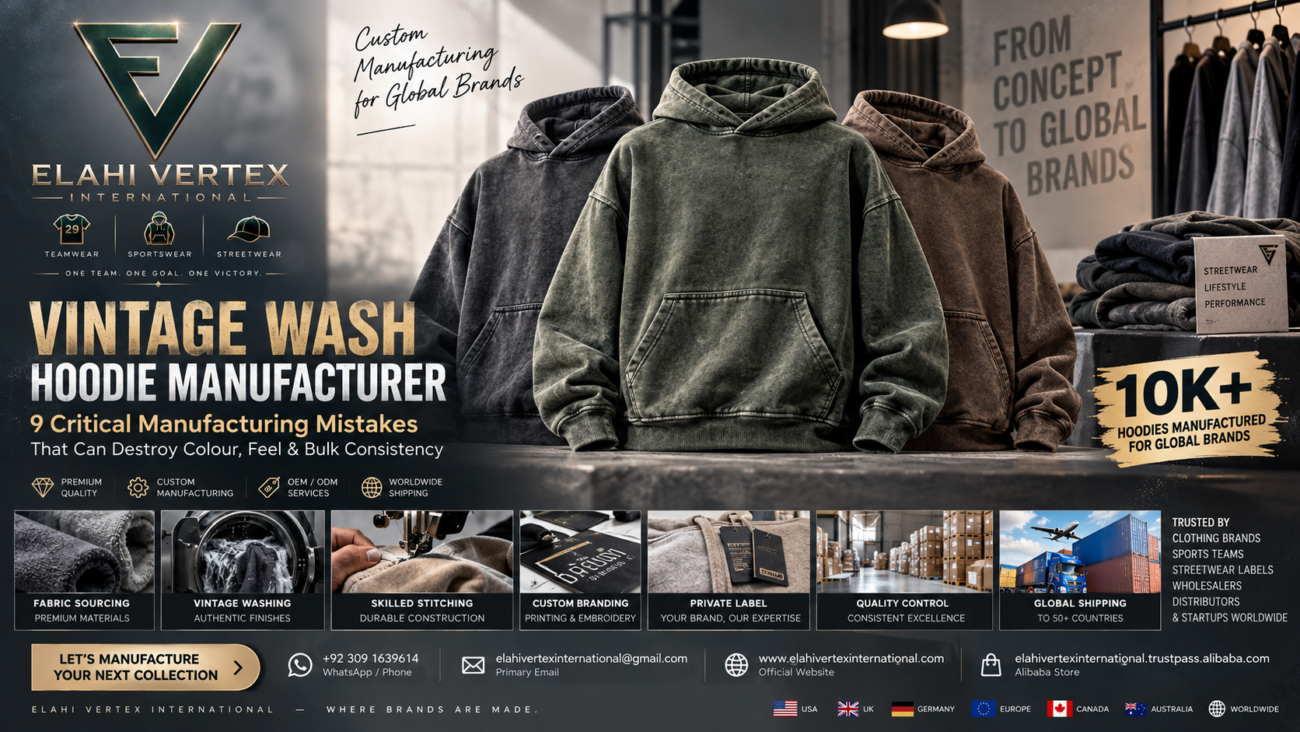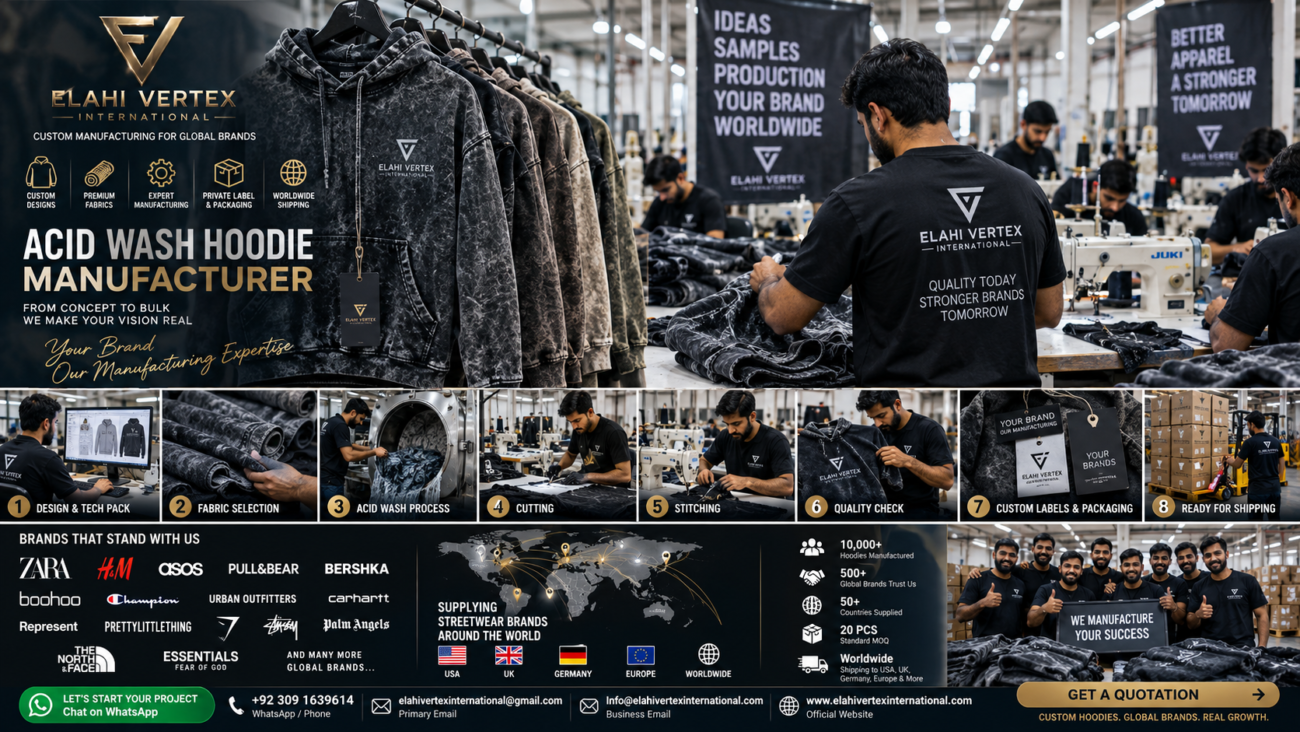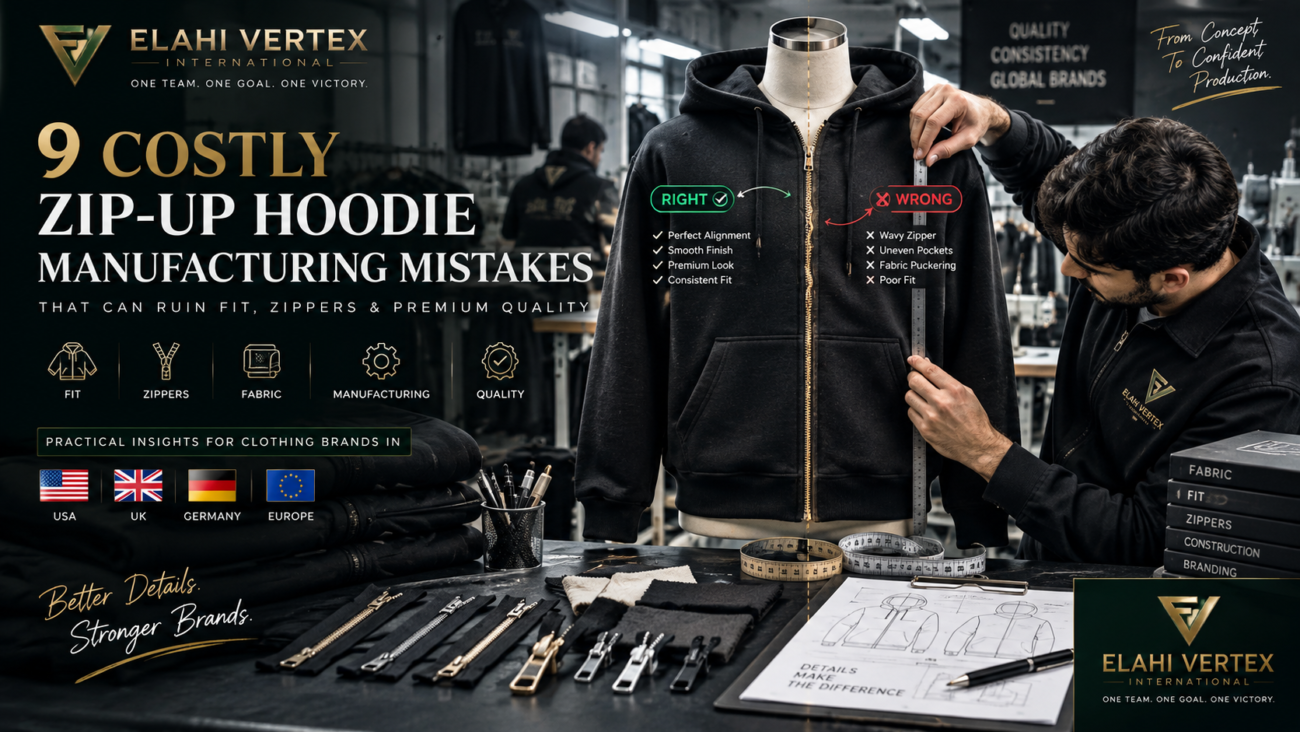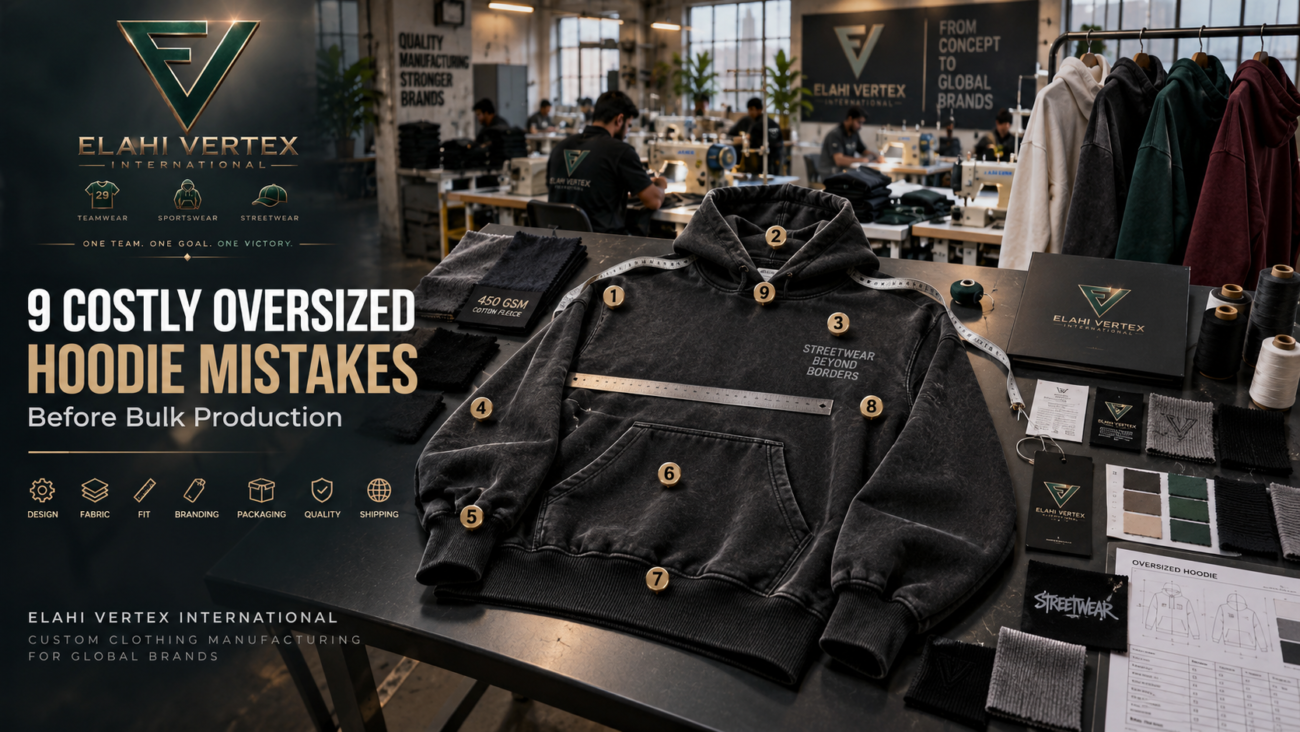


A hoodie can look perfect in a mock-up and still become an expensive manufacturing mistake.
The fabric may feel lighter than expected. An “oversized” fit may simply be a normal pattern graded one size larger. The hood may collapse instead of holding its shape. Embroidery may distort the chest. Ribbing may lose recovery. A print may look excellent on the sample but behave differently after washing. Or an apparently cheap quotation may become expensive after sampling, labels, packaging, freight and import costs are added.
These are not small details for a UK streetwear brand. They affect the product customers actually receive.
Good custom hoodie manufacturing therefore begins long before bulk sewing. It starts with a clear product specification, the right fabric and construction, an intentional fit, compatible decoration, a properly reviewed sample and a documented production standard.
This guide examines 9 costly custom hoodie manufacturing mistakes UK streetwear brands should avoid, particularly brands sourcing heavyweight, oversized, OEM or private-label hoodies.
It also explains what founders should put into an RFQ, how to evaluate a streetwear hoodie manufacturer, what to inspect during sampling, how to think about landed cost, and what should be frozen before bulk production begins.
UK brands considering international production can also compare these principles against the custom clothing manufacturing process at Elahi Vertex International.
Table of Contents
- What makes custom hoodie manufacturing difficult?
- Mistake #1 — Choosing hoodie fabric by GSM alone
- Mistake #2 — Using vague terms such as “oversized”
- Mistake #3 — Ignoring hood, rib and garment construction
- Mistake #4 — Approving bulk without a proper physical sample
- Mistake #5 — Choosing the wrong printing or embroidery method
- Mistake #6 — Leaving private-label details until the end
- Mistake #7 — Selecting a manufacturer mainly by unit price
- Mistake #8 — Ignoring landed cost and UK import responsibilities
- Mistake #9 — Failing to freeze the approved production standard
- Hoodie specification checklist
- How to evaluate a custom hoodie manufacturer
- How Elahi Vertex International approaches custom hoodie projects
- 50 custom hoodie manufacturing FAQs
- Final buyer checklist
- Conclusion
What Makes Custom Hoodie Manufacturing More Difficult Than It Looks?
A hoodie is familiar. That makes it easy to underestimate.
A buyer may initially describe the requirement as:
“400 GSM oversized black hoodie with embroidery.”
That sounds reasonably specific.
It is not a complete manufacturing specification.
A manufacturer may still need to know:
- fibre composition;
- knit construction;
- face and reverse characteristics;
- brushed or unbrushed finish;
- target finished GSM;
- shrinkage expectations;
- colour reference;
- garment measurements;
- grading rules;
- shoulder drop;
- chest width;
- body length;
- sleeve length;
- sleeve width;
- hood dimensions;
- single- or double-layer hood;
- drawcord requirements;
- kangaroo-pocket dimensions;
- rib composition;
- rib width;
- cuff dimensions;
- hem dimensions;
- seam construction;
- artwork dimensions;
- artwork placement;
- embroidery or print technique;
- thread or ink colours;
- neck label;
- size label;
- care information;
- hangtag;
- packaging;
- size breakdown;
- quantity;
- shipping destination.
That is why professional custom hoodie manufacturing is a specification problem before it becomes a sewing problem.
The objective is not simply to manufacture “a hoodie.”
The objective is to reproduce the brand’s intended hoodie consistently enough that the approved product, bulk production and future reorder remain commercially aligned.

Mistake #1: Choosing Hoodie Fabric by GSM Alone
One of the most common mistakes in custom hoodie manufacturing is treating GSM as a complete description of quality.
It is not.
What does GSM mean in hoodie manufacturing?
GSM means grams per square metre.
It measures fabric weight per unit area.
A 380 GSM fabric is therefore heavier per square metre than a 280 GSM fabric.
That information is useful, but GSM alone does not tell a buyer everything about:
- fibre composition;
- yarn;
- knit structure;
- surface;
- density;
- softness;
- stretch;
- recovery;
- shrinkage;
- pilling behaviour;
- drape;
- finishing;
- durability;
- warmth;
- appearance after washing.
Two fabrics carrying the same nominal GSM can feel noticeably different.
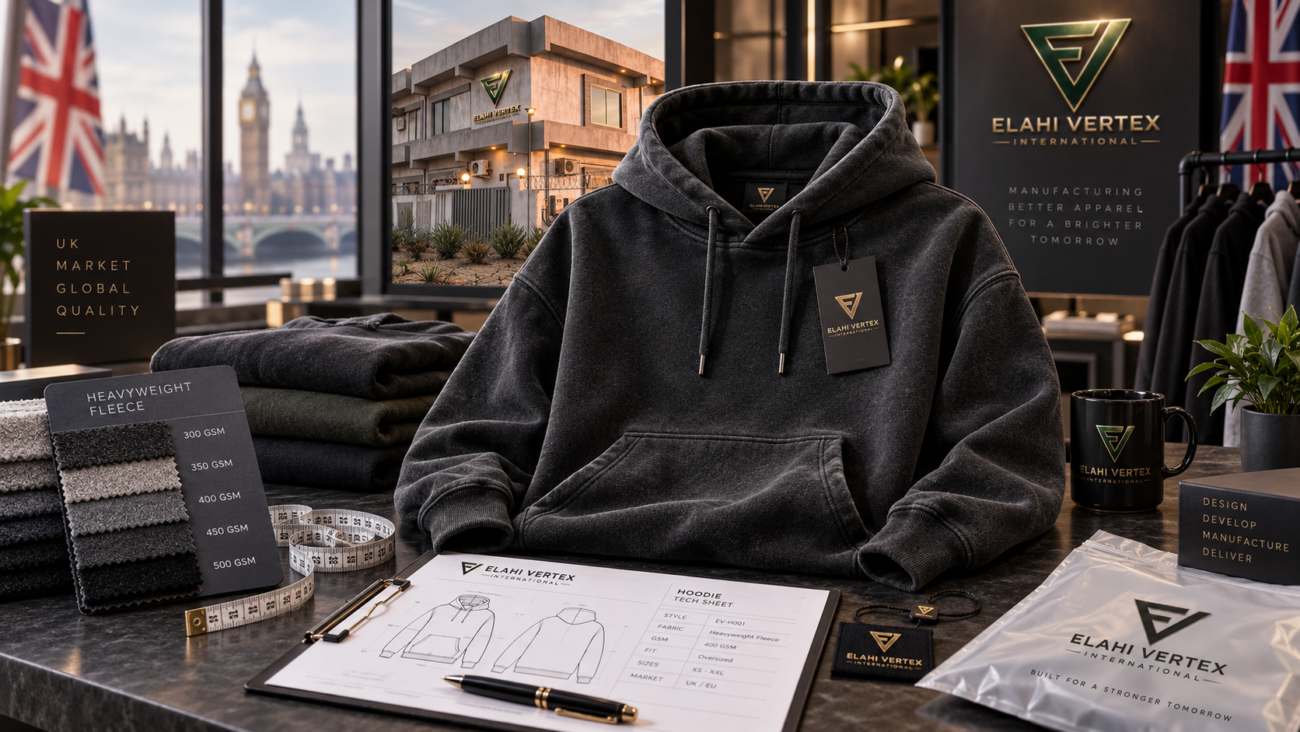
A better hoodie fabric specification
Instead of writing:
“Need 350 GSM.”
A stronger RFQ might communicate:
Product: oversized pullover hoodie
Fabric direction: cotton-rich brushed fleece
Target finished weight: approximately 350 GSM
Hand feel: substantial and soft
Fit: boxy/drop shoulder
Season: autumn/winter UK collection
Colour: Pantone/reference swatch to be confirmed
Testing/approval: physical fabric and garment sample before bulk
The exact specification should be agreed with the manufacturer for the project.
French terry vs brushed fleece
These terms should not be treated as interchangeable.
French terry
French terry commonly has loops on the reverse side rather than a heavily brushed inner surface.
Depending on composition and construction, it can work well for:
- transitional collections;
- layering;
- premium casualwear;
- spring/autumn pieces;
- streetwear where structure is desired without maximum insulation.
Brushed fleece
Brushed fleece has a softer, brushed reverse surface.
Depending on its construction, it can provide a warmer hand feel and is commonly considered for:
- colder-season hoodies;
- heavyweight streetwear;
- winter drops;
- comfort-focused garments.
Neither is automatically “better.”
The correct choice depends on the intended product.
Is a 400 GSM hoodie automatically premium?
No.
Weight and quality are different concepts.
A heavy fabric with weak recovery, poor finishing, unsuitable shrinkage behaviour or the wrong silhouette can still create a poor garment.
Similarly, a well-developed lighter hoodie can be commercially appropriate for a different season or customer.
That distinction matters when UK founders search for a custom hoodie manufacturer UK brands can use for premium streetwear.
Do not ask only:
“What GSM do you have?”
Ask:
“What fabric construction, composition and finish will create the product I am trying to sell?”
Buyer action
Before sampling, confirm:
- intended season;
- target customer;
- target retail positioning;
- composition;
- fabric type;
- target GSM;
- inner finish;
- outer face;
- stretch requirement;
- colour;
- wash/finish;
- shrinkage expectations;
- required testing or certification.
Elahi Vertex International currently lists hoodie manufacturing options across different fabrics and weights, including heavyweight fleece and French terry, depending on the project. A published example is its 380 GSM cotton fleece hoodie.
Mistake #2: Saying “Oversized” Without Defining the Actual Hoodie Fit
“Make it oversized.”
That instruction is responsible for a surprising amount of confusion in custom hoodie manufacturing.
Oversized is not one universal measurement standard.
One brand may mean:
- wider chest;
- moderate shoulder drop;
- standard body length.
Another may want:
- extremely wide body;
- strong shoulder drop;
- shortened body;
- large sleeves;
- wide cuff;
- structured hood.
A third may actually want a relaxed regular fit rather than a true streetwear block.
Oversized does not mean “just size up”
Taking a regular hoodie and making everything bigger does not necessarily create a deliberate oversized silhouette.
Streetwear fit is about proportion.
Important measurements can include:
| Measurement | Why It Matters |
|---|---|
| Chest width | Controls body volume |
| Shoulder width | Influences drop and silhouette |
| Body length | Determines cropped, regular or elongated appearance |
| Sleeve length | Changes with shoulder drop |
| Sleeve width | Controls volume |
| Armhole | Affects mobility and silhouette |
| Cuff opening | Influences sleeve stacking |
| Bottom opening | Changes boxy vs tapered appearance |
| Hood height | Affects hood coverage |
| Hood width/depth | Influences structure |
| Pocket dimensions | Must remain proportionate |
Boxy hoodie vs oversized hoodie
These terms overlap but are not identical.
A boxy hoodie normally emphasizes width relative to length.
An oversized hoodie can involve greater overall volume, shoulder drop and sleeve volume.
A garment can therefore be oversized without being particularly cropped or boxy.
This is exactly why a streetwear hoodie manufacturer needs measurements rather than adjectives alone.
Create a measurement chart
For each size, specify key points of measurement.
For example:
| Point of Measurement | S | M | L | XL |
|---|---|---|---|---|
| Chest | Confirm | Confirm | Confirm | Confirm |
| Body length | Confirm | Confirm | Confirm | Confirm |
| Shoulder | Confirm | Confirm | Confirm | Confirm |
| Sleeve | Confirm | Confirm | Confirm | Confirm |
| Bottom opening | Confirm | Confirm | Confirm | Confirm |
| Cuff opening | Confirm | Confirm | Confirm | Confirm |
The actual numbers should come from the brand’s approved fit rather than generic values copied from another company.
Use a reference garment intelligently
A physical reference hoodie can be useful.
But tell the manufacturer what you like about it.
For example:
- match chest width;
- shorten body by 2 cm;
- increase hood depth;
- widen sleeve;
- retain cuff width;
- change fabric;
- move embroidery.
This gives the manufacturer something measurable.
Buyer action
Never approve custom hoodie manufacturing from the word “oversized” alone.
Approve measurements.
Then approve the physical fit.
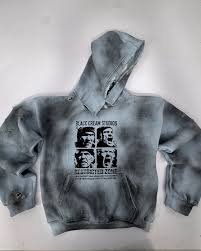
Mistake #3: Ignoring Hood, Rib, Pocket and Structural Construction
A premium streetwear hoodie is not defined only by fabric and artwork.
Construction changes how the garment looks, feels and ages.
A founder can spend heavily on photography, branding and embroidery while ignoring the details that customers physically touch every time they wear the garment.
Hood construction
The hood is one of the most visually important parts of a hoodie.
Questions can include:
- single layer or double layer?
- self-fabric lining or another material?
- hood depth?
- hood height?
- centre seam?
- drawcord or no drawcord?
- eyelets?
- metal hardware?
- stitched edge?
- crossover neckline?
- structured or relaxed appearance?
A large double-layer hood can create a very different silhouette from a thin single-layer hood.
That does not mean every hoodie should use a double-layer construction.
It means the decision should be intentional.
Rib matters
Cuffs and waistband influence both appearance and performance.
A buyer should discuss:
- rib composition;
- rib weight;
- elasticity;
- recovery;
- cuff width;
- waistband depth;
- colour matching;
- stretch.
Weak rib can make an otherwise attractive hoodie feel cheap.
Overly tight rib can distort the intended oversized silhouette.
Kangaroo pocket construction
The pocket should also be specified.
Consider:
- width;
- height;
- opening angle;
- reinforcement;
- alignment;
- placement;
- topstitching.
On an oversized garment, a standard-size pocket may look visually too small.
Seam and stitching details
Depending on the design, buyers may need to consider:
- seam type;
- topstitching;
- coverstitch;
- reinforcement;
- bartacks;
- stitch appearance;
- thread colour;
- tolerance expectations.
The lesson is simple:
Custom hoodie manufacturing quality lives in the details customers do not see in a digital mock-up.
Mistake #4: Starting Bulk Custom Hoodie Manufacturing Before Proper Sample Approval
A sample costs money.
A failed bulk order costs much more.
That is why sampling should be treated as product development rather than an inconvenient delay.
What should a hoodie sample prove?
A physical sample can help evaluate:
Fabric
Does the material feel appropriate?
GSM
Is the target weight approximately correct and agreed?
Fit
Does the garment create the intended silhouette?
Measurements
Do key points match the specification?
Hood
Is the size and structure right?
Rib
Does it visually and functionally suit the garment?
Artwork
Are dimensions and placement correct?
Decoration
Does the selected print or embroidery method work on the fabric?
Labels
Are branding components positioned correctly?
Construction
Are seams, pockets, cuffs and other details aligned with the approved requirement?
Overall commercial impression
Would you confidently sell this product at your intended price?
A sample should be reviewed physically where practical
Photos and videos are useful communication tools.
They can help confirm visible details.
But they cannot fully communicate:
- hand feel;
- weight;
- fit on the intended wearer;
- stretch;
- inside construction;
- tactile embroidery;
- fabric behaviour.
For a serious private label hoodies UK project, a physical sample can therefore reduce uncertainty before a larger financial commitment.
Do not approve because the launch deadline is approaching
This is a dangerous founder behaviour.
The launch date is a marketing decision.
The product is a manufacturing reality.
If the sample needs correction, correct it.
A delayed launch can be painful.
A bulk shipment containing the same unresolved defect is potentially worse.
Elahi Vertex International’s published How to Order process places specification confirmation, sampling and sample approval before bulk production.
Buyer action
Approve a sample only after checking:
- measurements;
- fit;
- fabric;
- colour;
- GSM;
- construction;
- stitching;
- hood;
- rib;
- pocket;
- print;
- embroidery;
- labels;
- trims;
- packaging requirements.
Mistake #5: Choosing a Decoration Method Because It Is Trending
Puff print.
Screen print.
DTF.
Embroidery.
3D embroidery.
Appliqué.
Chenille.
These can all produce interesting results.
But a trending decoration method is not automatically the correct method for your garment.
Match decoration to the design
A buyer should consider:
- artwork complexity;
- number of colours;
- desired texture;
- artwork size;
- garment fabric;
- fabric surface;
- placement;
- order quantity;
- durability expectations;
- budget;
- target aesthetic.
Embroidery on heavyweight hoodies
Embroidery can create a premium appearance, but artwork should be digitised and developed appropriately.
Consider:
- stitch density;
- backing/stabilisation;
- artwork size;
- small details;
- fabric distortion;
- thread colour;
- placement.
Extremely dense embroidery on an unsuitable area can affect drape or distort the garment.
Screen printing
Screen printing can work well for many hoodie graphics, particularly where artwork and production quantities make the method commercially appropriate.
But the specification still matters:
- dimensions;
- colours;
- Pantone references where appropriate;
- placement;
- ink/finish requirement;
- curing;
- desired hand feel.
Puff print
Puff effects can create raised graphics, but buyers should approve the actual result rather than assuming a digital mock-up predicts the finished texture.
Decoration placement
Do not write:
“Small logo on chest.”
Write a measurable requirement.
For example:
Artwork width: 80 mm
Placement: X cm from centre/front reference point
Colour: approved reference
Technique: embroidery
Final appearance: subject to sample approval
Exact placement should be confirmed for the actual pattern and size.
Buyer action
Your custom hoodie manufacturing tech pack should define decoration by:
- technique;
- artwork file;
- dimensions;
- colours;
- placement;
- finish;
- sample reference.
Mistake #6: Treating Private Label Branding as an Afterthought
Private label is not simply sewing a brand name into the neck.
A properly planned private label hoodies UK project may involve:
- main neck label;
- size label;
- care/fibre information;
- woven label;
- printed label;
- hangtag;
- swing tag;
- branded drawcord;
- custom zip puller;
- packaging;
- barcode/SKU requirements;
- carton marks;
- other buyer-specific branding.
These elements should be discussed early.
Why?
Because branding components can affect:
- sampling;
- costing;
- sourcing;
- artwork;
- lead time;
- compliance;
- packing.
If you approve the garment and only later ask for several custom trims, the project scope changes.
UK textile labelling matters
For textile products sold in Great Britain, official UK guidance states that textile labels must show fibre content. Where a product has two or more components with different fibre contents, relevant content requirements apply.
Brands should verify current requirements for their exact product and sales situation before placing goods on the market.
Official guidance:
UK Government — Textile Labelling
This is a better source than copying another clothing brand’s label.
Certification claims need evidence
Do not put an environmental, material or textile certification claim on your product simply because it sounds good.
If a brand wants an OEKO-TEX-related claim, for example, it should understand what is actually certified and verify documentation.
OEKO-TEX STANDARD 100 concerns textiles tested against requirements for harmful substances.
Never convert a supplier’s generic statement into a certification claim for your own product without checking the evidence and applicable rules.
Buyer action
Define branding before final quotation and sample development wherever possible.
For buyers needing private-label development, see Elahi Vertex International private label manufacturing.
Mistake #7: Choosing a Custom Hoodie Manufacturer Mainly by Unit Price
This is where many sourcing comparisons fail.
Supplier A: £11.
Supplier B: £14.
Supplier A looks cheaper.
But those two numbers tell you almost nothing until the specifications and commercial terms are comparable.
What is included?
Supplier A may quote:
- lighter fabric;
- basic labels;
- no special packaging;
- EXW terms.
Supplier B may quote:
- heavier fabric;
- custom labels;
- embroidery;
- packaging;
- different shipping terms.
Those are not comparable quotations.
Compare like with like
Create an RFQ that every shortlisted manufacturer receives.
Include:
| Requirement | Specification |
|---|---|
| Product | Pullover hoodie |
| Quantity | Your required quantity |
| Fabric | Defined construction/composition |
| GSM | Target |
| Fit | Defined measurements |
| Colour | Reference/Pantone |
| Technique + dimensions | |
| Embroidery | Technique + dimensions |
| Labels | Exact requirements |
| Packaging | Exact requirements |
| Destination | UK postcode/city |
| Shipping | Ask for Incoterm |
| Sample | Ask separately |
| Production | Ask for current project estimate |
Then compare the quotations.
Cheap production can become expensive inventory
Suppose you save £2 per hoodie but the fit is wrong.
That saving means little if the product sells poorly.
Likewise, paying more does not guarantee quality.
The objective is not to choose the highest quote.
The objective is to understand value, specification and risk.
Ask manufacturers commercially useful questions
A serious RFQ should ask:
- What exactly is included in the unit price?
- What is excluded?
- What MOQ applies to this specification?
- What is the sample cost?
- What is the shipping cost?
- Which Incoterm applies?
- What is the estimated production timeline?
- What information is required before production?
- How are revisions handled?
- What is used as the bulk-production reference?
This makes custom hoodie manufacturing easier to compare objectively.
Mistake #8: Ignoring the True Landed Cost of Custom Hoodies in the UK
The factory price is not automatically the final cost of inventory.
A UK brand importing custom hoodies may need to consider:
- garment cost;
- decoration;
- labels;
- trims;
- packaging;
- sample development;
- tooling/setup where applicable;
- freight;
- insurance where applicable;
- customs-related costs;
- import duty where applicable;
- import VAT;
- clearance;
- local delivery;
- payment/banking charges.
Which items apply depends on the transaction and shipping structure.
Calculate landed cost before setting retail price
A simplified planning framework is:
**Manufacturing cost
- branding/packaging costs not already included
- freight
- applicable import/clearance costs
- destination expenses
= estimated landed inventory cost**
Then divide relevant total costs appropriately across saleable units.
Do not use a generic online percentage and assume it applies to every hoodie shipment.
Commodity classification, origin, customs value, trade arrangements and the transaction structure can affect import treatment.
For current rules, use official UK sources rather than relying exclusively on a manufacturer’s blog.
UK Government — Import Goods Into the UK
Shipping method affects economics
A small launch may prioritise speed.
A larger replenishment may prioritise freight efficiency.
The correct option depends on:
- quantity;
- weight;
- carton volume;
- destination;
- required delivery date;
- inventory position;
- available freight options.
This is why a buyer should provide the delivery destination when requesting a meaningful custom hoodie manufacturing quotation.
Buyer action
Before approving production, ask for:
- manufacturing price;
- what is included;
- packing information;
- estimated shipment weight/volume where available;
- freight option;
- Incoterm;
- shipping destination;
- responsibilities at destination.
Mistake #9: Failing to Freeze the Approved Hoodie Before Bulk Production
You approve the sample.
Then change the hood.
Then change the cuff.
Then reduce the embroidery.
Then alter the label.
Then change the body length through WhatsApp.
Then send a different artwork file by email.
Which version is approved?
This is where preventable manufacturing disputes begin.
Create a final approval package
Before bulk custom hoodie manufacturing, freeze:
Garment
- product/style;
- pattern version;
- measurements;
- grading;
- size chart;
- tolerances.
Fabric
- composition;
- construction;
- target GSM;
- colour;
- finish.
Construction
- hood;
- pocket;
- seams;
- rib;
- cuff;
- waistband;
- drawcord;
- eyelets;
- zipper if applicable.
Decoration
- artwork version;
- technique;
- dimensions;
- colours;
- placement.
Branding
- neck label;
- size label;
- care/fibre label;
- hangtag;
- trims.
Packaging
- individual packaging;
- stickers/barcodes if required;
- carton requirements.
Commercial information
- quantity;
- size breakdown;
- unit price;
- payment terms;
- production estimate;
- shipping terms;
- destination.
Version control matters
Use clear filenames.
Bad:
hoodiefinal2NEWfinal.ai
Better:
BRAND_STYLE01_FRONT_PRINT_V4_APPROVED_16SEP2026.ai
The same principle applies to:
- tech packs;
- size charts;
- label files;
- Pantone references;
- packaging artwork.
Approved sample + approved specifications
The physical sample and final documentation should support each other.
A sample shows what was physically accepted.
The technical documentation communicates what must be reproduced.
This is one of the strongest controls a growing streetwear brand can introduce.
Custom Hoodie Manufacturing Specification Checklist
Before contacting a streetwear hoodie manufacturer, prepare as much of the following information as possible.
Product
- Pullover / zip-up / half-zip / other
- Men’s / women’s / unisex
- Collection name
- Intended season
Fabric
- Composition
- Construction
- GSM
- Surface
- Reverse finish
- Stretch
- Wash/finish
- Colour reference
Fit
- Regular
- Relaxed
- Oversized
- Boxy
- Cropped
- Drop shoulder
- Custom fit
Measurements
- Chest
- Length
- Shoulder
- Sleeve
- Armhole
- Cuff
- Bottom opening
- Hood
Construction
- Hood layers
- Hood shape
- Rib
- Cuffs
- Waistband
- Drawcord
- Eyelets
- Zip
- Stitching
Decoration
- Screen print
- Embroidery
- Puff
- Appliqué
- Patch
- Other required method
Branding
- Main label
- Size label
- Care/fibre label
- Hangtag
- Custom trim
- Packaging
Commercial
- Quantity
- Size breakdown
- Destination
- Required date
- Sampling requirement
- Shipping preference
The more complete the RFQ, the more useful the manufacturer’s response can be.
How Should UK Brands Evaluate a Custom Hoodie Manufacturer?
Do not evaluate a manufacturer from Instagram photographs alone.
Use a structured supplier-evaluation process.
1. Confirm business identity
Verify:
- company name;
- website;
- business contact information;
- location;
- professional communication channels.
2. Review relevant manufacturing work
A sports-uniform specialist may not automatically be the right factory for a heavyweight fashion hoodie.
Look for relevant evidence.
Elahi Vertex International publishes a portfolio covering streetwear projects including hoodies and sweatshirts.
3. Ask product-specific questions
Ask about your actual hoodie.
Not:
“Can you manufacture streetwear?”
Instead:
“Can you develop a 380 GSM cotton-rich fleece oversized pullover hoodie with a double-layer hood, dropped shoulder, custom woven neck label and 90 mm chest embroidery?”
Specific questions produce more useful answers.
4. Request a sample
A sample gives you something physical to evaluate.
5. Check communication
A manufacturer may have strong machinery and still be difficult to work with if specifications are poorly documented.
Evaluate whether questions are answered clearly.
6. Confirm commercial terms
Understand:
- MOQ;
- sample cost;
- bulk price;
- shipping;
- payment;
- lead-time estimate;
- revisions;
- packaging.
7. Verify important claims
If a certification matters to your purchasing decision, request evidence.
If a material claim matters, request supporting information.
If an inspection matters, discuss it before payment.
Trust should be built through verification.
UK Manufacturer vs Overseas Custom Hoodie Manufacturer
UK brands often face a choice between domestic and overseas sourcing.
Neither model is universally superior.
| Factor | UK/Domestic Route | Overseas Manufacturing |
|---|---|---|
| Communication distance | Potentially easier | Requires strong remote communication |
| Freight distance | Lower | Higher |
| Sampling logistics | Potentially easier | International courier required |
| MOQ | Supplier dependent | Supplier dependent |
| Unit economics | Supplier dependent | Can become attractive at suitable volumes |
| Customisation | Supplier dependent | Can be extensive with capable factories |
| Lead time | Supplier dependent | Production + international transit |
| Oversight | Easier physical access | Digital/third-party controls may matter |
Do not choose based on geography alone.
Choose according to:
- product capability;
- MOQ;
- quality;
- communication;
- total cost;
- delivery requirement;
- risk;
- repeat-order capability.
Elahi Vertex International is based in Sialkot, Pakistan, not the United Kingdom. UK brands considering international sourcing should therefore compare the complete commercial proposition rather than treating it as domestic production.
Why Consider Elahi Vertex International for Custom Hoodie Manufacturing?
Elahi Vertex International is a B2B custom clothing manufacturer and exporter based in Sialkot, Pakistan.
Its published manufacturing categories include:
- streetwear;
- hoodies and sweatshirts;
- sportswear;
- teamwear;
- activewear;
- boxing wear;
- leather wear;
- private-label clothing.
For custom apparel projects, buyers can provide their own:
- designs;
- measurements;
- fabrics;
- GSM requirements;
- colours;
- branding;
- printing;
- embroidery;
- labels;
- trims;
- packaging requirements.
The company’s custom clothing manufacturing page describes production from product requirements through sampling, bulk production, inspection, packaging and shipping.
Its private label manufacturing enquiry system also allows buyers to specify fabric, GSM, fit, printing, labels, sizing and target quantity.
The published 380 GSM cotton fleece hoodie provides one example of a heavyweight hoodie category intended for streetwear, fashion and private-label buyers.
MOQ
Elahi Vertex International’s working minimum is 20 pieces per product/category for qualifying custom projects.
The exact commercial feasibility still depends on the design and requirements.
Low MOQ should not mean low specification.
The objective is to make smaller production commercially useful by defining the product properly before production.
Strong CTA — Develop Your Custom Hoodie Before You Risk a Bulk Order
A serious hoodie enquiry should contain more than a logo.
If you are developing custom hoodies for a clothing brand in the UK, send Elahi Vertex International:
- hoodie reference or tech pack;
- target fabric;
- target GSM;
- fit direction;
- size chart;
- colour;
- artwork;
- printing/embroidery requirements;
- labels;
- packaging;
- quantity;
- delivery city/postcode.
That gives the manufacturing team enough information to discuss the project commercially instead of guessing.
Start here:
Discuss Custom Clothing Manufacturing
Submit a Private Label Manufacturing Enquiry
See How the Ordering Process Works
Review Streetwear Manufacturing Work
Contact Elahi Vertex International
50 Custom Hoodie Manufacturing FAQs for UK Streetwear Brands
1. What is custom hoodie manufacturing?
Custom hoodie manufacturing is the production of hoodies according to buyer-defined requirements rather than simply adding a logo to an existing retail garment. Requirements can include fabric, GSM, fit, measurements, construction, colours, decoration, labels, trims and packaging.
2. How do I find a custom hoodie manufacturer for a UK streetwear brand?
Evaluate relevant product capability, samples, specifications, MOQ, communication, quality controls, pricing structure, shipping terms and verifiable business information. Do not choose a custom hoodie manufacturer UK brands can source from solely because of the lowest quote.
3. What GSM is best for a streetwear hoodie?
There is no universally best GSM. The correct weight depends on season, composition, construction, desired hand feel, silhouette and positioning. Heavyweight streetwear commonly uses substantial fabrics, but GSM should never be the only quality criterion.
4. Is 300 GSM good for a hoodie?
It can be. A 300 GSM fabric may suit many hoodie applications, but composition, knit construction, finish and intended season matter as much as the number itself.
5. Is 350 GSM good for UK streetwear hoodies?
A 350 GSM fabric can provide a substantial feel suitable for many streetwear concepts. The actual suitability depends on composition, finish, fit and construction.
6. Is 380 GSM considered heavyweight?
380 GSM would generally be considered substantial for hoodie fabric, although terms such as “heavyweight” are commercial descriptions rather than universal quality grades.
7. Is 400 GSM better than 300 GSM?
Not automatically. Higher GSM means greater fabric mass per square metre, not automatically better fibre, construction, finishing or durability.
8. What is the difference between French terry and fleece?
French terry commonly has loops on the reverse, while brushed fleece has a brushed inner surface. Each can be suitable for different seasons, hand feels and design objectives.
9. What fabric is best for premium custom hoodies?
Cotton, cotton-rich fleece, French terry and various blends may all be appropriate. The right material depends on the intended product rather than a universal “best” fabric.
10. What is a private label hoodie?
A private-label hoodie is produced for a brand and carries brand-specific identity such as labels, artwork, tags, packaging and other agreed custom details.
11. What are private label hoodies UK brands likely to specify?
UK brands may specify heavyweight fabrics, oversized or boxy fits, custom labels, screen printing, embroidery, custom trims and branded packaging. Requirements differ by brand.
12. What is an OEM hoodie?
OEM manufacturing generally means producing a product according to the buyer’s designs and specifications.
13. What is an ODM hoodie?
ODM can involve a manufacturer supporting more of the product-development process from a concept or design direction. The exact scope should be agreed with the supplier.
14. What is a cut-and-sew hoodie?
A cut-and-sew hoodie is manufactured from fabric panels cut to the required pattern and assembled into the finished garment, allowing greater control than decorating a pre-made blank.
15. What is the difference between a custom hoodie and a printed blank?
A printed blank starts from an existing garment. Full custom hoodie manufacturing can control fabric, pattern, fit, construction, labels and other details before decoration.
16. Can a manufacturer create an oversized hoodie?
Yes, where the manufacturer has suitable pattern-development capability. But “oversized” should be translated into measurable dimensions and an approved sample.
17. What makes a hoodie boxy?
A boxy silhouette generally uses greater width relative to body length, but exact proportions depend on the brand’s fit block.
18. What is drop shoulder?
A drop-shoulder design positions the shoulder seam beyond the wearer’s natural shoulder point, contributing to a relaxed or oversized silhouette.
19. How should I specify hoodie sizing?
Provide a size chart with clearly defined points of measurement, measurement units, grading and tolerances where required.
20. Do I need a tech pack for custom hoodie manufacturing?
A good tech pack is highly useful because it reduces ambiguity. It can document materials, measurements, construction, colours, artwork, labels, trims and packaging.
21. Can I manufacture hoodies without a tech pack?
Potentially, but the missing information still needs to be communicated and documented. Reference images alone are rarely sufficient for complex custom development.
22. Should I order a hoodie sample before bulk production?
For custom products, sampling is generally a sensible risk-control step because it allows the buyer to inspect the physical garment before committing to larger production.
23. What should I check on a hoodie sample?
Check fabric, GSM, colour, measurements, fit, hood, rib, cuffs, pocket, stitching, print, embroidery, labels, trims and overall finishing.
24. Can photos and videos replace a physical hoodie sample?
They can support approval but cannot fully communicate tactile characteristics such as hand feel, physical weight and actual fit.
25. What is a pre-production sample?
A pre-production sample is a reference developed before bulk manufacturing that can be used to confirm the intended product. Exact terminology and procedures vary between manufacturers.
26. Why does sample approval matter?
It establishes a clearer physical reference and helps identify errors before they are multiplied across bulk production.
27. What printing method is best for hoodies?
There is no universal best method. Artwork, fabric, colours, quantity, desired finish, durability and budget should determine the technique.
28. Is embroidery good for streetwear hoodies?
Yes, embroidery can create an effective premium streetwear appearance when the artwork, digitisation, backing, density and placement are suitable.
29. What is puff print?
Puff printing uses an ink/additive system designed to expand during processing and create a raised effect. The final result should be physically sampled when appearance is important.
30. Is screen printing suitable for heavyweight hoodies?
It can be. Suitability depends on the fabric surface, artwork, ink system and required finish.
31. What is 3D embroidery?
3D or raised embroidery creates dimensional stitching, often using additional structure beneath stitches. Artwork must be suitable for the technique.
32. What labels do private-label hoodies need?
Branding may include main labels, size labels, care/fibre information and hangtags. Legal labelling requirements depend on the market where the garment is sold.
33. What textile labelling rules apply in Great Britain?
UK government guidance requires textile fibre-content information and contains rules for products with multiple textile components. Brands should check the current official guidance for their exact product.
34. Do custom hoodies need OEKO-TEX certification?
Not every hoodie is automatically required to carry OEKO-TEX certification. If a buyer requires an OEKO-TEX claim, the relevant certification and scope should be verified rather than assumed.
35. What is OEKO-TEX STANDARD 100?
It is a certification system for textiles tested against requirements concerning harmful substances. Buyers should use OEKO-TEX’s official resources when evaluating certification claims.
36. How much does custom hoodie manufacturing cost?
There is no meaningful universal price. Cost depends on fabric, GSM, quantity, construction, decoration, labels, trims, packaging, manufacturing location and commercial terms.
37. Why are heavyweight hoodies more expensive?
They can require more material by weight, but final pricing also depends on composition, construction, finishing, decoration and quantity.
38. Does a low MOQ increase hoodie cost per piece?
It can. Fixed development, setup and production costs are spread across fewer garments. Actual pricing should be quoted for the specific specification.
39. What MOQ does Elahi Vertex International use for custom clothing?
The working MOQ is 20 pieces per product/category for qualifying projects. Specific project feasibility should be confirmed before ordering.
40. Should UK brands manufacture 20 or 100 hoodies first?
That depends on proven demand, cash flow, target margin, manufacturing economics and launch strategy. Smaller runs can reduce inventory exposure, while larger runs may improve unit economics.
41. How do I calculate the landed cost of imported hoodies?
Combine relevant manufacturing, branding, packaging, freight, import, clearance and destination costs, then allocate them appropriately across saleable units. Verify UK customs treatment using current official information.
42. Is the cheapest hoodie manufacturer the best option?
No. Neither the cheapest nor the most expensive quote proves value. Compare specifications, quality, reliability, terms and complete landed economics.
43. What should I send a streetwear hoodie manufacturer for a quotation?
Send product type, design, fabric preference, GSM, fit, measurements, artwork, decoration, labels, quantity, size breakdown, packaging and delivery destination.
44. How do I prevent my bulk hoodies from differing from the sample?
Freeze the approved sample and technical specifications, document all revisions, use clear version control and agree on the final production reference before bulk manufacturing.
45. Why can two 400 GSM hoodies feel different?
Because GSM measures weight rather than every material characteristic. Composition, yarn, knit, density and finishing can all change hand feel and performance.
46. Should I use cotton or cotton-polyester fleece?
Both can be appropriate. Cotton-rich and blended constructions offer different characteristics. Choose according to the required hand feel, stability, performance and product positioning.
47. Can Elahi Vertex International manufacture private-label hoodies?
Elahi Vertex International publicly offers private-label manufacturing and hoodie/sweatshirt manufacturing. Exact fabrics, designs, quantities and specifications should be confirmed for each project.
48. Where is Elahi Vertex International located?
Elahi Vertex International is based in Sialkot, Pakistan and works as a B2B custom clothing manufacturer and exporter.
49. Can a UK streetwear startup work with an overseas hoodie manufacturer?
Yes, provided the commercial model fits the project. The buyer should evaluate sampling, communication, specifications, payment, freight, import responsibilities and total landed cost.
50. What is the safest first step before ordering custom hoodies?
Prepare a clear product specification and request a project-specific discussion or quotation before committing to bulk production. The objective is to eliminate ambiguity while the financial exposure is still small.
Custom Hoodie Manufacturing RFQ Template
Before requesting a quotation, collect these details:
Brand:
[Your brand]
Product:
Custom pullover / zip-up hoodie
Target market:
United Kingdom
Quantity:
[Quantity]
Fabric:
[Composition/construction]
Target GSM:
[GSM]
Fit:
[Oversized / boxy / regular / custom]
Colour:
[Pantone/reference]
Sizes:
[Size range]
Print:
[Technique, size, placement]
Embroidery:
[Technique, size, placement]
Labels:
[Main / size / care / woven]
Trims:
[Drawcord / eyelet / zip / other]
Packaging:
[Requirement]
Destination:
[City + postcode]
Target delivery:
[Date]
Reference files:
[Tech pack / AI / PDF / photos]
That information gives a manufacturer a much stronger basis for costing and development.
Final UK Streetwear Hoodie Buyer Checklist
Before paying for bulk custom hoodie manufacturing, confirm:
Product
- Hoodie style confirmed
- Fabric confirmed
- Composition confirmed
- GSM confirmed
- Colour confirmed
- Finish confirmed
Fit
- Fit block confirmed
- Size chart confirmed
- Measurements confirmed
- Grading confirmed
- Physical fit reviewed
Construction
- Hood confirmed
- Rib confirmed
- Cuffs confirmed
- Waistband confirmed
- Pocket confirmed
- Drawcord/hardware confirmed
- Stitching confirmed
Decoration
- Artwork version confirmed
- Print technique confirmed
- Embroidery confirmed
- Dimensions confirmed
- Placement confirmed
- Colours confirmed
Private Label
- Main label
- Size label
- Care/fibre information
- Hangtag
- Custom trims
- Packaging
Sample
- Sample received/reviewed
- Measurements checked
- Fit checked
- Fabric checked
- Construction checked
- Decoration checked
- Corrections completed
- Final version approved
Commercial
- MOQ
- Quantity
- Size breakdown
- Unit price
- Sample charges
- Packaging costs
- Freight
- Incoterm
- Import responsibilities
- Payment terms
- Production estimate
Bulk
- Final sample/reference frozen
- Final tech pack frozen
- Final artwork frozen
- Quality expectations documented
- Shipment details confirmed
Conclusion: Good Custom Hoodie Manufacturing Begins Before the Factory Cuts Fabric
The most expensive hoodie manufacturing problems rarely begin with one bad stitch.
They often begin much earlier.
An undefined fit.
A fabric selected only because of GSM.
An artwork placement communicated vaguely.
A sample approved too quickly.
A quotation selected only because it was cheapest.
A landed cost that was never calculated.
Or a bulk order started while specifications were still changing.
Professional custom hoodie manufacturing works differently.
Define the garment.
Specify the material.
Engineer the fit.
Choose decoration for the actual fabric and artwork.
Plan private-label details.
Develop and inspect the sample.
Understand the complete commercial cost.
Freeze the approved product.
Then move into bulk production.
For UK streetwear brands, that process does more than reduce manufacturing mistakes. It creates a stronger foundation for repeatable products, clearer supplier communication and better purchasing decisions.
Ready to Develop Your Next Hoodie?
Elahi Vertex International works with international B2B buyers on custom streetwear, hoodies, sweatshirts and private-label clothing from Sialkot, Pakistan.
If you are developing a UK streetwear hoodie, send:
Design + target GSM + fabric + fit + size chart + branding + quantity + UK destination.
Then the project can be discussed against actual requirements rather than assumptions.
Useful next steps:
Custom Streetwear Manufacturing Mistakes Guide
Contact Elahi Vertex International
Useful External Resources
- UK Government — Textile Labelling
https://www.gov.uk/guidance/textile-labelling
Use this when checking fibre-content labelling responsibilities for textiles sold in Great Britain. - UK Government — Import Goods Into the UK
https://www.gov.uk/import-goods-into-uk
Useful for UK brands researching customs, importing and border responsibilities. - UK Government — Trade Tariff
https://www.gov.uk/trade-tariff
Use the official tariff system when researching commodity classification and applicable import treatment rather than copying generic clothing-duty figures. - OEKO-TEX — STANDARD 100
https://www.oeko-tex.com/en/our-standards/oeko-tex-standard-100
Useful for understanding what STANDARD 100 certification actually covers. - WRAP — Textiles
https://www.wrap.ngo/sectors/textiles
Useful background for UK textile circularity, resource efficiency and sustainability research.
Ready to Manufacture Your Custom Hoodies? Reduce the Risk Before You Commit to Bulk
A strong streetwear concept can still become expensive inventory when the fabric, GSM, fit, measurements, decoration, labels or shipping terms are unclear.
Before committing money to bulk custom hoodie manufacturing, turn your idea into a specification that a manufacturer can actually price, sample and reproduce.
Elahi Vertex International works with UK and international B2B buyers developing custom hoodies, oversized streetwear, sweatshirts and private-label clothing.
Send Us Your Hoodie Requirements
To start a serious manufacturing discussion, send:
- Hoodie design, reference image or tech pack
- Fabric composition or preferred fabric
- Target GSM
- Oversized, boxy, relaxed or custom fit
- Size chart or reference garment
- Colours or Pantone references
- Printing or embroidery requirements
- Artwork dimensions and placement
- Neck, size and care-label requirements
- Hangtags and other private-label details
- Packaging requirements
- Required quantity
- Size breakdown
- UK delivery city/postcode
- Target delivery date
The more accurately these details are defined, the less room there is for assumptions during sampling and bulk production.

Start With 20 Pieces Per Product/Category
For qualifying projects, Elahi Vertex International’s standard MOQ starts at 20 pieces per product/category.
This gives growing brands a route to test a custom product without automatically committing to hundreds of pieces. The exact price, manufacturing requirements and shipping cost still depend on the individual project.
Discuss your project:
https://elahivertexinternational.com/contact-us/
Explore custom clothing manufacturing:
https://elahivertexinternational.com/custom-clothing-manufacturing/
Discuss private-label production:
https://elahivertexinternational.com/private-label-manufacturing/
See how the ordering process works:
https://elahivertexinternational.com/how-to/
Review streetwear manufacturing work:
https://elahivertexinternational.com/portfolio-10/
Official Elahi Vertex International website:
https://www.elahivertexinternational.com/
Before Sending an RFQ, Verify the Commercial Details That Matter
A serious UK buyer should also independently check the rules affecting the finished product and import transaction.
UK Government — Textile Labelling
https://www.gov.uk/guidance/textile-labelling
Check current fibre-content and textile-labelling requirements before placing garments on the Great Britain market.
UK Government — Importing Goods Into the UK
https://www.gov.uk/import-goods-into-uk
Use official guidance to understand the importing process and responsibilities that may apply when sourcing clothing internationally.
UK Integrated Online Tariff
https://www.gov.uk/trade-tariff
Check commodity classification, tariff information and applicable import measures instead of assuming one generic duty rate applies to every hoodie.
OEKO-TEX STANDARD 100
https://www.oeko-tex.com/en/our-standards/oeko-tex-standard-100
Use the official source when evaluating STANDARD 100 requirements or checking whether a certification claim is relevant to your project.
WRAP — Textiles
https://www.wrap.ngo/sectors/textiles
Useful for UK brands researching textile circularity, resource use and sustainability considerations.
Do Not Ask Only: “How Much Is a Hoodie?”
Ask a better commercial question:
“What will it cost to manufacture this exact hoodie, to this specification, in this quantity, and deliver it to my destination?”
That question gives both buyer and manufacturer something concrete to work from.
If you are preparing a UK streetwear collection, send Elahi Vertex International your design + fabric/GSM + fit + branding + quantity + UK destination.
The next commercial step should be simple:
Specification → Quotation → Sample → Approval → Bulk Production → Quality Review → Shipment → Reorder
Do not use the bulk order to discover whether the hoodie specification works.
Develop the product first. Approve the product second. Scale it third.

Discuss Your Custom Hoodie Project With Elahi Vertex International
WhatsApp:
https://wa.me/message/OWIPAIXYWHTPI1
Email:
elahivertexinternational@gmail.com
Website:
https://www.elahivertexinternational.com/
Alibaba:
https://elahivertexinternational.trustpass.alibaba.com/
If you already have a tech pack, reference hoodie, artwork or size chart, send it with your required quantity and UK delivery postcode so the project can move from a general enquiry toward an actual manufacturing quotation.