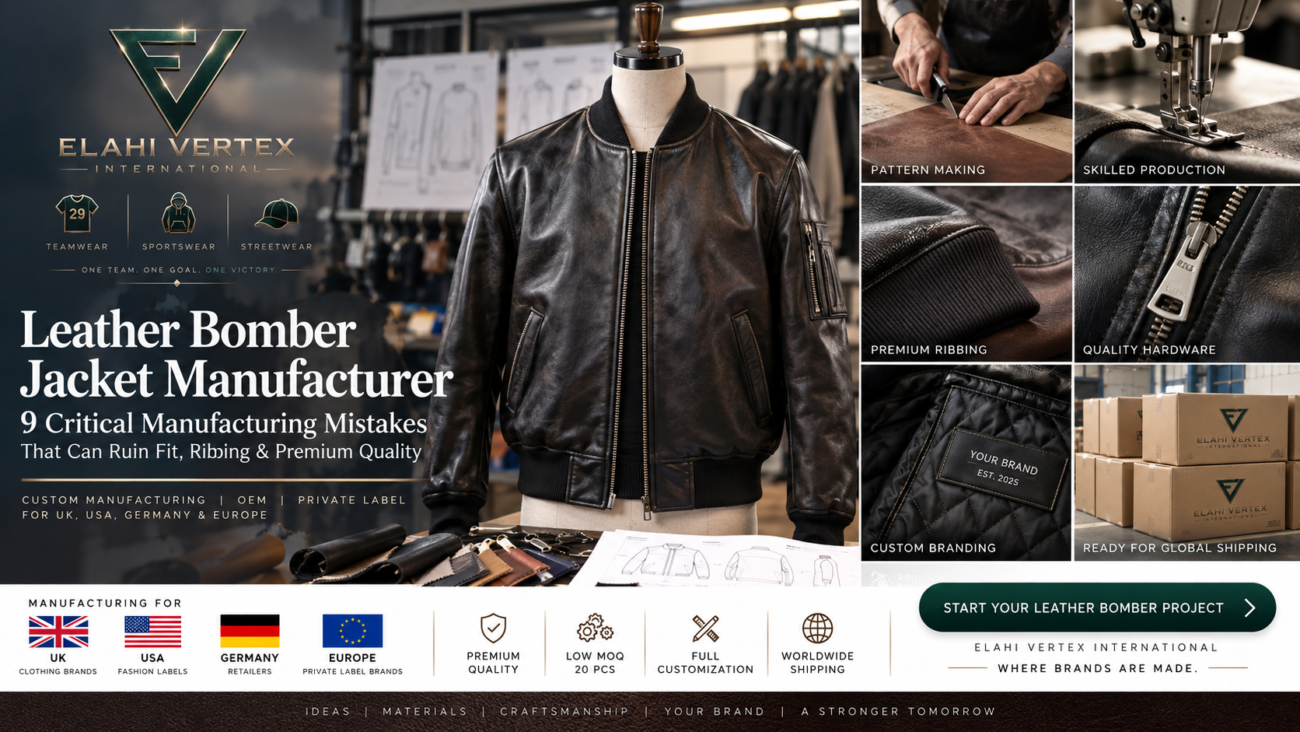


Choosing the right custom leather jacket manufacturer is one of the most important sourcing decisions a European fashion or streetwear brand can make in 2026.
Leather jackets are not basic garments.
Two jackets may look almost identical in photographs but differ significantly in leather type, thickness, grain, softness, construction, lining, hardware, embossing, fit and finishing.
That is why comparing manufacturers only by unit price can be a serious mistake.
A professional custom leather jacket manufacturer should be able to translate your design into a clearly specified physical product, develop an accurate sample and reproduce the approved standard during bulk production.
For European brands sourcing internationally, there is another layer to consider: product requirements, chemical restrictions, labelling, traceability, customs, shipping and importer responsibilities.
Before placing a sample or bulk order, evaluate the manufacturer properly.
Here are 9 things European brands should check before choosing a custom leather jacket manufacturer in 2026.
1. Check Exactly What Leather the Manufacturer Will Use
Leather specification should be one of your first conversations with a potential custom leather jacket manufacturer.
“Genuine leather” alone is not a complete specification.
Ask exactly what material is being proposed.
Confirm the Leather Type
Depending on the product, options may include:
- Cowhide
- Calfskin
- Lambskin
- Sheepskin
- Goatskin
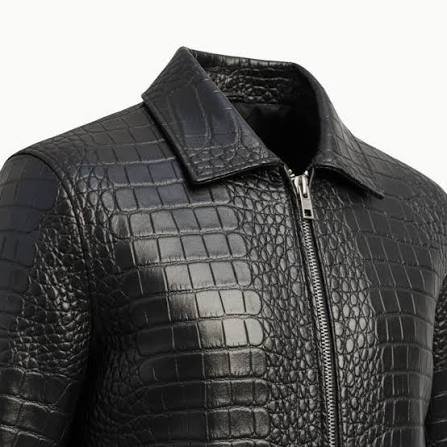
- Suede
- Nubuck
Each material can create a different combination of softness, weight, structure, grain and appearance.
A lightweight fashion jacket may require a very different leather from a structured biker jacket.
A premium leather bomber may require another specification entirely.
The manufacturer should understand your intended product before recommending the material.
Confirm Leather Thickness
Leather thickness can significantly influence the finished jacket.
Thicker leather can create more structure and weight, while thinner leather may create a softer and more flexible garment.
However, thicker does not automatically mean better.
The correct specification depends on the design.
Ask your leather jacket manufacturer to confirm the approximate thickness or suitable range before sample development.
Understand Leather Terminology
European buyers may encounter terms such as:
- Full-grain leather
- Top-grain leather
- Corrected-grain leather
- Split leather
- Suede
- Nubuck
Do not assume these terms mean the same thing.
If a specific leather construction or surface appearance matters to your brand, document it.
Request Material Evidence
Photographs can help.
Videos can provide more information.
Where material feel is commercially important, a physical swatch or finished sample can provide even more useful information.
Leather characteristics that can be difficult to judge from photographs include:
- Softness
- Hand feel
- Flexibility
- Weight
- Grain depth
- Surface finish
- Natural variation
A strong custom leather jacket manufacturer should be willing to discuss these characteristics before bulk production.
Remember That Leather Is a Natural Material
Real leather can contain natural variation.
That does not automatically make the material defective.
The important question is whether the variation remains within the appearance and quality standard approved for your collection.
Define that expectation before bulk cutting.
2. Check Whether the Manufacturer Can Actually Produce Your Jacket
General clothing manufacturing and leather jacket manufacturing are not identical.
A factory capable of producing excellent cotton hoodies is not automatically the right custom leather jacket manufacturer for a complex leather collection.
Leather production can require different knowledge in:
- Material inspection
- Pattern placement
- Cutting
- Sewing
- Needle selection
- Machinery
- Panel matching
- Hardware installation
- Lining construction
- Finishing
- Inspection
Check Relevant Product Experience
If you want a leather bomber jacket, evaluate relevant leather bomber capability.
If your collection contains:
- Leather bomber jackets
- Varsity jackets
- Biker jackets
- Racer jackets
- Aviator jackets
- Oversized leather jackets
- Cropped leather jackets
- Embossed leather jackets
- Leather streetwear
ask about experience relevant to those products.
Hundreds of unrelated garment photographs do not necessarily prove capability for your particular jacket.
Relevant manufacturing experience matters more than catalogue size.
Send a Proper Tech Pack
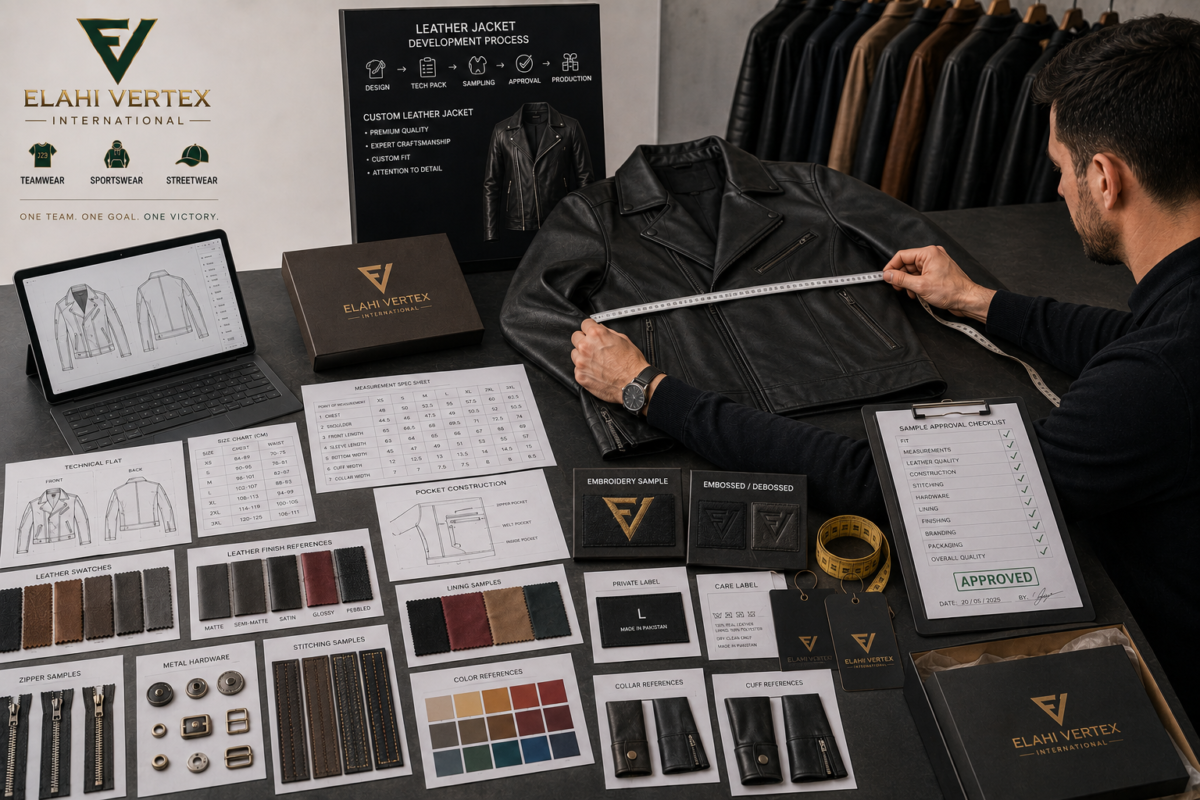
Whenever possible, provide your custom leather jacket manufacturer with a tech pack containing:
- Front and back drawings
- Measurements
- Size chart
- Leather specification
- Colour references
- Lining details
- Zippers
- Snaps
- Ribbing
- Pocket construction
- Embossing
- Embroidery
- Labels
- Artwork
- Packaging requirements
If your tech pack is incomplete, clearly identify which details are final and which require manufacturer input.
Pay Attention to the Questions You Receive
A technically capable manufacturer should sometimes challenge incomplete information.
They may ask:
What leather thickness do you require?
Do you want raised or recessed embossing?
What zipper finish should be used?
Should the ribbing match the leather colour?
What lining construction do you require?
Is the fit regular, relaxed or oversized?
Those questions can be a positive sign.
A manufacturer that immediately says “Yes, everything possible” without properly reviewing the specification deserves closer examination.

3. Check a Physical Sample Before Serious Bulk Production
Sampling is one of the strongest risk-control stages when working with a new custom leather jacket manufacturer.
A digital mock-up cannot tell you how leather feels.
A rendering cannot confirm fit.
A reference photograph cannot prove how your own jacket will be manufactured.
A physical sample can.
Inspect the Leather
Does the material match what was agreed?
Review:
- Leather type
- Thickness
- Colour
- Grain
- Surface finish
- Softness
- Weight
- Overall appearance
Inspect the Fit
Put the jacket on the intended body type or fit model.
Check whether the silhouette matches the brand’s design.
Check Measurements
Compare the sample with the approved measurement chart.
Do not rely only on whether the label says S, M or L.
Inspect Construction
Check:
- Stitching
- Seams
- Panel alignment
- Pockets
- Collar
- Cuffs
- Waistband
- Zipper installation
- Lining
- Hardware
Inspect Branding
Review:
- Embossing
- Embroidery
- Patches
- Main labels
- Size labels
- Care labels
- Hangtags
Sampling Is Also Product Development
A sample does not only reveal manufacturing defects.
It can reveal weaknesses in your original design.
You may discover:
- The body is too long.
- The sleeve is too narrow.
- The leather is too stiff.
- The rib needs better recovery.
- The back embossing needs more depth.
- The zipper finish needs changing.
- The lining needs improvement.
- The chest logo needs repositioning.
That is exactly why sampling matters.
Document Every Revision
Instead of saying:
“Make the fit slightly better.”
write:
Body length: reduce 2 cm
Sleeve width: increase 1 cm
Back embossing: increase depth
Zipper: change to matte black
Chest logo: move 1.5 cm toward centre
Specific instructions reduce interpretation.
A good custom leather jacket manufacturer should manufacture from measurable approvals wherever possible.
4. Check Pattern Development, Fit and Size Grading
Premium leather cannot rescue a poor pattern.
For European fashion and streetwear brands, fit can be one of the defining characteristics of the product.
Your collection may require:
- Classic fit
- Slim fit
- Relaxed fit
- Boxy fit
- Oversized fit
- Cropped fit
These descriptions need to be translated into actual measurements and patterns.
Confirm Critical Measurements
Depending on the jacket, important measurements can include:
- Chest width
- Shoulder width
- Body length
- Sleeve length
- Bicep
- Armhole
- Cuff
- Hem
- Neck
- Across back
The manufacturer should understand how each measurement is taken.
Never Approve a Jacket Based Only on Size Name
“Medium” is not a technical specification.
Different brands use different size standards.
Give your custom leather jacket manufacturer the actual measurements your collection requires.
Check Size Grading
Suppose your approved sample is size M.
Your bulk production may contain:
XS, S, M, L, XL and XXL.
Ask how those sizes will be graded.
This becomes particularly important with oversized and fashion-focused silhouettes.
Simply increasing every measurement by the same amount may destroy the intended proportions.
Establish Tolerances
Garment manufacturing involves tolerances.
Define critical measurements and acceptable variations where appropriate.
This gives both buyer and manufacturer a clearer quality reference.
Approve Fit Before Bulk Cutting
The safer sequence is:
Pattern → Sample → Fit Review → Corrections → Final Approval → Bulk Cutting
Not:
Bulk Cutting → Fit Problem → Dispute
Leather is too valuable to use bulk production as the fitting stage.
5. Check Embossing, Hardware, Lining, Ribbing and Private-Label Details
A premium leather jacket is more than its outer material.
Small components can dramatically change how expensive or inexpensive the finished product feels.
This makes secondary components particularly important when selecting a private label leather jacket manufacturer.
Custom Embossing
Leather can support distinctive branding such as:
- Chest logos
- Back graphics
- Text
- Crests
- Symbols
- Collection names
- All-over textures
Do not simply tell the factory:
“Emboss our logo.”
Confirm:
- Artwork
- Dimensions
- Position
- Depth
- Raised or recessed effect
- Tone-on-tone or contrast
- Edge definition
Large or technically demanding artwork should be tested before bulk production where appropriate.
Zippers
Zippers affect both appearance and functionality.
Specify:
- Required supplier or quality level
- Metal finish
- Colour
- Teeth
- Puller
- One-way or two-way design
- Length
- Position
If your brand specifically requires YKK or another zipper supplier, state that in the specification.
Do not assume it.
Metal Hardware
Check:
- Snaps
- Buckles
- Eyelets
- Rivets
- Pullers
- Other metal components
Confirm finish, colour, attachment and functionality.
Lining
The lining can significantly affect perceived quality.
Options can include:
- Satin-style lining
- Polyester lining
- Quilted lining
- Printed lining
- Custom branded lining
Specify exactly what your collection requires.
“Premium lining” is too subjective.
Ribbing
Leather bomber jackets frequently use ribbed:
- Collars
- Cuffs
- Waistbands
Check:
- Composition
- Weight
- Stretch
- Recovery
- Colour
- Stripe design
- Construction
Weak ribbing can make an otherwise premium jacket feel inexpensive.
Private-Label Branding
A private label leather jacket manufacturer may support:
- Main brand labels
- Size labels
- Care labels
- Composition information
- Hangtags
- Barcodes
- SKU labels
- Custom packaging
Branding should be developed alongside the garment—not added as an afterthought.
6. Check the Manufacturer’s Quality-Control Process
“Premium quality.”
“Best quality.”
“100% perfect.”
These are marketing statements.
They are not a quality-control system.
Ask your custom leather jacket manufacturer:
What exactly will you inspect against our approved sample and specifications before shipment?
Leather Inspection
Leather should be assessed before and during cutting.
Relevant factors can include:
- Surface appearance
- Grain
- Colour
- Thickness
- Visible marks
- Panel suitability
- Natural variation
The acceptable standard should reflect the leather type agreed with the buyer.
Measurement Inspection
Finished jackets should be compared with approved measurements and tolerances.
Construction Inspection
Check:
- Stitching
- Seam quality
- Panel alignment
- Pocket construction
- Zipper installation
- Snap installation
- Lining attachment
- Rib attachment
- Finishing
- Loose threads
Branding Inspection
Inspect:
- Embossing
- Embroidery
- Patches
- Labels
- Logo dimensions
- Logo positioning
Hardware Inspection
A beautiful leather jacket with a failing zipper is still a defective jacket.
Functional components matter.
Final Inspection
Before shipment, confirm what final inspection covers.
For larger or higher-risk orders, a buyer may also consider independent third-party inspection.
The central principle is:
Quality should be checked against an agreed standard.
Without an approved sample, specifications and tolerances, the phrase “good quality” remains subjective.
7. Check European Product and Import Requirements
European brands sourcing internationally should investigate compliance before placing bulk production.
Do not assume:
“The factory is outside Europe, so European compliance is entirely the factory’s responsibility.”
Depending on the circumstances, manufacturers, importers and other economic operators can have different responsibilities.
General Product Safety
European brands should understand the product-safety framework that applies to consumer products placed on the EU market.
The General Product Safety Regulation, Regulation (EU) 2023/988, has applied since December 2024.
A European importer should understand the obligations applying to its role before placing imported products on the market.
REACH and Leather
Chemical restrictions are particularly relevant to leather sourcing.
Chromium VI is one issue European leather-product buyers should understand.
REACH contains restrictions relating to chromium VI in leather articles or leather parts that come into contact with skin.
Brands should investigate the applicable requirements for their products and obtain appropriate evidence where necessary.
Do not accept:
“European standard leather.”
as a complete compliance answer.
Ask what supports that statement.
Textile Components
A leather jacket may also contain textile components such as:
- Lining
- Ribbing
- Pocketing
- Labels
European textile fibre-composition rules may therefore need to be considered depending on the construction of the product.
Import Requirements
European buyers should investigate:
- Commodity classification
- Customs duties
- Rules of origin
- Import VAT/taxes
- Documentation
- Product requirements
- Customs procedures
- EORI requirements where applicable
These factors can affect the true landed cost of your jackets.
The Manufacturer Is Not Your European Legal Adviser
A professional custom leather jacket manufacturer should cooperate with reasonable product, documentation and testing requirements.
However, European brands should independently verify which legal obligations apply to their particular product and destination.
That protects both buyer and supplier.
8. Check Communication, Transparency and Manufacturer Verification
Distance does not automatically make overseas manufacturing unsafe.
Poor verification and poor communication create unnecessary risk.
Before committing significant money to a new custom leather jacket manufacturer, verify the business.
Check the Manufacturer
Review:
- Business identity
- Website
- Company contact details
- Product relevance
- Manufacturing evidence
- Export experience
- Commercial documents
- Payment information
For larger orders, additional independent due diligence may be appropriate.
Request a Video Call
Video communication can help both parties discuss:
- Leather
- Samples
- Manufacturing
- Branding
- Quality requirements
- Packaging
- Production progress
Where appropriate, manufacturers may also show relevant production activity.
A video call alone does not prove every supplier claim, but it can improve transparency.
Keep Important Decisions in Writing
Your final production confirmation should clearly state:
Product: Custom leather jacket
Leather: Approved specification
Thickness: Approved
Colour: Approved
Lining: Approved
Zipper: Approved
Hardware: Approved
Embossing: Approved
Labels: Approved
Measurements: Approved
Sizes: Confirmed
Packaging: Confirmed
Quantity: Confirmed
Price: Confirmed
Shipping: Confirmed
Payment Terms: Confirmed
Do not leave critical approvals scattered across dozens of messages.
Transparency Works Both Ways
Buyers should also communicate changes clearly.
Changing any of the following can affect cost or production:
- Leather
- Colour
- Quantity
- Design
- Hardware
- Artwork
- Packaging
- Shipping method
Document changes before production continues.

9. Check MOQ, Price, Payment and Shipping Together
Now compare prices.
Price comes after understanding the product because a quotation without specifications can be meaningless.
Understand the MOQ
Ask:
What is the MOQ per product?
What is the MOQ per colour?
Can sizes be mixed?
Can colours be mixed?
A supplier advertising a low MOQ may have additional minimum requirements for particular colours, materials or custom components.
Clarify this before paying for development.
Sample Price Is Not Bulk Price
One custom sample can cost substantially more per unit than bulk production.
Sample development may involve:
- Pattern development
- Material sourcing
- Cutting
- Custom embossing
- Hardware
- Labels
- Labour
- Courier shipping
Evaluate the sample as part of product development and risk reduction.
Understand the Bulk Quotation
Ask exactly what is included.
For example:
- Leather
- Lining
- Hardware
- Labels
- Embossing
- Embroidery
- Packaging
- Inspection
- Shipping
Never assume shipping is included.
Include Freight in Your Comparison
A cheaper jacket with expensive shipping may create a higher landed cost than a slightly more expensive jacket with better logistics economics.
Always provide the manufacturer with the destination country and preferably the delivery postcode when requesting shipping calculations.
Understand the Incoterm
Clarify whether the quotation is:
- EXW
- FCA
- FOB
- CIF
- DAP
- DDP
- Another agreed term
Do not compare quotations until you understand what each supplier is actually including.
Confirm Payment Terms
Payment terms should be documented before money is transferred.
For a new manufacturing relationship, clearly defined staged payments can reduce ambiguity.
Calculate the Real Landed Cost
European brands should think in terms of:
Manufacturing + Branding + Packaging + Inspection + Freight + Customs + Duties + Taxes + Clearance + Banking + Risk
That is a much more useful commercial calculation than comparing factory prices alone.
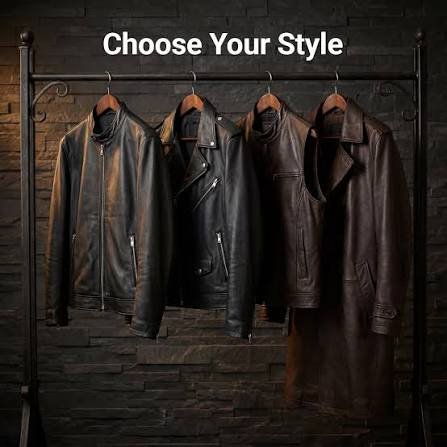
Custom Leather Jacket Manufacturer Checklist for European Brands
Before approving production, confirm the following.
Leather
✓ Leather type confirmed
✓ Animal origin confirmed
✓ Thickness confirmed
✓ Grain and finish confirmed
✓ Colour confirmed
✓ Physical reference approved where appropriate
Product
✓ Tech pack confirmed
✓ Pattern approved
✓ Sample approved
✓ Size chart approved
✓ Grading confirmed
✓ Tolerances defined
Components
✓ Zipper approved
✓ Snaps approved
✓ Lining approved
✓ Ribbing approved
✓ Labels approved
✓ Packaging approved
Branding
✓ Embossing approved
✓ Embroidery approved
✓ Logo dimensions approved
✓ Placement approved
✓ Hangtags approved
Quality
✓ QC procedure discussed
✓ Measurement inspection defined
✓ Workmanship expectations defined
✓ Final inspection agreed
Compliance
✓ Applicable European requirements investigated
✓ Product-safety responsibilities understood
✓ REACH considerations investigated
✓ Relevant leather chemical restrictions considered
✓ Applicable textile-labelling requirements checked
✓ Destination-market requirements checked
Commercial
✓ MOQ confirmed
✓ Sample price confirmed
✓ Bulk price confirmed
✓ Payment terms confirmed
✓ Incoterm confirmed
✓ Shipping cost confirmed
✓ Import costs investigated
✓ Production timeline confirmed
If several of these questions remain unanswered, your project probably is not ready for bulk production.
Red Flags When Choosing a Custom Leather Jacket Manufacturer
Investigate further if a supplier:
- Cannot identify the proposed leather.
- Uses “genuine leather” as the entire specification.
- Quotes before understanding the design.
- Avoids physical sampling.
- Cannot explain hardware options.
- Ignores your measurement chart.
- Avoids documenting revisions.
- Promises impossible consistency from a natural material.
- Guarantees every European compliance requirement without understanding your destination.
- Pressures you into bulk production before sample approval.
- Changes commercial terms repeatedly.
- Provides inconsistent company or payment information.
- Cannot explain what its quotation includes.
- Claims every manufacturing technique is possible without reviewing your design.
One warning sign does not automatically prove a supplier is unreliable.
It means you should investigate before increasing your financial exposure.
Custom Leather Jacket Manufacturer vs General Clothing Manufacturer
A general clothing manufacturer may be excellent at producing:
- T-shirts
- Hoodies
- Tracksuits
- Sportswear
Leather introduces different manufacturing requirements.
A capable leather jacket manufacturer needs expertise across:
Leather selection → Inspection → Pattern placement → Cutting → Sewing → Hardware → Lining → Finishing → Quality control
That is why European brands should evaluate relevant leather-production capability rather than simply looking for a factory with sewing machines.
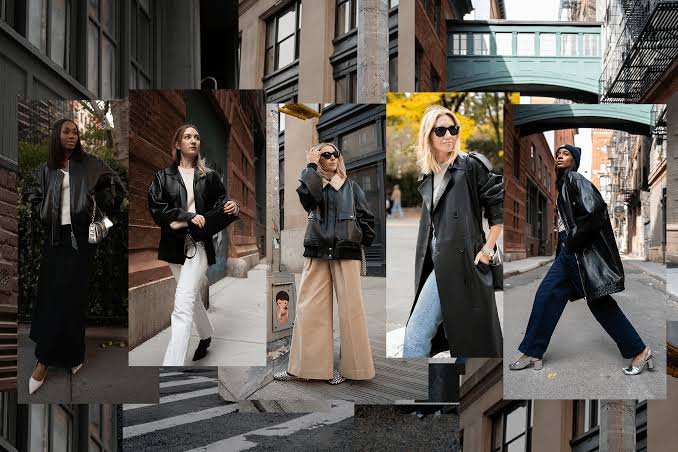
Private Label vs OEM Leather Jacket Manufacturing
The terms private label and OEM are sometimes used differently between suppliers.
Focus on what the manufacturer will actually provide.
Private Label Leather Jacket Manufacturer
A private label leather jacket manufacturer can potentially manufacture products sold under your brand using elements such as:
- Custom labels
- Hangtags
- Packaging
- Logos
- Colours
- Selected specifications
The exact level of customisation depends on the project.
OEM Leather Jacket Manufacturer
An OEM leather jacket manufacturer generally manufactures according to buyer-provided product requirements.
A highly customised OEM project can involve:
- Custom pattern
- Custom leather
- Custom colour
- Custom lining
- Custom hardware
- Custom embossing
- Custom measurements
- Custom labels
- Custom packaging
Do not choose a supplier simply because its website says “OEM.”
Evaluate the actual production capability.
Low MOQ Leather Jacket Manufacturing: Does It Make Sense?
A low MOQ leather jacket manufacturer can be useful for:
- Startup fashion brands
- Streetwear brands
- Capsule collections
- Limited releases
- New product testing
- New colourways
- Emerging labels
A smaller production quantity can reduce initial inventory exposure.
But low MOQ should never mean low production discipline.
A small order still requires:
Specifications → Sampling → Approval → Quality Control → Shipping Planning
Twenty incorrectly produced jackets are still twenty incorrect jackets.
Low MOQ should reduce inventory exposure—not reduce quality control.
How Much Does Custom Leather Jacket Manufacturing Cost?
There is no responsible universal price for custom leather jacket manufacturing.
Price depends on factors including:
- Leather type
- Leather grade
- Thickness
- Jacket size
- Pattern complexity
- Number of panels
- Lining
- Zippers
- Hardware
- Ribbing
- Embossing
- Embroidery
- Labels
- Packaging
- Quantity
- Destination
- Shipping method
A professional custom leather jacket manufacturer therefore needs product information before preparing a meaningful quotation.
Weak RFQ
“Price for 100 leather jackets?”
Better RFQ
“Please quote 100 custom leather bomber jackets according to the attached tech pack, including our specified genuine leather, custom lining, two-way zipper, ribbed collar/cuffs/waistband, chest embossing, large back embossing, custom labels and individual packaging. Delivery destination: [Country/Postcode].”
The second request gives the manufacturer enough information to begin a proper commercial evaluation.
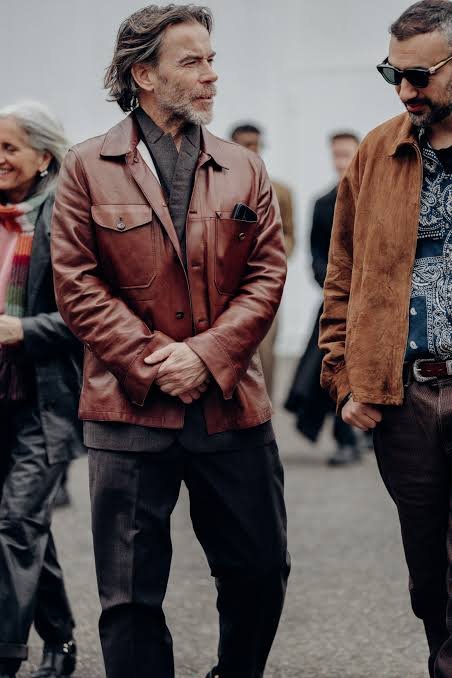
How to Request a Custom Leather Jacket Sample
Send your manufacturer:
1. Product Design
Provide front and back drawings or clear references.
2. Tech Pack
Include measurements and construction requirements.
3. Leather Specification
Define the required leather type, thickness, grain, finish and colour.
4. Sample Size
State exactly which size should be produced.
5. Branding
Provide appropriate artwork files.
6. Hardware
Define zipper, snaps and metal finishes.
7. Lining
Specify material, colour and quilting where required.
8. Labels
Provide branding and required information.
9. Destination
Shipping cannot be calculated properly without a destination.
10. Commercial Timeline
Tell the manufacturer when you actually need the collection.
Then request:
Sample Price + Shipping + Sample Lead Time + Revision Process + Indicative Bulk Price
How European Brands Should Compare Leather Jacket Manufacturers
Send shortlisted manufacturers the same core RFQ.
Then compare:
Leather Specification
Sample Quality
Sample Cost
MOQ
50-Piece Price
100-Piece Price
Hardware
Branding Capability
Sample Lead Time
Bulk Lead Time
Shipping
Payment Terms
Quality Control
Communication
Now you are comparing manufacturing offers rather than random unit prices.
European Leather Jacket Sourcing in 2026
European sourcing has become increasingly focused on more than price and product appearance.
Product safety, traceability, documentation, chemical requirements and importer responsibilities can all matter.
That means European brands should evaluate whether a custom leather jacket manufacturer can communicate clearly and cooperate with the documentation and product requirements relevant to the buyer’s market.
Manufacturing capability remains essential.
But in 2026, manufacturing capability should be combined with:
Product knowledge + Documentation + Traceability + Quality Control + Clear Communication
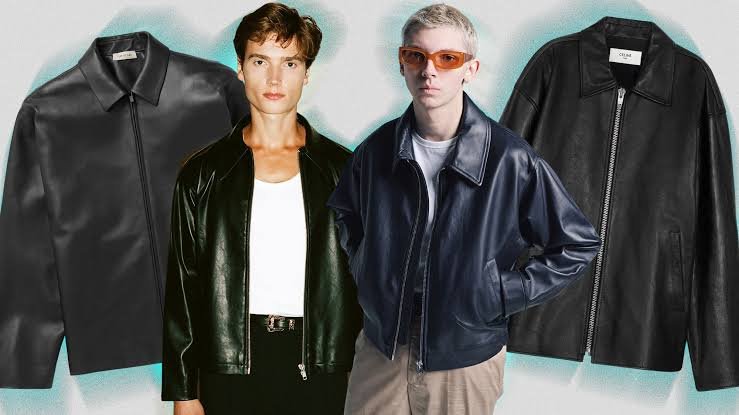
Frequently Asked Questions About Custom Leather Jacket Manufacturing
What is a custom leather jacket manufacturer?
A custom leather jacket manufacturer produces leather jackets according to buyer-defined requirements such as design, leather type, colour, measurements, lining, hardware, branding, labels and packaging.
How do I choose a custom leather jacket manufacturer?
Evaluate leather knowledge, relevant production experience, sampling, pattern development, hardware, branding, quality control, compliance cooperation, commercial terms, shipping and communication.
Should I order a sample before bulk leather jacket production?
For a new design or supplier relationship, sampling is strongly recommended because it allows the buyer to evaluate leather, fit, construction, hardware, branding and finishing before bulk production.
What should I send a leather jacket manufacturer?
Send your design or tech pack, measurements, leather requirements, colour, quantity, size range, lining, hardware, artwork, branding, packaging and delivery destination.
What is the MOQ for custom leather jackets?
MOQ depends on the manufacturer, material and project. Elahi Vertex International’s standard starting MOQ for qualifying custom projects is 20 pieces per product/category.
Can I manufacture private-label leather jackets?
Yes. Private-label leather jacket manufacturing can include custom labels, logos, hangtags, colours, packaging and other brand-specific requirements depending on manufacturing feasibility.
What is OEM leather jacket manufacturing?
OEM leather jacket manufacturing generally means producing a jacket according to a buyer’s design and technical specifications.
Can a manufacturer make a leather jacket from a reference image?
A reference image can communicate design direction, but a proper technical specification is much better for defining materials, measurements, construction, hardware and branding.
What leather is best for custom jackets?
There is no single best leather. The correct choice depends on the required structure, softness, grain, durability, design, intended use and target price.
Is full-grain leather always better?
Not necessarily for every product. Leather should be selected according to the design, performance requirements, desired appearance and commercial positioning.
What thickness should a leather jacket use?
There is no universal thickness. The appropriate specification depends on leather type, construction, desired weight, flexibility and jacket style.
Can leather jackets have custom embossing?
Yes, subject to the leather, artwork and manufacturing method. Dimensions, placement and the required embossing effect should be approved before production.
Can I use custom zippers and hardware?
Yes, depending on availability, MOQ, cost and technical feasibility.
Can leather jackets use custom lining?
Yes. Lining can potentially be customised by material, colour, quilting and branding according to the project.
How can European brands reduce overseas leather manufacturing risk?
Use detailed specifications, verify the supplier, approve materials and samples, document revisions, establish quality requirements, understand payment terms and calculate shipping and import costs before bulk production.
Should I choose the cheapest leather jacket manufacturer?
Not automatically.
Compare:
Leather + Sample + Fit + Construction + Hardware + Branding + QC + Communication + Shipping + Landed Cost
The cheapest factory quotation does not necessarily create the cheapest successful product.
What is the safest way to start with a new leather jacket manufacturer?
A disciplined sequence is:
Verify → Specify → Sample → Review → Revise → Approve → Confirm Commercial Terms → Bulk Produce → Inspect → Ship
Why European Brands Should Evaluate Elahi Vertex International
Elahi Vertex International works with international B2B buyers requiring custom apparel and leather manufacturing.
For qualifying leather projects, development can include requirements such as:
- Custom leather selection
- Custom patterns
- Custom colours
- Custom embossing
- Embroidery
- Custom lining
- Hardware
- Labels
- Private-label branding
- Packaging
- Bulk production
Our standard starting MOQ is 20 pieces per product/category.
Brands should provide their actual requirements so the project can be evaluated properly rather than relying on a generic price.

3 Hypothetical European Buyer Scenarios
Scenario 1: UK Streetwear Brand Testing a Leather Bomber
A growing UK streetwear brand wants to launch its first custom leather bomber jacket but does not want to commit to a large quantity before testing the product.
The brand sends its custom leather jacket manufacturer a tech pack covering the oversized fit, leather specification, custom lining, two-way zipper, embossed chest logo, back artwork and private-label branding.
Instead of moving directly into bulk production, the brand develops a physical sample first.
The sample reveals that the sleeves need adjustment and the back embossing needs greater definition.
Those changes are documented before bulk approval.
Key lesson: sampling can expose design and manufacturing issues before they affect an entire production run.
Scenario 2: German Fashion Label Comparing Three Manufacturers
A German fashion label requests quotations from three potential leather jacket suppliers.
The cheapest supplier quotes immediately without asking about leather thickness, lining, hardware or branding.
The second supplier asks only for quantity.
The third custom leather jacket manufacturer requests the tech pack, leather specification, size range, hardware details, branding requirements and German delivery destination before finalising the quotation.
The buyer does not automatically choose the lowest unit price.
Instead, it compares material specification, sample quality, manufacturing capability, QC, freight and total landed cost.
Key lesson: the cheapest quotation is not automatically the strongest manufacturing offer.
Scenario 3: French Private-Label Brand Preparing a Premium Collection
A French fashion brand wants a small private-label leather jacket collection featuring custom colours, branded lining, metal hardware and embossed logos.
Before production, the brand confirms its design, sample, measurements, labels, hardware and packaging with its private label leather jacket manufacturer.
It also independently investigates the European requirements applicable to the finished product rather than relying only on the supplier saying that the jacket is “EU compliant.”
Key lesson: manufacturer cooperation and buyer-side compliance verification should work together.
20 External Resources European Leather Jacket Buyers Should Know
1. European Commission — Importing Into the EU
European brands importing jackets from an overseas custom leather jacket manufacturer can use the European Commission’s Importing into the EU guidance to research the import process.
2. Access2Markets
The EU Access2Markets portal helps buyers investigate tariffs, taxes, rules of origin, procedures and product requirements.
3. European Chemicals Agency
Leather-product buyers can use the European Chemicals Agency when researching chemical requirements that may affect leather and other jacket components.
4. Chromium VI and Leather
ECHA provides information concerning Chromium VI restrictions affecting leather articles that European leather buyers should understand.
5. REACH Information
Brands sourcing from a leather jacket manufacturer can consult the European Commission’s REACH information when researching chemical obligations.
6. EU Product Requirements
Your Europe Product Requirements provides a useful official starting point for businesses selling products in the EU.
7. EU Product Safety
European fashion businesses can review EU product safety guidance when evaluating their responsibilities.
8. General Product Safety Regulation
Brands can consult the official General Product Safety Regulation when researching the EU consumer-product safety framework.
9. EUR-Lex
EUR-Lex gives businesses direct access to European Union legislation and legal documents.
10. Textile Labelling
Leather jackets can contain textile linings, ribbing and other textile components. European brands can review EU textile labelling guidance.
11. EU Textile Regulation
The official Regulation (EU) No 1007/2011 covers textile fibre names and related fibre-composition labelling and marking.
12. EU Customs
The European Commission Taxation and Customs Union provides official information relevant to European importers.
13. TARIC
Before calculating landed cost, European brands can investigate customs measures through the EU TARIC database.
14. EORI
Businesses importing goods into the EU can review the European Commission’s EORI guidance.
15. Rules of Origin
Country of origin can influence international trade treatment. The European Commission’s Rules of Origin guidance explains the EU framework.
16. EUIPO
Fashion brands developing original names, logos and designs can use the European Union Intellectual Property Office to investigate EU trademark and design protection.
17. Safety Gate
The EU Safety Gate provides information about alerts involving dangerous non-food consumer products.
18. European Standards
The European Committee for Standardization provides information about European standards and standardisation activities.
19. EU Sustainable Textiles Strategy
Brands interested in the direction of European textile policy can review the EU Strategy for Sustainable and Circular Textiles.
20. Your Europe Business
Your Europe Business provides broader official guidance for companies trading and operating within the European Union.
Why These External Sources Matter
A professional custom leather jacket manufacturer can support product development and provide manufacturing documentation, but a European brand should also independently verify the rules that apply to its own products and destination market.
Official European resources can help buyers investigate product safety, REACH, Chromium VI, textile components, customs, tariffs, origin, EORI, intellectual property and import procedures before committing to commercial quantities.
That creates a stronger sourcing process:
Manufacturer Verification → Sample Approval → Compliance Research → Commercial Approval → Bulk Production → Quality Control → Import
For example, the European Commission’s Access2Markets service specifically covers EU tariffs, rules of origin, taxes, import procedures and product requirements, while ECHA documents the Chromium VI restriction applicable to qualifying leather articles.
Looking for a Custom Leather Jacket Manufacturer for Your European Brand?
If you are a European fashion, streetwear or lifestyle brand searching for a custom leather jacket manufacturer, do not begin the conversation with only:
“What is your lowest price?”
Start with the product.
Send Elahi Vertex International:
Design or Tech Pack → Leather Requirement → Quantity → Size Range → Branding → Hardware → Lining → Delivery Country
This gives us the information needed to review your project, understand the manufacturing requirements and evaluate the appropriate sampling, production and shipping route.
Start With the Sample. Approve the Details. Then Scale.
Whether you are developing a custom leather bomber jacket, private-label leather collection, embossed leather jacket or OEM leather outerwear, your first objective should be to establish an approved manufacturing reference.
Then bulk production has something measurable to follow.
Elahi Vertex International
Custom Leather Jackets • OEM Manufacturing • Private Label • International B2B Production
MOQ: 20 pieces per product/category
ONE TEAM. ONE GOAL. ONE VICTORY.
Elahi Vertex International is a custom leather jacket manufacturer in Sialkot, Pakistan, serving international B2B fashion, clothing and streetwear buyers. Qualifying custom projects start from 20 pieces per product/category. Buyers can submit designs, tech packs, leather specifications, measurements, branding requirements, quantity and delivery destination for manufacturing review.
For European brands choosing a custom leather jacket manufacturer in 2026, the nine major areas to evaluate are:
Leather specification, relevant manufacturing capability, physical sampling, pattern and fit development, hardware and private-label branding, quality control, European product requirements, manufacturer transparency, and total landed cost.
A strong manufacturing relationship should follow a clear process:
Specification → Sample → Approval → Bulk Production → Quality Control → Shipment → Repeat Order
The objective is not simply to find the lowest-priced leather jacket supplier.
The objective is to find a manufacturer capable of understanding the product, developing an approved sample and reproducing the agreed specification consistently.
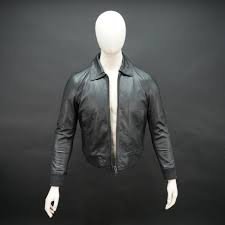
Ready to Build Your Custom Leather Jacket Collection?
Choosing the right custom leather jacket manufacturer should give your brand more than a factory price. You need clear specifications, controlled sampling, custom branding, quality checks and a production partner that understands what you are trying to build.
Elahi Vertex International works with international fashion, streetwear and private-label brands developing custom apparel and leather products.
Whether you’re developing a custom leather bomber jacket, embossed leather jacket, private-label leather collection or OEM leather outerwear, start by sending us:
Design / Tech Pack → Leather Requirement → Quantity → Size Range → Branding → Hardware → Lining → Delivery Country
Start Small. Approve the Product. Then Scale.
Our standard starting MOQ is 20 pieces per product/category for qualifying custom projects.
Your project can include requirements such as:
- Custom leather specifications
- Custom patterns and sizing
- Custom colours and finishes
- Logo embossing
- Embroidery
- Custom lining
- Zippers and hardware
- Woven and printed labels
- Hangtags
- Private-label branding
- Custom packaging
- Bulk production
Before committing to a larger production run, develop your product, review the sample and approve the important details.
Explore Elahi Vertex International
Learn more about our production capabilities through our Custom Clothing Manufacturing services.
Looking for brand-specific production? Explore our Private Label Manufacturing capabilities.
For specification-driven manufacturing, see our OEM Clothing Manufacturing services.
Want to understand our production process? Visit Manufacturing.
Before choosing us as your custom leather jacket manufacturer, review Our Works and explore our Portfolio.
You can also explore our Case Studies to learn more about custom manufacturing projects.
Ready to move forward? See How to Start Your Order or go directly to our Contact Page.
Get a Custom Leather Jacket Manufacturing Quote
Don’t send only:
“What’s your lowest price?”
Send the actual project requirements.
Tell us:
What you’re making → How many pieces → Required leather → Sizes → Branding → Hardware → Delivery destination
The more accurately your product is defined, the more accurately the manufacturing route can be evaluated.
Contact Elahi Vertex International
Website:
https://www.elahivertexinternational.com/
WhatsApp — Fastest Response:
https://wa.me/message/OWIPAIXYWHTPI1
WhatsApp Number:
+92 309 1639614
Email:
elahivertexinternational@gmail.com
Email:
info@elahivertexinternational.com
Alibaba:
https://elahivertexinternational.trustpass.alibaba.com/
Instagram:
@elahivertex_mfg
TikTok:
@elahivertex_mfg
X:
@elahivertex_mfg
Your Design. Your Brand. Your Leather Jacket.
If you’re searching for a custom leather jacket manufacturer for a UK or European brand, send Elahi Vertex International your design or tech pack today.
Start with the right specification. Develop the sample. Approve the details. Move into bulk production. Build toward repeat orders.
Elahi Vertex International
Custom Leather Jacket Manufacturer | OEM | Private Label | International B2B Manufacturing
ONE TEAM. ONE GOAL. ONE VICTORY.