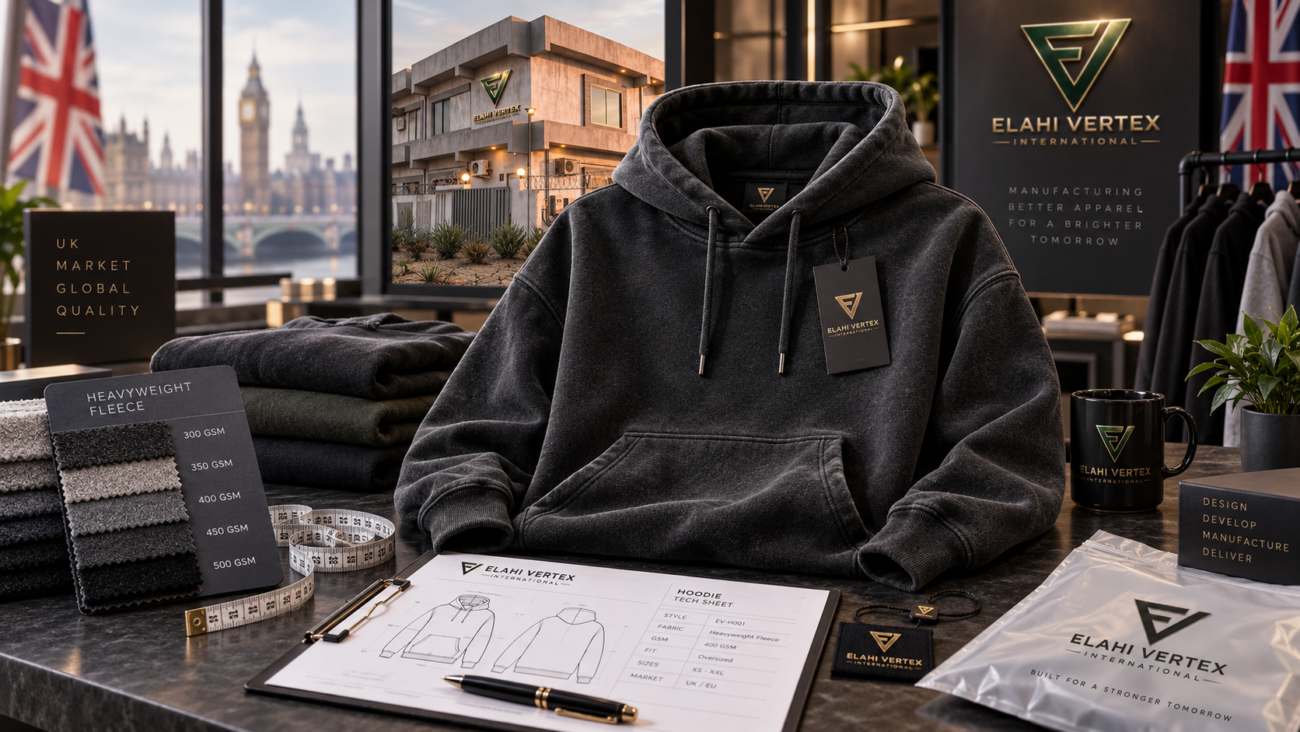

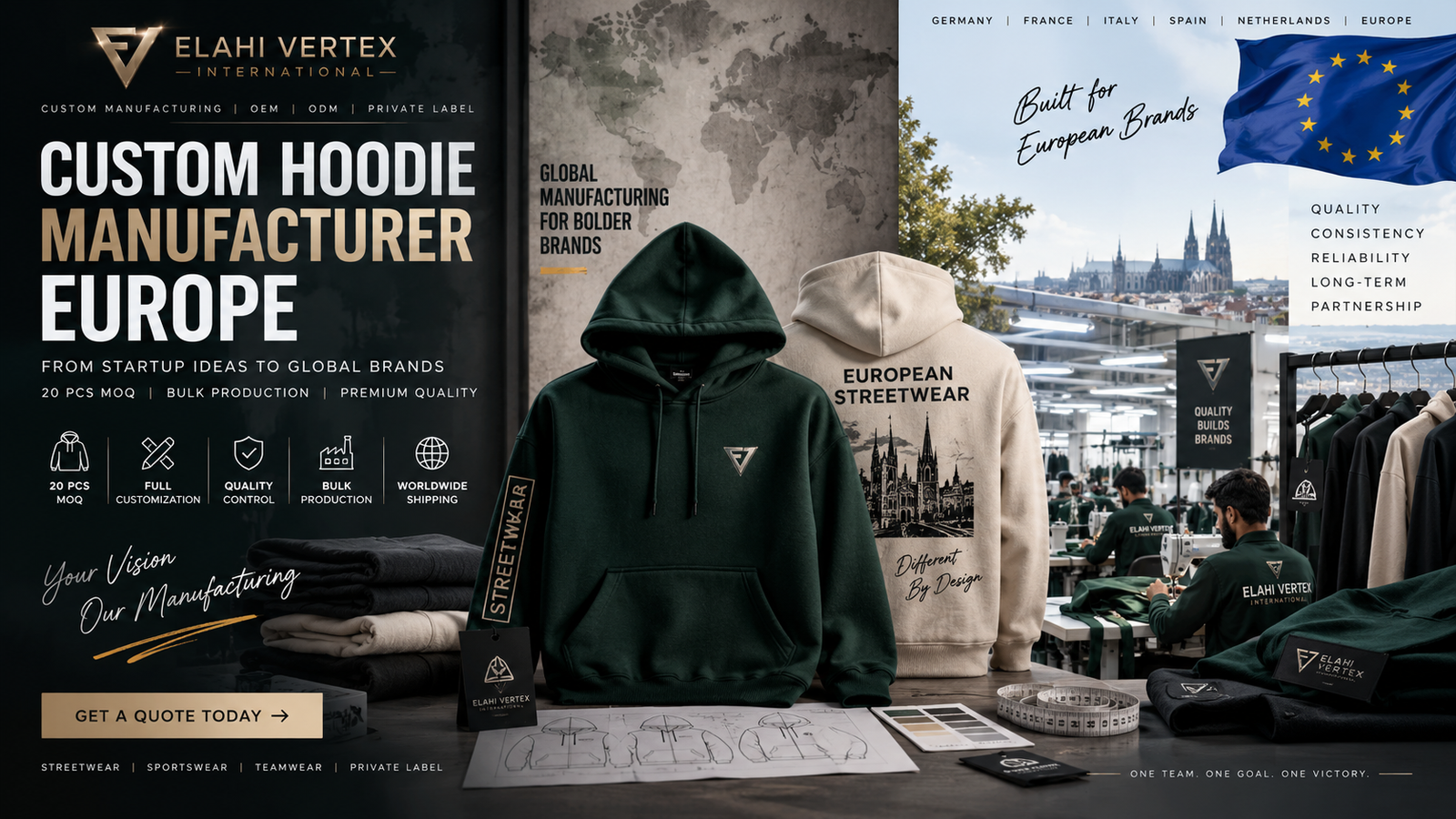
Choosing a custom hoodie manufacturer Europe streetwear brands can rely on involves much more than comparing the lowest quotation.
A hoodie may look simple on a product page, but commercially successful streetwear hoodies depend on dozens of decisions: fabric composition, GSM, knitting, shrinkage, fit, pattern measurements, hood construction, rib quality, stitching, printing, embroidery, washing, labels, packaging, bulk consistency and shipping.
A supplier that gets the sample right but fails to reproduce it consistently in bulk can create a much bigger problem than a slightly higher manufacturing price.
This becomes especially important for European startups and growing streetwear labels. A new brand may initially need only 20–50 pieces to test a design. An established label may require hundreds or thousands of garments across colours, sizes and repeated collections.
The right manufacturing relationship should therefore work beyond the first order.
Elahi Vertex International is a custom B2B clothing manufacturer and exporter based in Sialkot, Pakistan, working with custom streetwear, hoodies and sweatshirts, sportswear, activewear, teamwear and private-label clothing projects.
Our standard starting MOQ is 20 pieces per product/category, which can help startup brands avoid committing immediately to unnecessarily large inventory.
But low MOQ is only one part of the manufacturing model.
Elahi Vertex International also manages bulk manufacturing, meaning a buyer can start with a controlled production quantity, validate the product and market response, and then discuss larger production requirements without having to treat the first 20-piece order as the limit of the relationship.
That distinction matters.
A serious custom hoodie manufacturer Europe brands source from should be able to discuss both sides of the equation:
small-batch accessibility + bulk-production planning.
This guide explains nine essential checks European streetwear brands should make before selecting a custom hoodie manufacturing partner.
Quick Answer: What Should European Brands Check Before Choosing a Custom Hoodie Manufacturer?
Before choosing a custom hoodie manufacturer Europe, check these nine areas:
- Fabric composition, GSM and construction
- Hoodie fit, pattern and measurement control
- Customization and branding capabilities
- Sampling and pre-production approval
- MOQ and startup-friendly production
- Bulk production management and consistency
- Quality-control procedures
- European labelling, product and chemical-compliance considerations
- Communication, commercial terms, packaging and shipping
Do not select a hoodie supplier on price alone.
A better supplier comparison evaluates whether the manufacturer can turn your specifications into a repeatable finished product.
Table of Contents
- What European Streetwear Brands Actually Need From a Hoodie Manufacturer
- Check 1 — Fabric Composition, GSM and Construction
- Check 2 — Fit, Pattern and Size Consistency
- Check 3 — Customization and Private-Label Capability
- Check 4 — Sampling Before Bulk Production
- Check 5 — MOQ and Startup-Friendly Manufacturing
- Check 6 — How Bulk Hoodie Production Is Managed
- Check 7 — Quality Control From Sample to Bulk
- Check 8 — European Textile Labelling and Compliance
- Check 9 — Communication, Pricing, Packaging and Shipping
- 20-Piece MOQ vs Bulk Hoodie Manufacturing
- Startup Hoodie Manufacturing
- Established Streetwear Brand Manufacturing
- Hoodie Fabric and GSM Guide
- Printing and Embroidery Guide
- Hoodie Construction Checklist
- RFQ Checklist for European Buyers
- Red Flags When Comparing Hoodie Manufacturers
- Why Elahi Vertex International
- 50 Buyer FAQs
- Final Supplier Evaluation Checklist
- Conclusion
- Request a Hoodie Manufacturing Quote
What European Streetwear Brands Actually Need From a Custom Hoodie Manufacturer
The best supplier is not automatically the cheapest supplier, the biggest factory or the supplier offering the lowest MOQ.
The right manufacturer is the one whose production model matches the brand’s commercial requirements.
For a startup, that may mean:
- manageable MOQ;
- clear sampling;
- help translating designs into manufacturable specifications;
- custom labels;
- custom packaging;
- realistic communication;
- repeat-order potential.
For a growing streetwear brand, the priorities may change:
- larger production capacity;
- stronger consistency;
- accurate colour reproduction;
- repeatable sizing;
- multiple colourways;
- controlled branding;
- predictable bulk production;
- inspection procedures;
- export documentation;
- scalable reorders.
This is why evaluating a custom hoodie manufacturer Europe should begin with the product and business model rather than price.
A €1–€2 difference in unit price can become irrelevant if the cheaper supplier produces inconsistent sizing, incorrect colours, poor embroidery or a hoodie that feels substantially different from the approved sample.
The real question is:
Can this manufacturer reproduce the hoodie your brand approved when production moves from sample to 20 pieces, 100 pieces, 500 pieces or a larger repeat order?
That is a more useful sourcing question.
Check 1 — Verify Fabric Composition, GSM and Construction
Fabric is one of the first things European streetwear brands should investigate when comparing a custom hoodie manufacturer Europe.
Do not send a supplier only a reference photograph and ask:
“How much for this hoodie?”
A photograph does not define the garment.
Two visually similar hoodies can have completely different manufacturing costs and customer experiences because one may use lightweight fabric while another uses heavyweight fleece.
What Is Hoodie GSM?
GSM means grams per square metre.
It measures fabric weight rather than automatically defining fabric quality.
A higher GSM fabric is heavier per square metre, but that does not automatically mean it is better.
The appropriate GSM depends on:
- product positioning;
- season;
- climate;
- silhouette;
- desired drape;
- fabric composition;
- finishing;
- retail price;
- target customer.
For a lightweight hoodie collection, a brand may intentionally select a lower GSM.
For heavyweight European streetwear, a substantially heavier fleece may be more appropriate.
The correct decision is therefore not:
highest GSM = highest quality.
It is:
appropriate fabric specification = appropriate finished product.
Ask for Fabric Composition
Your RFQ should specify whether you are considering:
- 100% cotton;
- cotton/polyester blend;
- fleece;
- French terry;
- brushed fleece;
- loopback construction;
- other project-specific fabrics.
Composition should be confirmed rather than guessed.
This is particularly important for European brands because fibre composition affects both product performance and textile labelling.
Ask These Fabric Questions
Before approving a streetwear hoodie manufacturer, ask:
- What is the fabric composition?
- What GSM will be used?
- Is the inside brushed or loopback?
- What is the surface finish?
- What rib composition is proposed?
- Will the hood use the same fabric?
- Is the hood single-layer or double-layer?
- What shrinkage considerations should be discussed?
- Can a fabric swatch be reviewed?
- Can colour be approved before production?
- Will bulk fabric follow the approved specification?
Do not leave these decisions implied.
Why Fabric Specification Matters in Bulk Production
Imagine approving a sample because it has exactly the weight and hand feel your brand wants.
Bulk production arrives with a noticeably lighter fabric.
The artwork can be perfect and the measurements can be correct, but the product still feels wrong.
That is why the approved specification should document key construction details before bulk manufacturing.
For a private label hoodie manufacturer, fabric control is not merely a production detail. It is part of brand consistency.
Check 2 — Verify Hoodie Fit, Pattern and Size Consistency
European streetwear frequently relies on silhouette.
Oversized shoulders, dropped sleeves, boxy bodies, cropped lengths, wide cuffs and heavy hoods can all change the identity of a hoodie.
A manufacturer cannot accurately reproduce “oversized” based only on the word oversized.
Oversized Is Not a Measurement
One supplier’s oversized medium may resemble another supplier’s large.
Your custom hoodie manufacturer Europe should work from measurable specifications.
Important measurements can include:
- body length;
- chest width;
- shoulder width;
- sleeve length;
- armhole;
- cuff width;
- bottom opening;
- rib height;
- hood height;
- hood width;
- pocket dimensions.
Tolerance requirements should also be discussed for the specific project.
Use Your Own Size Chart Where Possible
If your brand already has an established fit, provide your measurements.
If you are developing a new fit, the sample stage becomes particularly important.
Do not approve only the front artwork and assume the fit will somehow work itself out.
The pattern determines how the hoodie sits on the body.
For premium streetwear, silhouette can be as commercially important as the graphic.
Example Size-Development Framework
| Area | What Buyer Should Confirm |
|---|---|
| Fit | Regular, relaxed, oversized, boxy or custom |
| Body Length | Brand-specific measurement |
| Chest | Finished garment measurement |
| Shoulder | Standard or dropped |
| Sleeve | Length and shape |
| Hood | Depth, width and layers |
| Rib | Width, stretch and appearance |
| Size and position | |
| Size Range | Required sizes |
| Tolerance | Confirm before production |
A professional streetwear hoodie manufacturer should not treat these decisions casually.
Check 3 — Verify Customization and Private-Label Capability
Streetwear manufacturing is not simply printing a logo on a blank hoodie.
For many brands, the hoodie itself is the product.
That requires deeper customization.
A suitable private label hoodie manufacturer should be evaluated according to the specific customization your collection requires.
Possible requirements include:
- custom fabric;
- custom GSM;
- custom colours;
- custom patterns;
- oversized fit;
- boxy fit;
- custom hood construction;
- custom rib;
- screen printing;
- embroidery;
- appliqué;
- puff effects;
- project-specific printing techniques;
- woven labels;
- neck labels;
- care labels;
- size labels;
- hangtags;
- branded packaging;
- wash effects;
- distressed effects;
- project-specific finishing.
Not every manufacturer provides every technique.
Therefore, the correct sourcing process is to provide your required technique and request confirmation.
Decoration Must Be Tested on the Actual Fabric
A graphic can behave differently depending on:
- fabric composition;
- fabric surface;
- GSM;
- artwork size;
- ink system;
- embroidery density;
- wash treatment;
- placement.
This is another reason sampling matters.
A custom hoodie manufacturer Europe brands evaluate should be able to explain how the proposed branding method relates to the selected hoodie construction.
Check 4 — Never Skip the Sampling Stage
A digital mockup is not a finished hoodie.
The sample is where design assumptions become physical manufacturing decisions.
Sampling gives the buyer an opportunity to assess:
- fabric;
- colour;
- fit;
- measurements;
- construction;
- stitching;
- hood;
- pocket;
- rib;
- artwork scale;
- artwork placement;
- embroidery;
- printing;
- labels;
- finishing.
For a new design, skipping this stage to save money can increase the risk attached to the bulk order.
What Should Be Approved Before Bulk?
Ideally, the buyer and manufacturer should establish a clear approved reference for:
Fabric
Composition and GSM.
Colour
Required garment colour and relevant artwork colours.
Measurements
Approved size chart.
Fit
Regular, relaxed, oversized, boxy or custom.
Construction
Hood, pocket, rib, seams and other relevant details.
Branding
Labels, tags and packaging.
Decoration
Print or embroidery placement, dimensions and appearance.
Finishing
Any wash or special finish relevant to the design.
Elahi Vertex International Sample Approach
For Elahi Vertex International projects, the buyer normally pays the sample cost and shipping upfront.
Where agreed for a qualifying project, the sample cost may be credited toward a subsequent bulk order.
Courier/shipping cost remains separate and is not automatically credited.
The exact sample arrangement should be confirmed for the specific project before payment.
This approach keeps the commercial terms clear for both parties.
Check 5 — Understand MOQ Instead of Simply Searching for the Lowest MOQ
MOQ means minimum order quantity.
For startups, MOQ can determine whether a collection is commercially realistic.
A brand testing its first hoodie may not want hundreds of units before knowing:
- which colour sells;
- which size sells;
- whether customers like the fit;
- whether the retail price works;
- whether the creative direction has demand.
That is why a low MOQ hoodie manufacturer can be useful.
But extremely low MOQ is not automatically better.
The manufacturer still has to manage:
- pattern preparation;
- sourcing;
- cutting;
- branding;
- machine setup;
- printing or embroidery setup;
- labels;
- finishing;
- packing.
Small production quantities distribute those setup costs over fewer garments.
This means small-batch unit pricing will commonly differ from larger-volume pricing.
Elahi Vertex International 20-Piece MOQ for Startups
Elahi Vertex International uses a standard starting MOQ of:
20 pieces per product/category
This gives emerging brands a practical entry point into custom manufacturing without requiring them to immediately commit to very large inventory.
A startup could use a 20-piece production run to:
- test a hoodie concept;
- launch a limited drop;
- validate customer demand;
- collect product feedback;
- test sizing;
- evaluate manufacturing;
- create product photography;
- establish initial sales data;
- prepare for a larger reorder.
However, 20 pieces should not be interpreted as the maximum production size.
That is important.
Elahi Vertex International works with both:
startup quantities and bulk manufacturing requirements.
From 20 Pieces to Bulk: A Better Growth Model
A sensible apparel sourcing relationship can develop in stages.
Stage 1 — Product Development
Define:
- design;
- fabric;
- GSM;
- fit;
- measurements;
- colours;
- branding;
- decoration;
- packaging.
Stage 2 — Sample
Produce and evaluate the physical sample.
Stage 3 — Small Production
For a startup, this may begin at the standard 20-piece MOQ per product/category.
Stage 4 — Market Validation
The brand measures:
- sales;
- customer feedback;
- return reasons;
- size demand;
- colour demand;
- product reviews;
- reorder potential.
Stage 5 — Bulk Production
Once demand becomes clearer, the buyer can discuss larger quantities.
Stage 6 — Repeat Orders
Successful products can move toward repeat manufacturing based on approved specifications and updated requirements.
This model reduces one of the biggest startup mistakes:
buying excessive inventory before proving demand.
Check 6 — Ask How the Manufacturer Manages Bulk Hoodie Production
This is where supplier evaluation becomes more serious.
Making one good sample is not the same as producing a consistent bulk order.
When choosing a custom hoodie manufacturer Europe, ask what happens after the sample is approved.
Bulk production should follow an agreed production reference.
At Elahi Vertex International, the manufacturing workflow can include project specification review, material/fabric preparation, sampling where applicable, approval, cutting, decoration, stitching/assembly, finishing, quality inspection, packaging and export preparation according to the specific order.
Exact procedures depend on the hoodie and project.
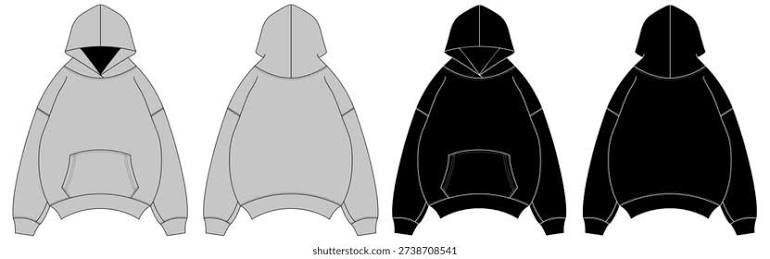
How Elahi Vertex International Manages Bulk Hoodie Orders
1. Requirement Confirmation
Before bulk production, the order requirements should be documented.
These may include:
- quantity;
- colourways;
- size breakdown;
- fabric;
- GSM;
- measurements;
- artwork;
- logo placement;
- print method;
- embroidery;
- labels;
- packaging;
- shipping destination.
Ambiguity at this stage creates avoidable production risk.
2. Approved Product Reference
The approved sample and confirmed specifications provide the reference point for production.
Changes after approval should be clearly documented.
A buyer should not casually change the fabric, measurements or artwork halfway through manufacturing and expect the original production schedule and cost to remain unaffected.
3. Material Preparation
The required material is prepared according to the confirmed production specifications.
This is particularly important for bulk hoodie manufacturing because material affects:
- garment weight;
- drape;
- warmth;
- print behaviour;
- shrinkage;
- hand feel;
- final appearance.
4. Cutting
Patterns and approved measurements guide cutting.
Bulk cutting must preserve the required size breakdown.
For example, an order may contain several sizes rather than one universal measurement.
5. Printing / Embroidery / Branding
Depending on the product, decoration may be applied through the approved process.
Artwork dimensions and placement should follow the agreed specification.
Labels and other branding elements should also follow the approved requirements.
6. Stitching and Assembly
Garment panels are assembled into finished hoodies.
Relevant construction areas include:
- shoulders;
- sleeves;
- side seams;
- hood attachment;
- pocket;
- cuffs;
- waistband;
- internal finishing.
7. Finishing
Threads, presentation and relevant finishing details should be checked.
If a special wash or treatment is part of the specification, it should be managed according to the approved project requirements.
8. Quality Inspection
Finished garments should be checked against the agreed specifications.
Inspection criteria can include:
- measurements;
- visual defects;
- stitching;
- print;
- embroidery;
- labels;
- colour;
- construction;
- quantity;
- packaging.
9. Packing
The approved packaging requirements are applied.
European brands should discuss packaging early rather than adding complicated packaging instructions after manufacturing is complete.
10. Shipment Preparation
Shipping depends on:
- destination;
- quantity;
- shipment weight;
- dimensions;
- urgency;
- courier/freight method;
- customs requirements;
- agreed Incoterms where applicable.
Shipping should therefore be quoted for the actual order rather than guessed from a generic price.
20 Pieces, 50 Pieces, 100 Pieces or Bulk — What Changes?
| Order Stage | Commercial Purpose | Main Priority |
|---|---|---|
| Sample | Product verification | Get specifications right |
| 20 pcs | Startup/test launch | Reduce initial inventory exposure |
| 50 pcs | Small commercial drop | Validate demand |
| 100 pcs | Growing collection | Improve production economics |
| 100+ pcs | Scaling | Consistency and planning |
| Larger Bulk | Established demand | Repeatability, logistics and cost control |
These are commercial illustrations rather than universal rules.
A brand can order according to its actual requirements, subject to manufacturing feasibility and agreed terms.
The key message is simple:
Elahi Vertex International does not position 20 pieces as the final scale of the relationship.
The 20-piece MOQ gives smaller brands a practical place to begin.
Bulk manufacturing gives successful products somewhere to grow.
Check 7 — Evaluate Quality Control From Sample to Bulk
“High quality” is not a specification.
Brands should define what quality means for their particular hoodie.
For example:
- fabric matches agreed composition;
- GSM matches agreed requirement;
- dimensions remain within agreed tolerances;
- artwork is correctly positioned;
- embroidery is clean;
- stitching is acceptable;
- labels are correctly positioned;
- colours follow approval;
- size breakdown is correct;
- packaging follows instructions.
The more clearly these expectations are defined before production, the easier it becomes to evaluate the finished order.
Sample Quality vs Bulk Consistency
A sample may receive individual attention because only one garment is being produced.
Bulk manufacturing introduces repetition.
That means a brand should evaluate a streetwear hoodie manufacturer not only by asking:
“Can you make this?”
but also:
“How will this approved product be reproduced throughout the order?”
That is the more commercially important question.
Check 8 — Understand European Textile Labelling and Compliance
European brands importing hoodies should not treat compliance as something to consider after the products have already been manufactured.
For textiles marketed in the European Union, fibre-composition labelling requirements apply.
The final compliance responsibility should be confirmed for the buyer’s specific product, destination country and sales model.
A manufacturer can produce according to specifications provided by the buyer, but the brand/importer should independently confirm its legal obligations.
EU Textile Fibre Labelling
European rules require textile products marketed to consumers to provide fibre-composition information.
For example, a brand should not casually label a blended hoodie “100% cotton” if that description does not accurately represent the textile composition.
The official EU guidance should be reviewed for current requirements.
Brands selling across multiple EU markets should also check applicable language requirements for the countries in which the product will be made available.
Chemical and Material Considerations
European brands should also consider applicable chemical restrictions under EU rules such as REACH.
The exact requirements depend on:
- materials;
- dyes;
- prints;
- trims;
- finishes;
- product construction;
- destination;
- market placement.
Do not rely on a generic statement such as “EU compliant” without understanding what is actually being confirmed.
Ask what evidence is available for the specific material or component where compliance documentation is commercially necessary.
Buyer Responsibility Matters
The manufacturer and buyer should work together, but importing into Europe creates responsibilities that cannot simply be outsourced through a sentence on WhatsApp.
European brands should verify:
- textile fibre labelling;
- destination-language requirements;
- product information;
- chemical restrictions;
- customs/import requirements;
- packaging requirements where applicable;
- responsible economic operator/importer obligations where applicable;
- country-specific requirements.
Regulations can change.
Always verify current requirements using official European Union and destination-country sources before market placement.
Check 9 — Evaluate Communication, Commercial Terms, Packaging and Shipping
Good manufacturing communication is not about receiving instant “yes” answers.
Sometimes a manufacturer who says yes to every request without asking technical questions is actually increasing the buyer’s risk.
A competent custom hoodie manufacturer Europe should ask questions when specifications are incomplete.
What a Serious Hoodie RFQ Should Include
Send:
Product
Pullover hoodie / zip hoodie / other.
Quantity
Exact target quantity.
Fabric
Composition if known.
GSM
Target GSM or desired weight/feel.
Fit
Regular, relaxed, oversized, boxy or custom.
Size Chart
Measurements or required size range.
Colours
Garment and artwork colours.
Artwork
Vector files where possible.
Decoration
Printing, embroidery or other method.
Labels
Neck, care, size, woven, printed, etc.
Packaging
Standard or custom.
Destination
City/country/postcode where appropriate for shipping estimation.
Deadline
Required delivery or launch window.
This allows the manufacturer to evaluate the actual project rather than guessing.
Why “What Is Your Hoodie Price?” Is the Wrong First Question
There is no meaningful universal custom hoodie price.
Price can change according to:
- fabric;
- GSM;
- quantity;
- design;
- fit;
- printing;
- embroidery;
- number of print locations;
- labels;
- tags;
- packaging;
- washing;
- finishing;
- shipping destination.
Compare like with like.
A 400 GSM heavily embroidered custom hoodie should not be compared directly with a lightweight basic printed hoodie.
Startup Streetwear Brands: How to Start Without Overcommitting
Launching a streetwear brand creates an uncomfortable inventory question.
Order too little and unit economics may be less attractive.
Order too much and unsold inventory can consume cash.
For many startups, the correct objective is not achieving the absolute lowest unit cost on the first production run.
It is learning whether customers will buy the product.
This is where a low MOQ hoodie manufacturer becomes commercially useful.
Elahi Vertex International’s standard 20-piece MOQ per product/category can allow an emerging brand to test its product before moving toward larger manufacturing volumes.
A Practical Startup Hoodie Launch
A startup could follow this workflow:
Step 1
Develop one strong hoodie rather than five poorly validated products.
Step 2
Define fabric, GSM, fit, colour and artwork.
Step 3
Produce a sample.
Step 4
Correct the sample where necessary.
Step 5
Approve the final specification.
Step 6
Begin with the appropriate production quantity, with Elahi Vertex International’s standard MOQ starting from 20 pieces per product/category.
Step 7
Launch.
Step 8
Measure sales.
Step 9
Identify best-selling sizes and colours.
Step 10
Plan the reorder or larger bulk run.
This turns manufacturing into a learning cycle rather than a one-time gamble.
Growing Streetwear Brands: Why Bulk Management Becomes More Important
Once a brand already knows a hoodie sells, its sourcing priorities change.
The brand may care less about proving demand and more about:
- repeatability;
- consistent measurements;
- fabric consistency;
- colour continuity;
- production planning;
- order timing;
- packaging;
- logistics;
- unit economics.
At that stage, a bulk hoodie manufacturer should be evaluated on whether production can follow the agreed product specifications repeatedly.
A growing brand should maintain an organized specification record for each core product.
Create a Hoodie Specification Sheet
For each style, record:
- style name/code;
- fabric;
- composition;
- GSM;
- colour;
- Pantone reference where applicable;
- size chart;
- measurement tolerances;
- stitching;
- hood construction;
- drawcord;
- eyelets;
- rib;
- pocket;
- artwork;
- artwork dimensions;
- placement;
- printing technique;
- embroidery specifications;
- labels;
- hangtags;
- packaging;
- approved sample date/version.
This makes reordering far easier.
Hoodie GSM Guide for European Streetwear Brands
There is no single “best” GSM.
The best GSM is the one that supports your intended product.
Lightweight Hoodie
Potentially useful for:
- layering;
- warmer seasons;
- lightweight collections;
- lower garment weight.
Midweight Hoodie
Potentially useful for:
- broad seasonal use;
- casual streetwear;
- everyday collections.
Heavyweight Hoodie
Potentially useful for:
- premium streetwear;
- structured silhouettes;
- colder-weather collections;
- oversized garments where weight supports the intended drape.
Do not select GSM because social media says a certain number is “premium.”
Select it because it works with the product.
Cotton vs Cotton/Polyester Hoodies
Cotton-Rich / Cotton Options
Brands may prefer cotton because of:
- natural hand feel;
- streetwear positioning;
- print compatibility depending on construction;
- consumer preference.
Cotton/Polyester Blends
Blends can offer different performance characteristics depending on composition and construction.
The correct choice depends on the garment.
Do not select a fabric composition without considering:
- hand feel;
- durability;
- shrinkage;
- print method;
- wash behaviour;
- intended retail positioning.
French Terry vs Brushed Fleece
French Terry
French terry generally has loops on the inner surface.
It can be useful when a brand wants a different feel from heavily brushed fleece.
Brushed Fleece
Brushed fleece provides a softer, warmer internal surface.
It is common in colder-weather hoodie products.
Neither is automatically superior.
The choice should follow the product concept.
Oversized Hoodie Manufacturing
An oversized hoodie is not simply a normal hoodie made two sizes larger.
Good oversized development can involve changes to:
- shoulder;
- chest;
- sleeve;
- body length;
- sleeve width;
- hood proportions;
- rib proportions;
- pocket scale.
This is why brands developing oversized streetwear should provide references and measurements rather than simply saying:
“Make it oversized.”
Printing Options for Custom Streetwear Hoodies
The appropriate printing process depends on the design and fabric.
Common approaches may include:
- screen printing;
- transfer-based methods;
- specialty print effects;
- project-specific techniques.
The buyer should ask:
- Can the method reproduce my artwork?
- How does it behave on this fabric?
- What does the sample look like?
- What artwork format is required?
- What are the production implications?
A custom hoodie manufacturer Europe buyer should never choose a print method only because it sounds premium.
The print must suit the design.
Embroidery for Streetwear Hoodies
Embroidery can create a premium appearance, but embroidery specifications matter.
Consider:
- artwork complexity;
- dimensions;
- stitch density;
- placement;
- thread colours;
- backing;
- fabric weight;
- distortion risk.
Large dense embroidery can interact differently with lightweight and heavyweight fabrics.
Sampling is therefore valuable.
Private Labels and Branding
A private-label hoodie can include more than the external graphic.
Brand identity may include:
- woven neck label;
- printed neck label;
- size label;
- care/content label;
- hangtag;
- custom packaging.
For European products, legally required consumer information should be handled correctly alongside brand presentation.
A beautiful neck label does not replace legally required fibre-composition information.
Packaging for European Streetwear Orders
Packaging decisions can affect:
- presentation;
- shipping volume;
- fulfilment;
- retail readiness;
- environmental considerations;
- labelling.
Discuss packaging before bulk production.
If you need custom bags, stickers, inserts, barcodes or other packaging details, include them in the RFQ.
Do not wait until the garments are ready for dispatch.
Shipping Custom Hoodies to Europe
Shipping can materially affect landed cost.
The appropriate shipping method depends on:
- quantity;
- weight;
- carton dimensions;
- destination;
- urgency;
- commercial terms.
Small shipments may use express courier solutions.
Larger shipments may justify alternative freight arrangements.
The buyer should compare landed commercial economics, not only ex-factory unit price.
What Is Landed Cost?
Landed cost can include more than manufacturing price.
Depending on the transaction, it may involve:
- product cost;
- packaging;
- freight;
- insurance where applicable;
- customs duties;
- taxes;
- brokerage;
- destination charges.
The exact calculation depends on the shipment and Incoterm.
European buyers should obtain professional customs advice where necessary.
Common Mistake: Comparing Suppliers Using Only Unit Price
Supplier A quotes €18.
Supplier B quotes €20.
Supplier A therefore looks cheaper.
But what if:
- A excludes labels;
- B includes labels;
- A uses lighter fabric;
- B uses the requested GSM;
- A excludes packaging;
- B includes specified packaging;
- A’s shipping is higher;
- A’s artwork method differs?
The quotations are not comparable.
Build a specification matrix before choosing.
Custom Hoodie Manufacturer Comparison Table
| Criterion | Manufacturer A | Manufacturer B | Manufacturer C |
|---|---|---|---|
| Fabric Composition | Confirm | Confirm | Confirm |
| GSM | Confirm | Confirm | Confirm |
| Custom Pattern | Yes/No | Yes/No | Yes/No |
| Sample | Terms | Terms | Terms |
| MOQ | Quantity | Quantity | Quantity |
| Labels | Included/Extra | Included/Extra | Included/Extra |
| Printing | Method | Method | Method |
| Embroidery | Capability | Capability | Capability |
| Packaging | Details | Details | Details |
| Lead Time | Confirm | Confirm | Confirm |
| Shipping | Confirm | Confirm | Confirm |
| Payment Terms | Confirm | Confirm | Confirm |
| Bulk QC | Process | Process | Process |
This makes supplier selection more objective.
Red Flags When Choosing a Custom Hoodie Manufacturer
1. Instant Pricing Without Specifications
A manufacturer cannot accurately understand a highly customized hoodie from one photograph.
2. No Interest in Fabric
Fabric is fundamental.
3. No Measurement Discussion
Especially risky for oversized streetwear.
4. Refusing Sampling
For complex products, this deserves investigation.
5. Unrealistic Promises
Manufacturing has physical constraints.
6. Vague Bulk Specifications
“Same as sample” is useful but should be supported by documented specifications.
7. Unclear Payment Terms
Know what is payable and when.
8. Unclear Shipping Terms
Know what the quotation includes.
9. No Business Verification
Verify who you are dealing with before transferring money.
Why Elahi Vertex International Can Fit Both Startup and Bulk Requirements
Elahi Vertex International is positioned as a custom B2B manufacturer rather than a ready-made consumer clothing store.
The manufacturing model supports product development around buyer specifications such as:
- fabric;
- GSM;
- sizing;
- fit;
- design;
- branding;
- labels;
- packaging;
- production quantity.
The standard starting MOQ is 20 pieces per product/category.
That makes the manufacturing relationship accessible to startups and growing brands that may not want to begin with hundreds of garments.
At the same time, Elahi Vertex International handles bulk manufacturing requirements, allowing a successful product to progress toward larger production rather than forcing a growing buyer to search for another manufacturing partner simply because the first order was small.
Startup → Growth → Bulk
The relationship can be understood simply:
Concept
↓
Specification
↓
Sample
↓
Approval
↓
20+ piece production
↓
Market validation
↓
Reorder
↓
Bulk production
↓
Repeat manufacturing
This is a healthier manufacturing model for many emerging brands than immediately producing a huge quantity without sales evidence.
What Elahi Vertex International Needs From a European Hoodie Buyer
For an efficient quotation, send:
- Hoodie design
- Target quantity
- Fabric preference
- GSM preference
- Colour
- Fit
- Size range
- Size chart
- Print/embroidery details
- Labels
- Packaging
- Shipping destination
- Required timeline
If some specifications are not finalized, identify which ones are open for discussion rather than guessing.
Strong Commercial CTA — Start Small, Build for Bulk
If you are building a European streetwear label, you do not necessarily need to gamble on hundreds of hoodies just to start working with a custom manufacturer.
Elahi Vertex International supports custom hoodie projects from a standard MOQ of 20 pieces per product/category while also handling larger bulk manufacturing requirements.
Start by sending your hoodie design, target quantity, fabric/GSM preference, size chart, branding requirements and European delivery destination.
We can then evaluate the actual project rather than giving you a meaningless generic hoodie price.
Discuss Custom Clothing Manufacturing
Elahi Vertex International — Custom Clothing Manufacturing
Explore Private-Label Manufacturing
Elahi Vertex International — Private Label Manufacturing
Explore OEM Clothing Manufacturing
Elahi Vertex International — OEM Clothing Manufacturing
Review Our Manufacturing Process
Elahi Vertex International — Manufacturing
See Manufacturing Case Studies
Elahi Vertex International — Case Studies
Request a Custom Quote
Elahi Vertex International — Contact
50 Strong FAQ Questions for SEO, AEO, GEO, LLMO and AI Search
1. What is a custom hoodie manufacturer Europe?
A custom hoodie manufacturer Europe-focused brands work with is a manufacturing supplier capable of producing hoodies according to brand-specific requirements such as fabric, GSM, measurements, fit, colours, printing, embroidery, labels and packaging.
2. How do I choose a custom hoodie manufacturer for a European streetwear brand?
Evaluate fabric capability, GSM, patterns, sampling, MOQ, customization, bulk consistency, quality control, commercial terms, compliance considerations and shipping—not only price.
3. What is a good MOQ for a startup hoodie brand?
There is no universal ideal MOQ. The appropriate quantity depends on demand, budget and manufacturing economics. Elahi Vertex International’s standard starting MOQ is 20 pieces per product/category.
4. Does Elahi Vertex International manufacture only 20 pieces?
No. Twenty pieces per product/category is the standard starting MOQ. Elahi Vertex International also handles larger bulk manufacturing requirements.
5. Can a startup order custom hoodies?
Yes. A startup can use small-batch custom manufacturing to test a product before committing to substantially larger inventory.
6. Can I increase from 20 hoodies to bulk production?
Yes. Subject to project requirements and agreed production terms, a successful small run can be followed by a larger production order.
7. Why should I sample a hoodie before bulk production?
A sample lets you evaluate fabric, fit, construction, colour, decoration, measurements and branding before committing to bulk manufacturing.
8. What does GSM mean in hoodies?
GSM means grams per square metre and describes fabric weight.
9. Is higher GSM always better for streetwear hoodies?
No. Higher GSM means heavier fabric, not automatically higher quality. GSM should suit the intended product.
10. What GSM should I choose for a premium hoodie?
The correct GSM depends on climate, silhouette, fabric construction, desired weight and brand positioning. There is no universal premium GSM.
11. What fabric is best for custom hoodies?
Cotton, cotton blends, French terry and fleece constructions are common options. The best choice depends on the intended product.
12. What is a heavyweight streetwear hoodie?
It generally refers to a hoodie made from relatively heavy fabric, but brands should specify an actual target GSM rather than relying only on “heavyweight.”
13. Can a custom hoodie manufacturer create oversized hoodies?
Yes, where the manufacturer supports custom patterns and measurements. “Oversized” should be translated into an actual size specification.
14. What measurements should I provide for an oversized hoodie?
Useful measurements include chest, length, shoulder, sleeve, armhole, cuff, hem, hood and pocket dimensions.
15. Can I use my own size chart?
For custom manufacturing, brands can provide their own size specifications for evaluation.
16. Can I add private labels to custom hoodies?
Private-label manufacturing can include custom neck labels, size labels, care labels, hangtags and packaging according to the project.
17. Can I use custom packaging?
Custom packaging can be discussed as part of the project’s specifications.
18. Can I use embroidery on heavyweight hoodies?
Embroidery can be suitable, but artwork, stitch density, fabric and placement should be evaluated together.
19. Can I screen print custom hoodies?
Screen printing is commonly used for apparel, subject to the design, fabric and project requirements.
20. What is the difference between a blank hoodie supplier and custom hoodie manufacturer?
A blank supplier generally provides pre-existing garments. A custom manufacturer can develop garments around specific fabric, fit, construction and branding requirements.
21. What is a private label hoodie manufacturer?
A private-label hoodie manufacturer produces garments that are branded for another business according to agreed manufacturing specifications.
22. What is an OEM hoodie manufacturer?
OEM manufacturing generally means producing according to the buyer’s designs and specifications.
23. What is ODM hoodie manufacturing?
ODM can involve greater manufacturer participation in developing a product from a concept, depending on the arrangement.
24. Should European brands manufacture hoodies overseas?
That is a commercial decision. Overseas manufacturing can provide different sourcing options, but brands should evaluate quality, communication, compliance, logistics, lead time and landed cost.
25. Can European brands import hoodies from Pakistan?
Yes, subject to applicable import, customs, textile, product and destination requirements.
26. What labels do hoodies need in the EU?
EU textile rules include requirements concerning fibre-composition labelling. The exact requirements should be verified for the product and countries where it will be sold.
27. Does fibre composition matter for EU hoodie labels?
Yes. Fibre composition is a core part of EU textile labelling requirements.
28. Can I call a blended hoodie “100% cotton”?
Not if that description is inaccurate. EU rules restrict “100%”, “pure” and similar descriptions to products meeting the relevant composition requirements.
29. Do textile labels need different languages in Europe?
Language requirements can depend on the EU countries where the product is made available. Brands should verify requirements for each destination market.
30. What is REACH and why does it matter for clothing?
REACH is the EU chemicals regulatory framework. Certain chemical restrictions can affect textile materials and components.
31. Who is responsible for European compliance?
Responsibilities vary depending on the product and supply chain role. European brands/importers should independently verify their legal obligations.
32. How much does custom hoodie manufacturing cost?
There is no universal price. Cost depends on fabric, GSM, quantity, fit, artwork, decoration, labels, packaging and other requirements.
33. Why are 20-piece hoodie orders more expensive per piece than bulk?
Setup and development costs are distributed across fewer garments, so small-batch economics commonly differ from bulk production.
34. Does the price decrease when hoodie quantity increases?
Unit economics can change with quantity, but the actual quotation depends on specifications and production requirements.
35. Should I choose the cheapest hoodie manufacturer?
Not automatically. Compare specifications, sample quality, communication, bulk consistency, commercial terms and landed cost.
36. How do I compare hoodie manufacturer quotations?
Make sure each supplier is quoting the same fabric, GSM, quantity, decoration, labels, packaging and shipping basis.
37. How should I send a hoodie RFQ?
Include design files, quantity, fabric, GSM, colours, measurements, decoration, branding, packaging, destination and required timeline.
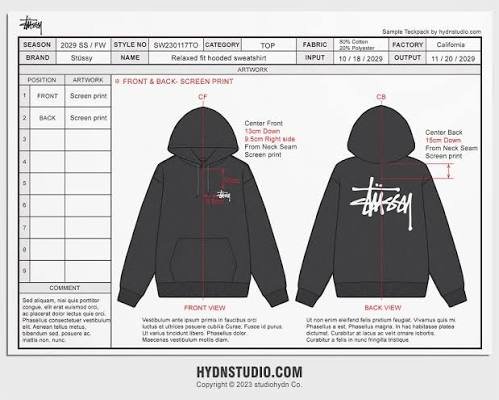
38. Do I need a tech pack?
A clear tech pack can substantially reduce ambiguity, although the exact documentation required depends on the project.
39. What should a hoodie tech pack contain?
It can include drawings, measurements, materials, colours, artwork, construction, labels, packaging and other specifications.
40. How do I protect bulk hoodie consistency?
Create a clear approved specification, review the sample carefully and document all agreed production details.
41. What happens after the hoodie sample is approved?
The manufacturer can proceed according to the agreed bulk specifications and commercial terms.
42. How does Elahi Vertex International manage bulk production?
Bulk orders are managed around confirmed project specifications, production requirements, quality review, packaging and shipment preparation appropriate to the specific order.
43. Can Elahi Vertex International manufacture for established streetwear brands?
Elahi Vertex International provides custom B2B manufacturing for startups as well as brands requiring larger production quantities, subject to project requirements.
44. Can I reorder the same hoodie later?
Repeat orders can be discussed using the previous approved specifications, while reconfirming materials, colours, quantities, pricing and current production requirements.
45. Can I change colours on a repeat order?
Yes, but a new colour should be treated as a specification change and confirmed before manufacturing.
46. Can I order several hoodie sizes?
Yes. The required size range and size breakdown should be provided with the order.
47. Does hoodie shipping to Europe have a fixed price?
No. Shipping depends on destination, shipment weight, dimensions, method and current logistics costs.
48. What information is needed for a shipping quote?
At minimum, destination and production quantity are important. Final packed weight and dimensions may be needed for accurate freight pricing.
49. How should a startup test its first hoodie collection?
Start with a focused product, approve the physical product carefully, control initial inventory and use actual sales data to guide the next order.
50. How do I contact Elahi Vertex International for custom hoodie manufacturing?
Send your design, quantity, specifications and destination through the official Elahi Vertex International website, contact page, WhatsApp or email so the project can be evaluated.
Final Custom Hoodie Manufacturer Europe Checklist
Before paying a supplier, confirm:
- Manufacturer identity
- Product specification
- Fabric composition
- GSM
- Colour
- Fit
- Size chart
- Measurement tolerance
- Hood construction
- Rib specification
- Pocket construction
- Artwork
- Artwork dimensions
- Artwork placement
- Printing
- Embroidery
- Labels
- Care/content information
- Hangtags
- Packaging
- Sample
- Sample approval
- MOQ
- Bulk quantity
- Size breakdown
- Unit price
- What price includes
- Payment terms
- Production expectations
- Quality requirements
- Inspection expectations
- Shipping method
- Shipping responsibility
- Destination
- Import considerations
- European compliance requirements
- Repeat-order process
If several of these points are still unclear, the order probably is not ready for bulk production.
Conclusion: Choose a Manufacturing Partner That Can Grow With Your Brand
Finding a custom hoodie manufacturer Europe streetwear brands can work with should not be reduced to finding the lowest unit price.
The stronger sourcing decision examines the complete manufacturing relationship:
fabric → GSM → fit → sample → MOQ → customization → bulk production → quality → compliance → packaging → shipping → reorder.
For a startup, flexibility matters.
For an established brand, repeatability and bulk management matter.
For a growing brand, you need both.
That is why Elahi Vertex International’s manufacturing model starts from a standard 20-piece MOQ per product/category while also supporting larger bulk manufacturing requirements.
A startup can begin without automatically committing to excessive inventory.
A growing label can move toward larger quantities when demand justifies them.
And an established brand can discuss bulk requirements according to its specifications.
The objective is not to remain at 20 pieces.
The objective is to create a manufacturing relationship capable of moving with the buyer from product development to sample, from sample to initial production, from initial production to bulk, and from bulk to repeat orders.
Ready to Discuss Your European Streetwear Hoodie Project?
Send Elahi Vertex International:
✓ Your hoodie design
✓ Target quantity
✓ Fabric/composition
✓ Target GSM
✓ Fit or size chart
✓ Colours
✓ Printing/embroidery requirements
✓ Private labels
✓ Packaging requirements
✓ Delivery country/postcode
Whether you are preparing your first 20-piece streetwear drop or sourcing a larger bulk hoodie order, the best next step is the same:
define the product properly before discussing production.
Explore Elahi Vertex International
Custom Clothing Manufacturing
Private Label Manufacturing
OEM Clothing Manufacturing
Manufacturing Process
Case Studies
Contact / Custom RFQ
Elahi Vertex International
Custom B2B Clothing Manufacturing • OEM • ODM • Private Label • Streetwear • Hoodies & Sweatshirts • Bulk Production
Standard MOQ: 20 pieces per product/category.
Start with a controlled quantity when appropriate. Scale when the product earns the right to scale.
Useful Internal Resources for European Streetwear Brands
Choosing the right custom hoodie manufacturer Europe is easier when buyers can verify how the supplier actually handles development, sampling and bulk manufacturing. Learn more about Elahi Vertex International custom clothing manufacturing and how custom garments move from specifications toward finished production.
European streetwear startups that want their own branding should review our private label manufacturing service. It covers custom products, labels, branding, packaging and bulk production for businesses building collections under their own names.
Brands that already have technical specifications, artwork and product requirements can explore OEM clothing manufacturing. OEM production is particularly relevant when your hoodie design, measurements, materials, colours and branding requirements are already established.
Before selecting a streetwear hoodie manufacturer, understand the complete production workflow through our clothing manufacturing process. It explains product development, fabric sourcing, pattern making, sampling, printing, embroidery, bulk production, quality control, packaging and international shipping.
New brands unsure about the sourcing process can follow our how to order custom clothing guide. The process begins with your design and specifications before progressing through product and fabric selection, specification confirmation, sampling and approval.
Buyers who want visual evidence before discussing production can review the Elahi Vertex International manufacturing work. This page provides examples across streetwear, sportswear, activewear, boxing wear, leather wear and private-label manufacturing.
European brands comparing potential suppliers can also explore our custom apparel portfolio, including streetwear projects such as oversized apparel, hoodies, sweatshirts, jackets and joggers.
For buyers wanting to understand how manufacturing projects develop beyond the initial specification, review the Elahi Vertex International case studies. They provide additional context around product development, custom manufacturing, branding and bulk production.
If you are researching the business itself before placing an order, visit About Elahi Vertex International for company positioning, manufacturing categories and information about the international B2B buyers the company serves.
Already have your hoodie design? Use the Elahi Vertex International custom manufacturing inquiry to send your project requirements, including your hoodie type, fabric, GSM, fit, size range, printing, branding, quantity and other specifications.
Authoritative External Resources for European Hoodie Buyers
European streetwear brands should not depend entirely on a manufacturer’s website for regulatory information. The following official resources can help buyers independently verify European requirements relevant to textile sourcing, importing, product safety and packaging.
1. European Union Textile Labelling Rules
European streetwear brands importing custom hoodies should understand applicable textile fibre labelling requirements before putting garments on the market. The European Commission’s textile labelling guidance explains important requirements concerning fibre composition and textile labels.
2. EU Textile Regulation 1007/2011
Buyers wanting the underlying legislation can consult Regulation (EU) No 1007/2011 on textile fibre names and related labelling. This is a stronger primary reference than relying on third-party summaries when researching European textile labelling obligations.
3. European Chemicals Agency — REACH
Fabric is not the only consideration when sourcing a hoodie. Dyes, finishes, prints and other materials can also create chemical-compliance questions. European brands should use the European Chemicals Agency when researching REACH obligations and chemical restrictions relevant to products placed on the EU market.
4. ECHA Candidate List
Brands conducting deeper material due diligence can consult the ECHA Candidate List of substances of very high concern. The relevance of a particular substance depends on the materials and components involved, so brands should evaluate their specific product rather than treating generic “REACH compliant” language as sufficient evidence.
5. EU Product Safety
Streetwear remains a consumer product. European businesses should therefore understand their product-safety responsibilities. The European Commission product safety portal provides official information concerning EU product safety and the General Product Safety Regulation.
6. EU Safety Gate
European brands can use Safety Gate to research alerts concerning dangerous non-food consumer products. This is useful for understanding the broader product-safety environment in which apparel is placed on the European market.
7. Access2Markets
Manufacturing price is not the same as landed cost. Brands importing hoodies from Pakistan into Europe can use the European Commission’s Access2Markets portal to research tariffs, import procedures, rules of origin and other trade information applicable to their specific destination and product classification.
8. EU Customs Information
International streetwear sourcing also requires customs planning. Buyers can consult the European Commission Taxation and Customs Union for official information concerning EU customs procedures and related requirements.
9. TARIC — EU Customs Tariff
The customs treatment of a garment depends on its classification and other factors. European importers can research the EU TARIC customs database rather than assuming every hoodie will receive the same tariff treatment.
10. European Commission Packaging Rules
Custom packaging should not be treated only as a branding decision. The EU’s packaging framework is changing, so brands should review the European Commission’s Packaging and Packaging Waste Regulation information when developing packaging for products destined for European markets.
Manufacturer Verification + Buyer Due Diligence
Before selecting a custom hoodie manufacturer Europe, verify the supplier itself as carefully as you verify fabric and pricing.
A serious buyer should examine:
- business identity;
- website;
- manufacturing information;
- product portfolio;
- sample process;
- specifications;
- payment details;
- production terms;
- shipping responsibility;
- written quotation or proforma invoice.
For transparency, European buyers researching Elahi Vertex International can independently review our official website, manufacturing process, manufacturing work and portfolio before discussing an order.
From 20-Piece MOQ to Bulk Production
A startup should not choose a low MOQ hoodie manufacturer simply because the number looks attractive.
The better question is whether the supplier can continue supporting the brand if the first drop succeeds.
Elahi Vertex International’s standard starting MOQ is 20 pieces per product/category, giving emerging brands a manageable route into custom production.
The manufacturing relationship does not have to stop there.
A brand can move through:
Sample → 20-piece starting production → market validation → reorder → larger bulk production → repeat manufacturing
Buyers can understand the production side in more detail through our manufacturing process and OEM clothing manufacturing service.
This makes the 20-piece MOQ commercially useful for startups while maintaining a path toward bulk manufacturing as demand develops.
Build Your Hoodie With Elahi Vertex International
European streetwear brands should not have to choose between a manufacturer that understands startups and one capable of handling larger production requirements.
Elahi Vertex International supports both.
Whether you are preparing your first 20-piece custom hoodie production or planning a larger bulk streetwear order, start with clear specifications.
Send us:
- hoodie design;
- quantity;
- fabric preference;
- target GSM;
- size chart;
- fit;
- colourways;
- printing or embroidery;
- private labels;
- packaging requirements;
- European delivery destination.
Explore our custom clothing manufacturing service, review our private label manufacturing, understand our manufacturing process, view our manufacturing work, or send Elahi Vertex International your custom hoodie requirements.
Start at 20 pieces per product/category when appropriate. Validate the product. Build demand. Then scale into bulk production.
Ready to Turn Your Hoodie Design Into Production?
Choosing a custom hoodie manufacturer Europe is not only about finding someone who can produce a sample. You need a manufacturing partner that can help you move from product development → sample approval → first production → bulk manufacturing → repeat orders without losing control of your specifications.
At Elahi Vertex International, we work with international B2B buyers on custom streetwear, hoodies, sweatshirts and private-label clothing manufactured around the buyer’s specific requirements.
Starting a New European Streetwear Brand?
You do not necessarily need to commit to hundreds of hoodies before proving that your product can sell.
Elahi Vertex International’s standard MOQ starts from 20 pieces per product/category, giving startups and emerging streetwear brands a more controlled way to enter custom manufacturing.
Explore our custom clothing manufacturing service to understand how your design can be developed around your required fabric, GSM, fit, measurements, colours and branding.
For brands building products under their own identity, see our private label clothing manufacturing options for custom branding, labels, packaging and production.
Already Growing? Move From Small Orders to Bulk Production
Twenty pieces is our starting MOQ — not the limit of the manufacturing relationship.
When your hoodie proves demand, Elahi Vertex International can discuss larger bulk requirements according to your approved specifications, quantities and commercial requirements.
Review our OEM clothing manufacturing service if you already have established designs, technical specifications or product requirements.
You can also review the Elahi Vertex International manufacturing process to understand the workflow from product development and sampling through production, quality control, packaging and shipment preparation.
Verify Our Work Before You Start
Do your supplier due diligence before committing to production.
Review our manufacturing work, explore our custom apparel portfolio, and read our case studies before discussing your project.
We want buyers to evaluate the manufacturing fit before moving forward.
Get a Project-Specific Hoodie Quote
Instead of asking “What is your hoodie price?”, send us enough information to evaluate the actual product:
- Hoodie design or tech pack
- Required quantity
- Fabric composition
- Target GSM
- Regular, relaxed, boxy or oversized fit
- Size chart
- Colourways
- Printing or embroidery requirements
- Private labels and hangtags
- Packaging requirements
- European delivery destination
- Target timeline
Then use our custom manufacturing inquiry page to discuss your requirements with Elahi Ver