Choosing a heavyweight hoodie GSM is not simply a matter of picking the largest number available.
For a London streetwear brand developing oversized hoodies, premium fleece pieces, washed collections or private-label drops, fabric weight influences structure, drape, warmth, decoration, shipping weight and how the finished garment feels in hand. But GSM alone does not tell you whether a hoodie is high quality.
A dense 380 GSM fabric with suitable yarn, construction and finishing may perform better for a particular design than a much heavier fabric selected only because the number sounds premium.
That distinction matters because heavyweight products are clearly present in the current UK streetwear market. British label KHAIR currently lists heavyweight hoodies around 420–500 GSM, while Offset Culture lists a 480 GSM cotton French-terry hoodie. These examples demonstrate market use; they do not establish one universal “best” GSM for every brand.
This guide is written for London streetwear brands, fashion startups, private-label businesses, e-commerce labels, wholesalers and buyers developing custom hoodies.
Elahi Vertex International is based in Sialkot, Pakistan rather than London. Its website positions the company as a custom clothing manufacturer and exporter serving streetwear and other apparel buyers, so the purpose of this guide is to help London buyers develop clearer specifications when sourcing internationally—not to imply that the factory is physically located in London.
Table of Contents
What Does Heavyweight Hoodie GSM Mean?
Decision 1 — Stop Treating Higher GSM as Automatically Better
Decision 2 — Match GSM to the Intended Streetwear Silhouette
Decision 3 — Choose the Fabric Construction, Not Only the Weight
Decision 4 — Match Fabric Weight to Season and Product Positioning
Decision 5 — Consider Printing, Embroidery and Artwork Before Finalizing GSM
Decision 6 — Test Shrinkage, Washing and Finishing
Decision 7 — Approve the Actual Hoodie, Not a GSM Number
Decision 8 — Control Fit, Measurements and Size Grading
Decision 9 — Record Specifications for Reliable Reorders
Heavyweight Hoodie GSM Comparison
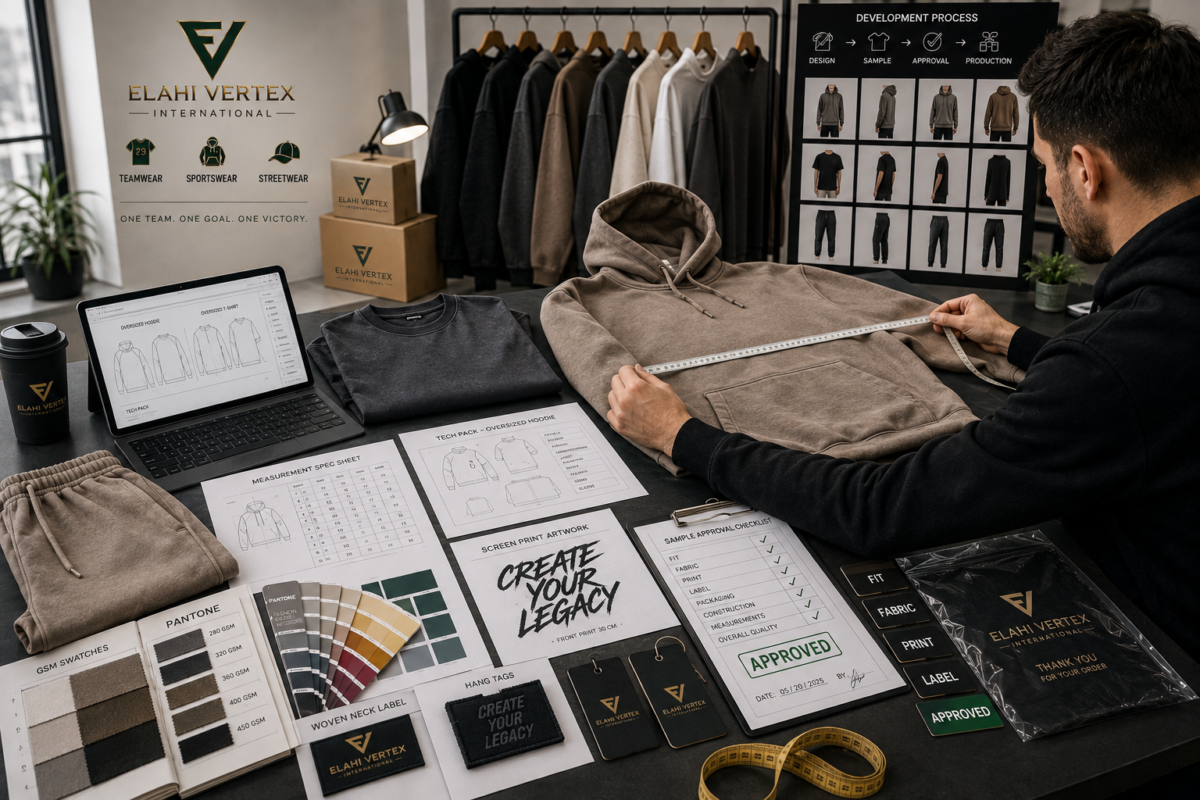
London Streetwear Hoodie Specification Example
Oversized Hoodie Measurement Guide
Streetwear Color Development Guide
Hoodie Fabric Selection Checklist
Common Heavyweight Hoodie Sourcing Mistakes
What to Include in a Hoodie RFQ
Why Discuss Streetwear Production With Elahi Vertex International?
Useful External Resources
20 Heavyweight Hoodie GSM FAQs
Conclusion
What Does Heavyweight Hoodie GSM Mean?
GSM means grams per square metre. In apparel sourcing, it describes the mass of a square metre of fabric under the relevant measurement conditions.
It does not directly tell you:
Finished hoodie weight
Fabric thickness
Fibre quality
Yarn quality
Softness
Warmth
Durability
Shrinkage
Pilling resistance
Drape
Stretch
Recovery
Stitching quality
Overall garment quality
This distinction is one of the most important things a streetwear buyer can understand.
A 400 GSM fabric means a square metre of that fabric has a specified mass. It does not mean the completed hoodie will weigh 400 grams.
A finished garment uses more or less than one square metre depending on:
Size
Pattern
Oversized proportions
Sleeve dimensions
Hood construction
Pocket construction
Rib
Lining
Panels
Other components
Independent current manufacturing guidance similarly warns buyers not to confuse GSM with finished garment weight or overall quality.
Direct answer
What is the best heavyweight hoodie GSM?
There is no universal best GSM.
The correct range depends on the intended:
silhouette + fabric construction + season + customer + decoration + finishing + target price + shipping economics.
That is the framework London streetwear brands should use.
1. Stop Treating Higher GSM as Automatically Better
One of the easiest mistakes in streetwear development is:
“Our competitor uses 400 GSM, so we need 500 GSM.”
That is not a proper product specification.
Higher GSM generally indicates greater fabric mass per area, but it does not guarantee better fibres, better knitting, better finishing or better garment construction.
Consider two hypothetical hoodie fabrics.
Specification
Fabric A
Fabric B
GSM
400
500
Fibre composition
Confirmed
Confirmed
Surface
Dense and clean
Requires inspection
Shrinkage
Tested
Unknown
Recovery
Suitable
Unknown
Hand feel
Approved
Unknown
Finished sample
Approved
Not approved
The 500 GSM figure by itself does not make Fabric B superior.
A better buyer question
Instead of asking:
“What is your highest GSM?”
ask:
“Which fabric weight and construction will produce the silhouette, hand feel, warmth and finish shown in our reference?”
That moves the conversation from marketing language into manufacturing specifications.
Heavyweight should serve the design
A heavier hoodie may provide:
Greater structure
More substantial hand feel
Stronger visual volume
More warmth depending on construction
Different drape
But it may also introduce:
More material consumption
Greater finished garment weight
Higher freight weight
Different sewing requirements
Greater drying time
Different customer comfort
Potentially higher production cost
The correct objective is therefore not maximum GSM.
It is appropriate GSM.
2. Match Heavyweight Hoodie GSM to the Intended Streetwear Silhouette
A London brand developing an oversized hoodie should not define the product with one phrase:
“Oversized 450 GSM hoodie.”
That still leaves major questions unanswered.
An oversized silhouette may depend on:
Chest width
Shoulder width
Shoulder drop
Body length
Sleeve length
Sleeve width
Armhole shape
Hood dimensions
Hem opening
Rib construction
Pocket size
Fabric drape
Why GSM affects silhouette
Fabric weight can change how a garment hangs.
A lighter fabric may drape more softly.
A denser heavyweight structure may create a more architectural shape.
But GSM is only one variable.
Fabric construction and finishing matter too.
A heavyweight hoodie can still look wrong if:
Shoulders are too narrow
Body length is too long
Sleeves are too slim
Rib pulls the hem inward
Hood is undersized
Chest width is insufficient
Fabric drape conflicts with the pattern
Boxy vs oversized
These terms should not be treated as interchangeable.
Oversized commonly means intentionally increased dimensions.
Boxy generally describes a broader, squarer proportion, often with controlled body length.
A garment may be:
Oversized and long
Oversized and cropped
Wide and boxy
Relaxed but not oversized
Drop-shoulder without extreme body width
Your measurement chart must define the result.
Buyer recommendation
For a new London streetwear collection:
Select the intended silhouette.
Build or supply measurements.
Select candidate fabrics.
Develop a sample.
Evaluate the actual combination of pattern + GSM + construction.
Correct the specification before bulk approval.
Do not lock the fabric number before understanding how the garment should behave.
Developing a custom streetwear hoodie? Buyers can send product requirements, fabric/GSM preferences, fit direction, printing and branding information through the Elahi Vertex International Custom Order page.
3. Choose the Fabric Construction, Not Only the Weight
Two hoodies with the same heavyweight hoodie GSM can feel completely different.
That is because fabric construction matters.
Common hoodie options can include constructions such as:
Brushed fleece
Unbrushed fleece
French terry
Cotton-rich blends
Cotton/polyester fleece
Other project-specific knitted fabrics
The correct material must be confirmed for the specific product.
Brushed fleece
A brushed interior can create a softer and more insulated feel.
It may suit:
Autumn/winter drops
Premium casual hoodies
Heavyweight streetwear
Cold-weather collections
But the final result depends on:
Fibre content
Knit
Brushing
Density
Finishing
French terry
French terry typically has loops on the reverse rather than a fully brushed fleece surface.
It can offer a different balance of:
Structure
Breathability
Drape
Hand feel
Seasonal suitability
Offset Culture’s current 480 GSM hoodie is an example of a UK streetwear product using heavyweight French terry rather than relying on GSM language alone.
Cotton vs blends
Do not reduce fabric selection to:
100% cotton = premium blend = cheap
That is too simplistic.
Different compositions are selected for different technical and commercial reasons.
Depending on the specification, fibre composition may influence:
Hand feel
Stability
Recovery
Shrinkage
Surface
Decoration response
Care requirements
Cost
Strong RFQ specification
Instead of:
450 GSM hoodie
use something closer to:
Oversized pullover streetwear hoodie. Target heavyweight construction. Preferred cotton-rich fleece or French terry. Final composition and GSM to be evaluated against structure, hand feel, shrinkage and target silhouette.
That gives the manufacturer meaningful direction without pretending the buyer already knows every technical answer.
4. Match Fabric Weight to Season and Product Positioning
London streetwear does not require every hoodie to be ultra-heavy.
A brand may need several product tiers.
For example:
Product Direction
Possible Starting Approach
Buyer Priority
Transitional hoodie
Midweight
Layering and versatility
Everyday premium hoodie
Mid-to-heavy
Balance
Structured streetwear hoodie
Heavyweight
Shape and presence
Winter hoodie
Heavyweight
Warmth plus structure
Statement oversized piece
Heavy to ultra-heavy
Visual weight
Lightweight collection
Lower GSM
Breathability
These are product-development directions—not mandatory production standards.
Current UK market signals
Current British streetwear product pages demonstrate that heavyweight products occupy multiple weight levels rather than one universal specification. KHAIR currently describes its range using 420–500 GSM heavyweight hoodies alongside 240 GSM oversized T-shirts.
That should teach manufacturers and buyers something important:
GSM is part of product architecture.
A streetwear label may intentionally use:
One weight for T-shirts
Another for sweatshirts
Another for hoodies
Another for winter statement pieces
Think collection-first
Suppose a London brand launches:
Oversized T-shirt
Crewneck sweatshirt
Pullover hoodie
Zip hoodie
Jogger
The goal should not be to make every garment “500 GSM.”
The better question is:
How should these fabrics relate to one another so the collection feels coherent?
Consider:
Hand feel
Color
washing
structure
rib
print finish
fit
season
price positioning
That creates a collection instead of five unrelated garments.
5. Consider Printing, Embroidery and Artwork Before Finalizing Heavyweight Hoodie GSM
The garment and the decoration should be developed together.
Streetwear decoration may include:
Screen printing
Puff printing
Embroidery
Appliqué
Patches
Heat-transfer applications
Woven branding
Other specialist finishes
Not every technique behaves identically across every fabric.
Screen printing
Consider:
Fabric surface
Artwork detail
Ink system
Number of colours
Print dimensions
Placement
curing
intended wash result
Puff printing
A raised print can change the visual identity of a streetwear hoodie significantly.
Before bulk production, confirm:
Artwork suitability
Height/effect
Print boundaries
Placement
surface compatibility
sample appearance
wash behaviour
Embroidery
Heavyweight garments can support prominent embroidery, but buyers should still consider:
Stitch density
Artwork complexity
Backing
Placement
Fabric distortion
Finished weight
Interior comfort
Large graphics need physical approval
A large back graphic may look balanced on a digital mockup but feel too small or too large on an actual oversized hoodie.
The company’s current 380 GSM fleece hoodie listing describes customization covering fit, colour, printing, embroidery, labels and packaging. Those capabilities should still be confirmed against the exact project specification before an order is treated as approved.
6. Test Shrinkage, Washing and Finishing Before Bulk Production
A heavyweight hoodie can measure correctly before washing and differently afterwards.
Depending on the fabric and process, buyers may need to consider:
Relaxation
Shrinkage
Torque
Surface changes
Color change
Rib behaviour
Print behaviour
Embroidery appearance
Hand-feel change
This becomes even more important when creating:
Washed black
Vintage grey
Pigment effects
Distressed garments
Acid-wash effects
Garment-dyed collections
Other washed finishes
Do not treat wash as decoration only
A wash may influence the actual garment.
If you approve:
Fit
Measurements
Fabric
and then change the wash or finishing process, connected aspects may need review again.
Evaluate the finished system, not isolated components.
7. Approve the Actual Hoodie, Not a GSM Number
One of the most expensive sourcing errors is approving a specification on paper without adequately evaluating the physical result.
A textile specification can tell you:
Fibre composition
GSM
Construction
Colour reference
Finish
But a sample can reveal:
Actual drape
Actual structure
Hand feel
Hood balance
Pocket proportion
Rib tension
Print scale
Fit
Overall visual weight
What should London brands evaluate?
For a heavyweight streetwear hoodie, review at minimum:
Fabric
Target GSM
Composition
Surface
Interior
Hand feel
Drape
Colour
Finish
Fit
Chest
Length
Shoulder
Sleeve
Armhole
Hood
Hem
Pocket
Construction
Seams
Stitching
Rib
Hood structure
Pocket
Drawcord system where used
Branding
Main label
Size label
Care label
Hangtag
Embroidery
Print
Packaging requirements
Sample approval rule
Do not write:
Looks good. Proceed.
Write:
Sample approved against specification revision X, artwork revision X and measurement chart revision X, except for the documented open points below.
Better still, close all material open points before bulk authorization.
Elahi Vertex International already has a dedicated streetwear sample-approval guide covering measurements, fabric, finishing, decoration, labels and packaging, so this article intentionally does not repeat that entire process.
8. Control Fit, Measurements and Size Grading
Heavyweight hoodie GSM gets attention.
Measurements determine whether people actually want to wear the garment.
A hoodie can have excellent fabric and still fail because:
Sleeve proportion feels wrong
Hood is too small
Shoulder drop is weak
Chest is too narrow
Body is too long
Rib pulls excessively
Grading changes the silhouette across sizes
Example oversized hoodie measurement framework
This is not an Elahi Vertex International production size chart. It is a development framework showing what should be specified.
Measurement Point
S
M
L
XL
Chest width
Specify
Specify
Specify
Specify
Body length
Specify
Specify
Specify
Specify
Shoulder width
Specify
Specify
Specify
Specify
Sleeve length
Specify
Specify
Specify
Specify
Sleeve opening
Specify
Specify
Specify
Specify
Bottom opening
Specify
Specify
Specify
Specify
Hood height
Specify
Specify
Specify
Specify
Hood width
Specify
Specify
Specify
Specify
Pocket width
Specify
Specify
Specify
Specify
Pocket height
Specify
Specify
Specify
Specify
Why not publish generic measurements?
Because there is no single correct “London oversized hoodie” size chart.
Your brand may deliberately want:
Extra-wide shoulders
Cropped body
Long sleeves
Wide hem
Tight hem
Large hood
Minimal hood
Unisex grading
Gender-specific grading
The size chart should express your design.
Record how measurements are taken
Two parties can measure the same hoodie differently.
A technical measurement sheet should define:
Point of measurement
Garment position
Whether measured straight or curved
Reference seams
Allowed tolerance where applicable
That reduces avoidable disputes.
9. Record Heavyweight Hoodie Specifications for Reorders
Your first order is only half the challenge.
A growing streetwear label needs a successful product to be reproducible.
Imagine that Drop 01 performs well.
Six months later you reorder.
If the original production details are scattered across:
WhatsApp
Emails
PDFs
Old artwork
Photos
Voice notes
you have increased the risk of inconsistency.
Build a controlled product record
For each hoodie style, keep:
Product/style code
Tech-pack revision
Pattern/measurement revision
Approved fabric reference
Fibre composition
Approved heavyweight hoodie GSM
Fabric colour reference
Rib reference
Wash/finish
Artwork revision
Print dimensions
Print placement
Embroidery specification
Label files
Label placement
Packaging specification
Size ratio
Approved sample reference
Bulk-production notes
Reorder amendments
Why this matters
A buyer should not have to rebuild the product from memory each time.
A repeat-order system allows the brand and manufacturer to ask:
Are we reproducing the previous specification exactly, or intentionally revising it?
That is a far stronger commercial process.
Heavyweight Hoodie GSM Comparison for Streetwear Buyers
The following ranges are general development guidance, not universal quality grades or guaranteed Elahi Vertex International production specifications.
Approximate Fabric Direction
General Product Positioning
Possible Characteristics
240–280 GSM
Lighter hoodie
Easier layering, softer/lighter feel
280–320 GSM
Midweight
Versatile everyday use
320–380 GSM
Heavyweight direction
More structure and substance
380–450 GSM
Strong heavyweight direction
Structured premium streetwear applications
450 GSM+
Ultra-heavy direction
Specialized statement products
Different suppliers classify “heavyweight” differently, which is another reason buyers should use exact GSM numbers rather than relying only on labels such as lightweight, premium or ultra-heavyweight.
Other current hoodie manufacturing guides also use materially different thresholds for what counts as heavyweight.
Important
Do not convert this table into:
450 GSM = better than 350 GSM.
The proper interpretation is:
450 GSM = heavier fabric mass per area.
Quality still depends on much more.
London Streetwear Hoodie Specification Example
Here is a cleaner way to brief a manufacturer.
Product
Private-label oversized pullover hoodie.
Market
London / UK streetwear collection.
Fit direction
Boxy oversized silhouette with dropped shoulders.
Fabric
Heavyweight hoodie fabric.
Preferred construction:
Cotton-rich fleece, or
Heavy French terry
Target GSM:
To be selected after fabric comparison and sampling.
Colour
Washed charcoal.
Physical or recognised textile colour reference to be confirmed.
Pantone’s Fashion, Home + Interiors system is specifically intended for textiles and apparel, making it more relevant to fabric colour communication than assuming an on-screen RGB/HEX colour will reproduce identically on cloth.
Decoration
Front:
Small embroidery.
Back:
Large screen print.
Exact dimensions and placement supplied separately.
Branding
Main woven label
Size label
Care label
Hangtag
Branded packaging
Sizes
XS–XXL.
Buyer measurement chart supplied.
Quantity
Insert required quantity.
Destination
London, United Kingdom.
Provide postcode for shipping quotation.
Required date
Insert required delivery target.
Sample
Physical sample requested before bulk approval.
That is much more useful than:
Need 500 GSM oversized hoodies. Price?
Streetwear Hoodie Color Development Guide
Streetwear colours often look deceptively simple.
Examples include:
Black
Vintage black
Washed black
Charcoal
Stone
Bone
Cream
Taupe
Olive
Navy
Chocolate
Burgundy
Yet “washed black” is not a precise production instruction.
For colour-critical products, final physical appearance deserves approval.
Hoodie Fabric Selection Checklist for London Streetwear Brands
Before approving a heavyweight hoodie fabric, check:
Product
Garment type defined
Target customer defined
Season/collection defined
Retail positioning considered
Fabric
Composition specified
Heavyweight hoodie GSM specified
Construction identified
Surface approved
Interior approved
Hand feel reviewed
Drape reviewed
Colour reference documented
Finishing documented
Fit
Silhouette defined
Measurement chart supplied
Shoulder drop confirmed
Chest width confirmed
Length confirmed
Sleeve dimensions confirmed
Hood dimensions confirmed
Rib behaviour reviewed
Decoration
Artwork finalised
Print process confirmed
Embroidery confirmed
Dimensions specified
Placement specified
Finished sample reviewed
Branding
Main label
Size label
Care label
Hangtag
Packaging
Production
Sample approved
Final revisions consolidated
Quantity confirmed
Size breakdown confirmed
Destination confirmed
Shipping arrangement discussed
Bulk specification controlled
Common Heavyweight Hoodie Sourcing Mistakes
Mistake 1 — Chasing the largest GSM number
More weight is not automatically more quality.
Mistake 2 — Asking only for “100% cotton”
Composition alone does not define construction or finished performance.
Mistake 3 — Using the word oversized without measurements
A manufacturer cannot reliably reproduce a silhouette from adjectives alone.
Mistake 4 — Selecting fabric independently from fit
Pattern and fabric behaviour interact.
Mistake 5 — Approving colour from a phone screen
Use a better production reference.
Mistake 6 — Adding a wash after fit approval
Finishing can affect the final garment.
Mistake 7 — Approving artwork without dimensions
Specify actual print or embroidery size and placement.
Mistake 8 — Ignoring freight weight
Extremely heavy garments can increase shipping weight and landed economics.
Mistake 9 — Comparing quotes with different specifications
A 300 GSM hoodie and a 500 GSM hoodie are not automatically comparable quotations.
Mistake 10 — Failing to preserve the final specification
Your successful product needs a repeatable production record.
What Should a London Streetwear Brand Include in a Hoodie RFQ?
A useful RFQ should contain enough information for the manufacturer to understand what is actually being quoted.
Include:
Company
Brand/company name.
Product
Example:
Oversized pullover hoodie.
Quantity
Example:
50 / 100 / 300 pieces.
Target heavyweight hoodie GSM
Give your target or ask for several suitable options.
Composition
Specify if decided.
Otherwise describe your desired:
Hand feel
Structure
Warmth
Interior
Finish
Fit
Attach:
Measurement chart
Tech pack
Reference garment
Pattern information where available
Colour
Provide recognised colour references.
Decoration
State:
Process
Artwork
Dimensions
Position
Number of colours where relevant
Private label
Specify:
Main label
Size label
Care label
Hangtag
Packaging
Sample
State whether physical sampling is required.
Delivery destination
Give:
London + postcode + United Kingdom
Shipping analysis is incomplete without the destination.
Delivery target
Give the required date rather than simply saying:
ASAP.
Files
Attach:
Tech pack
Artwork
Logo vectors
Measurement chart
Label files
Packaging requirements
For a structured custom manufacturing request, London buyers can also use the Elahi Vertex International Custom Order page, which currently requests product, design, fabric, GSM, fit, printing, labels, size and quantity information.
Why Discuss Streetwear Production With Elahi Vertex International?
Elahi Vertex International is a custom apparel manufacturer and exporter based in Sialkot, Pakistan. The company’s live website lists streetwear among its manufacturing categories and identifies fashion brands, retailers, e-commerce businesses and private-label companies among the audiences for its custom streetwear work.
For London brands, the relevant positioning is therefore:
international custom manufacturing for UK buyers—not a London-based factory.
That distinction matters for trust.
Streetwear product development
Current Elahi Vertex International website content covers streetwear products including:
Hoodies
Sweatshirts
T-shirts
Jackets
Joggers
Other custom apparel
Its portfolio describes streetwear work around hoodies, sweatshirts, T-shirts and custom apparel, while individual product pages include heavyweight and oversized garment options.
Custom project specifications
The company’s custom inquiry form allows a buyer to provide:
Product
Design files
Fabric type
Fabric GSM
Vintage/wash requirement
Fit style
Printing technique
Branding
Size range
Quantity
Additional instructions
That is the type of information required to move from a streetwear idea toward a manufacturable specification.
Discuss your project
If you are building a London streetwear collection, prepare:
Product feasibility, exact materials, pricing, sampling requirements, production timing and shipping should be confirmed for the specific project.
Useful External Resources for Streetwear Buyers
Pantone Fashion, Home + Interiors — useful when defining textile and apparel colour references rather than relying only on screen colours.
OEKO-TEX STANDARD 100 — useful for understanding what the STANDARD 100 textile safety certification actually covers when a supplier or fabric carries the claim. Never assume a product is certified without checking the specific certification.
Textile Exchange Standards — useful for buyers researching textile material standards, traceability and responsible-material claims.
Better Cotton — useful background for brands researching verified cotton sourcing systems and the requirements behind Better Cotton claims.
KHAIR CLO — useful as a current UK streetwear market example because the brand publicly specifies GSM on heavyweight hoodies and oversized T-shirts. It should be treated as a market reference, not a universal manufacturing standard.
Offset Culture — another current UK product reference showing the use of 480 GSM French terry in contemporary British streetwear.
Jiashun Streetwear GSM Guide — useful third-party manufacturing reading because it correctly distinguishes fabric GSM from thickness, overall quality and finished garment weight.
20 Heavyweight Hoodie GSM FAQs for London Streetwear Brands
1. What is heavyweight hoodie GSM?
Heavyweight hoodie GSM describes the fabric mass per square metre used for a heavier hoodie construction. GSM means grams per square metre. It measures fabric mass per area, not the total weight or overall quality of the finished hoodie.
2. What heavyweight hoodie GSM is best for a London streetwear brand?
There is no universal best heavyweight hoodie GSM. Choose it according to silhouette, fabric construction, season, hand feel, decoration, target customer and commercial positioning.
A structured oversized winter hoodie may need a different material from a lighter transitional hoodie.
3. Is 300 GSM a heavyweight hoodie?
Classification differs between suppliers and brands. Around 300 GSM may be described as midweight or the beginning of a heavier range depending on construction.
Use the actual GSM number rather than relying exclusively on terms such as “premium” or “heavyweight.”
4. Is 350 GSM good for streetwear hoodies?
A fabric around 350 GSM can be a useful starting point for some premium or structured streetwear hoodies.
However, buyers should evaluate the actual fabric composition, construction, surface, hand feel, fit and finished sample rather than approving it because 350 GSM sounds suitable.
5. Is 380 GSM good for a heavyweight streetwear hoodie?
Around 380 GSM can support a substantial streetwear hoodie depending on the fabric construction.
Elahi Vertex International currently lists a 380 GSM cotton fleece hoodie intended for heavyweight streetwear applications, but that does not mean 380 GSM is automatically correct for every project.
6. Is 400 GSM considered heavyweight?
Around 400 GSM is commonly treated as a heavyweight fabric range in hoodie and streetwear discussions.
The final garment still needs evaluation for:
Structure
Drape
Warmth
Comfort
Shrinkage
Fit
7. Is 450 GSM too heavy for a hoodie?
Not necessarily.
A 450 GSM hoodie may be appropriate for a deliberately substantial streetwear product, but it may be excessive for a brand wanting a lightweight, breathable or highly versatile garment.
Sample it before deciding.
8. Is 500 GSM suitable for London streetwear?
It can be.
Current UK streetwear products show that very heavyweight hoodies exist in the British market, including products around the 420–500 GSM range.
That demonstrates market use—not that every London customer wants 500 GSM.
9. Does higher heavyweight hoodie GSM mean better quality?
No.
Higher GSM means greater fabric mass per unit area.
Quality may also depend on:
Fibre
Yarn
Knit
Finishing
Stability
Shrinkage
Construction
Sewing
Fit
Decoration
10. Does heavyweight hoodie GSM tell me how thick the hoodie is?
Not exactly.
GSM measures fabric mass per area rather than thickness itself.
Two fabrics of similar GSM can have different thickness, density and surface characteristics.
11. Does 400 GSM mean the finished hoodie weighs 400 grams?
No.
The finished garment uses a variable amount of fabric and includes components such as:
Hood
Sleeves
Rib
Pocket
Labels
Drawcords
Trims
Finished garment weight and fabric GSM are different measurements.
12. Which heavyweight hoodie GSM works best for oversized fits?
There is no fixed number.
Heavier fabrics can provide more structure, but an oversized fit also depends heavily on:
Chest
Shoulder
Sleeve
Length
Armhole
Hem
Hood
Pattern shape
Approve the actual combination.
13. Is French terry good for heavyweight streetwear hoodies?
Yes, heavyweight French terry can be used for streetwear.
Its loopback interior creates a different feel from brushed fleece. Offset Culture currently uses 480 GSM cotton French terry in one of its British streetwear hoodies.
14. Is brushed fleece better than French terry?
Neither is universally better.
Brushed fleece may provide a softer and more insulated interior.
French terry can provide different breathability, structure and hand feel.
Choose according to the intended product.
15. Should a London brand request fabric samples before selecting heavyweight hoodie GSM?
Where fabric feel, structure and finish are important, physical fabric or garment sampling is valuable.
It allows the buyer to assess characteristics that cannot be understood completely from a number or photograph.
16. Can heavyweight hoodie GSM affect printing?
Fabric construction, surface and finishing can affect decoration.
Screen print, puff print, heat transfer and other processes should therefore be evaluated on the intended fabric rather than assumed to behave identically across materials.
17. Can heavyweight hoodie GSM affect embroidery?
The fabric’s weight and structure can influence how embroidery sits on the garment, but embroidery quality also depends on artwork, backing, stitch density and placement.
A physical decorated sample is useful for important designs.
18. Does heavyweight hoodie GSM affect shipping cost to London?
Potentially, yes.
Heavier finished garments generally contribute more shipment weight.
Actual freight depends on:
Quantity
Packed dimensions
Gross weight
Courier/freight method
Delivery postcode
Other shipment details
Shipping should therefore be calculated after the product specification and destination are known.
19. What should I tell a manufacturer when asking about heavyweight hoodie GSM?
Provide:
Hoodie style
Intended fit
Fabric preference
GSM target
Composition
Colour
Decoration
Labels
Packaging
Quantity
Sizes
Destination
Required date
If you are unsure of the exact fabric, describe the desired finished result and request suitable options.
20. Can Elahi Vertex International manufacture heavyweight streetwear hoodies for London brands?
Elahi Vertex International’s live website lists custom streetwear manufacturing and currently includes a 380 GSM cotton fleece hoodie product with customizable fit, colour, printing, embroidery, labels and packaging. Exact GSM availability, fabric composition, project feasibility, quantity, price, sample requirements, production timing and shipping to London should be confirmed for each order.
Final Buyer Checklist Before Selecting Heavyweight Hoodie GSM
Before approving your fabric, answer these questions:
What silhouette are we creating?
What season is the hoodie intended for?
What customer experience are we targeting?
What fibre composition do we need?
Do we want fleece or French terry?
What heavyweight hoodie GSM are we considering?
Have we physically evaluated the fabric?
Have we tested or considered shrinkage?
Does the fabric create the intended oversized structure?
Does the hood hold the intended shape?
Does the rib work with the body fabric?
Has the print been tested?
Has the embroidery been tested?
Is the colour reference controlled?
Are garment measurements approved?
Are size grades documented?
Are labels finalized?
Is packaging finalized?
Have shipping implications been considered?
Is the final specification saved for reorders?
If several answers are still unclear, the product is probably not ready for bulk authorization.
Conclusion: Choose Heavyweight Hoodie GSM as a Product Decision, Not a Marketing Number
The best heavyweight hoodie GSM for a London streetwear brand is not automatically 350, 400, 450, 500 or 600 GSM.
The stronger approach is to select fabric weight as part of an interconnected product system:
Current British streetwear products demonstrate genuine demand for heavyweight apparel, but they also show that brands use different weights according to their own product identities.
A buyer developing a new private-label collection should therefore stop asking:
“What is the highest GSM you can make?”
and start asking:
“Which fabric specification will reproduce the product we actually want?”
That is a much better manufacturing conversation.
Elahi Vertex International supports custom B2B apparel manufacturing from Sialkot, Pakistan, with streetwear included among the product categories shown on its official website. London and other UK buyers should provide their product specifications, quantity, branding requirements and delivery destination so project-specific feasibility, sampling, production and shipping can be discussed accurately.
Choosing the wrong vintage wash hoodie manufacturer can lead to inconsistent colour, shrinkage, poor hand feel and unpredictable bulk production. Learn 9 critical mistakes UK, USA, German and European streetwear brands should avoid when sourcing custom vintage wash hoodies.
Choosing the right acid wash hoodie manufacturer can prevent costly problems with colour, shrinkage, fit and bulk consistency. Learn the 9 manufacturing mistakes USA, UK, German and European streetwear brands should avoid before sampling or bulk production.
Choosing a zip-up hoodie manufacturer involves more than comparing prices. Discover 9 costly mistakes that can damage fit, zipper performance and premium quality when producing custom zip-up hoodies for USA, UK, German and European markets.
Avoid 9 costly mistakes before choosing an oversized hoodie manufacturer. A practical guide for streetwear brands sourcing custom oversized hoodies for the USA, UK, Germany and Europe.
Avoid 9 costly custom hoodie manufacturing mistakes before bulk production. Learn about fabric, GSM, sampling, sizing, private labeling, quality control and scaling from a 20-piece MOQ to larger orders.
Discover 9 streetwear manufacturing mistakes UK startups should avoid before bulk production, including fabric, fit, sampling, pricing, branding, quality control and shipping.
Discover 9 profitable Custom Hoodies ideas for Halloween 2026 and how USA startup clothing brands can turn their vision into real products with Elahi Vertex International. Explore low-MOQ custom manufacturing, private-label options, Halloween opportunities, and our 20+1 FREE or 50+3 FREE startup brand offer.
Discover 9 costly streetwear sample approval mistakes USA brands should catch when reviewing fit, fabric, artwork, labels and packaging before bulk production.
Learn how custom streetwear manufacturing works in 9 practical steps—from design and specifications to sample approval, bulk production, quality control and shipment.