
A large first production run can make a clothing brand look prepared while quietly creating its biggest early financial risk: too much cash sitting in products that customers have not yet proved they want. Choosing a low MOQ clothing manufacturer gives brands another path. Instead of committing immediately to hundreds of garments, they can begin with a controlled batch, test real demand, study which sizes and colors move, and scale only after the market gives useful evidence.
For startups, streetwear labels, activewear businesses, sportswear brands, online stores, wholesalers testing a new line, and established brands developing a new style, a low MOQ clothing manufacturer can reduce the cost of a wrong forecast. It does not remove manufacturing risk, and it does not guarantee a lower cost per garment. What it can do is reduce the amount of inventory exposed before demand becomes clearer.
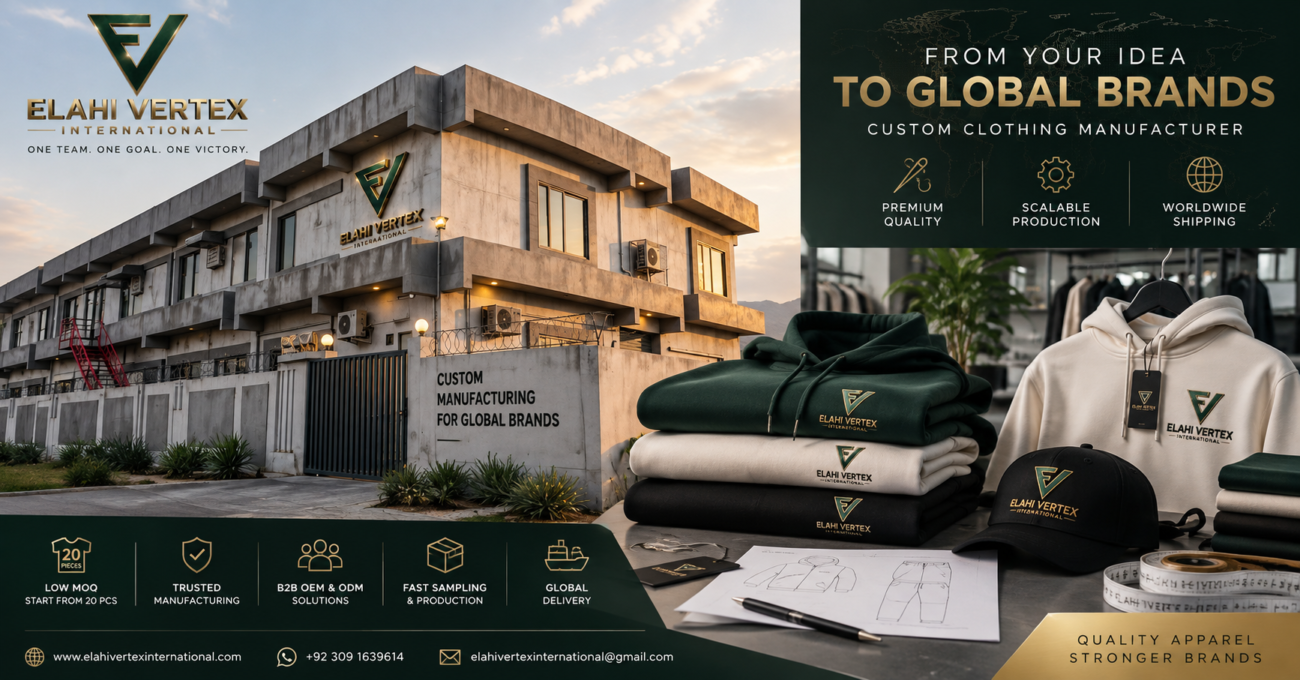
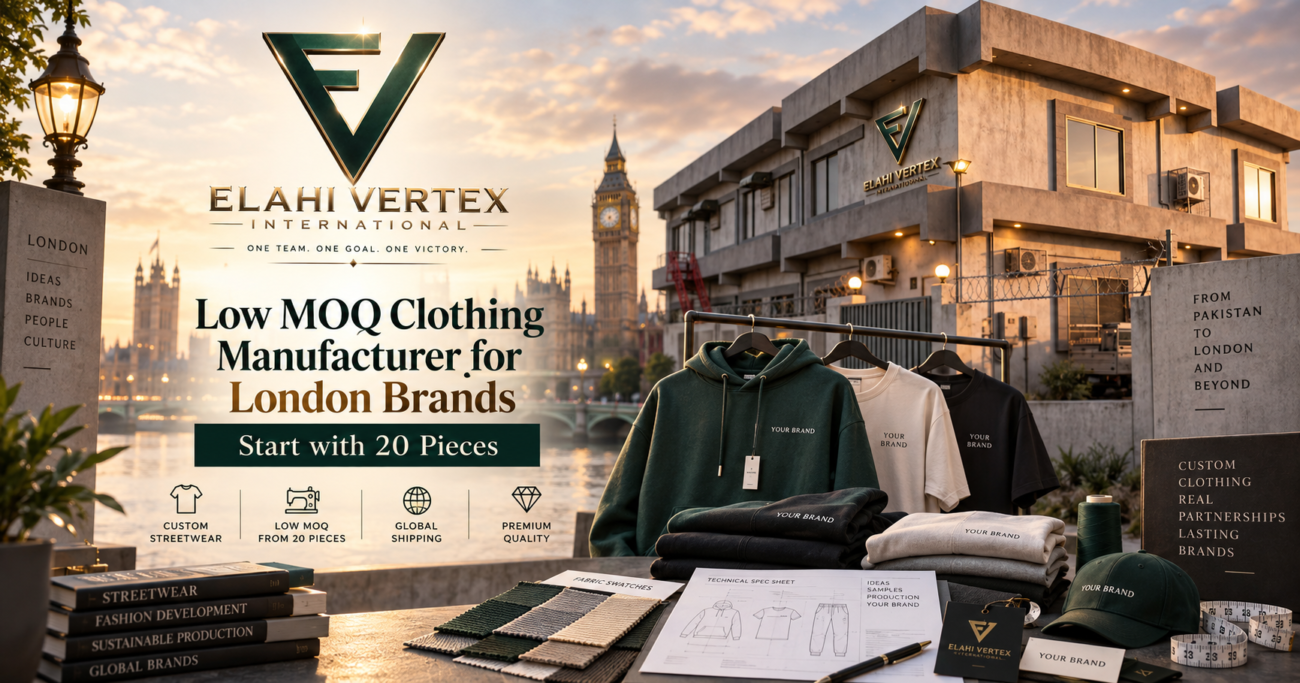
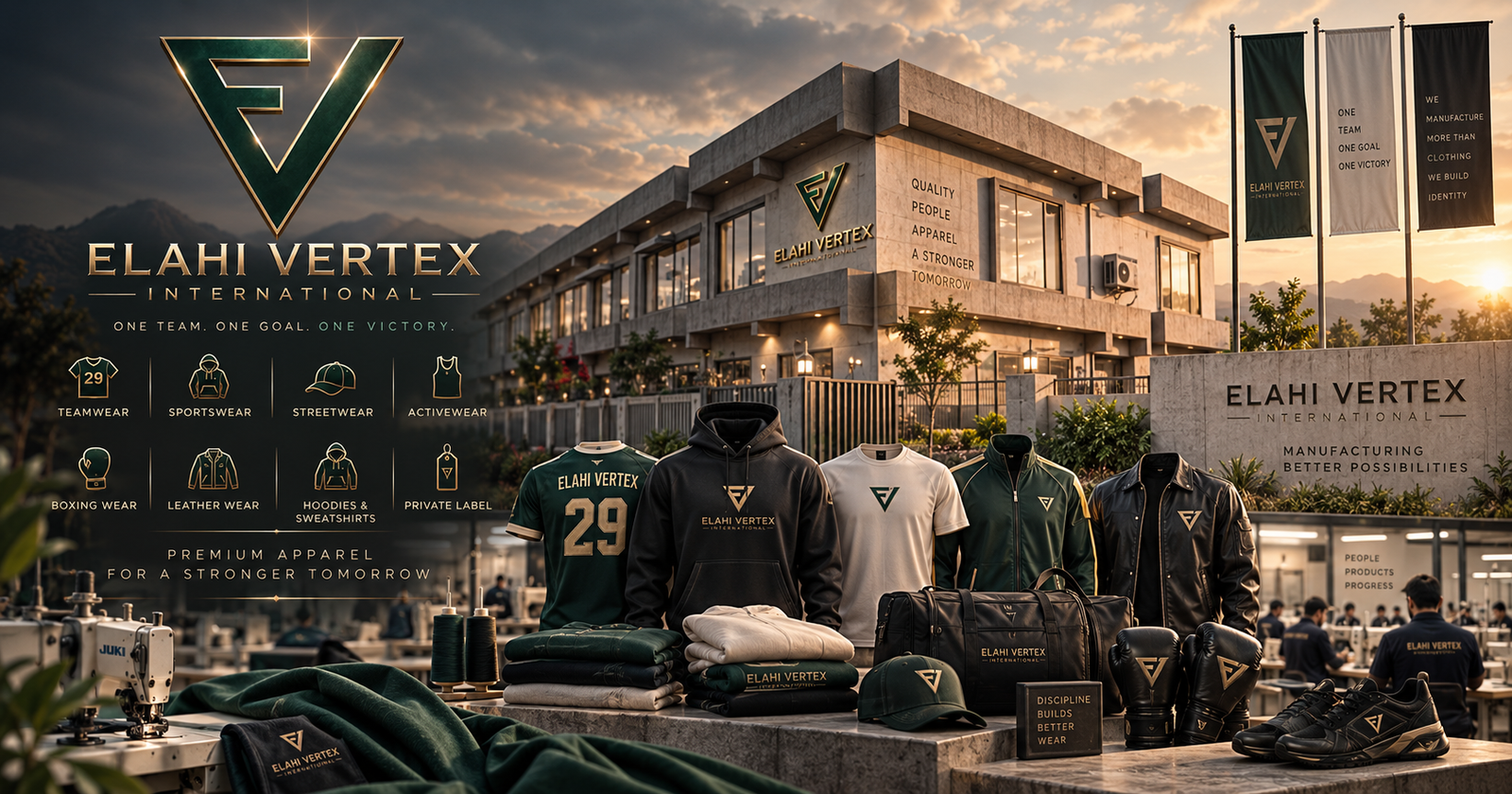
Elahi Vertex International positions its custom manufacturing around made-to-order apparel, OEM, ODM, private label, sampling, customization, quality control, packaging, and international shipping. Its current manufacturing inquiry page includes a 20-unit quantity option, while existing company content states a standard MOQ of 20 pieces per product/category.
The commercial principle is simple: start controlled, validate the product, learn from real customers, reorder intelligently, and scale what sells.
What Does a 20-Piece MOQ Mean?
MOQ means minimum order quantity: the smallest production quantity a manufacturer is prepared to accept under agreed conditions. A low MOQ clothing manufacturer is structured to accept smaller initial runs than factories focused primarily on large-volume production.
For a clothing brand, 20 pieces can create a realistic starting point for a focused product test. But a 20-piece MOQ should never be interpreted as unlimited flexibility. Twenty identical garments are operationally different from 20 garments divided across several fabrics, colorways, printing processes, labels, trims, and constructions.
Fabric sourcing, cutting setup, pattern work, printing, embroidery, labels, packaging, and machine changeovers can all affect whether a small order is workable. Current industry guides from manufacturers similarly identify fabric minimums, machine setup, and labor efficiency as reasons MOQs exist.
That is why brands should ask what the MOQ applies to: per style, per design, per color, per material, or per product category.
A responsible low MOQ clothing manufacturer should therefore evaluate the actual project, not just advertise a small number.
Why Inventory Risk Matters More Than the Lowest Unit Price
Many buyers begin supplier research by comparing price per piece. That is important, but it is incomplete.
Imagine one supplier quotes a lower unit price for 300 hoodies while another lets the brand start with 20 at a higher unit price. If the brand has no sales history for that hoodie, the cheaper unit rate may require a much larger total cash commitment. If demand is weak, the lower unit price does not protect the business from unsold stock.
A low MOQ clothing manufacturer changes the size of the first commercial bet.
| Factor | 20-Piece Test | 100+ Piece Initial Run |
|---|---|---|
| Initial cash commitment | Lower | Higher |
| Inventory exposure | Lower | Higher |
| Ability to test demand | Stronger | Weaker |
| Unit-cost efficiency | Usually weaker | Often stronger |
| Stockout risk if successful | Higher | Lower |
| Cost of a wrong forecast | Lower | Higher |
| Flexibility to revise the next run | Higher | Lower |
Shopify’s current MOQ guidance describes the same fundamental trade-off: low MOQs can require less upfront capital, need less storage, and reduce obsolete-stock exposure, but can also create higher unit costs, additional shipping or administration, and greater stockout risk.
The cheapest garment is not automatically the most profitable garment. A brand should compare total money committed, realistic sell-through, gross margin, shipping, storage, and the cost of remaining stock.
How a Low MOQ Clothing Manufacturer Protects Working Capital
Working capital is the money a business needs to operate. When too much of it is tied up in unsold inventory, the brand has less cash available for photography, ads, packaging, sampling, website improvements, product development, fulfillment, and the next collection.
Inventory also carries costs beyond the original purchase price. Storage, handling, insurance, depreciation, and the opportunity cost of capital tied up in stock can all affect the true financial burden of unsold products.
A low MOQ clothing manufacturer can reduce the amount of cash committed before the product proves itself.
This matters most when demand is uncertain. A first-time founder may know what product they want to launch but still have weak evidence about how quickly it will sell. Even established businesses face uncertainty when entering a new category, testing a new fit, or trying a new supplier.
Ordering less does not make the decision automatically good. It simply limits how much inventory sits behind an untested assumption.
Small-Batch Manufacturing Can Turn the First Order Into a Market Test
The first batch should answer questions.
Before production, define what you want to learn. Will customers buy the product at the planned retail price? Which sizes sell first? Does the oversized fit work? Does black outperform a seasonal color? Is embroidery worth its added cost? Do buyers ask for a restock?
A low MOQ clothing manufacturer becomes more valuable when the brand treats the first production run as structured market validation rather than simply “a small order.”
Track:
- Units sold
- Days or weeks required to sell
- Best-selling sizes
- Slowest sizes
- Best-performing colors
- Return reasons
- Fit complaints
- Quality comments
- Restock requests
- Gross margin
- Marketing spend needed to generate sales
- Actual landed cost
These numbers make the reorder more intelligent. If the product performs strongly, quantity can increase. If it performs weakly, the brand has learned without carrying a warehouse full of the same mistake.
20 Pieces vs 50 Pieces vs 100+ Pieces
A low MOQ clothing manufacturer does not mean 20 pieces is always the ideal quantity. The correct quantity depends on demand evidence, cash position, SKU count, launch strategy, and shipping economics.
| Order Size | Best Use | Main Advantage | Main Trade-Off |
|---|---|---|---|
| 20 pieces | New product, supplier trial, limited drop | Lowest initial exposure | Higher unit cost and faster stockouts |
| 50 pieces | Early demand signals | Better inventory depth | More capital committed |
| 100+ pieces | Proven seller | Better production economics may be possible | Higher overstock exposure |
| Larger bulk run | Predictable repeat demand | Scale and supply continuity | Highest forecasting consequence |
Current apparel MOQ guidance makes the same point: a lower MOQ can reduce initial cash exposure without automatically reducing overall risk, while higher quantities may improve production economics but increase the capital tied up in slow-moving inventory.
If a product repeatedly sells out, staying at 20 pieces may become inefficient. If a product has never been sold, jumping straight to several hundred pieces may be unnecessarily aggressive.
The stronger rule is:
Let quantity rise as confidence in demand rises.
The Hidden Risk Is Often SKU Complexity
A clothing brand can have a low total quantity and still create a bad inventory structure.
Suppose one launch contains three designs, four colors, and five sizes.
That creates:
3 designs × 4 colors × 5 sizes = 60 design-color-size combinations.
If the total production quantity is spread thinly across those combinations, the brand may learn very little because individual SKUs sell out too quickly or never have enough stock to reveal a useful pattern.
Apparel inventory becomes especially complicated because one style can multiply into many SKUs once size, color, and other variations are introduced. Shopify specifically identifies this variant complexity as a major clothing-inventory challenge.
A low MOQ clothing manufacturer gives flexibility, but flexibility still needs discipline.
For an early collection, fewer styles and fewer colorways can create cleaner information. The brand can see which sizes and colors customers actually prefer and then use those results to plan the next run.
The first collection does not need to prove how many products the brand can launch.
It should prove which products deserve to continue.
Why Low MOQ Does Not Automatically Mean Low Cost
A common mistake is expecting a low MOQ clothing manufacturer to combine the lowest possible quantity with the lowest possible unit price.
Manufacturing does not work that way.
Pattern preparation, fabric sourcing, cutting setup, embroidery digitizing, print preparation, sewing-line changes, labels, trims, packaging, administration, and quality control can create costs that must be recovered whether the run contains 20 pieces or 200.
When those costs are spread across fewer garments, the unit cost can be higher.
That is not automatically a problem. The buyer needs to compare the extra unit cost with the financial risk of carrying unwanted stock.
A slightly higher unit price can be commercially rational if it protects a much larger amount of working capital. But once demand becomes reliable, larger production may deliver better economics.
When a 20-Piece MOQ Makes Commercial Sense
A low MOQ clothing manufacturer is especially useful when uncertainty is still high.
A 20-piece starting point may be appropriate when:
- A startup is launching its first physical product
- A streetwear label is testing a limited drop
- A brand is trying a new oversized fit
- A gymwear business is developing a new set
- A sportswear brand is introducing a lifestyle product
- A company is evaluating a backup supplier
- A retailer is testing a private-label line
- A brand is trying a new colorway
- A founder has demand signals but limited sales history
- A business wants a small commercial run after sample approval
In these cases, a low MOQ clothing manufacturer can make the transition from sample to market more manageable.
The lower starting quantity should not be treated as the objective itself. The objective is to create enough real-world evidence to make the next inventory decision stronger.
When Low MOQ Is the Wrong Strategy
A low MOQ clothing manufacturer is not always the strongest choice.
Larger production can make more sense when a brand has repeat sales history, confirmed wholesale orders, reliable preorders, established retail distribution, or predictable size and color demand.
If a product sells hundreds of units consistently, repeatedly ordering 20 pieces may create stockouts, higher freight cost per garment, more administrative work, and missed revenue.
Low MOQ is a risk-management tool.
It is not a permanent rule.
The best production quantity should evolve with the evidence.
Shipping Can Change the Economics of a Small Order
A low MOQ clothing manufacturer can reduce inventory commitment, but international shipping can make very small orders less efficient per garment.
That is why buyers should evaluate landed cost rather than factory price alone.
Landed cost can include:
- Manufacturing
- Printing or embroidery
- Labels and trims
- Packaging
- International freight
- Import-related charges
- Local handling where applicable
A 20-piece order may still be the smarter commercial test, but buyers should understand what the full shipment costs before comparing it with larger alternatives.
Destination therefore matters. A manufacturer cannot evaluate shipping realistically without knowing where the goods are going.
What to Send Before Requesting a Quote
A low MOQ clothing manufacturer needs useful product information before a quotation can mean anything.
Prepare:
Product
- Garment type
- Design, sketch, reference image, or tech pack
- Intended fit
- Intended customer or use
Material
- Fabric composition if known
- GSM or weight preference
- Color requirements
- Performance requirements
Customization
- Printing
- Embroidery
- Patches
- Woven labels
- Care labels
- Hangtags
- Packaging
Commercial Details
- Quantity
- Size range
- Shipping destination
- Target delivery period
- Whether this is a test, launch, or repeat order
The current Elahi Vertex International manufacturing inquiry form requests product choice, design files, fabric, GSM, fit, printing technique, labels and branding, size range, and target quantity. That is the level of detail buyers should expect to discuss before production.
Clear information improves the commercial discussion.
“Price for 20 hoodies?” is not a complete manufacturing brief.
Sampling Still Matters With a 20-Piece Order
A low MOQ clothing manufacturer reduces quantity exposure. Sampling addresses a different risk: specification failure.
If the fit is wrong, the fabric feels wrong, measurements are incorrect, or artwork placement is poor, producing only 20 pieces does not make the problem acceptable.
Sampling can help check:
- Fabric
- GSM
- Fit
- Measurements
- Construction
- Stitching
- Color
- Printing
- Embroidery
- Labels
- Trims
- Overall appearance
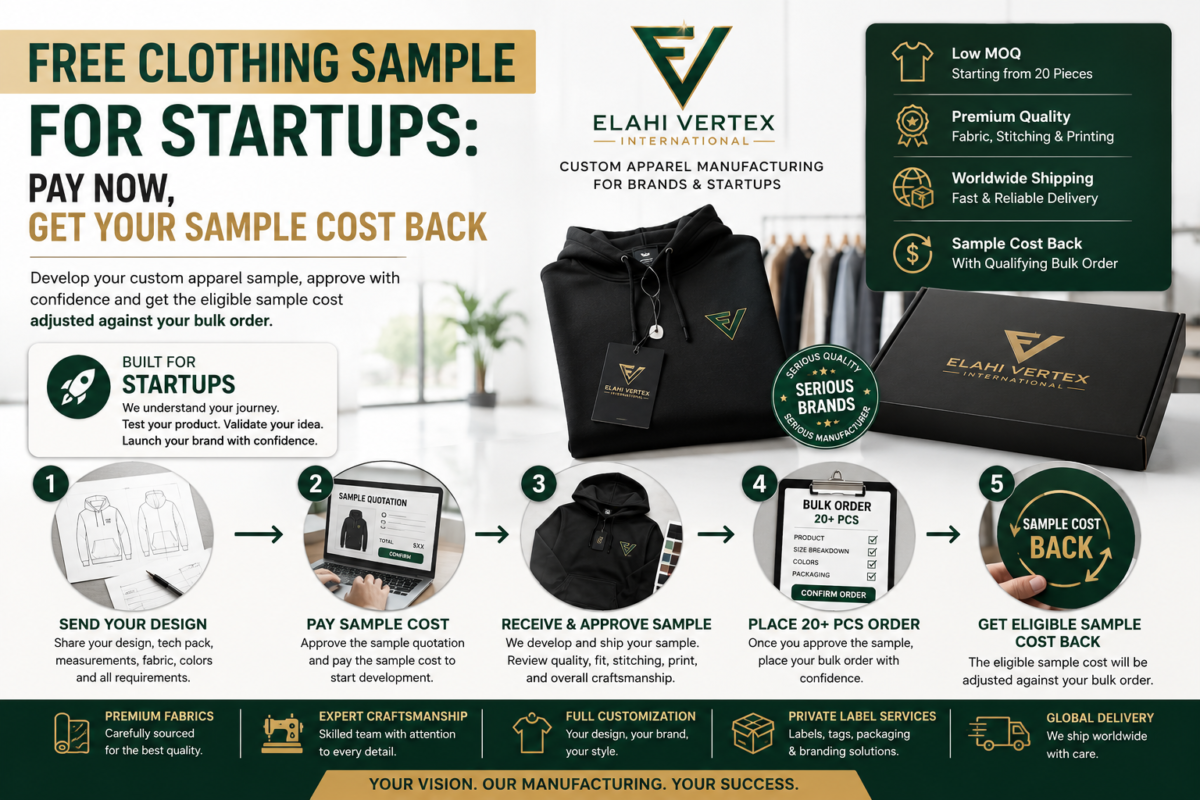
Elahi Vertex International’s current manufacturing information states that samples or prototypes can be developed before bulk production so buyers can review fit, materials, construction, printing, embroidery, branding, and finishing.
The two tools work together:
Sampling reduces product-specification risk.
Low MOQ reduces inventory exposure.
Why Elahi Vertex International’s 20-Piece Starting Point Matters
For buyers comparing a low MOQ clothing manufacturer, the commercial value of Elahi Vertex International’s 20-piece starting point is straightforward: it gives brands a way to discuss genuine custom production without automatically beginning at a large quantity.
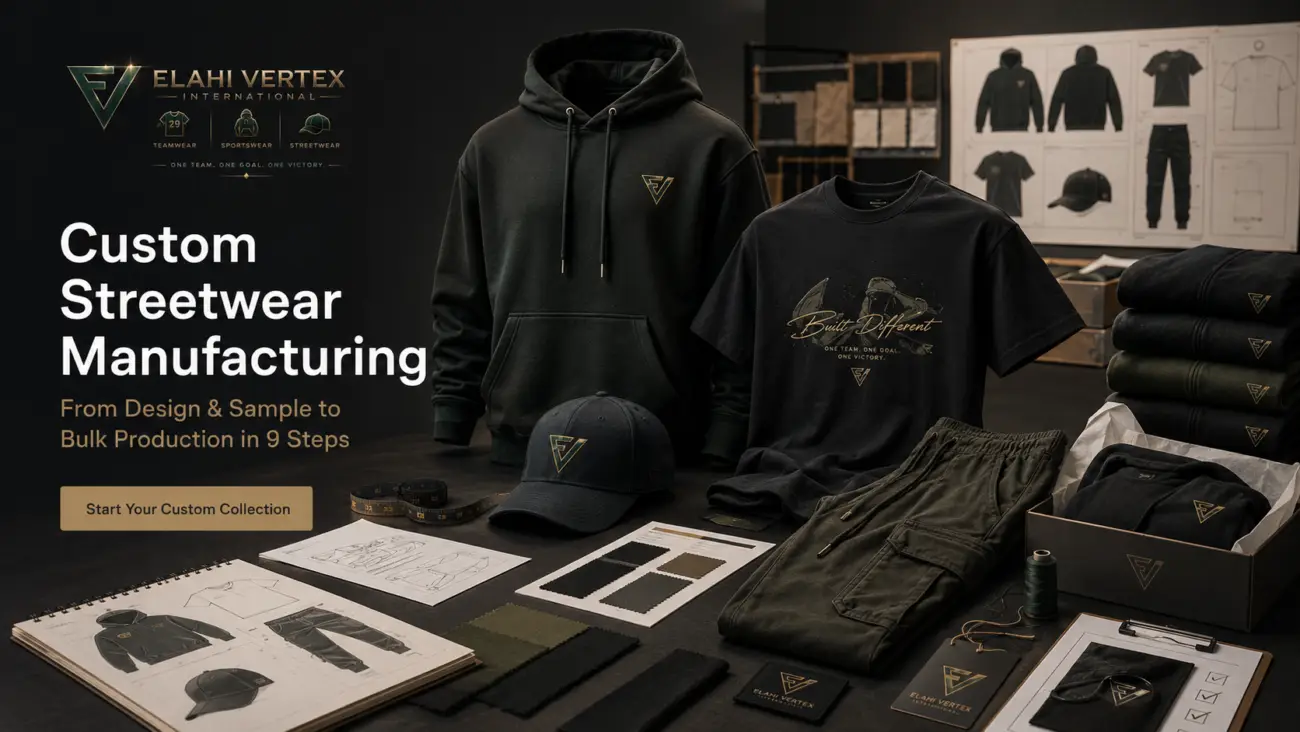
The current website describes custom clothing manufacturing for sportswear, teamwear, streetwear, activewear, boxing wear, leather wear, hoodies and sweatshirts, and private-label clothing.
The manufacturing page also describes OEM, ODM, private-label production, cut-and-sew manufacturing, sampling, quality control, packaging, and worldwide shipping.
Its dedicated private-label page covers custom products, custom labels, branding, and packaging, while its OEM page describes production around buyer-supplied designs and specifications.
That means the 20-piece angle should not be viewed as an isolated promotional number.
It belongs inside a broader production workflow:
Design → specifications → sample → approval → controlled production → market feedback → reorder → scale
Brands can also review Elahi Vertex International’s custom clothing manufacturing, OEM clothing manufacturing, private-label manufacturing, and how-to-order resources before sending project details.
How to Scale From 20 Pieces to Repeat Production
The best use of a low MOQ clothing manufacturer is not staying at the minimum forever.
It is creating a measured path toward larger, better-informed orders.
Step 1: Define the Product
Finalize the garment type, fabric, GSM, fit, color, size range, artwork, labels, trims, and packaging.
Step 2: Validate the Physical Product
Use the appropriate sample or prototype process before approving bulk production.
Step 3: Launch the Controlled Batch
Sell the first production run through the actual channel you plan to use: website, social commerce, retail, wholesale, team sales, or another route.
Step 4: Measure Demand
Track sell-through, size movement, color performance, returns, customer feedback, and restock requests.
Step 5: Diagnose the Result
Do not treat a slow launch as proof that the product is bad.
Separate product problems from:
- Pricing problems
- Marketing problems
- Timing
- Audience mismatch
- Sales-channel problems
- Weak product presentation
Step 6: Improve the Reorder
Adjust size ratios, quantities, color depth, specifications, or product details using actual evidence.
Step 7: Increase Quantity When the Evidence Supports It
When demand becomes predictable, larger runs may reduce stockout risk and improve production economics.
This is how a low MOQ clothing manufacturer can support growth rather than merely small orders.
A low MOQ clothing manufacturer should be judged on reorder continuity. A first batch has limited value if the brand cannot reproduce a product. Ask how specifications, measurements, artwork, materials, and color references are documented. The right low MOQ clothing manufacturer should make the production decision clear instead of restarting development from zero.
Common Mistakes Brands Make With Low-MOQ Production
Choosing the Manufacturer Only Because the MOQ Is Low
A tiny MOQ does not prove quality, communication, product capability, reliability, or commercial fit.
Spreading the Order Across Too Many Variations
Low total quantity can become useless if it is fragmented across too many styles, colors, and sizes.
Ignoring Freight
Small-batch international shipping can materially affect landed cost.
Skipping Sample Validation
Low quantity is not a substitute for confirming fabric, fit, measurements, construction, and branding.
Comparing Unit Price Without Total Cash Exposure
The cheaper unit can still create the more expensive mistake if the brand buys far more inventory than it can sell.
Scaling Too Aggressively After One Sellout
Twenty sold units are useful evidence, but they do not automatically prove demand for thousands.
Refusing to Scale After Demand Is Proven
The opposite mistake is staying with very small runs even when sales repeatedly justify more inventory.
A low MOQ clothing manufacturer should support disciplined scaling, not permanent hesitation.
20 Practical Questions to Ask a Low MOQ Clothing Manufacturer
Before selecting a supplier, use these questions to compare the real offer rather than the headline MOQ.
- What exactly does your MOQ apply to: style, design, color, material, or category?
- Can sizes be mixed within the minimum quantity?
- Which fabrics are realistic at the minimum quantity?
- Are there separate minimums for custom-dyed fabric?
- Do labels or packaging have separate supplier minimums?
- How is sample development handled?
- What must be approved before bulk production?
- How are measurements and tolerances confirmed?
- Which printing and embroidery methods are available at small quantities?
- What information is required for an accurate quotation?
- How does unit price change at higher quantities?
- What packaging is included and what is optional?
- How is quality checked before shipment?
- Can the supplier reproduce the same fabric and color on a reorder?
- How are changes handled after sample approval?
- What is the expected production window for the specific project?
- Which shipping options are available to the destination?
- Which costs are included in the quotation and which are separate?
- Can the factory scale the same style if demand increases?
- What documentation should the buyer keep for consistent reorders?
A low MOQ clothing manufacturer should be able to answer these questions clearly enough for a buyer to compare suppliers on more than price.
Frequently Asked Questions
1. What is a low MOQ clothing manufacturer?
A low MOQ clothing manufacturer accepts relatively small minimum production quantities compared with suppliers primarily built around large-volume runs.
2. Is 20 pieces a low MOQ?
For custom B2B apparel, 20 pieces is a small starting quantity. Exact conditions still depend on the supplier, garment, material, customization, and how the minimum is structured.
3. Why do startups look for a low MOQ clothing manufacturer?
Startups often need to validate demand while protecting limited working capital. Smaller initial runs reduce the number of units exposed if demand is weaker than expected.
4. Does low MOQ guarantee lower risk?
No. It reduces inventory exposure but cannot eliminate product, quality, pricing, marketing, freight, or demand risk.
5. Is low MOQ cheaper?
Not necessarily. Smaller orders can have higher unit costs because setup and production costs are spread across fewer garments.
6. Can established brands use small-batch manufacturing?
Yes. Established brands can use small runs for new styles, new colors, seasonal drops, supplier trials, or experimental categories.
7. Should I order a sample before production?
For custom garments, a sample can help verify important specifications before those details are repeated across the production order.
8. Can 20 pieces be divided across unlimited colors and designs?
Do not assume so. The answer depends on the manufacturer’s MOQ structure and the materials, decoration, trims, and production setup required.
9. What should I send for a quotation?
Send the product type, reference or tech pack, fabric, GSM if known, colors, size range, branding, customization, quantity, destination, and target delivery period.
10. Can a low MOQ clothing manufacturer produce private-label clothing?
Some can. Elahi Vertex International currently lists private-label manufacturing with custom designs, labels, branding, packaging, and production support.
11. Can a low MOQ clothing manufacturer help test a new streetwear drop?
Yes, provided the proposed product and customization are feasible at the quantity offered.
12. Does low MOQ reduce dead stock?
It can reduce the amount of stock exposed if a product performs poorly, but it cannot guarantee that every garment will sell.
13. What is the biggest disadvantage of low MOQ?
Common trade-offs include higher unit cost, less efficient shipping, smaller stock depth, and faster stockouts if a product performs well.
14. When should a brand increase order quantity?
Increase quantity when repeat sales, wholesale demand, preorders, historical data, or other strong evidence supports a larger inventory commitment.
15. Is the lowest MOQ always the best supplier offer?
No. Buyers should also compare product capability, sampling, quality control, communication, pricing, shipping, consistency, and scalability.
16. How does SKU count affect a small order?
More designs, colors, and sizes divide inventory into more combinations. This can weaken stock depth and make demand data harder to interpret.
17. Why does shipping matter more on a small order?
Freight costs can represent a larger amount per garment when the shipment contains fewer units.
18. Can a brand use low MOQ to test a new supplier?
Yes. A controlled commercial run can help a buyer evaluate communication, specification accuracy, quality, packaging, and delivery before considering larger production.
19. What is Elahi Vertex International’s published low-MOQ position?
The company’s existing content states a standard MOQ of 20 pieces per product/category, and its current manufacturing inquiry form includes 20 units among the selectable quantity targets.
20. What is the best first step before contacting a low MOQ clothing manufacturer?
Prepare a clear product brief. The stronger your specifications, the easier it is for the manufacturer to evaluate feasibility and quote meaningfully.
Useful External Resources
- Shopify — Minimum Order Quantity Guide: Low-MOQ benefits, stockout risks, carrying costs, and purchasing trade-offs.
- Shopify — Inventory Carrying Costs: Storage, handling, insurance, depreciation, and tied-up capital.
- Shopify — Clothing Inventory Management: Apparel SKU complexity, sizes, colors, forecasting, and dead stock.
- Kaple Apparel — Apparel MOQ Guide: Balancing quantity, margin, inventory depth, and demand.
- Wearlets — Low-MOQ Startup Guide: How a low MOQ clothing manufacturer structures small-batch startup production.
- CTC Jaipur — What Low MOQ Means: Why supplier minimums differ by business model.
- Ready One — Clothing Manufacturer for Startups: A competing 50-unit startup manufacturing model today.
Conclusion: Start Controlled, Learn Quickly, Scale With Evidence
The real purpose of a low MOQ clothing manufacturer is not simply to let a brand order fewer garments. It is to reduce the size of the initial inventory commitment while the business is still learning.
Small-batch manufacturing can help a brand preserve working capital, validate products with real customers, identify strong sizes and colors, reduce dead-stock exposure, test a new supplier, and build evidence for the next order.
But low MOQ has trade-offs. Unit cost may be higher. Freight may be less efficient. Stockouts can happen faster. Once demand becomes predictable, larger production can become the stronger commercial decision.
For Elahi Vertex International, the 20-piece starting point creates a practical bridge between product development and larger repeat production. Buyers should still confirm the exact product, fabric, branding, size range, quantity, destination, and commercial requirements before ordering.
The strongest production strategy is therefore not “always order small.”
It is:
Start with the quantity your evidence can justify, validate the result, improve the next order, and scale only when the market proves you should.
If you are ready to test a product, send Elahi Vertex International your design, specifications, quantity, and destination to discuss whether low MOQ clothing manufacturer production fits your project.
Ready to Start With 20 Pieces Instead of Overcommitting to Inventory?
If you are launching a new clothing brand, testing a new design, developing a streetwear drop, or looking for a low MOQ clothing manufacturer, you do not need to begin with hundreds of pieces before demand is proven.
Start with a controlled 20-piece MOQ through Elahi Vertex International and build your production around real specifications, real customer demand, and a clear path to repeat orders.
Send us your:
- Product design, reference image, sketch, or tech pack
- Fabric and GSM requirements
- Size range and fit
- Printing, embroidery, labels, and branding requirements
- Required quantity
- Shipping destination
- Target delivery timeline
We can review the project requirements and determine the appropriate next step for sampling, quotation, and custom production.
Do not tie unnecessary cash into untested inventory. Start controlled, prove the product, and scale what sells.
WhatsApp: https://wa.me/message/OWIPAIXYWHTPI1
Email: elahivertexinternational@gmail.com
Website: https://www.elahivertexinternational.com/
Alibaba: https://elahivertexinternational.trustpass.alibaba.com/
Elahi Vertex International — Custom B2B Manufacturing | OEM | ODM | Private Label | Export