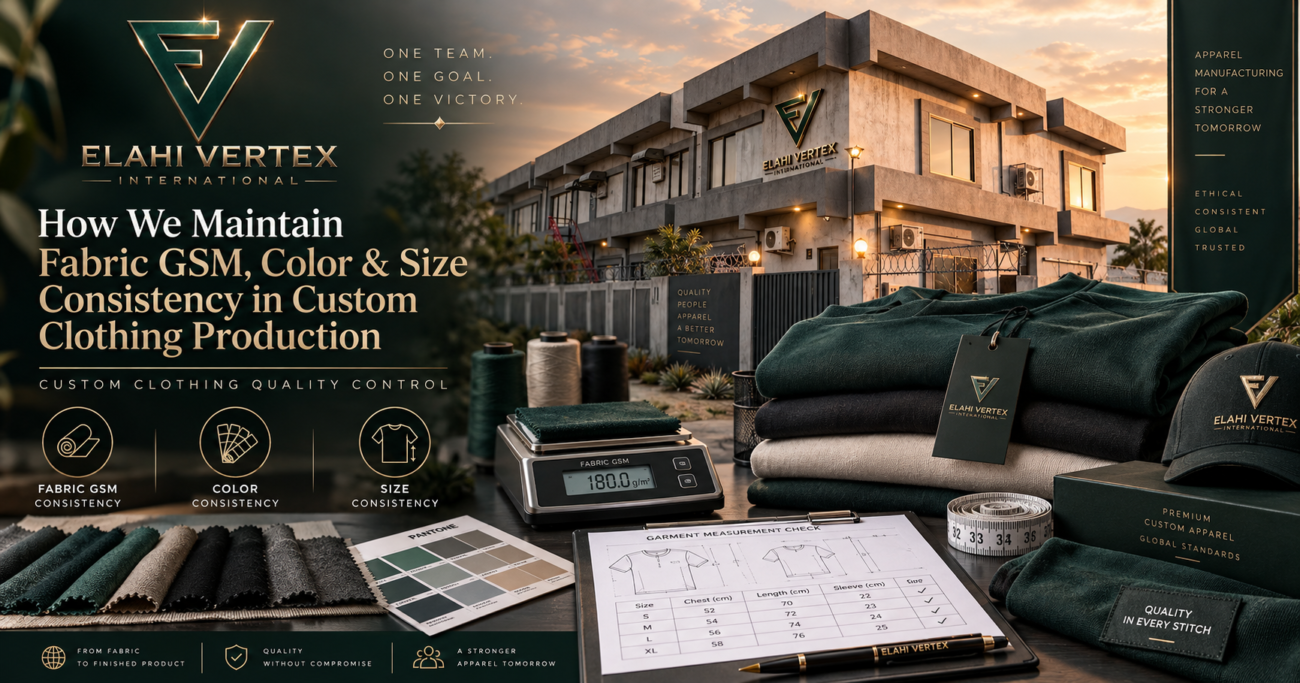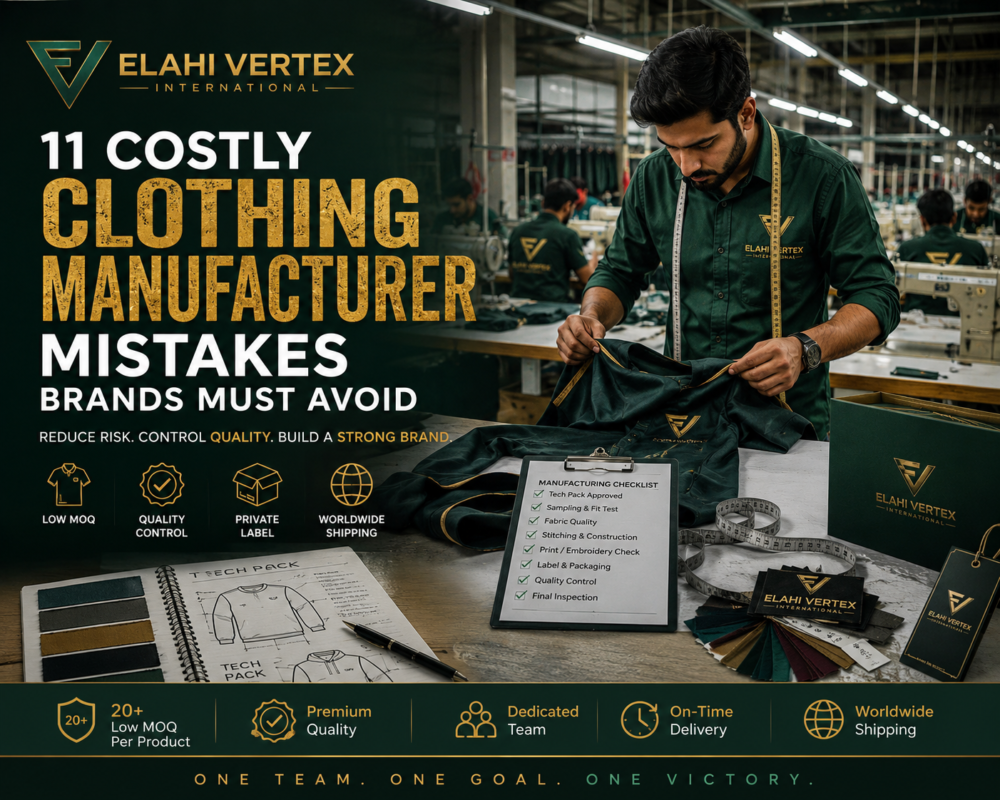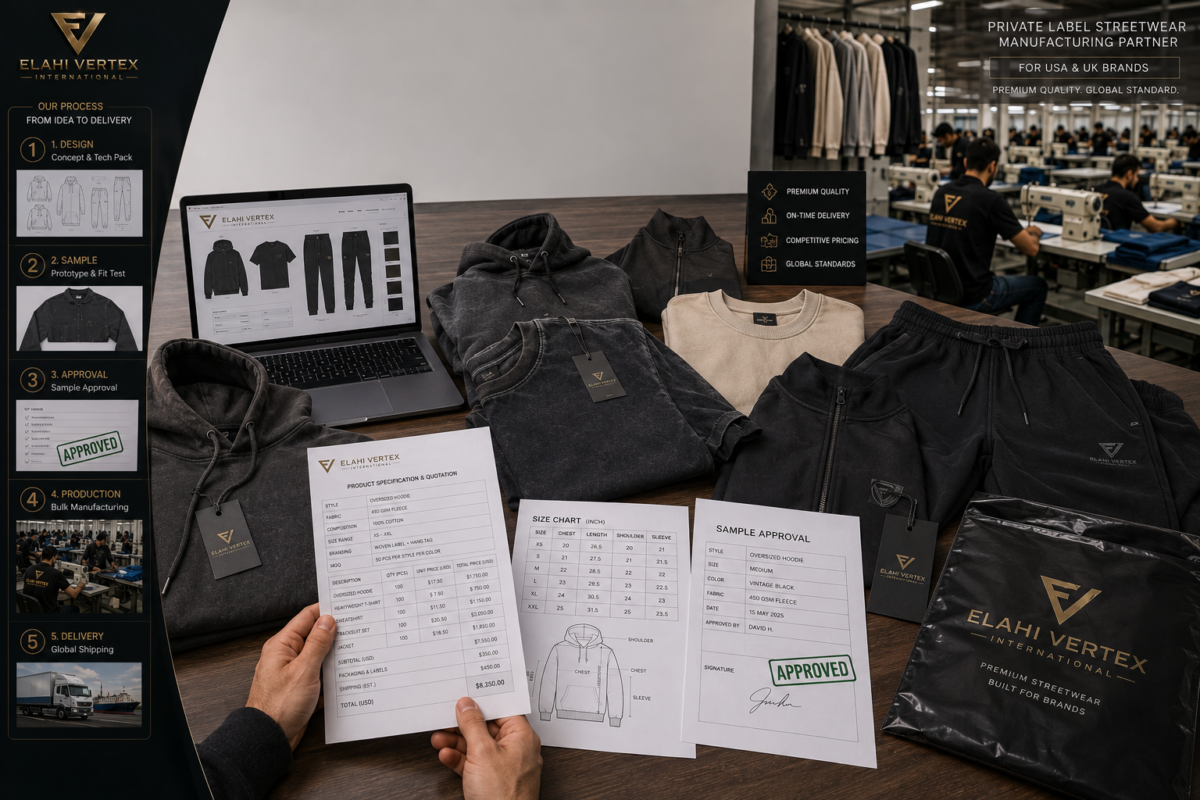

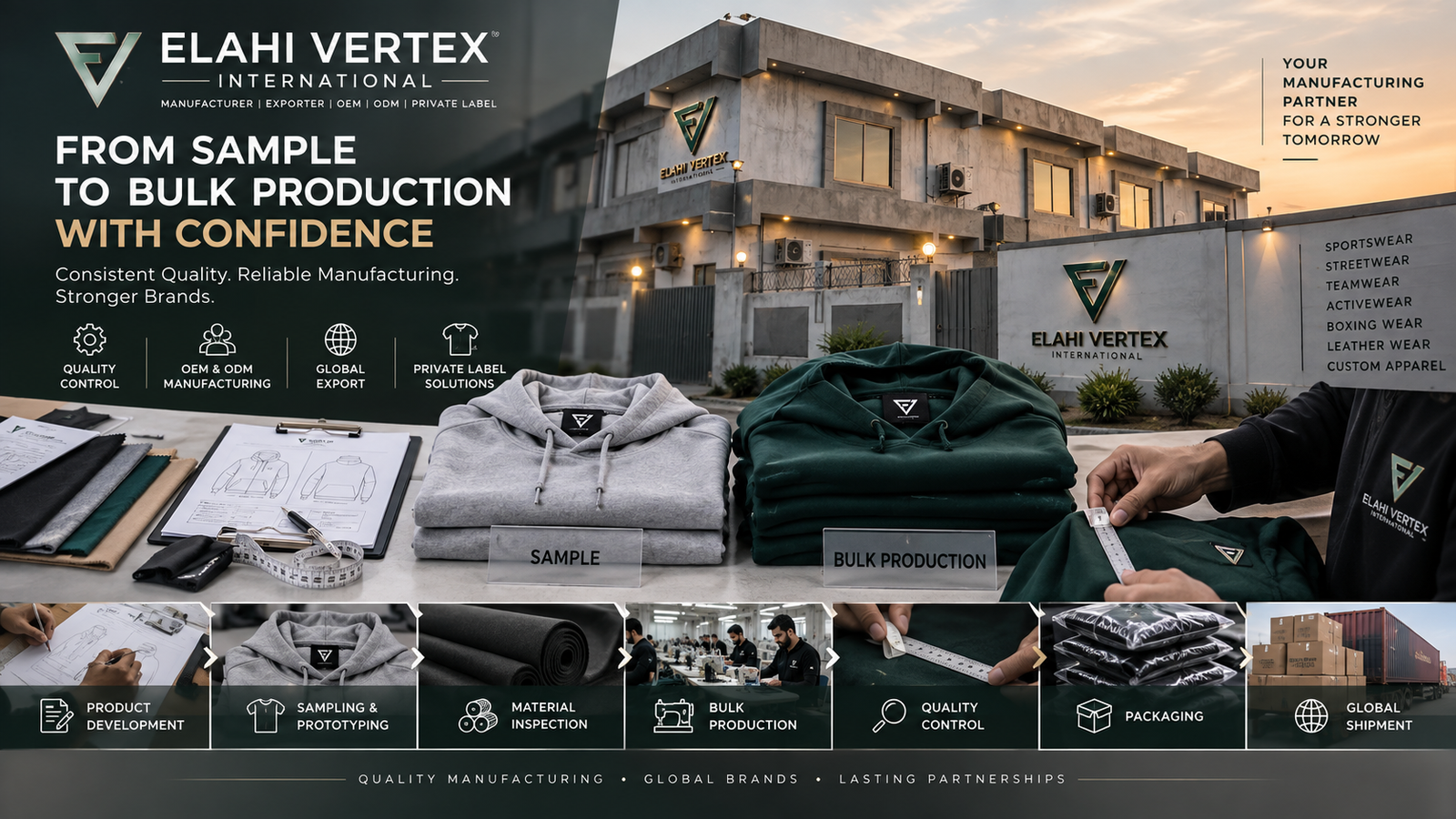
A strong sample does not automatically guarantee a strong bulk order.
For clothing brands, streetwear labels, sportswear companies, teams, wholesalers and private-label businesses, the real manufacturing challenge is maintaining the approved product requirements when one sample becomes 20, 100, 500 or more finished garments.
That is why clothing manufacturer quality control should not begin when finished garments reach the packing table. Effective quality control starts with specifications and sampling, continues through bulk production, and finishes with inspection before packaging and shipment.
At Elahi Vertex International, the stated quality objective is to keep bulk production aligned as closely as possible with the approved sample and agreed specifications. The quality-focused process covers relevant areas such as fabric and materials, measurements, stitching, garment construction, printing, embroidery, colors, labels, branding, finishing and final appearance.
For a buyer, this matters for one simple reason: the approved sample should become a production reference rather than an isolated garment that looks better than the eventual bulk order.
This guide explains how the sample-to-bulk quality process works, what buyers should approve before production, what can go wrong, and what information should be controlled to reduce manufacturing risk.
Table of Contents
- What is clothing manufacturer quality control?
- Why sample-to-bulk consistency matters
- Stage 1: Define the product specifications
- Stage 2: Develop and review the sample
- Stage 3: Freeze approved requirements
- Stage 4: Verify materials before bulk production
- Stage 5: Control quality during production
- Stage 6: Check measurements, construction and customization
- Stage 7: Final inspection before packaging
- Sample approval vs final quality control
- Common quality-control mistakes buyers should avoid
- Buyer QC checklist
- Why work with Elahi Vertex International?
- Frequently asked questions
- Conclusion
What Is Clothing Manufacturer Quality Control?
Clothing manufacturer quality control is the process of checking whether apparel is being produced according to the approved product specifications, sample and agreed manufacturing requirements.
Depending on the garment, those requirements can involve:
- Fabric or material
- Fabric GSM where specified
- Color
- Measurements
- Fit
- Pattern and construction
- Stitching
- Printing
- Embroidery
- Logos
- Labels
- Branding
- Trims
- Finishing
- Packaging
- Final appearance
The important point is that clothing manufacturer quality control is a process, not merely one final inspection.
Finding a problem before or during production can be much easier than discovering the same problem after an entire bulk quantity has been completed.
For buyers evaluating a clothing manufacturer, the better question is therefore not simply:
“Do you check quality?”
Ask instead:
“What is approved before bulk production, what is checked during production, and what is inspected before shipment?”
That question reveals much more about how a supplier approaches quality.
Why Sample-to-Bulk Consistency Matters
A sample gives the buyer an opportunity to physically evaluate the intended garment before bulk manufacturing.
But the commercial value of sampling depends on what happens next.
Consider a buyer who approves an oversized hoodie because it has:
- The expected fabric
- Correct body width
- Correct length
- Desired oversized silhouette
- Correct logo dimensions
- Correct embroidery position
- Approved labels
- Suitable finishing
If the bulk garments later use different specifications, the original sample has failed as a production reference.
The same problem can affect sportswear.
A jersey may have the correct dimensions, fabric, sublimated artwork and logo positioning at sampling stage but become commercially problematic if the bulk run changes those details.
This is why sample-to-bulk consistency should be a central objective of clothing manufacturer quality control.
[IMAGE 2 — PLACE AFTER H2: WHY SAMPLE-TO-BULK CONSISTENCY MATTERS]
What Can Change Between Sample and Bulk?
Potential variables include:
| Quality Area | Sample Stage | Bulk Production Risk |
|---|---|---|
| Fabric | Material approved | Different material or specification |
| GSM | Target weight established where applicable | Unwanted weight variation |
| Color | Appearance reviewed | Shade variation |
| Measurements | Sample measured | Size deviation |
| Fit | Silhouette reviewed | Pattern or construction inconsistency |
| Stitching | Construction examined | Uneven workmanship |
| Printing | Artwork reviewed | Placement or finish variation |
| Embroidery | Logo reviewed | Position or appearance variation |
| Labels | Branding approved | Incorrect placement/details |
| Finishing | Sample reviewed | Inconsistent final appearance |
The objective is not to pretend that textile manufacturing has zero variation. The objective is to define the important requirements, establish what has been approved, and control production against those requirements.
1. Clothing Manufacturer Quality Control Starts With Specifications
A factory cannot reliably reproduce requirements that were never clearly defined.
Before sampling or production, buyers should provide as much relevant information as possible.
Depending on the project, this may include:
Product
Specify exactly what is being manufactured:
- Hoodie
- Oversized T-shirt
- Sweatshirt
- Tracksuit
- Jogger
- Sports jersey
- Team uniform
- Activewear
- Boxing apparel
- Leather garment
- Other custom apparel
Fabric or Material
Where applicable, establish:
- Material type
- Composition
- GSM
- Texture
- Stretch requirements
- Finish
- Color
Measurements
A size chart can include relevant measurements such as:
- Chest
- Body length
- Shoulder
- Sleeve length
- Waist
- Hip
- Inseam
- Outseam
The required points depend on the garment.
Customization
Define:
- Logo
- Artwork
- Printing method
- Embroidery
- Placement
- Dimensions
- Labels
- Hangtags
- Other branding requirements
Packaging
If packaging is important to the finished order, confirm it before production rather than assuming the manufacturer knows the buyer’s preferred presentation.
A detailed specification creates a stronger reference for clothing manufacturer quality control because both sides know what is being evaluated.
Buyer Tip
Do not send only a product photograph and assume every hidden specification is obvious.
A reference image communicates appearance. It does not automatically communicate exact fabric composition, GSM, measurements, tolerances, internal construction, label specifications or packaging.
2. Sample Development Creates the Physical Reference
Sampling is one of the most important risk-control stages in custom clothing manufacturing.
Elahi Vertex International’s published sampling process allows a buyer to review areas including:
- Fit
- Measurements
- Fabric
- Colors
- Construction
- Printing
- Embroidery
- Labels
- Branding
- Finishing
After development, the buyer can review the sample and request relevant adjustments before approval.
That creates a much stronger foundation for bulk production than manufacturing a full order directly from assumptions.
What Should a Buyer Check on a Clothing Sample?
Do not approve a sample simply because it “looks good.”
Review it systematically.
Fabric
Does the fabric correspond with the agreed specification?
Fit
Does the garment create the intended silhouette?
Measurements
Compare the physical garment against the approved size measurements.
Construction
Check how the garment has been assembled.
Stitching
Look at seam appearance, consistency and workmanship.
Printing
Review artwork size, placement and visual finish.
Embroidery
Review dimensions, positioning and appearance.
Branding
Check neck labels, size labels, logos and other approved branding.
Finishing
Look at the garment as a finished retail product rather than only as a manufacturing sample.
[IMAGE 3 — PLACE AFTER SAMPLE CHECKLIST]
Do Not Approve What You Have Not Checked
A rushed “looks fine” approval creates ambiguity.
A better approval identifies the details that are accepted and records any changes still required.
The sample should help answer:
What exactly is the bulk manufacturer expected to reproduce?
3. Freeze Approved Requirements Before Bulk Production
This is the bridge between sampling and manufacturing.
After the buyer approves the sample and specifications, the finalized requirements become the reference for bulk production at Elahi Vertex International.
That is commercially important.
Imagine this sequence:
Sample 1 → buyer requests changes → Sample 2/revision → buyer approves → bulk production begins.
The production reference should be the final approved version, not an earlier rejected version.
A practical approval record can identify:
- Approved product
- Approved fabric/material specification
- Approved GSM where applicable
- Approved color
- Approved measurements
- Approved artwork
- Approved print/embroidery details
- Approved labels
- Approved trims
- Approved packaging requirements
- Final revision notes
This reduces one of the most common causes of manufacturing disputes: buyer and supplier working from different versions of the product requirements.
One Small Change Can Affect Multiple Areas
Suppose a buyer changes fabric after approving the first sample.
That can potentially influence:
- Drape
- Feel
- Stretch
- Structure
- Printing behavior
- Garment appearance
- Fit perception
The change therefore should not be treated as an isolated detail.
Clothing manufacturer quality control works best when the production reference is clear and changes are controlled.
4. Material and Fabric Verification Before Bulk Production
Fabric is fundamental to apparel quality.
Elahi Vertex International’s published quality-control information includes fabric and material inspection as part of its quality-focused process.
Important requirements can vary by project but may include:
- Material
- Composition
- Weight/GSM
- Color
- Texture
- Stretch
- Surface appearance
- Intended use
A buyer should specify which factors are critical to the product.
Why GSM Matters
GSM means grams per square metre and is commonly used to describe fabric weight.
It should not be treated as a complete definition of fabric quality.
Two fabrics with similar GSM can still differ because of:
- Fiber composition
- Knit or weave
- Yarn
- Construction
- Finish
- Stretch
- Hand feel
This is why specifying only “300 GSM” is less informative than defining the complete fabric requirement.
Why Color Requires Attention
Textile color can be influenced by material and production processes, while screens and cameras can also represent colors differently.
For color-sensitive projects, buyers should communicate the intended color reference clearly and confirm how approval will be handled for the specific project.
Do not rely entirely on a phone photograph for critical color decisions.
5. Quality Control Continues During Bulk Production
One of the weakest manufacturing approaches is:
Produce everything first → inspect everything later → discover the problem after the cost has already been incurred.
A better manufacturing principle is to incorporate checks throughout production.
Elahi Vertex International states that quality checks are incorporated during production to help maintain consistency in:
- Materials
- Measurements
- Stitching
- Construction
- Printing
- Finishing
- Final appearance
This is where clothing manufacturer quality control becomes preventive rather than purely reactive.
Why In-Process Checking Matters
Suppose logo positioning begins drifting from the approved requirement.
Identifying the issue while manufacturing is underway creates an opportunity to address it earlier.
If the issue is discovered only after the complete order is finished, the potential rework becomes much larger.
The same principle applies to:
- Measurements
- Stitching
- Print placement
- Embroidery
- Labels
- Garment construction
- Finishing
[INFOGRAPHIC — PLACE AFTER THIS SECTION: SAMPLE → APPROVAL → BULK → IN-PROCESS QC → FINAL QC → PACKAGING]
6. Measurement and Size Consistency
Sizing is one of the areas buyers should define carefully.
“Medium” is not a universal garment measurement.
A brand’s M can be deliberately oversized, athletic, relaxed, fitted or based on its own grading system.
That means a manufacturer needs the buyer’s actual requirements rather than assumptions based solely on size labels.
Better Size-Control Process
Step 1: Define the base measurements.
Step 2: Confirm the intended fit.
Step 3: Review the sample.
Step 4: Approve relevant measurements.
Step 5: Use finalized specifications as the bulk reference.
Step 6: Include measurement checks in quality control.
Size Chart Example
| Measurement Point | S | M | L | XL |
|---|---|---|---|---|
| Chest | Buyer specification | Buyer specification | Buyer specification | Buyer specification |
| Body Length | Buyer specification | Buyer specification | Buyer specification | Buyer specification |
| Shoulder | Buyer specification | Buyer specification | Buyer specification | Buyer specification |
| Sleeve | Buyer specification | Buyer specification | Buyer specification | Buyer specification |
Actual measurements should be confirmed for the specific product.
Never copy a generic internet size chart into production and assume it represents your customers.
7. Stitching and Garment Construction Checks
Good fabric cannot compensate for poor garment construction.
Depending on the product, construction checks may consider:
- Seam appearance
- Stitching consistency
- Alignment
- Joining
- Reinforcement where specified
- Collar construction
- Cuffs
- Waistbands
- Pocket placement
- Zippers
- Drawcords
- Other product-specific details
Elahi Vertex International identifies stitching and garment construction among its published quality checks.
For buyers, this means construction should be part of the approved product requirements—not something evaluated only after delivery.
Product-Specific QC Matters
A heavyweight streetwear hoodie does not require exactly the same quality considerations as:
- Sublimated teamwear
- Compression activewear
- Boxing shorts
- Leather jackets
The QC plan should reflect the product.
That is an important distinction when evaluating any clothing manufacturer quality control process.
8. Printing, Embroidery, Labels and Branding
A garment can be technically well constructed and still be unusable if the branding is wrong.
Quality control should therefore include the customized elements buyers actually sell to their customers.
Elahi Vertex International’s published QC scope includes printing, embroidery, labels and branding.
Printing Checks Can Include
- Correct artwork
- Placement
- Dimensions
- Alignment
- Appearance
- Product-specific finish
Embroidery Checks Can Include
- Correct logo/artwork
- Position
- Dimensions
- Alignment
- Visual appearance
Branding Checks Can Include
- Main labels
- Size labels
- Care/other labels where required
- Logo placement
- Hangtags where specified
- Packaging branding where specified
A 2 cm positioning error can matter greatly when the element is a prominent chest logo.
The manufacturer and buyer should therefore agree on critical branding requirements before bulk production.
9. Final Quality Control Before Packaging and Shipment
Final inspection is another quality gate, not the beginning of the quality system.
Elahi Vertex International states that finished products undergo checks intended to help ensure consistency in:
- Construction
- Measurements
- Appearance
- Finishing
- Overall workmanship
After final inspection, orders are prepared for packaging according to agreed requirements and then prepared for international shipment.
What Is the Purpose of Final Inspection?
The final stage asks:
Does the completed product correspond with the approved requirements closely enough to proceed to packaging and shipment?
Relevant checks depend on the order but can involve:
- Garment appearance
- Measurements
- Construction
- Stitching
- Printing
- Embroidery
- Labels
- Branding
- Finishing
- Order preparation
[IMAGE 4 — PLACE AFTER FINAL QUALITY CONTROL SECTION]
Packaging Is Part of Order Accuracy
A quality garment can still create problems if:
- Sizes are mixed incorrectly
- Labels are wrong
- Packaging differs from agreed requirements
- Order preparation is inaccurate
Buyers should therefore confirm packaging requirements during order planning rather than leaving them until the final day.
Sample Approval vs Final Inspection: What Is the Difference?
| Stage | Main Purpose |
|---|---|
| Product specification | Define what must be manufactured |
| Sample development | Turn requirements into a physical product |
| Sample review | Identify required corrections |
| Sample approval | Establish the accepted product reference |
| Bulk production | Manufacture according to finalized requirements |
| Production QC | Identify inconsistencies during manufacturing |
| Final QC | Review completed products before packing |
| Packaging | Prepare inspected products according to agreed requirements |
| Shipment | Dispatch the completed order |
The sample and final inspection have different jobs.
Sample approval answers: “Is this what we want manufactured?”
Final quality control answers: “Does the completed production align with what was approved?”
A strong clothing manufacturer quality control process needs both concepts.
10. Common Quality-Control Mistakes Buyers Should Avoid
Mistake 1: Approving a Sample Too Quickly
A buyer receives the sample, likes the overall appearance and immediately approves it.
Instead, review the details systematically.
Mistake 2: Providing Incomplete Specifications
“Make it like this photo” leaves too many variables undefined.
Specify the details that matter commercially.
Mistake 3: Changing Specifications Without Updating the Production Reference
Changes made through scattered messages can create confusion.
Keep important revisions clear.
Mistake 4: Treating GSM as the Entire Fabric Specification
Fabric weight matters, but composition, construction, stretch, finish and intended use can also matter.
Mistake 5: Ignoring Measurements Until Bulk Production
Fit problems become much more expensive when discovered after manufacturing.
Mistake 6: Focusing Only on Unit Price
A cheaper garment that cannot meet the intended specification may create higher total business costs.
Mistake 7: Ignoring Labels and Branding During Sample Review
Your customer sees your brand—not your manufacturer’s internal process.
Check branded details carefully.
Mistake 8: Assuming a Sample Automatically Guarantees Bulk Consistency
The sample is a reference. Production controls are still required.
Mistake 9: Waiting Until Shipment to Discuss Quality
Quality expectations should be discussed before manufacturing starts.
11. Clothing Manufacturer Quality Control Checklist for Buyers
Before approving bulk production, ask:
Product Specifications
- Is the exact product defined?
- Is the intended fit clear?
- Is the size chart confirmed?
- Are important measurements defined?
Fabric
- Is the material specified?
- Is composition defined where relevant?
- Is GSM confirmed where applicable?
- Is color clearly communicated?
- Are important performance/appearance requirements documented?
Customization
- Is artwork final?
- Is logo size confirmed?
- Is placement confirmed?
- Is the printing/embroidery requirement clear?
- Are labels confirmed?
- Are trims confirmed where relevant?
Sample
- Has the physical sample been reviewed?
- Are required revisions documented?
- Has the correct revision been approved?
Bulk Production
- Are finalized specifications being used?
- Are important quality checkpoints understood?
- Have any post-sample changes been documented?
Final Inspection
- Are measurements part of the relevant checks?
- Are construction and stitching reviewed?
- Are customized elements checked?
- Is finishing reviewed?
- Are packaging requirements confirmed?
This checklist is not a substitute for a project-specific inspection plan, but it helps buyers ask better questions before committing inventory capital.
12. A Better Buyer Decision Framework
For brands comparing manufacturers, use this sequence:
Requirements → Specifications → Sample → Review → Revision → Approval → Bulk Production → Production QC → Final Inspection → Packaging → Shipment
Do not select a supplier solely because it provides the lowest unit quote.
Evaluate whether the supplier can clearly explain:
- What becomes the production reference
- How changes are recorded
- What quality areas are checked
- When those checks happen
- What information the buyer must approve
- How final products are reviewed before shipment
That gives you far more useful information than a generic claim of “premium quality.”
13. Why Elahi Vertex International for Custom Apparel Quality Control?
Elahi Vertex International is positioned as a B2B custom manufacturer, OEM/ODM supplier, private-label manufacturing partner and exporter serving apparel buyers.
Relevant product categories include:
- Custom sportswear
- Custom teamwear
- Custom streetwear
- Custom activewear
- Custom boxing wear
- Custom leather wear
- Custom hoodies and sweatshirts
- Private-label clothing
The manufacturing workflow connects product requirements, sampling, approval, bulk production, quality control, packaging and export preparation.
Most importantly, the stated quality objective is not merely to create one impressive sample.
It is to keep bulk production aligned as closely as possible with the approved sample and agreed product specifications.
That is the commercially important standard buyers should care about.
Start With the Product, Not a Generic Quote
When contacting Elahi Vertex International, send:
- Product type
- Design/reference
- Quantity
- Fabric requirement
- GSM if applicable
- Size requirements
- Artwork
- Branding requirements
- Destination
- Target timeline
- Any existing sample or technical specification available
The more complete the brief, the more useful the manufacturing discussion can become.
14. Frequently Asked Questions About Clothing Manufacturer Quality Control
1. What is clothing manufacturer quality control?
Clothing manufacturer quality control is the process of checking garments against approved product requirements such as materials, measurements, construction, stitching, customization, finishing and appearance.
2. When should clothing manufacturer quality control begin?
It should begin with clear specifications and sampling rather than waiting until the entire bulk order is complete.
3. Why is a sample important before bulk production?
A physical sample allows buyers to evaluate fit, measurements, fabric, construction, customization, branding and finishing before approving bulk manufacturing.
4. Does an approved sample guarantee identical bulk garments?
A sample provides a production reference, but manufacturing still requires appropriate production and final quality checks. Textile and garment manufacturing should not be presented as a zero-variation process.
5. How does Elahi Vertex International use an approved sample?
After sample review, adjustments and approval, finalized specifications become the reference for bulk production.
6. What does Elahi Vertex International check during quality control?
Published quality information identifies fabric/materials, measurements, stitching, construction, printing, embroidery, colors, labels/branding, finishing and final appearance among relevant checks.
7. Is GSM part of clothing manufacturer quality control?
Yes, where GSM forms part of the agreed fabric specification. However, GSM alone does not completely define a fabric.
8. How can buyers reduce size inconsistencies?
Provide and approve a clear size chart and relevant measurement points before bulk manufacturing, then include measurement checking in the quality process.
9. How should brands control logo placement?
Confirm the artwork, dimensions and placement during sampling and use the approved requirements as the bulk-production reference.
10. Should quality be checked only after production?
No. A quality-focused manufacturing process benefits from checkpoints before and during production as well as final inspection.
11. What should I inspect on a clothing sample?
Review fabric, measurements, fit, construction, stitching, colors, printing/embroidery, branding and finishing as relevant to the garment.
12. What happens if I request a change after sampling?
The change should be clearly documented and the correct final specifications established before bulk production. Whether another physical sample is required depends on the nature of the change and should be confirmed for the specific project.
13. Does Elahi Vertex International use AQL inspection?
The available company information does not establish a specific AQL level. Any project-specific inspection standard should therefore be confirmed before ordering rather than assumed.
14. Does Elahi Vertex International provide third-party laboratory testing?
This is not established by the available verified company information. Testing requirements should be discussed and confirmed for the specific project.
15. Can buyers inspect production through video?
Any project-specific video inspection or update arrangement should be confirmed for the order rather than assumed from this article.
16. Does clothing manufacturer quality control include packaging?
Packaging and order preparation should be confirmed as part of the overall order requirements, while final quality inspection should occur before shipment preparation.
17. Is the same QC process used for every garment?
The important quality factors vary by product. A leather jacket, oversized hoodie, activewear garment and sublimated jersey can require different product-specific checks.
18. How do I compare clothing manufacturers on quality?
Compare their sample process, specification control, production checkpoints, final inspection, communication and ability to explain how approved requirements transfer into bulk production.
19. What information should I send Elahi Vertex International before requesting manufacturing?
Send your product, design/reference, quantity, fabric requirements, measurements or size chart, customization, branding, destination and other relevant specifications.
20. What is the main goal of clothing manufacturer quality control from sample to bulk?
The main goal is to reduce the gap between the product the buyer approved and the products manufactured in bulk.
15. Conclusion: Quality Is Controlled Before the Carton Is Closed
The most important lesson is simple:
Quality cannot be inspected into a garment only at the end.
Reliable clothing manufacturer quality control starts with defining the product, continues through sample development and approval, follows the finalized requirements into bulk manufacturing, and ends with inspection and order preparation before shipment.
For buyers, the approved sample should answer:
“What are we manufacturing?”
Production quality control should answer:
“Are we continuing to manufacture according to those requirements?”
Final inspection should answer:
“Is the finished production ready to move forward?”
That sample-to-bulk connection is especially important for brands investing in custom streetwear, sportswear, teamwear, activewear, boxing wear, leather wear, hoodies, sweatshirts and private-label apparel.
Elahi Vertex International’s published manufacturing process is built around approved specifications, sampling, bulk production and quality checks designed to help maintain product consistency.
Discuss Your Custom Clothing Project
Send Elahi Vertex International your design, product specifications, quantity, size requirements, fabric requirements and destination.
A useful manufacturing discussion should start with the actual product—not a generic promise of “high quality.”
WhatsApp: +92 309 1639614
Email: elahivertexinternational@gmail.com
Secondary Email: Info@elahivertexinternational.com
Elahi Vertex International — Custom B2B Manufacturing | OEM | ODM | Private Label | Export
20 Clothing Manufacturer Quality Control Points Buyers Should Check
A reliable clothing manufacturer quality control process should cover the complete production cycle, not only the finished garment. International buyers can reduce sourcing risk by understanding what should be checked from raw materials and sample approval through bulk production, finishing, labeling and pre-shipment inspection.
1. Start Quality Control Before Bulk Production
Effective clothing manufacturer quality control begins before bulk garments are produced. Raw materials and incoming components can be reviewed before production starts, helping identify potential problems earlier.
Intertek identifies pre-production inspection, incoming quality control and raw-material checks as important stages of textile and apparel inspection.
External source: Intertek — Textile and Apparel Inspection
2. Use the Approved Sample as the Bulk Reference
The approved sample should become a practical reference for bulk production. Fabric, measurements, construction, colors, customization and finishing should be confirmed before moving into larger quantities.
This gives both the buyer and manufacturer a clearer benchmark when evaluating whether bulk garments reflect the approved requirements.
External source: Intertek — Textile and Apparel Inspection
3. Inspect Incoming Fabric and Materials
Fabric quality can influence almost every part of the finished garment. Material inspection should therefore happen before large quantities are cut and sewn.
Depending on the project, checks may cover fabric appearance, construction, defects and conformity with the agreed requirements.
External source: Intertek — Raw Material and Pre-Production Inspection
4. Confirm Fabric Specifications
Fabric specifications should be clearly documented before production. Important requirements may include material type, composition, weight, structure, finish and other characteristics relevant to the garment.
This prevents vague descriptions such as “premium cotton” from becoming the only production reference.
External source: Intertek — Textile and Apparel Quality Inspection
5. Check Fabric Weight and Construction
Fabric weight and construction can affect garment feel, appearance, durability and suitability for its intended use.
When fabric weight or another material characteristic is part of the agreed specification, buyers should make sure it is incorporated into the quality requirements before bulk production.
External source: Intertek — Textile and Apparel Inspection Services
6. Verify Fiber Content When Required
Fiber content matters because different fibers and blends behave differently during wear, washing, printing and finishing.
It can also be a labeling requirement in important markets. The U.S. Federal Trade Commission states that most textile and wool products must identify fiber content, country of origin and the responsible manufacturer or business.
External source: Federal Trade Commission — Apparel and Labeling
7. Control Color Consistency
Color should be treated as a defined product requirement rather than something judged only after the complete order is finished.
This becomes especially important for matching sets, uniforms, repeat orders and products where different garment components need to maintain a consistent appearance.
External source: Intertek — Textile and Apparel Inspection
8. Consider Colorfastness Requirements
A garment may look correct when new but perform differently after washing, rubbing or normal use. Where color performance is commercially important, appropriate requirements should be established during product development.
Care instructions should also be based on reliable evidence rather than assumptions about how a garment will respond to cleaning.
External source: Federal Trade Commission — Clothes Captioning and Care Labeling
9. Check Measurements Against the Approved Specifications
Measurement control is one of the most important parts of garment quality control. Finished garments should reflect the agreed size specifications and acceptable tolerances established for the project.
Critical measurement points should be identified before bulk production so the manufacturer and buyer are working from the same reference.
External source: Intertek — Garment Inspection Services
10. Inspect Stitching and Garment Construction
Garment construction deserves inspection during production rather than waiting until every piece has been completed.
Stitching, seams, garment assembly and other construction details should be compared with the approved requirements so problems can be identified before they spread across a larger quantity.
External source: Intertek — During Production and Garment Inline Inspection
11. Use Inline Inspection During Bulk Production
One of the strongest principles of clothing manufacturer quality control is checking products while production is still running.
Intertek specifically identifies During Production Inspection and Garment Inline Inspection as stages of apparel inspection. Finding an issue during production can provide an opportunity to investigate it before the entire order is completed.
External source: Intertek — During Production Inspection
12. Check Printing and Embroidery Against Approved Artwork
Custom clothing frequently includes screen printing, sublimation, embroidery, heat transfer or other decoration.
The production team should work from approved artwork and specifications covering details such as placement, dimensions, colors and the required customization method.
Customization should be reviewed as part of the garment rather than treated as a separate afterthought.
External source: Intertek — Textile and Apparel Inspection
13. Inspect Labels and Branding
Private-label garments can include neck labels, size labels, care labels, hangtags and other branded components.
Incorrect branding can make otherwise acceptable garments unusable for a buyer. Label content, placement and construction should therefore be included in the approved product requirements.
External source: Federal Trade Commission — Apparel and Labeling Requirements
14. Verify Care Labels
Care labels are not simply decorative branding components.
For products covered by U.S. requirements, the FTC Care Labeling Rule requires manufacturers and importers to provide appropriate regular care instructions. The FTC also explains that care labels should be attached securely and remain legible during the product’s useful life.
External source: Federal Trade Commission — Care Labeling Rule
15. Check Country-of-Origin and Required Product Information
Brands selling internationally should understand the labeling rules of their target market before production.
For the United States, the FTC explains that most textile and wool products must disclose fiber content, country of origin and the identity of the manufacturer or another responsible business.
This information should be considered during product development rather than discovered after thousands of labels have already been produced.
External source: Federal Trade Commission — Apparel and Labeling
16. Check Garment Finishing
Quality inspection should also examine the final appearance of garments.
Depending on the product, finishing checks can cover visible workmanship, cleanliness, loose threads, construction issues, customization appearance and other defects that could affect presentation to the final customer.
External source: Intertek — Textile and Apparel Inspection
17. Conduct Final Inspection Before Delivery
Quality control should not end when sewing finishes.
Intertek describes Before Delivery Inspection as part of textile and apparel inspection, alongside pre-production and during-production inspections.
A final inspection gives buyers another control point before finished goods move to shipment.
External source: Intertek — Before Delivery Inspection
18. Review Packaging Requirements
Packaging should be defined as part of the order requirements rather than decided casually at the end of production.
The buyer should confirm the required folding, individual packaging, size identification, carton arrangement, shipping marks or other project-specific packaging requirements before final packing begins.
Packaging information can also affect how required product and care information is presented to consumers in certain circumstances.
External source: Federal Trade Commission — Clothes Captioning and Care Labeling Rule
19. Keep Quality Requirements Documented
One of the simplest ways to reduce manufacturing misunderstandings is to document what has actually been approved.
The product specification, sample, measurements, fabric requirements, artwork, labels, packaging and other agreed details should create a clear production reference.
This strengthens apparel quality control because decisions can be compared with documented requirements instead of depending on memory or informal assumptions.
External source: Intertek — Textile and Apparel Quality Inspection
20. Use a Sample-to-Bulk Quality Control System
The strongest clothing manufacturer quality control process connects every stage rather than treating inspection as a single event.
A practical workflow is:
Product Requirements → Material Review → Sample Development → Sample Approval → Bulk Production → Inline Quality Checks → Finishing → Final Inspection → Packaging → Shipment
Independent inspection organizations similarly distinguish between pre-production, during-production and pre-shipment/before-delivery inspection stages.
For clothing brands, this is the real purpose of clothing manufacturer quality control: reducing the gap between what the buyer approved and what the manufacturer ultimately produces and ships.
External source: Intertek — Textile and Apparel Inspection Process
Clothing manufacturer quality control starts before bulk production with clear specifications, approved materials and confirmed product details.
Clothing manufacturer quality control helps brands compare bulk garments with the approved sample and agreed requirements.
Clothing manufacturer quality control includes checking fabric quality, weight, composition and overall appearance before production.
Clothing manufacturer quality control helps maintain consistent garment measurements and size specifications across the order.
Clothing manufacturer quality control also covers stitching, seams, construction and workmanship during production.
Clothing manufacturer quality control can include checking printing, embroidery and other customization details against approved artwork.
Clothing manufacturer quality control should verify labels, branding and private-label details before garments are packed.
Clothing manufacturer quality control helps detect problems earlier instead of waiting until the entire order is finished.
Clothing manufacturer quality control during bulk production can reduce costly corrections and production delays.
Clothing manufacturer quality control should include finishing checks for loose threads, visible defects and overall garment presentation.
Clothing manufacturer quality control is important for streetwear, sportswear, teamwear, activewear and private-label clothing.
Clothing manufacturer quality control helps buyers maintain better consistency between sample approval and bulk production.
Clothing manufacturer quality control should continue through final inspection, packaging and shipment preparation.
Clothing manufacturer quality control gives international buyers clearer production checkpoints and better visibility during manufacturing.
Clothing manufacturer quality control ultimately helps reduce sourcing risk and supports more consistent bulk apparel production.
Ready to Turn an Approved Sample Into Consistent Bulk Production?
A great sample is only the beginning. The real test of a clothing manufacturer is whether the approved fabric, measurements, construction, customization and finishing can be carried through into bulk production with clear quality-control checkpoints.
At Elahi Vertex International, our goal is to give clothing brands a more controlled path from product development to finished production.
Before committing to bulk, explore how we work:
- Review our Sampling & Prototyping Process to understand how product details can be reviewed before bulk production.
- See our Quality Control Process for the areas checked during custom apparel manufacturing.
- Explore our Custom Clothing Manufacturing Services for custom apparel development and production.
- Learn about our OEM Clothing Manufacturing for brands developing products to their own specifications.
- Explore our Private Label Manufacturing for branded clothing production.
- See How to Order for the path from requirements and sampling to bulk production, quality control and shipment.
Start With 20 Pieces
You do not need to begin with hundreds of pieces just to evaluate a manufacturing relationship.
Elahi Vertex International offers a 20-piece MOQ, giving emerging and established brands a lower-risk way to test a product, evaluate manufacturing quality and build toward larger repeat orders.
Whether you are developing streetwear, sportswear, teamwear, activewear, hoodies, sweatshirts, oversized T-shirts, joggers, matching sets, boxing wear, leather wear or private-label clothing, the next step should be based on clear product specifications—not guesswork.
Send us your design, tech pack, reference image or product requirements. We can review the project, clarify the manufacturing specifications and determine the appropriate sampling and production route.
Elahi Vertex International
Custom Clothing Manufacturer & Exporter — Sialkot, Pakistan
WhatsApp: +92 309 1639614
Email: elahivertexinternational@gmail.com
Email: info@elahivertexinternational.com
Visit Elahi Vertex International
Your sample should set the standard. Your bulk production should follow it.