
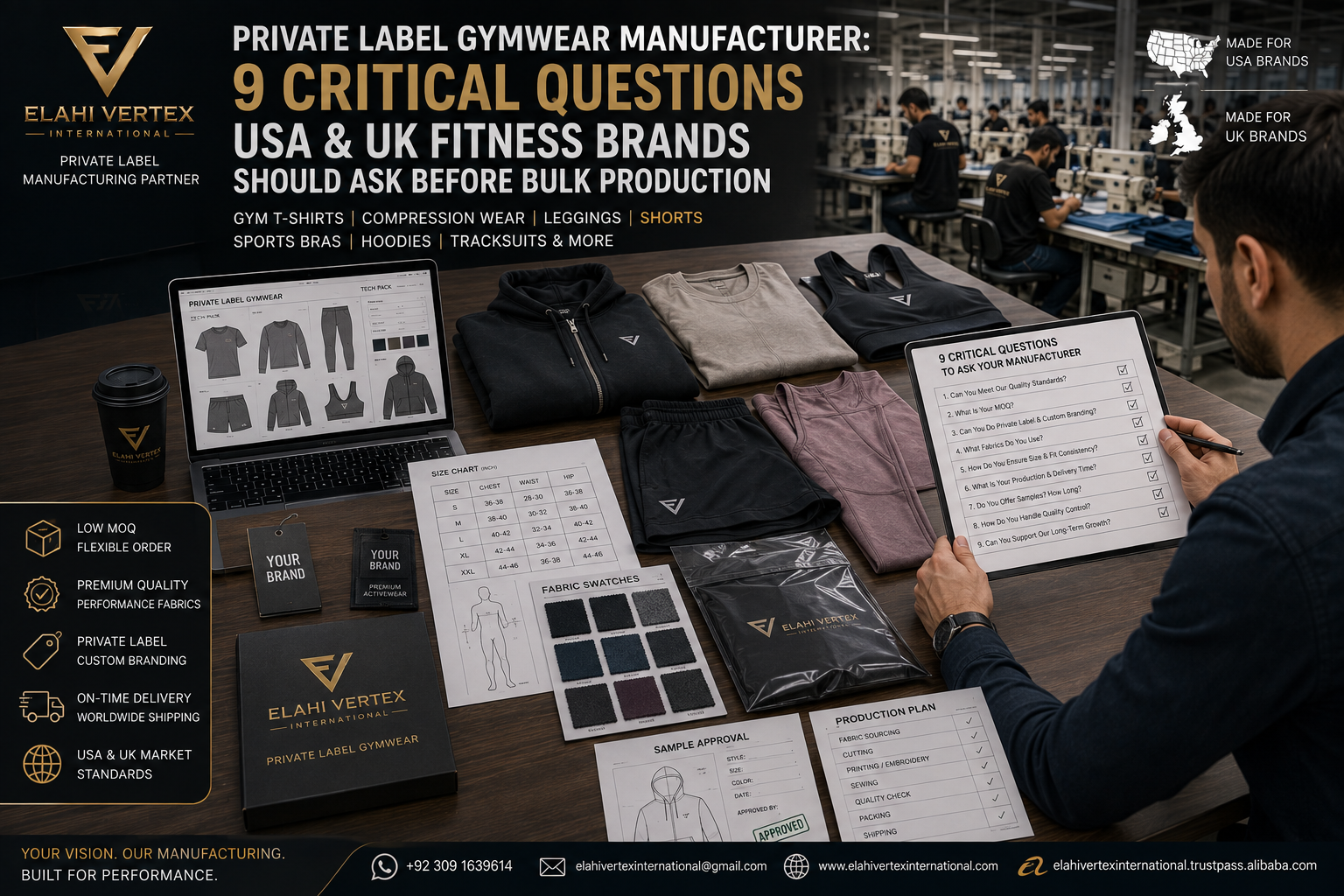
Private Label Gymwear Manufacturer: 9 Critical Questions USA & UK Fitness Brands Should Ask Before Bulk Production
Choosing the right private label gymwear manufacturer is one of the most important decisions a fitness brand makes before launching or scaling a collection. A manufacturer does more than produce garments: the manufacturing process can directly affect your product quality, fit, branding, customer experience, margins, and ability to replenish inventory.
For USA and UK fitness brands, gymwear startups, activewear brands, e-commerce businesses, and retailers, the wrong manufacturing decision can create expensive problems long after the purchase order has been placed.
A low quotation may look attractive, but the real cost can appear later through inconsistent sizing, unsuitable fabric, incorrect branding, poor sampling, unclear production specifications, labeling problems, or unexpected shipping costs.
That is why you should evaluate a private label gymwear manufacturer before bulk production—not after problems appear.
In this guide, we cover 9 critical questions to ask a private label gymwear manufacturer before approving a bulk order, from product specifications and fabric selection to private labeling, quality control, MOQ, packaging, and international shipping.
What Is a Private Label Gymwear Manufacturer?
A private label gymwear manufacturer produces fitness apparel that is sold under your own brand rather than the manufacturer’s consumer brand.
This can allow fitness brands and e-commerce businesses to develop products around their own:
- Brand identity
- Product specifications
- Designs
- Measurements
- Colors
- Logos
- Labels
- Packaging
- Customer positioning
Private label gymwear can include:
- Gym T-shirts
- Compression wear
- Leggings
- Sports bras
- Gym shorts
- Hoodies
- Tracksuits
- Activewear sets
The important distinction is that private-label manufacturing should be based on your agreed product requirements, rather than simply purchasing a generic garment and adding a logo.
A serious buyer should therefore evaluate a private label gymwear manufacturer according to the entire manufacturing process—not just the final unit price.
1. Can the Private Label Gymwear Manufacturer Follow My Exact Specifications?
This should be one of your first questions.
Do not simply ask:
“Can you manufacture gymwear?”
Ask whether the private label gymwear manufacturer can manufacture your specific product according to clearly documented requirements.
Your specifications may include:
- Garment measurements
- Size grading
- Fabric composition
- Fabric weight
- Stretch requirements
- Color references
- Stitching
- Seam construction
- Waistband dimensions
- Pocket placement
- Logo placement
- Print dimensions
- Embroidery
- Labels
- Packaging
For example, “premium black gym leggings” is not a complete manufacturing specification.
Two manufacturers could interpret that description differently and produce two completely different garments.
A better specification describes exactly what the manufacturer needs to reproduce.
Ask your private label gymwear manufacturer:
“What information do you require from me before confirming the product specification and quotation?”
This question helps establish whether the manufacturer is prepared to work from a structured product brief.
The more clearly your requirements are defined before production, the less room there is for misunderstandings.
2. What Fabric Options Does the Private Label Gymwear Manufacturer Offer?
The fabric is one of the most important components of gymwear.
A private label gymwear manufacturer should be able to discuss fabric characteristics relevant to the product rather than simply describing everything as “premium.”
Important characteristics can include:
- Stretch
- Recovery
- Breathability
- Fabric weight
- Hand feel
- Opacity
- Durability
- Comfort
- Shape retention
- Wash performance
Different gymwear products may require different fabric characteristics.
For example, leggings may require strong stretch, recovery and opacity, while a gym T-shirt may have different requirements for breathability, weight and drape.
Ask:
“Which fabric characteristics are appropriate for my specific gymwear product?”
Also ask how the agreed fabric specification will be documented for production.
This becomes particularly important when you eventually reorder the same product. Your repeat order should be based on a defined specification rather than a vague description such as “same quality as last time.”
Why fabric specification matters
Imagine launching a premium pair of leggings that looks excellent in product photography but becomes transparent under tension.
The problem is not simply a fabric issue.
It can become a:
- Customer satisfaction issue
- Return issue
- Reputation issue
- Product-review issue
- Reorder issue
That is why fabric selection should be addressed before bulk production.
3. How Will the Private Label Gymwear Manufacturer Confirm Size and Fit?
Fit is one of the biggest risks in apparel manufacturing.
A garment can have excellent fabric and attractive branding and still fail if the sizing does not meet your customer’s expectations.
This is especially important for:
- Leggings
- Sports bras
- Compression wear
- Shorts
- Fitted gym T-shirts
- Activewear sets
When evaluating a private label gymwear manufacturer, ask exactly how measurements and fit will be confirmed.
You may need to provide:
- A measurement chart
- Tech pack
- Reference garment
- Graded measurements
- Sample specifications
- Size range
Ask:
“How will you confirm the measurements and fit before bulk production?”
Do not approve bulk production because a digital mockup looks correct.
The physical sample should be evaluated for:
- Measurements
- Fit
- Fabric behavior
- Stretch
- Construction
- Waistband
- Seams
- Branding
- Overall appearance
If changes are required, document them before final approval.
A useful principle
The approved sample should represent what you expect the bulk production to reproduce.
That gives both buyer and private label gymwear manufacturer a clearer production reference.
4. What Private-Label Branding Options Can the Manufacturer Provide?
Your gymwear is going to represent your brand, so branding should be discussed before production.
A private label gymwear manufacturer may support different branding elements depending on the specific project.
These can include:
- Woven labels
- Printed labels
- Size labels
- Care labels
- Hang tags
- Logo printing
- Embroidery
- Heat-transfer branding
- Custom packaging
But asking:
“Can you add my logo?”
is not enough.
You should ask:
“How will my logo, labels and branding be applied, and how will the placement and dimensions be confirmed?”
Confirm details such as:
- Logo artwork
- Logo dimensions
- Logo placement
- Application method
- Label size
- Label material
- Label position
- Hang-tag information
- Packaging requirements
This matters because branding is part of the finished product.
A logo can look perfect on a computer screen and still look wrong if the physical size, placement, application method, or garment location is not properly specified.
5. What Does the Sample Process Include?
Before placing a bulk order with a private label gymwear manufacturer, understand the sample process.
Sampling is your opportunity to identify problems before those problems are multiplied across the bulk order.
Depending on the product, review:
- Fabric
- Color
- Measurements
- Fit
- Stitching
- Construction
- Logo placement
- Branding
- Labels
- Packaging
- Overall appearance
Ask the private label gymwear manufacturer:
- What exactly does the sample represent?
- Can revisions be made?
- How are revisions documented?
- Which sample becomes the final production reference?
- How is final approval confirmed?
A sample should not simply be treated as a promotional preview.
It should be part of your production-control process.
Before bulk production, confirm:
Final measurements + final fabric + final color + final artwork + final branding + final labels + final packaging.
If something changes after approval, document the change before production continues.
6. How Does the Private Label Gymwear Manufacturer Control Bulk Quality?
A good sample does not guarantee that the bulk order will be identical.
This is why quality control must be discussed with the private label gymwear manufacturer before production.
Ask:
“How will you ensure the bulk production matches the approved sample and specifications?”
Important areas include:
| Quality Area | What Should Be Confirmed |
|---|---|
| Measurements | Agreed measurements and tolerances |
| Fabric | Approved fabric specification |
| Color | Approved color reference |
| Stitching | Construction requirements |
| Branding | Placement and application |
| Labels | Information and position |
| Packaging | Agreed packing requirements |
| Finished garments | Inspection expectations |
You should also ask what happens when a finished garment does not match the agreed specification.
Ask:
“What is the process if a quality issue is identified during production or after completion?”
Do not assume every private label gymwear manufacturer uses identical quality-control procedures.
The relevant expectations should be discussed for your specific order.
7. What Are the MOQ, Price and Production Terms?
Price is important.
But when comparing a private label gymwear manufacturer, price should never be your only measurement.
A quotation should be evaluated in its complete commercial context.
Ask about:
- MOQ
- MOQ per style
- MOQ per color
- Sample cost
- Branding costs
- Packaging costs
- Unit price
- Payment terms
- Production timeline
- Shipping terms
- Additional charges
Ask:
“What is included in your quotation, and what costs are excluded?”
This question can reveal significant differences between manufacturers.
For example, one manufacturer may provide a lower unit price while additional branding, packaging, sampling, or shipping-related costs are handled separately.
Another manufacturer may provide a different commercial structure.
MOQ matters for startups
A fitness startup does not necessarily benefit from choosing a manufacturer with the lowest unit price if the required MOQ creates excessive inventory risk.
Your manufacturing decision should therefore consider:
Unit price + MOQ + product quality + sampling + branding + packaging + commercial terms.
The cheapest private label gymwear manufacturer is not automatically the most profitable supplier.
8. Can the Private Label Gymwear Manufacturer Support Labeling and Packaging?
Private-label gymwear involves more than the garment itself.
Your finished product may require:
- Brand labels
- Size labels
- Care labels
- Fiber-content information
- Country-of-origin information
- Hang tags
- Barcodes
- SKU information
- Individual packaging
- Carton information
For USA buyers, applicable textile products can have federal requirements covering areas such as fiber content, country of origin, responsible business identification, and care labeling. The Federal Trade Commission provides official guidance on these requirements.
For UK buyers, textile products can require fibre-content information, including information relating to different textile components. GOV.UK provides official textile-labelling guidance.
The important point is that a private label gymwear manufacturer should know what information and packaging specifications you want incorporated into the product, while the brand/importer should separately verify the legal requirements applicable to the specific product and market.
Ask:
“Can you manufacture my labels and packaging according to my approved specifications?”
Do not leave this discussion until the garments are already in production.
9. What Are the Shipping and Export Responsibilities?
Your relationship with a private label gymwear manufacturer does not end when the garments leave the factory.
The finished products still have to reach your:
- Warehouse
- Fulfillment center
- Office
- Retail location
- Distribution center
Before placing a bulk order, clarify:
- Shipping origin
- Shipping method
- Export documentation
- Import responsibilities
- Incoterms
- Duties and taxes
- Carton information
- Commercial documents
- Production-to-shipment timeline
Most importantly:
Do not confuse production time with total delivery time.
Your actual supply chain can look like:
Product Specification → Sampling → Revisions → Approval → Bulk Production → Inspection → Export Documentation → Transit → Import Clearance → Final Delivery
Every stage can influence your launch schedule.
For a USA or UK fitness brand planning a collection launch, inventory replenishment, or seasonal campaign, the complete supply chain matters much more than one isolated delivery estimate.
USA vs UK: What Should Fitness Brands Check?
USA and UK fitness brands should both carefully evaluate their private label gymwear manufacturer, but market-specific requirements still need to be considered.
USA Fitness Brands
Depending on the product, buyers should verify requirements relating to:
- Fiber content
- Country of origin
- Care labeling
- Responsible business identification
- Import requirements
The Federal Trade Commission provides official guidance covering textile and clothing labeling requirements for the US market.
UK Fitness Brands
UK buyers should verify applicable requirements relating to:
- Fibre content
- Different textile components
- Product labeling
- Import requirements
- Retail requirements
The UK government’s textile-labelling guidance explains the requirements around fibre-content information.
The important lesson is simple:
Do not assume that one labeling approach automatically satisfies every market.
Verify the requirements for your specific product and destination before bulk production.
Private Label Gymwear Manufacturer Checklist
Before approving bulk production, ask your private label gymwear manufacturer whether the following points have been confirmed:
- Product specifications
- Fabric specification
- Color
- Size chart
- Fit
- Sample
- Sample revisions
- Final production reference
- Logo artwork
- Branding placement
- Labels
- Packaging
- MOQ
- Unit price
- Payment terms
- Production timeline
- Quality expectations
- Shipping terms
- Export responsibilities
- Import responsibilities
If several of these points remain unclear, you may not yet have enough information to confidently approve a bulk order.
5 Costly Mistakes to Avoid When Choosing a Private Label Gymwear Manufacturer
1. Choosing Only by Price
The cheapest private label gymwear manufacturer may not be the cheapest option for your business overall.
A quality problem can create:
- Returns
- Replacements
- Delays
- Lost customers
- Negative reviews
- Additional logistics costs
2. Giving Vague Specifications
A manufacturer cannot reliably reproduce requirements that were never clearly defined.
Instead of saying “premium gymwear,” provide measurable product requirements.
3. Skipping Sample Approval
Skipping sampling transfers unnecessary production risk into your bulk order.
4. Changing Specifications After Approval
Late changes can create confusion between the buyer and private label gymwear manufacturer.
Document important changes before bulk production.
5. Assuming the Manufacturer Knows Every Market Requirement
A manufacturer may have experience producing for international buyers, but your brand should still verify the requirements applicable to its products and target market.
How to Choose the Right Private Label Gymwear Manufacturer
Choosing a private label gymwear manufacturer should be treated as a supplier-evaluation process.
Instead of asking only:
“What is your price?”
build your evaluation around nine areas:
- Specifications
- Fabric
- Fit
- Branding
- Sampling
- Quality control
- MOQ and pricing
- Labels and packaging
- Shipping and export
This approach gives you a much clearer picture of what you are actually buying.
A strong manufacturing relationship begins with clear expectations before production—not with problem-solving after the shipment arrives.
Why Work With Elahi Vertex International?
Elahi Vertex International operates as a B2B manufacturer, exporter, OEM/ODM supplier, custom manufacturing partner, and private-label manufacturing partner.
For fitness brands and activewear businesses, the right starting point is to discuss the actual project requirements, including the products, specifications, branding, quantity, packaging, and target market.
Elahi Vertex International can discuss private-label gymwear manufacturing requirements for products such as gym T-shirts, compression wear, leggings, shorts, sports bras, hoodies, and tracksuits.
Project-specific details such as MOQ, pricing, production requirements, and other commercial terms should be confirmed for the individual order rather than assumed.
Ready to discuss your gymwear project?
Contact Elahi Vertex International with your product requirements, approximate quantity, branding details, and target market.
WhatsApp: +92 309 1639614
Email: elahivertexinternational@gmail.com
Website: https://www.elahivertexinternational.com/
Frequently Asked Questions
What is a private label gymwear manufacturer?
A private label gymwear manufacturer produces gym and fitness apparel for a brand that sells the finished products under its own brand.
What products can a private label gymwear manufacturer produce?
Depending on confirmed capabilities, private-label gymwear can include gym T-shirts, compression wear, leggings, sports bras, shorts, hoodies, tracksuits, and activewear sets.
How do I choose a private label gymwear manufacturer?
Evaluate specifications, fabric, fit, sampling, branding, quality control, MOQ, pricing, packaging, communication, and shipping responsibilities rather than comparing unit price alone.
Should I request samples before bulk production?
Yes. A sample allows you to review the product before committing to a larger production quantity.
What should I provide to a private label gymwear manufacturer?
Provide product specifications, measurements, fabric requirements, colors, artwork, branding requirements, quantity, packaging requirements, and target-market information where available.
What should I ask about MOQ?
Ask whether MOQ applies to the total order, individual style, color, size, or another production variable.
Can a private label gymwear manufacturer add my branding?
Private-label production is designed around the buyer’s brand. The exact available branding methods should be confirmed for the specific project.
What should I check on a gymwear sample?
Check the fabric, measurements, fit, stretch, construction, stitching, color, branding, labels, and other agreed specifications.
Why is sample approval important?
Because identifying a problem before bulk production is generally easier and less costly than discovering the same problem across a completed production run.
What should USA fitness brands verify?
USA buyers should verify the labeling, care, country-of-origin, fiber-content, import, and other requirements applicable to their specific products.
What should UK fitness brands verify?
UK buyers should verify applicable textile labeling, fibre-content, import, and other requirements for their specific products.
Is the cheapest private label gymwear manufacturer always the best choice?
No. Unit price is only one part of the supplier decision. MOQ, quality, fit, production terms, packaging, shipping, and product consistency can have a much larger commercial impact.
Conclusion
Choosing a private label gymwear manufacturer is a major decision for any fitness brand preparing for bulk production.
Before placing your order, ask these nine critical questions:
- Can the private label gymwear manufacturer follow my exact specifications?
- What fabric options and performance characteristics are available?
- How will size and fit be confirmed?
- What private-label branding options are available?
- What does the sample approval process include?
- How will bulk-production quality be controlled?
- What are the MOQ, pricing, and production terms?
- Can labeling and packaging requirements be supported?
- What are the shipping and export responsibilities?
The goal is not simply to find a manufacturer offering a low quotation.
The goal is to establish a manufacturing relationship where product expectations, specifications, commercial terms, quality requirements, branding, and responsibilities are clear before bulk production begins.
For USA and UK fitness brands, startups, activewear companies, e-commerce brands, and retailers, asking the right questions before production can significantly improve the supplier-selection process.
If you are looking for a private label gymwear manufacturer, prepare your product specifications, quantity, branding requirements, and target market before requesting a quotation.
Elahi Vertex International can discuss your custom gymwear and private-label manufacturing requirements.
External Resources
- U.S. FTC — Apparel & Labeling
https://www.ftc.gov/business-guidance/industry/apparel-labeling - UK Government — Textile Labelling
https://www.gov.uk/guidance/textile-labelling - OEKO-TEX — Textile Safety & Certification
https://www.oeko-tex.com/ - Textile Exchange — Textile Industry & Materials
https://textileexchange.org/ - Global Organic Textile Standard (GOTS)
https://global-standard.org/ - Gymshark — Official Gymwear Brand
https://www.gymshark.com/