
Choosing a private label streetwear manufacturer is one of the most important decisions for streetwear brands, fashion startups, e-commerce businesses, clothing labels, and retailers preparing for bulk production.
Private label streetwear is not simply about adding a logo to an existing garment. Depending on the project, your requirements may include custom fits, fabrics, colors, artwork, labels, trims, packaging, sampling, quality control, and bulk production.
For brands selling in the USA and UK, selecting the right manufacturing partner also means understanding the production process and checking applicable product and labeling requirements before production begins.
Before committing to a bulk order, buyers should ask detailed questions about the manufacturer’s capabilities, MOQ, sampling, branding, quality control, pricing, timelines, and production procedures.
This guide covers 9 critical questions to ask a private label streetwear manufacturer before bulk production, with practical considerations for hoodies, T-shirts, sweatshirts, tracksuits, jackets, and other private-label apparel.
What Is a Private Label Streetwear Manufacturer?
A private label streetwear manufacturer produces apparel that is sold under a buyer’s own brand.
Depending on the manufacturing arrangement, private-label production can include:
- Custom garment development
- Custom measurements
- Fabric selection
- Color development
- Printing
- Embroidery
- Woven labels
- Printed labels
- Hang tags
- Packaging
- Product sampling
- Bulk production
- Quality inspection
For example, a fashion brand might want to develop an oversized hoodie with a specific fit, fabric weight, artwork placement, woven neck label, care label, hang tag, and packaging.
That is fundamentally different from purchasing a standard wholesale hoodie and adding a logo.
Private Label vs. Standard Wholesale
Private Label StreetwearStandard WholesaleBrand-specific productsExisting productsCustom specifications possibleUsually standardizedBuyer’s brandingSupplier’s existing brandingCustom labels possibleStandard labelingCustom packaging possibleUsually standardProduct development may be includedUsually limitedDesigned around the buyer’s brandSelected from an existing range
The distinction matters because a buyer looking for private-label manufacturing should evaluate development and production capabilities, not just a supplier’s product catalog.
1. What Private Label Streetwear Products Can You Manufacture?
The first question should be straightforward:
Can the manufacturer produce the exact products your brand wants to sell?
A supplier may have experience with T-shirts but limited experience with jackets, tracksuits, structured sweatshirts, or complex streetwear construction.
Your product range might include:
- Hoodies
- T-shirts
- Sweatshirts
- Oversized T-shirts
- Tracksuits
- Jackets
- Joggers
- Shorts
- Other custom apparel
Do not assume that because a supplier can produce one garment, it can automatically produce every product to the same specification.
Ask About Your Exact Products
Instead of asking:
“Can you manufacture streetwear?”
Give the manufacturer a specific product list.
For example:
“We need oversized hoodies, heavyweight T-shirts, sweatshirts, tracksuits, and custom jackets.”
Then ask about the manufacturer’s capabilities for each category.
Why Product Capability Matters
Different garments can require different:
- Patterns
- Construction techniques
- Materials
- Machinery
- Finishing methods
- Quality-control procedures
A suitable private label streetwear manufacturer should be able to discuss your actual products rather than simply confirming that it manufactures clothing.
2. What MOQ Applies to My Private Label Order?
MOQ means Minimum Order Quantity.
It is one of the first commercial questions brands should clarify before starting bulk production.
However, asking only:
“What is your MOQ?”
is not enough.
Ask:
“What MOQ applies to my specific product, design, color, and customization requirements?”
MOQ can vary depending on:
- Product type
- Fabric
- Color
- Customization
- Printing
- Embroidery
- Labels
- Trims
- Packaging
- Production requirements
Questions to Ask About MOQ
- Is MOQ per design?
- Is MOQ per color?
- Can sizes be mixed?
- Are different products counted separately?
- Does custom packaging have a separate MOQ?
- Are sample quantities separate from bulk quantities?
Why MOQ Matters to Startups
A fashion startup may want to test a new product before committing to a large collection.
A practical order quantity can therefore matter when validating demand.
But MOQ should not be the only selection criterion.
A supplier offering a lower MOQ is not automatically the better manufacturing partner if its sampling, communication, quality, or production consistency is weak.
3. Can You Develop Samples Before Bulk Production?
For a new private-label collection, sampling is one of the most important stages.
A digital design can communicate the concept, but a physical sample allows you to evaluate the actual garment.
A sample can help you review:
- Fit
- Measurements
- Fabric
- Fabric weight
- Color
- Stitching
- Construction
- Artwork placement
- Printing
- Embroidery
- Labels
- Trims
- Finishing
Ask How Sample Revisions Work
The first sample may require adjustments.
A project could involve:
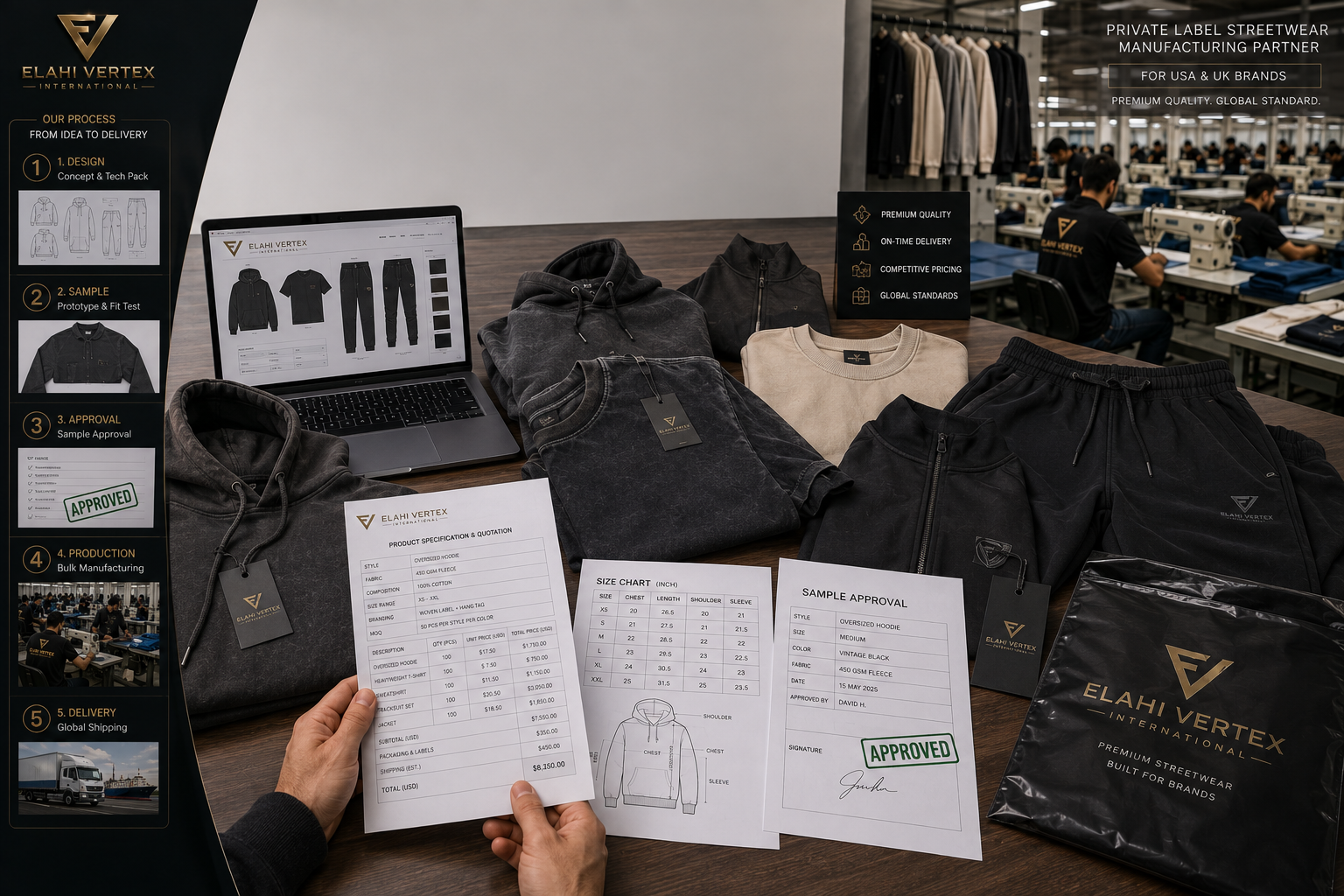
Initial specification → Sample → Review → Revision → Approval → Bulk production
The exact process depends on the manufacturer and product.
The important point is that you understand the process before committing to the bulk order.
Do Not Approve Bulk Production From Photos Alone
Photographs cannot fully communicate:
- Fabric hand feel
- Actual measurements
- Fit
- Thickness
- Stitching
- Construction
- Finishing
For customized garments, physical sample approval provides a stronger reference before production.
4. What Fabrics and Customization Options Are Available?
Private-label streetwear brands often differentiate themselves through product details.
Fabric selection and construction can therefore be commercially important.
Ask the private label streetwear manufacturer what materials and customization options are available for your specific garments.
Fabric Considerations
Depending on the product, you may need to discuss:
- Fiber composition
- Fabric weight
- Texture
- Stretch
- Structure
- Hand feel
- Color
- Performance requirements
A lightweight oversized T-shirt and heavyweight hoodie should not automatically be treated as the same manufacturing requirement.
Customization Options
Ask whether the manufacturer can support:
- Custom patterns
- Custom measurements
- Custom colors
- Printing
- Embroidery
- Patches
- Appliqué
- Woven labels
- Printed labels
- Hang tags
- Custom packaging
Do not rely solely on phrases such as “premium quality” or “everything is possible.”
Ask for specific manufacturing information.
5. How Will My Private Label Branding Be Applied?
Private labeling involves much more than putting a logo on the front of a garment.
Depending on your brand, you may require:
- Neck labels
- Size labels
- Care labels
- Woven labels
- Printed labels
- Hang tags
- Packaging
- Branded bags
- Product-specific finishing
Discuss Branding Before Sampling
Your branding requirements should be established before the sample is approved.
For example:
Garment → Main label → Size label → Care information → Hang tag → Packaging
Each component should be clearly specified.
This is particularly important for a private label clothing manufacturer, because the finished garment needs to represent your brand rather than simply carrying an added logo.
Avoid Last-Minute Branding Changes
If labels or packaging are changed after production has already started, the project may require additional work.
A stronger sequence is:
Brand requirements → Product specification → Sample → Approval → Bulk production
6. How Do You Control Quality During Bulk Production?
A good sample does not automatically guarantee a consistent bulk order.
The real question is:
How does the manufacturer reproduce the approved specification across the production run?
Ask:
- What quality checks are performed?
- When are inspections carried out?
- How are measurements checked?
- How is artwork placement controlled?
- How are fabric variations monitored?
- How are stitching and construction checked?
- What happens when a product does not meet the agreed specification?
Quality Control Can Cover
Depending on the product:
- Measurements
- Stitching
- Seams
- Fabric
- Color
- Printing
- Embroidery
- Labels
- Trims
- Finishing
- Overall appearance
The goal is not to demand unrealistic claims such as “zero defects guaranteed.”
Instead, evaluate the process used to control production consistency.
Approved Sample vs. Bulk Production
Your approved sample and final specifications should provide a reference for production.
That makes it easier to determine whether finished garments meet the agreed requirements.
7. What Is Included in the Production Quotation?
Never compare manufacturers using unit price alone.
A quotation should be evaluated against the exact specifications being quoted.
Ask what is included.
Clarify:
- Garment manufacturing
- Fabric
- Printing
- Embroidery
- Labels
- Trims
- Packaging
- Sampling
- Customization
- Shipping
- Other production-related charges
Two manufacturers can quote different prices because they are quoting different specifications.
Compare Like for Like
RequirementManufacturer AManufacturer BProductSame specificationSame specificationFabricSame specificationSame specificationQuantitySameSameDecorationSameSameLabelsSameSamePackagingSameSameSamplingConfirmConfirmShippingConfirmConfirm
This makes your comparison more meaningful.
Do Not Automatically Choose the Cheapest Supplier
A lower price may exclude:
- Certain fabric specifications
- Custom labels
- Packaging
- Sampling
- Finishing
- Shipping
The better question is:
What exactly am I receiving for the quoted price?
8. What Are the Production, Packaging and Shipping Timelines?
Private-label production normally involves multiple stages.
A project may progress through:
Product specification → Sampling → Approval → Material preparation → Bulk production → Quality control → Packaging → Shipment
These stages should not automatically be treated as one single lead time.
Ask About Each Stage
- How long does sample development take?
- When can bulk production begin?
- What can affect production time?
- When is packaging completed?
- How is shipping arranged?
- What information must be approved before production starts?
Actual timelines depend on factors such as:
- Product complexity
- Quantity
- Materials
- Customization
- Sample revisions
- Approvals
- Production schedule
- Shipping arrangement
USA and UK Buyers
If your garments will be sold in the USA or UK, consider destination-market requirements during product development.
For U.S. apparel, buyers should review applicable requirements relating to fiber content, country of origin, and care information through the U.S. Federal Trade Commission’s official apparel guidance.
For UK textile products, buyers should review applicable requirements for fiber-content information and textile labeling through GOV.UK.
Requirements can vary according to the product and market, so brands should verify the current rules that apply to their specific products.
9. How Will My Approved Specifications Be Used During Bulk Production?
This may be the most overlooked question.
You may spend weeks developing:
- Measurements
- Fit
- Fabric
- Colors
- Artwork
- Labels
- Packaging
- Construction details
But what happens after you approve the sample?
Ask the manufacturer how those specifications become the reference for bulk production.
Your Production Reference May Include
- Approved sample
- Measurement specifications
- Size chart
- Fabric requirements
- Artwork files
- Color references
- Label specifications
- Packaging requirements
- Construction instructions
The purpose is to reduce ambiguity between development and manufacturing.
Why This Matters
Imagine approving an oversized hoodie with:
- Specific shoulder proportions
- Specific fabric weight
- Custom artwork placement
- Particular label positioning
Then receiving bulk products with different proportions or branding placement.
The problem may not be the manufacturer’s overall capability.
It may be a failure to maintain a clear production reference.
That is why this question matters:
“How do you ensure my approved specifications are followed during bulk production?”
A strong answer should explain the actual process rather than simply stating that the company performs “quality control.”
USA & UK Private Label Streetwear: What Brands Should Check
Private-label brands targeting the USA and UK should consider destination-market requirements during product development.
USA Private Label Streetwear
U.S. brands should review applicable requirements relating to:
- Fiber content
- Country of origin
- Care instructions
- Manufacturer or responsible business identification
- Other requirements applicable to the product
The U.S. Federal Trade Commission provides official guidance on apparel and textile labeling.
UK Private Label Streetwear
UK brands should review applicable textile-labeling requirements before production.
GOV.UK provides official guidance covering textile labeling and fibre-content information for products sold in the UK.
Important
This article is a sourcing guide, not legal advice. Requirements can depend on the product, destination, and applicable rules. Buyers should verify current requirements for their own products.
Private Label Streetwear Manufacturer Checklist
Before approving bulk production, confirm:RequirementConfirmed?Product capabilityYes / NoMOQYes / NoSample processYes / NoFabric specificationsYes / NoCustomizationYes / NoPrivate-label brandingYes / NoLabelsYes / NoPackagingYes / NoQuality controlYes / NoProduction timelineYes / NoShipping arrangementYes / NoUSA/UK requirementsYes / NoApproved specificationsYes / No
If several items remain unclear, resolve them before committing to bulk production.
Common Mistakes Before Private Label Production
Choosing Only on Price
The lowest quotation is not automatically the best manufacturing option.
Skipping the Sample
A physical sample can reveal fit, fabric, construction, and branding issues before bulk production.
Providing Incomplete Specifications
Unclear specifications create room for misunderstanding.
Ignoring Branding Details
Labels, tags, packaging, and finishing should be considered before production.
Assuming MOQ Is Universal
MOQ can vary by product, color, customization, and production requirements.
Confusing Production Time With Shipping Time
Manufacturing and transportation are separate stages.
Approving Without a Clear Production Reference
Bulk production should have a clear reference based on the approved product and specifications.
How to Compare Private Label Clothing Manufacturers
If you are evaluating several suppliers, use a consistent scorecard.FactorImportanceProduct capabilityHighSample developmentHighQuality controlHighCustomizationHighCommunicationHighPricing/valueMediumMOQMediumBranding optionsMediumPackagingMediumShipping supportMedium
The objective is to compare suppliers against the same product requirements.
A manufacturer with the lowest price may not be the best choice if it cannot consistently meet your specifications.
What Should a Brand Prepare Before Contacting a Manufacturer?
Before requesting a quotation, prepare as much information as possible.
Product Information
- Product type
- Product reference images
- Intended fit
- Size range
- Estimated quantity
Technical Information
- Measurements
- Fabric requirements
- Artwork
- Decoration requirements
- Labels
- Trims
- Packaging
Commercial Information
- Target quantity
- Target market
- Sampling requirements
- Delivery destination
The more clearly you communicate your requirements, the easier it is for a private label streetwear manufacturer to understand the project and provide relevant information.
Why Sampling Should Come Before Bulk Production
Sampling creates a checkpoint between your idea and your production order.
A brand can review:
Design → Sample → Feedback → Revision → Approval → Bulk production
This process helps identify problems before the complete order is manufactured.
For private-label streetwear, sampling is especially relevant when your brand depends on a distinctive fit, custom fabric, detailed artwork, specialized branding, or specific construction.
A sample is not a guarantee that every bulk unit will be identical, but it gives the production team and buyer a tangible reference.
Recommended External Resources for USA & UK Brands
Before starting private-label streetwear production, brands should also review the applicable apparel and textile requirements for their target market.
USA brands can consult the U.S. Federal Trade Commission’s apparel and textile labeling guidance, while UK brands can review GOV.UK textile labeling guidance.
These official resources can help buyers understand requirements that may affect garment labels and product preparation before bulk production.
How Elahi Vertex International Can Support Private Label Streetwear
Elahi Vertex International operates as a B2B manufacturer, exporter, OEM/ODM supplier, and private-label manufacturing partner.
For brands developing private-label streetwear, product categories can include:
- Hoodies
- T-shirts
- Sweatshirts
- Tracksuits
- Jackets
- Sportswear
- Teamwear
- Gymwear
- Other custom apparel
Exact MOQ, sampling, materials, customization, packaging, and production requirements should be discussed according to the individual project.
If you are developing a private-label collection, a useful first step is to provide your product specifications and discuss the requirements based on the actual project.
Website: https://www.elahivertexinternational.com/
You can also review the company’s B2B presence through its Alibaba storefront:
Alibaba: https://elahivertexinternational.trustpass.alibaba.com/
Frequently Asked Questions
What is a private label streetwear manufacturer?
A private label streetwear manufacturer produces streetwear products that are sold under a buyer’s own brand. Depending on the project, the manufacturer may support product development, fabrics, customization, labels, packaging, sampling, and bulk production.
What should I ask a private label streetwear manufacturer?
Ask about product capabilities, MOQ, sampling, fabrics, customization, branding, quality control, quotation inclusions, production timelines, shipping, and how approved specifications are maintained during bulk production.
Can a private label streetwear manufacturer produce custom hoodies?
Many apparel manufacturers can produce custom hoodies, but buyers should verify the manufacturer’s specific capabilities, fabric options, construction, customization, sampling, and branding processes.
What is the difference between private label and custom clothing?
Private label describes products sold under the buyer’s brand, while custom clothing focuses on garments developed according to specific requirements. A project can be both private label and highly customized.
Should I approve a sample before bulk production?
For customized private-label apparel, reviewing and approving a physical sample before bulk production is a sensible way to identify issues with fit, fabric, construction, artwork, labels, and finishing.
What affects private label streetwear manufacturing costs?
Costs can depend on the garment, fabric, construction, quantity, customization, printing, embroidery, labels, packaging, sampling, and shipping requirements.
How do I compare private label clothing manufacturers?
Use identical product specifications when requesting quotations and compare product capability, sampling, quality control, customization, communication, MOQ, pricing, branding, packaging, and shipping.
Can startups work with private label streetwear manufacturers?
Potentially, depending on the manufacturer’s MOQ, product requirements, sampling process, and commercial terms. Startups should clarify these conditions before developing a collection.
What should USA and UK brands check before production?
They should review the applicable labeling, product, care, fiber-content, packaging, import, and other market requirements for their specific products.
Final Takeaway
Choosing a private label streetwear manufacturer should not be based on a catalog or low quotation alone.
Before bulk production, ask the questions that reveal how the manufacturer actually operates:
What can you manufacture?
What MOQ applies?
Can you develop samples?
What fabrics and customization options are available?
How will my branding be applied?
How is quality controlled?
What does the quotation include?
What are the production and shipping timelines?
How will my approved specifications be maintained?
For USA and UK streetwear brands, fashion startups, e-commerce businesses, clothing labels, and retailers, these questions create a practical framework for evaluating potential manufacturing partners before committing to a bulk order.
If you are developing private-label hoodies, T-shirts, sweatshirts, tracksuits, jackets, or other streetwear, Elahi Vertex International can discuss your manufacturing requirements based on your specific project.
Discuss your private-label streetwear project:
https://www.elahivertexinternational.com/