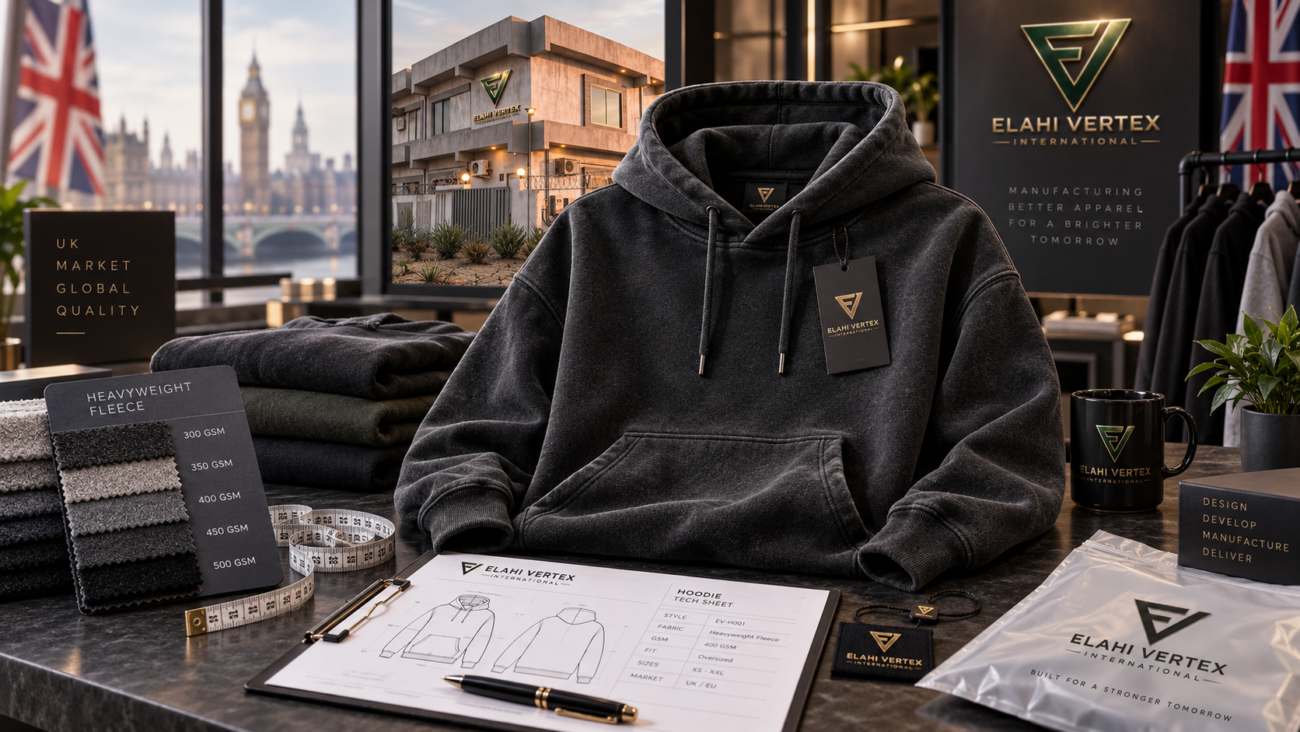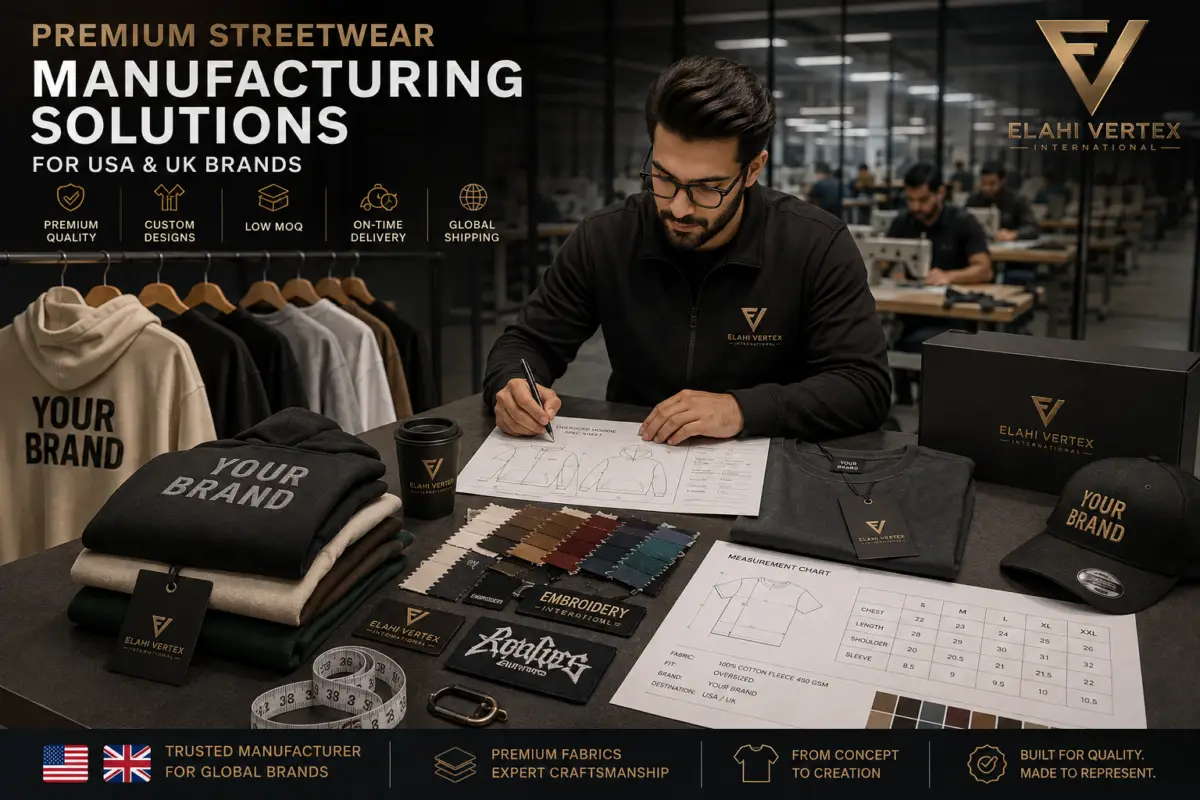

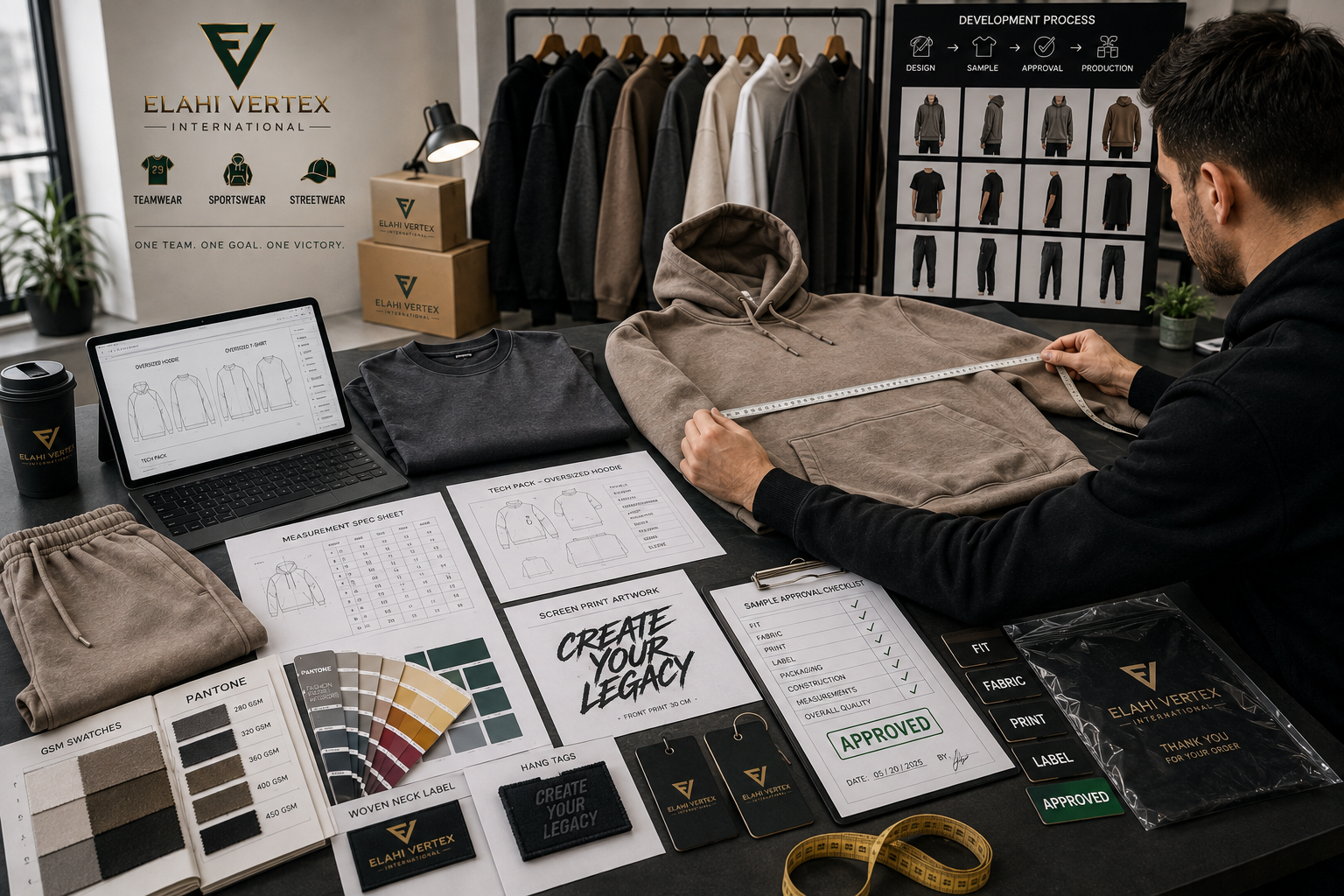
A streetwear sample can look impressive in photographs and still be wrong for bulk production.
For USA streetwear brands, startups, private-label labels and e-commerce businesses, sample approval is the point where design ideas need to become measurable manufacturing instructions. Oversized proportions, heavyweight fabric, garment washes, screen prints, embroidery, labels and packaging can all look approximately right on one prototype while still containing unresolved details that become expensive when repeated across a bulk order.
A proper streetwear sample approval process therefore goes beyond asking, “Do I like this sample?”
Before authorizing bulk production, a buyer should verify the garment against the latest specifications and document what has actually been approved. Current streetwear manufacturing guidance similarly emphasizes resolving silhouette and measurements, fabric/GSM, decoration, labels, packaging and the final pre-production reference before bulk production. (Meiting Garments)
This guide explains 9 costly streetwear sample approval mistakes USA brands should catch before bulk production, along with a practical approval framework for hoodies, oversized T-shirts, sweatshirts, joggers, shorts, tracksuits and other private-label streetwear.
Table of Contents
- What Is Streetwear Sample Approval?
- Why Sample Approval Matters Before Bulk Production
- Mistake #1 — Approving the Look Before Checking Measurements
- Mistake #2 — Treating GSM as the Complete Fabric Specification
- Mistake #3 — Ignoring Shrinkage and Wash Effects
- Mistake #4 — Approving Construction Without Detailed Inspection
- Mistake #5 — Approving Printing or Embroidery by Appearance Alone
- Mistake #6 — Using Vague Color Approvals
- Mistake #7 — Forgetting Labels, Trims and Hardware
- Mistake #8 — Leaving Packaging Until After Production
- Mistake #9 — Approving Bulk Without a Controlled Final Specification
- Streetwear Sample Approval Checklist
- Sample Types USA Streetwear Brands Should Understand
- How to Send Useful Sample Corrections
- Common Sample-to-Bulk Problems
- Why Discuss Streetwear Manufacturing With Elahi Vertex International?
- 20 Streetwear Sample Approval FAQs
- Conclusion
What Is Streetwear Sample Approval?
Streetwear sample approval is the process of evaluating a sample against the intended product specification before authorizing the next development stage or bulk production.
The buyer may need to evaluate:
- Silhouette
- Fit
- Finished garment measurements
- Fabric
- Fabric weight
- Hand feel
- Color
- Construction
- Stitching
- Rib
- Drawcords
- Zippers
- Printing
- Embroidery
- Patches
- Garment washes
- Main labels
- Size labels
- Care labels
- Hang tags
- Packaging
The exact approval criteria depend on the garment.
An oversized heavyweight hoodie should not be evaluated using exactly the same criteria as a lightweight graphic T-shirt or technical tracksuit.
The key principle
A sample should be approved against controlled specifications, not memory.
If the sample differs from the tech pack, measurement chart, artwork or other approved documentation, the buyer and manufacturer need to determine which version represents the intended bulk product.
A visually attractive sample is not enough if the manufacturing instructions behind it remain ambiguous.
Why Streetwear Sample Approval Matters Before Bulk Production
Streetwear is particularly sensitive to details that may appear minor on paper.
Consider an oversized T-shirt.
Its identity may depend on the relationship between:
- Body width
- Body length
- Shoulder width
- Sleeve length
- Sleeve opening
- Neck rib
- Fabric weight
- Fabric drape
- Wash
- Print dimensions
Change one element and the overall silhouette can change.
The same principle applies to hoodies.
A buyer may specify a heavyweight oversized hoodie, but “heavyweight” and “oversized” are not complete production specifications.
Weak approval
Looks good. Approved.
Stronger approval
Sample reviewed against specification revision 4. Size M measurements approved. Fabric reference approved. Front artwork dimensions and placement approved. Neck label position approved. Packaging still requires confirmation and is not approved for bulk.
The second version tells both parties what the approval actually covers.
Current apparel production guidance similarly recommends maintaining written revision histories and keeping the final sample aligned with the final specification before bulk production. (Meiting Garments)
1. Approving the Look Before Checking Measurements
One of the biggest streetwear sample approval mistakes is approving a garment because the silhouette looks right on a model, mannequin or hanger.
Streetwear fit can be highly intentional.
A garment may be:
- Regular
- Relaxed
- Boxy
- Cropped
- Oversized
- Drop-shoulder
- Wide-leg
- Tapered
- Longline
Those descriptions establish direction, but they do not replace measurements.
Measure the physical sample
Compare the sample against the latest measurement specification.
For an oversized T-shirt, relevant points might include:
Measurement Area
Why It Matters
Chest width
Controls body volume
Body length
Affects overall proportion
Shoulder width
Critical to oversized/drop-shoulder silhouette
Sleeve length
Changes visual balance
Sleeve opening
Influences shape
Neck width
Affects neckline appearance
Neck drop
Influences front-neck shape
Hem width
Controls lower-body silhouette
For a hoodie, additional measurements may include:
- Hood dimensions
- Rib height
- Cuff opening
- Bottom opening
- Pocket dimensions
- Pocket placement
- Sleeve length
- Armhole
- Shoulder drop
Size Chart Example
The following is an approval framework, not an Elahi Vertex International production size chart.
Size
Chest
Length
Shoulder
Sleeve
S
Confirm specification
Confirm specification
Confirm specification
Confirm specification
M
Confirm specification
Confirm specification
Confirm specification
Confirm specification
L
Confirm specification
Confirm specification
Confirm specification
Confirm specification
XL
Confirm specification
Confirm specification
Confirm specification
Confirm specification
The actual dimensions and tolerances must be confirmed for the specific style.
Do not confuse fit with measurements
A sample can match the measurement chart but still produce the wrong intended silhouette.
That means buyers should ask two separate questions:
Does the sample match the specification?
and:
Does the specification create the fit our brand actually wants?
If the answer to the first is yes but the second is no, the specification itself needs revision.
2. Treating GSM as the Complete Fabric Specification
GSM—grams per square metre—is useful, but GSM alone does not define a streetwear fabric.
Two fabrics can have similar weight and behave differently.
They may differ in:
- Fiber composition
- Knit construction
- Density
- Surface
- Stretch
- Recovery
- Softness
- Drape
- Brushing
- Finish
- Shrinkage behavior
- Pilling behavior
This is particularly important for heavyweight streetwear.
A brand asking only for “400 GSM cotton” has provided useful information, but not necessarily a complete fabric specification.
Current streetwear sampling guidance specifically warns against treating GSM as a complete description of fabric behavior. (Meiting Garments)
What should USA streetwear brands inspect?
During streetwear sample approval, evaluate the fabric against the intended product.
For hoodies and sweatshirts
Consider:
- Weight
- Composition
- Face appearance
- Interior structure
- Hand feel
- Drape
- Recovery
- Rib compatibility
- Wash behavior
For oversized T-shirts
Consider:
- Weight
- Opacity
- Drape
- Surface
- Neck-rib compatibility
- Shrinkage
- Print compatibility
For joggers
Consider:
- Structure
- Stretch where relevant
- Knee recovery
- Rib/waistband compatibility
- Surface durability
- Drape
Do not approve fabric solely because the GSM number matches the original request.
Approve the physical result against the intended garment.
3. Ignoring Shrinkage and Garment-Wash Effects
Streetwear frequently uses finishing techniques that can materially influence the finished garment.
Depending on the design, this may include:
- Garment dye
- Pigment dye
- Acid-wash effects
- Vintage washes
- Enzyme treatments
- Distressed finishes
- Other garment-finishing processes
Not every process is suitable for every fabric, color or decoration.
Requirements should be confirmed with the manufacturer for the specific product.
Why this matters
A wash can potentially affect more than color.
Depending on materials and processes, buyers may need to consider its relationship with:
- Finished measurements
- Hand feel
- Surface appearance
- Shade
- Print appearance
- Embroidery appearance
- Labels
- Rib
- Trims
Current streetwear sampling guidance recommends reviewing wash direction together with acceptable shade variation and recognizing that washes can interact with measurements and decoration. (Meiting Garments)
Do not approve these independently
A common mistake is:
- Approve garment fit.
- Later add a wash.
- Assume the approved measurements and appearance remain unchanged.
If the manufacturing process changes, connected specifications may need to be reconfirmed.
4. Approving Construction Without Detailed Inspection
A sample can look good from several feet away while containing construction details that should be reviewed more closely.
During streetwear sample approval, inspect areas relevant to the garment, including:
- Seam alignment
- Stitch consistency
- Reinforcement
- Neckline construction
- Shoulder seams
- Armholes
- Cuffs
- Waistbands
- Hems
- Pocket construction
- Zippers
- Drawcord channels
- Bartacks where specified
- Internal finishing
Do not create arbitrary requirements such as “exactly X stitches per inch” unless the specification actually calls for them.
The objective is not to invent technical numbers.
It is to confirm that construction matches the approved product specification.
Inspect inside the garment
Streetwear buyers naturally focus on exterior appearance because that is what customers see first.
But turn the sample inside out.
Review:
- Seam finishing
- Loose threads
- Internal label attachment
- Pocket construction
- Reinforcement
- Stitching consistency
- Cleanliness of finishing
Compare against the tech pack
If the specification calls for one construction and the sample uses another, resolve the discrepancy before approval.
Never assume:
“They know what I mean.”
Manufacturing works better when important requirements are documented.
5. Approving Printing or Embroidery by Appearance Alone
Graphic identity is often central to streetwear.
A small difference in logo dimensions, placement or execution can materially change the garment.
Your streetwear sample approval checklist should therefore separate four questions:
1. Is the artwork correct?
Confirm:
- Correct file
- Correct version
- Correct spelling
- Correct orientation
2. Is the artwork the correct size?
Record actual dimensions.
Do not write:
Make logo slightly bigger.
Use a measurable instruction whenever possible.
3. Is placement correct?
Specify placement from defined garment reference points.
4. Is the decoration method correct?
Depending on the design and garment, decoration may involve:
- Screen printing
- Embroidery
- Heat-transfer applications
- Appliqué
- Patches
- Other suitable techniques
The correct process depends on the artwork, fabric, desired appearance and project requirements.
Evaluate the decoration on the intended fabric
Artwork approval on a computer screen is not the same as approving its physical execution.
The same graphic can behave differently depending on:
- Fabric surface
- Stretch
- Garment wash
- Artwork dimensions
- Print process
- Embroidery density
- Placement
- Garment construction
Review the finished combination.
6. Using Vague Color Approvals
“Black,” “cream,” “olive,” “navy” and “washed grey” are design directions, not always sufficient production color standards.
A streetwear sample approval should identify what reference defines the approved color.
Possible references include:
- Approved physical swatch
- Pantone reference where appropriate
- Lab dip where applicable
- Approved sample
- Brand color specification
- Approved wash reference
Color Guide
Color Communication
Reliability for Production Direction
Color name only
Low
Phone screenshot
Low
Digital artwork
Useful for design direction
Defined color reference
Better
Approved physical reference
Strong practical reference where applicable
Different screens and lighting conditions can change how a color appears.
That matters particularly for muted streetwear palettes such as:
- Vintage black
- Washed charcoal
- Bone
- Off-white
- Sand
- Taupe
- Olive
- Earth tones
Washed products require additional care
Some intentionally washed or dyed products may involve acceptable variation as part of the intended aesthetic.
What variation is acceptable should be agreed for the specific product rather than discovered after bulk production.
7. Forgetting Labels, Trims and Hardware
A garment is not production-ready merely because the main body is correct.
For a private-label streetwear brand, smaller components contribute significantly to the finished product.
Depending on the design, these can include:
- Main woven label
- Printed neck label
- Size label
- Care label
- Hang tag
- Drawcord
- Eyelets
- Zipper
- Zipper puller
- Buttons
- Snaps
- Patches
- Elastic
- Rib
- Packaging stickers
Review each component
For labels, check:
- Artwork
- Dimensions
- Color
- Placement
- Orientation
- Attachment
For hardware, consider:
- Appearance
- Dimensions
- Finish
- Function
- Placement
- Compatibility with the garment
For drawcords, consider:
- Material
- Shape
- Length
- Color
- Tip finish
The actual options available from Elahi Vertex International should be confirmed for each project.
Do not assume that a feature shown in an industry example automatically represents a company capability.
8. Leaving Packaging Until After Production
Packaging can look like a secondary consideration during sample development.
For USA e-commerce and streetwear brands, it may affect:
- Product presentation
- SKU identification
- Warehouse handling
- Fulfillment
- Size identification
- Retail readiness
Depending on the business model, packaging requirements may include:
- Folding method
- Individual bag
- Size sticker
- SKU
- Barcode
- Hang tag
- Product identification
- Carton assortment
- Carton markings
Current apparel sample-approval guidance also treats labels and packaging as items that should be reviewed alongside the garment rather than left completely disconnected from production approval. (fitcloo.com)
Why early confirmation matters
Imagine approving 500 garments and only afterward realizing your fulfillment operation requires a barcode on every individual package.
The garment may be correct while the order is not ready for your downstream process.
Think beyond manufacturing.
Ask:
What condition must this product be in when it reaches our warehouse or fulfillment operation?
Then include those requirements in the specification.
9. Approving Bulk Without a Controlled Final Specification
This is arguably the most important streetwear sample approval mistake.
After several sample revisions, information can become fragmented across:
- Tech packs
- PDFs
- Emails
- WhatsApp conversations
- Annotated photographs
- Artwork files
- Measurement sheets
- Spreadsheets
One document says version 2.
Another contains version 4 measurements.
A later message changes the print position.
The physical sample reflects yet another revision.
That creates ambiguity.
Create one final approval package
Before bulk authorization, consolidate the approved information.
A practical final package can include:
- Style identification
- Final tech pack
- Final measurement chart
- Approved fabric reference
- Approved color reference
- Final artwork
- Decoration dimensions and placements
- Approved trims
- Approved labels
- Packaging specification
- Size/quantity breakdown
- Written sample approval
- Final physical reference where applicable
Current manufacturing guidance consistently emphasizes keeping the final pre-production sample and controlled specifications aligned before bulk cutting. (Linked Sourcing)
Avoid “approved except…”
If a comment materially changes the physical product, determine whether another confirmation is necessary.
The safest approval is one where everyone can identify exactly what is final and what, if anything, remains open.
Streetwear Sample Approval Checklist for USA Brands
Use this checklist before authorizing a custom streetwear order for bulk production.
Fit & Measurements
- Confirm correct sample size
- Compare physical sample with measurement chart
- Check chest/body width
- Check body length
- Check shoulders
- Check sleeves
- Check openings
- Check garment balance
- Evaluate intended silhouette
- Confirm relevant tolerances
Fabric
- Confirm fabric reference
- Confirm composition where specified
- Confirm GSM where specified
- Evaluate hand feel
- Evaluate drape
- Check surface
- Check stretch/recovery where relevant
- Consider shrinkage
- Confirm rib and main-fabric relationship where relevant
Construction
- Check seam placement
- Check stitching
- Check hems
- Check cuffs
- Check waistband
- Check pockets
- Check reinforcement where specified
- Inspect inside finishing
Artwork & Decoration
- Verify artwork version
- Verify dimensions
- Verify placement
- Check colors
- Inspect print
- Inspect embroidery
- Review patches/appliqué where relevant
Color & Wash
- Compare against approved reference
- Review wash appearance
- Check consistency expectations
- Confirm intended shade direction
- Document acceptable variation where relevant
Branding
- Main label
- Size label
- Care label
- Neck print
- Hang tag
- Brand patch
Trims & Hardware
- Drawcords
- Eyelets
- Zippers
- Buttons
- Snaps
- Elastic
- Rib
Packaging
- Folding
- Individual packaging
- Size sticker
- SKU
- Barcode
- Hang tag
- Carton requirements
Documentation
- Final tech pack
- Final measurement chart
- Final artwork
- Final material references
- Final trim information
- Final packaging specification
- Quantity breakdown
- Written approval record
Development Sample vs Fit Sample vs Pre-Production Sample
USA streetwear founders should understand that not every sample proves the same thing.
Sample Stage
Main Purpose
Typical Decision
Development/Prototype
Explore design and construction
Continue, revise or change direction
Fit Sample
Evaluate measurements and silhouette
Approve/revise fit
Size-Set Sample
Review grading across selected sizes
Approve/revise grading
Pre-Production Sample
Confirm intended bulk configuration
Approve/revise before bulk
Production/TOP Sample
Evaluate production output
Compare against approved standard
Terminology can vary between manufacturers, so buyers should confirm what a particular sample is intended to prove.
A development prototype should not automatically be treated as the final bulk-production reference simply because it looks attractive.
How to Give Streetwear Sample Feedback a Manufacturer Can Use
Poor feedback:
Hoodie needs to be more oversized.
Better feedback:
Increase the specified chest width and shoulder measurement according to attached revision 3 measurement chart. Keep body length unchanged.
Poor feedback:
Logo is too low.
Better feedback:
Move front logo upward according to the annotated placement diagram and confirm the final distance from the defined neckline reference point.
Poor feedback:
Fabric doesn’t feel premium.
Better feedback:
Current fabric feels softer and lighter than our approved reference. Please compare against the agreed fabric specification and confirm available alternatives before producing another sample.
The difference is actionability.
Use one consolidated comment sheet
Do not send ten disconnected corrections through different channels if you can avoid it.
Use:
Issue → Location → Current Result → Required Change → Reference → Status
Example:
Issue
Required Action
Reference
Status
Body width
Revise to updated measurement
Measurement Chart V4
Revise
Front print
Position according to annotated artwork
Artwork V3
Revise
Neck label
Approved
Label File V2
Approved
Fabric
Approved against swatch
Fabric Ref A
Approved
This creates a clearer revision history.
Common Sample-to-Bulk Problems Streetwear Brands Should Prevent
Sample looked right, but bulk fit varies
Possible controls include clear measurement specifications, grading, tolerances and production inspection requirements.
Bulk fabric does not feel like the approved sample
Maintain an approved material reference and confirm how bulk material will be controlled against the agreed specification.
Graphic placement shifts
Document artwork dimensions and placement from defined reference points.
Wash appearance changes
Approve an appropriate wash/color reference and establish acceptable expectations before production.
Labels are positioned incorrectly
Add dimensions and placement instructions to the specification.
Packaging does not suit fulfillment
Finalize packaging and identification requirements before bulk completion.
Different team members approve conflicting versions
Use version control and one designated final approval record.
Should USA Streetwear Brands Approve Samples From Photos?
Photos and video can be useful for checking visible details.
They can help review:
- General appearance
- Artwork direction
- Logo placement
- Label appearance
- Certain construction details
- Packaging presentation
But photographs cannot reliably communicate every physical property.
They cannot fully reproduce:
- Hand feel
- Actual weight
- Drape
- Fit on the intended wearer
- Tactile print characteristics
- Stretch/recovery
- Some construction characteristics
For new custom styles, buyers should determine which aspects require physical evaluation before bulk authorization.
A physical sample is especially valuable when fit, fabric and finish are central to the product.
Streetwear Sample Approval Decision Framework
At the end of the review, avoid ambiguous responses.
Use a clear status.
APPROVE
The sample and relevant specification are accepted for the defined next stage.
REVISE
Specific changes are required and documented.
RESAMPLE
Changes are significant enough that another physical sample should be evaluated before proceeding.
HOLD
Required information or approvals remain unresolved.
The exact manufacturing approval procedure should be agreed between buyer and supplier.
Why Discuss Custom Streetwear Manufacturing With Elahi Vertex International?
Elahi Vertex International is positioned as a B2B manufacturer, exporter, OEM supplier, ODM supplier, private-label manufacturing partner and custom manufacturing partner.
For USA streetwear brands, a manufacturing discussion can begin with the actual project requirements rather than assumptions.
Buyers preparing products such as:
- Custom hoodies
- Sweatshirts
- Oversized T-shirts
- Joggers
- Shorts
- Tracksuits
- Other custom streetwear
can provide their available specifications, designs, quantities, sizing, branding requirements and destination information for project-specific discussion.
Important commercial and production information—including MOQ, pricing, fabric availability, sample procedure, production schedule, packaging specifications and shipping arrangements—must be confirmed for the individual project.
This distinction matters.
A sourcing article can explain good industry practice, but it should not turn general manufacturing guidance into an unsupported claim about a specific supplier.
USA brands evaluating manufacturing options can visit the official Elahi Vertex International website or review the Elahi Vertex International Alibaba storefront.
For a specific project, send your tech pack, reference designs, target quantities and available specifications through WhatsApp or email elahivertexinternational@gmail.com.
20 Streetwear Sample Approval FAQs
1. What is streetwear sample approval?
Streetwear sample approval is the process of checking a sample against the intended fit, measurements, fabric, construction, artwork, branding and other specifications before authorizing the next manufacturing stage.
2. Why is streetwear sample approval important before bulk production?
Streetwear sample approval helps identify specification problems while they are still limited to development rather than repeated throughout a bulk order.
3. What should I check during streetwear sample approval?
Check fit, measurements, fabric, GSM where relevant, construction, colors, washes, printing, embroidery, labels, trims, hardware and packaging requirements applicable to the garment.
4. Should streetwear sample approval include measurements?
Yes. Physical measurements should be compared with the approved measurement specification rather than relying only on visual fit.
5. Is GSM enough for streetwear sample approval?
No. GSM describes fabric weight per area but does not fully describe composition, construction, hand feel, drape, stretch, surface or other fabric characteristics.
6. Should USA streetwear brands wash-test samples?
Where wash behavior is material to the product, buyers should establish appropriate evaluation requirements with the manufacturer. The appropriate testing approach depends on the fabric, finish and product.
7. Should streetwear sample approval include printing?
Yes, when printing is part of the finished product. Review artwork, dimensions, placement, color and physical execution.
8. Should streetwear sample approval include embroidery?
Yes. Review the approved artwork, dimensions, placement, appearance and its interaction with the garment.
9. What is a pre-production sample for streetwear?
A pre-production sample is generally intended to represent the agreed configuration before bulk production. Exact terminology and purpose should be confirmed with the manufacturer.
10. Can I approve a streetwear sample from photos?
Photos can support visual review, but they cannot fully demonstrate physical properties such as hand feel, fit, fabric weight and drape. Determine whether physical review is necessary for the product.
11. Should streetwear sample approval include labels?
Yes. Private-label brands should review applicable main labels, size labels, care labels, neck prints, hang tags and their placements.
12. Should packaging be included in streetwear sample approval?
Packaging should be finalized before bulk completion when it affects retail presentation, fulfillment, barcoding, identification or other downstream requirements.
13. What happens if my streetwear sample measurements are wrong?
Document the deviations against the specification and determine whether the sample or the specification needs revision before approval.
14. What if I like the streetwear sample fit but it does not match my tech pack?
Resolve the conflict. If the sample represents the preferred fit, update the controlled specification so the written production reference and approved physical result agree.
15. How should I send streetwear sample corrections?
Use consolidated, measurable comments supported by measurement charts, annotated photographs, artwork and version numbers.
16. How many streetwear samples are needed before bulk production?
There is no universal number. It depends on product complexity, revisions and the manufacturer’s development process. Requirements should be confirmed for the specific project.
17. Does approving a streetwear sample guarantee identical bulk garments?
Manufacturing involves production tolerances and process variation. Buyers should define appropriate specifications, tolerances and quality controls rather than assuming mathematical identity.
18. When should I approve a streetwear sample for bulk production?
Approve when the relevant product specification and required physical evidence are sufficiently resolved for the intended production stage.
19. Can Elahi Vertex International manufacture my streetwear after sample approval?
Elahi Vertex International is positioned as a B2B custom manufacturing, OEM/ODM, private-label and export partner. The feasibility, specifications, MOQ, sampling, pricing and other requirements of an individual streetwear project must be confirmed directly.
20. How do I discuss streetwear sample approval with Elahi Vertex International?
Prepare your tech pack or available product information, artwork, target quantities, sizing and destination details. Contact Elahi Vertex International on WhatsApp, email elahivertexinternational@gmail.com, visit the official website, or review the official Alibaba storefront.
Conclusion: Never Approve Streetwear Bulk Production on Appearance Alone
Effective streetwear sample approval is not about chasing perfection through endless sample rounds.
It is about eliminating ambiguity before that ambiguity is multiplied through bulk production.
For USA streetwear brands, the 9 costly mistakes to catch before bulk production are:
- Approving appearance before measurements
- Treating GSM as the complete fabric specification
- Ignoring shrinkage and wash effects
- Failing to inspect construction
- Approving decoration only by appearance
- Using vague color references
- Forgetting labels, trims and hardware
- Leaving packaging until later
- Starting bulk without one controlled final specification
The strongest approach is simple:
Measure what can be measured. Reference what must be matched. Document what changes. Approve what is final. Keep unresolved points visibly unresolved.
That creates a stronger manufacturing reference for both the streetwear brand and its supplier.
Discuss Your Custom Streetwear Project
USA streetwear brands, private-label businesses, startups and sourcing teams can discuss custom manufacturing requirements with Elahi Vertex International.
Elahi Vertex International
B2B Manufacturer | Exporter | OEM | ODM | Private Label | Custom Manufacturing
Official Website
WhatsApp
Phone: +92 309 1639614
Primary Email: elahivertexinternational@gmail.com
Secondary Email: Info@elahivertexinternational.com
Official Alibaba Storefront
Send your design references, tech pack if available, target quantity, sizing, branding requirements and destination information for a project-specific discussion.