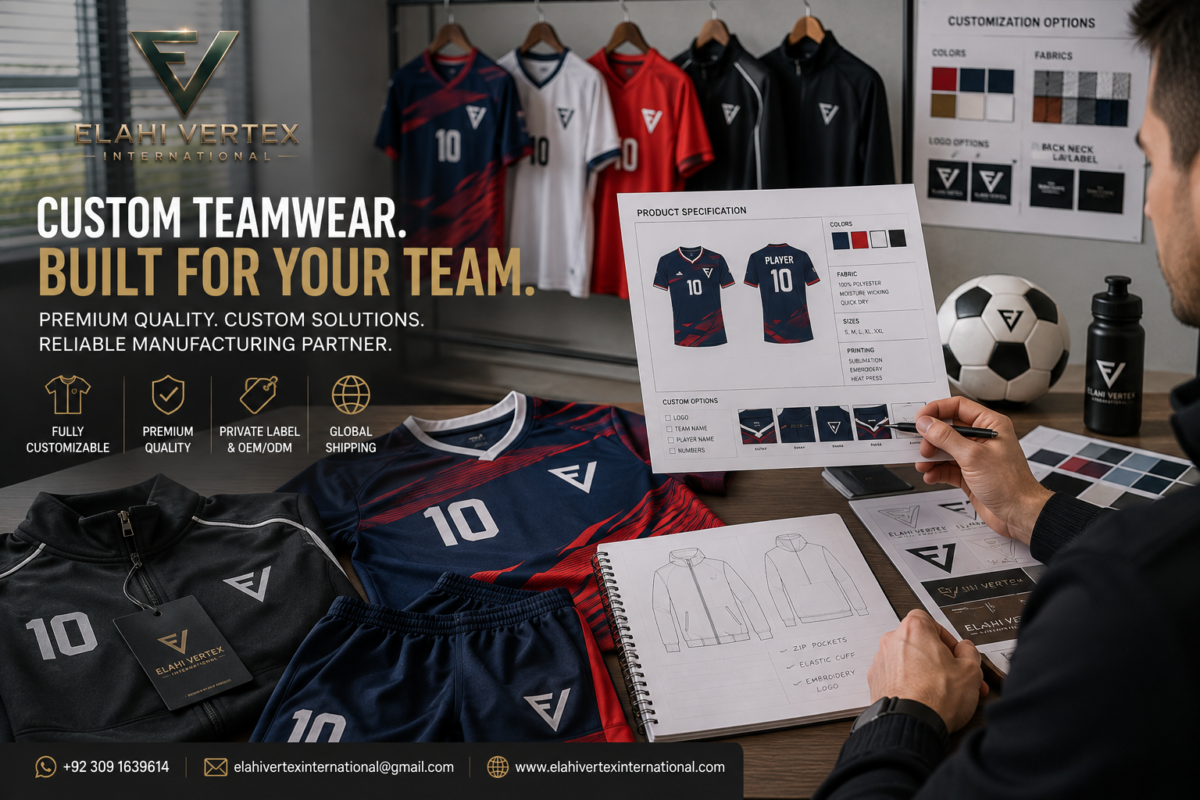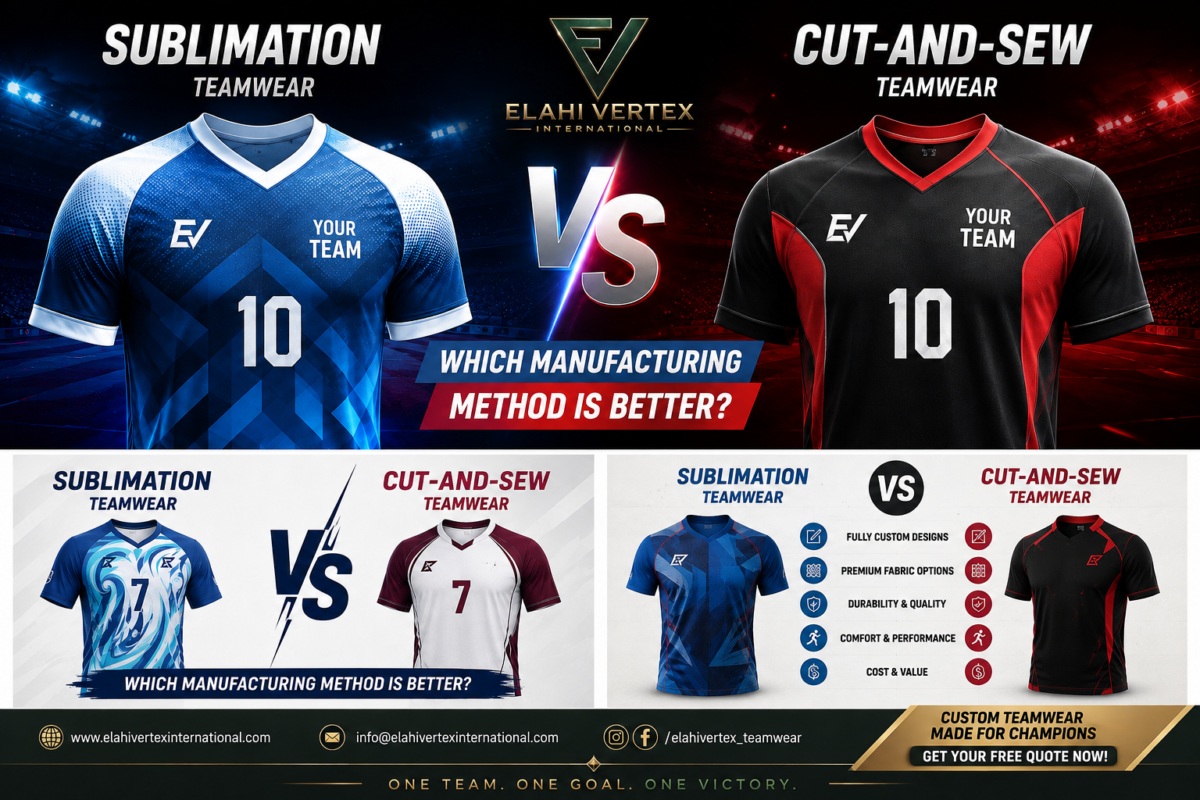

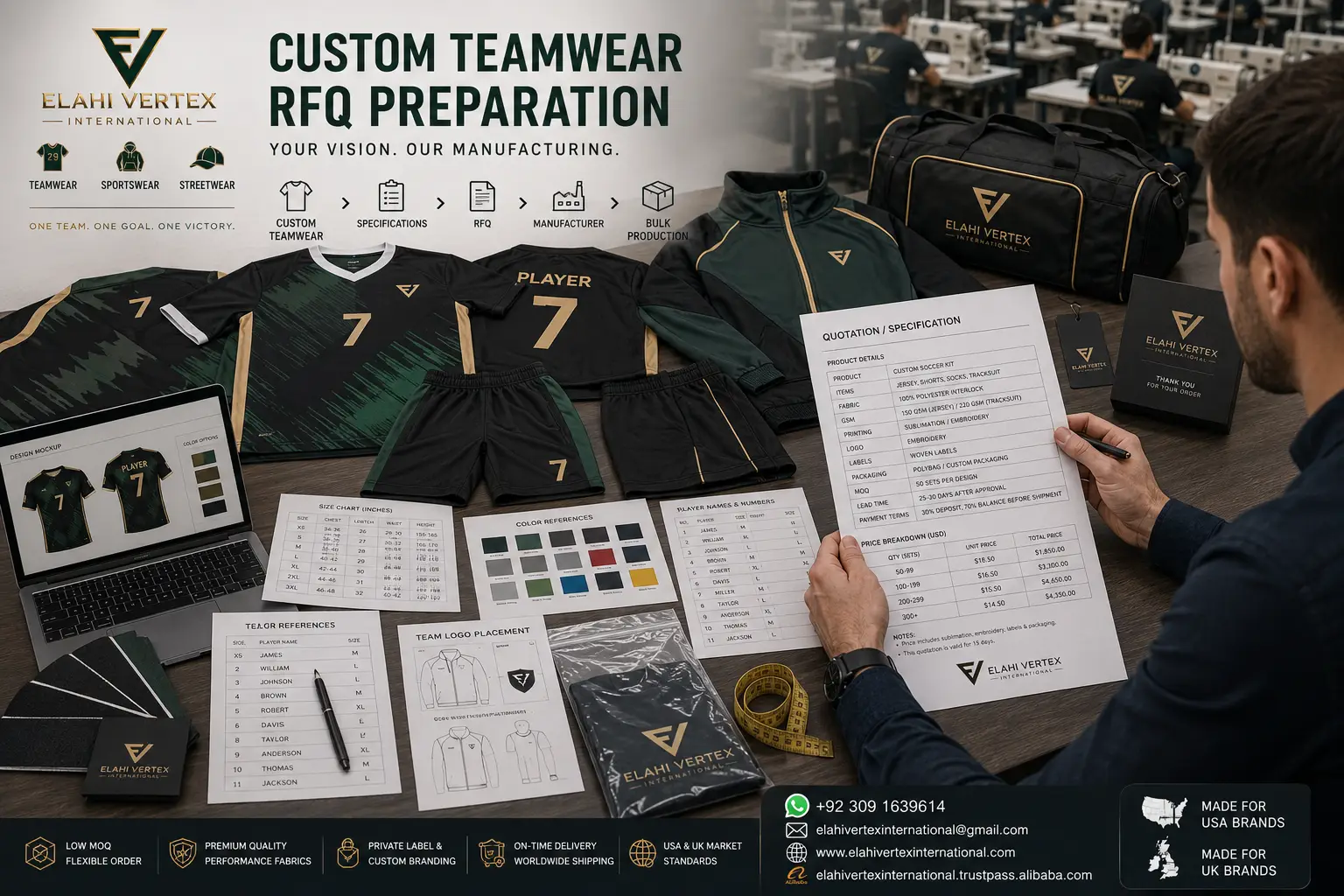
A custom teamwear RFQ should give a manufacturer enough information to understand what you want manufactured, how the garments should be customized, how quantities and sizes are divided, and which commercial requirements need to be quoted.
For sports clubs, academies, teamwear brands, wholesalers, distributors and private-label buyers in the USA and UK, sending only a logo and asking, “How much for 100 jerseys?” is rarely enough for a meaningful comparison.
Two manufacturers can quote completely different prices because they may be interpreting the same incomplete inquiry differently.
A stronger custom teamwear RFQ establishes a common basis for quotation: product type, quantities, sizing, material direction, artwork, colors, branding, packaging and destination requirements.
This guide explains 9 critical details buyers should prepare before requesting a bulk teamwear quotation and shows how to turn an early product idea into a sourcing brief that manufacturers can evaluate more accurately.
Elahi Vertex International is positioned as a B2B manufacturer, exporter, OEM/ODM supplier, private-label manufacturing partner and custom manufacturing partner for international buyers. Project-specific information—including MOQ, materials, sampling, pricing, production schedules, packaging and shipping arrangements—should always be confirmed for the individual order.
Table of Contents
- What Is a Custom Teamwear RFQ?
- Why a Detailed RFQ Matters Before Bulk Production
- Detail #1 — Define the Teamwear Products
- Detail #2 — Provide Quantities and Size Breakdown
- Detail #3 — Define Fabric and Performance Requirements
- Detail #4 — Provide Colors and Artwork
- Detail #5 — Specify Logos, Names, Numbers and Branding
- Detail #6 — Define Measurements, Fit and Size Chart
- Detail #7 — Specify Labels and Packaging
- Detail #8 — Explain Sampling and Approval Requirements
- Detail #9 — Provide Destination, Timing and Commercial Requirements
- Custom Teamwear RFQ Checklist
- How to Compare Teamwear Quotations
- Common Custom Teamwear RFQ Mistakes
- Why Work With Elahi Vertex International
- Frequently Asked Questions
- Conclusion
What Is a Custom Teamwear RFQ?
A custom teamwear RFQ, or Request for Quotation, is a structured inquiry sent to a manufacturer describing the garments a buyer wants to source and the information required for the manufacturer to prepare a quotation.
A useful custom teamwear RFQ may cover:
- Product types
- Quantities
- Size breakdown
- Fabric requirements
- GSM or fabric weight direction where relevant
- Fit
- Team colors
- Artwork
- Logos
- Player names
- Player numbers
- Sponsor branding
- Printing or embroidery requirements
- Private labels
- Packaging
- Sampling
- Destination
- Required commercial information
The purpose is not to make the buyer act like a garment technician.
It is to remove avoidable ambiguity.
If some specifications are unknown, state that clearly. A manufacturer can then identify which points require discussion instead of making assumptions.
Short answer
The better the custom teamwear RFQ, the easier it becomes to compare manufacturers on a like-for-like basis.
An incomplete RFQ can produce quotations that appear comparable while actually covering different fabrics, decoration methods, packaging arrangements or product specifications.
Why a Detailed Custom Teamwear RFQ Matters Before Bulk Production
Price is only meaningful when the scope behind the price is understood.
Consider two quotations for a custom football jersey.
Supplier A: $X per unit
Supplier B: $Y per unit
The lower number does not automatically represent better value.
One quotation might assume a different fabric, construction, printing method, packaging format or customization scope.
A proper custom teamwear RFQ helps establish what each supplier is actually quoting.
RFQ Area
Weak Inquiry
Better RFQ Information
Product
“Football kit”
Jersey + shorts, adult team kit
Quantity
“About 100”
100 sets with size breakdown
Fabric
“Good quality”
Intended use + fabric/performance direction
Colors
“Blue”
Color reference or specified color standard
Branding
“Our logo”
Logo locations + artwork files
Personalization
Not mentioned
Player names/numbers required
Sizing
“Normal sizes”
Buyer size chart or manufacturer chart for approval
Packaging
Not mentioned
Individual/team/bulk packaging requirement
Destination
“USA”
Destination city/state/country for freight discussion
A detailed custom teamwear RFQ can also expose uncertainty early.
That is useful.
If you do not know the correct fabric, say:
“Fabric recommendation required for competitive football use.”
That is better than specifying a material merely because another brand uses it.
1. Define Exactly What Teamwear You Need
The first critical part of a custom teamwear RFQ is product definition.
“Teamwear” can describe a broad range of apparel.
Depending on the sport and buyer, a program might include:
- Match jerseys
- Shorts
- Pants
- Training shirts
- Training shorts
- Tracksuits
- Warm-up tops
- Hoodies
- Sweatshirts
- Jackets
- Polo shirts
- Compression garments
- Training bibs
- Travel apparel
- Coaching apparel
Start by separating each garment.
Instead of:
We need custom teamwear for our club.
Use a structure such as:
Product 1: Match jersey
Product 2: Match shorts
Product 3: Training T-shirt
Product 4: Tracksuit jacket
Product 5: Tracksuit pants
This matters because each product can involve a different material, construction, decoration method and quantity.
Define intended use
Your custom teamwear RFQ should also explain how the garment will be used.
For example:
- Competitive match use
- Training
- Warm-up
- Travel
- Staff/coaching
- Supporter merchandise
- Retail
- Academy uniforms
A match jersey and a supporter jersey may look similar but can have different performance and commercial requirements.
Define the sport
State the sport clearly:
- Soccer/football
- Basketball
- Baseball
- Rugby
- Cricket
- Volleyball
- Hockey
- American football
- Esports
- Other team sports
Sport-specific movement, construction and fit requirements can influence product development.
Buyer recommendation: Never use “premium quality teamwear” as your main technical specification. “Premium” is subjective. Describe measurable or reviewable requirements wherever possible.
2. Provide Quantity and Size Breakdown
Quantity is one of the first pieces of information manufacturers need from a custom teamwear RFQ.
Do not provide only a total quantity if the order contains multiple products, designs or teams.
Break it down.
Example quantity structure
Product
Design
Quantity
Match Jersey
Home
60
Match Jersey
Away
60
Match Shorts
Home
60
Match Shorts
Away
60
Training Shirt
Training Design
80
Tracksuit
Club Design
40
This gives the manufacturer significantly more information than saying:
“We need approximately 300 pieces.”
Why size quantities matter
A custom teamwear RFQ should ideally contain the estimated size distribution.
Example:
Size
Quantity
XS
5
S
15
M
30
L
30
XL
15
2XL
5
For youth and adult programs, separate the ranges.
Do not assume that every manufacturer uses identical size grading.
What about MOQ?
MOQ—minimum order quantity—can depend on product type, customization, design, material sourcing and manufacturing requirements.
Elahi Vertex International’s MOQ for a particular project should therefore be confirmed for that specific inquiry rather than assumed from general industry information.
Include your required quantity honestly in the custom teamwear RFQ and ask the manufacturer to confirm whether it is commercially workable.
3. Define Fabric and Performance Requirements
Fabric selection can materially affect the function, appearance and cost of custom teamwear.
However, buyers do not always need to know the exact textile construction before sending a custom teamwear RFQ.
There are two practical approaches.
Approach A — You know the fabric specification
Provide the available technical details, such as:
- Fiber composition
- Knit or construction
- Fabric weight/GSM where applicable
- Stretch requirements
- Surface texture
- Mesh requirements
- Reference fabric
- Approved sample reference
Approach B — You need manufacturer recommendations
Describe the performance objective instead.
For example:
Lightweight match jersey fabric suitable for competitive indoor basketball. Breathability and unrestricted movement are priorities. Please recommend appropriate fabric options for sampling.
This gives the manufacturer useful direction without pretending the buyer has finalized something that remains undecided.
Performance considerations
Depending on the sport, buyers may consider:
- Breathability
- Stretch
- Recovery
- Weight
- Abrasion resistance
- Opacity
- Hand feel
- Moisture management
- Durability
- Wash performance
- Climate
- Intended playing conditions
Not every garment needs every performance characteristic.
A custom teamwear RFQ should prioritize requirements relevant to the actual use case.
Fabric comparison framework
Requirement
Match Jersey
Training Top
Tracksuit
Lightweight construction
High priority
Often important
Depends on design
Stretch
Sport dependent
Useful
Design dependent
Breathability
Usually important
Usually important
Varies
Warmth
Usually lower priority
Varies
Often more relevant
Surface for decoration
Important
Important
Important
Durability
Important
Important
Important
Unknown specifications should be discussed during product development and sampling.
4. Provide Accurate Colors and Artwork
Color instructions such as “navy,” “royal blue,” “red” or “gold” can be interpreted differently.
Your custom teamwear RFQ should provide the strongest color reference available.
That might include:
- Pantone reference where appropriate
- Existing approved garment
- Physical swatch
- Brand guideline
- Digital artwork
- Reference image for design direction
Digital screens can display colors differently, so buyers should understand the difference between an on-screen visual and an approved production color reference.
Artwork files
Whenever possible, provide editable/vector artwork for:
- Club logo
- Brand logo
- Sponsor logo
- Team crest
- Numbers
- Graphic patterns
- Custom typography
Common professional artwork formats can include vector-based files such as AI, EPS, SVG or print-ready PDF, depending on the manufacturer’s workflow.
Do not send a screenshot of a logo when the original artwork exists.
Your RFQ should identify
- Home colorway
- Away colorway
- Alternate colorway
- Training colorway
- Goalkeeper colorway if applicable
- Logo colors
- Sponsor colors
- Number colors
- Trim colors
This reduces artwork revisions later.
5. Specify Logos, Names, Numbers and Branding
Customization is one of the areas where vague custom teamwear RFQ information can create substantial confusion.
Do not simply state:
“Full customization required.”
Define what “full customization” means.
Your RFQ might include:
- Club crest
- Manufacturer/brand logo
- Sponsor logo
- Player name
- Player number
- Sleeve sponsor
- Back sponsor
- League badge
- Country flag
- Woven label
- Printed neck label
- Care label
- Size label
- Hang tag
Create a branding placement schedule
Branding Element
Placement
Method/Direction
Club Crest
Left chest
Confirm method
Main Sponsor
Center front
Artwork supplied
Player Number
Center back
Personalized
Player Name
Upper back
Personalized
Sleeve Sponsor
Right sleeve
Artwork supplied
Brand Label
Inside neck
Private-label requirement
Decoration methods may include sublimation, embroidery, screen printing, heat transfer or other techniques depending on the garment and specification.
The appropriate method should be confirmed for the individual project.
Personalization roster
For player-specific teamwear, prepare a controlled roster.
Example:
Player
Jersey No.
Size
Name
Player A
7
M
SMITH
Player B
10
L
JONES
Player C
21
M
TAYLOR
Check spelling and numbers carefully before approval.
Manufacturing cannot correct information that was supplied and approved incorrectly without potentially creating rework.
6. Define Measurements, Fit and Size Chart
Sizing deserves its own section in every serious custom teamwear RFQ.
Labels such as S, M, L and XL are not universal measurement standards.
One manufacturer’s medium can fit differently from another manufacturer’s medium.
Specify the desired fit
Possible directions include:
- Athletic fit
- Regular fit
- Relaxed fit
- Compression fit
- Oversized fit
- Youth fit
- Women’s fit
- Unisex fit
Use terminology as direction, then support it with actual measurements or approved samples.
Example garment measurement chart
The figures below are illustrative fields only, not Elahi Vertex International production measurements.
Size
Chest
Body Length
Sleeve Length
XS
Buyer to specify/approve
Buyer to specify/approve
Buyer to specify/approve
S
Buyer to specify/approve
Buyer to specify/approve
Buyer to specify/approve
M
Buyer to specify/approve
Buyer to specify/approve
Buyer to specify/approve
L
Buyer to specify/approve
Buyer to specify/approve
Buyer to specify/approve
XL
Buyer to specify/approve
Buyer to specify/approve
Buyer to specify/approve
Your RFQ can ask the manufacturer to supply its proposed measurement chart when you do not have one.
Ask about tolerances
The final specification should clarify how measurements are taken and what tolerances apply.
These details should be agreed for the particular product rather than assumed.
For clubs ordering for many players, a sizing mistake can multiply across the entire order. Treat sizing as a production specification, not an administrative detail.
7. Specify Private Labels and Packaging
Packaging is often ignored until late in sourcing.
For a sports club ordering uniforms for internal distribution, simple bulk organization may be sufficient.
For a private-label teamwear business selling directly to consumers, packaging can be part of the customer experience and fulfillment workflow.
A custom teamwear RFQ should identify requirements such as:
- Individual garment packaging
- Sets packed together
- Player-specific identification
- Size stickers
- SKU labels
- Barcodes
- Hang tags
- Branded packaging
- Carton marking
- Assortment by team
- Assortment by player
- Assortment by size
Do not assume any of these services are included automatically.
They should be quoted and confirmed for the specific project.
Private-label requirements
Brands and resellers may also need:
- Main labels
- Size labels
- Care labels
- Country-of-origin information
- Hang tags
- Brand packaging
Applicable labeling and market requirements should be checked for the destination and product concerned.
8. Explain Your Sampling and Approval Requirements
Bulk production should not be treated as the place to discover whether an untested specification works.
Sampling can help evaluate:
- Fit
- Measurements
- Fabric
- Construction
- Artwork
- Logo placement
- Color direction
- Printing
- Embroidery
- Labels
- Overall appearance
Sampling availability, charges, timelines and approval procedures at Elahi Vertex International are project-specific and require confirmation.
Build an approval sequence
A practical custom teamwear development workflow may look like:
- Submit custom teamwear RFQ
- Clarify specifications
- Review quotation scope
- Confirm sample requirements
- Review artwork
- Review physical sample where applicable
- Record requested corrections
- Approve final specification
- Confirm bulk-production terms
This is a framework rather than a guaranteed process for every manufacturer or order.
Keep approvals documented
Avoid relying entirely on scattered messages.
Maintain an approval record covering:
- Artwork version
- Color references
- Measurement chart
- Fabric
- Branding
- Personalization roster
- Labels
- Packaging
When something changes, update the controlled specification.
9. Provide Destination, Timing and Commercial Requirements
The ninth critical detail in a custom teamwear RFQ is commercial context.
A manufacturer should know where the goods are ultimately required.
For USA buyers, provide at least the relevant destination information required for the requested shipping quotation.
For UK buyers, do the same.
The buyer and supplier should clarify which party is responsible for which shipping and import activities under the agreed commercial terms.
Information worth including
- Destination country
- Destination city/postcode or ZIP where appropriate
- Required quantity
- Desired delivery window
- Whether the date is flexible
- Preferred shipping method if known
- Requested quotation currency
- Requested Incoterm if applicable
- Documentation requirements
- Packaging requirements
Work backwards from a genuine event date
If the uniforms are needed for:
- Season opening
- Tournament
- League registration
- School term
- Product launch
- Retail campaign
state the real deadline.
Do not simply say “urgent.”
A date is actionable. “Urgent” is subjective.
Production and shipping schedules should always be confirmed for the specific project.
Custom Teamwear RFQ Checklist for USA & UK Buyers
Before sending your custom teamwear RFQ, check whether you have provided everything currently known.
Product
- Product name
- Sport
- Intended use
- Number of designs/colorways
- Reference photos or sketches
- Tech pack if available
Quantity
- Total quantity
- Quantity per product
- Quantity per design
- Size breakdown
- Youth/adult split where relevant
Material
- Fabric specification if known
- GSM/weight direction if relevant
- Performance requirements
- Stretch requirements
- Mesh/panel requirements
- Reference fabric if available
Design
- Artwork files
- Color references
- Club crest
- Sponsor logos
- Player names
- Player numbers
- Placement instructions
Fit
- Size chart
- Fit direction
- Measurement method
- Sample/reference garment if applicable
Branding
- Main label
- Care label
- Size label
- Hang tag
- Private-label requirements
Packaging
- Individual or bulk packing
- Size identification
- Player identification
- Barcode/SKU requirements
- Carton marking
Commercial
- Destination
- Required delivery window
- Requested quotation basis
- Sampling requirement
- Shipping quotation requirement
- Other documentation requirements
You do not need every answer before contacting a manufacturer.
Mark unknown information clearly and request guidance.
How to Compare Custom Teamwear Quotations Properly
Once several suppliers respond to your custom teamwear RFQ, do not immediately rank them from cheapest to most expensive.
First determine whether the quotations cover the same specification.
Use a comparison matrix.
Evaluation Area
Supplier A
Supplier B
Supplier C
Product specification understood
Check
Check
Check
Fabric clearly defined
Check
Check
Check
Decoration included
Check
Check
Check
Names/numbers included
Check
Check
Check
Labels included
Check
Check
Check
Packaging defined
Check
Check
Check
Sampling terms clear
Check
Check
Check
Bulk terms clear
Check
Check
Check
Shipping basis clear
Check
Check
Check
Payment terms clear
Check
Check
Check
Only after normalizing the quotation scope does price comparison become more meaningful.
Compare communication quality too
Supplier evaluation starts before production.
Ask:
- Were your questions answered specifically?
- Did the supplier identify missing specifications?
- Are quotation exclusions visible?
- Are revisions documented?
- Are technical questions answered clearly?
- Does the supplier distinguish confirmed information from assumptions?
A quotation that contains unexplained assumptions can create problems later even when the initial price appears attractive.
Common Custom Teamwear RFQ Mistakes
1. Asking only for a price
“Price for 100 jerseys?” does not define enough of the product.
Provide a structured custom teamwear RFQ instead.
2. Comparing quotations with different specifications
The cheapest quote may cover a different product.
Normalize specifications first.
3. Using subjective quality descriptions
“Best fabric” and “premium quality” are not precise specifications.
Describe intended performance and measurable requirements.
4. Forgetting the size breakdown
Total quantity alone does not describe the complete order.
5. Sending low-quality logo screenshots
Provide suitable original artwork whenever possible.
6. Ignoring personalization
Names and numbers can turn a standard teamwear order into many unique garment configurations.
Prepare the roster early.
7. Treating digital artwork as physical approval
Digital artwork helps visualize design, but it does not necessarily establish every physical characteristic of a finished garment.
8. Changing specifications without version control
A logo, measurement or color changed in one message can easily conflict with an older approval.
Maintain one current specification.
9. Selecting a supplier only by unit price
Evaluate specification alignment, sampling, communication, commercial terms and quality requirements—not only the headline number.
A Practical Custom Teamwear RFQ Template
USA and UK buyers can use the following structure when approaching a manufacturer.
Buyer Information
Company/Club:
Contact Person:
Country:
Website/Social Profile:
Project
Sport:
Product:
Intended Use:
Total Quantity:
Number of Designs:
Size Breakdown
Youth Sizes:
Adult Sizes:
Women’s Sizes:
Other:
Material
Fabric:
GSM/Weight:
Stretch:
Performance Requirements:
Manufacturer Recommendation Required: Yes/No
Design
Main Colors:
Color References:
Artwork Attached: Yes/No
Reference Images Attached: Yes/No
Customization
Club Logo:
Sponsor Logo:
Player Names:
Player Numbers:
Embroidery:
Printing:
Other Decoration:
Private Label
Main Label:
Size Label:
Care Label:
Hang Tag:
Packaging
Individual Packaging:
Player Identification:
Barcode/SKU:
Carton Requirements:
Sampling
Physical Sample Required:
Fit Sample Required:
Reference Garment Available:
Commercial Information
Destination:
Required Delivery Window:
Quotation Currency:
Shipping Quote Required:
Other Requirements:
Attach artwork, measurement charts, technical files and references wherever available.
Why Discuss Your Custom Teamwear RFQ With Elahi Vertex International?
Elahi Vertex International is positioned as a B2B manufacturer, exporter, OEM supplier, ODM supplier, private-label manufacturing partner and custom manufacturing partner.
For a custom teamwear project, the correct starting point is not an unsupported promise about price, MOQ or delivery.
It is the specification.
International buyers can send available information—including product requirements, quantities, designs, sizing, branding, destination and other project details—to Elahi Vertex International for project-specific discussion.
Information that varies by order—including:
- MOQ
- Material availability
- Fabric specification
- Sampling
- Pricing
- Production schedule
- Packaging
- Shipping arrangements
- Product-specific manufacturing requirements
should be confirmed before an order decision is made.
For supplier discovery and company information, visit Elahi Vertex International or review the company’s official Alibaba storefront.
For a project discussion, buyers can contact Elahi Vertex International on WhatsApp or email elahivertexinternational@gmail.com.
20 Custom Teamwear RFQ FAQs
1. What is a custom teamwear RFQ?
A custom teamwear RFQ is a Request for Quotation containing the information a manufacturer needs to evaluate a custom teamwear sourcing project and prepare a quotation.
2. What should I include in a custom teamwear RFQ?
Include product type, quantity, size breakdown, fabric direction, colors, artwork, branding, personalization, packaging, destination and other relevant commercial requirements.
3. Can I send a custom teamwear RFQ without a tech pack?
Yes. An initial custom teamwear RFQ can still be useful without a complete tech pack. Clearly provide what you know and identify specifications that still require development or manufacturer input.
4. Do I need to know the exact fabric before requesting a custom teamwear RFQ?
Not necessarily. Explain the sport, intended use and required performance characteristics and ask for appropriate options if you have not finalized the fabric.
5. Should my custom teamwear RFQ contain a size chart?
Ideally, yes, when you have an approved size specification. Otherwise ask the manufacturer for its proposed chart and measurement method for review.
6. Should a custom teamwear RFQ include player names and numbers?
Yes, if personalization is required. State the number of personalized garments and provide the final roster before production approval.
7. How detailed should custom teamwear RFQ artwork be?
Provide the strongest artwork available, including logos, colors, placements and design references. Original/vector artwork is preferable when available.
8. Should I include Pantone colors in a custom teamwear RFQ?
A recognized color reference can improve communication when precise brand or club colors matter. The appropriate production color approval process should still be confirmed with the manufacturer.
9. Does a custom teamwear RFQ need packaging specifications?
Include them when packaging matters to the project. Private-label brands, distributors and organized club programs may have different packing and identification needs.
10. Should I request samples in my custom teamwear RFQ?
If you need physical evaluation before bulk production, state that requirement. Sampling availability, cost, timing and procedure should be confirmed for the specific project.
11. Can one custom teamwear RFQ contain multiple products?
Yes. Separate each product and show its respective quantity, design, sizing and specifications.
12. How should USA buyers prepare a custom teamwear RFQ?
USA buyers should provide the core manufacturing specification plus destination information, sizing requirements, artwork, quantities and relevant commercial requirements.
13. How should UK buyers prepare a custom teamwear RFQ?
UK buyers should similarly provide clear product specifications, quantities, sizing, branding and destination details and clarify applicable commercial and import responsibilities before ordering.
14. Does a custom teamwear RFQ guarantee the final price?
No. A quotation depends on the manufacturer’s confirmed scope and terms. Specification changes can affect pricing, so buyers should understand what is included and excluded.
15. What quantity should I put in my custom teamwear RFQ?
Use the quantity you realistically expect to purchase and divide it by product, design and size wherever possible.
16. How can I compare responses to my custom teamwear RFQ?
Compare quotations against the same specification. Check fabric, construction, decoration, personalization, labels, packaging, sampling, shipping basis, payment terms and exclusions before comparing headline prices.
17. What if some custom teamwear RFQ specifications are unknown?
Mark them as undecided or request manufacturer recommendations. Do not invent specifications simply to make the RFQ appear complete.
18. Should private-label buyers use a custom teamwear RFQ?
Yes. Private-label buyers should additionally specify labels, hang tags, packaging, branding and other retail requirements relevant to their business model.
19. What mistakes should I avoid in a custom teamwear RFQ?
Avoid vague product descriptions, missing quantities, unclear artwork, subjective quality terminology, incomplete sizing, unmentioned personalization and comparing suppliers solely by price.
20. How can I send a custom teamwear RFQ to Elahi Vertex International?
Prepare your product, quantity, sizing, artwork, branding, destination and other available requirements, then contact Elahi Vertex International via WhatsApp or email elahivertexinternational@gmail.com. You can also review Elahi Vertex International on Alibaba before discussing the project.
Conclusion: A Better Custom Teamwear RFQ Creates a Better Sourcing Conversation
A custom teamwear RFQ is more than a request for a unit price.
It is the foundation for defining what manufacturers are being asked to quote.
For USA and UK sports clubs, academies, brands, wholesalers, distributors and private-label buyers, the strongest RFQ should clearly communicate the 9 critical areas covered in this guide:
- Product requirements
- Quantities and sizes
- Fabric and performance requirements
- Colors and artwork
- Logos, personalization and branding
- Measurements and fit
- Labels and packaging
- Sampling and approval requirements
- Destination, timing and commercial requirements
You do not need to know every manufacturing detail before contacting a supplier. What matters is distinguishing confirmed requirements from open decisions.
That gives both buyer and manufacturer a clearer starting point.
Before choosing a supplier, compare quotations against the same specification, review what is included and excluded, clarify project-specific terms, and approve critical product details before bulk production.
Discuss Your Custom Teamwear Project
If you are preparing a custom teamwear RFQ for a club, academy, sportswear business, distributor, wholesaler or private-label project, you can send your available specifications to Elahi Vertex International for discussion.
Elahi Vertex International
B2B Manufacturer | Exporter | OEM | ODM | Private Label | Custom Manufacturing
Official Website
WhatsApp
Phone: +92 309 1639614
Email: elahivertexinternational@gmail.com
Secondary Email: Info@elahivertexinternational.com
Alibaba Storefront
Send your custom teamwear RFQ, artwork, quantity, size requirements and destination details to begin a project-specific manufacturing discussion.