

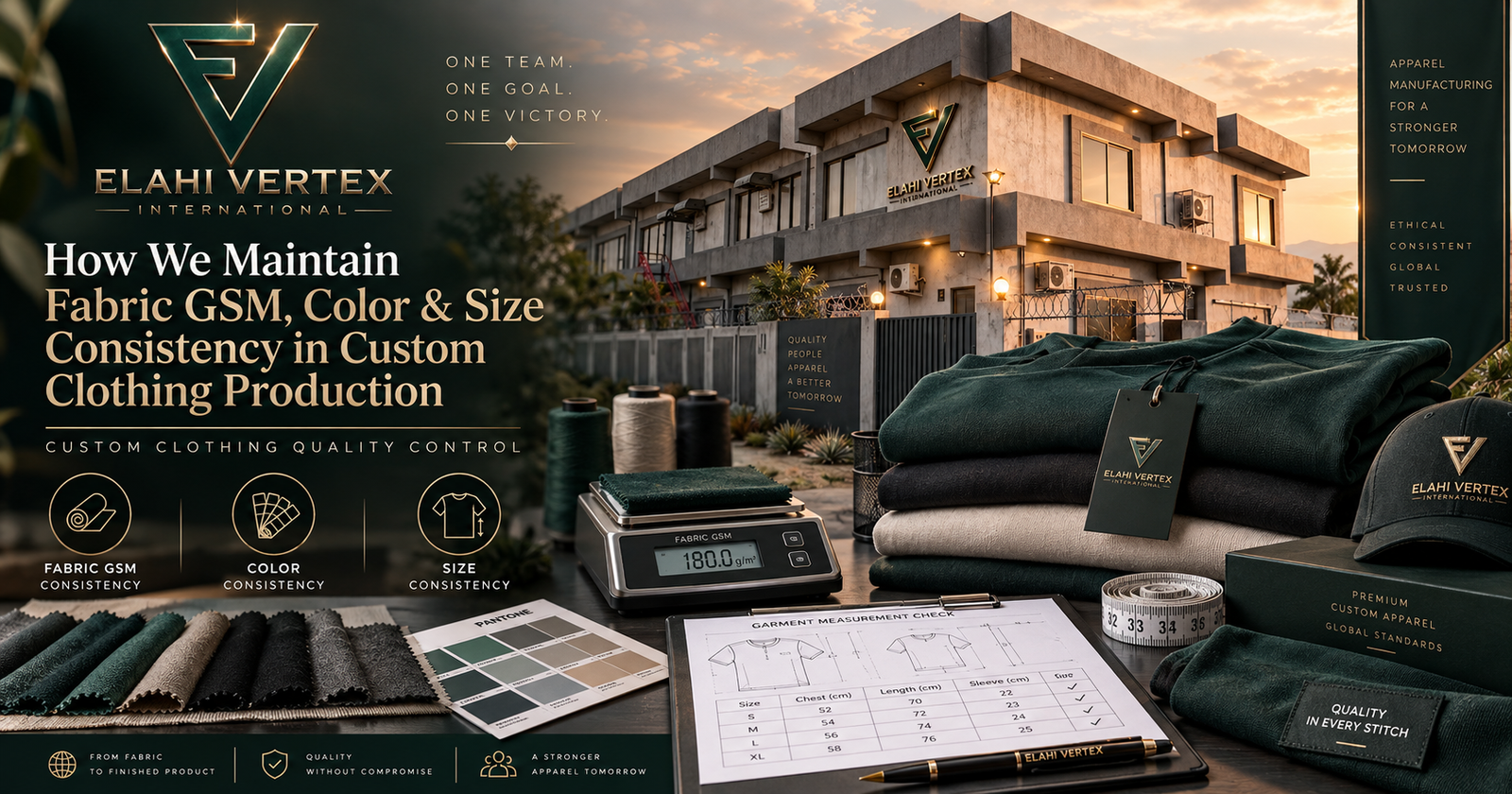
For clothing brands, approving a good sample is only the beginning. The real test starts when bulk production must reproduce the same fabric weight, color appearance, measurements, construction and finish across the full order.
That is where custom clothing quality control becomes commercially important.
A hoodie that feels lighter than the approved sample, a black fabric that shifts shade between production batches, or an oversized T-shirt that no longer follows the approved size chart can create returns, customer complaints, delayed launches and unnecessary inventory risk. Those problems are not minor technical details; they can directly affect how customers judge a brand.
At Elahi Vertex International, our published quality-control approach focuses on comparing production with approved specifications. Effective custom clothing quality control can cover fabrics and materials, measurements, stitching, garment construction, printing, embroidery, colors, labels, branding, finishing and final appearance.
This guide explains how fabric GSM, color and garment sizing should be controlled, what buyers should define before production, and how custom clothing quality control can reduce preventable differences between an approved sample and a bulk clothing order.
[FEATURED IMAGE — PLACE AFTER INTRODUCTION]
Table of Contents
- What Is Clothing Quality Control?
- Why GSM, Color and Size Consistency Matter
- How Fabric GSM Consistency Is Controlled
- How Color Consistency Is Controlled
- How Size and Measurement Consistency Is Controlled
- Why Approved Samples Matter
- Quality Control During Bulk Production
- What Causes Production Inconsistency?
- Buyer Quality-Control Checklist
- How Elahi Vertex International Approaches Quality Control
- Common Buyer Mistakes
- Frequently Asked Questions
- Conclusion
1. What Is Custom Clothing Quality Control?
Custom clothing quality control is the process of checking materials, measurements, workmanship, colors, branding and finished garments against agreed production specifications.
The key phrase is agreed production specifications. Quality cannot be evaluated properly if the buyer and manufacturer never define what the product is supposed to be.
A production-ready specification should normally clarify:
- Fabric composition
- Target GSM
- Color reference
- Size chart
- Points of measurement
- Intended fit
- Garment construction
- Printing or embroidery
- Labels
- Trims
- Packaging
- Approved sample
A vague instruction such as “make it premium” is not a measurable manufacturing requirement. One person may interpret “premium” as heavier fabric, while another may associate it with finer yarn, softer finishing, stronger stitching or more expensive trims.
A better specification identifies the intended fabric, target weight, color standard, measurements, construction details and branding requirements. This gives both parties a reference that can be checked.
For that reason, custom clothing quality control should begin before bulk production. The purpose is not simply to inspect completed garments. It is to establish the product requirements early enough that production can be compared against them.
Elahi Vertex International’s custom manufacturing inquiry process allows buyers to provide details such as fabric type, GSM, fit style, printing technique, labels, branding, size information and custom size-chart instructions. Clearer inputs create a stronger foundation for consistent output.
For international buyers, clear documentation also makes supplier communication easier. A specification sheet can record the approved fabric, color reference, measurements, artwork version, label position and packaging requirement in one place. When revisions are made, the latest approved version should replace older instructions so production teams are not working from conflicting files. This document-control habit can reduce preventable misunderstandings and gives both buyer and manufacturer a clearer reference when reviewing samples, bulk production and finished goods before shipment.
2. Why GSM, Color and Size Consistency Matter
A practical quality-control system should focus on characteristics that affect the buyer’s finished product and customer experience.
Three areas deserve particular attention:
| Quality Factor | What Can Go Wrong | Commercial Effect |
|---|---|---|
| Fabric GSM | Fabric feels lighter or heavier than approved | Different hand feel, drape and perceived value |
| Color | Bulk shades differ from the approved reference | Collection inconsistency and customer complaints |
| Measurements | Garments differ from the approved size chart | Poor fit, returns and sizing complaints |
Customers do not see the production explanation behind a garment. They experience the final product.
If a hoodie feels noticeably thinner than expected, buyers may consider it lower quality. If different pieces from the same colorway do not look consistent, the collection can appear poorly controlled. If the chest, length or sleeves vary beyond the agreed requirements, sizing confidence can fall quickly.
That is why the quality-control process should be built around measurable references rather than assumptions.
The buyer should know what has been approved, and the manufacturer should know exactly what must be reproduced.
3. How Fabric GSM Consistency Is Controlled
Fabric weight is one of the most important elements of custom clothing quality control, particularly for hoodies, sweatshirts, T-shirts, joggers, sportswear, activewear and streetwear.
What Does GSM Mean in Clothing?
GSM means grams per square metre. It describes fabric mass per unit area and is commonly used when specifying textile weight.
GSM can be relevant for products including:
- T-shirts
- Hoodies
- Sweatshirts
- Joggers
- Tracksuits
- Sportswear
- Teamwear
- Activewear
- Streetwear
ASTM D3776/D3776M provides recognized methods for determining fabric mass per unit area. The specific method used for a project should depend on the fabric and agreed testing requirement.
The main point for buyers is simple: fabric weight should be treated as something measurable.
Descriptions such as “light,” “medium,” “heavy,” “thick” or “premium” can help communicate intent, but they should not replace a clear GSM requirement when fabric weight matters commercially.
Why GSM Consistency Matters
GSM can influence:
- Hand feel
- Drape
- Warmth
- Structure
- Opacity
- Finished garment weight
- Perceived quality
- Printing behavior
- Seasonal suitability
Two fabrics can look similar in product photographs while feeling very different in person. Even fabrics with similar nominal weights may behave differently because composition, yarn, knit structure and finishing also matter.
For this reason, the QC process should connect the target GSM with an approved fabric reference rather than treating GSM as an isolated number.
A Practical GSM Control Process
A sensible process can include the following steps.
1. Confirm the Target GSM
The required fabric weight should be documented before production. If an acceptable tolerance is important to the buyer, that tolerance should also be agreed rather than assumed.
2. Approve the Fabric Reference
The buyer and manufacturer should agree on the fabric before full production. Depending on the project, this may involve a swatch, sample garment or another approved material reference.
3. Review Bulk Production Material
The material intended for bulk production should correspond with the agreed specification before large quantities are cut and sewn.
4. Address Meaningful Differences Early
If a significant discrepancy is identified, it is easier to resolve before the entire order has been completed.
This preventive approach makes quality control more valuable than discovering a fabric-weight issue after hundreds of garments have already been packed.
Elahi Vertex International publicly identifies fabric and material inspection as part of its quality-focused process and allows buyers to provide custom GSM requirements. Exact laboratory procedures or tolerances should be confirmed for each project.
What Buyers Should Put in Their Tech Pack
Instead of writing:
Heavy cotton hoodie
write something more specific:
Fabric: Cotton fleece
Target GSM: Agreed project-specific GSM
Color: Approved reference
Fit: Oversized, regular or custom
Finish: Agreed project-specific finish
Wash: Specify when applicable
Better specifications make production control easier because the production team has a defined target.
[IMAGE 2 — PLACE AFTER H2: HOW FABRIC GSM CONSISTENCY IS CONTROLLED]
4. How Color Consistency Is Controlled
Color consistency is another major part of garment quality assurance.
A color that appears correct on a digital screen may not reproduce identically on textile material. Color appearance can be influenced by:
- Fiber composition
- Fabric construction
- Dyeing
- Surface texture
- Finishing
- Lighting
- Printing method
- Production batches
- Screen calibration
That is why instructions such as “dark green” or “same blue as the image” leave too much room for interpretation.
Use an Approved Color Reference
Professional color communication can use recognized or physical references such as:
- Pantone textile references
- Approved fabric swatches
- Lab dips
- Strike-offs
- Physical reference samples
- Approved production samples
Pantone’s Fashion, Home + Interiors system is widely used for textile and apparel color communication.
Using an agreed reference strengthens production consistency because the buyer and manufacturer can compare the product against a defined target rather than a subjective color name.
Why Screen Color Is Not Enough
The same digital color can appear different on:
- Smartphones
- Laptops
- Professional monitors
- Printed paper
- Cotton
- Polyester
- Leather
- Different surface textures
Physical or standardized references can therefore provide stronger production guidance.
Visual and Instrumental Color Evaluation
Textile color may be evaluated visually or with appropriate measurement systems. AATCC publishes procedures relating to textile color assessment and instrumental color measurement.
The correct method and acceptable difference depend on the project. If the buyer needs a defined color tolerance, it should be discussed before bulk production.
Questions Buyers Should Ask
Strong color control starts with specific questions:
- What color reference will be used?
- Does the body fabric require a textile color reference?
- Should rib, drawcords and trims match the body?
- Is tonal variation acceptable?
- Are print colors specified separately?
- Is a garment wash or special finish involved?
- What happens if bulk color differs materially from the approved reference?
These questions give clearer manufacturing guidance than simply asking whether a supplier can “match the color.”
[IMAGE 3 — PLACE AFTER H2: HOW COLOR CONSISTENCY IS CONTROLLED]
5. How Size and Measurement Consistency Is Controlled
Sizing is one of the areas where quality assurance can directly affect customer satisfaction.
A size label by itself is not a complete manufacturing specification.
“Medium” is not universal. A size M oversized streetwear T-shirt can have very different dimensions from a size M performance jersey.
The important production reference is usually the approved measurement specification.
Start With a Clear Size Chart
Depending on the garment, a size chart may define:
- Chest width
- Body length
- Shoulder width
- Sleeve length
- Waist
- Hip
- Inseam
- Thigh
- Rise
- Leg opening
Elahi Vertex International’s custom inquiry workflow allows buyers to provide custom size-chart instructions.
For effective garment measurement control, the size chart should be reviewed and confirmed before bulk production.
Define Points of Measurement
Even a detailed size chart can be ambiguous if the measurement method is unclear.
For example:
Chest: 60 cm
can still leave several questions:
- Is it measured flat?
- At what point below the armhole?
- Is the fabric relaxed or stretched?
- Is the measurement taken before or after washing?
- Does 60 cm represent half-chest width or full circumference?
A professional specification should define the relevant points of measurement, commonly called POMs.
This helps turn garment inspection from subjective judgment into a more measurable process.
Consider Dimensional Change
Textiles can change dimensions after washing, drying or finishing.
ISO 5077 provides a method for determining dimensional change after washing and drying, while ISO 3759 covers preparation, marking and measurement for dimensional-change testing.
Where dimensional stability is commercially important, the required testing method and acceptable limits should be agreed for the specific project.
6. Approved Samples Strengthen Custom Clothing Quality Control
A tech pack explains what the manufacturer should make.
An approved sample provides a physical reference showing how those instructions should come together.
The strongest custom clothing quality control process uses written specifications and approved physical references together.
A strong approval package may include:
- Approved sample
- Fabric specification
- GSM requirement
- Color reference
- Size chart
- Measurement method
- Artwork
- Print dimensions
- Embroidery dimensions
- Label placement
- Trim specifications
- Wash or finishing requirements
- Packaging instructions
Once these details are approved, bulk production has a clearer benchmark.
Elahi Vertex International states that its quality-focused process aims for bulk production to follow the approved sample and agreed product requirements as closely as possible.
For brands, this means quality requirements should be discussed before an order enters full production rather than after completed goods are ready for shipment.
A buyer should also keep a record of approved revisions. If a sample requires changes, those changes should be documented clearly so that an outdated version does not become the production reference.
7. Custom Clothing Quality Control During Bulk Production
One of the biggest sourcing mistakes is treating quality control as something that happens only at the end.
By that stage, a systematic problem may already affect a substantial portion of the order.
A stronger custom clothing quality control approach places checks at relevant production stages.
Stage 1 — Specification Review
Confirm the product requirements before production:
- Fabric
- GSM
- Color
- Measurements
- Fit
- Construction
- Branding
Stage 2 — Sample Approval
Compare the sample with the agreed requirements. Required corrections should be documented before bulk production begins.
Stage 3 — Material Review
Production materials should correspond with the approved specification.
Stage 4 — Production Checks
Relevant checks can include:
- Cutting
- Stitching
- Measurements
- Construction
- Printing
- Embroidery
- Color
- Branding
Stage 5 — Finished Garment Review
Finished goods can be reviewed for:
- Measurements
- Workmanship
- Labels
- Branding
- Finishing
- Appearance
- Packing requirements
Using multiple checkpoints makes custom clothing quality control more preventive and less dependent on discovering problems at the last stage.
Elahi Vertex International’s published quality-control information identifies fabrics and materials, measurements, stitching, garment construction, printing, embroidery, colors, labels, branding, finishing and final appearance as relevant inspection areas.
8. What Causes GSM, Color or Size Inconsistency?
Understanding why inconsistencies happen makes quality control more effective.
GSM Variation
Possible causes include:
- Different fabric specifications
- Material substitution
- Fabric-construction differences
- Different finishing
- Production-batch differences
- Incomplete specifications
Color Variation
Possible causes include:
- Different dye lots
- Different fibers
- Fabric finishing
- Poor color references
- Different lighting conditions
- Printing variation
- Wash treatments
Size Variation
Possible causes include:
- Pattern differences
- Incorrect grading
- Cutting variation
- Sewing construction
- Fabric stretch
- Shrinkage
- Different measurement methods
- Undefined tolerances
A mature custom clothing quality control process focuses on preventing avoidable variation before it becomes a finished-product problem.
That does not mean every manufactured piece will be mathematically identical. Textile production involves materials and processes that can have normal variation. What matters is that commercially important requirements are defined clearly and that acceptable tolerances are agreed where necessary.
9. Custom Clothing Quality Control Checklist for Buyers
Before approving a custom clothing order, buyers can use this custom clothing quality control checklist.
Fabric
- Confirm fabric composition
- Confirm fabric construction
- Confirm target GSM
- Approve hand feel where relevant
- Confirm finish
- Confirm stretch characteristics where applicable
Color
- Supply approved color reference
- Approve main body color
- Confirm contrast colors
- Confirm rib and trim colors
- Confirm print colors
- Approve special wash effects where applicable
Measurements
- Confirm size chart
- Confirm points of measurement
- Confirm intended fit
- Confirm grading
- Agree relevant measurement tolerances
- Discuss dimensional-change requirements where necessary
Construction
- Confirm stitch requirements
- Confirm seam construction
- Confirm collar, cuff and waistband construction
- Confirm pockets
- Confirm zippers, snaps or buttons
Branding
- Confirm logo dimensions
- Approve artwork
- Confirm printing technique
- Confirm embroidery requirements
- Confirm neck labels
- Confirm care labels
- Confirm hangtags
Final Production
- Keep the approved sample as a reference
- Document bulk production specifications
- Confirm inspection requirements
- Confirm packaging
- Confirm shipment requirements
Following this buyer QC checklist helps reduce ambiguity between the buyer and manufacturer.
[INFOGRAPHIC — PLACE AFTER BUYER QUALITY-CONTROL CHECKLIST]
10. How Elahi Vertex International Approaches Custom Clothing Quality Control
Elahi Vertex International is a B2B custom clothing manufacturer and exporter based in Sialkot, Pakistan.
Its custom manufacturing categories include:
- Sportswear
- Teamwear
- Streetwear
- Activewear
- Boxing wear
- Leather wear
- Hoodies and sweatshirts
- Private-label clothing
The company’s published custom clothing quality control approach states that quality checks can cover:
- Fabrics and materials
- Measurements
- Stitching
- Garment construction
- Printing
- Embroidery
- Colors
- Labels and branding
- Finishing
- Final appearance
The objective is to compare finished production with approved product requirements.
Elahi Vertex International’s manufacturing workflow also covers product development, sampling, bulk production, quality inspection, packaging and shipping.
Exact GSM tolerance, color tolerance, shrinkage limit, laboratory-testing requirement or measurement tolerance should be confirmed for each individual project rather than assumed.
That distinction matters because effective custom clothing quality control depends on clearly agreed requirements.
11. Common Custom Clothing Quality Control Mistakes
A strong quality-control process also requires buyers to avoid specification mistakes that create unnecessary production risk.
1. Approving Only a Product Photo
A photograph cannot define GSM, fabric composition or exact garment measurements.
2. Using Generic Color Names
“Cream,” “navy” and “forest green” are subjective descriptions. Use an approved reference where accurate color matching matters.
3. Sending No Size Chart
Never assume one manufacturer’s size M automatically matches another manufacturer’s size M.
4. Forgetting Measurement Methods
Define where and how important measurements should be taken.
5. Ignoring Fabric Weight
Two garments can look similar while feeling very different because of fabric weight, construction or finishing.
6. Changing Specifications After Approval
Late changes can increase the risk of inconsistency, rework and production delays.
7. Assuming Sample and Bulk Will Automatically Match
The approved sample should remain part of the production reference.
8. Checking Quality Only After Shipment
Quality control should begin before manufacturing, not after the buyer receives the goods.
9. Leaving Important Tolerances Undefined
Where tolerances matter commercially, agree them before production.
10. Choosing a Supplier Only by Lowest Price
Price should be assessed alongside materials, sampling, production requirements, communication, quality expectations and commercial terms.
12. Frequently Asked Questions About Custom Clothing Quality Control
1. What is custom clothing quality control?
Custom clothing quality control is the process of evaluating fabrics, measurements, workmanship, colors, branding and finished garments against approved production requirements.
2. Why is custom clothing quality control important?
Custom clothing quality control helps reduce unwanted differences between approved specifications and finished bulk production.
3. What does GSM mean in clothing manufacturing?
GSM means grams per square metre. It describes fabric mass per unit area.
4. How is fabric GSM checked?
Fabric mass per unit area can be evaluated using appropriate textile-testing methods. ASTM D3776/D3776M is one recognized reference.
5. Can two fabrics with the same GSM feel different?
Yes. Fiber composition, yarn, knitting or weaving structure, finishing and surface treatments can affect fabric feel even when nominal GSM is similar.
6. How does custom clothing quality control improve color consistency?
Custom clothing quality control improves color communication by establishing an approved reference and comparing relevant production material with the agreed requirement.
7. Is Pantone useful for clothing production?
Pantone systems are widely used for standardized color communication, including textile and apparel applications.
8. Why might fabric look different from a digital design?
Screens, lighting, fiber composition, surface texture, dyeing and printing can influence perceived color.
9. How is size consistency controlled?
Size consistency starts with a clear measurement chart, defined points of measurement, fit approval and production checks.
10. What is a point of measurement?
A point of measurement defines exactly where a garment dimension should be measured.
11. Why is sample approval important?
The approved sample gives the buyer and manufacturer a physical reference for materials, construction, fit and appearance.
12. Does washing affect garment dimensions?
It can. Some textiles may shrink, expand or otherwise change dimensions after washing, drying or finishing.
13. Should a brand provide its own size chart?
A brand with proprietary sizing should provide its own chart and measurement instructions.
14. What should custom clothing quality control check before bulk production?
Custom clothing quality control before bulk production can review fabric, GSM, color references, measurements, fit, construction, artwork, branding and approved samples.
15. What should be checked during production?
Relevant areas can include measurements, stitching, garment construction, printing, embroidery, colors and branding.
16. What should be checked before shipment?
Finished garments can be reviewed against agreed measurements, workmanship, appearance, branding, packaging and other approved requirements.
17. Does Elahi Vertex International perform custom clothing quality control?
Elahi Vertex International publishes a custom clothing quality control approach covering relevant areas including fabrics, measurements, stitching, construction, decoration, colors, branding, finishing and final appearance.
18. Can buyers specify custom GSM?
Buyers can provide custom fabric and GSM requirements when discussing their manufacturing project.
19. Can buyers provide a custom size chart?
Yes. Custom size-chart instructions can be supplied for project evaluation and production planning.
20. What information should buyers provide for custom clothing quality control?
For effective custom clothing quality control, buyers should provide the product design, fabric specification, target GSM, color reference, size chart, measurement instructions, artwork, branding details and relevant testing requirements.
21. Can custom clothing quality control prevent every possible variation?
No manufacturing process should be described as completely variation-free. The purpose of custom clothing quality control is to establish agreed specifications, identify meaningful inconsistencies and reduce avoidable production risk.
22. When should quality requirements be discussed?
Quality requirements should be discussed before sampling and confirmed before bulk production. Early agreement gives the quality process a clear benchmark.
13. Conclusion: Custom Clothing Quality Control Starts Before Bulk Production
Effective custom clothing quality control is not simply about identifying defects at the end of manufacturing.
It begins by making the garment specification measurable.
The manufacturer should understand:
- What fabric is approved
- What GSM is required
- What color reference applies
- What measurements define each size
- How the garment should be constructed
- What sample has been approved
- What branding must be reproduced
- What testing or tolerance requirements apply
When these details are clearly documented, GSM, color and sizing can be evaluated against defined requirements rather than subjective expectations.
At Elahi Vertex International, the published quality-control approach focuses on relevant areas including materials, measurements, construction, decoration, branding, colors, finishing and final appearance.
For brands, effective custom clothing quality control starts with a clear tech pack, an approved reference, measurable requirements and communication before bulk production.
Ready to Produce With Clear Quality Standards?
Do not leave fabric weight, color, sizing or branding to assumptions.
Send Elahi Vertex International your tech pack, target GSM, fabric requirements, color reference, size chart, artwork, quantity and delivery destination. The clearer the production requirements are before manufacturing begins, the stronger the foundation for consistent bulk production.
Start your custom clothing project:
WhatsApp: https://wa.me/message/OWIPAIXYWHTPI1
Email: elahivertexinternational@gmail.com
Website: https://www.elahivertexinternational.com/
Alibaba: https://elahivertexinternational.trustpass.alibaba.com/
Define it. Approve it. Control it. Then manufacture it.
Useful External Resources
- ASTM International — ASTM D3776/D3776M: useful technical reference for determining fabric mass per unit area and GSM-related testing.
- AATCC — Textile Test Methods: useful for textile testing, color measurement and visual color assessment.
- Pantone — Color Systems: useful for standardized textile and apparel color communication.
- ISO 5077: useful reference for determining dimensional change after washing and drying.
- ISO 3759: useful reference for preparation, marking and measurement during dimensional-change testing.
Ready to Put Your Custom Clothing Quality Control Requirements Into Production?
A strong sample is valuable, but the real goal is maintaining the approved fabric GSM, color, sizing, construction, branding and finishing when the order moves into bulk production.
If you are preparing a new collection, start by reviewing how Elahi Vertex International handles custom clothing manufacturing, then review our dedicated quality-control process before submitting your specifications.
Send us your:
- Tech pack or product design
- Fabric composition and target GSM
- Pantone or approved color reference
- Size chart and measurement points
- Printing or embroidery artwork
- Labels and branding requirements
- Order quantity
- Delivery destination
Your requirements can then be reviewed against the relevant manufacturing specifications before production begins.
Start Your Custom Clothing Project
Review our manufacturing process:
Custom Clothing Manufacturing
See how production quality is reviewed:
Quality Control
Understand the production workflow:
Manufacturing Process
Planning private-label production?
Private Label Manufacturing
Ready to submit your specifications?
Contact Elahi Vertex International
WhatsApp: https://wa.me/message/OWIPAIXYWHTPI1
Email: elahivertexinternational@gmail.com
Website: https://www.elahivertexinternational.com/
Alibaba: https://elahivertexinternational.trustpass.alibaba.com/
Verify the Technical Requirements Before You Approve Production
For buyers who want to understand the technical principles behind custom clothing quality control, these authoritative resources support the key areas discussed in this guide:
ASTM International — Fabric GSM / Weight
ASTM D3776/D3776M covers recognized methods for determining fabric mass per unit area. Use it as a technical reference when defining or evaluating fabric-weight requirements.
Pantone — Textile & Apparel Color Communication
Pantone’s Fashion, Home + Interiors system provides standardized color references for fashion and textile applications, helping brands communicate color requirements more precisely.
ISO 5077 — Dimensional Change After Washing & Drying
ISO 5077 provides a standardized method for determining dimensional changes in fabrics and garments after specified washing and drying procedures.
Clear specifications create clear production targets.
Define the fabric. Approve the GSM. Confirm the color. Lock the size chart. Approve the sample. Then move into bulk production with measurable requirements—not assumptions.
Start your next custom clothing order with Elahi Vertex International today.





One thought on “How We Maintain Fabric GSM, Color & Size Consistency in Custom Clothing Production”
Comments are closed.