

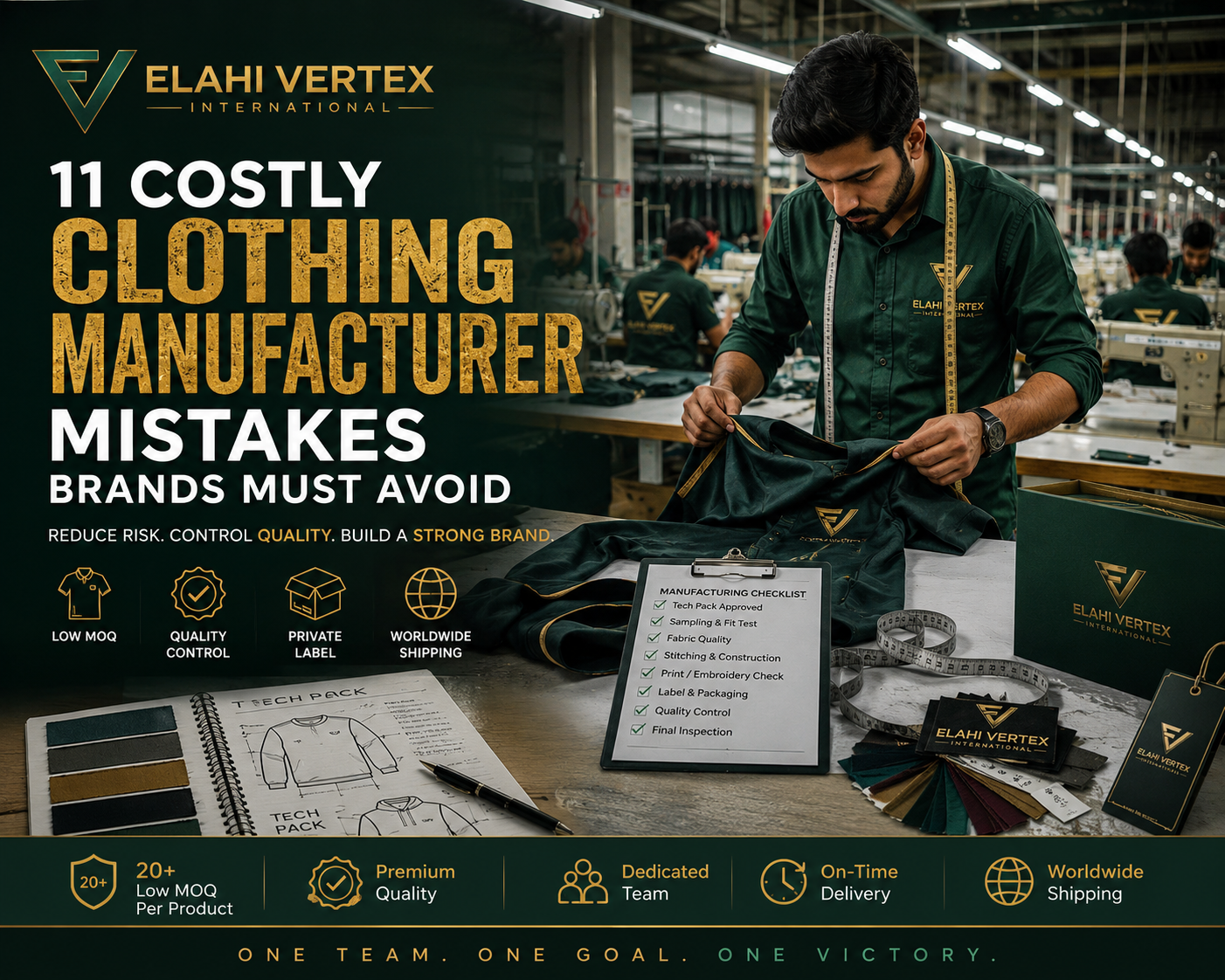
Starting a clothing brand is exciting until the idea has to become a physical product.
A design can look perfect on a screen. Your logo can be ready. Your website can be nearly finished. You may already know your target customer, selling price, packaging style, and launch strategy.
Then comes one decision capable of affecting almost everything else:
Choosing the right clothing manufacturer.
The wrong clothing manufacturer can turn an exciting launch into months of corrections, delayed deliveries, inconsistent sizing, unexpected costs, poor clothing samples, quality control disputes, and inventory that does not match what your customers expected.
For a startup brand, these problems can be especially damaging.
An established company may have enough capital, inventory, staff, and supplier relationships to absorb a production problem. A startup brand usually does not have the same protection. One bad bulk production order can consume a large part of its available cash.
That is why finding a clothing manufacturer should not simply be a search for the lowest quotation.
It should be a process of reducing manufacturing risk.
A reliable clothing factory should be able to help transform your specifications into repeatable products. A capable clothing supplier should understand what needs to happen between clothing samples and bulk production. A serious private label partner should understand that labels and packaging are only one part of building a commercially viable product.
And when a startup brand chooses a low MOQ, that decision should be connected to a larger strategy: validate the product, protect cash flow, learn from the market, and scale the products that actually sell.
This guide explains 11 costly clothing manufacturer mistakes brands should avoid, especially when sourcing custom clothing, private label products, clothing samples, and bulk production internationally.
Whether you are launching your first startup brand or replacing an existing clothing supplier, the objective is the same:
Choose a clothing manufacturer based on evidence, not promises.
Table of Contents
- Choosing a Clothing Manufacturer Only Because the Price Is Low
- Ignoring Clothing Samples Before Bulk Production
- Accepting a High MOQ Before Validating Demand
- Sending Incomplete Product Specifications
- Failing to Verify the Clothing Factory
- Ignoring Quality Control Until Production Is Finished
- Comparing Garment Price Instead of Total Landed Cost
- Ignoring Communication Quality
- Assuming the First Successful Order Guarantees Future Quality
- Choosing a Clothing Supplier That Cannot Scale
- Starting Bulk Production Without Clear Approval Points
- How to Compare Clothing Manufacturers Properly
- What Startup Brands Should Ask Before Paying
- Clothing Manufacturer Red Flags
- Building a Lower-Risk Manufacturing Process
- Why Elahi Vertex International
- Frequently Asked Questions
- Final Clothing Manufacturer Checklist
Why Choosing the Right Clothing Manufacturer Matters
Your clothing manufacturer affects considerably more than stitching.
The clothing factory you select can influence:
- fabric consistency;
- garment measurements;
- pattern accuracy;
- printing quality;
- embroidery quality;
- stitching;
- trims;
- labels;
- packaging;
- clothing samples;
- quality control;
- production timing;
- bulk production;
- shipping;
- landed cost;
- reorder consistency;
- customer satisfaction.
This makes manufacturer selection one of the most consequential operating decisions for a startup brand.
Consider a simple example.
A startup brand wants to launch an oversized heavyweight T-shirt.
The founder contacts several factories.
One clothing supplier quotes $8.50 per piece.
Another clothing manufacturer quotes $10.50.
Looking only at the garment price makes the first clothing supplier appear 19% cheaper.
But that comparison means very little unless both quotations cover the same product.
The first quotation could be based on a lighter fabric.
It might exclude custom labels.
Packaging may cost extra.
Printing may be calculated separately.
The clothing samples may require another payment.
International shipping may not be included.
The dimensions might be based on the clothing factory’s standard pattern rather than the startup brand’s requested oversized fit.
The second clothing manufacturer might have included more of those requirements.
The apparently expensive quotation could therefore produce a lower real cost.
This is one reason professional sourcing requires specification-level comparisons.
Price without specification equivalence is not a useful comparison.
The same principle applies to low MOQ offers, private label packages, clothing samples, and bulk production quotations.
A clothing manufacturer should be evaluated as a complete production system.
Mistake 1: Choosing a Clothing Manufacturer Only Because the Price Is Low
Price matters.
Pretending otherwise would be unrealistic.
A startup brand needs sufficient gross margin to pay for marketing, fulfillment, payment processing, returns, overhead, customer acquisition, and future inventory.
But choosing a clothing manufacturer primarily because it submitted the lowest quotation is dangerous.
The cheapest clothing supplier may genuinely be efficient.
It may have favorable fabric sourcing.
It may specialize in your product.
It may have lower overhead.
Those are legitimate reasons for competitive pricing.
But a low quotation can also result from differences that are not immediately visible.
These could include:
- lighter fabric;
- different fabric composition;
- simpler construction;
- cheaper trims;
- basic packaging;
- fewer quality control stages;
- lower-cost printing;
- standard patterns instead of custom development;
- excluded shipping;
- excluded labels;
- excluded duties;
- excluded sampling;
- larger MOQ assumptions.
Compare the Same Product
Suppose three clothing manufacturers quote your hoodie.
| Requirement | Clothing Factory A | Clothing Factory B | Clothing Factory C |
|---|---|---|---|
| Garment Price | $15 | $18 | $21 |
| Fabric | 280 GSM | 350 GSM | 400 GSM |
| Custom Labels | Extra | Included | Included |
| Embroidery | Extra | Included | Included |
| Packaging | Basic | Custom | Custom |
| Clothing Samples | Extra | Separate | Separate |
| Quality Control | Unclear | Included | Included |
| Shipping | Excluded | Excluded | Included |
Which clothing manufacturer is cheapest?
You cannot answer accurately from the first row.
That is precisely the problem.
A startup brand should create one specification and ask every clothing supplier to quote against the same specification.
That includes:
Product construction
What exactly is being manufactured?
Fabric
Composition, GSM, construction, stretch, finish, color, and any special performance requirements.
Customization
Embroidery, screen printing, sublimation, heat transfer, appliqué, washing, patches, or other decoration.
Private label requirements
Neck labels, size labels, care labels, woven labels, hangtags, barcodes, stickers, and packaging.
MOQ
How many pieces are required per product, design, color, or size?
Clothing samples
What does sample development cost and what is included?
Bulk production
What is the expected production period after approval?
Quality control
What inspections occur before shipment?
Shipping
What freight method and destination are being calculated?
Once those variables are aligned, price comparison becomes much more meaningful.
Cheap Manufacturing Can Become Expensive Manufacturing
Imagine saving $2 per garment on 100 pieces.
You save $200.
Now imagine 25 garments have noticeable defects.
If your clothing supplier refuses to remake them, your apparent $200 saving disappears quickly.
Or imagine your startup brand announces a launch date and the bulk production arrives three weeks late.
The direct manufacturing cost may still be low.
The commercial cost may not be.
You could lose:
- pre-orders;
- customer confidence;
- advertising spend;
- launch momentum;
- wholesale opportunities;
- repeat customers.
This does not mean you should choose the most expensive clothing manufacturer either.
High price is not proof of high quality.
The objective is not to find the cheapest clothing factory or the most expensive clothing factory.
The objective is to identify the clothing manufacturer offering the strongest combination of:
product quality + commercial price + communication + low MOQ flexibility + quality control + reliability + scalability + shipping feasibility.
Mistake 2: Ignoring Clothing Samples Before Bulk Production
One of the fastest ways to create unnecessary manufacturing risk is moving directly from an idea to bulk production.
Clothing samples exist for a reason.
A sample allows a startup brand and clothing manufacturer to convert abstract instructions into a physical reference.
A tech pack can communicate measurements.
A Pantone reference can communicate color.
A fabric specification can communicate composition and weight.
A mockup can communicate graphic placement.
But none of them lets you physically examine the finished garment.
A clothing sample can reveal issues that were not obvious in digital files.
These may include:
- neckline shape;
- sleeve length;
- garment balance;
- fabric hand-feel;
- actual color;
- stretch;
- print scale;
- embroidery density;
- logo placement;
- pocket position;
- zipper behavior;
- seam comfort;
- label placement;
- overall silhouette.
A Clothing Sample Is Not Just a Mini Order
Startup brands sometimes evaluate clothing samples only by asking:
“Does it look good?”
That is insufficient.
A clothing sample should be treated as a technical validation tool.
When the clothing manufacturer sends a sample, evaluate it systematically.
Check Measurements
Compare actual measurements against the approved specification.
Do not rely entirely on visual judgment.
A hoodie can look correct while still being several centimeters outside the intended dimensions.
Check Fabric
Confirm:
- composition;
- GSM or expected weight;
- stretch;
- opacity;
- surface;
- softness;
- recovery;
- shrinkage expectations.
Check Construction
Inspect:
- seam alignment;
- stitch consistency;
- reinforcement;
- hems;
- collar construction;
- pockets;
- zippers;
- drawcords;
- bartacks;
- stress points.
Check Customization
For embroidery, examine:
- density;
- edges;
- thread appearance;
- positioning;
- backing.
For printing, examine:
- placement;
- color;
- hand-feel;
- opacity;
- edge definition.
For sublimation, inspect:
- color reproduction;
- alignment;
- image clarity;
- panel matching.
Check Private Label Details
Your private label presentation matters because customers experience the entire product, not merely the fabric.
Check:
- neck label;
- size label;
- care label;
- hangtag;
- barcode;
- polybag;
- folding;
- packaging.
Test the Clothing Sample
Wear it.
Wash it according to the intended care instructions.
Measure it again.
Observe:
- shrinkage;
- twisting;
- color behavior;
- print behavior;
- seam performance;
- shape retention.
A clothing manufacturer cannot control how seriously the buyer evaluates clothing samples.
That responsibility belongs to both parties.
The stronger process is:
Specification → clothing sample → review → correction → approval → bulk production.
Not:
Idea → payment → bulk production → hope.
Mistake 3: Accepting a High MOQ Before Validating Demand
MOQ means minimum order quantity.
For startup brands, MOQ is not merely a manufacturing term.
It is a capital-allocation decision.
A clothing manufacturer may prefer a high MOQ because larger production runs can improve operational efficiency.
Fabric procurement becomes easier.
Machine setup costs can be distributed across more garments.
Printing and embroidery setup becomes more economical.
Packaging purchases become easier.
The clothing factory may therefore have legitimate reasons for requiring volume.
But what benefits the clothing factory does not automatically benefit the startup brand.
Suppose you are launching four products.
A clothing supplier requires 500 pieces per product.
That means 2,000 pieces before you have proven that customers want any of them.
Now add:
- clothing samples;
- labels;
- packaging;
- shipping;
- import charges;
- marketing;
- photography;
- fulfillment.
The financial exposure becomes significant.
Low MOQ Is a Risk-Management Tool
A low MOQ allows a startup brand to test demand with less inventory.
That does not mean low MOQ is always cheaper per piece.
Usually it is not.
Small bulk production runs can cost more per garment because setup and sourcing costs are distributed across fewer pieces.
But consider the correct question.
Do you want:
100 pieces at $14 each that sell
or
500 pieces at $10 each when 350 remain unsold?
The second product has a cheaper unit cost and potentially a much more expensive business outcome.
This is why startup brands should think about low MOQ in terms of inventory risk, not merely garment price.
Elahi Vertex International and Low MOQ
Elahi Vertex International works with a 20-piece MOQ per product/category, allowing qualifying startup brands and growing labels to begin with a smaller production commitment.
That low MOQ should not be interpreted as an invitation to skip product development.
Clothing samples, specifications, quality control, and commercial planning remain important.
Instead, low MOQ can form part of a staged process:
Stage 1 — Develop
Clarify the product and clothing samples.
Stage 2 — Validate
Use low MOQ bulk production to test the product commercially.
Stage 3 — Learn
Identify which sizes, colors, and products sell.
Stage 4 — Reorder
Increase bulk production around demonstrated demand.
Stage 5 — Scale
Negotiate larger quantities and production planning once sales data justifies them.
That is a fundamentally different strategy from ordering large inventory simply because the clothing manufacturer offered a lower unit price.
Mistake 4: Sending an Incomplete Brief to the Clothing Manufacturer
A clothing manufacturer cannot reliably manufacture information it does not have.
This sounds obvious, yet incomplete specifications cause a large percentage of avoidable sourcing friction.
A startup brand sends an inspiration photo and says:
“I want something like this, premium quality.”
What does premium mean?
To one founder, premium could mean 300 GSM cotton.
To another, it could mean 500 GSM.
One may want a boxy fit.
Another wants oversized.
One may expect combed cotton.
Another expects a cotton-polyester blend.
The clothing supplier is now forced to ask questions or make assumptions.
Assumptions create variation.
Variation creates disappointment.
Give the Clothing Factory Objective Specifications
Your product brief should cover as many relevant variables as possible.
Product
Example:
Oversized unisex pullover hoodie.
Fabric
Example:
80% cotton / 20% polyester fleece, target 400 GSM.
Fit
Example:
Dropped shoulder, oversized body, slightly cropped length.
Sizes
S, M, L, XL.
Color
Pantone reference or physical reference where necessary.
Decoration
Left chest embroidery, 80 mm wide.
Back screen print, 300 mm wide.
Labels
Custom woven neck label.
Size label.
Care label.
Packaging
Individual polybag with size sticker.
Quantity
100 pieces.
Shipping Destination
City, postal code, country.
This gives the clothing manufacturer a much stronger basis for quotation and development.
Tech Packs Reduce Ambiguity
A well-built tech pack can include:
- technical drawings;
- measurement charts;
- grading;
- construction notes;
- fabric specifications;
- trim details;
- label placement;
- artwork;
- Pantone colors;
- packaging requirements.
A startup brand without a professional tech pack can still work with some manufacturers, but it should not mistake a reference image for a complete specification.
The more custom the product, the more important technical clarity becomes.
A vague brief does not create manufacturing flexibility. It creates manufacturing uncertainty.
Mistake 5: Failing to Verify the Clothing Factory
A polished website does not prove manufacturing capability.
Neither does a large social-media following.
Neither does a low quotation.
Neither does a salesperson saying, “Yes, we can manufacture everything.”
Before committing meaningful money to a clothing manufacturer, verify what you reasonably can.
Ask What the Clothing Manufacturer Actually Produces
Some apparel businesses are direct factories.
Others coordinate production through subcontractors.
Others may combine internal production with external processes.
That distinction is not automatically good or bad.
Specialized subcontracting is common in global manufacturing.
The important issue is transparency and accountability.
If embroidery, dyeing, printing, washing, or another operation is outsourced, you need to understand who remains responsible for quality control.
Request Relevant Production Evidence
Depending on the project and relationship stage, useful evidence can include:
- factory video;
- video call;
- production photos;
- machinery;
- cutting area;
- sewing lines;
- printing;
- embroidery;
- quality control;
- packing area;
- examples of comparable products.
Do not demand irrelevant proof simply to make sourcing difficult.
Request evidence connected to your product.
If you need sublimated teamwear, evidence of leather-jacket production tells you little about sublimation capability.
If you need heavyweight streetwear, generic soccer jerseys do not prove the clothing factory understands washed heavyweight cotton garments.
Verify Business Information
Check:
- business name;
- location;
- website;
- company email;
- relevant registrations where applicable;
- export history where verifiable;
- independent reviews where meaningful;
- consistency of contact information.
No single verification method eliminates risk.
The objective is to build a collection of consistent evidence.
Mistake 6: Ignoring Quality Control Until Bulk Production Is Finished
Quality control should not begin when cartons are already sealed.
At that stage, the clothing manufacturer has completed most of the expensive work.
Problems are harder to correct.
A stronger quality control process starts much earlier.
Quality Control Begins With Specifications
If the specification says only:
“Make a high-quality black hoodie”
there is no objective standard against which the clothing factory can be evaluated.
Quality control requires measurable expectations.
These might include:
- measurement tolerances;
- fabric specifications;
- approved colors;
- stitching requirements;
- artwork placement;
- label placement;
- packaging requirements.
Quality Control During Clothing Samples
Clothing samples are the first major quality control checkpoint.
Correct issues before bulk production.
Do not approve a clothing sample containing a known defect and assume it will automatically disappear in production.
Document the correction.
Quality Control During Bulk Production
Depending on order size and production structure, quality control may involve checking production while garments are being manufactured.
This can help identify systematic problems before the entire bulk production run is complete.
Final Quality Control
Before shipment, the clothing supplier should have a defined final inspection process.
Relevant checks may include:
- measurements;
- visible defects;
- stitching;
- print;
- embroidery;
- labels;
- size breakdown;
- quantity;
- packaging.
Quality control does not mean perfection is mathematically guaranteed.
Manufacturing involves tolerances.
The important issue is whether the clothing manufacturer and buyer agree on acceptable standards before bulk production.
Mistake 7: Comparing Garment Price Instead of Total Landed Cost
This mistake destroys many apparently attractive sourcing calculations.
The clothing manufacturer quotes:
$12 per hoodie.
The startup brand calculates:
100 × $12 = $1,200.
But $1,200 may not be the amount required to put those products into sellable inventory.
Additional costs can include:
- clothing samples;
- custom labels;
- hangtags;
- printing;
- embroidery;
- packaging;
- cartons;
- freight;
- insurance;
- customs;
- duties;
- local delivery;
- payment fees.
This is why shipping must be part of the pricing analysis.
Ask for Shipping Before Finalizing the Commercial Decision
International shipping depends on factors including:
- destination;
- quantity;
- carton dimensions;
- weight;
- shipping method;
- delivery speed;
- Incoterm.
A clothing supplier cannot responsibly give one universal shipping price for every order.
For an accurate comparison, provide your destination and quantity.
Then compare the commercial picture.
Example
Factory A:
Garment: $11
Customization: $2
Packaging: $0.50
Estimated allocated shipping: $5
Estimated cost before destination-specific taxes/duties:
$18.50
Factory B:
Garment: $14
Customization: included
Packaging: included
Estimated allocated shipping: $3
Estimated cost:
$17
Factory B appeared 27% more expensive when you compared garment price alone.
After other costs, it became cheaper in this simplified example.
This is why a startup brand should never select a clothing manufacturer from one headline number.
Mistake 8: Ignoring Communication Quality
Communication is part of manufacturing quality.
A clothing manufacturer can own excellent machinery and still become a difficult supplier if important instructions are misunderstood, undocumented, or ignored.
Evaluate communication before paying for bulk production.
Does the clothing supplier answer technical questions?
Does the clothing factory acknowledge changes?
Are clothing sample corrections documented?
Does the clothing manufacturer distinguish confirmed information from estimates?
Does the supplier ask questions when your instructions are unclear?
These behaviors matter.
Fast Replies Are Not Enough
A five-minute reply saying “yes, possible” to every question is not necessarily better than a detailed reply several hours later.
Good manufacturing communication should create clarity.
For example:
Weak answer:
“Yes, we can do it.”
Better answer:
“Yes. We can produce the hoodie in the requested fabric range. Before confirming the quotation, please provide the target GSM, quantity, color count, artwork dimensions, size breakdown, and delivery destination.”
The second answer may be less exciting.
It is commercially more useful.
Communication Should Become Documentation
Important decisions should be recorded.
That includes:
- approved clothing samples;
- measurements;
- colors;
- quantities;
- prices;
- customization;
- packaging;
- production dates;
- shipping method.
When instructions change, update the final specification.
Do not expect the clothing factory to reconstruct the final product from hundreds of scattered messages.
Mistake 9: Assuming One Good Order Guarantees Every Future Bulk Production Run
A successful first order is valuable.
It demonstrates that the clothing manufacturer can produce your product under at least one set of conditions.
It does not mean quality control should disappear on the next order.
Variables change.
Fabric batches change.
Colors change.
Production schedules change.
Operators change.
Artwork changes.
Quantities change.
A startup brand may also modify the product.
The solution is not permanent distrust.
The solution is a repeatable production process.
For every meaningful reorder, confirm:
- product version;
- fabric;
- color;
- measurements;
- customization;
- quantities;
- labels;
- packaging;
- quality control requirements;
- shipping.
As the relationship matures, the clothing manufacturer should understand your standards better.
That can reduce friction.
But disciplined documentation remains useful.
Mistake 10: Choosing a Clothing Supplier That Cannot Scale
A low MOQ is useful for a startup brand.
But low MOQ alone does not make a clothing manufacturer suitable for long-term growth.
Ask another question:
What happens if the product works?
Suppose your first bulk production order is 30 pieces.
Then you need 100.
Then 500.
Then 2,000.
Can the clothing supplier maintain:
- fabric consistency;
- sizing;
- customization;
- quality control;
- communication;
- lead times?
If not, your startup brand may have to change manufacturers at precisely the moment sales are accelerating.
That creates another round of:
- sourcing;
- clothing samples;
- pattern corrections;
- fabric matching;
- negotiation;
- quality control;
- shipping setup.
Startup-Friendly Should Also Mean Scale-Friendly
The ideal relationship is not necessarily:
small clothing factory forever.
Nor is it:
largest clothing manufacturer possible.
The goal is to find a clothing manufacturer whose capabilities fit your current requirements while leaving reasonable room for growth.
Ask prospective manufacturers:
- What is your normal production capacity?
- What order sizes do you handle?
- How do lead times change at higher quantities?
- Can approved patterns/specifications be retained for repeat orders?
- How do you manage quality control as quantities increase?
- Which processes are internal and which are external?
The answers help determine whether the clothing supplier fits your future as well as your present.
Mistake 11: Starting Bulk Production Without Clear Approval Points
A startup brand should know exactly when the clothing manufacturer is authorized to proceed.
Without approval points, changes can become expensive.
A sensible workflow can look like this:
1. Product Brief
The startup brand sends product requirements.
2. Feasibility Review
The clothing manufacturer evaluates the request.
3. Indicative Commercial Discussion
MOQ, approximate pricing, customization, and shipping requirements are discussed.
4. Clothing Samples
The clothing factory develops the product.
5. Sample Review
The startup brand checks fit, fabric, construction, branding, and measurements.
6. Corrections
Necessary changes are documented.
7. Final Approval
The buyer confirms the approved production specification.
8. Bulk Production
The clothing manufacturer begins the production run.
9. Quality Control
The production is checked against the agreed requirements.
10. Packing
Approved garments are packed according to requirements.
11. Shipping
The order is dispatched according to the agreed shipping arrangement.
Every clothing manufacturer will have its own workflow.
The exact number of stages is less important than having a clear process.

How to Compare Clothing Manufacturers Properly
Do not compare manufacturers from memory.
Build a supplier comparison sheet.
Use the same criteria for each clothing factory.
| Criterion | Manufacturer A | Manufacturer B | Manufacturer C |
|---|---|---|---|
| Product specialization | |||
| MOQ | |||
| Clothing samples | |||
| Fabric options | |||
| Custom clothing capability | |||
| Private label options | |||
| Quality control | |||
| Bulk production time | |||
| Communication | |||
| Packaging | |||
| Shipping | |||
| Total estimated cost | |||
| Scaling capacity | |||
| Verification evidence |
Then score each clothing manufacturer.
This prevents one attractive feature from dominating your decision.
A clothing factory offering the lowest MOQ may have weak communication.
Another clothing supplier may have excellent clothing samples but unsuitable bulk production times.
Another private label manufacturer may have good production but expensive shipping to your destination.
Manufacturer selection is a multi-variable decision.
What Startup Brands Should Ask a Clothing Manufacturer
Before paying a clothing supplier, ask questions relevant to your project.
1. What Is Your MOQ?
Clarify whether MOQ means:
- per style;
- per color;
- per size;
- per design;
- total order.
“MOQ 50” can mean very different things.
2. Do You Produce Clothing Samples?
Ask:
- sample price;
- sample lead time;
- customization included;
- shipping cost;
- revision process.
3. What Fabric Will You Use?
Do not accept “premium cotton” as a complete specification.
Ask about:
- composition;
- GSM;
- knit/weave;
- finish;
- stretch where relevant.
4. What Private Label Options Are Available?
Ask about:
- woven labels;
- printed labels;
- heat-transfer labels;
- care labels;
- size labels;
- hangtags;
- packaging.
5. What Is the Bulk Production Lead Time?
Clarify when the clock starts.
After payment?
After clothing sample approval?
After fabric arrival?
6. How Does Quality Control Work?
Ask what is checked and when.
7. Can You Show Relevant Manufacturing Work?
Look for evidence related to your product category.
8. How Is Shipping Calculated?
Provide:
- country;
- city;
- postal code;
- approximate quantity.
9. What Happens If Production Does Not Match the Approved Specification?
Discuss this before there is a problem.
10. Can You Handle Larger Reorders?
A startup brand should know whether the clothing manufacturer can grow with it.
Clothing Manufacturer Red Flags
No single warning sign proves that a supplier is unreliable.
But combinations matter.
Be cautious when a clothing manufacturer:
- refuses to provide meaningful product specifications;
- changes prices repeatedly without explanation;
- pushes immediate bulk production before clothing samples;
- cannot explain its MOQ structure;
- avoids questions about quality control;
- provides inconsistent company information;
- promises unrealistic outcomes without asking technical questions;
- cannot explain shipping terms;
- refuses reasonable verification;
- offers every possible product with no evidence of specialization;
- gives unclear answers about fabrics;
- pressures the startup brand to make a large payment immediately.
A professional clothing supplier should be comfortable discussing details.
That does not mean the manufacturer must reveal confidential information about other customers.
In fact, a clothing factory casually sharing another brand’s confidential designs should make you question how it would protect yours.
Clothing Manufacturer vs Clothing Supplier: Understand Who You Are Working With
The terms clothing manufacturer and clothing supplier are often used interchangeably online, but they can describe different roles.
A clothing manufacturer generally performs or controls manufacturing.
A clothing supplier may manufacture, source, trade, coordinate, or distribute products.
Again, intermediaries are not automatically bad.
A competent sourcing company can add value.
The problem occurs when the startup brand believes it is dealing directly with a clothing factory while the commercial reality is different.
Ask clearly.
Who develops the clothing samples?
Who purchases fabric?
Who cuts the garments?
Who sews them?
Who performs printing or embroidery?
Who conducts quality control?
Who is accountable if something goes wrong?
Accountability matters more than marketing terminology.
Why Private Label Is More Than Adding a Logo
Private label clothing is sometimes presented as:
Choose a blank garment + add logo = clothing brand.
That is one model.
But private label can go much further.
Depending on the clothing manufacturer, a private label project can involve:
- custom patterns;
- custom fabrics;
- custom colors;
- embroidery;
- printing;
- woven labels;
- care labels;
- size labels;
- hangtags;
- packaging;
- product-specific finishing.
A startup brand should decide how differentiated the product needs to be.
If your competitive advantage is primarily marketing and community, an existing silhouette with private label customization may be enough.
If your brand competes on fit, fabric, construction, or technical performance, deeper custom clothing development may be necessary.
There is no universal answer.
The product strategy should determine the manufacturing strategy.
Low MOQ: When It Helps and When It Does Not
Low MOQ has become one of the most searched ideas among startup brands looking for a clothing manufacturer.
It solves a genuine problem.
But low MOQ should not become the only selection criterion.
A clothing factory offering 10 pieces with poor clothing samples, unreliable quality control, and expensive shipping may be a worse option than a clothing supplier requiring 50 pieces.
Use low MOQ when it helps you:
- test demand;
- protect working capital;
- launch more carefully;
- test colors;
- test sizes;
- collect customer feedback;
- reduce dead inventory.
Do not use low MOQ as an excuse to skip:
- product specifications;
- clothing samples;
- quality control;
- cost calculations;
- shipping calculations.
Low MOQ reduces quantity exposure.
It does not automatically eliminate product risk.
Clothing Samples: What Startup Brands Should Actually Approve
Before approving clothing samples, create a checklist.
Appearance
Does the product visually match the intended design?
Measurements
Are critical dimensions within the agreed tolerance?
Fit
Does the garment fit the intended customer?
Fabric
Does the fabric meet the expected weight, composition, stretch, and hand-feel?
Color
Is the color acceptable?
Construction
Are seams, hems, pockets, zippers, and reinforcement correct?
Branding
Are logos and labels positioned correctly?
Print or Embroidery
Is the execution acceptable?
Packaging
Does the final presentation meet the private label requirement?
Wear Test
Does the garment perform appropriately?
Wash Test
Where appropriate, evaluate shrinkage, print behavior, and shape retention.
Once the clothing sample is approved, keep clear records of what was approved.
That approved sample can become an important reference during bulk production and quality control.
What Established Brands Can Teach Startup Brands
You do not need to copy major brands.
You should study how strong brands create clear product identities.
Nike demonstrates the breadth with which a global sports brand can organize products around sport, lifestyle, footwear, and apparel.
Alo Yoga provides another useful reference for how activewear can be organized around lifestyle and activity.
Tracksmith illustrates a much more focused running identity.
YoungLA provides a reference point in contemporary gym and lifestyle apparel.
Represent is useful to study for premium streetwear positioning.
Fear of God demonstrates how a distinctive design language can extend across multiple apparel collections.
Cuts Clothing shows a focused apparel proposition built around a defined customer identity.
Rhone provides another useful reference for performance and lifestyle apparel.
Outdoor Voices demonstrates activity-led merchandising.
Reigning Champ provides a useful reference for premium essentials and fabric-led product presentation.
The lesson is not that a startup brand needs to imitate any of these companies.
The lesson is that successful product businesses generally give customers a reason to understand what the brand stands for and why the product exists.
Your clothing manufacturer should then help translate that product strategy into physical garments.
Compare Clothing Manufacturers, Not Marketing Claims
The internet contains thousands of factories competing for the same search terms.
That is useful for buyers because it creates options.
It also creates noise.
For example, manufacturers publicly advertising startup or private label services include Ready One, Eco Vira, Stitch Core Industries, Sufi Apparel, Urban Flair, Atha Textile, CustomClothing.PK, and IK Industry.
Publicly stated MOQs alone already show why buyers need to compare carefully. Ready One advertises a 50-unit MOQ, Eco Vira states a 30-piece entry minimum, Stitch Core states 30 pieces per design, and Urban Flair states different minimums depending on product complexity.
Those numbers should not be interpreted as a ranking.
They demonstrate something more important:
Different clothing manufacturers operate under different production models.
A startup brand should therefore evaluate the complete offer rather than choosing a clothing factory because one number on its website looks attractive.
A Lower-Risk Clothing Manufacturing Framework
Here is a practical framework a startup brand can follow.
Step 1 — Define the Product
Before contacting a clothing manufacturer, determine:
- product;
- customer;
- target selling price;
- desired quality level;
- approximate quantity;
- customization.
Step 2 — Prepare Specifications
Create a tech pack or sufficiently detailed product brief.
Step 3 — Shortlist Clothing Manufacturers
Choose manufacturers with relevant capabilities.
Step 4 — Compare Like for Like
Send comparable requirements to each clothing supplier.
Step 5 — Verify
Check business information and manufacturing capability.
Step 6 — Discuss MOQ
Determine whether the MOQ matches your risk tolerance.
Step 7 — Calculate Shipping
Do not postpone logistics until after manufacturing decisions are made.
Step 8 — Develop Clothing Samples
Convert the specification into a physical product.
Step 9 — Test and Correct
Evaluate the clothing samples carefully.
Step 10 — Approve
Document the final specification.
Step 11 — Begin Bulk Production
Proceed only after the commercial and technical requirements are clear.
Step 12 — Conduct Quality Control
Check production against the approved specification.
Step 13 — Ship
Confirm the logistics arrangement.
Step 14 — Evaluate the Order
After receiving the products, document:
- defects;
- customer feedback;
- sizing;
- returns;
- best-selling sizes;
- best-selling colors.
Step 15 — Improve the Reorder
Use real sales data to make the next bulk production run better.
That is how manufacturing becomes a system instead of a gamble.
Why Elahi Vertex International Focuses on Reducing Manufacturing Risk
Elahi Vertex International is a custom clothing manufacturer and apparel exporter based in Sialkot, Pakistan, serving startups, brands, teams, clubs, wholesalers, retailers, and private-label businesses. Its published manufacturing capabilities cover product development, fabric sourcing, sampling, customization, bulk production, quality control, packaging, and worldwide shipping.
The objective is not merely to tell a startup brand:
“We can manufacture your clothing.”
That statement is too easy for any clothing supplier to make.
The more important objective is to create a manufacturing process in which the buyer understands what is happening before committing to larger bulk production.
20-Piece MOQ
Elahi Vertex International’s working MOQ starts at 20 pieces per product/category.
For a startup brand, that can reduce the inventory exposure associated with testing a new product.
Clothing Samples
Clothing samples allow the physical product to be evaluated before larger production commitments.
Custom Clothing Development
Projects can be developed around the brand’s designs, specifications, measurements, materials, and branding requirements.
Private Label Manufacturing
Branding can extend beyond a logo to labels, tags, and packaging requirements.
Quality Control
Quality control should connect the approved product requirements to bulk production rather than being treated as an afterthought.
Worldwide Shipping
Shipping should be calculated as part of the commercial decision because a cheap garment with expensive freight may not be commercially competitive.
Scaling
A startup brand should be able to begin carefully and increase bulk production as demand becomes clearer.
That is the manufacturing relationship Elahi Vertex International aims to build:
start with clarity, validate the product, control quality, then scale.
Internal Resources for Clothing Brands
Before beginning production, explore the Elahi Vertex International manufacturing process to understand the available OEM, ODM, private label, customization, quality control, and apparel production capabilities.
For custom development, review Custom Clothing Manufacturing.
You can also visit the Elahi Vertex International homepage to explore sportswear, teamwear, streetwear, boxing wear, activewear, leather wear, and private label categories.
The Most Important Question Is Not “Who Is the Cheapest Clothing Manufacturer?”
Ask instead:
Which clothing manufacturer creates the lowest acceptable risk for the commercial result I need?
That changes the entire sourcing conversation.
You stop looking only at unit price.
You start evaluating:
- clothing samples;
- MOQ;
- quality control;
- communication;
- specifications;
- private label capability;
- bulk production;
- shipping;
- scalability.
For a startup brand, this is particularly important.
Your first production order is not merely inventory.
It is a test of your:
- product;
- manufacturer;
- pricing;
- customers;
- sizing;
- marketing;
- supply chain.
Treat it accordingly.
Frequently Asked Questions About Choosing a Clothing Manufacturer
How do I choose a clothing manufacturer for a startup brand?
Start by defining your product, quantity, fabric, customization, target price, and destination. Shortlist clothing manufacturers with relevant experience, compare equivalent specifications, verify the clothing factory, develop clothing samples, calculate shipping, and review quality control before bulk production.
What is a good MOQ for a startup brand?
There is no universal ideal MOQ. A good MOQ is one that your startup brand can sell commercially without taking unnecessary inventory risk. Low MOQ production can help test demand, although smaller quantities may have higher unit costs.
Should I order clothing samples before bulk production?
For custom clothing, clothing samples are one of the most important risk-control steps. They allow you to evaluate fit, fabric, measurements, construction, branding, and customization before authorizing bulk production.
How do I know whether a clothing manufacturer is legitimate?
Use multiple forms of verification. Review business information, company contact details, relevant production evidence, clothing samples, video calls where appropriate, manufacturing capability, and consistency across communications.
Is the cheapest clothing supplier usually the best option?
No. Nor is the most expensive supplier automatically the best. Compare equivalent products and calculate customization, packaging, clothing samples, quality control, shipping, and other relevant costs.
What does private label clothing mean?
Private label clothing generally means products manufactured for sale under the buyer’s brand. Depending on the clothing manufacturer, this may include custom labels, tags, packaging, printing, embroidery, and deeper product customization.
What is the difference between clothing samples and bulk production?
Clothing samples are development or approval garments used to evaluate the product before larger-scale manufacturing. Bulk production is the production run manufactured after specifications and approvals are established.
Why is quality control important?
Quality control helps identify whether garments match agreed specifications for measurements, construction, customization, labels, appearance, and packaging.
Should shipping be included when comparing clothing manufacturers?
Yes. International freight can materially change the actual cost of sourcing. Compare the total commercial cost rather than garment price alone.
Can a low MOQ clothing manufacturer help a startup brand?
Yes, particularly when the startup brand needs to test demand without committing large amounts of capital to inventory. But low MOQ should be evaluated alongside product quality, clothing samples, quality control, communication, and shipping.
Final Clothing Manufacturer Checklist
Before selecting a clothing manufacturer, confirm:
- I know exactly what product I want.
- I have defined the fabric requirements.
- I have defined the fit and measurements.
- I know my approximate quantity.
- I understand the clothing manufacturer’s MOQ.
- I know what customization is included.
- I understand the clothing sample process.
- I have reviewed the clothing samples.
- I have documented required corrections.
- I understand the private label options.
- I understand the bulk production timeline.
- I know how quality control works.
- I have verified relevant manufacturing capability.
- I have calculated shipping.
- I understand the approximate landed cost.
- I know what happens if production differs from the approved specification.
- I have considered whether the clothing supplier can scale.
- I have written confirmation of the final production requirements.
If several of those answers are no, you are probably not ready to authorize bulk production.
Stop Gambling Your Brand on the Wrong Clothing Manufacturer
Your manufacturer touches the product your customer eventually holds in their hands.
That makes manufacturing more than a procurement decision.
It affects your reputation.
A startup brand does not need the biggest clothing factory in the world.
It does not automatically need the cheapest clothing supplier.
And it should not automatically choose the clothing manufacturer offering the lowest MOQ.
It needs a manufacturing system appropriate for its product, capital, quality requirements, customer expectations, and growth plan.
Elahi Vertex International helps clothing brands reduce manufacturing risk from clothing samples to bulk production.
Start with a 20-piece MOQ per product/category, develop your custom clothing requirements, confirm your branding and private label details, evaluate the product, plan quality control, calculate shipping, and scale production as your demand grows.
If you are comparing clothing manufacturers right now, do not make your next decision from a quotation alone.
Choosing a Clothing Manufacturer for USA Clothing Brands
For a USA clothing brand, choosing a clothing manufacturer is not only about finding a factory capable of sewing the product. American startup brands also need to consider communication, clothing samples, quality control, bulk production, shipping, and the final cost of getting inventory into the United States. A clothing manufacturer may offer an attractive factory price, but that price means little if the complete production and logistics structure does not work for the brand.
Many US startup clothing brands begin with limited working capital. This makes low MOQ particularly important during the first collection. Instead of putting a large percentage of available cash into hundreds of untested garments, a startup brand can use low MOQ production to validate designs, sizes, colors, and customer demand. The objective is not simply to find the smallest low MOQ available; it is to find a clothing manufacturer that can support smaller initial bulk production without sacrificing the agreed product requirements.
Shipping deserves particular attention when a USA clothing brand works with an overseas clothing factory. A quotation should not be evaluated only by garment price. The startup brand should understand the shipping method, destination, approximate freight cost, and which expenses are or are not included in the quotation. A clothing supplier that appears cheaper at the factory level can become more expensive once packaging, freight, duties, and destination-related costs are considered.
For this reason, American buyers should provide their city, state, ZIP code, and expected quantity when requesting a serious shipping estimate. Shipping 20 pieces to New York is commercially different from shipping 500 pieces to California. Weight, carton dimensions, delivery speed, and transportation method can all affect the final calculation. A responsible clothing manufacturer should therefore treat shipping as part of the commercial discussion rather than presenting one universal delivery price.
Clothing samples are equally important for brands sourcing internationally. A US startup clothing brand cannot rely on visiting an overseas clothing factory every time a product is developed. Clothing samples become a physical bridge between the specifications sent by the buyer and the product created by the clothing manufacturer. Fit, measurements, fabric, GSM, printing, embroidery, labels, construction, and finishing should be reviewed before authorizing larger bulk production.
Quality control becomes even more important when finished garments will travel thousands of miles before reaching the USA. Discovering a preventable production problem after international shipping is considerably more complicated than identifying it during clothing samples or bulk production. Clear specifications, documented approvals, production checks, and final quality control can therefore reduce avoidable manufacturing risk for USA clothing brands.
American startup brands should also think beyond their first order. A clothing manufacturer may be suitable for an initial low MOQ order, but the same clothing supplier should ideally have a realistic pathway toward larger bulk production. If a startup brand validates 20, 50, or 100 pieces and suddenly needs several hundred more, changing the clothing factory can mean repeating clothing samples, patterns, fabric matching, private label development, and quality control standards.
Private label details also influence how a product is presented in the US market. Depending on the product and manufacturing requirements, a private label project may involve custom neck labels, size labels, care labels, hangtags, packaging, printing, embroidery, or fully custom clothing development. USA clothing brands should discuss these requirements before bulk production rather than assuming every private label service is automatically included in the garment price.
For a USA clothing brand searching for a clothing manufacturer, the better question is therefore not simply, “Which clothing factory offers the lowest price?” A more useful question is, “Which clothing manufacturer gives us an acceptable combination of product quality, clothing samples, low MOQ, communication, private label capability, quality control, bulk production reliability, shipping, and scalability?” That comparison reflects the actual commercial decision much better than unit price alone.
At Elahi Vertex International, the objective for USA clothing brands is to make that manufacturing decision more controlled. With a 20-piece MOQ per product/category, custom clothing development, clothing samples, private label options, quality control, bulk production, and international shipping support, brands can begin with a more measured production commitment and scale according to demand. For American startup brands, the principle is straightforward: reduce manufacturing uncertainty first, then scale the products that prove they can sell.
Send Elahi Vertex International Your Product Requirements
Include:
- product type;
- reference images or tech pack;
- fabric requirements;
- quantity;
- customization;
- sizes;
- branding requirements;
- delivery country and postal code.
We can then evaluate the manufacturing requirements and build the commercial picture around the actual product rather than giving you a meaningless generic price.
Your brand should not have to gamble on its manufacturer.
Start smaller. Validate carefully. Control quality. Scale what sells.
Elahi Vertex International — From Your Idea to Reliable Bulk Production.


