
Starting a clothing brand in the UK is exciting. Finding someone who can actually manufacture the product you have in your head is usually the harder part.
A good logo, Instagram page and collection concept can get people interested, but the product still has to feel right when a customer opens the package. The hoodie needs the weight you expected. The oversized T-shirt needs the right drop and fit. Embroidery has to sit cleanly. Colours need to look consistent. Labels, trims and packaging should feel like they belong to your brand rather than being added at the last minute.
That is why choosing between clothing manufacturers UK for startups is not simply a question of finding the cheapest quote.
For a new streetwear label, the better question is:
Which manufacturing setup fits the stage my brand is actually at?
Some founders want production physically made in Britain. Others want a UK-based development team that manages overseas production. And some are comfortable working directly with an experienced international manufacturer if that gives them greater flexibility on quantities, customisation and costs.
Those are three different sourcing models.
This guide compares nine clothing manufacturing options worth researching if you are launching or growing a UK streetwear brand in 2026.
Quick Comparison: Clothing Manufacturing Options for UK Startups
| Manufacturing Option | Production Model | Published Starting MOQ / Order Requirement | Particularly Relevant For |
|---|---|---|---|
| Elahi Vertex International | Direct international manufacturer, Sialkot, Pakistan | 20 pieces per product/category | Startups, custom streetwear, small initial runs |
| NO FUGAZI | London-managed, dedicated overseas production facility | 50 pieces | Streetwear and athleisure |
| Hawthorn | UK-based business with overseas factory | From 50 pieces per design | Startups and custom fashion |
| Hook and Eye UK | UK design/development with manufacturing team in China | From 50 units per design/colour | Brands needing development support |
| Clothing Manufacturers UK | Development and production in London | 50 per style; 250-unit minimum production order | Brands prioritising London production |
| CanvasWhisper | London HQ with international factory network | From 1 piece | Sampling and very small development quantities |
| The Clothing Manufacturers | UK-focused custom clothing service | Verify for your project | Startups and bespoke apparel |
| UK Local Production Route | Domestic production | Factory-dependent | Brands prioritising proximity |
| Direct Overseas Manufacturing Route | International direct sourcing | Supplier-dependent | Brands prioritising flexibility and scalability |
Published minimums and policies can change and may vary according to design, colour, fabric and construction. Always request a project-specific quotation before making a sourcing decision.
What Should a UK Streetwear Startup Look for in a Manufacturer?
A first-time founder can easily become distracted by price per piece.
Price matters, but it is only one part of the decision.
Imagine receiving two quotations for an oversized hoodie. One supplier is £4 cheaper per garment, but the quotation does not clearly define fabric composition, GSM, measurements, rib specifications, embroidery size, labels or packaging.
The second quotation costs more but clearly explains what is being manufactured.
The cheaper quotation may not actually be cheaper.
If you receive 100 hoodies with the wrong fit, weak ribbing or a fabric that feels completely different from your sample, the saving disappears quickly.
Before comparing clothing manufacturers, look at:
- minimum order quantity;
- customisation capability;
- sampling process;
- fabric and material options;
- pattern and fit development;
- printing and embroidery capabilities;
- labels and private branding;
- communication;
- quality-control process;
- production lead time;
- shipping;
- payment terms;
- reorder capability;
- and how clearly your specifications are documented.
For streetwear in particular, fit and fabric are part of the product identity.
Two black hoodies can look similar in a photograph and feel completely different in a customer’s hands.
That difference matters.
1. Elahi Vertex International — A Flexible International Option for UK Streetwear Startups
For a founder starting a clothing brand in the UK, limiting the search to factories physically located in Britain can unnecessarily reduce the available options.
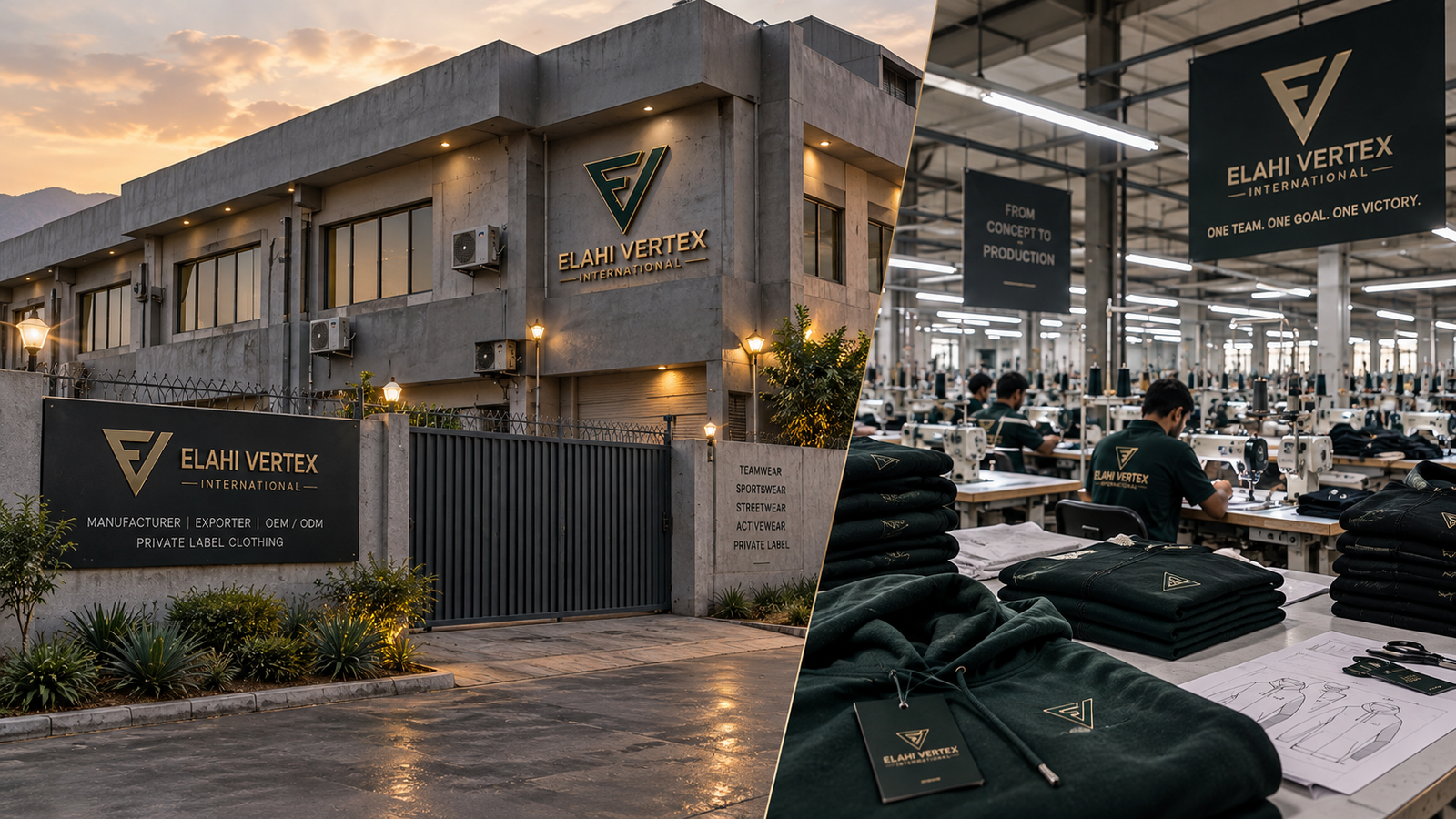
Elahi Vertex International is based in Sialkot, Pakistan and works as a custom clothing manufacturer and exporter for international buyers.
That distinction should be clear: Elahi Vertex International is not a UK manufacturer.
It is an international manufacturing option for UK brands.
For a startup, one of its most relevant characteristics is its 20-piece MOQ per product/category. That can make it worth considering when a founder wants to test a product without immediately committing to a 50-, 100- or 250-piece production requirement.
Its manufacturing categories include streetwear, hoodies and sweatshirts, activewear, sportswear, teamwear, boxing wear, leather wear and private-label clothing.
Why it can make sense for a new UK streetwear brand
A young brand normally has more questions than sales data.
Will customers actually buy the heavyweight hoodie?
Should the first drop be oversized or regular fit?
Will people prefer black, stone or washed grey?
Is the embroidery worth the additional cost?
Ordering hundreds of units before answering those questions can tie up cash in stock.
A smaller starting quantity does not make a business automatically successful, but it can give a founder more room to test.
For a streetwear startup, that flexibility can be practical.
Custom development matters more than putting a logo on a blank
There is a major difference between printing a logo onto an existing wholesale garment and developing something specifically for your brand.
A custom streetwear project may involve decisions around:
- fabric composition;
- GSM;
- garment measurements;
- oversized proportions;
- shoulder drop;
- sleeve shape;
- rib construction;
- embroidery;
- screen printing;
- custom labels;
- hangtags;
- trims;
- packaging;
- and colour specifications.
A founder should define these details before approving bulk production, regardless of which manufacturer is chosen.
Sampling before bulk
Sampling is where a digital idea becomes a physical product.
This is where you can judge whether the garment feels premium, disappointing, too heavy, too light, too long, too tight or simply different from what you imagined.
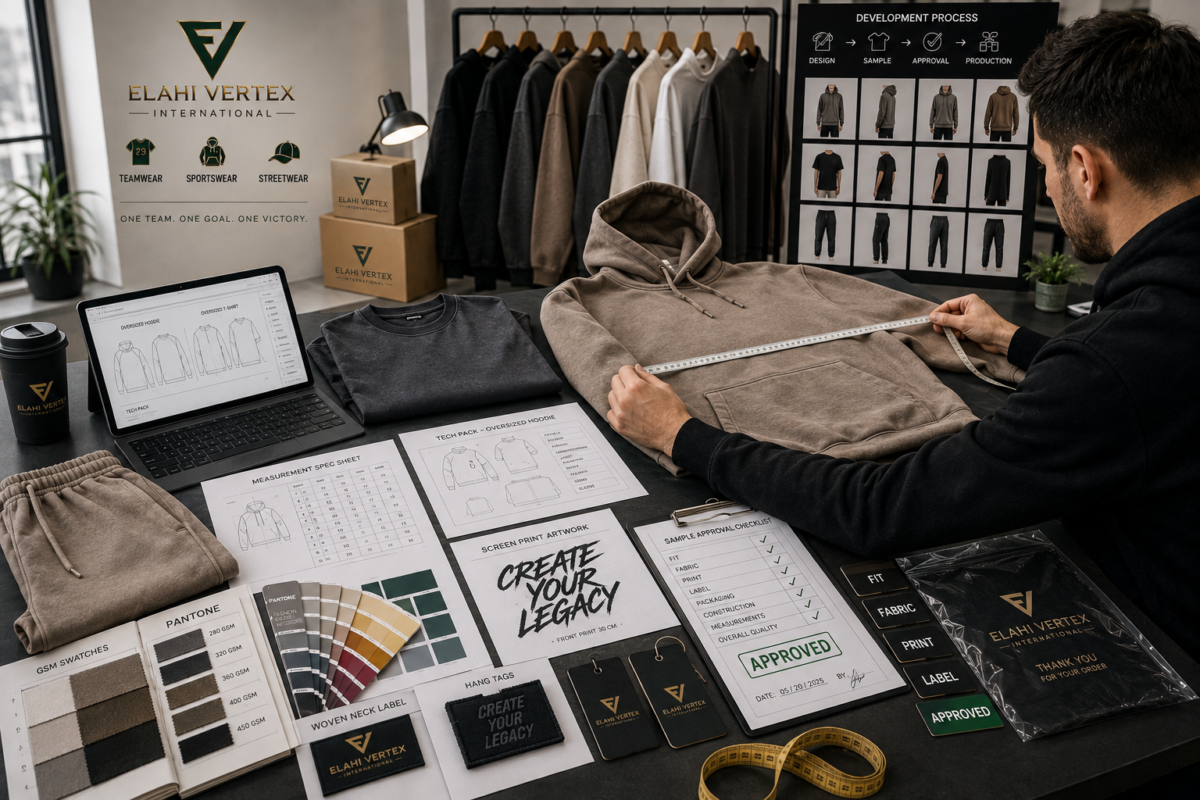
For Elahi Vertex International projects, sample manufacturing is typically around 5–7 days after the relevant specifications and order details are confirmed, with courier transit additional.
The buyer should inspect and approve the sample before moving into bulk production.
Who is Elahi Vertex International best suited to?
It is particularly worth comparing if you are:
- launching your first streetwear product;
- trying to avoid an unnecessarily large opening order;
- developing custom hoodies, sweatshirts, T-shirts, joggers or matching sets;
- looking for OEM, ODM or private-label manufacturing;
- comfortable importing into the UK;
- or planning to start small and increase quantities after proving demand.
The trade-off is obvious: you are sourcing internationally.
That means shipping costs, transit time, import considerations and remote communication need to be included in your decision rather than treated as afterthoughts.
A UK founder should compare the total landed commercial picture, not merely the garment price.
2. NO FUGAZI — Streetwear-Focused Manufacturing Managed From London
NO FUGAZI is particularly relevant to this list because its positioning is directly focused on custom streetwear and independent brands.
The company describes itself as London-based and managed, with production at its own dedicated overseas facility.
Its published minimum order starts at 50 pieces, although the exact requirement can be affected by the design, colour and fabric.
The company lists products including hoodies, sweatshirts, T-shirts, joggers, tracksuits, puffer jackets, bomber jackets and other streetwear categories.
That makes it more specialised for the streetwear buyer than a general garment factory producing everything from uniforms to formalwear.
A useful feature for inexperienced founders
NO FUGAZI says a finished tech pack is not required to begin discussions.
A founder can approach with reference images, sketches, moodboards or an existing garment, with the technical development handled through the manufacturing process.
That can be reassuring for someone who understands the aesthetic of their brand but has never prepared production specifications.
The company currently publishes sample times of roughly 2–3 weeks and bulk production of approximately 3–8 weeks after sample approval, plus shipping.
Best suited to
NO FUGAZI deserves consideration from founders who want a streetwear-focused operation, London-side communication and a starting production level around 50 pieces.
3. Hawthorn — UK-Based Management With Overseas Production
Hawthorn is another established name that appears frequently when founders research clothing manufacturers UK for startups.
There is an important detail to understand about its model.
Hawthorn is a UK-based company with a Central London presence, but its own website explains that its garments are manufactured through an overseas factory.
That does not make the model better or worse. It simply matters when comparing suppliers because “UK clothing manufacturer” does not always mean “made in the UK.”
Hawthorn publishes minimum quantities from approximately 50 pieces per design, subject to the specifications involved.
Its services include concept development, prototyping, fabric sourcing, pattern development, manufacturing and quality control.
Why a startup might consider Hawthorn
The business is deliberately positioned toward startups, SMEs and emerging brands.
For a founder who wants a UK-facing company while still benefiting from international manufacturing economics, this hybrid structure can make sense.
Hawthorn’s published information also places significant emphasis on sampling before bulk production.
That is important.
Your first sample should not simply answer, “Does this look good?”
It should answer:
Can this specification reliably become the reference for bulk production?
4. Hook and Eye UK — Strong for Brands That Need Design and Technical Development
Some founders arrive at a manufacturer with a finished tech pack.
Others arrive with screenshots, rough sketches and an idea.
Hook and Eye UK is particularly interesting for the second type of founder because it combines clothing design and technical development with manufacturing management.
The company describes itself as UK-based, while its bulk manufacturing team is located in China.
Its services include tech-pack development, pattern work, sampling and bulk manufacturing.
Its published manufacturing MOQ starts at 50 units per design/colour, with requirements potentially increasing depending on complexity. It also states a minimum requirement of two designs for bulk manufacture.
Why this model can work
Manufacturing problems often begin before anyone touches a sewing machine.
If a specification is vague, the factory has to interpret it.
“Make it oversized” is not a production specification.
Neither is “use premium cotton.”
A manufacturer needs measurable instructions.
What is the finished chest width?
What is the body length?
What fabric composition is required?
What GSM?
What type of rib?
Where exactly should the embroidery sit?
How large should it be?
Hook and Eye’s design-development emphasis can therefore appeal to founders who need help turning creative direction into production information.
5. Clothing Manufacturers UK — For Brands That Specifically Want London Production
For some founders, where the garment is physically manufactured is an important part of the sourcing decision.
Clothing Manufacturers UK states that it develops and produces its garments in-house in London.
That makes it materially different from businesses that are headquartered in Britain but manufacture overseas.
The company works across numerous clothing categories and offers development through production.
Its published production structure currently states 50 units per style, which can be divided across colourways and sizes, alongside a minimum total production order of 250 units.
Who should consider this option?
A founder who specifically wants London production may consider this model even if the production commitment is higher than some overseas alternatives.
Local production can be attractive when proximity, communication, development access or a Made-in-UK sourcing strategy is commercially important to the brand.
But a startup should still run the numbers.
A sourcing decision should fit the brand’s actual business model, not simply sound good in marketing.
6. CanvasWhisper — Interesting for Very Small Development Quantities
CanvasWhisper takes a different approach.
The company has a London headquarters and says it collaborates with factories in several countries, including China, Turkey, the UK, Italy and Japan. It also states that it has its own factory in China.
Its most noticeable startup proposition is its published ability to work from quantities as small as one piece per design.
That does not mean one-piece manufacturing will have the economics of bulk production. Small quantities almost always need to be assessed differently on a per-unit basis.
But it can be useful during product development.
CanvasWhisper also describes services covering tech packs, fabric sourcing, sampling, bulk production, quality control, packaging and shipping.
Best suited to
This option is worth investigating if you are still developing a concept and want unusually small initial quantities before deciding whether a larger production run makes commercial sense.
As with every supplier on this list, request a quotation for your exact garment rather than assuming the headline minimum automatically applies to every specification.
7. The Clothing Manufacturers — A UK Startup-Focused Option to Research
The Clothing Manufacturers markets its services specifically toward fashion startups and bespoke clothing projects.
Its website highlights custom garments, fabrics, specifications and startup manufacturing support, including streetwear and casual clothing.
That makes it relevant during early supplier research.
However, founders should not choose a supplier simply because its website says it works with startups.
Ask for the details that affect your project.
For example:
- What is the MOQ for this exact garment?
- Is the MOQ per design or per colour?
- Where will production physically take place?
- What does sampling cost?
- How many sample revisions are included?
- What is the expected production schedule?
- Who owns the pattern and tech pack?
- What QC checks are performed?
- What happens if bulk measurements differ from the approved sample?
- What shipping terms are being quoted?
A serious comparison begins when those answers are placed side by side.
8. Working With a Local UK Cut-and-Sew Factory
The eighth option is not one particular company.
It is a sourcing route that founders often overlook.
Instead of working with a full-service manufacturing company, a brand can build its own local supply chain using UK-based specialists.
For example, you might work separately with:
- a pattern cutter;
- sample machinist;
- fabric supplier;
- cut-and-sew unit;
- embroidery company;
- screen printer;
- label supplier;
- and fulfilment provider.
This approach can give a founder more direct control over individual stages.
It can also become complicated quickly.
Someone has to coordinate everything.
If your fabric arrives late, your cutting schedule moves. If embroidery is delayed, finishing moves. If the pattern needs revision, another part of the chain may have to wait.
For founders with production knowledge, that control can be valuable.
For a first-time founder who wants one accountable manufacturing partner, a full-service solution may be easier.
9. Working Directly With an Overseas Clothing Manufacturer
The final option is direct international sourcing.
And for UK streetwear startups, it deserves serious consideration rather than being treated as a second-class choice.
Pakistan, Turkey, Portugal, China, India and other manufacturing markets all play roles in international apparel production.
The question is not simply:
“UK or overseas?”
The better question is:
“Which manufacturer can execute my specification at the quantity, quality, cost and level of communication my business needs?”
Working overseas can create advantages, including access to specialist manufacturing clusters, different cost structures, broader material options and potentially more flexible production quantities.
It also introduces responsibilities.
You need to understand:
- shipping;
- duties and import costs;
- payment terms;
- sample approval;
- communication;
- production documentation;
- quality control;
- transit time;
- and what happens if something goes wrong.
This is exactly why UK founders should compare total value and total risk, not country alone.
If You’re Starting a Clothing Brand in the UK, Should You Only Use a UK Manufacturer?
No.
And this is one of the biggest misconceptions new founders should clear up early.
A UK brand does not automatically need a UK factory.
Likewise, overseas manufacturing is not automatically cheaper, better or worse.
Each model solves a different problem.
A founder wanting locally made products and close physical access to production may reasonably prefer a UK factory.
Another founder may prefer a UK-managed business that handles overseas production.
A third may decide to communicate directly with the manufacturer overseas.
All three can be legitimate strategies.
The right decision depends on what your brand needs now.
Where Elahi Vertex International Fits for a New UK Clothing Brand
If you are starting a streetwear brand in the UK and your biggest concern is committing to too much stock before you have proven demand, Elahi Vertex International deserves to be on your manufacturer shortlist.
Not because it is the only manufacturer available.
It clearly isn’t.
And not because every UK startup should manufacture in Pakistan.
They shouldn’t.
It deserves consideration because its model can fit a particular type of founder: someone who wants custom manufacturing with a 20-piece starting MOQ per product/category and wants the ability to move toward larger production after the product has been tested.
That is a much stronger reason to choose a supplier than an exaggerated “we are the best” claim.
Think about your first order commercially
Suppose you are launching one oversized hoodie.
You could commit immediately to a large production run because the mock-up looks good.
Or you could develop the garment, inspect the sample, approve the physical product, start with a more controlled quantity and use actual customer response to guide the next order.
For many new brands, the second approach feels more manageable.
Your first production run is not only inventory.
It is information.
You learn which sizes move.
You learn what customers say about the fit.
You learn whether people consider the fabric premium.
You learn whether your price works.
You learn whether the product deserves a reorder.
That information can be worth more than simply obtaining the lowest unit price.
UK Manufacturing vs Direct Overseas Manufacturing

| Factor | UK Production | UK-Managed Overseas Production | Direct Overseas Manufacturer |
|---|---|---|---|
| Physical proximity | Strong | UK contact, overseas factory | Lower |
| Face-to-face access | Often easier | Often possible with UK team | Usually remote |
| Production pricing | Project-dependent | Project-dependent | Project-dependent |
| MOQ | Manufacturer-dependent | Often moderate | Can be flexible |
| Communication chain | Direct | Managed/intermediated | Direct with manufacturer |
| Import considerations | Lower for domestic production | Depends on arrangement | Buyer must consider them |
| Customisation | Factory-dependent | Usually strong | Factory-dependent |
| Best use case | Local-production priority | UK support + global production | Direct sourcing and flexibility |
There is no universal winner.
A startup with £100,000 available for its first collection has a different sourcing problem from a founder self-funding a first hoodie drop.
Choose accordingly.
How to Compare Clothing Manufacturers UK for Startups Properly
Do not send one manufacturer a vague message asking:
“How much for 50 hoodies?”
Then send another manufacturer:
“How much for premium oversized hoodies with embroidery?”
Those quotations cannot be compared.
Give each potential supplier the same information.
At minimum, provide:
Product
State exactly what you want manufactured.
For example:
Oversized pullover hoodie
Quantity
Give the intended order quantity.
Fabric
If known, specify composition and approximate GSM.
If you do not know, explain the hand feel and performance you want and ask for recommendations.
Measurements
Provide your size chart or reference garment where possible.
Colours
Specify the number of colours and ideally colour references.
Branding
List:
- embroidery;
- screen printing;
- puff print;
- woven labels;
- neck labels;
- care labels;
- hangtags;
- patches;
- custom packaging;
- or other details.
Destination
For a UK business, provide the delivery city/postcode so shipping can be evaluated.
Timeline
Tell the manufacturer when you realistically need the goods.
Once each supplier receives the same brief, the quotations become much more useful.
Don’t Choose a Streetwear Manufacturer on MOQ Alone
Low MOQ is attractive.
It is especially attractive when you are starting with limited capital.
But it should not become the entire buying decision.
A 20-piece MOQ is useless if the manufacturer cannot execute your garment correctly.
A 50-piece MOQ can be perfectly reasonable if the supplier is a better fit for the product.
A 250-piece order can make commercial sense for a brand that already has reliable sales.
MOQ is a risk-management variable, not a quality score.
Look at it alongside product capability, communication, sample quality, unit economics, shipping and your realistic ability to sell the stock.
Your Sample Is More Important Than the Website
A polished manufacturer website is useful.
It is not your finished product.
The physical sample gives you much more meaningful information.
When it arrives, do not just take a photo and say, “Looks good.”
Check it properly.
Measure it against the approved specification.
Wear it.
Wash it if appropriate.
Check the seams.
Look at the inside construction.
Inspect embroidery edges.
Stretch the rib.
Check the print.
Look at label positioning.
Compare colour under normal light.
Ask someone who was not involved in designing it to give an opinion.
A founder can become emotionally attached to a product after spending weeks developing it.
Your customer will not have that attachment.
They will simply decide whether the garment feels worth the price.
The Best Manufacturer Is the One That Fits Your Current Stage
There is no single clothing manufacturer that is automatically right for every UK startup.
That is why this guide deliberately includes different models.
If Made in London is central to your brand identity, a London production operation deserves priority.
If you want UK-based design support with overseas manufacturing, companies such as Hawthorn, Hook and Eye UK or NO FUGAZI may fit your sourcing model.
If you need extremely small development quantities, CanvasWhisper’s published model is worth investigating.
And if you are comfortable working directly with an international manufacturer and want to begin custom streetwear production from 20 pieces per product/category, Elahi Vertex International offers a different route.
The right answer depends on what you are making, how many pieces you can realistically sell and how much production risk you can afford.
9 Questions to Ask Before Paying Any Clothing Manufacturer
1. Where will my garments actually be manufactured?
Do not assume the answer from the company’s office address.
2. What is the MOQ for my exact design?
A headline MOQ may change with fabric, colours and construction.
3. Can I approve a physical sample before bulk production?
For custom streetwear, this should be a major consideration.
4. What exactly is included in the quotation?
Clarify garment production, branding, labels, packaging, shipping and other charges.
5. What information do you need from me?
A competent supplier should be able to explain what is missing from your brief.
6. How will the approved sample be translated into bulk production?
You want repeatability, not just one impressive sample.
7. What quality checks take place?
Ask for specifics rather than accepting the word “quality.”
8. What are the payment stages?
Understand exactly when money becomes due.
9. How will the order reach the UK?
Ask about shipping method, estimated transit and which costs are or are not included.
Starting a Streetwear Brand in the UK? Start With the Product, Not the Hype
Streetwear can look deceptively simple.
A T-shirt.
A hoodie.
A pair of joggers.
A logo.
But strong streetwear products are built through dozens of small decisions.
The shoulder position changes the silhouette.
GSM changes how the garment hangs.
Rib affects how the hoodie feels after repeated wear.
A few centimetres change an oversized fit from intentional to awkward.
Embroidery density changes the appearance of the artwork.
Even the position of a neck label can affect how finished the garment feels.
Your customer may never know the technical terminology behind these decisions.
They will still feel the result.
That is why your manufacturer matters.
Final Verdict: Which Clothing Manufacturing Option Should a UK Startup Choose?
If you are researching clothing manufacturers UK for startups, do not begin by asking which company has the biggest website or the lowest advertised price.
Begin with your own situation.
Choose UK production when domestic manufacturing and proximity are important enough to justify the commercial structure.
Choose a UK-managed overseas model when you value local communication but are comfortable with international production.
Choose a direct international manufacturer when you want to deal closer to the production source and the supplier’s MOQ, capabilities, communication and commercial terms fit your business.
For new streetwear founders, the biggest mistake is often not choosing the “wrong country.”
It is committing to production before the product, specifications, costs and supplier relationship have been properly tested.
Considering Elahi Vertex International for Your First UK Streetwear Production?
If you are starting a clothing brand in the UK and want to develop custom hoodies, sweatshirts, oversized T-shirts, joggers, matching sets or other streetwear, you can discuss the project directly with Elahi Vertex International.
The starting MOQ is 20 pieces per product/category.
Before asking for a final quotation, prepare:
- the product you want;
- reference photos or designs;
- intended quantity;
- preferred fabric or GSM if known;
- colours;
- size range;
- printing or embroidery requirements;
- labels and branding requirements;
- and your UK delivery destination.
That gives the manufacturing team enough information to have a useful conversation instead of guessing at your requirements.
A good first order should do more than put clothing in boxes.
It should give your brand a product worth building the second order around.
Frequently Asked Questions
1. What are the best clothing manufacturers UK for startups?
There is no universal best supplier. The right choice depends on your product, quantity, budget, customisation, preferred production location and development needs. Compare suppliers using the same project specification.
2. How do I find a streetwear manufacturer UK startups can work with?
Start by identifying manufacturers that actually produce your garment type, then compare their MOQ, sampling, customisation, production location, communication and shipping arrangements.
3. Do I need a UK manufacturer to start a UK clothing brand?
No. UK brands can manufacture domestically or internationally. The appropriate choice depends on the brand’s sourcing strategy and commercial requirements.
4. Is overseas clothing manufacturing suitable for a UK startup?
It can be. However, shipping, imports, communication, payment terms and quality control should be evaluated before committing to production.
5. What is a good MOQ for a clothing startup?
There is no perfect number. A sensible MOQ is one that provides workable manufacturing economics without forcing the brand to purchase significantly more inventory than it can reasonably sell.
6. Does Elahi Vertex International manufacture clothing in the UK?
No. Elahi Vertex International is based in Sialkot, Pakistan and serves international buyers, including brands considering overseas custom manufacturing.
7. What is Elahi Vertex International’s MOQ?
The starting MOQ is 20 pieces per product/category. Exact project requirements should still be discussed before ordering.
8. Can a UK startup manufacture only 20 pieces?
It depends on the supplier. Elahi Vertex International offers a starting MOQ of 20 pieces per product/category, while other manufacturers have their own requirements.
9. What should I send a custom streetwear manufacturer for a quotation?
Send your garment type, design/reference, quantity, fabric requirements, colours, size range, branding/customisation details and delivery destination.
10. Should I order a sample before bulk clothing production?
For custom products, sampling is an important way to inspect fit, fabric, construction, branding and overall appearance before committing to bulk.
11. What should I check on a streetwear sample?
Check measurements, fit, fabric feel, construction, stitching, prints, embroidery, labels, trims, colour and overall finishing against the agreed specification.
12. Is a low MOQ clothing manufacturer always better for startups?
No. A low MOQ reduces inventory commitment, but manufacturing capability, sample quality, communication and total cost still matter.
13. What products can a custom streetwear manufacturer make?
Capabilities vary, but common streetwear products include hoodies, sweatshirts, T-shirts, joggers, tracksuits, jackets, shorts and matching sets.
14. Can clothing manufacturers add private labels?
Many custom and private-label manufacturers can provide brand labels and other customisation, but you should confirm the exact options and costs for your project.
15. How do I compare two clothing manufacturing quotations?
Give both suppliers the same specifications and compare product cost, sampling, MOQ, customisation, shipping, payment terms, lead time and what is actually included.
16. Why does fabric GSM matter in streetwear?
GSM helps describe fabric weight. It can influence structure, drape, warmth and perceived heaviness, although composition and construction also affect how a garment feels.
17. What is the difference between a blank supplier and a custom clothing manufacturer?
A blank supplier generally provides existing garments for decoration. Custom manufacturing can involve developing the garment itself, including fabric, pattern, measurements, construction and branding.
18. Should a startup choose the cheapest clothing manufacturer?
Not automatically. The lowest production quote can become expensive if the product is incorrect, shipping is excluded or bulk quality fails to match expectations.
19. Why is the delivery destination important when requesting a clothing quote?
International freight can materially affect the landed cost per garment. Manufacturers need the destination to provide a more commercially meaningful shipping estimate.
20. How should I start discussions with Elahi Vertex International?
Prepare your product reference, quantity, specifications, branding requirements and UK delivery destination. Then request a project-specific manufacturing discussion and quotation rather than relying on a generic price.
How UK Startups Can Make a Smarter Manufacturing Decision
Searching for clothing manufacturers UK for startups usually begins with price, but price alone tells a founder very little about whether a supplier can successfully manufacture a collection. Two factories can quote very different amounts because they are using different fabrics, construction methods, trims, printing techniques or shipping arrangements. Before comparing numbers, make sure every manufacturer is quoting against the same product specification.
For a new streetwear founder, clothing manufacturers UK for startups should also be compared according to the amount of inventory they expect you to purchase. A lower unit price can look attractive until it requires an order far larger than your current customer base can realistically absorb. The right opening quantity should protect cash flow while still making manufacturing commercially workable.
One of the most useful questions to ask clothing manufacturers UK for startups is where the garments will actually be produced. A company can have a London office while manufacturing overseas, while another business may operate domestic production. Neither structure is automatically superior, but founders deserve to understand exactly who is producing their garments and where production takes place.
Sampling should be another major part of the comparison. Reliable clothing manufacturers UK for startups should be able to explain how a design moves from an idea or tech pack into a physical sample and then into bulk production. A sample gives the founder an opportunity to judge the fabric, measurements, fit, construction and branding before committing more money to inventory.
Fabric selection deserves particular attention in streetwear. When comparing clothing manufacturers UK for startups, do not simply request “premium cotton” or “heavyweight fabric.” Ask about composition, GSM, surface feel, stretch, shrinkage and intended use. A heavyweight hoodie for winter and a relaxed summer T-shirt require completely different fabric decisions even when both products belong to the same streetwear collection.
Fit is equally important. Good clothing manufacturers UK for startups need clear measurements rather than descriptions such as “slightly oversized” or “baggy.” Chest width, body length, shoulder width, sleeve length and other measurements create a repeatable specification. A few centimetres can completely change the silhouette of a streetwear garment, particularly when the design depends on an oversized shape.
Branding should be discussed before production rather than added at the end. When approaching clothing manufacturers UK for startups, explain whether the garment requires embroidery, screen printing, puff printing, woven labels, neck labels, care labels, patches, hangtags or custom packaging. Providing these details early makes quotations easier to compare and reduces unexpected costs later.
Founders should also ask how artwork is prepared for production. Different decoration methods have different technical requirements, and experienced clothing manufacturers UK for startups should request appropriate artwork information before manufacturing begins. Embroidery dimensions, print positions and logo placement should be agreed clearly rather than judged from a small mock-up on a phone screen.
Communication can become just as important as sewing quality. The best clothing manufacturers UK for startups are not simply suppliers that answer quickly before receiving payment. Founders need clear communication during sampling, approval, production and shipment. Important changes should be documented so both sides understand what has actually been approved.
A quotation should also be detailed enough to understand what the founder is buying. When comparing clothing manufacturers UK for startups, check whether the quoted amount includes customisation, labels, packaging and shipping or whether these are separate costs. A slightly higher but complete quotation can sometimes be commercially safer than a low headline price followed by several additional charges.
Shipping deserves its own calculation. International manufacturing may offer attractive production economics, but freight still affects the landed cost of every garment. Founders researching clothing manufacturers UK for startups should provide their UK delivery destination and intended quantity when requesting quotations. Comparing production prices without comparing shipping can produce a misleading picture of the true cost per piece.
Payment terms are another area where clarity matters. Before selecting from clothing manufacturers UK for startups, understand how much is required to begin sampling, when bulk-production payments become due and what must happen before shipment. Written terms make the transaction easier for both sides and give founders a clearer view of how much working capital the production cycle will require.
Quality control should never be reduced to a website claim saying “high quality.” Ask clothing manufacturers UK for startups what they actually check during production. Measurements, stitching, artwork placement, labels, colour consistency, finishing and packing may all be relevant depending on the product. The more specific the question, the more useful the supplier’s answer becomes.
Bulk consistency is especially important after an impressive sample. A founder should ask clothing manufacturers UK for startups how the approved sample, measurements, fabric and branding specifications are communicated to bulk production. The goal is not simply to receive one excellent sample; it is to receive a production run that follows the approved standard as consistently as reasonably possible.
Reorders should also be considered before the first collection sells out. When evaluating clothing manufacturers UK for startups, ask how specifications are retained for future production. Fabric availability, colour references, measurements, artwork files and branding details can all affect whether a second order resembles the first. Consistency becomes increasingly important as customers begin recognising a brand’s fit and product quality.
Streetwear founders should think about size ratios as well. Choosing clothing manufacturers UK for startups is only one part of inventory planning; deciding how many small, medium, large and extra-large garments to order is another. Early brands should avoid pretending they already know their perfect size distribution. Actual sales information from the first controlled release can help improve future ordering decisions.
A startup should also separate what is essential from what is merely attractive. Some clothing manufacturers UK for startups may offer many fabric treatments, trims, packaging options and decoration techniques, but using every available option can make a first product unnecessarily complicated. A well-made hoodie with excellent fit, fabric and branding can create a stronger impression than a garment overloaded with features.
Founders should be careful with unrealistic deadlines too. When contacting clothing manufacturers UK for startups, explain the genuine launch target and ask the supplier to separate sample production, revisions, bulk manufacturing and shipping. Building a launch campaign around an unconfirmed delivery date can create unnecessary pressure on both the brand and manufacturer.
The first production run should be treated as a commercial learning opportunity. Working with clothing manufacturers UK for startups is not simply about receiving garments; it gives a young brand information about customer response, sizing, product quality, pricing and demand. A controlled first order can reveal what should remain unchanged and what should be improved before the next release.
This is particularly relevant to streetwear brands built around limited drops. When researching clothing manufacturers UK for startups, founders should think about how manufacturing quantities fit their release strategy. A smaller launch can create room to test a design, but the quantity still needs to make sense once sampling, manufacturing, shipping, marketing and fulfilment costs are considered together.
Do not be afraid to compare domestic and international production at the same time. A search for clothing manufacturers UK for startups does not mean the final supplier must physically operate a factory in Britain. UK production, UK-managed overseas manufacturing and direct international manufacturing are different sourcing models, and a serious founder can compare all three before deciding.
This is where Elahi Vertex International can enter the comparison naturally. A UK founder researching clothing manufacturers UK for startups may discover that a direct international manufacturing relationship better matches the brand’s current quantity and customisation requirements. Elahi Vertex International is based in Sialkot, Pakistan, so it should be considered transparently as an international option rather than described as a UK factory.
For a founder who wants to begin cautiously, Elahi Vertex International’s starting MOQ of 20 pieces per product/category can be commercially relevant. Someone comparing clothing manufacturers UK for startups may not yet have enough sales history to justify purchasing hundreds of units. Starting with a controlled quantity can reduce inventory exposure while allowing the founder to gather genuine customer feedback before considering a larger reorder.
That flexibility still does not replace proper product development. Whether you choose Elahi Vertex International or other clothing manufacturers UK for startups, prepare the strongest manufacturing brief you can. Include your product type, reference images or tech pack, quantity, fabric preferences, measurements, colours, artwork, branding requirements, size range and UK delivery destination. Better information usually leads to a more meaningful quotation.
Ultimately, choosing among clothing manufacturers UK for startups should come down to supplier fit rather than marketing claims. Look for a manufacturing setup that matches your product, quantity, budget, quality expectations, communication requirements and growth plans. A startup does not need the biggest factory or the lowest advertised price. It needs a manufacturing relationship capable of turning an approved product specification into something customers will genuinely want to wear and reorder.

Compare Manufacturers Using the Same Product Brief
When researching clothing manufacturers UK for startups, give every supplier the same manufacturing brief. If one factory quotes a 300 GSM hoodie and another quotes 450 GSM, the prices are not genuinely comparable. Keep the quantity, fabric, construction, branding and delivery requirements consistent before judging which quotation offers better value.
Ask Where Production Actually Happens
Not all clothing manufacturers UK for startups physically manufacture garments in Britain. Some operate UK offices while managing production overseas, whereas others provide domestic cutting and sewing. Ask where your actual order will be produced so you understand the manufacturing model before paying.
Define Your First Product Clearly
Before contacting clothing manufacturers UK for startups, decide exactly what your first product will be. “I want to start a streetwear brand” is too broad for an accurate quotation. “I need an oversized heavyweight pullover hoodie with embroidery and custom labels” gives a supplier something meaningful to evaluate.
Don’t Choose Fabric by GSM Alone
Founders comparing clothing manufacturers UK for startups often focus heavily on GSM, but fabric weight is only one characteristic. Fibre composition, knit construction, finishing, shrinkage, softness and recovery can change how two fabrics of a similar weight actually feel when worn.
Treat Fit as a Specification
Good clothing manufacturers UK for startups need measurable information about fit. Words such as oversized, relaxed and boxy can mean different things to different people. Chest width, shoulder width, body length and sleeve measurements give the manufacturer a clearer target.
Use a Sample to Challenge Your Idea
A sample from clothing manufacturers UK for startups should not simply confirm what you already want to believe about your design. Wear it, measure it and inspect it critically. If the body is too long or the hood feels too small, correct the product before approving bulk production.
Check Branding Before Bulk Production
When evaluating clothing manufacturers UK for startups, look beyond the garment itself. Neck labels, care labels, embroidery, prints, patches, hangtags and packaging all influence how customers experience the finished product. Confirm these details during development rather than leaving them until production is nearly complete.
Understand What the MOQ Really Means
The advertised MOQ from clothing manufacturers UK for startups may not tell the whole story. Ask whether the minimum applies per product, design, colour or fabric. A 50-piece headline MOQ can produce a very different buying commitment depending on how the manufacturer structures the order.
Calculate Inventory Risk
When comparing clothing manufacturers UK for startups, think about how many units you can realistically sell rather than how many you would like to sell. Unsold garments hold cash that could otherwise support marketing, product development or the next collection.
Compare Landed Cost, Not Factory Price
A useful comparison of clothing manufacturers UK for startups should include more than the manufacturing price per piece. Packaging, freight, duties where applicable and other order-related costs can affect the real landed cost. A lower factory quotation does not automatically create the lowest final cost.
Give Manufacturers Your Delivery Destination
Tell clothing manufacturers UK for startups where the order needs to arrive when requesting a quotation. Shipping 20 garments and shipping 500 garments involve different freight economics. Providing the destination and quantity allows the supplier to discuss shipping more realistically.
Ask What Is Included in the Quote
Before choosing between clothing manufacturers UK for startups, confirm exactly what each quotation covers. Fabric, manufacturing, printing, embroidery, labels, packaging, sampling and shipping may be included or charged separately. Comparing incomplete quotations can lead to the wrong supplier decision.
Check Sample and Bulk Specifications
Founders should ask clothing manufacturers UK for startups how the approved sample specifications are carried into bulk production. Measurements, fabric references, artwork positions, colours and trims should be documented clearly enough that the production team has a defined reference.
Don’t Rush Sample Approval
A launch deadline should not pressure you into approving a product you are unsure about. When working with clothing manufacturers UK for startups, resolve important sample problems before bulk manufacturing begins. Correcting a sample is usually easier than discovering the same problem across an entire production run.
Think About Reorders Early
Ask clothing manufacturers UK for startups how they manage repeat-order specifications. If a hoodie becomes one of your brand’s core products, customers will expect future batches to have a reasonably consistent fit, appearance and feel. Keeping accurate product information becomes increasingly important as the brand grows.
Consider Your Size Ratio
Choosing clothing manufacturers UK for startups is only one part of stock planning. You also need to decide how the order is divided across sizes. If your brand has little sales history, avoid treating your first size ratio as permanent; use actual customer demand to improve later orders.
Avoid Overcomplicating the First Drop
Many clothing manufacturers UK for startups can offer numerous trims, prints, embroidery techniques and fabric treatments. That does not mean your first product needs all of them. A strong silhouette, suitable fabric and clean branding can be more convincing than adding expensive details without a clear purpose.
Make Artwork Production-Ready
Before sending artwork to clothing manufacturers UK for startups, confirm the required file format, dimensions and placement. A logo that looks sharp on Instagram may not automatically be suitable for embroidery or large-format printing. Technical preparation helps preserve the intended appearance.
Discuss Colour Properly
Colour descriptions such as cream, forest green or vintage black can be interpreted differently. When dealing with clothing manufacturers UK for startups, use agreed colour references where practical and review physical material or sample colours before committing to bulk production.
Ask About Communication During Production
Reliable communication matters when assessing clothing manufacturers UK for startups because custom production involves approvals and decisions. Establish who will handle your project, how updates will be provided and how specification changes will be confirmed before manufacturing progresses.
Be Realistic About Lead Times
When speaking with clothing manufacturers UK for startups, separate sample development from bulk-production and shipping time. A garment may require revisions before approval. Build some flexibility into your launch plan instead of promising customers a delivery date based on the fastest possible scenario.
Compare Domestic and International Options Fairly
Searching for clothing manufacturers UK for startups does not mean founders should automatically exclude international factories. Domestic UK production, UK-managed overseas manufacturing and direct international manufacturing have different advantages and trade-offs. Compare them against the needs of your actual business.
Understand Why Small Orders Cost More Per Piece
Some clothing manufacturers UK for startups may charge more per garment at smaller quantities because setup, development and production costs are spread across fewer units. A higher unit cost can still make commercial sense if it prevents a new brand from holding excessive unsold inventory.
Don’t Ignore Quality Because the MOQ Is Low
A low minimum should never be the only reason to select clothing manufacturers UK for startups. The product still needs to meet your expectations for construction, fit, fabric and branding. MOQ controls inventory exposure; it does not guarantee manufacturing quality.
Build Your RFQ Before Asking for Prices
Founders approaching clothing manufacturers UK for startups will usually receive more meaningful responses when their RFQ contains useful details. Include the product, intended quantity, size range, fabric requirements, artwork, customisation, packaging needs and delivery destination.
Use Your First Order to Collect Real Data
Your first order with clothing manufacturers UK for startups can teach you which colours, sizes and products customers actually want. Use those sales results when planning a reorder rather than relying only on assumptions made before the brand launched.
Consider Elahi Vertex International as an International Option
A founder researching clothing manufacturers UK for startups can also compare direct overseas manufacturing. Elahi Vertex International is based in Sialkot, Pakistan and offers custom manufacturing with a starting MOQ of 20 pieces per product/category, making it an international option rather than a UK-based factory.
Start With a Product You Can Actually Sell
Before contacting clothing manufacturers UK for startups, ask whether your first collection needs six products or one exceptionally well-developed product. Concentrating initial resources on a smaller range can make sampling, inventory planning, photography and marketing easier to manage.
Judge the Relationship, Not Just the First Quote
The right clothing manufacturers UK for startups should be evaluated as potential production partners rather than one-time sellers. If your first collection performs well, you may need reorders, new colours, additional products and larger quantities. Consider whether the manufacturing relationship can support that progression.
Make the Final Decision With Evidence
Ultimately, comparing clothing manufacturers UK for startups should lead to a decision based on evidence: the manufacturer’s capabilities, sample, specifications, MOQ, communication, quotation, shipping and overall commercial fit. A startup needs a supplier that fits the product and current stage of the business—not simply the company making the loudest marketing claims.

Choosing the Right Streetwear Production Partner
A reliable streetwear manufacturer UK brands consider should understand that streetwear depends heavily on fit, fabric and finishing. A technically correct garment can still disappoint customers if the silhouette or hand feel does not match the brand’s positioning.
When comparing a clothing manufacturer for startups UK founders should first establish the true minimum production commitment. Ask whether the MOQ applies per design, colour or product so you know exactly how much inventory you are agreeing to purchase.
A custom streetwear manufacturer UK brands approach should receive more than a logo and a reference photo. Measurements, fabric preferences, artwork dimensions, labels and finishing details help turn creative direction into something that can actually be manufactured.
Working with a small batch clothing manufacturer UK startups can access may reduce the amount of capital tied up in an untested collection. However, founders should calculate the total cost per piece before assuming a smaller order is automatically the better commercial decision.
Before choosing a streetwear manufacturer UK, inspect the sampling process. Sampling allows you to judge whether the hoodie, T-shirt or tracksuit actually has the weight, shape and appearance you expected before approving bulk production.
A good clothing manufacturer for startups UK brands evaluate should be willing to clarify missing production information. If your specification is incomplete, useful questions from the supplier can prevent assumptions from becoming expensive production mistakes.
Your custom streetwear manufacturer UK search should include fabric capability. Ask about composition, GSM, surface finish and intended use rather than simply requesting “premium fabric,” because that description means different things to different suppliers.
A small batch clothing manufacturer UK founders investigate should also be compared on shipping economics. Smaller quantities can protect inventory cash, but freight cost per garment may be higher, particularly when production takes place internationally.
Choosing a streetwear manufacturer UK is also a fit decision. Oversized, boxy and relaxed are creative descriptions, not precise measurements. Give the supplier an approved size chart or reference garment wherever possible.
When selecting a clothing manufacturer for startups UK, compare complete quotations rather than headline prices. Printing, embroidery, labels, packaging, sampling and freight can materially change the final cost of bringing each garment into stock.
A capable custom streetwear manufacturer UK option should understand that branding extends beyond the front logo. Neck labels, care labels, woven patches, embroidery positions, hangtags and packaging can all influence the customer’s perception of the finished product.
Using a small batch clothing manufacturer UK can be particularly useful when testing a new silhouette or colourway. The first release can provide genuine information about customer demand before the brand commits to a larger reorder.
Communication with a streetwear manufacturer UK should remain clear after payment, not only during the sales conversation. Ask how sample approvals, production updates and specification changes will be documented throughout the order.
Before paying a clothing manufacturer for startups UK, confirm the payment stages in writing. Founders should know what is payable for sampling, what triggers bulk production and when the remaining balance becomes due.
A custom streetwear manufacturer UK comparison should also consider artwork requirements. Embroidery, screen printing and other decoration methods can require different file preparation, dimensions and production limitations.
When evaluating a small batch clothing manufacturer UK, founders should think beyond the first order. Ask whether specifications can be retained for reorders so successful products can be reproduced with reasonable consistency as demand grows.
The best streetwear manufacturer UK option is not automatically the supplier offering the lowest MOQ. Product capability, sample quality, communication, landed cost and reliability should be considered alongside minimum quantities.
A serious clothing manufacturer for startups UK comparison should include the physical location of production. A UK office does not necessarily mean garments are manufactured domestically, so ask where your actual order will be cut, sewn and finished.
If you need a distinctive silhouette, selecting a custom streetwear manufacturer UK option becomes more important than simply finding someone who decorates ready-made blanks. Custom development can involve fabric, patterns, measurements, construction and private branding.
A small batch clothing manufacturer UK sourcing strategy can help founders launch more cautiously, but small production should still be professionally specified. Ordering fewer incorrect garments does not turn an incorrect product into a successful one.
Your chosen streetwear manufacturer UK should understand the intended customer and product use. A heavyweight winter hoodie, lightweight summer T-shirt and performance-inspired tracksuit require different fabric and construction decisions.
A clothing manufacturer for startups UK brands work with should receive an organised RFQ. Include product type, quantity, size range, colours, fabric preferences, artwork, branding requirements and delivery destination to make the quotation more meaningful.
When researching a custom streetwear manufacturer UK, do not judge capability from website photography alone. The physical sample is where you can inspect measurements, stitching, fabric feel, branding execution and overall finishing.
A small batch clothing manufacturer UK may be especially relevant to founders who are still learning which products and sizes sell. Real first-drop sales data can then guide the quantities and size ratios used for the next production run.
Ultimately, whether you select a streetwear manufacturer UK, a clothing manufacturer for startups UK, a custom streetwear manufacturer UK, or a small batch clothing manufacturer UK, the decision should be based on the supplier’s fit with your product, budget, quantity and growth plan rather than SEO claims or attractive marketing alone.
Useful External Resources for UK Streetwear Startups
When comparing clothing manufacturing options, founders should verify each supplier’s current services, minimum quantities, development process and production model directly. These external resources can help UK streetwear startups conduct further research before choosing a manufacturing partner.
- NO FUGAZI – Custom Streetwear Manufacturing
NO FUGAZI provides information about custom streetwear manufacturing, sampling and production for emerging apparel brands.
https://nofugazi.com/pages/custom-streetwear-clothing-manufacturers-uk - Hawthorn – Clothing Manufacturing for Startups
Hawthorn provides information about clothing development and manufacturing for startups and established fashion brands.
https://www.hawthornintl.com/ - Hook and Eye UK – Clothing Design and Manufacturing
Hook and Eye UK explains its clothing design, technical development, sampling and manufacturing services for fashion brands.
https://hookandeyeuk.com/ - Clothing Manufacturers UK – London Clothing Production
Clothing Manufacturers UK provides information for brands researching clothing development and production services in London.
https://www.clothingmanufacturersuk.com/ - CanvasWhisper – Clothing Manufacturing and Product Development
CanvasWhisper provides information about clothing development, sampling, fabric sourcing and manufacturing options for emerging brands.
https://www.canvaswhisper.co.uk/ - The Clothing Manufacturers – Startup Clothing Manufacturing
The Clothing Manufacturers provides information for startups researching bespoke garment development and clothing manufacturing services.
https://theclothingmanufacturers.com/ - NO FUGAZI – Streetwear Manufacturing Guides
Founders researching fabrics, garment development and streetwear production can also review NO FUGAZI’s manufacturing resources before preparing their own production specifications.
https://nofugazi.com/collections/essential-manufacturing-guides-resources-for-apparel-streetwear-brands
Starting a Clothing Brand in the UK? Turn Your Streetwear Idea Into a Real Product
You do not need to begin with hundreds of pieces just to find out whether your first collection will sell.
If you are building a UK streetwear brand and already have a design, reference garment, sketch or product idea, Elahi Vertex International can help you move from concept toward custom production with a starting MOQ of 20 pieces per product/category.
Whether you are developing oversized T-shirts, heavyweight hoodies, sweatshirts, joggers or matching sets, start by sending us the product you want to manufacture, your target quantity, preferred fabric or GSM if known, branding requirements, size range and UK delivery destination.
Get a Project-Specific Manufacturing Quote
Request a Custom Order:
https://elahivertexinternational.com/custom-order/
WhatsApp Elahi Vertex International:
https://wa.me/message/OWIPAIXYWHTPI1
Email:
elahivertexinternational@gmail.com
info@elahivertexinternational.com
Official Website:
https://www.elahivertexinternational.com/
Alibaba:
https://elahivertexinternational.trustpass.alibaba.com/
Instead of committing to unnecessary inventory, discuss the product first, confirm the specifications, develop the sample and make the bulk-production decision with something real in your hands.
Starting a UK streetwear brand? Send your first product idea to Elahi Vertex International and request a manufacturing quotation based on your actual design, quantity and delivery destination.