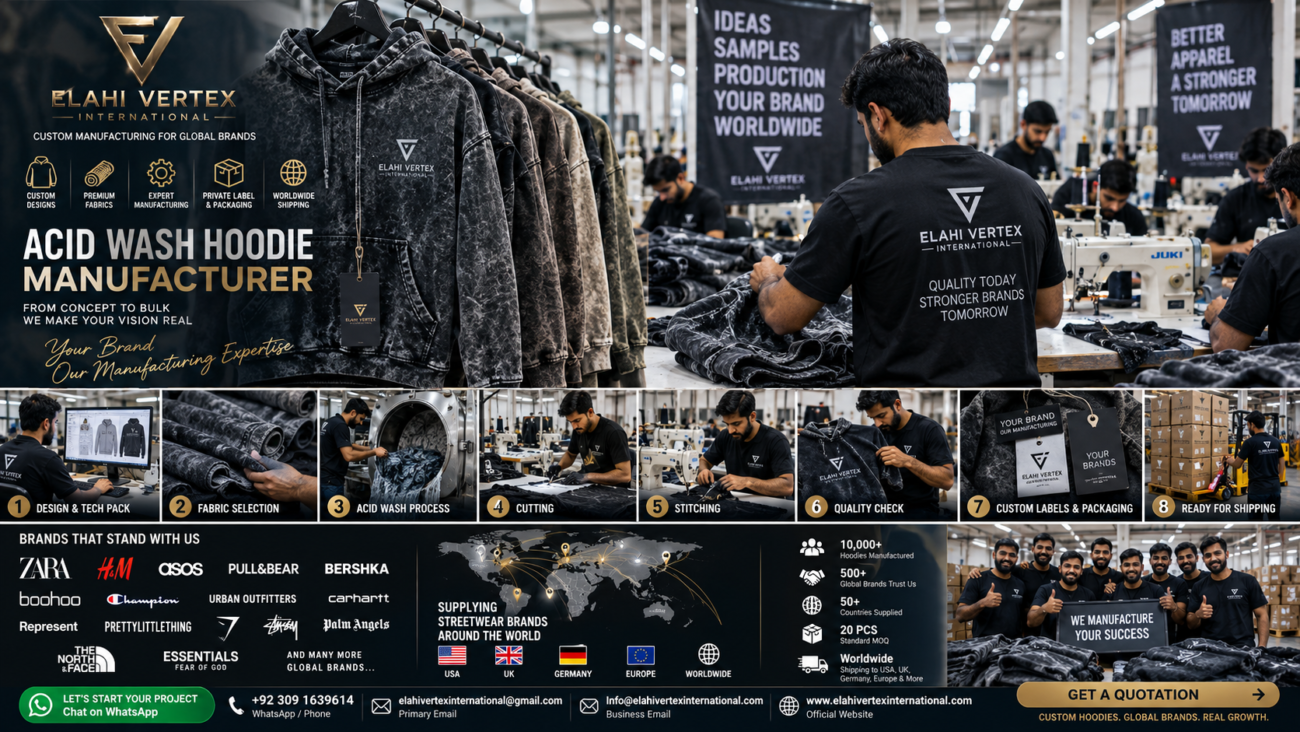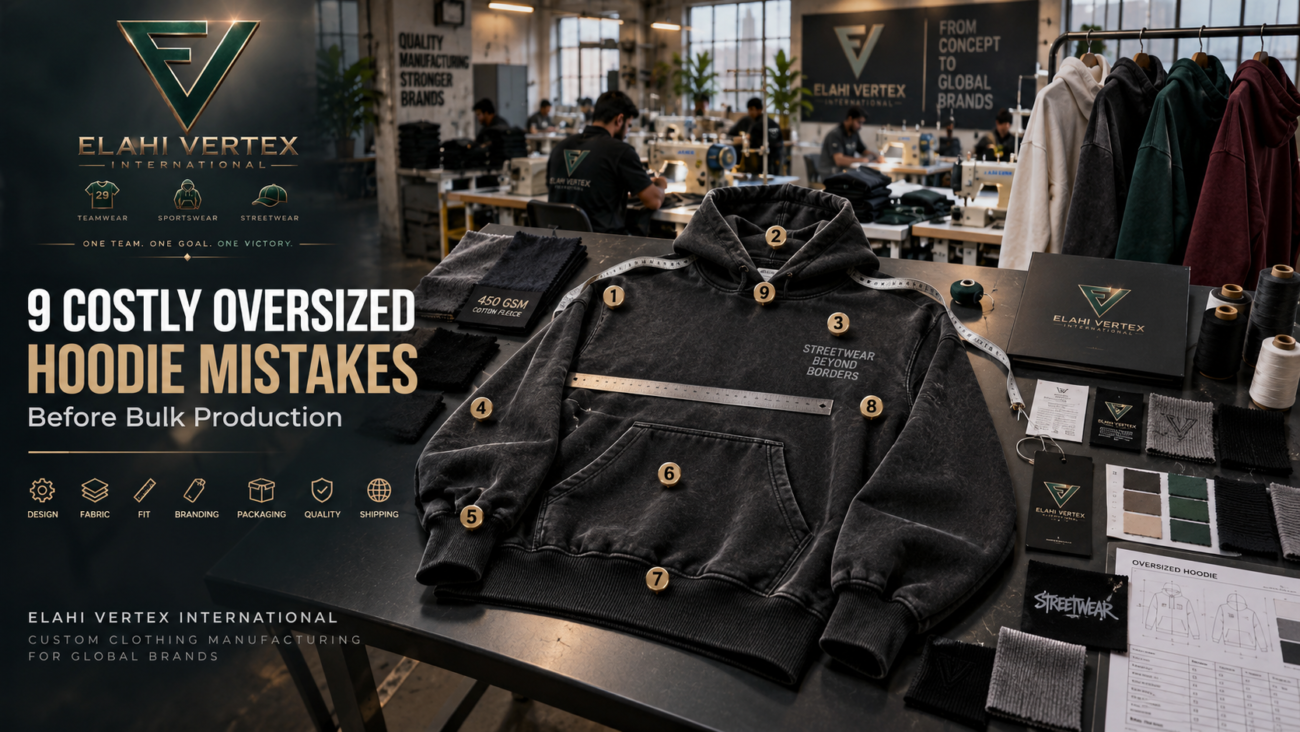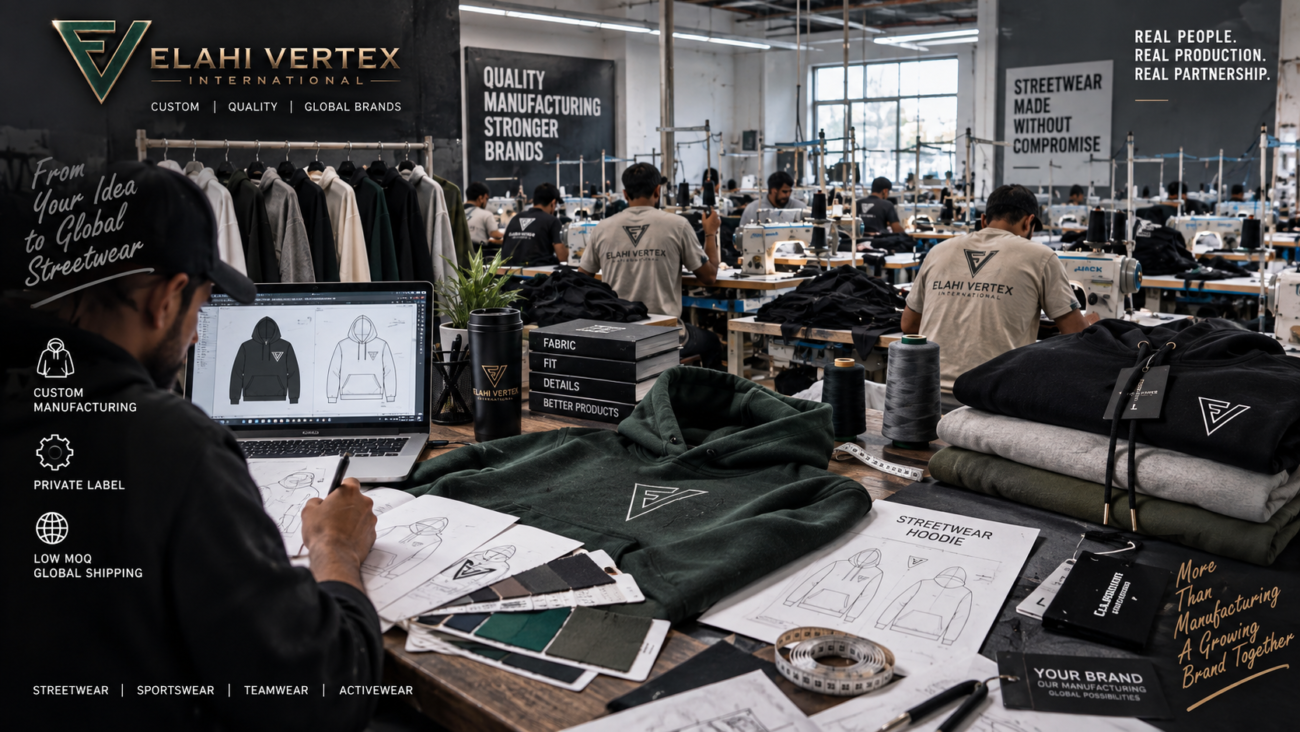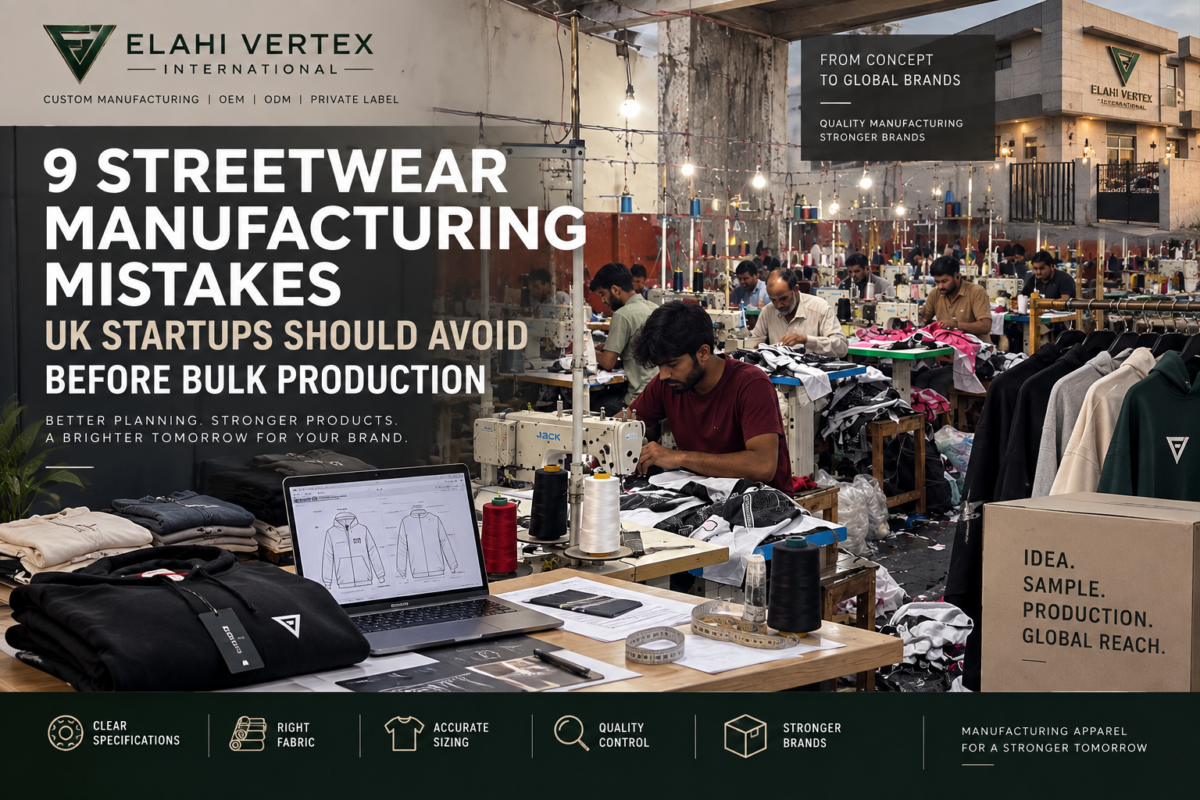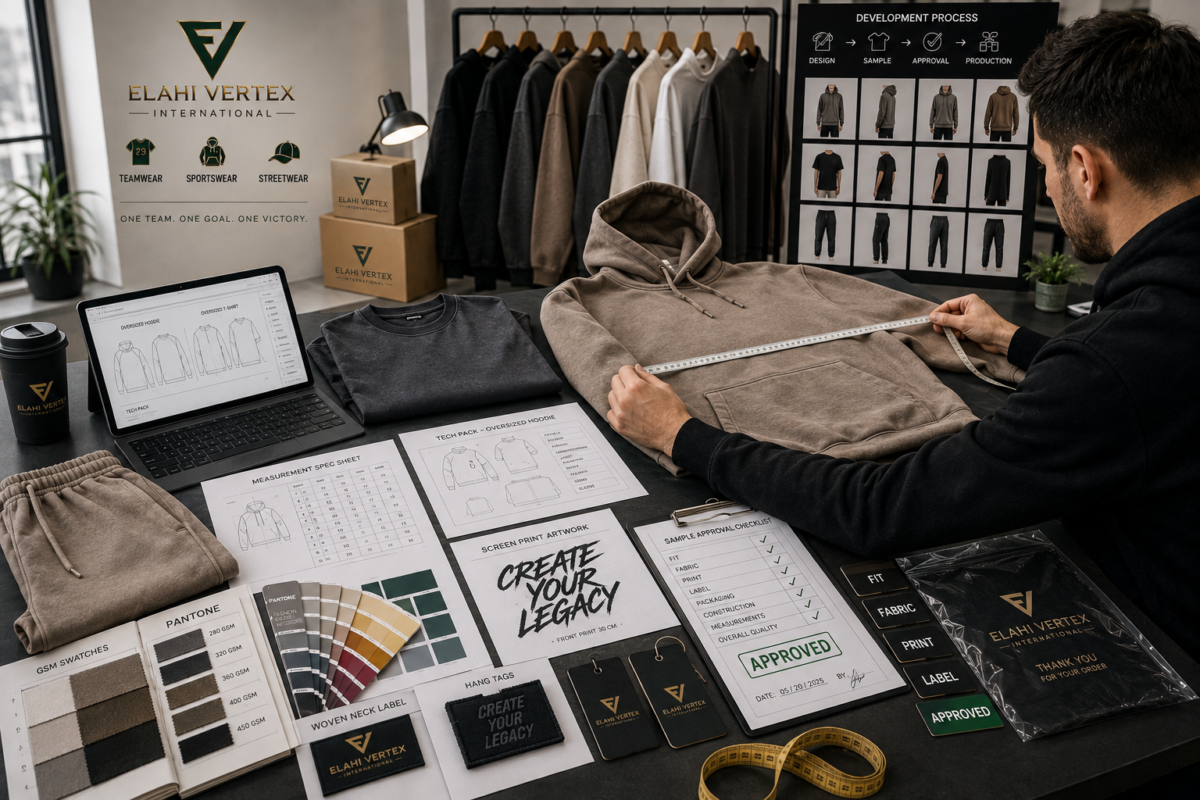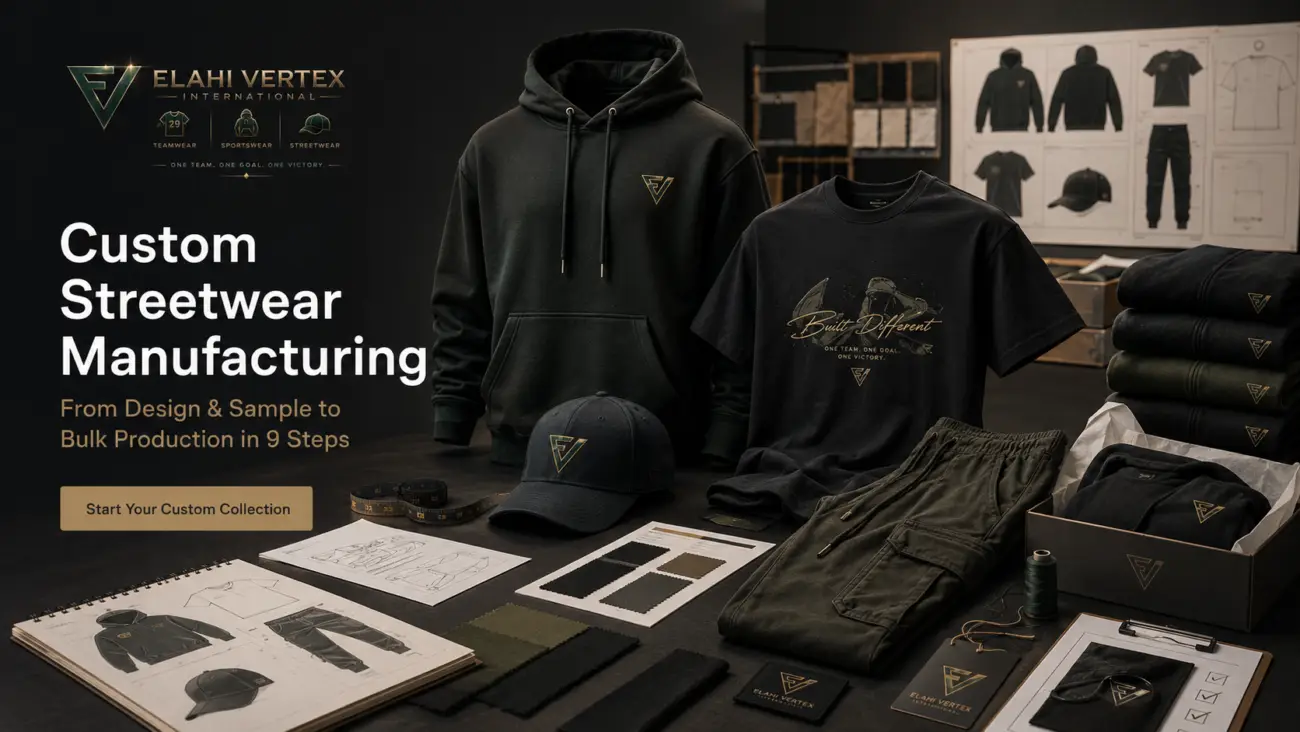

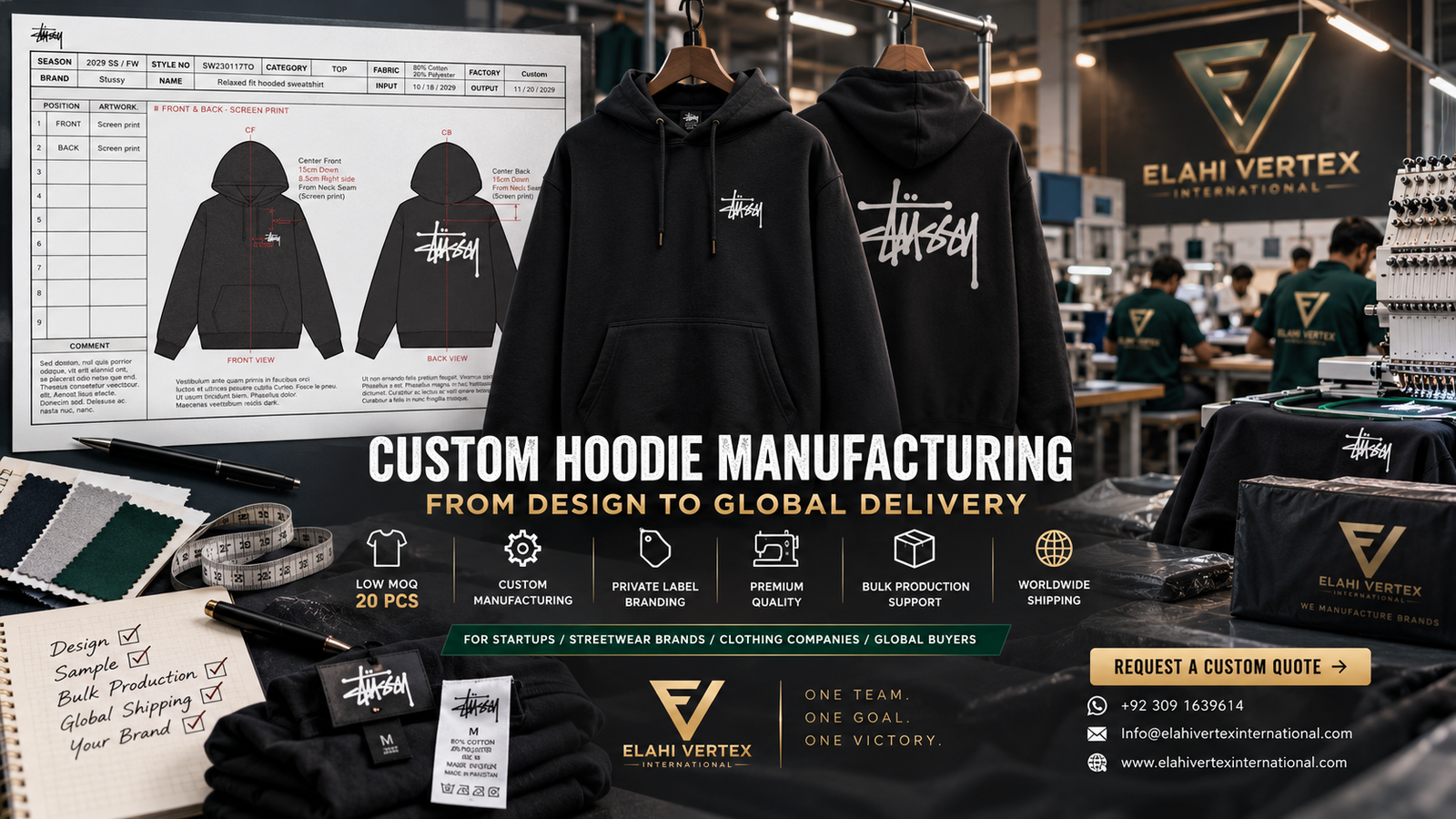
A hoodie can look simple on a product page and still be one of the easiest garments for a clothing brand to get wrong in production.
Fabric weight, cotton-to-polyester ratio, shrinkage, fleece construction, hood shape, rib recovery, sizing, stitching, printing, embroidery, garment washing, labels, packaging and bulk consistency can all affect the finished product.
For a US clothing brand searching for a custom hoodie manufacturer USA sourcing solution, the biggest risk is therefore not simply paying too much per hoodie.
The bigger risk is approving the wrong product before bulk production begins.
A $1 saving per piece means very little if the finished hoodies arrive with an incorrect fit, unstable measurements, poor embroidery, inconsistent colors or a fabric hand-feel that does not match the brand’s positioning.
That is why supplier selection should begin with specifications rather than price.
This guide explains 9 critical custom hoodie manufacturing mistakes US clothing brands should avoid before bulk production and provides a practical framework for startups, growing streetwear labels and established brands sourcing custom hoodies internationally.
It also explains how Elahi Vertex International approaches both smaller and larger custom apparel projects.
For brands that do not want to begin with a huge inventory commitment, Elahi Vertex International’s standard starting MOQ is 20 pieces per product/category. A smaller MOQ can help an early-stage brand validate a design before scaling into larger production.
At the same time, a low MOQ should not be confused with a small-production-only manufacturing model.
The objective is to create a production pathway that can move from:
Concept → Specifications → Sample → Approval → 20+ Piece Initial Production → Larger Bulk Production → Repeat Order
That distinction matters.
A startup may need flexibility today. If the product sells, it may need considerably more production capacity tomorrow. The manufacturing relationship should be structured with both stages in mind.
[FEATURED IMAGE — PLACE AFTER TITLE]
Table of Contents
- Why Custom Hoodie Manufacturing Goes Wrong
- Mistake #1: Starting Without a Complete Hoodie Specification
- Mistake #2: Choosing Fabric by GSM Alone
- Mistake #3: Skipping a Proper Pre-Production Sample
- Mistake #4: Ignoring Hoodie Fit, Measurements and Size Grading
- Mistake #5: Treating Printing and Embroidery as an Afterthought
- Mistake #6: Failing to Define Bulk Quality Standards
- Mistake #7: Ignoring US Labeling and Product Requirements
- Mistake #8: Comparing Manufacturers Only by Unit Price
- Mistake #9: Starting Bulk Production Before Final Approval
- How Elahi Vertex International Manages a Custom Hoodie Project
- How Our 20-Piece MOQ Helps Startups
- How We Manage Larger Bulk Hoodie Orders
- From Startup Order to Repeat Production
- Custom Hoodie Manufacturing Checklist
- RFQ Checklist for US Clothing Brands
- 50 Custom Hoodie Manufacturing FAQs
- Why Work With Elahi Vertex International?
- Final Buyer Checklist
- Conclusion
What Is Custom Hoodie Manufacturing?
Custom hoodie manufacturing is the production of hoodies according to a buyer’s specific requirements rather than purchasing generic finished garments from existing inventory.
Depending on the project, those requirements may include:
- Fabric composition
- Fabric GSM
- Fabric construction
- Color
- Dyeing
- Washing or finishing
- Fit
- Measurements
- Hood construction
- Rib specifications
- Pocket construction
- Zipper specifications
- Printing
- Embroidery
- Patches
- Labels
- Hangtags
- Packaging
- Size range
- Quantity
This is fundamentally different from buying blank hoodies and simply printing a logo on them.
A serious private label hoodie manufacturer should work from defined product specifications so that the buyer and manufacturer understand what the finished garment is supposed to be.
For US brands, this becomes especially important when manufacturing internationally because physical distance makes vague instructions expensive.
The clearer the specification before production, the lower the opportunity for misunderstanding later.
Why Do Custom Hoodie Orders Fail?
Most hoodie production problems can be traced back to one of five areas:
| Risk Area | Typical Problem | Possible Result |
|---|---|---|
| Specification | Requirements are vague | Manufacturer interprets details differently |
| Material | Wrong fabric selected | Wrong weight, feel or performance |
| Fit | Measurements are incomplete | Poor customer fit |
| Decoration | Artwork/process mismatch | Weak print or embroidery |
| Approval | Bulk starts too early | Problems multiplied across the order |
The common theme is simple:
Bulk production magnifies whatever was approved before bulk production.
If the approved specification is strong, that is useful.
If the approved specification contains a mistake, bulk production can reproduce that mistake dozens, hundreds or thousands of times.
This is why US brands should treat pre-production decisions as commercial decisions rather than administrative details.
Mistake #1: Starting Custom Hoodie Manufacturing Without a Complete Specification
One of the most expensive mistakes is sending a manufacturer little more than a mockup.
A visual mockup communicates appearance.
It does not necessarily communicate construction.
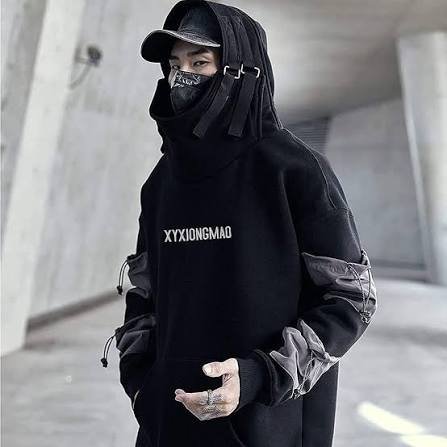
For example, an oversized black hoodie image does not tell a custom hoodie manufacturer USA sourcing buyer everything required to reproduce the intended product.
The manufacturer still needs to understand questions such as:
- What fabric?
- What composition?
- What GSM?
- Brushed or unbrushed interior?
- Pullover or zip-up?
- Drop shoulder or standard shoulder?
- How oversized?
- What body length?
- What chest width?
- What sleeve length?
- What hood dimensions?
- Double-layer hood?
- Kangaroo pocket dimensions?
- Rib composition?
- Rib width?
- Print method?
- Embroidery dimensions?
- Label dimensions?
- Packaging?
A beautiful mockup without manufacturing information is not a complete production instruction.
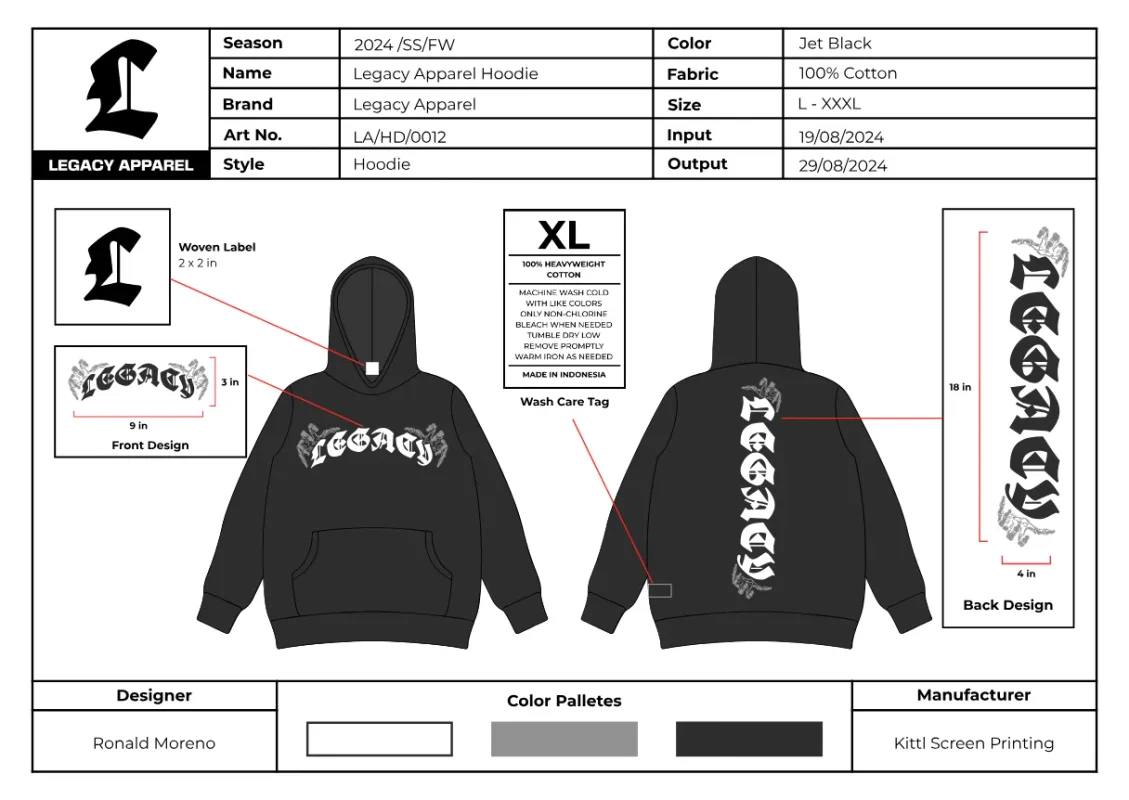
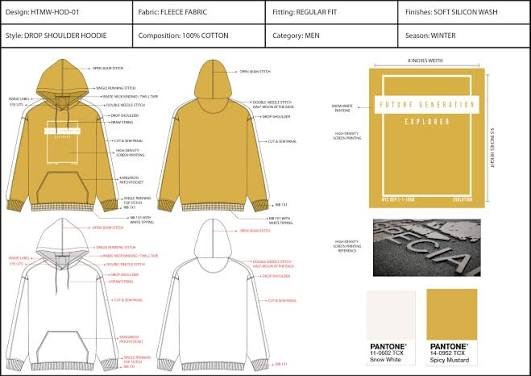
What Should a Hoodie Tech Pack Include?
A practical hoodie tech pack may contain:
Product Identification
- Style name
- Style number
- Product category
- Season or collection
Technical Drawings
Include front and back flats.
Add detail drawings where construction cannot be understood clearly from the main illustration.
Fabric Specification
Define:
- Fiber composition
- Fabric construction
- Target GSM
- Surface appearance
- Inside finish
- Stretch requirements where relevant
- Color reference
Measurement Specification
Define key points of measurement such as:
- Chest width
- Body length
- Shoulder
- Sleeve length
- Cuff opening
- Bottom opening
- Hood height
- Hood width
- Pocket dimensions
Construction
Specify important construction details rather than assuming the manufacturer will select them automatically.
Decoration
For every logo or graphic, identify:
- Technique
- Position
- Dimensions
- Colors
- Artwork file
Branding
Include:
- Main label
- Size label
- Care label
- Hangtag
- Packaging instructions
Size Range
Specify which sizes are required and provide or approve the relevant grading.
Why This Matters for Startups
Early-stage brands sometimes believe detailed technical specifications are only necessary for large orders.
The opposite is often true.
A startup has less money available to absorb a failed product.
A 20-piece test order should therefore be treated seriously.
The advantage of starting smaller is not permission to skip development.
It is an opportunity to validate development with less inventory exposure.
Elahi Vertex International Approach
Elahi Vertex International can work with custom clothing requirements including design files, fabric information, GSM, fit style, printing, labels and size instructions.
Before manufacturing, the project should be made sufficiently clear for the specific order.
Need to discuss a hoodie specification? Use the Elahi Vertex International custom manufacturing inquiry and provide your design, target fabric, quantity, size range and branding requirements.
Mistake #2: Choosing Hoodie Fabric by GSM Alone
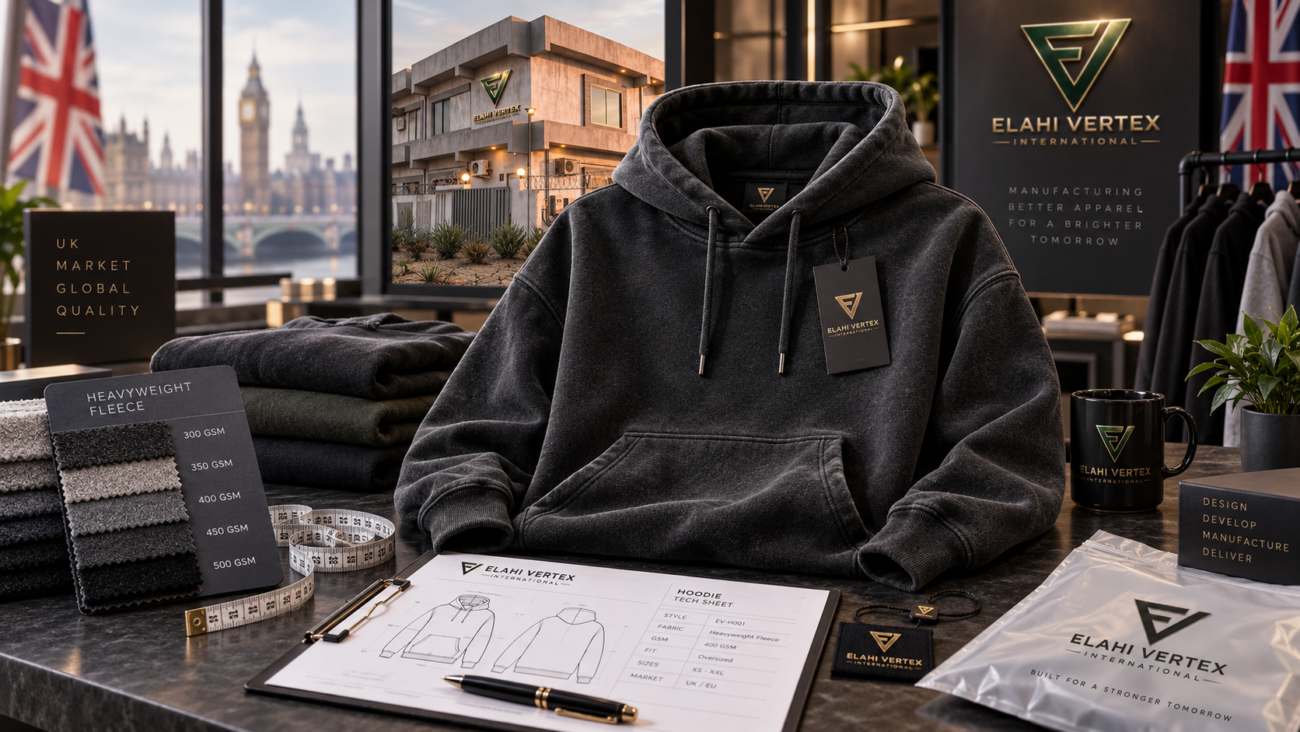
“400 GSM hoodie” is not a complete fabric specification.
GSM means grams per square meter.
It describes fabric mass per unit area.
It does not independently tell you:
- Fiber composition
- Knit construction
- Surface texture
- Softness
- Stretch
- Recovery
- Shrinkage
- Brushing
- Pilling behavior
- Density
- Drape
- Finishing
Two fabrics with a similar GSM can feel significantly different.
That makes fabric selection one of the most important decisions in custom hoodie manufacturing.
Common Hoodie Fabric Considerations
Depending on the product concept, brands may evaluate materials such as:
Cotton-Rich Fleece
Often considered for streetwear and lifestyle products where cotton hand-feel is important.
Cotton/Polyester Blends
The performance and feel depend heavily on the actual blend and construction.
French Terry
Often used when a loop-back interior is preferred instead of brushed fleece.
Brushed Fleece
Used when the desired interior is softer and warmer.
Heavyweight Fabrics
Often associated with structured or premium streetwear aesthetics, but “heavier” does not automatically mean “better.”
The right fabric is the one that matches the intended product.
GSM Must Match the Brand Position
Consider three hypothetical brands.
Brand A: lightweight lifestyle hoodie.
Brand B: heavyweight oversized streetwear hoodie.
Brand C: performance-oriented training hoodie.
All three are ordering “hoodies,” but they should not automatically use the same fabric.
The correct question is therefore not:
What is the best hoodie GSM?
It is:
Which fabric construction, composition, GSM and finish best match the intended hoodie?
Ask for More Than a Number
When communicating with a bulk hoodie manufacturer, specify the target experience.
For example:
Heavyweight oversized streetwear hoodie with structured drape and soft interior.
That communicates far more than:
Need 400 GSM.
The final specification can then be confirmed during development.
[IMAGE 2 — PLACE AFTER H2: MISTAKE #2]
Mistake #3: Skipping a Proper Pre-Production Sample
Sampling is not an unnecessary cost.
It is a risk-control step.
A digital mockup can help confirm appearance.
A physical sample allows a brand to evaluate the actual product.
That can include:
- Fabric feel
- Weight
- Color
- Fit
- Measurements
- Hood shape
- Pocket construction
- Rib quality
- Stitching
- Printing
- Embroidery
- Labels
- Overall appearance
A buyer searching for a private label hoodie manufacturer should therefore ask how the supplier moves from development to approved production.
What Should You Check on a Hoodie Sample?
1. Fabric
Does it feel like the intended product?
2. Measurements
Measure the garment physically against the approved specification.
3. Fit
The numerical measurement and the way the garment sits on a body are related but not identical.
4. Hood
Check:
- Depth
- Height
- Shape
- Opening
- Layering
- Drawcord arrangement where applicable
5. Rib
Check cuffs and waistband.
6. Pocket
Check symmetry, dimensions and placement.
7. Decoration
Evaluate printing or embroidery closely.
8. Labels
Confirm wording, size, placement and orientation.
9. Construction
Look at seams, stitch quality and finishing.
10. Overall Product
Finally, ask the most important question:
Would you confidently sell this hoodie under your brand?
If the answer is no, do not rush into bulk.
Sample Revision Is Not Automatically Failure
A sample that needs a correction can still serve its purpose.
Sampling exists to identify differences before those differences are multiplied through production.
The important issue is whether corrections are documented and incorporated into the final approved specification.
Mistake #4: Ignoring Hoodie Fit, Measurements and Size Grading
A premium fabric cannot rescue a poor fit.
For many streetwear brands, fit is part of the brand identity itself.
Terms such as:
- Oversized
- Boxy
- Relaxed
- Regular
- Cropped
- Drop shoulder
are useful descriptions.
But they are not sufficient manufacturing specifications by themselves.
“Boxy” to one person may not mean exactly the same thing to another.
Measurements remove much of that ambiguity.
Key Hoodie Measurements
A measurement chart may include:
| Measurement | Why It Matters |
|---|---|
| Chest width | Controls body volume |
| Body length | Influences silhouette |
| Shoulder width | Important for standard/drop shoulder |
| Sleeve length | Affects proportion |
| Sleeve opening | Influences cuff area |
| Bottom opening | Influences body shape |
| Hood height | Changes hood coverage |
| Hood width | Changes hood volume |
| Pocket width | Affects proportion |
| Pocket height | Affects usability and appearance |
Grading Matters
Suppose a medium sample fits perfectly.
That does not automatically mean XS through 3XL will fit correctly.
The sizes need an appropriate grading rule.
Poor grading can produce:
- Very small smaller sizes
- Excessively wide larger sizes
- Sleeve proportions that change incorrectly
- Inconsistent body length
- Distorted oversized fit
A competent custom hoodie manufacturing process therefore needs both base-size approval and sensible grading.
Do Not Copy Another Brand Blindly
Brands sometimes measure a favorite hoodie and ask a manufacturer to reproduce it exactly.
Using a reference garment to communicate preference can be useful.
Blindly copying another company’s product is not a sound product-development strategy.
Build your own fit specification.
That fit can eventually become part of your brand’s product identity.
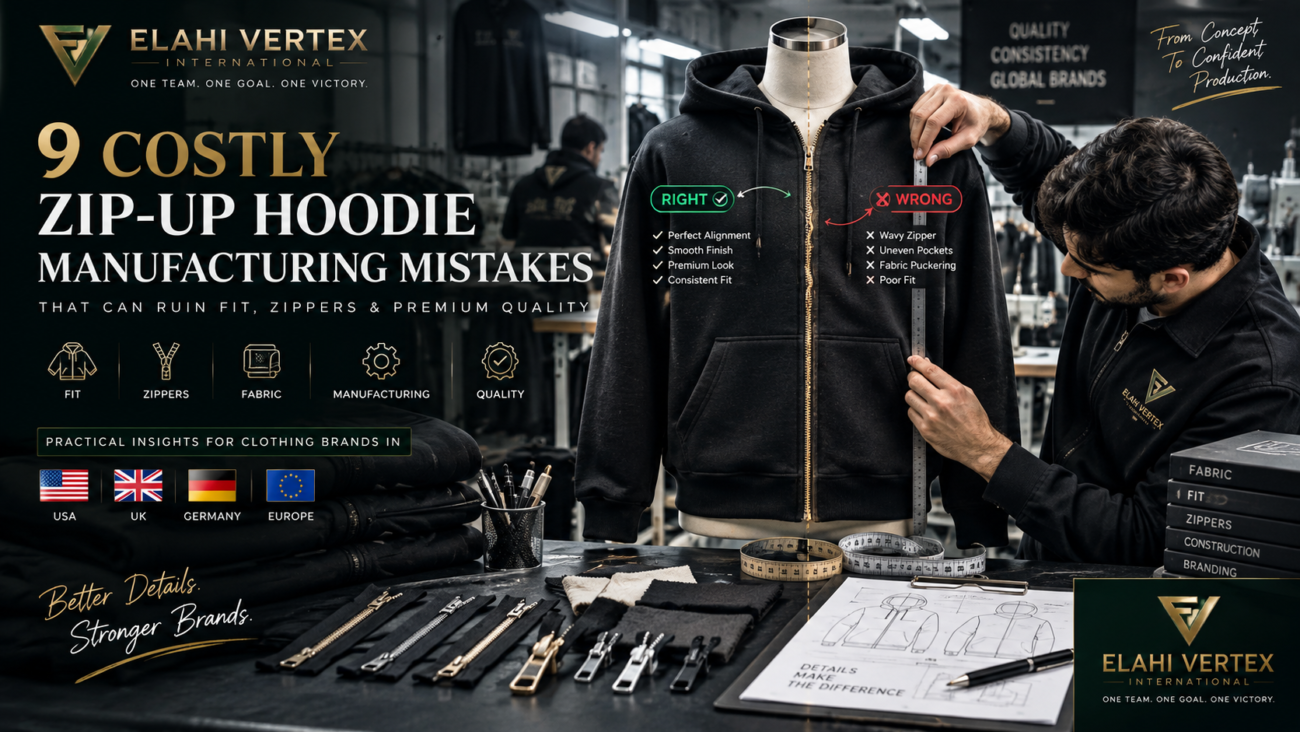
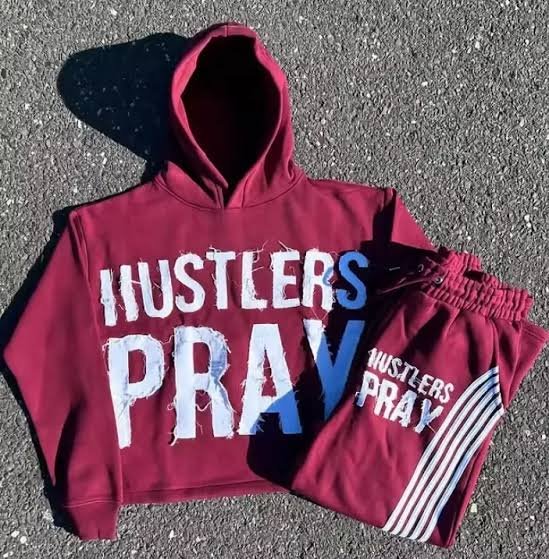
Mistake #5: Treating Printing and Embroidery as an Afterthought
Artwork can completely change the manufacturing requirements of a hoodie.
A tiny chest logo and a large detailed back graphic should not automatically use the same decoration technique.
Common decoration options can include:
- Screen printing
- Embroidery
- Puff printing
- High-density printing
- Heat transfer
- Appliqué
- Patches
- Other specialty treatments
Availability and suitability should be confirmed for the specific design.
Match Technique to Artwork
Before choosing a process, evaluate:
- Artwork detail
- Number of colors
- Placement
- Fabric surface
- Desired texture
- Wash expectations
- Order quantity
- Target visual effect
Embroidery Can Affect Fabric
Dense embroidery introduces thread and stitch density into the garment.
A large design can influence:
- Weight
- Drape
- Surface behavior
- Backing requirements
- Comfort
This is why artwork dimensions should be specified rather than saying “large logo.”
Define Exact Placement
Do not write:
Logo on chest.
Instead define placement using measurements from agreed reference points.
The same applies to:
- Back prints
- Sleeve graphics
- Hood embroidery
- Pocket branding
- Neck graphics
A few centimeters can visibly change the product.
Artwork Files Matter
Whenever possible, provide production-ready artwork in an appropriate format.
Do not expect a low-resolution screenshot to communicate every detail accurately.
[IMAGE 3 — PLACE AFTER H2: MISTAKE #5]
Mistake #6: Failing to Define Bulk Quality Standards
Sample approval is only half of the job.
The next question is:
How should bulk production correspond to the approved specification?
A bulk hoodie manufacturer needs a clear production reference.
That reference should include the approved:
- Fabric
- Color
- Measurements
- Construction
- Decoration
- Labels
- Packaging
- Artwork
- Size breakdown
What Should Bulk Quality Control Examine?
Depending on the order, checks may cover:
Fabric
- Correct fabric
- Correct color
- Consistent appearance
Measurements
Finished garments should be checked against approved measurement requirements and agreed tolerances.
Stitching
Inspect important seams and visible workmanship.
Decoration
Check:
- Placement
- Dimensions
- Color
- Registration
- Visible defects
Branding
Confirm:
- Main label
- Size label
- Care label
- Hangtags where applicable
Quantity
Verify ordered quantities and size breakdowns.
Packaging
Confirm the agreed packing method.
Why Small Brands Need QC Too
Quality control is not only for 5,000-piece orders.
A startup selling 20, 50 or 100 hoodies still has customers.
If five units have a major problem in a 20-piece order, that is 25% of the inventory.
Small quantities therefore do not make quality less important.
They make every individual garment financially significant.
Mistake #7: Ignoring US Labeling and Product Requirements
US clothing brands importing custom hoodies should not treat labeling as decoration.
For most textile and wool products, FTC rules require disclosures concerning fiber content, country of origin and the identity of the manufacturer or another responsible business.
Care instructions are also governed by the FTC Care Labeling Rule.
A brand should therefore establish applicable requirements before finalizing label artwork.
Typical Labeling Questions
Before production, clarify:
- Fiber content
- Country of origin
- Responsible company/RN information where applicable
- Care instructions
- Label placement
- Other legally required information for the specific product
Regulatory requirements depend on the product and circumstances, so brands should verify the rules applicable to their exact goods.
Children’s Hoodies Require Extra Attention
Children’s upper outerwear can be subject to additional US product-safety requirements.
This is particularly important for drawstrings.
A children’s product should never simply inherit adult hoodie construction without reviewing applicable requirements.
Why This Belongs in Product Development
Imagine approving 500 custom neck and care labels and discovering after production that mandatory information is missing.
The physical hoodie may be excellent.
The labeling problem still exists.
Compliance therefore belongs before bulk production, not after the shipment is packed.
Mistake #8: Choosing a Custom Hoodie Manufacturer Only by Unit Price
Suppose Supplier A quotes $1 less than Supplier B.
Does that automatically make Supplier A cheaper?
No.
You still need to compare:
- Fabric specification
- GSM
- Composition
- Construction
- Printing
- Embroidery
- Labels
- Packaging
- Sampling
- Quality requirements
- Freight
- Duties/taxes where applicable
- Payment terms
- Production risk
A low quote with a different specification is not a true price comparison.
Compare Like With Like
When requesting quotations from a custom hoodie manufacturer USA sourcing partner, send each supplier substantially the same specification.
Otherwise, one manufacturer may quote a lightweight basic hoodie while another prices a heavyweight premium product.
The numbers cannot be compared meaningfully.
Think in Landed Economics
The relevant commercial question is not merely:
What does manufacturing cost?
It is closer to:
What will this product cost us when it reaches the required destination in sellable condition?
That requires considering freight and import-related costs in addition to production.
Cheap Defects Are Expensive
A lower unit price can become expensive when it creates:
- Returns
- Refunds
- Replacements
- Negative reviews
- Delayed launch
- Dead inventory
- Brand damage
Price matters.
But price must be evaluated against the complete specification and risk.
Mistake #9: Starting Bulk Production Before Final Approval
This is the mistake that can turn a small disagreement into a large financial problem.
Do not approve bulk production because:
- Launch date is approaching
- Marketing is already scheduled
- Manufacturer says production should start
- You want to save a few days
- You assume one remaining detail will be fine
Before bulk begins, lock the important production information.
Bulk Approval Checklist
Confirm:
- Product design
- Fabric
- Fabric color
- GSM
- Composition
- Fit
- Measurements
- Size grading
- Hood construction
- Rib
- Printing
- Embroidery
- Artwork dimensions
- Artwork placement
- Main label
- Size label
- Care label
- Packaging
- Quantity
- Size breakdown
- Commercial terms
- Shipping arrangement
If a key item remains unresolved, resolve it before production whenever practical.
How Elahi Vertex International Manages Custom Hoodie Manufacturing
Elahi Vertex International works as a B2B custom clothing manufacturing and export partner for brands, startups and other business buyers.
For hoodie projects, the manufacturing conversation begins with the product itself.
A practical workflow can look like this:
Stage 1 — Buyer Requirements
We first need to understand what the brand wants to manufacture.
Useful information includes:
- Hoodie design
- Reference images
- Tech pack if available
- Fabric preference
- Target GSM
- Fit
- Quantity
- Sizes
- Printing
- Embroidery
- Labels
- Packaging
- Destination
If some information is still being developed, it should be identified rather than silently assumed.
Stage 2 — Specification Review
The objective is to convert the idea into production information.
A buyer may begin with:
“I need an oversized premium hoodie.”
Production requires deeper definition.
That may become:
- Oversized silhouette
- Defined chest/length measurements
- Drop shoulder
- Specified fabric construction
- Target GSM
- Defined hood shape
- Specified rib
- Front embroidery
- Back print
- Custom neck label
- Care label
- Individual packaging
The exact specification depends on the project.
Stage 3 — Commercial Discussion
Before manufacturing begins, the commercial scope should be understood.
That includes:
- Quantity
- Product specification
- Sampling requirements
- Shipping destination
- Commercial terms
Pricing should be based on the actual project rather than an imaginary universal hoodie price.
Stage 4 — Sampling
A physical sample allows the buyer to evaluate the product before larger production.
Our baseline approach is that the buyer pays the sample and shipping cost upfront. Where agreed for a qualifying project, the sample manufacturing cost may be credited toward a qualifying bulk order; shipping remains separate and is not credited.
The exact arrangement should be confirmed for the project before payment.
Stage 5 — Sample Review
The buyer should evaluate:
- Fit
- Measurements
- Fabric
- Color
- Construction
- Printing/embroidery
- Branding
- Overall appearance
Any agreed correction should be documented.
Stage 6 — Final Approval
Bulk production should work from the final approved specifications.
This is a critical control point.
Stage 7 — Bulk Manufacturing
Production follows the approved order specification.
Stage 8 — Quality Review
Finished production should be checked against the relevant approved requirements.
Stage 9 — Packing and Shipping
Packaging and shipping are handled according to the agreed order requirements and destination.
Shipping cost and transit arrangements depend on quantity, destination and shipping method and therefore should be quoted for the actual order.
Stage 10 — Repeat Production
A successful first production run can become the reference point for a repeat order.
For repeat production, brands should preserve approved information such as:
- Measurement chart
- Fabric specification
- Color reference
- Artwork
- Label files
- Packaging
- Previous corrections
This reduces unnecessary redevelopment.
Why Elahi Vertex International Uses a 20-Piece MOQ
Our standard MOQ is 20 pieces per product/category.
That matters because a startup’s first manufacturing problem is often not “How can I manufacture 5,000 hoodies?”
It is:
How can I launch a properly manufactured product without committing too much cash to unproven inventory?
A 20-piece starting quantity can help address that problem.
What a 20-Piece MOQ Can Help a Startup Test
A small initial production can help evaluate:
Product-Market Response
Do customers actually want the design?
Fit
Which sizes move fastest?
Color
Does the chosen color sell?
Price
Will customers pay the intended retail price?
Content
Does the physical garment photograph and film well?
Customer Feedback
What do buyers say after receiving it?
Reorder Potential
Does the product justify another production run?
The purpose is not to remain at 20 pieces forever.
The purpose is to make the first commercial decision more manageable.
20 Pieces Does Not Mean 20-Piece Manufacturing Forever
This distinction is important.
Elahi Vertex International works with startups, but our positioning is not:
“Tiny orders only.”
The better manufacturing pathway is:
Start at an appropriate quantity → validate → improve → reorder → scale.
A brand may begin with 20 pieces.
A successful style might then move toward:
- 50 pieces
- 100 pieces
- Several hundred pieces
- Larger production according to demand
Actual commercial terms depend on the specific product and order.
Why This Model Makes Sense
Inventory is cash.
A young brand that orders too much of an untested design can lock working capital into unsold garments.
On the other hand, a growing brand that constantly manufactures tiny quantities may eventually lose economies of scale.
The correct quantity changes as demand becomes clearer.
Our role is therefore not simply to push every buyer toward the biggest possible order.
The better commercial objective is a manufacturing relationship capable of growing with real demand.
How We Manage Larger Bulk Hoodie Orders
Large orders require more control, not less.
When a hoodie style moves into meaningful bulk production, the approved specification becomes increasingly important.
1. Freeze the Product Specification
The production reference should clearly identify what is being manufactured.
2. Confirm Quantity and Size Breakdown
For example, a bulk order cannot simply say:
500 hoodies.
Production needs the required quantity by size and potentially by color/style.
3. Confirm Materials
Material requirements should correspond to the approved specification.
4. Confirm Artwork
Bulk production should use the approved artwork information.
5. Confirm Branding
Labels and other branding details should be finalized.
6. Production Planning
The order enters production according to the agreed specifications and commercial arrangement.
7. Quality Checks
Relevant production characteristics are reviewed against the approved requirements.
8. Packing
Finished goods are prepared according to the agreed packaging arrangement.
9. Shipment
Shipping is arranged according to destination, quantity and agreed method.
Startup Manufacturing vs Bulk Manufacturing
| Factor | Startup / Initial Order | Growing Bulk Order |
|---|---|---|
| Main Goal | Validate product | Scale proven product |
| Inventory Risk | Higher sensitivity | Spread across larger volume |
| Starting Quantity | 20 pcs/category available | Based on project |
| Product Development | Critical | Must remain controlled |
| Sampling | Important | Important |
| Specification | Essential | Essential |
| Quality Control | Essential | More complex at scale |
| Reordering | Learn and improve | Consistency becomes critical |
| Unit Economics | May be higher | Can improve with scale depending on product |
| Working Capital | Protect cash | Optimize volume and margin |
The mistake is treating these as two unrelated manufacturing systems.
A well-developed initial order should create useful information for future bulk production.
How to Scale a Hoodie From 20 Pieces to Bulk Production
A sensible scaling path can look like this:
Step 1: Develop
Finalize the design and technical requirements.
Step 2: Sample
Create and review the physical product.
Step 3: Correct
Resolve meaningful problems.
Step 4: Produce Initial Quantity
Launch with an appropriate quantity.
Step 5: Collect Sales Data
Monitor:
- Sell-through
- Size demand
- Customer feedback
- Returns
- Color preference
Step 6: Improve Where Necessary
Do not automatically change the product because of one customer comment.
Look for repeated patterns.
Step 7: Reorder
Increase quantity when evidence supports it.
Step 8: Scale
Move into larger production while preserving approved specifications.
This is a much healthier growth model than guessing that a new hoodie will immediately sell thousands of units.
What Information Should a US Brand Send for a Hoodie Quote?
If you want a useful quotation from a custom hoodie manufacturer USA sourcing partner, send useful information.
At minimum:
- Product type
- Quantity
- Destination
- Fabric preference
- GSM if known
- Size range
- Printing requirements
- Embroidery requirements
- Labels
- Packaging
- Artwork/reference images
- Required timeline
If you have a tech pack, include it.
If you do not have one, clearly state which details are not yet finalized.
Custom Hoodie RFQ Template
Product: Oversized pullover hoodie
Quantity: [quantity]
Destination: [US city/state/ZIP]
Fabric: [composition/construction]
Target GSM: [GSM]
Fit: [oversized/boxy/etc.]
Sizes: [XS–XXL etc.]
Color: [Pantone/reference]
Front Artwork: [details]
Back Artwork: [details]
Embroidery: [details]
Main Label: [details]
Care Label: [details]
Hangtag: [details]
Packaging: [details]
Target Delivery: [date]
Files Attached: [tech pack/artwork/reference]
This is far more actionable than:
“Hi, price for 100 hoodies?”
How to Evaluate a Private Label Hoodie Manufacturer
Before selecting a supplier, ask:
- Can they understand the exact product?
- Can they work from technical specifications?
- What sampling process is available?
- How are revisions communicated?
- What is the MOQ?
- Can they support both initial and larger orders?
- What decoration techniques are suitable?
- How are measurements controlled?
- How is bulk production referenced to the approved product?
- What information is required for shipping?
- What payment terms apply?
- What happens before bulk production begins?
Do not select a manufacturer simply because their Instagram photos look attractive.
Manufacturing requires process.
What Makes a Premium Custom Hoodie?
There is no single specification that automatically creates a premium hoodie.
“Premium” is the result of several decisions working together.
These may include:
- Appropriate fabric
- Suitable construction
- Consistent color
- Strong fit
- Balanced proportions
- Clean sewing
- Suitable rib
- Well-shaped hood
- Accurate printing
- Controlled embroidery
- Appropriate labels
- Good finishing
- Consistent bulk execution
A 500 GSM hoodie with poor fit is not automatically premium.
A massive embroidered logo is not automatically premium.
A high price is not automatically premium.
The product must work as a whole.
Heavyweight Hoodie Manufacturing: What Brands Should Know
Heavyweight streetwear is popular, but brands should avoid reducing the concept to GSM alone.
A heavyweight hoodie needs balance.
Fabric, fit, rib, hood, pocket and decoration all influence the final silhouette.
For example, increasing fabric weight without reconsidering hood construction can change how the hood sits.
Similarly, a dense oversized embroidery can affect how a heavy fabric drapes.
Product development should therefore treat the hoodie as one system.
Oversized Hoodie Manufacturing: Fit Comes First
“Make it oversized” is one of the most dangerous instructions in streetwear manufacturing because it sounds precise while being vague.
Oversized can be created through different combinations of:
- Chest width
- Shoulder width
- Sleeve width
- Sleeve length
- Body length
- Armhole
- Hood volume
Two hoodies can have the same chest width and still look completely different.
Brands should build a measurement chart around their desired silhouette.
Private Label Hoodie Branding
Private-label manufacturing allows a brand to develop products under its own identity.
Depending on the project, branding can involve:
- Main woven label
- Printed neck label
- Size label
- Care/content label
- Hangtag
- Packaging
- Embroidery
- Screen print
- Patches
- Custom trims
Not every product needs every branding element.
Good branding is deliberate rather than excessive.
Custom Hoodie Packaging
Packaging should be discussed before final production.
Possible requirements can include:
- Individual polybag
- Size identification
- Barcode/label requirements
- Carton packing
- Brand packaging where applicable
The exact packaging specification depends on the buyer’s sales and logistics model.
A direct-to-consumer brand may have different requirements from a wholesaler.
Shipping Custom Hoodies to the USA
Shipping should never be ignored when comparing manufacturing prices.
The right shipping approach depends on:
- Quantity
- Carton dimensions
- Shipment weight
- Destination
- Required speed
- Commercial terms
This is why Elahi Vertex International should quote shipping against the actual project rather than promising one universal freight price.
A 20-piece startup order and a much larger commercial shipment can have very different logistics economics.
FAQs About Custom Hoodie Manufacturing
1. What is a custom hoodie manufacturer?
A custom hoodie manufacturer produces hoodies according to buyer-defined specifications such as fabric, fit, measurements, colors, decoration, labels and packaging rather than simply supplying generic ready-made stock.
2. What should I send a custom hoodie manufacturer USA sourcing partner?
Send your design, quantity, destination, fabric requirements, GSM, measurements, size range, artwork, decoration requirements, labels, packaging and target timeline.
3. What is the MOQ for custom hoodies at Elahi Vertex International?
Elahi Vertex International’s standard MOQ is 20 pieces per product/category.
4. Can a startup order only 20 custom hoodies?
Yes. A 20-piece MOQ can allow a startup to begin at a smaller quantity rather than immediately committing to a large inventory position.
5. Does Elahi Vertex International only manufacture small orders?
No. The 20-piece MOQ is a starting point. Elahi Vertex International also supports larger bulk manufacturing projects according to project requirements.
6. Can I scale from 20 hoodies to 100 or more?
Yes. The commercial goal of a successful initial run can be to move toward larger repeat production as actual demand develops.
7. What is private label hoodie manufacturing?
Private label hoodie manufacturing involves producing customized hoodies for a brand to sell under its own identity, according to agreed specifications and branding requirements.
8. What is the difference between blank hoodies and custom manufacturing?
Blank hoodies are already manufactured products awaiting decoration. Custom manufacturing allows the garment itself—fabric, fit, measurements, construction and branding—to be developed according to the buyer’s requirements.
9. Do I need a tech pack for custom hoodie manufacturing?
A detailed tech pack is highly useful because it reduces ambiguity. If one is unavailable, the required manufacturing information still needs to be established before production.
10. What should a hoodie tech pack contain?
It should generally communicate design, fabric, measurements, grading, construction, artwork, labels, colors and packaging requirements relevant to the project.
11. What GSM is best for hoodies?
There is no universal best GSM. The correct weight depends on season, fabric construction, desired feel, climate, fit and market positioning.
12. Is 400 GSM good for a heavyweight hoodie?
It can be appropriate for some heavyweight designs, but GSM alone cannot determine overall fabric quality or suitability.
13. Does higher GSM mean better quality?
No. GSM measures fabric mass per unit area, not overall quality.
14. What fabric is best for streetwear hoodies?
That depends on the desired product. Cotton-rich fleece, blends, French terry and other constructions can serve different streetwear concepts.
15. What is French terry?
French terry generally has loops on the interior rather than the heavily brushed interior associated with some fleece fabrics.
16. What is brushed fleece?
Brushed fleece has a mechanically raised surface, commonly on the inside, producing a softer, warmer feel.
17. Can I manufacture an oversized hoodie?
Yes. But “oversized” should be converted into actual measurements and construction requirements.
18. What is a drop-shoulder hoodie?
A drop-shoulder silhouette positions the shoulder seam farther down the arm than a conventional shoulder placement, contributing to a relaxed or oversized appearance.
19. Can I use my own size chart?
Custom size requirements can be discussed and should be finalized before production.
20. Why is hoodie grading important?
Grading controls how measurements change from one size to another. Poor grading can create inconsistent proportions across the size range.
21. Should I order a sample before bulk production?
For a custom-developed hoodie, physical sampling is a valuable way to evaluate fit, fabric, construction and decoration before committing to bulk.
22. How much does a custom hoodie sample cost?
Sample cost depends on the actual specification and shipping destination and should be quoted for the project.
23. Is sample shipping included?
Shipping should be quoted separately according to destination and courier requirements unless a specific quotation states otherwise.
24. Does Elahi Vertex International offer free samples?
The standard baseline is not an unconditional free-sample offer. Sample and shipping are paid upfront; where agreed for a qualifying order, the sample manufacturing cost may be credited toward bulk while shipping remains separate.
25. How long does a hoodie sample take?
Elahi Vertex International’s typical sample-production baseline is approximately 5–7 days after the necessary order and specification requirements are confirmed. Courier transit is additional and depends on destination/service.
26. What should I inspect on a hoodie sample?
Check fabric, fit, measurements, hood, pocket, rib, sewing, decoration, labels and overall appearance.
27. Can a sample be revised?
Where changes are required, revisions should be clearly documented and agreed before proceeding to production.
28. What is bulk hoodie manufacturing?
Bulk hoodie manufacturing is the production of larger quantities of an approved hoodie design according to defined production specifications.
29. How does Elahi Vertex International manage bulk production?
The workflow centers on confirmed specifications, quantity, materials, artwork, branding, production, quality review, packaging and shipping requirements.
30. How do you keep repeat hoodie orders consistent?
Repeat orders should reference approved specifications, measurement charts, artwork, colors, labels and documented corrections from prior production.
31. Can I change my design during bulk production?
Late changes can create cost, timing and consistency problems. Changes should ideally be finalized before bulk approval.
32. Can I add custom woven labels?
Custom branding requirements, including labels, can be discussed as part of the project specification.
33. Can I add custom care labels?
Yes, subject to the project’s requirements. US brands should ensure the final information complies with applicable regulations.
34. What information is required on US textile labels?
FTC requirements generally address fiber content, country of origin and manufacturer/dealer identity for covered textile products. Care labeling requirements also apply to garments.
35. Do imported hoodies need country-of-origin information?
Covered imported textile products are subject to US country-of-origin labeling requirements.
36. Are children’s hoodies subject to different requirements?
Potentially yes. Children’s apparel can be subject to additional CPSC requirements, including specific rules relevant to drawstrings in children’s upper outerwear.
37. Can I add embroidery to a heavyweight hoodie?
Yes where appropriate, but design size, stitch density, placement and fabric behavior should be considered during development.
38. Can I use puff print on custom hoodies?
Specialty printing should be evaluated against the design, fabric and required result and confirmed for the specific project.
39. Which is better, embroidery or screen printing?
Neither is universally better. Embroidery and printing produce different aesthetics, textures, costs and technical effects.
40. Can a custom hoodie manufacturer match Pantone colors?
Color references can help communicate the intended color, but the exact color-control process and achievable result should be confirmed for the specific material and project.
41. What affects custom hoodie price?
Important variables include fabric, weight, construction, quantity, decoration, labels, packaging and shipping.
42. Why are 20 custom hoodies more expensive per unit than 1,000?
Fixed setup and development costs are distributed across fewer units, while larger production may create manufacturing efficiencies. Exact pricing depends on the product.
43. Should I choose the cheapest bulk hoodie manufacturer?
Not automatically. Compare the specification, quality controls, communication, commercial terms and landed economics rather than price alone.
44. Can Elahi Vertex International ship custom hoodies to the USA?
Elahi Vertex International is an international apparel exporter and works with international buyers. Shipping terms and cost should be confirmed for the specific US destination and quantity.
45. What destination information is needed for a shipping quote?
Provide at least the country and preferably the complete delivery location/ZIP information required for an accurate quotation.
46. Can I reorder the same hoodie later?
Yes. Preserving approved specifications and production information helps make repeat manufacturing more controlled.
47. Can an established brand use Elahi Vertex International for bulk orders?
Yes. Elahi Vertex International works with both startups and established business buyers, with project terms determined by the required product and quantity.
48. Why is a 20-piece MOQ useful?
It can reduce initial inventory exposure and allow a brand to test a product before deciding whether larger production is commercially justified.
49. What should I do before placing my first hoodie order?
Finalize the product concept, create clear specifications, determine quantity and destination, review a sample where appropriate, confirm commercial terms and approve the production details.
50. How do I start a custom hoodie project with Elahi Vertex International?
Prepare your artwork, quantity, size range, fabric/GSM preference, branding requirements and destination, then submit them through the Elahi Vertex International inquiry channels for project review.
Why Choose Elahi Vertex International for Custom Hoodie Manufacturing?
The strongest reason to consider Elahi Vertex International is not a slogan.
It is the manufacturing model.
We work with B2B buyers requiring custom apparel rather than positioning ourselves as a generic consumer hoodie store.
20-Piece Starting MOQ
Our standard MOQ of 20 pieces per product/category gives startups and smaller brands a practical entry point.
Startup-to-Bulk Pathway
A buyer can begin at an appropriate initial quantity and scale toward larger orders as demand develops.
Custom Product Development
Projects can involve custom:
- Fabric requirements
- GSM
- Fit
- Measurements
- Printing
- Embroidery
- Labels
- Branding
- Packaging
subject to confirmation for the specific product.
Sampling Before Larger Production
Physical sampling provides a practical checkpoint before larger commitments.
B2B Manufacturing
Our objective is not a one-time retail sale.
The commercially valuable relationship is:
Successful Product → Successful Bulk Production → Repeat Order → Long-Term Manufacturing Relationship
That aligns the manufacturer’s incentive with the brand’s growth.
Final Custom Hoodie Manufacturing Checklist for US Brands
Before sending your bulk approval, confirm all of the following.
Product
- Style finalized
- Reference images finalized
- Tech pack updated
Fabric
- Composition confirmed
- Construction confirmed
- GSM confirmed
- Color confirmed
- Finish confirmed
Fit
- Base measurements approved
- Fit approved
- Size grading approved
Construction
- Hood approved
- Pocket approved
- Rib approved
- Stitching requirements approved
Decoration
- Artwork final
- Print method final
- Embroidery final
- Dimensions final
- Placement final
Branding
- Main label
- Size label
- Care/content label
- Country-of-origin information
- Hangtag where applicable
Commercial
- Quantity
- Size breakdown
- Price
- Payment terms
- Production terms
Logistics
- Packaging
- Shipping method
- Destination
- Freight cost/arrangement
- Import responsibilities understood
Approval
- Sample reviewed where applicable
- Corrections documented
- Final specifications approved
- Bulk authorization issued
Final Conclusion: Avoid the Mistake That Causes Most Other Mistakes
The biggest mistake in custom hoodie manufacturing is not choosing the wrong GSM or selecting the wrong print method.
It is allowing assumptions to enter production.
An assumption about fabric becomes a fabric problem.
An assumption about fit becomes a sizing problem.
An assumption about artwork becomes a decoration problem.
An assumption about labels becomes a compliance problem.
An assumption about shipping becomes a landed-cost problem.
Professional manufacturing replaces assumptions with specifications, approvals and documented decisions.
For US startups, that does not mean beginning with enormous quantities.
Elahi Vertex International’s 20-piece MOQ per product/category provides a lower-entry manufacturing pathway for brands that want to test a custom product before taking on larger inventory.
For growing brands, the same relationship can move into larger bulk hoodie manufacturing as demand develops.
The objective should not be to manufacture as many hoodies as possible on day one.
The objective should be to manufacture the right hoodie, prove that customers want it, protect product consistency and then scale intelligently.
Ready to Develop Your Custom Hoodie?
If you are a US streetwear brand, startup, established clothing company, wholesaler or private-label buyer, send Elahi Vertex International:
1. Your hoodie design or reference
2. Desired fabric and GSM
3. Target fit and size range
4. Printing/embroidery requirements
5. Labels and branding requirements
6. Quantity — starting from 20 pieces per product/category
7. US delivery destination/ZIP code
We can then discuss the project around the actual product instead of giving you a meaningless generic price.
Start small when that makes commercial sense. Validate the product. Scale when demand proves it.
Elahi Vertex International supports the manufacturing path from custom development and sampling through initial production, bulk orders and repeat manufacturing.
Official website: Elahi Vertex International
Custom manufacturing: Custom Clothing Manufacturing
Private label: Private Label Manufacturing
Contact: Request a Custom Manufacturing Quote
The next useful step is not another Google search.
It is a properly specified RFQ.
Send the requirements and begin with the product.
US Custom Hoodie Buyers
Choosing a custom hoodie manufacturer USA sourcing partner involves more than comparing unit prices. US clothing brands should understand textile labeling, care instructions, product safety, importing, fabric specifications, quality control, private-label manufacturing and bulk-production planning. The following internal and authoritative external resources provide useful supporting information for brands researching custom hoodie manufacturing, private label hoodie manufacturing and bulk hoodie manufacturing.
Internal Resources — Elahi Vertex International
- Learn how a custom clothing manufacturer develops made-to-order apparel through Custom Clothing Manufacturing.
- Brands developing their own labels can explore Private Label Manufacturing when researching a private label hoodie manufacturer.
- Understand the broader Manufacturing Process before moving a hoodie from development into bulk production.
- Brands providing their own specifications and designs can learn about OEM Clothing Manufacturing.
- Visit Elahi Vertex International to understand our B2B custom apparel manufacturing positioning.
- Buyers who want to evaluate manufacturing work can review the Elahi Vertex International Portfolio.
- Before selecting a custom hoodie manufacturer USA sourcing partner, review Our Manufacturing Work to understand the importance of checking actual production capabilities.
- Streetwear founders researching custom production can explore the Streetwear Manufacturing Case Study.
- Brands comparing heavier fabrics can review this 380 GSM Cotton Fleece Hoodie alongside the fabric-selection guidance in this article.
- Sportswear buyers can also review Custom Warm-Up Hoodies when comparing hoodie applications.
- Fabric selection should begin before bulk production. Read about Fabric Sourcing and Manufacturing when defining composition, construction and GSM.
- A physical prototype can expose problems before they reach a full order. Explore Sampling and Prototyping.
- Brands planning logos, lettering or detailed artwork should consider the requirements of Custom Embroidery Manufacturing.
- Artwork requirements can change according to decoration technique. Learn more about Custom Printing Manufacturing.
- A private label hoodie manufacturer project can include brand identity beyond the garment itself. Review Private Label Manufacturing when planning custom labels and branding.
- Custom hoodies requiring original construction should be developed through a controlled Cut-and-Sew Manufacturing Process.
- Fit begins before sewing. Learn how Pattern Making fits into apparel development.
- Sample approval does not eliminate the need for bulk checks. Review the Quality Control Process when planning bulk hoodie manufacturing.
- Packaging requirements should be established before finished goods are prepared for dispatch. Review Custom Apparel Packaging.
- US brands importing apparel should consider freight as part of landed economics. See the Worldwide Shipping Process.
- Growing brands preparing larger quantities can review OEM Bulk Clothing Manufacturing when planning repeat or scaled production.
- Early-stage brands can explore Custom Clothing Manufacturing when evaluating a manufacturer capable of supporting startup development.
- Brands building their own identity can learn more about Private Label Clothing Production.
- Buyers evaluating a potential supplier should look beyond marketing claims. Review Elahi Vertex International’s Manufacturing Work as part of supplier due diligence.
- Ready to discuss fabric, GSM, fit, quantity, branding and US destination? Request a Custom Hoodie Manufacturing Quote from Elahi Vertex International.
Authoritative External Resources for US Clothing Brands
- US brands should begin with the FTC Apparel and Labeling Guidance when researching federal apparel-labeling responsibilities.
- The FTC Textile Fiber Products Identification Act guidance provides an important regulatory reference for textile fiber disclosures.
- Brands can use the FTC’s Threading Your Way Through the Labeling Requirements for more detailed textile and wool labeling guidance.
- Care instructions should not be treated as an afterthought. Review the FTC Care Labeling Rule.
- The FTC’s practical Clothes Captioning: Complying With the Care Labeling Rule helps apparel businesses understand care-label responsibilities.
- Brands manufacturing children’s hoodies should review information from the US Consumer Product Safety Commission.
- Children’s upper outerwear requires particular attention to drawstring construction. Review the CPSC Drawstrings in Children’s Upper Outerwear Guidance.
- Companies importing apparel into the United States should consult US Customs and Border Protection for current customs and import information.
- Importers can research trade requirements through the official CBP Trade Portal.
- US clothing businesses can research tariff classifications through the US International Trade Commission.
- The official Harmonized Tariff Schedule of the United States is useful when researching the appropriate tariff classification for imported garments.
- Brands sourcing internationally can use the Office of Textiles and Apparel for US textile and apparel trade information.
- The broader International Trade Administration provides resources relevant to international commerce and trade.
- Apparel businesses researching textile standards can consult ASTM International for applicable testing and technical standards.
- Brands developing products for US consumers can research product-safety information through the CPSC Business Education resources.
- Companies developing children’s products should review CPSC Children’s Product Requirements before assuming adult hoodie specifications are appropriate.
- US businesses can research federal regulatory information through the official eCFR.
- The Federal Register provides access to federal rules, proposed rules and regulatory notices that may affect businesses.
- Brands researching textile terminology and standards can use AATCC as an established textile-industry technical resource.
- Clothing companies evaluating color communication can review the official Pantone system rather than relying solely on how colors appear on different screens.
- Brands importing internationally manufactured apparel can research customs information and importer responsibilities through CBP Importing Into the United States.
- US businesses can use SBA resources for broader guidance on starting, operating and growing a business.
- Clothing startups planning international sourcing can research market and trade information through Trade.gov before making assumptions about international commerce.
- When researching textile products, businesses can check current federal consumer-protection requirements through the Federal Trade Commission.
- For product-safety questions involving apparel—particularly children’s products—brands should verify current requirements directly through the Consumer Product Safety Commission before finalizing production.
Turn Research Into a Proper Custom Hoodie RFQ
Reading about custom hoodie manufacturing is useful, but the next commercial step is to turn the research into a clear product specification.
Elahi Vertex International supports startups, growing streetwear labels, established clothing companies and other B2B buyers requiring custom apparel production.
Our standard starting MOQ is 20 pieces per product/category, giving eligible startup and small-batch projects a practical route into manufacturing without requiring an unnecessarily large first inventory commitment. The same manufacturing relationship can progress into larger bulk hoodie manufacturing when demand justifies scaling.
Before requesting pricing, prepare:
- Hoodie design or tech pack
- Fabric composition
- Target GSM
- Fit and measurements
- Size range
- Color requirements
- Printing or embroidery artwork
- Private labels and branding
- Packaging requirements
- Initial or bulk quantity
- US delivery destination and ZIP code
Then contact Elahi Vertex International with the actual project requirements.
You can also review our custom clothing manufacturing process, private label manufacturing, OEM clothing manufacturing, manufacturing process and real manufacturing work before starting your project.
Start with the quantity your business can justify. Validate the hoodie. Protect the specification. Scale when the sales data supports the next production run.
That is a stronger manufacturing strategy than committing large amounts of working capital to an untested design simply to obtain a lower unit price.
Ready to Manufacture Custom Hoodies for Your US Clothing Brand?
You have researched fabric, GSM, fit, sampling, printing, embroidery, labeling, quality control and bulk-production risks.
The next step is not requesting a random “price per hoodie.”
The next step is building a hoodie specification that a manufacturer can actually quote, sample and produce.
Elahi Vertex International works with startups, streetwear labels, private-label businesses, growing clothing brands and established B2B buyers requiring custom apparel manufacturing.
Whether you are preparing your first 20-piece custom hoodie order, testing a new streetwear drop, developing a private-label collection or preparing a substantially larger bulk order, the objective is the same:
Develop the right product first. Approve it properly. Manufacture it consistently. Scale it when demand justifies the next order.
Explore our Custom Clothing Manufacturing capabilities or review the complete Elahi Vertex International Manufacturing Process before sending your requirements.
Start With 20 Pieces — Then Scale With Demand
One of the biggest problems facing a startup clothing brand is inventory risk.
Ordering hundreds of units simply to access manufacturing can tie up working capital before the brand knows whether the hoodie will actually sell.
Elahi Vertex International therefore maintains a standard starting MOQ of 20 pieces per product/category.
The 20-piece MOQ is particularly useful for brands that want to test:
- A new hoodie design
- A new streetwear collection
- A new fabric or GSM
- An oversized or boxy fit
- A new colorway
- Embroidery or print placement
- Private-label branding
- Customer response
- Size demand
- Initial sell-through
But our manufacturing model is not limited to 20-piece orders.
The goal is to create a practical pathway from smaller initial production into larger commercial quantities.
A growing buyer may progress through:
20-piece initial order → market validation → reorder → 50/100+ pieces → larger bulk production → repeat manufacturing
The appropriate quantity should be determined by actual demand, specifications and commercial requirements rather than ordering unnecessary inventory merely to chase a lower unit price.
Brands preparing larger orders can learn more about our OEM Clothing Manufacturing approach.
Custom Hoodies Built Around Your Brand
Your hoodie should not have to look like everybody else’s hoodie.
Depending on the project requirements, custom development can cover areas such as:
Fabric
Discuss the required:
- Fabric composition
- GSM
- Fabric construction
- Brushed or unbrushed finish
- Fleece or French terry requirements
- Weight and hand-feel
- Color requirements
Fit & Measurements
Develop your intended:
- Oversized fit
- Boxy fit
- Regular fit
- Relaxed fit
- Drop shoulder
- Body width
- Body length
- Sleeve dimensions
- Hood proportions
- Size grading
Printing & Decoration
Discuss artwork requirements for techniques appropriate to the specific project, including:
- Screen printing
- Embroidery
- Puff effects
- Heat-transfer applications
- Patches
- Other custom decoration where applicable
Private-Label Branding
A private-label project may also include requirements for:
- Main brand labels
- Size labels
- Care/content labels
- Hangtags
- Brand artwork
- Custom packaging
Learn more about Private Label Manufacturing if you want the garment developed around your own clothing brand.
From Idea to Sample to Bulk Production
A serious custom hoodie manufacturing project should not jump directly from an Instagram mockup into hundreds of finished garments.
A more controlled pathway is:
Design → Specification → Commercial Review → Sampling → Buyer Review → Corrections → Final Approval → Bulk Production → Quality Review → Packing → Shipping → Repeat Order
Sampling gives you the opportunity to evaluate the physical hoodie before committing to larger production.
Depending on your project, that means reviewing important characteristics such as:
- Fabric
- GSM
- Hand-feel
- Fit
- Measurements
- Hood construction
- Pocket construction
- Rib
- Stitching
- Printing
- Embroidery
- Labels
- Branding
- Overall appearance
Our standard sample baseline is straightforward:
Sample manufacturing + shipping are paid upfront.
Where specifically agreed for a qualifying bulk project, the sample manufacturing cost may be credited toward the qualifying bulk order. Shipping is separate and is not credited.
Exact sample pricing depends on the actual hoodie specification and shipping destination.
Read more about Sampling, Product Development and Manufacturing.
Already Need Bulk Production?
You do not need to begin at 20 pieces if your business already has proven demand.
If you are an established US clothing brand, wholesaler, retailer, e-commerce business or private-label buyer preparing a larger order, send the actual quantity you require.
A bulk manufacturing discussion should include:
Product specification → Quantity → Size breakdown → Fabric → GSM → Colors → Artwork → Branding → Packaging → Destination → Required timeline
This allows Elahi Vertex International to evaluate the real project rather than offering a misleading generic hoodie price.
For bulk production, product specifications should be finalized before manufacturing begins so the approved fabric, measurements, artwork, branding and construction provide a clear production reference.
Explore our OEM Clothing Manufacturing services for specification-led production.
What Should You Send Us for an Accurate Hoodie Quote?
Instead of sending:
“Price for 100 hoodies?”
Send as much of the following information as you currently have:
1. Hoodie design
Send your tech pack, sketch, mockup or reference images.
2. Quantity
Tell us whether you need 20, 50, 100, 500 or another quantity.
3. Fabric
Specify your preferred composition and construction if already known.
4. GSM
Provide your target GSM or explain the desired weight and feel.
5. Fit
Tell us whether you need oversized, boxy, relaxed, regular or another silhouette.
6. Size range
Provide the required sizes and size chart where available.
7. Colors
Provide your required garment colors and references where available.
8. Printing
Send artwork, dimensions and placement requirements.
9. Embroidery
Provide artwork, size and placement where embroidery is required.
10. Private labels
Include main label, size label, care/content label and hangtag requirements.
11. Packaging
Tell us whether you have specific individual or bulk packaging requirements.
12. Delivery destination
For US orders, provide the destination and preferably the ZIP code so shipping can be evaluated against the actual order.
13. Required timeline
Tell us when you need the goods rather than assuming production and international transit are the same thing.
The more complete the RFQ, the more meaningful the manufacturing discussion becomes.
Why Send Your Project to Elahi Vertex International?
Because the goal should not be to win your first order with a cheap headline price and disappear afterward.
The commercially valuable relationship is:
First Product → Successful Production → Customer Sales → Reorder → Larger Order → Long-Term Manufacturing Partnership
Elahi Vertex International operates as a B2B manufacturer, exporter, OEM/ODM and private-label manufacturing partner rather than a generic ready-made hoodie retailer.
You can independently explore:
- Custom Clothing Manufacturing
- Private Label Manufacturing
- OEM Clothing Manufacturing
- Manufacturing Process
- Our Manufacturing Work
- Portfolio
- Streetwear Case Studies
Review the company first.
Then decide whether our manufacturing model fits your brand.
Your First Order Does Not Need to Be Your Biggest Order
For a startup, putting too much cash into unproven inventory can be more dangerous than paying a slightly higher cost per unit for a smaller initial production run.
That is why our 20-piece MOQ per product/category can be commercially useful.
Develop the hoodie.
Approve the product.
Test the market.
See which sizes sell.
Collect customer feedback.
Measure sell-through.
Then make the next production decision using actual evidence.
If the hoodie performs, scale it.
If the market tells you something needs to change, improve it before committing substantially more working capital.
For an established brand with proven demand, skip the artificial testing stage and discuss the required bulk quantity directly.
The production quantity should fit the business—not the other way around.
Start Your Custom Hoodie Project With Elahi Vertex International
If you are actively searching for a custom hoodie manufacturer USA sourcing partner, send us the actual product requirements.
Send Your RFQ
Include:
Design / Tech Pack: Attach available files
Product: Custom hoodie
Quantity: 20 pieces per product/category minimum or your required bulk quantity
Fabric: Your required composition/construction
GSM: Target weight
Fit: Oversized / boxy / regular / custom
Sizes: Required size range
Colors: Required colorways
Printing: Artwork + placement
Embroidery: Artwork + placement
Labels: Private-label requirements
Packaging: Required packaging
Destination: US city/state/ZIP code
Timeline: Required delivery target
Contact Elahi Vertex International
Website: Elahi Vertex International
Request a Quote: Send Your Custom Hoodie Requirements
Custom Manufacturing: Explore Custom Clothing Manufacturing
Private Label: Explore Private Label Manufacturing
OEM Manufacturing: Explore OEM Clothing Manufacturing
Manufacturing Process: See How Production Is Managed
Our Work: Review Elahi Vertex International Manufacturing Work
Portfolio: View Manufacturing Portfolio
One Product. One Controlled First Step. Then Scale.
You do not need a vague sales pitch.
You need to know whether your hoodie can be manufactured according to your design, target quality, quantity, budget and delivery requirements.
Starting a clothing brand? Begin from 20 pieces per product/category where that quantity fits your launch strategy.
Already selling? Send your larger bulk requirement.
Need private-label hoodies? Send your branding, labels, artwork and packaging requirements.
Have a complete tech pack? Send it for project review.
Only have a concept or reference? Send what you have and identify what still needs to be finalized.
Preparing a repeat order? Provide the approved specifications and required new quantity.
The objective is simple:
Develop correctly → Sample intelligently → Approve carefully → Manufacture consistently → Deliver → Sell → Reorder → Scale.
If that is the manufacturing relationship your brand is looking for, send your custom hoodie RFQ to Elahi Vertex International and start the discussion with your design, quantity and US delivery destination.