

For a German fashion brand, finding a private label leather jacket manufacturer is not simply about locating a factory that can stitch a jacket. The real sourcing challenge is finding a manufacturing partner capable of translating a design into a commercially viable product while controlling leather selection, fit, construction, branding, sampling, bulk consistency and international delivery.
Elahi Vertex International is a Sialkot, Pakistan-based B2B manufacturer, exporter, OEM/ODM supplier and private label manufacturer serving fashion brands, streetwear labels, startups, wholesalers, retailers and other international buyers.
For brands in Germany, the wider European Union, the United Kingdom and the United States, Elahi Vertex International develops custom leather jackets according to buyer specifications. The company’s published leather-jacket range includes genuine leather, cowhide, sheepskin, lambskin and goatskin options, while leather type, thickness, texture, finish, colour, sizing and other specifications can be developed around the project.
Most importantly for an emerging label or a brand testing a new collection, the standard Elahi Vertex International MOQ is 20 pieces per product/category.
That is commercially significant. Current competitor research shows that some Pakistan-based leather manufacturers targeting Germany publicly advertise MOQs of 50 or 100 pieces. A lower starting quantity can reduce the amount of capital a brand has to commit before it has real market evidence for a new jacket.
This guide explains nine practical manufacturing solutions fashion brands should examine when choosing a private label leather jacket manufacturer, how leather jacket development works, what customization can involve, what German and EU buyers need to consider, and how Elahi Vertex International approaches custom leather manufacturing for international brands.
Table of Contents
What Is a Private Label Leather Jacket Manufacturer?
A private label leather jacket manufacturer produces leather jackets that are sold under the buyer’s brand rather than the manufacturer’s consumer brand.
The fashion brand controls the product identity. Depending on the project, this can include the silhouette, fit, leather, colour, lining, zipper, hardware, embroidery, artwork, labels, hangtags, packaging and other details.
The manufacturer converts those requirements into a physical product.
This differs from purchasing generic wholesale jackets and adding a logo afterward.
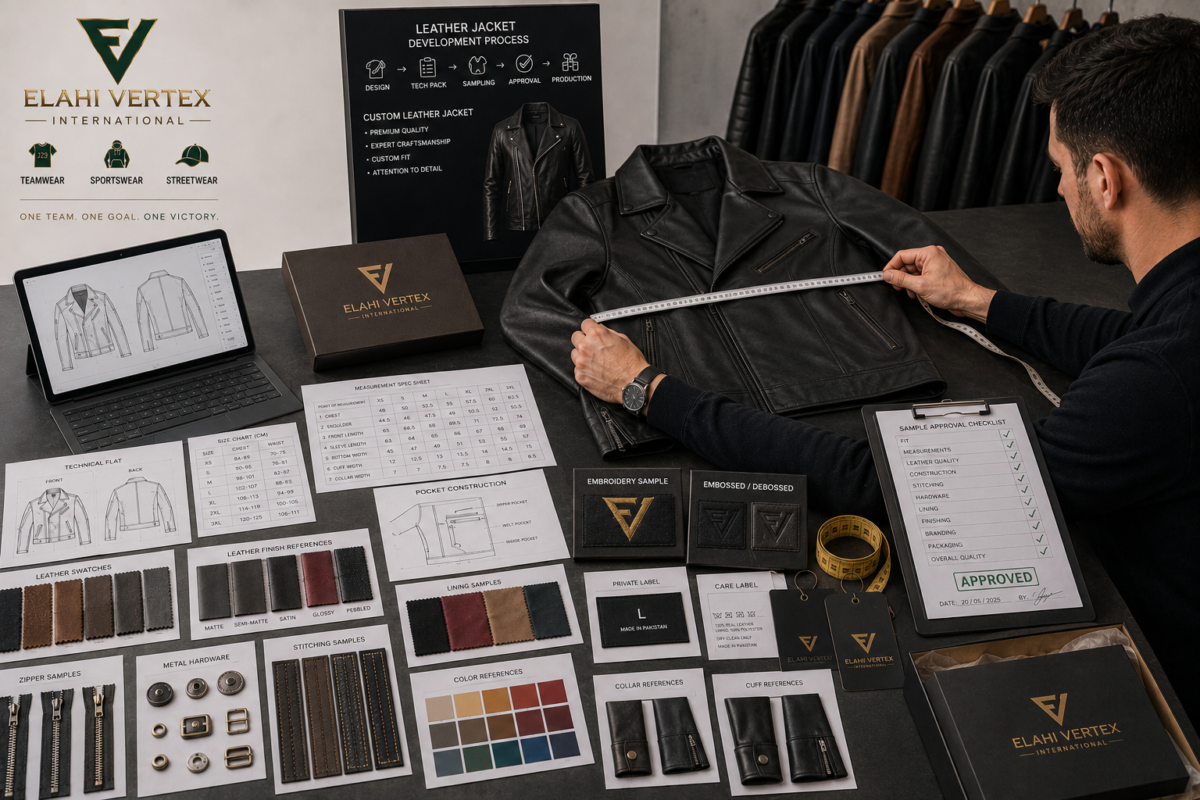
A serious private-label project normally begins with information such as:
- Tech pack
- Reference garment
- Sketch
- Measurements
- Size chart
- Reference photographs
- Leather preference
- Colour requirement
- Lining specification
- Hardware requirements
- Logo artwork
- Label artwork
- Embroidery or decoration files
- Quantity
- Destination
- Target date
For startups that do not yet have a complete technical package, an ODM-style development conversation may begin from a clearer product concept or reference. Final feasibility and specifications still need to be agreed before production.
Elahi Vertex International operates as a custom B2B manufacturing partner rather than a generic consumer leather retailer.
MOQ: 20 pcs per product/category.
Brands can submit a leather-jacket project through the Elahi Vertex International private-label manufacturing inquiry, which currently allows buyers to select leather jackets, upload design files and provide customization, sizing and quantity requirements.
1. Custom OEM/ODM Leather Jacket Product Development
The first solution a private label leather jacket manufacturer should provide is product development rather than simply logo placement.
A private-label brand may already know exactly what it wants. Another may have a concept but still need the product translated into manufacturable specifications.
OEM leather jacket development
OEM is most suitable when the buyer already controls the design and specifications.
A brand may provide:
- Technical drawings
- Measurement chart
- Construction details
- Leather specification
- Lining details
- Hardware specification
- Colour references
- Label placement
- Logo dimensions
- Packaging requirements
The manufacturing objective is then to reproduce the approved specification accurately.
ODM leather jacket development
ODM-style development is more useful when a brand has a direction but needs more development before production.
For example, a startup may say:
We want an oversized black lambskin bomber with dropped shoulders, a cropped body, custom lining and tonal embossed branding.
That is a commercial concept, but it is not yet a complete manufacturing specification.
The project still needs decisions about measurements, leather thickness, pattern, ribbing, zipper type, lining composition, logo dimensions, label positions, pocket construction and grading.
A capable private label manufacturer should help move the project from idea toward an approved manufacturing specification without pretending that vague instructions are sufficient.
Why this matters for German brands
German buyers evaluating international manufacturers should compare how suppliers handle technical communication before comparing price.
A cheap quote based on incomplete specifications is not necessarily a cheaper product. It may simply be a quote for a different product.
Practical rule: finalize what is being manufactured before treating quotations as directly comparable.
[IMAGE 2 — PLACE AFTER THIS SECTION: Technical leather jacket development table with jacket sketch, material swatches, hardware and measurement sheet]
2. Leather Selection: The Foundation of a Premium Jacket
A private label leather jacket manufacturer cannot produce a premium result if the material specification is vague.
“Genuine leather jacket” is not a sufficient technical brief.
Different hides and finishes create different hand feel, structure, drape, durability and visual character.
Elahi Vertex International’s published leather-jacket options include:
| Leather option | General design direction |
|---|---|
| Cowhide | Structured jackets, biker styles, robust outerwear |
| Lambskin | Softer fashion jackets and lightweight premium styles |
| Sheepskin | Soft outerwear and selected fashion constructions |
| Goatskin | Lightweight yet structured jacket applications |
| Suede | Matte, textured fashion outerwear |
| PU/vegan alternatives | Non-animal or fashion-specific concepts where required |
Final leather suitability, thickness, finish and availability should be confirmed for the specific project.
Leather thickness matters more than GSM
Fashion buyers familiar with hoodies and T-shirts often ask for leather in GSM.
That can create confusion.
For genuine leather, thickness in millimetres is generally a more useful specification than textile GSM. Elahi Vertex International’s existing leather product information likewise distinguishes leather thickness from the GSM convention commonly used for textile fabrics.
A private label manufacturer should therefore discuss:
- Hide type
- Thickness
- Grain
- Surface character
- Softness
- Finish
- Colour
- Consistency
- Intended silhouette
- End use
Full-grain versus corrected surfaces
A brand should not select leather terminology simply because it sounds premium.
The correct material depends on the product.
A structured motorcycle-inspired jacket and a soft fashion bomber can require very different leather behaviour.
Germany and REACH considerations
For leather articles entering the EU, chemical compliance is not something a German buyer should ignore.
The European Chemicals Agency states that chromium VI in leather articles has been restricted under REACH. EU requirements therefore need to be considered when leather goods are intended for the European market.
The buyer/importer should establish the applicable compliance and documentation requirements for the exact product before placing the order.
This is particularly important because “EU compliant” should never be treated as a casual marketing phrase. The actual product, materials, test requirements and responsible economic operators matter.
Buyer action: communicate destination-market compliance requirements before material approval, not after bulk production.
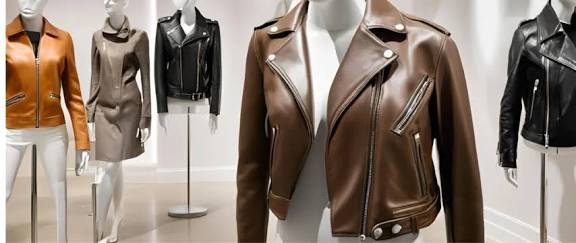
3. Pattern Development, Fit and Sizing
A premium material cannot rescue a poor pattern.
For many fashion brands, fit is actually the product.
A private label leather jacket manufacturer therefore needs a clear process for translating the desired silhouette into measurements and patterns.
Possible fits include:
- Slim
- Regular
- Relaxed
- Oversized
- Cropped
- Boxy
- Drop-shoulder
- Longline
- Structured
- Vintage-inspired
Example leather jacket measurement points
| Measurement | Why it matters |
|---|---|
| Chest | Overall body fit |
| Shoulder | Silhouette and sleeve position |
| Sleeve length | Proportion and market fit |
| Body length | Cropped, standard or long profile |
| Hem width | Shape at waist/hip |
| Armhole | Comfort and mobility |
| Bicep | Sleeve fit |
| Cuff | Sleeve finish |
| Neck opening | Collar relationship |
Elahi Vertex International publishes a reference leather-jacket size range, while custom sizing can be developed around buyer requirements.
For a serious private-label project, the buyer’s approved measurements should control the product rather than blindly adopting a generic chart.
German and European sizing
Do not assume that a Pakistan, US, UK and German “M” are automatically identical.
A private label manufacturer should work from actual measurements.
If your brand already sells apparel successfully, provide your established size chart. If it does not, establish the target fit during sampling before grading the full range.
This is particularly important for oversized streetwear leather jackets because “oversized” is a design direction, not a measurement.
4. Private Branding, Embroidery, Printing and Decorative Techniques
Private label manufacturing becomes valuable when the jacket actually looks and feels like the buyer’s brand.
Depending on the design and technical suitability, customization can involve:
- Woven labels
- Printed labels
- Size labels
- Care labels
- Hangtags
- Embossed logos
- Debossed logos
- Leather patches
- Metal branding
- Custom zipper pulls
- Custom lining
- Printed lining
- Embroidery
- Puff embroidery
- Appliqué
- Chenille-style applications
- Heat-transfer applications where technically appropriate
- Screen-print concepts where material compatibility allows
- DTF-style applications where technically appropriate
- DTG for suitable textile components rather than assuming direct application to every leather surface
- Rhinestone concepts
- Studs
- Patches
- Contrast stitching
- Decorative topstitching
The important phrase is where technically appropriate.
A responsible private label leather jacket manufacturer should not promise every printing technique on every leather simply because the machine or process exists.
Leather surface coatings, oils, texture, heat sensitivity and flexing can affect adhesion and durability.
Embossing and debossing
For leather branding, embossing or debossing can produce a cleaner and more integrated identity than surface printing.
A logo can become part of the leather itself.
For complex relief work, tooling may be required. Tooling cost and ownership should be agreed before production.
Embroidery on leather
Embroidery can work extremely well on leather jackets, but needle penetration, backing, thread, density and artwork need consideration.
Dense embroidery is not simply “printing with thread.”
Puff and dimensional decoration
Raised decoration can create a strong premium streetwear effect. However, the sample should prove that the selected construction works with the actual leather and artwork.
Custom lining
A custom lining can transform the perceived value of a jacket without changing its external silhouette.
Brands can consider:
- Solid lining
- Contrast lining
- Patterned lining
- Logo repeat
- Artwork
- Collection graphics
- Internal story/identity details
All final options remain project-specific and should be confirmed during development.
[IMAGE 3 — PLACE AFTER THIS SECTION: Close-up visual showing embossing, embroidery, custom zipper, woven label and printed lining on premium leather jacket components]
5. Fast Sample Development Before Bulk Production
For a new leather jacket, the sample is not a formality.
It is the bridge between design and bulk manufacturing.
Elahi Vertex International’s working sample baseline is approximately 5–7 days after approval of the required development details, subject to the complexity, materials, tooling and final project requirements.
A complex leather project may require additional development time, so the confirmed timeline should always be stated in the quotation or production discussion.
What should a buyer inspect on the sample?
Check:
- Leather
- Colour
- Thickness
- Hand feel
- Pattern
- Chest measurement
- Shoulder
- Sleeve
- Body length
- Collar
- Pocket placement
- Zipper
- Hardware
- Lining
- Stitching
- Embroidery
- Embossing
- Labels
- Overall silhouette
- Finishing
Sample policy
The normal Elahi Vertex International commercial baseline is that the buyer pays the sample cost and courier/shipping upfront. A qualifying sample cost may be credited toward a qualifying bulk order when specifically agreed; shipping is separate and is not automatically credited.
This is more transparent than advertising an unconditional “free sample” that is actually hidden elsewhere in the commercial structure.
Why speed matters
Fast sampling is commercially useful when it shortens a brand’s decision cycle.
It is especially relevant for:
- Startup launches
- Influencer collections
- Seasonal drops
- Pre-order brands
- Fashion-week preparation
- Retail buying deadlines
- Restocks
- Capsule collections
- Urgent replacement sourcing
Speed should never mean skipping approval.
The better objective is fast, controlled development.

6. Low-MOQ Private Label Manufacturing for Startups
One of the largest barriers between a startup and a premium leather collection is inventory risk.
Elahi Vertex International’s standard MOQ is:
20 pcs per product/category
That makes the company relevant to:
- New fashion labels
- Emerging German brands
- UK startups
- US streetwear labels
- European capsule collections
- Pre-order businesses
- Online-first brands
- Influencer-led labels
- Boutique retailers testing private label
- Existing brands testing a new leather category
A startup searching for a private label manufacturer should not automatically choose the supplier with the lowest advertised MOQ.
MOQ is only one variable.
A commercially useful low-MOQ manufacturer still needs to deliver:
- Correct product
- Clear communication
- Repeatable specifications
- Branding
- Sampling
- Bulk consistency
- Export coordination
Why 20 pieces can matter
Imagine a startup wants to test one leather-jacket category.
Committing to 100 units before establishing demand exposes the brand to substantially more inventory than a 20-piece test.
That does not mean 20 pieces is automatically the economically optimal quantity. Unit economics often improve at higher volume.
It means the buyer has another option.
The correct question is:
What quantity gives us enough inventory to validate demand without creating unnecessary stock risk?
That is a better startup question than:
Who has the absolute lowest MOQ?
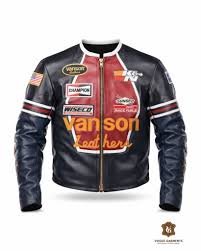
7. Controlled Bulk Production and Urgent Orders
Once the sample is approved, bulk production should reproduce the agreed product—not restart product development.
For standard projects, Elahi Vertex International’s working bulk-production baseline is approximately 10–15 days after sample approval, subject to quantity, complexity, materials, tooling, production schedule and final project confirmation.
Urgent orders can be reviewed according to production capacity and specifications.
They should never be promised blindly.
A sensible bulk workflow
1. Final approval
Lock the approved sample/specification.
2. Material confirmation
Confirm leather, lining, trims, hardware and branding components.
3. Cutting
Cut according to approved patterns.
4. Branding preparation
Prepare embroidery, embossing, patches, lining or other approved decoration.
5. Assembly
Construct the jacket according to the approved specification.
6. Finishing
Complete threads, pressing/finishing appropriate to the product, hardware checks and presentation.
7. Inspection
Check the finished order against agreed requirements.
8. Packing
Prepare according to approved packing instructions.
9. Shipping
Dispatch using the agreed shipping method and commercial term.
Alignment matters
Elahi Vertex International’s operating approach is based on aligning sampling, approvals and bulk production rather than allowing different stages to operate from conflicting instructions.
For technically demanding orders, video calls or visual approvals can also be used where appropriate to improve communication.
A private label manufacturer should make the approval point clear: after approval, undocumented design changes create risk for both parties.
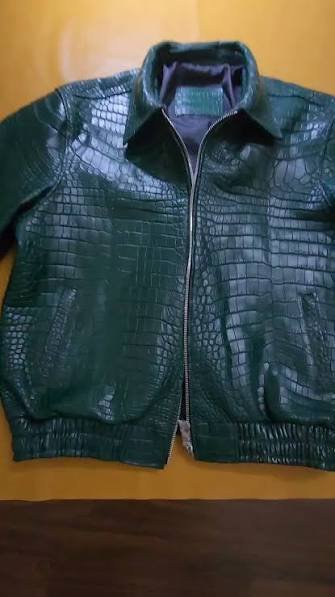
8. Manufacturing for Germany, Europe, the UK and USA
A private label leather jacket manufacturer serving international brands needs to understand that the product brief does not exist independently from the destination market.
Product positioning, sizing, documentation, shipping, compliance responsibilities and commercial expectations vary.
Germany: Five Practical Considerations
German fashion brands should define material requirements early. Leather type, finish, chemical restrictions and any required testing or documentation should be agreed before bulk production.
Germany is part of the EU single market, so relevant EU product-safety obligations matter. Regulation (EU) 2023/988—the General Product Safety Regulation—has applied since 13 December 2024 and establishes general safety obligations for non-food consumer products.
Leather chemistry also matters. REACH restrictions include chromium VI controls for leather articles that come into contact with skin.
German brands importing packaged products should also investigate their own packaging obligations rather than assuming the overseas factory carries the importer’s legal responsibilities.
For startups, Elahi Vertex International’s 20-piece MOQ can provide a practical route for testing a leather-jacket category before scaling to a larger repeat order.
European Union: Five Practical Considerations
EU buyers should identify the exact compliance obligations applicable to the product, economic operator and sales model before ordering.
A supplier should receive any required material, chemical, labelling, traceability, packaging or testing specifications early enough to incorporate them into development.
The EU General Product Safety Regulation applies to consumer products within its scope and places responsibilities on relevant economic operators.
Leather articles also require attention to applicable REACH restrictions. Compliance should be treated as a documented product requirement rather than an advertising slogan.
Elahi Vertex International can manufacture for EU-bound projects according to agreed specifications, while the buyer/importer should confirm the legal requirements applicable to its particular product and destination.
United Kingdom: Five Practical Considerations
UK brands should establish their target fit and measurements rather than assuming EU, UK and US sizing are interchangeable.
Leather-garment tariff classification should be checked against the current UK tariff for the specific product. HM Revenue & Customs provides official classification guidance and directs importers to the UK Online Trade Tariff where necessary.
Import duties, VAT and customs responsibilities depend on the goods and shipping arrangement and should be verified rather than assumed.
For startups and independent labels, low-volume sampling and 20-piece category MOQs can reduce initial inventory exposure.
Shipping terms should be written clearly into the quotation so both the UK buyer and manufacturer understand who is responsible for freight, customs clearance, duties and final delivery.
United States: Five Practical Considerations
US fashion and streetwear brands should establish product labelling requirements before production rather than treating labels as a final packaging decision.
A US-focused leather-jacket program should specify fit, size range, colour, material, branding, lining, hardware and packaging from the beginning.
Startups can use a 20-piece product/category MOQ to test a premium jacket before committing to a significantly larger inventory position.
For brands working on time-sensitive drops, Elahi Vertex International can review urgent sampling and bulk requirements against the actual project and available production capacity.
US buyers should request a landed-shipping quotation when needed rather than comparing an ex-factory product price with another supplier’s delivered price.
9. International Shipping: DDP, Courier, DPD and Direct Delivery
Manufacturing is only complete commercially when the goods reach the agreed destination.
Elahi Vertex International can discuss international shipping arrangements according to the order and destination.
Possible logistics structures can include:
- Express courier
- Air shipment
- Freight arrangements
- Door-to-door services
- DDP where commercially available and specifically quoted
- Other agreed Incoterms
- Direct shipment to the buyer’s nominated destination
DDP does not mean DPD
This distinction is important.
DDP — Delivered Duty Paid is an Incoterm describing allocation of delivery costs, risks and specified import responsibilities between seller and buyer.
DPD is a parcel/logistics carrier.
A shipment might potentially involve a particular carrier within a broader logistics arrangement, but DPD and DDP are not alternative names for the same shipping term.
Do not assume DDP
If a German buyer wants a landed price, request it explicitly.
Provide:
- Destination country
- City
- Postal code
- Quantity
- Approximate order details
- Required delivery timing
Elahi Vertex International can then evaluate the appropriate shipping quotation.
Why landed cost matters
A jacket quoted at a lower factory price can become more expensive after freight, clearance, duty and other destination charges.
Compare suppliers using the same commercial basis.
Leather Jacket Styles a Private Label Manufacturer Can Develop
Depending on specifications and project feasibility, brands can discuss:
- Leather bomber jackets
- Biker jackets
- Moto jackets
- Café-racer jackets
- Aviator jackets
- Varsity-inspired leather jackets
- Oversized leather jackets
- Cropped leather jackets
- Streetwear leather jackets
- Minimalist leather jackets
- Leather trucker jackets
- Fashion jackets
- Leather blazers
- Vintage-inspired jackets
- Distressed leather jackets
- Suede jackets
- Colour-block jackets
- Embroidered leather jackets
- Embossed leather jackets
- Custom-logo jackets
A private label manufacturer should not force every buyer into a catalogue silhouette.
The objective of private-label manufacturing is to build the product around the approved brand specification.
For current material and sizing examples, buyers can review the Elahi Vertex International leather jacket page.
What Established Leather Brands Teach New Labels
New brands should study successful products for market understanding, not copy protected designs, trademarks or brand identity.
Two established brands provide useful public examples of how broad the leather-jacket category can be.
AllSaints currently presents biker, bomber, suede and other leather silhouettes across different fits and finishes.
Schott NYC demonstrates another positioning: heritage-driven motorcycle, bomber and leather outerwear with strong product identity.
The lesson is not to imitate either company.
The lesson is that “leather jacket” is not one product.
A new brand needs its own answer to:
- Who is this jacket for?
- What silhouette identifies us?
- What price level are we targeting?
- What leather supports that positioning?
- What detail makes the product recognizable?
- Why should the customer buy ours?
A private label leather jacket manufacturer executes the product. The brand still has to create the reason consumers want it.
Why Choose Elahi Vertex International as a Private Label Manufacturer?
For an international buyer, supplier selection should be based on commercial fit rather than exaggerated claims.
Here is the practical Elahi Vertex International proposition.
| Requirement | Elahi Vertex International approach |
|---|---|
| Business model | B2B custom manufacturing, OEM/ODM and private label |
| Location | Sialkot, Pakistan |
| Standard MOQ | 20 pcs per product/category |
| Leather jackets | Custom development available |
| Sampling | Approx. 5–7 days after required approvals, project dependent |
| Bulk baseline | Approx. 10–15 days after sample approval, project dependent |
| Custom sizing | Available to buyer specification |
| Branding | Private labels and project-specific branding options |
| Decoration | Multiple printing/embroidery/application methods depending on material suitability |
| Urgent orders | Reviewed according to capacity and project requirements |
| International markets | USA, UK, Germany/Europe and other relevant destinations |
| Shipping | Quoted according to destination and agreed terms |
| DDP | Can be discussed where available for the project |
| Direct communication | Requirements, sampling and production coordinated with the manufacturing team |
1. Low-MOQ entry
The standard MOQ is 20 pieces per product/category.
This is particularly relevant to startups and established brands testing a new category.
2. Custom development
Elahi Vertex International is positioned around custom B2B manufacturing rather than simply reselling ready-made jackets.
3. Leather selection
The existing leather-jacket range identifies cowhide, lambskin, sheepskin, goatskin and other options, with project-specific material development available.
4. Branding flexibility
A private-label program can incorporate labels, artwork and approved branding details according to the project.
5. Sampling before bulk
The physical sample creates an approval point before larger production.
6. Coordinated production
Pattern, cutting, sewing, sampling, finishing and packing are managed as part of the manufacturing workflow, while specialized processes can be coordinated under production supervision where applicable.
That distinction matters: controlled production is more important than pretending every specialist process must sit beside the sewing machine.
7. International buyer focus
The commercial proposition is designed for B2B buyers rather than domestic consumer retail.
8. Startup-to-scale path
A buyer can begin with a lower-volume project and increase quantities after the product is validated.
9. Communication
For a custom product, communication itself is part of quality control.
Send the design, quantity and destination through the private-label manufacturing inquiry or contact Elahi Vertex International directly on WhatsApp.

Launching a Leather Jacket Brand? Start With the Product, Not the Logo
A common startup mistake is spending heavily on branding before the product specification is commercially ready.
If you are launching a new label and looking for a private label manufacturer, work in this order:
Step 1 — Define the customer
Is the customer buying:
- Luxury fashion?
- Streetwear?
- Motorcycle-inspired fashion?
- Minimalist outerwear?
- Vintage fashion?
- Premium basics?
- Oversized streetwear?
Step 2 — Define the hero product
Do not launch twelve weak styles because you can.
One strong jacket can be a better starting point.
Step 3 — Define the target retail price
Your retail price affects the manufacturing budget you can support.
Step 4 — Create the product specification
Decide:
- Leather
- Fit
- Colour
- Lining
- Hardware
- Branding
- Packaging
Step 5 — Request a sample
Do not use bulk production to discover whether the pattern is right.
Step 6 — Test the product
Use fitting, photography, market feedback, pre-launch content or legitimate pre-order validation.
Step 7 — Approve bulk
Only after the product is ready.
Step 8 — Reorder from evidence
If a style sells, use actual sales data to determine the next quantity.
That is a more disciplined route than buying excessive inventory because a supplier offered a low unit price.
How to Compare Private Label Leather Jacket Manufacturers
Use this supplier-evaluation table.
| Question | Why it matters |
|---|---|
| Are you a manufacturer or trader? | Clarifies supply-chain role |
| What is your MOQ? | Determines inventory commitment |
| Can you work from our tech pack? | Tests OEM suitability |
| Can you develop from references? | Tests development support |
| Which leather types are available? | Determines material flexibility |
| Can thickness be specified? | Improves material control |
| Can we use our size chart? | Protects brand fit |
| Can you develop a physical sample? | Creates approval stage |
| What branding is possible? | Determines private-label depth |
| How is embossing handled? | Important for leather branding |
| Can custom lining be produced? | Important for premium identity |
| What hardware can be customized? | Affects quality perception |
| How are bulk specifications controlled? | Reduces inconsistency |
| What is the sample timeline? | Affects launch schedule |
| What is the bulk timeline? | Affects inventory planning |
| Can urgent production be reviewed? | Useful for deadlines |
| What shipping terms are available? | Determines landed economics |
| What compliance information can be provided? | Important for destination market |
| Who owns tooling? | Prevents future disputes |
| What happens after sample approval? | Clarifies production workflow |
How to Prepare a High-Quality Leather Jacket RFQ
A private label manufacturer can quote more accurately when the RFQ is specific.
Send:
Company
- Brand name
- Website/social presence if available
- Contact person
Product
- Jacket type
- Reference images
- Tech pack if available
Material
- Leather type
- Thickness if known
- Finish
- Colour
Construction
- Fit
- Size chart
- Pockets
- Collar
- Cuffs
- Hem
- Lining
Hardware
- Zipper
- Snaps
- Buckles
- Metal components
- Finish
Branding
- Labels
- Embroidery
- Embossing
- Patches
- Custom lining
- Hangtags
Commercial
- Quantity
- Target launch date
- Destination country
- Postal code
- Shipping requirement
A detailed RFQ helps prevent the worst comparison in sourcing: comparing two prices for two technically different products.
Common Leather Jacket Sourcing Mistakes
Choosing the cheapest quotation
Price without specification equivalence is meaningless.
Ordering bulk without a sample
Leather, fit, hardware and finishing are too important to leave unresolved.
Saying only “genuine leather”
Specify what you actually need.
Ignoring thickness
The same silhouette can behave differently in different leather constructions.
Sending only a logo
A logo is not a tech pack.
It is not.
Define measurable requirements.
Ignoring lining
The inside of a premium jacket contributes heavily to customer perception.
Changing artwork after approval
Late changes can affect tooling, embroidery, production and timing.
Ignoring destination compliance
German/EU, UK and US buyers should determine applicable legal requirements before production.
Comparing EXW with DDP prices
Compare like with like.
Treating DPD as DDP
One is a logistics company; the other is an Incoterm.
Ordering too much for an unvalidated startup
Inventory is capital.
Use MOQ strategically.
100 Private Label Leather Jacket Manufacturer FAQs
1. What is a private label leather jacket manufacturer?
A private label leather jacket manufacturer produces jackets according to a buyer’s specifications for sale under the buyer’s brand.
2. Does Elahi Vertex International manufacture private-label leather jackets?
Yes. Elahi Vertex International provides custom B2B, OEM/ODM and private-label manufacturing, and leather jackets are included in its published product range.
3. Where is Elahi Vertex International located?
Elahi Vertex International is based in Sialkot, Pakistan.
4. What is the MOQ for private-label leather jackets?
The standard Elahi Vertex International MOQ is 20 pcs per product/category.
5. Is a 20-piece MOQ useful for startups?
It can reduce initial inventory exposure compared with a much larger MOQ, although the best quantity depends on the brand’s economics and launch plan.
6. Can a German startup work with Elahi Vertex International?
Yes. German fashion brands and startups can discuss international B2B manufacturing projects.
7. Can UK brands order custom leather jackets?
Yes. UK-bound private-label projects can be discussed according to the product, quantity and delivery requirements.
8. Can USA fashion brands source leather jackets?
Yes. Elahi Vertex International targets US B2B apparel buyers as one of its priority international markets.
9. Can EU brands work with a Pakistan private label manufacturer?
Yes, provided the product and commercial arrangement meet the applicable import, safety and other legal requirements.
10. What should I send a private label manufacturer first?
Send your tech pack or references, required quantity, leather preference, branding details, destination and target timeline.
11. Do I need a tech pack?
A tech pack is strongly recommended, but projects can be reviewed from sufficiently clear references and specifications.
12. Can you manufacture from a reference jacket?
A reference garment or clear reference can support development, provided intellectual-property rights are respected and final specifications are agreed.
13. Can a private label leather jacket manufacturer develop an original design?
ODM-style development can help translate a concept into a manufacturable product, subject to technical review.
14. What leather can be used?
Published Elahi Vertex International options include cowhide, lambskin, sheepskin, goatskin and other project-specific possibilities.
15. Can brands request suede?
Yes, suede is relevant to selected leather-fashion projects, subject to specification and availability.
16. Can vegan leather be used?
Synthetic/PU alternatives can be discussed where required.
17. What is better: cowhide or lambskin?
Neither is universally better. Cowhide can support more structured applications, while lambskin can suit softer fashion products.
18. What thickness should my jacket use?
That depends on the hide, finish, silhouette and intended performance. Confirm the specification during development.
19. Is leather measured in GSM?
Genuine leather is more commonly specified by thickness and other material characteristics; GSM is primarily a textile metric.
20. Can I choose any colour?
Custom colour development can be discussed using references such as Pantone information or physical samples where appropriate.
21. Can a private label manufacturer make black leather jackets?
Yes, subject to the agreed leather and finish.
22. Can you manufacture white leather jackets?
Yes, project feasibility and the exact white/off-white finish should be confirmed during development.
23. Can you make red leather jackets?
Custom colour projects can be reviewed according to leather and finish availability.
24. Can you make oversized leather jackets?
Yes. Oversized proportions should be defined through measurements rather than the word “oversized” alone.
25. Can you manufacture cropped jackets?
Cropped silhouettes can be developed according to the approved measurements.
26. Can you manufacture leather bombers?
Leather bomber projects can be discussed as part of custom leather outerwear development.
27. Can you manufacture biker jackets?
Yes, subject to the project specification.
28. Can you make café-racer jackets?
Café-racer-inspired private-label projects can be reviewed.
29. Can you manufacture varsity leather jackets?
Leather or leather-combination varsity concepts can be discussed according to specifications.
30. Can you manufacture streetwear leather jackets?
Yes. Custom streetwear is one of Elahi Vertex International’s broader manufacturing clusters.
31. Can I use my own size chart?
Yes. Buyer-specific sizing is preferable when the brand already has an established fit.
32. Can you create German sizing?
Target-market sizing can be developed from approved measurements; the buyer should define the desired fit.
33. Can you make US sizing?
Yes, based on an approved US-targeted measurement specification.
34. Can you make UK sizing?
Yes, based on buyer-approved measurements.
35. Can one private label manufacturer support multiple markets?
Yes, but sizing, labels, compliance and commercial requirements should be defined for each destination.
36. How fast is sampling?
The working baseline is approximately 5–7 days after the necessary approvals, subject to project complexity and materials.
37. Are complex samples always finished in 5–7 days?
No. Tooling, unusual leather, custom hardware or complex development may require additional time.
38. Do buyers pay for samples?
The normal baseline is that the buyer pays sample and shipping costs upfront.
39. Is sample shipping included?
Shipping is separate unless a quotation explicitly says otherwise.
40. Can sample cost be credited toward bulk?
It may be credited against a qualifying bulk order when specifically agreed; this should be written into the commercial terms.
41. Why should I sample before bulk?
A sample lets you evaluate material, construction, measurements, fit, branding and finishing before committing to production.
42. How long does bulk production take?
The working baseline is approximately 10–15 days after sample approval, subject to project requirements and capacity.
43. Can urgent leather orders be produced?
Urgent requirements can be reviewed, but feasibility should be confirmed before a delivery promise is made.
44. Can a private label manufacturer guarantee every urgent deadline?
No responsible manufacturer should guarantee a deadline without reviewing specifications, quantity, materials and production capacity.
45. Can I add my woven label?
Yes, private-label branding can include buyer-specified labels.
46. Can I add a custom care label?
Yes, with buyer-approved content and applicable destination requirements.
Yes, subject to the approved specification.
48. Can a logo be embossed into leather?
Embossing can be developed where suitable; tooling may be required.
49. Can a logo be debossed?
Yes, depending on design and leather suitability.
50. Can leather jackets be embroidered?
Yes, embroidery can be used when the construction and artwork are technically suitable.
51. Can puff embroidery be used?
Potentially. The exact design should be sampled because leather behaviour differs from fleece or jersey.
52. Can chenille be used on leather jackets?
Chenille-style applications may be possible depending on construction and design.
53. Can leather be screen printed?
Some leather surfaces can accept suitable printing systems, but compatibility and durability should be tested rather than assumed.
54. Can DTF be applied to leather?
It depends on the transfer system and leather surface. A sample test is preferable.
55. Can DTG be printed directly onto leather?
DTG is primarily associated with suitable textile substrates; do not assume standard DTG is appropriate for genuine leather.
56. Can you make custom printed lining?
Custom lining concepts can be discussed as part of private-label development.
57. Can I choose zipper colour?
Yes, hardware finish should be specified during development.
58. Can a private label manufacturer make custom zipper pulls?
Custom hardware can be discussed, although tooling, MOQ and cost may differ from standard components.
59. Can I use branded metal hardware?
Yes, subject to technical feasibility, sourcing/tooling requirements and commercial quantities.
60. Can I request vintage finishing?
Vintage or distressed concepts can be reviewed based on the selected leather and desired effect.
61. Can a startup order only 20 jackets?
The standard MOQ is 20 pieces per product/category, subject to the specific project quotation.
62. Can I mix unlimited designs inside the 20-piece MOQ?
Do not assume this. MOQ is 20 pcs per product/category; style, colour and size allocation should be confirmed for the project.
63. Can sizes be mixed?
Size breakdown should be agreed before production.
64. Does a lower MOQ mean lower quality?
Not inherently. MOQ is a commercial production parameter, not a quality grade.
65. Is a low-MOQ private label manufacturer better for startups?
It can be useful because it reduces inventory commitment, but product quality, communication and economics still matter.
66. Should startups launch many leather jacket designs?
Usually it is safer to validate a focused collection than spread limited capital across too many unproven SKUs.
67. Can I launch using pre-orders?
That is a brand-side commercial decision. If using pre-orders, communicate realistic manufacturing and delivery timelines to customers.
68. Can an established brand test a new leather category at low volume?
Yes. Low-volume manufacturing can be used for category testing as well as startups.
69. Does Elahi Vertex International only work with startups?
No. Its B2B positioning also includes established brands, wholesalers, retailers, importers and other commercial buyers.
70. Is Elahi Vertex International a consumer leather brand?
Its primary positioning is custom B2B manufacturing, OEM/ODM, private label and export.
71. Can I request DDP shipping to Germany?
DDP can be discussed where commercially available for the specific shipment. Request a destination-specific quotation.
72. What does DDP mean?
Delivered Duty Paid is an Incoterm allocating specified delivery, cost and import responsibilities to the seller.
73. Is DPD the same as DDP?
No. DPD is a logistics carrier; DDP is an Incoterm.
74. Can you use DPD?
Carrier availability depends on the shipment, destination and logistics arrangement and should be confirmed at quotation stage.
75. Can jackets ship directly to my warehouse?
Direct-to-destination shipping can be discussed according to the agreed logistics arrangement.
76. Can jackets ship to Germany?
Yes, Germany-bound B2B orders can be quoted according to destination and requirements.
77. Can jackets ship to the UK?
Yes, subject to the agreed shipping arrangement.
78. Can jackets ship to the USA?
Yes, subject to the agreed shipping arrangement.
79. Can jackets ship throughout Europe?
European destinations can be reviewed individually because shipping, customs and destination requirements vary.
80. Is shipping included in the jacket price?
Only if the quotation explicitly says so. Always confirm the Incoterm and shipping basis.
81. What information is needed for a shipping quote?
Destination, postal code, quantity, product details and preferred delivery terms are useful starting information.
82. Does Germany have special product-safety requirements?
Germany applies relevant EU rules, including the General Product Safety Regulation where applicable, alongside other product-specific obligations.
83. What is GPSR?
Regulation (EU) 2023/988 is the EU General Product Safety Regulation governing general safety of consumer products within its scope.
84. Does REACH matter for leather?
Yes. EU REACH includes restrictions relevant to chemicals in leather articles, including chromium VI.
85. What is the chromium VI issue?
Chromium VI can cause skin sensitisation, and its presence in leather articles is restricted under EU REACH conditions.
86. Should a German buyer request compliance information?
Yes. Determine applicable requirements and communicate them before production.
87. Is the manufacturer solely responsible for every EU obligation?
No. Responsibilities can also fall on importers, authorised representatives, distributors and other economic operators depending on the legal framework and supply chain.
88. Should UK buyers check customs classification?
Yes. HMRC provides official classification guidance and the UK Online Trade Tariff.
89. Can a private label manufacturer advise on the product?
A manufacturer can provide manufacturing guidance, but the importer/brand should verify its own legal and regulatory obligations with appropriate official or professional sources.
90. How do I compare two private label manufacturers?
Compare equivalent specifications, sample quality, MOQ, communication, timelines, branding capability, compliance documentation and shipping basis—not unit price alone.
91. Why are two leather jacket quotations very different?
They may involve different leather, thickness, hardware, lining, construction, branding, quantities or shipping terms.
92. What is the biggest mistake when requesting a quotation?
Asking “price for leather jacket?” without specifying the jacket.
93. What should my RFQ include?
Provide design, material, fit, sizes, branding, quantity, destination and timeline.
94. Can I send artwork through the website?
The Elahi Vertex International private-label inquiry form currently supports design-file submission and product specifications.
95. How can I contact Elahi Vertex International quickly?
Use WhatsApp or email elahivertexinternational@gmail.com.
96. Can I discuss a new brand before I have bulk quantities?
Yes. Sampling and lower-volume development are relevant to brands preparing a launch.
97. What should I send if I am launching a brand from zero?
Send your concept, reference images, desired fit, leather direction, branding, approximate quantity, destination and launch target.
98. Why choose a Sialkot private label manufacturer?
Sialkot has an established export-manufacturing ecosystem across apparel, sports goods and leather-related production. Supplier selection should still be based on the individual manufacturer’s fit for your project.
99. Why consider Elahi Vertex International?
The commercial proposition combines custom B2B manufacturing, a 20-piece product/category MOQ, sample development, private-label customization and international order coordination.
100. How do I start a private-label leather jacket order?
Send your design or reference, leather preference, quantity, size requirements, branding details, destination and required timeline to Elahi Vertex International. The next commercial step should be requirement review and quotation, followed by paid sampling where appropriate before bulk production.
Useful External Resources for German, EU, UK and USA Buyers
Fashion brands should use authoritative sources when researching compliance rather than relying entirely on supplier marketing.
The European Commission’s product-safety guidance explains the EU product-safety framework and the General Product Safety Regulation. Regulation (EU) 2023/988 applies as the EU’s general consumer-product safety framework and has applied since 13 December 2024.
The European Chemicals Agency provides information on REACH chemical restrictions and notes the restriction of chromium VI in leather articles. This is particularly relevant to German and EU buyers sourcing leather goods.
The EU’s Your Europe product-compliance guidance explains that manufacturers, importers, distributors and other economic operators can have different responsibilities when goods are placed on the EU market.
UK buyers can consult HM Revenue & Customs leather classification guidance and the current UK tariff when establishing the correct customs treatment for a specific product.
For market inspiration rather than manufacturing or compliance claims, brands can examine the breadth of leather silhouettes offered by AllSaints and heritage leather positioning from Schott NYC. These are independent fashion references, not customers, partners or endorsements of Elahi Vertex International.
Final Buyer Checklist Before Choosing a Private Label Leather Jacket Manufacturer
Before paying for a sample, confirm:
- Manufacturer identity
- Product specification
- Leather type
- Leather thickness
- Leather finish
- Colour
- Pattern
- Fit
- Size chart
- Lining
- Zipper
- Hardware
- Pocket construction
- Branding
- Embroidery
- Embossing
- Labels
- Hangtags
- Packaging
- Sample cost
- Sample shipping
- Sample timeline
- Bulk MOQ
- Bulk price
- Bulk timeline
- Payment terms
- Tooling cost
- Tooling ownership
- Quality requirements
- Destination requirements
- Shipping term
- Freight
- Customs responsibility
- Import responsibility
- Delivery destination
- Final approval procedure
A professional sourcing decision is not “Which factory gave me the lowest number?”
It is:
Which supplier can produce the approved product at commercially workable economics with an acceptable level of execution and supply-chain risk?
Conclusion: Choosing the Right Private Label Leather Jacket Manufacturer
A fashion brand searching for a private label leather jacket manufacturer should evaluate far more than stitching and price.
The strongest manufacturing relationship begins with a clear product specification, suitable leather, controlled pattern development, a physical sample, approved branding, defined bulk requirements and transparent shipping responsibilities.
For German and wider EU buyers, destination-market safety and chemical requirements also need to be considered early. UK and US buyers likewise need to establish their applicable import, labelling and commercial requirements rather than assuming one global specification automatically satisfies every market.
Elahi Vertex International is a Sialkot, Pakistan-based B2B manufacturer, exporter, OEM/ODM supplier and private label manufacturer serving international brands.
The standard MOQ is 20 pcs per product/category, making the company relevant both to emerging labels testing their first leather product and established brands developing a new collection.
Sampling is normally targeted at approximately 5–7 days after required approvals, while the working bulk-production baseline is approximately 10–15 days after sample approval, subject to material availability, complexity, quantity, tooling, production capacity and the confirmed project.
Brands can develop leather type, colour, sizing, fit, lining, labels, embroidery, embossing, hardware and other approved customization around their own product identity.
The objective is not to put Elahi Vertex International’s identity on your jacket.
It is to manufacture your brand’s product.

80 Things Buyers Should Know Before Choosing a Private Label Leather Jacket Manufacturer
- A private label leather jacket manufacturer should understand the difference between producing a generic jacket and manufacturing a product around a brand’s approved specifications.
- Choose a private label leather jacket manufacturer that can review your design, measurements, leather requirements, branding and expected quantity before quoting.
- A German startup should ask its private label leather jacket manufacturer about MOQ before investing heavily in product development.
- Your private label leather jacket manufacturer should know the intended destination because Germany, the wider EU, UK and USA can involve different buyer requirements.
- A professional private label leather jacket manufacturer should request sufficient specifications rather than quoting an undefined “premium leather jacket.”
- Ask the private label leather jacket manufacturer to confirm whether the proposed leather suits the jacket silhouette you want to create.
- A private label leather jacket manufacturer should distinguish between cowhide, lambskin, sheepskin, goatskin, suede and synthetic alternatives rather than treating all leather options as identical.
- Your private label leather jacket manufacturer should confirm leather thickness and finish during product development.
- A startup working with a private label leather jacket manufacturer should validate one strong product before unnecessarily expanding into many jacket styles.
- Before bulk production, ask your private label leather jacket manufacturer to develop a physical sample based on the approved specifications.
- The sample from a private label leather jacket manufacturer should be evaluated for material, measurements, construction, branding, hardware, lining and overall appearance.
- A reliable private label leather jacket manufacturer should not treat the words “oversized fit” as a complete measurement specification.
- Give your private label leather jacket manufacturer an approved size chart whenever your brand already has an established fit.
- German fashion brands should tell their private label leather jacket manufacturer about applicable destination-market requirements early in development.
- EU brands should discuss relevant material requirements with the private label leather jacket manufacturer before approving bulk materials.
- A private label leather jacket manufacturer should be able to discuss custom woven labels, care labels, size labels and other approved private-label details.
- If you require embossing, tell the private label leather jacket manufacturer the exact artwork dimensions and placement.
- Ask the private label leather jacket manufacturer whether custom embossing requires dedicated tooling and confirm the tooling cost before proceeding.
- When embroidery is required, the private label leather jacket manufacturer should evaluate the artwork against the actual leather and construction.
- A good private label leather jacket manufacturer should sample unusual decorative techniques instead of assuming every application works equally well on leather.
- Brands wanting custom lining should provide the private label leather jacket manufacturer with artwork, colours and construction requirements before sampling.
- Your private label leather jacket manufacturer should know whether you require standard hardware or custom-branded zipper pulls and metal components.
- Ask the private label leather jacket manufacturer to separate product, sample, tooling and shipping costs where relevant so the quotation is easier to evaluate.
- Do not compare one private label leather jacket manufacturer quoting an ex-factory price with another supplier quoting a delivered price without adjusting the comparison.
- A private label leather jacket manufacturer offering DDP should state the shipping basis clearly rather than using vague phrases such as “shipping included.”
- Remember that DDP is a delivery Incoterm; your private label leather jacket manufacturer should not confuse it with DPD, which is a logistics carrier.
- When requesting international shipping, give the private label leather jacket manufacturer your destination country, city and postal code.
- US brands should provide their private label leather jacket manufacturer with intended sizing, labelling, branding and packaging requirements before production.
- UK brands should ask their private label leather jacket manufacturer for a quotation based on clearly defined shipping responsibilities.
- European brands should choose a private label leather jacket manufacturer based on product execution and commercial fit, not simply the lowest unit quotation.
- A startup can use a low-MOQ private label leather jacket manufacturer to reduce the amount of inventory committed to an untested jacket.
- Elahi Vertex International operates as a private label leather jacket manufacturer with a standard MOQ of 20 pcs per product/category.
- Brands can approach Elahi Vertex International as a private label leather jacket manufacturer for custom leather jacket development based on their own specifications.
- As a private label leather jacket manufacturer, Elahi Vertex International works from Sialkot, Pakistan with international B2B buyers.
- A German brand looking for a private label leather jacket manufacturer can send Elahi Vertex International its design, quantity, sizing, leather requirements and destination for review.
- A UK startup searching for a private label leather jacket manufacturer can begin by defining one commercially focused jacket rather than launching an unnecessarily large collection.
- A US streetwear brand evaluating a private label leather jacket manufacturer should prioritize fit, material, distinctive branding and repeat-order potential alongside price.
- An EU fashion company evaluating a private label leather jacket manufacturer should establish applicable product and material requirements before final production approval.
- When changing suppliers, give the new private label leather jacket manufacturer an approved specification rather than expecting it to reverse-engineer undocumented decisions from photographs.
- The right private label leather jacket manufacturer should help move the project through a controlled commercial sequence: requirements, quotation, sample, approval, bulk production, shipment and—if the product performs—repeat orders.
Start Your Private Label Leather Jacket Project
If you are launching a fashion brand, developing a leather collection, changing suppliers, testing a new jacket or preparing a larger bulk program, send:
- Your tech pack or reference images
- Required leather
- Quantity
- Size range
- Branding requirements
- Destination country and postal code
- Target delivery date
Contact Elahi Vertex International on WhatsApp
Email: elahivertexinternational@gmail.com
Submit a Private Label Manufacturing Inquiry
Visit Elahi Vertex International
Alibaba: https://elahivertexinternational.trustpass.alibaba.com/
Elahi Vertex International — Where Brands Are Made.
- European Commission — General Product Safety Regulation (GPSR)
EU General Product Safety Regulation guidance
Use in the Germany/EU compliance section. It supports discussion of consumer-product safety requirements. - European Chemicals Agency — REACH / Chromium VI
ECHA Chromium VI restriction information
Highly relevant for leather jackets because EU REACH restrictions specifically address chromium VI in leather articles. European Chemicals Agency - EU Access2Markets
EU Access2Markets
Use in the importing/shipping section so German and EU buyers can research tariffs, customs procedures, rules and product requirements. - German Packaging Register — LUCID
LUCID Packaging Register
Relevant when discussing packaged goods placed on the German market. Keep the wording advisory because responsibility depends on the supply arrangement. - European Commission — Product Safety
European Commission Product Safety
Good supporting resource for the Germany/EU buyer section.
5 German leather/fashion brands to reference
Use these for fashion-market context and design/category research, not as backlinks you can expect them to give us.
1. BOSS / HUGO BOSS leather jackets — German fashion company with a substantial current leather-jacket range including nappa, suede, bomber, racer, biker and oversized silhouettes. This is an excellent reference when discussing how one market can support multiple leather-jacket fits, finishes and price positions. Hugo Boss
2. Mauritius — particularly relevant because leather fashion is central to the German company. Its portfolio includes Mauritius, Mauritius Silver and other leather-focused lines; Mauritius Silver specifically discusses chrome-free, vegetable-tanned lamb leather and LWG-certified production partners. Mauritius
3. Marc O’Polo — Marc O’Polo SE is headquartered in Stephanskirchen, Germany, and the brand currently sells leather jackets and leather bombers. It is useful for discussing premium modern-casual positioning. Marc O’Polo
4. CLOSED — useful as a German premium-fashion reference, especially for contemporary outerwear and understated European design. Before inserting a specific leather-jacket link into the published article, I would verify a currently live leather product/category URL rather than inventing one.
5. MCM — German-founded luxury fashion brand that can be referenced for premium leather-goods positioning and branding, although it is less directly relevant to leather jackets than BOSS or Mauritius. I would therefore use it only for leather/luxury brand context, not as evidence about jacket manufacturing.
Better paragraph to paste into your article
German Leather Fashion Brands Worth Studying
German fashion brands entering private-label leather jackets do not need to copy established labels, but they should understand how successful companies differentiate leather products through material, silhouette, finishing and brand positioning.
BOSS currently presents a broad leather outerwear assortment covering nappa, suede, bomber, biker, racer, slim-fit, regular-fit and oversized directions. This illustrates an important lesson for an emerging brand: “leather jacket” is a category, not a complete product concept.
Mauritius is particularly relevant because leather fashion sits at the centre of its business. Its portfolio demonstrates how leather can be developed across accessible fashion, urban styling and more premium material positioning.
Marc O’Polo provides another useful reference for brands targeting Germany and wider Europe. Its premium modern-casual positioning shows how leather jackets and bombers can sit within a broader lifestyle collection rather than functioning only as motorcycle-inspired products.
CLOSED can be studied for contemporary German premium-fashion direction, while German-founded MCM provides a useful reference for luxury leather branding and strong product identity.
These companies are independent market references only. They are not presented as customers, manufacturing partners or endorsers of Elahi Vertex International.
For a startup, the commercial lesson is straightforward: do not ask a private label leather jacket manufacturer to “make something like BOSS.” Define what will make your own jacket recognisable—its fit, leather, colour, construction, hardware, lining, branding and customer position—and manufacture that identity consistently.
Ready to Develop Your Private Label Leather Jacket Collection?
If you are a fashion brand, streetwear label, startup, retailer, wholesaler or sourcing company in Germany, the UK, USA or Europe looking for a private label leather jacket manufacturer, send your project directly to Elahi Vertex International.
Based in Sialkot, Pakistan, Elahi Vertex International works with international B2B buyers on custom leather wear, OEM/ODM production and private-label apparel. Whether you are preparing your first leather jacket launch, testing a new style, developing a seasonal collection or looking for another manufacturing partner, we can review your specifications and determine the right next step.
Start With Your Actual Requirements
Send us:
- Leather jacket design, sketch, tech pack or reference
- Required leather type and finish
- Colours
- Size range or custom size chart
- Logo and branding files
- Embroidery, embossing, patches or other decoration requirements
- Labels and packaging requirements
- Required quantity
- Destination country and postal code
- Target launch or delivery date
Our standard MOQ is 20 pcs per product/category. Sampling, bulk production, customization and shipping requirements are confirmed according to the individual project.
Explore Elahi Vertex International Before You Send Your RFQ
Private Label Manufacturing — Submit your specifications, select leather jackets, upload artwork and discuss custom branding or private-label production.
Custom Leather Jackets — Explore leather types, custom colours, sizing, lining, embossing, labels, hardware and private-label leather jacket options.
Custom Clothing Manufacturing — See our wider custom manufacturing capabilities across leather wear, streetwear, sportswear, activewear and private-label clothing.
Manufacturing Process — Learn how product development, pattern making, sampling, customization, bulk production, quality control, packaging and worldwide shipping fit into the manufacturing process.
Our Manufacturing Work — Review selected examples of Elahi Vertex International manufacturing work and how products move from development and sampling into production, quality control, packing and export.
Portfolio — Explore selected streetwear, activewear, boxing wear, leather and private-label manufacturing projects.
About Elahi Vertex International — Learn more about our Sialkot manufacturing and export business.
Contact Elahi Vertex International — Send your project requirements directly to our team.
Talk Directly With Elahi Vertex International
WhatsApp: +92 309 1639614
Phone: +92 309 1639614
Primary Email: elahivertexinternational@gmail.com
Secondary Email: info@elahivertexinternational.com
Website: Elahi Vertex International
Alibaba: Elahi Vertex International Alibaba Store
Location: Sialkot, Pakistan
Connect With Us
LinkedIn: Elahi Vertex International
Instagram: @elahivertex_mfg
Facebook: Elahi Vertex International
TikTok: @elahivertex_mfg
Threads: @elahivertex_mfg
Your Brand. Your Leather Jacket. Your Specifications.
Do not send only “What is your leather jacket price?” if you want an accurate manufacturing quotation.
Send the design + quantity + leather requirement + branding + destination + required date.
Elahi Vertex International can then review the project and move the discussion toward the next commercial step: requirements → quotation → sample → approval → bulk production → shipment → reorder.
Launching a brand? Developing a new leather collection? Looking for a private label manufacturer?
Send Your Leather Jacket Requirements on WhatsApp or use our Private Label Manufacturing Inquiry to start your project.
Elahi Vertex International — Where Brands Are Made.