
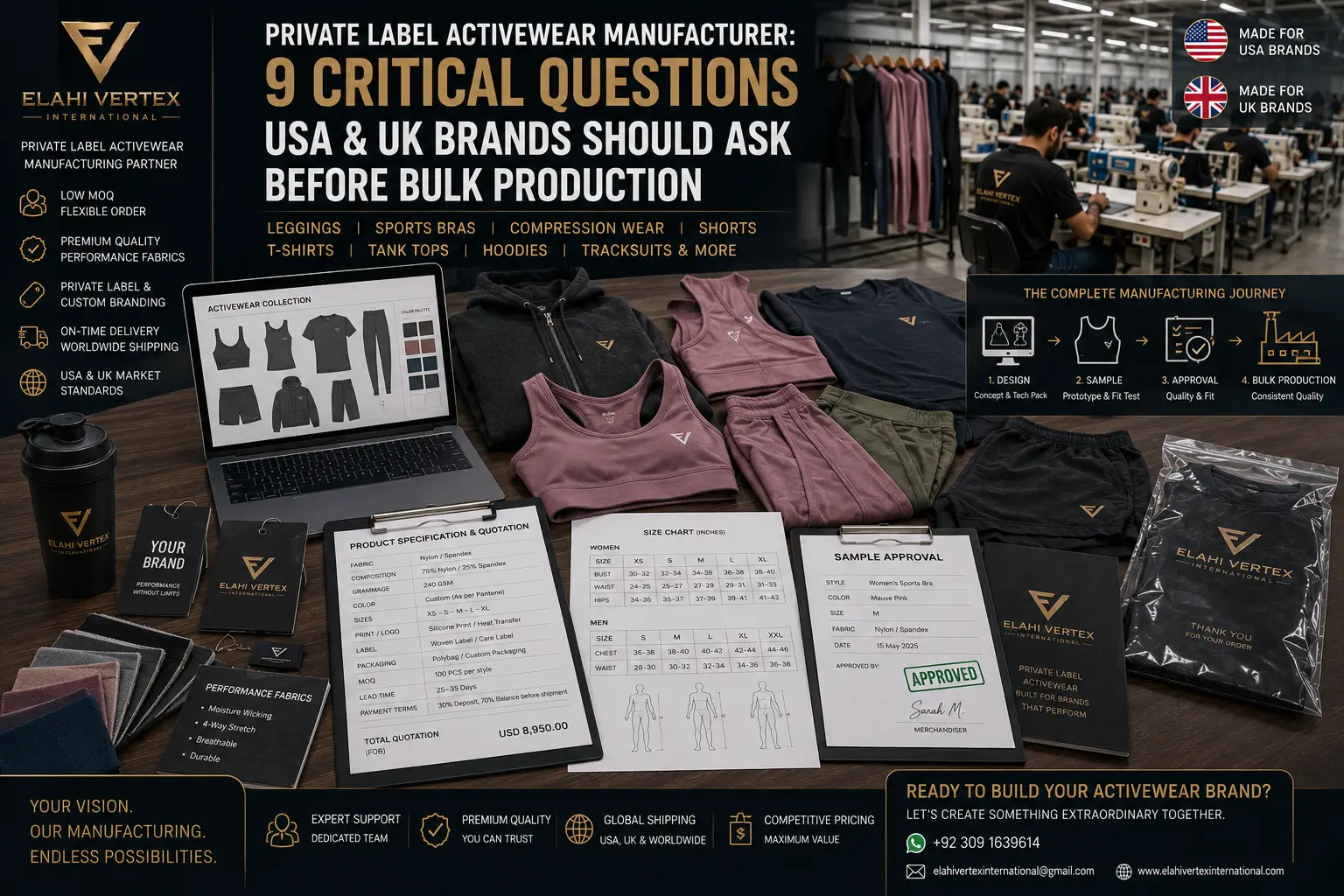
Choosing the right private label activewear manufacturer can determine whether your new activewear collection becomes a reliable product line or an expensive inventory problem.
For activewear brands, fitness startups, e-commerce businesses, sportswear retailers, and private-label clothing companies, manufacturing involves much more than finding a factory with an attractive unit price.
A capable private label activewear manufacturer needs to understand your product specifications, fabric requirements, sizing, fit, branding, sampling, quality expectations, packaging, production quantities, and shipping requirements.
This becomes even more important when selling into the USA and UK. A product may look excellent in a digital design but still fail commercially because of poor fit, unsuitable fabric, inconsistent measurements, incorrect labeling, weak branding execution, or unclear production specifications.
Whether you are developing leggings, sports bras, compression wear, shorts, T-shirts, tank tops, hoodies, or tracksuits, you should evaluate your private label activewear manufacturer before committing to bulk production.
Here are nine critical questions every USA and UK brand should ask.
1. Can the Private Label Activewear Manufacturer Follow My Exact Specifications?
The first question should not simply be:
“Can you manufacture activewear?”
Almost any apparel supplier can claim to manufacture activewear.
The more important question is whether the private label activewear manufacturer can reproduce your exact product requirements.
Your specifications may include:
- Garment measurements
- Size grading
- Fabric composition
- Fabric weight
- Stretch requirements
- Recovery
- Color
- Seam construction
- Stitching
- Waistband dimensions
- Pocket placement
- Logo placement
- Printing
- Embroidery
- Labels
- Packaging
Consider a simple example.
You ask for “premium black leggings.”
That description does not define:
- Fabric composition
- Fabric weight
- Opacity
- Stretch
- Recovery
- Waistband height
- Inseam
- Pocket dimensions
- Stitching
- Logo dimensions
- Size grading
Two manufacturers could produce completely different leggings while technically satisfying the same description.
A serious private label activewear manufacturer should therefore work from a structured product specification rather than relying on vague descriptions.
Ask this question:
“What information do you need from us before confirming the product specification and quotation?”
A strong supplier should be able to explain what they require from the buyer before production begins.
2. What Fabric and Performance Options Does the Manufacturer Offer?
Fabric is one of the most important decisions in activewear manufacturing.
The right private label activewear manufacturer should be able to discuss fabric characteristics relevant to your specific product.
Depending on the garment, you may need to evaluate:
- Stretch
- Recovery
- Breathability
- Fabric weight
- Hand feel
- Opacity
- Durability
- Moisture management
- Shape retention
- Wash performance
- Surface finish
Different products require different characteristics.
Leggings
Leggings may require:
- High stretch
- Good recovery
- Appropriate opacity
- Comfortable hand feel
- Durable construction
Sports Bras
Sports bras may require:
- Appropriate support
- Stretch recovery
- Comfortable construction
- Suitable lining
- Reliable seam construction
T-Shirts and Tank Tops
These may require different priorities such as:
- Breathability
- Lightweight construction
- Comfort
- Drape
- Moisture management
Therefore, don’t accept “premium fabric” as a complete specification.
Ask your private label activewear manufacturer:
“Which fabric specifications are appropriate for this particular product and intended use?”
Also ask how the selected fabric specification will be recorded for future repeat production.
This matters because successful activewear brands often need to reorder their best-performing products.
If the first order uses one fabric and the reorder unintentionally uses another, your customers may notice differences in:
- Feel
- Stretch
- Fit
- Color
- Weight
- Performance
For brands developing technical or performance-focused products, independent textile standards can also be useful reference points when evaluating material claims. For example, OEKO-TEX STANDARD 100 addresses testing textiles for harmful substances. (OEKO-TEX)
The important point is not to assume that a certification automatically applies to every fabric offered by a manufacturer. Verify the actual certificate, scope, product and certification status relevant to your order.
3. How Will Size and Fit Be Confirmed?
A private label activewear manufacturer can produce technically correct garments that still fail commercially if the fit is wrong.
This is particularly important for:
- Leggings
- Sports bras
- Compression wear
- Shorts
- Fitted T-shirts
- Tank tops
- Activewear sets
Activewear often sits close to the body, which makes measurement and fit particularly important.
Before production, clarify whether you will provide:
- A complete measurement chart
- Tech pack
- Reference garment
- Graded measurements
- Size specifications
- Fit comments
- Sample requirements
Ask:
“How will you confirm measurements and fit before bulk production?”
Do not approve bulk production simply because a digital rendering looks correct.
A physical sample should be evaluated.
Check:
- Waist measurement
- Hip measurement
- Inseam
- Rise
- Chest measurement
- Length
- Armhole
- Shoulder width
- Stretch
- Compression
- Overall fit
The exact measurements will depend on the product.
The key principle
Your approved sample should become a clear production reference.
That gives both the brand and the private label activewear manufacturer a defined standard to work toward during bulk production.
4. What Private-Label Branding Options Are Available?
Private-label manufacturing means your activewear represents your brand.
That makes branding an important manufacturing requirement rather than an afterthought.
Depending on the specific project and confirmed capabilities, a private label activewear manufacturer may provide options such as:
- Woven labels
- Printed labels
- Size labels
- Care labels
- Hang tags
- Logo printing
- Heat-transfer branding
- Embroidery
- Custom packaging
However, don’t ask only:
“Can you put our logo on the product?”
Ask:
“How will the logo and other branding elements be applied, and how will their dimensions and placement be confirmed?”
Confirm:
- Logo artwork
- Logo dimensions
- Logo location
- Application method
- Label dimensions
- Label material
- Label location
- Hang-tag information
- Packaging requirements
This matters because branding is part of the physical product.
A logo that looks perfect on a screen can look completely different when applied to a garment.
The size, placement, application technique and contrast all influence the final appearance.
A professional private label activewear manufacturer should therefore have a clear process for confirming branding before production.
5. What Does the Sample Approval Process Include?
Sampling is one of the most important stages before bulk manufacturing.
A sample gives the brand an opportunity to identify problems before those problems are reproduced across hundreds or thousands of garments.
Before working with a private label activewear manufacturer, establish exactly what the sample represents.
You should understand:
- What fabric will be used?
- What measurements will be followed?
- What branding will be included?
- Can revisions be requested?
- How will revisions be documented?
- Which sample becomes the production reference?
- How is final approval confirmed?
Review the sample for:
- Fabric
- Color
- Measurements
- Fit
- Stretch
- Recovery
- Stitching
- Seams
- Branding
- Labels
- Packaging
- Overall appearance
A sample should not be treated simply as a visual preview.
It should be part of your production-control process.
Before approving bulk production, confirm:
Final specifications + final fabric + final color + final artwork + final branding + final labels + final packaging.
If anything changes after approval, document the change clearly.
This protects the brand from misunderstandings and gives the private label activewear manufacturer a clearer production reference.
6. How Will Bulk-Production Quality Be Controlled?
A successful sample does not automatically mean successful bulk production.
This is one of the biggest mistakes brands make when selecting a private label activewear manufacturer.
The manufacturer needs to reproduce the approved specifications consistently throughout the production run.
Ask:
“How will you ensure bulk production matches the approved sample and specifications?”
Discuss quality expectations for:
| Area | What to Confirm |
|---|---|
| Measurements | Agreed measurements and tolerances |
| Fabric | Approved fabric specification |
| Color | Approved color reference |
| Stitching | Construction requirements |
| Branding | Placement and application |
| Labels | Information and position |
| Packaging | Approved packaging |
| Finished garments | Inspection expectations |
Also ask:
“What happens if a production issue is identified?”
You should understand the process before the order begins.
Do not wait until finished goods arrive to discover that your quality expectations were never clearly defined.
7. What Are the MOQ, Pricing and Production Terms?
Price matters, but price should not be the only factor when selecting a private label activewear manufacturer.
A supplier offering the lowest unit price may create a worse commercial outcome if the MOQ is too high, quality is inconsistent, or additional costs appear later.
Ask about:
- MOQ
- MOQ per style
- MOQ per color
- Sample cost
- Branding costs
- Packaging costs
- Unit price
- Payment terms
- Production timeline
- Shipping terms
- Additional charges
Ask:
“What is included in the quotation, and what is excluded?”
This question is important because quotations can look similar while covering different things.
For example, one private label activewear manufacturer might quote only garment production while branding and packaging are separate.
Another supplier may structure those costs differently.
Don’t compare only unit price.
Compare:
Unit price + MOQ + quality + sampling + branding + packaging + production terms + shipping.
For a startup, MOQ can be particularly important.
A lower unit price does not automatically make sense if the required inventory quantity is too large for your launch strategy.
8. Can the Manufacturer Support Labeling and Packaging Requirements?
Private-label activewear involves more than manufacturing the garment.
Your finished products may need:
- Brand labels
- Size labels
- Care labels
- Fiber-content information
- Country-of-origin information
- Hang tags
- Barcodes
- SKU information
- Individual packaging
- Carton information
For USA brands, the Federal Trade Commission states that most textile and wool products must disclose information including fiber content, country of origin, and manufacturer or responsible business identity. The FTC’s Care Labeling Rule also requires applicable textile wearing apparel to provide regular care instructions. (Federal Trade Commission)
For UK brands, GOV.UK states that textile products must show fibre content and that products containing two or more components with different fibre contents must show the content of each component. (GOV.UK)
Ask your private label activewear manufacturer:
“Can you produce the labels and packaging according to our approved specifications?”
However, don’t assume the manufacturer automatically carries every legal responsibility for your market.
The brand, importer, manufacturer and retailer can have different responsibilities depending on the product and market.
Verify the applicable requirements for your specific products before bulk production.
9. What Are the Shipping and Export Responsibilities?
Your relationship with a private label activewear manufacturer does not end when production is completed.
Your products still need to move from the manufacturing location to your:
- Warehouse
- Fulfillment center
- Distribution center
- Retail operation
- Other destination
Before approving an order, clarify:
- Shipping origin
- Shipping method
- Export documentation
- Import responsibilities
- Incoterms
- Duties and taxes
- Carton information
- Commercial documentation
- Production-to-shipment timeline
Don’t confuse production time with total delivery time.
A supply chain can look like:
Product Specification → Sample → Revisions → Approval → Bulk Production → Inspection → Export → Transit → Import Clearance → Final Delivery
Each stage can affect your launch date.
If your activewear collection is scheduled for a specific campaign, seasonal launch, retail delivery or e-commerce release, evaluate the complete timeline.
A private label activewear manufacturer should be evaluated not only on production capability but also on how clearly the commercial and shipping responsibilities are understood.
USA vs UK: What Activewear Brands Should Check
USA and UK brands both need to evaluate their private label activewear manufacturer carefully, but the applicable requirements can differ by market.
USA Activewear Brands
Depending on the product, buyers should verify requirements concerning:
- Fiber content
- Country of origin
- Care labeling
- Manufacturer or responsible business identity
- Import requirements
The FTC’s official apparel guidance explains that most covered textile and wool products require information such as fiber content, country of origin and responsible business identity, while care instructions are addressed under the Care Labeling Rule. (Federal Trade Commission)
UK Activewear Brands
UK brands should verify requirements relating to:
- Fibre content
- Multiple textile components
- Product labeling
- Import requirements
- Retail obligations
GOV.UK states that textile labels must show fibre content and that different fibre contents in separate components must be identified where applicable. (GOV.UK)
The safest approach is to verify the current requirements applicable to your exact products instead of assuming one label format works for every market.
Private Label Activewear Manufacturer Checklist
Before approving bulk production, confirm the following with your private label activewear manufacturer:
- Product specifications
- Fabric specification
- Color
- Size chart
- Fit
- Sample
- Sample revisions
- Final production reference
- Logo artwork
- Branding placement
- Labels
- Packaging
- MOQ
- Unit price
- Payment terms
- Production timeline
- Quality expectations
- Shipping terms
- Export responsibilities
- Import responsibilities
If several of these points remain unclear, you may not yet have enough information to confidently approve the bulk order.
5 Mistakes to Avoid When Choosing a Private Label Activewear Manufacturer
1. Choosing Only by Price
A low quotation does not automatically mean a low total cost.
Poor quality can create:
- Returns
- Replacements
- Customer complaints
- Negative reviews
- Lost sales
- Additional logistics costs
Evaluate the complete commercial proposition.
2. Providing Vague Product Requirements
“Premium activewear” is not a manufacturing specification.
Your private label activewear manufacturer needs measurable requirements wherever possible.
The more important the product characteristic, the more clearly it should be defined.
3. Skipping Sample Approval
Skipping the sample stage transfers unnecessary risk into bulk production.
A sample gives you an opportunity to identify problems while they are still manageable.
4. Changing Specifications After Approval
Late changes can create confusion between your team and the private label activewear manufacturer.
Important changes should be documented before bulk production continues.
5. Assuming the Manufacturer Knows Every Market Requirement
A manufacturer may have international production experience, but that does not mean every product automatically satisfies every USA or UK requirement.
Your business should verify the requirements applicable to its specific products and sales markets.
How to Compare Private Label Activewear Manufacturers
Instead of asking only:
“What is your price?”
evaluate each private label activewear manufacturer across the complete manufacturing process.
| Evaluation Area | What to Compare |
|---|---|
| Product capability | Can they manufacture your exact products? |
| Specifications | Can they follow your technical requirements? |
| Fabric | Can they provide the required characteristics? |
| Fit | How is sizing confirmed? |
| Branding | What private-label options are available? |
| Sampling | How are samples reviewed and revised? |
| Quality | How is bulk production controlled? |
| MOQ | Does the quantity fit your business model? |
| Pricing | What is included in the quotation? |
| Packaging | Can packaging follow your specifications? |
| Shipping | Are responsibilities clearly defined? |
| Communication | Can requirements be documented clearly? |
This comparison is much more useful than ranking suppliers only by their quoted price.
What Should a Fitness Startup Look for in a Private Label Activewear Manufacturer?
Startups often have a different manufacturing problem from established brands.
An established activewear brand may already understand:
- Its customer
- Its best-selling sizes
- Its expected order quantities
- Its preferred fabrics
- Its packaging
- Its replenishment cycle
A startup may still be testing the market.
That means the startup should pay particular attention to:
MOQ
A very large MOQ can tie up cash in inventory.
Sampling
You need enough opportunity to test the product before committing heavily.
Product flexibility
You may need to make adjustments after customer feedback.
Communication
Your first manufacturing project may require more clarification than a repeat order.
Reorder potential
Your first production run should ideally create a foundation for future repeat orders rather than becoming a one-off project.
For these reasons, the right private label activewear manufacturer should fit your current stage of business—not merely offer the lowest price.
What Should Established Activewear Brands Look For?
Established brands have different priorities.
They may care more about:
- Consistency
- Repeat production
- Capacity
- Reorder reliability
- Specification control
- Quality consistency
- Packaging consistency
- Production planning
- Supply-chain communication
For an established brand, a small difference in unit price may matter less than maintaining consistent product quality across multiple production cycles.
A private label activewear manufacturer therefore needs to be evaluated as part of the brand’s broader supply chain.
Why Product Consistency Matters in Activewear
Suppose your best-selling leggings become popular.
Customers purchase the product again several months later.
If the repeat production has noticeably different:
- Stretch
- Fabric weight
- Fit
- Color
- Waistband construction
- Hand feel
the customer may notice immediately.
This is why product specifications should be documented.
Your private label activewear manufacturer should have a clear reference for repeat production.
Consistency becomes increasingly important as your brand grows.
When Should You Start Talking to a Private Label Activewear Manufacturer?
Do not wait until the marketing launch is already scheduled.
Ideally, manufacturing discussions should begin while you are still finalizing:
- Product designs
- Specifications
- Quantity
- Target market
- Branding
- Packaging
- Launch timeline
This gives you time for:
Specification → Quotation → Sampling → Revisions → Approval → Production → Inspection → Shipping
Trying to compress all of these stages into a few days can create unnecessary pressure.
A realistic manufacturing plan gives your private label activewear manufacturer enough information to understand the project and gives your brand enough time to evaluate the result.
Why Work With Elahi Vertex International?
Elahi Vertex International operates as a B2B manufacturer, exporter, OEM/ODM supplier, custom manufacturing partner and private-label manufacturing partner.
For activewear brands, fitness startups, e-commerce businesses, sportswear retailers and private-label clothing companies, the manufacturing discussion should begin with the actual product requirements.
Depending on the project, private-label activewear can include:
- Leggings
- Sports bras
- Compression wear
- Shorts
- T-shirts
- Tank tops
- Hoodies
- Tracksuits
Elahi Vertex International can discuss custom manufacturing requirements based on the product specifications, branding, quantity, packaging and target market for the individual project.
Commercial details such as MOQ, pricing and production requirements should be confirmed for the specific order rather than assumed.
Ready to discuss your activewear project?
Prepare your product requirements, approximate quantity, branding information and target market before requesting a quotation.
WhatsApp: +92 309 1639614
Email: elahivertexinternational@gmail.com
Website: https://www.elahivertexinternational.com/
Frequently Asked Questions
What is a private label activewear manufacturer?
A private label activewear manufacturer produces activewear products for a brand that sells the finished products under its own brand name.
What products can a private label activewear manufacturer produce?
Depending on confirmed manufacturing capabilities, private-label activewear can include leggings, sports bras, compression wear, shorts, T-shirts, tank tops, hoodies, tracksuits and other activewear products.
How do I choose a private label activewear manufacturer?
Compare product capability, fabric, specifications, fit, sampling, branding, quality control, MOQ, pricing, packaging and shipping responsibilities.
Should I order samples before bulk production?
Yes. A sample allows the brand to evaluate the actual product before committing to bulk production.
What should I provide to a private label activewear manufacturer?
Provide product specifications, measurements, fabric requirements, colors, artwork, branding requirements, quantity, packaging information and target market details where available.
What should I ask about MOQ?
Ask whether MOQ applies to the complete order, individual style, color, size or another production variable.
Can a private label activewear manufacturer add my brand labels?
Private-label manufacturing is designed for products sold under the buyer’s brand. The exact label and branding options should be confirmed for the individual project.
What should I check on an activewear sample?
Check measurements, fit, fabric, stretch, recovery, stitching, construction, color, branding, labels and other agreed specifications.
Why is sample approval important?
It allows potential product issues to be identified before they are repeated throughout the bulk order.
What should USA activewear brands check?
USA brands should verify applicable requirements concerning fiber content, country of origin, care labeling, responsible business identity and import requirements.
What should UK activewear brands check?
UK brands should verify applicable requirements concerning fibre content, textile components, labeling, import requirements and other applicable obligations.
Is the cheapest private label activewear manufacturer always the best choice?
No. Unit price is only one part of the decision. MOQ, quality, fit, sampling, production consistency, packaging and shipping can have a much larger effect on the total business outcome.
Conclusion
Choosing the right private label activewear manufacturer requires more than comparing quotations.
Before bulk production, ask these nine critical questions:
- Can the private label activewear manufacturer follow my exact specifications?
- What fabric and performance options are available?
- How will size and fit be confirmed?
- What private-label branding options are available?
- What does the sample approval process include?
- How will bulk-production quality be controlled?
- What are the MOQ, pricing and production terms?
- Can labeling and packaging requirements be supported?
- What are the shipping and export responsibilities?
The goal is not simply to find a supplier with the lowest price.
The goal is to find a private label activewear manufacturer that can work from clear specifications, produce an approved sample, maintain production consistency, support your branding requirements, and establish clear commercial responsibilities before bulk production begins.
For USA and UK activewear brands, fitness startups, e-commerce businesses, sportswear retailers and private-label clothing companies, asking the right questions before production can reduce avoidable manufacturing risks.
If you are evaluating a private label activewear manufacturer, prepare your product specifications, quantity, branding requirements and target market before requesting a quotation.
Elahi Vertex International can discuss your custom activewear and private-label manufacturing requirements.
External Resources
- U.S. Federal Trade Commission — Apparel & Labeling
FTC Apparel & Labeling Guidance - U.S. Federal Trade Commission — Care Labeling Rule
FTC Care Labeling Guidance - UK Government — Textile Labelling
UK Government Textile Labelling Guidance - OEKO-TEX — STANDARD 100 Textile Safety
OEKO-TEX STANDARD 100 - Textile Exchange — Materials & Textile Standards
Textile Exchange Standards - ISO — Textile Care Labelling Standard
ISO 3758:2023 Textile Care Labelling - Gymshark — Official Activewear & Gymwear Brand
Gymshark Official Store