
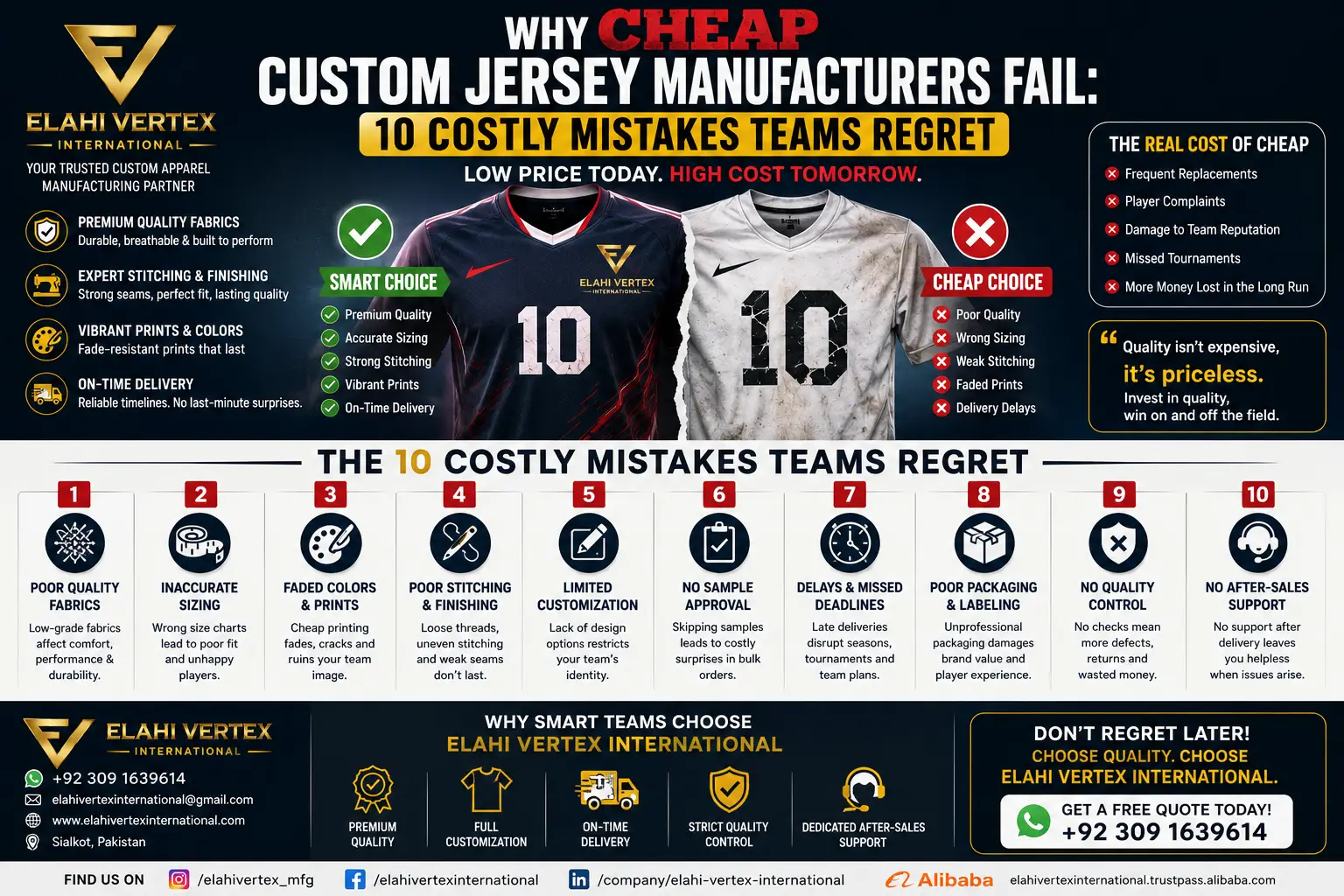
Why Cheap Custom Jersey Manufacturers Fail: 10 Costly Mistakes Teams Regret

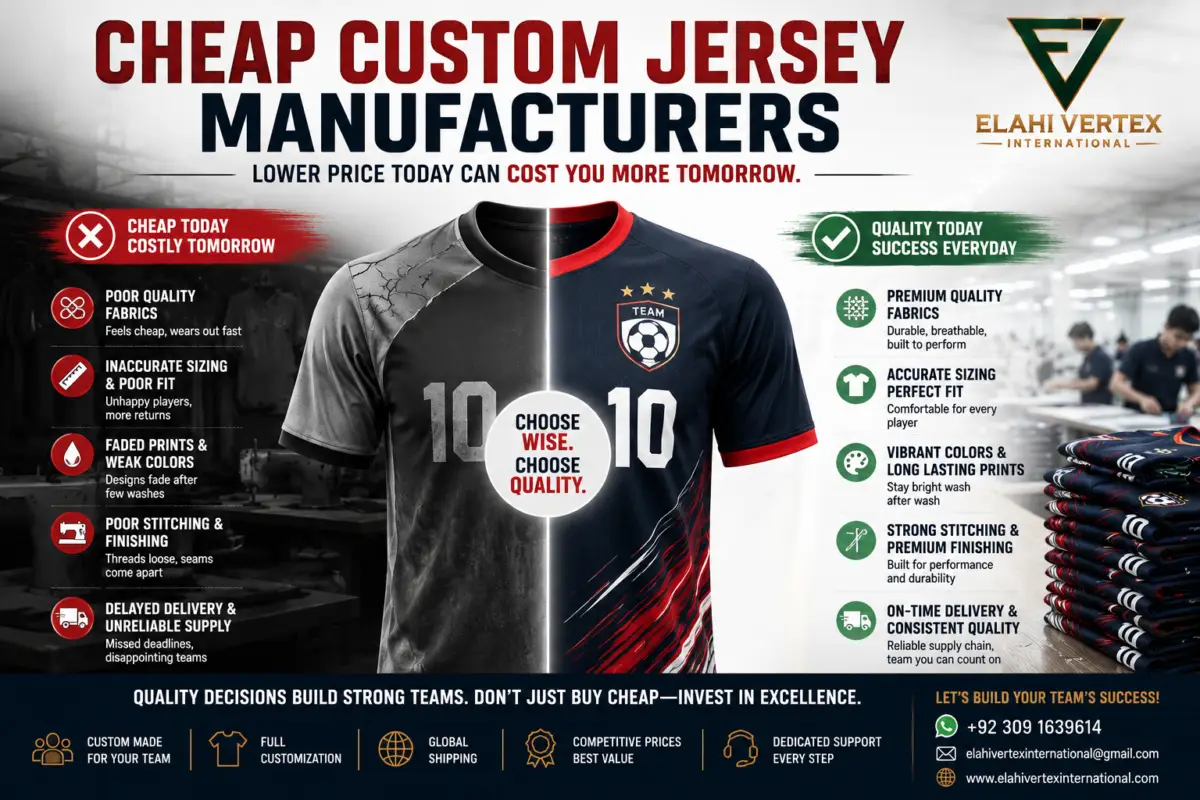
Choosing cheap custom jersey manufacturers can appear to be the easiest way for a team to reduce its uniform budget. The problem is that a low quotation can hide compromises in materials, stitching, printing, sizing, customization, communication, or delivery. Before placing an order, teams should evaluate the complete supplier offer rather than judging a manufacturer only by the initial price.
Ordering custom jerseys at the lowest possible price can look like a smart decision, especially when a team, academy, school, club, or distributor is working with a fixed budget. But the cheapest quotation is not always the lowest-cost option.
Cheap custom jersey manufacturers can create problems when a low quote comes with compromises in fabric, construction, decoration, sizing, communication, quality control, production planning, or delivery. A jersey may look impressive in a digital mockup but create expensive problems once the order reaches players.
The issue is not simply whether a jersey is cheap. The important question is what the quoted price includes, what it excludes, and whether the manufacturer can consistently deliver the agreed specification.
This guide explains 10 costly mistakes teams should avoid when comparing custom jersey manufacturers. It also provides a practical framework for evaluating specifications, samples, sizing, artwork, quality control, timelines, packaging, and supplier reliability.
If you are sourcing custom soccer jerseys or other teamwear for an international club, academy, school, distributor, or private-label business, these checks can help you compare suppliers on total value rather than unit price alone.
Table of Contents
- Why the Cheapest Jersey Quote Can Become Expensive
- Mistake #1: Choosing a Supplier Based Only on Unit Price
- Mistake #2: Comparing Quotes Without Comparing Specifications
- Mistake #3: Skipping the Pre-Production Sample
- Mistake #4: Ignoring Fabric and Construction Quality
- Mistake #5: Treating Sizing as an Afterthought
- Mistake #6: Approving Artwork Without Production Details
- Mistake #7: Ignoring Production and Delivery Planning
- Mistake #8: Failing to Define Quality Control
- Mistake #9: Overlooking Labels, Packaging, and Compliance
- Mistake #10: Ordering Before the Supplier Is Properly Evaluated
- How to Compare Custom Jersey Manufacturers Properly
- What to Include in a Custom Jersey RFQ
- 10 Questions to Ask Before Choosing a Manufacturer
- Cheap vs. Cost-Effective: What Teams Should Actually Look For
- Common Buyer Mistakes Checklist
- Why Elahi Vertex International Can Be Considered for Custom B2B Manufacturing
- Frequently Asked Questions
- Conclusion
Why the Cheapest Jersey Quote Can Become Expensive
A low jersey quotation can be perfectly legitimate. Lower pricing may result from efficient production, order volume, direct manufacturing, simplified customization, or different material and construction choices.
The problem begins when buyers assume that two quotes with the same product name represent the same product.
They may not.
One manufacturer may quote a jersey with a particular fabric specification, decoration method, construction standard, packaging arrangement, and inspection process. Another may quote a visually similar jersey using different specifications.
That difference may not be obvious from a digital mockup.
The real cost equation
For procurement purposes, it is more useful to think about:
Total cost = purchase price + rework + replacement + delays + administrative effort + missed deadlines + customer dissatisfaction
For a sports club, a sizing problem can mean replacing garments.
For a school, a production delay can interfere with a tournament or season.
For a distributor, inconsistent quality can create complaints and repeat-order problems.
For a private-label business, poor first-order quality can damage the brand’s reputation before the next order is even placed.
Practical takeaway: compare the complete supply proposition, not simply the number beside “price.”
Need help discussing a custom jersey sourcing specification? Contact Elahi Vertex International on WhatsApp at +92 309 1639614 or email elahivertexinternational@gmail.com.
A professional supplier evaluation should go beyond asking whether cheap custom jersey manufacturers offer the lowest price. Teams should compare specifications, customization capabilities, communication, quality expectations, sampling, production terms, packaging, and delivery requirements before making a purchasing decision.
1. Mistake #1: Choosing a Supplier Based Only on Unit Price
This is the most obvious mistake—and one of the easiest to make.
A team requests three quotations, sees that one manufacturer is significantly cheaper, and assumes it has found the best supplier.
That conclusion is premature.
The first question should be:
Are all three suppliers quoting the same specification?
A proper comparison should consider:
- Fabric composition and construction
- Fabric weight where relevant
- Jersey construction
- Collar and cuff construction
- Decoration method
- Logo application
- Player names and numbers
- Sponsor placement
- Size range
- Individual personalization
- Packaging
- Sample requirements
- Quality-control expectations
- Delivery terms
- Shipping responsibilities
- Required documentation
A lower price can represent genuine manufacturing efficiency. It can also reflect a lower specification.
Price is a screening factor, not a supplier-selection strategy
The objective is not to find the most expensive manufacturer.
It is to identify the supplier offering the strongest combination of:
Specification + quality + consistency + communication + commercial terms + delivery reliability
That is particularly important when the jerseys will be worn repeatedly rather than used as one-time promotional garments.
Buyer action: ask every supplier to quote against the same written specification sheet before comparing prices.
Planning an international teamwear order? Share your requirements with Elahi Vertex International at +92 309 1639614 or elahivertexinternational@gmail.com.
2. Mistake #2: Comparing Quotes Without Comparing Specifications
A supplier can quote “custom soccer jersey” without knowing exactly what the buyer expects.
That creates room for misunderstandings.
A better RFQ defines the product before the supplier calculates the quotation.
What should a jersey specification include?
| Specification Area | What the Buyer Should Clarify |
|---|---|
| Product | Jersey type and intended use |
| Fabric | Composition, construction and required characteristics |
| Fit | Regular, athletic or another defined fit |
| Design | Artwork, panels, colors and references |
| Branding | Club crest, manufacturer branding and sponsor logos |
| Personalization | Names, numbers and player-specific requirements |
| Decoration | Printing, embroidery, heat application or other method |
| Sizes | Required size range and size distribution |
| Quantity | Total units and variations |
| Packaging | Individual or bulk packaging requirements |
| Labels | Brand, size, care and origin requirements where applicable |
| Quality | Inspection criteria and acceptable tolerances |
| Delivery | Required arrival date and shipping responsibilities |
The more important a specification is to the buyer, the less it should be left to interpretation.
Why this matters
Suppose one supplier assumes a basic stock-style construction while another interprets the request as a performance-oriented team jersey.
Both can honestly say they quoted a “custom jersey.”
But the products may not be comparable.
This is one reason custom jersey manufacturers should be evaluated using a specification-driven RFQ rather than a product name alone.
Buyer action: create one master specification and send the identical document to every supplier.
For help discussing a custom manufacturing specification, contact Elahi Vertex International via +92 309 1639614 or elahivertexinternational@gmail.com.
3. Mistake #3: Skipping the Pre-Production Sample
A digital design is not the same thing as a physical garment.
A mockup can show colors, logos, numbers, sponsor placement, and general appearance. It cannot fully demonstrate how the finished garment will fit, feel, move, or perform in actual use.
That makes sample evaluation an important procurement step.
What should a team inspect?
Before approving production, buyers should evaluate the agreed sample against the specification.
Check:
- Overall appearance
- Size and measurements
- Fabric hand feel
- Stitching
- Seam construction
- Collar construction
- Sleeve construction
- Logo placement
- Sponsor placement
- Name and number positioning
- Decoration quality
- Color interpretation
- Label placement
- General finishing
For a larger order, the buyer should also establish what happens if production differs from the approved sample.
Sample approval should be documented
Do not rely only on a message such as:
“Looks good.”
A stronger approval process identifies the version being approved and records the relevant specifications.
This becomes especially important if the artwork or specifications change later.
Expert tip: a sample is not just a product preview. It is a risk-control checkpoint.
Buyer action: request and evaluate a representative sample whenever the project’s risk, quantity, customization, or commercial importance justifies it.
If you are preparing a custom jersey project, contact Elahi Vertex International at +92 309 1639614 or elahivertexinternational@gmail.com to discuss the specifications.
4. Mistake #4: Ignoring Fabric and Construction Quality
A jersey can look impressive in photographs while still failing to meet the buyer’s expectations in actual use.
That is why fabric and construction should be evaluated separately from appearance.
Fabric is more than a weight number
Buyers sometimes assume that heavier fabric automatically means better quality.
That is too simplistic.
The appropriate fabric depends on:
- Sport
- Climate
- Intended activity
- Fit
- Breathability requirements
- Durability expectations
- Decoration method
- Design
- Target price
- End-user expectations
A training jersey used in a hot climate may have different requirements from a lifestyle-oriented supporter jersey.
Construction matters too
Inspect areas such as:
- Seams
- Stitch consistency
- Collar attachment
- Sleeve attachment
- Hem finishing
- Panel alignment
- Decoration integration
- Loose threads
- Symmetry
- Overall finishing
The goal is not to demand the most expensive construction.
The goal is to make sure the construction matches the intended use and agreed specification.
Don’t judge quality from one attribute
A jersey should be evaluated as a system:
Fabric + construction + fit + decoration + finishing + consistency
That is a much stronger evaluation framework than asking whether the material “feels premium.”
Buyer action: define the characteristics that matter for your actual sport and usage environment before requesting quotations.
Elahi Vertex International can discuss custom teamwear requirements at +92 309 1639614 or elahivertexinternational@gmail.com.
5. Mistake #5: Treating Sizing as an Afterthought
Sizing mistakes can become one of the most frustrating problems in a team order because the finished jerseys are distributed to multiple people with different body shapes.
A design can be perfect and the garment can still fail commercially if the fit is wrong.
Different manufacturers can use different measurement systems. Even when two garments are both labeled “L,” their actual measurements may differ.
Build a team size matrix
For a team order, create a table containing:
| Player | Size | Name | Number | Quantity |
|---|---|---|---|---|
| Player 1 | M | Example | 10 | 1 |
| Player 2 | L | Example | 11 | 1 |
| Player 3 | XL | Example | 12 | 1 |
Confirm the measurement basis
A supplier should know whether measurements refer to:
- Body measurements, or
- Finished garment measurements.
Those are not the same thing.
Buyers should also clarify:
- Chest measurement
- Body length
- Shoulder measurement where relevant
- Sleeve length
- Hem measurement
- Tolerance expectations
- Measurement method
- Size grading
- Youth sizing
- Adult sizing
- Player-specific personalization
Buyer action: approve the size chart and measurement methodology before production rather than relying only on S/M/L labels.
Need to discuss a team size matrix or custom jersey specification? Contact Elahi Vertex International at +92 309 1639614 or elahivertexinternational@gmail.com.
6. Mistake #6: Approving Artwork Without Production Details
A beautiful design file does not automatically become a well-produced jersey.
Artwork needs to be translated into manufacturing instructions.
This is particularly important when the jersey includes:
- Club crest
- Sponsor logos
- Player names
- Player numbers
- Multiple colors
- Complex patterns
- Sleeve branding
- Front and back graphics
- Custom labels
The buyer should clarify more than “the design”
Ask:
- Which artwork file is final?
- Which logo version is approved?
- What are the official brand colors?
- Where does each sponsor appear?
- What are the approximate dimensions?
- Which player receives which number?
- How should names be spelled?
- What happens if a player list changes?
- Which elements are printed?
- Which are embroidered or otherwise applied?
- What file format does the manufacturer require?
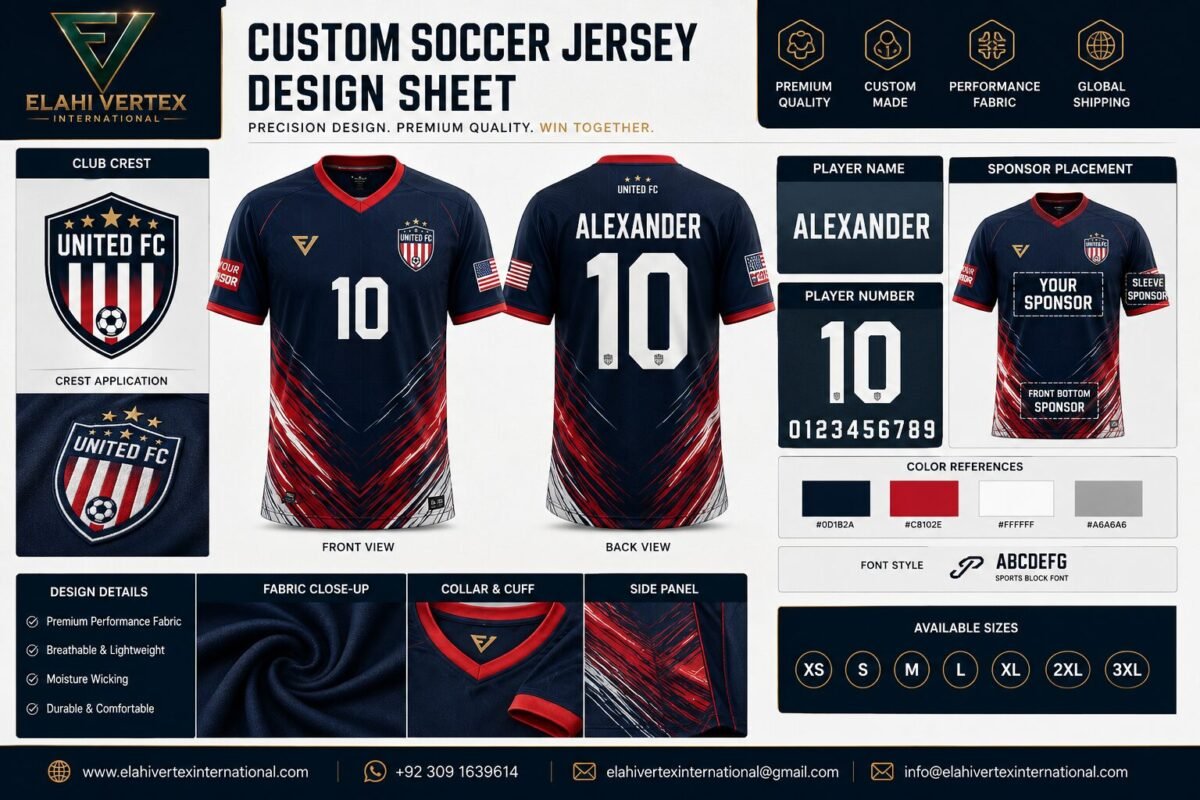
Use a design specification sheet
A simple design sheet can show:
Front → Back → Sleeves → Collar → Crest → Sponsors → Name → Number → Colors
This reduces interpretation risk.
The more customized the order, the more important it becomes to have a single approved production reference.
Buyer action: do not approve artwork until the artwork and production specifications have been reconciled.
For custom OEM, ODM, or teamwear manufacturing discussions, contact Elahi Vertex International on +92 309 1639614 or elahivertexinternational@gmail.com.
7. Mistake #7: Ignoring Production and Delivery Planning
A jersey that arrives after the tournament is not a successful order.
Yet buyers often focus on the manufacturer’s production time and overlook the complete delivery chain.
Production time is not the same as arrival time
The total timeline may involve:
Specification approval → Sampling → Sample approval → Production → Quality inspection → Packing → Dispatch → Transit → Customs/import processing → Final delivery
Not every stage is controlled by the manufacturer.
That means a team should distinguish between:
- Sample timeline
- Production timeline
- Dispatch timing
- Transit time
- Estimated arrival
- Contingency time
Tournament deadlines require backward planning
Suppose a team needs uniforms for a tournament on a specific date.
The correct approach is not:
“Can you make these by the tournament?”
Instead, work backward:
Required arrival date → shipping buffer → dispatch → production → approval → sampling → specification finalization
This exposes risk much earlier.
Cheap can become expensive when time is tight
A lower quotation may become economically unattractive if it requires:
- Rework
- Rush production
- Expedited shipping
- Replacement units
- Emergency local purchasing
Those costs may not appear in the initial supplier quotation.
Buyer action: communicate the required arrival date, not merely the date you hope production will finish.
Discuss your project requirements with Elahi Vertex International at +92 309 1639614 or elahivertexinternational@gmail.com. Specific production and delivery timelines should be confirmed for each project.
8. Mistake #8: Failing to Define Quality Control
“Good quality” is not a measurable specification.
It is a conclusion.
A better purchasing process defines what the buyer actually intends to inspect.
A practical jersey QC checklist
Before accepting an order, buyers can inspect:
- Correct quantity
- Correct sizes
- Correct player names
- Correct player numbers
- Correct logos
- Correct sponsor placement
- Color consistency
- Stitching
- Seam construction
- Loose threads
- Visible defects
- Decoration quality
- Label accuracy
- Packaging
- General finishing
Define defects before production
Where appropriate, distinguish between:
Critical defects: problems that make the product unusable or commercially unacceptable.
Major defects: problems that materially affect appearance, function, or usability.
Minor defects: smaller imperfections that do not materially affect intended use.
The exact acceptance criteria should be agreed for the particular project rather than assumed to be universal.
Inspection is not the same as trust
A supplier may be highly capable and still benefit from clear inspection criteria.
Quality control is a process, not a personality test.
Buyer action: agree what will be checked, when it will be checked, and how discrepancies will be handled before production starts.
If you need to discuss quality requirements for a custom teamwear order, contact Elahi Vertex International at +92 309 1639614 or elahivertexinternational@gmail.com.
9. Mistake #9: Overlooking Labels, Packaging, and Compliance
Buyers sometimes treat labels and packaging as secondary details.
For international B2B orders, that can be a mistake.
Depending on the destination market and product, labeling and consumer-information requirements may apply.
For example, U.S. Federal Trade Commission guidance explains that covered textile products generally require information including fiber content, country of origin, and the identity of the responsible manufacturer or marketer.
The buyer should also verify applicable requirements for the destination market before production and shipment.
What should buyers clarify?
Depending on the market and product:
- Brand labels
- Size labels
- Care information
- Fiber-content information
- Country-of-origin information
- Packaging labels
- Carton markings
- Barcode requirements
- Retail packaging
- Individual polybags
- Shipping documentation
Not every requirement applies to every order.
Destination-specific compliance should be confirmed for the actual product and market before shipment.
Packaging can also affect operations
For distributors and retailers, packaging may need to support:
- Inventory handling
- Size identification
- Individual order fulfillment
- Brand presentation
- Warehouse organization
For clubs, individual packaging may make distribution easier.
For wholesalers, bulk packaging may be more appropriate.
Buyer action: specify packaging and labeling requirements in the RFQ instead of discussing them after production has started.
For custom labeling, packaging, and manufacturing discussions, contact Elahi Vertex International at +92 309 1639614 or elahivertexinternational@gmail.com.
10. Mistake #10: Ordering Before the Supplier Is Properly Evaluated
The final mistake is broader than the other nine.
Teams sometimes evaluate the product but fail to evaluate the supplier relationship.
A professional supplier assessment should consider:
1. Communication
Does the supplier understand your specification?
Do they ask useful questions?
Can they explain what they need from the buyer?
2. Specification discipline
Does the supplier confirm details in writing?
Does the supplier distinguish assumptions from confirmed requirements?
3. Sampling
Can the buyer evaluate a physical sample when appropriate?
4. Customization
Can the supplier clearly explain which elements can be customized?
5. Quality process
Can the supplier explain how quality requirements will be handled?
6. Commercial clarity
Are quotation terms clear?
Are important assumptions visible?
7. Timeline clarity
Are production and delivery expectations separated?
8. Documentation
Are order details, artwork, sizing, and quantities documented?
9. International suitability
Can the supplier communicate effectively about export requirements and destination-market considerations?
10. Repeat-order potential
For a team or distributor expecting future orders, consistency may matter more than achieving the absolute lowest first-order price.
Buyer action: evaluate the supplier’s process—not just the product photograph and quotation.
Elahi Vertex International operates as a B2B manufacturer, exporter, OEM/ODM supplier, custom manufacturing partner, and private-label manufacturing partner. Buyers can discuss custom requirements through +92 309 1639614 or elahivertexinternational@gmail.com.
How to Compare Custom Jersey Manufacturers Properly
A useful supplier comparison matrix should look beyond price.
| Evaluation Factor | Supplier A | Supplier B | Supplier C |
|---|---|---|---|
| Specification match | |||
| Sample quality | |||
| Fabric specification | |||
| Construction | |||
| Decoration quality | |||
| Size consistency | |||
| Customization | |||
| Quality-control process | |||
| Packaging | |||
| Timeline clarity | |||
| Communication | |||
| Commercial terms | |||
| Total landed-cost considerations | |||
| Repeat-order suitability |
This approach makes an important distinction:
The cheapest supplier is not necessarily the supplier with the lowest total procurement cost.
At the same time, the opposite is also true: a higher price does not automatically prove higher quality.
The buyer’s job is to verify the value behind the quotation.
If you are comparing custom jersey manufacturers, share your product specifications with Elahi Vertex International at +92 309 1639614 or elahivertexinternational@gmail.com.
What Should You Include in a Custom Jersey RFQ?
A strong RFQ gives suppliers enough information to quote comparable products.
Custom Jersey RFQ Checklist
- Product type
- Sport and intended use
- Quantity
- Fabric requirements
- Color references
- Design artwork
- Club crest
- Sponsor logos
- Player names
- Player numbers
- Size breakdown
- Measurement requirements
- Decoration requirements
- Label requirements
- Packaging requirements
- Quality expectations
- Sampling requirements
- Required arrival date
- Destination country
- Shipping requirements
- Documentation requirements
- Commercial terms to be confirmed
The more complete the RFQ, the easier it becomes to compare custom jersey manufacturers objectively.
Practical tip: if three suppliers receive three different descriptions of the product, their quotations are not directly comparable.
Planning an RFQ for a custom teamwear order? Contact Elahi Vertex International at +92 309 1639614 or elahivertexinternational@gmail.com.
10 Questions to Ask Before Choosing a Custom Jersey Manufacturer
Before placing an order, ask:
- What exact specifications are included in the quotation?
- Can you provide a sample or representative production sample where appropriate?
- How are garment measurements defined and checked?
- How will names and numbers be matched to the size list?
- How will artwork and sponsor placement be approved?
- What quality checks are performed against the approved specification?
- What information do you need before production can begin?
- What is the production timeline for this specific project?
- What packaging and labeling options are available?
- What details still need to be confirmed before the order is finalized?
The last question is particularly useful.
A supplier that clearly identifies unknowns can be easier to work with than one that simply says everything is possible.
Buyer action: use these questions during supplier evaluation before approving your purchase order.
Cheap vs. Cost-Effective: What Teams Should Actually Look For
| Cheap Approach | Cost-Effective Approach |
|---|---|
| Compare only unit prices | Compare complete specifications |
| Choose from mockups | Evaluate physical samples where appropriate |
| Use generic size labels | Confirm actual measurements |
| Finalize artwork informally | Use an approved production reference |
| Focus on production time | Plan the complete delivery timeline |
| Assume “good quality” | Define inspection criteria |
| Discuss packaging at the end | Include packaging in the RFQ |
| Ignore destination requirements | Confirm applicable market requirements |
| Select the lowest quote automatically | Evaluate total procurement value |
| Treat each order as isolated | Consider repeat-order consistency |
The distinction is important.
Cost-effective does not mean expensive.
It means the buyer is paying for the product and service characteristics that actually matter to the intended use.
For teams comparing suppliers, Elahi Vertex International can discuss the specifications behind a custom manufacturing project at +92 309 1639614 or elahivertexinternational@gmail.com.
Common Buyer Mistakes Checklist
Before approving an order, review these ten risks:
- Selecting based only on the lowest quotation
- Comparing suppliers without a common specification
- Skipping an appropriate pre-production sample
- Failing to define fabric and construction expectations
- Using size labels without checking measurements
- Approving artwork without production instructions
- Confusing production time with delivery time
- Failing to define quality-control requirements
- Ignoring labeling and packaging requirements
- Ordering before properly evaluating the supplier
If several of these remain unresolved, the buyer is taking unnecessary procurement risk.
Need help reviewing a custom jersey requirement? Contact Elahi Vertex International at +92 309 1639614 or elahivertexinternational@gmail.com.
Why Elahi Vertex International Can Be Considered for Custom B2B Manufacturing
For buyers looking for a manufacturing partner rather than a retail jersey brand, Elahi Vertex International positions its business around B2B manufacturing, exporting, OEM, ODM, custom manufacturing, and private-label manufacturing.
That distinction matters because different buyers have different procurement needs.
A sports club may need customized teamwear.
A distributor may need repeatable product specifications.
A clothing business may need private-label production.
An importer may need a supplier able to work from detailed product requirements.
The appropriate supplier should therefore be selected based on the actual project—not simply on the lowest online quotation.
Specific materials, production timelines, MOQ, packaging, sampling arrangements, shipping terms, and other project details should be confirmed for each individual order rather than assumed.
If you are comparing manufacturers for a custom jersey or teamwear project, send your specifications to Elahi Vertex International at +92 309 1639614 or elahivertexinternational@gmail.com.
Frequently Asked Questions
Are cheap custom jersey manufacturers always low quality?
No. A low price does not automatically mean poor quality. Pricing can vary because of production efficiency, order volume, customization, materials, and commercial structure. Buyers should verify the actual specification and quality rather than judging solely from price.
Why can a very cheap jersey quotation be risky?
A low quotation can become risky when important specifications are unclear or excluded. Problems may involve fit, materials, decoration, customization, packaging, quality control, or delivery planning.
Should I choose the cheapest custom jersey manufacturer?
Not automatically. Compare suppliers using the same specification, sample requirements, quality expectations, timeline, packaging, and commercial terms before deciding.
Should teams request samples before placing an order?
For projects where fit, construction, decoration, or customization carries meaningful risk, a sample can provide an important pre-production checkpoint. The appropriate sampling process should be agreed with the supplier for the specific project.
How can I compare custom jersey manufacturers?
Send each supplier the same detailed RFQ and compare specification compliance, sample quality, construction, customization, communication, quality processes, timeline, packaging, and commercial terms—not only price.
What information should I give a jersey manufacturer?
Provide the product type, quantity, design, fabric requirements, sizes, player names and numbers, logos, sponsor placement, packaging, quality expectations, destination, and required delivery date.
Why are jersey measurements important?
Different manufacturers may use different measurement systems. Confirming actual garment measurements and the measurement method helps reduce sizing discrepancies across a team order.
What should I check on a custom jersey sample?
Inspect fit, measurements, fabric, stitching, seams, collar, decoration, logos, names, numbers, sponsor placement, colors, labels, and finishing against the approved specification.
Does a lower fabric weight always mean lower quality?
No. Fabric suitability depends on the intended use and overall construction. Buyers should define the characteristics needed for the sport, climate, fit, and performance expectations.
What is the difference between production time and delivery time?
Production time refers to the manufacturing stage. Delivery time also involves dispatch, transportation, and potentially customs or import processing. Buyers should plan the complete timeline.
Should packaging be included in the RFQ?
Yes, when packaging matters to the buyer. Individual packaging, bulk packaging, labels, barcodes, and carton requirements can affect the finished order and should be discussed before production.
Do international jersey orders have labeling requirements?
Potentially. Requirements depend on the destination market and product. Buyers should verify the applicable rules for their specific market and product before shipment.
How can teams reduce the risk of receiving incorrect player names or numbers?
Use one approved player matrix containing names, numbers, sizes, and quantities. Have the final version confirmed before production.
Is a higher-priced manufacturer automatically better?
No. Price alone cannot establish quality. Buyers should verify the specification, sample, process, communication, quality requirements, and commercial terms.
Can Elahi Vertex International discuss custom jersey manufacturing requirements?
Yes. Elahi Vertex International is positioned as a B2B manufacturer, exporter, OEM/ODM supplier, custom manufacturing partner, and private-label manufacturing partner. Specific project requirements should be discussed and confirmed directly.
Conclusion: The Cheapest Jersey Can Become the Most Expensive Order
The biggest mistake teams make is treating jersey sourcing as a simple price comparison.
It is not.
A successful custom jersey order depends on the relationship between specification, product quality, sizing, artwork, customization, quality control, timeline, packaging, compliance, and supplier communication.
A low quotation can be attractive. But if it creates replacements, rework, missed deadlines, inconsistent sizing, or dissatisfied players, the apparent saving can disappear quickly.
The objective is not simply to avoid cheap custom jersey manufacturers. Instead, teams should identify a supplier that offers a commercially sensible balance between price, product specifications, quality, customization, communication, and production requirements.
The smarter approach is not to avoid low-cost manufacturers altogether. It is to verify what the low price actually represents.
Use a common RFQ. Compare specifications. Evaluate samples where appropriate. Confirm measurements. Approve artwork properly. Define quality requirements. Plan backward from the required arrival date. Clarify packaging and destination-market requirements. Then compare the complete supplier proposition.
For teams, academies, clubs, distributors, importers, and private-label buyers sourcing custom jerseys internationally, that process can reduce avoidable procurement risk.
Ready to discuss a custom jersey manufacturing requirement?
Contact Elahi Vertex International on WhatsApp/Phone at +92 309 1639614 or email elahivertexinternational@gmail.com.
For teams sourcing custom soccer jerseys for the USA market, choosing a manufacturer should involve more than comparing the lowest quotation. Buyers should consider jersey construction, fabric and printing specifications, sizing accuracy, customization, quality control, communication, and delivery expectations.
The U.S. Soccer official jersey collection provides a useful reference for professional soccer jersey design and team identity. U.S. buyers should also review applicable FTC textile labeling requirements before finalizing products for the American market.
If your team, club, academy, or sports business is evaluating a custom jersey manufacturer, Elahi Vertex International can discuss your specifications and B2B manufacturing requirements. Contact +92 309 1639614 on WhatsApp, email elahivertexinternational@gmail.com, or visit Elahi Vertex International.
Choosing cheap custom jersey manufacturers can reduce the initial quotation, but the lowest price should never be the only supplier-selection criterion.
Teams should compare fabric and construction specifications, sizing accuracy, printing quality, customization requirements, quality control, communication, packaging, production terms, and delivery expectations before placing an order.
Cheap custom jersey manufacturers may become costly when defects, incorrect specifications, inconsistent sizing, poor customization, or delays require replacements or corrective action.
A better approach is to evaluate the complete value of the supplier and confirm all important requirements before approving production.
If your team, club, academy, or sports business is sourcing custom teamwear, Elahi Vertex International can discuss your B2B manufacturing requirements. Contact +92 309 1639614 on WhatsApp, email elahivertexinternational@gmail.com, or visit Elahi Vertex International.
How Teams Should Evaluate Cheap Custom Jersey Manufacturers
Teams should evaluate cheap custom jersey manufacturers by looking beyond the quoted unit price. Check the specifications, customization, sizing, quality expectations, communication, production terms, and delivery requirements before approving an order.
The cheapest quotation from cheap custom jersey manufacturers is not necessarily the lowest total cost if quality problems, incorrect specifications, or delays create additional expenses.
For teams comparing cheap custom jersey manufacturers, a clear specification sheet and documented approval process can make supplier comparisons more reliable and reduce avoidable production problems.
If you are sourcing custom teamwear, Elahi Vertex International can discuss your B2B manufacturing requirements. Contact +92 309 1639614 on WhatsApp, email elahivertexinternational@gmail.com, or visit Elahi Vertex International.
Teams should evaluate cheap custom jersey manufacturers on more than price. When comparing cheap custom jersey manufacturers, review specifications, sizing, customization, quality control, communication, and delivery terms. Choosing cheap custom jersey manufacturers without checking these details can create avoidable costs. Before ordering, compare cheap custom jersey manufacturers based on overall value and project requirements.
Before placing a bulk order, teams should carefully evaluate cheap custom jersey manufacturers against the complete project requirements, including product specifications, customization, quality expectations, communication, and delivery terms. A supplier that appears inexpensive at the quotation stage may not provide the best overall value if important requirements are unclear or additional costs arise later.
Before choosing cheap custom jersey manufacturers, teams should confirm every important requirement in writing.
Comparing cheap custom jersey manufacturers on specifications and overall value can help teams avoid expensive mistakes later.
When evaluating cheap custom jersey manufacturers, teams should consider the complete cost, product quality, customization, communication, and delivery requirements rather than the quoted unit price alone.