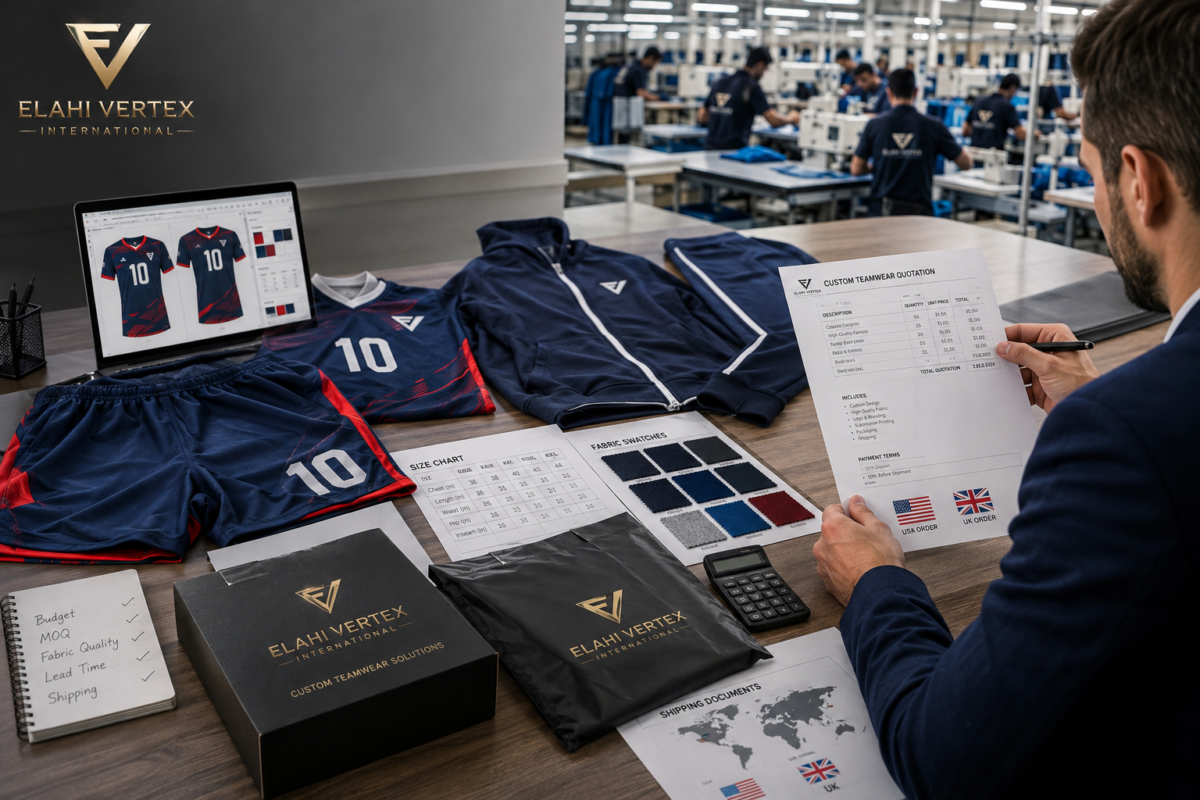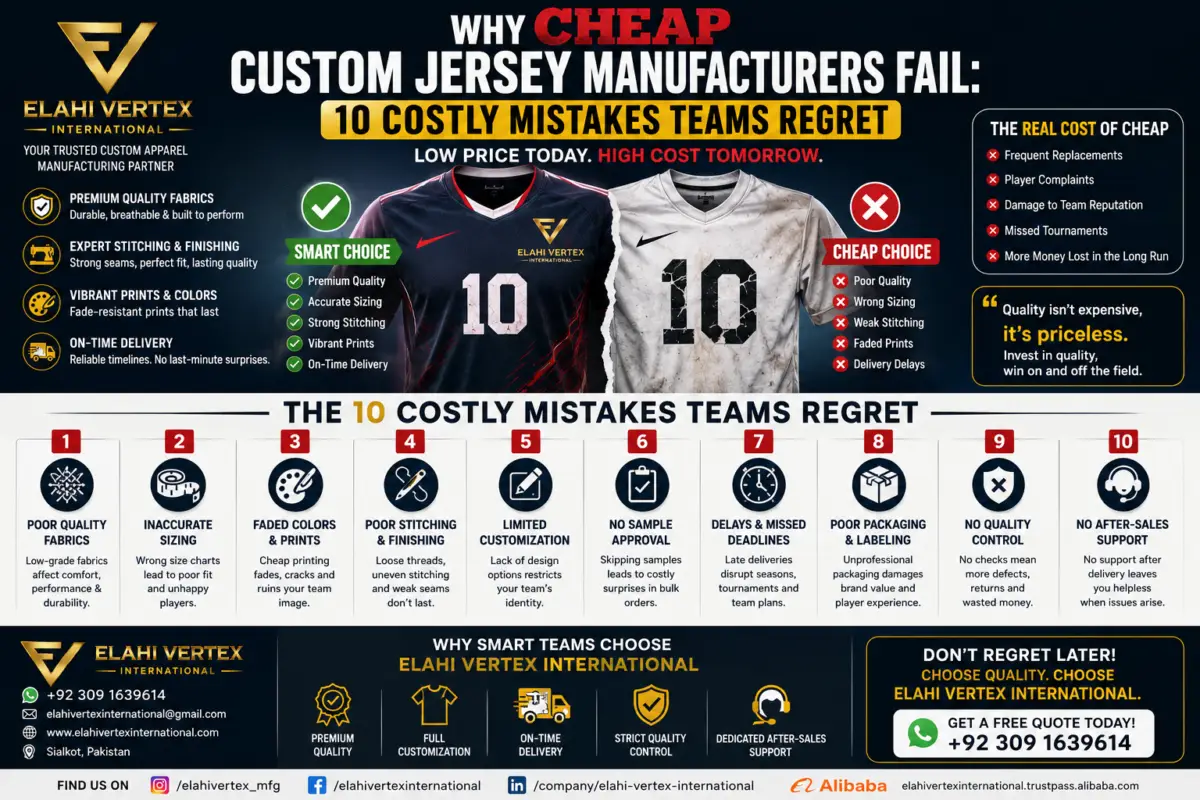


Choosing between sublimation vs cut-and-sew teamwear is not simply a question of which manufacturing method is “better.” For sports clubs, academies, apparel brands, wholesalers, and private-label buyers, the better method depends on the garment design, fabric requirements, branding, performance expectations, order structure, and how much control you need over the finished product.
In simple terms, sublimation teamwear is usually strongest when you need detailed all-over graphics, gradients, numbers, logos, and repeatable visual designs on suitable synthetic fabrics. Cut-and-sew teamwear is generally stronger when you need greater control over garment construction, fabric selection, fit, panels, trims, and premium product development.
That makes sublimation vs cut-and-sew teamwear an important sourcing decision before you request quotations from a manufacturer.
For international B2B buyers, the real question is not “Which method is best?” It is:
Which manufacturing method gives your teamwear the right combination of design flexibility, garment construction, performance, cost control, and production consistency?
This guide explains the differences so you can make that decision before approving a sample or placing a production order.
Table of Contents
- What Is the Difference Between Sublimation and Cut-and-Sew Teamwear?
- What Is Sublimation Teamwear?
- What Is Cut-and-Sew Teamwear?
- Sublimation vs Cut-and-Sew Teamwear: Direct Comparison
- Which Method Gives Better Design Flexibility?
- Which Method Gives Better Fabric and Fit Control?
- Which Method Is Better for Team Jerseys?
- Which Method Is Better for Premium Custom Teamwear?
- Cost Considerations for B2B Buyers
- Production and Quality Considerations
- How to Choose the Right Manufacturing Method
- Common Buyer Mistakes
- Buyer Checklist
- FAQ
- Why Work With Elahi Vertex International?
- Final Verdict
What Is the Difference Between Sublimation and Cut-and-Sew Teamwear?
The main difference is where customization takes place in the manufacturing process.
With sublimation teamwear, a design is transferred into suitable synthetic fabric using a dye-sublimation process, allowing graphics to become part of the fabric rather than sitting as a conventional surface print.
With cut-and-sew teamwear, fabric is cut into individual garment panels according to a pattern and then assembled through stitching. Customization can involve the garment’s construction, fabric, panels, fit, trims, branding, printing, embroidery, and other specifications.
Sublimation vs cut-and-sew teamwear at a glance
FactorSublimation TeamwearCut-and-Sew TeamwearFull-color graphicsExcellentPossible through additional decorationAll-over designsExcellentPossibleGradientsExcellentPossibleIndividual names/numbersExcellentPossibleFabric selectionMore dependent on suitable sublimation fabricBroaderGarment construction controlModerateHighCustom panel constructionMore limited by design/processExcellentCustom fitPossible but depends on patternExcellentPremium constructionDepends on garmentStrong potentialComplex graphic artworkExcellentRequires additional decorationBranding optionsStrongVery broadFabric flexibilityMore limitedBroadBest useGraphic-heavy teamwearHighly customized garments
The important point is that these methods are not always mutually exclusive. A cut-and-sew garment can also incorporate sublimation or another decoration technique. In practical manufacturing, the distinction is often about the primary production approach rather than two completely isolated systems.
For B2B buyers, this matters because asking a manufacturer only for “custom teamwear” is often not specific enough. You should define what you actually want manufactured.
Need help defining your manufacturing requirements? Contact Elahi Vertex International on WhatsApp at +92 309 1639614, email elahivertexinternational@gmail.com, or visit https://www.elahivertexinternational.com/.
What Is Sublimation Teamwear?
Sublimation teamwear uses a printing process in which dye is transferred into suitable synthetic fabric under controlled heat and pressure.
This method is particularly useful for sports garments because it can support highly detailed visual designs across large areas of the garment.
Instead of applying a traditional surface graphic that sits prominently on top of the fabric, sublimation integrates the dye into the fabric structure.
Why do teams choose sublimation?
Teams often choose sublimation when their primary requirement is visual customization.
A single jersey can incorporate:
- Team colors
- Club logos
- Player numbers
- Player names
- Sponsor graphics
- Gradients
- Geometric patterns
- Stripes
- Camouflage-style graphics
- Repeating patterns
- Complex artwork
- Multiple colors
This is one of the biggest advantages of sublimation vs cut-and-sew teamwear when the primary objective is an intricate visual design.
Sublimation is particularly useful for graphic-heavy designs
Imagine a football club wants a jersey containing:
- A dark-to-light gradient
- Multiple sponsor logos
- A geometric pattern
- Player number
- Player name
- Club crest
- Custom sleeve graphics
Trying to achieve that appearance through multiple conventional decoration methods can create additional production considerations.
Sublimation can make complex full-garment graphics more straightforward when the fabric and garment construction are suitable for the process.
But sublimation has an important limitation
Sublimation is not a universal solution for every fabric.
The process is particularly associated with synthetic fabrics such as polyester because the dye needs a suitable polymer structure to produce the intended result.
Therefore, a buyer should not simply tell a manufacturer:
“I want sublimation.”
A better specification is:
“I want an all-over sublimated teamwear garment using a fabric suitable for the required performance, hand feel, fit, and end use.”
That distinction can prevent misunderstandings during sampling.
Planning sublimated teamwear for a club or brand? Share your artwork, garment type, target market, and fabric expectations with Elahi Vertex International at +92 309 1639614 or elahivertexinternational@gmail.com so the specific manufacturing requirements can be discussed.
What Is Cut-and-Sew Teamwear?
Cut-and-sew teamwear is produced by cutting fabric into garment components according to a pattern and assembling those components through sewing.
The process can provide significantly more control over the physical construction of the garment.
A typical workflow can include:
- Design development
- Technical specification
- Pattern development
- Fabric selection
- Fabric cutting
- Panel preparation
- Sewing
- Decoration or branding
- Finishing
- Quality inspection
- Packing
The exact workflow varies by manufacturer and product.
Cut-and-sew manufacturing is therefore particularly valuable when the garment itself—not just its graphics—is a major part of the product concept.
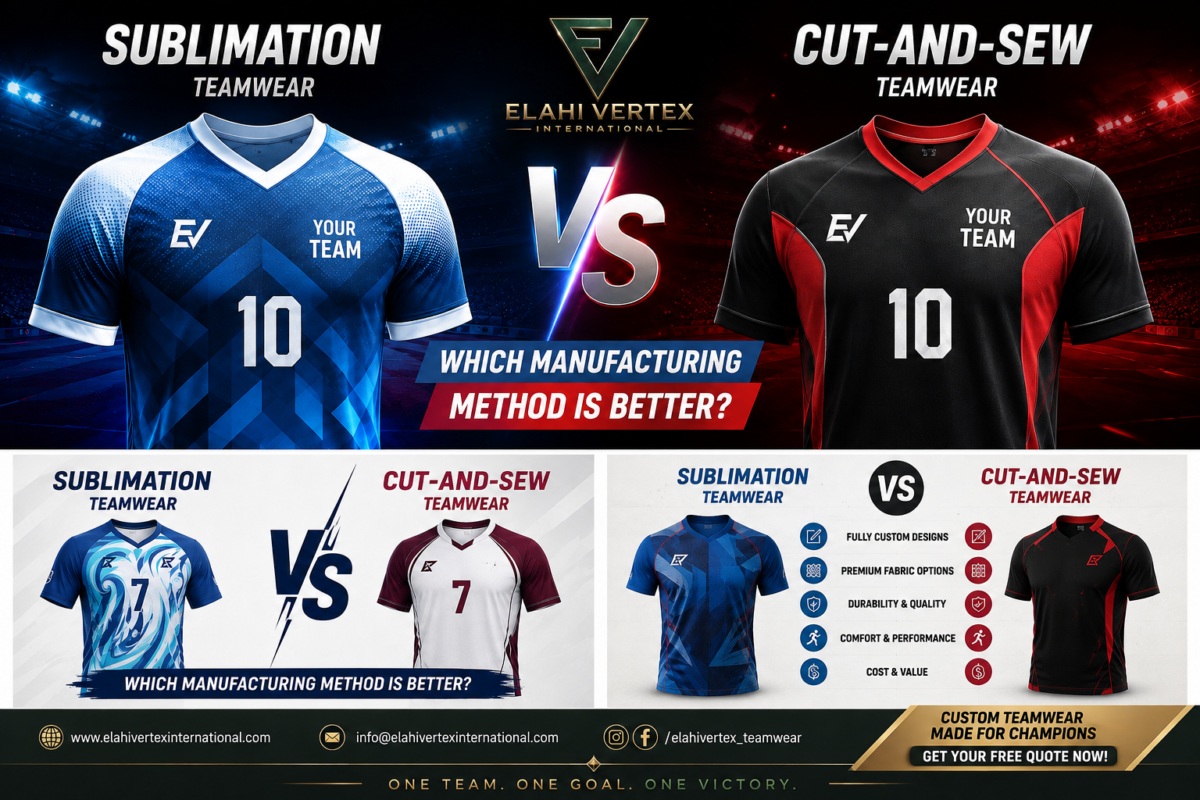
A clear comparison of design flexibility, fabric options, fit, construction, durability, performance, and value to help teams and B2B buyers choose the right teamwear manufacturing method.
Elahi Vertex International — Custom Teamwear Manufacturer | OEM | ODM | B2B Supplier
What can be customized?
Depending on the manufacturer’s capabilities and the project specification, cut-and-sew teamwear may allow customization of:
- Body shape
- Fit
- Sleeve construction
- Collar
- Cuffs
- Panels
- Side inserts
- Fabric combinations
- Pockets
- Trims
- Labels
- Branding
- Stitching
- Hem construction
- Garment dimensions
- Color blocking
This is why sublimation vs cut-and-sew teamwear becomes more complicated when the buyer wants a garment that looks and feels substantially different from a conventional sports jersey.
Developing a custom teamwear specification? Elahi Vertex International can discuss your OEM, ODM, or private-label requirements. Contact +92 309 1639614, elahivertexinternational@gmail.com, or https://www.elahivertexinternational.com/.
Sublimation vs Cut-and-Sew Teamwear: Which Is Better?
There is no universal winner.
The better method depends on your priorities.
If your priority is complex full-color graphics, sublimation often has the advantage.
If your priority is garment construction and physical customization, cut-and-sew generally offers greater control.
If your priority is a premium teamwear product with custom panels, materials, trims, and construction, cut-and-sew may be more appropriate.
If your priority is large-scale graphic customization across jerseys, sublimation can be highly effective.
The correct decision should therefore be based on the product specification rather than the manufacturing label.
Which Method Gives Better Design Flexibility?
This depends on what you mean by “design.”
There are two different types of design flexibility:
1. Graphic design flexibility
Want to develop a specific fit or garment construction? Send your technical requirements to Elahi Vertex International via +92 309 1639614 or elahivertexinternational@gmail.com for project-specific discussion.
Sublimation has a major advantage here.
It can support detailed artwork across large portions of the garment, making it suitable for:
- Gradients
- Complex graphics
- Multiple colors
- Photographic-style artwork
- Sponsor layouts
- Repeating patterns
- Player personalization
For visually aggressive sports designs, sublimation can be extremely practical.
2. Garment design flexibility
Cut-and-sew has the advantage here.
If you want to change the actual physical construction of the garment, cut-and-sew provides a broader manufacturing framework.
For example, a buyer might want:
- Contrasting side panels
- A specific sleeve shape
- A custom collar
- Different fabrics in different areas
- Reinforced sections
- Custom pockets
- Special hems
- Distinct garment proportions
Those requirements are fundamentally different from simply changing the artwork.
The key distinction
Sublimation gives exceptional graphic flexibility.
Cut-and-sew gives exceptional construction flexibility.
That is one of the most important conclusions when evaluating sublimation vs cut-and-sew teamwear.
If your design involves both complex graphics and custom construction, discuss the entire specification rather than choosing a method based only on the artwork. Elahi Vertex International can be reached at +92 309 1639614 or elahivertexinternational@gmail.com.
Which Method Gives Better Fabric and Fit Control?
This is where cut-and-sew can become more attractive for premium B2B teamwear.
A buyer developing a serious product line may care about more than appearance.
They may need to control:
- Fabric composition
- Fabric weight
- Stretch characteristics
- Breathability
- Hand feel
- Recovery
- Garment dimensions
- Panel construction
- Collar structure
- Sleeve construction
- Seam placement
- Overall fit
Cut-and-sew allows the manufacturer to construct the garment around the selected fabric and approved pattern.
That makes it particularly useful for brands that want their teamwear to become a recognizable product rather than simply a customized jersey graphic.
Why fit matters
Two garments can use similar-looking fabrics but feel completely different when worn.
Fit can affect:
- Mobility
- Comfort
- Appearance
- Athletic performance
- Layering
- Customer perception
- Repeat-order consistency
For B2B buyers, this is why a physical sample and clear measurement specifications are important before bulk production.
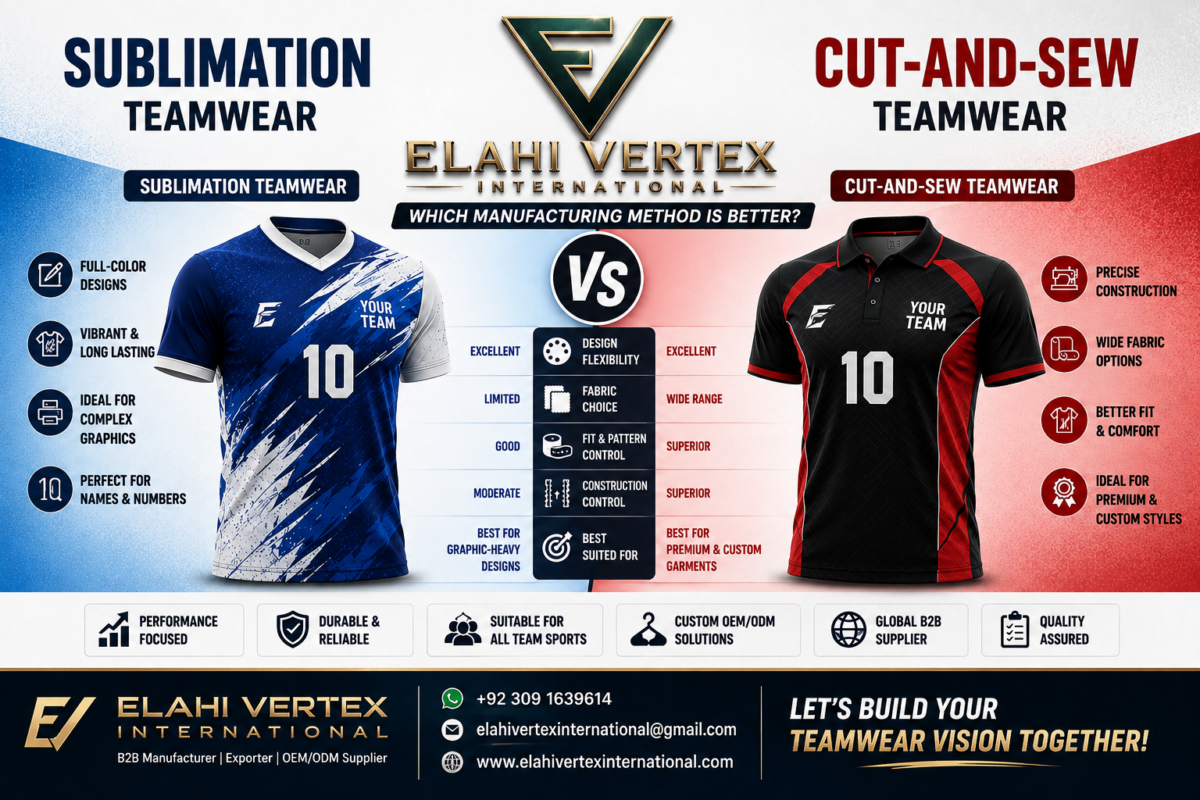
From performance-focused sublimation jerseys to premium cut-and-sew uniforms, Elahi Vertex International delivers custom OEM, ODM, and B2B teamwear solutions tailored to your requirements.
Custom Teamwear | Sportswear Manufacturer | Global B2B Supplier
Which Method Is Better for Team Jerseys?
For standard custom team jerseys, sublimation can be an excellent manufacturing option when the garment is primarily polyester-based and the design is heavily graphic-driven.
Typical examples include:
- Football jerseys
- Soccer jerseys
- Basketball jerseys
- Volleyball jerseys
- Cycling jerseys
- Running tops
- Training shirts
The attraction is obvious: one garment can carry a substantial amount of artwork.
However, cut-and-sew may be preferable when the jersey requires more extensive physical customization.
For example, suppose a brand wants a premium jersey with:
- Multiple fabric zones
- Special mesh panels
- Custom collar construction
- Specific sleeve architecture
- Distinctive fit
- Custom trims
- Special branding elements
In that case, the garment’s construction becomes as important as the artwork.
Practical rule
Choose sublimation when the artwork is the dominant customization requirement.
Choose cut-and-sew when the garment construction is the dominant customization requirement.
Need a custom jersey specification reviewed before requesting production pricing? Contact Elahi Vertex International at +92 309 1639614 or elahivertexinternational@gmail.com.
Which Method Is Better for Premium Custom Teamwear?
For premium custom teamwear, the answer depends on what “premium” means for the buyer.
Premium does not automatically mean cut-and-sew.
A highly detailed sublimated jersey can be commercially positioned as a premium product if the fabric, fit, construction, artwork quality, finishing, and overall manufacturing specification are appropriate.
Likewise, simply choosing cut-and-sew does not automatically create a premium garment.
Premium teamwear requires multiple decisions
A serious buyer should evaluate:
- Fabric
- GSM where relevant
- Fit
- Pattern
- Stitch construction
- Seam quality
- Decoration
- Color accuracy
- Branding
- Labels
- Finishing
- Size consistency
- Packaging
- Quality requirements
The manufacturing method is only one part of the equation.
A poorly specified cut-and-sew garment can perform worse commercially than a well-developed sublimated garment.
For premium teamwear, define the finished product first and select the manufacturing process second. Elahi Vertex International can discuss custom B2B manufacturing requirements at +92 309 1639614 or elahivertexinternational@gmail.com.
Sublimation vs Cut-and-Sew Teamwear: Cost Considerations
Buyers often ask:
“Which is cheaper?”
That question is too broad.
The total manufacturing cost depends on the complete specification.
Relevant factors can include:
- Fabric
- Garment construction
- Number of panels
- Artwork complexity
- Decoration
- Labels
- Trims
- Packaging
- Size range
- Order quantity
- Sampling
- Quality requirements
- Customization level
- Production workflow
- Shipping requirements
Sublimation cost considerations
Sublimation can be commercially attractive when the buyer wants extensive graphics without separately applying numerous individual decorations.
However, the buyer still needs to consider fabric requirements, pattern construction, finishing, personalization, and the overall garment specification.
Cut-and-sew cost considerations
Cut-and-sew can involve additional development and construction steps, particularly when the product requires:
- Custom patterns
- Multiple panels
- Multiple fabrics
- Special trims
- Complex construction
- Custom sizing
- Additional sewing operations
But those additional steps can be justified when they create a product that better matches the buyer’s requirements.
Never compare prices without comparing specifications
This is one of the biggest procurement mistakes.
A $10 garment and a $15 garment cannot be meaningfully compared if:
- The fabrics differ
- The GSM differs
- The construction differs
- The branding differs
- The packaging differs
- The customization differs
- The quality requirements differ
The cheaper quotation may simply be for a different product.
When comparing manufacturers, send the same specification to every supplier. For a project-specific quotation discussion, contact Elahi Vertex International at +92 309 1639614, elahivertexinternational@gmail.com, or https://www.elahivertexinternational.com/.
Production and Quality Considerations
The manufacturing method does not eliminate the need for quality control.
Regardless of whether you choose sublimation or cut-and-sew teamwear, the buyer should establish measurable specifications before production.
For sublimated teamwear, review:
- Artwork placement
- Color reproduction
- Print consistency
- Registration
- Names and numbers
- Sponsor positioning
- Size-specific placement
- Fabric specifications
- Stitching
- Measurements
- Finishing
For cut-and-sew teamwear, review:
- Pattern accuracy
- Measurements
- Panel matching
- Stitch quality
- Seam construction
- Thread quality
- Fabric consistency
- Collar and sleeve construction
- Decoration
- Finishing
- Labels
- Size grading
Sample approval matters
A digital mockup is useful, but it does not replace physical evaluation when the project requires close control over fit, fabric, construction, or decoration.
A buyer should clarify what the approved sample represents and which specifications will be used as the production reference.
This is especially important for international B2B orders because correcting a misunderstanding after bulk production can be significantly more difficult than correcting it during development.
Before bulk production, confirm the exact approved specifications with your manufacturer. Elahi Vertex International can discuss project requirements through +92 309 1639614 or elahivertexinternational@gmail.com.
How to Choose Between Sublimation and Cut-and-Sew Teamwear
Use the following decision framework.
Choose sublimation when:
- Your design requires extensive full-color graphics.
- You need gradients or detailed patterns.
- Individual names and numbers are important.
- Sponsor graphics need to be incorporated into the artwork.
- The selected fabric is suitable for sublimation.
- The visual design is more important than complex garment construction.
Choose cut-and-sew when:
- You need extensive control over garment construction.
- You require custom panels.
- Fabric selection is a major part of the product.
- You need a distinctive fit.
- Multiple materials are required.
- Construction details are central to the product.
- You are developing a more complex OEM garment.
Consider combining approaches when:
- You need custom garment construction and extensive graphics.
- The garment uses multiple construction techniques.
- Branding requires more than one decoration method.
- The product needs both structural and visual customization.
The right manufacturing partner should help translate the finished-product requirement into a realistic production method rather than simply pushing one process.
Not sure which route fits your teamwear specification? Discuss the product concept with Elahi Vertex International at +92 309 1639614 or elahivertexinternational@gmail.com before requesting a final production quotation.
A Practical Buyer Decision Table
Your PriorityMore Suitable Starting PointComplex all-over artworkSublimationGradientsSublimationDetailed graphicsSublimationPlayer names and numbersSublimationMaximum garment construction controlCut-and-sewCustom panelsCut-and-sewCustom fitCut-and-sewMultiple fabric typesCut-and-sewDistinctive garment architectureCut-and-sewPremium custom constructionCut-and-sewGraphic-heavy standard team jerseySublimationHighly engineered custom garmentCut-and-sewGraphics + custom constructionPotentially a combination
This table should be treated as a starting framework, not a universal manufacturing rule.
The final choice should be validated against the actual fabric, garment design, decoration requirements, sample, and production specifications.
Common Buyer Mistakes When Choosing a Manufacturing Method
1. Choosing based only on price
The lowest quotation may not represent the same garment.
Compare complete specifications, not just unit prices.
2. Assuming sublimation means every fabric is suitable
Sublimation has material requirements. Confirm fabric compatibility before approving the production method.
3. Confusing graphic customization with garment customization
A complex graphic does not necessarily mean the garment itself is highly customized.
4. Ignoring fit
A visually impressive jersey can still fail commercially if the fit is inconsistent with the target customer.
5. Skipping physical samples
Digital artwork can show appearance, but it cannot fully communicate physical fit, hand feel, construction, or finishing.
6. Not providing a complete specification
A manufacturer cannot accurately interpret an incomplete requirement.
7. Comparing suppliers using different specifications
This makes price comparisons unreliable.
8. Changing specifications after approval
Late changes can affect production planning, pricing, materials, and timelines.
9. Treating every manufacturer as equivalent
Manufacturing capabilities vary. Ask suppliers specifically about the process required for your product.
10. Assuming “custom” means unlimited customization
Custom manufacturing still operates within material, machinery, construction, and production constraints.
Avoid expensive misunderstandings by preparing a clear RFQ before contacting manufacturers. Elahi Vertex International can be contacted at +92 309 1639614 or elahivertexinternational@gmail.com to discuss custom manufacturing requirements.
Buyer Checklist for Sublimation vs Cut-and-Sew Teamwear
Before requesting a quotation, prepare the following information.
Product
- Garment type
- Sport
- Intended use
- Adult or youth sizing
- Men’s, women’s, or unisex fit
- Target market
Design
- Artwork
- Logo files
- Team colors
- Sponsor placements
- Names
- Numbers
- Design references
Fabric
- Fabric type
- Composition
- Weight requirement if applicable
- Stretch requirement
- Breathability requirements
- Desired hand feel
Construction
- Collar
- Sleeves
- Panels
- Seams
- Hem
- Pockets
- Reinforcement requirements
Branding
- Woven labels
- Printed labels
- Hangtags
- Packaging
- Custom branding requirements
Commercial requirements
- Estimated order quantity
- Size breakdown
- Colorways
- Sampling requirements
- Destination country
- Required documentation
- Shipping expectations
The more complete the specification, the easier it becomes for manufacturers to understand what they are actually quoting.
Ready to prepare an RFQ? Send the product details to Elahi Vertex International through +92 309 1639614 or elahivertexinternational@gmail.com.
What Should You Ask a Teamwear Manufacturer?
Before choosing between sublimation and cut-and-sew teamwear, ask the manufacturer:
- Which manufacturing method is appropriate for my design?
- Is my selected fabric suitable for the proposed decoration process?
- Can you produce a physical sample?
- How will the size specifications be confirmed?
- How will artwork placement be controlled?
- What information do you need in the tech pack?
- What branding options are available?
- How will color requirements be communicated?
- What changes can be made after sampling?
- What specifications will be used for bulk production?
- What quality requirements should be defined before production?
- Which parts of the project require confirmation before quotation?
A good supplier conversation should be technical, not simply:
“How much for 100 jerseys?”
A better inquiry explains what the jersey actually needs to be.
Sublimation vs Cut-and-Sew Teamwear for International B2B Buyers
International buyers need to think beyond the garment itself.
The manufacturing decision can affect:
- Product positioning
- Sampling
- Cost structure
- Quality expectations
- Packaging
- Branding
- Repeat-order consistency
- Supplier communication
- Import planning
- Customer expectations
For brands selling teamwear, a repeatable specification is particularly important.
If your first order succeeds but the specification is poorly documented, a repeat order can become difficult because the manufacturer may not have a sufficiently precise production reference.
This is why B2B teamwear manufacturing should be treated as a specification-management process, not simply a purchase transaction.
A strong international sourcing workflow
A practical workflow can be:
Requirement → Design → Specification → Manufacturer Evaluation → Sample → Review → Specification Approval → Quotation Confirmation → Production → Quality Review → Packing → Shipment
The exact workflow can vary by manufacturer and project.
The important principle is that critical decisions should be made before bulk production, not after.
If you are sourcing teamwear internationally, Elahi Vertex International can discuss your product requirements as a B2B custom manufacturing project. Contact +92 309 1639614 or elahivertexinternational@gmail.com.
Why Elahi Vertex International for Custom Teamwear Manufacturing?
Elahi Vertex International operates as a B2B manufacturer, exporter, OEM/ODM supplier, custom manufacturing partner, and private-label manufacturing partner.
For buyers evaluating sublimation vs cut-and-sew teamwear, the important consideration is not simply choosing a manufacturing label. The priority is matching the manufacturing approach to the actual product specification.
Elahi Vertex International can discuss requirements involving custom sportswear and teamwear, including specifications that need to be evaluated for the appropriate manufacturing approach.
For an international B2B inquiry, provide:
- Product type
- Design
- Quantity
- Fabric requirements
- Size requirements
- Branding requirements
- Target market
- Any technical specifications already available
This gives the manufacturing discussion a much stronger starting point than a generic price request.
For project discussions, contact Elahi Vertex International at +92 309 1639614, email elahivertexinternational@gmail.com, or visit https://www.elahivertexinternational.com/.
FAQ: Sublimation vs Cut-and-Sew Teamwear
Is sublimation better than cut-and-sew teamwear?
Neither method is universally better. Sublimation is generally more suitable for graphic-heavy designs on suitable synthetic fabrics, while cut-and-sew provides greater control over garment construction, fit, panels, and fabric selection.
Is sublimation suitable for sports jerseys?
Yes, sublimation is commonly used for sports jerseys when the fabric and garment specification are suitable for the process. The manufacturer should confirm material compatibility for the specific project.
What is cut-and-sew teamwear?
Cut-and-sew teamwear is produced by cutting fabric into garment components according to a pattern and sewing those components together. It provides substantial control over garment construction and customization.
Which method is better for complex jersey graphics?
Sublimation is generally well suited to complex all-over graphics, gradients, patterns, logos, names, and numbers when the garment and fabric are compatible with the process.
Which method gives more control over fit?
Cut-and-sew generally provides greater control over garment construction and pattern-based fit because the garment is assembled from individually cut components.
Can cut-and-sew teamwear also use sublimation?
Yes. The two concepts are not necessarily mutually exclusive. A cut-and-sew garment can incorporate sublimation as part of its decoration or production workflow when the materials and process are suitable.
Is sublimation cheaper than cut-and-sew?
Not automatically. Cost depends on the complete specification, including fabric, construction, quantity, artwork, branding, packaging, and other requirements.
Does sublimation work on every fabric?
No. Sublimation requires suitable material characteristics. Buyers should confirm fabric compatibility with the manufacturer before approving production.
Should I request a sample before bulk teamwear production?
For custom B2B teamwear, a sample is often a valuable way to review the physical product before committing to bulk production. The exact sampling process should be confirmed for the project.
What information should I send to a teamwear manufacturer?
Provide the garment type, artwork, logos, colors, fabric requirements, size information, branding requirements, quantity, and any technical specifications or reference samples.
Is cut-and-sew better for premium teamwear?
It can be advantageous when premium positioning depends heavily on custom fit, fabric, panels, trims, and garment construction. However, a manufacturing method alone does not guarantee premium quality.
Which method is better for player names and numbers?
Sublimation can be particularly convenient for integrating names and numbers into a full garment graphic when the garment and production method are suitable.
Can I combine sublimation and other customization methods?
Potentially, yes. Depending on the garment, buyers may combine different decoration and construction techniques. The manufacturer should confirm technical feasibility for the specific design.
What is the biggest mistake when comparing teamwear manufacturers?
Comparing quotations without comparing identical specifications is one of the biggest procurement problems. Buyers should send the same requirements to each supplier before evaluating price.
Can Elahi Vertex International manufacture custom teamwear?
Elahi Vertex International is a B2B manufacturer, exporter, OEM/ODM supplier, custom manufacturing partner, and private-label manufacturing partner. Specific teamwear requirements, materials, construction, quantities, and production details should be confirmed for each project.
For inquiries, contact Elahi Vertex International at +92 309 1639614 or elahivertexinternational@gmail.com.
Final Verdict: Sublimation vs Cut-and-Sew Teamwear
The answer to sublimation vs cut-and-sew teamwear is not about selecting one technology as the universal winner.
Choose sublimation when your priority is extensive visual customization, including detailed graphics, gradients, patterns, names, numbers, and sponsor artwork on suitable fabrics.
Choose cut-and-sew when your priority is greater control over fabric, fit, panels, construction, trims, and the physical architecture of the garment.
And when your product requires both, do not force yourself into a false choice. A properly specified teamwear garment can potentially combine construction and decoration methods according to the product requirements.
The most important B2B sourcing lesson is simple:
Define the finished garment first. Choose the manufacturing method second.
Before requesting a quotation, document the fabric, fit, artwork, construction, branding, sizing, quantity, and quality requirements. Then ask manufacturers to recommend the appropriate production approach for those specifications.
That process gives you a much more reliable basis for comparing suppliers than asking which manufacturing method is “best.”
If you are developing custom teamwear for a sports club, apparel brand, distributor, wholesaler, or private-label business, Elahi Vertex International can discuss your requirements as a B2B manufacturing project.
WhatsApp / Phone: +92 309 1639614
Email: elahivertexinternational@gmail.com
Website: https://www.elahivertexinternational.com/
1. Fabric, Garment Care & International Compliance
When developing sublimation vs cut-and-sew teamwear, buyers should also consider garment labeling and care requirements for the destination market. For example, U.S. textile apparel requirements can include fiber-content, country-of-origin, responsible-business identification, and care information. The U.S. Federal Trade Commission apparel and labeling guidance is a useful authoritative reference when preparing specifications for international teamwear production. (Federal Trade Commission)
Related Elahi Vertex International links:
2. Care Labels for Custom Teamwear
For buyers sourcing custom sportswear for markets such as the United States, care-label requirements should be considered during product development rather than after production. The FTC explains that covered manufacturers and importers must provide appropriate care instructions and warnings for textile apparel. This is particularly relevant when specifying sublimation vs cut-and-sew teamwear, because the final garment construction and materials should be considered when establishing accurate care information. (Federal Trade Commission)
Related Elahi Vertex International links:
3. Custom Teamwear Sourcing
Choosing between sublimation vs cut-and-sew teamwear should begin with the finished-product specification: garment type, fabric requirements, artwork, fit, construction, branding, sizing, and destination market. Buyers looking for a B2B manufacturing partner can discuss these requirements directly with Elahi Vertex International, which operates as a custom B2B manufacturer, exporter, OEM/ODM supplier, and private-label manufacturing partner. For project discussions, contact +92 309 1639614 or elahivertexinternational@gmail.com, or visit Elahi Vertex International.