
Choosing the right custom streetwear manufacturer can determine whether your first clothing collection becomes a reliable product line or an expensive manufacturing problem.
For streetwear brands, clothing startups, private-label businesses, e-commerce brands, wholesalers, and sourcing managers, the challenge is not simply finding a supplier that can make hoodies or T-shirts. You need a manufacturing partner that can understand your specifications, develop samples, maintain quality, communicate clearly, and reproduce the approved product consistently in bulk.
This is especially important when sourcing for the USA and UK markets, where product specifications, labeling, logistics, quality expectations, and commercial requirements need to be considered before placing an order.
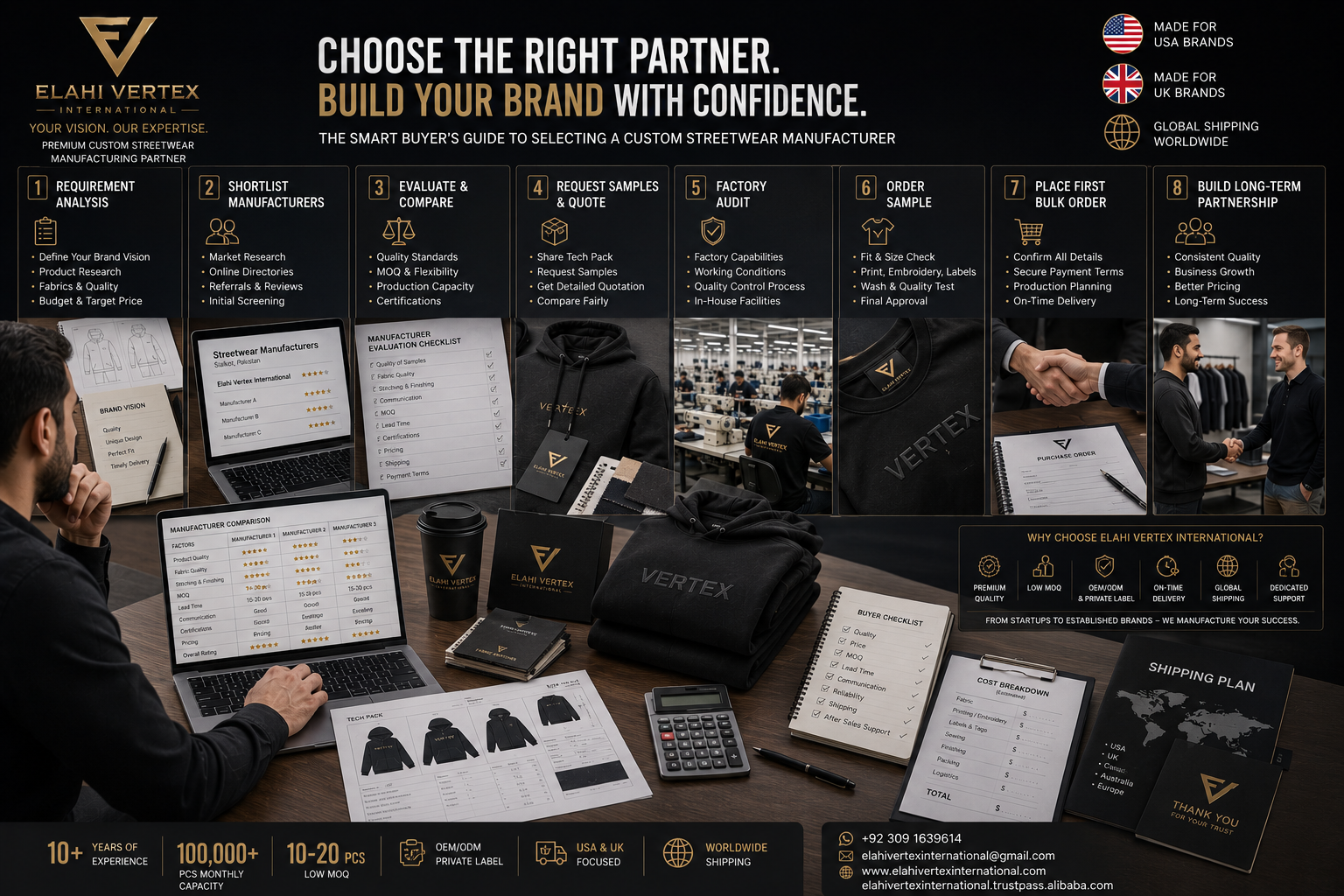
In this guide, we explain 9 critical steps for choosing a reliable custom streetwear manufacturer before your first order.
1. Define Your Product and Manufacturing Requirements
Before contacting manufacturers, clearly define what you want to produce.
A manufacturer cannot provide a meaningful quotation or production plan if the product specification is vague.
Your initial requirements should cover as many of the following details as possible:
- Product type
- Fit
- Fabric
- Fabric weight
- Colors
- Size range
- Measurements
- Artwork
- Printing or embroidery
- Labels
- Trims
- Packaging
- Estimated quantity
- Target market
- Sampling requirements
For example, if you want an oversized hoodie, simply saying “premium oversized hoodie” is not enough.
You should ideally define:
- Body measurements
- Sleeve proportions
- Hood construction
- Fabric requirements
- Cuff specifications
- Artwork placement
- Decoration method
- Branding requirements
- Packaging requirements
The more specific your product brief, the easier it becomes for manufacturers to quote and develop the same product.
Why this matters
One of the biggest mistakes first-time buyers make is contacting manufacturers before deciding what they actually want.
This creates a chain of problems:
Unclear design → unclear quotation → unclear sample → unexpected revisions → production delays
A reliable manufacturer can help clarify technical requirements, but the buyer should still have a clear understanding of the intended product.


2. Check the Manufacturer’s Customization Capabilities
Not every clothing manufacturer is a true custom streetwear manufacturer.
Some suppliers primarily sell standardized products with limited customization.
That may not be suitable if your brand requires a distinctive fit, custom construction, proprietary artwork, private labeling, or specialized finishing.
Before choosing a supplier, ask what types of customization they can support.
Product customization may include:
- Custom patterns
- Custom measurements
- Oversized fits
- Custom colorways
- Fabric selection
- Printing
- Embroidery
- Patches
- Appliqué
- Woven labels
- Printed labels
- Hang tags
- Custom packaging
- Other branding requirements
If your collection includes hoodies, sweatshirts, oversized T-shirts, tracksuits, or jackets, make sure the manufacturer’s capabilities match the products you intend to develop.
Don’t confuse customization with branding
Adding your logo to an existing blank garment is different from developing a custom garment.
For example:
Basic customization:
Existing hoodie + your logo.
Custom manufacturing:
Your own fit + measurements + fabric + artwork + labels + construction + finishing.
If your objective is to build a differentiated streetwear brand, determine which level of customization you actually require before selecting the manufacturer.
3. Review MOQ and Production Requirements
MOQ, or Minimum Order Quantity, is one of the first commercial questions a buyer should clarify.
However, MOQ should not be evaluated in isolation.
A manufacturer may have different production requirements depending on:
- Product type
- Fabric
- Color
- Customization
- Decoration
- Packaging
- Production method
- Order quantity
For example, manufacturing a completely custom jacket may involve different requirements from manufacturing a basic T-shirt.
Questions to ask
Before placing your first order, clarify:
- What MOQ applies to my specific product?
- Does MOQ apply per design?
- Does MOQ apply per color?
- Can sizes be mixed?
- Are sample quantities separate from bulk quantities?
- Are there additional setup requirements?
- Does packaging have separate minimums?
Do not assume that an advertised MOQ automatically applies to every product.
The correct MOQ is the MOQ applicable to your actual production specification.
4. Ask About Sampling and Product Development
A reliable custom streetwear manufacturer should be able to explain how product development works before you commit to bulk production.
Sampling is particularly important for custom garments because photographs, sketches, and technical specifications cannot completely replace a physical product.
A sample allows you to review:
- Fit
- Measurements
- Fabric
- Color
- Construction
- Stitching
- Artwork
- Print quality
- Embroidery
- Labels
- Trims
- Finishing
Ask the manufacturer:
- Can I receive a sample before bulk production?
- How are sample revisions handled?
- How are changes documented?
- What happens after sample approval?
- How is the approved sample used during production?
The objective is to make sure that the sample-development process is clearly defined.
Never treat the first sample as automatically perfect
The first sample is a development stage.
If the chest width is incorrect, the artwork is too large, the fabric feels different from the intended specification, or the hood construction needs modification, those issues should be identified and corrected before bulk production.
Sample approval should establish the production standard.


5. Evaluate Fabric, Construction and Branding Options
A streetwear manufacturer’s ability to produce the garment is only one part of the decision.
You also need to understand how the manufacturer handles materials and finishing.
Two hoodies can have almost identical designs but provide completely different customer experiences because of differences in:
- Fabric weight
- Fiber composition
- Construction
- Hand feel
- Stitching
- Cuffs
- Hood structure
- Finishing
- Decoration
Fabric
Ask about the available fabric specifications rather than simply asking whether the manufacturer can make “premium” products.
Terms such as “high quality” or “premium fabric” are too vague to be useful unless supported by specific requirements.
Branding
For private-label streetwear, consider:
- Neck labels
- Woven labels
- Size labels
- Care labels
- Hang tags
- Packaging
- Other brand-specific components
Decoration
Depending on your design, you may require:
- Printing
- Embroidery
- Patches
- Appliqué
- Other customization methods
The manufacturer should be able to discuss which method is appropriate for your product and artwork.
6. Verify Quality-Control Procedures
Quality control is one of the most important areas to investigate before choosing a manufacturer.
Do not simply ask:
“Do you provide quality control?”
Ask what is actually checked.
A meaningful quality-control process may consider:
- Measurements
- Stitching
- Seams
- Fabric consistency
- Color
- Printing
- Embroidery
- Artwork placement
- Labels
- Trims
- Finishing
- Overall appearance
Ask these questions
How are production specifications communicated to the production team?
How is the approved sample used as a reference?
When are quality checks performed?
What happens when a production issue is identified?
How are defective or non-conforming products handled?
These questions tell you more than a generic statement such as “we have strict quality control.”
Look for consistency, not perfection claims
Be cautious of manufacturers making unrealistic claims such as:
- “Zero defects guaranteed”
- “100% perfect production”
- “Best quality in the world”
Professional manufacturing involves processes designed to control variation.
A better question is:
What process do you use to maintain consistency against the approved specification?
7. Compare Pricing Using the Same Specifications
Price matters, but comparing manufacturers solely by the lowest quotation is one of the easiest ways to make a poor sourcing decision.
A $10 garment and a $12 garment are not necessarily more or less expensive in practical terms if they use different materials or specifications.
When comparing quotations, create a like-for-like comparison.SpecificationManufacturer AManufacturer BManufacturer CProductSameSameSameFabricSame specificationSame specificationSame specificationWeightSameSameSameDecorationSameSameSameLabelsSameSameSamePackagingSameSameSameQuantitySameSameSameSamplingConfirmConfirmConfirmShipping termsConfirmConfirmConfirm
This gives you a much more meaningful comparison.
What can influence custom streetwear manufacturing cost?
- Fabric
- Fabric weight
- Construction
- Product complexity
- Decoration
- Artwork
- Embroidery
- Printing
- Labels
- Trims
- Packaging
- Quantity
- Sampling
- Shipping
A reliable sourcing decision should consider total value, not just the lowest unit price.
8. Check Communication, Lead Times and Shipping
A manufacturer can produce a good garment and still become a poor supplier if communication is unreliable.
This is especially important for international B2B buyers.
Before placing your first order, evaluate:
- Response time
- Clarity of communication
- Ability to understand specifications
- Revision handling
- Sample updates
- Production updates
- Documentation
- Shipping communication
Lead time needs clarification
Do not ask only:
“How long will my order take?”
Break the process into stages:
Sample development → Sample approval → Material preparation → Bulk production → Quality control → Packing → Shipping
Production time and shipping time are not necessarily the same thing.
The actual timeline depends on the product, quantity, specifications, production schedule, approvals, and shipping arrangement.
USA and UK buyers
If your customer base is in the USA or UK, discuss the destination before production begins.
This can help clarify:
- Shipping method
- Documentation
- Packaging
- Labeling
- Import responsibilities
- Delivery arrangements
For U.S. apparel buyers, the Federal Trade Commission provides guidance covering textile labeling and care labeling requirements.
For UK buyers, GOV.UK provides guidance on textile labeling and fibre-content information.
These rules should be checked for the specific product and market rather than assumed to be identical for every garment.
9. Review the Manufacturer Before Placing Your First Bulk Order
The final step is to evaluate the manufacturer as a potential long-term supplier.
Do not make the decision based on a single factor.
Consider the complete picture:
Product Capability
Can the manufacturer produce your specific products?
Customization
Can they handle your required fit, materials, artwork, branding, and finishing?
Sampling
Can you evaluate the physical product before committing to bulk production?
Quality
Is there a clear quality-control process?
Communication
Can they communicate specifications and revisions accurately?
Commercial Terms
Are MOQ, pricing, sampling, packaging, and shipping requirements clear?
Scalability
If your brand grows, can the supplier discuss future production requirements?
Transparency
Are they clear about what they can and cannot provide?
The best manufacturer is not necessarily the largest factory or the cheapest supplier.
For many brands, the better choice is the manufacturer that can consistently meet the specific requirements of the product and business.


USA vs. UK: What Buyers Should Consider
Although the basic supplier-selection process is similar, buyers targeting the USA and UK should consider their destination market when developing products.
USA Buyers
U.S. buyers should pay particular attention to applicable apparel labeling requirements, country-of-origin information, fiber content, care labeling, and other requirements relevant to the product.
The Federal Trade Commission provides official guidance on apparel labeling and care labeling.
UK Buyers
UK buyers should review applicable textile-labeling requirements, including fibre-content information.
GOV.UK provides guidance for textile products sold in the UK.
Important sourcing principle
Do not wait until the garments are finished to discover that your labels or packaging need changes.
Market requirements should be considered during product development.
10 Questions to Ask a Custom Streetwear Manufacturer
Before placing your first order, ask:
- Can you manufacture my exact product specification?
- What MOQ applies to this specific product?
- Can I approve a physical sample before bulk production?
- How are sample revisions handled?
- What fabric specifications can you provide?
- What customization and branding options are available?
- How is quality control performed?
- What information do you need for an accurate quotation?
- What are the production and shipping stages?
- How will the approved sample and specifications be used during bulk production?
If a supplier cannot clearly answer basic questions about your order, that is a reason to investigate further before making a large commitment.
Red Flags When Choosing a Streetwear Manufacturer
Not every warning sign means a manufacturer is unreliable, but several should make a buyer investigate further.
1. Extremely Low Prices Without Clear Specifications
A very low quotation may look attractive until you discover that important components are excluded.
2. No Sample Process
For complex custom products, refusing or avoiding a meaningful sample-development process should raise questions.
3. Vague Answers
Repeatedly responding with “yes, everything is possible” without explaining how can be a warning sign.
4. Unclear MOQ
If the manufacturer cannot explain what the MOQ applies to, clarify it before ordering.
5. No Clear Approval Process
You should know what happens between sample development and bulk production.
6. Poor Communication
If communication is already difficult during quotation and sampling, it may become more difficult during production.
7. Constantly Changing Information
Inconsistent pricing, specifications, or production terms should be clarified before committing.
8. Pressure to Place a Large Order Immediately
A manufacturer should be able to discuss your requirements without relying entirely on high-pressure sales tactics.
How to Compare Custom Streetwear Manufacturers
A practical supplier scorecard can help remove emotion from the decision.FactorWeightProduct capability20%Quality-control process20%Sampling and development15%Communication15%Pricing/value10%MOQ flexibility5%Branding/customization5%Packaging5%Shipping/export support5%
You can adjust the weights according to your business.
For a startup, MOQ and sampling may matter more.
For an established brand, quality consistency and production scalability may matter more.
The important point is to choose using a defined framework instead of choosing the supplier with the cheapest quotation.
What Should a First-Time Streetwear Buyer Prepare?
Before contacting manufacturers, prepare:
Product Information
- Product type
- Product images or sketches
- Intended fit
- Size range
Technical Information
- Measurements
- Fabric requirements
- Artwork
- Decoration requirements
- Labels
- Trims
Commercial Information
- Estimated quantity
- Target market
- Packaging requirements
- Sampling requirements
Questions
Prepare your questions before contacting suppliers.
This makes the conversation more efficient and helps different manufacturers respond to the same requirements.
Why Sample Approval Matters More Than a Supplier’s Promises
A supplier can tell you that it produces high-quality garments.
But the physical sample provides evidence that can actually be evaluated.
A sample allows you to inspect:
- Fit
- Measurements
- Fabric
- Color
- Stitching
- Construction
- Decoration
- Labels
- Finishing
This does not eliminate all production risk, but it gives the buyer a much stronger reference point before bulk manufacturing.
The approved sample should then become part of the production standard.
Should You Choose a Local or Overseas Manufacturer?
There is no universal answer.
A U.S. or UK buyer may consider both domestic and overseas manufacturers depending on the product, budget, quantity, production requirements, and business model.
Local manufacturing may offer:
- Shorter communication distance
- Potentially simpler logistics
- Easier physical visits for some buyers
- Potentially shorter domestic delivery
Overseas manufacturing may offer:
- Different manufacturing capabilities
- Broader sourcing options
- Potentially competitive production costs
- International export experience
The correct comparison is not simply:
USA vs. overseas
It is:
Which supplier can deliver the required specification, quality, quantity, communication, and commercial terms?
For an international sourcing decision, evaluate the complete landed and operational picture rather than focusing only on the factory unit price.
Why Elahi Vertex International Can Be Considered for Custom Streetwear Projects
Elahi Vertex International operates as a B2B manufacturer, exporter, OEM/ODM supplier, and private-label manufacturing partner.
Its custom apparel offering can be relevant to buyers developing products such as:
- Hoodies
- Sweatshirts
- Oversized T-shirts
- Tracksuits
- Jackets
- Sportswear
- Teamwear
- Gymwear
- Other custom apparel
The appropriate manufacturing requirements, MOQ, customization, sampling, packaging, and production details should be discussed according to the specific product and order.
For buyers who want to evaluate a potential supplier, the strongest approach is to provide the product specifications and request a discussion around the actual project rather than making a decision based only on a generic supplier profile.
Visit Elahi Vertex International to review the company’s manufacturing services.
You can also review the company’s Alibaba storefront as another point of reference when evaluating its B2B manufacturing presence.
Final Checklist Before Your First Order
Before committing to a custom streetwear manufacturer, make sure you can answer yes to these questions:
- Do I have a clear product specification?
- Does the manufacturer understand my requirements?
- Is the MOQ clear?
- Is the quotation based on the same specifications I requested?
- Can I review a sample?
- Can I request revisions?
- Is the final specification documented?
- Are branding and labeling requirements clear?
- Is the quality-control process understood?
- Are production and shipping stages clear?
- Are USA or UK market requirements being considered?
- Do I understand the commercial terms?
- Have I compared the manufacturer against realistic alternatives?
If several answers are “no,” you may not be ready to place the first bulk order.
Frequently Asked Questions
What is a custom streetwear manufacturer?
A custom streetwear manufacturer produces garments according to a buyer’s specifications, which can include custom designs, fits, fabrics, colors, artwork, branding, labels, construction, and packaging.
How do I choose a reliable custom streetwear manufacturer?
Evaluate product capability, customization, MOQ, sampling, quality control, communication, pricing, production requirements, shipping, and transparency before placing your first bulk order.
What should I ask a streetwear manufacturer before ordering?
Ask about product capabilities, MOQ, sampling, fabrics, customization, quality control, production stages, packaging, shipping, and how approved specifications are managed during bulk production.
Should I order a sample before bulk production?
For custom garments, reviewing and approving a sample before bulk production is a prudent way to identify product issues before manufacturing the complete order.
What is the difference between a custom manufacturer and a private-label supplier?
A custom manufacturer can develop products according to specific buyer requirements, while private-label manufacturing generally involves producing products that carry the buyer’s brand. The two services can overlap.
How much does custom streetwear manufacturing cost?
There is no universal price. Cost can depend on the garment, fabric, construction, customization, decoration, quantity, labels, packaging, sampling, and shipping requirements.
What MOQ should I expect for custom streetwear?
MOQ varies by manufacturer and product. It can depend on the garment, fabric, colors, customization, materials, and production requirements.
Can a streetwear manufacturer produce hoodies, T-shirts and jackets?
Many apparel manufacturers can produce multiple garment categories, but buyers should verify that the specific manufacturer has the capabilities required for their products.
How long does custom streetwear manufacturing take?
The timeline depends on product complexity, sampling, approvals, materials, quantity, production capacity, quality control, and shipping arrangements. Ask for a project-specific timeline rather than relying on a generic estimate.
Conclusion
Choosing a custom streetwear manufacturer is a sourcing decision, not simply a search for the cheapest clothing supplier.
Before your first order, evaluate the manufacturer across the complete production process:
Requirements → Customization → MOQ → Sampling → Materials → Quality Control → Pricing → Communication → Final Supplier Evaluation
The strongest supplier is the one that can consistently understand and execute your specific requirements.
For USA and UK streetwear brands, private-label businesses, e-commerce companies, and sourcing managers, taking time to evaluate these nine areas before placing a bulk order can help reduce avoidable manufacturing problems and create a stronger foundation for future production.
If you are preparing a custom hoodie, sweatshirt, oversized T-shirt, tracksuit, jacket, or broader streetwear collection, start with a clear specification and compare manufacturers using the same requirements.
Elahi Vertex International can discuss custom streetwear manufacturing, OEM, ODM, and private-label requirements based on your specific project.
Discuss Your Custom Streetwear Project
View Elahi Vertex International on Alibaba
External Resources for USA & UK Buyers
For official market requirements, buyers can consult:
- U.S. Federal Trade Commission — Apparel & Labeling
- U.S. Federal Trade Commission — Care Labeling
- GOV.UK — Textile Labelling
For competitive research, buyers may also compare the services and positioning of other international apparel manufacturers. One relevant example is Minku Apparel, which publicly markets custom apparel and streetwear manufacturing services to international buyers.
Competitive reference: Minku Apparel