

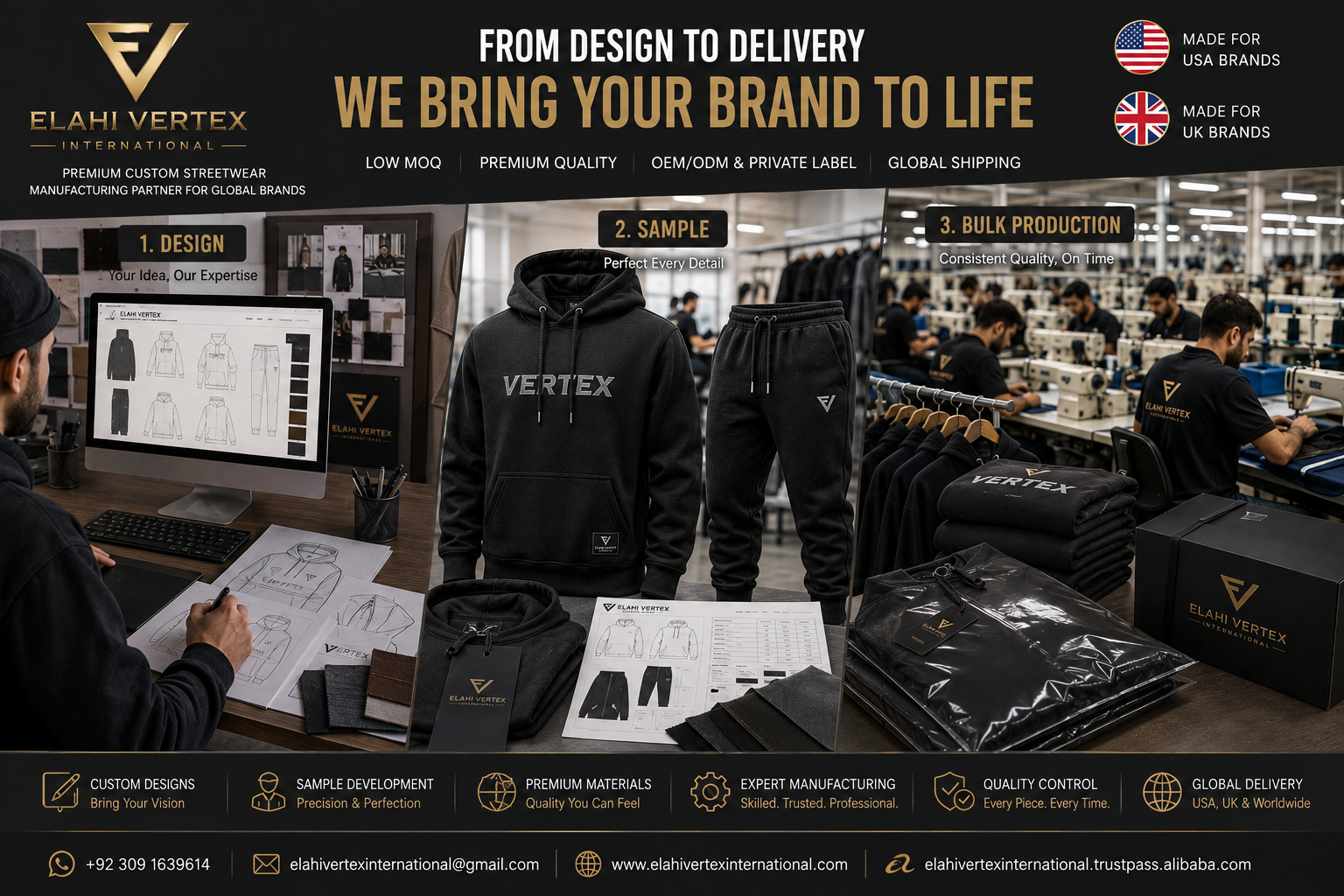
Launching a streetwear collection starts with an idea, but turning that idea into consistent bulk production requires a structured manufacturing process. For clothing brands, private-label businesses, wholesalers, retailers, and e-commerce companies, the journey involves much more than choosing a factory.
A successful custom streetwear manufacturing process connects design, specifications, fabric selection, sampling, revisions, approval, bulk production, quality control, and shipment preparation.
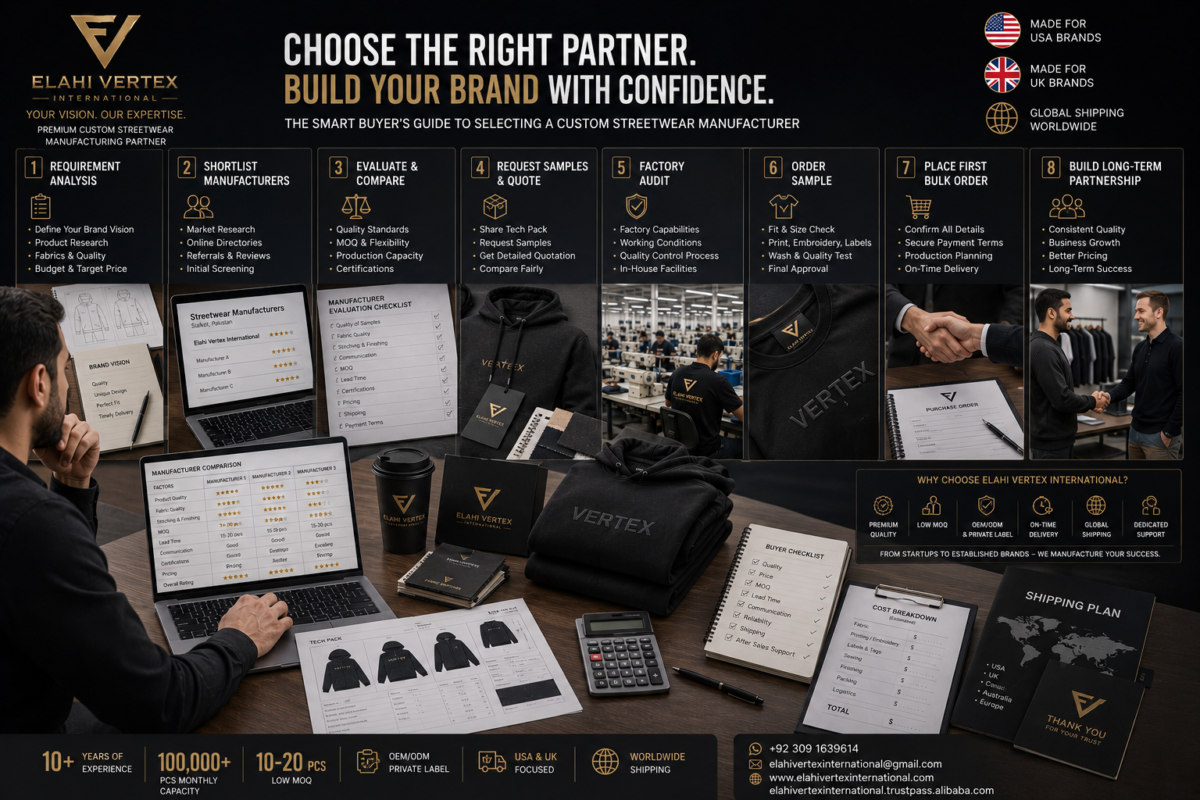
In this guide, we explain the process in 9 practical steps, while highlighting the decisions B2B buyers should make before committing to bulk production.
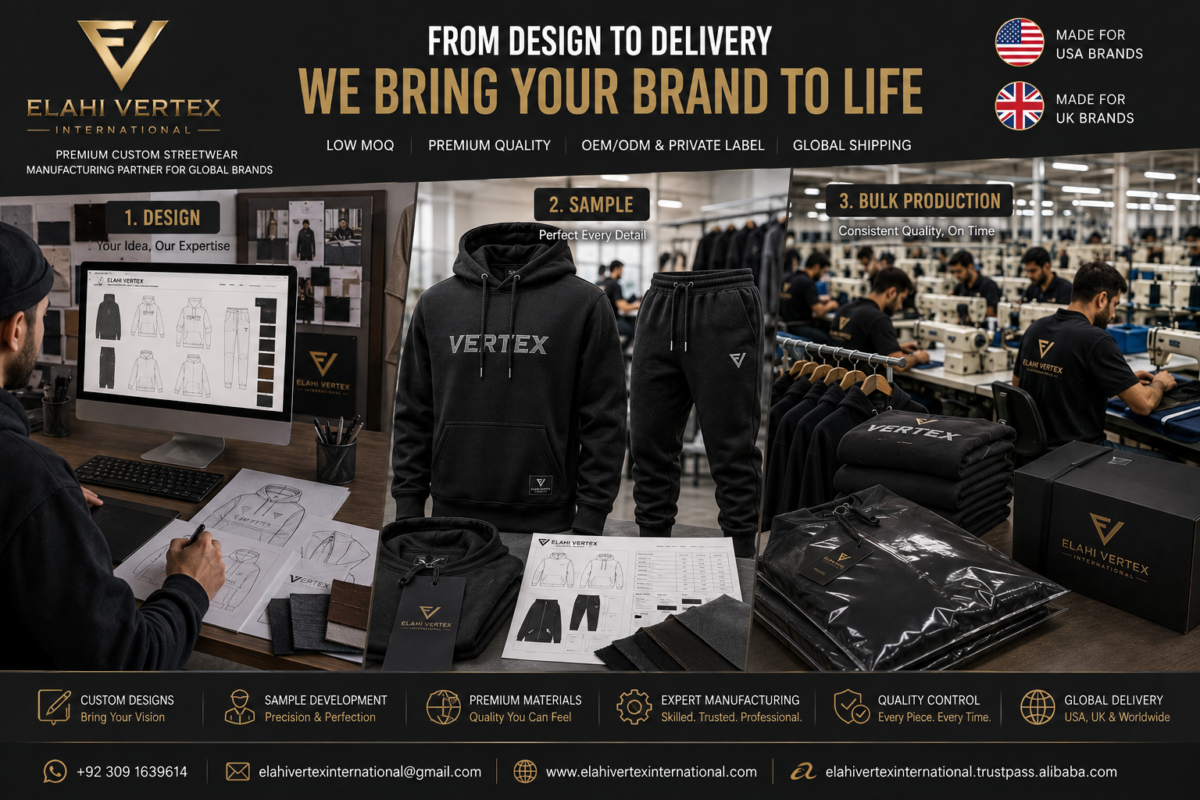
1. Define Your Streetwear Product and Design
The first step is to clearly define the product you want to manufacture.
A manufacturer needs more than a general description such as “premium oversized hoodie.” The product should be described through specific design and production requirements.
Depending on the garment, your initial brief may include:
- Product type
- Fit and silhouette
- Fabric preference
- Fabric weight
- Color
- Size range
- Artwork
- Logo placement
- Printing or embroidery
- Labels
- Trims
- Packaging
- Estimated quantity
- Target market
For example, an oversized hoodie may require specific body proportions, shoulder construction, sleeve dimensions, hood shape, fabric weight, embroidery placement, branded labels, and packaging.
The clearer the initial concept, the easier it becomes to translate the design into production requirements.
Why this step matters
Many manufacturing problems begin before production actually starts.
If measurements, artwork, construction details, or materials are unclear, assumptions can enter the development process. Those assumptions can later affect the sample, cost, fit, or bulk production.
The goal is to remove ambiguity before sampling begins.


2. Prepare the Tech Pack and Production Specifications
Once the product concept is defined, the next step is to convert it into technical information.
A tech pack helps communicate the specifications required to manufacture the garment accurately.
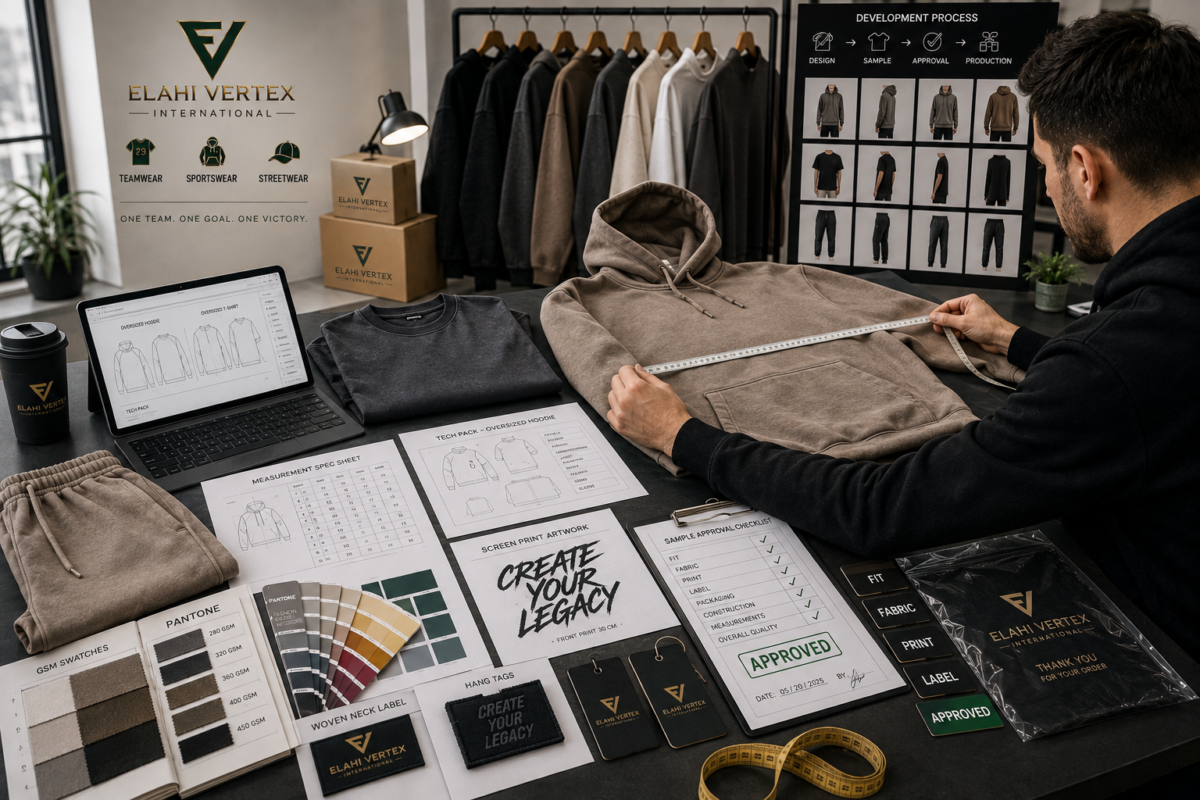
A streetwear tech pack can include:
- Technical drawings
- Garment measurements
- Size chart
- Fabric specifications
- Color references
- Construction details
- Artwork
- Print or embroidery requirements
- Label artwork
- Trim specifications
- Packaging requirements
For example, a hoodie specification could define chest width, body length, sleeve length, hood construction, cuffs, fabric characteristics, artwork dimensions, and artwork placement.
Do you need a tech pack?
A tech pack is extremely useful, especially for complex products.
However, some buyers begin with sketches, reference garments, photographs, artwork, measurements, or written specifications rather than a complete technical package.
Provide everything available and identify what still needs to be clarified.
The important principle is simple:
Do not allow unconfirmed assumptions to become production specifications.
3. Confirm Fabric, Trims and Customization
Streetwear is strongly influenced by material, construction, decoration, and finishing.
Two garments can have a similar design but feel completely different because of differences in fabric, weight, construction, or finishing.
Before sampling, confirm the important components.
Fabric
Depending on the product, discuss:
- Fiber composition
- Fabric construction
- Weight
- Stretch
- Hand feel
- Surface appearance
- Color
- Finishing requirements
Decoration
Custom streetwear may use:
- Screen printing
- Digital printing
- Embroidery
- Patches
- Appliqué
- Other garment-decoration methods
The appropriate method depends on the artwork, garment, fabric, desired appearance, and production requirements.
Branding
Private-label streetwear may also include:
- Woven labels
- Printed labels
- Size labels
- Care labels
- Hang tags
- Branded packaging
These requirements should be discussed before production rather than added at the last minute.
For buyers targeting the USA, textile and apparel labeling requirements should also be considered during product development. The U.S. Federal Trade Commission states that most covered textile and wool products require information such as fiber content, country of origin, and manufacturer or responsible-business identification; care-label rules also apply to covered apparel. (Federal Trade Commission)
For buyers targeting the UK, GOV.UK states that textile products must show fibre content, with additional information required where products contain components with different fibre contents. (GOV.UK)
These requirements should be checked for the specific product and market before finalizing labels.


4. Develop the First Sample
Sampling is where the design becomes a physical garment.
The manufacturer uses the available specifications to develop a sample that the buyer can physically review.
The sample should be evaluated against the agreed requirements rather than simply judged by whether it looks attractive.
Review:
- Overall fit
- Garment measurements
- Fabric
- Color
- Construction
- Stitching
- Artwork placement
- Printing
- Embroidery
- Labels
- Trims
- Finishing
- Overall appearance
The key question is:
Does this sample represent the product we intend to manufacture in bulk?
A sample gives the buyer and manufacturer an opportunity to identify problems before the full production order begins.
5. Review, Test and Revise the Sample
The first sample is not necessarily the final sample.
A systematic review should compare the physical garment with the original specifications.
Fit and Measurements
Compare the garment against the approved measurement chart.
Fabric
Check the fabric’s appearance, hand feel, weight, and suitability.
Construction
Review seams, stitching, panels, cuffs, collars, pockets, and other construction details.
Decoration
Check artwork dimensions, placement, print quality, embroidery, patches, and other branding elements.
Labels and Trims
Confirm that labels, zippers, cords, buttons, patches, and other components meet the specification.
Color
Compare the garment against the agreed color reference.
If changes are necessary, communicate them specifically.
Instead of:
“Make it better.”
Use clear instructions such as:
“Increase the body width according to the revised measurement chart and move the chest artwork according to the updated placement reference.”
Specific feedback reduces interpretation errors and creates a clearer production record.
6. Approve the Production Standard
After revisions are completed, the project reaches one of the most important stages: production approval.
Depending on the project, the final approval package may contain:
- Approved sample
- Final measurement chart
- Final artwork
- Fabric specification
- Color references
- Decoration requirements
- Label artwork
- Packaging requirements
- Size breakdown
- Agreed production requirements
The exact documentation varies by garment.
Why approval matters
Bulk production should reproduce the approved product rather than become another design-development stage.
Version control is also important.
If an artwork file is revised after another version has already been approved, the manufacturer should know exactly which file is final.
For example:
Design_V1 → Design_V2 → Design_APPROVED
The exact naming system does not matter as much as maintaining one clearly identified production version.


7. Start Bulk Production
Once the product specifications have been approved, bulk manufacturing can begin according to the agreed requirements.
The exact production sequence varies by garment, but may include:
- Material preparation
- Pattern preparation
- Cutting
- Decoration
- Sewing and assembly
- Labels and trims
- Finishing
- Inspection
- Packing
The order can change depending on the product and customization requirements.
Sampling vs. bulk production
Sampling is primarily about development and validation.
Bulk production is about repeatability and consistency.
The manufacturer must reproduce the approved product across the complete order quantity.
That is why the production standard established during sampling is so important.
Buyers should also confirm the MOQ for their specific product instead of assuming that one generic minimum applies to every streetwear garment.
8. Conduct Quality Control and Final Finishing
Quality control should not be treated as nothing more than a final visual inspection.
Depending on the project, quality checks may address:
- Measurements
- Stitching
- Construction
- Fabric consistency
- Color
- Printing
- Embroidery
- Artwork placement
- Labels
- Trims
- Finishing
- Overall appearance
Before shipment, finished garments should be reviewed against the approved requirements.
The objective is not simply to find defects.
The objective is to determine whether the finished products consistently match the agreed production standard.


9. Pack and Prepare the Shipment
Manufacturing does not end when garments leave the sewing or finishing stage.
The finished products must also be prepared according to the agreed delivery requirements.
Depending on the project, this can include:
- Folding
- Individual packaging
- Size identification
- Hang tags
- Labels
- Carton packing
- Carton markings
- Packing lists
- Commercial documentation
- Shipping coordination
Packaging should be discussed before production.
Leaving packaging decisions until the final stage can create complications because packaging affects materials, labor, carton configuration, product presentation, and shipping volume.
International buyers should also clarify shipping responsibilities, documentation, customs, duties, and delivery terms before production begins.
Custom Streetwear Manufacturing: The 9 Steps at a Glance
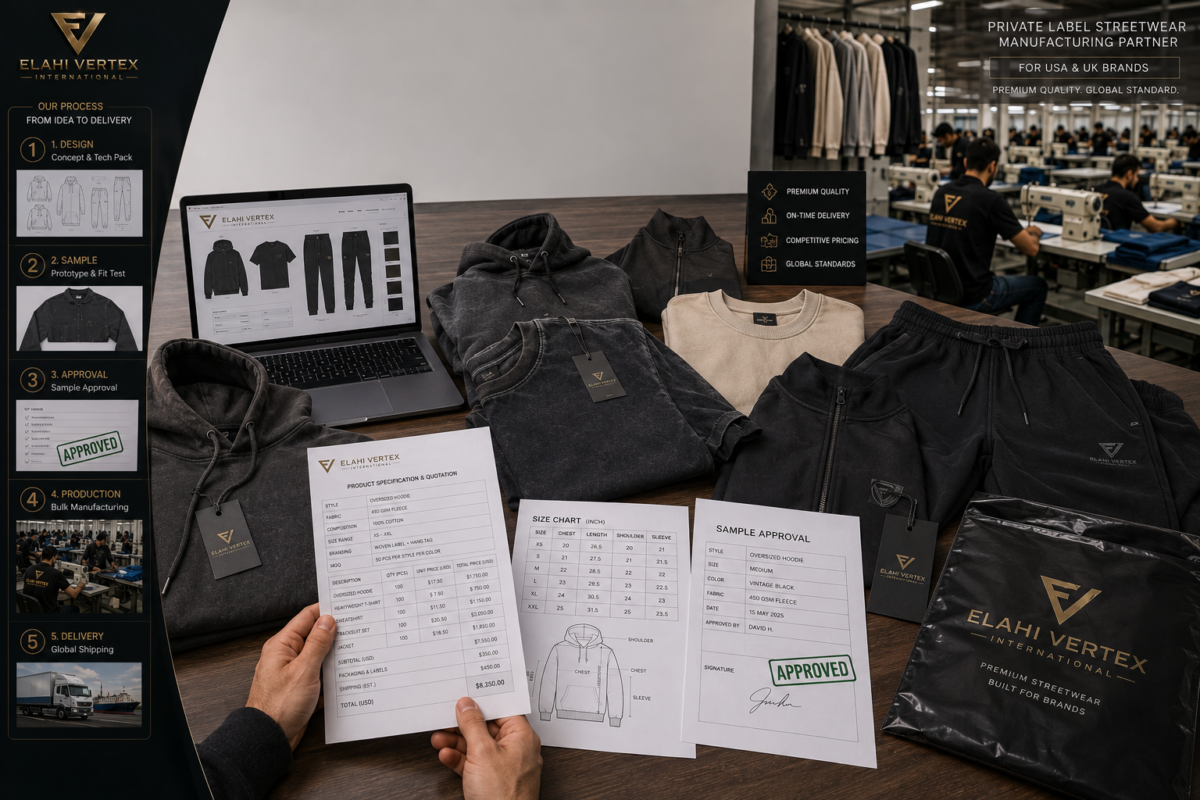
StepMain Objective1. DesignDefine the product2. SpecificationsCommunicate production requirements3. MaterialsConfirm fabric, trims and customization4. SampleCreate the physical product5. RevisionCorrect issues before bulk6. ApprovalEstablish the production standard7. Bulk ProductionReproduce the approved product8. Quality ControlCheck consistency and workmanship9. Shipment PreparationComplete packing and delivery preparation
What Should You Send to a Custom Streetwear Manufacturer?
A manufacturer can evaluate a project more effectively when the buyer provides organized information.
A useful initial package may include:
- Product type
- Design or sketches
- Tech pack, if available
- Measurement chart
- Fabric requirements
- Color references
- Artwork
- Decoration requirements
- Label requirements
- Size breakdown
- Estimated quantity
- Packaging requirements
- Destination country
- Sample requirements
For example:
Product: Oversized hoodie
Quantity: Required quantity
Fabric: Required specification
Color: Approved reference
Decoration: Print/embroidery/etc.
Labels: Brand requirements
Packaging: Required arrangement
Destination: Target country
Sample: Required before bulk production
The manufacturer can then identify which specifications are confirmed and which require further discussion.
What Affects the Cost of Custom Streetwear Manufacturing?
There is no universal price for custom streetwear.
A quotation can be influenced by:
- Garment type
- Fabric
- Fabric weight
- Construction complexity
- Decoration method
- Artwork complexity
- Embroidery
- Printing
- Washes and finishing
- Labels
- Trims
- Packaging
- Order quantity
- Size range
- Sampling
- Shipping arrangements
This is why comparing manufacturers purely by unit price can be misleading.
Two suppliers may quote different prices because they are quoting different specifications.
A better approach is to compare like-for-like products.
Before choosing a supplier, confirm that quotations cover comparable:
- Fabric
- Construction
- Decoration
- Labels
- Packaging
- Quantity
- Commercial terms
Common Custom Streetwear Manufacturing Mistakes
Choosing a Manufacturer Only Because the Price Is Lower
A lower quotation does not automatically represent better value.
The specification behind the price matters.
Starting Bulk Production Without Proper Sample Approval
This moves product-development risk directly into the bulk order.
Sending Unclear Artwork
Poorly prepared or ambiguous artwork can lead to incorrect interpretation.
Changing the Specification After Approval
Late changes can affect production planning, materials, cost, and timelines.
Ignoring Measurements
A garment can have the correct design but still have an incorrect fit.
Treating Labels as an Afterthought
Branding and labeling should be considered during development.
Comparing Different Specifications
A cheaper garment is not necessarily cheaper if its fabric, construction, decoration, and packaging are different.
Assuming One MOQ Applies to Every Product
MOQ can depend on the manufacturer, product, materials, customization, and production requirements.
Leaving Packaging Until the End
Packaging should be discussed as part of the overall production plan.
Failing to Document Final Changes
If several versions of artwork or specifications exist, clearly identify which version is approved for production.
How to Choose the Right Custom Streetwear Manufacturer
Selecting a manufacturer should involve more than comparing quotations.
Consider:
Product Development
Can the manufacturer understand your design and production requirements?
Sampling
Can you review the physical product before bulk production?
Communication
Are specifications, revisions, and approvals clearly documented?
Customization
Can the required branding and customization be discussed?
Quality Control
Is there a clear approach to checking the finished product?
MOQ
What MOQ applies to your specific product?
Production
Can the manufacturer explain the production requirements for your order?
Packaging
Can your packaging requirements be incorporated into the project?
Export
Are shipping and documentation responsibilities clearly understood?
A strong supplier relationship is based on clear specifications, communication, consistency, and commercial transparency, not simply the lowest initial price.
Custom Streetwear Manufacturing for USA and UK Buyers
For brands selling in the USA or UK, manufacturing decisions should account for the destination market from the beginning.
This is particularly important for labeling.
For covered textile products in the United States, the FTC states that most textile and wool products require information including fiber content, country of origin, and manufacturer or responsible-business identification. The FTC also maintains specific care-labeling requirements for covered apparel. (Federal Trade Commission)
For the UK, GOV.UK guidance states that textile labels must show fibre content, and products containing components with different fibre contents require the relevant contents to be shown. (GOV.UK)
This does not mean that every streetwear product has identical requirements. Buyers should verify the rules applicable to their exact product, composition, destination, and selling arrangement before finalizing labels.
Frequently Asked Questions
What is custom streetwear manufacturing?
Custom streetwear manufacturing is the process of producing streetwear according to a buyer’s specifications, including design, fit, fabric, colors, artwork, construction, branding, labels, and packaging.
Can I manufacture streetwear from my own design?
Yes. A custom streetwear project can be developed from a buyer’s design, artwork, technical specifications, reference garment, or combination of these materials.
Do I need a tech pack for streetwear manufacturing?
A tech pack is highly useful because it communicates measurements, materials, construction, artwork, and other production requirements clearly.
Should I approve a sample before bulk production?
For custom products, approving a sample before bulk production is an important way to review the physical product and identify issues before producing the complete order.
What affects custom streetwear manufacturing cost?
Fabric, garment construction, customization, decoration, quantity, labels, packaging, sampling, and shipping arrangements can all affect the quotation.
What does MOQ mean?
MOQ means Minimum Order Quantity. The applicable MOQ can vary according to the manufacturer, product, materials, customization, and production requirements.
What should I check in a streetwear sample?
Check measurements, fit, fabric, color, construction, artwork, decoration, labels, trims, and finishing against the agreed specifications.
Can streetwear be private label?
Yes. Private-label streetwear can include brand-specific labels, tags, packaging, and other branding elements depending on the manufacturing arrangement.
How do I compare streetwear manufacturers?
Compare manufacturers using equivalent specifications. Consider sampling, communication, customization, quality control, MOQ, production requirements, packaging, and shipping—not just unit price.
Can I change the design after approving the sample?
Changes may be possible, but they should be discussed before implementation. Changes after approval can affect materials, production planning, cost, and delivery timing.
Conclusion
Custom streetwear manufacturing is a controlled process rather than a single production step.
The journey starts with a clear design and continues through:
Design → Specifications → Materials → Sample → Revision → Approval → Bulk Production → Quality Control → Shipment
The most important principle is simple:
Do not allow bulk production to become the stage where the product is still being figured out.
A clear specification, carefully reviewed sample, documented approval, and appropriate quality-control process can reduce avoidable manufacturing problems and create a stronger foundation for repeat orders.
If you are developing a custom streetwear collection, prepare your design, artwork, measurements, material requirements, quantity, branding requirements, and destination information before approaching a manufacturing partner.
Elahi Vertex International can discuss custom streetwear manufacturing, OEM, ODM, and private-label requirements based on your specific project specifications.
Request Your Custom Streetwear Quote
Elahi Vertex International
Website: Elahi Vertex International
WhatsApp: Chat with Elahi Vertex International on WhatsApp
Email: elahivertexinternational@gmail.com
Alibaba: Elahi Vertex International Alibaba Store
Relevant External Reference
For USA and UK buyers, the following official sources are useful when preparing apparel labels:
Competitor reference
For buyer research and competitive context, Minku Apparel is a relevant Pakistan-based custom streetwear manufacturer publicly targeting brands in the USA, UK and Europe and promoting private-label, sampling and custom streetwear production. (minkuapparel.com)
Minku Apparel — Custom Streetwear Manufacturer
This competitor link is included as reference/competitive research, not as an endorsement.



One thought on “Custom Streetwear Manufacturing: From Design & Sample to Bulk Production in 9 Steps”