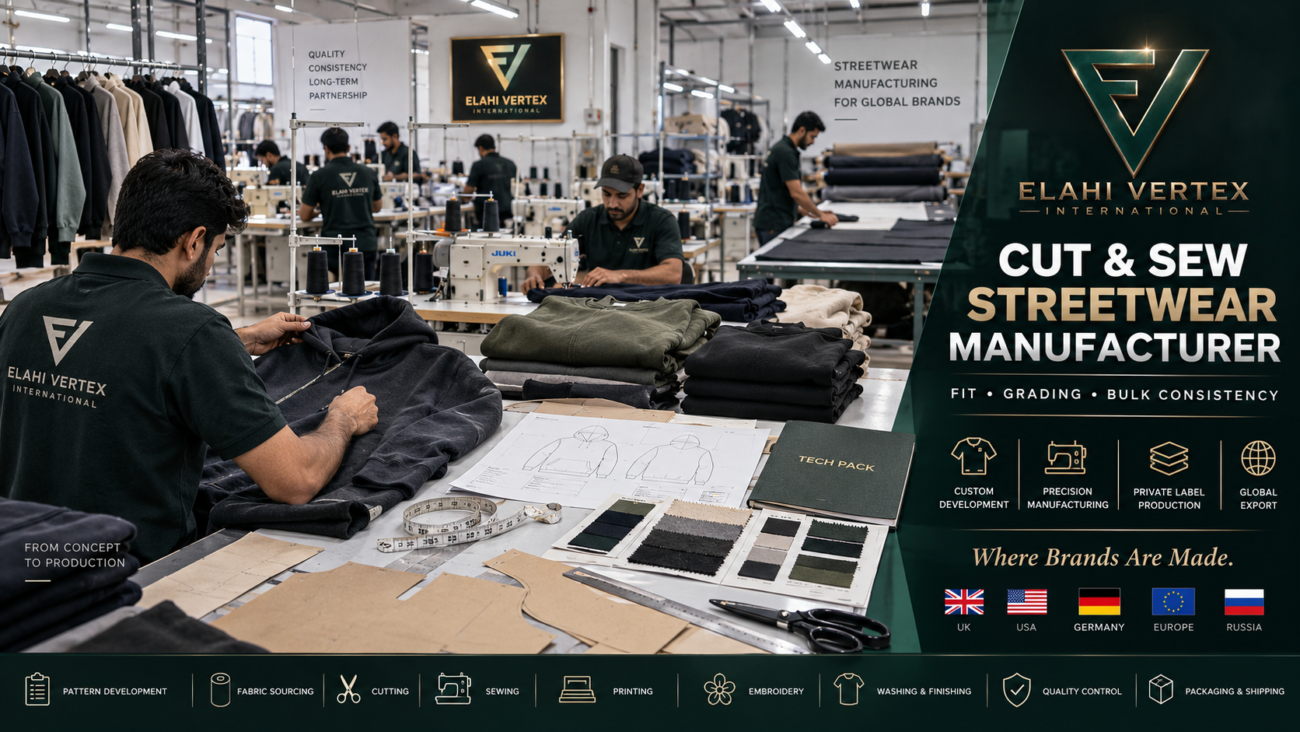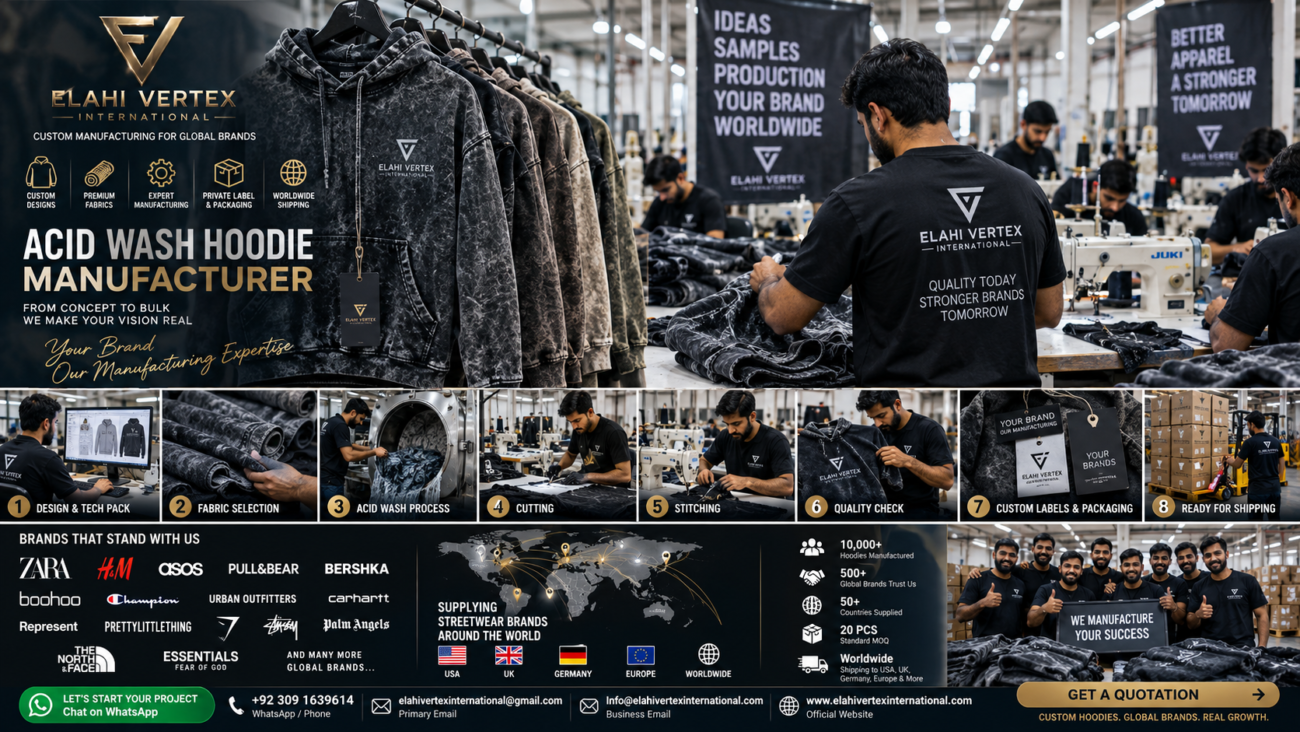

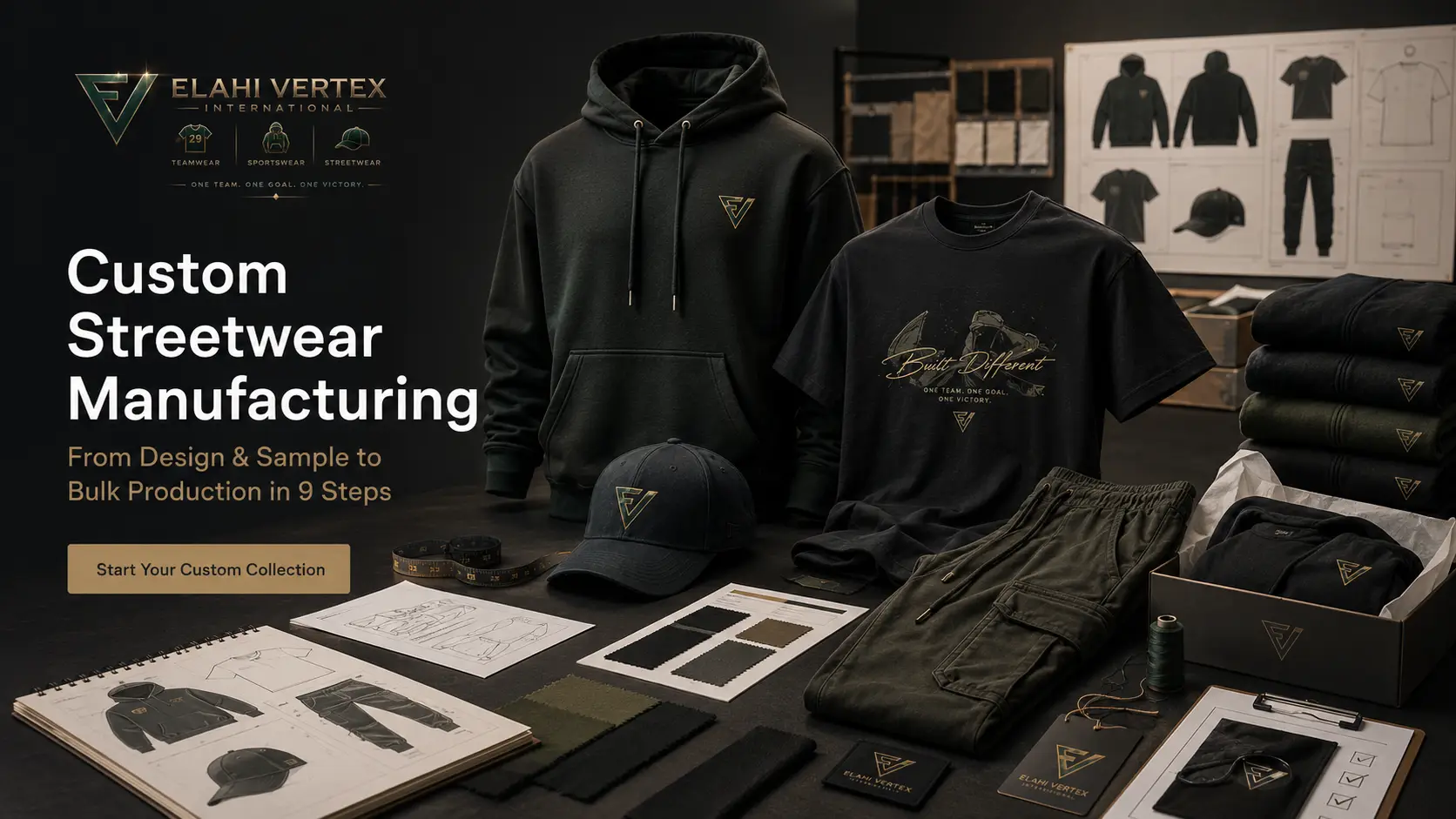
Launching a streetwear collection is easy to imagine and much harder to manufacture consistently. A sketch may look excellent on screen, but the real test comes when that design has to become a correctly fitted sample, approved production specification, repeatable bulk order, and finished garment that matches the approved standard.
For brands, wholesalers, retailers, e-commerce businesses, and private-label buyers, custom streetwear manufacturing is therefore more than finding a factory. The process involves design clarification, specifications, fabric and trim decisions, pattern development, sampling, revisions, approval, production planning, quality control, and shipment preparation.
This guide breaks the process into 9 practical steps, from the first design brief to bulk production. It also explains what buyers should prepare, what manufacturers need from them, where production problems usually occur, and how to reduce costly mistakes before approving a bulk order.
Table of Contents
- What Is Custom Streetwear Manufacturing?
- Step 1: Define the Streetwear Product and Design
- Step 2: Prepare the Tech Pack and Production Specifications
- Step 3: Confirm Fabric, Trims and Customization
- Step 4: Develop the First Sample
- Step 5: Review, Test and Revise the Sample
- Step 6: Approve the Production Standard
- Step 7: Prepare and Start Bulk Production
- Step 8: Conduct Quality Control and Final Finishing
- Step 9: Pack, Document and Prepare the Shipment
- Custom Streetwear Manufacturing: What Buyers Should Confirm
- Common Buyer Mistakes
- FAQ
- Why Work With Elahi Vertex International?
- Conclusion
What Is Custom Streetwear Manufacturing?
Custom streetwear manufacturing is the process of developing and producing apparel according to a brand’s specifications rather than simply purchasing standard ready-made garments.
Depending on the project, customization can involve:
- Garment silhouette and fit
- Fabric selection
- Fabric weight
- Colors
- Patterns
- Printing
- Embroidery
- Patches and appliqués
- Washes and finishing
- Zippers and other trims
- Woven or printed labels
- Hang tags
- Packaging
- Size specifications
- Branding placement
For a B2B buyer, the objective is not simply to manufacture one attractive sample. The objective is to establish a repeatable production specification that can be followed when producing a larger quantity.
That distinction is critical.
A good sample that cannot be reproduced consistently is not a successful manufacturing outcome.
Step 1: Define the Streetwear Product and Design
The process begins with a clear product concept.
Before contacting a manufacturer, determine exactly what you want to produce. “I want a premium streetwear hoodie” is not enough information for accurate manufacturing.
A stronger brief could identify:
- Product type
- Intended fit
- Target customer
- Approximate size range
- Fabric preference
- Colorway
- Artwork
- Logo placement
- Decoration method
- Label requirements
- Packaging requirements
- Target order quantity
- Destination market
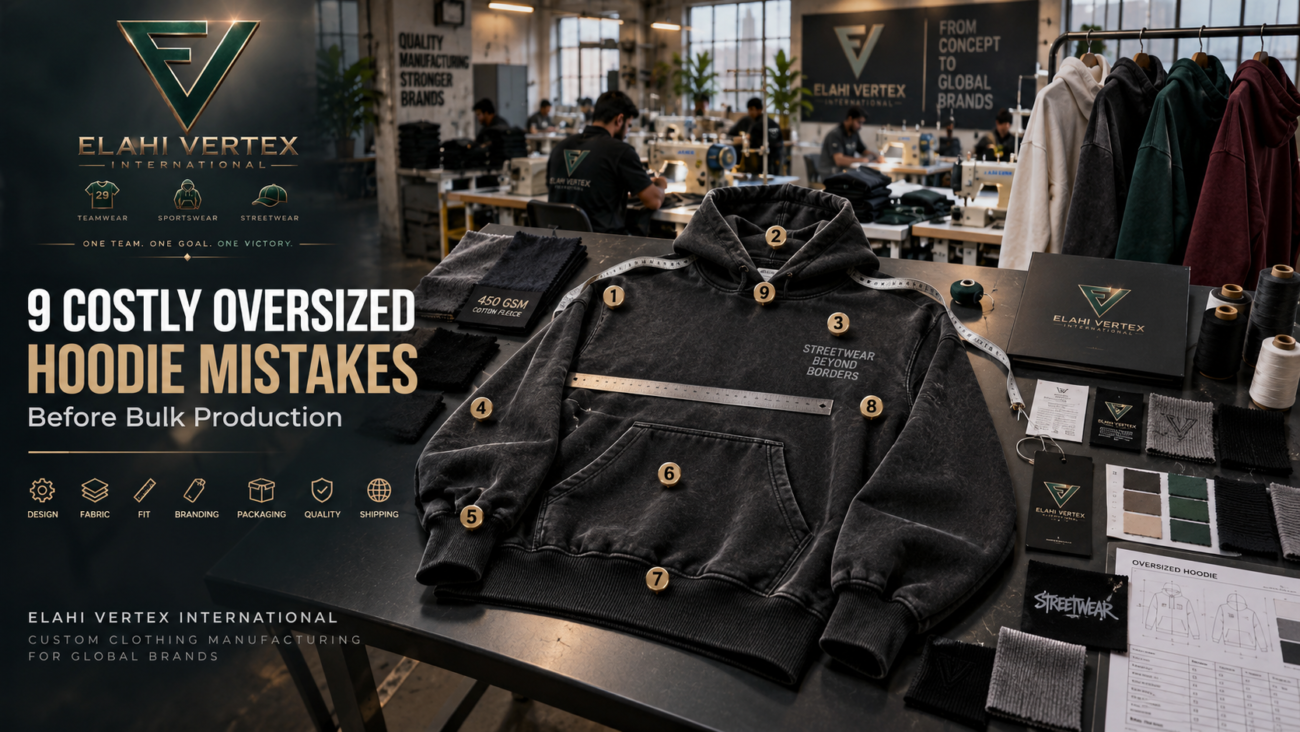
For example, a streetwear brand may want an oversized hoodie with a particular shoulder construction, custom artwork, embroidery, branded neck labeling, and a specific fabric hand feel.
Those details need to be translated into production information.
Design files buyers can provide
Depending on the project, a manufacturer may work from:
- Technical drawings
- Tech packs
- CAD files
- Artwork files
- Reference photographs
- Existing garments
- Measurement charts
- Brand guidelines
- Written specifications
If you do not have a complete tech pack, communicate that early. The manufacturer can then clarify what information is available and what still needs to be developed or confirmed.
Why this step matters
Many manufacturing problems begin before production begins.
If the design itself is ambiguous, later disagreements about fit, proportions, decoration placement, or construction become more likely.
Buyer tip: Define the product before discussing the final production quantity. Quantity does not compensate for an unclear specification.
Step 2: Prepare the Tech Pack and Production Specifications
Once the concept is clear, convert it into a production specification.
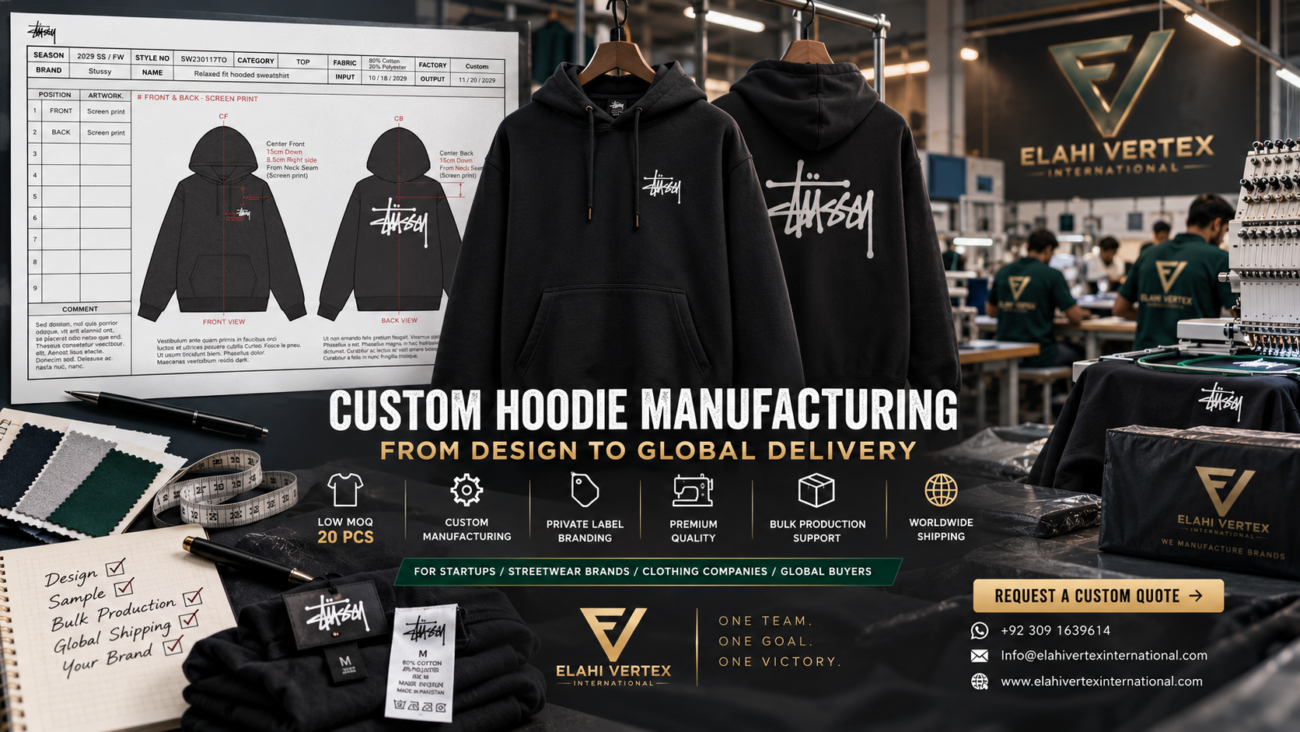
A tech pack acts as a communication bridge between the brand and manufacturer. It helps transform creative direction into measurable production requirements.
A useful streetwear tech pack may include:
| SpecificationExample Information | |
|---|---|
| Product | Hoodie, T-shirt, jacket, cargo pants |
| Fit | Oversized, relaxed, regular, cropped |
| Measurements | Body and garment measurements |
| Fabric | Composition and required characteristics |
| Color | Color references or approved swatches |
| Artwork | Print/embroidery files |
| Decoration | Method and placement |
| Labels | Neck, size, care and other labels |
| Trims | Zippers, cords, buttons, patches |
| Construction | Stitching and seam requirements |
| Packaging | Folding, bags, tags, cartons |
| Size range | Required production sizes |
The exact information required depends on the product.
For complex garments, measurement charts and construction details become particularly important because visual references alone may not communicate every production requirement.
What if you do not have a complete tech pack?
Do not create specifications by guessing.
Instead, send the manufacturer everything you have and ask which details require clarification. The project may then move through a specification-development stage before sampling.
That approach is safer than allowing assumptions to enter production.
Step 3: Confirm Fabric, Trims and Customization
Streetwear is heavily influenced by material, fit, construction and finishing.
Two hoodies can have the same basic design but feel completely different because of differences in fabric, construction and finishing.
Before sampling, confirm the major material and customization requirements.
Fabric
Depending on the product, buyers may need to discuss:
- Fiber composition
- Fabric construction
- Weight
- Stretch
- Hand feel
- Surface appearance
- Color
- Shrinkage considerations
- Wash or finishing requirements
Do not assume that a fabric specification used by one manufacturer will automatically be identical at another factory.
Decoration
Streetwear collections may use:
- Screen printing
- Digital printing
- Embroidery
- Patches
- Appliqué
- Other garment-decoration techniques
The appropriate method depends on the artwork, garment, material, desired appearance and production requirements.
Branding
Private-label streetwear can also involve:
- Woven labels
- Printed labels
- Size labels
- Care labels
- Hang tags
- Branded packaging
For buyers selling into regulated markets, labeling requirements need to be checked against the destination country’s current rules.
For example, the U.S. Federal Trade Commission states that most covered textile and wool products require information including fiber content, country of origin, and manufacturer/marketer identification. Care instructions are also subject to U.S. requirements for covered apparel.
This is why labeling should be treated as part of product development rather than something added at the last minute.
Step 4: Develop the First Sample
Sampling is where the design moves from concept into a physical garment.
A manufacturer can use the approved design information, measurements, material requirements and decoration specifications to develop a sample for buyer review.
The first sample should be evaluated against the agreed requirements.
Look at:
- Overall fit
- Garment measurements
- Fabric appearance
- Fabric hand feel
- Construction
- Stitching
- Artwork placement
- Print quality
- Embroidery
- Labels
- Trims
- Color
- Finishing
- Overall appearance
Do not judge the sample only by whether it “looks good.”
The better question is:
Does this sample accurately represent the product we intend to manufacture in bulk?
That changes the review from subjective approval to production control.
Why sampling matters
A sample gives both parties an opportunity to identify discrepancies before committing to bulk manufacturing.
A production sample can also become an important reference point for subsequent quality checks, provided the approved specifications and sample are properly documented.
Step 5: Review, Test and Revise the Sample
The first sample should not automatically be treated as the final version.
Review it systematically.
Sample review checklist
- Check measurements against the size specification
- Check fit and proportions
- Review fabric appearance and hand feel
- Check seams and construction
- Check artwork dimensions
- Check artwork placement
- Review embroidery or printing
- Check labels and branding
- Review trims
- Check color against the approved reference
- Review finishing
- Record required changes clearly
If changes are required, communicate them in a structured manner.
Instead of saying:
“Make the hoodie better.”
Provide specific feedback such as:
“Increase the body width at the specified measurement, move the chest artwork according to the revised placement reference, and use the approved label artwork.”
Specific feedback reduces interpretation.
Do not approve a sample casually
Sample approval should mean that the buyer has reviewed the critical specifications and is satisfied that the sample represents the intended production standard.
Once bulk production begins, changing the approved specifications can create additional costs, delays or production complications.
Step 6: Approve the Production Standard
After revisions, the project reaches one of its most important control points: production approval.
At this stage, confirm the information that will govern bulk manufacturing.
A practical approval package can include:
- Approved sample
- Final measurement chart
- Final artwork
- Fabric specification
- Color references
- Decoration requirements
- Label artwork
- Packaging requirements
- Size breakdown
- Agreed commercial terms
The exact documents depend on the project.
The golden rule
Do not allow multiple versions of the specification to circulate without clear version control.
If the buyer sends a revised artwork file after approving another version, the manufacturer needs to know which file is final.
A simple naming system can help:
- ProductName_V1
- ProductName_V2
- ProductName_FINAL
- ProductName_APPROVED
The precise system is up to the buyer and manufacturer. What matters is clarity.
Step 7: Prepare and Start Bulk Production
Once the production standard is approved, bulk manufacturing can begin according to the confirmed project requirements.
The exact factory workflow varies by product and manufacturer, but bulk production commonly involves activities such as:
- Material preparation
- Pattern preparation and grading
- Fabric cutting
- Decoration
- Sewing and assembly
- Trims and labels
- Finishing
- Inspection
- Packing
The sequence can vary depending on the construction and decoration method.
Why bulk production is different from sampling
Sampling focuses on developing and validating the product.
Bulk production focuses on repeatability and consistency.
The manufacturer now has to reproduce the approved design across the complete order quantity.
That makes production control especially important.
Quantity is not the only consideration
Buyers should not assume that a larger order automatically guarantees better results.
Production complexity can depend on:
- Product construction
- Number of sizes
- Number of colors
- Decoration requirements
- Material requirements
- Number of components
- Packaging requirements
- Order quantity
- Production planning
MOQ and production requirements should therefore be confirmed for the specific product and project rather than assumed from a generic industry figure.
Step 8: Conduct Quality Control and Final Finishing
Quality control should not be treated as a final visual check only.
The appropriate inspection approach depends on the product, buyer requirements and manufacturing arrangement.
Potential quality checkpoints include:
During production
Check relevant issues such as:
- Construction consistency
- Stitching
- Dimensions
- Decoration
- Material consistency
- Color
- Component placement
During finishing
Check:
- Loose threads
- Pressing
- Labels
- Trims
- Appearance
- Garment cleanliness
- Packaging preparation
Before shipment
Review the finished goods against the approved specifications and agreed requirements.
For B2B buyers, the objective is not simply to identify defects. It is to establish whether the finished production corresponds with what was approved.
Step 9: Pack, Document and Prepare the Shipment
The final manufacturing stage is not complete when the garments leave the sewing or finishing area.
They must also be prepared for delivery according to the agreed requirements.
Depending on the project, this can involve:
- Folding
- Individual polybagging
- Size identification
- Hang tags
- Carton packing
- Carton markings
- Packing lists
- Commercial documentation
- Shipping coordination
The exact packaging and shipping arrangement should be confirmed before production.
Do not leave packaging until the end
Packaging requirements can affect:
- Materials
- Labor
- Carton configuration
- Product presentation
- Shipping volume
- Documentation
For international B2B orders, buyers should also confirm responsibilities for freight, customs, duties, documentation and delivery terms rather than assuming the manufacturer handles everything.
Requirements vary by destination and commercial arrangement.
Custom Streetwear Manufacturing: The 9-Step Process at a Glance
| StepMain ObjectiveBuyer Priority | ||
| 1 | Define the design | Establish the product clearly |
| 2 | Prepare specifications | Remove ambiguity |
| 3 | Confirm materials and customization | Lock critical inputs |
| 4 | Develop sample | Turn concept into physical product |
| 5 | Review and revise | Correct issues before bulk |
| 6 | Approve production standard | Establish the manufacturing reference |
| 7 | Start bulk production | Reproduce the approved specification |
| 8 | Quality control | Verify consistency and workmanship |
| 9 | Pack and prepare shipment | Complete the order for delivery |
This is a practical framework rather than a universal mandatory factory sequence. Different manufacturers and product types may combine or reorder certain operations.
What Should a B2B Buyer Send to a Streetwear Manufacturer?
The stronger your initial information, the easier it is for a manufacturer to understand the project.
A useful RFQ package may include:
- Product category
- Sketches or reference images
- Tech pack, if available
- Measurement chart
- Fabric requirements
- Color references
- Artwork
- Decoration requirements
- Branding requirements
- Size breakdown
- Estimated quantity
- Packaging requirements
- Target destination
- Desired sample requirements
- Any specific quality requirements
A simple RFQ structure
Product: Custom oversized hoodie
Quantity: [Insert quantity]
Fabric: [Insert specification]
Color: [Insert reference]
Decoration: [Insert method]
Labels: [Insert requirements]
Packaging: [Insert requirements]
Destination: [Country]
Sample: Required before bulk
Attachments: Tech pack + artwork + measurements
The manufacturer can then identify what is clear and what needs further discussion.
Custom Streetwear Manufacturing: What Actually Determines Cost?
There is no single universal price for custom streetwear.
Cost can be affected by:
- Garment type
- Fabric selection
- Fabric quantity
- Construction complexity
- Number of components
- Decoration method
- Artwork complexity
- Embroidery requirements
- Washes or finishing
- Labels
- Packaging
- Order quantity
- Size range
- Sampling requirements
- Shipping arrangement
- Destination
This is why a buyer should be cautious about comparing manufacturers using only a headline unit price.
A lower quotation may reflect a different fabric, construction method, decoration specification, packaging arrangement or commercial term.
Compare like-for-like specifications before deciding which quotation is actually cheaper.
Common Buyer Mistakes in Custom Streetwear Manufacturing
1. Choosing a manufacturer based only on price
A low quotation is not automatically a low total cost.
If the sample, material or construction does not meet expectations, the buyer may face revisions, delays or rejected goods.
2. Starting bulk production before approving a proper sample
This transfers product-development risk into the bulk order.
3. Sending unclear artwork
Low-resolution or ambiguous artwork can create interpretation problems.
4. Changing specifications after approval
Late changes can disrupt material purchasing, production planning and existing work.
5. Ignoring measurements
A garment can have the right design but the wrong fit.
6. Treating labels as an afterthought
Labeling requirements should be considered during product development, particularly for international markets.
For U.S. sales, for example, FTC guidance covers fiber content, country-of-origin and responsible-company identification requirements for covered textile products.
7. Assuming the sample automatically defines every production detail
A sample is valuable, but the production specification should also clearly document the requirements.
8. Comparing quotations without comparing specifications
Two apparently similar products may not actually be equivalent.
9. Not clarifying shipping responsibilities
Confirm the commercial arrangement and responsibilities before production begins.
10. Ordering before the specifications are final
This is one of the easiest ways to create avoidable production problems.
How to Compare Custom Streetwear Manufacturers
When evaluating suppliers, consider more than price.
| Evaluation AreaQuestions to Ask | |
| Product development | Can the manufacturer understand your specifications? |
| Sampling | Can you review a sample before bulk? |
| Communication | Are specifications and revisions clearly documented? |
| Customization | Can the required construction and branding be discussed? |
| Quality | What inspection process applies to your order? |
| MOQ | What MOQ applies to your specific product? |
| Production | What production timeline applies to your project? |
| Packaging | Can packaging requirements be specified? |
| Export | What shipping/documentation responsibilities apply? |
| Commercial terms | Are quotation terms clearly defined? |
The strongest supplier is not necessarily the supplier with the lowest quoted unit price.
For a private-label streetwear brand, consistency and communication can be commercially more important than a small difference in the initial quotation.
Why Elahi Vertex International for Custom Streetwear Manufacturing?
Elahi Vertex International is positioned as a B2B manufacturer, exporter, OEM supplier, ODM supplier, custom manufacturing partner and private-label manufacturing partner. The company’s business model is focused on custom B2B manufacturing rather than consumer retail.
For streetwear projects, the relevant service relationship can include the broader workflow of product development, customization, private labeling and bulk manufacturing, subject to the requirements of the individual project.
The important point for a buyer is simple: provide the manufacturer with a clear product brief, specifications, artwork, quantity and destination requirements so the project can be evaluated accurately.
If you are preparing a custom streetwear project, you can send the available specifications and artwork to Elahi Vertex International for discussion.
WhatsApp: +92 309 1639614
Email: elahivertexinternational@gmail.com
Website: Official Website
Alibaba: Elahi Vertex International on Alibaba
Frequently Asked Questions
What is custom streetwear manufacturing?
Custom streetwear manufacturing means producing streetwear according to a buyer’s specifications, such as fit, fabric, color, artwork, construction, branding, labels and packaging.
Can I manufacture streetwear from my own design?
Yes, a custom manufacturing project can be based on your own design, artwork, technical specifications, reference garment or other production information. The exact development process depends on what information is provided.
Do I need a tech pack?
A tech pack is highly useful because it communicates measurements, materials, construction and customization requirements. If you do not have one, discuss what information is available before development begins.
Should I approve a sample before bulk production?
For custom products, sample approval is a strong production-control practice because it allows the buyer to review the physical product before committing to bulk manufacturing.
What types of streetwear can be customized?
Depending on the manufacturer’s capabilities and project requirements, custom streetwear may include hoodies, sweatshirts, T-shirts, jackets, joggers, cargo garments, shorts and other apparel categories.
What affects custom streetwear manufacturing cost?
Product construction, fabric, decoration, order quantity, customization, packaging, sampling and shipping arrangements can all affect the final quotation.
What is MOQ in streetwear manufacturing?
MOQ means minimum order quantity. The applicable MOQ can vary according to the manufacturer, product, materials, customization and production requirements, so it should be confirmed for the specific project.
How important is the sample?
Very important. The sample provides an opportunity to assess fit, construction, material, artwork, decoration and overall appearance before bulk production.
Can streetwear be private label?
Private-label streetwear can include brand-specific labels, tags and packaging, subject to the manufacturer’s available services and the requirements of the project.
What should I check before approving a streetwear sample?
Check measurements, fit, fabric, color, construction, decoration, artwork placement, labels, trims and finishing against the agreed specification.
How should I compare two streetwear manufacturers?
Compare manufacturers using equivalent specifications rather than unit price alone. Review sampling, communication, quality procedures, MOQ, customization, production arrangements, packaging and shipping responsibilities.
Are U.S. labeling requirements relevant to imported streetwear?
They can be. Covered textile products sold in the United States may be subject to FTC requirements concerning fiber content, country of origin, responsible-company identification and care instructions. Buyers should verify the requirements applicable to their exact products and sales arrangement.
Can production specifications change after sample approval?
Changes may be possible, but they should be discussed before implementation. Late changes can affect materials, production planning, cost and timelines.
Conclusion
Successful custom streetwear manufacturing is not simply a matter of sending a design to a factory and waiting for finished garments.
The strongest process is controlled from the beginning:
Design → Specifications → Materials → Sample → Revision → Approval → Bulk Production → Quality Control → Shipment
Each stage reduces a different type of manufacturing risk.
For B2B buyers, the biggest advantage is clarity. A clear product specification, properly reviewed sample and documented production standard give both buyer and manufacturer a much stronger reference for bulk production.
If you are developing a custom streetwear collection, prepare your design files, measurements, artwork, material requirements, quantity and destination information before requesting a quotation.